
Showing 35 items matching "outer space"
-
 Moorabbin Air Museum
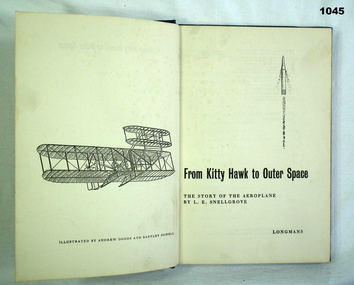
Book - Aviation history, From Kitty Hawk to Outer Space The Story of the Aeroplane
... From Kitty Hawk to Outer Space The Story of the Aeroplane......Outer space...Aviation history Kitty Hawk The first "birdmen" The great air race Aeroplanes go to war Two aerial knights Wings over the Atlantic The Schneider Trophy races Sky Queens The Battle of Britain Dam busting Jets The modern airport Whirlybirds/eggbeaters & choppers Outer space Overview of pioneers of flight , circa 1960 From Kitty Hawk to Outer Space The Story of the Aeroplane Book Aviation history ...Overview of pioneers of flight , circa 1960non-fictionOverview of pioneers of flight , circa 1960kitty hawk, the first "birdmen", the great air race, aeroplanes go to war, two aerial knights, wings over the atlantic, the schneider trophy races, sky queens, the battle of britain, dam busting, jets, the modern airport, whirlybirds/eggbeaters & choppers, outer space -
 Bendigo Military Museum
Book, From Kitty Hawk to Outer Space, 1960
... From Kitty Hawk to Outer Space....Pages 122 From Kitty Hawk to Outer Space. Book BOOK ...Dark blue hard cover. Title printed on spine./ Author - L.E. SNELLGROVE. Pages 122Stamp on first page "Air Cadet Corps City of Bendigo Squadron"books, military history, story of air travel -
 Eltham District Historical Society Inc
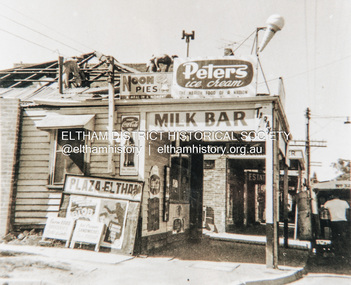
Photograph, Formerly Burges Blue Gum Cafe being demolished, cnr Pryor Street and Main Road, Eltham, Sep. 1960
... I married a monster from outer space (film 1958)...A new two story brick building was erected on site approximately 1961 for Mr Millet - visible in 1962 aerial photos Film poster is advertising The Blob (1958) and "I married a monster from outer space" (1958) which both appear to have been screened in Australia in 1960 and 1961 1922 Originally opened in October 1922 by Miss Barber, it was known as the Blue Gum Soda Fountain. ...A new two story brick building was erected on site approximately 1961 for Mr Millet - visible in 1962 aerial photos Film poster is advertising The Blob (1958) and "I married a monster from outer space" (1958) which both appear to have been screened in Australia in 1960 and 1961 1922 Originally opened in October 1922 by Miss Barber, it was known as the Blue Gum Soda Fountain. ...Formerly Burges Blue Gum Cafe being demolished, cnr Pryor Street and Main Road, Eltham, Sept. 1960. A new two story brick building was erected on site approximately 1961 for Mr Millet - visible in 1962 aerial photos Film poster is advertising The Blob (1958) and "I married a monster from outer space" (1958) which both appear to have been screened in Australia in 1960 and 1961 1922 Originally opened in October 1922 by Miss Barber, it was known as the Blue Gum Soda Fountain. It was named after a prominent Bluegum which stood on the property. 1928 It was taken over by W. Jim Burges in 1928 and by 1929 was known as the Blue Gum Café but also as the Blue Gum Tea Rooms from around August 1931. 1935 In August 1935 Jim Burges sold the Blue Gum Café to Mr and Mrs L.H. Herring of Kallista. The Herrings maintained the name Blue Gum Café 1938 In July 1938 the Herrings sold the business as the Eltham Confectionary And Soda Fountain to Misses Robinson and Pringle effective from August 1st. 1939 In April 1939, Misses Robinson and Pringle sold the Eltham Confectionary And Soda Fountain to Mr Herbert Eugene Borner and Miss Edith Florance Borner, (brother and older sister), formerly of Yarra Glen and it became known as H.E. Borner’s Shop. It is not known when the Borners sold the shop. Both were recorded there in the 1949 Electoral Roll. However, it is noted that Herbert Borner of Blackburn, late of Eltham, died as a result of an accident in August 1952. Sister Edith married railway employee John Stephens in in 1962. She died December 1978. So it is most likely they sold it possibly sometime between 1950 and 1951. 1950 The ownership between 1950 and 1954 is unknown but at some time during that period, the business was acquired by John Henry Millett and his wife, Esther. In 1949 they are listed in Footscray North and are recorded in the 1954 Electoral Roll as shopkeeper, Main Road, Eltham. It is possible they purchased it from the Borners between 1950 and 1951. It was advertised in the 1955 Easter Gymkhana Program as The Blue Gum, J. Millet, Proprietor. c. Aug. 1960 OLD LANDMARK GOES EDHS_05531 ELTHAM’S GROWTH HAS BEEN RAPID IN RECENT YEARS Possibly Diamond Valley News c.August 1960 Perhaps the most famous landmark in Eltham's' business section disappeared last Wednesday when the towering blue gum in Pryor Street at the rear of Main Road shops was felled. The tree, stated to be more than 80 feet high, was the one for which the adjoining café was named, when that business was Eltham’s only provision store, long before the turn of the century. Mr. J. Millett, who now owns the property on which the tree stood, deeply regretted its removal, but was mindful of the need for expansion in the business area. The "Old Blue Gum" was removed by Mr. A. Wilson, expert tree feller, from Heidelberg. Its proportions might be assessed by these facts – it took a gang of experienced men two days to completely fell and clear the tree, and, falling sections being brought down by cable tipped electricity wires on the opposite side of Pryor Street. Sep. 1960 The original store was demolished in September 1960 to make way for a new two-story brick building which became known as Millett’s Foodland. Aerial imagery shows that this was erected by 1962. 1968-1985 The name Blue Gum did not disappear but was reincarnated a few doors up some years later as the Blue Gum Milk Bar at 1006 Main Road (present-day Vyve Beauty & Wellness building on the northern side of Pryor Street one premises up from Westpac bank) “As a lifelong resident of the Diamond Valley, Ian Chesser (Chess) is a well-known face within the local community due to his involvement with numerous sporting clubs, and for being the “kid from the Blue Gum Milk Bar” many years ago” “From the time he was a child, Ian would assist his parents Graeme and Shirley at the Blue Gum Milk Bar working behind the counter.” "Ian Chesser - Barry Plant - Eltham." realcommercial.com.au https://www.realcommercial.com.au/agent/ian-chesser-1704490 Accessed 18 Nov. 2025. - Research by Peter Pidgeon, EDHS, May 2026Colour photograph copy of originalColour photograph copy of original. Possibly donated by Peter Bassett-Smith, noted as Sept 19601960, blue gum milk bar (eltham), butcher, coca cola, eltham shopping centre, eltham shops, estate agency, fire, four n twenty, i married a monster from outer space (film 1958), main road eltham, milk bar, noon pies, peters ice cream, pryor street, staffs general store, summer, the blob (film 1958), eltham, shops, blue gum café, blue gum milk bar, blue gum soda fountain -
Clunes Museum
Card - CLUNES GIRL GUIDES
... INVITE FROM 1ST CARISBROOK BROWNIE GUIDES FOR OUTER SPACE REVELS 17/3/90 . THE INVITATION IS IN AN ENVELOPE .5 WHITE PLASTIC BAG WITH YELLOW AND BLUE EMBLEM OF GIRL GUIDES AUSTRALIA AND GUIDE SHOP PRINTED ON BOTTOM IN BLUE...INVITE FROM 1ST CARISBROOK BROWNIE GUIDES FOR OUTER SPACE REVELS 17/3/90 . THE INVITATION IS IN AN ENVELOPE .5 WHITE PLASTIC BAG WITH YELLOW AND BLUE EMBLEM OF GIRL GUIDES AUSTRALIA AND GUIDE SHOP PRINTED ON BOTTOM IN BLUE Card CLUNES GIRL GUIDES ....1 HANDWRITTEN BLUE INVITATION CARD TO MISS STEART FOR CLUNES DIVISION GUIDE RALLY AT AVOCA RACECOURSE 23/3/86 .2 PRINTED INVITATION FRFROM GOVERNOR AND LADY BROOKS TO ENID STEART TO A GARDEN PARTY AT GOVERMENT HOUSE 11/3/1960. THE INVITATION IS IN AN ENVELOPE .3 INVITATION FOR ENID STEART TO A GARDEN PARTY TO MEET PRINCESS ALEXANDRA OF KENT AND THE GOVERNOR OF VICTORIA AND LADY BROOKS ON 19/9/1959 (WEATHER PERMITTING) INVITATION IS IN AN ENVELOPE .4 HAND DRAWN INVITATION ON YELLOW PAPER WITH A ROCKET. INVITE FROM 1ST CARISBROOK BROWNIE GUIDES FOR OUTER SPACE REVELS 17/3/90 . THE INVITATION IS IN AN ENVELOPE .5 WHITE PLASTIC BAG WITH YELLOW AND BLUE EMBLEM OF GIRL GUIDES AUSTRALIA AND GUIDE SHOP PRINTED ON BOTTOM IN BLUE.3 IN INK UNDER (WEATHER PERMITTING) "DID NOT"enid steart, clunes girl guides, governor and lady brooks, princess alexandra of kent -
 Bendigo Military Museum
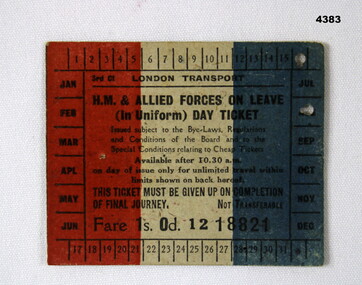
Souvenir - RAILWAY TICKET, Bell Punch Coy LTD, C. WW2
... Rectangular card ticket with black type on both sides, front has a red stripe on left and blue on the right, around the outer edges are date spaces which can be clipped to indicate the day used, back has details of train/bus and tram services available for use....Souvenir leave pass transport ticket Clipped holes 0n “16” and “Aug” Rectangular card ticket with black type on both sides, front has a red stripe on left and blue on the right, around the outer edges are date spaces which can be clipped to indicate the day used, back has details of train/bus and tram services available for use. ...H.M and Allied Forces on leave (in uniform) day ticket issued to service personnel for use in London during WW2, ticket used on 16th August, year not known. Part of the Frederick Gardner Davey DFC RAAF collection.Refer Cat No 3536P.Rectangular card ticket with black type on both sides, front has a red stripe on left and blue on the right, around the outer edges are date spaces which can be clipped to indicate the day used, back has details of train/bus and tram services available for use.Clipped holes 0n “16” and “Aug”souvenir, leave pass, transport ticket -
 The Beechworth Burke Museum
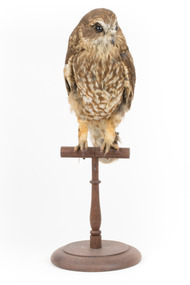
Animal specimen - Southern Boobook, Trustees of the Australian Museum, 1860-1880
... outer ring in their eyes around a large black pupil. This specimen is part of a collection of almost 200 animal specimens that were originally acquired as skins from various institutions across Australia, including the Australian Museum in Sydney and the National Museum of Victoria (known as Museums Victoria since 1983), as well as individuals such as amateur anthropologist Reynell Eveleigh Johns between 1860-1880. These skins were then mounted by members of the Burke Museum Committee and put-on display in the formal space...outer ring in their eyes around a large black pupil. This specimen is part of a collection of almost 200 animal specimens that were originally acquired as skins from various institutions across Australia, including the Australian Museum in Sydney and the National Museum of Victoria (known as Museums Victoria since 1983), as well as individuals such as amateur anthropologist Reynell Eveleigh Johns between 1860-1880. These skins were then mounted by members of the Burke Museum Committee and put-on display in the formal space ...Known for its distinctive ‘boo-book’ sound which gives it its name, the Southern Boobook owl inhabits a variety of environments, including woodland, rural, open desert and dense forest. It is found on mainland Australia as well as Tasmania and other costal islands. Some similar species can be located in New Zealand, New Guinea and Indonesia. Young Boobooks’ plumage is mostly off white, and there are slight variations in subspecies based on location - the Cape York rainforest owls are a larger, darker brown bird while the Tasmanian Boobooks are smaller and often have more white flecks on their plumage. Southern Boobooks hunt and eat nocturnally and, like most owls, their diet consists of smaller animals including smaller mammals and insects. While elements of this particular specimen are representative of the actual bird, the form and structuring of this specimen’s neck area appears to be somewhat out of shape in comparison to images of the actual bird, which present a distinct head structure. The eyes on this specimen are also problematic, as they are solely black - not aligning with accurate representations of this species that have a distinct golden yellow outer ring in their eyes around a large black pupil. This specimen is part of a collection of almost 200 animal specimens that were originally acquired as skins from various institutions across Australia, including the Australian Museum in Sydney and the National Museum of Victoria (known as Museums Victoria since 1983), as well as individuals such as amateur anthropologist Reynell Eveleigh Johns between 1860-1880. These skins were then mounted by members of the Burke Museum Committee and put-on display in the formal space of the Museum’s original exhibition hall where they continue to be on display. This display of taxidermy mounts initially served to instruct visitors to the Burke Museum of the natural world around them, today it serves as an insight into the collecting habits of the 19th century.This specimen is part of a significant and rare taxidermy mount collection in the Burke Museum. This collection is scientifically and culturally important for reminding us of how science continues to shape our understanding of the modern world. They demonstrate a capacity to hold evidence of how Australia’s fauna history existed in the past and are potentially important for future environmental research. This collection continues to be on display in the Museum and has become a key part to interpreting the collecting habits of the 19th century.One of the most commonly found Australian species of owl, the Southern Boobook is also Australia’s smallest owl. With a coating of dark chocolate brown coloured plumage on its wings, dorsal area, continuing onto the top of the head and around its eyes, the owl’s breast plumage is flecked with hazelnut brown and white feathers. Its chin and nose areas are a soft creamy white, and the owl’s beak is a darker grey. Traditionally, the eyes are yellow as are the legs and taloned feet. This particular specimen stands upon a wooden perch and an identifying tag hangs from its right leg.Swing-tag appears to read: '39. Boobook Owl / Catalogue page 53.' The 2 digit number at the beginning of the label could also be '3a'. taxidermy mount, taxidermy, animalia, burke museum, beechworth, australian museum, skin, reynell eveleigh johns, bird, southern boobook, mopoke, australia, boobook, nocturnal, ninox novaeseelandiae, owl -
 Flagstaff Hill Maritime Museum and Village
Gun Emplacement, 1890's
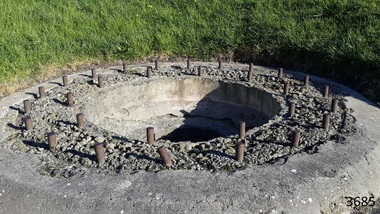
... outer of 20. The base once held a 5 inch Armstrong rifled breech loading gun with hydro-pneumatic disappearing. In the centre of the ring on the ground is a keyhole shaped space. ...outer of 20. The base once held a 5 inch Armstrong rifled breech loading gun with hydro-pneumatic disappearing. In the centre of the ring on the ground is a keyhole shaped space. ...The Warrnambool Battery on Flagstaff Hill has embankments for 3 guns. Those on the left and right still have cannon in place but in the centre is an empty embankment, apart from this concrete ring with metal threaded studs. In 1898 a 5 inch breech loading gun (BL) was installed here. The gun had a hydro-pneumatic disappearing carriage (hence the sign on the concrete wall "5" BL HP").. This type of gun was faster to load and fire that the 80 pound RML’s installed on either side of it. Its arrival spelt the end of the 80 pound RML guns’ useful life, although they continued to be used for practice sessions. The 5 inch BL was the main defensive weapon of the Warrnambool Battery until the Battery was downgraded in importance. It was removed in 1904 and recalled to Melbourne in 1910. The gun emplacement ring is all that remains of the mounting for a 5 inch Armstrong rifled breech loading gun. HISTOR of the WARRNAMBOOL GUNS & CANNON In the years following the Crimean War (1854-1857J) there was a great concern in the Colony that Imperial Russia would attempt an invasion. Coastal defences in the colony of Victoria were greatly strengthened by the Government as a result. Warrnambool was originally protected by cannons at Cannon Hill, approximately 1 kilometer west of the Flagstaff Hill Fortifications. The cannons included two 1866 guns, both 80 Pound Rifled Muzzle Loaders (RML) purchased by Victoria’s Colonial Government. They were part of a shipment of 26 such guns sent from England in December 1866. They are registered as No. 23 (80cwt-2qr-0lbs) - Gun 1, and No.13 (81cwt-1qr-12lbs) - Gun 2. They were cast at the Royal Gun Factory, Woolwich Arsenal, in 1866 and have a 6.3 inch bore. Both barrels carry the Royal Cypher of Queen Victoria, Insignia of the Royal Engineers, within the Garter and Motto surmounted by the Crown, with the Royal Cypher of Queen Victoria within the Garter (letters in centre “VR”, motto “HONI SOIT QUI MAL Y PENSE”, "Shame be to him who thinks evil of it."). The guns were originally supplied with wooden carriages. (The Royal Arsenal at Woolwich, England, was established eleven years after the Restoration of King Charles II. It was the principal supplier of armaments to the British and Empire Governments. At the height of its operations during World War One the factory covered 1300 acres and employed very nearly 80,000 workers. Woolwich was the Headquarters of the Royal Artillery since the raising of that Regiment in 1716. The Arsenal was closed in the late 1960’s.) These two 80pdr cannons were transferred to the Warrnambool Garrison Artillery Battery Fortifications erected at Flagstaff Hill in 1887 as part of Victoria’s Coastal Defences. The original wooden carriages were subsequently replaced with the present iron garrison carriages in 1888. They are a “C” pivot. The ‘racers’ or curved track set into the floor of the gun emplacement (which enabled the guns to be traversed more quickly) are as specified for guns up to 10 inch, being of wrought iron 2.78 inches wide. A temporary third gun, now no longer on Flagstaff Hill’s site, was the 5 inch Rifled Breech Loading (BL) Armstrong gun mounted on an Elswick hydro pneumatic disappearing carriage and installed in this very concrete base or pad. The State of Victoria took over the ownership of the guns at the time of Australian Federation in 1901. In about 1901/1902 the Garrison Battery was converted to the Warrnambool Battery of the Australian Field Artillery (No 4 Field Battery). It was equipped with 4.7 inch naval guns mounted on field carriages. They were now a mobile unit but continued to use the Warrnambool Garrison area at Flagstaff Hill for practice. When the Fortifications were declared obsolete the two 80 Pounder RML were relocated to Cannon Hill in 1910. On the outbreak of World War One the 4.7 inch guns were recalled to Melbourne, and the Battery was disbanded. Most of the personnel probably re-enlisted in the local 4th Australian Light Horse Regiment. The two 80 Pounder RML were moved back to the Fortifications in 1973. They were both fully restored by Army First Year Apprentices at the Ordinance Factory in Bendigo in time for the centenary year of the fortifications in 1987. The guns are capable of firing 80 pound (32.3kg) armour piercing exploding shells 3.65kms out to sea. They were originally manned by volunteers before a paid Garrison was established. Now the Guns are again fired by volunteers on Special Event days. Since restoration the Gun Number 1 had been fired on a regular basis but Gun Number 2 hadn’t been fired since the mid 1990’s. In April 2015 Gun Number 2 was serviced in preparation for the firing of both cannons on the ANZAC Centenary commemorations on April 25th 2015. Other guns from the original Cannon Hill location were obsolete by the time the 1887 Warrnambool Garrison Artillery Battery was built. These guns are (1) a 32 Pounder Muzzle Loading Smooth Bore (SB) cast in 1813 at the famous Carron Foundry, number 80837 and now located in the Warrnambool Botanic Gardens. It is now mounted on a replica carriage due to the original carriage being in a fragile condition (the original carriage stored under cover at Flagstaff Hill). (2) a 68 Pounder Muzzle Loading Smooth Bore cast in 1861 at the equally august Low Moor Foundry, number 10310 and now located on the lawn area at the entrance to Flagstaff Hill Maritime Village. It is still mounted on its original wooden garrison carriage. Its wooden slide compressor mechanism is fragile and now kept in Flagstaff Hill’s storage. There are only seven 32 Pounder SB made by Carron and fifteen 68 Pounder SB made at Low Moor known to exist in the State of Victoria [references; Flagstaff Hill Maritime Village interpretation boards, information sheets and other documents; South Western Victoria Guns and Cannon report, May 2008, ref W/F/08] The Gun embankment is contained within the heritage listed Lady Bay Lighthouse Comples, on the Victorian Heritage Register VHR H1520. The gun emplacement base is evidence of the last defences installed on this stretch of coastline. The Warrnambool Garrison has been added to the Victorian Heritage Register H1250 “for its intact battery and guns, a strong reminder of Victoria’s wealth and determination to protect itself from the perceived threat of invasion in the 1880’s.” The City of Warrnambool is one of several custodians of a collection of artillery pieces of heritage significance at a state, national and international level. These pieces are directly related to the defence of south-west Victoria in the 19th century. The care and preservation come under the Heritage Act 1995. Gun emplacement; the remains of the mounting platform of a temporary third gun installed in 1898 in the centre of the battery. This consists of a circular concrete well or sump surrounded by two rings of mounting bolts, the inner of 10 and the outer of 20. The base once held a 5 inch Armstrong rifled breech loading gun with hydro-pneumatic disappearing. In the centre of the ring on the ground is a keyhole shaped space. The gun was removed in 1904. flagstaff hill, warrnambool, shipwrecked coast, flagstaff hill maritime museum, maritime museum, shipwreck coast, flagstaff hill maritime village, great ocean road, colonial defences, victoria’s coastal defences, warrnambool fortification, warrnambool garrison battery, warrnambool volunteer corps, ordinance, armaments, cannon hill fortifications, flagstaff hill fortifications, 4th australian light horse regiment, garrison gun, 5 inch breech loading gun, emplacement for hydro-pneumatic disappearing carriage, gun emplacement -
 Orbost & District Historical Society
car wheel rim splitter, 1920's
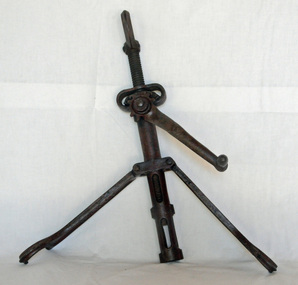
... outer rims of older vehicles to facilitate removal and replacement of tires. The tool was used to remove a tyre and replace it onto a split wheel rim. After the air was let out, the safety rim key was pulled. The swing arms were spread out and the three arms evenly spaced...outer rims of older vehicles to facilitate removal and replacement of tires. The tool was used to remove a tyre and replace it onto a split wheel rim. After the air was let out, the safety rim key was pulled. The swing arms were spread out and the three arms evenly spaced ...A rim splitter was used on the outer rims of older vehicles to facilitate removal and replacement of tires. The tool was used to remove a tyre and replace it onto a split wheel rim. After the air was let out, the safety rim key was pulled. The swing arms were spread out and the three arms evenly spaced around the rim. The single arm with the screw gear needed to be close to the split so that the hooks fit on the rim and the rim was then pulled inward and the tyre could be be removed from the rim. After the tire was repaired or a new one was ready to be put on the collapsed rim the tool was used to push the rim back together and the safety key could be reinserted. A rim splitter were a universal type tool used for many cars of the 1920's and 1930's.A cast iron rim splitter which has two hinged side arms with hooked ends. The middle shaft has a hooked end and an inner bolt that can be screwed up or down.St Joseph Michigan Hercules Product Co Made in U.S.A. L 7motoring rim-splitter tyres tool -
 Greensborough Historical Society
Memorabilia - Newspaper Clipping, The Herald, $118m. for Ringwood road loop, 18/07/1978
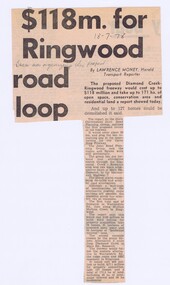
... space, conservation area and residential land a report showed today. Bruce Morgan was the first Shire Secretary (1964-1983) of the Shire of Diamond Valley. This collection was compiled by his wife, Mavis Morgan, detailing the events they attended in their official capacity bruce morgan mavis morgan shire of diamond valley Outer Ring Freeway Handwritten on clipping: "Bruce Morgan was organising this proposal" News clipping in black text $118m. for Ringwood road loop Memorabilia Newspaper Clipping The Herald Lawrence Money ...The proposed Diamond Creek to Ringwood freeway would cost up to $118 million and take up to 171 ha. of open space, conservation area and residential land a report showed today. Bruce Morgan was the first Shire Secretary (1964-1983) of the Shire of Diamond Valley. This collection was compiled by his wife, Mavis Morgan, detailing the events they attended in their official capacityNews clipping in black textHandwritten on clipping: "Bruce Morgan was organising this proposal"bruce morgan, mavis morgan, shire of diamond valley, outer ring freeway -
 Eltham District Historical Society Inc
Photograph, Demolishing the Bini Shell at Diamond Creek, 1991, 1991
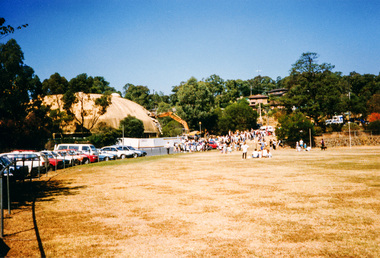
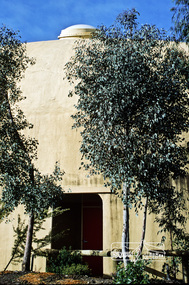
... outer membrane workmen filled in any holes. It was some days before pneumatic drills pecked out the first opening. The ceiling of the concrete dome was lined with fluffy insulating material. The dome was 36 metres in diameter at the base and 12 metres high in the centre with a usable floor space...outer membrane workmen filled in any holes. It was some days before pneumatic drills pecked out the first opening. The ceiling of the concrete dome was lined with fluffy insulating material. The dome was 36 metres in diameter at the base and 12 metres high in the centre with a usable floor space ...In 1978 Diamond Valley Shire recognised the need for a new public hall in Diamond Creek. Council considered the Bini shell form of construction which was in operation overseas and in use in New South Wales as libraries, gymnasiums, sports centres and multi-purpose centres. The Council gave the go-ahead. A site was chosen opposite the Hotel and close to the railway line. One day in - the following year, in 1979, activity stood still in Diamond Creek as school children and other excited spectators watched the one-hour inflation of the Bini Shell. This unusual method of construction was invented by Italian industrial designer and architect Dante Bini. The construction pneumatically raises a level of reinforced concrete from ground level which has not been set, using an internal balloon. The inner membrane inflates and compresses the mesh and concrete against the outer membrane. A net of flexible steel rods was laid on the building’s circular base, on the top of a fabric bladder. 300 tonnes of reinforced concrete were poured onto the mesh and a sealed cover laid over the concrete making a sandwich of cover, bladder and mesh. Compressed air was pumped into the bladder and the sandwich slowly began to rise and become a massive self-supporting dome. After inflation and removal of the outer membrane workmen filled in any holes. It was some days before pneumatic drills pecked out the first opening. The ceiling of the concrete dome was lined with fluffy insulating material. The dome was 36 metres in diameter at the base and 12 metres high in the centre with a usable floor space of 670 square metres. An opening night dinner was held to celebrate the new facility on March 12, 1980. Shire President Ron Pata made a speech and unveiled a plaque. It was the first public building in Victoria to be erected using the Bini Shell design method of construction The facility could cater for up to 400 people and in 1980 a fee for use was $100 for up to 200 people, $150 for up to 300 people and $200 for up to 400 people. For the next ten years or so, locals attended the hall for marital arts classes, basketball and netball games and school discoes and various other activities. After pieces of concrete fell off a Bini shell interstate due to a construction fault, the Council closed the centre. Demotion took place during the Diamond Creek Town Fair in 1991, as part of the annual Town Fair’s program. Research by L.P. Jan 2022This was the first public building in Victoria to be erected using the Bini Shell design method of construction.Colour photograph1991, diamond creek, bini shell, demolition, oval -
 Eltham District Historical Society Inc
Photograph, Fred Mitchell, Bini Shell at Diamond Creek, 1983, 1983
... outer membrane workmen filled in any holes. It was some days before pneumatic drills pecked out the first opening. The ceiling of the concrete dome was lined with fluffy insulating material. The dome was 36 metres in diameter at the base and 12 metres high in the centre with a usable floor space...outer membrane workmen filled in any holes. It was some days before pneumatic drills pecked out the first opening. The ceiling of the concrete dome was lined with fluffy insulating material. The dome was 36 metres in diameter at the base and 12 metres high in the centre with a usable floor space ...In 1978 Diamond Valley Shire recognised the need for a new public hall in Diamond Creek. Council considered the Bini shell form of construction which was in operation overseas and in use in New South Wales as libraries, gymnasiums, sports centres and multi-purpose centres. The Council gave the go-ahead. A site was chosen opposite the Hotel and close to the railway line. One day in - the following year, in 1979, activity stood still in Diamond Creek as school children and other excited spectators watched the one-hour inflation of the Bini Shell. This unusual method of construction was invented by Italian industrial designer and architect Dante Bini. The construction pneumatically raises a level of reinforced concrete from ground level which has not been set, using an internal balloon. The inner membrane inflates and compresses the mesh and concrete against the outer membrane. A net of flexible steel rods was laid on the building’s circular base, on the top of a fabric bladder. 300 tonnes of reinforced concrete were poured onto the mesh and a sealed cover laid over the concrete making a sandwich of cover, bladder and mesh. Compressed air was pumped into the bladder and the sandwich slowly began to rise and become a massive self-supporting dome. After inflation and removal of the outer membrane workmen filled in any holes. It was some days before pneumatic drills pecked out the first opening. The ceiling of the concrete dome was lined with fluffy insulating material. The dome was 36 metres in diameter at the base and 12 metres high in the centre with a usable floor space of 670 square metres. An opening night dinner was held to celebrate the new facility on March 12, 1980. Shire President Ron Pata made a speech and unveiled a plaque. It was the first public building in Victoria to be erected using the Bini Shell design method of construction The facility could cater for up to 400 people and in 1980 a fee for use was $100 for up to 200 people, $150 for up to 300 people and $200 for up to 400 people. For the next ten years or so, locals attended the hall for marital arts classes, basketball and netball games and school discoes and various other activities. After pieces of concrete fell off a Bini shell interstate due to a construction fault, the Council closed the centre. Demotion took place during the Diamond Creek Town Fair in 1991, as part of the annual Town Fair’s program. Research by LP January 2022This was the first public building in Victoria to be erected using the Bini Shell design method of construction.Digital copy of colour photographfred mitchell collection, 1983, bini shell, diamond creek -
 Geoffrey Kaye Museum of Anaesthetic History
Equipment - Bellamy Gardner mask with Ogston frame, post 1905
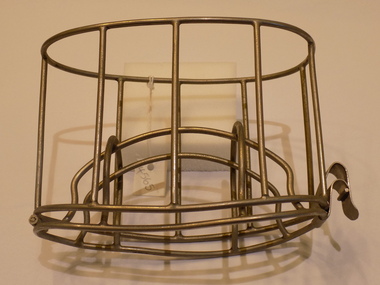
... space" contained within the apparatus." Bellamy Gardner Ogston Open ether administration Henry Peter Penn Moulded into connector clip: BRITISH MAKE Open wire ether mask with inner dome (Bellamy Gardner mask) and outer wire frame tower (Ogston frame). ...The Bellamy Gardner mask was in use by 1905 and was the first British mask for the open administration of ether. This mask combines the features of the Bellamy Gardner mask with a tower frame designed by Ogston. The Museum's "Penn catalogue", circa 1970, describes this mask: "this followed closely upon Ferguson's lead, but has an enormous amount of "dead-space" contained within the apparatus."Open wire ether mask with inner dome (Bellamy Gardner mask) and outer wire frame tower (Ogston frame).Moulded into connector clip: BRITISH MAKEbellamy gardner, ogston, open ether administration, henry peter penn -
 Bendigo Historical Society Inc.
Clothing - MAGGIE BARBER COLLECTION: LARGE LACE COLLAR, Late 1800's early 1900's
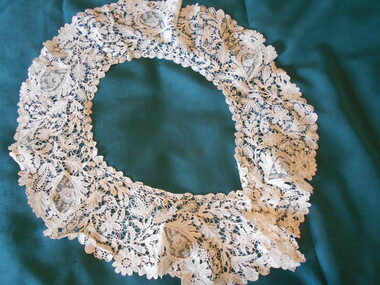
... Thirteen daisy like flowers are spaced around the outer edge, along with leaves and smaller flowers. ...Thirteen daisy like flowers are spaced around the outer edge, along with leaves and smaller flowers. ...Clothing. Very large, deep, linen lace collar.- Brussells Bobbin lace. Six large ''tear-drop'' shapes - 8cm long, enclose a delicate floral design. Thirteen daisy like flowers are spaced around the outer edge, along with leaves and smaller flowers. The long neck - edge is edged with a leaf - like design lace. This collar may have been worn over an evening gown with a deep back neckline.costume accessories, female, large lace collar -
 Bendigo Historical Society Inc.
Accessory - MAGGIE BARBER COLLECTION: LADIES WALKING CANE - TWO EXTRA HANDLES, 1920's
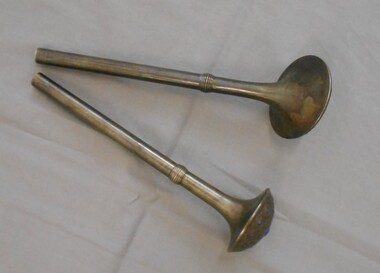
... (a) A circular metal disk, slightly convex with six tiny crosses spaced around the outer rim. Shaped like a funnel at the rear, the handle extends into a 16 cm stem which would fit over the walking cane. ...(a) A circular metal disk, slightly convex with six tiny crosses spaced around the outer rim. Shaped like a funnel at the rear, the handle extends into a 16 cm stem which would fit over the walking cane. ...Object. (a) A circular metal disk, slightly convex with six tiny crosses spaced around the outer rim. Shaped like a funnel at the rear, the handle extends into a 16 cm stem which would fit over the walking cane. Eight raised circles decorate the stem, giving a .8 cm decorative ridge. Four circles impressed below the lower edge. A hallmark is impressed below these circles, xo.... with remainder unreadable. (b) Circular rounded top, decorated with concentric small circles, raised slightly, and each centred with a tiny blue gemstone. A larger Royal Blue, circular raised gem stone is at the centre. This knob is 6 cm in diameter.costume accessories, female, ladies walking cane -
 Warrnambool and District Historical Society Inc.
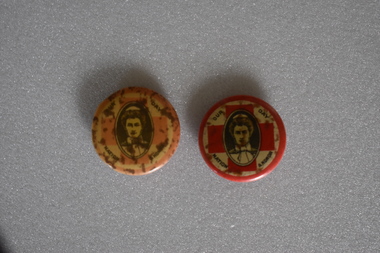
Badges x 2, Red Cross - Nation& Honour
... In the spaces left by the cross is black text on a white background.. The outer rim is red .There is a pin clip on the reverse. .2 Identical to .1 but very faded ...In the spaces left by the cross is black text on a white background.. The outer rim is red .There is a pin clip on the reverse. .2 Identical to .1 but very faded Red Cross - Nation& Honour Badges x 2 ...These badges feature an image of the British nurse Edith Cavell. She was shot by a German firing squad in 1915 for assisting Allied soldiers to escape from Belgium. She became an heroic figure of sacrifice in World War One and her image on these badges has been used to promote the sales of them to assist the welfare of Allied soldiers.These badges are significant souvenirs of World War One and were probably sold in Warrnambool and district..1 Circular metal and enamel badge featuring, inside a black oval a drawing of the face and shoulders of a nurse in uniform. The oval is in the centre of a red cross. In the spaces left by the cross is black text on a white background.. The outer rim is red .There is a pin clip on the reverse. .2 Identical to .1 but very faded .1 OUR DAY NATION & HONOURnurse, edith cavell -
 Warrnambool and District Historical Society Inc.
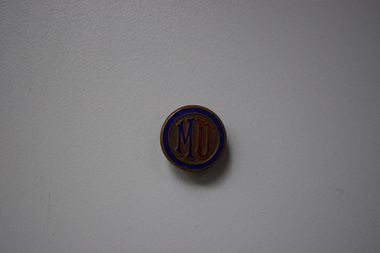
Badges, Manchester Unity, Mid 20th century
... space). Some years ago the Manchester Unity I. O.O.F. joined with the Australian Natives Association to form a new benefit group, Australia Unity. These badges are of interest as mementoes of a benefit society that was prominent in Warrnambool for over 100 years. Manchester Unity Independent Order of Oddfellows Benefit Societies in Warrnambool History of Warrnambool MU .1 A round metal lapel badge with gilt edging, an outer ...The MU on these badges stands for Manchester Unity Independent Order of Oddfellows. This was one of the most prominent of the benefit societies operating in Warrnambool over the years. Originating in England, Manchester Unity I.O.O.F. was established in Warrnambool in 1860. This benefit society built and opened the Oddfellows Hall in Koroit Street Warrnambool in 1869 (building still extant but now used for office space). Some years ago the Manchester Unity I. O.O.F. joined with the Australian Natives Association to form a new benefit group, Australia Unity. These badges are of interest as mementoes of a benefit society that was prominent in Warrnambool for over 100 years..1 A round metal lapel badge with gilt edging, an outer blue band and the letters ‘MU’ in blue and red on a gold-coloured background. The stud clip is at the back. .2 As above except that it has a long stick pin attached to the back instead of a stud. MUmanchester unity independent order of oddfellows, benefit societies in warrnambool, history of warrnambool -
 Nillumbik Shire Council
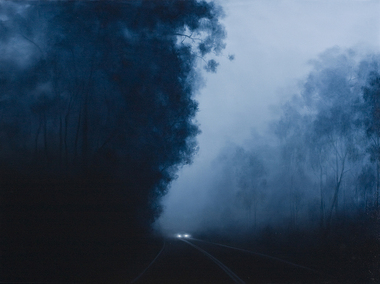
Painting: Camilla TADICH, Camilla Tadich, 6.23am Kangaroo Ground, 2009
... (catalogue, 'Silent Space' Ex. 2006) Tadich's early experiences of fireworks, simple fireworks and bonfire in the surrounding bush of her outer Melbourne home, caught her imagination. ...Tadich spends time observing night time phenomena, the light from the moon, street lights and other sources; atmospheric states, fog and dampness and the nature of surfaces, vegetation, road, vehicles and buildings. She uses photographs and sketches before settling on the final idea for a work.This painting is typical of Tadich's recent work. She continues her exploration of the Australian landscape (most often the local, Nillumbik Shire). It is 'a dramatic interplay between narrative, landscape and the binaries of light/dark and the known/unknown of local landscape. The swathes of darkness within the work(s) pose questions about our inscribed fears and tensions, both cultural and existential'. (catalogue, 'Silent Space' Ex. 2006) Tadich's early experiences of fireworks, simple fireworks and bonfire in the surrounding bush of her outer Melbourne home, caught her imagination. She was inspired to investigate the issues surrounding nights in the bush. In this painting the narrative is ambiguous, the pinpricks of light, in this case from the car headlights provide a critical element. We can distinguish familiar features, a road, trees and a car that suggest human presence. However, what is going on is unclear. The resulting tension can leave us unsure, unsettled and anxious.Oil on canvascamilla tadich, nillumbik shire council, kangaroo ground -
 Sunshine and District Historical Society Incorporated
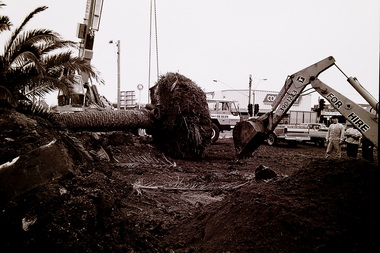
Photograph - St. Albans Square Palm Tree Installation 1991 Photographs, C. McGee, 17th June 1991
... outer suburbs were building European‑style pedestrian plazas to support growing migrant communities. St Albans, with its large Maltese, Yugoslav, Italian, Greek, and later Vietnamese population, needed: a central meeting place, a pedestrian‑friendly shopping zone, a civic space separate from traffic, somewhere for markets, gatherings, and casual socialising. ...outer suburbs were building European‑style pedestrian plazas to support growing migrant communities. St Albans, with its large Maltese, Yugoslav, Italian, Greek, and later Vietnamese population, needed: a central meeting place, a pedestrian‑friendly shopping zone, a civic space separate from traffic, somewhere for markets, gatherings, and casual socialising. ...St Albans Square emerged during the period when Melbourne’s outer suburbs were building European‑style pedestrian plazas to support growing migrant communities. St Albans, with its large Maltese, Yugoslav, Italian, Greek, and later Vietnamese population, needed: a central meeting place, a pedestrian‑friendly shopping zone, a civic space separate from traffic, somewhere for markets, gatherings, and casual socialising. The Square was built as part of the Main Road East commercial precinct, becoming the suburb’s unofficial “town centre.”These photographs taken by The Advocate captures the installation of the 10 metre palm tree at St Albans Square is significant as the palm tree has become a long‑standing landscape marker that contributes to the visual identity and social character of the precinct. The tree was donated to Council by local Ardeer resident Peter Zafiropoulous. Positioned at the intersection of Main Road East and The Esplanade, it serves as a focal point within the plaza and reflects late‑20th‑century suburban design practices that used distinctive plantings to create recognisable civic landmarks. The tree has remained a constant feature through decades of commercial change, multicultural growth, and streetscape redevelopment, and continues to embody the continuity of community life in St Albans. Its survival into 2026 enhances its value as a living element of the suburb’s public‑realm heritage.Palm Tree St. Albans Square 284.2st. albans square, main road east, the esplanade, st. albans -
 Ballarat Tramway Museum
Functional Object - Employee's Pass, Melbourne and Metropolitan Tramways Board (MMTB), 20/08/2001 12:00:00 AM
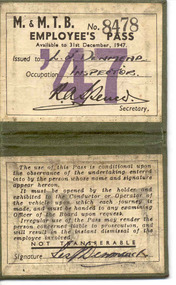
... space for the employees signature. Ticket issued to "L. J. Denmead", "Inspector" and signed by "R.A. Spencer"? as Board Secretary and signed by "Leslie Denmead". All entries made in black ink. These passes would have been issued as part of the conditions of employment. Image files show the inner and outer...space for the employees signature. Ticket issued to "L. J. Denmead", "Inspector" and signed by "R.A. Spencer"? as Board Secretary and signed by "Leslie Denmead". All entries made in black ink. These passes would have been issued as part of the conditions of employment. Image files show the inner and outer ...Dark green cloth enveloping two pieces of cardboard, joined together with the cloth, printed on the outside with the MMTB logo and the words "Melbourne & Metropolitan Tramways Board / EMPLOYEE'S PASS / 1947". On the inside, two pre printed pieces of off white paper have been glued to the cloth covered cards. The top card has been over stamped using a hand stamp machine with the Number "8478" and overprinted in purple ink " ' 47". Space for the name of the employee, occupation and for authorising signature of the Board Secretary has been provided. The bottom section details the conditions of use and space for the employees signature. Ticket issued to "L. J. Denmead", "Inspector" and signed by "R.A. Spencer"? as Board Secretary and signed by "Leslie Denmead". All entries made in black ink. These passes would have been issued as part of the conditions of employment. Image files show the inner and outer portions of the ticket respectively. Note Item not numbered in pencil.trams, tramways, employees pass, mmtb, tickets, melbourne -
 Broadmeadows Historical Society & Museum
Photograph - Group Photograph, Early Years Celebration, 1990
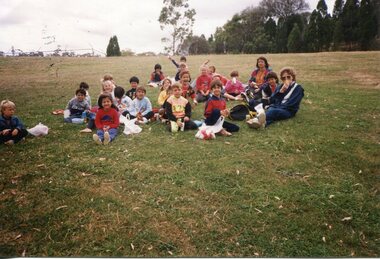
... outer suburbs fostered social cohesion, local identity, and intergenerational connection during a formative period in the region’s development. This photograph from the 1990 Jacana Primary School Christmas picnic, likely held at Greenvale Reservoir Park, is a valuable visual record of community life and educational culture in Melbourne’s northern suburbs during the late 20th century. It captures the joyful participation of younger students in a cherished annual event, reflecting the school’s emphasis on inclusiveness, celebration, and connection to local natural spaces ...This photograph captures a joyful scene from Jacana Primary School’s 1990 Christmas picnic, likely held at Greenvale Reservoir Park—a popular recreational destination north of Melbourne, celebrated for its wide open spaces and welcoming, family-friendly atmosphere. The image showcases younger students enjoying an end-of-year celebration, reflecting the school’s commitment to nurturing community spirit through shared outdoor experiences. Founded in 1959, Jacana Primary School was a vital part of the local community until its closure in the early 2000s. Events like the annual Christmas picnic were central to the school’s culture, offering students—especially those in the early years—opportunities to form friendships, celebrate their achievements, and connect with peers and teachers in a relaxed, natural setting. The choice of Greenvale Reservoir Park underscores the school’s strong ties to local landscapes and its dedication to inclusive, accessible activities. This photograph stands as a visual testament to the values that defined Jacana Primary School: joy, inclusiveness, and a deep sense of community. It also contributes to a broader understanding of how public education in Melbourne’s outer suburbs fostered social cohesion, local identity, and intergenerational connection during a formative period in the region’s development.This photograph from the 1990 Jacana Primary School Christmas picnic, likely held at Greenvale Reservoir Park, is a valuable visual record of community life and educational culture in Melbourne’s northern suburbs during the late 20th century. It captures the joyful participation of younger students in a cherished annual event, reflecting the school’s emphasis on inclusiveness, celebration, and connection to local natural spaces. Jacana Primary School, established in 1959 and closed in the early 2000s, played a pivotal role in shaping the social fabric of the Jacana community. Events such as the Christmas picnic were integral to the school’s identity, fostering friendships, strengthening ties between families and educators, and promoting a sense of belonging among students. The use of Greenvale Reservoir Park highlights the school’s commitment to accessible, outdoor learning environments and its engagement with the surrounding landscape. This image is significant not only for its depiction of school traditions but also for its broader representation of how public education in Melbourne’s outer suburbs contributed to social cohesion, local identity, and intergenerational connection. It stands as a testament to the enduring values of joy, community, and inclusivity that defined Jacana Primary School and its legacy.Photograph on glossy paper of a group children in the park.PH18289 (crossed out) PH-4209 (crossed out) PH-4868jacana primary school, christmas picnic, 1990, jacana, christmas party -
 Broadmeadows Historical Society & Museum
Photograph - Group Photograph, Picnic Under the Pavilion, 1990
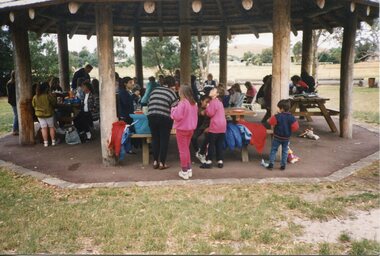
... Its open spaces and family-friendly amenities made it an ideal location for school events, reinforcing the school’s commitment to outdoor learning and community engagement. The photograph is historically significant as it reflects broader trends in public education during the late 20th century in Melbourne’s outer suburbs—particularly the role of schools in building community identity and supporting intergenerational relationships. ...Its open spaces and family-friendly amenities made it an ideal location for school events, reinforcing the school’s commitment to outdoor learning and community engagement. The photograph is historically significant as it reflects broader trends in public education during the late 20th century in Melbourne’s outer suburbs—particularly the role of schools in building community identity and supporting intergenerational relationships. ...This photograph documents a moment from the 1990 Jacana Primary School Christmas picnic, likely held at Greenvale Reservoir Park, a popular recreational area in Melbourne’s northern suburbs. The image shows students, families, and staff gathered under a wooden pavilion, engaging in festive activities that marked the end of the school year. Jacana Primary School was established in 1959 to serve the growing suburban community of Jacana, part of Melbourne’s post-war urban expansion. The school became a central institution in the area, not only for education but also for fostering social bonds among families from diverse backgrounds. Annual events like the Christmas picnic were key to the school’s ethos, promoting inclusivity, celebration, and connection to nature. Greenvale Reservoir Park, where the picnic was likely held, offered a scenic and accessible venue for such gatherings. Its open spaces and family-friendly amenities made it an ideal location for school events, reinforcing the school’s commitment to outdoor learning and community engagement. The photograph is historically significant as it reflects broader trends in public education during the late 20th century in Melbourne’s outer suburbs—particularly the role of schools in building community identity and supporting intergenerational relationships. It also captures the spirit of Jacana Primary School before its closure in the early 2000s, preserving a visual memory of its contribution to local life.This photograph, taken during the 1990 Jacana Primary School Christmas picnic at Greenvale Reservoir Park, holds cultural and historical significance as a visual record of community life and educational values in Melbourne’s northern suburbs during the late 20th century. It captures a moment of joyful gathering under a wooden pavilion, where students, families, and staff came together to celebrate the end of the school year. Jacana Primary School, established in 1959, served as a cornerstone of the Jacana community until its closure in the early 2000s. Events such as the annual Christmas picnic were central to the school’s identity, fostering inclusiveness, friendship, and a strong sense of belonging. The choice of Greenvale Reservoir Park reflects the school’s connection to local landscapes and its commitment to accessible, outdoor learning experiences. The image is significant not only for its depiction of school traditions but also for its broader representation of how public education in Melbourne’s outer suburbs supported social cohesion, local identity, and intergenerational connection. It stands as a testament to the enduring values of joy, community, and inclusivity that defined Jacana Primary School and its legacy within the region.Photograph on glossy paper of a group children in the park.PH18289 (crossed out) PH-4209 (crossed out) PH-4868jacana primary school, christmas picnic, 1990, jacana, christmas party -
 Broadmeadows Historical Society & Museum
Photograph - Group Photograph, Hilltop Moments, 1990
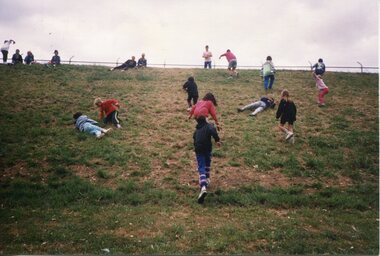
... spaces provided a safe and engaging environment for children to explore, play, and interact beyond the classroom. This photograph is historically significant as it illustrates the role of public education in promoting social cohesion and community identity in Melbourne’s outer suburbs during a period of rapid urban development. ...spaces provided a safe and engaging environment for children to explore, play, and interact beyond the classroom. This photograph is historically significant as it illustrates the role of public education in promoting social cohesion and community identity in Melbourne’s outer suburbs during a period of rapid urban development. ...This photograph, taken during the 1990 Jacana Primary School Christmas picnic, shows children playing freely on a grassy hill—likely within Greenvale Reservoir Park, a popular location for school and family outings in Melbourne’s northern suburbs. The image captures a relaxed and spontaneous moment of outdoor play, with students climbing, sitting, and lying on the hillside while others observe from the fence line above. Jacana Primary School, founded in 1959, was a key educational and social institution in the Jacana community until its closure in the early 2000s. Annual events like the Christmas picnic were central to the school’s culture, offering students opportunities to celebrate the end of the school year in a natural, open-air setting. These gatherings fostered a sense of belonging and community among students, families, and staff. The choice of Greenvale Reservoir Park reflects the school’s emphasis on accessible, inclusive experiences and its connection to local landscapes. The park’s open spaces provided a safe and engaging environment for children to explore, play, and interact beyond the classroom. This photograph is historically significant as it illustrates the role of public education in promoting social cohesion and community identity in Melbourne’s outer suburbs during a period of rapid urban development. It also serves as a visual reminder of the value placed on outdoor learning and intergenerational connection in the school’s traditions.This photograph, taken during the 1990 Jacana Primary School Christmas picnic, is a significant visual record of childhood experience and community life in Melbourne’s outer northern suburbs. It captures students engaging in unstructured outdoor play on a grassy hill—likely within Greenvale Reservoir Park—highlighting the school’s emphasis on freedom, exploration, and connection to the natural environment. Jacana Primary School, established in 1959 and closed in the early 2000s, was a vital institution in the Jacana community. Events like the annual Christmas picnic were central to the school’s culture, offering students opportunities to celebrate the end of the school year in a relaxed, inclusive setting. The choice of Greenvale Reservoir Park reflects the school’s commitment to accessible, local spaces that supported both learning and play. The image is historically significant as it illustrates the broader role of public education in fostering social cohesion, community identity, and intergenerational connection during a period of suburban growth and change. It also serves as a testament to the enduring value of outdoor experiences in shaping childhood memories and school traditions.Photograph on glossy paper of a group children in the park.PH18289 (crossed out) PH-4209 (crossed out) PH-4868jacana primary school, christmas picnic, 1990, jacana, christmas party -
 Broadmeadows Historical Society & Museum
Photograph - Group Photograph, Gathering in the Park, 1990
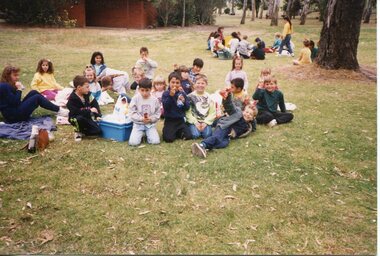
... spaces that supported outdoor learning and social engagement. The park’s open environment encouraged intergenerational participation and reinforced the school’s values of inclusivity and community spirit. This image is historically significant as it illustrates the role of public education in promoting social cohesion and local identity in Melbourne’s outer suburbs during a period of suburban expansion. ...spaces that supported outdoor learning and social engagement. The park’s open environment encouraged intergenerational participation and reinforced the school’s values of inclusivity and community spirit. This image is historically significant as it illustrates the role of public education in promoting social cohesion and local identity in Melbourne’s outer suburbs during a period of suburban expansion. ...This photograph, taken during the 1990 Jacana Primary School Christmas picnic, depicts children and adults gathered on the grass in a relaxed, park-like setting—likely Greenvale Reservoir Park in Melbourne’s northern suburbs. Groups are seated on blankets or directly on the grass, sharing snacks and drinks, suggesting a casual and inclusive celebration to mark the end of the school year. Jacana Primary School, established in 1959, was a central institution in the Jacana community until its closure in the early 2000s. Annual events such as the Christmas picnic were a key part of the school’s culture, fostering a sense of community among students, families, and staff. These gatherings provided opportunities for informal interaction, celebration, and connection beyond the classroom. The use of Greenvale Reservoir Park reflects the school’s emphasis on accessible, natural spaces that supported outdoor learning and social engagement. The park’s open environment encouraged intergenerational participation and reinforced the school’s values of inclusivity and community spirit. This image is historically significant as it illustrates the role of public education in promoting social cohesion and local identity in Melbourne’s outer suburbs during a period of suburban expansion. It also serves as a visual record of Jacana Primary School’s enduring legacy in shaping community life through shared experiences.This photograph, taken during the 1990 Jacana Primary School Christmas picnic, is a valuable visual record of community engagement and school culture in Melbourne’s northern suburbs. It depicts children and adults gathered on the grass in a relaxed, park-like setting—likely Greenvale Reservoir Park—sharing food, conversation, and companionship in celebration of the end of the school year. Jacana Primary School, established in 1959 and closed in the early 2000s, played a central role in the Jacana community. Annual events such as the Christmas picnic were integral to the school’s identity, fostering a sense of belonging and connection among students, families, and staff. These gatherings encouraged informal interaction and reinforced the school’s commitment to inclusivity and community-building. The image is historically significant as it reflects the broader role of public education in promoting social cohesion, local identity, and intergenerational relationships during a period of suburban growth and transformation. It also highlights the importance of accessible public spaces—like Greenvale Reservoir Park—in supporting educational and social experiences beyond the classroom.Photograph on glossy paper of a group children in the park.PH18289 (crossed out) PH-4209 (crossed out) PH-4868jacana primary school, christmas picnic, 1990, jacana, christmas party -
 Broadmeadows Historical Society & Museum
Photograph - Group Photograph, Piggyback Races, 1990
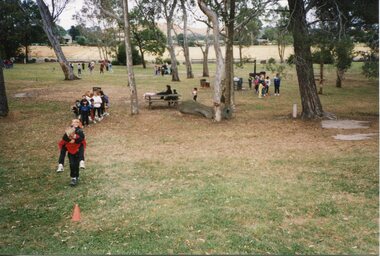
... spaces that supported inclusive and active learning experiences. The park’s open layout and family-friendly environment made it an ideal venue for school-wide gatherings that encouraged participation across age groups. This image is historically significant as it illustrates the role of public education in promoting social cohesion, physical wellbeing, and community identity in Melbourne’s outer suburbs during a period of suburban development. ...outer suburbs during a period of suburban expansion. It illustrates how schools like Jacana Primary fostered social cohesion, community identity, and intergenerational connection through shared traditions and accessible public spaces. ...This photograph, taken during the 1990 Jacana Primary School Christmas picnic, captures children participating in a piggyback race in a park setting—likely Greenvale Reservoir Park, a well-known recreational area in Melbourne’s northern suburbs. The image shows students actively engaged in playful competition, with a red cone marking the race course and groups of children and adults scattered throughout the background. Jacana Primary School, established in 1959 and closed in the early 2000s, was a central institution in the Jacana community. Events like the annual Christmas picnic were key to the school’s culture, offering students opportunities to celebrate the end of the school year through games, social interaction, and outdoor fun. These activities fostered a sense of camaraderie, physical engagement, and community spirit. The use of Greenvale Reservoir Park reflects the school’s commitment to accessible, natural spaces that supported inclusive and active learning experiences. The park’s open layout and family-friendly environment made it an ideal venue for school-wide gatherings that encouraged participation across age groups. This image is historically significant as it illustrates the role of public education in promoting social cohesion, physical wellbeing, and community identity in Melbourne’s outer suburbs during a period of suburban development. It also serves as a visual record of Jacana Primary School’s emphasis on joyful, shared experiences that extended beyond the classroom.This photograph, taken during the 1990 Jacana Primary School Christmas picnic, is a vivid representation of the school’s commitment to joyful, inclusive, and active community events. It captures children participating in a piggyback race on the grassy grounds of what is likely Greenvale Reservoir Park, with other students, families, and staff visible in the background enjoying the day’s festivities. Jacana Primary School, established in 1959 and closed in the early 2000s, played a vital role in the social and educational life of the Jacana community. Annual events such as the Christmas picnic were central to the school’s culture, offering opportunities for students to engage in physical play, build friendships, and celebrate the end of the school year in a relaxed, outdoor setting. The image is historically significant as it reflects the broader role of public education in Melbourne’s outer suburbs during a period of suburban expansion. It illustrates how schools like Jacana Primary fostered social cohesion, community identity, and intergenerational connection through shared traditions and accessible public spaces. The photograph stands as a testament to the enduring values of fun, participation, and community that defined the school’s legacy.Photograph on glossy paper of a group children in the park.PH18289 (crossed out) PH-4209 (crossed out) PH-4868jacana primary school, christmas picnic, 1990, jacana, christmas party -
 Lakes Entrance Historical Society
Photograph - Housing, Tudor dwelling at Colqhuoun Road. Lakes Entrance 1999
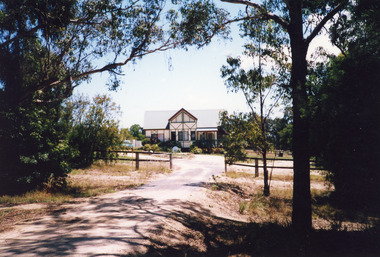
... space originally had large banquet hall in centre, surrounded by kitchen and utilities, bedrooms upstairs overlooking hall. It has since been modified. Houses Architecture Colour photograph of a mock Tudor dwelling at Colqhuoun Road. Corrugated iron gable roof across building. Gable roofed projection centre front. Dark painted lathes on outer ...Built late 1970's or early 1980's by Roger Simpson, cabinet maker. Internal space originally had large banquet hall in centre, surrounded by kitchen and utilities, bedrooms upstairs overlooking hall. It has since been modified.Colour photograph of a mock Tudor dwelling at Colqhuoun Road. Corrugated iron gable roof across building. Gable roofed projection centre front. Dark painted lathes on outer walls add to Tudor effects. Set well back from road with established garden. Lakes Entrance Victoriahouses, architecture -
Moorabbin Air Museum
Drawing (Item) - CAC 04-52317 Spacer Outer Wing Aileron Bellcrank
... Drawing CAC 04-52317 Spacer Outer Wing Aileron Bellcrank ANSETT AUSTRALIA HISTORICAL AIRCRAFT GROUP ... -
 Sunbury Family History and Heritage Society Inc.
Photograph, Rosa McCall, 2000
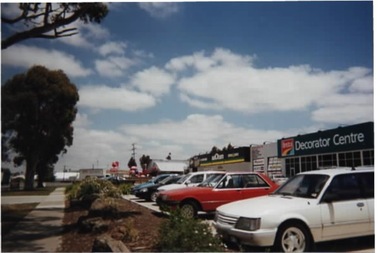
... space. This development was one of many that reflected the growth of Sunbury from a country town to an outer suburb of Melbourne. ...The commercial development was built along Horne Street between Mitchells Lane and Neill Street in 2000 on land that had been open space. This development was one of many that reflected the growth of Sunbury from a country town to an outer suburb of Melbourne.A non-digital coloured photograph of a commercial centre with cars parked in the designated area in front of the businesses. Along the roadside and bordering the footpath are large gum trees. horne street, neill street, mitchells lane, pasley street, sunbury, commercial development -
 Vision Australia
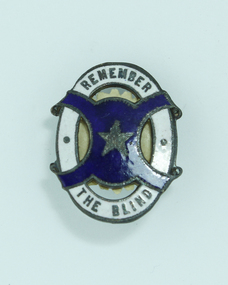
Badge - Object, Remember the Blind badge, 1940-1980
... The outer oval is narrow, white with gold edges and words. A dark blue oval is in the centre, suspended over the empty space by four curved pieces of metal, with gold edging. ...The outer oval is narrow, white with gold edges and words. A dark blue oval is in the centre, suspended over the empty space by four curved pieces of metal, with gold edging. ...To raise funds for the Royal Victorian Institute for the Blind, these badges were sold by street sellers in Melbourne. "Remember the Blind" - Blue and white oval badges with the words, 'Remember the Blind' around the edge. The outer oval is narrow, white with gold edges and words. A dark blue oval is in the centre, suspended over the empty space by four curved pieces of metal, with gold edging. Some badges have paper numbers on the reverse. Metal pin with enamel with writingRemember the Blind royal victorian institute for the blind, badges -
 Parks Victoria - Point Hicks Lightstation
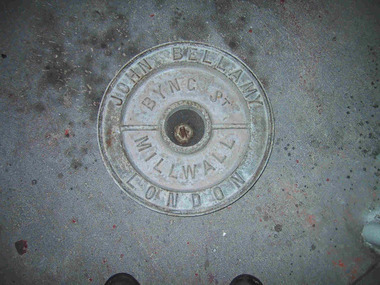
Lid, ship tank
... It has the name ‘John Bellamy London’ cast in capitals in a continuous circle on the outer edge of the lid face, and the words ‘Byng St Millwall’ on the inner circle. , of Millwall, London, manufactured boilers and ship tanks from the 1860s to the 1930s and came from a family of tank makers who began manufacturing tanks some time before 1856. Ship tanks were invented in 1808 by notable engineer, Richard Trevithick and his associate John Dickinson. Their patent obtained the same year described the tank’s superior cubic shape that allowed it to fit squarely as a container in vessels and thus use space...It has the name ‘John Bellamy London’ cast in capitals in a continuous circle on the outer edge of the lid face, and the words ‘Byng St Millwall’ on the inner circle. , of Millwall, London, manufactured boilers and ship tanks from the 1860s to the 1930s and came from a family of tank makers who began manufacturing tanks some time before 1856. Ship tanks were invented in 1808 by notable engineer, Richard Trevithick and his associate John Dickinson. Their patent obtained the same year described the tank’s superior cubic shape that allowed it to fit squarely as a container in vessels and thus use space ...The heavy cast iron, round lid was originally fastened into a large, riveted metal box, known as a ship tank. It has the name ‘John Bellamy London’ cast in capitals in a continuous circle on the outer edge of the lid face, and the words ‘Byng St Millwall’ on the inner circle. , of Millwall, London, manufactured boilers and ship tanks from the 1860s to the 1930s and came from a family of tank makers who began manufacturing tanks some time before 1856. Ship tanks were invented in 1808 by notable engineer, Richard Trevithick and his associate John Dickinson. Their patent obtained the same year described the tank’s superior cubic shape that allowed it to fit squarely as a container in vessels and thus use space efficiently, while its metal fabric preserved and secured its liquid or solid contents from damage. The containers revolutionised the movement of goods by ship and made wooden casks redundant. Research by Michael Pearson has determined that they were carried on passages to Australia from at least the 1830s conveying ships’ victuals and water storage, as well as general goods heading for the colonies. Pearson found photographic evidence of their use in the 1860s, and by the 1870s they appeared to be in common use. lids surviving from containers indicate that nearly all the tanks transported to Australia came from London manufacturers. It was usual for the brand name to also feature as a stencil on the tank but in most cases this eventually wore off. A tank without its original stencil survives at Wilsons Promontory. Tanks transporting ‘drinking water or perishable dry goods were hermetically sealed by the use of the tightly fitting lid with a rubber sealing ring ‘which was screwed tight with the aid of lugs cast into the lid and wedges cast into the rim of the loading hole’. The raised iron rod welded across the outer face of many lids such as the Bellamy example, allowed for screwing the lid tight. Once in the colonies, the ship tanks were often recycled and adapted for many resourceful uses such as packing cases, dog kennels, water tanks, oil containers and food stores and this invariably led to the separation of the lid and tank. The Bellamy lid could have been salvaged from a shipwreck but is more likely to have to have originated from a recycled tank that was brought to the lightstation for water storage purposes. Pearson writes that: Ship tanks show up at a wide range of sites, many of them isolated like lighthouses. They were, I think, usually taken there for the purposes they filled, usually water storage, as they were readily available, relatively light to transport, and probably very cheap to buy as second-hand goods containers. In rural areas they may have been scavenged for their new uses from local stores, to whom goods were delivered in them. Parks Victoria has identified five tank lids in the lightstation collections covered by this project. In addition to the Bellamy lid at Point Hicks, they include a Bow brand lid at Point Hicks and another at Cape Otway, unidentified lids at Cape Otway and Wilsons Promontory. Pearson and Miles Lewis have each recorded two versions of the Bellamy trade name on the lids; one being ‘John Bellamy Byng St. London’; the other, ‘John Bellamy Byng St. Millwall London’. The Point Hicks lid has the second version of the name, as do other examples in Victoria that Lewis has identified at Illawarra, Toorak; Warrock homestead, Casterton; Eeyeuk homestead, Terang; Ward’s Mill, Kyneton; and Boisdale homestead near Maffra, and in NSW at Ayrdale Park, Wolumla; and Bishop’s Lodge, Hay. Pearson’s list includes the same lids in NSW at Tumbarumba; the Quarantine Station, Sydney; Willandra Station; Bedervale, Braidwood; Gunnedah Museum; Walla Walla and Macquarie Island. The Point Hicks lid is currently stored in the lighthouse although it is unlikely that its use had any association with this building. The lid is in good condition and retains the central bung. Pearson notes that ‘surviving lids are far less numerous than the tanks themselves, presumably because the uses to which the tanks were put did not require the lid to be retained’.347 The Bellamy ship tank lid has first level contributory significance for its historic values. Circular cast-iron disc with raised outer ridge with inscription. It also has an inner depression with inscription. Two metal sections form handles over inner depression. Hole in middle of disc.Around perimeter of outer edge "JOHN BELLAMY LONDON" Around inner area "BYNG ST MILLWALL" -
 Parks Victoria - Wilsons Promontory Lightstation
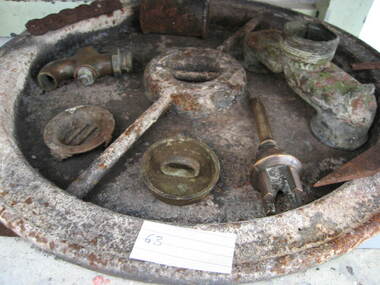
Tank lid
... outer face of many lids allowed for screwing the lid tight. Ship tanks were invented in1808 by notable engineer, Richard Trevithick and his associate John Dickinson. Their patent obtained the same year described the tank’s superior cubic shape that allowed it to fit squarely as a container in ships and thus use space efficiently, while its metal fabric preserved and secured its contents, whether liquid or solid, from damage. ...outer face of many lids allowed for screwing the lid tight. Ship tanks were invented in1808 by notable engineer, Richard Trevithick and his associate John Dickinson. Their patent obtained the same year described the tank’s superior cubic shape that allowed it to fit squarely as a container in ships and thus use space efficiently, while its metal fabric preserved and secured its contents, whether liquid or solid, from damage. ...Lid for ship's tanks used for early domestic water storage (1860's) at the lightstation The water tank and lid are probably from the same unit that was used for transporting drinking water or perishable dry goods on ships. The unit comprised a large, riveted metal tank which was fitted with a heavy cast iron round lid to form a hermetically sealed container. It had a rubber sealing ring ‘which was screwed tight with the aid of lugs cast into the lid and wedges cast into the rim of the loading hole’. A raised iron rod welded across the outer face of many lids allowed for screwing the lid tight. Ship tanks were invented in1808 by notable engineer, Richard Trevithick and his associate John Dickinson. Their patent obtained the same year described the tank’s superior cubic shape that allowed it to fit squarely as a container in ships and thus use space efficiently, while its metal fabric preserved and secured its contents, whether liquid or solid, from damage. The containers revolutionised the movement of goods by ship and made wooden casks redundant. Research by Michael Pearson has determined that they were carried on passages to Australia from at least the 1830s, conveying ships’ victuals and water storage as well as general goods heading for the colonies, and by the 1870s they were in common use. Once in the colonies, the tanks were often recycled and adapted for many resourceful uses such as water tanks, packing cases, dog kennels, oil containers and food stores and this invariably led to the separation of the lid and tank. Raised lettering on the lids indicates that nearly all of the ship tanks transported to Australia came from London manufacturers, and it was usual also for the brand name to feature as a stencil on the associated square tank but in most cases this eventually wore off. It is not known if the Wilsons Promontory tank retains its stencil, and the heavy lid will need to be turned over to reveal its manufacturer’s name. How it came to the lightstation is also not known, but it was either brought to the site as a recycled tank or salvaged from a shipwreck. Pearson writes that Ship tanks show up at a wide range of sites, many of them isolated like lighthouses. They were, I think, usually taken there for the purposes they filled, usually water storage, as they were readily available, relatively light to transport, and probably very cheap to buy as second‐hand goods containers. In rural areas they may have been scavenged for their new uses from local stores, to whom goods were delivered in them. Recycled to serve as a water tank, the Wilsons Promontory tank is the last surviving example of several that were used at the site to hold water for domestic consumption. The tank has had its lid removed and a tap fitted to the one of the sides. It stands on concrete blocks next to a building to receive water running off the roof via a metal pipe. Wilsons Promontory is the only lightstation managed by Parks Victoria with a tank container, although Cape Otway and Point Hicks have lids. Parks Victoria has identified four other lids which include two at Point Hicks, one manufactured by Lancaster and Co. the other by Bellamy. Cape Otway also has two, one unidentified and the other by the Bow Tank Works, East London, which produced tanks between 1910 and 1930. Pearson notes that ‘surviving lids are far less numerous than the tanks themselves, presumably because the uses to which the tanks were put did not require the lid to be retained’. The tank and lid, which are possibly part of the same unit, have first level contributory significance for their historic values and rarity. Round ship's tanks lid, iron.
