
Showing 349 items matching "overseas study"
-
 University of Melbourne, Burnley Campus Archives
Document, Report to Council on Overseas Study Tour, 1985
... Report to Council on Overseas Study Tour......overseas study tours...robert g. luff directors hcah overseas study tours Report by Robert G. Luff, Director, HCAH Report to Council on Overseas Study Tour Document ...Report by Robert G. Luff, Director, HCAHrobert g. luff, directors, hcah, overseas study tours -
Whitehorse Historical Society Inc.
Document, Overseas study tour June-August 1979, 1979
... Overseas study tour June-August 1979...Study tour of North America and Europe taken by City Engineer for the City of Nunawading Study tour of North America and Europe taken by City Engineer for the City of Nunawading Overseas study tour June-August 1979 Document Document ...Study tour of North America and Europe taken by City Engineer for the City of NunawadingStudy tour of North America and Europe taken by City Engineer for the City of NunawadingStudy tour of North America and Europe taken by City Engineer for the City of Nunawadingcity of nunawading, wilson, d.j. -
 Expression Australia
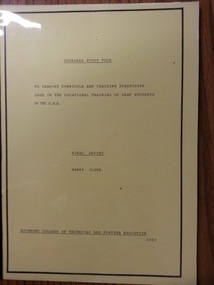
Report, Final Report, Overseas Study Tour, To Examine Curricula and Teaching Strategies Used in the Vocational Training of Deaf Students in the U.S.A
... Final Report, Overseas Study Tour, To Examine Curricula and Teaching Strategies Used in the Vocational Training of Deaf Students in the U.S.A...Winston Churchill Memorial Trust; Written by Barry Clyne, Churchill Fellow 1983, Richmond College of Technical and Further Education This report is significant as it led to the setting up of the Auslan Program at Kangan Batman TAFE. vocational training, barry clyne, richmond college of technical and further education Yellow cover, Size 28cmHx22cmW, 71 pages Final Report, Overseas Study Tour, To Examine Curricula and Teaching Strategies Used in the Vocational Training of Deaf Students in the U.S.A Report ...Winston Churchill Memorial Trust; Written by Barry Clyne, Churchill Fellow 1983, Richmond College of Technical and Further EducationThis report is significant as it led to the setting up of the Auslan Program at Kangan Batman TAFE.Yellow cover, Size 28cmHx22cmW, 71 pagesvocational training, barry clyne, richmond college of technical and further education -
 Ballarat Tramway Museum
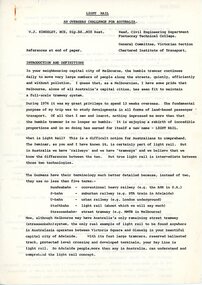
Document - Document - Discussion Paper, Light Rail; An overseas Challenge for Australia
... ...overseas study...During 1076 he was overseas to study the developments in all forms of land-based passenger transport. ...During 1076 he was overseas to study the developments in all forms of land-based passenger transport. ...Ron Bridger was an avid collector of items related to transport, predominately Trams. These items include newspaper cuttings, pamphlets, reports, timetables, fares prices plus special items relating to events. Items from Melbourne and regional Victoria, interstate - Adelaide and Sydney, plus overseas, make up this collection. A discussion paper written by W J Kingsley, Head of Civil Engineering Department at Footscray Technical College. During 1076 he was overseas to study the developments in all forms of land-based passenger transport. He found the tramcar was enjoying a rebirth and a new name - LIGHT RAIL. This paper goes into depth the various forms of transport and compares the efficiency of each. It provides a challenge for Australia to consider the benefits of Light Rail.Six sheets of A4 paper, printed on both sides - 12 page document. Paper titled "Light Rail - An overseas challenge for Australia" Topic divided into sections: Introduction and Definition; The Private Motor Car; Gee-Whizz; Energy; Vehicles; Track; Overhead and Signalling; Standardization; Some Particular Applications of Real Note; CostAuthor W J Kingsley, w jkingsley, civil engineering department, overseas study, light rail, travel comparisons, efficiency of travel options, ron bridger collection, 1976, as box 48a -
University of Melbourne, Burnley Campus Archives
Letter, Accommodation - Office 1/6, 1978-1980
... Correspondence re overseas study tours, vegetable breeding, etc....Correspondence re overseas study tours, vegetable breeding, etc. Accommodation - Office 1/6 Letter ...Correspondence re overseas study tours, vegetable breeding, etc. -
Federation University Historical Collection
Book - Book - Scrapbook, Ballarat College of Advanced Education: Scrapbook of newspaper cutting, Book 2; June 1976 to March 1977
... ...overseas study trip...The cuttings cover the period from 30 June 1976 to 11 March 1977. ballarat institute of advanced education biae employment advertisements application for enrolment outline of courses merger tomorrow of tertiary colleges community sharing of education facilities careers in the 70s gabriel laderman - artist and teacher farewell to w rowe educational values ballarat cae university choir from japan forum on education education - lack of public concern deakin uni tertiary system inquiry great tertiary power game mitch pearson - artist arblaster award to bruce cannon uni staff hit at colleges colleges warned of harsh cutbacks overseas study trip book sold out before launch graham hawley - artist hsc still the best system campus was his canvas alistair knox merger provides wide scope moves for paramedical courses in ballarat dr stephen parsons $104m for state colleges commonwealth grant to sister francesca watt the great college perks cloisters of paradise workshop looks at school reviews joan kirner open day at mount helen uk sculptor at art school student strikers mp wont't meet early childhood health program $1m physical education building forum on uranium farewell to c a sonsee noel janetski returns anzaas congress to come to ballarat 230 diplomas conferred disease of idleness cae contract for union extensios counselling goes public dr gary pennington - canadian lecturer african interest in bcae courses Book with yellow cover, front. ...Newspaper cuttings relating to Ballarat College of Advanced Education. These are from various newspapers and include The Age, Ballarat Courier, The Australian, The Herald. The cuttings cover the period from 30 June 1976 to 11 March 1977. Book with yellow cover, front. Spiral bound.ballarat institute of advanced education, biae, employment advertisements, application for enrolment, outline of courses, merger tomorrow of tertiary colleges, community sharing of education facilities, careers in the 70s, gabriel laderman - artist and teacher, farewell to w rowe, educational values, ballarat cae, university choir from japan, forum on education, education - lack of public concern, deakin uni, tertiary system inquiry, great tertiary power game, mitch pearson - artist, arblaster award to bruce cannon, uni staff hit at colleges, colleges warned of harsh cutbacks, overseas study trip, book sold out before launch, graham hawley - artist, hsc still the best system, campus was his canvas, alistair knox, merger provides wide scope, moves for paramedical courses in ballarat, dr stephen parsons, $104m for state colleges, commonwealth grant to sister francesca watt, the great college perks, cloisters of paradise, workshop looks at school reviews, joan kirner, open day at mount helen, uk sculptor at art school, student strikers, mp wont't meet, early childhood health program, $1m physical education building, forum on uranium, farewell to c a sonsee, noel janetski returns, anzaas congress to come to ballarat, 230 diplomas conferred, disease of idleness, cae contract for union extensios, counselling goes public, dr gary pennington - canadian lecturer, african interest in bcae courses -
Federation University Historical Collection
Book - Book - Scrapbook, Ballarat School of MInes: Scrapbook of Newspaper Cuttings, Book 3, September 1977 - February 1978
... mr beanland on overseas study leave...The papers concerned are The Courier, Ballarat, The Australian, The Age over the period from 7 September 1977 to 28 February 1978. staffing advertisements new vehicle workshop at smb award for top apprentice peter chenery course on beef butchering smb buys boatshed at lake wendouree firms close doors to the semi-literate peter shields new deputy principal praise for new smb library big subject range planned by smb boilermakers briefing certificates awarded at victorian school of forestry two foundation heads of department appointed banking course planned motor school at smb smb reaches out to community tafe courses for women students will learn good driving habits practical program for women deportment course at smb d taylor kellock painting department retires after 32 years off campus study program for 1978additional courses at smb mr beanland on overseas study leave 20 new teachers join smb radio mast for smb like mother like daughter val d'angri eureka flag Book with deep red and white cover back and front, spiral bound. ...Collection of newspaper articles related to Ballarat School Of Mines.They cover activities and advertisements for staff. The papers concerned are The Courier, Ballarat, The Australian, The Age over the period from 7 September 1977 to 28 February 1978.Book with deep red and white cover back and front, spiral bound. staffing advertisements, new vehicle workshop at smb, award for top apprentice peter chenery, course on beef butchering, smb buys boatshed at lake wendouree, firms close doors to the semi-literate, peter shields new deputy principal, praise for new smb library, big subject range planned by smb, boilermakers briefing, certificates awarded at victorian school of forestry, two foundation heads of department appointed, banking course planned, motor school at smb, smb reaches out to community, tafe courses for women, students will learn good driving habits, practical program for women, deportment course at smb, d taylor kellock painting department retires after 32 years, off campus study program for 1978additional courses at smb, mr beanland on overseas study leave, 20 new teachers join smb, radio mast for smb, like mother like daughter, val d'angri, eureka flag -
 Sunshine and District Historical Society Incorporated
Administrative record - City of Sunshine - Commissioner Mr Alexander "Alex" George Gillon Collection 1976 - 1982 Attachments for the Ordinary Meeting of Council to be Held on 25th July 1978, City of Sunshine, 25th July 1978
... Cannon, Testro & Coburn Letter Lease - Italo-Australian Co-Operative Social Club Ltd Supplementary Valuations for the Western, Central, Southern and River Wards of the City of Sunshine The Local Government Engineers Association of Victoria Overseas Study Tours 1979 Western Region Commission Future Role and Objectives of the Commission The Retail Association of Victoria Nighttime Trading...Cannon, Testro & Coburn Letter Lease - Italo-Australian Co-Operative Social Club Ltd Supplementary Valuations for the Western, Central, Southern and River Wards of the City of Sunshine The Local Government Engineers Association of Victoria Overseas Study Tours 1979 Western Region Commission Future Role and Objectives of the Commission The Retail Association of Victoria Nighttime Trading Stapled foolscap sized document. ...Attachments for the Ordinary Meeting of Council to be Held on 25th July 1978 Patrick J. Cannon, Testro & Coburn Letter Lease - Italo-Australian Co-Operative Social Club Ltd Supplementary Valuations for the Western, Central, Southern and River Wards of the City of Sunshine The Local Government Engineers Association of Victoria Overseas Study Tours 1979 Western Region Commission Future Role and Objectives of the Commission The Retail Association of Victoria Nighttime Trading city of sunshine, alexander "alex" george gillon, italo-australian co-operative social club, furlong road, st. albans -
 Cheese World Museum
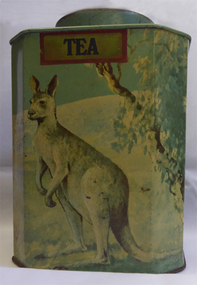
Tea caddy, 1930s
... James Burleigh was a director of Warrnambool Cheese and Butter and undertook an overseas farm study tour to the United Kingdom in the late 1930s....James Burleigh was a director of Warrnambool Cheese and Butter and undertook an overseas farm study tour to the United Kingdom in the late 1930s. ...This tin belonged to Doug Burleigh and was used by his family as a tea caddy. The Burleigh family were early settlers in the Nullawarre area. James Burleigh was a director of Warrnambool Cheese and Butter and undertook an overseas farm study tour to the United Kingdom in the late 1930s.These Australiana tea caddies are significant as an item with aesthetic and interpretive capacity. It was common in many households on the mantelpiece for ready access. It was also a means for Bushells to advertise their product. An octagonal tin tea caddy decorated with embossed Australian animals in full colour on each side -kangaroo, emu, koala and kookaburra; light blue background and top and a circular lid with the brand name imprinted. A red-edged adhesive label is on the side with the kangaroo.TEA [side] Bushells/Tea of Flavor [lid] Bushells/Tea of Flavor/FIRST GRADE/1 LB NET [base]warrnambool cheese and butter factory company, burleigh, nullawarre, allansford, tea caddies, tins, bushells tea -
 Greensborough Historical Society
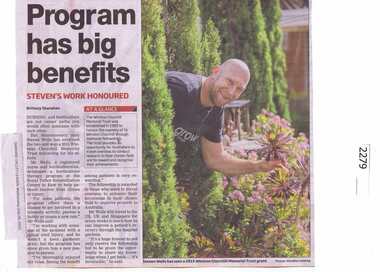
Newspaper clipping, Program has big benefits, 29/07/2015
... He was awarded a Winston Churchill Memorial Trust Fellowship to further his studies overseas....He was awarded a Winston Churchill Memorial Trust Fellowship to further his studies overseas. steven wells winston churchill memorial fellowship royal talbot rehabilitation News clipping, black text, colour image. ...Steven Wells of Montmorency is a registered nurse and horticulturalist. He has developed a horticulture therapy program at Royal Talbot Rehabilitation Centre in Kew. He was awarded a Winston Churchill Memorial Trust Fellowship to further his studies overseas.News clipping, black text, colour image.steven wells, winston churchill memorial fellowship, royal talbot, rehabilitation -
 Victoria Police Museum
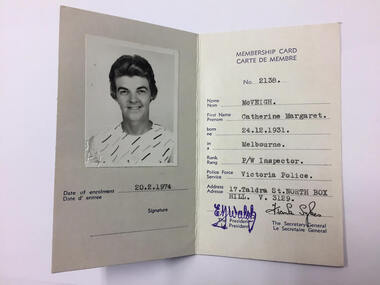
Identification Card, Catherine Margaret McVeigh, 20 February 1974
... In 1973 Margaret won the Churchill Fellowship award and travelled overseas to study the integration of women into world police forces. ...In 1973 Margaret won the Churchill Fellowship award and travelled overseas to study the integration of women into world police forces. ...Margaret 'Catherine' McVeigh joined the Women's Royal Australian Air Force in 1951, aged 19, discharging at her own request on 10 July 1956. Margaret then joined the Victoria Police Force on 20 June 1956 and served in the Women Police Division. Following the application of the Equal Opportunity Act, Margaret moved to general police duties on 4 January 1979. She was then in charge of No. 3 Division "O" District (Mounted Branch, Police Dog Squad and the Police Horse Stud Farm). In 1973 Margaret won the Churchill Fellowship award and travelled overseas to study the integration of women into world police forces. She then joined the International Police Association and was issued this identification card. Margaret was the first female member of the Victoria Police to attain the rank of Chief Inspector and subsequently Superintendent and Chief Superintendent. In August 1988, at the time of her retirement, she was Chief Superintendent in Charge of the Traffic Operations Group.International Police Association identification card belonging to Police Woman Inspector Catherine Margaret McVeigh. Card has blue cover and is unsigned.mcveigh, catherine margaret, 12428, police women, international police association, police woman, policewomen, policewoman -
 Vision Australia
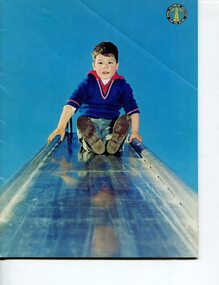
Administrative record - Text, Royal Victorian Institute for the Blind annual report 1967-1968, 1967-1968
... Petersen went on a study tour overseas, F.F. Knight senior Vice President and member of the board for more than seventeen years was honored for his work with a CBE, and the Insurance Institute of Victoria met the cost of a 16mm version of the film "A matter of independence"....Petersen went on a study tour overseas, F.F. Knight senior Vice President and member of the board for more than seventeen years was honored for his work with a CBE, and the Insurance Institute of Victoria met the cost of a 16mm version of the film "A matter of independence". ...Events that occurred in 1967 : Eight suburban craft centres for elderly blind people were established allowing a half day each week for people, the institute's secretary E.E. Petersen went on a study tour overseas, F.F. Knight senior Vice President and member of the board for more than seventeen years was honored for his work with a CBE, and the Insurance Institute of Victoria met the cost of a 16mm version of the film "A matter of independence".1 volume of printed and illustrated materialannual reports, royal victorian institute for the blind -
 Federation University Art Collection
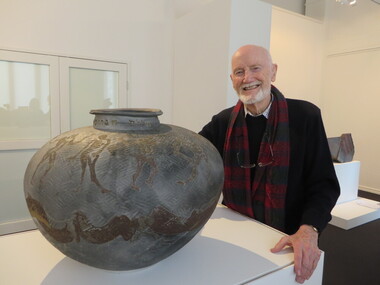
Ceramic - Pottery, 'Shalom Vessel' by Hedley Potts, c1988
... In 1974 he received an Australian Council Crafts Board grant to study overseas, and was visiting artist at the Goldsmith's College, University of London in 1979. ...In 1974 he received an Australian Council Crafts Board grant to study overseas, and was visiting artist at the Goldsmith's College, University of London in 1979. ...Hedley POTTS (09/11/1936 - 01/06/2023) Hedley Potts studied ceramics at RMIT in the early 1960s. In 1974 he received an Australian Council Crafts Board grant to study overseas, and was visiting artist at the Goldsmith's College, University of London in 1979. He was appointed as Senior Lecturer in Ceramics at the Gippsland Institute of Advanced Education in 1972 when he introduced Ceramics into the program fo the first time. By the 1980s Potts he was a senior lecturer in Ceramics at Monash University's Churchill Campus (now Federation University). In 1995, Hedley Potts was appointed artist in residence at Kingston Arts Centre in Moorabbin. He was one of the artists represented in the Ceramics Victoria Inc 40th Anniversary exhibition in 2009. He incises his works 'Hedley Potts' on the base.Handbuilt raku fired earthenware.ceramics, blackware, jan feder, jan feder memorial ceramics collection, gippsland campus, moorleigh ceramic co-op, hedley potts -
 Flagstaff Hill Maritime Museum and Village
Furniture - Smoker's Cabinet, 1927
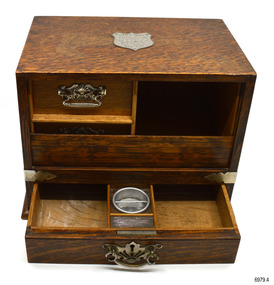
... It may have been chosen as something suitable for Dr Angus to take with him when shortly afterwards sailed overseas to study at the London University College Hospital and at the Edinburgh Royal Infirmary. ...It may have been chosen as something suitable for Dr Angus to take with him when shortly afterwards sailed overseas to study at the London University College Hospital and at the Edinburgh Royal Infirmary. ...This smoker’s cabinet is a very decorative and clever version of the item that was a novelty piece of furniture that appeared before the First World War. The contents of the cabinet are cleverly hidden behind a tambour roller door. The door slides down into the cabinet when the bottom drawer is unlocked and pulled forward, revealing two more drawers and a shelf. The bottom drawer is fitted with its own removable ashtray and a match striker. The smoker’s cabinet was a popular piece of personal furniture from the 1900s to the 1930s. The cabinet was usually designed so that its purpose was hidden. Behind the door would be a place to store all manner of things associated with smoking, such as pipes, cigars or tobacco, a removable ashtray, matches and perhaps cigar trimmers. The small cabinet was presented to Dr Angus in March 1927 by patients of the Mira hospital in Nhill, Victoria, to show their appreciation for his care. It may have been chosen as something suitable for Dr Angus to take with him when shortly afterwards sailed overseas to study at the London University College Hospital and at the Edinburgh Royal Infirmary. In 1928 he became a Fellow of the Royal College of Surgeons, Edinburgh, before returning to Australia. He and his wife and their young family settled in the Nhill district until moving to Warrnambool in 1939. His family donated this smoker’s cabinet, along with many other historic items, and it is now part of the W.R. Angus Collection. W.R. Angus Collection- The W R Angus Collection spans from 1885 to the mid-1900s and includes historical medical and surgical equipment and instruments from the doctors Edward and Thomas Ryan of Nhill, Victoria. Dr Angus married Gladys in 1927 at Ballarat, the nearest big city to Nhill where he began as a Medical Assistant. He was also Acting House surgeon at the Nhill hospital where their two daughters were born. He and his family moved to Warrnambool in 1939, where Dr Angus operated his own medical practice. He later added the part-time Port Medical Officer responsibility and was the last person appointed to that position. Dr Angus and his wife were very involved in the local community, including the early planning stages of the new Flagstaff Hill, where they contributed to the layout of the gardens. Dr Angus passed away in March 1970.This smoker’s cabinet is significant as an unusual and rare piece of personal vintage furniture. The tambour roller door is seldom seen on this type of cabinet. The smoker’s cabinet is connected to the history of Warrnambool, as it was owned by Dr W. R. Angus and is part of the W.R. Angus Collection, which is notable for still being located at the site connected to Doctor Angus, Warrnambool’s last Port Medical Officer. It is also connected to the history of western Victoria through its origin, being a gift from the patients of the Mira Hospital in Nhill to Dr Angus, who was the local doctor there in the 1920s and 1930s. Smoker’s cabinet; a stained and lacquered Rosewood tabletop cabinet with a tambour cover. The cabinet is lockable. The tambour shutter door rolls downwards as the bottom drawer is opened, revealing the top two drawers and shelf. The bottom drawer is divided into compartments and has a fitted metal bowl with a bar across it to use as an ashtray and an attached striking surface for lighting matches. The cupboard had decorative silver metal swinging handles on the drawers and sides. The underside of the cabinet is painted crimson. A shield-shaped silver metal commemorative plaque is attached to the top. The cupboard was a gift to Dr W R Angus on March 7th 1927 from the patients of the Mira Hospital in Nhill, Victoria, and is part of the W.R. Angus Collection.Inscription on the plaque: “Dr W.R. ANGUS, A Token of Appreciation from the Patients of “Mira” Hospital, Nhill, Victoria, March 7th 1927.”flagstaff hill, warrnambool, maritime village, maritime museum, shipwreck coast, great ocean road, dr w r angus, dr roy angus, dr ryan, smoker’s cabinet, smoker’s cupboard, tambour door, smoking stand, smoking accessory, novelty furniture, tobacco storage, tabletop cabinet, patients’ gift, mira hospital, nhill hospital, w.r. angus, doctor angus, dr angus, march 7th 1927, w.r. angus collection -
 Sunshine and District Historical Society Incorporated
Administrative record - City of Sunshine - Commissioner Mr Alexander "Alex" George Gillon Collection 1976 - 1982 - Notice of Ordinary Meeting of to be held on Tuesday 25th July 1978, City of Sunshine, 19th July 1978
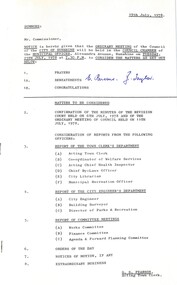
... Notice of Ordinary Meeting of to be held on Tuesday 25th July 1978 Report of the Town Clerk's Department Report of the Town Clerk Lease Italo-Australian Co-Operative Social Club Ltd Supplementary Valuations Overseas Study Tours 1979 Municipal Association of Victoria Appointments Metropolitan Sectional Council Municipal Association of Victoria The Hub Sports Centre Prices Western Region Commission Report of the Co-Ordinator of Welfare Services Special Bus Replacement Willis Street Pre-School Centre Proposal for the Funding of Emergency Relief in the Western Region Family Day Care Family Day Care conference Tenancy Issues Use of Midway Hostel for Emergency Accommodation Home Help Designated Officer's Register Community Youth Support Scheme Deer Park Report of the Acting Chief Health Inspector Prosecutions Proceedings Sunshine Magistrates Court Immunisation Health Act Food Analyses Head Lice Infant Welfare Officers Western Region Environmental Committee Food Poisoning (Oysters) Butcher Shops Extended Opening Report of the Medical Officer of Health Report of the Chief By-Laws Officer Prohibited Parking Withers Street Supervision of School Crossings Main Road East / St. ...Albans Road Hampshire Road Market Road Main Road West Station Road Plantation Street The Esplanade Hulett Street Carter Street White Street Ridley Street Adams Street Bon Thomas Reserve Quinn Street Boral Albion Reid Notice of Ordinary Meeting of to be held on Tuesday 25th July 1978 Report of the Town Clerk's Department Report of the Town Clerk Lease Italo-Australian Co-Operative Social Club Ltd Supplementary Valuations Overseas Study Tours 1979 Municipal Association of Victoria Appointments Metropolitan Sectional Council Municipal Association of Victoria The Hub Sports Centre Prices Western Region Commission Report of the Co-Ordinator of Welfare Services Special Bus Replacement Willis Street Pre-School Centre Proposal for the Funding of Emergency Relief in the Western Region Family Day Care Family Day Care conference Tenancy Issues Use of Midway Hostel for Emergency Accommodation Home Help Designated Officer's Register Community Youth Support Scheme Deer Park Report of the Acting Chief Health Inspector Prosecutions Proceedings Sunshine Magistrates Court Immunisation Health Act Food Analyses Head Lice Infant Welfare Officers Western Region Environmental Committee Food Poisoning (Oysters) Butcher Shops Extended Opening Report of the Medical Officer of Health Report of the Chief By-Laws Officer Prohibited Parking Withers Street Supervision of School Crossings Main Road East / St. ...Notice of Ordinary Meeting of to be held on Tuesday 25th July 1978 Report of the Town Clerk's Department Report of the Town Clerk Lease Italo-Australian Co-Operative Social Club Ltd Supplementary Valuations Overseas Study Tours 1979 Municipal Association of Victoria Appointments Metropolitan Sectional Council Municipal Association of Victoria The Hub Sports Centre Prices Western Region Commission Report of the Co-Ordinator of Welfare Services Special Bus Replacement Willis Street Pre-School Centre Proposal for the Funding of Emergency Relief in the Western Region Family Day Care Family Day Care conference Tenancy Issues Use of Midway Hostel for Emergency Accommodation Home Help Designated Officer's Register Community Youth Support Scheme Deer Park Report of the Acting Chief Health Inspector Prosecutions Proceedings Sunshine Magistrates Court Immunisation Health Act Food Analyses Head Lice Infant Welfare Officers Western Region Environmental Committee Food Poisoning (Oysters) Butcher Shops Extended Opening Report of the Medical Officer of Health Report of the Chief By-Laws Officer Prohibited Parking Withers Street Supervision of School Crossings Main Road East / St. Albans High School and Rosamond Road / Maribyrnong High School Report of the City Librarian Children's Book Night Report of the Municipal Recreation Officer Albion Rovers Soccer Club Hours Club may use Selwyn Park for the Playing of Soccer Department of Youth, Sport and Recreation Commonwealth Games Appeal week Report of the Manager of the Sunshine Swimming Pool and the Deer Park Swimming Pool Report of the City Engineer Town Planning Car Parking Policy Melbourne Metropolitan Parking Study Planning Permit Application Factory Lot 37 Western Avenue Planning Permit Application Single Storey Units Lots 39, 40, 41, 42 & 44 Madden Street Maidstone Planning Permit Application Panel Beating Lot 4 McIntyre Road Planning Permit Application Petrol Filling Station, Bank, Child Minding Centre and Library Highpoint West Shopping Centre Rosamond Road Planning Permit Application Illuminated Facia Sign 29A Sun Crescent Planning Permit Application Extension to Existing Factory Warehouse and Caretaker's Dwelling and Addition of Offices McIntyre Road and Cromer Avenue Planning Permit Application Illuminated Facia Sign Sun Crescent C.S.C. Homes Pty Ltd, Sun Crescent Planning 7 C.S.C. Estate Agency Planning Permit Application Service Premises & Caretaker's Dwelling Lot 1 Ballarat Road Planning Permit Application Extension to Existing Warehouse Lot 13 McIntyre Road Planning Permit Application Re-building of Existing Shop 105 Anderson Road West Corner of Fraser Street Planning Permit Application Warehouse Corner McIntyre Road and Balwin Avenue Planning Permit Application Extension to Existing Car Sales Yard and Motor Repair Station 31 St. Albans Road Planning Permit Application Car Sales Yard Ballarat Road South West Corner Hampshire Road Planning Permit Application 3 Factories Market Road Brooklyn Consolidation of Title Station Road and Main Road West Shell Co of Australia Drainage Construction Subdivision Plantation Street and The Esplanade Plan of Consolidation Hulett Street Boral Albion Reid Strata Subdivision of 2 Carter Street Consolidation of Title Rosamond Road and White Street Contract Playground Equipment Various Reserves Tenders for Surplus Vehicles Tender for Tractor Mower Use of Asphalt Plant Melbourne City Council Hulett Street Private Street Scheme Declaration of Sewage Areas No 3513 & 3499 Sewage Facilities to Premises St. Albans Report of the Building Surveyor Ruinous and Dangerous Building Lots 6 & 7 Furlong Road Sunshine North Ruinous and Dangerous Building 28 - 30 Ridley Street Albion Relocation of Housee to Lot 26 Adams Street St. Albans Flats Lots 3 & 4 Ballarat Road Deer Park Seminar Residential Slab Construction 31st August 1978 Report of the Director of Parks & Recreation Reserves Development Reserves Active Usage Patterns Bon Thomas Reserve Development Orders of the Day Accounts Submitted for Payment as at 3rd July 1978 city of sunshine, alexander "alex" george gillon, italo-australian co-operative social club, furlong road, st. albans, the hub, sun crescent, sunshine, willis street pre-school centre, willis street, midway hostel, williamson road, maribyrnong, main road east, st. albans high school, rosamond road, maribyrnong high school, albion rovers soccer club, selwyn park, selwyn street, albion, sunshine swimming pool, kennedy street, deer park swimming pool, deer park, western avenue, madden street, maidstone, mcintyre road, sunshine north, highpoint west shopping centre, cromer avenue, ballarat road, anderson road, fraser street, balwin avenue, st. albans road, hampshire road, market road, main road west, station road, plantation street, the esplanade, hulett street, carter street, white street, ridley street, adams street, bon thomas reserve, quinn street, boral albion reid -
 Sunshine and District Historical Society Incorporated
Administrative record - City of Sunshine - Commissioner Mr Alexander "Alex" George Gillon Collection 1976 - 1982 - Minutes of the ordinary meeting of council held on 25th July 1978, City of Sunshine, 25th July 1978
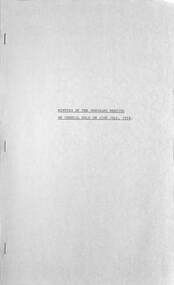
... Minutes of the meeting of the sunshine city council held on 25th July 1978 Report of the Town Clerk's Department Report of the Town Clerk Lease Italo-Australian Co-Operative Social Club Ltd Supplementary Valuations Overseas Study Tours 1979 Municipal Association of Victoria Appointments Metropolitan Sectional Council Municipal Association of Victoria The Hub Sports Centre Prices Western Region Commission Report of the Co-Ordinator of Welfare Services Special Bus Replacement Willis Street Pre-School Centre Proposal for the Funding of Emergency Relief in the Western Region Family Day Care Family Day Care conference Tenancy Issues Use of Midway Hostel for Emergency Accommodation Home Help Designated Officer's Register Community Youth Support Scheme Deer Park Report of the Acting Chief Health Inspector Prosecutions Proceedings Sunshine Magistrates Court Immunisation Health Act Food Analyses Head Lice Infant Welfare Officers Western Region Environmental Committee Food Poisoning (Oysters) Butcher Shops Extended Opening Report of the Medical Officer of Health Report of the Chief By-Laws Officer Prohibited Parking Withers Street Supervision of School Crossings Main Road East / St. ...Burton Crescent Minutes of the meeting of the sunshine city council held on 25th July 1978 Report of the Town Clerk's Department Report of the Town Clerk Lease Italo-Australian Co-Operative Social Club Ltd Supplementary Valuations Overseas Study Tours 1979 Municipal Association of Victoria Appointments Metropolitan Sectional Council Municipal Association of Victoria The Hub Sports Centre Prices Western Region Commission Report of the Co-Ordinator of Welfare Services Special Bus Replacement Willis Street Pre-School Centre Proposal for the Funding of Emergency Relief in the Western Region Family Day Care Family Day Care conference Tenancy Issues Use of Midway Hostel for Emergency Accommodation Home Help Designated Officer's Register Community Youth Support Scheme Deer Park Report of the Acting Chief Health Inspector Prosecutions Proceedings Sunshine Magistrates Court Immunisation Health Act Food Analyses Head Lice Infant Welfare Officers Western Region Environmental Committee Food Poisoning (Oysters) Butcher Shops Extended Opening Report of the Medical Officer of Health Report of the Chief By-Laws Officer Prohibited Parking Withers Street Supervision of School Crossings Main Road East / St. ...Minutes of the meeting of the sunshine city council held on 25th July 1978 Report of the Town Clerk's Department Report of the Town Clerk Lease Italo-Australian Co-Operative Social Club Ltd Supplementary Valuations Overseas Study Tours 1979 Municipal Association of Victoria Appointments Metropolitan Sectional Council Municipal Association of Victoria The Hub Sports Centre Prices Western Region Commission Report of the Co-Ordinator of Welfare Services Special Bus Replacement Willis Street Pre-School Centre Proposal for the Funding of Emergency Relief in the Western Region Family Day Care Family Day Care conference Tenancy Issues Use of Midway Hostel for Emergency Accommodation Home Help Designated Officer's Register Community Youth Support Scheme Deer Park Report of the Acting Chief Health Inspector Prosecutions Proceedings Sunshine Magistrates Court Immunisation Health Act Food Analyses Head Lice Infant Welfare Officers Western Region Environmental Committee Food Poisoning (Oysters) Butcher Shops Extended Opening Report of the Medical Officer of Health Report of the Chief By-Laws Officer Prohibited Parking Withers Street Supervision of School Crossings Main Road East / St. Albans High School and Rosamond Road / Maribyrnong High School Report of the City Librarian Children's Book Night Report of the Municipal Recreation Officer Albion Rovers Soccer Club Hours Club may use Selwyn Park for the Playing of Soccer Department of Youth, Sport and Recreation Commonwealth Games Appeal week Report of the Manager of the Sunshine Swimming Pool and the Deer Park Swimming Pool Report of the City Engineer Town Planning Car Parking Policy Melbourne Metropolitan Parking Study Planning Permit Application Factory Lot 37 Western Avenue Planning Permit Application Single Storey Units Lots 39, 40, 41, 42 & 44 Madden Street Maidstone Planning Permit Application Panel Beating Lot 4 McIntyre Road Planning Permit Application Petrol Filling Station, Bank, Child Minding Centre and Library Highpoint West Shopping Centre Rosamond Road Planning Permit Application Illuminated Facia Sign 29A Sun Crescent Planning Permit Application Extension to Existing Factory Warehouse and Caretaker's Dwelling and Addition of Offices McIntyre Road and Cromer Avenue Planning Permit Application Illuminated Facia Sign Sun Crescent C.S.C. Homes Pty Ltd, Sun Crescent Planning 7 C.S.C. Estate Agency Planning Permit Application Service Premises & Caretaker's Dwelling Lot 1 Ballarat Road Planning Permit Application Extension to Existing Warehouse Lot 13 McIntyre Road Planning Permit Application Re-building of Existing Shop 105 Anderson Road West Corner of Fraser Street Planning Permit Application Warehouse Corner McIntyre Road and Balwin Avenue Planning Permit Application Extension to Existing Car Sales Yard and Motor Repair Station 31 St. Albans Road Planning Permit Application Car Sales Yard Ballarat Road South West Corner Hampshire Road Planning Permit Application 3 Factories Market Road Brooklyn Consolidation of Title Station Road and Main Road West Shell Co of Australia Drainage Construction Subdivision Plantation Street and The Esplanade Plan of Consolidation Hulett Street Boral Albion Reid Strata Subdivision of 2 Carter Street Consolidation of Title Rosamond Road and White Street Contract Playground Equipment Various Reserves Tenders for Surplus Vehicles Tender for Tractor Mower Use of Asphalt Plant Melbourne City Council Hulett Street Private Street Scheme Declaration of Sewage Areas No 3513 & 3499 Sewage Facilities to Premises St. Albans Report of the Building Surveyor Ruinous and Dangerous Building Lots 6 & 7 Furlong Road Sunshine North Ruinous and Dangerous Building 28 - 30 Ridley Street Albion Relocation of Housee to Lot 26 Adams Street St. Albans Flats Lots 3 & 4 Ballarat Road Deer Park Seminar Residential Slab Construction 31st August 1978 Report of the Director of Parks & Recreation Reserves Development Reserves Active Usage Patterns Bon Thomas Reserve Development Orders of the Day Accounts Submitted for Payment as at 3rd July 1978 Extraordinary Business Report of the City Engineer Ex G.U.D. Premise Burton Crescent Maribyrnong Intersection Ballarat Road / Station Street Statcon Signal Programme Deferred Payment of Costs city of sunshine, alexander "alex" george gillon, italo-australian co-operative social club, furlong road, st. albans, the hub, sun crescent, sunshine, willis street pre-school centre, willis street, midway hostel, williamson road, maribyrnong, withers street, main road east, st. albans high school, rosamond road, maribyrnong high school, albion rovers soccer, selwyn park, selwyn street, albion, sunshine swimming pool, kennedy street, deer park swimming pool, deer park, western avenue, madden street, maidstone, mcintyre road, highpoint west shopping centre, cromer avenue, sunshine north, ballarat road, anderson road, fraser street, balwin avenue, st. albans road, hampshire road, market road, brooklyn, main road west, plantation street, the esplanade, hulett street, boral albion reid, carter street, white street, ridley street, adams street, bon thomas reserve, quinn street, g.u.d., burton crescent -
 Ballarat Tramway Museum
Magazine, K. V. Newmann and MMTB Public Relations Officer, "MMTB News", 1965
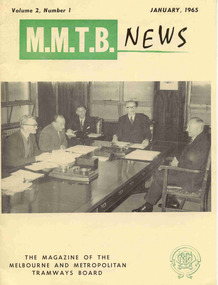
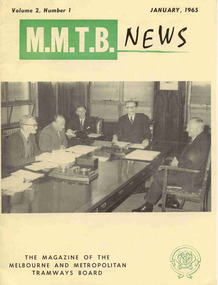
... Stan Bowen, the ARE Tram Tour, and Port Melbourne Tramways Social Angling Club. 2719.5 - Vol. 2, No. 5 - 16 pages, July 1965, with a photo of the Doncaster Bus depot on the front cover, articles or notes; Freeways, Public Transport, Decimal conversion, Doncaster Bus depot, Melbourne in twenty years, Engineering Department - Bus branch, visit of Mr Ken Hall and Frank Kirby overseas to study new trams. 2719.6 - Vol. 2, No. 6 - 20 pages, August September 1965 with a photo of W6 921 being lowered at Preston Depot, with notes or articles; an abridged version of an address by R. ...Stan Bowen, the ARE Tram Tour, and Port Melbourne Tramways Social Angling Club. 2719.5 - Vol. 2, No. 5 - 16 pages, July 1965, with a photo of the Doncaster Bus depot on the front cover, articles or notes; Freeways, Public Transport, Decimal conversion, Doncaster Bus depot, Melbourne in twenty years, Engineering Department - Bus branch, visit of Mr Ken Hall and Frank Kirby overseas to study new trams. 2719.6 - Vol. 2, No. 6 - 20 pages, August September 1965 with a photo of W6 921 being lowered at Preston Depot, with notes or articles; an abridged version of an address by R. ...Eight issues of "MMTB News" - The Magazine of the Melbourne and Metropolitan Tramways Board. Two copies of each issue. Second copy added 31/8/2004. All issues printed with an off-white gloss paper cover with the rest of the magazine white glass paper. 2719.1 - Vol. 2, No. 1 - 16 pages, January 1965, with a photo of the Board meeting in the Board room of the MMTB, notes or articles on traffic congestion, a short history of public street transport in Melbourne, TMSV tour of 7/2/1965 with PCC 980, and" Some Views on Public Transport". 2719.2 - Vol. 2, No. 2 - 16 pages, February 1965, with a photo of Dusseldorf 3 section tramcar on the front cover, notes on the costs of concessions, press visit to the Carlton Power control supervisory centre, "Melbourne - 1985", Mark VI buses, tool safety, "Staggered Working Hours", hydro-foil on Sydney Harbour, "Traffic Congestion". 2719.3 - Vol. 2, No. 3 - 12 pages, March - April 1965, with a photo of W7 1012 and bus 751 on the front cover, notes or articles on "New Trams for Melbourne", retirement of D.H. Eakin, "Traffic Congestion", "Tramway buses at the Gippsland Fires", The Australian Good Neighbour movement. 2719.4 - Vol. 2, No. 4 - 16 pages, May - June 1965, with a photo of L 101 at West Maribyrnong terminus during an Association of Railway Enthusiasts tour (photo Robert Wilson), notes or articles; "A Motorist Speaks Up for Trams", "Tramways Hospital a Major Benefit", parking in the central city, tramway ambulance, "Radio Control is Human Nerve Centre", staff shortages, retirement of Mr. Stan Bowen, the ARE Tram Tour, and Port Melbourne Tramways Social Angling Club. 2719.5 - Vol. 2, No. 5 - 16 pages, July 1965, with a photo of the Doncaster Bus depot on the front cover, articles or notes; Freeways, Public Transport, Decimal conversion, Doncaster Bus depot, Melbourne in twenty years, Engineering Department - Bus branch, visit of Mr Ken Hall and Frank Kirby overseas to study new trams. 2719.6 - Vol. 2, No. 6 - 20 pages, August September 1965 with a photo of W6 921 being lowered at Preston Depot, with notes or articles; an abridged version of an address by R. J. Risson to the Constitutional Club in Melbourne, lost items on trams, Bus Engineering, and social or sporting club news. 2719.7 - Vol. 2, No. 7 - 16 pages, October - November 1965 with a photo of PCC 980 on the front cover, notes or articles on; free travel for USA City shoppers, safety, Stores Department printing section, Ballarat's Tramways Diamond Jubilee - TMSV tour to Ballarat on 15/8/1965 including two photos, PCC 980, Christmas functions, retirement of Arthur Wisdom and Bill Wallis. (Reference photos Reg. Item - 1877). See btm2819i9 for image of the article re the TMSV Tour to Ballarat. 2719.8 - Vol. 2, No. 8 - 16 pages, December 1965 with a photo of cable car set No. 1 on the front cover with notes or articles; Children's art show, "Quest for New Tram", "The Development of Melbourne's Trams" and sporting or social club news. Has a Christmas message from Chairman, Mr. Risson with photograph.Each issue has stamped on the front cover or inside "The Australian Railway Historical Society (S.A. Branch).trams, tramways, mmtb, carlton control, buses, pcc 980, ballarat, new trams, are, tmsv -
 Melbourne Tram Museum
Magazine, K. V. Newmann, MMTB Public Relations Officer, "MMTB News", 1965
... Stan Bowen, the ARE Tram Tour, and Port Melbourne Tramways Social Angling Club. 1722.5 - Vol. 2, No. 5 - 16 pages, July 1965, with a photo of the Doncaster Bus depot on the front cover, articles or notes; Freeways, Public Transport, Decimal conversion, Doncaster Bus depot, Melbourne in twenty years, Engineering Department - Bus branch, visit of Mr Ken Hall and Frank Kirby overseas to study new trams. 1722.6 - Vol. 2, No. 6 - 20 pages, August September 1965 with a photo of W6 921 being lowered at Preston Depot, with notes or articles; an abridged version of an address by R. ...Stan Bowen, the ARE Tram Tour, and Port Melbourne Tramways Social Angling Club. 1722.5 - Vol. 2, No. 5 - 16 pages, July 1965, with a photo of the Doncaster Bus depot on the front cover, articles or notes; Freeways, Public Transport, Decimal conversion, Doncaster Bus depot, Melbourne in twenty years, Engineering Department - Bus branch, visit of Mr Ken Hall and Frank Kirby overseas to study new trams. 1722.6 - Vol. 2, No. 6 - 20 pages, August September 1965 with a photo of W6 921 being lowered at Preston Depot, with notes or articles; an abridged version of an address by R. ...Eight issues of "MMTB News" - The Magazine of the Melbourne and Metropolitan Tramways Board. Two copies of each issue. All issues printed with an off-white gloss paper cover with the rest of the magazine white glass paper. 1722.1 - Vol. 2, No. 1 - 16 pages, January 1965, with a photo of the Board meeting in the Board room of the MMTB, notes or articles on traffic congestion, a short history of public street transport in Melbourne, TMSV tour of 7/2/1965 with PCC 980, and" Some Views on Public Transport". 1722.2 - Vol. 2, No. 2 - 16 pages, February 1965, with a photo of Dusseldorf 3 section tramcar on the front cover, notes on the costs of concessions, press visit to the Carlton Power control supervisory centre, "Melbourne - 1985", Mark VI buses, tool safety, "Staggered Working Hours", hydro-foil on Sydney Harbour, "Traffic Congestion". 1722.3 - Vol. 2, No. 3 - 12 pages, March - April 1965, with a photo of W7 1012 and bus 751 on the front cover, notes or articles on "New Trams for Melbourne", retirement of D.H. Eakin, "Traffic Congestion", "Tramway buses at the Gippsland Fires", The Australian Good Neighbour movement. 1722.4 - Vol. 2, No. 4 - 16 pages, May - June 1965, with a photo of L 101 at West Maribyrnong terminus during an Association of Railway Enthusiasts tour (photo Robert Wilson), notes or articles; "A Motorist Speaks Up for Trams", "Tramways Hospital a Major Benefit", parking in the central city, tramway ambulance, "Radio Control is Human Nerve Centre", staff shortages, retirement of Mr. Stan Bowen, the ARE Tram Tour, and Port Melbourne Tramways Social Angling Club. 1722.5 - Vol. 2, No. 5 - 16 pages, July 1965, with a photo of the Doncaster Bus depot on the front cover, articles or notes; Freeways, Public Transport, Decimal conversion, Doncaster Bus depot, Melbourne in twenty years, Engineering Department - Bus branch, visit of Mr Ken Hall and Frank Kirby overseas to study new trams. 1722.6 - Vol. 2, No. 6 - 20 pages, August September 1965 with a photo of W6 921 being lowered at Preston Depot, with notes or articles; an abridged version of an address by R. J. Risson to the Constitutional Club in Melbourne, lost items on trams, Bus Engineering, and social or sporting club news. 1722.7 - Vol. 2, No. 7 - 16 pages, October - November 1965 with a photo of PCC 980 on the front cover, notes or articles on; free travel for USA City shoppers, safety, Stores Department printing section, Ballarat's Tramways Diamond Jubilee - TMSV tour to Ballarat on 15/8/1965 including two photos, PCC 980, Christmas functions, retirement of Arthur Wisdom and Bill Wallis. (Reference photos Reg. Item - 1877). See btm2819i9 for image of the article re the TMSV Tour to Ballarat. 1722.8 - Vol. 2, No. 8 - 16 pages, December 1965 with a photo of cable car set No. 1 on the front cover with notes or articles; Children's art show, "Quest for New Tram", "The Development of Melbourne's Trams" and sporting or social club news. Has a Christmas message from Chairman, Mr. Risson with photograph.trams, tramways, mmtb, carlton control, buses, pcc 980, ballarat, new trams, are, tmsv -
 Flagstaff Hill Maritime Museum and Village
Clothing - Belt, late 1920's
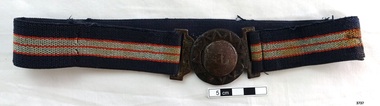
... “LARGS BAY”, when he worked his passage to the UK and return to Australia for his overseas studies. He was awarded the FRCS (Fellow from the Royal College of Surgeons) in 1928 in Edinburgh, Scotland. ...“LARGS BAY”, when he worked his passage to the UK and return to Australia for his overseas studies. He was awarded the FRCS (Fellow from the Royal College of Surgeons) in 1928 in Edinburgh, Scotland. ...This late 1920’s elastic belt is decorated with an anchor, giving it a nautical theme. It was worn by Dr W.R. Angus during his service as ship’s surgeon on ships "BANESHIRE" and the Australian Commonwealth Line’s T.S.S. “LARGS BAY”, when he worked his passage to the UK and return to Australia for his overseas studies. He was awarded the FRCS (Fellow from the Royal College of Surgeons) in 1928 in Edinburgh, Scotland. The belt was donated to Flagstaff Hill Maritime Village, along with photos of the ship LARGS BAY and of Dr Angus in his ship surgeon’s uniform, by the family of Doctor William Roy Angus, Surgeon and Oculist. ABOUT THE “W.R.ANGUS COLLECTION” Doctor William Roy Angus M.B., B.S., Adel., 1923, F.R.C.S. Edin.,1928 (also known as Dr Roy Angus) was born in Murrumbeena, Victoria in 1901 and lived until 1970. He qualified as a doctor in 1923 at University of Adelaide, was Resident Medical Officer at the Royal Adelaide Hospital in 1924 and for a period was house surgeon to Sir (then Mr.) Henry Simpson Newland. Dr Angus was briefly an Assistant to Dr Riddell of Kapunda, then commenced private practice at Curramulka, Yorke Peninsula, SA, where he was physician, surgeon and chemist. In 1926, he was appointed as new Medical Assistant to Dr Thomas Francis Ryan (T.F. Ryan, or Tom), in Nhill, Victoria, where his experiences included radiology and pharmacy. In 1927 he was Acting House Surgeon in Dr Tom Ryan’s absence. Dr Angus had become engaged to Gladys Forsyth and they decided he further his studies overseas in the UK in 1927. He studied at London University College Hospital and at Edinburgh Royal Infirmary and in 1928, was awarded FRCS (Fellow from the Royal College of Surgeons), Edinburgh. He worked his passage back to Australia as a Ship’s Surgeon on the on the Australian Commonwealth Line’s T.S.S. Largs Bay. Dr Angus married Gladys in 1929, in Ballarat. (They went on to have one son (Graham 1932, born in SA) and two daughters (Helen (died 12/07/1996) and Berenice (Berry), both born at Mira, Nhill ) According to Berry, her mother Gladys made a lot of their clothes. She was very talented and did some lovely embroidery including lingerie for her trousseau and beautifully handmade baby clothes. Dr Angus was a ‘flying doctor’ for the A.I.M. (Australian Inland Ministry) Aerial Medical Service in 1928 . Its first station was in the remote town of Oodnadatta, where Dr Angus was stationed. He was locum tenens there on North-South Railway at 21 Mile Camp. He took up this ‘flying doctor’ position in response to a call from Dr John Flynn; the organisation was later known as the Flying Doctor Service, then the Royal Flying Doctor Service. A lot of his work during this time involved dental surgery also. Between 1928-1932 he was surgeon at the Curramulka Hospital, Yorke Peninsula, South Australia. In 1933 Dr Angus returned to Nhill and purchased a share of the Nelson Street practice and Mira hospital (a 2 bed ward at the Nelson Street Practice) from Dr Les Middleton one of the Middleton Brothers, the current owners of what previously once Dr Tom Ryan’s practice. Dr Tom and his brother had worked as surgeons included eye surgery. Dr Tom Ryan performed many of his operations in the Mira private hospital on his premises. He had been House Surgeon at the Nhill Hospital 1902-1926. Dr Tom Ryan had one of the only two pieces of radiology equipment in Victoria during his practicing years – The Royal Melbourne Hospital had the other one. Over the years Dr Tom Ryan had gradually set up what was effectively a training school for country general-practitioner-surgeons. Each patient was carefully examined, including using the X-ray machine, and any surgery was discussed and planned with Dr Ryan’s assistants several days in advance. Dr Angus gained experience in using the X-ray machine there during his time as assistant to Dr Ryan. When Dr Angus bought into the Nelson Street premises in Nhill he was also appointed as the Nhill Hospital’s Honorary House Surgeon 1933-1938. His practitioner’s plate from his Nhill surgery is now mounted on the doorway to the Port Medical Office at Flagstaff Hill Maritime Village, Warrnambool. When Dr Angus took up practice in the Dr Edward and Dr Tom Ryan’s old premises he obtained their extensive collection of historical medical equipment and materials spanning 1884-1926. A large part of this collection is now on display at the Port Medical Office at Flagstaff Hill Maritime Village in Warrnambool. In 1939 Dr Angus and his family moved to Warrnambool where he purchased “Birchwood,” the 1852 home and medical practice of Dr John Hunter Henderson, at 214 Koroit Street. (This property was sold in1965 to the State Government and is now the site of the Warrnambool Police Station. and an ALDI store is on the land that was once their tennis court). The Angus family was able to afford gardeners, cooks and maids; their home was a popular place for visiting dignitaries to stay whilst visiting Warrnambool. Dr Angus had his own silk worm farm at home in a Mulberry tree. His young daughter used his centrifuge for spinning the silk. Dr Angus was appointed on a part-time basis as Port Medical Officer (Health Officer) in Warrnambool and held this position until the 1940’s when the government no longer required the service of a Port Medical Officer in Warrnambool; he was thus Warrnambool’s last serving Port Medical Officer. (Masters of immigrant ships arriving in port reported incidents of diseases, illness and death and the Port Medical Officer made a decision on whether the ship required Quarantine and for how long, in this way preventing contagious illness from spreading from new immigrants to the residents already in the colony.) Dr Angus was a member of the Australian Medical Association, for 35 years and surgeon at the Warrnambool Base Hospital 1939-1942, Dr Angus served with the Australian Department of Defence as a Surgeon Captain during WWII 1942-45, in Ballarat, Victoria, and in Bonegilla, N.S.W., completing his service just before the end of the war due to suffering from a heart attack. During his convalescence he carved an intricate and ‘most artistic’ chess set from the material that dentures were made from. He then studied ophthalmology at the Royal Melbourne Eye and Ear Hospital and created cosmetically superior artificial eyes by pioneering using the intrascleral cartilage. Angus received accolades from the Ophthalmological Society of Australasia for this work. He returned to Warrnambool to commence practice as an ophthalmologist, pioneering in artificial eye improvements. He was Honorary Consultant Ophthalmologist to Warrnambool Base Hospital for 31 years. He made monthly visits to Portland as a visiting surgeon, to perform eye surgery. He represented the Victorian South-West subdivision of the Australian Medical Association as its secretary between 1949 and 1956 and as chairman from 1956 to 1958. In 1968 Dr Angus was elected member of Spain’s Barraquer Institute of Barcelona after his research work in Intrasclearal cartilage grafting, becoming one of the few Australian ophthalmologists to receive this honour, and in the following year presented his final paper on Living Intrasclearal Cartilage Implants at the Inaugural Meeting of the Australian College of Ophthalmologists in Melbourne In his personal life Dr Angus was a Presbyterian and treated Sunday as a Sabbath, a day of rest. He would visit 3 or 4 country patients on a Sunday, taking his children along ‘for the ride’ and to visit with him. Sunday evenings he would play the pianola and sing Scottish songs to his family. One of Dr Angus’ patients was Margaret MacKenzie, author of a book on local shipwrecks that she’d seen as an eye witness from the late 1880’s in Peterborough, Victoria. In the early 1950’s Dr Angus, painted a picture of a shipwreck for the cover jacket of Margaret’s book, Shipwrecks and More Shipwrecks. She was blind in later life and her daughter wrote the actual book for her. Dr Angus and his wife Gladys were very involved in Warrnambool’s society with a strong interest in civic affairs. He had an interest in people and the community They were both involved in the creation of Flagstaff Hill, including the layout of the gardens. After his death (28th March 1970) his family requested his practitioner’s plate, medical instruments and some personal belongings be displayed in the Port Medical Office surgery at Flagstaff Hill Maritime Village, and be called the “W. R. Angus Collection”. This belt is representative of the uniform worn by ship’s staff in the 1920’s. The belt is also representative of Australian medical students travelling overseas to complete their medical studies. The W.R. Angus Collection is significant for still being located at the site it is connected with, Doctor Angus being the last Port Medical Officer in Warrnambool. The collection of medical instruments and other equipment is culturally significant, being an historical example of medicine, administration, household equipment and clothing from late 19th to mid-20th century. Dr Angus assisted Dr Tom Ryan, a pioneer in the use of X-rays and in ocular surgery. Belt, part of the W.R. Angus Collection. Elastic belt, black, grey and red horizontal stripes. Round black-painted metal fastening on each end with remnants of gold zing-zag border around buckle’s wreath end an anchor impressed into the buckle’s tongue. flagstaff hill, warrnambool, shipwrecked coast, flagstaff hill maritime museum, maritime museum, shipwreck coast, flagstaff hill maritime village, great ocean road, dr w r angus, dr ryan, t.s.s. largs bay, warrnambool base hospital, nhill base hospital, mira hospital, flying doctor, ship medical staff uniform, ship medical staff belt, 1920’s elastic belt with tongue and wreath buckle, tongue and wreath belt buckle with anchor symbol, ship staff uniform, 1920’s belt -
 Sunshine and District Historical Society Incorporated
Administrative record - City of Sunshine - Commissioner Mr Alexander Alex George Gillon Collection 1976 - 1982 - Minutes of the ordinary meeting of council held on 28th Nov 1978, City of Sunshine, 28th November 1978
... Camelot Drive East Side Consolidation of Title Ballarat Road Deer Park Consolidation of Title Gee Street Sunshine North Consolidation of Title Comley Street Consolidation of Title Pineneedle Court Strata Subdivision 28 Sydney Street Drainage Works Robinsons Road Shire of Melton Intersection Ballarat Road / Station Road Statcon Signal Programme Deferred Payment of Costs Traffic Conditions Traffic Lights Versus Roundabouts Traffic Signal Maintenance State Highways Overseas Study Tour 1979 Local Government Engineers Association of Victoria Preference to Unionists Federated Municipal and Shire council Employees' Union of Australia Victoria Division Sewerage Facilities M.M.B.W. ...Camelot Drive East Side Consolidation of Title Ballarat Road Deer Park Consolidation of Title Gee Street Sunshine North Consolidation of Title Comley Street Consolidation of Title Pineneedle Court Strata Subdivision 28 Sydney Street Drainage Works Robinsons Road Shire of Melton Intersection Ballarat Road / Station Road Statcon Signal Programme Deferred Payment of Costs Traffic Conditions Traffic Lights Versus Roundabouts Traffic Signal Maintenance State Highways Overseas Study Tour 1979 Local Government Engineers Association of Victoria Preference to Unionists Federated Municipal and Shire council Employees' Union of Australia Victoria Division Sewerage Facilities M.M.B.W. ...Minutes of the Ordinary Meeting of Council held on 28th Nov 1978 Report of the Town Clerk's Department Report of the Town Clerk Dempster Park Proposed Lease to Sunshine Cricket Club Issue of Title on former Devonshire Road between Railway Line and Anderson Road was Discontinued (H.V. McKay Memorial Gardens) Application for Title former Right of Way off Railway Parade Deer Park Christmas Recess The Hub Loan Borrowings Meals on Wheels Co-Ordinator of Welfare Services Deer Park Hall Pre-School Centre & Deer Park West Kindergarten Committee Northumberland Road Child Care Centre Settlement Committee Midway Hostel Maribyrnong Report of the Chief Health Inspector Issuing of Septic tank Approval Notices Application for Transfer of Proprietorship of Premises Under The Health Act Noise By-Law Nuisance Condition 403 Ballarat Road Sunshine Health Act Registration (Late Fee) Report of the Medical Officer of Health Report of the Chief By-Laws Officer Disposal of Derelict Vehicles Report of the City Librarian Library Hours Over the Christmas New Year Period Bookmobile Sites During Christmas School Holidays Report of the Municipal Recreation Officer Swimming Pool Sunshine Swimming & Life Saving Club use of the New Heated Pool Rent to be paid by Sunshine & District Table Tennis Association Report of the City Engineer Policy Advertising Procedures Under Section 18B of the Town and Country Planning Act 1961 as Amended Proposed Rezoning of Former Sunshine Post Office Corner of Dickson Street and Station Place Planning Permit Application Detached Houses Lots 26, 29 & 30 Chifley Drive Maribyrnong Planning Permit Application Factory Lot 19 McIntyre Road Planning Permit Application Amusement Parlour & Cafe 54A Station Place Planning Permit Application Food Premises and Caretaker's Residence Addition to Existing Retail Plant Nursery and Live Poutry Sales Lot 1 Emu Road South East Side of Hampstead Road Planning Permit Application New Offices and Showrooms Railway Lot 24 Berkshire Road North West Corner of Steers Street Planning Permit Application Sky Sign 240 Hampshire Road Planning Permit Application Sky Sign 152 Ballarat Road Planning Permit Application Garage Extension 64 - 66 Monash Street (Former Petrol Station Site) Planning Permit Application Service Premise & Caretaker's Dwelling and Associated Car Parking South East Corner of Aycliffe Drive and Tamar Drive Planning Permit Application 6 Lot Subdivision Camelot Drive South East Corner Main Road West Planning Permit Application Vicarage (Caretaker's Residence) Addition to Existing Place of Worship and Place of Assembly Church of England Darnley Street Planning Permit Application Subdivision & Detached Houses Lot 1001 Neale Road North Side Planning Permit Application Subdivision & Detached Houses Lot 1001 Oakwood Road North of Neale Road Planning Permit Application Subdivision & Detached Houses Lot 1000 Fairfax Circuit North of Neale Road Planning Permit Application Illuminated Sign 195 Hampshire Road Planning Permit Application Consulting Room Dental Clinic Lots 9, 10 & Part 11 Main Road West South East Corner Pennell Street Planning Permit Application Private Tip Lot 35 Reid Street Plan of Subdivision Fairfax Circuit & Oakwood Road Plan of Subdivision Neale Road, Fairfax Circuit & Antioch Court Plan of Subdivision R.D.C. Camelot Drive East Side Consolidation of Title Ballarat Road Deer Park Consolidation of Title Gee Street Sunshine North Consolidation of Title Comley Street Consolidation of Title Pineneedle Court Strata Subdivision 28 Sydney Street Drainage Works Robinsons Road Shire of Melton Intersection Ballarat Road / Station Road Statcon Signal Programme Deferred Payment of Costs Traffic Conditions Traffic Lights Versus Roundabouts Traffic Signal Maintenance State Highways Overseas Study Tour 1979 Local Government Engineers Association of Victoria Preference to Unionists Federated Municipal and Shire council Employees' Union of Australia Victoria Division Sewerage Facilities M.M.B.W. St. Albans and Sunshine West Areas Child Care Facility 24 Northumberland Road Sunshine North Planning Permits Furlong Road Infant Welfare Centre, Tallintyre Reserve Infant Welfare Centre, Beachley Reserve Infant Welfare Centre & Station Road Infant Welfare Centre Half Cost Fencing Dumfries Street Deer Park Albion Tennis Club Selwyn Park Lack of Toilet Facilities Report of the Building Surveyor Building Over Easement 13 Fairbairn Road Sunshine West Building Over Easement 6 Chestnut Drive St. Albans Building Over Easement 54 Angelique Grove Deer Park Fence Over 2.0m 9 Amelia Street Deer Park Sitting of Building Lot 598 Droitwich Crescent Deer Park Sitting of Building 3 Dundalk Street Sunshine Sitting of Building Lot 64 Tulloch Street Deer Park Sitting of Building 21 Cambridge Street Maidstone Extensions of Time for Building Permit Lots 923, 924 & 925 Fernhill Court Albanvale Breaches of Regulation Lots 3, 4 & 5 Ballarat Road Deer Park Building on Land Liable to Flooding Lot 9 Mernda Street Sunshine West Orders of the Day Accounts Submitted for Payment as a t 15th November 1978 city of sunshine, alexander "alex" george gillon, sunshine cricket club, dempster park, phoenix street, sunshine north, devonshire road, sunshine gardens, anderson road, sunshine, railway parade, deer park, h.v. mckay memorial gardens, the hub, sun crescent, deer park hall pre-school centre, station road, deer park west kindergarten committee, northumberland road child care centre, midway hostel, williamson road, maribyrnong, ballarat road, swimming pool sunshine swimming & life saving club, sunshine swimming pool, kennedy street, sunshine & district table tennis association, sunshine post office, dickson street, station place, chifley drive, mcintyre road, emu road, hampstead road, maidstone, berkshire road, steers street, hampshire road, monash street, aycliffe drive, tamar drive, camelot drive, main road west, albanvale, church of england, darnley street, braybrook, neale road, oakwood road, fairfax circuit, pennell street, st. albans, reid street, albion, antioch court, gee street, comley street, pineneedle court, sydney street, robinsons road, northumberland road, furlong road infant welfare centre, furlong road, tallintyre reserve infant welfare centre, kermeen street, beachley reserve infant welfare centre, ardoyne street, station road infant welfare centre, dumfries street, albion tennis club, selwyn park, selwyn street, fairbairn road, chestnut drive, angelique grove, amelia street, droitwich crescent, dundalk street, tulloch street, cambridge street, fernhill court, mernda street -
 Sunshine and District Historical Society Incorporated
Administrative record - City of Sunshine - Commissioner Mr Alexander Alex George Gillon Collection 1976 - 1982 - Notice of ordinary meeting of the council 28th November 1978, City of Sunshine, 22nd November 1978
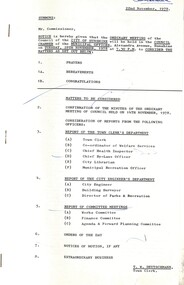
... Camelot Drive East Side Consolidation of Title Ballarat Road Deer Park Consolidation of Title Gee Street Sunshine North Consolidation of Title Comley Street Consolidation of Title Pineneedle Court Strata Subdivision 28 Sydney Street Drainage Works Robinsons Road Shire of Melton Intersection Ballarat Road / Station Road Statcon Signal Programme Deferred Payment of Costs Traffic Conditions Traffic Lights Versus Roundabouts Traffic Signal Maintenance State Highways Overseas Study Tour 1979 Local Government Engineers Association of Victoria Preference to Unionists Federated Municipal and Shire council Employees' Union of Australia Victoria Division Sewerage Facilities M.M.B.W. ...Camelot Drive East Side Consolidation of Title Ballarat Road Deer Park Consolidation of Title Gee Street Sunshine North Consolidation of Title Comley Street Consolidation of Title Pineneedle Court Strata Subdivision 28 Sydney Street Drainage Works Robinsons Road Shire of Melton Intersection Ballarat Road / Station Road Statcon Signal Programme Deferred Payment of Costs Traffic Conditions Traffic Lights Versus Roundabouts Traffic Signal Maintenance State Highways Overseas Study Tour 1979 Local Government Engineers Association of Victoria Preference to Unionists Federated Municipal and Shire council Employees' Union of Australia Victoria Division Sewerage Facilities M.M.B.W. ...Notice of Ordinary Meeting of the Council 28th November 1978 Report of the Town Clerk's Department Report of the Town Clerk Dempster Park Proposed Lease to Sunshine Cricket Club Issue of Title on former Devonshire Road between Railway Line and Anderson Road was Discontinued (H.V. McKay Memorial Gardens) Application for Title former Right of Way off Railway Parade Deer Park Christmas Recess The Hub Loan Borrowings Meals on Wheels Co-Ordinator of Welfare Services Deer Park Hall Pre-School Centre & Deer Park West Kindergarten Committee Northumberland Road Child Care Centre Settlement Committee Midway Hostel Maribyrnong Report of the Chief Health Inspector Issuing of Septic tank Approval Notices Application for Transfer of Proprietorship of Premises Under The Health Act Noise By-Law Nuisance Condition 403 Ballarat Road Sunshine Health Act Registration (Late Fee) Report of the Medical Officer of Health Report of the Chief By-Laws Officer Disposal of Derelict Vehicles Report of the City Librarian Library Hours Over the Christmas New Year Period Bookmobile Sites During Christmas School Holidays Report of the Municipal Recreation Officer Swimming Pool Sunshine Swimming & Life Saving Club use of the New Heated Pool Rent to be paid by Sunshine & District Table Tennis Association Report of the City Engineer Policy Advertising Procedures Under Section 18B of the Town and Country Planning Act 1961 as Amended Proposed Rezoning of Former Sunshine Post Office Corner of Dickson Street and Station Place Planning Permit Application Detached Houses Lots 26, 29 & 30 Chifley Drive Maribyrnong Planning Permit Application Factory Lot 19 McIntyre Road Planning Permit Application Amusement Parlour & Cafe 54A Station Place Planning Permit Application Food Premises and Caretaker's Residence Addition to Existing Retail Plant Nursery and Live Poutry Sales Lot 1 Emu Road South East Side of Hampstead Road Planning Permit Application New Offices and Showrooms Railway Lot 24 Berkshire Road North West Corner of Steers Street Planning Permit Application Sky Sign 240 Hampshire Road Planning Permit Application Sky Sign 152 Ballarat Road Planning Permit Application Garage Extension 64 - 66 Monash Street (Former Petrol Station Site) Planning Permit Application Service Premise & Caretaker's Dwelling and Associated Car Parking South East Corner of Aycliffe Drive and Tamar Drive Planning Permit Application 6 Lot Subdivision Camelot Drive South East Corner Main Road West Planning Permit Application Vicarage (Caretaker's Residence) Addition to Existing Place of Worship and Place of Assembly Church of England Darnley Street Planning Permit Application Subdivision & Detached Houses Lot 1001 Neale Road North Side Planning Permit Application Subdivision & Detached Houses Lot 1001 Oakwood Road North of Neale Road Planning Permit Application Subdivision & Detached Houses Lot 1000 Fairfax Circuit North of Neale Road Planning Permit Application Illuminated Sign 195 Hampshire Road Planning Permit Application Consulting Room Dental Clinic Lots 9, 10 & Part 11 Main Road West South East Corner Pennell Street Planning Permit Application Private Tip Lot 35 Reid Street Plan of Subdivision Fairfax Circuit & Oakwood Road Plan of Subdivision Neale Road, Fairfax Circuit & Antioch Court Plan of Subdivision R.D.C. Camelot Drive East Side Consolidation of Title Ballarat Road Deer Park Consolidation of Title Gee Street Sunshine North Consolidation of Title Comley Street Consolidation of Title Pineneedle Court Strata Subdivision 28 Sydney Street Drainage Works Robinsons Road Shire of Melton Intersection Ballarat Road / Station Road Statcon Signal Programme Deferred Payment of Costs Traffic Conditions Traffic Lights Versus Roundabouts Traffic Signal Maintenance State Highways Overseas Study Tour 1979 Local Government Engineers Association of Victoria Preference to Unionists Federated Municipal and Shire council Employees' Union of Australia Victoria Division Sewerage Facilities M.M.B.W. St. Albans and Sunshine West Areas Child Care Facility 24 Northumberland Road Sunshine North Planning Permits Furlong Road Infant Welfare Centre, Tallintyre Reserve Infant Welfare Centre, Beachley Reserve Infant Welfare Centre & Station Road Infant Welfare Centre Half Cost Fencing Dumfries Street Deer Park Albion Tennis Club Selwyn Park Lack of Toilet Facilities Report of the Building Surveyor Building Over Easement 13 Fairbairn Road Sunshine West Building Over Easement 6 Chestnut Drive St. Albans Building Over Easement 54 Angelique Grove Deer Park Fence Over 2.0m 9 Amelia Street Deer Park Sitting of Building Lot 598 Droitwich Crescent Deer Park Sitting of Building 3 Dundalk Street Sunshine Sitting of Building Lot 64 Tulloch Street Deer Park Sitting of Building 21 Cambridge Street Maidstone Extensions of Time for Building Permit Lots 923, 924 & 925 Fernhill Court Albanvale Breaches of Regulation Lots 3, 4 & 5 Ballarat Road Deer Park Building on Land Liable to Flooding Lot 9 Mernda Street Sunshine West Orders of the Day Accounts Submitted for Payment as a t 15th November 1978 city of sunshine, alexander "alex" george gillon, sunshine cricket club, dempster park, phoenix street, sunshine north, devonshire road, sunshine gardens, anderson road, albion, railway parade, deer park, deer park hall pre-school centre, station road, deer park west kindergarten committee, northumberland road child care centre, northumberland road, midway hostel, williamson road, maribyrnong, ballarat road, sunshine, swimming pool sunshine swimming & life saving club, sunshine swimming pool, kennedy street, sunshine & district table tennis association, sunshine post office, dickson street, station place, chifley drive, mcintyre road, emu road, hampstead road, maidstone, berkshire road, steers street, hampshire road, monash street, aycliffe drive, tamar driv, camelot drive, main road west, albanvale, church of england, darnley street, braybrook, neale road, oakwood road, fairfax circuit, pennell street, st. albans, reid street, antioch court, gee street, comley street, pineneedle court, sydney street, robinsons road, furlong road infant welfare centre, tallintyre reserve infant welfare centre, beachley reserve infant welfare centre, station road infant welfare centre, dumfries street, albion tennis club, selwyn park, selwyn street, fairbairn road, ardoyne street, furlong road, kermeen street, chestnut drive, angelique grove, amelia street, droitwich crescent, dundalk street, tulloch street, cambridge street, fernhill court, sunshine west, mernda street, h.v. mckay memorial gardens, the hub, sun crescent -
 Flagstaff Hill Maritime Museum and Village
Badge - Epaulette, 1920s
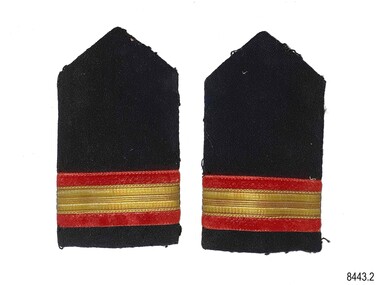
... He decided he further his studies overseas in the UK in 1927, sailing on the ship SS Banffshire (built in 1912, destroyed in 1937). ...He decided he further his studies overseas in the UK in 1927, sailing on the ship SS Banffshire (built in 1912, destroyed in 1937). ...The pair of epaulettes once belonged to W.R. Angus, who possibly wore them when he worked his passage fo or from the UL in the 1920s. The epaulettes are part of Flagstaff Hill’s comprehensive W.R. Angus Collection, donated by the family of Dr W R Angus (1901-1970), surgeon and oculist. William Roy Angus (1901-1970) qualified as a doctor in 1923. He decided he further his studies overseas in the UK in 1927, sailing on the ship SS Banffshire (built in 1912, destroyed in 1937). He studied at London University College Hospital and at Edinburgh Royal Infirmary and in 1928 he was awarded FRCS (Fellow from the Royal College of Surgeons), Edinburgh, Scotland. He worked his passage back to Australia as a Ship’s Surgeon on the Australian Commonwealth Line T.S.S. Largs Bay, purchased by the White Star Line in 1928. Dr W R Angus was a Surgeon Captain for the Australian Defence Forces, Army Medical Corps, stationed in Ballarat, Victoria, and in Bonegilla, N.S.W. He completed his service just before the end of the war due to suffering from a heart attack. The W.R. Angus Collection: - The W.R. Angus Collection includes historical medical equipment, surgical instruments and material belonging to Dr Edward Ryan and Dr Thomas Francis Ryan, (both of Nhill, Victoria) and Dr Angus’ own belongings. The Collection’s history spans the medical practices of the two Doctors Ryan, from 1885-1926 plus that of Dr Angus, up until 1969. It includes historical medical and surgical equipment and instruments from the doctors Edward and Thomas Ryan of Nhill, Victoria. Dr Angus married Gladys in 1927 at Ballarat, the nearest big city to Nhill where he began as a Medical Assistant. He was also Acting House surgeon at the Nhill hospital where their two daughters were born. During World War II He served as a Military Doctor in the Australian Defence Forces. Dr Angus and his family moved to Warrnambool in 1939, where Dr Angus operated his own medical practice. He later added the part-time Port Medical Officer responsibility and was the last person appointed to that position. Dr Angus and his wife were very involved in the local community, including the planning stages of the new Flagstaff Hill and the layout of the gardens there. Dr Angus passed away in March 1970.This pair of epaulettes is connected to the badges in the W.R. Angus Collection. Dr W R Angus (1901-1970), surgeon and oculist, collected a range of badges and military objects including those he personally used during his time as Surgeon Captain in the Australian Defence Forces in World War II. The W.R. Angus Collection is significant for still being located at the site it is connected with, Doctor Angus being the last Port Medical Officer in Warrnambool. The Collection includes historical medical objects that date back to the late 1800s.Epaulette (pair of two), dark blue with red and gold horizontal stripes. A tall rectangular shape with a point at the top. Made from a card covered by hessian, the front is covered with a dark blue fabric joined at the back by crossed stitching. The epaulettes belonged to Dr W R Angus and are now part of the W. R. Angus Collection.flagstaff hill, warrnambool, maritime village, maritime museum, shipwreck coast, great ocean road, flagstaff hill maritime museum and village, dr w r angus, w.r. angus collection, badge, insignia, badge collection, epaulettes, naval epaulettes, naval insignia, shoulder boards, ss banffshire, t.s.s. largs bay, uniform -
 Federation University Historical Collection
Document, History of the Ballarat Technology Park, Oakbank
... David White, the Minister for Industry, Technology and resources (See the Courier 4th August 1989) Mr Beaumont went overseas to study similar parks and look for tenants. ...David White, the Minister for Industry, Technology and resources (See the Courier 4th August 1989) Mr Beaumont went overseas to study similar parks and look for tenants. ...The Ballarat Technology Park is associated with Federation University Australia. The first stage commenced on 03 August 1989 when the first sod was turned by Hon, David White, Minister for Industry, Technology and Resources. John Beaumont was the Director of the Ballarat Technology Research and Development Park in 1989.Twenty items relating to the History of the Ballarat Technology Park as collected by John Parkin. .1) Handwritten notes by John Parkin on the history of the Ballarat Technology Park .2) Letter from A.E. Helyar (Shire of Buninyong Secretary), 08 March 1988 .3) Shire of Buninyong Minutes 07 June 1988 .4) Development of High Technology Activity by Jack Barker .5) Definition of a Technology Park by Derek Woolley .6) Shire of Buninyong minutes 28 June 1988 .7) Shire of Buninyong minutes 19 July 1988 .8) Invitation to a reception to commemorate the inauguration of the Ballarat Technology Park (John Parkin) by Shire of Buninyong President Cr Judith Coull to be held on 03 August 1989. .9) Invitation to a reception to the Ballarat Technology Park (John Beaumont) .10) Ballarat Courier article 04 August 1989 .11) Draft letter to Professor Geoffrey Blainey from John Parkin .12) Letter to the Editor from John Parkin, 18 December 2000 .13) University of Ballarat Development Appeal, 04 November 1994 .14 & .15) Invitation to installment dinner to celebrate the installation of Professor Geoffrey Blainey as Chancellor of the University of Ballarat to be held in the Union Building (now Albert Coates Building), Mt Helen campus .16) Letter to the editor from John Parkin .17) Letter from John Beaumont, 25 November 1994 .18) Invitation to the opening of the ISSC Southern Region Data Centre to be held on 24 November 1995. .19) Letter from Barry Traynor, 13 December 1995 .20) Planning Scheme information relating to the LaTrobe Research and Development Zone. .1) 2nd May 2005 History of Technology Park (I.T. centre) The history of the Technology Park started back in the mid-1980s. At the time I was a Buninyong Shire Councilor and as such I was Buninyong's representative on the then Ballarat Development Committee. At one of our meetings we received a request for information on a suitable site for a technology park. The requirements were for a site adjacent to a tertiary institution, secluded for security purposes and large enough to contain such a development. The next morning I contacted our Shire Engineer at the time, Newell Barrett and we drove around the area we both agreed that the current site was the most suitable we saw to meet the requirements. At the time it was owned by George Morrison. however the original enquiry to the B.D.C. came to nothing but the Shire Council and the B.D.C. decided to investigate the possibility of the site becoming a technology Park and information was collected. At about this time Mr Morrison put the property on the market and it was bought by a Ballarat builder, Mr John Beaumont, with the idea of developing it as a residential area. Council then arranged a meeting with Messrs Morrison and Beaumont to discuss the matter. I remember Mr Morrison saying he did not care what was done with it he just wanted to sell it and move down to the coast. Mr Beaumont, on the other hand, said he wasn't ready to retire yet and the idea interested him. As a result a committee consisting of the B.C.A.E., B.D.C. and Buninyong Shire Council (and Mr Beaumont) was formed to plan the development and rezone the area to technology park. It was previously zoned residential land and would seem to have been suitable for sub-division and residential development - its close proximity to the College being a major factor in its favour. The point of this is if Mr Beaumont had insisted on pursuing his original plan and had opposed the rezoning, I am quite confident he would have won an appeal at the A.A.T . (Administrative Appeals Tribunal - forerunner of V.C.A.T.) and the I.T. centre would not have got off the ground and the area would be covered with houses. But Mr Beaumont did go into the project with enthusiasm and the first stage was commenced on the 3rd August 1989 when the first sod was turned by Hon. David White, the Minister for Industry, Technology and resources (See the Courier 4th August 1989) Mr Beaumont went overseas to study similar parks and look for tenants. Unfortunately government did not support the project as they have now and apparently Mr Beaumont was ahead of his time for the private sector so Mr Beaumont could not continue the development and the site eventually passed to the College. I personally think more could have been done ... The work done by the Buninyong Shire Council and Ballarat Development Committee seems to have been forgotten as according to the Courier December 21, 2000 we are told the Park opened in 1995 as a joint venture between the City and the University. As a former Councillor said to me on the day "What happened to the plaque David White unveiled in 1989!" If there is any other information you want, please contact me. You may use my file for reference. Kind regards John Parkin PS I always felt a bit guilty that I encouraged John Beaumont and he was left in the lurch. ballarat technology park, parkin, john parkin, helyar, barker, woolley, shire of buninyong, beaumont, blainey, geoffrey blainey, southern region data centre, greenhill enterprise centre, stan jeffrey, jeffrey, john beaumont, david white -
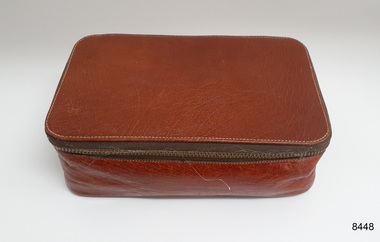 Flagstaff Hill Maritime Museum and Village
Accessory - Traveller's Pouch, Lyall Robertson Pty Ltd, ca 1946
... It seems likely that he wore the epaulettes on a uniform when he worked his passage to or from the UK as a young Ship’s Surgeon, with the purpose of furthering his studies overseas in 1927-1928. He travelled outward on the SS Banffshire and homeward on the Commonwealth Line’s T.S.S. ...It seems likely that he wore the epaulettes on a uniform when he worked his passage to or from the UK as a young Ship’s Surgeon, with the purpose of furthering his studies overseas in 1927-1928. He travelled outward on the SS Banffshire and homeward on the Commonwealth Line’s T.S.S. ...The Robex traveller’s pouch may have originally contained men’s grooming set or toiletries such as shaving accessors and soap. The leather strap inside the lid was designed to hold items like a toothbrush, comb or razor. The owner, Dr W.R. Angus, had used the pouch to store his personal memorabilia including epaulettes and various Australian Army-issued items from WWII. It seems likely that he wore the epaulettes on a uniform when he worked his passage to or from the UK as a young Ship’s Surgeon, with the purpose of furthering his studies overseas in 1927-1928. He travelled outward on the SS Banffshire and homeward on the Commonwealth Line’s T.S.S. Largs Bay. The pouch dates from 1946 at the earliest. The Robex leather accessories brand was made by Lyall Robertson Pty. Ltd., Sandringham, Victoria. Robertson established his home business in the 1940s and went on to be a leading firm with over 200 staff. The Robex trademark was registered on July 5th, 1946. The leather pouch is now part of Flagstaff Hill’s comprehensive W.R. Angus Collection, donated by the family of Dr W R Angus (1901-1970), surgeon and oculist. The W.R. Angus Collection: - The W.R. Angus Collection includes historical medical equipment, surgical instruments and material belonging to Dr Edward Ryan and Dr Thomas Francis Ryan, (both of Nhill, Victoria) and Dr Angus’ own belongings. The Collection’s history spans the medical practices of the two Doctors Ryan, from 1885-1926 plus that of Dr Angus, up until 1969. It includes historical medical and surgical equipment and instruments from the doctors Edward and Thomas Ryan of Nhill, Victoria. Dr Angus married Gladys in 1927 at Ballarat, the nearest big city to Nhill where he began as a Medical Assistant. He was also Acting House surgeon at the Nhill hospital where their two daughters were born. During World War II Dr Angus served as a Military Doctor. He was a Surgeon Captain for the Australian Defence Forces, Army Medical Corps, stationed in Ballarat, Victoria, and in Bonegilla, N.S.W. He completed his service just before the end of the war due to suffering from a heart attack. Dr Angus and his family moved to Warrnambool in 1939, where Dr Angus operated his own medical practice. He later added the part-time Port Medical Officer responsibility and was the last person appointed to that position. Both Dr Angus and his wife were very involved in the local community, including the planning stages of the new Flagstaff Hill and the layout of the gardens there. Dr Angus passed away in March 1970.This traveller's pouch is significant for its connection with the firm Lyall Robertson Pty Ltd of Victoria, a home-based enterprise of the 1940s with quickly grew to employ much staff to make its good quality goods. It is also connected with the local doctor, W.R. Angus and Warrnambool's Medical History. Dr W R Angus (1901-1970), surgeon and oculist, collected a range of military objects including those he personally used during his time as Surgeon Captain in the Australian Defence Forces in World War II. The W.R. Angus Collection is significant for still being located at the site it is connected with, Doctor Angus being the last Port Medical Officer in Warrnambool. The Collection includes historical medical objects that date back to the late 1800s.Traveller's pouch; tan water buffalo calf leather with brass zipper closure, cream-coloured fabric lining, and leather straps inside the lid for securing items. A silver embossed logo is on the lining of the base of the pouch. The Robex brand was made by Lyall Robertson Pty. Ltd in Victoria. The pouch belonged to Dr W R Angus and is now part of the W. R. Angus Collection.Stamped inside the base “ROBEX / WATER BUFFALO” and a silver logo [shield] flagstaff hill, warrnambool, maritime village, maritime museum, shipwreck coast, great ocean road, flagstaff hill maritime museum and village, dr w r angus, w.r. angus collection, australian army, world war 2, second world war, ww 2, army issue, wwii, traveller's pouch, personal grooming accessory, robex, buffalo calf leather, lyall robertson pty. ltd, ss banffshire, t.s.s. largs bay, leather goods, travel goods -
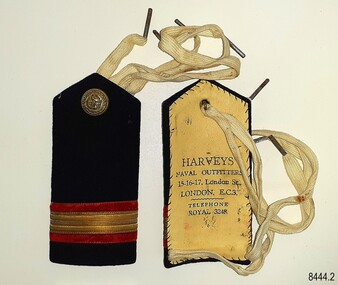 Flagstaff Hill Maritime Museum and Village
Badge - Epaulette, Harvey's Naval Outfitters, 1920s
... He decided he further his studies overseas in the UK in 1927, sailing on the ship SS Banffshire (built in 1912, destroyed in 1937). ...He decided he further his studies overseas in the UK in 1927, sailing on the ship SS Banffshire (built in 1912, destroyed in 1937). ...The pair of epaulettes once belonged to W.R. Angus, who possibly wore them when he worked his passage to and from the UK in the 1920s. The button on each has an unidentified emblem. They are part of Flagstaff Hill’s comprehensive W.R. Angus Collection, donated by the family of Dr W R Angus (1901-1970), surgeon and oculist. The ties, which look like shoe laces, would secure the epaulettes to the uniform's shoulders. The epaulettes were made by Harvey's Naval Outfitters of 15-16-17 London Street, London, E.C.3, in the East Central area of London. Another of the firm's addresses is Leadenhall Street, London, named the 'centre of commerce'. East India Company and Pacific & Oriental Steam Navigation Company (P&O) once had their headquarters there. The postcode 'EC3' dates back to 1917 when the postcode system was established in the United Kingdom. William Roy Angus (1901-1970) qualified as a doctor in 1923. He decided he further his studies overseas in the UK in 1927, sailing on the ship SS Banffshire (built in 1912, destroyed in 1937). He studied at London University College Hospital and Edinburgh Royal Infirmary and in 1928 he was awarded FRCS (Fellow from the Royal College of Surgeons), Edinburgh, Scotland. He worked his passage back to Australia as a Ship’s Surgeon on the Australian Commonwealth Line T.S.S. Largs Bay, purchased by the White Star Line in 1928. Dr W R Angus was a Surgeon Captain for the Australian Defence Forces, Army Medical Corps, stationed in Ballarat, Victoria, and in Bonegilla, N.S.W. He completed his service just before the end of the war due to suffering from a heart attack. The W.R. Angus Collection: - The W.R. Angus Collection includes historical medical equipment, surgical instruments and material belonging to Dr Edward Ryan and Dr Thomas Francis Ryan, (both of Nhill, Victoria) and Dr Angus’ own belongings. The Collection’s history spans the medical practices of the two Doctors Ryan, from 1885-1926 plus that of Dr Angus, up until 1969. It includes historical medical and surgical equipment and instruments from the doctors Edward and Thomas Ryan of Nhill, Victoria. Dr Angus married Gladys in 1927 at Ballarat, the nearest big city to Nhill where he began as a Medical Assistant. He was also Acting House surgeon at the Nhill hospital where their two daughters were born. During World War II He served as a Military Doctor in the Australian Defence Forces. Dr Angus and his family moved to Warrnambool in 1939, where Dr Angus operated his own medical practice. He later added the part-time Port Medical Officer responsibility and was the last person appointed to that position. Dr Angus and his wife were very involved in the local community, including the new Flagstaff Hill's planning stages and the gardens' layout. Dr Angus passed away in March 1970.This pair of epaulettes is connected to the badges in the W.R. Angus Collection. Dr W R Angus (1901-1970), surgeon and oculist, collected a range of badges and military objects including those he personally used during his time as Surgeon Captain in the Australian Defence Forces in World War II. The W.R. Angus Collection is significant for still being located at the site it is connected with, Doctor Angus being the last Port Medical Officer in Warrnambool. The Collection includes historical medical objects that date back to the late 1800s.Epaulette (pair of two), dark blue with red and gold horizontal stripes, with a gold-coloured button and woven white web ties. A tall rectangular shape with a point at the top. Made from a card base, covered by dark blue fabric and a hand-stitched lining of cream-coloured leather, stamped with the maker's details. The button has an inscripton and image. Made by Harvey's Outfitters in London. The button has images and text. The epaulettes belonged to Dr W R Angus and are now part of the W. R. Angus Collection.“HARVEYS’ / NAVAL OUTFITTERS / 15-16-17, London St / LONDON E.C.3. / TELEPHONE / ROYAL 3248” Button; Inscription and image [indecipherable] Button is embossed with images (anchor, serpent, flag) and text "B. 'G. "flagstaff hill, warrnambool, maritime village, maritime museum, shipwreck coast, great ocean road, flagstaff hill maritime museum and village, dr w r angus, w.r. angus collection, badge, insignia, badge collection, epaulettes, naval epaulettes, naval insignia, shoulder boards, ss banffshire, t.s.s. largs bay, uniform, harvey's naval outfitters, london street london -
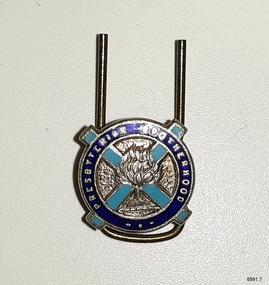 Flagstaff Hill Maritime Museum and Village
badge - Presbyterian Brotherhood badge, 1920s to 1940s
... He sailed overseas to further his studies at Edinburgh Royal Infirmary and in 1928, was awarded FRCS (Fellow from the Royal College of Surgeons), Edinburgh, Scotland. ...He sailed overseas to further his studies at Edinburgh Royal Infirmary and in 1928, was awarded FRCS (Fellow from the Royal College of Surgeons), Edinburgh, Scotland. ...This badge is one of a set of badges collected by Dr W R Angus from the organisations in which he was involved. The set of badges is now part of Flagstaff Hill’s comprehensive W.R. Angus Collection, donated by the family of Dr W R Angus, surgeon and oculist. The badge represents the Australian Presbyterian Brotherhood. The Presbyterian church has used the burning bush logo from the 1800s. The logo describes the Biblical account of the prophet Moses, who saw the miracle of a bush on fire that did not burn and heard the voice of God giving his instructions. The light blue cross symbolises the origin of the Australian Presbyterian church, the Church of Scotland, which is Presbyterian. Its flag is blue with a white 'x' and a burning bush symbol in the centre. Dr William Roy Angus was of Scottish heritage. He sailed overseas to further his studies at Edinburgh Royal Infirmary and in 1928, was awarded FRCS (Fellow from the Royal College of Surgeons), Edinburgh, Scotland. He was e Presbyterian and treated Sunday as a Sabbath, a day of rest. He would visit three or four country patients on a Sunday, taking his children along ‘for the ride’ and visiting with him. Sunday evenings he would play the pianola and sing Scottish songs to his family. In 1928, Dr Angus was a Flying Doctor in the A.I.M. (Australian Inland Ministry) Aerial Medical Service, which was established by the Presbyterian Church in that year. The W.R. Angus Collection includes historical medical equipment, surgical instruments and material belonging to Dr Edward Ryan and Dr Thomas Francis Ryan, (both of Nhill, Victoria) and Dr Angus’ own belongings. The Collection’s history spans the medical practices of the two Doctors Ryan, from 1885-1926 plus that of Dr Angus, up until 1969. It includes historical medical and surgical equipment and instruments from the doctors Edward and Thomas Ryan of Nhill, Victoria. Dr Angus married Gladys in 1927 at Ballarat, the nearest big city to Nhill where he began as a Medical Assistant. He was also Acting House surgeon at the Nhill hospital where their two daughters were born. During World War II He served as a Military Doctor in the Australian Defence Forces. Dr Angus and his family moved to Warrnambool in 1939, where Dr Angus operated his own medical practice. He later added the part-time Port Medical Officer responsibility and was the last person appointed to that position. Both Dr Angus and his wife were very involved in the local community, including the planning stages of the new Flagstaff Hill and the layout of the gardens there. Dr Angus passed away in March 1970.This badge is significant for connecting Doctor Angus with organisations that he supported. The badge also associates Dr Angus with the history of the Presbyterian Church in Australia, showing the historic logo of the burning bush and the Scottish flag. The W.R. Angus Collection is significant for still being located at the site it is connected with, Doctor Angus being the last Port Medical Officer in Warrnambool. The Collection includes historical medical objects that date back to the late 1800s.Badge; a round badge with a blue enamel outer border in front of a light blue enamel ‘x’. A silver logo is on top of the 'X'. There is a silver inscription around the outer circle. It is the badge of the Presbyterian Brotherhood of Australia.This badge is part of a set of badges collected by Dr W R Angus. the set represents organisations that he was involved in, and is part of the W.R. Angus Collection.On the dark blue border: “PRESBYTERIAN BROTHERHOOD’ Logo [a bush on fire] a 'burning bush'flagstaff hill, warrnambool, maritime village, maritime museum, shipwreck coast, great ocean road, w.r. angus, badge, organisation badge, flagstaff hill maritime museum and village, badges, buttons, lapel badge, religious badge, denominational badge, presbyterian church, presbyterian brotherhood, hat pin, flying doctor, scottish heritage, w.r. angus collection -
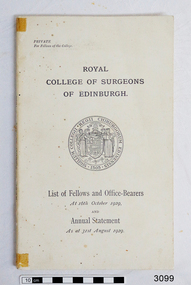 Flagstaff Hill Maritime Museum and Village
Book, Royal College of Surgeons, Edinburgh, Royal College of Surgeons of Edinburg, 1929
... Ryan in Nhill to go overseas to study. On page 56 of this bookm last entry reads “Angus, William Roy, M.B., B.S. c/o Mr. ...Ryan in Nhill to go overseas to study. On page 56 of this bookm last entry reads “Angus, William Roy, M.B., B.S. c/o Mr. ...This book was published in 1929, the year after Dr. Angus became a Fellow of the Royal College of Surgeons, Edinburgh. At that time he had taken time off as Medical Assistant to Dr. T.F. Ryan in Nhill to go overseas to study. On page 56 of this bookm last entry reads “Angus, William Roy, M.B., B.S. c/o Mr. W.J. Angus, 37 Kermode Street, North Adelaide, South Australia” The book was donated to Flagstaff Hill Maritime Village by the family of Doctor William Roy Angus, Surgeon and Oculist. It is part of the “W.R. Angus Collection” that includes historical medical equipment, surgical instruments and material once belonging to Dr Edward Ryan and Dr Thomas Francis Ryan, (both of Nhill, Victoria) as well as Dr Angus’ own belongings. The Collection’s history spans the medical practices of the two Doctors Ryan, from 1885-1926 plus that of Dr Angus, up until 1969. ABOUT THE “W.R.ANGUS COLLECTION” Doctor William Roy Angus M.B., B.S., Adel., 1923, F.R.C.S. Edin.,1928 (also known as Dr Roy Angus) was born in Murrumbeena, Victoria in 1901 and lived until 1970. He qualified as a doctor in 1923 at University of Adelaide, was Resident Medical Officer at the Royal Adelaide Hospital in 1924 and for a period was house surgeon to Sir (then Mr.) Henry Simpson Newland. Dr Angus was briefly an Assistant to Dr Riddell of Kapunda, then commenced private practice at Curramulka, Yorke Peninsula, SA, where he was physician, surgeon and chemist. In 1926, he was appointed as new Medical Assistant to Dr Thomas Francis Ryan (T.F. Ryan, or Tom), in Nhill, Victoria, where his experiences included radiology and pharmacy. In 1927 he was Acting House Surgeon in Dr Tom Ryan’s absence. Dr Angus had become engaged to Gladys Forsyth and they decided he would take time to further his studies overseas in the UK in 1927. He studied at London University College Hospital and at Edinburgh Royal Infirmary and in 1928, was awarded FRCS (Fellow from the Royal College of Surgeons), Edinburgh. He worked his passage back to Australia as a Ship’s Surgeon on the on the Australian Commonwealth Line’s T.S.S. Largs Bay. Dr Angus married Gladys in 1929, in Ballarat. (They went on to have one son (Graham 1932, born in SA) and two daughters (Helen (died 12/07/1996) and Berenice (Berry), both born at Mira, Nhill ) Dr Angus was a ‘flying doctor’ for the A.I.M. (Australian Inland Ministry) Aerial Medical Service in 1928 . The organisation began in South Australia through the Presbyterian Church in that year, with its first station being in the remote town of Oodnadatta, where Dr Angus was stationed. He was locum tenens there on North-South Railway at 21 Mile Camp. He took up this ‘flying doctor’ position in response to a call from Dr John Flynn; the organisation was later known as the Flying Doctor Service, then the Royal Flying Doctor Service. A lot of his work during this time involved dental surgery also. Between 1928-1932 he was surgeon at the Curramulka Hospital, Yorke Peninsula, South Australia. In 1933 Dr Angus returned to Nhill where he’d previously worked as Medical Assistant and purchased a share of the Nelson Street practice and Mira hospital from Dr Les Middleton one of the Middleton Brothers, the current owners of what was once Dr Tom Ryan’s practice. Dr L Middleton was House Surgeon to the Nhill Hospital 1926-1933, when he resigned. [Dr Tom Ryan’s practice had originally belonged to his older brother Dr Edward Ryan, who came to Nhill in 1885. Dr Edward saw patients at his rooms, firstly in Victoria Street and in 1886 in Nelson Street, until 1901. The Nelson Street practice also had a 2 bed ward, called Mira Private Hospital ). Dr Edward Ryan was House Surgeon at the Nhill Hospital 1884-1902 . He also had occasions where he successfully performed veterinary surgery for the local farmers too. Dr Tom Ryan then purchased the practice from his brother in 1901. Both Dr Edward and Dr Tom Ryan work as surgeons included eye surgery. Dr Tom Ryan performed many of his operations in the Mira private hospital on his premises. He too was House Surgeon at the Nhill Hospital 1902-1926. Dr Tom Ryan had one of the only two pieces of radiology equipment in Victoria during his practicing years – The Royal Melbourne Hospital had the other one. Over the years Dr Tom Ryan gradually set up what was effectively a training school for country general-practitioner-surgeons. Each patient was carefully examined, including using the X-ray machine, and any surgery was discussed and planned with Dr Ryan’s assistants several days in advance. Dr Angus gained experience in using the X-ray machine there during his time as assistant to Dr Ryan. Dr Tom Ryan moved from Nhill in 1926. He became a Fellow of the Royal Australasian College of Surgeons in 1927, soon after its formation, a rare accolade for a doctor outside any of the major cities. He remained a bachelor and died suddenly on 7th Dec 1955, aged 91, at his home in Ararat. Scholarships and prizes are still awarded to medical students in the honour of Dr T.F. Ryan and his father, Dr Michael Ryan, and brother, John Patrick Ryan. ] When Dr Angus bought into the Nelson Street premises in Nhill he was also appointed as the Nhill Hospital’s Honorary House Surgeon 1933-1938. His practitioner’s plate from his Nhill surgery states “HOURS Daily, except Tuesdays, Fridays and Saturday afternoons, 9-10am, 2-4pm, 7-8pm. Sundays by appointment”. This plate is now mounted on the doorway to the Port Medical Office at Flagstaff Hill Maritime Village, Warrnambool. Dr Edward Ryan and Dr Tom Ryan had an extensive collection of historical medical equipment and materials spanning 1884-1926 and when Dr Angus took up practice in their old premises he obtained this collection, a large part of which is now on display at the Port Medical Office at Flagstaff Hill Maritime Village in Warrnambool. During his time in Nhill Dr Angus was involved in the merging of the Mira Hospital and Nhill Public Hospital into one public hospital and the property titles passed on to Nhill Hospital in 1939. In 1939 Dr Angus and his family moved to Warrnambool where he purchased “Birchwood,” the 1852 home and medical practice of Dr John Hunter Henderson, at 214 Koroit Street. (This property was sold in1965 to the State Government and is now the site of the Warrnambool Police Station. ). The Angus family was able to afford gardeners, cooks and maids; their home was a popular place for visiting dignitaries to stay whilst visiting Warrnambool. Dr Angus had his own silk worm farm at home in a Mulberry tree. His young daughter used his centrifuge for spinning the silk. Dr Angus was appointed on a part-time basis as Port Medical Officer (Health Officer) in Warrnambool and held this position until the 1940’s when the government no longer required the service of a Port Medical Officer in Warrnambool; he was thus Warrnambool’s last serving Port Medical Officer. (The duties of a Port Medical Officer were outlined by the Colonial Secretary on 21st June, 1839 under the terms of the Quarantine Act. Masters of immigrant ships arriving in port reported incidents of diseases, illness and death and the Port Medical Officer made a decision on whether the ship required Quarantine and for how long, in this way preventing contagious illness from spreading from new immigrants to the residents already in the colony.) Dr Angus was a member of the Australian Medical Association, for 35 years and surgeon at the Warrnambool Base Hospital 1939-1942, He served as a Surgeon Captain during WWII1942-45, in Ballarat, Victoria, and in Bonegilla, N.S.W., completing his service just before the end of the war due to suffering from a heart attack. During his convalescence he carved an intricate and ‘most artistic’ chess set from the material that dentures were made from. He then studied ophthalmology at the Royal Melbourne Eye and Ear Hospital and created cosmetically superior artificial eyes by pioneering using the intrascleral cartilage. Angus received accolades from the Ophthalmological Society of Australasia for this work. He returned to Warrnambool to commence practice as an ophthalmologist, pioneering in artificial eye improvements. He was Honorary Consultant Ophthalmologist to Warrnambool Base Hospital for 31 years. He made monthly visits to Portland as a visiting surgeon, to perform eye surgery. He represented the Victorian South-West subdivision of the Australian Medical Association as its secretary between 1949 and 1956 and as chairman from 1956 to 1958. In 1968 Dr Angus was elected member of Spain’s Barraquer Institute of Barcelona after his research work in Intrasclearal cartilage grafting, becoming one of the few Australian ophthalmologists to receive this honour, and in the following year presented his final paper on Living Intrasclearal Cartilage Implants at the Inaugural Meeting of the Australian College of Ophthalmologists in Melbourne In his personal life Dr Angus was a Presbyterian and treated Sunday as a Sabbath, a day of rest. He would visit 3 or 4 country patients on a Sunday, taking his children along ‘for the ride’ and to visit with him. Sunday evenings he would play the pianola and sing Scottish songs to his family. One of Dr Angus’ patients was Margaret MacKenzie, author of a book on local shipwrecks that she’d seen as an eye witness from the late 1880’s in Peterborough, Victoria. In the early 1950’s Dr Angus, painted a picture of a shipwreck for the cover jacket of Margaret’s book, Shipwrecks and More Shipwrecks. She was blind in later life and her daughter wrote the actual book for her. Dr Angus and his wife Gladys were very involved in Warrnambool’s society with a strong interest in civic affairs. Their interests included organisations such as Red Cross, Rostrum, Warrnambool and District Historical Society (founding members), Wine and Food Society, Steering Committee for Tertiary Education in Warrnambool, Local National Trust, Good Neighbour Council, Housing Commission Advisory Board, United Services Institute, Legion of Ex-Servicemen, Olympic Pool Committee, Food for Britain Organisation, Warrnambool Hospital, Anti-Cancer Council, Boys’ Club, Charitable Council, National Fitness Council and Air Raid Precautions Group. He was also a member of the Steam Preservation Society and derived much pleasure from a steam traction engine on his farm. He had an interest in people and the community He and his wife Gladys were both involved in the creation of Flagstaff Hill, including the layout of the gardens. After his death (28th March 1970) his family requested his practitioner’s plate, medical instruments and some personal belongings be displayed in the Port Medical Office surgery at Flagstaff Hill Maritime Village, and be called the “W. R. Angus Collection”. The W.R. Angus Collection is significant for still being located at the site it is connected with, Doctor Angus being the last Port Medical Officer in Warrnambool. The collection of medical instruments and other equipment is culturally significant, being an historical example of medicine from late 19th to mid-20th century. Dr Angus assisted Dr Tom Ryan, a pioneer in the use of X-rays and in ocular surgery. Book, Royal College of Surgeons of Edinburgh, owned by Dr. W.R. Angus. White, card covered book. Published 1929. Contains list of Fellows and Office-Bearers as at 16th October 1929, and the Annual Statement as at 31st August 1929. W.R. Angus is the last name listed on page 56.flagstaff hill, warrnambool, shipwrecked coast, flagstaff hill maritime museum, maritime museum, shipwreck coast, flagstaff hill maritime village, great ocean road, dr w r angus, dr ryan, surgical instrument, t.s.s. largs bay, warrnambool base hospital, nhill base hospital, mira hospital, flying doctor, medical treatment, medical history, medical education, royal college of surgeons edinburgh, fellow of royal college of surgeons edinburgh, surgeon's qualifications, gazette of surgeons -
 Flagstaff Hill Maritime Museum and Village
Textile - Bedspread, early 20th century
... Angus had become engaged to Gladys Forsyth and it was decided he would take time to further his studies overseas in the UK. in 1927 He studied at London University College Hospital and at Edinburgh Royal Infirmary and in 1928, was awarded FRCS (Fellow from the Royal College of Surgeons), Edinburgh. ...Angus had become engaged to Gladys Forsyth and it was decided he would take time to further his studies overseas in the UK. in 1927 He studied at London University College Hospital and at Edinburgh Royal Infirmary and in 1928, was awarded FRCS (Fellow from the Royal College of Surgeons), Edinburgh. ...This crocheted bedspread was used by Dr. and Mrs. Angus in their home in "Birchwood" Warrnambool. It was donated to Flagstaff Hill Maritime Village by the family of Doctor William Roy Angus, Surgeon and Oculist. It is part of the "W.R. Angus Collection" that includes historical medical equipment, surgical instruments, and material once belonging to Dr. Edward Ryan and Dr. Thomas Francis Ryan, (both of Nhill, Victoria) as well as Dr. Angus's belongings. The Collection's history spans the medical practices of the two Doctors Ryan, from 1885-1926 plus that of Dr. Angus, up until 1969. WR Angus Collection: Doctor William Roy Angus qualified as a doctor from Adelaide University in 1923. Dr. Angus was born in Murrumbeena, Victoria in 1901 until he died in 1970. He qualified as a doctor in 1923 at the University of Adelaide and was a Resident Medical Officer at the Royal Adelaide Hospital in 1924 and for a period house surgeon to Sir Henry Simpson Newland. Dr. Angus was also briefly an Assistant to Dr. Riddell of Kapunda SA, then commenced private practice at Curramulka, Yorke Peninsula, SA, where he was a physician, surgeon, and chemist. In 1926, he was appointed as new Medical Assistant to Dr. Thomas Francis Ryan (T.F. Ryan), in Nhill, Victoria, where his experiences included radiology and pharmacy. In 1927 he was Acting House Surgeon in Dr. Tom Ryan's absence. Dr. Angus had become engaged to Gladys Forsyth and it was decided he would take time to further his studies overseas in the UK. in 1927 He studied at London University College Hospital and at Edinburgh Royal Infirmary and in 1928, was awarded FRCS (Fellow from the Royal College of Surgeons), Edinburgh. He worked his passage back to Australia as a Ship's Surgeon on the Australian Commonwealth Line's T.S.S. Largs Bay. Dr. Angus married Gladys in 1929, in Ballarat and had one son Graham born in 1932, and two daughters (Helen and Bernice, both were born at Mira, Nhill SA Dr. Angus was a 'flying doctor' for the A.I.M. (Australian Inland Ministry) Aerial Medical Service in 1928. The Organisation began in South Australia through the Presbyterian Church that year, with its first station being in the remote town of Oodnadatta, where Dr. Angus was stationed. He was locum there on North-South Railway at 21 Mile Camp taking up the position of 'flying doctor' in response to a call from Dr. John Flynn; the Organisation later became known as the Flying Doctor Service. Between 1928-1932 he was a surgeon at the Curramulka Hospital, Yorke Peninsula, South Australia but in1933 he returned to Nhill where he'd previously worked as a Medical Assistant and purchased a share of the Nelson Street practice and Mira hospital from Dr. Les Middleton the current owners of what was once Dr. Tom Ryan's practice. When Dr. Angus bought into the Nelson Street premises in Nhill he was also appointed as the Nhill Hospital's Honorary House Surgeon 1933-1938. His practitioner's plate from his Nhill surgery states "Hours Daily, except Tuesdays, Fridays and Saturday afternoons, 9-10 am, 2-4 pm, 7-8 pm. Sundays by appointment". This plate is now mounted on the doorway to the Port Medical Office at Flagstaff Hill Maritime Village, Warrnambool. Dr. Edward Ryan and Dr. Tom Ryan had an extensive collection of historical medical equipment and materials spanning 1884-1926 and when Dr. Angus took up practice in their old premises he obtained this collection, a large part of which is now on display at the Port Medical Office at Flagstaff Hill Maritime Village in Warrnambool. During his time in Nhill, Dr. Angus was involved in the merging of the Mira Hospital and Nhill Public Hospital into one public hospital and the property titles passed on to Nhill Hospital in 1939. In 1939 Dr. Angus and his family moved to Warrnambool where he purchased "Birchwood," the 1852 home and medical practice of Dr. John Hunter Henderson, at 214 Koroit Street. (This property was sold in1965 to the State Government and is now the site of the Warrnambool Police Station.) The Angus family were able to afford gardeners, cooks, and maids with their home becoming a popular place for visiting dignitaries to stay whilst visiting Warrnambool. Dr. Angus had his silkworm farm at home in a Mulberry tree. His young daughter used his centrifuge for spinning the silk. Dr. Angus was appointed on a part-time basis as Port Medical Officer in Warrnambool and held this position until the 1940's when the government no longer required the service of a medical officer he then became Warrnambools last serving Port Medical Officer. Dr. Angus was a member of the Australian Medical Association, for 35 years and surgeon at the Warrnambool Base Hospital from 1939 to 1942, He served as a Surgeon Captain during WWII from 1942 to 1945, in Ballarat, Victoria, and in Bonegilla, N.S.W., he completed his service just before the end of the war as he suffered a heart attack. It was during his convalescence he carved an intricate and 'most artistic' chess set from the material that dentures were made from. He then studied ophthalmology at the Royal Melbourne Eye and Ear Hospital and created cosmetically superior artificial eyes by pioneering using the intrascleral cartilage. Angus received accolades from the Ophthalmological Society of Australasia for this work. He returned to Warrnambool to commence practice as an ophthalmologist, pioneering in artificial eye improvements. He was an Honorary Consultant Ophthalmologist to Warrnambool Base Hospital for 31 years. He represented the Victorian South-West subdivision of the Australian Medical Association as its secretary between 1949 and 1956 and as chairman from 1956 to 1958. In 1968 Dr. Angus was elected member of Spain's Barraquer Institute of Barcelona after his research work in Intrasclearal cartilage grafting, becoming one of the few Australian ophthalmologists to receive this accolade, and in the following year presented his final paper on Living Intrasclearal Cartilage Implants at the Inaugural Meeting of the Australian College of Ophthalmologists in Melbourne. In his personal life, Dr. Angus was a Presbyterian and treated Sunday as a Sabbath, a day of rest. He would visit 3 or 4 country patients on a Sunday, taking his children along 'for the ride' and to visit with him. Sunday evenings he would play the pianola and sing Scottish songs to his family. One of Dr. Angus' patients was Margaret MacKenzie, author of a book on local shipwrecks that she'd seen as an eye witness from the late 1880s in Peterborough, Victoria. In the early 1950's Dr. Angus, painted a picture of a shipwreck for the cover jacket of Margaret's book, Shipwrecks, and More Shipwrecks. Dr. Angus and his wife Gladys were very involved in Warrnambool society with a strong interest in civic affairs. Their interests included organisations such as Red Cross, Rostrum, Warrnambool and District Historical Society (founding members), Wine and Food Society, Steering Committee for Tertiary Education in Warrnambool, Local National Trust, Good Neighbour Council, Housing Commission Advisory Board, United Services Institute, Legion of Ex-Servicemen, Olympic Pool Committee, Food for Britain Organisation, Warrnambool Hospital, Anti-Cancer Council, Boys' Club, Charitable Council, National Fitness Council, and Air Raid Precautions Group. He was also a member of the Steam Preservation Society and derived much pleasure from a steam traction engine on his farm. He had an interest in people and the community He and his wife Gladys were both involved in the creation of Flagstaff Hill, including the layout of the gardens. After his death on 28th March 1970, his family requested his practitioner's plate, medical instruments, and some personal belongings be displayed in the Port Medical Office surgery at Flagstaff Hill Maritime Village, and be called the "W. R. Angus Collection". The W.R. Angus Collection is significant for the social and medical achievement's that Dr. William Roy Angus had accomplished in his lifetime and the collection of equipment that he and his predecessors had used to treat patients give an insight into the working lives of early colonial medical practices in rural Australia. This collection of medical artefacts is on display located at Flagstaff Hill Village and the Port Medical Officers building where Doctor Angus had practice as the last Port Medical Officer for Warrnambool.Crocheted double bedspread, from the W.R. Angus Collection. White cotton, hand crocheted 30 squares joined as patchwork then a border crocheted around edge. Each square is 41cm square.Noneflagstaff hill, warrnambool, shipwrecked coast, flagstaff hill maritime museum, shipwreck coast, great ocean road, hand crafted manchester, crocheted bedspread, patchwork bedspread, household linen, early 20th century bedspread, dr. w r angus -
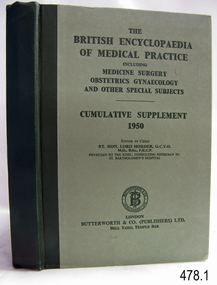 Flagstaff Hill Maritime Museum and Village
Book, The British Encyclopaedia of Medical Practice 1950
... Dr Angus had become engaged to Gladys Forsyth and they decided he further his studies overseas in the UK in 1927. He studied at London University College Hospital and at Edinburgh Royal Infirmary and in 1928, was awarded FRCS (Fellow from the Royal College of Surgeons), Edinburgh. ...Dr Angus had become engaged to Gladys Forsyth and they decided he further his studies overseas in the UK in 1927. He studied at London University College Hospital and at Edinburgh Royal Infirmary and in 1928, was awarded FRCS (Fellow from the Royal College of Surgeons), Edinburgh. ...This Book was donated to Flagstaff Hill Maritime Village by the family of Doctor William Roy Angus, Surgeon and Oculist. It is part of the “W.R. Angus Collection” that includes historical medical equipment, surgical instruments and material once belonging to Dr Edward Ryan and Dr Thomas Francis Ryan, (both of Nhill, Victoria) as well as Dr Angus’ own belongings. The Collection’s history spans the medical practices of the two Doctors Ryan, from 1885-1926 plus that of Dr Angus, up until 1969. ABOUT THE “W.R.ANGUS COLLECTION” Doctor William Roy Angus M.B., B.S., Adel., 1923, F.R.C.S. Edin.,1928 (also known as Dr Roy Angus) was born in Murrumbeena, Victoria in 1901 and lived until 1970. He qualified as a doctor in 1923 at University of Adelaide, was Resident Medical Officer at the Royal Adelaide Hospital in 1924 and for a period was house surgeon to Sir (then Mr.) Henry Simpson Newland. Dr Angus was briefly an Assistant to Dr Riddell of Kapunda, then commenced private practice at Curramulka, Yorke Peninsula, SA, where he was physician, surgeon and chemist. In 1926, he was appointed as new Medical Assistant to Dr Thomas Francis Ryan (T.F. Ryan, or Tom), in Nhill, Victoria, where his experiences included radiology and pharmacy. In 1927 he was Acting House Surgeon in Dr Tom Ryan’s absence. Dr Angus had become engaged to Gladys Forsyth and they decided he further his studies overseas in the UK in 1927. He studied at London University College Hospital and at Edinburgh Royal Infirmary and in 1928, was awarded FRCS (Fellow from the Royal College of Surgeons), Edinburgh. He worked his passage back to Australia as a Ship’s Surgeon on the on the Australian Commonwealth Line’s T.S.S. Largs Bay. Dr Angus married Gladys in 1929, in Ballarat. (They went on to have one son (Graham 1932, born in SA) and two daughters (Helen (died 12/07/1996) and Berenice (Berry), both born at Mira, Nhill According to Berry, her mother Gladys made a lot of their clothes. She was very talented and did some lovely embroidery including lingerie for her trousseau and beautifully handmade baby clothes. Dr Angus was a ‘flying doctor’ for the A.I.M. (Australian Inland Ministry) Aerial Medical Service in 1928. Its first station was in the remote town of Oodnadatta, where Dr Angus was stationed. He was locum tenens there on North-South Railway at 21 Mile Camp. He took up this ‘flying doctor’ position in response to a call from Dr John Flynn; the organisation was later known as the Flying Doctor Service, then the Royal Flying Doctor Service. A lot of his work during this time involved dental surgery also. Between 1928-1932 he was surgeon at the Curramulka Hospital, Yorke Peninsula, South Australia. In 1933 Dr Angus returned to Nhill and purchased a share of the Nelson Street practice and Mira hospital (a 2 bed ward at the Nelson Street Practice) from Dr Les Middleton one of the Middleton Brothers, the current owners of what previously once Dr Tom Ryan’s practice. Dr Tom and his brother had worked as surgeons included eye surgery. Dr Tom Ryan performed many of his operations in the Mira private hospital on his premises. He had been House Surgeon at the Nhill Hospital 1902-1926. Dr Tom Ryan had one of the only two pieces of radiology equipment in Victoria during his practicing years – The Royal Melbourne Hospital had the other one. Over the years Dr Tom Ryan had gradually set up what was effectively a training school for country general-practitioner-surgeons. Each patient was carefully examined, including using the X-ray machine, and any surgery was discussed and planned with Dr Ryan’s assistants several days in advance. Dr Angus gained experience in using the X-ray machine there during his time as assistant to Dr Ryan. When Dr Angus bought into the Nelson Street premises in Nhill he was also appointed as the Nhill Hospital’s Honorary House Surgeon 1933-1938. His practitioner’s plate from his Nhill surgery is now mounted on the doorway to the Port Medical Office at Flagstaff Hill Maritime Village, Warrnambool. When Dr Angus took up practice in the Dr Edward and Dr Tom Ryan’s old premises he obtained their extensive collection of historical medical equipment and materials spanning 1884-1926. A large part of this collection is now on display at the Port Medical Office at Flagstaff Hill Maritime Village in Warrnambool. In 1939 Dr Angus and his family moved to Warrnambool where he purchased “Birchwood,” the 1852 home and medical practice of Dr John Hunter Henderson, at 214 Koroit Street. (This property was sold in1965 to the State Government and is now the site of the Warrnambool Police Station and an ALDI sore is on the land that was once their tennis court). The Angus family was able to afford gardeners, cooks and maids; their home was a popular place for visiting dignitaries to stay whilst visiting Warrnambool. Dr Angus had his own silk worm farm at home in a Mulberry tree. His young daughter used his centrifuge for spinning the silk. Dr Angus was appointed on a part-time basis as Port Medical Officer (Health Officer) in Warrnambool and held this position until the 1940’s when the government no longer required the service of a Port Medical Officer in Warrnambool; he was thus Warrnambool’s last serving Port Medical Officer. (Masters of immigrant ships arriving in port reported incidents of diseases, illness and death and the Port Medical Officer made a decision on whether the ship required Quarantine and for how long, in this way preventing contagious illness from spreading from new immigrants to the residents already in the colony.) Dr Angus was a member of the Australian Medical Association, for 35 years and surgeon at the Warrnambool Base Hospital 1939-1942, He served as a Surgeon Captain during WWII 1942-45, in Ballarat, Victoria, and in Bonegilla, N.S.W., completing his service just before the end of the war due to suffering from a heart attack. During his convalescence he carved an intricate and ‘most artistic’ chess set from the material that dentures were made from. He then studied ophthalmology at the Royal Melbourne Eye and Ear Hospital and created cosmetically superior artificial eyes by pioneering using the intrascleral cartilage. Angus received accolades from the Ophthalmological Society of Australasia for this work. He returned to Warrnambool to commence practice as an ophthalmologist, pioneering in artificial eye improvements. He was Honorary Consultant Ophthalmologist to Warrnambool Base Hospital for 31 years. He made monthly visits to Portland as a visiting surgeon, to perform eye surgery. He represented the Victorian South-West subdivision of the Australian Medical Association as its secretary between 1949 and 1956 and as chairman from 1956 to 1958. In 1968 Dr Angus was elected member of Spain’s Barraquer Institute of Barcelona after his research work in Intrasclearal cartilage grafting, becoming one of the few Australian ophthalmologists to receive this honour, and in the following year presented his final paper on Living Intrasclearal Cartilage Implants at the Inaugural Meeting of the Australian College of Ophthalmologists in Melbourne In his personal life Dr Angus was a Presbyterian and treated Sunday as a Sabbath, a day of rest. He would visit 3 or 4 country patients on a Sunday, taking his children along ‘for the ride’ and to visit with him. Sunday evenings he would play the pianola and sing Scottish songs to his family. One of Dr Angus’ patients was Margaret MacKenzie, author of a book on local shipwrecks that she’d seen as an eye witness from the late 1880’s in Peterborough, Victoria. In the early 1950’s Dr Angus, painted a picture of a shipwreck for the cover jacket of Margaret’s book, Shipwrecks and More Shipwrecks. She was blind in later life and her daughter wrote the actual book for her. Dr Angus and his wife Gladys were very involved in Warrnambool’s society with a strong interest in civic affairs. He had an interest in people and the community. They were both involved in the creation of Flagstaff Hill, including the layout of the gardens. After his death (28th March 1970) his family requested his practitioner’s plate, medical instruments and some personal belongings be displayed in the Port Medical Office surgery at Flagstaff Hill Maritime Village, and be called the “W. R. Angus Collection”. The W.R. Angus Collection is significant for still being located at the site it is connected with, Doctor Angus being the last Port Medical Officer in Warrnambool. The collection of medical instruments and other equipment is culturally significant, being an historical example of medicine, administration, household equipment and clothing from late 19th to mid-20th century. Dr Angus assisted Dr Tom Ryan, a pioneer in the use of X-rays and in ocular surgery. The British Encyclopaedia of Medical Practice 1950 Author: Rt. Hon. Lord Horder Publisher: Butterworth & Company Date: 1950Pastedown front endpaper has sticker that reads "W. R. Angus, 309 Koroit Street, Warrnambool"flagstaff hill, warrnambool, shipwrecked-coast, flagstaff-hill, flagstaff-hill-maritime-museum, maritime-museum, shipwreck-coast, flagstaff-hill-maritime-village, the british encyclopaedia of medical practice 1950, book, dr. w.r. angus, dr ryan, t.s.s. largs bay, warrnambool base hospital, nhill base hospital, mira hospital, flying doctor, medical treatment, medical history, medical education -
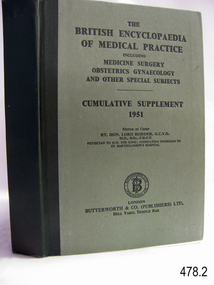 Flagstaff Hill Maritime Museum and Village
Book, The British Encyclopaedia of Medical Practice 1951
... Dr Angus had become engaged to Gladys Forsyth and they decided he further his studies overseas in the UK in 1927. He studied at London University College Hospital and at Edinburgh Royal Infirmary and in 1928, was awarded FRCS (Fellow from the Royal College of Surgeons), Edinburgh. ...Dr Angus had become engaged to Gladys Forsyth and they decided he further his studies overseas in the UK in 1927. He studied at London University College Hospital and at Edinburgh Royal Infirmary and in 1928, was awarded FRCS (Fellow from the Royal College of Surgeons), Edinburgh. ...This Book was donated to Flagstaff Hill Maritime Village by the family of Doctor William Roy Angus, Surgeon and Oculist. It is part of the “W.R. Angus Collection” that includes historical medical equipment, surgical instruments and material once belonging to Dr Edward Ryan and Dr Thomas Francis Ryan, (both of Nhill, Victoria) as well as Dr Angus’ own belongings. The Collection’s history spans the medical practices of the two Doctors Ryan, from 1885-1926 plus that of Dr Angus, up until 1969. ABOUT THE “W.R.ANGUS COLLECTION” Doctor William Roy Angus M.B., B.S., Adel., 1923, F.R.C.S. Edin.,1928 (also known as Dr Roy Angus) was born in Murrumbeena, Victoria in 1901 and lived until 1970. He qualified as a doctor in 1923 at University of Adelaide, was Resident Medical Officer at the Royal Adelaide Hospital in 1924 and for a period was house surgeon to Sir (then Mr.) Henry Simpson Newland. Dr Angus was briefly an Assistant to Dr Riddell of Kapunda, then commenced private practice at Curramulka, Yorke Peninsula, SA, where he was physician, surgeon and chemist. In 1926, he was appointed as new Medical Assistant to Dr Thomas Francis Ryan (T.F. Ryan, or Tom), in Nhill, Victoria, where his experiences included radiology and pharmacy. In 1927 he was Acting House Surgeon in Dr Tom Ryan’s absence. Dr Angus had become engaged to Gladys Forsyth and they decided he further his studies overseas in the UK in 1927. He studied at London University College Hospital and at Edinburgh Royal Infirmary and in 1928, was awarded FRCS (Fellow from the Royal College of Surgeons), Edinburgh. He worked his passage back to Australia as a Ship’s Surgeon on the on the Australian Commonwealth Line’s T.S.S. Largs Bay. Dr Angus married Gladys in 1929, in Ballarat. (They went on to have one son (Graham 1932, born in SA) and two daughters (Helen (died 12/07/1996) and Berenice (Berry), both born at Mira, Nhill According to Berry, her mother Gladys made a lot of their clothes. She was very talented and did some lovely embroidery including lingerie for her trousseau and beautifully handmade baby clothes. Dr Angus was a ‘flying doctor’ for the A.I.M. (Australian Inland Ministry) Aerial Medical Service in 1928. Its first station was in the remote town of Oodnadatta, where Dr Angus was stationed. He was locum tenens there on North-South Railway at 21 Mile Camp. He took up this ‘flying doctor’ position in response to a call from Dr John Flynn; the organisation was later known as the Flying Doctor Service, then the Royal Flying Doctor Service. A lot of his work during this time involved dental surgery also. Between 1928-1932 he was surgeon at the Curramulka Hospital, Yorke Peninsula, South Australia. In 1933 Dr Angus returned to Nhill and purchased a share of the Nelson Street practice and Mira hospital (a 2 bed ward at the Nelson Street Practice) from Dr Les Middleton one of the Middleton Brothers, the current owners of what previously once Dr Tom Ryan’s practice. Dr Tom and his brother had worked as surgeons included eye surgery. Dr Tom Ryan performed many of his operations in the Mira private hospital on his premises. He had been House Surgeon at the Nhill Hospital 1902-1926. Dr Tom Ryan had one of the only two pieces of radiology equipment in Victoria during his practicing years – The Royal Melbourne Hospital had the other one. Over the years Dr Tom Ryan had gradually set up what was effectively a training school for country general-practitioner-surgeons. Each patient was carefully examined, including using the X-ray machine, and any surgery was discussed and planned with Dr Ryan’s assistants several days in advance. Dr Angus gained experience in using the X-ray machine there during his time as assistant to Dr Ryan. When Dr Angus bought into the Nelson Street premises in Nhill he was also appointed as the Nhill Hospital’s Honorary House Surgeon 1933-1938. His practitioner’s plate from his Nhill surgery is now mounted on the doorway to the Port Medical Office at Flagstaff Hill Maritime Village, Warrnambool. When Dr Angus took up practice in the Dr Edward and Dr Tom Ryan’s old premises he obtained their extensive collection of historical medical equipment and materials spanning 1884-1926. A large part of this collection is now on display at the Port Medical Office at Flagstaff Hill Maritime Village in Warrnambool. In 1939 Dr Angus and his family moved to Warrnambool where he purchased “Birchwood,” the 1852 home and medical practice of Dr John Hunter Henderson, at 214 Koroit Street. (This property was sold in1965 to the State Government and is now the site of the Warrnambool Police Station and an ALDI sore is on the land that was once their tennis court). The Angus family was able to afford gardeners, cooks and maids; their home was a popular place for visiting dignitaries to stay whilst visiting Warrnambool. Dr Angus had his own silk worm farm at home in a Mulberry tree. His young daughter used his centrifuge for spinning the silk. Dr Angus was appointed on a part-time basis as Port Medical Officer (Health Officer) in Warrnambool and held this position until the 1940’s when the government no longer required the service of a Port Medical Officer in Warrnambool; he was thus Warrnambool’s last serving Port Medical Officer. (Masters of immigrant ships arriving in port reported incidents of diseases, illness and death and the Port Medical Officer made a decision on whether the ship required Quarantine and for how long, in this way preventing contagious illness from spreading from new immigrants to the residents already in the colony.) Dr Angus was a member of the Australian Medical Association, for 35 years and surgeon at the Warrnambool Base Hospital 1939-1942, He served as a Surgeon Captain during WWII 1942-45, in Ballarat, Victoria, and in Bonegilla, N.S.W., completing his service just before the end of the war due to suffering from a heart attack. During his convalescence he carved an intricate and ‘most artistic’ chess set from the material that dentures were made from. He then studied ophthalmology at the Royal Melbourne Eye and Ear Hospital and created cosmetically superior artificial eyes by pioneering using the intrascleral cartilage. Angus received accolades from the Ophthalmological Society of Australasia for this work. He returned to Warrnambool to commence practice as an ophthalmologist, pioneering in artificial eye improvements. He was Honorary Consultant Ophthalmologist to Warrnambool Base Hospital for 31 years. He made monthly visits to Portland as a visiting surgeon, to perform eye surgery. He represented the Victorian South-West subdivision of the Australian Medical Association as its secretary between 1949 and 1956 and as chairman from 1956 to 1958. In 1968 Dr Angus was elected member of Spain’s Barraquer Institute of Barcelona after his research work in Intrasclearal cartilage grafting, becoming one of the few Australian ophthalmologists to receive this honour, and in the following year presented his final paper on Living Intrasclearal Cartilage Implants at the Inaugural Meeting of the Australian College of Ophthalmologists in Melbourne In his personal life Dr Angus was a Presbyterian and treated Sunday as a Sabbath, a day of rest. He would visit 3 or 4 country patients on a Sunday, taking his children along ‘for the ride’ and to visit with him. Sunday evenings he would play the pianola and sing Scottish songs to his family. One of Dr Angus’ patients was Margaret MacKenzie, author of a book on local shipwrecks that she’d seen as an eye witness from the late 1880’s in Peterborough, Victoria. In the early 1950’s Dr Angus, painted a picture of a shipwreck for the cover jacket of Margaret’s book, Shipwrecks and More Shipwrecks. She was blind in later life and her daughter wrote the actual book for her. Dr Angus and his wife Gladys were very involved in Warrnambool’s society with a strong interest in civic affairs. He had an interest in people and the community. They were both involved in the creation of Flagstaff Hill, including the layout of the gardens. After his death (28th March 1970) his family requested his practitioner’s plate, medical instruments and some personal belongings be displayed in the Port Medical Office surgery at Flagstaff Hill Maritime Village, and be called the “W. R. Angus Collection”. The W.R. Angus Collection is significant for still being located at the site it is connected with, Doctor Angus being the last Port Medical Officer in Warrnambool. The collection of medical instruments and other equipment is culturally significant, being an historical example of medicine, administration, household equipment and clothing from late 19th to mid-20th century. Dr Angus assisted Dr Tom Ryan, a pioneer in the use of X-rays and in ocular surgery. The British Encyclopaedia of Medical Practice 1951 Author: Rt. Hon. Lord Horder Publisher: Butterworth & Company Date: 1952Pastedown front endpaper has sticker that reads W. R. Angus, 309 kroit Street, Warrnamboolflagstaff hill, warrnambool, shipwrecked-coast, flagstaff-hill, flagstaff-hill-maritime-museum, maritime-museum, shipwreck-coast, flagstaff-hill-maritime-village, the british encyclopaedia of medical practice 1951, book, dr w r angus, dr ryan, surgical instrument, t.s.s. largs bay, warrnambool base hospital, nhill base hospital, mira hospital, flying doctor, medical treatment, medical history, medical education
