
Showing 39 items matching "pair of paintings"
-
 Flagstaff Hill Maritime Museum and Village
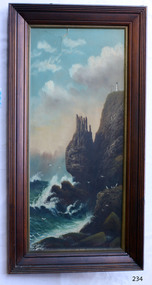
Painting - Oil painting, W. Langley-Taylor, Cape Schank [Schanck], Late 19th to early 20th century
... painting...w. langley-taylor...wall decoration...seascape of victoria's coast...art...mrs m irby...victoria's coast...pair...This painting is one of a pair of large paintings by W. Langley-Taylor in our collection. ...This painting is one of a pair of large paintings by W. Langley-Taylor in our collection. ...This painting is one of a pair of large paintings by W. Langley-Taylor in our collection. Currently, no further information has been found about the artist but research is ongoing. The subjects of these paintings are seascapes of notable areas of the coast on each side of Port Phillip Bay, south of Melbourne, Victoria. The subject of this painting is Cape Schanck, Victoria, which is on the east side of Port Phillip Bay. It includes the Cape Schanck Lighthouse and its Flagstaff. The Cape Schanck Lighthouse was built in 1859 and is the second of Victoria’s coastal lights. It is 21 metres tall and made from limestone. Unusually, its stairway is made from stone rather than wrought iron. Gilded tours are available to explain its use and significance to visitors. The lighthouse keepers at Cape Schanck kept records of the ships that sailed past them along Bass Strait; ship’s names, direction, time and date and so on. The details would also be passed on to shipping agencies, Harbour Masters and newspapers, which published Arrivals and Departures into and out of shipping ports such as Port Phillip Bay and the Port of Melbourne. INSCRIPTIONS “Mrs M Irby” (and on the Eagle Rock, Warrnambool, painting “980/Regency”) The inscription “Mrs M Irby” is on the back of both paintings but the significance of the inscription has not yet been discovered. Perhaps she was connected with the ship or shipping company “Irby”. A ship named “Irby”, built in Merseyside, Liverpool in 1881 by R & J Evans, Birkenhead. It was a four-masted iron ship built for the White Star Line. Henry Wilson Hewitt bought her in 1882, then later she was owned by Chadwick & Pritchard. In 1888 she was registered under the Irby Ship Co. Ltd. (trading as J. Joyce) in Liverpool. In 1912 Galgate Co. Ltd owned her. She traded between London, England and Australia, and is recorded as being in Melbourne and Hobart. In 1919 the Irby was destroyed by a mine when on her way to England. Or perhaps her name and the inscription in pencil “980/Regency” on the Eagle Rock Warrnambool, painting could be a delivery address for the paintings, perhaps an apartment in a hotel. NOTE: The artist’s spelling of the title “Cape Schank, Vic.” is incorrect. The location in this painting is named Cape Schanck. This painting is geographically significant for its depiction of Victoria’s coastal scenery. It is also significant as one of a pair of seascapes depicting sites on either side of Port Phillip Bay. Historically, the painting is significant as an example of the late nineteenth- and early twentieth-century methods and materials used in frame construction.Oil on board, in a dark-stained wooden frame, portrait format. The composition depicts a seascape with cliffs, a lighthouse and a flagstaff, birds in flight, waves breaking against rocks, and a blue sky with clouds. The title is painted at the lower left. The work is signed at lower right by the Victorian artist W. Langley-Taylor. A handwritten inscription in red crayon or heavy red pencil appears on the reverse. The board is fixed within the timber frame by small dark metal tacks. Metal eyes secure the hanging wire to the frame. Small round nail heads are visible around the frame, and both the board and the wood exhibit colour change. The handwritten inscription runs vertically along the lower left edge of the board. The wire hangs in a shallow curve, and the mitred corners are reinforced with staples. The board shows some damage. The discolouration visible on both the board and frame may indicate the former presence of a backing paper, once attached to the reverse with tape and tacks.Painted on front “W.LANGLEY-TAYLOR.” and “CAPE SCHANK, VIC.” [NOTE: correct spelling is Schanck] Handwritten on back “Mrs. M. Irby” flagstaff hill, warrnambool, shipwrecked coast, flagstaff hill maritime museum, maritime museum, shipwreck coast, flagstaff hill maritime village, great ocean road, painting, oil painting, cape schanck painting, w. langley-taylor, wall decoration, seascape of victoria's coast, art, mrs m irby, victoria's coast, pair of paintings -
 Flagstaff Hill Maritime Museum and Village
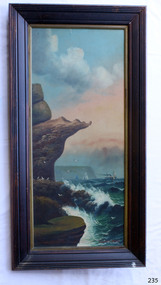
Painting - Oil painting, W. Langley-Taylor, Eagle Rock, Warrnambool, Vic, Late 19th to early 20th century
... painting...wall decoration...seascape of victoria's coast...mrs m irby...art...seascape...pair...This painting is one of a pair of large works by W. Langley-Taylor in our collection. ...This painting is one of a pair of large works by W. Langley-Taylor in our collection. ...This painting is one of a pair of large works by W. Langley-Taylor in our collection. Further information about the artist has not yet been identified. The pair depicts coastal sites on either side of Port Phillip Bay, south of Melbourne. This work represents Eagle Rock, Warrnambool, on the bay’s western side. Eagle Rock lies about 400 metres west of Thunder Point, near Shelly Beach. The painting shows the cliff formations looking east towards the Warrnambool Breakwater. The site is well known locally, appears in many photographs, and is also a recognised dive location in calm conditions. This stretch of Warrnambool coastline is exposed to the Southern Ocean. In the painting, the breaking waves and northerly drift of smoke from the steamship suggest a strong southerly wind. THE INSCRIPTIONS “Mrs M Irby” and “980/Regency”:- The significance of the inscription “Mrs M Irby”, which appears on the reverse of both paintings, has not been determined. It may refer to the ship or shipping company Irby. Irby was a four-masted iron ship built in Liverpool in 1881. It later traded between London and Australia, including visits to Melbourne and Hobart, before being destroyed by a mine in 1919 while en route to England. Alternatively, “Mrs M Irby” and the pencil inscription “980/Regency” may refer to a delivery address, perhaps an apartment or hotel. This painting is geographically significant for its depiction of Victoria’s coastal scenery. It is also significant as one of a pair of seascapes depicting sites on either side of Port Phillip Bay. Historically, the painting is significant as an example of the late nineteenth- and early twentieth-century methods and materials used in frame construction.Painting oil on board in a dark wooden frame, portrait orientation. Seascape of rock formation and cliffs, two yachts, a two-masted steamboat with red funnel and smoke, flying birds, high waves breaking onto rocks, blue sky with clouds, some tinted pink. The title is painted on the lower left corner, and the artist, W. Langley-Taylor, has signed his name on the lower right. The inscription on the back is handwritten script in red crayon or thick red pencil. The board is held in place inside the timber frame with small, dark metal tacks around all sides. Metal eyes join the wire to the frame. Small, round, dark metal nail heads are dispersed around the frame, and there is a change of colour on both the board and the wood of the frame. Painted on front “W.LANGLEY-TAYLOR.” and “EAGLE ROCK, WARRNAMBOOL, VIC.” Handwritten on back “Mrs. M. Irby” and “980 [underlined] Regency”flagstaff hill, warrnambool, shipwrecked coast, flagstaff hill maritime museum, maritime museum, shipwreck coast, flagstaff hill maritime village, great ocean road, eagle rock warrnambool, w. langley-taylor, oil painting, wall decoration, seascape of victoria's coast, mrs m irby, art, seascape, pair of paintings -
 Wangaratta Art Gallery
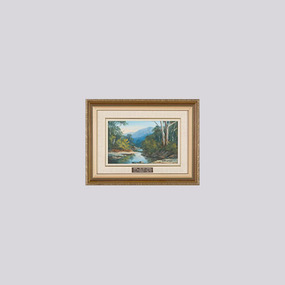
Painting, Mary Watson, The Buckland River, 1988
... Obverse: MARY WATSON/ (bottom right corner) WINNER - PAIR SMALL PAINTINGS/ 1988 WANGARATTA ART SHOW/ Presented By WANGARATTA Y'S MEN'S CLUB/ (plaque mounted on frame)...wangaratta art gallery mary watson painting landscape buckland river Obverse: MARY WATSON/ (bottom right corner) WINNER - PAIR SMALL PAINTINGS/ 1988 WANGARATTA ART SHOW/ Presented By WANGARATTA Y'S MEN'S CLUB/ (plaque mounted on frame) A river landscape painted with oils in shades of green, blue, brown, and grey. ...Rural City of Wangaratta Collection. Gift of the Wangaratta Y's Men's Club.A river landscape painted with oils in shades of green, blue, brown, and grey.Obverse: MARY WATSON/ (bottom right corner) WINNER - PAIR SMALL PAINTINGS/ 1988 WANGARATTA ART SHOW/ Presented By WANGARATTA Y'S MEN'S CLUB/ (plaque mounted on frame)wangaratta art gallery, mary watson, painting, landscape, buckland river -
 Wangaratta Art Gallery
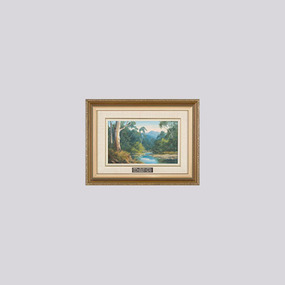
Painting, Mary Watson, The Ovens River, 1988
... Obverse: MARY WATSON/ (bottom right corner) WINNER - PAIR SMALL PAINTINGS/ 1988 WANGARATTA ART SHOW/ Presented By WANGARATTA Y'S MEN'S CLUB/ (plaque mounted on frame)...wangaratta art gallery mary watson landscape painting ovens river Obverse: MARY WATSON/ (bottom right corner) WINNER - PAIR SMALL PAINTINGS/ 1988 WANGARATTA ART SHOW/ Presented By WANGARATTA Y'S MEN'S CLUB/ (plaque mounted on frame) A river landscape painted with oils in shades of green, blue, brown, and grey. ...Rural City of Wangaratta Collection. Gift of the Wangaratta Y's Men's Club.A river landscape painted with oils in shades of green, blue, brown, and grey.Obverse: MARY WATSON/ (bottom right corner) WINNER - PAIR SMALL PAINTINGS/ 1988 WANGARATTA ART SHOW/ Presented By WANGARATTA Y'S MEN'S CLUB/ (plaque mounted on frame)wangaratta art gallery, mary watson, landscape, painting, ovens river -
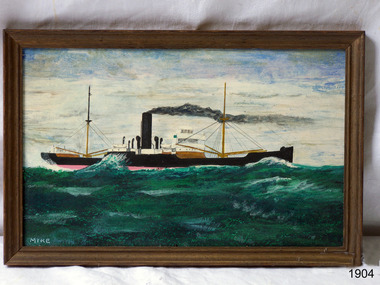 Flagstaff Hill Maritime Museum and Village
Painting - Vessel, Steamship, Mike McCrea (artist), ca 1985
... This is one of a pair of paintings by artist Mike McCrea, created when he was in Warrnambool in 1985. ...This is one of a pair of paintings by artist Mike McCrea, created when he was in Warrnambool in 1985. ...This is one of a pair of paintings by artist Mike McCrea, created when he was in Warrnambool in 1985. The painting was framed and sold by Patana Galleries, Paton Place, Manly Vale, NSW. It was later purchased by athe company of Master Mariners of Australia and who donated the pair to Flagstaff Hill. The pair of paintings are significant for their association with steamships and the Master Mariners of Australia group. The paintings represent a time in local history when many steamships were sailing the coast and transporting passengers and goods.Painting; timber framed oil painting with the image of a cargo steamship off the coast of Warrnambool. Artist is Mike McCrea. Framed by Patana Galleries, Manly Vale, NSW. Hand written, "Red. No. 390 A" Sticker "61"flagstaff hill, warrnambool, shipwrecked-coast, flagstaff-hill, flagstaff-hill-maritime-museum, maritime-museum, shipwreck-coast, flagstaff-hill-maritime-village, painting, mic mccrea, patana galleries, master mariners of australia, steamship -
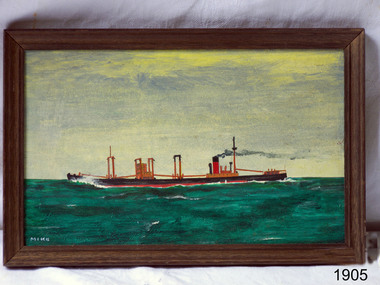 Flagstaff Hill Maritime Museum and Village
Painting - Vessel, Steamship, Mike McCrea (artist), ca 1985
... This is one of a pair of paintings by artist Mike McCrea, created when he was in Warrnambool in 1985. ...This is one of a pair of paintings by artist Mike McCrea, created when he was in Warrnambool in 1985. ...This is one of a pair of paintings by artist Mike McCrea, created when he was in Warrnambool in 1985. The painting was framed and sold by Patana Galleries, Paton Place, Manly Vale, NSW. It was later purchased by athe company of Master Mariners of Australia and who donated the pair to Flagstaff Hill. The pair of paintings are significant for their association with steamships and the Master Mariners of Australia group. The paintings represent a time in local history when many steamships were sailing the coast and transporting passengers and goods.Painting, framed oil on board; cargo steamship off the coast of Warrnambool by artist Mike McCrea. Framed by Patana Galleries, Manly Vale, N.S.W. Signed by artist.Signed; "MIKE" "J15/62 McCrea" "Red. No. 390 A" Sticker with "62" "PATANA GALLERIES / PATON PLACE, MANLY VALE / PHONE 949-1535"flagstaff hill, warrnambool, shipwrecked-coast, flagstaff-hill, flagstaff-hill-maritime-museum, maritime-museum, shipwreck-coast, flagstaff-hill-maritime-village, painting, mike mccrea, steamship, master mariners of australia, patana galleries -
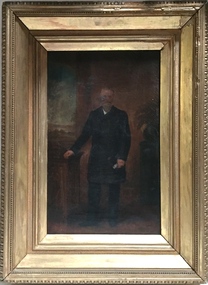 Kew Historical Society Inc
Painting - John Halfey, c.1882
... He is shown holding a document or perhaps a pair of gloves. The painting is badly damaged with a hole in the area of his face that has been patched and repainted....He is shown holding a document or perhaps a pair of gloves. The painting is badly damaged with a hole in the area of his face that has been patched and repainted. ...John Halfey (1825-89) was born in Southport, Lancashire and migrated to Victoria in 1852. After finding gold at Sandhurst, and representing the latter in the Victorian Parliament, he moved to Melbourne to engage in various commercial pursuits, including directorships of insurance, mining and banking companies. A resident of Kew from the late 1850s, he was known for the hospitality provided at his house Ordsall (later Southesk) in Cotham Road. On 14 December 1860, Halfey chaired a public meeting calling for separation from the Boroondara Roads Board, which led, four days later, to the proclamation of Kew as a separate municipality. He was elected to the Council in 1861, replacing Cr. Oswin, and subsequently served as the second Chairman of the Municipality in 1862-1863. John Halfey became a trustee of Holy Trinity Church in Bulleen Road (now High Street) in 1862. He was to resign from Council after four years in 1865. Twenty-four years later in January 1889, he died aged 63 from a seizure, at his rooms at the Herald Office. He was interred in the Boroondara General Cemetery where his monument is the tallest in the Cemetery. Donated by Eileen Grigg, 2017Small, full-length portrait of John Halfey in an original gilded frame. The artist depicts him formally dressed in a frock coat beside an open window. He is shown holding a document or perhaps a pair of gloves. The painting is badly damaged with a hole in the area of his face that has been patched and repainted.john halfey, ordsall, chairman of kew, boroondara roads board, municipality of kew -
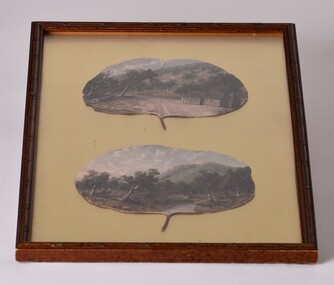 Chiltern Athenaeum Trust
Painting - Oil painting on gumleaf by Alfred William Eustace, circa 1851 to 1907
... This gum leaf painting is one of a pair displayed on foil in the same frame. ...painting on gum leaf by Alfred William Eustace. A scene of a log cabin on Black Dog Creek Road, Chiltern, with Skeleton Hill in the background. The canvas is a juvenile Red Box (Eucalyptus polyanthemos) leaf. It is one of a pair...This gum leaf painting is one of a pair displayed on foil in the same frame. ...This gum leaf painting is one of a pair displayed on foil in the same frame. It is typical of many paintings by the self-taught Australian artist Alfred William Eustace (1820-1907). A.W. Eustace, a well-known Australian artist, was born in Berkshire, England, where he was an assistant gamekeeper to the Earl of Craven at Ashdown Park. He migrated to Australia with his wife and children in 1851 and camped on the Ullina and Eldorado Runs on the Black Dog Creek at Chiltern, which was in excess of 50,000 acres of grazing land. A.W. Eustace was employed as a shepherd by Jason Withers and while tending his flocks in the solitude of the bush, Eustace turned his attention to painting and music to while away the long and weary hours. He endeavoured to capture the spirit of the bush painting on board, canvas or tin plate, but as these materials were not always readily available he then started painting on large round eucalyptus leaves from the White and Red Box trees that grew around about him. About 1856 he painted a small picture of the famous Woolshed goldrush and during the next few years became well known in North-East Victoria. John Sadlier, a police officer stationed at Beechworth said that Eustace painted "some really exquisite scenes. He was of an easy-going dreamy temperament, a student of nature only, despising the works of men. Unfortunately his drawings were on eucalyptus leaves, the largest and roundest he could find and not on canvas, and no doubt have all perished long ago." How wrong he was. In 1876 the Melbourne Age newspaper reported, 'Eustace’s celebrated paintings on gum leaves are again attracting attention,…Mr Eustace is an elegant artist…he seems without effort to catch the colour and spirit of Australian scenery…' In 1864 A.W. Eustace held an Art Union in Albury, and again in 1884 in Ballarat. He exhibited at the Victorian Academy of Arts in 1877 and also held an exhibition of gum leaf paintings at Stevens Gallery, Melbourne in 1893. By 1896 he was receiving orders from heads of states in Europe, with his works acknowledged by Queen Victoria, Emperor Frederick of Germany and the Czar of Russia, as well as the Governors of New South Wales and Victoria. His paintings reflected his ability to paint the sky in his realistic style which is still noted by art critics of the day. A.W. Eustace was also a skillful taxidermist. The collection of birds and animals that can be seen at the Beechworth Museum are examples of his taxidermy skill. When not doing his work, painting or taxidermy, he regularly contributed letters and verse to the Chiltern newspaper, The Federal Standard. A book of verse in his hand writing was presented to The Athenaeum Trust by the Boadle family. In the 1870’s he became interested in spiritualism often being involved in lively debate at lectures and séances. Alfred William Eustace died in 1907 and is buried in the Chiltern New Cemetery with his wife Sarah and one of his daughters, Elizabeth.An oil painting on gum leaf by the well-known Australian artist Alfred William Eustace. He was a self-taught artist during the 19th and early 20th century and a prominent resident of Chiltern. Oil painting on gum leaf by Alfred William Eustace. A scene of a log cabin on Black Dog Creek Road, Chiltern, with Skeleton Hill in the background. The canvas is a juvenile Red Box (Eucalyptus polyanthemos) leaf. It is one of a pair of Eustace gum leaf paintings mounted on gold foil, under glass in a brown frame. Inscription on back. Labels on back: Rehoused by The Centre for Cultural Materials/ Conservation, University of Melbourne "Oil on Gum Leaf"/ by Alfred William Eustace/ Donor:- Cam & Connie Boadle/ Wales U.K. Crescent/ MUSEUM/ GRADE/ 24 OCT 1998/ CONSERVATION BOARD ALBURY/ PICTURE FRAMERS/ Shop 15 & 16/ AMP Lane,/ Albury, 2640/ Ph: 02 6021 7088black dog creek, chiltern, alfred eustace, skeleton hill, gum leaf, painting, eustace -
 Flagstaff Hill Maritime Museum and Village
Opera Glasses & case, Early 20th Century
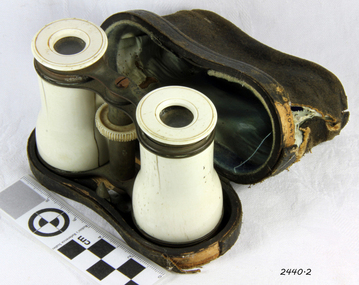
... pair of binoculars with a magnification capability of X3. Less than a year later, a well-known inventor and philosopher by the name of Galileo developed what became known as the Galilean telescope. Advertisements were first found for opera glasses and theatre binoculars in London as early as 1730 in the form of a long collapsible telescope. The "Opera Glass" as it was referred to; was often covered in enamel, gems, ivory, or other art and paintings...pair of binoculars with a magnification capability of X3. Less than a year later, a well-known inventor and philosopher by the name of Galileo developed what became known as the Galilean telescope. Advertisements were first found for opera glasses and theatre binoculars in London as early as 1730 in the form of a long collapsible telescope. The "Opera Glass" as it was referred to; was often covered in enamel, gems, ivory, or other art and paintings ...Opera Glasses came into existence as a result of a long line of inventions, and further improvements upon those inventions. The process started in the year 1608 when a Dutch optician by the name of Hans Lipperhey developed the first pair of binoculars with a magnification capability of X3. Less than a year later, a well-known inventor and philosopher by the name of Galileo developed what became known as the Galilean telescope. Advertisements were first found for opera glasses and theatre binoculars in London as early as 1730 in the form of a long collapsible telescope. The "Opera Glass" as it was referred to; was often covered in enamel, gems, ivory, or other art and paintings. For almost 100 years opera glasses existed merely as telescopes. In Vienna, in 1823 the first binocular opera glasses and theatre binoculars began to appear. They were two simple Galilean telescopes with a bridge in the centre, each telescope focused independently from the other by extending or shortening the telescope until the desired focus was achieved, which was useful, yet very cumbersome. Two years later in Paris, Pierre Lemiere improved on this design and created a centre focus wheel. This allowed the focusing of both telescopes together. After this development, opera glasses and theatre binoculars grew in popularity because of the superior view they facilitated in opera and theatre houses. The beautiful design of the glasses themselves also added appeal to the opera-going crowd. By the 1850's opera glasses and theatre, glasses had become a must-have fashion accessory for all opera and theatergoers.Not very significant as not associated with a historic event or person and made during the first half of the 20th Century and many are still available and easily sourced.Vintage Pair of Opera Glasses, with cow bone barrels and eyepieces, both barrel pieces have split in them, both metal end barrels each have a minor dent, optics are pretty clear no mould although have very minor dust spots inside, they look like they were gilded at some point but most of this has rubbed off glasses have a black leather case with blue lining. No markings whatsoever anywhereflagstaff hill, warrnambool, shipwrecked coast, flagstaff hill maritime museum, maritime museum, shipwreck coast, flagstaff hill maritime village, great ocean road, binoculars, opera glasses, theatre glasses, optical instrument, cow bone -
 Glenelg Shire Council Cultural Collection
Painting, Greenmount, n.d
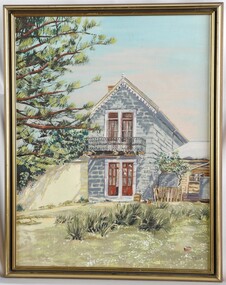
... The painting depicts a double storey bluestone building with a pair of red doors on both storeys. ...CEMA Art Collection Previously located in History House Front: DEB Back: (No inscriptions) The painting depicts a double storey bluestone building with a pair of red doors on both storeys. ...CEMA Art Collection Previously located in History HouseThe painting depicts a double storey bluestone building with a pair of red doors on both storeys. The top storey has a small balcony with black railing. To the right of the building is a single storey wooden building with two water tanks out the front. To the left of the building is a yellow wall and the edge of a tall Norfolk Pine. In the foreground is a grass area with clumps of tall grass. The background is a blue and grey sky. The work has a gold and black frame and exposed canvas.Front: DEB Back: (No inscriptions) -
 Ringwood and District Historical Society
Painting, "Busch's Weir" - Oil on canvas by Hermann Otto ("Hof") Busch (1880-1960), 1953
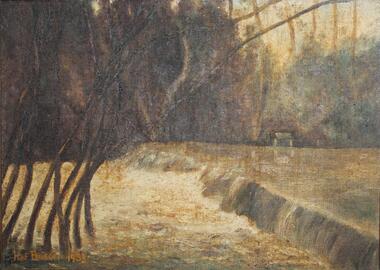
... (See Reg #4856B for other of two paintings in the pair)...(See Reg #4856B for other of two paintings in the pair) "Busch's Weir" - Oil on canvas by Hermann Otto ("Hof") Busch (1880-1960) Painting Hermann Busch ...In the 1930s, Hermann Busch constructed a concrete wall across Dandenong Creek, forming "Busch's Weir" on his Bayswater property, "Waldheim". The weir wall was demolished in the 1960s.One of two paintings of weir across Dandenong Creek, mounted in beveled edge wooden frame with ornate corner moldings. (See Reg #4856B for other of two paintings in the pair)Hof Busch 1953 -
 Ringwood and District Historical Society
Painting, "Busch's Weir" - Oil on canvas by Hermann Otto ("Hof") Busch (1880-1960), 1953
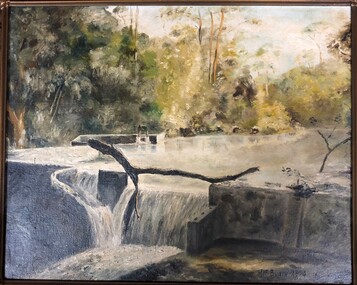
... (See Reg #4856 for other of two paintings in the pair)...(See Reg #4856 for other of two paintings in the pair) "Busch's Weir" - Oil on canvas by Hermann Otto ("Hof") Busch (1880-1960) Painting Hermann Busch ...In the 1930s, Hermann Busch constructed a concrete wall across Dandenong Creek, forming "Busch's Weir" on his Bayswater property, "Waldheim". The weir wall was demolished in the 1960s.One of two paintings of weir across Dandenong Creek, mounted in beveled edge wooden frame with ornate corner moldings. (See Reg #4856 for other of two paintings in the pair)Hof Busch 1953 -
 Flagstaff Hill Maritime Museum and Village
Functional object - Opera Glasses, 1920s
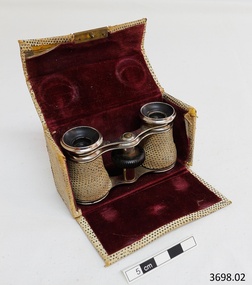
... pair of binoculars with a magnification capability of X3. Less than a year later, a well-known inventor and philosopher by the name of Galileo developed what became known as the Galilean telescope. Advertisements were first found for opera glasses and theatre binoculars in London as early as 1730 in the form of a long collapsible telescope. The "Opera Glass" as it was referred to; was often covered in enamel, gems, ivory, or other art and paintings...pair of binoculars with a magnification capability of X3. Less than a year later, a well-known inventor and philosopher by the name of Galileo developed what became known as the Galilean telescope. Advertisements were first found for opera glasses and theatre binoculars in London as early as 1730 in the form of a long collapsible telescope. The "Opera Glass" as it was referred to; was often covered in enamel, gems, ivory, or other art and paintings ...Opera Glasses came into existence as a result of a long line of inventions, and further improvements upon those inventions. The process started in the year 1608 when a Dutch optician by the name of Hans Lipperhey developed the first pair of binoculars with a magnification capability of X3. Less than a year later, a well-known inventor and philosopher by the name of Galileo developed what became known as the Galilean telescope. Advertisements were first found for opera glasses and theatre binoculars in London as early as 1730 in the form of a long collapsible telescope. The "Opera Glass" as it was referred to; was often covered in enamel, gems, ivory, or other art and paintings. For almost 100 years opera glasses existed merely as telescopes. In Vienna, in 1823 the first binocular opera glasses and theatre binoculars began to appear. They were two simple Galilean telescopes with a bridge in the centre, each telescope focused independently from the other by extending or shortening the telescope until the desired focus was achieved, which was useful, yet very cumbersome. Two years later in Paris, Pierre Lemiere improved on this design and created a centre focus wheel. This allowed the focusing of both telescopes together. After this development, opera glasses and theatre binoculars grew in popularity because of the superior view they facilitated in opera and theatre houses. The beautiful design of the glasses themselves also added appeal to the opera-going crowd. By the 1850's opera glasses and theatre, glasses had become a must-have fashion accessory for all opera and theatregoers. A vintage pair of 1920s opera glasses probably made in France by an unknown maker the item is significant due to it's provenance that can be traced and it's completeness as a useful social item and fashion accessory used by theatergoers from the mid 19th century and well into the 20th century. Some people still use modern variants of theater glasses today to improve their enjoyment of the theater.Both glasses and case are covered with black and white snake skin. Case lined with purple velvet, and has brass closure clip.Noneflagstaff hill, warrnambool, shipwrecked coast, flagstaff hill maritime museum, maritime museum, flagstaff hill maritime village, great ocean road, opera glasses, serpentine opera glasses, binoculars, accessories, optical instrument, scientific instrument, theater glasses, french opera glasses, hans lipperhey -
 Flagstaff Hill Maritime Museum and Village
Domestic object - Ornament, Early 20th Century
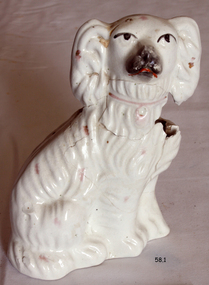
... painting of the Staffordshire dogs may differ from factory to factory. As the popularity of the figurines increased towards the end of the 19th century, the quality began to decline. Thousands were manufactured but originals in good condition and their correct pairs...painting of the Staffordshire dogs may differ from factory to factory. As the popularity of the figurines increased towards the end of the 19th century, the quality began to decline. Thousands were manufactured but originals in good condition and their correct pairs ...Staffordshire dog figurines are matching pairs of pottery spaniel dogs, standing guard, which were habitually placed on mantelpieces in 19th-century homes. Mainly produced by Staffordshire pottery factories, these earthenware figures were also made in other English counties and Scotland. They are also known as hearth spaniels or fireplace dogs as they were positioned on top of the mantelpiece. Many other breeds were produced, particularly the greyhound, though the spaniels were especially popular and this is attributed to royalty favouring the King Charles Spaniel breed. In Scotland, they have colloquially been termed 'Wally dugs.' and were manufactured in bulk at potteries in places such as Pollokshaws in Glasgow and Portobello near Edinburgh. Though the most popular, the dogs were only one of many types of Staffordshire figures; other animals and human figures of various kinds were also popular. Staffordshire dogs are nowadays collectors’ items and since the 1720s, spaniels had been produced by various pottery factories in Staffordshire. The quality of the modelling and painting of the Staffordshire dogs may differ from factory to factory. As the popularity of the figurines increased towards the end of the 19th century, the quality began to decline. Thousands were manufactured but originals in good condition and their correct pairs are now uncommon. These figures continued to be made until the 1920s and early models are of better quality. However, reproductions were still being manufactured in 2009.Early 19th century pair of Staffordshire dogs used as a mantle place display however given their damaged condition and being of a later provenance have little historic or monetary value. Ceramic white dog, figurine one of a pair, with painted face and collar. Both are nearly identical except one sits to the left while the other sits to the right.Noneflagstaff hill, warrnambool, shipwrecked coast, flagstaff hill maritime museum, maritime museum, shipwreck coast, flagstaff hill maritime village, great ocean road, ornament, ceramic ornament, dog ornament -
 Ringwood and District Historical Society
Flyer - Catalogue, Public Auction - Brick Residence and Contents of Dwelling, "Wyncliff", Whitehorse Road, Ringwood. 1935
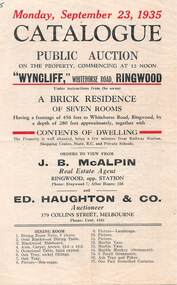
... Pair Pictures (White frames); One Picture ("The Mourners"); Picture ("The Wanderer Found"); Small Picture; Wicker Chair. FOURTH BEDROOM - Duchess Chest 5 drawers; Corner Wardrobe and Curtains; One Single Bed & Wire Mattress; Single Bedding; Lino on floor 14ft x 6ft 6in.; Occasional Table; 3 Pictures; Two Door Mats; Hall Runner (Carpet) 21ft. BREAKFAST ROOM - Two Wicker Chairs; Cushion; Brown Cushion; Four Vienna Chairs; Jardinere; Kerb (Wooden). 3 Pictures; Oil Painting...Pair Pictures (White frames); One Picture ("The Mourners"); Picture ("The Wanderer Found"); Small Picture; Wicker Chair. FOURTH BEDROOM - Duchess Chest 5 drawers; Corner Wardrobe and Curtains; One Single Bed & Wire Mattress; Single Bedding; Lino on floor 14ft x 6ft 6in.; Occasional Table; 3 Pictures; Two Door Mats; Hall Runner (Carpet) 21ft. BREAKFAST ROOM - Two Wicker Chairs; Cushion; Brown Cushion; Four Vienna Chairs; Jardinere; Kerb (Wooden). 3 Pictures; Oil Painting ...Double-sided A5 size advertisement for public auction under instructions from the owner on Monday, September 23, 1935 on the property - seven room brick residence with frontage 456 feet by approximately 280 feet and contentents of dwelling fully listed over 4 pages. Agent - J.B. McAlpin, Ringwood, opp. station. Phone Ringwood 7; after houres 236. Auctioneer - ED. Haughton & Co., 379 Collins Street, Melbourne. Phone Central 4101.Contents of Dwelling List - includes: DINING ROOM - Dining Room Suite - 6 pieces; Oval Blackwood Dining Table; Blackwood Sideboard; Axminster Carpet, Occasional Table hand carved; Oak Trays; Seascape, Landscape and other Pictures; 2 Marble Vases; Marble Monkey and 3 other Small Ornaments; Ash Tray and Poker; One Pair Stencilled Curtains. Two Large Vases, 1 with floral design; Salad Bowl and Servers; One Dozen Dessert Knives; Nine Stainless Teaspoons (new); Plated Vases; Plated Jam Dishes; Plated Cream Bowl; Silver Plated Cake Dish; One Pair Plated Shell Butter Dishes; Lino Border. LOUNGE ROOM - 2 Pictures and 1 pair with Circular Frames; Floral Jardinere and Pot Plant; Cabinet Gramophone "Singola"; Records; Player Piano "Cable"; Piano Stool; 31 Rolls; Roll Cabinet; Quantity of Music; Music Case, Leather; Portable Gramophone "Decca"; Floral Design Jardinere; Wicker Occasional Table; 2 Wicker Chairs; Cane Lounge Settee; Blackwood Bookcase; 9 Volumes Universal Encyclopedia; 10 Vols Children's Encyclopedia; Floral Vase; Black and Gold Vase; One pair Plated Vases; Ash Pan; Lino Border (Lounge Room); One Carpet, green 13.6 x 10.6; One Cushion; Hall Stand; Pedestal; Floral Design Jardinere; Painting on Canvas (Landscape); Hall Runner Carpet 25 feet; Hall Lino 29ft 5 in.; Five Door Mats (small). FIRST BEDROOM - Arm Chair (Leather); English Oak Dressing Table; English Oak Wash Stand Marble Top; Toilet Set (Four pieces); Silk Fire Screen; Blackwood Occasional Table; Black and Gold Vase; Pair China Vases; Pair Glass Vases; Single Glass Vase; One Kewpie Lavender Bag; Bedroom Lino 15.6 x 13.6. SECOND BEDROOM - Arm Chair (Leather); Dressing Table; Wash Stand; 3 Piece Toilet Set; One Vase (Pink Cameo Design); Two Ornaments (one round); Bedroom Lino 13.5 x 12.10; 3 Pictures; 2 Pairs Curtains (applique, stenc'ld); Pair Curtain Poles. THIRD BEDROOM - Lino approx 14ft x 10ft; Two Green Mohair Mats; Pair Pictures (White frames); One Picture ("The Mourners"); Picture ("The Wanderer Found"); Small Picture; Wicker Chair. FOURTH BEDROOM - Duchess Chest 5 drawers; Corner Wardrobe and Curtains; One Single Bed & Wire Mattress; Single Bedding; Lino on floor 14ft x 6ft 6in.; Occasional Table; 3 Pictures; Two Door Mats; Hall Runner (Carpet) 21ft. BREAKFAST ROOM - Two Wicker Chairs; Cushion; Brown Cushion; Four Vienna Chairs; Jardinere; Kerb (Wooden). 3 Pictures; Oil Painting (Canvas); 2 Pictures; Lino 14ft x 14ft; Brown Table Cover; Fruit Set; Robur Tea Pot; Plaque; China Biscuit Barrel; Glass Fruit Bowl; Pair Pickle Jars and Stand; Wooden Inkstand; Pair Ash Trays; Two Marble Vases; Glass Vase; Electric Jug and Electric Toaster (practically new); Picture; Cushion; Pair Lace Curtains; Curtain Rod; Three Lace Curtains; Brass Curtain Rods (3); Lino in Vestibule 10ft x 8 ft; Lino in Kitchen 12.6 x8.6; Coal Scuttle; Two Small Tables (1 Baize Cover). STORE ROOM - Briquette Grate; Three Coir Mats (one new); Three Small Door Mats (new); Glass Fire Screen; 2 Alm Pot Stands; Steel Pot Stand; Lady's Bicycle; 2 Electric Radiators (one large); White Cabinet; Stretcher Bed; Large Cot with Wire Mattress; Kerb; Fender and Irons; Lino on floor 12ft x 12ft; Lino in Storeroom 6ft x 6ft; Three Large Window Blinds; Clothes Horse; Dressmaker's Fitting Stand; Dressmaker's Bust; Window Display Bust; Blouse Stand; Small Display Stand; Meat Cover (Metal); Leather Portmantau; Leather Kit Bag; Four Large Wooden Drawers; Picnic Basket; Mattress, Bolster and Pillow; Cot Quilt; One Long-handled Feather Duster; Feather Duster; Wicker Lounge; Cane Soiled Linen Basket; One New Washing Tub; Copper Preserving Pan; Lino in Laundry 8 x 6 approx; Carpet Sweeper; Small Jardinere; 2 Shopping Baskets; Kitchen Safe; Kitchen Table; Three Buckets; 1 Horse Rub patent (prac new); Wooden Pot Plant Stand; Bird Cage and Stand; Pair Steps; Pair Small Steps; Metal Meat Safe; Wooden Safe; Hand worked Table Cover; Pair Poplin Silk Curtains (new); Leather Table Centre. VERANDAH - 12ft Shelving with doors; 35ft Shelving; Wooden Stand; Axe Stand (wooden); Nine feet Wooden Shop Fittings; Small Filing Cabinet; Three Window Frames & Glass; 38 Pot Plants Fernery; 9 Hanging Baskets Fernery; Electric Shop Sgn Storeroom; 2 Small Electric Shop Signs Storeroom; 2 Garden Sprays; Doll's Pram and Doll; Two Boxes Paint and Slate; Crystal Radio Set; New Canvas Blind & Roller 6ft.; Electric Light Reflectors (two); Two pieces of Painted Baize; Small Vice; Sprinkler; One Gallon Tin of Spray Oil; 2 Packets of "Aresto"; Two Hurricane Lamps; One Pair Spring Balance Scales; Small Pair Spring Balance Scales. WASH HOUSE - Pair Heavy Tracers (2); Pair Reins; Back Band; One Tug; Pair Hames; One Pair Neck Bands (2); Four Manger Balls; Pair Knee Pads; Kicking Strap complete; Leather Head Stall; Collar Pad; Knife Board and Tin Polish; Fork Cleaner; Foot Spray Pump. TOOL SHED - One Stewart Horse Clipper; Approx 120ft Ribbed Hose; 100ft ½in Hose; Child's Scooter; Tin Box; Ferret Box; One Tool Box; Tomato Hoe; Sprinkler; Two Large Augers; Large Watering Can; Medium Watering Can; Small Watering Can; Wooden Tool Chest; Rope, Tackle and two Pulleys; Six pieces of Lino; Three Small Canvas Blinds; Lawn Mower 14in.; Lawn Mower 12in.; Grass Catcher; 8 Pieces Garden Tools; Barrow; Quantity of Timber; Quantity of Flower Pots; Quantity of Wire; 4 Egg & 1 Fowl Crates Feed Room; 1 Gallon Demijohn Feed Room; Quantity of Shelving Feed Room; Quantity of Cement, Lime; Six Small Doors; Roll of Perforated Cardboard; Boot Rack; Coat Rack; 3 Automatic Sanitary Disinfectant; Pair Neck Straps and Rope; One Chimney Top & 3 Vent Bks.; Desk; Large Pump; Large Safe; Pair Sliding Door Rollers & Fittings; Two Wooden Doors; Box Sundries; Wooden Frame and Glass; 2 Vienna Chairs; Delivery Cart; Five Boxes Tiles; Quantity Agricultural Pipes; Wooden Bench; Wood Horse; Earthenware Drain Pipe; Wooden Tool Box; New Brass Spray "Rego"; Two Wood Planes. YARD - Pair Hedge Clippers; Box Containing 2 prs Secateurs & Punch; Box Tools seven pieces; Box Sundries; Lawn Weeder and Seed Sower; Box Tools 6 pieces; Two Saws; Bundle Files; Three Braces; Box of 13 pieces Gimlets etc.; Five Spanners; Box Tools 4 pieces; Four Coal Chisels; Box 7 pieces of Tools; Box of 5 pieces of Tools; Box of Docket Books; One Printing set; Large Figure Printing Set; Small Figure Printing set; Price Ticket Box; Air Brush Writing Set Complete; Six Shelves & Brackets, one Hat Rack, in store room; Box of Three Hammers; Two Boot Lasts; Tin of Polishing Oil; Box of Gardening Sundries; 2 Bicycle Pumps Saddle & Clips; One Covered Baking Dish; 200 c.p. Globe (Vestibule); Two "Dimolite" Fittings; Set of Five Canisters; Earthernware Jar; Two shopping Cases; Dinner Set 11 pieces; Box of Sundry Tins; Alm Fish Pan and Drainer; Two Ventilators; Knife Board & 3 Bread Saws; Soap Box and Jewel Case; Three Glass Articles. OFFICE FURNITURE - Steel Safe (Office Safe); Office Table five drawers; Cabinet 8 drawers; Cupboard three shelves; Selves 2ft3in x 1ft6in; Cheque Protector; Remington Typewriter; Typewriter Adjustable Table; Burroughs Bookkeeping Machine and Stand Complete; Small Office Table; Glass Show Case3ft9 x 2ft.; Four Sheets M. Glass; Five Sheets P. Glass; Gent's Overcoat new; Boy's Pullover New; Small Show Case; Duplicator (complete); Webster's Dictionary; Family doctor's Book. Two Dictionaries; Bundle of Three Books; Art Decorating Book; Bundle of Three Books; Bundle of Three Books; Two Books (Children's); (Multiple) Bundles each containing Three Books; Leather Riding Whip; Tort-shell Inkstand & Calendar; Tort-shell Folding Letter Rack; Water Filter; Thermos Flask and Case; Two Waste Paper Baskets. -
 Bendigo Military Museum
Print - HRH PRINCE PHILLIP FRAMED, unknown
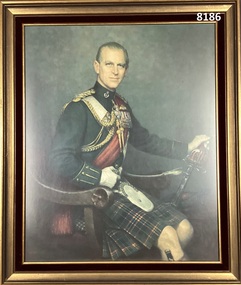
... This is one of a pair the other being HRH Queen Elizabeth, refer Cat No 8187. brsl smirsl HRH Elizabeth Print of original painting of HRH Phillip Duke of Edinburgh seated with kilt, medals, awards and holding a sword in left hand. ...This is one of a pair the other being HRH Queen Elizabeth, refer Cat No 8187.Print of original painting of HRH Phillip Duke of Edinburgh seated with kilt, medals, awards and holding a sword in left hand. The frame is gold with a brown felt edging.brsl, smirsl, hrh, elizabeth -
 Sunshine and District Historical Society Incorporated
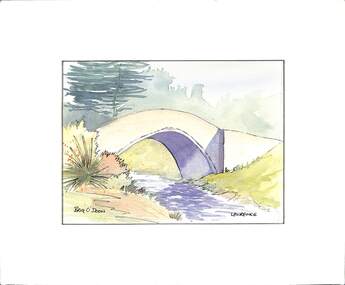
Painting - Brig O' Doon Painting by Brian Lawrence, Brian Lawrence, Brig O' Doon
... paintings won prizes at the Royal Melbourne Show, Sunbury Show, Bacchas Marsh Show and at the Ballarat Society of Artists Awards. Brian became good friends of John Willaton, a S&DHS member and former City of Sunshine Town Clerk. During a trip to Scotland by John & his wife Dorothy to research Dorothy's family tree, the pair...paintings won prizes at the Royal Melbourne Show, Sunbury Show, Bacchas Marsh Show and at the Ballarat Society of Artists Awards. Brian became good friends of John Willaton, a S&DHS member and former City of Sunshine Town Clerk. During a trip to Scotland by John & his wife Dorothy to research Dorothy's family tree, the pair ...Brian was born in Ayr on the West Coast of Scotland. Brian lived in Mernda Street Sunshine West. Brian was an artist who painted in water colours. His paintings won prizes at the Royal Melbourne Show, Sunbury Show, Bacchas Marsh Show and at the Ballarat Society of Artists Awards. Brian became good friends of John Willaton, a S&DHS member and former City of Sunshine Town Clerk. During a trip to Scotland by John & his wife Dorothy to research Dorothy's family tree, the pair stayed at Brian's brother's in-law Bed & Breakfast accommodation. Brian gave this painting to John & Dorothy in memory of their trip to Scotland.Water colored painting of the Brigde over the River Doon, Scotland mounted in cardBrig O' Doon|To John From Brian Lawrence in memory of your trip to the Brig O' Doon (Bridge over River Doon) B. Lawrence 98brig o' doon, scotland, brian lawrence -
 Robin Boyd Foundation
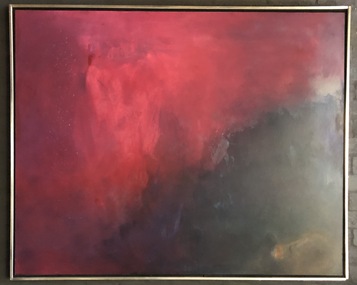
Painting, Donald Laycock, Nights of Love, 1965
... This painting is dedicated to Patricia Boyd, Robin Boyd's wife, on the reverse side. "Night of Love" was exhibited as a complimentary pair with "Days of Gold" at Laycock's 1965 exhibition at South Yarra Gallery, where Robin Boyd purchased it. ...This painting is dedicated to Patricia Boyd, Robin Boyd's wife, on the reverse side. "Night of Love" was exhibited as a complimentary pair with "Days of Gold" at Laycock's 1965 exhibition at South Yarra Gallery, where Robin Boyd purchased it. ...This painting is dedicated to Patricia Boyd, Robin Boyd's wife, on the reverse side. "Night of Love" was exhibited as a complimentary pair with "Days of Gold" at Laycock's 1965 exhibition at South Yarra Gallery, where Robin Boyd purchased it. It hangs in the living/dining room. "Three of the Players", the 1953 painting by John Brack, hung in this position in the Mark Strizic photograph in Robin Boyd's book "Living in Australia" p 80. The Brack was in the Boyd home until 2010, when it was sold.Abstract composition, predominantly in red tones but with blue tones in the bottom right hand corner.Initials and date (DL 65) in centre at the bottom. On the reverse side - "1506" ; label on rear with cutting instructions, and" To Pat".donald laycock, south yarra gallery, paricia boyd, robin boyd, walsh st artwork, ohm2022, ohm2022_18 -
 Embroiderers Guild, Victoria
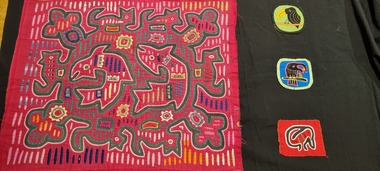
Accessory - San Blas Mola Panel
... pairs to decorate the front and back of a Guna woman's blouse. Artists fill nearly all the spaces, traditionally believed to leave no room for evil spirits to settle. Evolving from ancestral geometric body painting...pairs to decorate the front and back of a Guna woman's blouse. Artists fill nearly all the spaces, traditionally believed to leave no room for evil spirits to settle. Evolving from ancestral geometric body painting ...traditional hand sewn crafted by indigenous Guna (Kuna) people of the San Blas Islands, panama and Colombia. Usually made in pairs to decorate the front and back of a Guna woman's blouse. Artists fill nearly all the spaces, traditionally believed to leave no room for evil spirits to settle. Evolving from ancestral geometric body painting. Following 1925 Guna Revolution, securing their autonomy, making and wearing Molas became a symbol of cultural identity and independence.Black panel with rectangle of reverse applique in very bright colours - orange, blue, pink, black, with red fabric predominant. Depicting two dolphins/sharks. Three separate motifs depict birds. Part of Mola - traditional garment.embroidery, mola, reverse applique -
 Benalla Art Gallery
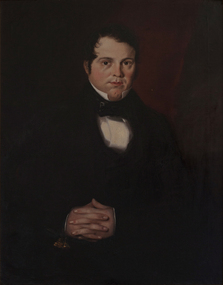
Painting, Joseph BACKLER, Henry Johnson (portrait pair), c. 1843
... Polished timber frame with gold gesso inlay Henry Johnson (portrait pair) Painting Joseph BACKLER ...Born: London, Middlesex, England 1813; Arrived: Sydney, New South Wales, Australia 1832; Died: Sydney, New South Wales 1895VictorianBennett Bequest, 1999 Oil on canvas depicting portrait of seated Henry Johnson in black suit and bowtie. Polished timber frame with gold gesso inlayRecto: Not signed, not dated, not titled painting, portrait, colonial, man, face, hands, figure -
 Benalla Art Gallery
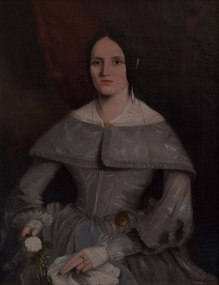
Painting, Joseph BACKLER, Caroline Johnson (portrait pair), c. 1843
... Polished timber frame with gold gesso inlay Caroline Johnson (portrait pair) Painting Joseph BACKLER ...Born: London, Middlesex, England 1813; Arrived: Sydney, New South Wales, Australia 1832; Died: Sydney, New South Wales 1895VictorianBennett Bequest, 1999 Oil on canvas depicting portrait of seated Caroline Johnson in grey dress. Polished timber frame with gold gesso inlayRecto: Not signed, not dated, not titled painting, portrait, colonial, woman, face, dress, flower, figure -
 National Wool Museum
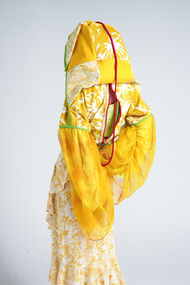
Clothing - 35 Life, Canwen Zhao, 2022
... painting, she draws inspiration from ancient Chinese philosophy and aesthetics, which gives her a unique sense of beauty. After 8 years of fashion and art training, she possesses a keen insight into current trends and tends to combine art with commercial needs. Zhao's design style is diverse, characterized by a multidimensional approach, a focus on colour application, and storytelling through details. sustainable fashion we the makers art culture design Chinese philosophy prize Outfit consisting of six pieces: - Orange plastic eye wear with green paint - Pair of red and green metal clip on earrings - Red beaded phone case with attached beads on string - Pair of red and green painted running shoes - Yellow and green hooded garment with red piping and zips - Brown bag with green beaded handles Clothing 35 Life Canwen Zhao ...Canwen Zhao was awarded the $10,000 We The Makers Acquisitive Prize for '35 Life' in 2023. Artist Statement: "35life" is a sustainable fashion project that transforms second-hand clothing materials into urban street outdoor-style products. Highlighting prominent Chinese classic red and green colours not only conveys eastern aesthetics but also adds a sense of unity to the clothing collection. The high-saturation and high-brightness full-colour palette keeps the clothing consistently "fresh," allowing any trendy colours to seamlessly integrate into the project's designs, thus extending the lifespan of the garments. Additionally, all clothing items can quickly transform into a stylish bag for convenient daily carrying and home storage. These bags are made from leftover fabric generated during the production process and serve as original packaging for sale. This approach not only reduces excessive packaging but also enhances the chances of resale in the second-hand market. The project draws inspiration from the traditional Chinese cultural concept of "huo feng ding," meaning "exchange the old for the new." it's also influenced by the designer's personal experience with health issues, making the designs suitable for individuals who can't be exposed to sunlight for extended periods, adapting to the changing urban lifestyle. 35life aims to provide visually pleasing and comfortable dressing experiences for urban dwellers who are busy with work and experience high levels of stress. Unlike traditional design patterns, this project adopts a unique design approach. It selects 3-5 pieces of raw materials based on their colours, and then disassembles them through structural lines. While retaining most of their functionality, these materials are rearranged and assembled on a flat surface before being shaped on a dress form. Subsequently, various ways of creating storage bags are derived from the initial clothing prototypes. After refining the designs, the final products are developed, and similar materials are used to create samples. Therefore, under this design methodology, even for the same garment, it is impossible to produce two identical pieces of clothing. Each garment is truly one-of-a-kind, which enhances its rarity and contributes to the longevity of the fashion pieces. The project includes various types of clothing, each with unique storage methods. This yellow look, named "elegant beach sunscreen monarch," draws its fashion inspiration from traditional Han Chinese attire and its storage concept from the Chinese cultural concept of "jiu jiu gui yi." the design employs flat pattern cutting, utilizing materials from the second-hand market such as beach towels, children's waterproof clothing, and women's dresses. Similar colours and patterns are reassembled through cutting and combining. For the sleeves, quick-drying, sun-protective sport fabric forms the base, overlaid with discarded silk fabric dyed with turmeric and plant dyes. This not only ensures functionality but also adds a sense of elegance. The length can be adjusted using drawstrings. Artist Bio: Zhao Canwen is a multidisciplinary fashion designer with a strong passion for integrating art, history, culture, and sustainable design. With over 15 years of experience in painting, she draws inspiration from ancient Chinese philosophy and aesthetics, which gives her a unique sense of beauty. After 8 years of fashion and art training, she possesses a keen insight into current trends and tends to combine art with commercial needs. Zhao's design style is diverse, characterized by a multidimensional approach, a focus on colour application, and storytelling through details.Outfit consisting of six pieces: - Orange plastic eye wear with green paint - Pair of red and green metal clip on earrings - Red beaded phone case with attached beads on string - Pair of red and green painted running shoes - Yellow and green hooded garment with red piping and zips - Brown bag with green beaded handlessustainable, fashion, we the makers, art, culture, design, chinese philosophy, prize -
 Tatura Irrigation & Wartime Camps Museum
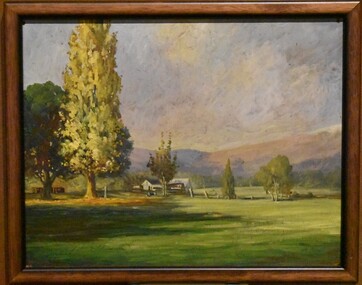
Artwork, other - Painting, Farm Scene
... Back: 'Oil painting believed to be by Charlotte Rippert. Wedding gift to Otto Lobert in Camp 3, WW2. (One of a pair C3505) DONOR: Otto Lobert, Nov. 1993' ...Charlotte Rippert Otto Lobert Mrs Lobert Camp 3 weddings Queen Elizabeth Camp 3 artwork Back: 'Oil painting believed to be by Charlotte Rippert. Wedding gift to Otto Lobert in Camp 3, WW2. (One of a pair C3505) DONOR: Otto Lobert, Nov. 1993' Oil painting on Board (framed) - painting is of a farm scene with a large yellow-green tree in the centre-left with four other green trees and a farm and fence - in the background are hills against the skyline Farm Scene Artwork, other Painting ...This artwork was painted by Charlotte Rippert who was interned in Camp 3 with her whole family. The painting was painted in camp. Charlotte Rippert was a German Lutheran Missionary in Egypt, arrested as a security risk in Cairo, 1941. Transported on Queen Elizabeth to Australia and interned at Camp 3 1941-1945.Oil painting on Board (framed) - painting is of a farm scene with a large yellow-green tree in the centre-left with four other green trees and a farm and fence - in the background are hills against the skylineBack: 'Oil painting believed to be by Charlotte Rippert. Wedding gift to Otto Lobert in Camp 3, WW2. (One of a pair C3505) DONOR: Otto Lobert, Nov. 1993' charlotte rippert, otto lobert, mrs lobert, camp 3 weddings, queen elizabeth, camp 3 artwork -
 Tatura Irrigation & Wartime Camps Museum
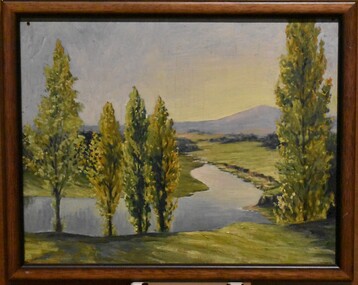
Painting - Oil Painting, 5 Trees and a River
... Painting by ??Charlotte Rippert?? Wedding Gift - in Camp 3. DONOR: Otto Lobert (One of pair C3502) Nov. 1993)...Painting by ??Charlotte Rippert?? Wedding Gift - in Camp 3. DONOR: Otto Lobert (One of pair C3502) Nov. 1993) landscape scene with a hill in background and five tall trees and a river in the foreground 5 Trees and a River Painting Oil Painting ...1 of 2 Oil painting by Charlotte Rippert which were given to Otto Lobert and his wife on the wedding Camp 3 1946.landscape scene with a hill in background and five tall trees and a river in the foregroundBack: 'Oil Painting by ??Charlotte Rippert?? Wedding Gift - in Camp 3. DONOR: Otto Lobert (One of pair C3502) Nov. 1993)charlotte rippert, otto lobert, mrs lobert, camp 3 weddings, oil paintings, internment camp art work -
 Clunes Museum
Painting - SEASCAPE IN OILS
... 1 of a pair (see catalogue no. 170 Circular painting on brown painted mounting board, gold inner mount, brown printed frame with gold and black floral and leaf edging....seascape OILS Stamped on back "Prepared Students Academy Board Wincor & Newton 38 Rathdowne Place London W Sticker "38" 1 of a pair (see catalogue no. 170 Circular painting on brown painted mounting board, gold inner mount, brown printed frame with gold and black floral and leaf edging. ...1 of a pair (see catalogue no. 170 Circular painting on brown painted mounting board, gold inner mount, brown printed frame with gold and black floral and leaf edging.Stamped on back "Prepared Students Academy Board Wincor & Newton 38 Rathdowne Place London W Sticker "38"seascape, oils -
Clunes Museum
Painting - SEASCAPE IN OILS
... 1 of a pair (see catalogue no. 169) Circular painting on brown painted mounting board, gold inner mount, brown printed frame with gold and black floral and leaf edging....SEASCAPE OILS 1 of a pair (see catalogue no. 169) Circular painting on brown painted mounting board, gold inner mount, brown printed frame with gold and black floral and leaf edging. ...1 of a pair (see catalogue no. 169) Circular painting on brown painted mounting board, gold inner mount, brown printed frame with gold and black floral and leaf edging.seascape, oils -
 Kew Historical Society Inc
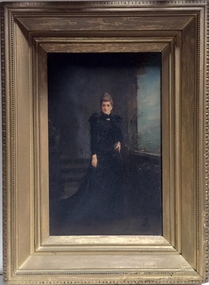
Painting - Annie Halfey, c.1882
... pair of portraits of John Halfey and his wife, and gains historic significance from that. annie halfey john halfey ordsall marston Small, full-length portrait of Annie [Mrs. John] Halfey ( -1909) in an original gilded frame. Annie Halfey is depicted in a high necked black dress with a silver brooch at her throat. She stands in a room by an open window. The detailing of the face is highly rendered by the artist/s. Painting ...Annie Halfey (nee Marston) was the daughter of Carlington George E. Marston, a chemist of Smith Street, Collingwood. Marston had extensively speculated on land in Kew and in this way had made his money. Marston was the owner of 'Wimba' in Cotham Road, having purchased the house in 1879. Annie Marston married the eminent Victorian pioneer John Halfey, and together they made their home at Ordsall (later Southesk) in Cotham Road, Kew. She died in March 1909. (Rogers, 1973).Donated by Eileen Grigg, 2017Small, full-length portrait of Annie [Mrs. John] Halfey ( -1909) in an original gilded frame. Annie Halfey is depicted in a high necked black dress with a silver brooch at her throat. She stands in a room by an open window. The detailing of the face is highly rendered by the artist/s.annie halfey, john halfey, ordsall, marston -
 Vision Australia
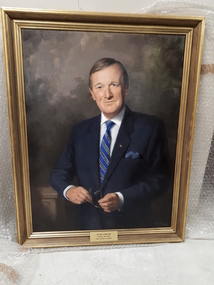
Painting - Artwork, Portrait of John Moule, 2003
... It is part of a series of paintings commissioned by the VAF Board to commemorate the work of past presidents of the organisation. Mr Moule is standing with his arm on a dresser, and holds a pair of glasses. ...It is part of a series of paintings commissioned by the VAF Board to commemorate the work of past presidents of the organisation. Mr Moule is standing with his arm on a dresser, and holds a pair of glasses. ...Framed portrait of John Moule who was President of the Vision Australia Foundation, from 1992-1999. It is part of a series of paintings commissioned by the VAF Board to commemorate the work of past presidents of the organisation. Mr Moule is standing with his arm on a dresser, and holds a pair of glasses. He is dressed in a navy blue suit, with a blue kercheif in his breast pocket,, a white collared shirt and a blue, white and black striped tie. On his lapel is a small gold badge. The plaque at the base of the painting reads 'Mr John A. Moule AM / President 1992-1999 / Vision Australia Foundation'. 1 art original in old gold frameThe plaque at the base of the painting reads 'Mr John A. Moule AM / President 1992-1999 / Vision Australia Foundation'.vision australia, john moule -
![Painting - Oil on panel, Harmer, Emma, [Pears]](/media/collectors/530576742162ef0fa09a2288/items/534748179821f420f8c039da/item-media/5f01b66221ea670df4e166f5/item-fit-380x285.jpg?cb=6) Federation University Art Collection
Federation University Art CollectionPainting - Oil on panel, Harmer, Emma, [Pears]
... The Art Collection features over 2000 works and was listed as a 'Ballarat Treasure' in 2007. art artwork pears Horsham Campus Art Collection Framed drawing of nine pairs. [Pears] Painting Oil on panel Harmer, Emma ...This item is part of the Federation University Art Collection. The Art Collection features over 2000 works and was listed as a 'Ballarat Treasure' in 2007.Framed drawing of nine pairs.art, artwork, pears, horsham campus art collection -
 Whitehorse Historical Society Inc.
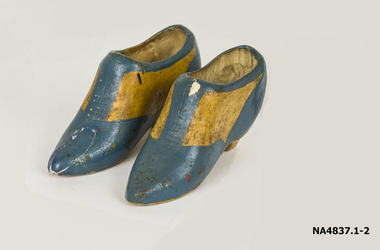
Ceramic - Ceramic shoes
... A pair of miniature dark fawn coloured pottery shoes with some teal painting...Pottery so possibly made there. ceramics earthenware ornaments A pair of miniature dark fawn coloured pottery shoes with some teal painting Ceramic Ceramic shoes ...Miniature shoes belonged to Martha Edwards who died in 1957, married in 1897. Martha was donor's grandmother. Donor's uncles worked at Geal Bros. Pottery so possibly made there.A pair of miniature dark fawn coloured pottery shoes with some teal paintingceramics, earthenware, ornaments
