
Showing 18 items matching "paling splitter"
-
 Department of Energy, Environment and Climate Action
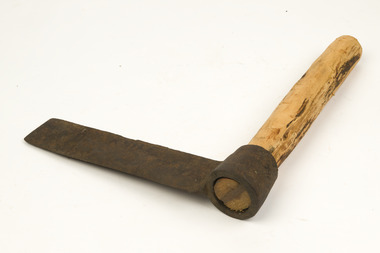
Shingle knife or paling splitter, Also known as a Froe
... Shingle knife or paling splitter...Shingle knife or paling splitter Metal knife with short wooden handle...Timber tools Shingle knife or paling splitter Metal knife with short wooden handle Also known as a Froe Shingle knife or paling splitter ...Also known as a froe (or frow), shake axe or paling knife, this tool is used for cleaving wood by splitting it along the grain. The L-shaped tool is hammered on the top edge of its blade into the end of a piece of wood in the direction of the grain, then twisting the blade in the wood by rotating the haft (handle). This item was purchased in about 1919 and used on the Ritchie family farm at Glen Park.Shingle knife or paling splitter Metal knife with short wooden handletimber tools -
 Emerald Museum & Nobelius Heritage Park
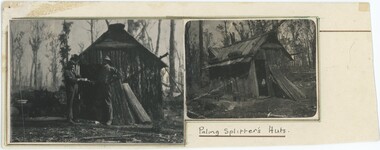
Photograph, Paling Splitter's Huts, Late 19th/Early 20th Century
... The men in the larger photograph may be the eponymous Paling Splitters. Timber splitters were vital to the construction of buildings across colonial-era Victoria, cutting palings and other materials from harvested local timber. ..."Paling Splitter's Huts."...Forestry Plants Industry "Paling Splitter's Huts." This item is a collage of two black and white photographs adhered to a cream piece of card. ...The men in the larger photograph may be the eponymous Paling Splitters. Timber splitters were vital to the construction of buildings across colonial-era Victoria, cutting palings and other materials from harvested local timber. They spread rapidly eastwards from the 1860s as demand for wood grew, endangering favoured tree varieties like the mountain ash and messmate from camps in rural areas with little to no regulation. Finally after an 1897-1901 Royal Commission, in 1907 the State Forest Department was created to regulate splitters. Timber splitting was replaced over the first half of the 20th century by the introduction of steam powered sawmills deep in the forest, connected to the market by small timber tramways. This photograph is likely from the late 19th or early 20th century.Timber splitters were vital to the construction of most 19th century Victorian towns and settlements, Emerald included; this photograph captures the lifestyle of such workers,. potentially from this area where much of Melbourne's timber supply originated.This item is a collage of two black and white photographs adhered to a cream piece of card. The card has an underlined annotation in the bottom right and no other writing. The photographs are bordered by a black line and a green line, both apparently ruled but handdrawn. The reverse of the card is blank besides its museum accession number. The smaller, rightmost photograph is an angled shot on a small hut built of wooden planks, with an angled roof and small doorframe; the background shows mid-density tree coverage filling the sky. The larger, leftmost photograph shows the same hut from an angle looking directly at the door, with two men standing in front of it and shaking hands."Paling Splitter's Huts."forestry, plants, industry -
 Marysville & District Historical Society
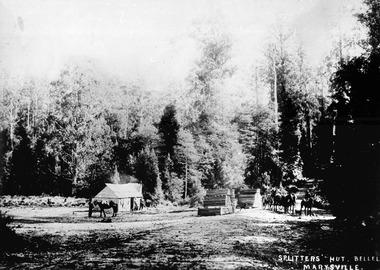
Photograph (item) - Black and white photograph, Unknown
... ...paling splitter...A timber splitter (historically also called a paling-splitter or wood-splitter) was a manual forest worker who felled large trees and split the wood along the grain into useful building materials and fencing components using hand tools like axes, heavy wooden mallets (mauls), and iron wedges....A digital copy of a black and white photograph of a splitters hut at Bellel near Marysville. marysville victoria australia timber splitter paling splitter wood splitter photograph SPLITTERS HUT BELLEL/ MARYSVILLE A digital copy of a black and white photograph of a splitters hut at Bellel near Marysville. ...A digital copy of a black and white photograph of a splitters hut at Bellel near Marysville. A timber splitter (historically also called a paling-splitter or wood-splitter) was a manual forest worker who felled large trees and split the wood along the grain into useful building materials and fencing components using hand tools like axes, heavy wooden mallets (mauls), and iron wedges.A digital copy of a black and white photograph of a splitters hut at Bellel near Marysville.SPLITTERS HUT BELLEL/ MARYSVILLEmarysville, victoria, australia, timber splitter, paling splitter, wood splitter, photograph -
 Marysville & District Historical Society
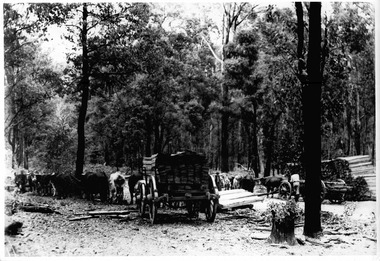
Photograph (item) - Black and white photograph, The original photograph was taken in the early 1900s
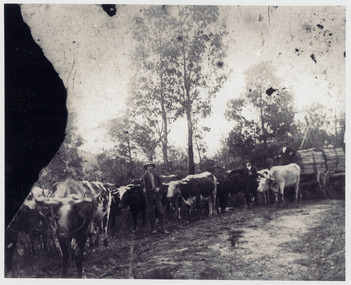
... ...paling splitter...The original photograph was taken in the early 1900s. marysville victoria australia timber splitter paling splitter wood splitter bullocks photograph A copy of a black and white photograph of bullocks hauling palings through the forest. ...A copy of a black and white photograph of bullocks hauling palings through the forest. The original photograph was taken in the early 1900s.A copy of a black and white photograph of bullocks hauling palings through the forest. The original photograph was taken in the early 1900s.marysville, victoria, australia, timber splitter, paling splitter, wood splitter, bullocks, photograph -
 Marysville & District Historical Society
Photograph (item) - Black and white photograph, The original photograph was taken in the early 1900s
... ...paling splitter...The original photograph was taken in the early 1900s. marysville victoria australia timber splitter paling splitter wood splitter bullocks photograph A copy of a black and white photograph of bullocks hauling palings through the forest. ...A copy of a black and white photograph of bullocks hauling palings through the forest. The original photograph was taken in the early 1900s.A copy of a black and white photograph of bullocks hauling palings through the forest. The original photograph was taken in the early 1900s.marysville, victoria, australia, timber splitter, paling splitter, wood splitter, bullocks, photograph -
 Marysville & District Historical Society
Photograph (item) - Black and white photograph, Unknown
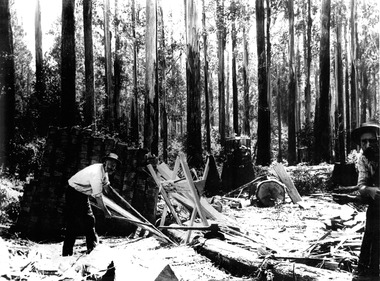
... ...paling splitter...A copy of a black and white photograph of Andrew Kirwan splitting a log into palings. marysville victoria australia timber splitter paling splitter wood splitter andrew kirwan photograph A copy of a black and white photograph of Andrew Kirwan splitting a log into palings. ...A copy of a black and white photograph of Andrew Kirwan splitting a log into palings.A copy of a black and white photograph of Andrew Kirwan splitting a log into palings.marysville, victoria, australia, timber splitter, paling splitter, wood splitter, andrew kirwan, photograph -
 Marysville & District Historical Society
Photograph (item) - Black and white photograph, Unknown
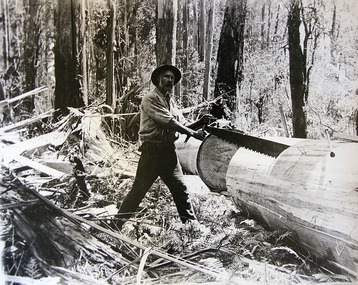
... ...paling splitter...A digital copy of a black and white photograph of Andrew Kirwan preparing a large log for splitting into palings. marysville victoria australia timber splitter paling splitter wood splitter andrew kirwan photograph A digital copy of a black and white photograph of Andrew Kirwan preparing a large log for splitting into palings. ...A digital copy of a black and white photograph of Andrew Kirwan preparing a large log for splitting into palings.A digital copy of a black and white photograph of Andrew Kirwan preparing a large log for splitting into palings.marysville, victoria, australia, timber splitter, paling splitter, wood splitter, andrew kirwan, photograph -
 Marysville & District Historical Society
Photograph (item) - Black and white photograph, Unknown
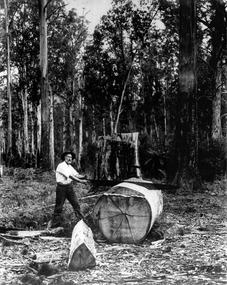
... ...paling splitter...A digital copy of a black and white photograph of Andrew Kirwan preparing a large log for splitting. marysville victoria australia timber splitter paling splitter wood splitter andrew kirwan photograph A digital copy of a black and white photograph of Andrew Kirwan preparing a large log for splitting. ...A digital copy of a black and white photograph of Andrew Kirwan preparing a large log for splitting.A digital copy of a black and white photograph of Andrew Kirwan preparing a large log for splitting.marysville, victoria, australia, timber splitter, paling splitter, wood splitter, andrew kirwan, photograph -
 Marysville & District Historical Society
Photograph (item) - Black and white photograph, Unknown
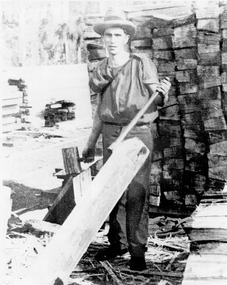
... ...paling splitter...A digital copy of a black and white photograph of George Locke splitting palings. marysville victoria australia timber splitter paling splitter wood splitter george locke photograph A digital copy of a black and white photograph of George Locke splitting palings. ...A digital copy of a black and white photograph of George Locke splitting palings.A digital copy of a black and white photograph of George Locke splitting palings.marysville, victoria, australia, timber splitter, paling splitter, wood splitter, george locke, photograph -
 Marysville & District Historical Society
Photograph (item) - Black and white photograph, Unknown
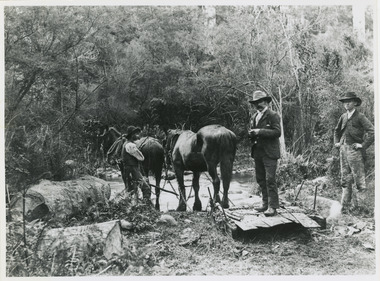
... ...paling splitter...A copy of a black and white photograph of three men with two horses hauling palings over Myrtle Creek in Marysville. marysville victoria australia timber splitter paling splitter wood splitter myrtle creek photograph A copy of a black and white photograph of three men with two horses hauling palings over Myrtle Creek in Marysville. ...A copy of a black and white photograph of three men with two horses hauling palings over Myrtle Creek in Marysville.A copy of a black and white photograph of three men with two horses hauling palings over Myrtle Creek in Marysville.marysville, victoria, australia, timber splitter, paling splitter, wood splitter, myrtle creek, photograph -
 Lakes Entrance Historical Society
Photograph - gold mining town of Grant Victoria, 1900 c
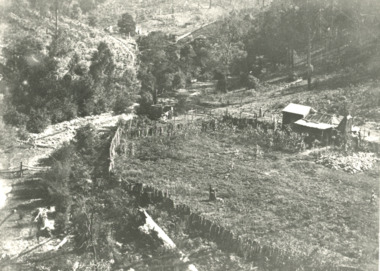
... Black and white photograph of a vegetable patch and flower garden beside a rustic dwelling surrounded by split paling fence near the gold mining town of Grant Victoria...Mines and Mining Settlement Topography Gold Black and white photograph of a vegetable patch and flower garden beside a rustic dwelling surrounded by split paling fence near the gold mining town of Grant Victoria gold mining town of Grant Victoria Photograph gold mining town of Grant Victoria ...Black and white photograph of a vegetable patch and flower garden beside a rustic dwelling surrounded by split paling fence near the gold mining town of Grant Victoriamines and mining, settlement, topography, gold -
 Eltham District Historical Society Inc
Photograph, Peter Pidgeon, Birch Cottage, Eltham-Yarra Glen Road, Christmas Hills, 27 September 2018, 2018
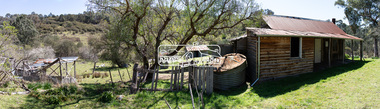
... Timber outbuildings of differing eras are to the north-west of the house, with pole framing and paling infill construction and Redcliffe brand corrugated iron. Post and rail (front) and split paling (rear) fence remnants line the front boundary. ...Timber outbuildings of differing eras are to the north-west of the house, with pole framing and paling infill construction and Redcliffe brand corrugated iron. Post and rail (front) and split paling (rear) fence remnants line the front boundary. ...Originally built by John Hill, a shoemaker at Kangaroo Ground around 1878. In the late 1970s when our Society was the Shire of Eltham Historical Society, an offer was made to the Society regarding use of an old cottage at Christmas Hills. The cottage sat beside Watsons Creek just outside the then Shire of Eltham but following municipal restructuring it now lies within the Shire of Nillumbik. For various reasons the offer ultimately lapsed. At that time some research on the cottage was carried out for the Society by Keith Chappel as part of a larger research project that he was doing. Keith’s notes were taken from Lands Department records and showed that the property was the subject of a permissive occupancy of Crown land comprising the creek reserve. In 1903 a Miner’s Right of one acre in area was granted to Edwin Samuel Birch. In 1907 Birch applied to purchase this land but was unable to because it was part of the creek reserve. The documents show that the cottage existed at that time. Upon Birch’s death in 1932, his daughter, Honor Mary Birch was granted a permit to occupy the residence. Honor Mary Birch, known as Nora, was born 1900, the daughter of Edwin Samuel Birch and Honor (nee Young). In 1939 she married George Henry Williams (aka Henry). Honor died 8 July 1976. Her siblings were Margaret Martin (dec), Bert Birch and Brigidene Brinkkotter. In her will she gave and bequeathed “all the improvements on the land held by me at Christmas Hills under Permissive Occupancy from the Department of Land and Survey consisting of the house property thereon and all the contents of the said house to my nephew Brian Joseph Martin of Christmas Hills aforesaid farmer”. The will described the property as a four room, five square house, about 100 years old with enclosed verandah, including kitchen, combined lounge dining room, bedroom and store room; built of ‘bush slabs’ with a corrugated iron roof. A dairy had been erected in 1935. After her death, the property was acquired by the Melbourne Metropolitan Board of Works in 1978. The property is listed on the Victorian Heritage Database HO200-Hill, later Birch farm complex, 945 Eltham-Yarra Glen Road, Watsons Creek and described as: The house has a steep but simply gabled roof form clad with corrugated iron, vertical adzed hardwood slab front wall construction, split palings to the gable ends; rubble freestone chimney at one end (with added gsi flue), pole-framed Graeme Butler & Associates, 2006: 101 Shire of Nillurnbik Planning Scheme Amendment C13 Heritage Assessments verandah (rebuilt?); six-pane double-hung sash windows; T&G bead-edge boarded ledged & braced door; and paling clad rooms added at verandah ends. A slab-clad large fireplace is at the north corner of the house, with a gsi upper cladding added and an internal lining of rubble stone. The rear facade is different construction, being drop-slab, and sits beneath a rear skillion addition to the main gabled form: this may be more recent construction. The house appears to have been once set up for public display and may have been recreated in part for that purpose. Outbuildings are reached by a track along the east side of the house, including what may have been a creamery (typical standard inter-war design clad with corrugated iron and lined with 1938 Lysaght Queens Head Australia galvanised sheet iron) and a paling clad gabled out-house. Timber outbuildings of differing eras are to the north-west of the house, with pole framing and paling infill construction and Redcliffe brand corrugated iron. Post and rail (front) and split paling (rear) fence remnants line the front boundary. Pepper trees part of house yard landscape49 born digital images (includes one panoramic stitch and nine frames from drone video)birch cottage, christmas hills, early settlers, edwin samuel birch, honor mary birch, john hill, watsons creek -
 Orbost & District Historical Society
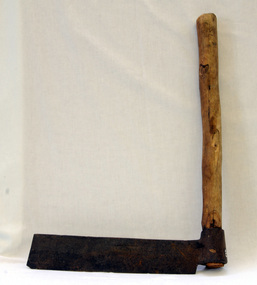
paling knife, c. 1890s to 1960s
... split palings. The palings are shaped by hand with the bottom edge put onto the timber and a mallet hit onto the top of the blade. This pre-dates sawn palings. Associated with the timber and household building industry in the Orbost region. paling-knife splitting-timber A rectangular flat iron blade attached to a wooden handle. ...Used in the timber industry for making split palings. The palings are shaped by hand with the bottom edge put onto the timber and a mallet hit onto the top of the blade. This pre-dates sawn palings. Associated with the timber and household building industry in the Orbost region.A rectangular flat iron blade attached to a wooden handle. The cutting edge of the knife is along the bottom (rather than the end as with an axe). The wooden handle appears to be made from a small tree branch.paling-knife splitting-timber -
 Orbost & District Historical Society
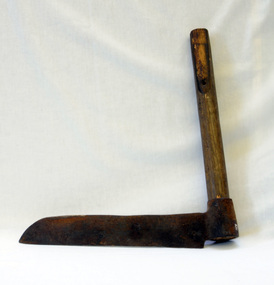
paling knife, froe, c. late 19th early 20th century
... Used to split shingles or palings from planks of wood. Used in the timber industry and building industries. paling-knife shingle-knife froe A paling or shingle knife, also called a froe. ...Used to split shingles or palings from planks of wood. Used in the timber industry and building industries.A paling or shingle knife, also called a froe. The blade is iron, with the sharper edge on the bottom. It has a short wooden handle .paling-knife shingle-knife froe -
 Orbost & District Historical Society
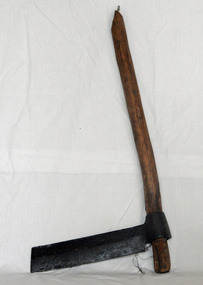
paling knife, c. late 19th, early 20th century
... tool hand-tool paling-knife split-timber...Dates prior to palings being mass-produced by mechanical saws in timber mills. tool hand-tool paling-knife split-timber A rectangular iron blade attached to a wooden handle. ...Used for splitting wooden palings used in the construction of paling fences. Dates prior to palings being mass-produced by mechanical saws in timber mills.A rectangular iron blade attached to a wooden handle. The bottom of the blade is the sharp edge. tool hand-tool paling-knife split-timber -
 Ringwood and District Historical Society
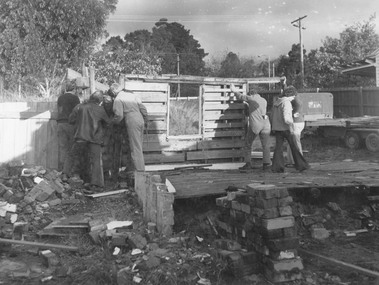
Photograph, Dismantling Ringwood miners cottage in 1975
... Pictured during dismantling May 1975 showing original hand split internal paling walls and flooring nailed to saplings laid directly on the ground...Pictured during dismantling May 1975 showing original hand split internal paling walls and flooring nailed to saplings laid directly on the ground.: Black and white photograph Dismantling Ringwood miners cottage in 1975 Photograph ...Black and white photographImage shows a section of the front wall of the cottage being dismantled. Typed below photograph: "Ringwood miners cottage 1873 - formerly No. 367 Maroondah Highway opposite Civic Centre. Pictured during dismantling May 1975 showing original hand split internal paling walls and flooring nailed to saplings laid directly on the ground.: -
 Narre Warren and District Family History Group
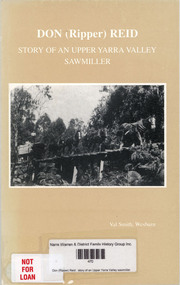
Book, Val Smith, Don (Ripper) Reid : story of an Upper Yarra Valley sawmiller, 1997
... Don Reid Donald Ambrose Reid Prior to 1901 the men working in the forests of the Upper Yarra Valley were mainly paling splitters and shingle cutters. When the Warburton-Lilydale Railway was completed in 1901, sawmilling became a major industry and one of the main employers in the Upper Yarra Valley. ...Prior to 1901 the men working in the forests of the Upper Yarra Valley were mainly paling splitters and shingle cutters. When the Warburton-Lilydale Railway was completed in 1901, sawmilling became a major industry and one of the main employers in the Upper Yarra Valley. The railway enabled the sawmillers to get their timber to the Melbourne markets easily and economically. The mills were built, usually in the allotted logging area. Tramlines were used to bring timber from the mills to the railway. In the Upper Yarra Valley the tramlines were mostly horse drawn, or if it was too steep a combination of winches for lowering and then horse to complete the journey. Steam locomotives were used on the Powelltown to Yarra Junction tramline and Ezard-Richards' tramline at Starvation Creek. Donald Ambrose Reid has been a son, brother, husband, father, grandfather, Shire Councillor, firefighter and friend but through it all a Sawmiller. This is Don Reid's story. A story of a sawmilling family. Don's memories also give an insight into the early history of Upper Yarra Valley and the changes that occurred in the sawmilling and logging industry. VAL SMITH 1996/97.non-fictionPrior to 1901 the men working in the forests of the Upper Yarra Valley were mainly paling splitters and shingle cutters. When the Warburton-Lilydale Railway was completed in 1901, sawmilling became a major industry and one of the main employers in the Upper Yarra Valley. The railway enabled the sawmillers to get their timber to the Melbourne markets easily and economically. The mills were built, usually in the allotted logging area. Tramlines were used to bring timber from the mills to the railway. In the Upper Yarra Valley the tramlines were mostly horse drawn, or if it was too steep a combination of winches for lowering and then horse to complete the journey. Steam locomotives were used on the Powelltown to Yarra Junction tramline and Ezard-Richards' tramline at Starvation Creek. Donald Ambrose Reid has been a son, brother, husband, father, grandfather, Shire Councillor, firefighter and friend but through it all a Sawmiller. This is Don Reid's story. A story of a sawmilling family. Don's memories also give an insight into the early history of Upper Yarra Valley and the changes that occurred in the sawmilling and logging industry. VAL SMITH 1996/97.upper yarra valley (vic.), don reid, donald ambrose reid -
 Mont De Lancey
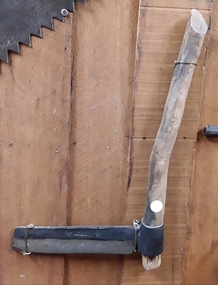
Tool - Shingle Splitter, Wolpin Wedge Mills, Unknown
... A steel bladed wooden curved handled Shingle Splitter sometimes called a Paling Knife used for splitting or cleaving timber. ...Steel Wood Froes Cleaving axes Axes Cutting tools Hand axes Woodworking tools Wolpin Wedge Mills A steel bladed wooden curved handled Shingle Splitter sometimes called a Paling Knife used for splitting or cleaving timber. ...Used in the late 19th century.A steel bladed wooden curved handled Shingle Splitter sometimes called a Paling Knife used for splitting or cleaving timber. It has two crossed hammer shape symbols stamped at the beginning and end of the inscription - Wolpin Wedge Mills. It was used in the late 19th century.Wolpin Wedge Millssteel, wood, froes, cleaving axes, axes, cutting tools, hand axes, woodworking tools
