

Historical information
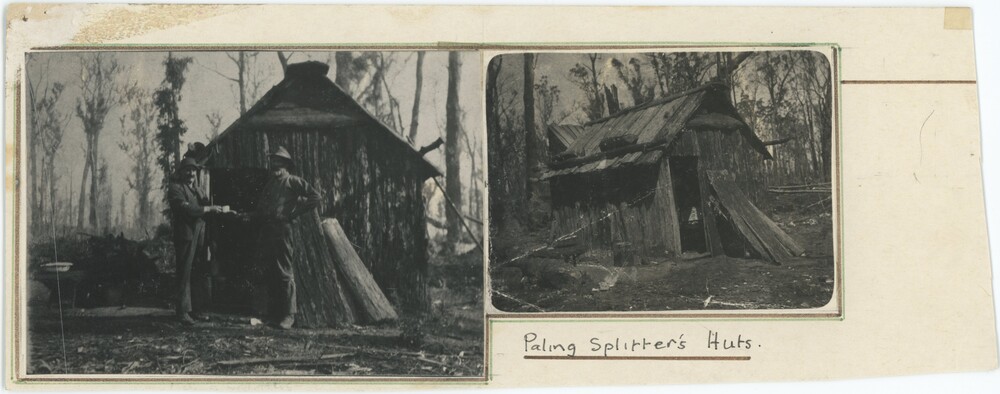
The men in the larger photograph may be the eponymous Paling Splitters. Timber splitters were vital to the construction of buildings across colonial-era Victoria, cutting palings and other materials from harvested local timber. They spread rapidly eastwards from the 1860s as demand for wood grew, endangering favoured tree varieties like the mountain ash and messmate from camps in rural areas with little to no regulation. Finally after an 1897-1901 Royal Commission, in 1907 the State Forest Department was created to regulate splitters.
Timber splitting was replaced over the first half of the 20th century by the introduction of steam powered sawmills deep in the forest, connected to the market by small timber tramways. This photograph is likely from the late 19th or early 20th century.
Significance
Timber splitters were vital to the construction of most 19th century Victorian towns and settlements, Emerald included; this photograph captures the lifestyle of such workers,. potentially from this area where much of Melbourne's timber supply originated.
Physical description
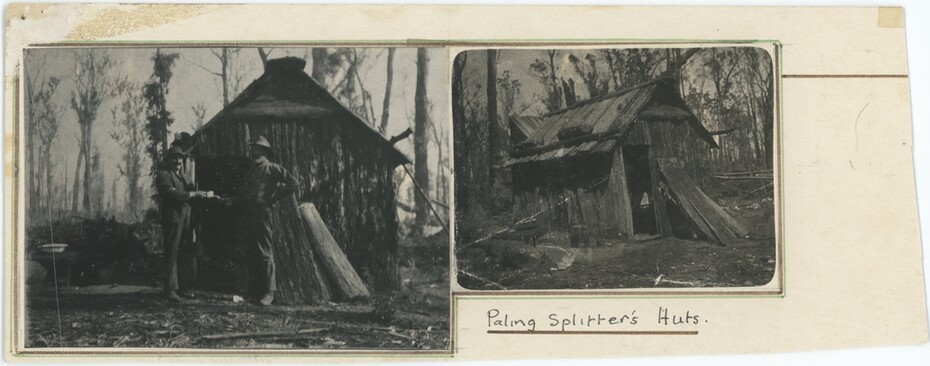
This item is a collage of two black and white photographs adhered to a cream piece of card. The card has an underlined annotation in the bottom right and no other writing. The photographs are bordered by a black line and a green line, both apparently ruled but handdrawn. The reverse of the card is blank besides its museum accession number. The smaller, rightmost photograph is an angled shot on a small hut built of wooden planks, with an angled roof and small doorframe; the background shows mid-density tree coverage filling the sky. The larger, leftmost photograph shows the same hut from an angle looking directly at the door, with two men standing in front of it and shaking hands.
Inscriptions & markings
"Paling Splitter's Huts."