
Showing 40 items matching "paratrooper"
-
 Lara RSL Sub Branch
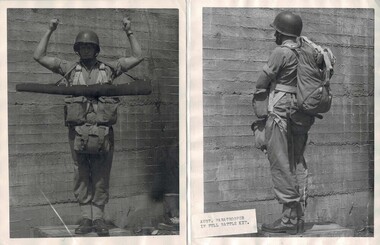
Photographs, Australian Paratrooper in full Battle Kit
... Australian Paratrooper in full Battle Kit...2 x Black and White Photos inside plastic envelope Australian Paratrooper in full Battle Kit Photographs ...2 x Black and White Photos inside plastic envelope -
 Montmorency–Eltham RSL Sub Branch
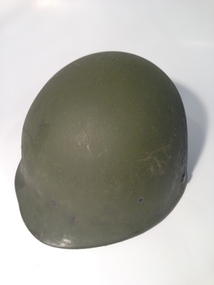
Uniform - Helmet Liner US M-1C Paratrooper Helmet, Paratrooper Helmet
... Paratrooper Helmet...Fibre helmet liner with internal webbing (chin strap missing). Paratrooper Helmet Uniform Helmet Liner US M-1C Paratrooper Helmet ...Fibre helmet liner with internal webbing (chin strap missing).On webbing, stamp designating part number etc, as shown in photo 0189c. headgear, helmet -
 Montmorency–Eltham RSL Sub Branch
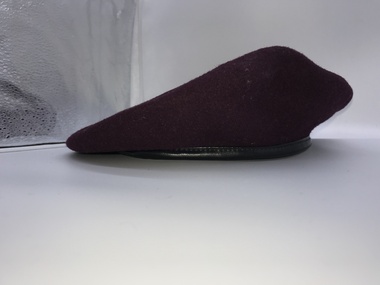
Uniform - Maroon beret, Maroon Paratrooper Beret
... Maroon Paratrooper Beret...Pure wool TOP beret Written in a square and diamond Made in England Size 7 A round beret, maroon in colour, with as black inner rim with adjustable brown cord. Maroon Paratrooper Beret Uniform Maroon beret ...A round beret, maroon in colour, with as black inner rim with adjustable brown cord.No Insignia badge. Pure wool TOP beret Written in a square and diamond Made in England Size 7 -
 National Vietnam Veterans Museum (NVVM)
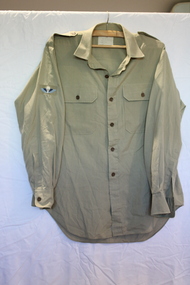
Uniform - Shirt, paratrooper
... Long sleeved khaki shirt with 6 brown buttons down the front and 2 chest pockets with button down flaps and button-down epaulettes. Paratrooper emblem towards the top of left sleeve....Paratrooper insignia/ CGCF/ Victoria/ 1970/ 61.E-16433/840566025.2488/ Army no____/Name_____ on inside collar. ...Uniform Shirt, paratrooper ...Standard issue item as used by Australian servicemen during the conflict in Vietnam (1962-1972).Long sleeved khaki shirt with 6 brown buttons down the front and 2 chest pockets with button down flaps and button-down epaulettes. Paratrooper emblem towards the top of left sleeve.Paratrooper insignia/ CGCF/ Victoria/ 1970/ 61.E-16433/840566025.2488/ Army no____/Name_____ on inside collar. uniform shirt, long sleeved, paratrooper insignia -
 Tatura Irrigation & Wartime Camps Museum
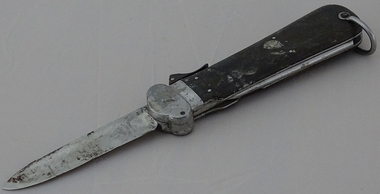
Sidearm - German, 1940's
... Formerly part of German paratroopers equipment/arms in WW2...German paratroopers sidearm resembling large pocket knife with blade and retractable spike. ...Formerly part of German paratroopers equipment/arms in WW2 arms edged weapons SMF Solingen Rostfrei German paratroopers sidearm resembling large pocket knife with blade and retractable spike. ...Possession of POW at Camp13, Murchison. Formerly part of German paratroopers equipment/arms in WW2German paratroopers sidearm resembling large pocket knife with blade and retractable spike. Wood covereed metal shaft/handle riveted. Metal ring attached at spike end. Thumb guide towards unprotected blade.SMF Solingen Rostfreiarms, edged, weapons -
 Bendigo Military Museum
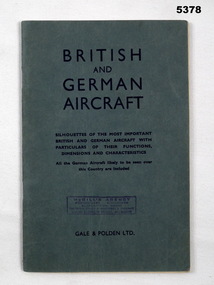
Booklet - BOOKLET, AVIATION, Gale & Polden Ltd, Wellington works, British & German Aircraft, 1941
... ...Paratrooper...Page 31 has drawings of a German paratrooper and his equipment....Refers to service of LAC Lance & Percy Coates WW2 Aircraft Paratrooper First page written in ink is LAC Coates. ...Refers to service of LAC Lance & Percy CoatesThis is a pocket sized booklet. It has a blue cardboard cover. It is fastened with two staples. THE PRINTING IS IN BLACK INK, IT HAS A RUBBER STAMP OF MCGILLS Agency, Melbourne. Inside it has 31 pages of aircraft silhouettes. Page 31 has drawings of a German paratrooper and his equipment.First page written in ink is LAC Coates. There are a few penciled entries with aircraft engine power.ww2, aircraft, paratrooper -
 Dandenong/Cranbourne RSL Sub Branch
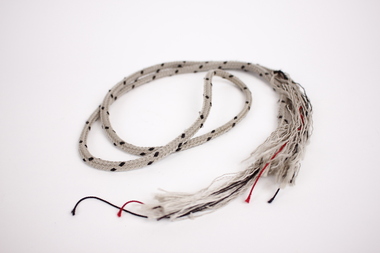
Equipment - German Parachute Cord WWII
... ...paratrooper...This rope was part of a German Parachute cord from the Second World War. German paratroopers, or Fallschirmjager, were often at the forefront of German military actions. ...This rope was part of a German Parachute cord from the Second World War. German paratroopers, or Fallschirmjager, were often at the forefront of German military actions. ...This rope was part of a German Parachute cord from the Second World War. German paratroopers, or Fallschirmjager, were often at the forefront of German military actions. Australian soldiers faced a Fallschirmjager assault during the invasion of Crete in 1941.German paratrooopers, or Fallschirmjager, were an elite unit within the German military. Australian forces faced the Fallschirmjager during the airborne invasion of Crete in 1941. This object has the capacity to tell the story of that engagement.A length of frayed rope taken from a Second World War German Parachute. Coiled, with black and red threads running through the structure.german, paratrooper, parachute, fallschirmjager, crete, 1941 -
 Lara RSL Sub Branch
Photograph, Australian Paratroopers in full battle kit
... Australian Paratroopers in full battle kit...Australian Paratroopers in full battle kit Australian Paratroopers in full battle kit Photograph ...Australian Paratroopers in full battle kit -
 National Vietnam Veterans Museum (NVVM)
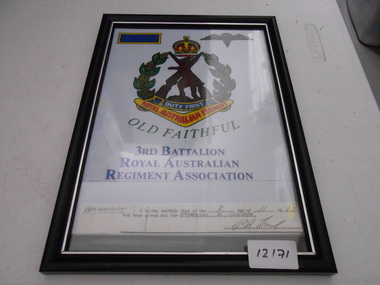
Document, Old Faithful
... RAR Insignia, Old Faithful, Paratrooper Wings...Document 3 RAR RAR Insignia, Old Faithful, Paratrooper Wings Framed document depiction RAR Insignia with "Old Faithful" below. ...Framed document depiction RAR Insignia with "Old Faithful" below. There is a note below "Grzegzewski - I hereby certify that on 2nd day of 11 1967 has been warned out for enbarkation to Vietnam."RAR Insignia, Old Faithful, Paratrooper Wingsdocument, 3 rar -
 Running Rabbits Military Museum operated by the Upwey Belgrave RSL Sub Branch
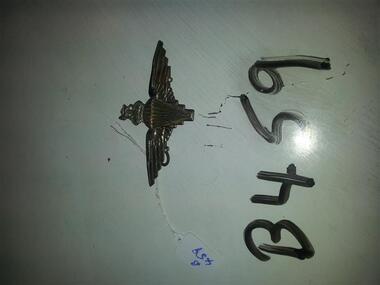
Badge Lapel
... Wings Paratrooper probably British lightly rusted in places...Badge/Buttons Pre 1952 Army Wings Paratrooper probably British lightly rusted in places Badge Lapel ...Wings Paratrooper probably British lightly rusted in placesbadge/buttons, pre 1952, army -
Running Rabbits Military Museum operated by the Upwey Belgrave RSL Sub Branch
Jacket - Battledress
... Battle jacket khaki Royal Australian Artillery with Sergents Stripes and paratroopers wings...Uniform 1968 Army Battle jacket khaki Royal Australian Artillery with Sergents Stripes and paratroopers wings Jacket - Battledress ...Battle jacket khaki Royal Australian Artillery with Sergents Stripes and paratroopers wingsuniform, 1968, army -
 National Vietnam Veterans Museum (NVVM)
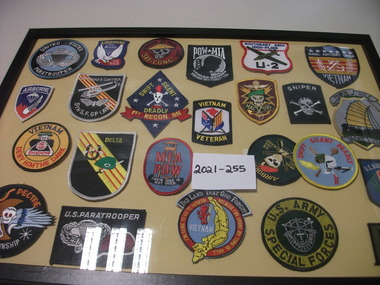
Badge - US cloth badges
... Special Forces, Naval Forces, paratrooper; Airborne Forces....Special Forces, Naval Forces, paratrooper; Airborne Forces. Badge US cloth badges ...24 U.S. badges displayed in frame behind perspex (?) U.S. Special Forces, Naval Forces, paratrooper; Airborne Forces.united states army, united states navy -
 Tatura Irrigation & Wartime Camps Museum
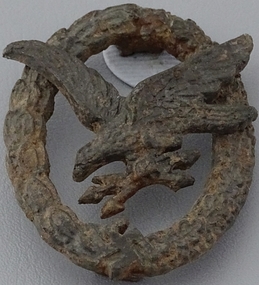
Badge - military
... Metal German paratroopers dual badge depicting a leaf design around outer edge and a swastika. ...Found at Camp13 site, post war, by wartime guard numismatics badges Metal German paratroopers dual badge depicting a leaf design around outer edge and a swastika. ...Found at Camp13 site, post war, by wartime guardMetal German paratroopers dual badge depicting a leaf design around outer edge and a swastika. A flying eagle in the centre of the badge.numismatics, badges -
 Mont De Lancey
Clothing - Red Devils Beret and Belt, Kangol Wear Limited - Wartime textile and apparel contractors, WW2
... The maroon beret was adopted by the British paratroopers in July 1942. Initially it was adorned with an Army Air Corps badge. ...This is a 'Red Devils' maroon felt beret and webbing belt worn by WW2 paratroopers. The beret has a black leather trim around the edges. ...The maroon beret was adopted by the British paratroopers in July 1942. Initially it was adorned with an Army Air Corps badge. ...The maroon beret was adopted by the British paratroopers in July 1942. Initially it was adorned with an Army Air Corps badge. This was replaced with the Parachute Regiment badge in 1943. The maroon beret in a military configuration has been an international symbol of airborne forces since the Second World War. The beret was a practical headgear, for soldiers who needed a hat that could be worn in confined areas, slept in and could be stowed in a small space when they wore steel helmets. The "Red Devils" nickname and maroon beret were earned by the British 1st Parachute Brigade during World War II, though standard webbing belts rather than a specific "red devil belt" formed part of their gear. The Red Devils also flew into battle using military gliders rather than parachutes. This is a 'Red Devils' maroon felt beret and webbing belt worn by WW2 paratroopers. The beret has a black leather trim around the edges. It has a silver coated British Parachute Regiment badge on the front, which features a winged parachute, surrounded by a King's crown. The belt is made of red webbing with a closed sliver coated two piece clasp buckle, featuring the airborne parachute design. It has an adjustable slider.Inside the red beret is stitched a weathered marked plastic label holder with a piece of paper inserted - 'Hat size 7.1/8 0220. A/78/C.../DC...8(2) 'clothing, berets, headwear, ww2 paratroopers clothing -
 Lara RSL Sub Branch
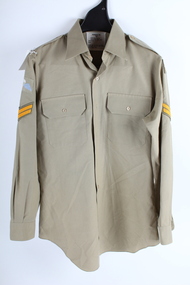
Uniform, Khaki shirt. long sleeve, 1981
... Khaki long sleeve shirt with pockets on the front and corporal stripes on the sleeves.Has paratroopers badge on right sleeve and Australian Army badge on left sleeve....Khaki long sleeve shirt with pockets on the front and corporal stripes on the sleeves.Has paratroopers badge on right sleeve and Australian Army badge on left sleeve. ...Standard issue shirts for use by Australian Army personal.Khaki long sleeve shirt with pockets on the front and corporal stripes on the sleeves.Has paratroopers badge on right sleeve and Australian Army badge on left sleeve.Name tag label on the inside. -
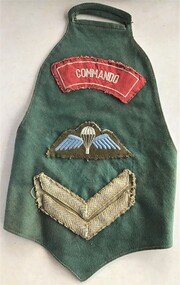 Queenscliffe Maritime Museum
Uniform - Brassard
... "Commando" in white on red background badge; White parachute on blue wings on green base paratrooper badge; 2 khaki chevrons corporal stripes ...Similar to ones worn by commandos involved in Rip disaster of 1960 brassard commando "Commando" in white on red background badge; White parachute on blue wings on green base paratrooper badge; 2 khaki chevrons corporal stripes Army commando jungle green brassard with badge, unit logo and stripes Uniform Brassard ...A brassard is a fabric armband holding any fabric badges, unit logos or rank insignia and is worn over fatigues or army tunics.Similar to ones worn by commandos involved in Rip disaster of 1960Army commando jungle green brassard with badge, unit logo and stripes"Commando" in white on red background badge; White parachute on blue wings on green base paratrooper badge; 2 khaki chevrons corporal stripes brassard, commando -
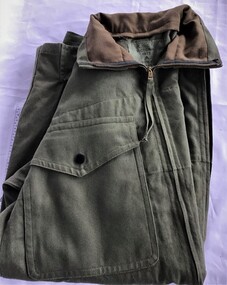 Queenscliffe Maritime Museum
Uniform - Para smock
... Paratrooper smock jacket similar to ones worn by commandos in Rip Disaster on 17 February 1960...Paratrooper smock jacket similar to ones worn by commandos in Rip Disaster on 17 February 1960 smock paratroopers commandos uniform rip disaster Para smock jacket as worn by commandos Uniform Para smock ...Paratrooper smock jacket similar to ones worn by commandos in Rip Disaster on 17 February 1960Para smock jacket as worn by commandossmock, paratroopers, commandos, uniform, rip disaster -
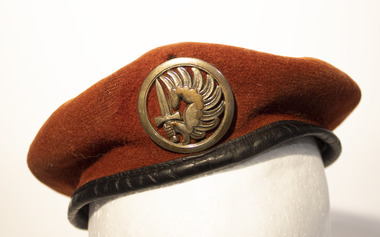 National Vietnam Veterans Museum (NVVM)
Headwear - Beret, French paratrooper
... ...paratrooper...Label inside Made in France Headwear Beret, French paratrooper Beatex ...Today’s Vietnam, Cambodia, and Laos were under French rule from the 1880s until 1954. The Vietnam War has its origins in the Indochina wars. During the French Indochina War (1946 - 1954), France’s war effort against nationalist groups such as Ho Chi Minh’s Viet Minh was largely funded by the United States.Maroon/red wool beret with black leather binding. Metal badge with dagger and feathers. Label inside Made in Franceberet, france, french indochina war, paratrooper -
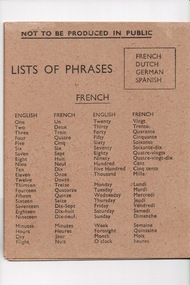 Lara RSL Sub Branch
card folder, List of Phrases
... WW2 US Army 8 page pamphlet of Language Phrases for German, Spanish, French and Dutch issued to Aviation personnel, Paratroopers, etc., as escape and evasion aid....WW2 US Army 8 page pamphlet of Language Phrases for German, Spanish, French and Dutch issued to Aviation personnel, Paratroopers, etc., as escape and evasion aid. ...WW2 US Army 8 page pamphlet of Language Phrases for German, Spanish, French and Dutch issued to Aviation personnel, Paratroopers, etc., as escape and evasion aid.Used by the USAF during WW2 for aviation when in enemy territory in Europe.Card folder - List of Phases - French, Dutch, German & Spanish"Not to be produced in public" and printed list of phrases in French, Dutch, German and Spanishww2, world war two, usaf, united states air force, list of phrases, french, dutch, german, spanish -
Moorabbin Air Museum
Document (Item) - Personal Photograph and Negatives Collection of Kevin Kerle
... Collection includes a large number of large-format unidentified negatives, as well as photos of paratroopers jumping from RAAF aircraft and a variety of civilian and military aircraft from the 1930s, 1940s and 1950s. ...Collection includes a large number of large-format unidentified negatives, as well as photos of paratroopers jumping from RAAF aircraft and a variety of civilian and military aircraft from the 1930s, 1940s and 1950s. ...Collection includes a large number of large-format unidentified negatives, as well as photos of paratroopers jumping from RAAF aircraft and a variety of civilian and military aircraft from the 1930s, 1940s and 1950s. There is also a photo of Australian soldiers posing around a shot down German aircraft during the First World War.Many of these photos appear to be very rare, and feature good captions which help to identify the aircraft, units and even crewmen being photographed. -
 Clayton RSL Sub Branch
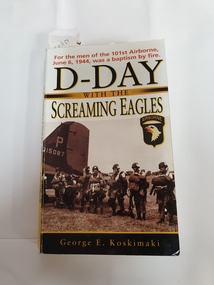
Non-fiction book, D-Day with the Screaming Eagles
... Koskimaki is a former paratrooper who jumped into Normandy on June 6, 1944, as General Maxwell Taylor’s radioman. ...Koskimaki is a former paratrooper who jumped into Normandy on June 6, 1944, as General Maxwell Taylor’s radioman. ...101st Airborne June 6 1944 George E. Koskimaki is a former paratrooper who jumped into Normandy on June 6, 1944, as General Maxwell Taylor’s radioman. He went on to become a preeminent historian of the 101st Airborne Division, having interviewed hundreds of fellow veterans for their firsthand accounts. He currently lives in Northville, Michigan non-fiction novel written by 101st Airborne paratrooper...soft cover non-fiction bookhighlighting noted and some personal notes visible on some pages. -
 Flagstaff Hill Maritime Museum and Village
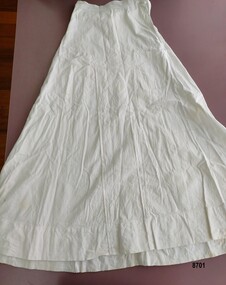
Textile - Overskirt, circa 1910
... During W.W.2, a local Warrnambool couple (Meryl and Tony Everard) boarded with them – Tony was in the airforce training paratroopers to jump into (and survive) enemy territory and his wife Meryl worked in the Methodist baby Home. ...During W.W.2, a local Warrnambool couple (Meryl and Tony Everard) boarded with them – Tony was in the airforce training paratroopers to jump into (and survive) enemy territory and his wife Meryl worked in the Methodist baby Home. ...This item is one of a collection of clothing items that belonged to the Stephenson family who lived at 22 McCracken Street, Kensington, Melbourne. Matthew Stephenson (1861 – 1943) who had grown up on the Bendigo goldfields and shifted to Melbourne in the early 1900’s was a train driver and later, a fireman with the railways. His wife Elizabeth Jane (Betsy) Wigley (1865 – 1953) also grew up on the goldfields around Majorca and Bendigo. They married in 1885 in Bendigo. They had two daughters – Ethel Evelyn Stephenson (1886 – 1956) and Lillian or Lila (1891 – 1977) who were milliners and dressmakers and who continued to live in the family home after the death of their parents. The family are recorded as living at 22 McCracken Street, Kensington, as early as 1914. It is not known who made or owned the clothing that makes up this collection but as it appears to be from the late Victorian and early Edwardian era, the different pieces were probably made and worn by any of the three ladies of the house – Betsy, Ethel and/or Lila. During W.W.2, a local Warrnambool couple (Meryl and Tony Everard) boarded with them – Tony was in the airforce training paratroopers to jump into (and survive) enemy territory and his wife Meryl worked in the Methodist baby Home. The Everards developed a close friendship with the Stephensons and were responsible for clearing out the house (and finding this clothing collection) after Lila died in 1977. This overskirt is an outer protective garment made of durable cotton and was probably worn over a lady's skirt or dress to protect it whilst they were working. The pockets are large enough for the wearer to keep small items in and there is a loop at the back that would allow the wearer to hang it on a hook, when she finished her work. This item is an example of clothing worn by working women in the late 19th and early 20th centuryA heavy cotton ankle length overskirt made with two wide gored sections containing inset pockets joined to a middle T shaped front band. It has a waistband of grosgrain ribbon and a side opening with 3 pairs of metal snaps (one pair is missing) and a hook and eye at the top. The waistband also has a taped loop (for hanging) and an unusual double fabric overlay with unattached curved ends.flagstaff hill maritime museum and village, great ocean road, shipwreck coast, warrnambool, overskirt, needlework, sewing, protective garment, stephenson family -
 Flagstaff Hill Maritime Museum and Village
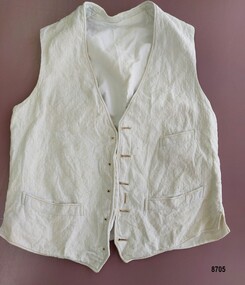
Textile - Waistcoat, circa 1910
... During W.W.2, a local Warrnambool couple (Meryl and Tony Everard) boarded with them – Tony was in the airforce training paratroopers to jump into (and survive) enemy territory and his wife Meryl worked in the Methodist baby Home. ...During W.W.2, a local Warrnambool couple (Meryl and Tony Everard) boarded with them – Tony was in the airforce training paratroopers to jump into (and survive) enemy territory and his wife Meryl worked in the Methodist baby Home. ...This item is one of a collection of clothing items that belonged to the Stephenson family who lived at 22 McCracken Street, Kensington, Melbourne. Matthew Stephenson (1861 – 1943) who had grown up on the Bendigo goldfields and shifted to Melbourne in the early 1900’s was a train driver and later, a fireman with the railways. His wife Elizabeth Jane (Betsy) Wigley (1865 – 1953) also grew up on the goldfields around Majorca and Bendigo. They married in 1885 in Bendigo. They had two daughters – Ethel Evelyn Stephenson (1886 – 1956) and Lillian or Lila (1891 – 1977) who were milliners and dressmakers and who continued to live in the family home after the death of their parents. The family are recorded as living at 22 McCracken Street, Kensington, as early as 1914. It is not known who made or owned the clothing that makes up this collection but as it appears to be from the late Victorian and early Edwardian era however the vest was probably made by one of the three ladies of the house, for their husband and father, Matthew Stephenson. During W.W.2, a local Warrnambool couple (Meryl and Tony Everard) boarded with them – Tony was in the airforce training paratroopers to jump into (and survive) enemy territory and his wife Meryl worked in the Methodist baby Home. The Everards developed a close friendship with the Stephensons and were responsible for clearing out the house (and finding this clothing collection) after Lila died in 1977. Although by 1916, men's "ready to wear" clothing were widely available, this waistcoat was handmade (possibly by Matthew's wife or daughters). Men's suits in the early part of the twentieth century were predominantly three piece, consisting of a jacket, vest (or waistcoat) and trousers made from matching fabrics. Some men liked to wear a watch attached to their waistcoat with a fob chain. This item is an example of clothing worn by men on special occasions, in the late 19th and early 20th century.A man's waistcoat with cream cotton weave front pieces and cream cotton lining and back. The left front features five machine worked horizontal buttonholes and one vertical buttonhole (for a fob watch) and two inset pockets. The right hand side has five corresponding stud holes and one inset pocket. The studs or buttons are missing. The lining and back of the waistcoat are made from a plain cream cotton fabric. The back also features a cotton strap with a two pronged metal buckle.flagstaff hill maritime museum and village, great ocean road, shipwreck coast, warrnambool, vest, waistcoat, needlework, sewing, stephenson family, man's waistcoat -
 Flagstaff Hill Maritime Museum and Village
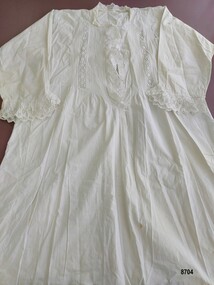
Textile - Nightgown, Circa 1900
... During W.W.2, a local Warrnambool couple (Meryl and Tony Everard) boarded with them – Tony was in the airforce training paratroopers to jump into (and survive) enemy territory and his wife Meryl worked in the Methodist baby Home. ...During W.W.2, a local Warrnambool couple (Meryl and Tony Everard) boarded with them – Tony was in the airforce training paratroopers to jump into (and survive) enemy territory and his wife Meryl worked in the Methodist baby Home. ...This item is one of a collection of clothing items that belonged to the Stephenson family who lived at 22 McCracken Street, Kensington, Melbourne. Matthew Stephenson (1861 – 1943) who had grown up on the Bendigo goldfields and shifted to Melbourne in the early 1900’s was a train driver and later, a fireman with the railways. His wife Elizabeth Jane (Betsy) Wigley (1865 – 1953) also grew up on the goldfields around Majorca and Bendigo. They married in 1885 in Bendigo. They had two daughters – Ethel Evelyn Stephenson (1886 – 1956) and Lillian or Lila (1891 – 1977) who were milliners and dressmakers and who continued to live in the family home after the death of their parents. The family are recorded as living at 22 McCracken Street, Kensington, as early as 1914. It is not known who made or owned the clothing that makes up this collection but as it appears to be from the late Victorian and early Edwardian era, the different pieces were probably made and worn by any of the three ladies of the house – Betsy, Ethel and/or Lila. During W.W.2, a local Warrnambool couple (Meryl and Tony Everard) boarded with them – Tony was in the airforce training paratroopers to jump into (and survive) enemy territory and his wife Meryl worked in the Methodist baby Home. The Everards developed a close friendship with the Stephensons and were responsible for clearing out the house (and finding this clothing collection) after Lila died in 1977. This nightgown is machine sewn and has an added detailed design of pintucks and broderie anglaise lace to the front yoke and cuffs as a decorative element. The 1800's bought a shift in attitude towards modesty as the Victorian era progressed and by the mid to late 1800's it had become more acceptable ladies to wear simple, modest nightgowns. They tended to have a very loose fit and were usually made of linen, cotton or flannel, which had the advantage of providing warmth and also being easy to wash - a necessity for a garment worn next to the skin. Although the basic design of the nightgown was fairly simple, the wearer was free to add various types of trim e.g. lace, crochet, pintucks, embroidery etc.This item is an example of the needlework skills of women in the late 19th and early 20th century - combining machine stitching with hand embroidery to personalise and embellish a practical item of clothing. A full length lady's cotton nightgown with long sleeves finished with a diagonal pointed cuff of broderie anglaise. The bodice features a front opening placket with 3 buttons and buttonholes and a broderie anglaise cover. On either side of the placket, the bodice has been decorated with rows of vertical pintucks and a broderie anglaise panel insert. There is also a frill of broderie anglaise lace around the neck. The back of the nightgown is gathered onto a yoke.flagstaff hill maritime museum and village, great ocean road, shipwreck coast, warrnambool, nightgown, lady's nightgown, needlework, sewing, broderie anglaise, pintucks, stephenson family -
 Flagstaff Hill Maritime Museum and Village
Textile - Skirt, circa 1910
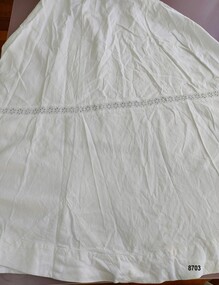
... During W.W.2, a local Warrnambool couple (Meryl and Tony Everard) boarded with them – Tony was in the airforce training paratroopers to jump into (and survive) enemy territory and his wife Meryl worked in the Methodist baby Home. ...During W.W.2, a local Warrnambool couple (Meryl and Tony Everard) boarded with them – Tony was in the airforce training paratroopers to jump into (and survive) enemy territory and his wife Meryl worked in the Methodist baby Home. ...This item is one of a collection of clothing items that belonged to the Stephenson family who lived at 22 McCracken Street, Kensington, Melbourne. Matthew Stephenson (1861 – 1943) who had grown up on the Bendigo goldfields and shifted to Melbourne in the early 1900’s was a train driver and later, a fireman with the railways. His wife Elizabeth Jane (Betsy) Wigley (1865 – 1953) also grew up on the goldfields around Majorca and Bendigo. They married in 1885 in Bendigo. They had two daughters – Ethel Evelyn Stephenson (1886 – 1956) and Lillian or Lila (1891 – 1977) who were milliners and dressmakers and who continued to live in the family home after the death of their parents. The family are recorded as living at 22 McCracken Street, Kensington, as early as 1914. It is not known who made or owned the clothing that makes up this collection but as it appears to be from the late Victorian and early Edwardian era, the different pieces were probably made and worn by any of the three ladies of the house – Betsy, Ethel and/or Lila. During W.W.2, a local Warrnambool couple (Meryl and Tony Everard) boarded with them – Tony was in the airforce training paratroopers to jump into (and survive) enemy territory and his wife Meryl worked in the Methodist baby Home. The Everards developed a close friendship with the Stephensons and were responsible for clearing out the house (and finding this clothing collection) after Lila died in 1977. This skirt features broderie anglaise trim. Although broderie anglaise was a lace that could be made by hand, it was very time consuming to make. St Gallen was a city in Switzerland that had become known for producing quality textiles. At the beginning of the 19th century, the first embroidery machines were developed in St Gallen. Factories used embroidery machines but people also had them in their homes. They were able to produce broderie anglaise for export. By the early 20th century, machine made lace, fabric, ribbons etc. were being sold in drapers shops all over England and Wales to women who were making clothes and furnishings for their families. It is highly likely that the lady who made this skirt brought the lengths of broderie anglaise already made to embellish and personalise her skirt.This item is an example of the needlework skills of women in the late 19th century - creating pintucks and adding lace to personalise and embellish a practical item of clothing. A full length lady's skirt of heavy textured ribbed twill cotton. The top of the skirt is made from five pieces of fabric, sewn together and inserted into a simple waistband. It has an opening with room for 6 hook and eyes (but only the middle three remain). The top section of the skirt is separated from the bottom section by a strip of eyelet embroidery that has been inserted in a horizontal line at the back but becomes slightly diagonal at the front causing the two ends to cross in a decorative X fashion. The bottom of the skirt is the same heavy cotton as the top and one seam features a V shaped insert or patch.flagstaff hill maritime museum and village, great ocean road, shipwreck coast, warrnambool, broderie anglaise, needlework, sewing, stephenson family, skirt, lady's skirt -
 Flagstaff Hill Maritime Museum and Village
Footwear - Leather boots, Adler Boots and Shoes, circa 1920
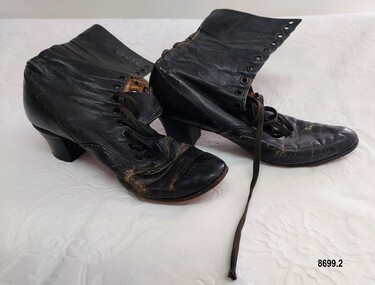
... During W.W.2, a local Warrnambool couple (Meryl and Tony Everard) boarded with them – Tony was in the airforce training paratroopers to jump into (and survive) enemy territory and his wife Meryl worked in the Methodist baby Home. ...During W.W.2, a local Warrnambool couple (Meryl and Tony Everard) boarded with them – Tony was in the airforce training paratroopers to jump into (and survive) enemy territory and his wife Meryl worked in the Methodist baby Home. ...This item is one of a collection of clothing items that belonged to the Stephenson family who lived at 22 McCracken Street, Kensington, Melbourne. Matthew Stephenson (1861 – 1943) who had grown up on the Bendigo goldfields and shifted to Melbourne in the early 1900’s was a train driver and later, a fireman with the railways. His wife Elizabeth Jane (Betsy) Wigley (1865 – 1953) also grew up on the goldfields around Majorca and Bendigo. They married in 1885 in Bendigo. They had two daughters – Ethel Evelyn Stephenson (1886 – 1956) and Lillian or Lila (1891 – 1977) who were milliners and dressmakers and who continued to live in the family home after the death of their parents. The family are recorded as living at 22 McCracken Street, Kensington, as early as 1914. It is not known who made or owned the clothing that makes up this collection but as it appears to be from the late Victorian and early Edwardian era, the different pieces were probably made and worn by any of the three ladies of the house – Betsy, Ethel and/or Lila. During W.W.2, a local Warrnambool couple (Meryl and Tony Everard) boarded with them – Tony was in the airforce training paratroopers to jump into (and survive) enemy territory and his wife Meryl worked in the Methodist baby Home. The Everards developed a close friendship with the Stephensons and were responsible for clearing out the house (and finding this clothing collection) after Lila died in 1977. Starting in around 1850, women began wearing boots that resembled the ones already worn by men in high society. Victorian women's boots were slightly more feminine in nature, however, than those worn by their male counterparts. The boots first worn by women extended to the middle of the calf so that her ankle would stay properly covered underneath her many skirts. These boots often featured laces or a row of buttons to keep them secure to the foot and ankle. Although usually made from durable materials like rubber and leather, boots that were worn purely for fashion were sometimes made of more elegant materials like patent leather or dyed suede. Edwardian boots were lace up or button up. The most remarkable thing about women's shoes in the 1920's was that they were visible! This led to an increase in demand for new styles every season which made ordering custom fit shoes a thing of the past. New shoes were made in standard sizes, ready to buy from local clothing stores or mail order catalogues. Working women, however, tended to wear sensible, lace up shoes and boots. These boots appear to be of a practical nature, designed for comfort, warmth, and proof against the rain and mud, rather than high fashion. They feature the brand name "adler" printed on the inner sole and have stamped letters and numbers suggesting ready-made sizes.This pair of boots are a significant example of a working woman's footwear dating around the early 20th century.Pair of lady's black leather, lace up boots featuring 3.75 cm heels, 14 pairs of lacing eyelets, a black leather tongue and black shoelaces. The leather soles have tacks on the heels and near the instep. The boots have a black leather inner sole and the inner shaft and upper part of the boots are lined with a durable cotton type fabric. Both boots have ink markings (handwritten and stamped) at the top of the shaft lining and the inner sole of the left hand boot is labelled "adler".Both boots - "0/128 /X" (handwritten) and "6MC200" (stamped). Left boot inner sole - "adler" left boot upper shaft lining - "X/8FH?" (handwritten)flagstaff hill maritime museum and village, great ocean road, shipwreck coast, warrnambool, boots, lady's boots, footwear, leather boots, lace up boots, adler, stephenson family -
 Flagstaff Hill Maritime Museum and Village
Textile - Petticoat, circa 1900
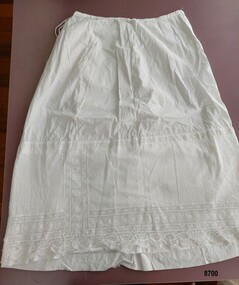
... During W.W.2, a local Warrnambool couple (Meryl and Tony Everard) boarded with them – Tony was in the airforce training paratroopers to jump into (and survive) enemy territory and his wife Meryl worked in the Methodist baby Home. ...During W.W.2, a local Warrnambool couple (Meryl and Tony Everard) boarded with them – Tony was in the airforce training paratroopers to jump into (and survive) enemy territory and his wife Meryl worked in the Methodist baby Home. ...This item is one of a collection of clothing items that belonged to the Stephenson family who lived at 22 McCracken Street, Kensington, Melbourne. Matthew Stephenson (1861 – 1943) who had grown up on the Bendigo goldfields and shifted to Melbourne in the early 1900’s was a train driver and later, a fireman with the railways. His wife Elizabeth Jane (Betsy) Wigley (1865 – 1953) also grew up on the goldfields around Majorca and Bendigo. They married in 1885 in Bendigo. They had two daughters – Ethel Evelyn Stephenson (1886 – 1956) and Lillian or Lila (1891 – 1977) who were milliners and dressmakers and who continued to live in the family home after the death of their parents. The family are recorded as living at 22 McCracken Street, Kensington, as early as 1914. It is not known who made or owned the clothing that makes up this collection but as it appears to be from the late Victorian and early Edwardian era, the different pieces were probably made and worn by any of the three ladies of the house – Betsy, Ethel and/or Lila. During W.W.2, a local Warrnambool couple (Meryl and Tony Everard) boarded with them – Tony was in the airforce training paratroopers to jump into (and survive) enemy territory and his wife Meryl worked in the Methodist baby Home. The Everards developed a close friendship with the Stephensons and were responsible for clearing out the house (and finding this clothing collection) after Lila died in 1977. A petticoat is a lady's undergarment - worn under a skirt or dress. They provided warmth, modesty and shape to the dress. In the middle of the 19th century, petticoats were worn over hoops, bustles or in layers. Petticoats varied according to the style of the outside skirt or dress. Plain petticoats tended to be worn with everyday wear whilst better dresses (party dresses or silk gowns) were worn with petticoats that often had more trim and embellishments. Edwardian petticoats had less volume than Victorian era petticoats and they had a "dust ruffle" or lining under a lace flounce. The "dust ruffle" protected the lace flounce and gave the petticoat more flare at the bottom, greater freedom when walking as well as saving the flounce (which was often made of finer material) from everyday wear and tear. Tucks are another feature of Edwardian petticoats - when the lace at the bottom became worn, it could be cut off and the tucks released. This extended the life of the petticoat. This petticoat features an intricate trim of broderie anglaise. Although broderie anglaise was a lace that could be made by hand, it was very time consuming to make. St Gallen was a city in Switzerland that had become known for producing quality textiles. At the beginning of the 19th century, the first embroidery machines were developed in St Gallen. Factories used embroidery machines but people also had them in their homes. They were able to produce broderie anglaise for export. By the early 20th century, machine made lace, fabric, ribbons etc. were being sold in drapers shops all over England and Wales to women who were making clothes and furnishings for their families. It is highly likely that the lady who made this petticoat brought the lengths of broderie anglaise already made to embellish and personalise her petticoat.This item is an example of the needlework skills of women in the late 19th century - creating pintucks and adding lace to personalise and embellish a practical item of clothing. A lady's fine cotton and lace ankle length petticoat featuring a deep decorative hem made from sheer pinspot fabric and bands of eyelet lace. The top section of the petticoat is made from five sections of fine cotton sewn together with french seams and gathered with pleats and darts into the waistband. The waistband opening has two button holes and one button (the top button is missing) and a front section with a drawstring. The lace hem is lined with the same fine cotton as the top of the petticoat. There are three different lace bands - a narrow one featuring small flowers, a similar wider band with larger flowers and it is finished at the bottom with a broad band of lace with an intricate leaf design.flagstaff hill maritime museum and village, great ocean road, warrnambool, shipwreck coast, petticoat, lady's petticoat, broderie anglaise, decorative petticoat, draw string waist, machine sewn, dressmaker, stephenson family, pintucks, needlework -
 Flagstaff Hill Maritime Museum and Village
Textile - Petticoat, circa 1910
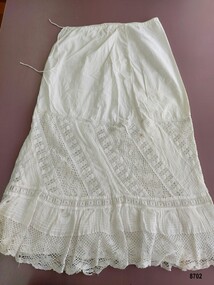
... During W.W.2, a local Warrnambool couple (Meryl and Tony Everard) boarded with them – Tony was in the airforce training paratroopers to jump into (and survive) enemy territory and his wife Meryl worked in the Methodist baby Home. ...During W.W.2, a local Warrnambool couple (Meryl and Tony Everard) boarded with them – Tony was in the airforce training paratroopers to jump into (and survive) enemy territory and his wife Meryl worked in the Methodist baby Home. ...This item is one of a collection of clothing items that belonged to the Stephenson family who lived at 22 McCracken Street, Kensington, Melbourne. Matthew Stephenson (1861 – 1943) who had grown up on the Bendigo goldfields and shifted to Melbourne in the early 1900’s was a train driver and later, a fireman with the railways. His wife Elizabeth Jane (Betsy) Wigley (1865 – 1953) also grew up on the goldfields around Majorca and Bendigo. They married in 1885 in Bendigo. They had two daughters – Ethel Evelyn Stephenson (1886 – 1956) and Lillian or Lila (1891 – 1977) who were milliners and dressmakers and who continued to live in the family home after the death of their parents. The family are recorded as living at 22 McCracken Street, Kensington, as early as 1914. It is not known who made or owned the clothing that makes up this collection but as it appears to be from the late Victorian and early Edwardian era, the different pieces were probably made and worn by any of the three ladies of the house – Betsy, Ethel and/or Lila. During W.W.2, a local Warrnambool couple (Meryl and Tony Everard) boarded with them – Tony was in the airforce training paratroopers to jump into (and survive) enemy territory and his wife Meryl worked in the Methodist baby Home. The Everards developed a close friendship with the Stephensons and were responsible for clearing out the house (and finding this clothing collection) after Lila died in 1977. A petticoat is a lady's undergarment - worn under a skirt or dress. They provided warmth, modesty and shape to the dress. In the middle of the 19th century, petticoats were worn over hoops, bustles or in layers. Petticoats varied according to the style of the outside skirt or dress. Plain petticoats tended to be worn with everyday wear whilst better dresses (party dresses or silk gowns) were worn with petticoats that often had more trim and embellishments. Edwardian petticoats had less volume than Victorian era petticoats and they had a "dust ruffle" or lining under a lace flounce. The "dust ruffle" protected the lace flounce and gave the petticoat more flare at the bottom, greater freedom when walking as well as saving the flounce (which was often made of finer material) from everyday wear and tear. Tucks are another feature of Edwardian petticoats - when the lace at the bottom became worn, it could be cut off and the tucks released. This extended the life of the petticoat. This petticoat features an intricate trim of broderie anglaise. Although broderie anglaise was a lace that could be made by hand, it was very time consuming to make. St Gallen was a city in Switzerland that had become known for producing quality textiles. At the beginning of the 19th century, the first embroidery machines were developed in St Gallen. Factories used embroidery machines but people also had them in their homes. They were able to produce broderie anglaise for export. By the early 20th century, machine made lace, fabric, ribbons etc. were being sold in drapers shops all over England and Wales to women who were making clothes and furnishings for their families. It is highly likely that the lady who made this petticoat brought the lengths of broderie anglaise already made to embellish and personalise her petticoat.This item is an example of the needlework skills of women in the late 19th century - creating pintucks and adding lace to personalise and embellish a practical item of clothing.A lady's ankle length petticoat made in three sections. The top section is made from three rectangles of fine cotton (batiste) joined into a round with narrow french seams and inserted into a simple drawstring waistband with a small opening. The second section is made with rows of alternating strips of fine pin tucked lawn, white cotton cut work embroidery and a wider cotton lace design all joined in a diagonal pattern and lined with fine lawn. The bottom section of the petticoat has a horizontal strip of eyelet lace followed by a wider strip of fine pin tucked lawn and is finished with a deep hem of white cotton crocheted lace fabric and has the same lawn lining as the section above.flagstaff hill maritime museum and village, great ocean road, shipwreck coast, warrnambool, petticoat, lady's petticoat, needlework, sewing, broderie anglaise, stephenson family, drawstring waistband -
 Lara RSL Sub Branch
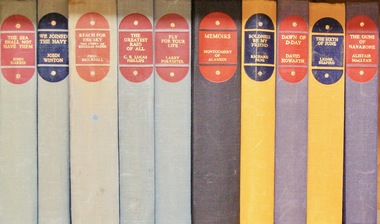
Book, Dawn of D Day, 1959
... Historical recount of D-Day landings and subsequent battles wwii d day battle of normandy air drop american air drop canadian troops french civilians invasion fleet paratroopers juno beach invasion beaches dropping zones utah beach omaha beach Hardcover - dark blue Front Back and spine. ...This book was issued in 1960 and is an impression of the experience of the men who landed in the light of dawn on D Day. An impression of what it was like to be dropped from the sky at morning or ship to shore from a landing craft under fire.Historical recount of D-Day landings and subsequent battlesHardcover - dark blue Front Back and spine. The spine has the title printed. Inside front and back cover have illustrated maps by Charles Green. Photographs, maps and illustrations.wwii, d day, battle of normandy, air drop, american air drop, canadian troops, french civilians, invasion fleet, paratroopers, juno beach, invasion beaches, dropping zones, utah beach, omaha beach -
 Lara RSL Sub Branch
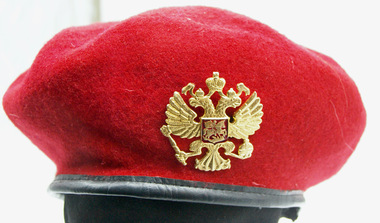
Uniform - Russian paratrooper red beret
... In April 1930, Soviet industry produced its first run of domestic parachutes, not surprisingly patterned on the Irvin style. russian front 1918-1919 russian paratroopers history of russian paratroopers history of change in aircraft to cater for paratroopers fabric informatiion labelt i.e. dry clean Red felted wool beret withblack leather hat trim Uniform Russian paratrooper red beret ...The Soviet Union was one of the first countries to realize the unique potential of parachute forces. As early as 1927 there were reports of parachute troops being used against bandits in Central Asia. Within the next two to three years Leonid G. Minov began to organize the first military parachute units. He traveled to the United States to study parachute strategy and techniques employed in air rescue missions. He returned to his country with a supply of American-made Irvin parachutes. In April 1930, Soviet industry produced its first run of domestic parachutes, not surprisingly patterned on the Irvin style.Red felted wool beret withblack leather hat trimfabric informatiion labelt i.e. dry cleanrussian front 1918-1919, russian paratroopers history of russian paratroopers, history of change in aircraft to cater for paratroopers
