
Showing 12 items matching "peter darwin"
-
 Vision Australia
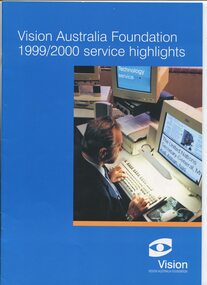
Administrative record - Text, Vision Australia Foundation 1999/2000 service highlights, 2000
... ...Peter Darwin...Vision Australia Foundation Corporation records Emily Macdonald Chris Lynch John McLeod Donna Meade Anna Baxter John Williams Margaret Bell Helen Morse Sue Harrison Nellie Lucas Edna Barron Margaret Sanders Helen Coutts-Green John Wicking Neil Maxwell Peter Darwin Margaret Laughton Ken Austin 1 volume of printed pages with illustrations Vision Australia Foundation 1999/2000 service highlights Administrative record Text ...The annual report outlines the achievements of the year and financial position of the organisation. Other articles discuss the addition of Telelink groups for Greek, Vietnamese and Macedonian clients, planning to move from Commercial Road building, Boroondara Council becomes the first to offer information in audio and Braille, expansion of radio network with stations open in Albury, Shepparton and Bendigo, Kooyong Fair raises $60,000, George Vowell, Mirridong and Kelaston receive government accreditation, and a Vision Australia centre opens in Southport QLD.1 volume of printed pages with illustrationsvision australia foundation, corporation records, emily macdonald, chris lynch, john mcleod, donna meade, anna baxter, john williams, margaret bell, helen morse, sue harrison, nellie lucas, edna barron, margaret sanders, helen coutts-green, john wicking, neil maxwell, peter darwin, margaret laughton, ken austin -
 Federation University Historical Collection
Book, Northern Territory of South Australia Report Resulting from the Explorations by the Government Geologist, 1906, 1906
... It includes a chapter of Bathurst Island and Melville Island, Primitive Methhods of Chinese Mining, Early Days of Mining in the Northern Territory Images include sandbank at low tide, Douglas River, Granite at Union Hill, Night Cliff, East Point, union hill, zapopan gold mine Brook's Creek, Blow Gold Mine Yam Creek, Daly River Copper Mine, Mount Ellison Copper Mine, Point Charles Lighthouse, Blacks Camp near Point Charles Lighthouse, The Venture Stranded on a Daly River Sandbank, Hyland Bay Natives, Boabab Trees at Blunder Bay, The Wai Hoi, Mouth of Fitzmaurice River, Point Blaze Natives, Fort Hill and Old Gulnare Jetty Port Darwin, Large Anthill, Daly RIver Natives, Wargie Natives, L.C.E. Gee, H.Y.L. Brown, H. Basedow. F.J. Williamson, Aboriginal crew (Pedro, Peter, Tobatchie, Bubs, Loman), Henry Roberts, Schollert's Grave It also includes a large folder Geological Map of the North-Western District Northern Territory of South Australia. ...It includes a chapter of Bathurst Island and Melville Island, Primitive Methhods of Chinese Mining, Early Days of Mining in the Northern Territory Images include sandbank at low tide, Douglas River, Granite at Union Hill, Night Cliff, East Point, union hill, zapopan gold mine Brook's Creek, Blow Gold Mine Yam Creek, Daly River Copper Mine, Mount Ellison Copper Mine, Point Charles Lighthouse, Blacks Camp near Point Charles Lighthouse, The Venture Stranded on a Daly River Sandbank, Hyland Bay Natives, Boabab Trees at Blunder Bay, The Wai Hoi, Mouth of Fitzmaurice River, Point Blaze Natives, Fort Hill and Old Gulnare Jetty Port Darwin, Large Anthill, Daly RIver Natives, Wargie Natives, L.C.E. Gee, H.Y.L. Brown, H. Basedow. F.J. Williamson, Aboriginal crew (Pedro, Peter, Tobatchie, Bubs, Loman), Henry Roberts, Schollert's Grave It also includes a large folder Geological Map of the North-Western District Northern Territory of South Australia. ...Pale blue soft covered geological and general report. It includes a chapter of Bathurst Island and Melville Island, Primitive Methhods of Chinese Mining, Early Days of Mining in the Northern Territory Images include sandbank at low tide, Douglas River, Granite at Union Hill, Night Cliff, East Point, union hill, zapopan gold mine Brook's Creek, Blow Gold Mine Yam Creek, Daly River Copper Mine, Mount Ellison Copper Mine, Point Charles Lighthouse, Blacks Camp near Point Charles Lighthouse, The Venture Stranded on a Daly River Sandbank, Hyland Bay Natives, Boabab Trees at Blunder Bay, The Wai Hoi, Mouth of Fitzmaurice River, Point Blaze Natives, Fort Hill and Old Gulnare Jetty Port Darwin, Large Anthill, Daly RIver Natives, Wargie Natives, L.C.E. Gee, H.Y.L. Brown, H. Basedow. F.J. Williamson, Aboriginal crew (Pedro, Peter, Tobatchie, Bubs, Loman), Henry Roberts, Schollert's Grave It also includes a large folder Geological Map of the North-Western District Northern Territory of South Australia. northern territory of south australia, geology, l. o'loughlin, douglas river, bathurst island, melville island, apsley straight, chinese, aboriginal -
 Bendigo Military Museum
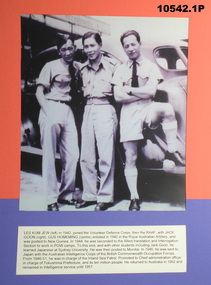
Photograph - AUSTRALIAN CHINESE SERVICEMEN/WOMEN, WW2, Bendigo & District RSL Club, Unknown
... PETER MOO (top right) served with the Australian Army in the Northern Territory, his brother FRANK MOO (top centre) served with the Australian Imperial Force in Rabaul and Bougainville, Frank's children CLARENCE MOO (top right) served with the Royal Australian Engineers and then transferred to the Royal Australian Air Force HARRY MOO (bottom left) served with the Royal Australian Air Force's 31 Beaufighter Squadron in Darwin and Morotai, MAVIS MOO (bottom centre) served with the Australian Army Medical Women's Service and ARTHUR MOO (bottom right) served with the Australian Army and later the Royal Australian Air Force. ...PETER MOO (top right) served with the Australian Army in the Northern Territory, his brother FRANK MOO (top centre) served with the Australian Imperial Force in Rabaul and Bougainville, Frank's children CLARENCE MOO (top right) served with the Royal Australian Engineers and then transferred to the Royal Australian Air Force HARRY MOO (bottom left) served with the Royal Australian Air Force's 31 Beaufighter Squadron in Darwin and Morotai, MAVIS MOO (bottom centre) served with the Australian Army Medical Women's Service and ARTHUR MOO (bottom right) served with the Australian Army and later the Royal Australian Air Force. 1.2.3. ...Australian Chinese Servicemen from WW2 photographs - Exhibition held at the Bendigo & District RSL, post 2010.1.2.3. Photographs on photographic paper, enlarged black and white portraits. Mount - red and blue colour cardboard, double mount with top area containing the photograph, lower area printed information. 1. Three servicemen in informal group. 2. Two servicewomen, one serviceman and a civilian - group portrait. 3. Five servicemen and one service woman in uniform - collection of small portraits.Printed information - black ink print. 1. LES KUM JEW (left)- in 1942, joined the Volunteer Defence Corps, then the RAAF, with JACK GOON (right). GUS HOMEMING (centre) enlisted in 1942 in the Royal Australian Artillery, and was posted to New Guinea. In 1944, he was seconded to the Allied translation and Interrogation Section to work in POW camps. To this end, and with other students including Jack Goon, he learned Japanese at Sydney University. He was then posted to Morotai. In 1946, he was sent to Japan with the Australian Intelligence Corps of the British Commonwealth Occupation Forces. From 1946-51, he was in charge of the Inland Sea Patrol. Promoted to Chief Administration Officer in charge of Tokushima Prefecture and its ten million people. He returned to Australia in 1952 and remained in Intelligence service until 1957. 2. EUNICE LEONG (top left) worked from 1940 as a wireless operator for the Army in Melbourne, Sydney and Alice Springs, and as a signals instructor at Bonegilla. Her sister, VALDA (top right) worked as a radar plotter with the WAAAF, and her brother MAX (bottom right) went with the British Commonwealth Occupation Forces to Japan after the War. 3. PETER MOO (top right) served with the Australian Army in the Northern Territory, his brother FRANK MOO (top centre) served with the Australian Imperial Force in Rabaul and Bougainville, Frank's children CLARENCE MOO (top right) served with the Royal Australian Engineers and then transferred to the Royal Australian Air Force HARRY MOO (bottom left) served with the Royal Australian Air Force's 31 Beaufighter Squadron in Darwin and Morotai, MAVIS MOO (bottom centre) served with the Australian Army Medical Women's Service and ARTHUR MOO (bottom right) served with the Australian Army and later the Royal Australian Air Force. photographs, chinese/australians, ww2 -
 Bendigo Military Museum
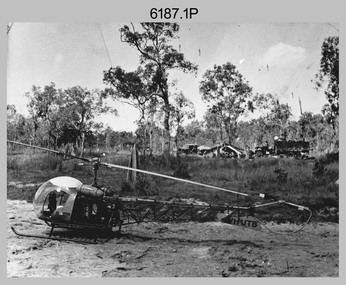
Photograph - Bell 47G-2 helicopter used in Royal Australian Survey Corps Field Operations, c1965
... Darwin. Acknowledgement: Royal Australian Survey Corps – Aerodist Years 1964-1975 Version 2021.0 Authored by Peter Jensen....Darwin. Acknowledgement: Royal Australian Survey Corps – Aerodist Years 1964-1975 Version 2021.0 Authored by Peter Jensen. ...This is a set of four photographs of Bell 47G-2 helicopters used in Royal Australian Survey Corps Field Operations. c1965. From 1957, helicopter transport of survey parties revolutionised transport in remote areas. The most common helicopter used by the Royal Australian Survey Corps at this time was the civilian Bell 47G-2 and the Sioux, the Australian Army’s equivalent. From 1964 an Aerodist MRC2 airborne Electronic Distance Measuring (EDM) system was extensively used for topographic surveys over long distances by trilateration to replace traverse requiring survey station intervisibility. In 1965 the command field survey unit personnel attached to the Army Survey Regiment’s Topographic Squadron were used mainly in support roles such as station clearing, tower operations, station monumenting, Aerodist computations, forward base operations, geodetic observations on the north-south traverse and logistic support for Remote teams. .1P is a photo of a civilian Bell 47G-2 helicopter Registration / Serial VH-UTB owned by Helicopter Utilities from Mascot, NSW c1965. In the background of this photograph is three personnel and vehicles at a field survey camp. The left-hand vehicle is a Willys Jeep with trailer and on the right is probably a Truck, 2 1/2 ton, 6x6, General Service GMC. The Bell 47G-2: VH-UTB was destroyed, and its pilot killed in tragic circumstances during a civilian survey operation on Cape York Peninsula in June 1966. .2P is a photo of a a civilian Bell 47G-2 helicopter Registration / Serial VH-IHB taken in Wyndham, WA. As the letters ‘TAA’ appear on the fuselage, the helicopter was charted from Trans Australian Airways. .3P is a photo of a Bell 47G-2: VH-UTC with survey camp in background. .4P is a photo of a Bell 47G-2 equipped with floats and unidentified personnel loading stores, possibly in Darwin. Acknowledgement: Royal Australian Survey Corps – Aerodist Years 1964-1975 Version 2021.0 Authored by Peter Jensen.This is a set of four photographs of civilian Bell 47G-2 helicopters used in Royal Australian Survey Corps Field Operations. c1965. The photographs were printed on photographic paper and are part of the Army Survey Regiment’s Collection. The photographs were scanned at 300 dpi. .1) - Photo, black & white, c1965, Bell 47G-2 helicopter: VH-UTB with survey camp in background. .2) - Photo, black & white, c1965, Bell 47G-2 helicopter: VH-IHB with survey station in foreground. .3) - Photo, black & white, c1965, Bell 47G-2 helicopter: VH-UTC with survey camp in background. .4) - Photo, black & white, c1965, Bell 47G-2 helicopter: Unidentified personnel loading stores possibly in Darwin..2P – annotated on bottom of photo ‘Wyndham Area – Helicopter drops observing party’ The other photographs are not annotated.royal australian survey corps, rasvy, army survey regiment, army svy regt, fortuna, asr, surveying -
 Monbulk RSL Sub Branch
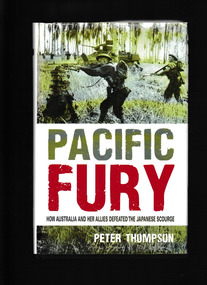
Book, peter Thompson, Pacific fury : how Australia and her allies defeated the Japanese scourge, 2008
... Darwin. The Battle of Midway. POWs. Kamikaze. Hiroshima. These words alone are enough to convey the terror, courage and drama of the Pacific War, when the balance of power stood on a knife-edge and when the future of Australia herself was on the brink - threatened by Japanese aggression on one hand and British apathy on the other. Until now the history of the Pacific War has largely been written from the American perspective. Now, for the first time, Peter ...Pearl Harbour. Kokoda. The fall of Singapore. Curtin's fight with Churchill. The bombing of Darwin. The Battle of Midway. POWs. Kamikaze. Hiroshima. These words alone are enough to convey the terror, courage and drama of the Pacific War, when the balance of power stood on a knife-edge and when the future of Australia herself was on the brink - threatened by Japanese aggression on one hand and British apathy on the other. Until now the history of the Pacific War has largely been written from the American perspective. Now, for the first time, Peter Thompson places Australian voices and action at the heart of a struggle that took an unimaginable number of lives and only ended with the unleashing of the most powerful weapon the world had ever seen. Pearl Harbor; The fall of Singapore; Curtin's fights with Churchill; The bombing of Darwin; POW camps; The battle of Midway; Kokoda; Buna; Kamikaze pilots; Hiroshima. These words alone are enough to convey the terror, courage and drama of the Pacific War, when the balance of power stood on a knife-edge and when the future of Australia was on the brink - threatened by Japanese aggression on the one hand and British deception on the other. After a conflict that took an unimaginable number of lives and ended with the unleashing of the most powerful weapon the world had ever seen, the Allies emerged victorious. Australia, however, was criticised by Churchill and his generals for showing cowardice in the face of the enemy and for not caring about the fate of other nations. The endorsement of these claims by several military historians today shows that the smear has not gone away. Until nowIndex, bibliography, notes, ill, maps, p.548.non-fictionPearl Harbour. Kokoda. The fall of Singapore. Curtin's fight with Churchill. The bombing of Darwin. The Battle of Midway. POWs. Kamikaze. Hiroshima. These words alone are enough to convey the terror, courage and drama of the Pacific War, when the balance of power stood on a knife-edge and when the future of Australia herself was on the brink - threatened by Japanese aggression on one hand and British apathy on the other. Until now the history of the Pacific War has largely been written from the American perspective. Now, for the first time, Peter Thompson places Australian voices and action at the heart of a struggle that took an unimaginable number of lives and only ended with the unleashing of the most powerful weapon the world had ever seen. Pearl Harbor; The fall of Singapore; Curtin's fights with Churchill; The bombing of Darwin; POW camps; The battle of Midway; Kokoda; Buna; Kamikaze pilots; Hiroshima. These words alone are enough to convey the terror, courage and drama of the Pacific War, when the balance of power stood on a knife-edge and when the future of Australia was on the brink - threatened by Japanese aggression on the one hand and British deception on the other. After a conflict that took an unimaginable number of lives and ended with the unleashing of the most powerful weapon the world had ever seen, the Allies emerged victorious. Australia, however, was criticised by Churchill and his generals for showing cowardice in the face of the enemy and for not caring about the fate of other nations. The endorsement of these claims by several military historians today shows that the smear has not gone away. Until nowworld war 1939 – 1945 – campaigns – pacific, world war 1939 – 1945 – australia -
 Victorian Aboriginal Corporation for Languages
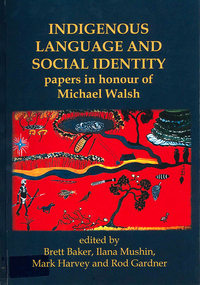
Book, Brett Baker, Indigenous language and social identity : papers in honour of Michael Walsh, 2010
... Peter Sutton Juwaliny : dialectal variation and ethnolinguistic identity in the Great Sandy Desert /? Sally Dixon 6. Who were the 'Yukul'? and who are they now? /? Brett Baker 7. Colonisation and Aboriginal concepts of land tenure in the Darwin...Peter Sutton Juwaliny : dialectal variation and ethnolinguistic identity in the Great Sandy Desert /? Sally Dixon 6. Who were the 'Yukul'? and who are they now? /? Brett Baker 7. Colonisation and Aboriginal concepts of land tenure in the Darwin ...For almost 40 years, Michael Walsh has been working alongside Indigenous people: documenting language, music and other traditional knowledge, acting on behalf of claimants to land in the Northern Territory, and making crucial contributions to the revitalisation of Aboriginal languages in NSW. This volume, with contributions from his colleagues and students, celebrates his abiding interest in and commitment to Indigenous society with papers in two broad themes. ?Language, identity and country? addresses the often complex relations between Aboriginal social groups and countries, and linguistic identity. In ?Language, identity and social action? authors discuss the role that language plays in maintaining social identities in the realms of conversation, story-telling, music, language games, and in education. ?Language and Social Identity in Australian Indigenous Communities? will be of interest to students of linguistics, Indigenous studies, anthropology, and sociology. Contents: 1. Introduction /? Rod Gardner ... [et al.] 2. Michael Walsh : a personal reflection /? Ros Fraser 3. Place and property at Yintjingga/?Port Stewart under Aboriginal Law and Queensland Law /? Bruce Rigsby and Diane Hafner 4. Linguistic identities in the eastern Western Desert : the Tindale evidence /? Peter Sutton Juwaliny : dialectal variation and ethnolinguistic identity in the Great Sandy Desert /? Sally Dixon 6. Who were the 'Yukul'? and who are they now? /? Brett Baker 7. Colonisation and Aboriginal concepts of land tenure in the Darwin region /? Mark Harvey 8. Aboriginal languages and social groups in the Canberra region : interpreting the historical documentation /? Harold Koch 9. The Kuringgai puzzle : languages and dialects on the NSW Mid Coast /? Jim Wafer and Amanda Lissarrague 10. Dawes' Law generalised : cluster simplification in the coastal dialect of the Sydney language /? David Nash 11. Space, time and environment in Kala Lagaw Ya /? Lesley Stirling 12. Turn management in Garrwa mixed-language conversations /? Ilana Mushin and Rod Gardner 13. Laughter is the best medicine : roles for prosody in a Murriny Patha conversational narrative /? Joe Blythe 14. Collaborative narration and cross-speaker repetition in Umpila and Kuuku Ya'u /? Clair Hill 15. Co-narration of a Koko-Bera story : giants in Cape York Peninsula /? Paul BlackMaps, b&w photographs, charts, word listslanguage and identity, language maintenance, language and culture, language and country -
 Plutarch Project
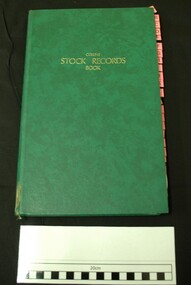
Film screening Log Book, Log Book, Collins late 1950's
... From January 1959 and until 1982, “Cosmopolitan Motion Pictures”, owned by Mr Peter Yannoudes (Παναγιώτης Γιαννούδης) and Mr Stathis Raftopoulos (Στάθης Ραφτόπουλος) travelled around Australia to entertain the Greek, Turkish, Indian and Yugoslav speaking population of Australia and provide a significant cinema culture. They travelled as far as Perth in WA, Adelaide in SA, Tasmania, Darwin...From January 1959 and until 1982, “Cosmopolitan Motion Pictures”, owned by Mr Peter Yannoudes (Παναγιώτης Γιαννούδης) and Mr Stathis Raftopoulos (Στάθης Ραφτόπουλος) travelled around Australia to entertain the Greek, Turkish, Indian and Yugoslav speaking population of Australia and provide a significant cinema culture. They travelled as far as Perth in WA, Adelaide in SA, Tasmania, Darwin ...Yiannoudes Family Film Memorabilia It is normally a time consuming and difficult task to accurately assess a collection’s significance to the primary criteria, however in the case of the “Yiannoudes Family Film Memorabilia” we have no hesitation of its high significance about its historic, social, rarity, interpretive, cultural and provenance to Australia, including the country side where most of this collection memorabilia visited. From January 1959 and until 1982, “Cosmopolitan Motion Pictures”, owned by Mr Peter Yannoudes (Παναγιώτης Γιαννούδης) and Mr Stathis Raftopoulos (Στάθης Ραφτόπουλος) travelled around Australia to entertain the Greek, Turkish, Indian and Yugoslav speaking population of Australia and provide a significant cinema culture. They travelled as far as Perth in WA, Adelaide in SA, Tasmania, Darwin in Nt, Canberra in ACT and Sydney and NSW. However they found themselves also in places like Berri and Renmark in NSW, where concentrations of migrants lived and thrived during the period. Initially they were travelling by train, carrying all their equipment by hand and placing them in boxes and suitcases. However after 1962 when they acquired their first automobile, travelling became less of a burden, nevertheless cumbersome and laborious. They carried with them initially two portable projectors (second one as a backup) and at times travelled with a third in order to ensure that technology will not be letting them down at the time of film projection. At times the films were projected onto a white sheet of cloth because there was no proper screen to project it on at the venue they were using. Mr P. Yiannoudes has also published a book in October 2010, titled “Greek Cinema Across Australia – Behind the Scenes”. The book was published in two languages, English and in Greek. Details about the launch can be found on the Diasporic Literature Spot website at this address (in the Greek language) http://diasporic.org/ellinika/biblia/greek-films-in-australia/. His book is devoted to those with whom he co-operated in order to bring for the first time Greek language films into Australia. Their names are: Stathis Raftopoulos, Andreas Papadopoulos, Andreas Katopodis, Theodoros Kanellopoulos, Michael Ioannou, Fotis Hatzipavlides, Kostas Vrahnas, Evaggelos Terpenos, Dionysis Lourantos, Dimitris Georgiou, Vasilis Florias and Jim Gragie. All businessmen with the right entrepreneurial spirit to be the first and to make their mark in the making of cultural Australia. Mr P. Yiannoudes a Cypriot by descent born in the town of Vouni, a village in the area of Lemesos. In Lemesos he learned the first few things about cinema which would help him in all his later life. He migrated to Australia in 1956 has been a prominent member of the Greek & Cypriot Communities in Melbourne for many decades. He has been President of the Cypriot Community, President of Federation of Cypriot Communities in Australia (for 18 years), President of SEKA (for 26 years) and highly regarded member of the Greek-Cypriots Diaspora since he also has been Vice-President of the Global Federation of Cypriots of Diaspora for 18 years. Mr P. Yiannoudes is now working on creating a small museum of these pieces in the back of the Westgarth Theatre with the help of the Plutarch Project and …. In this collection numbering hundreds of items, we will try and capture some of the glory that was the Greek film industry in Australia for 23 years between 1959 and 1982. “Cosmopolitan Motion Pictures” also owned a large number of cinemas in Melbourne, the National Theatre in Richmond, the Westgarth Theatre in Northcote (which is still owned by the Yiannoudes family today), Sun Theatre in Yarraville, Kinema in Albert Park, Empire Theatre in Brunswick, Paramount Theatre in Oakleigh, Globe Theatre in Richmond, Galaxy Theatre in Brunswick and the Cosmopolitan Theatre in Brusnwick. At the same time they were hiring other theatres for film projections. They were the Astor Theatre in St. Kilda, Victoria Theatre in Richmond, Sunshine Theatre in Sunshine. Apart from Melbourne they were using the Pantheon Theatre in Adelaide, the Norwood Town Hall in Adelaide, the Shepparton Town Hall in Shepparton, the Premier Theatre in Perth, the Rivoli Theatre in Berri and the Renmark Theatre in Renmark. The number of films shown around Australia were over 1500 in total whilst about 1218 of them were in the Greek language. Other languages shown were in Turkish (about 150 films), Yugoslavian (about 100 films), English, French, German, Swedish, Dutch language films. “Cosmopolitan Motion Pictures” was the first company to bring Swedish and Dutch films to Australia. They also showed Martial Arts films for the first time in Australia in 1975 at the Galaxy Theatre in Melbourne. However one of the most significant pieces that tell the story with places and dates is the Show Logbook. The Show Logbook has a large number of stories to tell. It is still intact and in fair condition after all these years of travelling around Australia. It is categorised with an alphabetic index on the right by film title. Greek, Indian, Turkish and Yugoslav language film titles adorn its pages alongside the place where they were first shown, the towns and cities they visited and the dates for each one. It is an extremely significant part of history of the settlement of migrants in Australia. This Log Book is of Primary Significance to the "Cosmopolitan Motion Pictures" and the Yiannoudes family film memorabilia collection. It has a Historic, Social, Provenance and Rarity significance for the settlement of migrants in Australia and the entertainment industry.This is the Log Book, manually updated and used by "Cosmopolitan Motion Pictures" for films shown in different parts of AustraliaCollins Stock Records Booklogbook, films, shown, cultural, language, greek, australia, γιαννούδης, κατάσταση, yiannoudes -
 Plutarch Project
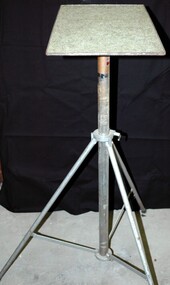
Projector tripod stand, circa 1950's
... From January 1959 and until 1982, “Cosmopolitan Motion Pictures”, owned by Mr Peter Yannoudes (Παναγιώτης Γιαννούδης) and Mr Stathis Raftopoulos (Στάθης Ραφτόπουλος) travelled around Australia to entertain the Greek, Turkish, Indian and Yugoslav speaking population of Australia and provide a significant cinema culture. They travelled as far as Perth in WA, Adelaide in SA, Tasmania, Darwin...From January 1959 and until 1982, “Cosmopolitan Motion Pictures”, owned by Mr Peter Yannoudes (Παναγιώτης Γιαννούδης) and Mr Stathis Raftopoulos (Στάθης Ραφτόπουλος) travelled around Australia to entertain the Greek, Turkish, Indian and Yugoslav speaking population of Australia and provide a significant cinema culture. They travelled as far as Perth in WA, Adelaide in SA, Tasmania, Darwin ...From January 1959 and until 1982, “Cosmopolitan Motion Pictures”, owned by Mr Peter Yannoudes (Παναγιώτης Γιαννούδης) and Mr Stathis Raftopoulos (Στάθης Ραφτόπουλος) travelled around Australia to entertain the Greek, Turkish, Indian and Yugoslav speaking population of Australia and provide a significant cinema culture. They travelled as far as Perth in WA, Adelaide in SA, Tasmania, Darwin in Nt, Canberra in ACT and Sydney and NSW. However they found themselves also in places like Berri and Renmark in NSW, where concentrations of migrants lived and thrived during the period. Initially they were travelling by train, carrying all their equipment by hand and placing them in boxes and suitcases. However after 1962 when they acquired their first automobile, travelling became less of a burden, nevertheless cumbersome and laborious. They carried with them initially two portable projectors (second one as a backup) and at times travelled with a third in order to ensure that technology will not be letting them down at the time of film projection. At times the films were projected onto a white sheet of cloth because there was no proper screen to project it on at the venue they were using. This projector stand was the actual projector stand used in their trips around Australia.Historic and rarity (only one left that was used by "Cosmopolitan Motion Pictures") Primary significanceMetal construction Projector tripod with a cloth on top to stop damaging the projectors. It has an adjustable height depending that extends to about 1.5 metres.T.J.N. Macey - Toolmaker and Manufacturing Engineerstand, tripod, projector, film, culture, language, greek, entertainment, yiannoudes, γιαννούδης, τρίποδο -
 Plutarch Project
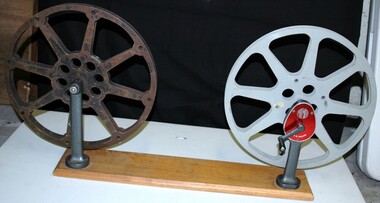
Film rewinder, circa 1950's
... From January 1959 and until 1982, “Cosmopolitan Motion Pictures”, owned by Mr Peter Yannoudes (Παναγιώτης Γιαννούδης) and Mr Stathis Raftopoulos (Στάθης Ραφτόπουλος) travelled around Australia to entertain the Greek, Turkish, Indian and Yugoslav speaking population of Australia and provide a significant cinema culture. They travelled as far as Perth in WA, Adelaide in SA, Tasmania, Darwin...From January 1959 and until 1982, “Cosmopolitan Motion Pictures”, owned by Mr Peter Yannoudes (Παναγιώτης Γιαννούδης) and Mr Stathis Raftopoulos (Στάθης Ραφτόπουλος) travelled around Australia to entertain the Greek, Turkish, Indian and Yugoslav speaking population of Australia and provide a significant cinema culture. They travelled as far as Perth in WA, Adelaide in SA, Tasmania, Darwin ...From January 1959 and until 1982, “Cosmopolitan Motion Pictures”, owned by Mr Peter Yannoudes (Παναγιώτης Γιαννούδης) and Mr Stathis Raftopoulos (Στάθης Ραφτόπουλος) travelled around Australia to entertain the Greek, Turkish, Indian and Yugoslav speaking population of Australia and provide a significant cinema culture. They travelled as far as Perth in WA, Adelaide in SA, Tasmania, Darwin in Nt, Canberra in ACT and Sydney and NSW. However they found themselves also in places like Berri and Renmark in NSW, where concentrations of migrants lived and thrived during the period. Initially they were travelling by train, carrying all their equipment by hand and placing them in boxes and suitcases. However after 1962 when they acquired their first automobile, travelling became less of a burden, nevertheless cumbersome and laborious. They carried with them initially two portable projectors (second one as a backup) and at times travelled with a third in order to ensure that technology will not be letting them down at the time of film projection. At times the films were projected onto a white sheet of cloth because there was no proper screen to project it on at the venue they were using. This winder was part of the equipment they carried around Australia Historical significance Primarily as it is the actual unit used to manually rewind all films.A film rewinding gadget, perhaps home made, with a wooden base, two reels, and an metal winder used for transferring the film from one reel to the next."Premier - Made in England"winder, film, entertainment, language, greek, yiannoudes, γιαννούδης, plutarch -
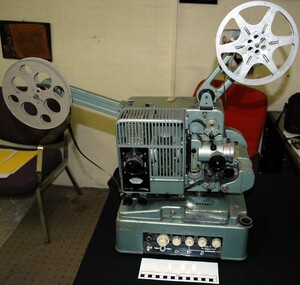 Plutarch Project
16mm Portable Optical & Magnetic Sound Projector, circa 1950's
... From January 1959 and until 1982, “Cosmopolitan Motion Pictures”, owned by Mr Peter Yannoudes (Παναγιώτης Γιαννούδης) and Mr Stathis Raftopoulos (Στάθης Ραφτόπουλος) travelled around Australia to entertain the Greek, Turkish, Indian and Yugoslav speaking population of Australia and provide a significant cinema culture. They travelled as far as Perth in WA, Adelaide in SA, Tasmania, Darwin...Primary historic significance as well as rarity significance projector film magnetic sound optical language Greek Siemens German Γιαννούδης προβολέας Yiannoudes Plutarch Siemens From January 1959 and until 1982, “Cosmopolitan Motion Pictures”, owned by Mr Peter Yannoudes (Παναγιώτης Γιαννούδης) and Mr Stathis Raftopoulos (Στάθης Ραφτόπουλος) travelled around Australia to entertain the Greek, Turkish, Indian and Yugoslav speaking population of Australia and provide a significant cinema culture. They travelled as far as Perth in WA, Adelaide in SA, Tasmania, Darwin ...One of the three projectors used in every trip was this 16mm Portable Projector, which was used taken to about 60 towns and cities around Australia, as Mr Yiannoudes states. This projector is in working condition serviced by Mr Yiannoudes himself regularly. It is an optical and magnetic sound projector, a rare one of its type.Primary historic significance as well as rarity significanceFrom January 1959 and until 1982, “Cosmopolitan Motion Pictures”, owned by Mr Peter Yannoudes (Παναγιώτης Γιαννούδης) and Mr Stathis Raftopoulos (Στάθης Ραφτόπουλος) travelled around Australia to entertain the Greek, Turkish, Indian and Yugoslav speaking population of Australia and provide a significant cinema culture. They travelled as far as Perth in WA, Adelaide in SA, Tasmania, Darwin in Nt, Canberra in ACT and Sydney and NSW. However they found themselves also in places like Berri and Renmark in NSW, where concentrations of migrants lived and thrived during the period. Initially they were travelling by train, carrying all their equipment by hand and placing them in boxes and suitcases. However after 1962 when they acquired their first automobile, travelling became less of a burden, nevertheless cumbersome and laborious. They carried with them initially two portable projectors (second one as a backup) and at times travelled with a third in order to ensure that technology will not be letting them down at the time of film projection. At times the films were projected onto a white sheet of cloth because there was no proper screen to project it on at the venue they were using. One of the three projectors used in every trip was this 16mm Portable Projector, which was used taken to about 60 towns and cities around Australia, as Mr Yiannoudes states. This projector is in working condition serviced by Mr Yiannoudes himself regularly. It is an optical and magnetic sound projector, a rare one of its type. Apart from this projector these items were taken on each trip. -a- 3 projectors in total -b- 2 tripod stands -c- 1 20 feet x 10 feet screen -d- 6 projector lamps and 2 exider lamps for sound -e- 2 extra lamps per film to be shown -f- 1 film rewinder (see rewinder in same collection)Siemensprojector, film, magnetic, sound, optical, language, greek, siemens, german, γιαννούδης, προβολέας, yiannoudes, plutarch -
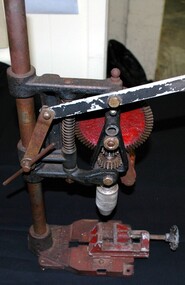 Plutarch Project
Hand Operated drill
... From January 1959 and until 1982, “Cosmopolitan Motion Pictures”, owned by Mr Peter Yannoudes (Παναγιώτης Γιαννούδης) and Mr Stathis Raftopoulos (Στάθης Ραφτόπουλος) travelled around Australia to entertain the Greek, Turkish, Indian and Yugoslav speaking population of Australia and provide a significant cinema culture. They travelled as far as Perth in WA, Adelaide in SA, Tasmania, Darwin...From January 1959 and until 1982, “Cosmopolitan Motion Pictures”, owned by Mr Peter Yannoudes (Παναγιώτης Γιαννούδης) and Mr Stathis Raftopoulos (Στάθης Ραφτόπουλος) travelled around Australia to entertain the Greek, Turkish, Indian and Yugoslav speaking population of Australia and provide a significant cinema culture. They travelled as far as Perth in WA, Adelaide in SA, Tasmania, Darwin ...From January 1959 and until 1982, “Cosmopolitan Motion Pictures”, owned by Mr Peter Yannoudes (Παναγιώτης Γιαννούδης) and Mr Stathis Raftopoulos (Στάθης Ραφτόπουλος) travelled around Australia to entertain the Greek, Turkish, Indian and Yugoslav speaking population of Australia and provide a significant cinema culture. They travelled as far as Perth in WA, Adelaide in SA, Tasmania, Darwin in Nt, Canberra in ACT and Sydney and NSW. However they found themselves also in places like Berri and Renmark in NSW, where concentrations of migrants lived and thrived during the period. Initially they were travelling by train, carrying all their equipment by hand and placing them in boxes and suitcases. However after 1962 when they acquired their first automobile, travelling became less of a burden, nevertheless cumbersome and laborious. They carried with them initially two portable projectors (second one as a backup) and at times travelled with a third in order to ensure that technology will not be letting them down at the time of film projection. At times the films were projected onto a white sheet of cloth because there was no proper screen to project it on at the venue they were using.Primary historic significance in the context that it was used, as well as rarity significanceMetal adjustable height, hand operated drill. Rusty appearance. It seems to have a small piece at the bottom broken off, but still in working order according to Mr P. Yiannoudes. This drill was used to drill holes in cinema light carbon sticks in order to extend their life.drill, carbon, film, entertainment, greek, language, hand, yiannoudes, γιαννούδης, τρυπάνι -
Tatura Irrigation & Wartime Camps Museum
Document - Biography, Peter Drescher, 1991
... Peter Drescher interred as a child from Palastine, in 1941, at Camp 3. Served for 20 years in the Australian Army, Still living in Darwin. ...Peter Drescher interred as a child from Palastine, in 1941, at Camp 3. Served for 20 years in the Australian Army, Still living in Darwin. ...Peter Drescher interred as a child from Palastine, in 1941, at Camp 3. Served for 20 years in the Australian Army, Still living in Darwin. Uhlheer and Hoffman Families Palastine group intered Camp 3, 1941, settled in Australia after the war.Clear plastic, red back foldercamp 3, tatura victoria, internment camps, hoffmann
