
Showing 16 items matching "pharmacist warrnambool"
-
 Warrnambool and District Historical Society Inc.
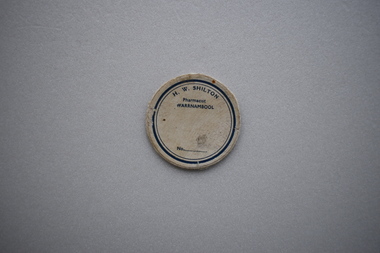
Label, H.W.Shilton, Mid 20th century
... H.W.Shilton Pharmacist Warrnambool No………...Shilton Warrnambool Chemist History of Warrnambool H.W.Shilton Pharmacist Warrnambool No……… This is a round piece of light card with a blue border and blue printing. ...This label comes from the Warrnambool pharmacy of H.W.Shilton. It appears to be a cardboard stopper inserted into the top of a bottle. Harry Shilton’s business was at 119 Liebig Street. He commenced in 1938 when he purchased the business from Ralph Barnes. In 1953 Alan Anderson went into partnership with Harry Shilton. The latter retired in 1960 and in 1967 John Lindsay became the proprietor of the pharmacy business. This label is of minor interest as a memento of a 20th century Warrnambool chemist and as an example of a cardboard bottle top insert. This is a round piece of light card with a blue border and blue printing.H.W.Shilton Pharmacist Warrnambool No………h.w. shilton, warrnambool chemist, history of warrnambool -
 Warrnambool and District Historical Society Inc.
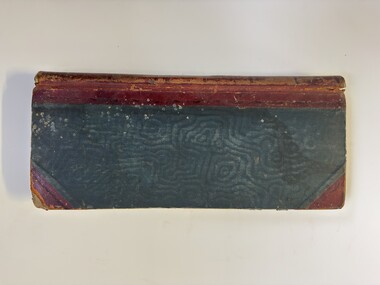
Administrative record (item) - Pharmacy Ledger, Pharmacy Prescription Ledger J Sambell
... ...pharmacist warrnambool...Warrnambool He then moved to the corner of Koroit and Fairy Sts where he went into partnership with his son and grand daughter. The ledger which covers the period of 1883-1980 has an alphabetical index at the front and contains nearly one thousand handwritten prescriptions. It was donated by a later pharmacist...It also contains a large number of local names and is a valuable source of what medicines were being prescribed in the period. sambell chemist pharmacist warrnambool sambell chemist J Sambell prescription ledger 1883-1890 This is a rectangular ledger with a dark green fabric cover and maroon corners and spine . ...This ledger is a record from Sambell's Pharmacy which operated from various premises in Fairy St Warrnambool He commenced working when he purchaesed the business of Kennedy and Co in Timor St Warrnambool He then moved to the corner of Koroit and Fairy Sts where he went into partnership with his son and grand daughter. The ledger which covers the period of 1883-1980 has an alphabetical index at the front and contains nearly one thousand handwritten prescriptions. It was donated by a later pharmacist Chris Houlihan who operated in Warrnambool in the 1960-1970's. The book contains a blotter for Plaza dental soap. This ledger has much local significance as the Sambell chemist shop was a well known business over many years in Warrnambool. It also contains a large number of local names and is a valuable source of what medicines were being prescribed in the period. sambell, chemist, pharmacist warrnambool, sambell chemist, j sambell, prescription ledger, 1883-1890 -
 Flagstaff Hill Maritime Museum and Village
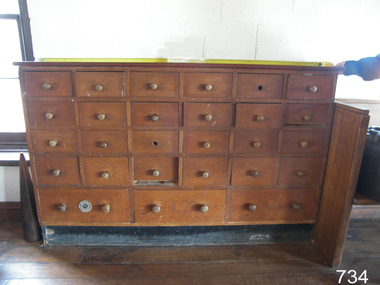
Chest of Drawers
... flagstaff hill warrnambool shipwrecked-coast flagstaff-hill flagstaff-hill-maritime-museum maritime-museum shipwreck-coast flagstaff-hill-maritime-village drawers cabinet chest of drawers furnitrue storage furniture Chest of drawers, wooden varnished 5 rows tall, 6 rows across with 3 double units on bottom level. Turned wooden handles. Pharmacists ...Chest of drawers, wooden varnished 5 rows tall, 6 rows across with 3 double units on bottom level. Turned wooden handles. Pharmacists drawersflagstaff hill, warrnambool, shipwrecked-coast, flagstaff-hill, flagstaff-hill-maritime-museum, maritime-museum, shipwreck-coast, flagstaff-hill-maritime-village, drawers, cabinet, chest of drawers, furnitrue, storage furniture -
 Flagstaff Hill Maritime Museum and Village
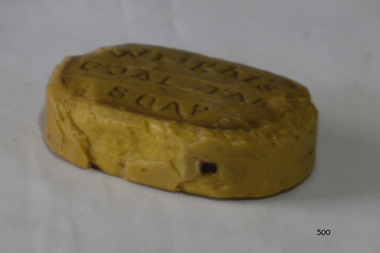
Domestic object - Soap, Wright, Layman & Umney Ltd, ca 20th century
... Warrnambool in the 19th century. The product has endured for over 150 years. Flagstaff Hill Maritime Museum Wright's coal tar soap soap bathing antiseptic washing personal hygiene London Southwark chemist pharmacist Colonies Wright's Coal Tar Soap Sapo Carboni Detergens England soap tablet babies soap nursery soap Wright Layman & Umney Ltd. ...Wright’s Coal Tar Soap was a popular brand of household soap, manufactured by William Valentine Wright from 1867. The oval yellow soap tablet was antiseptic, designed to cleanse the skin thoroughly. It was originally named Sapo Carbonis Detergens, which remains a registered trademark. The product was developed from ‘liquor carbonis detergens’, the liquid by-product of the distillation of coal to make coke. The liquid was made into an antiseptic soap for treating skin diseases. William Valentine Wright was born in 1826 at Aldeburgh, Suffolk. He was a wholesale druggist and chemist who had a small business, W.V. Wright & Co., at 11 Old Fish Street Hill, City of London, where he first sold the soap. In 1863 Wright moved his firm to small premises at 50 Southwark Street, Southwark, London, and not long afterwards M. Sellers and Mr Charles Noel Layman joined the partnership. The company's name changed to Wright, Layman & Umney, when Charles Umney (1843–1909) was taken into the partnership on June 17, 1876, after the death of M. Sellers. William Valentine Wight 1877. Rob Umney, great-great-grandson of Charles Umney, provided further details about the firm, adding that in the late 1960s, the Wright’s Coal Tar Soap business was taken over by LRC Products Ltd who sold it to Smith & Nephew in 1994. The current owners of the brand, Simple Health and Beauty Ltd are based in Solihull and the soap is called Wright's Traditional Soap ‘With coal tar fragrance’. The coal tar has been replaced with tea tree oil. There were concerns that ingredients in coal tar could cause cancer when a person is exposed to very high concentrations, such as in roofing and road paving. In January 2025 the current manufacturers still produce the Wright's Coal Tar Soap.Wright's Coal Tar Soap was sold throughout the United Kingdom and Colonies, which includes Australia. The soap represents many consumer goods sold at pharmacies and chemist shops across the world, such as Sambell and Son, who operated a pharmacy in Fairy Street, Warrnambool in the 19th century. The product has endured for over 150 years.Soap; yellow oval tablet of soap engraved with the brand Wright's Coal Tar oval."WRIGHT'S / COAL TAR / SOAP"flagstaff hill, maritime museum, wright's, coal tar soap, soap, bathing, antiseptic, washing, personal hygiene, london, southwark, chemist, pharmacist, colonies, wright's coal tar soap, sapo carboni detergens, england, soap tablet, babies soap, nursery soap, wright, layman & umney ltd., w.t. wrifght & co., soap cake, soap bar, medical, cleansing, baby care -
 Flagstaff Hill Maritime Museum and Village
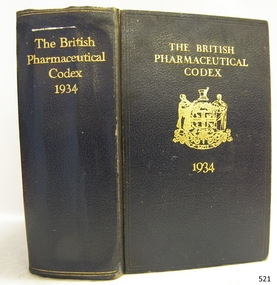
Book, The British Pharmaceutical Codex
... flagstaff hill warrnambool shipwrecked-coast flagstaff-hill flagstaff-hill-maritime-museum maritime-museum shipwreck-coast flagstaff-hill-maritime-village the british pharmaceutical codex book The British Pharmaceutical Codex Published by direction of the council of the Pharmaceutical Society of Great Britian Publisher: The Pharmaceutical Press Date: 1934 An Imperial Dispensatory for the use of Medical Practitioners and Pharmacists The British Pharmaceutical Codex Book Book ...The British Pharmaceutical Codex Published by direction of the council of the Pharmaceutical Society of Great Britian Publisher: The Pharmaceutical Press Date: 1934 An Imperial Dispensatory for the use of Medical Practitioners and Pharmacists flagstaff hill, warrnambool, shipwrecked-coast, flagstaff-hill, flagstaff-hill-maritime-museum, maritime-museum, shipwreck-coast, flagstaff-hill-maritime-village, the british pharmaceutical codex, book -
 Flagstaff Hill Maritime Museum and Village
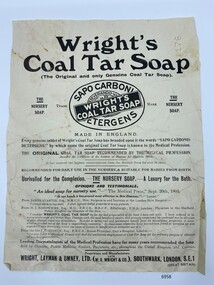
Flyer - Advertisement, Soap, Wright, Layman & Umney Ltd, Late 1940s
... Warrnambool in the 19th century. Flagstaff Hill Maritime Museum Wright's coal tar soap soap bathing antiseptic washing personal hygiene London Southwark chemist pharmacist Colonies Wright's Coal Tar Soap Sapo Carboni Detergens punch marks England soap tablet babies soap nursery soap advertising poster flyer Wright Layman & Umney Ltd. ...Wright’s Coal Tar Soap was a popular brand of household soap, manufactured by William Valentine Wright from 1867. The yellow soap was antiseptic, designed to cleanse the skin thoroughly. It was originally named Sapo Carbonis Detergens, which remains a registered trademark. The product was developed from ‘liquor carbonis detergens’, the liquid by-product of the distillation of coal to make coke. The liquid was made into an antiseptic soap for treating skin diseases. William Valentine Wright was born in 1826 at Aldeburgh, Suffolk. He was a wholesale druggist and chemist who had a small business, W.V. Wright & Co., at 11 Old Fish Street Hill, City of London, where he first sold the soap. In 1863 Wright moved his firm to small premises at 50 Southwark Street, Southwark, London, and not long afterwards M. Sellers and Mr Charles Noel Layman joined the partnership. The company's name changed to Wright, Layman & Umney, when Charles Umney (1843–1909) was taken into the partnership on June 17, 1876, after the death of M. Sellers. William Valentine Wight 1877. Rob Umney, great-great-grandson of Charles Umney, provided further details about the firm, adding that in the late 1960s, the Wright’s Coal Tar Soap business was taken over by LRC Products Ltd who sold it to Smith & Nephew in 1994. The current owners of the brand, Simple Health and Beauty Ltd are based in Solihull and the soap is called Wright's Traditional Soap ‘With coal tar fragrance’. The coal tar has been replaced with tea tree oil. There were concerns that ingredients in coal tar could cause cancer when a person is exposed to very high concentrations, such as in roofing and road paving. In January 2025 the current manufacturers still produce the Wright's Coal Tar Soap.The flier states that Wright's Coal Tar Soap was sold throughout the United Kingdom and Colonies, which includes Australia. The soap is representative of the many consumer goods sold at pharmacies and chemist shops across the world, such as Sambell and Son, who operated a pharmacy in Fairy Street, Warrnambool in the 19th century. The paper flier is rectangular and has printed text and a logo. The top right corner has stamped punch marks. It promotes Wright's Coal Tar Soap, made by Wright, Layman & Umney Ltd. England.Punch mark; "1176"flagstaff hill, maritime museum, wright's, coal tar soap, soap, bathing, antiseptic, washing, personal hygiene, london, southwark, chemist, pharmacist, colonies, wright's coal tar soap, sapo carboni detergens, punch marks, england, soap tablet, babies soap, nursery soap, advertising, poster, flyer, wright, layman & umney ltd., w.t. wrifght & co., soap bar, soap cake -
 Flagstaff Hill Maritime Museum and Village
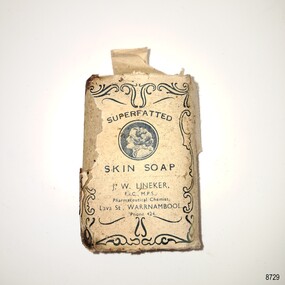
Domestic object - Soap, J W Lineker (Jean Winter Lineker) Pharmacist and Chemist, Mid-20th century
... Warrnambool. Domestic object Soap J W Lineker (Jean Winter Lineker) Pharmacist and Chemist ...This early-to-mid 20th century bar, or cake, of Australian-made soap is carefully wrapped in card and finished with an attractive outer wrapper that promotes its gentle, moisturising qualities. The wrapper also records its origin: J. W. Lineker, pharmaceutical chemist, of Lava Street, Warrnambool. Although the manufacturer is unclear, the soap may have been made by the chemist herself. It was one of several items removed from the steam ferry Rowitta before the vessel was demolished in 2015, after around 40 years as a popular exhibit at Flagstaff Hill. The soap was likely part of a display inside the Rowitta. The wrapper identifies Jean Winder Lineker as a pharmaceutical chemist and lists her credentials, including Master of Pharmacy. In her earlier studies, she had passed the Pharmacy Board’s Intermediate Examination in 1924. By 1940, when she was granted probate from her late father’s will, Jean had relocated from Ballarat to 127 Fairy Street, Warrnambool, just around the corner from her Lava Street pharmacy. Jean was born at Dunkeld in 1900 to Adolphus Winter Lineker (ca. 1863–1934) and Jane Sophia Lineker, born Collins, who had married in 1899. The Lineker family had long associations with tailoring in western Victoria. An article in the Warrnambool Standard in October 1897 reported that A. W. Lineker, late of Melbourne, planned to open a tailoring establishment in Liebig Street, Warrnambool. By 1909, the family was in Portland, where they established the West End Tailoring Establishment in Julia Street. A comment in the local newspaper commends his window display; “Mr Lineker's windows attracted much attention throughout the evening, and most complimentary references were made to his neat dressing.” In 1912, they moved to Geelong and opened another tailor shop, before later moves to Ballarat, Brighton and Koroit. Adolphus died at Koroit in 1934, while Jane later returned to Dunkeld, where she died in 1940. Jane and Jean had been named joint executors of Adolphus’ will, but Jane died before probate was granted later that year. Other members of the Lineker family also operated tailoring businesses across the Western District in the late 19th and early 20th centuries. Everyday toiletries such as this offer a small but revealing insight into local retailing, personal care and pharmacy practice in regional Victoria during the mid-20th century. It is connected to pharmaceutical chemist Jean Winter Lineker, who lived in Warrnambool and ran her business there. Jean came from the well-known Lineker family: her father and other relatives operated several tailoring businesses across the western district of Victoria during the late 19th and early 20th centuries. Bar of soap: Superfatted Skin Soap within a rectangular, light coloured paper packet with navy-blue printed inscriptions on the front. The unsealed packet exposes a grey card lining and grey-fawn coloured soap. A decorative border encloses a female cameo portrait and details of the soap’s distributer. The soap originated from J. W. Lineker, pharmaceutical chemist, Lava St, Warrnambool. “SUPERFATTED / SKIN SOAP / J. W. LINEKER / FN. C., M.P.S.. / Pharmaceutical Chemist / Lava St, WARRNAMBOOL, / ‘Phone 424.” Logo within a circle: Portrait of a young lady showing the left side of her face.flagstaff hill maritime museum and village, great ocean road, shipwreck coast, warrnambool, superfatted skin soap, j. w. lineker, pharmaceutical chemist, lava st, fn. c, m.p.s., phone 424, australian made, soap, the rowitta, jean winder lineker, master of pharmacy, pharmacy board, intermediate examination, ballarat, 127 fairy street, adolphus winter lineker, jane sophia lineker, western victoria, tailor, portland, geelong, brighton, koroit, chemist, pharmacy -
 Flagstaff Hill Maritime Museum and Village
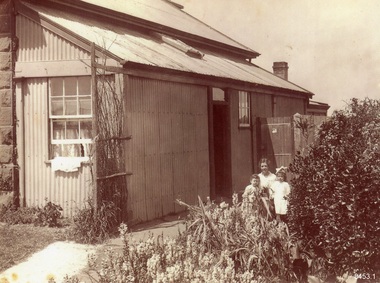
Photograph - Historical, building, Lighthouse Keeper's Quarters Warrnambool, Ca. 1917
... Janet and Stewart had a son, John Stewart Lindsay, who was a Pharmacist, a member of the Warrnambool City Council, the Mayor of the City of Warrnambool, a former Director of Flagstaff Hill, and Chairman of the Flagstaff Hill Advisory Committee....Lighthouse Keeper's Cottage, Flagstaff Hill, Merri St Warrnambool" Stamp "John Stewart Lindsay, Pharmacist, --0 Thompson Street Warrnambool 3280" "HOWARD NICHOLL / FLAGSTAFF HILL / MERRI STREET" " KEEP OUT OF REACH OF CHILDREN / Lindsay's Pharmacy / 119 Liebig Street, Warrnambool / Tel. 5561 4310" [round symbol of mortar and pestle] Typed letter (from John Lindsay to Howard Nicholl, October 21 1997)...Lighthouse Keeper's Cottage, Flagstaff Hill, Merri St Warrnambool" Stamp "John Stewart Lindsay, Pharmacist, --0 Thompson Street Warrnambool 3280" "HOWARD NICHOLL / FLAGSTAFF HILL / MERRI STREET" " KEEP OUT OF REACH OF CHILDREN / Lindsay's Pharmacy / 119 Liebig Street, Warrnambool / Tel. 5561 4310" [round symbol of mortar and pestle] Typed letter (from John Lindsay to Howard Nicholl, October 21 1997) Photograph from c. 1917 depicts the western side of the Warrnambool's Lighthouse keeper's Quarters constructed in bluestone, which was where the Assistant Lighthouse Keeper resided. ...This photograph of the Warrnambool Lighthouse Keeper's Quarters was donated together with an accompanying letter written by John Lindsay on October 21st, 1997. The letter was addressed to Howard Nicholl, the Director of Flagstaff Hill at that time. The following information was gleaned from the contents of the letter and the labels attached to the photograph:- The photograph of the Cottage was taken in about 1917. The woman is Gertrude Shade, married to James Shade, who was the Warrnambool Town Council's Officer responsible for keeping records of Shipping activity entering and leaving the busy Port of Warrnambool. The couple and their children, Janet and William, were residents of the Assistant Lighthouse Keeper's Quarters at that time. The family is pictured in the garden on the west side of the building. A washhouse, these days referred to as a laundry, is behind the building and had already been removed when the Flagstaff Hill Planning Board had access to the site in 1972. The corrugated iron veranda was replaced in the 1980s with a smaller covered entry. Janet Shade married the man who lived across the road, Stewart Lindsay, in 1935. Stewart was employed by Nestle at the age of sixteen, working in the export department. He was acting Manager when the Manager became ill, supervising the loading of dairy products and biscuits into the holds of the waiting ships, where they were then exported to Indonesia. Many of the ships were registered in Liberia and the seamen were called 'lascar seamen, or Indian Sailors. Janet and Stewart had a son, John Stewart Lindsay, who was a Pharmacist, a member of the Warrnambool City Council, the Mayor of the City of Warrnambool, a former Director of Flagstaff Hill, and Chairman of the Flagstaff Hill Advisory Committee.This photograph has significance as a historical record of the Warrnambool Lighthouse Kerr'er's Quarters in 1917. The photograph connects the cottage to local families, to local industry, to the Port of Warrnambool, and to overseas exports from Warrnambool. Photograph from c. 1917 depicts the western side of the Warrnambool's Lighthouse keeper's Quarters constructed in bluestone, which was where the Assistant Lighthouse Keeper resided. The image shows the corrugated iron lean-to, and other rooms that were added to the original building after 1872, which were removed in the 1970s due to their poor condition. The members of the family pictured were residents at the time; Gertrude Shade (Mrs James Shade), her daughter Janet and her son William. Inscriptions are on the reverse and the accompanying envelope. Typed label "Gertrude Shade with William and Janet. Lighthouse Keeper's Cottage, Flagstaff Hill, Merri St Warrnambool" Stamp "John Stewart Lindsay, Pharmacist, --0 Thompson Street Warrnambool 3280" "HOWARD NICHOLL / FLAGSTAFF HILL / MERRI STREET" " KEEP OUT OF REACH OF CHILDREN / Lindsay's Pharmacy / 119 Liebig Street, Warrnambool / Tel. 5561 4310" [round symbol of mortar and pestle] Typed letter (from John Lindsay to Howard Nicholl, October 21 1997)flagstaff hill, warrnambool, maritime museum, shipwreck coast, great ocean road, lighthouse keeper's quarters, lighthouse keeper's cottage, gertrude shade, james shade, janet shade, john stewart lindsay, stewart lindsay, nestle, warrnambool exports, port of warrnambool, planning board, 1917, howard nicholl, william shade, export to indonesia, janet lindsay, light keeper -
 Flagstaff Hill Maritime Museum and Village
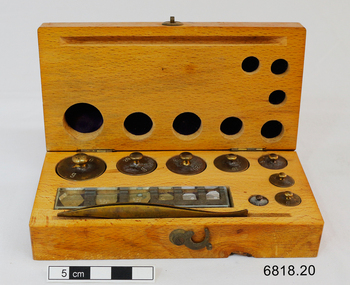
Instrument - Apothecary Set of Weights, 1903 – 1917
... warrnambool base hospital...mira hospital...apothecary weights set...pharmacist...Dr Angus assisted Dr Tom Ryan, a pioneer in the use of X-rays and in ocular surgery. flagstaff hill warrnambool shipwrecked coast flagstaff hill maritime museum maritime museum shipwreck coast flagstaff hill maritime village great ocean road dr w r angus dr ryan nhill base hospital warrnambool base hospital mira hospital apothecary weights set pharmacist weights weights and measures chemist weights Lid of the box has maker's plate "MADE SPECIALLY / FOR / H B SILBERBERG & CO. / MELBOURNE" Apothecary or pharmacy weights set, metric, in fitted wooden box with metal hook latch. ...This apothecary weights set was supplied by the company 'H B Silberberg & Company, Melbourne.' The company used this name in Melbourne from 1903-1917, then changed their name to “H.B. Selby & Company”. The firm specialised in the manufacture, import and supply of scientific instruments, laboratory apparatus, chemicals and industrial equipment. It was founded in Melbourne around 1889 by Carl de Beer and traded under the name of his brother Ernest de Beer and Company. Herbert B Silberberg joined the de Beer partnership in 1903 and, later in the same year, bought the de Beers’ shares in the business. Silberberg carried on as de Beer, Silberberg & Company for four months, after which he changed the name to H B Silberberg & Company. (Australian National University Archives; H B Selby and Company Proprietary Limited) This apothecary weights set was donated to Flagstaff Hill Maritime Village by the family of Doctor William Roy Angus, Surgeon and Oculist. It is part of the “W.R. Angus Collection” that includes historical medical equipment, surgical instruments and material once belonging to Dr Edward Ryan and Dr Thomas Francis Ryan, (both of Nhill, Victoria) as well as Dr Angus’ own belongings. The Collection’s history spans the medical practices of the two Doctors Ryan, from 1885-1926 plus that of Dr Angus, up until 1969. ABOUT THE “W.R.ANGUS COLLECTION” Doctor William Roy Angus M.B., B.S., Adel., 1923, F.R.C.S. Edin.,1928 (also known as Dr Roy Angus) was born in Murrumbeena, Victoria in 1901 and lived until 1970. He qualified as a doctor in 1923 at University of Adelaide, was Resident Medical Officer at the Royal Adelaide Hospital in 1924 and for a period was house surgeon to Sir (then Mr.) Henry Simpson Newland. Dr Angus was briefly an Assistant to Dr Riddell of Kapunda, then commenced private practice at Curramulka, Yorke Peninsula, SA, where he was physician, surgeon and chemist. In 1926, he was appointed as new Medical Assistant to Dr Thomas Francis Ryan (T.F. Ryan, or Tom), in Nhill, Victoria, where his experiences included radiology and pharmacy. In 1927 he was Acting House Surgeon in Dr Tom Ryan’s absence. Dr Angus had become engaged to Gladys Forsyth and they decided he would take time to further his studies overseas in the UK in 1927. He studied at London University College Hospital and at Edinburgh Royal Infirmary and in 1928, was awarded FRCS (Fellow from the Royal College of Surgeons), Edinburgh. He worked his passage back to Australia as a Ship’s Surgeon on the on the Australian Commonwealth Line’s T.S.S. Largs Bay. Dr Angus married Gladys in 1929, in Ballarat. (They went on to have one son (Graham 1932, born in SA) and two daughters (Helen (died 12/07/1996) and Berenice (Berry), both born at Mira, Nhill ) Dr Angus was a ‘flying doctor’ for the A.I.M. (Australian Inland Ministry) Aerial Medical Service in 1928 . The organisation began in South Australia through the Presbyterian Church in that year, with its first station being in the remote town of Oodnadatta, where Dr Angus was stationed. He was locum tenens there on North-South Railway at 21 Mile Camp. He took up this ‘flying doctor’ position in response to a call from Dr John Flynn; the organisation was later known as the Flying Doctor Service, then the Royal Flying Doctor Service. A lot of his work during this time involved dental surgery also. Between 1928-1932 he was surgeon at the Curramulka Hospital, Yorke Peninsula, South Australia. In 1933 Dr Angus returned to Nhill where he’d previously worked as Medical Assistant and purchased a share of the Nelson Street practice and Mira hospital from Dr Les Middleton one of the Middleton Brothers, the current owners of what was once Dr Tom Ryan’s practice. Dr L Middleton was House Surgeon to the Nhill Hospital 1926-1933, when he resigned. [Dr Tom Ryan’s practice had originally belonged to his older brother Dr Edward Ryan, who came to Nhill in 1885. Dr Edward saw patients at his rooms, firstly in Victoria Street and in 1886 in Nelson Street, until 1901. The Nelson Street practice also had a 2 bed ward, called Mira Private Hospital ). Dr Edward Ryan was House Surgeon at the Nhill Hospital 1884-1902 . He also had occasions where he successfully performed veterinary surgery for the local farmers too. Dr Tom Ryan then purchased the practice from his brother in 1901. Both Dr Edward and Dr Tom Ryan work as surgeons included eye surgery. Dr Tom Ryan performed many of his operations in the Mira private hospital on his premises. He too was House Surgeon at the Nhill Hospital 1902-1926. Dr Tom Ryan had one of the only two pieces of radiology equipment in Victoria during his practicing years – The Royal Melbourne Hospital had the other one. Over the years Dr Tom Ryan gradually set up what was effectively a training school for country general-practitioner-surgeons. Each patient was carefully examined, including using the X-ray machine, and any surgery was discussed and planned with Dr Ryan’s assistants several days in advance. Dr Angus gained experience in using the X-ray machine there during his time as assistant to Dr Ryan. Dr Tom Ryan moved from Nhill in 1926. He became a Fellow of the Royal Australasian College of Surgeons in 1927, soon after its formation, a rare accolade for a doctor outside any of the major cities. He remained a bachelor and died suddenly on 7th Dec 1955, aged 91, at his home in Ararat. Scholarships and prizes are still awarded to medical students in the honour of Dr T.F. Ryan and his father, Dr Michael Ryan, and brother, John Patrick Ryan. ] When Dr Angus bought into the Nelson Street premises in Nhill he was also appointed as the Nhill Hospital’s Honorary House Surgeon 1933-1938. His practitioner’s plate from his Nhill surgery states “HOURS Daily, except Tuesdays, Fridays and Saturday afternoons, 9-10am, 2-4pm, 7-8pm. Sundays by appointment”. This plate is now mounted on the doorway to the Port Medical Office at Flagstaff Hill Maritime Village, Warrnambool. Dr Edward Ryan and Dr Tom Ryan had an extensive collection of historical medical equipment and materials spanning 1884-1926 and when Dr Angus took up practice in their old premises he obtained this collection, a large part of which is now on display at the Port Medical Office at Flagstaff Hill Maritime Village in Warrnambool. During his time in Nhill Dr Angus was involved in the merging of the Mira Hospital and Nhill Public Hospital into one public hospital and the property titles passed on to Nhill Hospital in 1939. In 1939 Dr Angus and his family moved to Warrnambool where he purchased “Birchwood,” the 1852 home and medical practice of Dr John Hunter Henderson, at 214 Koroit Street. (This property was sold in1965 to the State Government and is now the site of the Warrnambool Police Station. ). The Angus family was able to afford gardeners, cooks and maids; their home was a popular place for visiting dignitaries to stay whilst visiting Warrnambool. Dr Angus had his own silk worm farm at home in a Mulberry tree. His young daughter used his centrifuge for spinning the silk. Dr Angus was appointed on a part-time basis as Port Medical Officer (Health Officer) in Warrnambool and held this position until the 1940’s when the government no longer required the service of a Port Medical Officer in Warrnambool; he was thus Warrnambool’s last serving Port Medical Officer. (The duties of a Port Medical Officer were outlined by the Colonial Secretary on 21st June, 1839 under the terms of the Quarantine Act. Masters of immigrant ships arriving in port reported incidents of diseases, illness and death and the Port Medical Officer made a decision on whether the ship required Quarantine and for how long, in this way preventing contagious illness from spreading from new immigrants to the residents already in the colony.) Dr Angus was a member of the Australian Medical Association, for 35 years and surgeon at the Warrnambool Base Hospital 1939-1942, He served as a Surgeon Captain during WWII1942-45, in Ballarat, Victoria, and in Bonegilla, N.S.W., completing his service just before the end of the war due to suffering from a heart attack. During his convalescence he carved an intricate and ‘most artistic’ chess set from the material that dentures were made from. He then studied ophthalmology at the Royal Melbourne Eye and Ear Hospital and created cosmetically superior artificial eyes by pioneering using the intrascleral cartilage. Angus received accolades from the Ophthalmological Society of Australasia for this work. He returned to Warrnambool to commence practice as an ophthalmologist, pioneering in artificial eye improvements. He was Honorary Consultant Ophthalmologist to Warrnambool Base Hospital for 31 years. He made monthly visits to Portland as a visiting surgeon, to perform eye surgery. He represented the Victorian South-West subdivision of the Australian Medical Association as its secretary between 1949 and 1956 and as chairman from 1956 to 1958. In 1968 Dr Angus was elected member of Spain’s Barraquer Institute of Barcelona after his research work in Intrasclearal cartilage grafting, becoming one of the few Australian ophthalmologists to receive this honour, and in the following year presented his final paper on Living Intrasclearal Cartilage Implants at the Inaugural Meeting of the Australian College of Ophthalmologists in Melbourne In his personal life Dr Angus was a Presbyterian and treated Sunday as a Sabbath, a day of rest. He would visit 3 or 4 country patients on a Sunday, taking his children along ‘for the ride’ and to visit with him. Sunday evenings he would play the pianola and sing Scottish songs to his family. One of Dr Angus’ patients was Margaret MacKenzie, author of a book on local shipwrecks that she’d seen as an eye witness from the late 1880’s in Peterborough, Victoria. In the early 1950’s Dr Angus, painted a picture of a shipwreck for the cover jacket of Margaret’s book, Shipwrecks and More Shipwrecks. She was blind in later life and her daughter wrote the actual book for her. Dr Angus and his wife Gladys were very involved in Warrnambool’s society with a strong interest in civic affairs. Their interests included organisations such as Red Cross, Rostrum, Warrnambool and District Historical Society (founding members), Wine and Food Society, Steering Committee for Tertiary Education in Warrnambool, Local National Trust, Good Neighbour Council, Housing Commission Advisory Board, United Services Institute, Legion of Ex-Servicemen, Olympic Pool Committee, Food for Britain Organisation, Warrnambool Hospital, Anti-Cancer Council, Boys’ Club, Charitable Council, National Fitness Council and Air Raid Precautions Group. He was also a member of the Steam Preservation Society and derived much pleasure from a steam traction engine on his farm. He had an interest in people and the community He and his wife Gladys were both involved in the creation of Flagstaff Hill, including the layout of the gardens. After his death (28th March 1970) his family requested his practitioner’s plate, medical instruments and some personal belongings be displayed in the Port Medical Office surgery at Flagstaff Hill Maritime Village, and be called the “W. R. Angus Collection”. The W.R. Angus Collection is significant for still being located at the site it is connected with, Doctor Angus being the last Port Medical Officer in Warrnambool. The collection of medical instruments and other equipment is culturally significant, being an historical example of medicine from late 19th to mid-20th century. Dr Angus assisted Dr Tom Ryan, a pioneer in the use of X-rays and in ocular surgery. Apothecary or pharmacy weights set, metric, in fitted wooden box with metal hook latch. Part of the W.R. Angus Collection. Round brass weights (50g, 20g, 20g, 10g, 5g, 2g, 2g, 1g) and small silver sheet weights under glass (500mg, 200mg, 200mg, 50mg, 10mg, 5mg, & 5 other smaller ones), plus brass tweezers. Lid of the box has maker's plate "MADE SPECIALLY / FOR / H B SILBERBERG & CO. / MELBOURNE"flagstaff hill, warrnambool, shipwrecked coast, flagstaff hill maritime museum, maritime museum, shipwreck coast, flagstaff hill maritime village, great ocean road, dr w r angus, dr ryan, nhill base hospital, warrnambool base hospital, mira hospital, apothecary weights set, pharmacist weights, weights and measures, chemist weights -
 Flagstaff Hill Maritime Museum and Village
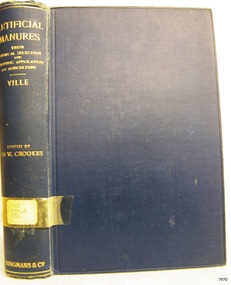
Book - Technical Reference, Georges M Ville (George M Ville), Artificial Manures, 1909
... His career began as a pharmacist and he is known for his research and experiments on the effects of nitrogen and chemical fertilisers on plants, mostly on his experimental farm, He wrote several books in his field of work. The book is part of Flagstaff Hill's Pattison Collection, a large group of books and records, some of which are rare and valuable. The collection was owned by the Warrnambool...His career began as a pharmacist and he is known for his research and experiments on the effects of nitrogen and chemical fertilisers on plants, mostly on his experimental farm, He wrote several books in his field of work. The book is part of Flagstaff Hill's Pattison Collection, a large group of books and records, some of which are rare and valuable. The collection was owned by the Warrnambool ...The author, Georges M. Ville (or George M Ville) was a French agriculturalist and botanist who lived from 1824-1897. His career began as a pharmacist and he is known for his research and experiments on the effects of nitrogen and chemical fertilisers on plants, mostly on his experimental farm, He wrote several books in his field of work. The book is part of Flagstaff Hill's Pattison Collection, a large group of books and records, some of which are rare and valuable. The collection was owned by the Warrnambool Mechanics' Institute, founded in 1853, and is named after Warrnambool's Public Librarian, Ralph Pattison. The handwritten comment on the fly page infers that the book was purchased by a Government subsidy in May 1910 and received in that same month. The book's publisher, Longman, Green & Co. was originally established by Thomas Longman founded his publishing firm in 1724 in London by the name Longman. In August of that year, he bought the two shops and goods of William Taylor and set up his publishing house there at 39 Paternoster Row. The shops were called Black Swan and Ship, and it is said that the 'ship' sign was the inspiration for Longman's Logo. After many changes of name and management, the firm was incorporated in 1926 as Longmans, Green & Co. Pty Ltd. The firm was acquired by Pearson in 1968 and was known as Pearson Longman or Pearson PLC. The Pattison Collection, along with other items at Flagstaff Hill Maritime Village, was originally part of the Warrnambool Mechanics' Institute’s collection. The Warrnambool Mechanics’ Institute Collection is primarily significant in its totality, rather than for the individual objects it contains. Its contents are highly representative of the development of Mechanics' Institute libraries across Australia, particularly Victoria. A diversity of publications and themes has been amassed, and these provide clues to our understanding of the nature of and changes in the reading habits of Victorians from the 1850s to the middle of the 20th century. The collection also highlights the Warrnambool community’s commitment to the Mechanics’ Institute, reading, literacy and learning in the regions, and proves that access to knowledge was not impeded by distance. These items help to provide a more complete picture of our community’s ideals and aspirations. The Warrnambool Mechanics Institute book collection has historical and social significance for its strong association with the Mechanics Institute movement and the important role it played in the intellectual, cultural and social development of people throughout the latter part of the nineteenth century and the early twentieth century. The collection of books is a rare example of an early lending library and its significance is enhanced by the survival of an original collection of many volumes. The Warrnambool Mechanics' Institute’s publication collection is of both local and state significance. Artificial Manures: their chemical selection and scientific application to agriculture Author: Georges M Ville Publisher: Longmans Green & Co. Date: 1909 (first published in 1882) Translated [from French] and edited by Sir William Crookes, D. Scl., F.R.S. New edition revised by Sir William Crookes, D. Sc., F.R.S. and John Percival, M.A. Director of the Department of Agriculture, University College, Reading The blue cloth hardcover book with embossed gold text and lines on the spine contains illustrations and tables. It is part of the Pattison Collection. Inscriptions include a label, stamp, stickers and handwriting.Label on spine: "PAT 631.8 VIL" Sticker on front endpaper: "Warrnambool Mechanics Institute and Free Library" Sticker on endpaper: "Corangamite Regional Library Service" Stamp: "Corangamite Regional Library Service" Stamp on Fly: "from Warrnambool Public Museum" Handwriting on fly: "Purchased Govt Subsidy 10th May 1910" "Received May 24th 1910" "[signature]flagstaff hill, flagstaff hill maritime museum and village, warrnambool, maritime museum, maritime village, great ocean road, shipwreck coast, pattison collection, ralph eric pattison, warrnambool mechanics’ institute, mechanics’ institute library, warrnambool library, free library, corangamite regional library service, longmans green and co. london, artificial manures, chemical selection of artificial manures, scientific selection of artificial manures, georges m ville, george ville, french, agriculturalist, agriculture, sir william crookes, john percival, 1909, 1882, 1910, fertilizers, farming, farm improvement -
 Warrnambool and District Historical Society Inc.
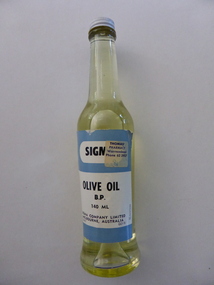
Bottle, Sigma Company Limited, Thomas Pharmacy Olive Oil, Mid 20th century
... Thomas' pharmacy operated from Fairy Street in Warrnambool, initially from 90 fairy Street on the corner of Fairy and Koroit Streets then later moving to 140 Fairy Street on the corner of Fairy and Lava Streets. Mrs W L Hobson is noted as the pharmacist...Thomas' pharmacy operated from Fairy Street in Warrnambool, initially from 90 fairy Street on the corner of Fairy and Koroit Streets then later moving to 140 Fairy Street on the corner of Fairy and Lava Streets. Mrs W L Hobson is noted as the pharmacist ...Thomas' pharmacy operated from Fairy Street in Warrnambool, initially from 90 fairy Street on the corner of Fairy and Koroit Streets then later moving to 140 Fairy Street on the corner of Fairy and Lava Streets. Mrs W L Hobson is noted as the pharmacist in the 1970's. Olive oil in the 1970's was used primarily to moisten and cleanse dry skin.It has also been used as a laxative. It is generally well tolerated and considered safe for skin care for babies. A commonly used product which has multiple uses.Clear glass bottle with long narrowed neck. White screw top and dusty blue and white paper label with black text. Small sticker on right side of label. Filled with olive oil. Thomas' Pharmacy Warrnambool Phone 622907 on sticker. Sigma Company Limited Melbourne Australia on bottom of label. 1270 and crown on the bottom of the bottle.thomas pharmacy, warrnambool, olive oil -
 Warrnambool and District Historical Society Inc.
Functional object - Calendar, Carolyn and Lindsay Monaghan, Pharmacists, Monaghans' Amcal Pharmacy Calendar 1984, 1983
... Warrnambool for the year 1984. It would have been handed out to regular customers and business contacts. Monaghans' Pharmacy in 1984 was operated by pharmacists, Carolyn and Lindsay Monaghan. ...Warrnambool for the year 1984. It would have been handed out to regular customers and business contacts. Monaghans' Pharmacy in 1984 was operated by pharmacists, Carolyn and Lindsay Monaghan. ...This calendar has been produced by Monaghans' pharmacy in Fairy Street Warrnambool for the year 1984. It would have been handed out to regular customers and business contacts. Monaghans' Pharmacy in 1984 was operated by pharmacists, Carolyn and Lindsay Monaghan. The building at 140 Fairy Street formerly housed the bakery business of Henry H. Smith and his successors (from the mid 1880s) and one of the photographs on the calendar shows the building when it was a bakery. Today Monaghans' pharmacy at 140 Fairy Street still operates.This calendar is of interest because of its photographs of historical note and because it is a memento of a long-standing business in Warrnambool.This is a buff-coloured sheet of thickened paper with two sepia photographs and brown printing on one side and black printing on the other. It has a hole punched at the top centre and is stained and creased.monaghans' pharmacy warrnambool, henry h.smith baker warrnambool, chemists in warrnambool -
 Warrnambool and District Historical Society Inc.
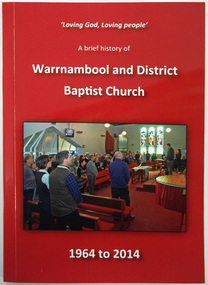
Book, A brief history of Warrnambool & District Baptist Church 1964 to 2014, 2014
... The author is well-known in Warrnambool as a former pharmacist and a volunteer worker in historical and cultural spheres (Flagstaff Hill, Mahogany Ship Committee, Portuguese Festival etc) warrnambool warrnambool baptist church Front Cover: ‘Loving God, Loving people’ – A Brief History of Warrnambool and District Baptist Church 1964 to 2014 This is a paper back book of 52 pages. ...The Warrnambool Baptist Church in Koroit Street celebrated 150 years of formal worship in 2014. This book gives a brief overview of those years from 1964 to 2014 as the first 100 years have been recorded elsewhere. The book gives details on resident ministers, women’s and men’s fellowship societies, missionary work, local church activities and Sunday School classes. The book is of some importance as it gives us a good picture of the Baptist Church in Warrnambool over the past 50 years. It will be useful for researchers and for others interested in the Church’s activities. The author is well-known in Warrnambool as a former pharmacist and a volunteer worker in historical and cultural spheres (Flagstaff Hill, Mahogany Ship Committee, Portuguese Festival etc)This is a paper back book of 52 pages. It has a red cover with a colour photograph of the interior of the Warrnambool Baptist Church. The pages are glued together. The book contains printed material, black and white and colour photographs and illustrations. Front Cover: ‘Loving God, Loving people’ – A Brief History of Warrnambool and District Baptist Church 1964 to 2014 warrnambool, warrnambool baptist church -
 Warrnambool and District Historical Society Inc.
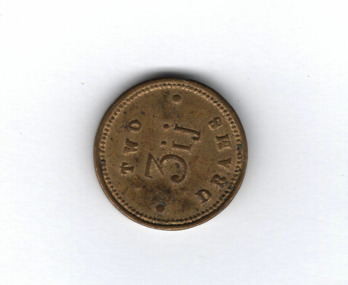
Apothecaries Weight 2 Drams
... This coin has no known local provenance but a two-dram coin such as this would have been used by doctors and pharmacists in the Warrnambool district from the 1840s to the 1940s approximately. ...Apothecaries weights were historically used by physicians and pharmacists for the assembling of medical recipes (20 grains = 1 scruple; 3 scruples = 1 dram (drachm); 8 drams = 1 troy ounce). The coin weights were used up until about the 1940s. This coin is a stater, a 2 gram coin. The symbol for the dram was the number 3 and the letters ‘ij’ are equivalent to the Roman numerals 11 meaning two. The coin has the date March 16, 1847, the date of the registration of the coin.This coin has no known local provenance but a two-dram coin such as this would have been used by doctors and pharmacists in the Warrnambool district from the 1840s to the 1940s approximately. It will be useful for display.This brass circular weight with raised engraving has an annulus of very small dots close to the rim on the obverse and reverse sides. The edge is smooth with a small chip .It is named a StaterObverse REGISTERED MARCH 16 1847 a CROWN Reverse .TWO DRAMS 3 I j apothecaries, weight, warrnambool history -
 Warrnambool and District Historical Society Inc.
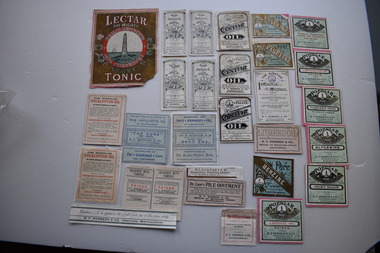
Multiple Labels, Kennedy, Early 20th century
... Warrnambool Bowls Club. He also made locally perfumes with many varieties named after people or events of the time-Federation, Nellie Melba etc.. His pharmacy building in Timor Street and his house 55 Canterbury Road "Ivanhoe" still stands (2019) The use of a lighthouse in his advertising and on his bottles is of particular interest. W.D.H.S. has Kennedy bottles in its collection These labels are of great significance as they were produced for a pharmacist ...Richard Kennedy (1826-1903), a wholesale , retail and manufacturing chemist in Timor Street, came to Warrnambool in 1880 and had what was described in "Cyclopedia of Victoria' as the "largest and best appointed pharmacy in Victoria'. Kennedy was Vice President of the Pharmaceutical Society of Victoria, on the Pharmacy Board and was prominent in community affairs in Warrnambool. He was for some time President of the Mechanics Institute and the Warrnambool Hospital and a foundation member of the Warrnambool Bowls Club. He also made locally perfumes with many varieties named after people or events of the time-Federation, Nellie Melba etc.. His pharmacy building in Timor Street and his house 55 Canterbury Road "Ivanhoe" still stands (2019) The use of a lighthouse in his advertising and on his bottles is of particular interest. W.D.H.S. has Kennedy bottles in its collectionThese labels are of great significance as they were produced for a pharmacist of note in Victoria and Warrnambool. .1 Rectangular paper label adhered to a piece of pink card. It features a lighthouse and small sailing ship in the centre of a red circle with black and white text, Surrounding the circle is text and decorations of flowers on an olive green background. The label is torn on the bottom right hand corner. It is adhered to a piece of pink card. .2 Light green label featuring a lighthouse in a circle underneath which is a scroll with text, There are finely drawn curly decorations and further text. It is adhered to a piece of pink card. .3 Similar to .2 with different text .4 Similar to .2 and .3 with different text .5 Similar to .2,.3,.4 with different text .6 Similar to .2,.3,.4,.5 with different text 6.1Similar to .2,.3,.4,.5,.6 with different text 6.2 Turquoise label with a gold diagonal wide band with text. The label features a lighthouse in a circle , there are decorations of leaves, and curls. The white and black text is stylised, especially the name of the manufacturer. .7 Buff coloured rectangular card adhered to a piece of pink card. The dark green text is surrounded by a decorative border. .8 White rectangular featuring a blue coloured lighthouse and detailed black text .9 White rectangular label with black detailed text surrounded by a border. .10 Similar to 6.2 with different text, adhered to white paper. .11 identical to .10 but adhered to pink card. .12 White rectangular card with black and red text .13 identical to .12 .14 Three joined pale blue labels with dark blue text. The central label is larger than the other two which are equal in size. One of the smaller labels in upside down. All have borders. .15 Identical to .14 excepting it is adhered to white card .16 White rectangular label with black text. It features a lighthouse, decorations of leaves and a variety of styles and fonts of the print. It is adhered to a piece of pink card. .17 Identical to .16 excepting it is adhered to white card. .18 Identical to .17 .19 Rectangular white label with red and black detailed text adhered to a piece of white paper .20 Identical to .19 excepting it is adhered to a piece of pink card. .21 Rectangular white label with grey text , a decorative border and further decorations adhered to a piece of white card. .22 Identical to .21 but not adhered, .23 Identical to .21 , adhered to white card .24 Identical to .22 .25 Square white label with red and black text. and a red border. .26 White rectangular label with dark green text and border. .27 Small white rectangular label with gold text adhered to a piece of white paper .1 LECTAR THE MIGHTY HEALTH RESTORING LIFE PRESERVER NERVE TONIC .2 POPULAR FAMILY MEDICINES CARBOLIC OIL POISON FROM R. F. KENNEDY& CO PHARMAISTS WARRNAMBOOL .3 As for .2 FRIAR'S BALSAM in lieu of CARBOLIC OIL .4 As for .2, .3 GLYCERINE in lieu OF FRIAR'S BALSAM .5 As for .2,.3,.4 Paregoric, Peppermint, Aniseed and Laudanum. POISON in lieu of GLYCERINE .6 As for .2,.3,.4,.5 CAMPHORATED OIL in lieu of Paregoric,Peppermint, Aniseed and Laudanum .6.1 As for .2,.3,.4,.5,.6 PARRISH'S FOOD . in lieu of CAMPHORATED OIL Dose- Adults 1/2 to 1 teaspoonful 6.2 Pure BENZINE FROM R. F. KENNEDY AND CO. Pharmaceutical Works WARRRNAMBOOL .7 LINSEED OILR.F KENNEDY & CO. Wholesale and Manufacturing Chemists WARRNAMBOOL .8 the primary text is : THE ALSATIAN INFLUENZA MIXTURE A section of the ensuing text is ; "For EXHAUSTION, LOSS OF APPETITE , NEURITIS and GENERAL RUN DOWN it will be found a Powerful Tonic." .9 Dr Law's PILE OINTMENT Directions ............... R.F KENNEDY & CO Wholesale and Manufacturing Chemists WARRNAMBOOOL 10. As for .2,.3,.4,.5,.6.6.1 VASELINE in lieu of BENZINE .11 Identical to .10 .12 COLOURED WITH TUMERIC. Labelled in accordance with the "SALE AND USE OF POISONS ACT" POISON R.F. KENNEDY & CO. Chemists WARRNAMBOOL APPROXIMATELY 7 GRAMS .13 Identical to .12. .14 Central label "THE CURE" FOR CORNS R.F. KENNEDY &CO manufacturing Chemists WARRNAMBOOL .Small label PROPRIETORS OF THE. CELEBRATED . CURE FOR TOOTHACHE . Small label PROPRIETORS OF The Sulpho- Thymol Soap, For Eruptions and Irritations of the Skin. .15 Identical to .14 .16TASTELESS ITALIAN CASTOR OIL OF THE PUREST QUALITY. Adults Dose one to two tablespoonfuls . Children half to one tablespoonful. IMPORTED BY R.F. KENNEDY&CO. Manufacturing Chemists Timor ST. Warrnambool .17 Identical to .16 .18 Identical to .16 .19 PURE REDISTILLED EUCALYPTUS OIL OF EXTRA STRENGTH & PURITY DEODORANT & DISINFECTANT FROM R.F. KENNEDY & CO'S Pharmaceutical Works Warrnambool ( Much more detail) .20 Identical to .19 .21,.22,.23,.24 PURE Refined SALAD OIL FROM R.F. KENNEDY & CO.MANUFACTURING CHEMISTS WARRNAMBOOL .25 Brilliantine AN ELEGANT AND FRAGRANT PREPARATION FOR THE HAIR, MOUSTACHE, OR WHISKERS. PROPRIETORS R.F. KENNEDY & CO. WARRNAMBOOL .26 Directions.--- To be applied to the irritable parts two or three times daily R.F. KENNEDY & CO., Chemists, Warrnambool .27 R.F. KENNEDY & CO. Manufacturing and Dispensing Chemists WARRNAMBOOL chemists, pharmaceutical society of victoria, mechanics institute, warrnambool, warrnambool hospital, warrnambool bowls club -
 Warrnambool and District Historical Society Inc.
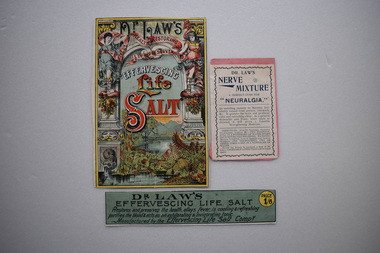
3x Labels, Gaspars Modern Printing Co, Kennedy, Early 20th century
... Warrnambool Bowls Club. He also made perfumes with many varieties named after people or events of the time -- Federation, Nellie Melba etc. His pharmacy building in Timor Street and his house in Canterbury Road ("Ivanhoe") still stand (2019). R.F. Kennedy's pharmacy had the sole rights to Dr. Law's products. These labels are of importance as R.F. Kennedy was a well acknowledged pharmacist ...Dr. Law's patent medicines were sold in Warrnambool by Richard Kennedy (1826-1903). He was, a wholesale, retail and manufacturing chemist in Timor Street, Warrnambool in 1880 and he had what was described in the "Cyclopedia of Victoria" as "the largest and best appointed pharmacy in Victoria.". Kennedy was the Vice President of the Pharmaceutical Society of Victoria, on the Pharmacy Board and prominent in community affairs in Warrnambool. He was for some time the President of the Mechanics Institute and the Warrnambool Hospital and a foundation member of the Warrnambool Bowls Club. He also made perfumes with many varieties named after people or events of the time -- Federation, Nellie Melba etc. His pharmacy building in Timor Street and his house in Canterbury Road ("Ivanhoe") still stand (2019). R.F. Kennedy's pharmacy had the sole rights to Dr. Law's products.These labels are of importance as R.F. Kennedy was a well acknowledged pharmacist and a prominent business man and citizen of Warrnambool. Dr. Law's products were popular patent medicines in the early 20th century..1 Rectangular brightly coloured paper label with text and decorations including pillars,flowers, ferns, fruit, a gargoyle and two figures. One edge has been cut. .2 White rectangular label with blue text adhered to a piece of pink card. .3 Mid green rectangular label with black text and a yellow circle with text. All edges have been cut. .1 Mr LAW'S HEALTH RESTORING LIFE PRESERVER EFFERVESCING Life SALT. .2 DR.LAW'S NERVE MIXTURE A PERFECT CURE FOR "NEURALGIA." Further text in fine print .3 DR. LAW'S EFFERVESCING LIFE SALT restores and preserves the health, allays fever, is cooling & refreshing purifies the blood & acts as an exhilarating & invigorating tonic. Manufactured by the Effervescing life Salt Comp.y.(sic) Price 1/6r.f. kennedy, dr. law's products, pharmacy
