
Showing 29 items matching "portland family history"
-
 Glenelg Shire Council Cultural Collection
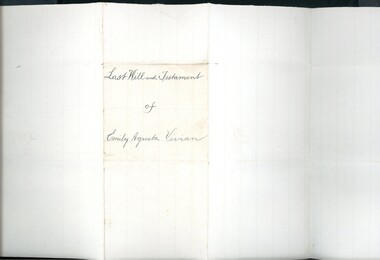
Legal record - Last Will and Testament - Emily Augusta Vivian, 17/04/1921
... ...Portland Family History...Betty Vivan Collection will Vivian family records Emily Vivian Betty Vivian Collection Portland Family History Glenelg Shire Council Cultural Collection Portland Back: 'Last Will and Testament of Emily Agusta Vivian' handwritten, black pen Last will and testament of Emily Agusta Vivian. ...Betty Vivan CollectionLast will and testament of Emily Agusta Vivian. Lined paper, handwritten by the testator, witnessed by Grace Hurrell and H. W. Hurrell. Dated 17th April 1921.Back: 'Last Will and Testament of Emily Agusta Vivian' handwritten, black penwill, vivian family records, emily vivian, betty vivian collection, portland family history, glenelg shire council cultural collection, portland -
 Flagstaff Hill Maritime Museum and Village
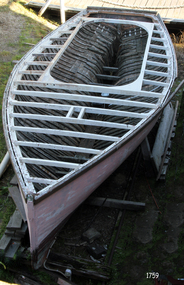
Vehicle - Vessel, Couta boat, Viator, 1890-1920
... Portland. Later it was used as a fishing and recreation boat for local families. For years Viator sat in a paddock in East Warrnambool until purchased in 1975 and donated to Flagstaff Hill. ‘COUTA BOATS - The ‘couta design for vessels is believed to have originated at Port Phillip, Victoria, for the purpose of the Barracouta (‘couta) fishing industry, being both fast and seaworthy. , The 'couta fish was an important food fish in Australian waters, supplying Melbourne with plenty of inexpensive fish. VIATORY’S OWNERS - Some of Viator’s history...Portland. Later it was used as a fishing and recreation boat for local families. For years Viator sat in a paddock in East Warrnambool until purchased in 1975 and donated to Flagstaff Hill. ‘COUTA BOATS - The ‘couta design for vessels is believed to have originated at Port Phillip, Victoria, for the purpose of the Barracouta (‘couta) fishing industry, being both fast and seaworthy. , The 'couta fish was an important food fish in Australian waters, supplying Melbourne with plenty of inexpensive fish. VIATORY’S OWNERS - Some of Viator’s history ...The historic Victorian ‘couta boat “Viator” was built by renowned boat builder J.R. Jones of Williamstown in Melbourne, between 1890 and 1920. He was one of the early builders of this design. The features of Viator - carvel planked, open cockpit, vertical stem and straight keel, single mast and a pivoting centreboard - are all characteristics of an early Bass Strait ‘couta boat. This has been confirmed by experienced Victorian ‘couta boat restorer Tim Phillips. Viator served as a ‘couta fishing boat in the Warrnambool area until the mid-1930s, then some say she served as a mail ferry across to Portland. Later it was used as a fishing and recreation boat for local families. For years Viator sat in a paddock in East Warrnambool until purchased in 1975 and donated to Flagstaff Hill. ‘COUTA BOATS - The ‘couta design for vessels is believed to have originated at Port Phillip, Victoria, for the purpose of the Barracouta (‘couta) fishing industry, being both fast and seaworthy. , The 'couta fish was an important food fish in Australian waters, supplying Melbourne with plenty of inexpensive fish. VIATORY’S OWNERS - Some of Viator’s history is known: - 1940, registered Port Fairy and owned by G.J. Richards. - 1941-1945, registered in Port Fairy and owned by Jens “Peter” Petersen. - 1950’s “Brusher” Richards of Warrnambool and Port Fairy used it for fishing. - Peter Watson and his son also went fishing in Viator. - Frank Ferrier, boat builder, was an owner (son of ‘La Bella’ hero, William Ferrier) - Arthur Rogers owned Viator too, then sold it to Terry Pridmore and Wayne Moorefield - The Viator was stored in a paddock, unused, in Fairmont Avenue, Warrnambool, where it was gradually deteriorating. - 1975 Viator was purchase at a very reasonable price from Pridmore, then donated to Flagstaff Hill Maritime Village. RESTORATION - Shipwright Erik Mikkelsen soon started restoration on the Viator after it arrived at Flagstaff Hill in 1975. In 2006 the Maritime Museums of Australia awarded a grant to Flagstaff Hill Maritime Village to assist with the restoration and renovation of the Viator. Its restoration continues today in the care of Flagstaff Hill’s boat builder. J R. JONES - boat builder The photograph of the EVA MYRL shows the builder J R Jones with his team of workers. The other photograph shows a vessel built by J R Jones' son, J B Jones of Footscray, and his team of boat boulders. The photograph of the EVA MYRL was taken by E. A. Dond---. The other photograph is of the Sturrock Coot, taken a Albert Park Lake in St Kilda.The Viator is the most significant boat in the Flagstaff Hill's fleet, being the last remaining local 'couta boat and one of few existing examples of this craft. Viator received Heritage status with the Australian Maritime Museums Council and is listed on the Australian Register of Historical Vessels in 2006 (ARHV Number: HV000561). Viator was built in Victoria in the early days by renowned boat builder J.R. Jones, and sailed by fishermen for many years, both local and on the coastal waters of Victoria, and was possibly used for the mail service. It is significant for being used for the fishing trade, for government service, perhaps as a mail boat, and for recreation by local families.Vessel, the ‘Viator’, an historic Victorian ‘couta boat, handmade by renowned boat builder This J.R. Jones 'couta boat, the Viator, was built in Williamstown, c.1890-1920. The single mast vessel has a Caravel hull built from New Zealand Kauri, blackwood, with a red gum keel and a jarrah stem and stern. It has a pivoting centreboard. Two photographs are included; one of the builder with his team, the other is of his son J B Jones, with his team. Marked "Viator" Photograph 1759.2: "E. A. Dond---" (indecipherable". Handwritten on back "Grandfather / J R Jones / Built" Photograph 1759.3; sign within photograph "J B JONES / BUILDER / FOOTSCRAY", stamped in the card, bottom right " ----- / MELBOURNE" and handwritten on the back "I think this is Mr Abel Sturrock Coot Albert Park Lake"flagstaff hill, warrnambool, shipwrecked coast, flagstaff hill maritime museum, maritime museum, shipwreck coast, flagstaff hill maritime village, great ocean road, arhv hv000561, arthur rogers, bass strait ‘couta boat, “brusher” richards of warrnambool and port fairy, clinker hull boat, ‘couta crafted boat c 1890-1905, ‘couta fishing boat, erik mikkelsen shipwright, g.j. richards of port fairy, jens “peter” petersen, john lindsay, old mail boat, pivoting centerboard boat, peter watson, single-masted ketch, terry prodmore and wayne moorefield, vessel viator, viator a historical vessel, victorian ‘couta boat, victorian barracoota boat, warrnambool ‘couta boat, western victoria fishing boat, western victoria mail boat, hv000561, australian register of historical vessels, erik mikkelsen, j b jones, j b jones boat builder, footscray, sturrock coot, sturrock, j r jones, j r jones boat builder, williamstown, eva myrl -
 Glenelg Shire Council Cultural Collection
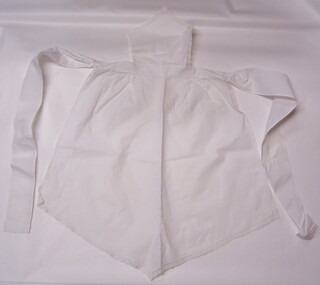
Clothing - Apron, 1900s
... Part of Graham Collection, donated by the Family of Misses Mary and Edith Maude Graham, of 4 Blair Street, Portland. clothing womens history needlework domestic item Lace edged white lawn apron with attached bib. ...Part of Graham Collection, donated by the Family of Misses Mary and Edith Maude Graham, of 4 Blair Street, Portland.Lace edged white lawn apron with attached bib. Both bib and apron, pentagonal shape.clothing, womens history, needlework, domestic item -
 Glenelg Shire Council Cultural Collection
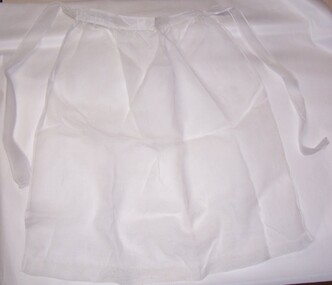
Clothing - Apron, 1900-1940
... Part of Graham Collection, donated by the Family of Misses Mary and Edith Maude Graham, of 4 Blair Street, Portland. clothing domestic item apron needlework womens history White half apron. ...Part of Graham Collection, donated by the Family of Misses Mary and Edith Maude Graham, of 4 Blair Street, Portland.White half apron.clothing, domestic item, apron, needlework, womens history -
 Glenelg Shire Council Cultural Collection
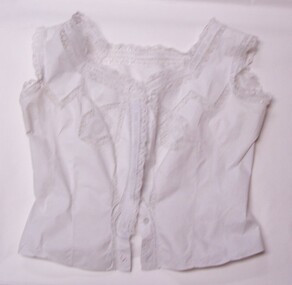
Clothing - Camisole, Robertson & Moffatt Pty Ltd., Melbourne, n.d
... Part of Graham Collection, donated by the Family of Misses Mary and Edith Maude Graham, of 4 Blair Street, Portland. clothing underwear womens history Front: Red EMB label inside front. ...Part of Graham Collection, donated by the Family of Misses Mary and Edith Maude Graham, of 4 Blair Street, Portland.White cotton camisole with lace edging at neck, arms and front. Lace inserts over breast area. 4 covered buttons on front opening. 1 modern button at top. 1 uncovered button.Front: Red EMB label inside front. Initials F.M.G.clothing, underwear, womens history -
 Glenelg Shire Council Cultural Collection
Certificate - Certificate of Baptism - James Ward and Thomas Ward, 1854
... Displayed in History House. baptism family record Ward family Back: Henry Ward Goldsmith/Late of Portland (black pencil, centre) Certified Extract of the Baptism Certificates of James Ward, 12th May 1838 and Thomas James Ward, 4th May 1836 Framed certificate. ...Displayed in History House.Certified Extract of the Baptism Certificates of James Ward, 12th May 1838 and Thomas James Ward, 4th May 1836 Framed certificate. Page 21 of baptism register for Parish of Launceston in the County of Cornwall, Van Diemen's Land, 1838. Framed with 933.2, Baptism certificate of Thomas James Ward, 4th May 1836. Certified extracts from the Baptismal Registry, 28th June 1854. Carved acorns in frame.Back: Henry Ward Goldsmith/Late of Portland (black pencil, centre)baptism, family record, ward family -
 Glenelg Shire Council Cultural Collection
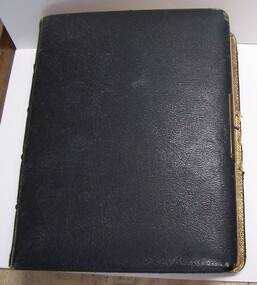
Album - Ward Family Photograph Album, 1890s
... Sign from History House reads: Donated by Miss M. Batson, Portland Ward family records family history family photography Front: (inside cover, label) The Ward family photograph album Dark green leather bound album. ...Displayed in History House. Sign from History House reads: Donated by Miss M. Batson, PortlandDark green leather bound album. Numerous thick gold-edged pages for single photographs.Front: (inside cover, label) The Ward family photograph albumward family records, family history, family photography -
 Glenelg Shire Council Cultural Collection
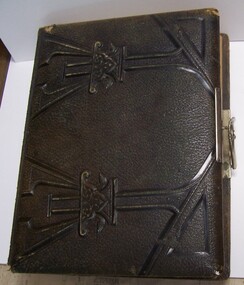
Photograph - Photograph Album - Ward Family Photograph Album, 1890s
... History House reads: "Donated by Miss M. Batson, Portland". Leathed-bound brown covers, padded, with decorative embossed pattern and detailed clasp. Photographs in decorative pages. Photograph Photograph Album - Ward Family ...Displayed in History House. Sign from History House reads: "Donated by Miss M. Batson, Portland".Leathed-bound brown covers, padded, with decorative embossed pattern and detailed clasp. Photographs in decorative pages. -
 Glenelg Shire Council Cultural Collection
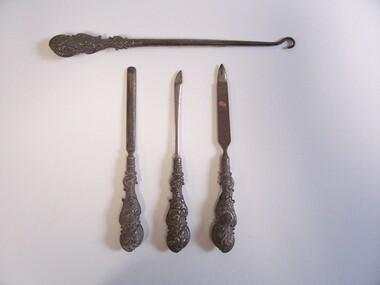
Domestic object - Manicure set, Levi & Salamon, 1898
... Part of Graham Collection, donated by the Family of Misses Mary and Edith Maude Graham, of 4 Blair Street, Portland. Displayed in History House....Part of Graham Collection, donated by the Family of Misses Mary and Edith Maude Graham, of 4 Blair Street, Portland. Displayed in History House. ...Part of Graham Collection, donated by the Family of Misses Mary and Edith Maude Graham, of 4 Blair Street, Portland. Displayed in History House.Nail file, Cuticle knife, Cuticle press, button hook. (3724.1- 3724.4) Silver decorative handles.Front: Hallmarks: Lion passant. Anchor - Birmingham. - "Y" - 1898. L & S - Levi & Salamon, Birmingham (only readable on button hook).graham collection, personal care, manicure -
 Glenelg Shire Council Cultural Collection
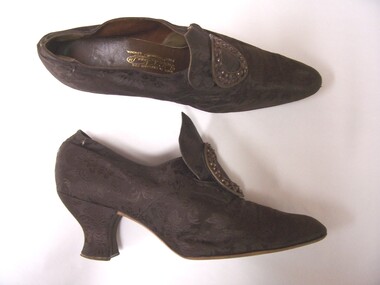
Clothing - Shoes - Ladies Dress shoes, Buckley & Nunn Ltd, n.d
... Part of Graham Collection, donated by the Family of Misses Mary and Edith Maude Graham, of 4 Blair Street, Portland. Displayed at History House....Part of Graham Collection, donated by the Family of Misses Mary and Edith Maude Graham, of 4 Blair Street, Portland. Displayed at History House. ...Part of Graham Collection, donated by the Family of Misses Mary and Edith Maude Graham, of 4 Blair Street, Portland. Displayed at History House.Brown satin-covered shoes. Embroidered pattern of flowers over surface. Cotton-reel heel. Large oval button on front with decorative pattern of polished faceted metal.Front: (left) 38 (sole of shoe) (right) 94 (sole of shoe) Inside: Made in England for Buckley & Nunn Ltd, Paris. Melbourne London. (gold text on leather sole lining) -
 Glenelg Shire Council Cultural Collection
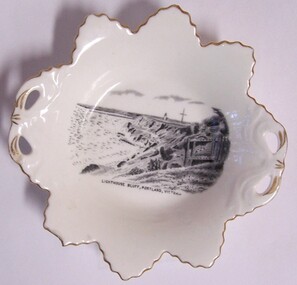
Souvenir - Souvenir Butter Dish - Portland Lighthouse, 1930s
... family already had a long history in producing china. Tuscan specialized in decorative fine bone china dinnerware that is very fine and light. Despite their reputation for quality, the company suffered the fate of the other potteries with lower sales and higher costs after WW2. Wedgwood purchased the company in 1967. However, Wedgwood continued producing china under the Tuscan name. However, in 1967 the new owners added the Royal prefix to the name. Despite this production ceased in 2006. souvenir of Portland ...Owned by James and Ada Brimblecombe, Heywood. Later owned by Merle Lewis, Mt. Gambier. R.H. Plant founded Tuscan Fine China in 1878 in Staffordshire. This area known as the Potteries, was England’s centre for the production of china. The Plant family already had a long history in producing china. Tuscan specialized in decorative fine bone china dinnerware that is very fine and light. Despite their reputation for quality, the company suffered the fate of the other potteries with lower sales and higher costs after WW2. Wedgwood purchased the company in 1967. However, Wedgwood continued producing china under the Tuscan name. However, in 1967 the new owners added the Royal prefix to the name. Despite this production ceased in 2006.Leaf-shaped butter dish of white glazed china, edged in gold. Black and white image of a lighthouse on a cliff with a tall flagpole behind it. There is a broken fence running to the edge of the cliff in the right foreground.Front: Lighthouse Bluff, Portland, Victoria (printed with image in centre of dish) Back: Tuscan China/England (stamped logo, green)souvenir of portland, portland harbour, whalers bluff, domestic item, butter dish -
 Glenelg Shire Council Cultural Collection
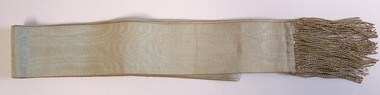
Container - T. Gaunt & Co. box, c. 1900
... Part of Graham Collection, donated by the family of Misses Mary and Edith Maude Graham, of 4 Blair Street, Portland. Displayed in History House. ...Part of Graham Collection, donated by the family of Misses Mary and Edith Maude Graham, of 4 Blair Street, Portland. Displayed in History House. ...Part of Graham Collection, donated by the family of Misses Mary and Edith Maude Graham, of 4 Blair Street, Portland. Displayed in History House. Box used to store sashes (3770.1 and 3770.2)Cardboard box in two parts, with metal-casing on corners. Box lid has a line drawing of glasses with a diagram, above proprietor's name and business details.Front: Miss Welshman/Convent of Sacred Heart/Burke Rd/East Malvern (ink, cover) T. Gaunt & Co., Prop. Ltd.,/Ophthalmic Opticians, Watchmakers and Jewellers,/Cnr Royal Arcade and Bourke Street,/MELBOURNE./ SIGHT TESTED GRATIS (printed cover) -
 Glenelg Shire Council Cultural Collection
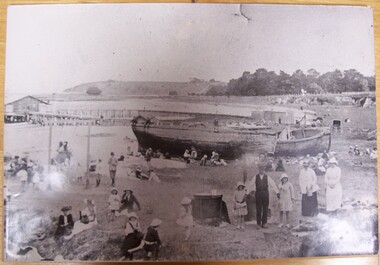
Photograph - Photograph - beach scene, Portland, n.d
... History House. Portland beach scene photography Back: Donated to History House 24/1/1992 by Vern McCallum. Black and white photograph of Portland Bay mounted on thick cardboard. Eyelet in top of mount. Families ...Displayed at History House.Black and white photograph of Portland Bay mounted on thick cardboard. Eyelet in top of mount. Families on beach. Lighters (wrecked) on beach. Copper in foreground. Children on swing. Pier in background.Back: Donated to History House 24/1/1992 by Vern McCallum.portland, beach scene, photography -
Glenelg Shire Council Cultural Collection
Photograph - Photograph - Burswood , Portland, n.d
... Portland local history Burswood Hentys Photograph of 'Burswood' which was the home of the Henty family in Portland Photograph Photograph - Burswood , Portland ...Photograph of 'Burswood' which was the home of the Henty family in Portlandportland local history, burswood, hentys -
 Glenelg Shire Council Cultural Collection
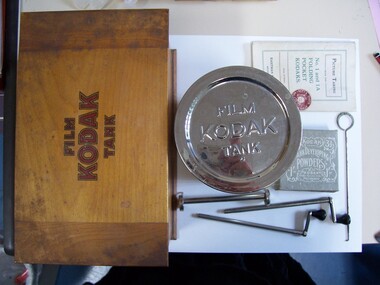
Functional object - Developing Set - Kodak, n.d
... Part of Graham Collection, donated by the Family of Misses Mary and Edith Maude Graham, of 4 Blair Street, Portland. Displayed in History House....Part of Graham Collection, donated by the Family of Misses Mary and Edith Maude Graham, of 4 Blair Street, Portland. Displayed in History House. ...Part of Graham Collection, donated by the Family of Misses Mary and Edith Maude Graham, of 4 Blair Street, Portland. Displayed in History House.Developing set by Kodak. Contains: Wooden box with lid (3771.1and 3771.2), developing tank (3771.3 - 3771.5), film reel (3771.6), booklet (3771.7), 4 x metal tools and handles (3771.8 - 3771.11) and packet of developing powders (3771.12) -
 Glenelg Shire Council Cultural Collection
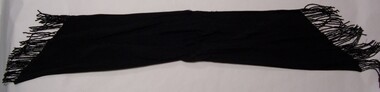
Costume - Scarf - Black Beaded, n.d
... Part of Birmingham Collection, donated by the family of Misses Mary and Edith Maude Graham, of 4 Blair Street, Portland. Displayed at History House....Part of Birmingham Collection, donated by the family of Misses Mary and Edith Maude Graham, of 4 Blair Street, Portland. Displayed at History House. ...Part of Birmingham Collection, donated by the family of Misses Mary and Edith Maude Graham, of 4 Blair Street, Portland. Displayed at History House.Black silk crepe with black beading. Possibly a collar - type accessory. -
 Glenelg Shire Council Cultural Collection
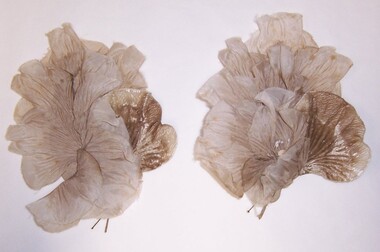
Decorative object - Flowers - Taffeta and Velvet Flowers, 1930-1959
... Part of Birmingham Collection, donated by the Family of Misses Mary and Edith Graham, of 4 Blair Street, Portland. Displayed at History House....Part of Birmingham Collection, donated by the Family of Misses Mary and Edith Graham, of 4 Blair Street, Portland. Displayed at History House. ...Part of Birmingham Collection, donated by the Family of Misses Mary and Edith Graham, of 4 Blair Street, Portland. Displayed at History House.Taffeta and velvet flowers attached to a cotton backing. Wax and wire stamens in centre of arrangement. -
 Glenelg Shire Council Cultural Collection
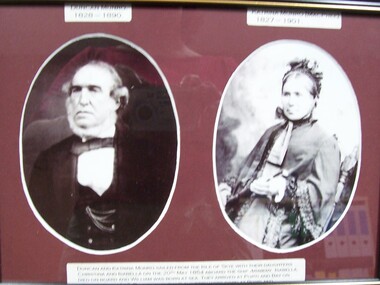
Photograph - Photograph - Duncan Munro, 1828 - 1890 and Katrina Munro (MacPhee), 1827 - 1901, n.d
... Family History Group Inc. Front: Duncan Munro, 1828 - 1890. Katrina Munro [MacPhee], 1827 - 1901. (top). Duncan and Katrina Munro sailed from the Isle of Skye with their daughters, Christina and Isabella on the 20th May 1854 aboard the ship ARABIAN. Isabella died on board and William was born at sea. They arrived at Portland ...On disply at History House. Likely reproduced and mounted by the Family History Group Inc.Two black and white photographic reproductions of earlier photographs mounted in oval setting in a burgundy matt. Framed under glass in a black and gold frame.Front: Duncan Munro, 1828 - 1890. Katrina Munro [MacPhee], 1827 - 1901. (top). Duncan and Katrina Munro sailed from the Isle of Skye with their daughters, Christina and Isabella on the 20th May 1854 aboard the ship ARABIAN. Isabella died on board and William was born at sea. They arrived at Portland Bay on 18th (?) September 1845. Their other eight children were born at Portland. (lower centre). -
 Glenelg Shire Council Cultural Collection
Journal - Fisherman's Union Minute Book, Charles (Carl) Gustav Patterson, 1905
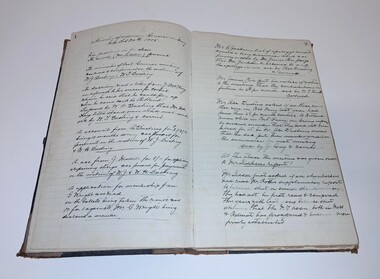
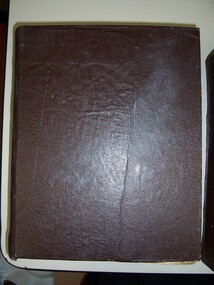
... Portland Botanic Gardens. The book also documents the early history off the union movement in Portland. This book has been in the Patterson family until donation to the Glenelg Shire Cultural Collection. ...The Fisherman's Union in Victoria evolved from the formalisation of the fishing industry in the late 19th century, leading to state-based unions like the Victorian Fishermen's Union. These early unions provided members with exclusive access to resources like cold storage and sales networks, but also functioning as barriers to non-European participation. This union represented a shift from informal fishing practices to a regulated industry, reflecting broader trends in Australian trade unionism during this period. The book belonged to the family of Charles Gustav Patterson who was part of the original Portland Lifeboat crew. Receipts collected by Roy Patterson were inside the book and have been accessioned separately.Interim statement pending further research: This minute book is significant because it belonged to Charles Gustav Patterson. Patterson was one of the early European settlers to Portland and as well as being a part of the early fishing industry here was part of the Portland Lifeboat crew who took part in the rescue of survivors from the Admella Shipwreck. The book details repairs done to the Portland Lifeboat as well as documenting its history - in particular its time at the Portland Botanic Gardens. The book also documents the early history off the union movement in Portland. This book has been in the Patterson family until donation to the Glenelg Shire Cultural Collection.Dark blue book with brown/orange spine and corners. The front cover has paint splashes and splatters on it. The spine has a dark red label located in the top half of the spine. It reads, ' Minute Book'/ The corners on both the front and back cover are worn with the top layer having worn off. Both the inside of the front and back cover have blue marbled paper. The pages of the book are numbered in the top corners. The pages have blue lines and a red lined margin. The inside has hand written minutes. The first page is titled ' Minutes of ordinary General Meeting Held Feb 24th 1905'. The handwriting is in black ink. Page 262 is loose and detached. The final page - 286 - has the minutes dated 8.1. 1937. The book contained receipts and other papers which have been catalogued separately.fishing, union, unionism, trade unions, portland lifeboat, admella, patterson, glenelg shire cultural collection, portland harbour, fisherman's union -
 Glenelg Shire Council Cultural Collection
Book - Family Bible belonging to Joshua Black, The Bible, 1805
... History House. Joshua Black landed in Portland with this bible in 1838. Joshua Black western district families family bible religious text Front: Inside cover - This bible was re covered by/Dudley Neil Black 24th October 1973/This was the property of/Joshua Black who landed at/Portland with this bible in 1838. ...Brown leather bound bible. Rag-paper page. Family inscription page at beginning of New Testament.joshua black, western district families, family bible, religious text -
 Cheese World Museum
DVD, On our selection: the women's story
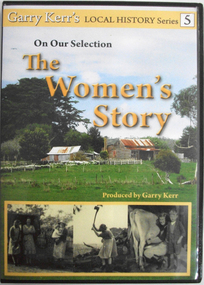
... Portland/Heywood district provide us with a snapshot of life as it was from the 1920's through to the 1960's. They speak about their own and their mother's lives, lives which have experienced the greatest material and personal changes in history. The story of the 'Remarkable Mary Stuchbery' details the struggles of a wife and family...Portland/Heywood district provide us with a snapshot of life as it was from the 1920's through to the 1960's. They speak about their own and their mother's lives, lives which have experienced the greatest material and personal changes in history. The story of the 'Remarkable Mary Stuchbery' details the struggles of a wife and family ...This is the story of the women of the bush, women who performed more than the traditional duties of wife and mother. They worked alongside their men, through good/times and bad and they were rare to complain. Six former country women of the Portland/Heywood district provide us with a snapshot of life as it was from the 1920's through to the 1960's. They speak about their own and their mother's lives, lives which have experienced the greatest material and personal changes in history. The story of the 'Remarkable Mary Stuchbery' details the struggles of a wife and family whose husband/father contracted polio shortly after returning from WWII service. Garry Kerr has produced a series of local history stories, initially for the Heywood [history group] and more recent items privately.The material contained in these interviews provides a first-hand insight into the experiences of women who were involved in carving farms from virgin bush. Their recollections of work, social activities and opportunities for their children are an invaluable primary source.Full colour DVD cover featuring image of old hip-roof weatherboard house with front verandah and skillion roof to rear with stone chimney attached to outside. Corrugated iron roof is rusty. To the left is an outbuilding. Picket and wire fencing is in the foreground, background has large cypress tree to left and gum to right. At the bottom is a series of three black and white images showing (L-R) three women in working clothes and a woman holding a baby; woman chopping wood; woman milking cow with young boy standing beside her. The back cover is yellow with images of the seven women featured showing coloured images of the interviewees beside black and white images of the interviewees when young. DVD features the same images as the front cover.Garry Kerr's LOCAL HISTORY Series 5/On Our Selection/The/Women's/Story/Produced by Garry Kerr (front) WOMEN WERE THE UNSUNG HEROES OF THE BUSH/This is the story of the women of the bush [see historical information] ... Running time 74 minutes/Plus an additional 30 minutes of/'The Remarkable Mary Stuchbery' -
 Warrnambool and District Historical Society Inc.
Book - Paperback, Vanda Savill (1913-2005), Such is life, 1985
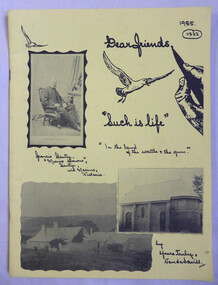
... family of ‘Merino Downs’ in Western Victoria. It includes excerpts from Henty diaries and details on the 150th anniversary celebrations of the arrival of the Hentys in Portland (1834-1985). The Henty family members are regarded as the first permanent European settlers in the Colony of Victoria. The author, Vanda Savill, lived at Heywood on a dairy farm and had the Bower Birds Nest Museum and History...family of ‘Merino Downs’ in Western Victoria. It includes excerpts from Henty diaries and details on the 150th anniversary celebrations of the arrival of the Hentys in Portland (1834-1985). The Henty family members are regarded as the first permanent European settlers in the Colony of Victoria. The author, Vanda Savill, lived at Heywood on a dairy farm and had the Bower Birds Nest Museum and History ...An example of Vanda Savill's handwritten books documenting western district local histories focussing on the Henty family.This is a paper back book with a yellow cover with black headings and annotations, black and white sketches and black and white photographs. There are 52 pages of handwritten and copied material with photographs and illustrations. The pages are stapled.non-fictionAn example of Vanda Savill's handwritten books documenting western district local histories focussing on the Henty family.henty family, vanda savill, warrnambool -
 Warrnambool and District Historical Society Inc.
Leisure object - Sheet music, First love, 1850s
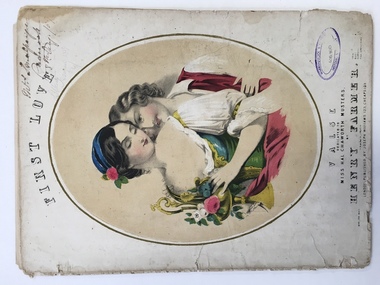
... families in the district. Stephen Henty owned Cadnook (Kadnook), near Harrow, in the 1850s and sold it to Mordaunt Smalpage (or Smalpaige) in July 1859. Stephen Henty, who came to Victoria in 1836, was the brother-in-law of Captain Helpman, the Warrnambool Harbour Master from 1861 to 1869. They were co-owners of the ‘Champion’ which plied between Portland and Melbourne until it was wrecked off Cape Otway in 1857 when it collided with the ‘Lady Bird’. This is a most significant item because of the signatures on the front cover. Stephen Henty was important, not only in the history ...This piece of music, ‘First Love’, dates from the 1850s and was composed by Henry Farmer (1819-1891). Born in Nottingham, Farmer was an organist and composer and conductor of the Nottingham Harmonic Society from 1866 to 1880. He dedicated this music to Miss Hal Chaworth Musters. It is not known who ‘Miss Hal’ was but the Chaworth name was an ancient one in Nottingham and marriage with a member of the Musters family brought into being the name ‘Chaworth Musters’ and the estates included Annesley, Edwalton and Wiverton. The signatures on the front cover indicate that this music is connected to two early families in the district. Stephen Henty owned Cadnook (Kadnook), near Harrow, in the 1850s and sold it to Mordaunt Smalpage (or Smalpaige) in July 1859. Stephen Henty, who came to Victoria in 1836, was the brother-in-law of Captain Helpman, the Warrnambool Harbour Master from 1861 to 1869. They were co-owners of the ‘Champion’ which plied between Portland and Melbourne until it was wrecked off Cape Otway in 1857 when it collided with the ‘Lady Bird’.This is a most significant item because of the signatures on the front cover. Stephen Henty was important, not only in the history of Victoria, but also in the history of Warrnambool because of his connection with coastal shipping and his relationship with Captain Helpman. As far as we know the Hentys never lived in Warrnambool but it is possible that this music was played on the ‘Henty’ piano that was donated to the old Warrnambool Museum in 1889 and is now in the Warrnambool Art Gallery. The Hentys brought six pianos to Victoria in 1837. The music is also important in social history as an example of the music that was played in mid-Victorian drawing rooms. This is a piece of music of seven pages printed back to back (cover and 11 pages of musical notation) The pages have black printing on white with a multi-coloured front cover. The cover has a stylized portrait of a man and woman in period costume. The woman is holding an urn of flowers. Some of the pages are loose and the page folds and corners are tattered and torn. The name ‘Smalpaige ‘is written in ink and the name ‘Henty’ is written in pencil. Front Cover: ‘Mrs Smalpaige, Cadnook, 8th Aug/59’ ‘S.Henty, 8 August 1859’ ‘First Love’, ‘Valse dedicated to Miss Hal Chaworth Musters by Henry Farmer, London, Published by Joseph Williams, 123, Cheapside, Solo, 4, Duet, 4, Septett, 3/6, Full Orchestra, 5/-, Ent. Sta. Hall.’ stephen henty, mrs smalpaige, warrnambool, first love sheet music, history of warrnambool, henry farmer -
 Warrnambool and District Historical Society Inc.
Work on paper - Sheet music, Varsoviana sur L’Etoile Du Nord, 1860s
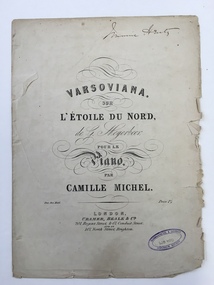
... The Henty family members, founders of the first permanent Victorian settlement at Portland, were influential in the history of the Warrnambool area because of their connections with surrounding properties and with coastal shipping. ...This piece of music is the varsoviana dance piece from the Giacomo Meyerbeer opera, ‘L’Etoile Du Nord’ arranged by Camille Michel. The varsoviana was a slow graceful dance originating in Poland in 1850 and appearing in Australia in 1856. ‘L’Etoile Du Nord’ was a comic opera in three acts composed by Giacomo Meyerbeer in 1854. Meyerbeer was the most successful stage composer of the 19th century but his works are rarely performed today. Camille Michel was an editor, composer, author and arranger working from the 1840s to the 1880s. The varsoviana music arrangement probably dates from the late 1850s or 1860s. It is not clear who ‘Minnie Henty’ was but it is most likely that she was Minnie Adair who married George Henty, the son of Stephen and Jane Henty, pioneer settlers in Western VictoriaThis sheet music is most important mainly because of the ‘Minnie Henty’ signature. The Henty family members, founders of the first permanent Victorian settlement at Portland, were influential in the history of the Warrnambool area because of their connections with surrounding properties and with coastal shipping. The music also has social significance as an example of music popular in 19th century drawing rooms.This is a two-page piece of sheet music (cover and two pages of music notation) with the material printed in black on cream paper. The back cover is blank and the front cover has the title and names of the composer and the arranger with ornate scrolls around the printing. The edges and fold of the pages are much tattered and torn in some places. There is also a Warrnambool and District Historical Society stamp on the front cover and the signature of Minnie Henty. Front Cover: ‘Minnie Henty’ ‘Varsoviana sur L’Etoile Du Nord de G. Meyerbeer pour le piano par Camille Michel, Ent.Sta.Hall., Price 1s/-, London, Cramer, Beale & Co., 201,Regent Street & 67, Conduit Street and at 167, North Street, Brighton.’ henty family, giacomo meyerbeer, camille michel -
 Otway Districts Historical Society
Document, Pioneering in the Otway Ranges in the late 1800s and early 1900s
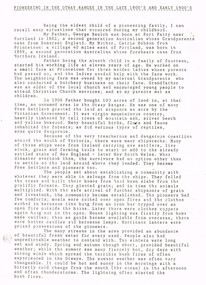
... Two pages with the history of George Baulch and family in the Otway Ranges. George Baulch; Carrie Hobson; Portland; Princetown; Otway Ranges; Typed on paper with advertisments on the reverse side. ...Two pages with the history of George Baulch and family in the Otway Ranges.A story about George Baulch and his family settling in the Otway Ranges in the late 1890s and early 1900s.Typed on paper with advertisments on the reverse side.george baulch; carrie hobson; portland; princetown; otway ranges; -
 Warrnambool and District Historical Society Inc.
Document, Warrnambool calling, 1933
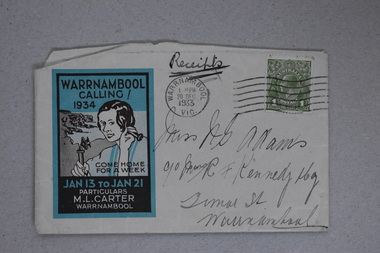
... Portland and many other places besides Melbourne took this opportunity to have a reunion of past and present citizens. Also Warrnambool had at the time two men very interested in the history of the settlement – Henri Worland and Patrick O’Grady and the first Warrnambool Historical Society was established the following year with Worland and O’Grady prominent in its establishment and Martin Carter on the first committee as well. Martin Carter, whose name appears on this envelope was the organizer of the 1934 reunion. The Carter family...Portland and many other places besides Melbourne took this opportunity to have a reunion of past and present citizens. Also Warrnambool had at the time two men very interested in the history of the settlement – Henri Worland and Patrick O’Grady and the first Warrnambool Historical Society was established the following year with Worland and O’Grady prominent in its establishment and Martin Carter on the first committee as well. Martin Carter, whose name appears on this envelope was the organizer of the 1934 reunion. The Carter family ...This is a souvenir of a ‘Back To’ celebration in Warrnambool in 1934. There had been a large-scale ‘Back To’ in Warrnambool in 1930, perhaps prompted by the growing interest in the history of the town ( this was evidenced in many country towns in Victoria at the time) and the need to gather together the remaining older local people as those regarded as pioneers of the district were fast dying out. In 1934 the State of Victoria was celebrating the centenary of the first permanent white settlement at Portland and many other places besides Melbourne took this opportunity to have a reunion of past and present citizens. Also Warrnambool had at the time two men very interested in the history of the settlement – Henri Worland and Patrick O’Grady and the first Warrnambool Historical Society was established the following year with Worland and O’Grady prominent in its establishment and Martin Carter on the first committee as well. Martin Carter, whose name appears on this envelope was the organizer of the 1934 reunion. The Carter family had long been established in Warrnambool as saddlers and Martin Carter was a Warrnambool Councillor from 1917 to 1925 and Mayor during three of those years. No information is available on the ‘Miss Adams ‘ in the address but ‘ R. F. Kennedy & Co.’ refers to the well-known pharmacy business in Timor Street Warrnambool.This envelope is of interest as a souvenir of a ‘Back To’ in Warrnambool in 1934. This is a small envelope with most of the back flap missing. The inside of the envelope has a blue lining. The envelope has a franked green Australian stamp and a Warrnambool Post Office stamp. A handwritten address is on the right side of the envelope. On the left side is a printed poster/advertisement in blue, black and grey colouring. The advertisement features an illustration of a woman speaking into a telephone with a coastal scene background. ‘Warrnambool Calling 1934 Come Home For a Week Jan 13 to Jan 21 Particulars M.L.Carter Warrnambool’ ‘Miss A. G. Adams C/O Messrs R.F.Kennedy & Coy Timor Street Warrnambool back to warrnambool 1934, history of warrnambool -
 Port Fairy Historical Society Museum and Archives
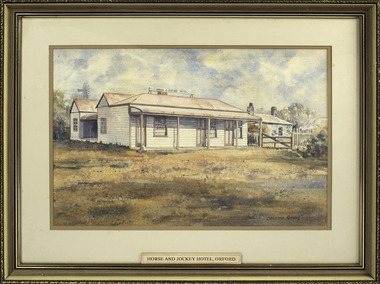
Painting - painting, watercolour, Horse and Jockey Hotel Orford, 01.02.1984
... Painted for Mrs Ruby Young whose family owned the hotel at one time - (since burnt down) The hotel was built around 1857 near "Shaw Crossing" when Cowton and Bland selected the site because the bullockies watered and rested their stock on route Belfast and Portland. The name of the hotel came about because the winning post for the horse races was in front of the inn and the jockeys weighed in there. Illustration of a hotel that became the hub of social life in Orford that no longer exists. local history ...Painted for Mrs Ruby Young whose family owned the hotel at one time - (since burnt down) The hotel was built around 1857 near "Shaw Crossing" when Cowton and Bland selected the site because the bullockies watered and rested their stock on route Belfast and Portland. The name of the hotel came about because the winning post for the horse races was in front of the inn and the jockeys weighed in there.Illustration of a hotel that became the hub of social life in Orford that no longer exists.Watercolour painting of "Horse and Jockey" Hotel Orford. Frame composite wooden gilt embossingChristopher Mathews Ruby Young 1989 50 Whalers Road Victor Harbor S.A. 5211 1/2/84local history, illustrations, watercolours, horse and jockey hotel, ruby young, horseracing -
 City of Melbourne Libraries
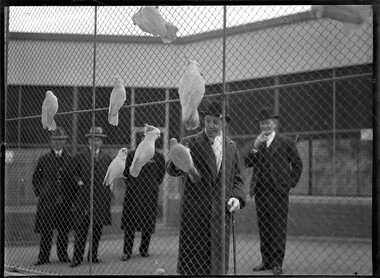
Photograph, Bull, Hugh Jones, 1897-1993, Vice-regal visit to zoo: Governor (Lord Huntingfield) meets the cockatoos
... history-listen/101588262? utm_source=abc_news_app&utm_medium=content_shared&utm_campaign=abc_news_app&utm_content=safari Touching Canine Devotion. (1942, September 21). Portland Guardian (Vic. : 1876 - 1953), p. 1 (EVENING). Retrieved October 6, 2024, from http://nla.gov.au/nla.news-article64381989 OBITUARY (1947, August 11). Portland Guardian (Vic. : 1876 - 1953), p. 2 (EVENING). Retrieved August 26, 2024, from http://nla.gov.au/nla.news-article64412155 Family...history-listen/101588262? utm_source=abc_news_app&utm_medium=content_shared&utm_campaign=abc_news_app&utm_content=safari Touching Canine Devotion. (1942, September 21). Portland Guardian (Vic. : 1876 - 1953), p. 1 (EVENING). Retrieved October 6, 2024, from http://nla.gov.au/nla.news-article64381989 OBITUARY (1947, August 11). Portland Guardian (Vic. : 1876 - 1953), p. 2 (EVENING). Retrieved August 26, 2024, from http://nla.gov.au/nla.news-article64412155 Family ...A group of five men dressed in hats and overcoats look at caged cockatoos. Research by project volunteer, Fiona Collyer: On 25 June 1934, new Victorian Governor, His Excellency Lord Huntingfield and his wife Lady Huntingfield made an official visit to the Melbourne Zoological Gardens in order to grant his patronage to the Royal Zoological and Acclimatisation Society. The zoo director, Mr. Andrew Wilkie, introduced them to the cockatoos in the flight aviary. The Argus newspaper reported the visit in the following morning’s issue: "Birds' Greeting To Governor. Visit to Zoological Gardens. "A Very Important Society." "Cheery shouts of "Hullo!" and requests for drinks greeted His Excellency the Governor (Lord Huntingfield) on one of his official visits yesterday morning. Lady Huntingfield, who accompanied him, was asked loudly for a kiss. They were inspecting the huge cockatoo aviary at the Zoological Gardens after Lord Huntingfield had granted his patronage to the Royal Zoological and Acclimatisation Society. Both obviously enjoyed the democratic experience. It was explained to them that most of the cockatoos had been presented by residents of flats, whose neighbours objected to the noise of the birds, while others were protected birds which had been surrendered. Lord Huntingfield recalled that he had taken two Australian cockatoos to England when he left Australia in his youth. One, a galah, had lived in England for many years." In 1929, the Zoo built a commodious new flight aviary at the cost of several thousand pounds and Zoo director, Mr Andrew Wilkie, sent out an appeal published in newspapers Australia-wide for donations of parrots from all states. Many of the parrot species he wanted were protected and a special permit needed for their capture, however Mr Wilkie guaranteed he would obtain authority from the Fisheries and Game Department and that the cost of transit would be borne by the Zoo. The wanted birds were "Parrots - Black-tailed, Rock Pebbler, King, Superb, Grass (all kinds), Swamp or Ground, Mallee or Ringneck" and "Cockatoo[s] - Black, Pink or Major Mitchell, Gang-Gang". The Zoo asked that the birds be sent in boxes large enough to prevent overcrowding, contain food and water and the Zoo notified on the type and number of birds in transit. All boxes were to be addressed to 'The Zoo, Melbourne'. A letter from a reader appeared in the Weekly Times newspaper's popular "Camp-fire Circle" page for "Young Australians", 11 May 1929: "Dear Pal, I am much interested in your page, especially the nature notes. I have a pet parrot, but I don’t like to see it shut up in a cage, so I am giving it to the Melbourne Zoo. It can whistle 'Pretty Joey' and 'What's the Matter with Father' and is just learning to whistle for the dog... Wishing you and the Camp-fire Circle success." - Murray Holmes (Gorae, Vic.) The fate of this talented parrot is unknown, however in 1932, this young naturist, T Murray Holmes, 1912-1947, collected for the first time a type specimen, blue star sun orchid from Gorae (near Portland, Victoria), and it was named in his honour, Thelymitra holmesii. Murray was described by orchid collector W H Nicholls as "a youthful and energetic orchidologist, who added much to our knowledge of the orchids of south-western Victoria." Murray Holmes enlisted in the army in 1941 and fought in the Middle East before being sent to Java. In 1942 he was captured by the Japanese and became a prisoner of war for three years, working on the notorious Thai-Burma railway. Murray's health was undermined though ill treatment and starvation and he returned to Australia after the war, broken and sick. He died aged 35 in 1947. He was intensely interested in the flora and fauna of the Gorae area to the end. Murray's parents received over 200 tributes of respect for their son - too many to answer personally so they put a notice in the Portland Guardian thanking "all kind friends and relatives for letters, cards, floral tributes and personal expressions of sympathy received in their recent sad bereavement - the lamented death of their loved son, Murray." Andrew Arthur Wellesley Wilkie, 1853-1948, was Director of the Melbourne Zoo from 1923 to 1936 and was associated with the zoo for 70 years. He first worked as a horticultural assistant to Government botanist Baron Ferdinand von Mueller at the Botanical Gardens at the age of 13, along with his older brother David. One of Andrew’s jobs was to capture moths for the National Herbarium. In 1857, a group of prominent Melburnians assembled at St. Patrick’s Hall to form the Zoological Society of Victoria, with the aim of introducing animals and plants from overseas. It was conceived, “For the purposes of science and for that of affording the public the advantages of studying the habits of the animal creation in properly arranged zoological gardens.” The Victorian Government granted 32 acres (13 hectares) of land to the Zoological Society at the southern end of Richmond Paddock on the opposite bank to the Botanical Gardens. (This is where AAMI Stadium and Collingwood Football Club now stand.) In 1861, the Zoological Society of Victoria was renamed The Acclimatisation Society of Victoria. Unfortunately the Yarra River frontage was damp, swampy and subject to flooding, so the animals were briefly housed at the Botanical Gardens until in 1862, the City of Melbourne donated 55 acres (22 hectares) of land at Royal Park for the fledgling zoo. Baron von Mueller secured employment at Royal Park for Andrew and David and they helped to lay out the gardens, plant trees and take care of a collection of deer, pheasants, hares and partridges. Initially the zoo was used for the acclimatisation of animals recovering from the long voyage to Australia and for breeding them for sport. In 1872, the zoo bought two lions, a leopard and a cheetah that had been seized from circus showmen Keith and Phillips when they were unable to pay the bill of butcher Mr T K Bennet of Bourke Street. The first zoo director, Mr. Albert Le Souef, negotiated with captains of ships to buy animals at overseas ports they visited and soon a multitude of exotic species arrived, including a ten-year-old Indian elephant in 1878. In 1923, after being head keeper for some years, Andrew was appointed director of the zoo. By 1933, the zoo had 110 different species of animals, 200 species of birds and 72 species of reptiles under Andrew’s care. He had personally planted all but six trees and laid out the garden beds. As director he lobbied authorities for funds to build more humane enclosures for the animals. In June 1928, Table Talk magazine wrote of Andrew Wilkie: “Up at the Zoo there is a humble gentleman who is a lion among the lions, who knows the proper specific to employ when the boa constrictor has chilblains, and who is a friend and confidant of Queenie the elephant. His fount of zoological lore has never been plumbed. It is bottomless, like his good fellowship and geniality. Every day he may be seen somewhere in the grounds of that growing sanctuary for the strange and arresting fauna and creeping things of the world, and I assure you as one who is privy to his passion that that area and its inhabitants are rarely out of his thoughts.” Andrew retired from the zoo in 1936 at the age of 83 and in 1948 died at his home in Brunswick aged 94. He and his wife Josephine had six children. The Victorian Acclimatisation Society was founded in 1861 by Edward Wilson, 1813-1878, then owner and editor of The Argus newspaper. He said that Australian indigenous animals were practically useless, providing only “a little sport and an occasional meal”. The Society believed that Australia’s plants and animals were vastly inferior to those in Europe. They wanted to introduce and acclimatise to Victoria “all innoxious animals, birds, fishes, insects and vegetables, whether useful or ornamental” for sport and for the table, and to spread indigenous animals and plants from the colony around the world. Their motto was “if it lives, we want it”. The Society was primarily responsible for introducing sparrows, starlings, sambar and hog deer, ostriches, brown trout, blackberries, and carp to the Murray River. They released the European songbirds, thrush and blackbird to quell the homesickness of British settlers. The Society also sent Australian animals like platypus, echidnas, kangaroos and koalas to Europe for scientific and novelty purposes. Thomas Austin, a wealthy sheep farmer of Barwon Park, Winchelsea (property now owned by the National Trust) was a member and in 1859 he introduced hares, blackbirds, thrushes and partridges onto his property. He is probably best known for introducing 24 breeding rabbits onto his estate as game for shooting parties. Thomas quipped, “The introduction of a few rabbits could do little harm and might provide a touch of home, in addition to a spot of hunting." In 2022, genomic data confirmed that Australia’s feral rabbit population is entirely descended from these rabbits. Biological control has brought the rabbit population down from an estimated high of 10 billion rabbits in the 1920s to approximately 200 million today, inhabiting 70% of Australian landmass (5.3 million square kilometres). In 1872, the Acclimatisation Society was renamed The Zoological and Acclimatisation Society of Victoria and they focused on importing exotic animals for display purposes to the zoo. In 1937, the Royal Acclimatisation Society of Victoria was recreated as the Zoological Board of Victoria with a focus on research of native animals threatened with extinction. In an editorial for The Argus newspaper, 16 March 1856, Edward Wilson lamented: "...this country has been shamelessly stolen from the blacks. Had they been like the New Zealanders or the North American Indians, we should have bought their land, and supplied them with the means of living when we took it... In less than twenty years we have nearly swept them off the face of the earth. We have shot them down like dogs. In the guise of friendship we have issued corrosion sublimate in their damper, and consigned whole tribes to the agonies of an excruciating death. We have made them drunkards, and infected them with disease which has rotted the bones of their adults, and made such few children as are born amongst them a sorrow and a torture from the very instant of their birth. We have made them outcasts on their own land, and are rapidly consigning them to entire annihilation. There are but a few of them left, comparatively. This is what we would do for that few. We would feed and clothe every one of them.” [Note: this last sentence is italicized in the original newspaper article text]. Lord Huntingfield, (William Charles Arcedeckne Vanneck) 1883-1969, Governor of Victoria 1934-1939, was a British Conservative Party politician and the first ever Australian-born Governor of an Australian state (although he was always considered British). He was patron of the Royal Zoological and Acclimatisation Society of Victoria and was acting Governor-General for six months during the absence of Lord Gowie in 1938. Lady Huntingfield (née Margaret Eleanor Crosby) 1884-1943, his American-born wife showed great interest in social welfare and the advancement of women and children. She was president of the City Newsboys Society and Patroness of the Girls Friendly Society. In 1937, rose breeder Alister Clark named a yellow hybrid tea rose for her. In 1940, the City of Melbourne opened the Lady Huntingfield Free Kindergarten in North Melbourne, now the Lady Huntingfield Early Learning and Family Services Centre. Lady Huntingfield died in London in 1943 after her house was bombed during a German airstrike. The Lady Huntingfield Memorial Scholarship was established after the City of Melbourne raised £1000 in a public appeal conducted in her memory for students undertaking a Social Work degree at the University of Melbourne. It is awarded annually to this day. The Queen Victoria Hospital named a bed in her honour. References: Prominent Personalities ANDREW WILKIE (1928, June 7). Table Talk (Melbourne, Vic. : 1885 - 1939), p. 15. Retrieved August 29, 2024, from http://nla.gov.au/nla.news-article146562949 BIRDS' GREETING TO GOVERNOR (1934, June 26). The Argus (Melbourne, Vic. : 1848 - 1957), p. 6. Retrieved August 19, 2024, from http://nla.gov.au/nla.news-article10950051 Zoo Appealing For Parrots And Cockatoos To Fill Aviary For Children’s Instruction (1929, April 11). The Sun News-Pictorial (Melbourne, Vic. : 1922 - 1954; 1956), p. 31. Retrieved August 23, 2024, from http://nla.gov.au/nla.news-article275757361 LETTERS FROM READERS (1929, May 11). Weekly Times (Melbourne, Vic. : 1869 - 1954), p. 50. Retrieved October 6, 2024, from http://nla.gov.au/nla.news-article223183144 Correspondence. (1929, April 18). Corryong Courier (Vic. : 1894 - 1945), p. 6. Retrieved August 30, 2024, from http://nla.gov.au/nla.news-article269039262 'Edward Wilson (journalist)', Wikipedia, https://en.wikipedia.org/wiki/Edward_Wilson_(journalist) 'Thomas Austin (pastoralist)', Wikipedia, https://en.wikipedia.org/wiki/Thomas_Austin_(pastoralist) 'The Acclimatisation Society was driven by misguided ideals about 'fixing nature' in Australia', ABC News, https://www.abc.net.au/news/2022-11-04/acclimatisation-society-introduced-species-history-listen/101588262? utm_source=abc_news_app&utm_medium=content_shared&utm_campaign=abc_news_app&utm_content=safari Touching Canine Devotion. (1942, September 21). Portland Guardian (Vic. : 1876 - 1953), p. 1 (EVENING). Retrieved October 6, 2024, from http://nla.gov.au/nla.news-article64381989 OBITUARY (1947, August 11). Portland Guardian (Vic. : 1876 - 1953), p. 2 (EVENING). Retrieved August 26, 2024, from http://nla.gov.au/nla.news-article64412155 Family Notices (1947, September 11). Portland Guardian (Vic. : 1876 - 1953), p. 2 (EVENING). Retrieved October 10, 2024, from http://nla.gov.au/nla.news-article64412476 'Thelymitra holmesii', Wikipedia, https://en.wikipedia.org/wiki/Thelymitra_holmesii THE ABORIGINES. (1856, March 16). The Argus (Melbourne, Vic. : 1848 - 1957), p. 4. Retrieved September 28, 2024, from http://nla.gov.au/nla.news-article4833244Photographer notations on slide: "Vice Regal visit to zoo B42".zoos, governors, 1930-1939, cockatoos -
 Portland CEMA Inc (Council for Encouragement of Music and the Arts)
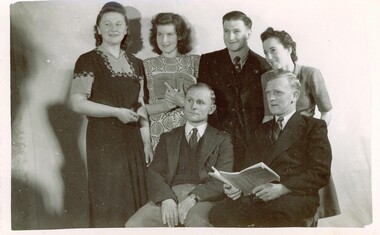
Audio - Listening to the Voices - Digitised Interviews Portland CEMA Inc, Bob and Jean Stuchbery Interviewed by Lesley Jackson 1984
... The "Listening to the Voices" project aims to preserve the recorded memories of Portland C.E.M.A. ( Council for Encouragement of Music and the Arts) early members in order to enable access to local historians, family historians and current members. Bob and Jean Stuchbery were active members in the post WW2 era and throughout the 1950s. Jean made cameo appearances into the 1980s The series of oral history ...The "Listening to the Voices" project aims to preserve the recorded memories of Portland C.E.M.A. ( Council for Encouragement of Music and the Arts) early members in order to enable access to local historians, family historians and current members. Bob and Jean Stuchbery were active members in the post WW2 era and throughout the 1950s. Jean made cameo appearances into the 1980sThe series of oral history interviews (1983-1990) captured the memories of some active early members of the Portland Council for Encouragement of Music and the Arts. First hand memories of the formation of the organisation in 1945, early activities of its groups, fundraising and building of the CEMA Arts Centre provide a window into community life in Portland and District in the post WW2 era. Recent digitisation (2025) has preserved deteriorating cassette tape recordings.oral history - portland c.e.m.a., portland council for encouragement of music and the arts
