
Showing 8 items matching "premature infants"
-
 Alfred Hospital Nurses League - Nursing History Collection
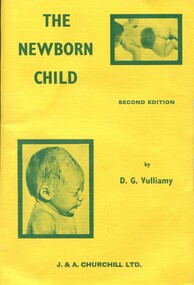
Book - Illustrated textbook, David G Vulliamy 1917-2013, The newborn child, 1967
... ...premature infants...First edition published 1961, author was a paediatrician Insight into medical knowledge and practice in the 1960's newborn infants neonatal period premature infants This textbook was traditionally used as a clinical guide for medical students and nursing staff detailing the physical characteristics, commom disorders, and general care of infants during the neonatal period At the base of front end page there is a printed black and white donation sticker: black Maltese cross in circle, 'This book was donated to Alfred Archival Association Nursing Division by'. ...This textbook was traditionally used as a clinical guide for medical students and nursing staff detailing the physical characteristics, commom disorders, and general care of infants during the neonatal periodIllustrated book with yellow binding. Green print on front cover. In additon to title, edition, author and publisher details there are two photographs of newborn infants. Title, edition and author also printed on spinenon-fictionThis textbook was traditionally used as a clinical guide for medical students and nursing staff detailing the physical characteristics, commom disorders, and general care of infants during the neonatal periodnewborn infants, neonatal period, premature infants -
![Front cover of 'The insul-cot handbook Mark 1' [ca.1950's] Laver & Campbell](/media/collectors/50187a8f023fd7201471f198/items/6a152ce38a79ffb97438ec7e/item-media/6a169cf1e625583bca8d5b29/item-fit-380x285.jpg?cb=6) Alfred Hospital Nurses League - Nursing History Collection
Alfred Hospital Nurses League - Nursing History CollectionManual - Instruction manual, Dr J C Laver et al, The insul-cot handbook Mark 1, [ca.1950's]
... It was engineered to overcome high premature infant mortality rates in Australian hospitals by providing a clean, temperature-controlled environment while allowing easy access to the baby. ...It was engineered to overcome high premature infant mortality rates in Australian hospitals by providing a clean, temperature-controlled environment while allowing easy access to the baby. ...The Insul-cot Mark 1 is a historically significant, early portable infant incubator designed by South Australian engineer and inventor Edward Thomas (Ted) Both and his broher Donald in the 1950s. It was engineered to overcome high premature infant mortality rates in Australian hospitals by providing a clean, temperature-controlled environment while allowing easy access to the baby. This manual provided instructions for its useAn Australian inventionStapled illustrated booklet with green cover. Black print on front cover detais title and publisher. There is also an illustration of three humicribs [black print on white background]. Name hand written at top right [blue ink], red pencil mark in centre, previous catalogue number On front cover there is a name hand written at top right [blue ink], red pencil mark in centre, previous catalogue number is printed on a small white sticker at bottom left. On contents page previous catalogue number handwritten at top right [black ink] underneath this 'Patricia J ?' [hand written blue ink] At the bottom of this page is a printed black and white donation sticker: black Maltese cross in circle, "This book was donated to Alfred Archival Association Nursing Division by" Patricia Armstrong-Grant [handwritten black ink}neonatal care, humicribs, isolettes -
 Royal Australian and New Zealand College of Obstetricians & Gynaecologists (RANZCOG)
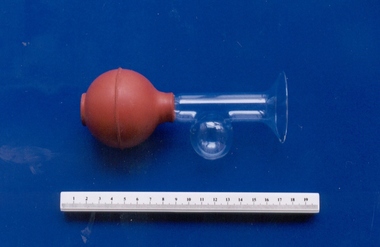
'Coronet' Breast Reliever used by Dr John Green, c. 1948, Coronet, c1948
... The milk was expressed by hand in the home, then transported to the hospital to feed the premature infant. ...The milk was expressed by hand in the home, then transported to the hospital to feed the premature infant. Breast feeding Breast pump, Coronet brand. ...These breast pumps were known as breast relievers or breast exhausters. They were a refinement of the much earlier 'sucking glass'. The breast pump was refined during the Victorian age. Glass breast pumps were used to manually express milk for the infant. These pumps were in use from the early 1920s to the late 1960s. They can also be used to stimulate lactation. These pumps were widely used in the 1950s by mothers of premature babies. The milk was expressed by hand in the home, then transported to the hospital to feed the premature infant. Breast pump, Coronet brand. Consists of glass bulb and red rubber pump, housed in original box. Box consists of cardboard lid and base and is labelled "CORONET/ BRAND/ BREAST RELIEVER/ MADE IN AUSTRALIA/". "DR. JOHN GREEN" written in pen on box label.breast feeding -
 Royal Australian and New Zealand College of Obstetricians & Gynaecologists (RANZCOG)
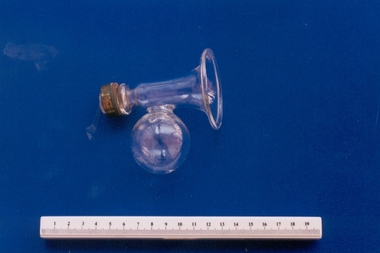
Breast pump associated with midwife Mary Howlett, c. 1866 - 1920
... The milk was expressed by hand in the home, then transported to the hospital to feed the premature infant. ...The milk was expressed by hand in the home, then transported to the hospital to feed the premature infant. Mary Howlett (1840-1922) began practising as a country midwife in 1866 in the western district of Victoria. ...These breast pumps were also known as breast relievers or breast exhausters. They were a refinement of the much earlier 'sucking glass'. The breast pump was refined during the Victorian age. Glass breast pumps were used to manually express milk for the infant. These pumps were in use from the early 1920s to the late 1960s. They can also be used to stimulate lactation. These pumps were widely used in the 1950s by mothers of premature babies. The milk was expressed by hand in the home, then transported to the hospital to feed the premature infant. Mary Howlett (1840-1922) began practising as a country midwife in 1866 in the western district of Victoria. She qualified as a 'ladies monthly nurse' in 1887 and continued to practise as a nurse and midwife until 1920.She began her six months training at the Melbourne Lying-In Hospital. She was known by many as 'Auntie', and her career spanned more than 50 years. Mrs Howlett's midwifery box and contents were given to Dr Frank Forster, and he donated them to the museum collection in 1993.Glass breast pump with brass screw attachment and remnants of rubber pump. Pump is loosely bell shaped with a glass bowl attached to the side of the bell.infant feeding, midwifery -
 Royal Australian and New Zealand College of Obstetricians & Gynaecologists (RANZCOG)
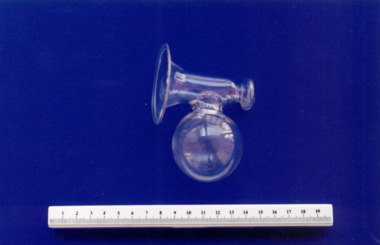
Breast pump associated with midwife Mary Howlett, c. 1866 - 1920
... The milk was expressed by hand in the home, then transported to the hospital to feed the premature infant. ...The milk was expressed by hand in the home, then transported to the hospital to feed the premature infant. Mary Howlett (1840-1922) began practising as a country midwife in 1866 in the western district of Victoria. ...These breast pumps were also known as breast relievers or breast exhausters. They were a refinement of the much earlier 'sucking glass'. The breast pump was refined during the Victorian age. Glass breast pumps were used to manually express milk for the infant. These pumps were in use from the early 1920s to the late 1960s. They can also be used to stimulate lactation. These pumps were widely used in the 1950s by mothers of premature babies. The milk was expressed by hand in the home, then transported to the hospital to feed the premature infant. Mary Howlett (1840-1922) began practising as a country midwife in 1866 in the western district of Victoria. She qualified as a 'ladies monthly nurse' in 1887 and continued to practise as a nurse and midwife until 1920.She began her six months training at the Melbourne Lying-In Hospital. She was known by many as 'Auntie', and her career spanned more than 50 years. Mrs Howlett's midwifery box and contents were given to Dr Frank Forster, and he donated them to the museum collection in 1993.Glass breast pump. Pump is loosely bell shaped with a glass bowl attached to the side of the bell.infant feeding, midwifery -
 Vision Australia
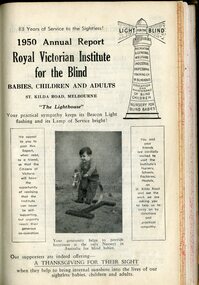
Administrative record - Text, Royal Victorian Institute for the Blind annual report 1950, 1950
... This includes the increase of blind babies due to medical care of premature infants, interest free loans to help workers purchase homes, praise for Council of Auxiliaries chairwoman Augusta Tutton, establishment of the Blind Workers Retirement Fund, foundation of the Victorian Guild of Professional Blind, Headmaster Green offers insight into the routines and education of children in the nursery and school, listing of staff including portraits of George Findlay, Donald Forbes, Hugh Jeffrey, Neil Westh and Dorothy Nuske - first blind woman to receive a Bachelor of Music....This includes the increase of blind babies due to medical care of premature infants, interest free loans to help workers purchase homes, praise for Council of Auxiliaries chairwoman Augusta Tutton, establishment of the Blind Workers Retirement Fund, foundation of the Victorian Guild of Professional Blind, Headmaster Green offers insight into the routines and education of children in the nursery and school, listing of staff including portraits of George Findlay, Donald Forbes, Hugh Jeffrey, Neil Westh and Dorothy Nuske - first blind woman to receive a Bachelor of Music. ...From it's beginning in 1867, the Royal Victorian Institute for the Blind grew in size and its number of employees and benefactors. These bound volumes of annual reports contain the information sent to subscribers of the Institute and outline the notable events and difficulties facing the blind and the RVIB. This includes the increase of blind babies due to medical care of premature infants, interest free loans to help workers purchase homes, praise for Council of Auxiliaries chairwoman Augusta Tutton, establishment of the Blind Workers Retirement Fund, foundation of the Victorian Guild of Professional Blind, Headmaster Green offers insight into the routines and education of children in the nursery and school, listing of staff including portraits of George Findlay, Donald Forbes, Hugh Jeffrey, Neil Westh and Dorothy Nuske - first blind woman to receive a Bachelor of Music.1 volume bound with illustrations.royal victorian institute for the blind, annual reports, george findlay, donald forbes, hugh jeffrey, neil westh, dorothy hamilton -
 Numurkah & District Historical Society
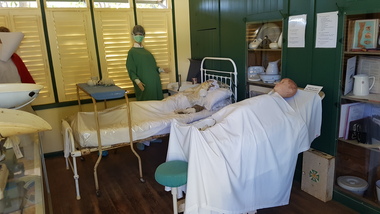
Isolation Ward Medical Displays - overview
... Health Nursing Certificates & Notebooks – Winifred Smith Shelf Three – South end of Isolation Ward Nursing Certificates & Notebooks – Winifred Smith Shelf Four – South end of Isolation Ward 1 x white enamel bucket 1 x enamel bowl Glass Cabinet: Premature Babies Book Handbook of Paediatrics Various health brochures 1 x enamel potty, dry liners, nappy pins 1 x infant welfare leather case 2 x breast pump 2 x dippers Medical Items placed around the room 1 x kidney dish with syringes & bandage 1 x stethoscope 1 x catheters 1 x oxygen tubing 1 x hospital bed (pre-dates 1950’s eg from local private hospital) 1 x operating table and 1 x theatre stool (original Numurkah Hospital 1950’s) 1 x heart table 1 x dental chair, mouthwash dish & stand 3 x wooden crutches 1 x early dentist chair 1 x Infant Welfare Centre sign ...Health Nursing Certificates & Notebooks – Winifred Smith Shelf Three – South end of Isolation Ward Nursing Certificates & Notebooks – Winifred Smith Shelf Four – South end of Isolation Ward 1 x white enamel bucket 1 x enamel bowl Glass Cabinet: Premature Babies Book Handbook of Paediatrics Various health brochures 1 x enamel potty, dry liners, nappy pins 1 x infant welfare leather case 2 x breast pump 2 x dippers Medical Items placed around the room 1 x kidney dish with syringes & bandage 1 x stethoscope 1 x catheters 1 x oxygen tubing 1 x hospital bed (pre-dates 1950’s eg from local private hospital) 1 x operating table and 1 x theatre stool (original Numurkah Hospital 1950’s) 1 x heart table 1 x dental chair, mouthwash dish & stand 3 x wooden crutches 1 x early dentist chair 1 x Infant Welfare Centre sign Isolation Ward Medical Displays - overview ...Shelf One – North End of Isolation Ward 1 x slipper enamel bedpan 1 x enamel pan with spout 1 x stainless steel bedpan 1 x stainless steel urinal 2 x ceramic urinals 1 x ceramic bowl Shelf Two – North end of Isolation Ward 1 x small enamel kidney dish 2 x slipper ceramic bedpans 1 x enamel wash-bowl & jug Shelf Three – North end of Isolation Ward 1 X dry Steriliser Shelf Four – North end of Isolation Ward 1 X steam Steriliser Shelf One – South end of Isolation Ward 1 x nurse’s dictionary Domestic Medical Practice Book Doctor and Specialist Book Aids to Gynaecological Nursing Book Foundations of Anatomy & Physiology Book 2 x thermometers 1 x stainless steel swab bowl 1 x ophthalmoscope 1 x stainless bowl & bandages 1 x scissors/ tweezers kit 1 x large operating scissors & 1 x operating tweezers 1 x camode pot 1 x sigmoidoscope 3 x plessors Shelf Two – South end of Isolation Ward 1 x ceramic jug Kaarimba Ladies Auxiliary History of Num. Dist. Health Nursing Certificates & Notebooks – Winifred Smith Shelf Three – South end of Isolation Ward Nursing Certificates & Notebooks – Winifred Smith Shelf Four – South end of Isolation Ward 1 x white enamel bucket 1 x enamel bowl Glass Cabinet: Premature Babies Book Handbook of Paediatrics Various health brochures 1 x enamel potty, dry liners, nappy pins 1 x infant welfare leather case 2 x breast pump 2 x dippers Medical Items placed around the room 1 x kidney dish with syringes & bandage 1 x stethoscope 1 x catheters 1 x oxygen tubing 1 x hospital bed (pre-dates 1950’s eg from local private hospital) 1 x operating table and 1 x theatre stool (original Numurkah Hospital 1950’s) 1 x heart table 1 x dental chair, mouthwash dish & stand 3 x wooden crutches 1 x early dentist chair 1 x Infant Welfare Centre sign hospital, medical equipment -
 Kew Historical Society Inc
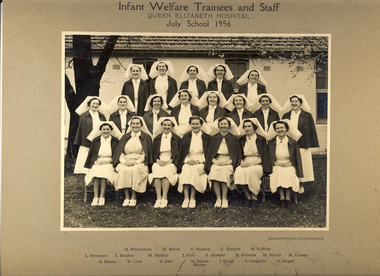
Photograph, Infant Welfare Trainees and Staff, Queen Elizabeth Hospital, 1956
... Infant Welfare and Mothercraft Training School. The Centre provided after-care for nursing mothers and babies transferring from maternity hospitals, and specialised care for babies referred by private practitioners and the Social Welfare Department – babies who were premature, frail or had feeding or similar problems. ...Infant Welfare and Mothercraft Training School. The Centre provided after-care for nursing mothers and babies transferring from maternity hospitals, and specialised care for babies referred by private practitioners and the Social Welfare Department – babies who were premature, frail or had feeding or similar problems. ...Carlton Refuge/Carlton Home was established in 1857 in Madeline Street, Carlton (relocating in 1890 to Keppel Street, Carlton). The Carlton Home provided maternity care for married and unmarried mothers, and residential care for infants and toddlers unable to be at home with their mother. It also operated a day-care centre for children. Most of the residents were mothers or children on private placements. The Children's Welfare Department used the Carlton Home as a maternity home for wards, a foster home for infant wards, and for children requiring placements under the infant life protection provisions of the Children's Welfare Act. By the late 1940s, the home was in a bad state of repair and it closed in 1949. In 1951, the facility reopened as the Queen Elizabeth Maternal and Child Health Centre that also operated as an Infant Welfare and Mothercraft Training School. The Centre provided after-care for nursing mothers and babies transferring from maternity hospitals, and specialised care for babies referred by private practitioners and the Social Welfare Department – babies who were premature, frail or had feeding or similar problems. (Source: DHHS)The photograph is a valuable primary resource relating to training for maternal and infant welfare centres in Kew, Victoria. It has a strong provenance through inscriptions linking it to the Denmark Street Maternal and Child Health Centre.Photograph, mounted on card of Infant Welfare Trainees and Staff, Queen Elizabeth Hospital, 1956. The photograph lists the names of the individuals below the photograph. They include: Back Row {L-R] M Whittenbury, M Bolton, E Haebich, G Barnard, M Griffiths / Middle Row [L-R] L Stevenson, T Boucher, M Madden, J Price, A Glowrey, R Helmore, M Murfet, M Lindsay / Front Row [L-R] R Buxton, W Crick, G Stott, M Buxton Matron, J Keogh, B Longmuir, E Borgelt.Obverse: Infant Welfare Trainees and Staff, Queen Elizabeth Hospital, July School 1956 Reverse: "Presented to Kew Historical Soc by Dr Darbyshire following a 50 year birthday display at the Denmark Street Maternal and Child Health Centre [Kew] in May 1980. [Illegible]."denmark street maternal and child health centre, baby health centres --- kew (vic), queen elizabeth hospital, infant welfare
