
Showing 16 items matching "premier - queensland"
-
 Unions Ballarat
Don't you worry about that! The Joh Bjelke-Petersen Memoirs (Don Woodward Collection), Bjelke-Petersen, Joh, 1990
... ...premier - queensland...Petersen was the longest serving Premier of Queensland from 1968-1987, representing the National Party. ...Petersen was the longest serving Premier of Queensland from 1968-1987, representing the National Party. ...Autobiography - Joh Bjelke-Petersen. Petersen was the longest serving Premier of Queensland from 1968-1987, representing the National Party. His wife, Flo Bjelke-Petersen, served in the federal senate. He is known for the Joh for PM campaign (unsuccessful) and as a participant in the downfall of Prime Minister Gough Whitlam in 1975. By use of the Queensland police force, he obstructed street demonstrations for a long period of time. Political autobiography - Queensland - National Party.Book; 259 pages. Front cover: white text; author's name and title; colour photograph of Sir Joh Bjelke-Petersen.btlc, ballarat trades hall, ballarat trades and labour council, premier - queensland, politics, national party of australia, premiers - bjelke-petersen, joh, autobiography, senators - bjelke-petersen, florence -
 Vision Australia
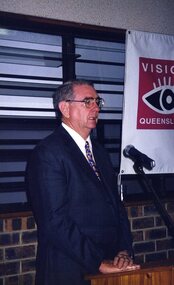
Photograph - Image, 1998 Vision Queensland AGM, 27/10/1998
... Former Premier of Queensland, Mike Ahern, was the guest speaker at the Vision Queensland AGM, held on October 28, 1998. ...The Honourable Mike Ahern, former Premier of Queensland and Chairman of the Queensland Community Foundation Board. ...Former Premier of Queensland, Mike Ahern, was the guest speaker at the Vision Queensland AGM, held on October 28, 1998. ...Former Premier of Queensland, Mike Ahern, was the guest speaker at the Vision Queensland AGM, held on October 28, 1998. Other attendees included chairman John Puttick, and board directors Des Knight, Ian Barclay and Terry Boyle, as well as Peta Nagle and Kevin O'Mahoney.12 col. photographs of attendees at the 1998 Vision Qld AGMThe Honourable Mike Ahern, former Premier of Queensland and Chairman of the Queensland Community Foundation Board. Guest speaker at Vision Queensland's AGM 27/10/1998vision qld, mike ahern, john puttick, peta nagle, kevin o'mahoney, des knight, ian barclay, terry boyle -
Unions Ballarat
Joh: The life and political adventures of Johannes Bjelke-Petersen (Don Woodward Collection), Lunn, Hugh, 1978
... The book is a biography and political history focussing upon the career of former National Party Premier of Queensland, Joh Bjelke-Petersen. Bjelke-Petersen was Premier of Queensland for almost twenty years and is renowned for using police to obstruct street demonstrations and his unsuccessful "Joh for PM" campaign (against PM Bob Hawke). ...The book is a biography and political history focussing upon the career of former National Party Premier of Queensland, Joh Bjelke-Petersen. Bjelke-Petersen was Premier of Queensland for almost twenty years and is renowned for using police to obstruct street demonstrations and his unsuccessful "Joh for PM" campaign (against PM Bob Hawke). ...The book is a biography and political history focussing upon the career of former National Party Premier of Queensland, Joh Bjelke-Petersen. Bjelke-Petersen was Premier of Queensland for almost twenty years and is renowned for using police to obstruct street demonstrations and his unsuccessful "Joh for PM" campaign (against PM Bob Hawke). He is believed to have been pivotal in the 1975 constitutional crisis that led to the sacking of Prime Minister, Gough Whitlam. His wife, Florence Bjelke-Petersen, was a Senator in the Australian Federal Parliament.Biographical interest. Political and historical - State politics.Book; 280 pages. Cover: blue background; white lettering; author's name and title on the spine.btlc, ballarat trades hall, ballarat trades and labour council, biography, politics and government, premiers - bjelke-petersen, joh, senators - bjelke-petersen, florence -
 Vision Australia
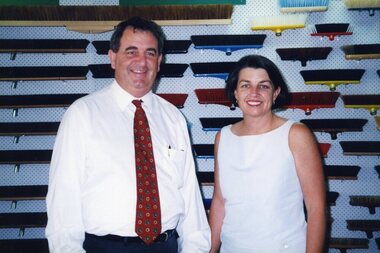
Photograph - Image, John Puttick with Anna Bligh, circa 2000?
... John Puttick, Chairman of Vision Queensland, with Anna Bligh, Minister for Disability Services (later to become Queensland Premier)....John Puttick, Chairman of Vision Queensland, with Anna Bligh, Minister for Disability Services (later to become Queensland Premier). Vision QLD John Puttick Anna Bligh 2 col. photographs of John Puttick and Anna Bligh John Puttick with Anna Bligh Photograph Image ...John Puttick, Chairman of Vision Queensland, with Anna Bligh, Minister for Disability Services (later to become Queensland Premier).2 col. photographs of John Puttick and Anna Blighvision qld, john puttick, anna bligh -
Unions Ballarat
Jigsaw: The biography of Johannes Bjelke-Petersen (Don Woodward Collection), Townsend, Derek, 1983
... The book is a biography and political history focussing upon the career of former National Party Premier of Queensland, Joh Bjelke-Petersen. Bjelke-Petersen was Country Party/National Party Premier of Queensland for almost twenty years and is renowned for using police to obstruct street demonstrations and his unsuccessful "Joh for PM" campaign (against PM Bob Hawke). ...The book is a biography and political history focussing upon the career of former National Party Premier of Queensland, Joh Bjelke-Petersen. Bjelke-Petersen was Country Party/National Party Premier of Queensland for almost twenty years and is renowned for using police to obstruct street demonstrations and his unsuccessful "Joh for PM" campaign (against PM Bob Hawke). ...The book is a biography and political history focussing upon the career of former National Party Premier of Queensland, Joh Bjelke-Petersen. Bjelke-Petersen was Country Party/National Party Premier of Queensland for almost twenty years and is renowned for using police to obstruct street demonstrations and his unsuccessful "Joh for PM" campaign (against PM Bob Hawke). He is believed to have been pivotal in the 1975 constitutional crisis that led to the sacking of Prime Minister, Gough Whitlam. His wife, Florence Bjelke-Petersen, was a Senator in the Australian Federal Parliament. This biography was written at the time when Petersen was still Premier (1983).Politics and government. Biographical interest.Book; 375 pages. Dustjacket: white background; colour photograph of Joh Bjelke-Petersen shaped like a jigsaw piece; black lettering; author's name and title. Cover: green background; gold lettering; author's name and title.btlc, ballarat regional trades and labour council, ballarat trades hall, premiers - bjelke-petersen, joh, senators - bjelke-petersen, florence, biography, politics and government, country party, national party -
 Vision Australia
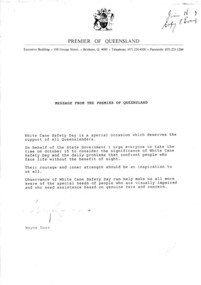
Letter - Text, [Various letters on White Cane Day 1990], 1990
... Various letters of acknowledgement and support for White Cane Day in 1990, written by then Queensland Premier Wayne Goss, Australian Prime Minster Bob Hawke, Brisbane Lord Mayor Sallyanne Atkinson, Queensland White Cane Committee and a Media News release from RVIB,...Various letters of acknowledgement and support for White Cane Day in 1990, written by then Queensland Premier Wayne Goss, Australian Prime Minster Bob Hawke, Brisbane Lord Mayor Sallyanne Atkinson, Queensland White Cane Committee and a Media News release from RVIB, Royal Victorian Institute for the Blind Queensland White Cane Day Committee White Cane Day Wayne Goss Bob Hawke Sallyanne Atkinson 6 typed letters from various people and to the media [Various letters on White Cane Day 1990] Letter Text ...Various letters of acknowledgement and support for White Cane Day in 1990, written by then Queensland Premier Wayne Goss, Australian Prime Minster Bob Hawke, Brisbane Lord Mayor Sallyanne Atkinson, Queensland White Cane Committee and a Media News release from RVIB,6 typed letters from various people and to the mediaroyal victorian institute for the blind, queensland white cane day committee, white cane day, wayne goss, bob hawke, sallyanne atkinson -
 Bendigo Historical Society Inc.
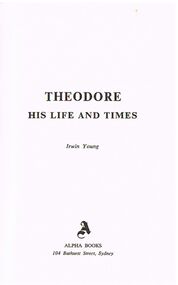
Book - ALEC H CHISHOLM COLLECTION: BOOK ''THEODORE, HIS LIFE AND TIMES'' BY IRWIN YOUNG
... ALEC H CHISHOLM COLLECTION. 189 page hardcover biography of Edward Granville Theodore, State and Federal politician, Union organiser, Premier of Queensland, Deputy Prime Minister and Treasurer in the Scullin Government. ...ALEC H CHISHOLM COLLECTION. 189 page hardcover biography of Edward Granville Theodore, State and Federal politician, Union organiser, Premier of Queensland, Deputy Prime Minister and Treasurer in the Scullin Government. ...Book. ALEC H CHISHOLM COLLECTION. 189 page hardcover biography of Edward Granville Theodore, State and Federal politician, Union organiser, Premier of Queensland, Deputy Prime Minister and Treasurer in the Scullin Government. Forward by E. G. Whitlam. Illustrated with B & W photos. Published in 1971 by Alpha Books, Sydney and printed by the Griffin Press, Adelaide. Catalogue sticker ''2167 YOU'' on spine. Handwritten in biro on flyleaf ''For A. H. Chisholm Esq with kind regards and best wishes and the hope this book recalls interesting events, John Theodore 4.11.71''. Also a newspaper cutting (3-4-74) pasted on flyleaf relating to the estate of Mr N. B. Theodore. SBN 35553 064 2.Irwin Youngbooks, collections, biography, alec h chisholm collection, edward granville theodore, irwin young, n.b.theodore, e.g.whitlam, biography, politics -
 Bendigo Military Museum
Administrative record - History of the Post War Army - Royal Australian Survey Corps 1953, Australian Survey Corps (Royal from 1948), 1938-1953
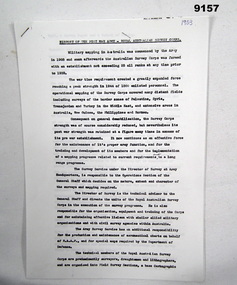
... The second page describes the Military mapping programme referencing a memo from the Queensland Premier dated 2 Aug 1944 and mentions notes from the 1938 Commonwealth Survey Committee. ...The second page describes the Military mapping programme referencing a memo from the Queensland Premier dated 2 Aug 1944 and mentions notes from the 1938 Commonwealth Survey Committee. ...The six stapled photocopies of typed text describe in some detail the history of the post WWII Army, and in particular the Australian Survey Corps. The first of 3 x separate pages at the rear is a summary of the recommendations, Commonwealth Survey Committee 1944. The second page describes the Military mapping programme referencing a memo from the Queensland Premier dated 2 Aug 1944 and mentions notes from the 1938 Commonwealth Survey Committee. The third page (possibly incomplete) is from the Conference of the Commonwealth Survey Committee and the State Surveyor General held at Canberra 15 20 Jan 1945.6 x photocopies of A4 pages of typed text, stapled in the top LH Corner. There are an additional 3 x A4 photocopied pages at the rear of the original document.Hand written note on the first page "1953"royal australian survey corps, rasvy, fortuna, army survey regiment, army svy regt, asr -
 Bendigo Historical Society Inc.
Map - CENTENARY OF FEDERATION MAP OF AUSTRALIA
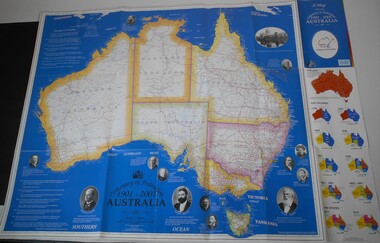
... Description of the footsteps to federation and starting at left pictures of: John Forrest (first premier of Western Australia) - Edmund Barton (Australia's first Prime Minister) - Charles Kingston (premier of South Australia) - Catherine Helen Spence (first woman to run for political office) - Alfred Deakin ( Australia's first deputy Prime Minister) - John Quick (Force behind the people convention) - Andrew Inglis Clark (Attorney General of Tasmania) - Henry Parkes (Premier of New South Wales) - Robert Garran (helped draft the final version of the Constitution) - George Reid (Premier of New South Wales) - Maybanke Wolstenholme (leading women' s suffrage and Federation campaigner) - Samuel Griffith (former Queensland Premier) - The Exhibition Building, Melbourne - Vaiben Louis Solomon (represented the Northern Territory). ...Description of the footsteps to federation and starting at left pictures of: John Forrest (first premier of Western Australia) - Edmund Barton (Australia's first Prime Minister) - Charles Kingston (premier of South Australia) - Catherine Helen Spence (first woman to run for political office) - Alfred Deakin ( Australia's first deputy Prime Minister) - John Quick (Force behind the people convention) - Andrew Inglis Clark (Attorney General of Tasmania) - Henry Parkes (Premier of New South Wales) - Robert Garran (helped draft the final version of the Constitution) - George Reid (Premier of New South Wales) - Maybanke Wolstenholme (leading women' s suffrage and Federation campaigner) - Samuel Griffith (former Queensland Premier) - The Exhibition Building, Melbourne - Vaiben Louis Solomon (represented the Northern Territory). ...Map of Australia printed for the Centenary of Federation 1901-2001. Description of the footsteps to federation and starting at left pictures of: John Forrest (first premier of Western Australia) - Edmund Barton (Australia's first Prime Minister) - Charles Kingston (premier of South Australia) - Catherine Helen Spence (first woman to run for political office) - Alfred Deakin ( Australia's first deputy Prime Minister) - John Quick (Force behind the people convention) - Andrew Inglis Clark (Attorney General of Tasmania) - Henry Parkes (Premier of New South Wales) - Robert Garran (helped draft the final version of the Constitution) - George Reid (Premier of New South Wales) - Maybanke Wolstenholme (leading women' s suffrage and Federation campaigner) - Samuel Griffith (former Queensland Premier) - The Exhibition Building, Melbourne - Vaiben Louis Solomon (represented the Northern Territory). On the right the evolution of the colonies and the states from 1788 to 1915.australia, history, centenary of federation -
 Orbost & District Historical Society
book, The White Woman, 1994
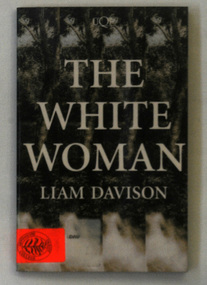
... Premier’s Awards. This is a useful research tool on the history of indigenous and settler relationships in early Gippsland. davison-liam aboriginal-history Bottom left corner - orange sticker Orbost Secondary College A book titled "The White Woman" by Liam Davison. It is the story of the search for the lost white woman in Gippsland, Victoria, 1846. The cover has a black and white picture of forest with the title in white print. The White Woman book University of Queensland ...The white woman of Gippsland, or the captive woman of Gippsland, was supposedly a European woman rumoured to have been held against her will by Aboriginal people in the Gippsland region of Australia in the 1840s. Liam Patrick Davison (29 July 1957 – 17 July 2014) was an Australian novelist and reviewer. He was born in Melbourne, where, until 2007, he taught creative writing at the Chisholm Institute in Frankston. Davison and his wife Frankie, a teacher at Toorak College, were both killed on 17 July 2014 aboard Malaysia Airlines Flight 17 This, his third novel, was shortlisted for both The Age Book of the Year and the Victorian Premier’s Awards.This is a useful research tool on the history of indigenous and settler relationships in early Gippsland.A book titled "The White Woman" by Liam Davison. It is the story of the search for the lost white woman in Gippsland, Victoria, 1846. The cover has a black and white picture of forest with the title in white print.Bottom left corner - orange sticker Orbost Secondary Collegedavison-liam aboriginal-history -
 Kiewa Valley Historical Society
Photo - Running Creek Cricket Club
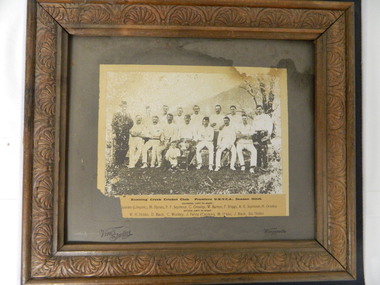
... premiers of the Upper Kiewa Valley Cricket Association in 1913 - 1914. Their team consisted of local men some of whom were related. The occasion was important enough to have a photo and to remember it possibly hanging the photo up in a public place eg. club rooms. cricket. running creek. upper kiewa valley cricket association. sport. vine's studio. Title, names of players. Grey cardboard - Vine's Studios / Wangaratta. On back handwritten "Donated by Mrs J. Woodside / Guluguba / Queensland ...Running Creek belonged to the Upper Kiewa Valley Cricket Association and were premiers in 1913 - 1914. They dressed in whites with long sleeved shirts and trousers. The umpire was dressed very formally. The names of the players are local families and included brothers or relations with the same surname.Historical: Running Creek were premiers of the Upper Kiewa Valley Cricket Association in 1913 - 1914. Their team consisted of local men some of whom were related. The occasion was important enough to have a photo and to remember it possibly hanging the photo up in a public place eg. club rooms.Black & white photo of Running Creek Cricket Team, Premiers 1913 - 1914. Upper Kiewa Valley Cricket Association Far left - The umpire fully dressed in suit & hat and far right man with white shirt & black trousers. In between 13 cricketers in 2 rows and a child beside the cup at the front. Names of players are typed below the photo. Photo is glued on grey cardboard, framed in brown decorative wooden frame. Back: String attached 1 side only.Title, names of players. Grey cardboard - Vine's Studios / Wangaratta. On back handwritten "Donated by Mrs J. Woodside / Guluguba / Queensland / on 19 July 1972cricket. running creek. upper kiewa valley cricket association. sport. vine's studio. -
 Bendigo Historical Society Inc.
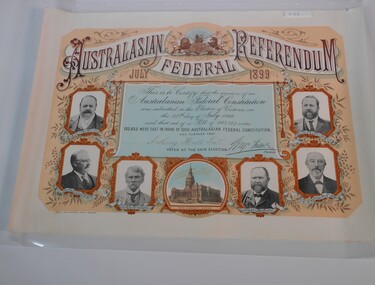
Document - AUSTRALASIAN FEDERAL REFERENDUM JULY 1899 CERTIFICATE
... premiers: G. Reid from NSW, G. Turner from Victoria, E. Braddon from Tasmania, J. Forrest from WA, R. Dickson from Queensland, C. ...premiers: G. Reid from NSW, G. Turner from Victoria, E. Braddon from Tasmania, J. Forrest from WA, R. Dickson from Queensland, C. ...Ornate certificate Australasian Federal referendum July 1899. This is to certify that the question of an Australasian Federal Constitution was submitted to the electors of Victoria on the 27th day of July 1899 and that out of a Poll of 163,783 votes 152,653 were cast in favour of such Australasian Federal Constitution and further that Anthony Hall Seniors voted at the said election. Signed by the premier. Photo of the six state premiers: G. Reid from NSW, G. Turner from Victoria, E. Braddon from Tasmania, J. Forrest from WA, R. Dickson from Queensland, C. Kingston from SA. Also a drawing of Parliament House.government, state, federation convention -
Bendigo Historical Society Inc.
Document - BROADCASTING STATION 3CV, MARYBOROUGH, 2 March, 1956
... Queensland to overcome the manufacturing difficulties being experienced due to the shortage of plywood in Victoria. Present activities: Ready Built Housing Factory... on-site building... a modern joinery... timber yard... drying kilns... etc.... and plumbing & electrical & engineering services... a door and panel factory at Cairns... retail hardware store... Melbourne Sales Depot. Hedges & Bell Pty Ltd were est. 1945... with a staff of 40 employees are the largest printing firm outside the metropolitan area. The branch of Premier...Queensland to overcome the manufacturing difficulties being experienced due to the shortage of plywood in Victoria. Present activities include: Ready Built Housing Factory, on-site building, a modern joinery, timber yard, drying kilns, etc., and plumbing & electrical & engineering services, a door and panel factory at Cairns, retail hardware store, Melbourne Sales Depot. Hedges & Bell Pty Ltd were est 1945, with a staff of 40 employees are the largest printing firm outside the metropolitan area. The branch of Premier...Queensland to overcome the manufacturing difficulties being experienced due to the shortage of plywood in Victoria. Present activities: Ready Built Housing Factory on-site building a modern joinery timber yard drying kilns etc. and plumbing & electrical & engineering services a door and panel factory at Cairns retail hardware store Melbourne Sales Depot. Hedges & Bell Pty Ltd were est. 1945 with a staff of 40 employees are the largest printing firm outside the metropolitan area. The branch of Premier ...Broadcasting Station 3CV, Maryborough. A souvenir of the opening of the New Studios and Offices of Central Victoria Broadcasters Pty Ltd. March 2nd, 1956. Established 1956, offices in Burke Street, opening coincides with the stations 21st birthday, March 2 for the former celebration, October 26 for the latter. Coverage included Bendigo, Ballarat, Daylesford, Castlemaine and Maryborough. 3CV plays active part in assisting charities and hospitals at Maryborough, Daylesford, Maldon and Dunolly. Active Women's Radio Club with branches in country centres adds strength to station's charitable efforts. Opening 3CV's new premises will widen the scope of the station's charitable efforts, and stronger link with Australian Commercial Broadcasting stations. Writer Harold V Nunn writes history of district of Mayborough. Manager Ken J Parker, Central Victoria Broadcasters Pty. Ltd. The Souvenir brochure also covers topics such as: deep lead mining. WWI. Houses being pulled down. New settlements of Mildura. Secondary Industries. Bowenvale, Alma, Majorca, Craigie, Amherst, Adelaide Lead, Havelock, Bet Bet, Bently. Primary production and a railway staff of approximately 150. Maryborough a little town without a future. Coal fields at Wonthaggi. 1917 a public meeting was convened in an effort to stem the tide of adversity. Mayor George Frost, M.L.A., decision to form a Progress Association, a policy of secondary industry was decided upon and committees were appointed, James L Drew much credit is due. Maryborough's move for rejuvenation was revolutionary, because apart from Ballarat, Bendigo and Geelong, it was regarded as so much presumption that industry could be expected to function with success in a country town. Governments were unsympathetic. Maryborough & district people showed determination to succeed and their faith in their town. Employment and economic security provided by the industries outweighed the debt. Maryborough's general position is that it is no longer dependent upon one particular phase of activity. The first of the industries to be formed in 1918 was the Butter Factory. The nearer dairy companies did not take kindly to the prospect of another opposition company taking supplies from their districts, and in the first few years of establishment completion made the going hard for the management. But adopting a conservative policy and placing all profits to reserve I the first six years of operation headway was gradually made. Thus it was a red letter day for the company in 1925 when the first dividend of 5 percent was paid.1955 dividend of 10 per cent. Operating it's own trucks the dairy serviced local dairymen up to 40 miles. Maryborough Knitting mills est. 1923, having transferred from Clunes. Out bid Ballarat and Bendigo to the industry. The mill has what is probably the largest circular underwear plant in the Commonwealth, which is conservatively valued at 198,913 pounds. It produces between four and five million garments each year, worth over one million pounds. The company has established subsidiary mills at Dunolly, Talbot and Avoca. The company also assisted in the establishment of the Interknit Hosiery Co. Ltd., Clunes. The Maryborough Flour Mills is the second oldest of Mayborough's industries. It was built by Mr Cadwallader over 70 years ago. It was later sold to Mr. A Land and then to Jas. Minifie & Co. It had a somewhat 'in-and -out' existence until purchased in 1923 by Messrs. Willersdorf and Forbes, of Eddington. In 1939 the firm began to build silos for the storage of bulk wheat and the present storage capacity is 100,000 bushels. 1944 power was changed from steam to electricity. The mill has an out put of 20 sacks an hour. 1938 a chaff mill was built, and now is regarded as one of the best in Victoria. Its output in one year of approximately 6,800 tons is a State record for a single cutter. During this 30 year period Patience and Nicholson Limited has grown with Maryborough and is now one of the major key industries of Australia. The P&N brand covers precision tools - taps, dies and twist drills - indispensable to the country's economy, and quality is acknowledged equally by an air craft factory in Canada, a dockyard in Thailand, a railway workshop in New Zealand, no less than by our own Australian industries. Maryborough can be proud of the part played by P&N in war when, geared to the needs of the times, it poured countless millions of tools into defence factories and to the armed forces of the Allies, and now in peace when it is providing, hydro-electric undertakings and the manufacture of cars and tractors. From 1858, W Phelan & Sons Pty Ltd has made phenomenal and spectacular growth, becoming incorporated as a private company in 1929. It is without doubt the greatest private development in the history of Maryborough. 1940 joinery manufacture was commenced. The company entered the Ready Built Housing field in `950 - and in 1951 established a factory at Cairns, Northern Queensland to overcome the manufacturing difficulties being experienced due to the shortage of plywood in Victoria. Present activities include: Ready Built Housing Factory, on-site building, a modern joinery, timber yard, drying kilns, etc., and plumbing & electrical & engineering services, a door and panel factory at Cairns, retail hardware store, Melbourne Sales Depot. Hedges & Bell Pty Ltd were est 1945, with a staff of 40 employees are the largest printing firm outside the metropolitan area. The branch of Premier Wireworks is a contribution made by the decentralisation policy of the State.event, official, celebration, broadcasting station 3cv, maryborough. a souvenir of the opening of the new studios and offices of central victoria broadcasters pty ltd. march 2nd, 1956. established 1956, offices in burke street, 21st birthday. coverage bendigo, ballarat, daylesford, castlemaine maryborough. assisting charities and hospitals maldon and dunolly. women's radio club opening 3cv's new premises australian commercial broadcasting stations. writer harold v nunn writes history of district of mayborough. manager ken j parker, central victoria broadcasters pty. ltd. souvenir brochure: deep lead mining. wwi. houses pulled down. new settlements. primary production railway staff. coal fields wonthaggi. 1917 a public meeting was convened in an effort to stem the tide of adversity. mayor george frost, m.l.a., form a progress association, policy of secondary industry, james l drew rejuvenation was revolutionary, employment and economic security. the first of the industries to be formed in 1918 was the butter factory. thus it was a red letter day for the company in 1925 when the first dividend of 5 percent was paid.1955 dividend of 10 per cent. operating it's own trucks serviced local dairymen. maryborough knitting mills est. 1923 largest circular underwear plant in the commonwealth. established subsidiary mills at dunolly, talbot, avoca. interknit hosiery co. ltd., clunes. the maryborough flour mills it was built by mr cadwallader. mr. a land jas. minifie & co. messrs. willersdorf and forbes, build silos for wheat storage capacity is 100, 000 bushels. 1944 power was changed from steam to electricity. 20 sacks an hour. 1938 a chaff mill was built, best in victoria. patience and nicholson limited the p&n precision tools - taps, dies and twist drills. war, geared to the needs of the times, countless millions of tools into defence factories the armed forces of the allies, hydro-electric undertakings and the manufacture of cars and tractors. from 1858, w phelan & sons pty ltd, incorporated 1929. 1940 joinery manufacture. ready built housing field in 1950 - 1951 established a factory at cairns, northern queensland to overcome the manufacturing difficulties being experienced due to the shortage of plywood in victoria. present activities: ready built housing factory, on-site building, a modern joinery, timber yard, drying kilns, etc., and plumbing & electrical & engineering services, a door and panel factory at cairns, retail hardware store, melbourne sales depot. hedges & bell pty ltd were est. 1945, with a staff of 40 employees are the largest printing firm outside the metropolitan area. the branch of premier wireworks is a contribution made by the decentralisation policy of the state. -
 Bendigo Historical Society Inc.
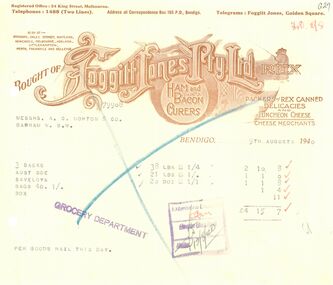
Financial record - INVOICE COLLECTION: Foggitt Jones Pty. Ltd
... Jones was elected as a Labor member to the Queensland Legislative Assembly in 1915, defeating the then premier. He was subsequently appointed to the Legislative Council. ...Jones was elected as a Labor member to the Queensland Legislative Assembly in 1915, defeating the then premier. He was subsequently appointed to the Legislative Council. ...https://historyoutthere.com/2015/09/14/ham-and-cheese-please/ The company was founded in 1904 when Charles Emanuel Foggitt and Thomas Llewellyn Jones left food manufacturer J.C.Hutton. Together they took over the floundering Oxley factory. Within five years their trade in ham, bacon, cheese, and related foodstuffs, was worth over £1,000,000 a year. They paid over-award wages, premises were scrupulously clean, and their products filled banquet halls and kitchens across the country. Foggitt ran the processing. He was born to a farming family in Yorkshire, England, in 1865. Two of his sons served on the western front in the First World War, and his third son in the Second World War earning a Distinguished Service Cross and Mentioned in Despatches. His brother-in-law was William Bertram, the long-time Labor member and speaker of the Queensland Legislative Assembly. Foggitt didn’t live to witness the crowning glory however. He died in 1926, the year before his company with partner Thomas Jones as chairman of directors, took over his old employer J.C.Hutton. Jones himself passed away in 1946. With the founders gone, after a while so too was the passion. The holding company United Provisions Ltd changed its name to Huttons, eventually selling its operations, and delisting from the stock exchange. Jones ran the business. He was born to a radical family in Welshpool, Wales, in 1872. His father was a strong radical before the labor movement was founded, and his grandfather was a militant chartist who narrowly escaped transportation. Jones was elected as a Labor member to the Queensland Legislative Assembly in 1915, defeating the then premier. He was subsequently appointed to the Legislative Council. In his spare time he served as commodore of Royal Queensland Yacht Club.All printed in tan ink on thick cream paper. Each with two holes punched in the left side of the page. 10934.31a - receipt number G27 or 79908 Receipt dated: 9th August 1940 The receipt header reads "Bought of Foggitt Jones Pty. Ltd. Rex" in capital letters. The header also reads: ham and bacon curers. Packers of rex Canned Delicacies and Luncheon Cheese - Cheese merchants. Above the company name, it lists the company's: Locations - "Also at: - Brisbane, Oxley, Sydney, Maitland, Newcastle, Melbourne, Adelaide, Littlehampton, Perth, Fremantle and Bellevue." This receipt is from their Bendigo location. Addresses - registered office: 34 King Street, Melbourne. Contact Info - Phone 1488 Telegrams: Foggitt Jones, Golden Square. Correspondence to P.O. Box 195, Bendigo. receipt items typed in black ink. For the purchase of 3 backs, Aust Sge, Saveloys etc. Purchased for the price of: 4 pounds, 15 shillings and 7 pence. 10934.31b - receipt number G9 or 79565 Receipt dated: 5th August 1940 The receipt header reads "Bought of Foggitt Jones Pty. Ltd. Rex" in capital letters. The header also reads: ham and bacon curers. Packers of rex Canned Delicacies and Luncheon Cheese - Cheese merchants. Above the company name, it lists the company's: Locations - "Also at: - Brisbane, Oxley, Sydney, Maitland, Newcastle, Melbourne, Adelaide, Littlehampton, Perth, Fremantle and Bellevue." This receipt is from their Bendigo location. Addresses - registered office: 34 King Street, Melbourne. Contact Info - Phone 1488 Telegrams: Foggitt Jones, Golden Square. Correspondence to P.O. Box 195, Bendigo. receipt items typed in black ink. For the purchase of 6 backs bacon, saveloys etc. Purchased for the price of: 5 pounds, 14 shillings and 4 pence. 10934.31c - receipt number G38 or 80159 Receipt dated: 13th August 1940 The receipt header reads "Bought of Foggitt Jones Pty. Ltd. Rex" in capital letters. The header also reads: ham and bacon curers. Packers of rex Canned Delicacies and Luncheon Cheese - Cheese merchants. Above the company name, it lists the company's: Locations - "Also at: - Brisbane, Oxley, Sydney, Maitland, Newcastle, Melbourne, Adelaide, Littlehampton, Perth, Fremantle and Bellevue." This receipt is from their Bendigo location. Addresses - registered office: 34 King Street, Melbourne. Contact Info - Phone 1488 Telegrams: Foggitt Jones, Golden Square. Correspondence to P.O. Box 195, Bendigo. receipt items typed in black ink. For the purchase of 2 backs bacon, Saveloys etc. Purchased for the price of: 2 pounds, 7 shillings and 6 pence. 10934.31d - receipt number G70 or 79420 Receipt dated: 2nd August 1940 The receipt header reads "Bought of Foggitt Jones Pty. Ltd. Rex" in capital letters. The header also reads: ham and bacon curers. Packers of rex Canned Delicacies and Luncheon Cheese - Cheese merchants. Above the company name, it lists the company's: Locations - "Also at: - Brisbane, Oxley, Sydney, Maitland, Newcastle, Melbourne, Adelaide, Littlehampton, Perth, Fremantle and Bellevue." This receipt is from their Bendigo location. Addresses - registered office: 34 King Street, Melbourne. Contact Info - Phone 1488 Telegrams: Foggitt Jones, Golden Square. Correspondence to P.O. Box 195, Bendigo. receipt items typed in black ink. For the purchase of 2 backs bacon, Aust Sge, Saveloys etc. Purchased for the price of: 3 pounds, 8 shillings and 4 pence.bendigo, morton's stores, foggitt jones pty ltd -
 Vision Australia
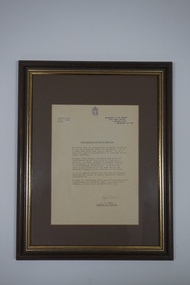
Letter - Object, White Cane Day Proclamation
... Queensland was the first state to celebrate White Cane Day in 1978, followed by Victoria in 1979. Rupert Hamer Association for the Blind White Cane Day On the back: This proclamation of October 15, each year, as White Cane Day throughout the State of Victoria, was made by the Premier of Victoria, the Honourable R.J. ...In 1964 the first White Cane Safety Day was proclaimed in the United States, to recognise the white cane as a method of independence for blind people and increase awareness by motorists to pay extra consideration to white cane users. Since then the recognition of White Cane Day has spread around the world including Asia, Africa and Europe. In Australia, Queensland was the first state to celebrate White Cane Day in 1978, followed by Victoria in 1979.Typewritten letter in brown frameOn the back: This proclamation of October 15, each year, as White Cane Day throughout the State of Victoria, was made by the Premier of Victoria, the Honourable R.J. Hamer as the result of a deputation by blind people from the Association for the Blind on Thursday October 12th, 1978.rupert hamer, association for the blind, white cane day -
 City of Melbourne Libraries
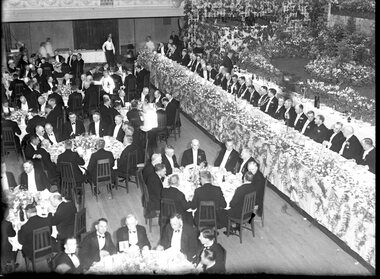
Photograph, Bull, Hugh Jones, 1897-1993, Lord Mayor's Dinner, Melbourne Town Hall
... Premier Albert Dunstan on 22 December 1938. It replaced an earlier footbridge, which in turn had replaced a punt service. The bridge (originally referred to as Punt Road Bridge) was named after Robert Hoddle, who planned central Melbourne’s Hoddle Grid, the grid of streets which form Melbourne’s central business district. Hoddle arrived in Australia from the UK in 1823 and went on to carry out surveys in NSW and Queensland...Premier Albert Dunstan on 22 December 1938. It replaced an earlier footbridge, which in turn had replaced a punt service. The bridge (originally referred to as Punt Road Bridge) was named after Robert Hoddle, who planned central Melbourne’s Hoddle Grid, the grid of streets which form Melbourne’s central business district. Hoddle arrived in Australia from the UK in 1823 and went on to carry out surveys in NSW and Queensland ...Photographer notations on slide: "General View Of Lord Mayor's Dinner At Town Hall Nov 1936 B112" Published: The Age, Tuesday 10 November 1936, page 13 Published title: LORD MAYOR'S BANQUET Published caption: The brilliant scene inside the Melbourne Town Hall last night during the Lord Mayor’s banquet. Trove article identifier: http://nla.gov.au/nla.news-article205939431 Description: 700 guests (all men) are seated around numerous tables in the Melbourne Town Hall for the Lord Mayor's dinner in November 1936. Before the stage is a top table of 35 men, all dressed smartly in black dinner suits, with either a black or white bow tie. Many are wearing their medals. The Lord Mayor has on his Mayoral chains, and to his right is the Governor of Victoria, Lord Huntingfield. The stage is heavily decorated with fresh flowers. Research by project volunteer, Louise McKenzie: This image takes up one quarter of the photographic space on page 13 of The Age on 10 November 1936, reflecting the importance of the event and also the sheer dramatics of the image: 700 guests (all men), a top table of 35, and all dressed smartly in black dinner suits, with either a black or white bow tie. Many are wearing their medals. The Lord Mayor has on his Mayoral chains, and to his right is the Governor of Victoria, Lord Huntingfield. Further to his right is a man with an impressive sash across his chest. It is a very animated, and rather informal, moment. Banks of fresh flowers smother the stage, which is decorated in the manner of a terrace at an English stately home. Tables are laden with food, drink and decorations, and the wait staff (men and women) are also formally dressed, in the manner of Downton Abbey. It is spectacular, dramatic, and luxurious, and perpetuates the proud descriptor of “Marvellous Melbourne” as conferred by London Journalist George Augustus Sala when he visited the city in 1885. During its 1880s boom, Melbourne was the second-largest city in the British Empire, after London, and reputedly the richest city in the world. At times the expression was used with some irony, but "...in Victoria’s centenary year, 1934, with the city mired in another depression, a publisher bravely entitled a book of souvenir photographs Marvellous Melbourne, claiming that the subject ‘still finds apt expression in the happy one-time sobriquet’.” This photo seems to reflect an ongoing pride in Melbourne and a desire for it to live up to its descriptor and celebrate its post-centenary era in style. So it is no surprise to find that on page 11 of The Age on the same day, a second photo is to be found – a cropped view of one table – along with a very detailed description of the night, its purpose, and a surprise announcement. But, who was the Lord Mayor in whose honour the dinner was held? In 1934, the Lord Mayor of Melbourne was Cr. Alexander George Wales, (born Richmond, 11 October 1885, died Elsterwick, 31 May 1962). His father was a contractor and quarry-owner, but was blinded in an industrial accident in 1899. Consequently Alexander, then aged 14, left Brunswick State School to become a railway labourer working at a quarry, and in 1903 joined the Commonwealth public service as a clerk and began studying at night school, determined to improve himself. In 1907 he was appointed secretary of the Albion Quarrying Co. (in which the family had an interest), then its managing director and chairman. As the Australian Dictionary of Biography notes, he was instrumental in expanding the company’s interests, "...becoming director of the Hardware Co. of Australia Pty Ltd, the Twentieth Century Building and Investment Society, the Albion Sand Co. and the Geelong Brick Co.”. His public career began in 1914 when he was elected to the Brunswick council. He was mayor 1917-18, and in 1925 progressed to the Melbourne City Council where he remained for 29 years, being a member of most council committees. He served three successive terms as lord mayor (1934-37), was Chairman of the council’s decorations committee for Melbourne’s centenary, president of the Metropolitan Fire Brigades Board (1936), and Chairman of the Public Works Committee (1937-39). In 1936 he was elected to the Legislative Council with United Australia Party support, but later resigned over possible State government contract tender irregularities. Wales received "the customary reward” of a knighthood and was invested at Buckingham Palace by King George VI whose coronation he attended in 1937. He was an early director of what is now Ampol, and helped the development of the petroleum industry in Australia after visiting the USA in 1943 and 1946. He was impressed by that country’s wartime shipbuilding efforts and supported closer ties with the USA. “While president (1947-48) of the Melbourne Chamber of Commerce, Wales was a vocal critic of the Federal Labor Government, ...a staunch anti-socialist ... and a focus for conservative opposition to the Curtin and Chifley governments...” He is described as “a natural leader in business and civic politics,... a powerful force in the Melbourne City Council... opposing democratic reforms such as the creation of a Greater Melbourne Council and the abolition of plural voting, but advocat[ing] the redevelopment of city-owned property like the Eastern and Western markets...” So, this Lord Mayor’s dinner marks the third successive term in office for Governor Cr. A G Wales. The room is filled with powerful and influential men, and provided a platform for the Premier of Victoria, Albert Dunstan (1882-1950, United Country party) to announce that if the City Council would bear half the cost the State Government would build a bridge at Punt Road “at once”. He announced that the Government proposed to have the bridge built by the Country Roads Board, and allow the City Council to pay its share on convenient terms, and further, it would investigate the shared provision of more Yarra bridges. The proposal for the Punt Road Bridge was met with applause as the Yarra River constituted a serious traffic barrier. On 12 November 1936, two days after the Lord Mayor’s dinner, The Age published an article, “Building without a Plan”. It questions the appropriateness of the next Yarra bridge being the one at Punt Road, and encourages a “proper procedure” to look at the provision of additional Yarra bridges as a whole. But in fact this topic had been canvassed back in August when Melbourne City Council’s public works committee had recommended the replacement of the footbridge at Punt Road with a bridge, and if the Country Roads Board would declare this portion of Punt Road, including the river crossing, a State Highway, this could give the Board authority to construct the bridge and allocate the cost. Hence the reference at the dinner to a shared expense. Still an integral part of traffic management today, the Hoddle Bridge carries Punt Road over the Yarra River between Richmond and South Yarra in Melbourne. It is a five-lane road bridge with narrow footpaths on either side. It is of continuous reinforced concrete T-beam construction with five segmental arched spans, supported on transverse piers, and linked by concrete cross-beams. “The piers terminate in a series of tapered concrete pillars with Art Deco-styled steamlined decoration. Each pillar supports a Victorian-style lamp. The infill railings are geometric-patterned painted metal. Construction began in late 1937, and it was opened by Premier Albert Dunstan on 22 December 1938. It replaced an earlier footbridge, which in turn had replaced a punt service. The bridge (originally referred to as Punt Road Bridge) was named after Robert Hoddle, who planned central Melbourne’s Hoddle Grid, the grid of streets which form Melbourne’s central business district. Hoddle arrived in Australia from the UK in 1823 and went on to carry out surveys in NSW and Queensland before arriving in Melbourne in 1837. He designed layouts for both Melbourne and Williamstown, and later Geelong and other Victorian country areas. He was keen that major streets be at least 30 metres wide. ”With remarkable foresight he provided for wide boulevards from the city to the suburbs, but the subdivisions of early speculators in inner suburbs created the bottle-necks of today. After the separation of the colony in 1851, he became Victoria’s first surveyor-general... and advocated the provision of three-chain (60 m) roads and the widening of all existing main roads from one (20 m) to three chains." However, he was met with constant opposition and in 1853, was eased out of office. As a small and interesting aside: Hoddle was appointed auctioneer for the first sale of crown land in Melbourne on 1 June 1837. His commission was 57 pounds 12s 7d. and he bought two allotments for himself at a cost of 54 pounds. After he died his second wife married Richard Buckhurst Buxton, a member of the family which in 1860s Melbourne established the Australian property dynasty of Buxton Real Estate, Becton, MAB Corporation etc. Returning to the dinner and The Age article of 10 November 1836: Another topic of the after-dinner speeches was a reference to the upcoming Armistice Day. “The Minister of Customs (Mr White) said the proximity of Armistice day reminded us that eighteen years ago we had high hopes of prolonged peace.” The term “Armistice Day” was coined after WWI: “At 11 am on 11 November 1918, the guns on the Western Front fell silent after more than four years of continuous warfare. The Germans called for an armistice (suspension of fighting) in order to secure a peace settlement. They accepted the allied terms on unconditional surrender. Therefore on the 11th hour of the 11th day of the 11th month, a minute’s silence is observed and dedicated to those soldiers who died fighting to protect the nation. Originally known as Armistice Day, it was renamed Remembrance Day after World War Two to commemorate those who were killed in both World Wars. Today it refers to the loss of Australian lives from all wars and conflicts, accompanied by the words, "We will remember them, Lest we forget"." There was comment at the dinner about the need to remain firm in supporting the “democratic government in the British Empire to avoid a “plunge into savagery”. There was a grave responsibility on the British people to keep democracy alive, and that could not be done without adequate defence forces... Many weak governments in non-British countries had been swept aside by strong-fisted dictators, who now were the real threat to peace”. With the benefit of hindsight these were very pertinent comments and tragically prophetic. The Melbourne Shrine of Remembrance had only been dedicated two years earlier, at a ceremony attended by the Duke of Gloucester, son of King George V. Over 300,000 citizens attended: one third of the population of Melbourne. It became the location for the Anzac Day Dawn Service. Originally the march travelled from the Shrine into the city, however, in 1936, this was reversed, and the Shrine became the termination point for Anzac Day Marches. Also significant in 1936, was the installation of a statue in the west forecourt of the Shrine: “The Man with the Donkey” (aka 'Private John Simpson and his Little Donkey'). The work is said to represent the “valour and compassion of the Australian soldier”. Its full citation, according to the City of Melbourne City Collection is: West Side of Base: "The / Man with his Donkey / Gallipoli, April 25 to May 19 / in Commemoration / of the valour and compassion / of the Australian Soldier" AFTER LANDING AT GALLIPOLI, SIMPSON, WITH HIS LITTLE DONKEY, WORKED ALONE, DAY AND NIGHT TAKING WATER TO THE FRONT LINE AND CARRYING THE WOUNDED BACK TO THE DRESSING STATIONS. HE AND HIS DONKEY WERE KILLED BY A SHRAPNEL SHELL ON THE 19TH MAY, 1915. SIMPSON WAS MENTIONED IN DISPATCHES BY SIR IAN HAMILTON, COMMANDER-IN-CHIEF OF THE MEDITERRANEAN EXPEDITIONARY FORCE. / Erected by Public Subscription under auspices of the / Red Cross Society. East Side of Base: Private John Simpson." Their summary in background states: "A bronze figure of Simpson and his donkey with a wounded man on the donkey's back on a granite pedestal. Private John Simpson Kirkpatrick’s intrepid and short-lived exploits during the Gallipoli campaign have made him a popular figure of World War One. He has been mythologised to represent the lauded values of the digger, and he symbolises all those who went into battle unarmed. Born in England in 1892, he came to Australia in 1910. He enlisted to make his way back to England, but as a member of the 3rd Field Ambulance AIA was sent to Gallipoli. After just three weeks of bearing wounded soldiers across Shrapnel Gully on the back of his donkey, Simpson was killed by shrapnel fire. Simpson’s story became a powerful propaganda tool for enlistment in Australia, but following the war he was quickly forgotten. With the Shrine of Remembrance nearing completion in 1933, the memory of Simpson was rekindled to commemorate all who gave their lives to help others during the war. One plaque reads: ‘The / Man with his donkey / Gallipoli … / In commemoration / of the valour and compassion / of the Australian soldier’. In 1935, Wallace Anderson’s design for the memorial was selected though a competition organised by the Australian Red Cross. Anderson had served during the war and worked at the Australian War Memorial after his return. His Man with the Donkey was cast in Italy, and after some debate was sited near the shrine. Unveiled 20th June, 1936." The sculptor, Victorian-born William Wallace Anderson (1888-1975), served in France during WWI and afterwards produced a number of bronze war memorials and memorial portraits, predominantly in Victoria. “His most famous work is that of Simpson and his Donkey (1935), which he completed after winning a competition conducted by the Victorian Division of the Australian Red Cross. Anderson’s fee was 350 pounds; the cast, made by the Chiurazzi Foundry, Naples, Italy, cost 40 pounds. The work... has become well known as a symbol of the Anzac tradition.” A debate as to the siting of the statue arose from a strong view expressed by General Sir John Monash that no representation of individual members of the Australian Defence Force be located on the Shrine itself. Hence its location off to the northwest of the forecourt, in a garden of rosemary. And finally we return to the photo of the grand Lord Mayor’s dinner! An article in The Argus of 4 November 1936 refers to “Brilliant Scene at Lord Mayor’s Ball – Hall Becomes a Garden”. So now it becomes clear why the Town Hall, location of the Lord Mayor’s Dinner on 10 November 1934, only 6 days later, is so lavishly decorated. The floral decorations from the Ball are still in place - an early example of “recycling”, which is gratifying to note at a time of Depression. The reporter has captured the scene with enthusiasm: “Hundreds of tiny rose lights, hidden among pink roses, transformed the Melbourne Town Hall into a magical garden last night, when the Lord Mayor and Lady Mayoress (Councillor A. C. Wales, M.L.C., and Mrs. Wales) entertained about 3,500 guests at a ball. His Excellency the Governor (Lord Huntingfield) and Lady Huntingfield were present, while Rear-Admiral and Mrs. Lane Poole and officers from the visiting squadron were among the special guests. The balconies all round the hall were hidden by a white trellis, covered with pink blossoms and greenery. Rosy flowers were issued up every pillar, and great golden lamps, hanging from the door, were seated in greenery and trails of sweet peas. The organ gallery was converted into a terrace garden with stone steps leading to banks of pink azaleas, pink pelargoniums, masses of calceolarias, and the lovely deep mauve and blue of cinerarias. Slender Japanese maples and poplar trees grew from the higher slopes amid thickets of hostas, while a fascinating illusion was created by the lofty conservatory windows, which formed the background, and which were tinted cerulean blue to simulate the sky seen through glass. Large fern baskets hung from the conservatory roof, and the whole scene was enclosed in trellises of blossom. In the entrance palm green shrubs stood like sentinels round the passed floor, and flowers bloomed in misty golds. The long corridor upstairs leading to the council chamber was lined with an avenue of poplar trees in tubs. In the Lower Town Hall great banks of calceolarias and azaleas decked the upper dais, and each supper table was adorned with a different coloured flower with sprays of roses and Japanese maple laid on the snowy cloths. The adjoining supper-rooms were fragrant with the scent of huge bowls of stock in mauve, purple, and pink, while the white walls were covered with palm leaves and flowers. The roof garden below the clock tower was enclosed as a buffet with rose wreathed walls, and flowers were arranged attractively in the Lady Mayoress's rooms." References: LORD MAYOR'S BANQUET. CENTURY MAKERS AT THE M.C.G. BEFORE THE CHANGE. (1936, November 10). The Age (Melbourne, Vic. : 1854 - 1954), p. 13. Retrieved September 4, 2024, from http://nla.gov.au/nla.news-article205939431 'Portrait of Sir George Wales (Lord Mayor 1934-1937)', City Collection, City of Melbourne, https://citycollection.melbourne.vic.gov.au/portrait-of-sir-george-wales-lord-mayor-1934-37/ Graeme Davison, 'Marvellous Melbourne', eMelbourne, https://www.emelbourne.net.au/biogs/EM00906b.htm THE LORD MAYOR'S BANQUET. (1936, November 10). The Age (Melbourne, Vic. : 1854 - 1954), p. 11. Retrieved September 26, 2024, from http://nla.gov.au/nla.news-article205939643 BRILLIANT SCENE AT LORD MAYOR'S BALL Hall Becomes a Garden (1936, November 4). The Argus (Melbourne, Vic. : 1848 - 1957), p. 14. Retrieved September 26, 2024, from http://nla.gov.au/nla.news-article11932746 'Hoddle Bridge', Wikipedia, https://en.wikipedia.org/wiki/Hoddle_Bridge 'Hoddle Bridge', Victorian Heritage Database Report, Victorian Heritage Council, https://vhd.heritagecouncil.vic.gov.au/places/195689/download-report David Dunstan, 'Wales, Sir Alexander George (1885–1962)', Australian Dictionary of Biography, National Centre of Biography, Australian National University, https://adb.anu.edu.au/biography/wales-sir-alexander-george-8951/text15737, published first in hardcopy 1990, accessed online 26 September 2024. Marjorie J. Tipping, 'Hoddle, Robert (1794–1881)', Australian Dictionary of Biography, National Centre of Biography, Australian National University, https://adb.anu.edu.au/biography/hoddle-robert-2190/text2823, published first in hardcopy 1966, accessed online 26 September 2024. BUILDING WITHOUT A PLAN. (1936, November 12). The Age (Melbourne, Vic. : 1854 - 1954), p. 8. Retrieved September 26, 2024, from http://nla.gov.au/nla.news-article205949762 NEW BRIDGE AT PUNT ROAD (1936, August 12). The Argus (Melbourne, Vic. : 1848 - 1957), p. 10. Retrieved September 26, 2024, from http://nla.gov.au/nla.news-article11902131 'The Shrine of Remembrance', Beaconsfield’s Soldiers: https://beaconsfield.org.au/digitalmemorial/shrine-introduction/ 'Shrine of Remembrance', Wikipedia, https://en.wikipedia.org/wiki/Shrine_of_Remembrance Ken Scarlett, 'Anderson, William Wallace (1888–1975)', Australian Dictionary of Biography, National Centre of Biography, Australian National University, https://adb.anu.edu.au/biography/anderson-william-wallace-9362/text16441, published first in hardcopy 1993, accessed online 26 September 2024. 'Man with the Donkey', City Collection, City of Melbourne, https://citycollection.melbourne.vic.gov.au/man-with-the-donkey-aka-private-john-simpson-and-his-little-donkey/ 'Remembrance Day', Australian Army, https://www.army.gov.au/about-us/history-and-research/traditions/remembrance-day Photographer notations on slide: "General View Of Lord Mayor's Dinner At Town Hall Nov 1936 B112".melbourne town hall, mayors, lord mayors, centenaries, bridges, dinners, clothing and dress, festive decorations, dances and balls, eating and drinking, shrine of remembrance, governors, monuments and memorials, 1930-1939, plants
