
Showing 24 items matching "previous identities"
-
 Moorabbin Air Museum
Book - AIRLINERS, Jet Airliners of the World 1949 - 1998
... ...Previous identities...Airliners Aircraft type Constructors number Series Operator /owner Previous identities Comprehensive list of world jet airliners 1949 to 1998, circa 1998 Jet Airliners of the World 1949 - 1998 Book AIRLINERS ...Comprehensive list of world jet airliners 1949 to 1998, circa 1998non-fictionComprehensive list of world jet airliners 1949 to 1998, circa 1998aircraft type, constructors number, series, operator /owner, previous identities -
 Flagstaff Hill Maritime Museum and Village
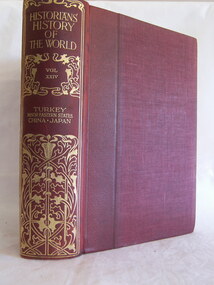
Book - Reference Book/History, Henry Smith Williams, The Historians History of the World Vol 24 set 1 - Edited by Henry Smith Williams L.L.D. Published by “The Times” 1908, 1908
... This volume highlights the 19th-century theme of "Nationalism" specifically how ethnic and religious identities within Poland and the Balkans survived centuries of foreign rule. While previous volumes handled the major empires (Britain, France, Germany), Volume 24 completes the map of Europe by giving voice to the smaller or occupied nations, ensuring the set lived up to its name as a world history. flagstaff hill warrnambool shipwrecked-coast flagstaff-hill flagstaff-hill-maritime-museum maritime-museum shipwreck-coast flagstaff-hill-maritime-village book the historians history of the world vol 24 set 1 In the 1908 edition of The Historians' History of the World, Volume 24 acts as the definitive survey of the "Eastern Question" and the peripheral powers of Europe. ...In the 1908 edition of The Historians' History of the World, Volume 24 acts as the definitive survey of the "Eastern Question" and the peripheral powers of Europe. It shifts focus away from the Western powers of the time to examine the complex histories of the East and the South. The contents cover, Poland, the Balkans, Turkey, and Minor Nations Volume 24 becomes a geographically diverse volume that covers the history of several regions that were, in 1908, centres of intense geopolitical tension.The Book is part of a 25 volume set with red cloth bindings and gold filigree design to rib.non-fictionIn the 1908 edition of The Historians' History of the World, Volume 24 acts as the definitive survey of the "Eastern Question" and the peripheral powers of Europe. It shifts focus away from the Western powers of the time to examine the complex histories of the East and the South. The contents cover, Poland, the Balkans, Turkey, and Minor Nations Volume 24 becomes a geographically diverse volume that covers the history of several regions that were, in 1908, centres of intense geopolitical tension. flagstaff hill, warrnambool, shipwrecked-coast, flagstaff-hill, flagstaff-hill-maritime-museum, maritime-museum, shipwreck-coast, flagstaff-hill-maritime-village, book, the historians history of the world vol 24 set 1 -
 Flagstaff Hill Maritime Museum and Village
Theodolite, Troughton & Simms, Mid 19th Century
... identity portraits of members of the Victorian Court, Centennial International Exhibition, Melbourne, 1888. (See further details below.) History for Troughton & Simms: Edward Troughton & William Simms established a scientific instrument making business in London in 1826. Edward Troughton (1756-1835) had previously...identity portraits of members of the Victorian Court, Centennial International Exhibition, Melbourne, 1888. (See further details below.) History for Troughton & Simms: Edward Troughton & William Simms established a scientific instrument making business in London in 1826. Edward Troughton (1756-1835) had previously ...The theodolite was sold by T. Gaunt & Co. of Melbourne, a manufacturer, importer and retailer of a wide variety of goods including jewellery, clocks and watches, navigational and measuring instruments, dinnerware, glassware and ornaments. Thomas Gaunt photograph was included in an album of security identity portraits of members of the Victorian Court, Centennial International Exhibition, Melbourne, 1888. (See further details below.) History for Troughton & Simms: Edward Troughton & William Simms established a scientific instrument making business in London in 1826. Edward Troughton (1756-1835) had previously had his own scientific instrument business, inherited from his father. His achievement's included a transit telescope for Greenwich Observatory (1816) and the precision surveying instruments for the Ordnance Survey of Britain, Ireland and India. William Simms (1793-1860) had trained as a goldsmith and began to gain work dividing circles on fine astronomical instruments. When William Simms died in 1860, the business was taken over by his son James and nephew William. Troughton & Simms shop in Fleet Street became the hub of the finest scientific instrument made in London, in a period in which there was an expanding demand for precision instruments, for astronomy, surveying and precision measurement. They made instruments for Greenwich Observatory, for imperial surveys and exploring expeditions. When fire destroyed the Houses of Parliament in 1834, the firm was commissioned to create new standard lengths, this required 10 years of testing against the remaining old measurements. Troughton and Simms made several of the main instruments for Melbourne Observatory, including an 18 inch azimuth used of the Geodetic Survey, portable transit instrument (circa 1850), zenith sector (1860), a 4.5 inch equatorial telescope (1862), an 8 inch equatorial telescope (1874) spectroscope (1877) and an 8 inch transit instrument in (1884). While the firm had an excellent reputation for quality the company exasperated many of its customers with delays of years in delivering some instruments. History for Thomas Gaunt: Thomas Ambrose Gaunt (1829 – 1890) was a jeweller, clock maker, and manufacturer of scientific instruments, whose head office and showroom were at 337–339 Bourke Street, Melbourne, Victoria, Australia. Thomas Gaunt established Melbourne's leading watchmaking, optical and jewellery business during the second half of the 19th century. Gaunt arrived in Melbourne in 1852, and by 1858 had established his own business at 14 Little Bourke Street. Around 1869 he moved to new premises in Bourke Street on the corner of Royal Arcade, Gaunt's shop quickly became a Melbourne institution. Gaunt proudly advertised that he was 'The only watch manufacturer in the Australian colonies'. While many watches and clocks may have had Gaunt's name on the dial, few would have been made locally. Gaunt did make some watches for exhibitions, and perhaps a few expensive watches for wealthy individuals. Gaunt's received a telegraph signal from Melbourne Observatory each day to correct his main clock and used this signal to rate and repair ship's chronometers and good quality watches. Thomas Gaunt also developed a department that focused on scientific instrumentation, making thermometers and barometers (from imported glass tubes), telescopes, surveying instruments and microscopes. Significance: With the rapid urban expansion, one of the most important needs of the new colony was to survey and map the landscape of the Australian Colony’s interior. Theodolites, such as this one, made by Troughton and Simms, who were significant scientific instrument makers of the 19th century were instrumental to the colony's surveyors and would have played an important part in their everyday work. This transit theodolite remains of national significance due to its pioneering role in Australian science and its association with Australia's earliest surveyors and astronomers. It is also significant for its association with nineteenth-century surveying instruments and instrument makers. Theodolite, Vernier repetition theodolite with enclosed horizontal circle (of about 130 mm diameter). Vertical circle exposed and somewhat corroded (diameter about 115 mm). Plate level 20" per division. Altitude bubble 20" per division. Horizontal and vertical circle intervals 20". Original (blue/grey) paint. Altitude bubble setting screw disabled. Tribrach allows movement of theodolite by 15 mm inside tribrach (for centering).Inscribed on the inner mounting plate,“Specially made in England for T Gaunt & Co Melbourne” and inscribed a little lower “Troughton & Simms London”flagstaff hill, warrnambool, shipwrecked-coast, flagstaff-hill, flagstaff-hill-maritime-museum, maritime-museum, shipwreck-coast, flagstaff-hill-maritime-village, theodolite, t. gaunt & co, troughton & simms, scientific instrument, measuring instrument, surveyor's instrument -
 The Beechworth Burke Museum
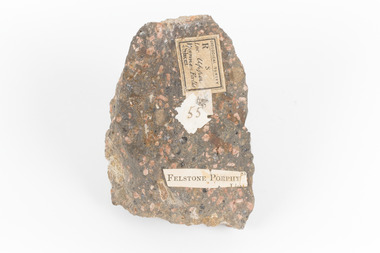
Geological specimen - Porphyritic Rhyodacite
... previously named the Upper Wannon Falls), Victoria. The falls are fed by the Wannon River that has its head waters in the Grampians mountains. Approx. 10km upstream of the Wannon Falls, Nigretta is a multi-channel segmented cascade of smaller drops and bounces guided by patterns of joints in a much older (Devonian) rhyolitic volcanic rock. Both the Wannon and Nigretta Falls are iconic landscape features, entrenched in the history and identity...previously named the Upper Wannon Falls), Victoria. The falls are fed by the Wannon River that has its head waters in the Grampians mountains. Approx. 10km upstream of the Wannon Falls, Nigretta is a multi-channel segmented cascade of smaller drops and bounces guided by patterns of joints in a much older (Devonian) rhyolitic volcanic rock. Both the Wannon and Nigretta Falls are iconic landscape features, entrenched in the history and identity ...This specimen was recovered from the Nigretta Falls (previously named the Upper Wannon Falls), Victoria. The falls are fed by the Wannon River that has its head waters in the Grampians mountains. Approx. 10km upstream of the Wannon Falls, Nigretta is a multi-channel segmented cascade of smaller drops and bounces guided by patterns of joints in a much older (Devonian) rhyolitic volcanic rock. Both the Wannon and Nigretta Falls are iconic landscape features, entrenched in the history and identity of the region. These falls are particularly rare as they are the product of volcanic activity, which is unique in the context of the Volcanic Plain of Victoria. Waterfalls of this capacity are generally associated with the Uplands areas of Victoria, rather than the edges of the Volcanic Plain. This specimen is part of a larger collection of geological and mineral specimens collected from around Australia (and some parts of the world) and donated to the Burke Museum between 1868-1880. A large percentage of these specimens were collected in Victoria as part of the Geological Survey of Victoria that begun in 1852 (in response to the Gold Rush) to study and map the geology of Victoria. Collecting geological specimens was an important part of mapping and understanding the scientific makeup of the earth. Many of these specimens were sent to research and collecting organisations across Australia, including the Burke Museum, to educate and encourage further study. A solid, dark grey mineral specimen with pale terracotta coloured inclusions. Rhyodacite is a volcanic rock intermediate in composition between dacite and rhyolite. Rhyodacites form from rapid cooling of lava relatively rich in silica and low in alkali metal oxides.GEOLOGICAL SURVEY / R / S 55 FELSTONE PORPHYburke museum, beechworth, indigo shire, beechworth museum, geological, geological specimen, porphyritic rhyodacite, lava, nigretta falls, upper wannon falls, dacite, rhyolite, volcanic geology -
 Bendigo Historical Society Inc.
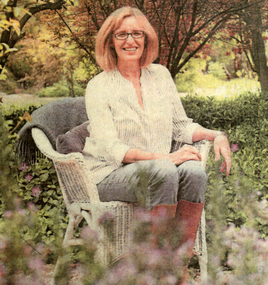
Newspaper - Bendigo Advertiser Article - Historic win for Katrina, Sat Oct 23 2021
... previous month. The ARA Historical Novel Prize is a significant award, with $100,000 in total prize money; the CYA category winner receives $30,000. We Are Wolves is Nannestad's first historical novel, inspired by a tidbit she sent to her publisher. The story follows Liesl, Otto, and baby Mia Wolf as they flee East Prussia and survive as displaced war orphans. The novel explores themes of identity...previous month. The ARA Historical Novel Prize is a significant award, with $100,000 in total prize money; the CYA category winner receives $30,000. We Are Wolves is Nannestad's first historical novel, inspired by a tidbit she sent to her publisher. The story follows Liesl, Otto, and baby Mia Wolf as they flee East Prussia and survive as displaced war orphans. The novel explores themes of identity ...Katrina Nannestad won the 2021 ARA Historical Novel Prize in the Children and Young Adult (CYA) category for her book We Are Wolves. Nannestad, a teacher and children's author, received the prize after being shortlisted the previous month. The ARA Historical Novel Prize is a significant award, with $100,000 in total prize money; the CYA category winner receives $30,000. We Are Wolves is Nannestad's first historical novel, inspired by a tidbit she sent to her publisher. The story follows Liesl, Otto, and baby Mia Wolf as they flee East Prussia and survive as displaced war orphans. The novel explores themes of identity, family, trust, survival, and hope. The judging panel, chaired by Paul Macdonald, praised the novel for its writing, research, and appeal to both young and older readers.The book was described as simple, poetic, deeply moving, and a brilliant exploration of important issues.Bendigo Advertiser Article - Historic win for Katrina Sat Oct 23 2021 Page 2 Bendigo weekly This item contains the following documents 3486.52a Colour photo of Sedgwick author Katrina Nannestad 3486.52b The article Historic win for Katrinabendigo, author katrina nannestead novelist -
 Alfred Hospital Nurses League - Nursing History Collection
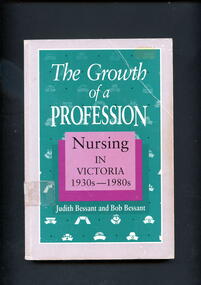
Book - Illustrated book, Judith Bessant et al, The Growth of a Profession: Nursing in Victoria 1930s-1980s, 1991
... identity within medicine, improving wages and conditions and the transferring of nurse education into the tertiary sector. The book culminates with the nurses' strike of 1986. On front end paper is a printed black and white donation sticker: black Maltese cross in circle, "This book was donated to Alfred Archival Association Nursing Division by" Also on this page is a dedication "To AHNL from Judith Bessant Bob Bessant" hand-written and signed by them in blue ink. previous catalogue number is written in blue ink in top right-hand corner of this page. ...This book is about nurses and nursing in Victoria from the 1930s until the 1980's. It traces the difficult steps that the nursing profession has made towards forging its identity within medicine, improving wages and conditions and the transferring of nurse education into the tertiary sector. The book culminates with the nurses' strike of 1986.Illustrated book. Front cover, within a light grey border, has part of title and authors names printed in white on a green background, also on this background are illustrations of nurses' caps in graduating colour shades of green to white. Between the title and authors names is a light pink square offset on a larger dark pink rectangle. On this square the rest of the title is printed in black ink. Abbreviated title, authors and publishers name are printed in black ink on a grey background. On the back cover are printed a synopsis of the book, authors details and publishers name on a grey rectangular background, with a green border.non-fictionThis book is about nurses and nursing in Victoria from the 1930s until the 1980's. It traces the difficult steps that the nursing profession has made towards forging its identity within medicine, improving wages and conditions and the transferring of nurse education into the tertiary sector. The book culminates with the nurses' strike of 1986.nurses - victoria-history, nursing-victoria-history, royal victorian college of nursing, royal australian nursing federation-victorian branch-history -
 Alfred Hospital Nurses League - Nursing History Collection
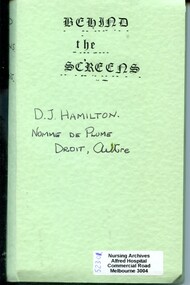
Book, Doris J Hamilton, Behind the screens, 1925
... Apparently she was still working at the Alfred Hospital when her true identity was revealed and instantly dismissed 'as a warning to others [see 202605.031] Provides insight into conditions faced by student nurses in the 1920's Doris Jean Hamilton Alfred Hospital Nurse training-Victoria-history The author undertook her nursing training in the early 1920's and details the endless hard work, unduly strict discipline andd the strange hierachy faced by student nurses at that time At bottom right there is a small white rectangular sticker with black print 'Nursing Archive/Alfred Hospital/Commercial Rd/Melbourne 3004' Previous catalogue number is handwitten [black ink] on this sticker. previous catalogue number also handwritten inside front cover at top left. ...The author undertook her nursing training in the early 1920's and details the endless hard work, unduly strict discipline andd the strange hierachy faced by student nurses at that timePhotocopied book with green cover and black print. Title printed and author's name and nomme de plume handwitten [black ink] on front cover. pages have been gluednon-fictionThe author undertook her nursing training in the early 1920's and details the endless hard work, unduly strict discipline andd the strange hierachy faced by student nurses at that timedoris jean hamilton, alfred hospital, nurse training-victoria-history -
 Alfred Hospital Nurses League - Nursing History Collection
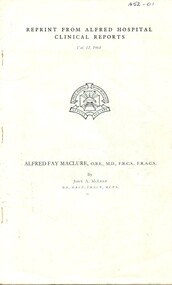
Booklet - Illustrated biography, John A McLean, Alfred Fay Maclure, 1964
... The biography origionally appeared in the Alfred Hospital Clinical Reports, Vol 12, 1964 Provides information about a noted Alfred Hospital identity Alfred Fay Maclure Alfred Hospital Surgeons Handwritten at top right of the cover page is the previous catalogue number [black ink] Illustrated booklet, staples have ben removed. ...Alfred Fay Maclure (1883-1956) was a well known surgeon at the Alfred Hospital. His association with the Alfred began in 1908 when he became house surgeon to Hamilton Rusell. During World War I, he served with the Australian Army at Lemnos, Egypt and France, he was mentioned twice in despatches and awarded the O.B.E. Mr Maclure also spent six months working at the special plastic surgery centre at Sidcup, England. After the war he returned to work at the Alfred, and was subdean of the medical school during the 1920's. Mr Maclure had been due to retire in 1943, but he stayed on as an Honourary Surgeon until 1943 when he suffered a cereco-vascular accident. Mr Maclure trained 75 house surgeons during the 25 years he was an inpatient surgeon at the Alfred. The biography origionally appeared in the Alfred Hospital Clinical Reports, Vol 12, 1964Provides information about a noted Alfred Hospital identityIllustrated booklet, staples have ben removed. Black print on whtie background. In the centre of the cover page is the logo of the Alfred Hospital, above this is information about original publication, below is the title and author. Handwritten at top right is the previous catalogue number [black ink]Handwritten at top right of the cover page is the previous catalogue number [black ink]alfred fay maclure, alfred hospital, surgeons -
 Warrnambool and District Historical Society Inc.
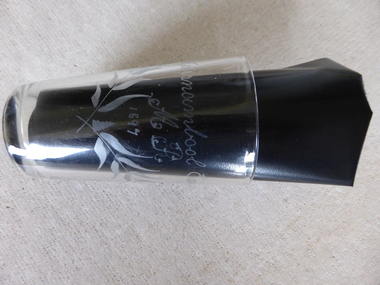
Souvenir - Tumbler etched glass Warrnambool exhibition 1896-7, 1897
... previous to this. No doubt many of his engraved objects were sold and this glass tumbler would be one of these. This is a valuable and significant item because:- 1. It is an important souvenir from the Warrnambool Industrial and Art Exhibition of 1896-7, the only one we have from Villiers’ stall. 2. It is an example of what is believed to be the first etching on glass to be done in Warrnambool. The identity ...The Warrnambool Industrial and Art Exhibition of 1896-7 was held for three months in the Town Hall/Council Chambers/ Mechanics Institute buildings with additional temporary buildings placed on the Liebig and Timor Streets corner area. It was one of the biggest events ever held in Warrnambool with an estimated 70,000 attending. John Villiers, the owner of a glassware and crockery shop in Liebig Street and a well-known theatrical performer, had a large display stand at the Exhibition. He displayed glassware items from Britain and Europe and sold souvenirs of the Exhibition. Villiers engaged Mr Bartholomew, a Melbourne engraving artist, and he gave engraving exhibitions at Villiers’ stall. Glass etching had not been seen in Warrnambool previous to this. No doubt many of his engraved objects were sold and this glass tumbler would be one of these. This is a valuable and significant item because:- 1. It is an important souvenir from the Warrnambool Industrial and Art Exhibition of 1896-7, the only one we have from Villiers’ stall. 2. It is an example of what is believed to be the first etching on glass to be done in Warrnambool. The identity of ‘M.R.’ is not known. This is an etched glass tumbler from the Warrnambool Industrial and Art Exhibition of 1896-7. It is plain glass with a solid base. A three branched frond of fern is on one side of the glass and a two-branched frond of leaves on the other. ‘Warrnambool Exhibition, M.R. 1897’ warrnambool, warrnambool industrial and art exhibition 1896-7, etched glass tumbler, john villiers 1896, warrnambool souvenirs, villiers -
 Victorian Aboriginal Corporation for Languages
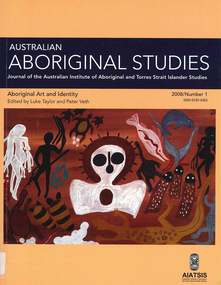
Periodical, Australian Institute of Aboriginal and Torres Strait Islander Studies, Australian Aboriginal studies : journal of the Australian Institute of Aboriginal and Torres Strait Islander Studies, 2008
... It is possible that the intervention that Robinson might have considered revolutionary was more likely a continuation of previously well established cultural practice, the commercial development of which was both an Indigenous ?adjustment? to changing socio-cultural circumstances, and a quiet statement of maintenance of identity by strong individuals adapting and attempting to continue their cultural traditions. 4. ...It is possible that the intervention that Robinson might have considered revolutionary was more likely a continuation of previously well established cultural practice, the commercial development of which was both an Indigenous ?adjustment? to changing socio-cultural circumstances, and a quiet statement of maintenance of identity by strong individuals adapting and attempting to continue their cultural traditions. 4. ...1. Rock-art of the Western Desert and Pilbara: Pigment dates provide new perspectives on the role of art in the Australian arid zone Jo McDonald (Australian National University) and Peter Veth (Australian National University) Systematic analysis of engraved and painted art from the Western Desert and Pilbara has allowed us to develop a spatial model for discernable style provinces. Clear chains of stylistic connection can be demonstrated from the Pilbara coast to the desert interior with distinct and stylistically unique rock-art bodies. Graphic systems appear to link people over short, as well as vast, distances, and some of these style networks appear to have operated for very long periods of time. What are the social dynamics that could produce unique style provinces, as well as shared graphic vocabularies, over 1000 kilometres? Here we consider language boundaries within and between style provinces, and report on the first dates for pigment rock-art from the Australian arid zone and reflect on how these dates from the recent past help address questions of stylistic variability through space and time. 2. Painting and repainting in the west Kimberley Sue O?Connor, Anthony Barham (Australian National University) and Donny Woolagoodja (Mowanjum Community, Derby) We take a fresh look at the practice of repainting, or retouching, rockart, with particular reference to the Kimberley region of Western Australia. We discuss the practice of repainting in the context of the debate arising from the 1987 Ngarinyin Cultural Continuity Project, which involved the repainting of rock-shelters in the Gibb River region of the western Kimberley. The ?repainting debate? is reviewed here in the context of contemporary art production in west Kimberley Indigenous communities, such as Mowanjum. At Mowanjum the past two decades have witnessed an artistic explosion in the form of paintings on canvas and board that incorporate Wandjina and other images inspired by those traditionally depicted on panels in rock-shelters. Wandjina also represents the key motif around which community desires to return to Country are articulated, around which Country is curated and maintained, and through which the younger generations now engage with their traditional lands and reach out to wider international communities. We suggest that painting in the new media represents a continuation or transference of traditional practice. Stories about the travels, battles and engagements of Wandjina and other Dreaming events are now retold and experienced in the communities with reference to the paintings, an activity that is central to maintaining and reinvigorating connection between identity and place. The transposition of painting activity from sites within Country to the new ?out-of-Country? settlements represents a social counterbalance to the social dislocation that arose from separation from traditional places and forced geographic moves out-of-Country to government and mission settlements in the twentieth century. 3. Port Keats painting: Revolution and continuity Graeme K Ward (AIATSIS) and Mark Crocombe (Thamarrurr Regional Council) The role of the poet and collector of ?mythologies?, Roland Robinson, in prompting the production of commercial bark-painting at Port Keats (Wadeye), appears to have been accepted uncritically - though not usually acknowledged - by collectors and curators. Here we attempt to trace the history of painting in the Daly?Fitzmaurice region to contextualise Robinson?s contribution, and to evaluate it from both the perspective of available literature and of accounts of contemporary painters and Traditional Owners in the Port Keats area. It is possible that the intervention that Robinson might have considered revolutionary was more likely a continuation of previously well established cultural practice, the commercial development of which was both an Indigenous ?adjustment? to changing socio-cultural circumstances, and a quiet statement of maintenance of identity by strong individuals adapting and attempting to continue their cultural traditions. 4. Negotiating form in Kuninjku bark-paintings Luke Taylor (AIATSIS) Here I examine social processes involved in the manipulation of painted forms of bark-paintings among Kuninjku artists living near Maningrida in Arnhem Land. Young artists are taught to paint through apprenticeships that involve exchange of skills in producing form within extended family groups. Through apprenticeship processes we can also see how personal innovations are shared among family and become more regionally located. Lately there have been moves by senior artists to establish separate out-stations and to train their wives and daughters to paint. At a stylistic level the art now creates a greater sense of family autonomy and yet the subjects link the artists back in to much broader social networks. 5. Making art and making culture in far western New South Wales Lorraine Gibson This contribution is based on my ethnographic fieldwork. It concerns the intertwining aspects of the two concepts of art and culture and shows how Aboriginal people in Wilcannia in far western New South Wales draw on these concepts to assert and create a distinctive cultural identity for themselves. Focusing largely on the work of one particular artist, I demonstrate the ways in which culture (as this is considered) is affectively experienced and articulated as something that one ?comes into contact with? through the practice of art-making. I discuss the social and cultural role that art-making, and art talk play in considering, mediating and resolving issues to do with cultural subjectivity, authority and identity. I propose that in thinking about the content of the art and in making the art, past and present matters of interest, of difficulty and of pleasure are remembered, considered, resolved and mediated. Culture (as this is considered by Wilcannia Aboriginal people) is also made anew; it comes about through the practice of artmaking and in displaying and talking about the art work. Culture as an objectified, tangible entity is moreover writ large and made visible through art in ways that are valued by artists and other community members. The intersections between Aboriginal peoples, anthropologists, museum collections and published literature, and the network of relations between, are also shown to have interesting synergies that play themselves out in the production of art and culture. 6. Black on White: Or varying shades of grey? Indigenous Australian photo-media artists and the ?making of? Aboriginality Marianne Riphagen (Radboud University, The Netherlands) In 2005 the Centre for Contemporary Photography in Melbourne presented the Indigenous photo-media exhibition Black on White. Promising to explore Indigenous perspectives on non-Aboriginality, its catalogue set forth two questions: how do Aboriginal artists see the people and culture that surrounds them? Do they see non-Aboriginal Australians as other? However, art works produced for this exhibition rejected curatorial constructions of Black and White, instead presenting viewers with more complex and ambivalent notions of Aboriginality and non-Aboriginality. This paper revisits the Black on White exhibition as an intercultural event and argues that Indigenous art practitioners, because of their participation in a process to signify what it means to be Aboriginal, have developed new forms of Aboriginality. 7. Culture production Rembarrnga way: Innovation and tradition in Lena Yarinkura?s and Bob Burruwal?s metal sculptures Christiane Keller (University of Westerna Australia) Contemporary Indigenous artists are challenged to produce art for sale and at the same time to protect their cultural heritage. Here I investigate how Rembarrnga sculptors extend already established sculptural practices and the role innovation plays within these developments, and I analyse how Rembarrnga artists imprint their cultural and social values on sculptures made in an essentially Western medium, that of metal-casting. The metal sculptures made by Lena Yarinkura and her husband Bob Burruwal, two prolific Rembarrnga artists from north-central Arnhem Land, can be seen as an extension of their earlier sculptural work. In the development of metal sculptures, the artists shifted their artistic practice in two ways: they transformed sculptural forms from an earlier ceremonial context and from earlier functional fibre objects. Using Fred Myers?s concept of culture production, I investigate Rembarrnga ways of culture-making. 8. 'How did we do anything without it?': Indigenous art and craft micro-enterprise use and perception of new media technology.maps, colour photographs, b&w photographswest kimberley, rock art, kuninjku, photo media, lena yarinkura, bob burruwal, new media technology -
 Ballarat Tramway Museum
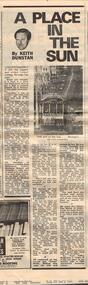
Newspaper, Herald Sun, "A Place in the Sun", 17/04/1972 12:00:00 AM
... Newspaper clipping from The Melbourne Sun, dated Monday 17/4/1972, column written by Keith Dunstan titled "A place in the sun" detailing the events, musings and some identities names of the closure of the Bendigo tramway system the previous day. ...Bendigo Tramway Closure Last Tram Newspaper clipping from The Melbourne Sun, dated Monday 17/4/1972, column written by Keith Dunstan titled "A place in the sun" detailing the events, musings and some identities names of the closure of the Bendigo tramway system the previous day. ...Newspaper clipping from The Melbourne Sun, dated Monday 17/4/1972, column written by Keith Dunstan titled "A place in the sun" detailing the events, musings and some identities names of the closure of the Bendigo tramway system the previous day. Has a photo of No. 26 climbing View St from Charing Cross. One of a large group of newspaper cuttings from John Bainbridge, 7/4/02. Item has been folded for inclusion within a scrap book. Has a piece of plain paper Secured to the back of the portion that was not Secured to the scrap book itself. For full print of the photograph, see Reg Item 3888.bendigo, tramway closure, last tram -
 Ballarat Tramway Museum
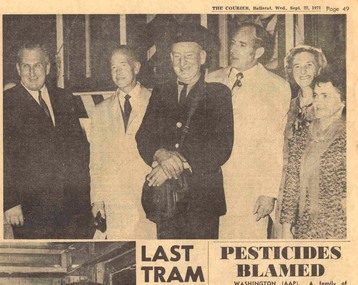
Newspaper, The Courier Ballarat, "Last Tram", 22/09/1971
... Two photos of crews and identities involved in the running of the Last tram the previous Sunday. ...Two photos of crews and identities involved in the running of the Last tram the previous Sunday. ...Newspaper clipping from The Courier, Ballarat, Wed. 22/9/1971, pages 7, 8 and 49,50. Pages 7 and 8 - see Reg. Item 1846, Pieces of Tram History - "Ballarat Tramways Sample Tickets". Pages 49 and 50 - "Last Tram". Two photos of crews and identities involved in the running of the Last tram the previous Sunday. Photos feature: Cr N.F. Donald, Mayor of Sebastopol, handing the tram keys over to Cr. J. Chisholm , at the town boundary. Others featured in the first photo, Mr. L. J. Denmead, L. Walker, Mrs. Chisholm and Mrs Donald. The Second photo feature: Eddie Lake, Alec Turnbull, Joe Smerdon and Herb Knight. Under photos has a Railways of Australia, RoA, advertisement titled "The Age of superpower". See Reg Item 3335 for an actual print of this photograph - but in poor condition. For other photographs of the event see Reg Item 6423last tram, city of ballaarat, borough of sebastopol, closure -
 Melton City Libraries
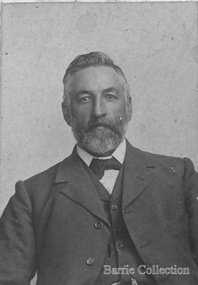
Photograph, Thomas Lang, 1905
... previous school was Coliban SS No 1920. Mr Lang was the Head Teacher at Melton until 1917. In 1910 he was a Committee Member Melton Mechanics Institute and Public Library atits establishment. He was a Life Member of the Melton Mechanics Institute In 1875, he married Mary Elizabeth Coates on the 30th December at the home of Mrs Coates, Thomas Lang of Norton’s Creek aged 26 andMary Elizabeth aged 24 of Armstrongs. They had 9 children, Thomas.J. Lang, George William, Jessie, Maude, Effie, Walter, Horace, Eva and James. Passed away in 1927. Local Identities ...Born on the 22nd October 1852 or 1849 St Ives Cornwall, in 1896 Thomas and Mary Elizabeth moved to Melton. Mr Lang’s previous school was Coliban SS No 1920. Mr Lang was the Head Teacher at Melton until 1917. In 1910 he was a Committee Member Melton Mechanics Institute and Public Library atits establishment. He was a Life Member of the Melton Mechanics Institute In 1875, he married Mary Elizabeth Coates on the 30th December at the home of Mrs Coates, Thomas Lang of Norton’s Creek aged 26 andMary Elizabeth aged 24 of Armstrongs. They had 9 children, Thomas.J. Lang, George William, Jessie, Maude, Effie, Walter, Horace, Eva and James. Passed away in 1927. Black and white photo of Langlocal identities, education -
 Melton City Libraries
Archive, Western Highway Petroleum, Unknown
... Local Identities Advertisement of Western Highway Petroleum, business previously located on Western Highway, Melton. ...Advertisement of Western Highway Petroleum, business previously located on Western Highway, Melton. local identities -
 Melton City Libraries
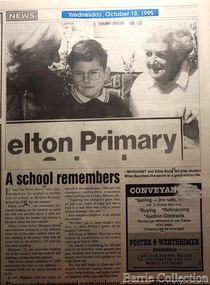
Newspaper, A school remembers, 1995
... previous masonry ones. An endowment pine plantation established in 1930 augmented the school’s fundraising activities when it was harvested in 1968. Part of the site was planted with eucalyptus trees in 1959. Famous ex-students of the early twentieth century included Hector Fraser (internationally successful shooter) and cyclist Sir Hubert Opperman". Education Local Identities ..."On 17th May 1858 a State subsidised, combined Denominational School was opened by HT Stokes, with an attendance of about 30 children. This school was conducted in the wooden Melton Combined Protestant Church, situated on ‘a creek flat’ thought to be on the north side of Sherwin Street between Pyke and Byran Streets. It is likely that the Church had been established by 1855 and that the first minister was the Rev. Hampshire, who lived in Cambridge House on the Exford Estate. Ministers of the Protestant denominations were invited to hold services there. As there was only one resident Minister in the town (Presbyterian Mr J Lambie), laymen of the various denominations often spoke on Sundays. In 1863 this building was declared a Common School with the number 430. One of its first and most prominent headmasters was John Corr, who served from 1860 to 1864. Most of Mr Corr’s children also became teachers, including Joseph Corr, at the Rockbank school, and J Reford Corr and WS Corr, headmasters and teachers at numerous prestigious private secondary schools around Australia. John Corr purchased land alongside the school and elsewhere in and near Melton, became secretary and treasurer of the new Cemetery Trust, and by July 1861 was deputy registrar of births, deaths and marriages. He walked three miles every Sunday to teach at the Weslyan Sunday School he had established. Despite good reports from the Education Department Inspector, and burgeoning enrolments, the local school committee recommended the dismissal of, firstly, his wife (from the work mistress position), and then him from the headmaster position. Corr saw his dismissal as an attempt to redirect state aid for education from the Combined Protestant school to the support of the Free Presbyterian Minister Rev James Lambie (by one account the owner of the land on which the Common School was erected), whose son-in-law James Scott subsequently assumed responsibility for the school. Rev Lambie failed in his efforts to keep the existing school, which the Education Department Inspector and the majority of Melton citizens regarded as badly situated and badly built. Following a conditional promise of state aid, local contributors in 1868-69 raised ₤72.10.6 towards the cost of an iron-roofed bluestone rubble building 43 ft x 12 ft. This was erected on a new site of 1.5 acres (the present site). The State contributed ₤120 to the new school, which opened in 1870. A very early (c.1874) photograph of the school shows its headmaster and work mistress / assistant teacher (probably James Scott and his wife Jessie) and its (very young) scholars. Similar photos show pupils in front of the school in c.1903, and 1933. In 1877 a second bluestone room costing ₤297 was added and further land acquired from the Agricultural Society (who only needed it two days a year) to enlarge the schoolground to 3 acres. In the early 1880s an underground tank augmented the school water supply and in 1919 a five-roomed wooden residence was added. During this period the school correspondents often compained that the walls of the bluestone buildings were damp, affecting the plaster. In 1923 a brick room 26 ft 6 in by 24 ft with a fireplace and four rooms facing south, was added, and a corridor built to link the three buildings. This served adequately for the next 40 years. The school bell probably dates to 1883. The school also has a memorial gate (1951) to World War One ex-students, and an honour board to the 64 ex-students who served in the First World War. The school roll fell to 42 in the early post war-years, but was boosted by an influx of migrants, mainly from the UK, from the late 1960s. This presaged the boom in Melton’s development, and the corresponding growth of the school, with timber and temporary classrooms added to the previous masonry ones. An endowment pine plantation established in 1930 augmented the school’s fundraising activities when it was harvested in 1968. Part of the site was planted with eucalyptus trees in 1959. Famous ex-students of the early twentieth century included Hector Fraser (internationally successful shooter) and cyclist Sir Hubert Opperman". Photo of Edna and Margaret Barrie with Miles Baunders taken for the Telegrapheducation, local identities -
 Melton City Libraries
Photograph, Melton Fire Brigade Memorial Wall, 2013
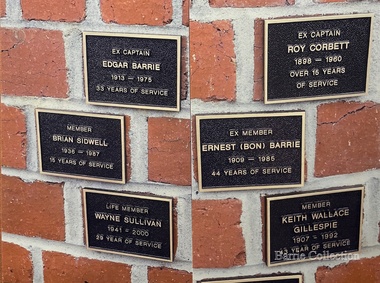
... Previously the Mt Cotterell Group VL3LY communication headquarters occupied their h ome in Ferris road at its inception in 1967. The First Avenue headquarters and map room, with radio equipment was also housed at the residence. It was operated with an additional cable connection to Fireman Wayne Sullivan (Deputy C/O) who resided at the rear in Kurrajong Cr. Emergency services local identities ...Ernest W (Bon) Barrie, 1909 – 1985 Melton Fire Brigade (and predecessor Bush Fire Brigade) Apparatus Officer, 1945 - 1953 Captain, 1951 - 1965 Mt Cotterill Fire Brigades’ Group Elected Group Officer, on the formation of the Group, 1967. As Group Communications Officer he operated the VL3 LY base radio station from home on a 24 hour basis for fire brigades of Melton, Rockbank, Sydenham, Diggers Rest, Toolern Vale, Truganina and Werribee. With his brother Edgar, he built the first Melton Fire Truck. It was housed on the family property until a fire station was constructed in the Melton township. Recipient of the Queens Medal, 1979 Recognised for 44 years of service on the Melton Fire Brigade Memorial Wall Plaque, dedicated May 2013 Mt Cotterell Fire Brigades G H Q and aerial was erected at No 17 - 19 First Avenue in 1974 at the home of Edna and Bon Barrie. Previously the Mt Cotterell Group VL3LY communication headquarters occupied their h ome in Ferris road at its inception in 1967. The First Avenue headquarters and map room, with radio equipment was also housed at the residence. It was operated with an additional cable connection to Fireman Wayne Sullivan (Deputy C/O) who resided at the rear in Kurrajong Cr.Section of the Melton Fire Brigade Memorial wall with brigade members who have passed away while as members. emergency services, local identities -
 Melbourne Legacy
Document, President's Fund Accounts 1971-1986, 1986
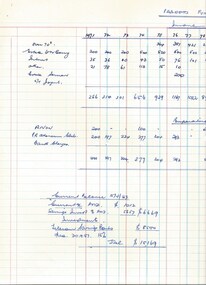
... previous 15 years. Donations continued to come from the Berry Fund and also from the Over 70s Legatees. The over 70s was a group of legatees that met up socially and after their annual meeting they forwarded a cheque to Legacy. Also appears to be donations from legatee Dono Joynt. The expenditure is marked as ANON to protect the identity...previous 15 years. Donations continued to come from the Berry Fund and also from the Over 70s Legatees. The over 70s was a group of legatees that met up socially and after their annual meeting they forwarded a cheque to Legacy. Also appears to be donations from legatee Dono Joynt. The expenditure is marked as ANON to protect the identity ...The President's Fund was created in 1932 by a donation from Legatee Walter W Berry from his late father's estate "to help temporarily embarrassed Melbourne Legatees" towards the end of The Great Depression. The aim of the fund was the give the President a way to help needy cases with discretion and without having to gain approval from committees. In many cases the money was repaid by the recipient. This sheet of accounts was compiled in 1986 to show the income and expenditure over the previous 15 years. Donations continued to come from the Berry Fund and also from the Over 70s Legatees. The over 70s was a group of legatees that met up socially and after their annual meeting they forwarded a cheque to Legacy. Also appears to be donations from legatee Dono Joynt. The expenditure is marked as ANON to protect the identity of the recipients and amounted to $7,600 over the 15 years. The note mentions some of the amounts are estimates. This document was in a folder labelled President's Fund Origin and Authorisation with many other documents that included correspondence, receipts of donations and material about when money was given to help appropriate cases. The folder was marked with H40 which is part of an early archive project from the late 1960s and early 1970s.The Presidents Fund was a significant help to legatees and junior legatees who were unable to obtain help from other sources.White lined paper with hand written columns of income and expenditure and a note that accompanied the account. Handwritten figures in blue ink.financial help, presidents fund -
 Melbourne Tram Museum
Pamphlet, Stephen Huxley for Swinburne University, "Thoroughly modern Millimetre" and "Makeover", c2001
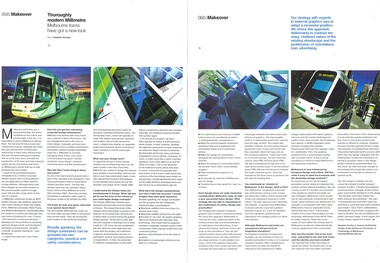
... Pamphlet - set of two A4 size full colour single side documents, titled "058:Makeover - Thoroughly modern Millimetre - Melbourne trams have got a new look" and "060 Makeover" about the application of the Yarra Trams" graphics or Corporate Identity to the C class trams by Millimetre, previously known as MYD Graphic Design. ...Trams tramways Yarra Trams C Class Livery Colour Schemes tram 3003 Pamphlet - set of two A4 size full colour single side documents, titled "058:Makeover - Thoroughly modern Millimetre - Melbourne trams have got a new look" and "060 Makeover" about the application of the Yarra Trams" graphics or Corporate Identity to the C class trams by Millimetre, previously known as MYD Graphic Design. ...Pamphlet - set of two A4 size full colour single side documents, titled "058:Makeover - Thoroughly modern Millimetre - Melbourne trams have got a new look" and "060 Makeover" about the application of the Yarra Trams" graphics or Corporate Identity to the C class trams by Millimetre, previously known as MYD Graphic Design. Details the basis of the design, the new C class trams, design considerations and the design brief. Has a photos of the exterior of C3003 and the interior design. Written by Stephen Huxley for Swinburne University. Two copies of each held.trams, tramways, yarra trams, c class, livery, colour schemes, tram 3003 -
 The Beechworth Burke Museum
Photograph - Poster - Reproduction, December 1878
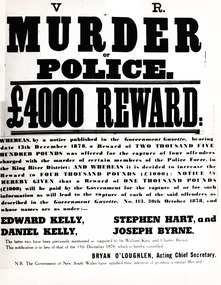
... The poster notes that the previous reward of £2500 offered on 13 December 1878 has been cancelled, and replaced with this increased reward money. The poster identities ...Poster created 13th December 1878 by the Government of New South Wales, offering a reward of £4000 for information leading to the capture of Edward Kelly, Daniel Kelly, Stephen Hart and Joseph Bryne. The men were charged with the murder of police in the King River District. The poster notes that the previous reward of £2500 offered on 13 December 1878 has been cancelled, and replaced with this increased reward money.The poster identities numerous Bushrangers who were being charged by the State Police Department in the late 19th Century. The large reward indicates the strong need and desire for information by the Police Department. The members of the Kelly Gang were hiding out in the Beechworth area.Black and white rectangular reproduced poster printed on paperObverse: V / R ./ MURDER / OF / POLICE. /£4000 REWARD:kelly album, wanted poster, reward, murder of police, edward kelly, daniel kelly, stephen hart, joseph byrne, £4000, king river district, 1878, kelly gang -
Linton Mechanics Institute and Free Library Collection
Book - Novel, Gibbs, George, The splendid outcast [with illustrations by the author], 1920
... As Jim delves into his memories, the novel explores issues of honour, identity and moral choices Book plate pasted inside front cover indicating book was previously in another collection: "Ballaarat Mechanics' Institute Circulating Library". 352 p. ill. ...Set during World War I, the story follows the life of Jim Horton, who has been injured and hospitalised, and who has assumed the name of his brother. As Jim delves into his memories, the novel explores issues of honour, identity and moral choices352 p. ill. (black & white plates). Plain dark green cover with leather trim on corners and spine. Title and author's name embossed in gold on spine. "Ballaarat Mechanics' Institute' also embossed on spine.fictionSet during World War I, the story follows the life of Jim Horton, who has been injured and hospitalised, and who has assumed the name of his brother. As Jim delves into his memories, the novel explores issues of honour, identity and moral choices fiction, george gibbs -
 Linton Mechanics Institute and Free Library Collection
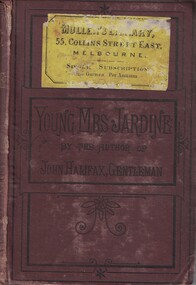
Book - Novel, Craik, Dinah Maria Mulock, Young Mrs. Jardine : 'By the author of 'John Halifax, gentleman' &c., &c.' (known to be Dinah Maria Mulock Craik) : in three volumes : Vol. II, 1879
... identity and independence. Fiction Dinah Maria Mulock Craik Book plate pasted to front cover indicating book was previously in another collection: "Mullen's Library, 55, Collins Street East, Melbourne" 303 p. : brown cover imprinted in black with with geometric design. ...303 p. : brown cover imprinted in black with with geometric design. Title and attribution ("by the author of John Halifax, Gentleman") imprinted on front cover in black, and on spine in gold.fictionfiction, dinah maria mulock craik -
Emerald Museum & Nobelius Heritage Park
Photograph - Emerald Football Club, Unknown maker
... There is also strong research potential as this is a rare image in where we know the identities of majority of the players within the photograph. emerald football club emerald mul moss Anthony Blank Damen Lund Danny Thomas Australian Rules Football Mountain District Football Association Emerald & District Collection Reverse: Emerald Football Club / Damen (Darien?) Lund going for the / ball / Mull Moss (back right) / no. 11, Anthony Blank. / THIS PAPER MANUFACTURED BY KODAK / " 14 Danny Thomas / KEMOM05025 NNNAA / VEMUP 411 / Black and white rectangular photograph printed on matte photographic paper. This black and white photograph depicts previous ...Emerald Football (Netball) Club has been established since 1905 and is a part of the Mountain District Football Association, which is now known as the Yarra Valley Mountain District Football League.This record holds strong historic significance as it captures an insight into the history of sport and recreation within Emerald and surrounding suburbs. There is also strong research potential as this is a rare image in where we know the identities of majority of the players within the photograph.Black and white rectangular photograph printed on matte photographic paper. This black and white photograph depicts previous Emerald Football Club players in action during a football game located at Emerald Football Club. The image consists of eight players; Damian Lund who is going for the ball, Mull Moss who is on the back right, Anthony Blank who is number 11 and Danny Thomas who is number 14.Reverse: Emerald Football Club / Damen (Darien?) Lund going for the / ball / Mull Moss (back right) / no. 11, Anthony Blank. / THIS PAPER MANUFACTURED BY KODAK / " 14 Danny Thomas / KEMOM05025 NNNAA / VEMUP 411 /emerald football club, emerald, mul moss, anthony blank, damen lund, danny thomas, australian rules football, mountain district football association, emerald & district collection -
Emerald Museum & Nobelius Heritage Park
Photograph - Claringbould Supermarket, Unknown photographer
... identity of the man pictured. This item holds historical significance as it shows what groceries stores looked like once; it could be used for research on groceries and their previous prices as well as research on what fruit and vegetables were available in the past. ...Further research is needed on the identity of the man pictured.This item holds historical significance as it shows what groceries stores looked like once; it could be used for research on groceries and their previous prices as well as research on what fruit and vegetables were available in the past.Black and white rectangular photograph. The black and white photograph depicts a man holding a bag of apples in his right hand, and a bag of oranges in his left hand. He stands in the corner of a grocery store, in the fruit and vegetable section. Behind him, occupying the right two-thirds of the photograph, we can see three levels of metal shelves holding various fruit and vegetables in them. Signs can be seen just below each shelf labelling what product is on the shelf and its price including signs for cauliflower at 75c each, cabbage at an unclear price, and pumpkins at 39c per kilogram. A sign with an image of fruit and vegetables on it can also be seen above the shelving. The man wears jeans and a pullover sweater over a collared shirt.Obverse: PUMPKINS / 39 C kg / CABBAGE CAULIFLOWER / Halves / C A 75 C EA /supermarket, vegetables, supermarket prices, emerald, victoria, australia -
Emerald Museum & Nobelius Heritage Park
Booklet - History Booklet, Williams, Dorothy et al, 1989
... Monbulk Memories: the Twenties|Nathania Springs and Beyond|Home with the McKellars|Catherine Mitchell's Family|Old Identities of Monbulk's Early Days|Between the Wars - Soft cover bound , total 50 pages. Contains five titles previously issued separately. ...Tait Monbulk Historical Society Monbulk Memories: the Twenties|Nathania Springs and Beyond|Home with the McKellars|Catherine Mitchell's Family|Old Identities of Monbulk's Early Days|Between the Wars - Soft cover bound , total 50 pages. Contains five titles previously issued separately. ...Volume compiled by Dorothy Williams, contains Monbulk Memoirs Series 5, 9, 10, 11, and 14. Nathania Springs and Beyond is the transcript of a talk given in 1986 by Sid Gay about his family to a Ladies' Guild luncheon; Home with the McKellars is Arthur Matthews's memories of his time as a foster child with the McKellar family; Catherine Mitchell's Family is a transcript of a conversation with John and Marion Mitchell about Catherine and Henry Mitchell, who came to live in Monbulk around 1893; Old Identities of Monbulk's Early Days, by Elizabeth Pack, recalls early settlement in Monbulk; Between Two Wars, by M.L. Tait (Dot Larter) relates the story of the Larter family who came to live in Monbulk after World War 1.Monbulk Memories: the Twenties|Nathania Springs and Beyond|Home with the McKellars|Catherine Mitchell's Family|Old Identities of Monbulk's Early Days|Between the Wars - Soft cover bound , total 50 pages. Contains five titles previously issued separately. Various pagings. ill., maps. ISBN 1875 301 275 etc.monbulk victoria australia, dandenong ranges, victoria, australia, pioneers, sid gay, dorothy williams, alexander mckellar, frances mckellar, catherine mitchell, john mitchell, marion mitchell, arthur matthews, elizabeth pack, m.l. tait, monbulk historical society
