
Showing 213 items matching "price family"
-
 Whitehorse Historical Society Inc.
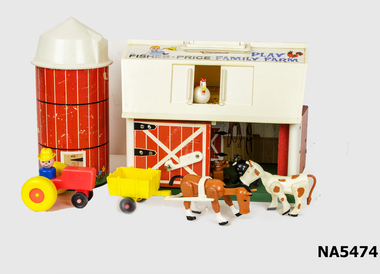
Education kit - Fisher Price Family Farm
... Fisher Price Family Farm...Fisher Price Family Barn which was originally donated by a local grandparent was used by Nunawading Toy Library....Fisher Price Family Play Farm...Fisher Price Family Barn which was originally donated by a local grandparent was used by Nunawading Toy Library. ...Fisher Price Family Barn which was originally donated by a local grandparent was used by Nunawading Toy Library.Barn with cream roof and red walls. Two doors open with tractor inside. Also with a cow, dog, pig and chicken. Also feed trough and horse and cart. Silo had cream roof with red sides and has 4 white fencing inside lid.Fisher Price Family Play Farmnunawading toy library, fisher price, toy, education -
 Mt Dandenong & District Historical Society Inc.
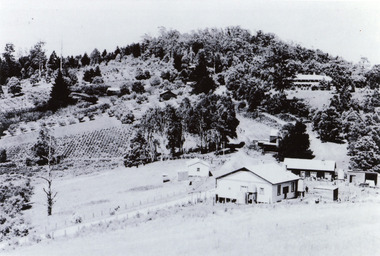
Photograph, View of Raspberry Crop and Orchard in Price Family Property
... View of Raspberry Crop and Orchard in Price Family Property...Wide view showing raspberry crop and orchards on Price Family property with home of Norman Jeeves in foreground and Hubert Jeeves' Motor garage to the left. ...View of Raspberry Crop and Orchard in Price Family Property Photograph Photograph ...Wide view showing raspberry crop and orchards on Price Family property with home of Norman Jeeves in foreground and Hubert Jeeves' Motor garage to the left. Long, dark building is now gallery. Tea House/Post office right of centre and Mountjoy Guest House up on hill. fiveways, jeeves, mountjoy, orchard, tea rooms, price, crop -
 Greensborough Historical Society
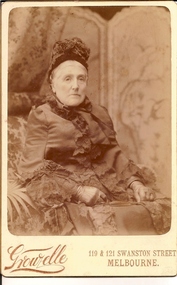
Photograph - Photograph (copy), Partington and Price family photographs, 1860-1915
... Partington and Price family photographs...family...ellen partington...archibald price...Four studio portraits of members of the Partington and Price family: 1] Grandma Gibbs of Kew who was the Grandma of Sarah Jane Gibbs (William Partington's first wife) who in turn was the Grandmother of Eva Partington. 2] Grandma Ellen Partington. ...Partington and Price family photographs Photograph Photograph (copy) ...Four studio portraits of members of the Partington and Price family: 1] Grandma Gibbs of Kew who was the Grandma of Sarah Jane Gibbs (William Partington's first wife) who in turn was the Grandmother of Eva Partington. 2] Grandma Ellen Partington. Ellen was one of 7 children of Benjamin and Sarah Whatmough. She married Charles Partington and they migrated to Australia in 1857, living at Point Lookout, the Watsonia Toll Gates and Willis Vale. Their children include Prudence, Maria, Charles [Junior]; Ben, Tom, Joe, and Will. 3] Archibald Price of Williamstown and Doris and Ivy Partington. [The Funeral notice for Archibald Price appears in the Williamstown Chronicle Saturday 22 January 1876, page 2]Copy of 4 photographs, sepia studio portraits.partington family, ellen partington, archibald price -
 Greensborough Historical Society
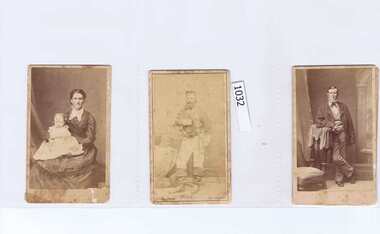
Photographs, Price Family studio photographs, 1869-1899
... Price Family studio photographs...Eva Partington's grandfather Archibald Price [Right Photo]. archibald price jane price Names of subjects written on back. 3 studio portraits, sepia. Price Family studio photographs Photographs ...Studio portraits of Jane Price (who died 31/12/1990) and child (Eva Partington born 1899). Jane price was first wife of Will Partington and died in childbirth two years after this photo. Eva Partington's grandfather Archibald Price [Centre Photo]. Eva Partington's grandfather Archibald Price [Right Photo].3 studio portraits, sepia.Names of subjects written on back.archibald price, jane price -
 Port of Echuca
A copy of a black and white photo, 24/09/1984
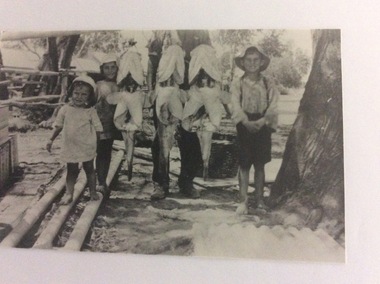
... ...price family collection...This photograph and P000066 and P000065 are all part of the Hugh Price Family collection of photographs....This photograph and P000066 and P000065 are all part of the Hugh Price Family collection of photographs. This photograph is significant because it shows the size and weight of Murray cod living in the river system in the 1920's. ...Fishing documentation around the Echuca area in the 1920's. The children are unknown. This photograph and P000066 and P000065 are all part of the Hugh Price Family collection of photographs.This photograph is significant because it shows the size and weight of Murray cod living in the river system in the 1920's. What sort of equipment would have been needed to bring such a heavy fish onto the bank?A copy of a black and white photograph of three children standing on either side of three Murray cods which are suspended from a stand behind them. Written in lead pencil on the back of the photograph are the words; Price. 90 lb. cod c. 1926. 'Jenkins Print Mildura. murray cod, price family collection, jenkins print mildura, 1926 -
 Greensborough Historical Society
Article, Faye Fort, Archie Price and Sarah, 1834o
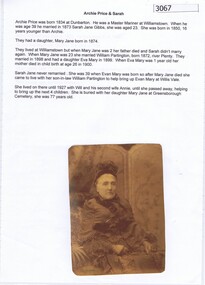
... ...price family...Notes on the Price family - Archie and Sarah, and their daughter Mary Jane. ...Notes on the Price family - Archie and Sarah, and their daughter Mary Jane. ...Notes on the Price family - Archie and Sarah, and their daughter Mary Jane. Mary Jane married William Partington and following Mary's death, Sarah came to Greensborough to help raise Will and Mary's daughter Eva.Brief family notes, typed text, includes handwritten notes.partington family, price family, sarah price, archie price, william partington -
 Port of Echuca
Black and white photograph
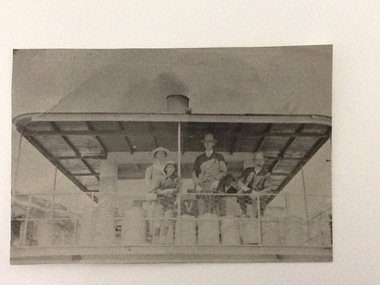
... ...Price Family Collection...Kelvin mail run Hugh Price cargo Price Family Collection Kelvin on mail run, Murray Bridge. ...A copy of a black and white photograph of paddle steamer travel along the Murray river. It shows passengers (2 men, 1 girl, 1 boy) on the upper deck of the P. S. Kelvin, around the late 1890-1900. In the background is a third man, Hugh Price, at the wheel of the paddlesteamer. On the back of the photograph is documented as being on the mail run and at the Murray Bridge.Demonstrates passenger transport and travel along the river as well as the delivery of mail services between rural communities around the Murray Bridge, Blanchetown region in South Australia around 1890-1900.Copy of a Black and white photograph of 2 men, 1 girl and 1 boy on upper deck of P. S. Kelvin. In background is a 3rd man, Hugh Price, at the wheel. Documented as being on mail run and at the Murray Bridge (at Echuca)Kelvin on mail run, Murray Bridge. Hugh Price at wheel in rear.murray bridge south australia, p.s. kelvin, mail run, hugh price, cargo, price family collection -
 Port of Echuca
A black and white photograph of three men working on a lock, 20/09/1984
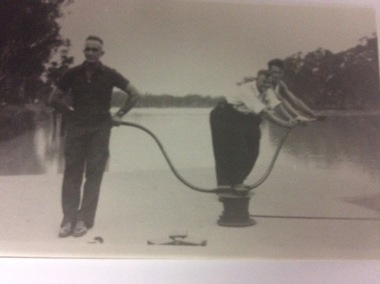
... ...price family collection...This photograph shows how locks were manually opened to allow river transport to proceed. locks renmark euston price family collection murray river capstan lock capstan Written on the back in lead pencil Price. ...This photograph shows three men opening a lock, manually using a lock capstan. The men are fit and strong. The river behind them appears to be very high. Not sure what the era is, but is obviously before looks were mechanised. The devise they are using is called a lock capstan.This photograph shows how locks were manually opened to allow river transport to proceed. A black and white photograph of three men working on a lock somewhere on the Murray River in South Australia. The device they are using is called a lock capstan.Written on the back in lead pencil Price. Opening up lock -probably Lock 7, Renmark. Maybe Euston.locks, renmark, euston, price family collection, murray river, capstan, lock capstan -
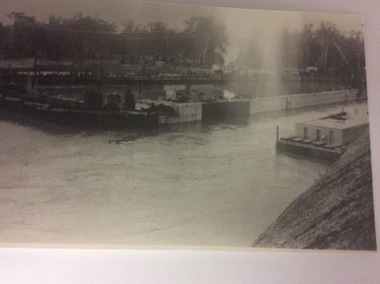 Port of Echuca
Black and white photograph, 21/09/1984
... ...price family collection...There is a paddle steamer in the background passing around the lock. murray river euston (lock construction) price family collection paddle steamer traffic Written on the back in lead pencil "Price. ...This photograph shows the extent of the Euston lock in the early 20th Century. There is a paddle steamer in the background which appears to be going around the lock. This photograph might have been taken during construction of the lock?This photograph possibly shows the Euston lock being constructed. There is a paddle steamer in the background passing around the lock.A black and white photograph of Euston lock.Written on the back in lead pencil "Price. Euston Lock."murray river, euston (lock construction), price family collection, paddle steamer traffic -
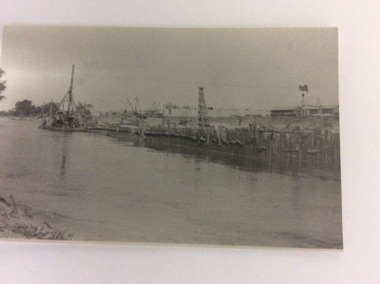 Port of Echuca
A black and white photograph, 24/09/1984
... ...price family collection...This shows how the river was locked to develop the irrigation industry in the early 20th Century. lock construction price family collection mildura jenkins print irrigation In pencil on the back is written; 'Price / Lock construction? ...This is a copy of a photograph from the Price Collection. The river and town are unknown. The photograph shows how locks were constructed using long vertical planks to form a wall. One of the cranes is floating on a pontoon.This shows how the river was locked to develop the irrigation industry in the early 20th Century.A copy of a black and white rectangular photograph of a lock being constructed . The river is in the foreground and in the background, cranes and rigs can be seen. A wooden wall dominates the centre of the photograph. Houses and buildings can be seen in the distance.In pencil on the back is written; 'Price / Lock construction? 'Jenkins Print Mildura.'lock construction, price family collection, mildura, jenkins print, irrigation -
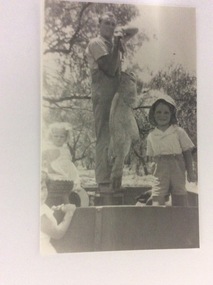 Port of Echuca
A copy of a black and white photo, 24/09/1984
... ...price family collection...This photograph shows how big Murray cod are. murray cod price family collection fishing Written on the back in lead pencil are the words; Price and Cod. ...The people in the photograph are unknown. No date is recorded. This photograph is part of the Hugh Price collection. P000065, P000066, and P000067 are all part of the Hugh Price collection.This photograph shows how big Murray cod are.This is a rectangular black and white photograph of a man and three young children standing in a boat. The man is standing on a container and holding a very big Murray Cod. To his right is a seated girl in white; to his left is a boy in shorts wearing a hat. Part of a young girl can be seen in the left hand corner of looking back at the camera.Written on the back in lead pencil are the words; Price and Cod.murray cod, price family collection, fishing -
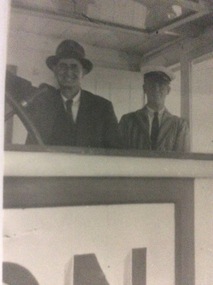 Port of Echuca
A black and white copy of a photograph, 24/09/1984
... ...price family collection...This photograph is linked to P000067, P000065 as they are all part of the Hugh Price Family collection. p.s marion hugh price captain george makins george makins 1943 price family collection In pencil, written on the back is Price / Oct 43 / Capt. ...During the Second World War the P.S Marion operated as a passenger vehicle up and down the Murray River.This is a photograph showing Hugh Price steering the P.S. Marion while the Captain looks on! This photograph is linked to P000067, P000065 as they are all part of the Hugh Price Family collection.A copy of a black and white photograph of Hugh Price and Captain George Makins in the wheelhouse of the P.S Marion.In pencil, written on the back is Price / Oct 43 / Capt. Geo Makins, (in cap) & Hugh Price.p.s marion, hugh price, captain george makins, george makins, 1943, price family collection -
 Port of Echuca
Black and white photograph, Approx. 1980
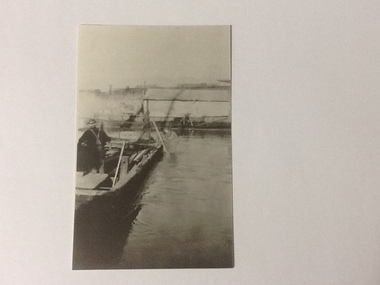
... ...Price family collection...This scene is possibly from the beginning of the 20th century and could be about the development of the irrigation industry. lock scene lock construction Price family collection Irrigation industry On reverse in pencil: Price, Lock scene, location Unknown. ...Black and white photograph of an unknown lock scene where 3 men are working from a hollow platform structure, with one person being a diver coming up or going down a ladder. Another person appears to have hold of a hose (could be oxygen) and the back view of the other person appears to be working with them watching what is happening. This could be part of lock construction as there appears to be cranes and a tripod in the distance.This black and white photograph demonstrates historical and social significance in that it gives a close up view of workmen in the process of lock construction. It appears that there is a diver suited up with helmet on, descending the ladder and a person holding what appears to be hose connected to the person diving. This scene is possibly from the beginning of the 20th century and could be about the development of the irrigation industry.Black and white photograph , portrait format, of 3 men on a hollow platform structure in a river. One man is a diver and is on a ladder which steps down into the water. Copy of an original photograph. On reverse in pencil: Price, Lock scene, location Unknown. lock scene, lock construction, price family collection, irrigation industry -
 Port of Echuca
A rectangular copy of a black and white photograph, 24/09/1984
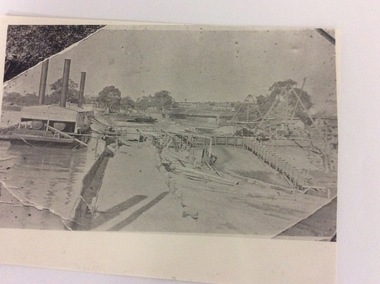
... ...the price family collection...It shows the strategy and the lay out do constructing a Lock. irrigation industry murray river lock construction. the price family collection Written in lead pencil on the back are the words; Constructing Lock. ...This photograph shows how locks were constructed in the early 20th Century. There is floating steam equipment in the left of the photograph. This photograph is significant because it shows equipment used to construct Locks along the Murray in the early days of the 20th Century. It shows the strategy and the lay out do constructing a Lock.A photo copy of a black and white photograph, which looks like it was a photograph taken of a photo which was still in someone's photo album. The photograph shows Lock construction. Locality is unknown.Written in lead pencil on the back are the words; Constructing Lock. Unknown site.irrigation industry, murray river, lock construction., the price family collection -
 Whitehorse Historical Society Inc.
Education kit - Doll House, Fisher Price, Fisher Price Play House (1970s), c1970's
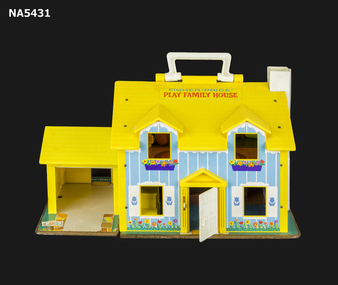
... Fisher Price play family House...C1970's doll house used in a community toy library C1970's toy Doll house Toy c1970s Nunawading Toy Library Fisher Price play family House Plastic, mostly yellow; Coloured transfer decoration; 2 storey house with garage; 4 dormer windows; Plastic furniture; Plastic people; Carry mantle. ...C1970's doll house used in a community toy libraryC1970's toyPlastic, mostly yellow; Coloured transfer decoration; 2 storey house with garage; 4 dormer windows; Plastic furniture; Plastic people; Carry mantle. Fisher Price play family Housedoll house, toy, c1970s, nunawading toy library -
 Lakes Entrance Historical Society
Photograph, Lake Tyers Beach Caravan Park, 1983
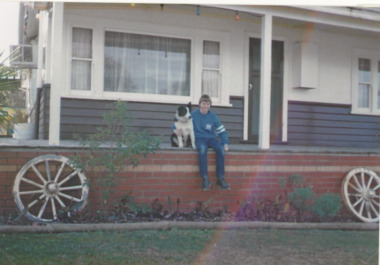
... Colour photograph of Frank and Wendy Prices family residence with son Wayne and dog Bill on the front veranda Lake Tyers Beach Victoria...Boats and Boating Tourism Caravan Parks Colour photograph of Frank and Wendy Prices family residence with son Wayne and dog Bill on the front veranda Lake Tyers Beach Victoria Lake Tyers Beach Caravan Park Photograph ...Colour photograph of Frank and Wendy Prices family residence with son Wayne and dog Bill on the front veranda Lake Tyers Beach Victoriaboats and boating, tourism, caravan parks -
 Ballarat Clarendon College
Book
... Four books donated to the Ballarat College Weatherly Library in 1954 possibly by Keith Hargreaves Price. The Price family lived in Dumbarton from 1918. Ballarat Colleg bought the Dumbarton property in 1954. ...Four books donated to the Ballarat College Weatherly Library in 1954 possibly by Keith Hargreaves Price. The Price family lived in Dumbarton from 1918. Ballarat Colleg bought the Dumbarton property in 1954. ...Four books donated to the Ballarat College Weatherly Library in 1954 possibly by Keith Hargreaves Price. The Price family lived in Dumbarton from 1918. Ballarat Colleg bought the Dumbarton property in 1954. Example of community generosity to the establishment of Ballarat College facilities and appointments.Set of four booksBook plate inside front covers: Ballarat College Library / PRESENTED BY / Mr K H Price 1954 / PLEASE REPORT ANY LOOSE LEAVES, ETC keith-hargreaves-price, dumbarton, ballarat-college, weatherly-library, 1954 -
 City of Warrnambool Rowing Club
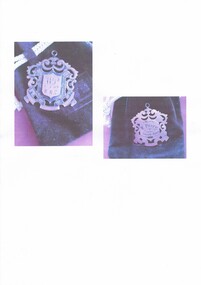
Photograph of a medal dated 1908 and corresponding newspaper article
... A medal held in the Price family won by William Price in 1908. Reported on page 2 on the 2nd January 1908 the results of a regatta held in Colac the day before. ...A medal held in the Price family won by William Price in 1908. Reported on page 2 on the 2nd January 1908 the results of a regatta held in Colac the day before. ...A medal held in the Price family won by William Price in 1908. Reported on page 2 on the 2nd January 1908 the results of a regatta held in Colac the day before. The Warrnambool A.N.A. team won the Friendly Society’s Fours. Photograph of a pocket sized medal.On front: ? H.P ?date...08 W.R.C. Won By W. Price Society fours on back.warrnambool rowing club, city of warrnambool rowing club, william price, colac regatta 1908, rowing -
 National Wool Museum
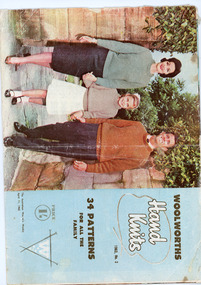
Book, Knitting, Woolworths Hand Knits no. 2, 1962
... WOOLWORTHS / Hand / Knits / 1962, No. 2 / 34 PATTERNS / FOR ALL THE / FAMILY / PRICE / 1'- / W / The Australian Women's Weekly / April 11, 1962...This knitting pattern book was produced by "The Australian Women's Weekly" in 1962 and contains knitting patterns for men, women and children using 'Woolworths' brand wool. handicrafts - history knitting australian women's weekly woolworths ltd handicrafts - history knitting WOOLWORTHS / Hand / Knits / 1962, No. 2 / 34 PATTERNS / FOR ALL THE / FAMILY / PRICE / 1'- / W / The Australian Women's Weekly / April 11, 1962 Woolworths Hand Knits no. 2, 1962 Book, Knitting ...This knitting pattern book was produced by "The Australian Women's Weekly" in 1962 and contains knitting patterns for men, women and children using 'Woolworths' brand wool.WOOLWORTHS / Hand / Knits / 1962, No. 2 / 34 PATTERNS / FOR ALL THE / FAMILY / PRICE / 1'- / W / The Australian Women's Weekly / April 11, 1962handicrafts - history knitting, australian women's weekly woolworths ltd, handicrafts - history, knitting -
 Mt Dandenong & District Historical Society Inc.
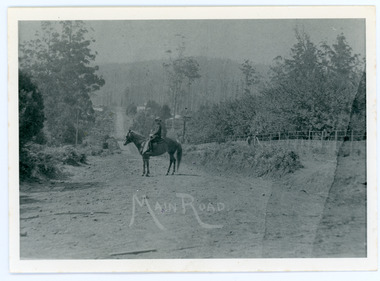
Photograph, Looking Down Falls Road
... From the outset the Price family ran a store from their home.This picture, taken 1914, shows Edward John Price on his pony delivering papers from his parent's newsagency that was opposite 'Mountjoy' guesthouse on Ridge Road. ...From the outset the Price family ran a store from their home.This picture, taken 1914, shows Edward John Price on his pony delivering papers from his parent's newsagency that was opposite 'Mountjoy' guesthouse on Ridge Road. ...Edward John Price was a son of early settler Edward Joseph Price. Edward Joseph was the first settler in the Village Settlement when he took out Lot 1, Section 1. He built a small home of slabs and brought his family up in 1896. From the outset the Price family ran a store from their home.This picture, taken 1914, shows Edward John Price on his pony delivering papers from his parent's newsagency that was opposite 'Mountjoy' guesthouse on Ridge Road. He was taking them to Lily Badenhop's post office in Blythe's Road. The section of road he is on was called Main Road and is now Falls Road.Black and white photograph showing a man on horseback in the centre of an unmade road that is running into the distance.Trees, a fence and houses can be seen with hills in the background. Reverse of photograph has handwritten description by John Lundy-Clarke.On Front MAIN ROAD On Reverse Looking down Falls Road then the main road in 1914. Before Frank Craig built The Fron (1918). Dunbar’s house Halcyon on left of road. The hall on its right with Keogh’s sheds showing further in the trees. The horseman is Edward John Price who delivered the daily papers to Lil Badenhop’s shop. The bag he carried them in can be seen hanging from the saddle pommel. The first road formation can be seen on the bank to the right. The road seen was constructed 1905 by Bill McGivern.edward john price, edward joseph price, lily badenhop, post office, falls road, main road, mountjoy, frank craig, bill mcgivern, dunbar, halcyon, keogh, farndons hall -
Stawell Historical Society Inc
Headwear - Costume and Accessories, c1930
... Shallow crown flat brim. Price Tag attached. McClure family...Shallow crown flat brim. Price Tag attached. McClure family Headwear Costume and Accessories ...Black Shiny Straw Hat. Grosgrain Ribbon edged with Straw rhinestone ornamentation. Shallow crown flat brim. Price Tag attached. McClure familystawell clothing material -
 Mt Dandenong & District Historical Society Inc.
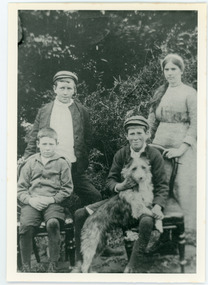
Photograph, Clarke Family 1911
... The Lundy-Clarke family were related to the Price family through the marriage of two Ross sisters - Annie Ross to Edward Joseph Price and Helen Ross to Robert Lundy-Clarke. ...The Lundy-Clarke family were related to the Price family through the marriage of two Ross sisters - Annie Ross to Edward Joseph Price and Helen Ross to Robert Lundy-Clarke. ...John Lundy-Clarke grew up in the Kalorama/Mt Dandenong area and later in life (1972-74) began to write a comprehensive history of the district working from an original settlement map in an effort to cover all areas. The Lundy-Clarke family were related to the Price family through the marriage of two Ross sisters - Annie Ross to Edward Joseph Price and Helen Ross to Robert Lundy-Clarke. Edward Joseph Price took up Lot 1 in the Village Settlement and Robert Lundy-Clarke was persuaded to take up Lot 2. He felt it would be unproductive. He signed it over to Edward Joseph Price and took his family to New Zealand. After his death in 1911 the family returned to the district. The Lundy-Clarke family were related to the Dunbar family as Caroline Dunbar was a sister to Annie and Helen Ross. Agnes Annie Clarke aged 18 daughter of Robert Lundy-Clarke and Helen nee Ross. Born 1893 died 1974. James Ross Clarke aged 12 son of Robert Lundy-Clarke and Helen nee Ross. Born 1898 died 1972. John Lundy-Clarke aged 10 son of Robert Lundy-Clarke and Helen nee Ross. Born 1901 died 1993. John Stewart Dunbar aged 13 son of Andrew Dunbar and Caroline nee Ross. Born 1898. This photograph was taken in 1911 in the grounds of Dunbar's Hazeldene Dairy in Falls Road. Black and white photograph showing four young people outdoors in a group. A girl and boy standing with two boys seated on chairs, one holding a dog. Reverse of photograph has handwritten description by John Lundy-Clarke.1911 Right to left - Agnes Annie Clarke aged 18 daughter of R. Lundy-Clarke and Helen nee Ross. Born 1893 died 1974. James Ross Clarke aged 12 brother of Agnes. Born 1898 died 1972. John Stewart Dunbar son of Andrew Dunbar and Caroline nee Ross. Born 1898. John Lundy-Clarke. Brother of Agnes with "Possum" (Apart from Agnes, not sure of the accuracy of the other name placements)lundy-clarke, john lundy-clarke, robert lundy clarke, agnes clarke, james clarke, john dunbar, andrew dunbar, caroline dunbar, caroline ross, helen lundy-clarke, helen ross, annie ross, annie price, dairy, hazeldene, hazeldene dairy, dunbar's dairy, falls road -
 Geelong Football Club
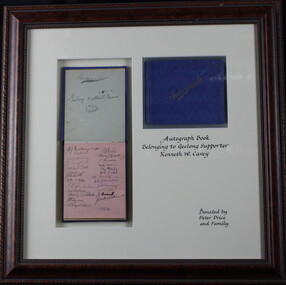
1934 Autograph Book Geelong Football Club, Framed Autograph Book - 1934
... Cavey- and -Donated by / Peter Price / and Family-. There is a photocopy of a blue front cover of a booklet with the text -Autographs-. ...Cavey- and -Donated by / Peter Price / and Family-. There is a photocopy of a blue front cover of a booklet with the text -Autographs-. ...Brown decorated timber frame, cream shadow box mounting card, booklet, photocopy text, glass. Black printed text reads -Autograph Book / Belonging to Geelong Supporter / Kenneth W. Cavey- and -Donated by / Peter Price / and Family-. There is a photocopy of a blue front cover of a booklet with the text -Autographs-. On the left of the display is an opened booklet with notes and autographs hand-written in pencil and pen. Display is protected by glass. Rear of frame has a Kardinia Picture Frames sticker and a fabric cord running horizontally which is used to hang the item.Autographs of 1934. Les Hardiman. Reg Hickey. Angie Muller. Bob Troughton. Clive Coles. Lou Daily. Alex McGregor. George Todd. George Moloney. Jack Walker. Jack Williams. Jack Metherell. Jack Carney. Len Metherell. Bill Kuhlken. Allan Everett. Jack Collins. Peter Hardiman. Tom Arklay. Joe Tucker. Jack Lyons. Norm Glenister. Gus Leishman.gfc 1934 team, geelong cats 1934 -
 City of Moorabbin Historical Society (Operating the Box Cottage Museum)
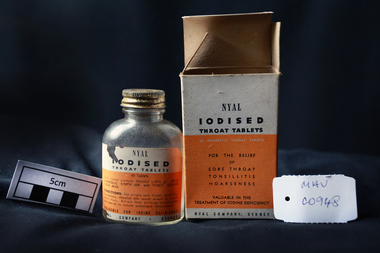
Manufactured Glass, brown bottle 'Nyal', c1950
... Over the decades since that time Nyal has changed its focus to concentrate solely on the healthcare category, providing trusted medication at affordable prices to Australian families Current manufacturer INova Pharmaceuticals (Aust) Pty Ltd Level 10, 12 Help Street, Chatswood, NSW 2067 ...Over the decades since that time Nyal has changed its focus to concentrate solely on the healthcare category, providing trusted medication at affordable prices to Australian families Current manufacturer INova Pharmaceuticals (Aust) Pty Ltd Level 10, 12 Help Street, Chatswood, NSW 2067 glassware bottles manufactured glass pharmacy medicines nyal pty ltd moorabbin bentleigh cheltenham NYAL / IODISED / THROAT TABLETS / / for SORE THROAT, TONSILITIS / (formula….)/ DIRECTIONS …/ NYAL COMPANY SYDNEY A brown glass bottle with a metal screw top, in original box, for 'NYAL' throat tablets Manufactured Glass, brown bottle 'Nyal' Nyal pharmaceuticals pty ltd ...Nyal was originally registered in 1911 with an extensive portfolio of products ranging from perfumed soap to toiletries, sold exclusively through pharmacy. Over the decades since that time Nyal has changed its focus to concentrate solely on the healthcare category, providing trusted medication at affordable prices to Australian families Current manufacturer INova Pharmaceuticals (Aust) Pty Ltd Level 10, 12 Help Street, Chatswood, NSW 2067 A brown glass bottle with a metal screw top, in original box, for 'NYAL' throat tablets NYAL / IODISED / THROAT TABLETS / / for SORE THROAT, TONSILITIS / (formula….)/ DIRECTIONS …/ NYAL COMPANY SYDNEYglassware, bottles, manufactured glass, pharmacy, medicines, nyal pty ltd, moorabbin, bentleigh, cheltenham -
Stawell Historical Society Inc
Photograph, Mick Walsh, Mick Walsh Stawell Studio Colour Negatives, 1975 to 1986
... Blake Family Nicholson Ron & Margaret Mason Stewart & Price Lynette Bibby family McAllister & Oates Torney & Jones Pan McKay family Reading & Glasson Jim Redman Longmore & West Smith & Quaiffe Christian family Robert Stewart baby Wright & Holloway Graeme & Kay Ellen baby Aileen Neild & Chris Tate Stawell Golf Club A B C D Champions Whelan & Thomas Rodger Payne baby Denise Whitehead Ken Robson Memorials Beckwith & Talbot Schwab & Elliott Dowd & Eastick Barry Henderson baby Quinn & Cameron Wright flowers Pickering & Pietsch Clarke Craig Robson 21st Mrs Kevin Brooks Paulett & Krishna Rama Lang & McDonald Smith & Price RAAMS Erwin Golden Wedding Hilda Cross Sue Wallis & Tom Kilpatrick Eckman family McGregor & Brennan ...Blake Family Nicholson Ron & Margaret Mason Stewart & Price Lynette Bibby family McAllister & Oates Torney & Jones Pan McKay family Reading & Glasson Jim Redman Longmore & West Smith & Quaiffe Christian family Robert Stewart baby Wright & Holloway Graeme & Kay Ellen baby Aileen Neild & Chris Tate Stawell Golf Club A B C D Champions Whelan & Thomas Rodger Payne baby Denise Whitehead Ken Robson Memorials Beckwith & Talbot Schwab & Elliott Dowd & Eastick Barry Henderson baby Quinn & Cameron Wright flowers Pickering & Pietsch Clarke Craig Robson 21st Mrs Kevin Brooks Paulett & Krishna Rama Lang & McDonald Smith & Price RAAMS Erwin Golden Wedding Hilda Cross Sue Wallis & Tom Kilpatrick Eckman family McGregor & Brennan Photography Mick Walsh 52 Patrick Street Stawell Colour negatives of families, weddings and other. ...Negatives from Stawell Photographer. Discarded from Penna Print Ararat. Son contacted and gave approval for Stawell Historical Society to keep them. Only those of a non personal nature scanned. Blake Family Nicholson Ron & Margaret Mason Stewart & Price Lynette Bibby family McAllister & Oates Torney & Jones Pan McKay family Reading & Glasson Jim Redman Longmore & West Smith & Quaiffe Christian family Robert Stewart baby Wright & Holloway Graeme & Kay Ellen baby Aileen Neild & Chris Tate Stawell Golf Club A B C D Champions Whelan & Thomas Rodger Payne baby Denise Whitehead Ken Robson Memorials Beckwith & Talbot Schwab & Elliott Dowd & Eastick Barry Henderson baby Quinn & Cameron Wright flowers Pickering & Pietsch Clarke Craig Robson 21st Mrs Kevin Brooks Paulett & Krishna Rama Lang & McDonald Smith & Price RAAMS Erwin Golden Wedding Hilda Cross Sue Wallis & Tom Kilpatrick Eckman family McGregor & Brennan Colour negatives of families, weddings and other. Nineteen Lever Arch Folders Mick Walsh 52 Patrick Street Stawellphotography -
 Flagstaff Hill Maritime Museum and Village
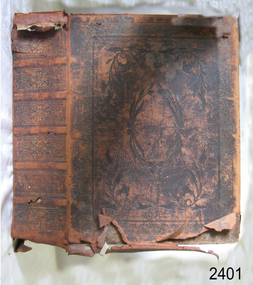
Book - Reference/Bible, Rev. John Eadie, The Holy Bible (with the Commentaries of Scott and Henry 1862), 1862
... Family Bible. He fought bitter legal and ecclesiastical battles against other publishers and conservative clergy to keep prices low. ...Family Bible. He fought bitter legal and ecclesiastical battles against other publishers and conservative clergy to keep prices low. ...This specific 1862 Bible is a fascinating artifact from the height of 19th-century British industrial printing, combining massive theological authority with an effort to make large-scale Family Bibles accessible to the general public.The Holy Bible with the Commentaries of Scott and Henry 1862 Edited by Rev John Eadie Publisher: W R McPhun Date: 1862non-fictionThis specific 1862 Bible is a fascinating artifact from the height of 19th-century British industrial printing, combining massive theological authority with an effort to make large-scale Family Bibles accessible to the general public.flagstaff hill, warrnambool, shipwrecked-coast, flagstaff-hill, flagstaff-hill-maritime-museum, maritime-museum, shipwreck-coast, flagstaff-hill-maritime-village, book, bible, the holy bible, scott and henry -
 Flagstaff Hill Maritime Museum and Village
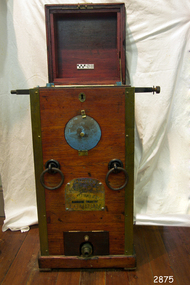
Machine - Diving Compressor, Siebe Gorman & Co. Ltd, 1880-1890
... family, and a new company, Siebe Gorman & Co. Ltd. (1905-1998) was formed. Under the chairmanship of Albert Vickers, R.H. Davis was kept on as Managing Director, and the company forged ahead. However, after WW1, the Great Depression caused manufacturing output and share prices...family, and a new company, Siebe Gorman & Co. Ltd. (1905-1998) was formed. Under the chairmanship of Albert Vickers, R.H. Davis was kept on as Managing Director, and the company forged ahead. However, after WW1, the Great Depression caused manufacturing output and share prices ...This compressor was part of the E.G. Ward Collection. It is connected to the diving suit and boots, also in our collection. Siebe Gorman & Company Ltd was a British company that developed diving equipment and breathing equipment and worked on commercial diving and marine salvage projects. The company advertised itself as 'Submarine Engineers'. It was founded by Augustus Siebe, a German-born British engineer chiefly known for his contributions to diving equipment. Siebe Gorman traded as an engineering firm for over 180 years, from 1819 to 1999. The early success of the business was due to its founder, the Prussian immigrant Christian 'Augustus' Siebe (1788-1872). For business reasons, he applied for and was granted British citizenship in 1856. He was a gifted engineer who was able to translate theoretical problems into practical, working products. During the industrial Victorian period, the business traded as 'A. Siebe's at 145 High Street, Holborn, London, but in 1828, new premises were acquired at 5 Denmark Street, Soho. The family firm produced a wide range of manufactured goods, including paper-making machinery, measuring machinery, water-pumps, refrigeration equipment and diving apparatus. Augustus Siebe specialised in submarine engineering early on, and the company gained a reputation for the manufacture of safe, reliable diving apparatus. Augustus Siebe is best remembered for the development and manufacture of the ‘closed’ Diving Dress based on the ideas of Charles and John Deane, George Edwards and Charles Pasley. Apart from some small modifications to valves and diver communications, the basic 12 bolt ‘closed’ diving dress remained relatively unchanged after the 1870s. Later company successes were also based on innovation, with new products that could be successfully developed and manufactured to high standards. This was largely attributed to the inventive nature, foresight, engineering and entrepreneurial skills of Robert Henry Davis (1870-1965). In 1882, RH Davis joined the company of 'Siebe & Gorman' as a young 11-year-old office boy, and he was to remain with the company until he died in 1965. Augustus Siebe retired in 1869 and handed over the company to a new partnership of Henry H. Siebe (1830-1885) and William A. O'Gorman (1834-1904). The new firm traded as 'Siebe & Gorman' (1870-1879) from premises in and around Mason Street, Westminster Bridge Road, Lambeth, London. The two partners soon recognised the potential of R.H. Davis, and in 1894, aged 24, he became General Manager of Siebe & Gorman. Davis increasingly ran the company until the surviving partner (W.A. Gorman) died in 1904. The firm was disposed of to the Vickers (armaments) family, and a new company, Siebe Gorman & Co. Ltd. (1905-1998) was formed. Under the chairmanship of Albert Vickers, R.H. Davis was kept on as Managing Director, and the company forged ahead. However, after WW1, the Great Depression caused manufacturing output and share prices to slump. In 1924, Robert Davis made a deal with the Vickers Board and acquired control of the company through majority shares. Under his leadership, the Siebe Gorman Company flourished, and in time, four of his sons also joined the firm. The company gained a worldwide reputation for the manufacture of diving apparatus, decompression and observation chambers, and safety breathing apparatus of all types for use on the land, in the air and under the sea (including mine rescue, tunnelling, aircraft, diving, submarine escape and in other hazardous environments). Close research and development links with the MOD (especially the Admiralty), also provided a lucrative outlet for the company's products. In 1932, Robert Davis was knighted by King George V, principally for his invention of the ‘Davis Submerged Escape Apparatus’ (D.S.E.A.). Siebe Gorman essentially remained a family firm from the beginning (under A Siebe) until it became a public company for the first time in 1952. However, following WW2, British manufacturing stagnated through stifled investment and post-war austerity, and there was little innovation. Siebe Gorman's fortunes began to decline as an ageing Sir Robert Davis failed to invest or change the company's business and management practices. In 1959, Siebe Gorman was acquired by the “Fairy Group” and the ailing Sir Robert was made Life President. Consequently, nothing changed, and the slow decline continued until Sir Robert's death in March 1965. Around 1960, Siebe Gorman acquired the diving apparatus manufacturer C E Heinke, and for a brief period, it manufactured some diving equipment under the combined name of Siebe Heinke. Around 1964, Mr E. 'Barry' Stephens was appointed as the new Managing Director to modernise Siebe Gorman. Changes were made, including a move to a new factory in Wales in 1975. The new company concentrated on firefighting breathing apparatus and escape equipment, and the move coincided with the loss of many of the older, traditional craft skills. Between 1985 and 1998, Siebe expanded through acquisitions, and several other companies were acquired. The Siebe Gorman (diving apparatus) company has therefore traded as A. Siebe (1819-1870); Siebe & Gorman (1870-1879); Siebe Gorman & Co (1880-1904); Siebe Gorman & Co. Ltd (1905-1998).The diving compressor, along with associated equipment in the Flagstaff Hill collection, represents a highly significant snapshot of marine history. These items are particularly important in understanding the evolution of diving equipment, with a special focus on their use in salvage operations before and throughout the Second World War. Manufactured by a company renowned for its inventions, development, and innovation in marine engineering, the equipment demonstrates the progression of technology in deep-sea diving. Early helmets and related items produced by this company remain highly sought after by collectors worldwide, highlighting their historical and technological value. The presence of these items within the Flagstaff Hill Maritime Museum allows for a unique insight into the working conditions and methods employed by divers. It also illustrates the considerable dangers they faced while performing such essential and hazardous work, underscoring the critical role played by these professionals in maritime history.A single cylinder divers' pump by Siebe Gorman & Co Ltd, London, eccentric hand cranked in brass, brass-mounted mahogany case with instructions to the underside of the lid, brass-covered pressure gauge and air outlet, brass maker's plaque to the front, water inlet and outlet to the rear, green-painted lifting rings. Machinery has some blue-painted areas on the metal. This compressor is part of the E.G. Ward Collection.Plate on the back 'WATER SUPPLY" "WATER OVERFLOW" "WATER DRAIN-IN" Pressure gauge dial "BOURDON'S PRESSURE GAUGE" STEBE GORMAN & CO. LONDON", "LBS PRESSURE" "FEET OF SALT WATER" Plate on the front " PATENT, Siebe Gorman & Co Ltd Submarine Engineers" below emblem (Lion, Crown, Horse)flagstaff hill, warrnambool, flagstaff-hill, maritime-museum, diving compressor, london, siebe gorman & co ltd, marine technology, life saving, deep sea diving, maritime museum, maritime village, manine history, maritime history, marine engineers, marine diving, deep-sea diving, e g ward, vintage diving compressor, e. g. ward, e.g. ward, edward ward, ted ward -
 Flagstaff Hill Maritime Museum and Village
Functional object - Diving Suit, boots and weight, Early-to-mid 20th century
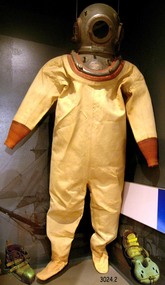
... family and a new company 'Siebe Gorman & Co. Ltd.' (1905-1998) was formed. Under the chairmanship of Albert Vickers, R.H. Davis was kept on as Managing Director, and the company forged ahead. However, after WW1, the Great Depression caused manufacturing output and share prices...family and a new company 'Siebe Gorman & Co. Ltd.' (1905-1998) was formed. Under the chairmanship of Albert Vickers, R.H. Davis was kept on as Managing Director, and the company forged ahead. However, after WW1, the Great Depression caused manufacturing output and share prices ...This diving suit with helmet, boots and weight is part of the E. G.Ward collection, along with the diving compressor and a photograph of a diver in this equipment. Siebe Gorman & Company Ltd was a British company that developed diving equipment and breathing equipment and worked on commercial diving and marine salvage projects. The company advertised itself as 'Submarine Engineers'. It was founded by Augustus Siebe, a German-born British engineer chiefly known for his contributions to diving equipment. Siebe Gorman traded as an engineering firm for over 180 years from 1819 to 1999. The early success of the business was due to its founder, the Prussian immigrant Christian 'Augustus' Siebe (1788-1872). For business reasons, he applied for and was granted British citizenship in 1856. He was a gifted engineer who was able to translate theoretical problems into practical, working products. During the industrial Victorian period, the business traded as 'A. Siebe' at 145 High Street Holborn London, but in 1828 new premises were acquired at 5 Denmark Street, Soho. The family firm produced a wide range of manufactured goods including paper-making machinery, measuring machinery, water pumps, refrigeration equipment and diving apparatus. Augustus Siebe specialised in submarine engineering early on and the company gained a reputation for the manufacture of safe, reliable diving apparatus. Augustus Siebe is best remembered for the development and manufacture of the ‘closed’ Diving Dress based on the ideas of Charles and John Deane, George Edwards and Charles Pasley. Apart from some small modifications to valves and diver communications, the basic 12-bolt ‘closed’ diving dress remained relatively unchanged after the 1870s. Later company successes were also based on innovation, with new products that could be successfully developed and manufactured to high standards. This was largely attributed to the inventive nature, foresight, engineering and entrepreneurial skills of Robert Henry Davis (1870-1965). In 1882, RH Davis joined the company of 'Siebe & Gorman' as a young 11-year-old office boy and he was to remain with the company until he died in 1965. Augustus Siebe retired in 1869 and handed over the company to a new partnership of Henry H. Siebe (1830-1885) and William A. O'Gorman (1834-1904). The new firm traded as 'Siebe & Gorman' (1870-1879) from premises in and around Mason Street, Westminster Bridge Road, Lambeth, London. The two partners soon recognised the potential of R.H. Davis and in 1894, aged 24, he became General Manager of Siebe & Gorman. Davis increasingly ran the company until the surviving partner (W.A. Gorman) died in 1904. The firm was disposed of to the Vickers (armaments) family and a new company 'Siebe Gorman & Co. Ltd.' (1905-1998) was formed. Under the chairmanship of Albert Vickers, R.H. Davis was kept on as Managing Director, and the company forged ahead. However, after WW1, the Great Depression caused manufacturing output and share prices to slump. In 1924 Robert Davis made a deal with the Vickers Board and acquired control of the company through majority shares. Under his leadership, the Siebe Gorman Company flourished and within time, four of his sons also joined the firm. The company gained a worldwide reputation for the manufacture of diving apparatus, decompression and observation chambers, and safety breathing apparatus of all types for use on the land, in the air and under the sea (including mine rescue, tunnelling, aircraft, diving, submarine escape and in other hazardous environments). Close research and development links with the MOD (especially the Admiralty), also provided a lucrative outlet for the company products. In 1932, Robert Davis was knighted by King George V, principally for his invention of the ‘Davis Submerged Escape Apparatus’ (D.S.E.A.). Siebe Gorman essentially remained a family firm from the beginning (under A.Siebe) until it became a public company for the first time in 1952. However, following WW2, British manufacturing stagnated through stifled investment and post-war austerity, and there was little innovation. Siebe Gorman fortunes began to decline as an ageing Sir Robert Davis failed to invest, or change the company business and management practices. In 1959, Siebe Gorman was acquired by the “Fairy Group” and the ailing Sir Robert was made Life President. Consequently, nothing changed and the slow decline continued until Sir Robert's death in March 1965. Around 1960, Siebe Gorman acquired the diving apparatus manufacturer C E Heinke, and for a brief period, it manufactured some diving equipment under the combined name of Siebe Heinke. Around 1964, Mr E. 'Barry' Stephens was appointed as the new Managing Director to modernise Siebe Gorman. Changes were made, including a move to a new factory in Wales in 1975. The new company concentrated on fire-fighting breathing apparatus and escape equipment, and the move coincided with the loss of many of the older, traditional craft skills. Between 1985 and 1998, Siebe expanded through acquisitions, and several other companies were acquired. The Siebe Gorman (diving apparatus) company has therefore traded as A. Siebe (1819-1870); Siebe & Gorman (1870-1879); Siebe Gorman & Co (1880-1904); Siebe Gorman & Co. Ltd (1905-1998).The diving suit, helmet, boots, and weights, along with associated equipment in the Flagstaff Hill collection, represent a highly significant snapshot of marine history. These items are particularly important in understanding the evolution of diving equipment, with a special focus on their use in salvage operations before and throughout the Second World War. Manufactured by a company renowned for its inventions, development, and innovation in marine engineering, the equipment demonstrates the progression of technology in deep-sea diving. Early helmets and related items produced by this company remain highly sought after by collectors worldwide, highlighting their historical and technological value. The presence of these items within the Flagstaff Hill Maritime Museum allows for a unique insight into the working conditions and methods employed by divers. It also illustrates the considerable dangers they faced while performing such essential and hazardous work, underscoring the critical role played by these professionals in maritime history.Diving suit including helmet, boots and a weight. Diving suit is made of canvas with knitted cuffs. The helmet is metal. The boots have a thick sole and thick leather upper that is held on with leather straps and buckles. The toe of the boot is heavy metal. The weight is worn next to the trunk of the diver and it has an inscription to mark the front. It is worn with straps and buckles holding it in place. Royal Navy Admiralty Pattern 6 bolt No 3 light Siebe Gorman light diving helmet circa 1960, used by the Royal Navy before and after World War 2. This equipment is part of the E. G. Ward Collection."Siebe Gorman & Co Ltd Marine Engineers London. Patent" with "E G Ward" on front and back plate. On weight "FRONT"flagstaff hill, warrnambool, diving suit, siebe gorman and co ltd., siebe gorman and co ltd marine engineers london, marine engineers, diving helmet, diving boots, diving weight, marine diving, maritimemuseum, maritime village, maritime history, marine technology, life saving, deep sea diving, maritime museum, siebe gorman and co ltd., siebe gorman and co ltd, london, deep-sea diving, e. g. ward, e g ward, e.g. ward, edward ward, ted ward -
 Flagstaff Hill Maritime Museum and Village
Tool - Wood moulding Plane, Edward Preston & Sons, Early 20th century
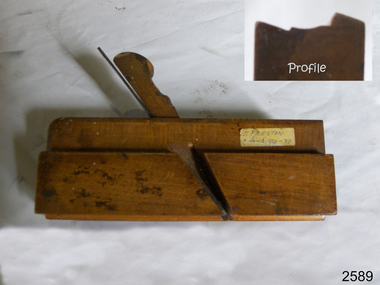
... prices. Edward Preston Sr. (1798–1883) was first listed as a plane-maker at 77 Lichfield Street in the Birmingham Directory of 1833, but later listings and advertisements assert that the business was started in 1825. Preston is likewise recorded as a plane-maker living with his family...prices. Edward Preston Sr. (1798–1883) was first listed as a plane-maker at 77 Lichfield Street in the Birmingham Directory of 1833, but later listings and advertisements assert that the business was started in 1825. Preston is likewise recorded as a plane-maker living with his family ...By the end of the nineteenth century, the firm of Edward Preston & Sons was founded in 1825, becoming one of England's leading makers of hand tools and in many ways a British counterpart to America's "Stanley" for its wide range of quality utilitarian tools at affordable prices. Edward Preston Sr. (1798–1883) was first listed as a plane-maker at 77 Lichfield Street in the Birmingham Directory of 1833, but later listings and advertisements assert that the business was started in 1825. Preston is likewise recorded as a plane-maker living with his family in Lichfield Street in the 1841 census, at which time his younger son Edward was 6 years old. Around 1850, his son Edward left school to join his father's business and is recorded in the 1851 census as a plane-maker at his father's address. He appears to have been quite a talented and resourceful young man, as he had later been able to start up his own "wood and brass spirit level manufacturing business at 97½ Lichfield Street by 1864. By 1866, Edward Jnr had added planes, routers, joiners, coach, gun, cabinet, and carpenters tools to his line, and the following year he moved his shop from his father's address and relocated to 26 Newton Street, before moving again to much larger premises at 22–24 Whittall Street. This location became known as the Whittall Works and later was the office and factory of Edward Preston & Sons, Ltd. In 1889 Edward Preston Jnr and his three sons were brought into the firm and the name was changed to Edward Preston & Sons, becoming Edward Preston & Sons Ltd on incorporation in 1898. Part of the firm's output was a healthy line of malleable and gun-metal planes and patent adjustable iron smoothers, shoulder planes, bull-nose, and block planes - a range that was expanded in later years. The 1901 catalog shows several styles of planes that were unique to the Preston brand, along with the usual styles which had already been set by other makers. The death of Edward Preston Jnr was reported in the Lichfield Mercury of 26 September 1913. "Mr. Preston was decided of an innovative turn of mind," the newspaper wrote, "as many of the machines in use at his works, as well as of the tools produced were the invention of himself and his three sons, who now manage the business." The report noted that at the time of his death, the business was carried on at Whittall Works, Cheston Street, Aston, Birmingham. Falling on hard times, the firm of Edward Preston & Sons was sold to the Birmingham firm of John Rabone & Sons in 1932, and shortly thereafter manufacturing rights to some of the Preston range of planes were sold to the Sheffield firm of C. & J. Hampton, who would later merge with the Record Tool Company. Some of the Preston planes were directly added to the Record line by the Hampton firm, while others were modified or discontinued altogether. Generally, all Preston wooden planes are stamped on the front of the plane, the shape, size, and character type of the stamp indicating the age of the plane. On some metal planes, all the parts were stamped with a number or symbol during manufacture. This number was used to re-assemble the parts following a batch process. Not all Preston tools are trade-marked clearly. Early shoulder, rebate, chariot planes, and chamfer rebates commonly appear without trademarks but may have assembly numbers. The "E P" trade-mark was already in use by 1882. The trade-mark "Preston" also appears on some later tools that were manufactured in Sheffield, England. These are generally smoothing planes and appear modern and very similar in construction to other modern manufacturers' planes.The item gives a snapshot of one of England's premier tool manufacturing companies at a time when significant industrial changes were occurring in manufacturing and business structures in the World that were beginning to affect social changes.Ogee moulding Plane Maker E Preston & Sons sticker with date 1904 -1931flagstaff hill, warrnambool, shipwrecked-coast, flagstaff-hill, flagstaff-hill-maritime-museum, maritime-museum, shipwreck-coast, flagstaff-hill-maritime-village -
 Flagstaff Hill Maritime Museum and Village
Domestic object - Razor, John Clarke Ltd, 1930s
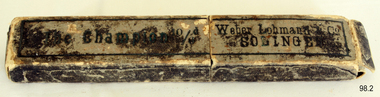
... Weber was married to a woman named Altenbach, from a family that manufactured innovative low-priced pocketknives, as well as other cutlery items. ...Weber was married to a woman named Altenbach, from a family that manufactured innovative low-priced pocketknives, as well as other cutlery items. ...In 1848, 43-year-old John Clarke launched a cutlery business in Harvest Lane in Neepsend, Sheffield UK. Clarke entered the trade late in life he was indenture and apprenticed to Octavius Twigg, a razor maker. Clarke was granted his Freedom in 1856 and began using the trademark 'NEVA'. By the 1860s, Thomas Clarke's son by his wife Elizabeth had joined the firm. When John Clarke died at his home at Augusta Place, Rock Street, Sheffield on 25 July 1873 (aged 68), he only employed six workmen. By 1881, Thomas had expanded this number to twenty. He sold a wide range of cutlery and was also an ‘emigration agent’, the Sheffield Independent, of 7th September in 1886 had an article published stating Thomas helped to recruit personnel from England for cutlery centers in America. In 1893 Clarke’s showroom displayed miniature knives from '5/16ths-inch long to the most expensive sportsman's knives, that were gold and silver mounted. Table knives and carvers were also manufactured (or factored). Agencies were opened in London, New York, and Melbourne. Besides ‘NEVA, the ‘EXPRESS’ and ‘RING’ marks were used on razors; and Clarke’s marketed the American ‘GEM’ safety razor. By 1901, the firm had moved to Mowbray Street, where its Mowbray Works overlooked the River Don. Thomas Clarke died at Harrogate on 26 April 1902, aged 62, and was buried in the same Burngreave cemetery as his parents. Thomas’s sons, John Roome Clarke (1860-1925) and Thomas Edward Clarke, were directors, another son George William Clarke was a shareholder. John Roome Clarke died on 3 February 1925, aged 64 his son, John Clarke, of Crimicar Lane, remained as the senior partner. Clarke’s was one of the last producers of hand-made pocket knives and it also produced a large output of sheath knives for scouting associations. The firm was liquidated in 1964, but the company name was resurrected and Its last address after 1980 was at 65 Garden Street Sheffield. The company trademark passed on to Meteor Industries and then to Egginton Ltd. Weber & Co: The Clarke company purchased or (factored) many of its blades for razors and knives from Weber & Co of Solingen Germany. The full name of the firm originally was Jowika Stahlwarenfabrik Eugen Weber & Altenbach KG. It was founded in Solingen prior to 1928, under the name Johann & Wilhelm Kleinewefers GMBH, Messerfabrik. JWK for short, hence JoWiKa. The company was sold to Eugen Weber in the 1930s. Weber was married to a woman named Altenbach, from a family that manufactured innovative low-priced pocketknives, as well as other cutlery items. In 1960 Weber opened a branch factory in Listowel Ireland. It was sold to Albert M. Baer of Imperial Schrade in 1978. The Listowel factory was closed about a year and a half before the U.S. Schrade factory closed in 2004 and the Jowika factory in Solingen had closed in 1984.An item with an interesting manufacturing history from the 1930s showing how one man can grow a business into a successful concern that made quality products that stand the test of time.Razor metal folding blade with horn handle in its original cardboard box Inscription Made by John Clarke and Son England. "Champion" razor. On box " The Champion 10/6d" and "Weber Lohmann & Co SOLINGEN".flagstaff hill, warrnambool, shipwrecked-coast, flagstaff-hill, flagstaff-hill-maritime-museum, maritime-museum, shipwreck-coast, flagstaff-hill-maritime-village
