
Showing 90 items matching "primary production"
-
 Lakes Entrance Historical Society
Map - Alpine Study Area - Primary Production, Land Conservation Council
... Alpine Study Area - Primary Production......primary production...crops livestock study primary production Map No. 9 Map shows private land, cropping, sheep, cattle, dairy farm, tobacco farm, walnut, chestnuts, apples. ...Map shows private land, cropping, sheep, cattle, dairy farm, tobacco farm, walnut, chestnuts, apples. Public area, uncleared area, cattle main stock route. 2 pages A and BMap No. 9crops, livestock, study, primary production -
University of Melbourne, Burnley Campus Archives
Journal, Frank Read, Enriching Victoria's Rural Resources, 1960's
... primary production...Report on Victoria's primary production produced by Frank Read, Director of Agriculture, Victoria, in the early 1960's. ...primary production horticulture Report on Victoria's primary production produced by Frank Read, Director of Agriculture, Victoria, in the early 1960's. ...primary production, horticulture -
Bendigo Historical Society Inc.
Document - BROADCASTING STATION 3CV, MARYBOROUGH, 2 March, 1956
... New settlements. Primary production railway staff. Coal fields Wonthaggi. 1917 a public meeting was convened in an effort to stem the tide of adversity. ...Bowenvale, Alma, Majorca, Craigie, Amherst, Adelaide Lead, Havelock, Bet Bet, Bently. Primary production and a railway staff of approximately 150. ...New settlements. Primary production railway staff. Coal fields Wonthaggi. 1917 a public meeting was convened in an effort to stem the tide of adversity. ...Broadcasting Station 3CV, Maryborough. A souvenir of the opening of the New Studios and Offices of Central Victoria Broadcasters Pty Ltd. March 2nd, 1956. Established 1956, offices in Burke Street, opening coincides with the stations 21st birthday, March 2 for the former celebration, October 26 for the latter. Coverage included Bendigo, Ballarat, Daylesford, Castlemaine and Maryborough. 3CV plays active part in assisting charities and hospitals at Maryborough, Daylesford, Maldon and Dunolly. Active Women's Radio Club with branches in country centres adds strength to station's charitable efforts. Opening 3CV's new premises will widen the scope of the station's charitable efforts, and stronger link with Australian Commercial Broadcasting stations. Writer Harold V Nunn writes history of district of Mayborough. Manager Ken J Parker, Central Victoria Broadcasters Pty. Ltd. The Souvenir brochure also covers topics such as: deep lead mining. WWI. Houses being pulled down. New settlements of Mildura. Secondary Industries. Bowenvale, Alma, Majorca, Craigie, Amherst, Adelaide Lead, Havelock, Bet Bet, Bently. Primary production and a railway staff of approximately 150. Maryborough a little town without a future. Coal fields at Wonthaggi. 1917 a public meeting was convened in an effort to stem the tide of adversity. Mayor George Frost, M.L.A., decision to form a Progress Association, a policy of secondary industry was decided upon and committees were appointed, James L Drew much credit is due. Maryborough's move for rejuvenation was revolutionary, because apart from Ballarat, Bendigo and Geelong, it was regarded as so much presumption that industry could be expected to function with success in a country town. Governments were unsympathetic. Maryborough & district people showed determination to succeed and their faith in their town. Employment and economic security provided by the industries outweighed the debt. Maryborough's general position is that it is no longer dependent upon one particular phase of activity. The first of the industries to be formed in 1918 was the Butter Factory. The nearer dairy companies did not take kindly to the prospect of another opposition company taking supplies from their districts, and in the first few years of establishment completion made the going hard for the management. But adopting a conservative policy and placing all profits to reserve I the first six years of operation headway was gradually made. Thus it was a red letter day for the company in 1925 when the first dividend of 5 percent was paid.1955 dividend of 10 per cent. Operating it's own trucks the dairy serviced local dairymen up to 40 miles. Maryborough Knitting mills est. 1923, having transferred from Clunes. Out bid Ballarat and Bendigo to the industry. The mill has what is probably the largest circular underwear plant in the Commonwealth, which is conservatively valued at 198,913 pounds. It produces between four and five million garments each year, worth over one million pounds. The company has established subsidiary mills at Dunolly, Talbot and Avoca. The company also assisted in the establishment of the Interknit Hosiery Co. Ltd., Clunes. The Maryborough Flour Mills is the second oldest of Mayborough's industries. It was built by Mr Cadwallader over 70 years ago. It was later sold to Mr. A Land and then to Jas. Minifie & Co. It had a somewhat 'in-and -out' existence until purchased in 1923 by Messrs. Willersdorf and Forbes, of Eddington. In 1939 the firm began to build silos for the storage of bulk wheat and the present storage capacity is 100,000 bushels. 1944 power was changed from steam to electricity. The mill has an out put of 20 sacks an hour. 1938 a chaff mill was built, and now is regarded as one of the best in Victoria. Its output in one year of approximately 6,800 tons is a State record for a single cutter. During this 30 year period Patience and Nicholson Limited has grown with Maryborough and is now one of the major key industries of Australia. The P&N brand covers precision tools - taps, dies and twist drills - indispensable to the country's economy, and quality is acknowledged equally by an air craft factory in Canada, a dockyard in Thailand, a railway workshop in New Zealand, no less than by our own Australian industries. Maryborough can be proud of the part played by P&N in war when, geared to the needs of the times, it poured countless millions of tools into defence factories and to the armed forces of the Allies, and now in peace when it is providing, hydro-electric undertakings and the manufacture of cars and tractors. From 1858, W Phelan & Sons Pty Ltd has made phenomenal and spectacular growth, becoming incorporated as a private company in 1929. It is without doubt the greatest private development in the history of Maryborough. 1940 joinery manufacture was commenced. The company entered the Ready Built Housing field in `950 - and in 1951 established a factory at Cairns, Northern Queensland to overcome the manufacturing difficulties being experienced due to the shortage of plywood in Victoria. Present activities include: Ready Built Housing Factory, on-site building, a modern joinery, timber yard, drying kilns, etc., and plumbing & electrical & engineering services, a door and panel factory at Cairns, retail hardware store, Melbourne Sales Depot. Hedges & Bell Pty Ltd were est 1945, with a staff of 40 employees are the largest printing firm outside the metropolitan area. The branch of Premier Wireworks is a contribution made by the decentralisation policy of the State.event, official, celebration, broadcasting station 3cv, maryborough. a souvenir of the opening of the new studios and offices of central victoria broadcasters pty ltd. march 2nd, 1956. established 1956, offices in burke street, 21st birthday. coverage bendigo, ballarat, daylesford, castlemaine maryborough. assisting charities and hospitals maldon and dunolly. women's radio club opening 3cv's new premises australian commercial broadcasting stations. writer harold v nunn writes history of district of mayborough. manager ken j parker, central victoria broadcasters pty. ltd. souvenir brochure: deep lead mining. wwi. houses pulled down. new settlements. primary production railway staff. coal fields wonthaggi. 1917 a public meeting was convened in an effort to stem the tide of adversity. mayor george frost, m.l.a., form a progress association, policy of secondary industry, james l drew rejuvenation was revolutionary, employment and economic security. the first of the industries to be formed in 1918 was the butter factory. thus it was a red letter day for the company in 1925 when the first dividend of 5 percent was paid.1955 dividend of 10 per cent. operating it's own trucks serviced local dairymen. maryborough knitting mills est. 1923 largest circular underwear plant in the commonwealth. established subsidiary mills at dunolly, talbot, avoca. interknit hosiery co. ltd., clunes. the maryborough flour mills it was built by mr cadwallader. mr. a land jas. minifie & co. messrs. willersdorf and forbes, build silos for wheat storage capacity is 100, 000 bushels. 1944 power was changed from steam to electricity. 20 sacks an hour. 1938 a chaff mill was built, best in victoria. patience and nicholson limited the p&n precision tools - taps, dies and twist drills. war, geared to the needs of the times, countless millions of tools into defence factories the armed forces of the allies, hydro-electric undertakings and the manufacture of cars and tractors. from 1858, w phelan & sons pty ltd, incorporated 1929. 1940 joinery manufacture. ready built housing field in 1950 - 1951 established a factory at cairns, northern queensland to overcome the manufacturing difficulties being experienced due to the shortage of plywood in victoria. present activities: ready built housing factory, on-site building, a modern joinery, timber yard, drying kilns, etc., and plumbing & electrical & engineering services, a door and panel factory at cairns, retail hardware store, melbourne sales depot. hedges & bell pty ltd were est. 1945, with a staff of 40 employees are the largest printing firm outside the metropolitan area. the branch of premier wireworks is a contribution made by the decentralisation policy of the state. -
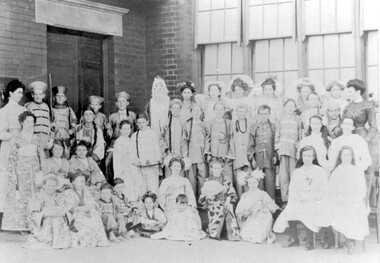 Surrey Hills Historical Society Collection
Photograph, Surrey Hills Primary School 1911 dramatic production, 1911
... Surrey Hills Primary School 1911 dramatic production...Surrey Hills Primary School 1911 dramatic production Photograph ...Group of 38 male and female students of varying ages from Surrey Hills Primary School. It is taken outside the school buildings and students are accompanied by 2 female teachers. Most of the students are dressed in oriental costume. surrey hills primary school, school concerts, children, education, primary education, music, schools, (mr) john reaburn, operetta -
Tatura Irrigation & Wartime Camps Museum
Motor Spirit Consumer's licence X3, Commonwealth of Australia , State of Victoria, 1949
... These licences were for primary production. They show type of vehicle, type of production,spaces for each month, and cancel stamp.There are also some coupons for 2 or 5 gallons...These licences were for primary production. They show type of vehicle, type of production,spaces for each month, and cancel stamp.There are also some coupons for 2 or 5 gallons.+ Motor Spirit Consumer's licence X3 Commonwealth of Australia , State of Victoria ...Primary Industry rationing cards.3 WW2 Petrol Rationing licence forms, 1 for John Cross (Toolamba) and 2 for George Cross. These licences were for primary production. They show type of vehicle, type of production,spaces for each month, and cancel stamp.There are also some coupons for 2 or 5 gallons.+ -
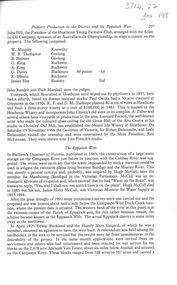 Bendigo Historical Society Inc.
Document - Eppalock Weir
... On top of front page: 'Primary Production in the District and the Eppalock Weir.' ...On top of front page: 'Primary Production in the District and the Eppalock Weir.' ...Five-page photocopied document. On top of front page: 'Primary Production in the District and the Eppalock Weir.' A history of the proposed water storage on the Campaspe River, later Eppalock Weir, is detailed with reference to proponents and opponents to the scheme, dating back to 1865. A photo of the commemorative water fountain erected to honour those involved in the construction of Lake Eppalock is attached as the last page. lake eppalock, hugh mccoll, campaspe, wild duck creek, edwin buckland, huntly shire council, martin o'sullivan, ernest coyle, mcivor shire council, state rivers and water supply commission -
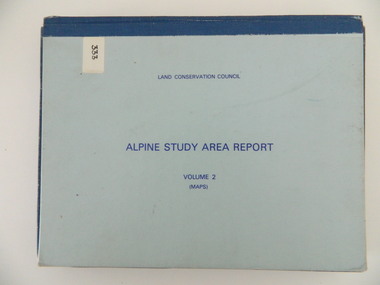 Kiewa Valley Historical Society
Report - Alpine Study Area Volume 2 Maps, Land Conservation Council, 1970s
... Recreation. 9. Primary production. 10. Minerals...Recreation. 9. Primary production. 10. Minerals Land Conservation Council Report - Alpine Study Area Volume 2 Maps ...The Victorian Environmental Assessment Council and the former Environment Conservation Council (ECC) and Land Conservation Council (LCC) have completed 36 land use investigations over more than 35 years, including 27 regional reviews. They provide a framework for use of Public Land in Victoria. The Land Conservation Council was established by the Land Conservation Act 1970.These maps provide an assessment of the Alpine area at the time the maps were created. Some of the topics eg. Rainfall and water resources may change over the years thus providing a comparative analysis. Others may provide information for future development such as mineral exploration, building of a dam / tunnel etc.Blue box shaped folder containing 9 of 10 Maps of the Alpine Study Area produced by the Land Conservation Council. Maps include 1. Public land and descriptive blocks. 2. Physiography. 3. Topography. 4. Geology (missing). 5. Rainfall and water resources. 6. Vegetation 7. Land systems. 8. Recreation. 9. Primary production. 10. Minerals Ex library item. Stamped in red "Discarded From Stock / Swan Hill Regional Libraryalpine area, maps of alpine area, land conservation council -
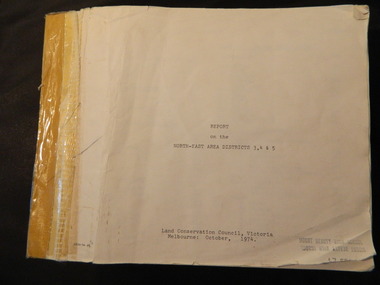 Kiewa Valley Historical Society
Report - Land Conservation Council x2, Land Conservation Council, Victoria Melbourne, April 1978, October 1974
... It describes and assesses the natural resources:-Physiography, Geology, Topography, Land Systems, Outdoor Recreation, Public land and blocks. Primary Production. Vegetation....It describes and assesses the natural resources:-Physiography, Geology, Topography, Land Systems, Outdoor Recreation, Public land and blocks. Primary Production. Vegetation. North East Victoria includes the Kiewa Valley. ...Land Conservation Act 1970 established the Land Conservation Council to investigate and recommend to the Minister use of public land in Victoria. It describes and assesses the natural resources:-Physiography, Geology, Topography, Land Systems, Outdoor Recreation, Public land and blocks. Primary Production. Vegetation.North East Victoria includes the Kiewa Valley. This report gives an understanding of the development of the area.Thick heavy book with 312 pages with black and white photos. Back half has a folder with heavy cardboard attached to thick cardboard back cover. Inside folder are 9 maps with color each with a different title.Stamped on Front Cover: "Mount Beauty High School" Has a library borrowing slip at the back of the last page.land conservation council, environment, public land, kiewa valley, planning -
 Bendigo Historical Society Inc.
Photograph - PETER ELLIS COLLECTION: GRAVEL HILL PRIMARY SCHOOL
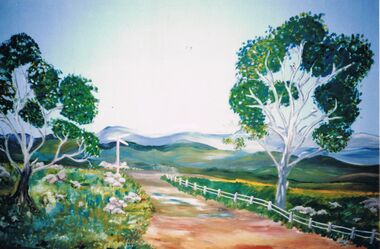
... Gravel Hill Primary School. 1988 Production 'The Wallaby Track''...Gravel Hill Primary School. 1988 Production 'The Wallaby Track'' Photograph PETER ELLIS COLLECTION: GRAVEL HILL PRIMARY SCHOOL ...Colour photograph. Painted scenery. Mountains. Gumtrees. Signpost. Dirt road. Gravel Hill Primary School. 1988 Production 'The Wallaby Track''education, primary, gravel hill school -
 Melbourne Tram Museum
Book, Victorian and Melbourne Centenary Celebrations Council, "The Official Centenary Guide and Souvenir", 1934
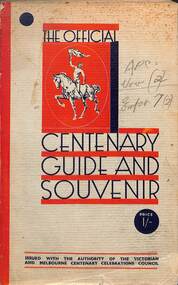
... Includes a short section of the history of Victoria and Melbourne, Education, Religious Activities, Public Utilities, Primary production, places of interest, Instructions, Pleasure Resorts and Sporting. ...Includes a short section of the history of Victoria and Melbourne, Education, Religious Activities, Public Utilities, Primary production, places of interest, Instructions, Pleasure Resorts and Sporting. ...Produced by the Victorian and Melbourne Centenary Celebrations 1934-1935. An extensive four month event was planned. Includes a short section of the history of Victoria and Melbourne, Education, Religious Activities, Public Utilities, Primary production, places of interest, Instructions, Pleasure Resorts and Sporting. The Utilities included the Victorian Railways, MMTB, Police, Melbourne Harbour Trust and the SEC. Includes many advertisements for car dealers, manufacturers, insurance and hotels.Yields information about the Melbourne Centenary Celebrations in 1934.Book - 222 pages - 7 sections, glued cover with many black and white photos and advertisements.Has pencil marks on the front and inside front cover and in marks on the outside rear cover.victoria, centenary celebrations, melbourne, mmtb, vr, secv, harbour trust -
 Bendigo Historical Society Inc.
Photograph - PETER ELLIS COLLECTION: GRAVEL HILL PRIMARY SCHOOL
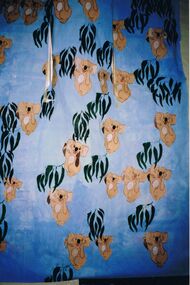
... Gravel Hill Primary School. 1988 Production 'The Wallaby Track''...Gravel Hill Primary School. 1988 Production 'The Wallaby Track'' Photograph PETER ELLIS COLLECTION: GRAVEL HILL PRIMARY SCHOOL ...Colour photograph showing a light blue back ground with cartoon Koalas and Eucalyptus leaves. Some tears in background. Gravel Hill Primary School. 1988 Production 'The Wallaby Track''artwork, print, koala print -
 Bendigo Historical Society Inc.
Photograph - PETER ELLIS COLLECTION: GRAVEL HILL PRIMARY SCHOOL
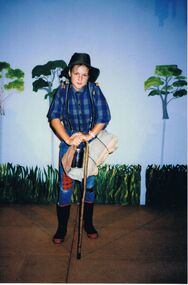
... Gravel Hill Primary School. 1988 Production 'The Wallaby Track''....Gravel Hill Primary School. 1988 Production 'The Wallaby Track''. Photograph PETER ELLIS COLLECTION: GRAVEL HILL PRIMARY SCHOOL ...Colour photograph. Girl dressed as Swagman. Corks hanging on hat. Check shirt. Walking stick. Swag bedroll. Torn jeans gum boots, billy can. Gravel Hill Primary School. 1988 Production 'The Wallaby Track''.photo, individual, young male -
 Bendigo Historical Society Inc.
Photograph - PETER ELLIS COLLECTION: GRAVEL HILL PRIMARY SCHOOL
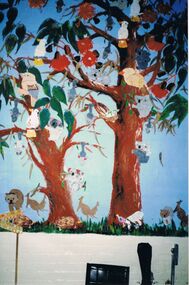
... Gravel Hill Primary School. 1988 Production 'The Wallaby Track''...Gravel Hill Primary School. 1988 Production 'The Wallaby Track'' Photograph PETER ELLIS COLLECTION: GRAVEL HILL PRIMARY SCHOOL ...Colour photograph showing a painted scene of gumtrees. Koalas, kookaburra, blossoms, sulphur crested cockatoo, gumnuts, ringtail possum, wombat, kangaroo, Echidna, lyre bird. Gravel Hill Primary School. 1988 Production 'The Wallaby Track''artwork, acrylic, australiana -
 Bendigo Historical Society Inc.
Photograph - PETER ELLIS COLLECTION: GRAVEL HILL PRIMARY SCHOOL
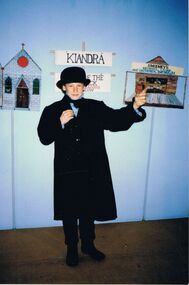
... Gravel Hill Primary School. 1988 Production 'The Wallaby Track''....Gravel Hill Primary School. 1988 Production 'The Wallaby Track''. Photograph PETER ELLIS COLLECTION: GRAVEL HILL PRIMARY SCHOOL ...Colour photograph. Child in costume. Boy three piece suit, trench coat and hat. Pointing at painted scenery Sweeney's General Store and Universal Emporium. Kiandra. Church. Gravel Hill Primary School. 1988 Production 'The Wallaby Track''.photo, individual, young male -
 Bendigo Historical Society Inc.
Photograph - PETER ELLIS COLLECTION: BOYS PAINTING
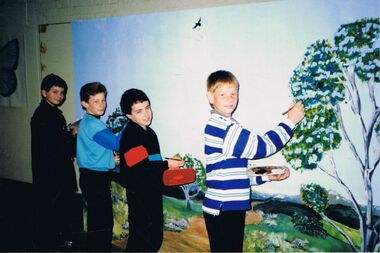
... Gravel Hill Primary School. 1988 Production 'The Wallaby Track'' Back of photo reads: Damon Mlekuz LHS Designed and ran the painting crew....Gravel Hill Primary School. 1988 Production 'The Wallaby Track'' Back of photo reads: Damon Mlekuz LHS Designed and ran the painting crew. ...Colour photograph. Four boys painting scenery. Gum tree. Hills. Bird in sky. Gravel Hill Primary School. 1988 Production 'The Wallaby Track'' Back of photo reads: Damon Mlekuz LHS Designed and ran the painting crew.photo, group, four boys -
 Bendigo Historical Society Inc.
Photograph - PETER ELLIS COLLECTION: GRAVEL HILL PRIMARY SCHOOL
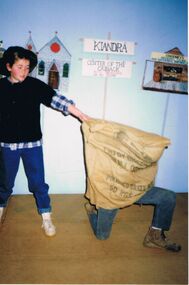
... Gravel Hill Primary School. 1988 Production 'The Wallaby Track''....Gravel Hill Primary School. 1988 Production 'The Wallaby Track''. Photograph PETER ELLIS COLLECTION: GRAVEL HILL PRIMARY SCHOOL ...Colour photograph. Children in costume. Hessian sack. Jeans. Boots. Kiandra. Center of the outback with dragons so go slow. Sweeney's general store and universal emporium. Painted scenery. Church. Gravel Hill Primary School. 1988 Production 'The Wallaby Track''.photo, group, children in costume -
 Bendigo Historical Society Inc.
Photograph - PETER ELLIS COLLECTION: GRAVEL HILL PRIMARY SCHOOL
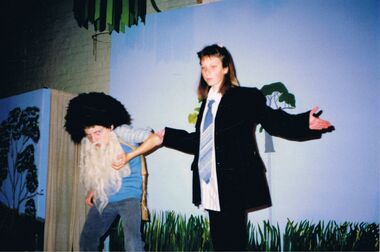
... Gravel Hill Primary School. 1988 Production 'The Wallaby Track'' Back of photo reads: Greg Dundan -Bendigo Addy Editor. ...Gravel Hill Primary School. 1988 Production 'The Wallaby Track'' Back of photo reads: Greg Dundan -Bendigo Addy Editor. ...Colour photograph. Children in costume. Painted scenery. Girl in suit with blue striped tie. Boy in wig and scruffy beard. Gravel Hill Primary School. 1988 Production 'The Wallaby Track'' Back of photo reads: Greg Dundan -Bendigo Addy Editor. Belinda Earnshaw.photo, group, children in costume -
 Bendigo Historical Society Inc.
Photograph - PETER ELLIS COLLECTION: GRAVEL HILL PRIMARY SCHOOL
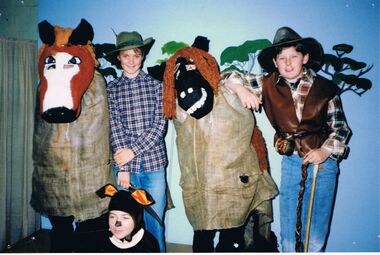
... Gravel Hill Primary School. 1988 Production 'The Wallaby Track'' Staple holes in corners....Gravel Hill Primary School. 1988 Production 'The Wallaby Track'' Staple holes in corners. ...Colour photograph. Kids in costume. Horse mask hessian body. Girl in check shirt jeans and hat. Bot in hat check shirt jeans, waistcoat. Child dressed as dog at front. Gravel Hill Primary School. 1988 Production 'The Wallaby Track'' Staple holes in corners.education, primary, gravel hill school -
 City of Greater Bendigo - Civic Collection
Work on paper - Architectural Drawing, City of Bendigo, Proposed Brick Residence at Bendigo Abbatoirs (sic) for the Bendigo City Council, Not dated
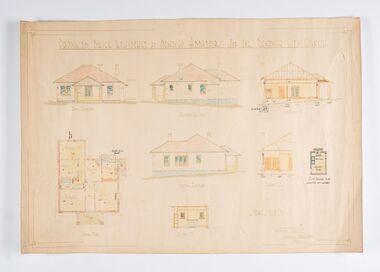
... It is historically significant to the City of Greater Bendigo as a key to the primary production industry that centred on this precinct from the 1860s to the mid 1990s; they are an important surviving component of one of the largest regional livestock markets in Victoria. ...It is historically significant to the City of Greater Bendigo as a key to the primary production industry that centred on this precinct from the 1860s to the mid 1990s; they are an important surviving component of one of the largest regional livestock markets in Victoria. ...Situated at 47 Lansell Street, Bendigo, the original 1911-12 Charles D'Ebro designed brick Bendigo Municipal Abattoir, comprising twin slaughter and hanging rooms for cattle, sheep and pigs, and two smaller ancillary brick buildings. After the buildings were acquired by the Country Roads Board in 1945, a substantial but sympathetic addition was made to the south-eastern end of the old cattle abattoir. The abattoir is significant for historic, architectural and technical reasons at a state level. as a rare surviving municipal abattoir, and represents the development of hygienic slaughtering through municipal regulations, thus improving standards of public health in Victoria. It is historically significant to the City of Greater Bendigo as a key to the primary production industry that centred on this precinct from the 1860s to the mid 1990s; they are an important surviving component of one of the largest regional livestock markets in Victoria. D'Ebro was critically influential in the development of industrial and in particular meat processing buildings, designing major freezing works and abattoirs throughout Victoria and Australia.(Source, National Trust Database). The Bendigo facility finally closed in 1945, when all slaughtering for local consumption passed to a joint export and local slaughtering facility at the Bendigo Inland Meat Authority. Ink, pen, pencil and watercolour architectural drawing for the proposed brick residence at Bendigo abattoirs. Proposed Brick Residence at Bendigo Abbatoirs (sic) For The Bendigo City Council. / Front Elevation / Easter Elevation / Section A. D. / Ground Plan / Wester Elevation / Section C.D. / Section I. P. ? Existing Building to be / Converted into Laundry ? Scale 1/8" to 1 FT / Geo. Austen Architect / Commonwealth Bank Chambers / Bendigocity of greater bendigo commerce, charles d'ebro -
 Flagstaff Hill Maritime Museum and Village
Book - Reference/Legal Acts, John Ferres, Government Printer, The Victorian Statutes Vol 2 Collectors of Customs, 1866
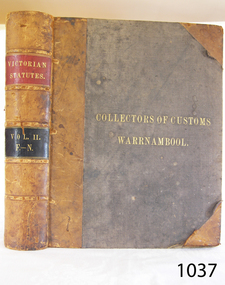
... production, allowing him to help issue the very first eight-page newspaper in the colony. In late 1851, the newly independent Colony of Victoria abruptly dismissed its first official government printer, Edward Khull, for alleged incompetence right as the state desperately needed to print its official financial Estimates. Thanks to his sterling reputation at the Herald, Ferres was tapped by government officials and officially appointed Victorian Government Printer on 8 November 1851. This work is historically and legally significant, as it is a primary ...Because the subject item is a book of law, it would not traditionally have a singular author, but rather a corporate author, specifically the Colony of Victoria and, more precisely, the Parliament of Victoria. The Victorian Statutes of 1866 is an official compilation of the statute law of the Colony of Victoria, Australia, 'Published by Authority', and printed by John Ferres, who was the Victorian Government Printer at the time. Ferres was the printer/publisher, not an author or editor in the usual sense, as this is a government publication rather than an individually authored work.Hard cover book, The Victorian Statutes Vol 2 Author: Corporate Author “The Colony of Victoria” Publisher: John Ferres Government Printer Melbourne. Date: 1866 Three quarter leather, Olive Front Cover, Brown Spine with Gold embossed Title on spine & front cover "Collector of Customs Warrnambool"non-fictionBecause the subject item is a book of law, it would not traditionally have a singular author, but rather a corporate author, specifically the Colony of Victoria and, more precisely, the Parliament of Victoria. The Victorian Statutes of 1866 is an official compilation of the statute law of the Colony of Victoria, Australia, 'Published by Authority', and printed by John Ferres, who was the Victorian Government Printer at the time. Ferres was the printer/publisher, not an author or editor in the usual sense, as this is a government publication rather than an individually authored work.flagstaff hill, warrnambool, shipwrecked-coast, flagstaff-hill, flagstaff-hill-maritime-museum, maritime-museum, shipwreck-coast, flagstaff-hill-maritime-village, the victorian statutes vol 2 collectors of customs, book -
 Flagstaff Hill Maritime Museum and Village
Functional object - Hand Trolley, Melbourne Steamship Company (MSS Co), Late 19th to mid-20th century
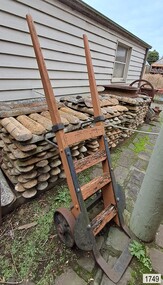
... It is associated with the maritime industries of shipping, transportation, travel, and trade, as well as the colonial primary production sectors of farming, markets, and produce. ...This hand trolley was originally marked M.S.S. Co., and likely to have once belonged to the Melbourne Steamship Company, often referred to by those initials. Flagstaff Hill’s collection has several other objects connected to the M.S.S. Co. The firm was established in 1873 under the name Hugh R. Reid and Company, renamed Melbourne Steamship Company Ltd in 1895, and became Melbourne’s foremost interstate shipping line. Warrnambool was one of the ports of call at least between 1922 and 1956; for example, on September 27 1934, the ship Coolana left Warrnambool on its way to Stanley, Burnie and Devonport, then on to Sydney and Newcastle, while other of its vessels were visiting Fremantle, Port Lincoln, Whyalla, Adelaide, and Melbourne. The firm remained in business until around 1960. A hand trolley can be loaded with heavy and bulky objects such as luggage, and stacks of boxes such as produce, cargo and equipment. It uses the principles of wheels and leverage, like a wheelbarrow, and can easily be wheeled from one place to another. Hand trolleys are still used by farmers, railway workers, shipping companies, porters, airports, hospitals, warehouses, logistical firms, furniture removalists, factory labourers and even in private homes when heavy loads need to be moved. Hand trolleys were first used in the 18th century in industries where children were used to move heavy loads. By using a hand trolley, the young labourers could move the piles of objects with the same efficiency as the adult workers. This hand trolley is significant for its likely connection to the Melbourne Steamship Company, or MSSCo, Melbourne’s foremost shipping line for interstate trade in the late nineteenth and early-to- mid twentieth century, representing many aspects of early trade within maritime Australia; Warrnambool was one of the ports visited by the company’s ships. The design of the hand trolley is an example of equipment used since the 18th century to move heavy loads at docks and shipyards. It is associated with the maritime industries of shipping, transportation, travel, and trade, as well as the colonial primary production sectors of farming, markets, and produce. The design represents an early step in the evolution of the simple hand trolley. More recently, as well as the continued use of this simple style of trolley, the design has been improved to include specialised trolleys that fold, climb stairs, move pianos and even easily turn corners on their spinning, pivoting wheels. Hand trolley: an L-shaped handcart with handles and supporting legs at one end, wheels at the other, and a ledge or platform to hold the load. This hand trolley has orange wooden slats and handles, two metal wheels, and a black metal frame with semi-circular side flanges. An inscription is stamped on one side.Stamped: "M.S.S.CO."warrnambool, flagstaff-hill, flagstaff-hill-maritime-museum, maritime-museum, shipwreck-coast, flagstaff-hill-maritime-village, hand trolley, sack truck, trolley, luggage trolley, hand truck, trundler, sack barrow, bag barrow, leverage, marine technology, cargo handling, docks, wharft, shipping, trade, vintage, antique, hand card, rolling cart, station trolley, dolly, stack truck, box cart, two-wheeler, material handling equipment, shipping trade, mss co, mssc, melbourne steamship company, interstate shipping, hugh r. reid and company -
 Flagstaff Hill Maritime Museum and Village
Equipment - Hand Trolley
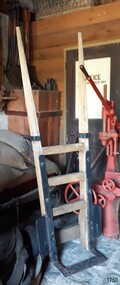
... It is associated with the maritime industries of shipping, transportation, travel and trade as well as the colonial primary production sectors of farming, markets and produce. ...A hand trolley can be loaded with heavy and bulky objects such as luggage, and stacks of boxes such as produce, cargo and equipment. It uses the principles of wheels and leverage, like a wheelbarrow, and can easily be wheeled from one place to another. Hand trolleys are still used by farmers, railway workers, shipping companies, porters, airports, hospitals, warehouses, logistical firms, furniture removalists, factory labourers and even in private homes when heavy loads need to be moved. Hand trolleys were first used in the 18th century in industries where children were used to move heavy loads. By using a hand trolley, the young labourers could move the piles of objects with the same efficiency as the adult workers. The design of the hand trolley is an example of equipment used since the 18th century to move heavy loads at the docks and shipyards. It is associated with the maritime industries of shipping, transportation, travel and trade as well as the colonial primary production sectors of farming, markets and produce. The design represents an early step in the evolution of the simple hand trolley. More recently, as well as the continued use of this simple style of trolley, the design has been improved to include specialised trolleys that fold, climb stairs, move pianos and even easily turn corners on their spinning, pivoting wheels. Hand trolley: an L-shaped hand-operated trolley with handles and supporting legs at one end, wheels at the other, and a ledge or platform to hold the load. This hand trolley has orange wooden slats and handles, two metal wheels, and a black metal frame with curved corners on its rectangular side flanges.flagstaff hill, warrnambool, shipwreck coast, maritime museum, flagstaff hill maritime museum and village, vintage, antique, hand trolley, hand card, hand truck, rolling cart, luggage trolley, station trolley, dolly, stack truck, sack truck, trundler, box cart, sack barrow, bag barrow, two-wheeler, leverage, material handling equipment, marine technology, cargo handling, docks, shipping trade -
 The Beechworth Burke Museum
Geological specimen - Galena (with quartz), unknown
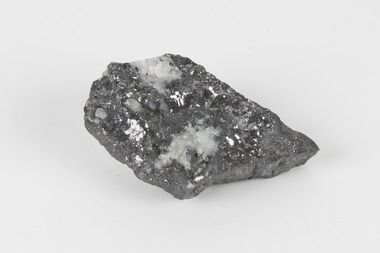
... primary source of both lead and silver. This specimen of Galena comes from Broken Hill. Broken Hill has one of the world’s largest and most significant deposit of ore for the production of lead. ...primary source of both lead and silver. This specimen of Galena comes from Broken Hill. Broken Hill has one of the world’s largest and most significant deposit of ore for the production of lead. ...Galena is the natural compound of lead and classed as a sulphide, it crystallises in a cubic pattern and its chemical formula is PbS. Galena is a primary source of both lead and silver. This specimen of Galena comes from Broken Hill. Broken Hill has one of the world’s largest and most significant deposit of ore for the production of lead. Mining of Galena at Broken Hill began with the staking of land by Charles Rasp in 1883. By the following year, in 1884, Rasp and six others had formed Broken Hill Mining Company. Broken Hill Mining Company eventually evolved into BHP group limited and is currently the largest mining company in the world and the largest company in Australia. There is archaeological evidence from artefacts discovered in Turkey that humans have been extracting lead from galena by the process of smelting since at least 6500 BCE. This specimen also has quartz on the top surface which is frequently discovered alongside Galena. This mineral specimen is of historic significance as a sample of Galena extracted from Broken Hill during the 19th century. Mining for Galena in Broken Hill begin in 1883 by Charles Rasp and evolved into the world’s largest mining company – BHP Group Limited. Broken Hill is one of the world’s most significant deposits of ore for the production of lead. This specimen is part of a larger collection of geological and mineral specimens collected from around Australia (and some parts of the world) and donated to the Burke Museum between 1868-1880. A large percentage of these specimens were collected in Victoria as part of the Geological Survey of Victoria that begun in 1852 (in response to the Gold Rush) to study and map the geology of Victoria. Collecting geological specimens was an important part of mapping and understanding the scientific makeup of the earth. Many of these specimens were sent to research and collecting organisations across Australia, including the Burke Museum, to educate and encourage further study.A flat, hand-sized, grey sulphide specimen that is the natural compound of lead with a quartz formation on the top surface. Existing Label: GALENA / (with quartz) / Locality: Broken Hill / N.S.W 120 x 70 x 29geological specimen, geology, geology collection, burke museum, beechworth, galena, galena quartz, quartz, charles rasp, broken hill mining company, bhp group limited, bhp, lead, ore, lead sulphide, sulphide, silver, broken hill -
 Greensborough Historical Society
Compact disc, Briar Hill Primary School - A reflective look 1927- 2007, 1927-2007
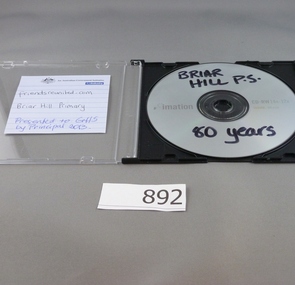
... Primary School in 2007. Contents: a selection of unnamed class photographs from 1927 - 2006. Activities include Spring Fair 2007. A production ...One Power point presentation (dated 27/11/2007) to commemorate the 80th anniversary of Briar Hill Primary School in 2007. Contents: a selection of unnamed class photographs from 1927 - 2006. Activities include Spring Fair 2007.A production of the Briar Hill Primary School to celebrate 80 years.1 compact disc in plastic case.briar hill primary school -
Ringwood and District Historical Society
Book - Inventory, Ringwood Primary School Inventory book (text books,maps, etc). 1961-1969, 1961 - 1969
... A Pencraft Production.) Ringwood Primary School No 2997. Book containing an inventory of text books, maps and requisites. ...Ringwood Primary School No 2997. Book containing an inventory of text books, maps and requisites. Education Department Vic Form No. ST 673. The book has alphabetic index tabs; mottled green cover; red cloth spine.Inventory (The Pencraft Faint Indexed Account Book. A Pencraft Production.) -
Ringwood and District Historical Society
Magazine, Southwood Primary School, Ringwood. Draft mock-up cover of school history publication, c.1997
... production incorporating the 1997 year book and the last grade six graduation on front. Draft mock-up cover of school history with photocopied school photograph inserts. A3 page folded to contain 4 black and white photocopied photos of classes at Southwood Primary School 1980 and 1988 - photo of school pasted on front. ...Part of production incorporating the 1997 year book and the last grade six graduation on front.Draft mock-up cover of school history with photocopied school photograph inserts. A3 page folded to contain 4 black and white photocopied photos of classes at Southwood Primary School 1980 and 1988 - photo of school pasted on front. -
 Ringwood and District Historical Society
Archive, Parent Record for Nature Notes & Probe magazines Collection
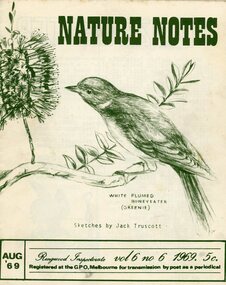
... production and readers throughout Australia, as well as its many creators and producers during its 20-year existence, mourn its passing. Written from material supplied by Barry Archibald (editor 'Nature Notes' 1977-78) Margaret Preece & Lois Aders (parents in charge of collating and packaging during its last years of existence. Parent Record for Archive collection of photographs, documents, minutes etc relating to the Nature Notes and Probe magazines published by the Ringwood Electorate State/Primary ...Parent Record for Archive collection of photographs, documents, minutes etc relating to the Nature Notes and Probe magazines published by the Ringwood Electorate State/Primary SchoolsFrom “The History of Ringwood East Primary School 1924-1990” 'Nature Notes' was a children's nature magazine, produced at Ringwood East Primary School for approximately 10 years. It came to us from Blackburn Lake Primary School and before that Blackburn South Primary School. It was originally developed by Harry Hopkins in 1964. He was a District Inspector of schools and also President of the Gould League at the time. Fred Rodgers and Len Delacca were original contributors, Fred writing on native flora and Len writing on native flora [fauna]. It came to Ringwood East in 1975 with Keith Dyer, a teacher on the staff, as editor. The magazine had a large circulation, supplying to schools, private subscribers and societies as well as sending many complimentary copies to libraries, and museums; distribution was throughout Australia. The Magazine continued to grow under consequent editors, Anne Gibson (who also developed 'Probe' a junior version of 'Nature Notes' designed for grades 2 and 4), Barry Archibald, Colin Bull, Russell Hall, Deborah Brydon and Mandy Charmichael. The editors would research, compile, edit and print the magazine which was a monthly issue. The parents would then come in on a Monday to collate, fold and staple. This usually was a morning’s work but this depended on how many helping hands there were. The Wednesday was packing and posting day and in the early days the parents used to deliver the local orders to save costs. Subscribers were sought through advertisements in various school literature and material. The Parents Club received an annual remuneration for their hard work and in turn were able to help purchase many items needed throughout the school. These magazines were packed with really good nature information and taught children how to look after their environment using articles, puzzles, riddles, questions and quizzes. There were special characters as well like 'Wally the Wombat' and 'Ernie the Echidna' for the children to follow on various adventures every month. Children would enjoy watching them crop up in each edition. The magazine stayed with us at Ringwood East until 1986, when due to restructuring and various other things was moved to Healesville Sanctuary where it adopted a new format and name. From here it has since folded and so the end of 'Nature Notes'. 'Nature Notes' was a very successful magazine. Many people through the years devoted a lot of time and energy to its production and readers throughout Australia, as well as its many creators and producers during its 20-year existence, mourn its passing. Written from material supplied by Barry Archibald (editor 'Nature Notes' 1977-78) Margaret Preece & Lois Aders (parents in charge of collating and packaging during its last years of existence. -
 Ringwood and District Historical Society
Newspaper, Eastwood Primary School, East Ringwood - Newspaper Clipping - 9-11-1993 - "Puppets bring prks award to students"
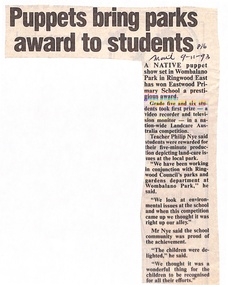
... The article reports that Eastwood Primary School’s Grade 5 and 6 students won a national Landcare Australia competition with a five‑minute puppet show about environmental issues in Wombalano Park. Working alongside Ringwood Council’s parks and gardens department, the students created a production that earned the school a video recorder and television monitor. ...The article reports that Eastwood Primary School’s Grade 5 and 6 students won a national Landcare Australia competition with a five‑minute puppet show about environmental issues in Wombalano Park. Working alongside Ringwood Council’s parks and gardens department, the students created a production that earned the school a video recorder and television monitor. ...The article reports that Eastwood Primary School’s Grade 5 and 6 students won a national Landcare Australia competition with a five‑minute puppet show about environmental issues in Wombalano Park. Working alongside Ringwood Council’s parks and gardens department, the students created a production that earned the school a video recorder and television monitor. Their teacher, Philip Nye, said the whole school community was proud, and the children were thrilled to have their efforts recognised.. (Co-Pilot Summary 4/7/2026). -
 Ringwood and District Historical Society
Newspaper - Clipping, Jason and His Amazing Technicolor Dreamcoat Production by North Ringwood Primary Scool Choir and Norwood Secondary College, Ringwood, Victoria, 1993
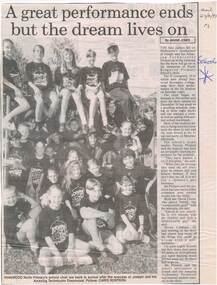
... Jason and His Amazing Technicolor Dreamcoat Production by North Ringwood Primary Scool Choir and Norwood Secondary College, Ringwood, Victoria....Group photo caption: Ringwood North Primary's school choir are back to school aftger the success of Joseph and His Amazing Technicolor Dreamcoat. Picture: Chris Rostron. Ringwood Mail, 23 February 1993 Page 3 - Report by Janine Jones. Jason and His Amazing Technicolor Dreamcoat Production ...Ringwood Mail, 23 February 1993 Page 3 - Report by Janine Jones.Group photo caption: Ringwood North Primary's school choir are back to school aftger the success of Joseph and His Amazing Technicolor Dreamcoat. Picture: Chris Rostron. -
 Ringwood and District Historical Society
Newsletter, Maroondah High School - Newsletter Vol 4. No. 1 June 1981
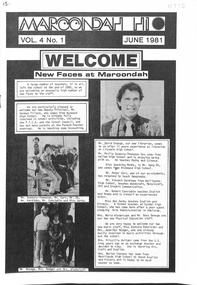
... Articles include: - WELCOME _ New faces at Maroondah - including new Deputy Principal Norman Tillack - "The Music Man" school production announced, with photos of Mark Donaldson, Lyndell Wickham, Lynda Gorman, Kate Morton, John Brohm and Sonya Mau - A Play called "Family Feud", report by Richard Farkashazy 8F - Differences between Primary and High School, by Granham Jang 7B - Our exchange Student - by Trina Besser - Our Top HSC Students 1980 - Jenny Gaunson and Grant Hutchinson - Sports photos - Work Experience Report by Melinda Dodds 10B - The Dinkum Aussie, by Kay Hislop 11B - Farewell to Mrs Cole and Mrs Unthank - Year 11 Biology Camp - Year 8 Activities - Jells Park, by Kylie Dickson 8A, Nicole Hoppener 8A, Tanya Neet 8A - HSC Camp Inverloch (Photos) - School Committe; - PTCA report (Ann Hallett - President)...Articles include: - WELCOME _ New faces at Maroondah - including new Deputy Principal Norman Tillack - "The Music Man" school production announced, with photos of Mark Donaldson, Lyndell Wickham, Lynda Gorman, Kate Morton, John Brohm and Sonya Mau - A Play called "Family Feud", report by Richard Farkashazy 8F - Differences between Primary and High School, by Granham Jang 7B - Our exchange Student - by Trina Besser - Our Top HSC Students 1980 - Jenny Gaunson and Grant Hutchinson - Sports photos - Work Experience Report by Melinda Dodds 10B - The Dinkum Aussie, by Kay Hislop 11B - Farewell to Mrs Cole and Mrs Unthank - Year 11 Biology Camp - Year 8 Activities - Jells Park, by Kylie Dickson 8A, Nicole Hoppener 8A, Tanya Neet 8A - HSC Camp Inverloch (Photos) - School Committe; - PTCA report (Ann Hallett - President) Maroondah High School - Newsletter Vol 4. ...Black and White printed A4 sized newsletter (8 pages). Articles include: - WELCOME _ New faces at Maroondah - including new Deputy Principal Norman Tillack - "The Music Man" school production announced, with photos of Mark Donaldson, Lyndell Wickham, Lynda Gorman, Kate Morton, John Brohm and Sonya Mau - A Play called "Family Feud", report by Richard Farkashazy 8F - Differences between Primary and High School, by Granham Jang 7B - Our exchange Student - by Trina Besser - Our Top HSC Students 1980 - Jenny Gaunson and Grant Hutchinson - Sports photos - Work Experience Report by Melinda Dodds 10B - The Dinkum Aussie, by Kay Hislop 11B - Farewell to Mrs Cole and Mrs Unthank - Year 11 Biology Camp - Year 8 Activities - Jells Park, by Kylie Dickson 8A, Nicole Hoppener 8A, Tanya Neet 8A - HSC Camp Inverloch (Photos) - School Committe; - PTCA report (Ann Hallett - President)
