
Showing 27 items matching "primitive buildings"
-
 Coal Creek Community Park & Museum
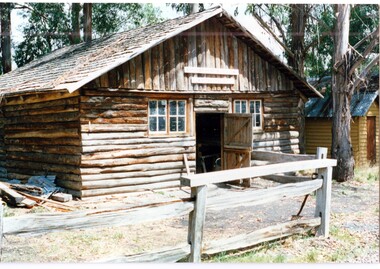
Photograph (item) - Slab Building used as a dairy and cattle housing, Coal Creek Community Park & Museum
... ...primitive buildings...This is a photo of the dairy building constructed in the farm area at Coal Creek Community Park & Museum. it was built c1980s and designed to replicate what settler's may have used to stable their cows and collect milk and cream. farming dairy farms primitive buildings pencilled on the reverse 'A13'. ...This is a photo of the dairy building constructed in the farm area at Coal Creek Community Park & Museum. it was built c1980s and designed to replicate what settler's may have used to stable their cows and collect milk and cream. pencilled on the reverse 'A13'. Agfa watermarks. Printer's code SQPIX 00420 NNNNAfarming, dairy farms, primitive buildings -
 Eltham District Historical Society Inc
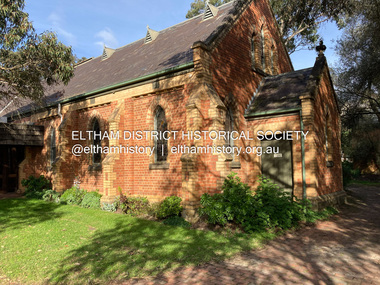
Photograph, Jim Connor, Eltham - Montmorency Uniting Church, 810 Main Rd, Eltham, 10 July 2023
... Primitive Methodists. Eltham Wesleyans first worshipped together in the home of William and Mary Crozier, on 24 acres bounded by Mount Pleasant Road and Pitt Street. From there they moved to a slab and bark hut in 1855 (this later served as the first school run by David Clark prior to the building of a new school in Dalton Street) and the members then built a chapel in 1858 on Lot 20, Henry Street (later to become the Rechabite Hall and Eltham Public Hall). ...Primitive Methodists. Eltham Wesleyans first worshipped together in the home of William and Mary Crozier, on 24 acres bounded by Mount Pleasant Road and Pitt Street. From there they moved to a slab and bark hut in 1855 (this later served as the first school run by David Clark prior to the building of a new school in Dalton Street) and the members then built a chapel in 1858 on Lot 20, Henry Street (later to become the Rechabite Hall and Eltham Public Hall). ...Located on the corner of Main Road and John Street, the church first served the community as the Eltham Wesleyan Church since 1881. It became the Eltham Methodist Church in 1902, the year it united with the Primitive Methodists. Eltham Wesleyans first worshipped together in the home of William and Mary Crozier, on 24 acres bounded by Mount Pleasant Road and Pitt Street. From there they moved to a slab and bark hut in 1855 (this later served as the first school run by David Clark prior to the building of a new school in Dalton Street) and the members then built a chapel in 1858 on Lot 20, Henry Street (later to become the Rechabite Hall and Eltham Public Hall). The present church on John Street was designed by architects Crouch and Wilson in the Early English Gothic style with biochrome brick window frames, buttress heads and pinnacle. Church member George Stebbing built the church, the foundations were constructed with stone from the walls of the first Eltham State Primary School (No. 209) building which collapsed in 1874 and were purchased by Robert David Taylor. Stebbing was also responsible for building St Margaret’s Church and Shillinglaw Cottage. The Roll of Honour, which presently hangs in the church hall (which also doubles as the Opportunity Shop) lists 27 members of the congregation who served in the First World War, 11 of whom never returned. The red-brick Church Hall was opened in 1931 and in 1971 further additions linked the hall and church, including a foyer, vestry, meeting room and toilets reflecting the Eltham style of that time with its simplicity, extensive clear glass, reused baked clay-bricks from the 1881 church, heavy ceiling beams and compressed straw ceiling. On June 26, 1977, the church became part of the new Uniting Church in Australia consisting of the former Methodist and Congregational and most of the Presbyterian Churches. Following of declining numbers of worshippers, the church merged with the Montmorency Uniting Church on June 23, 1996. In 2023 the Uniting church approved a plan to renovate the church. It is understood that the historic church and the hall will be retained, and the building added in 1971 is to be demolished, to make way for a new purpose-built Opportunity shop. The proposed areas to be demolished include the current foyer, toilets, crèche, etc, including the area between the hall and the former RSL. Works are expected to commence mid to late July 2023. The Society was invited by a church member to take photographs of these areas to document them prior to demolition works commencing. Ref: “Nillumbik Now and Then” by Marguerite Marshall (2008)jim connor collection, 2023-07-10, eltham-montmorency uniting church, john street, methodist church, opportunity shop, uniting church, uniting church hall -
 Eltham District Historical Society Inc
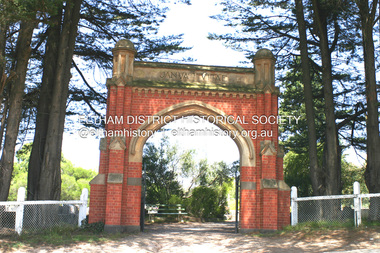
Photograph - Digital Photograph, Alan King, Memorial Arch Gateway, Nillumbik Cemetery, Diamond Creek, 23 January 2008
... Primitive Methodist Church. The barn stood at the corner of Phipps Crescent and the main road.4 Former Eltham Shire councillor George Stebbings, who died in 1896, built several prominent buildings in the district, including Shillinglaw Cottage in Eltham.5 The grave of miner James Joseph Whyte, who died in 1908, is a reminder of Diamond Creek’s gold mining history. ...Primitive Methodist Church. The barn stood at the corner of Phipps Crescent and the main road.4 Former Eltham Shire councillor George Stebbings, who died in 1896, built several prominent buildings in the district, including Shillinglaw Cottage in Eltham.5 The grave of miner James Joseph Whyte, who died in 1908, is a reminder of Diamond Creek’s gold mining history. ...The Nillumbik Cemetery is of historical, architectural, aesthetic and social significance at a Regional level (North-east Melbourne). The memorial arch is of State significance. Nillumbik Cemetery, which was established in 1867, is of historical and social significance for its association with the early history of Diamond Creek and as a record of the pioneering families of the district. Significant graves include those of the famous writer Alan Marshall, author of 'I Can Jump Puddles', footballer Gordon Coventry, and William Ellis, notable early settler and benefactor. The 1897 Tudor/Gothic revival memorial arch, bequeathed by William Ellis, is a rare design in ornamental gateways and is relatively large for the size of the cemetery. It is unique in Victoria as a cemetery gateway arch. The burial ground has associated structures, such as the hexagonal timber sexton's office, post and wire fence and picket hand gate along Main Street, all probably built in the early twentieth century. Covered under Heritage Overlay, Nillumbik Planning Scheme. National Trust of Australia (Victoria) - Regional significance Published: Nillumbik Now and Then / Marguerite Marshall 2008; photographs Alan King with Marguerite Marshall.; p83 Entering Nillumbik Cemetery through an ornamental gateway and shaded by the Monterey Cypress hedge helps one leave the busy world outside and contemplate yesterday’s Diamond Creek. The gateway, classified by the National Trust of Australia (Victoria), and inscribed with ‘JANVA VITAE’ (gate of life), was a gift from a distinguished pioneer, William Ellis. Ellis, who was an original trustee of the Nillumbik Cemetery representing the Primitive Methodists and a successful farmer, bequeathed £100 to build the red-brick and carved stone gateway in 1887. In 1867 surveyor Edward Bage had set aside two acres (0.8ha) now 35 Main Street, for this cemetery, in what was then called the village of Nillumbik. Several earlier burials on private lands in the district might have been exhumed and re-interred in the new cemetery. The first burials in the cemetery are thought to be of ‘a Chinaman who hanged himself from a tree behind the Church of England’ and ‘another man who was drowned in a water-hole behind the same church’.1 The 1000 or so graves in the cemetery are grouped into five denominational sections: two Anglican and one each for the Methodist (the largest), Catholic and Presbyterian Churches. It is believed that several unmarked graves are of Aborigines and Chinese miners.2 Perhaps the most famous person buried in the cemetery was author Alan Marshall, who died in 1984 and wrote, among other books, I Can Jump Puddles. Surprisingly his grave is particularly modest consisting of only a grassed plot with a tiny boulder and a simple bronze plaque. It lies about halfway down the main path, at the west and third row back. The first European, interred at the cemetery on July 9, 1869, was Hannah, aged 13 years eight months, daughter of local orchardist John Lawrey and wife Honor.3 Each grave has a story which reflects a rich history. Phillip Cummings, who died in 1884, provided the barn for Diamond Creek’s first school, run by the Primitive Methodist Church. The barn stood at the corner of Phipps Crescent and the main road.4 Former Eltham Shire councillor George Stebbings, who died in 1896, built several prominent buildings in the district, including Shillinglaw Cottage in Eltham.5 The grave of miner James Joseph Whyte, who died in 1908, is a reminder of Diamond Creek’s gold mining history. At age 51, Whyte died from a rock fall in the Diamond Mine, Diamond Creek. Diamond Creek’s first butcher, Patrick Ryan, became President of the Shire of Heidelberg and Chairman of the Eltham Hurstbridge Railway Trust. A former gold miner, he was grandfather of local historian Reverend Jock Ryan. He was buried in an unmarked grave halfway down the central path. His son John Lawrence, who is buried elsewhere, had been a Mayor of the City of Heidelberg. George Martin Pizzey gave a hall, for what was to become The St John’s Anglican Church in Diamond Creek. He was a Crimean War veteran, mason and leather goods manufacturer in Melbourne, who died in 1915. The two world wars took a heavy toll of locals with 54 personnel buried here, two thirds of whom served in World War One. A sporting pioneer was Greensborough District Cricket Club founder, Andrew Webb, who was buried in 1971. Politician Roy Mountford Vale (Monte), who died in 1977, was a Member of the Legislative Assembly of Greensborough, and a founding councillor and president of the Diamond Valley Shire. Modern-day residents are also remembered in this cemetery. The tragic Ash Wednesday bushfires took their toll on the district: William Marsden of Panton Hill CFA died, aged 39, fighting bushfires at Upper Beaconsfield in 1983.6 Several graves tell of those who held distinguished positions overseas, including William Constable, who died in 1989. Constable was artistic director of a ballet company, art director of more than 30 films for London-based film productions, and was awarded best Film Art Director at the Moscow Film Festival in 1960.This collection of almost 130 photos about places and people within the Shire of Nillumbik, an urban and rural municipality in Melbourne's north, contributes to an understanding of the history of the Shire. Published in 2008 immediately prior to the Black Saturday bushfires of February 7, 2009, it documents sites that were impacted, and in some cases destroyed by the fires. It includes photographs taken especially for the publication, creating a unique time capsule representing the Shire in the early 21st century. It remains the most recent comprehenesive publication devoted to the Shire's history connecting local residents to the past. nillumbik now and then (marshall-king) collection, diamond creek, memorial arch, gateway, nillumbik cemetery, william ellis -
 Eltham District Historical Society Inc
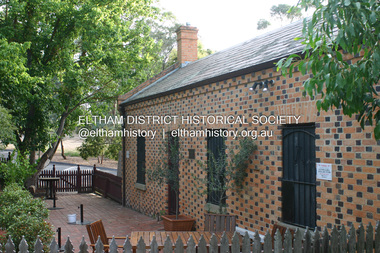
Photograph - Digital Photograph, Alan King, Shillinglaw Cottage, 6 January 2008
... building beside it – a former bank – and St Margaret’s Church of England in Pitt Street. Stebbing was also an Eltham Shire Councillor from 1871 to 1873 and a trustee and treasurer of the Eltham Wesleyan Church.3 In the 1870s he is recorded as the owner of up to five houses. Earlier he had been described as a bricklayer and later became a farmer. In 1882 Stebbing returned to the Pitt Street house and Shillinglaw occupied the new house in Main Road, which he owned from 1887. Shillinglaw was a prolific poet and preached at the Eltham Primitive...building beside it – a former bank – and St Margaret’s Church of England in Pitt Street. Stebbing was also an Eltham Shire Councillor from 1871 to 1873 and a trustee and treasurer of the Eltham Wesleyan Church.3 In the 1870s he is recorded as the owner of up to five houses. Earlier he had been described as a bricklayer and later became a farmer. In 1882 Stebbing returned to the Pitt Street house and Shillinglaw occupied the new house in Main Road, which he owned from 1887. Shillinglaw was a prolific poet and preached at the Eltham Primitive ...Covered under National Estate, National Trust of Australia (Victoria) Local Significance and Heritage Overlay, Nillumbik Planning Scheme. Published: Nillumbik Now and Then / Marguerite Marshall 2008; photographs Alan King with Marguerite Marshall.; p95 Thanks to an Australia first effort by local residents, the historic Shillinglaw Cottage still survives. The cottage at Panther Place, Eltham, once stood about 100 metres away on Main Road. But in 1963 it faced demolition to make room for the Eltham Shire Offices (since demolished). However residents rallied to save Shillinglaw Cottage and became the first in Australia to remove and reconstruct an early settler’s brick building. A fundraiser was the residents’ compilation of loved recipes into the cookery book, Flavour of Eltham. The cottage, built in the late 1870s by noted pioneer builder George Stebbing, is one of Eltham’s earliest buildings and associated with significant early settlers. It is on the National Estate and National Trust Registers. The cottage was constructed with handmade bricks in the Flemish Bond style, typical of cottages and farmhouses in Flanders, Europe. It features burnt ‘header’ bricks over the façade, which gives a chequered effect. The roof is made of slate, while the windows are 12-paned sash with relieving arches. It is not clear who were the first owners of the cottage. The National Trust claims that Stebbing built it for farmer Thomas Cochrane.1 Others say Cochrane first owned the land but Stebbing was Shillinglaw’s first owner and remained so until 1887. The Shillinglaw family then bought it and lived there for around 80 years until 1963 when they sold it to the Eltham Council.2 Farmer Thomas Cochrane bought the Shillinglaw Cottage site from land developer Josiah Holloway. The site was the largest in what Holloway called Little Eltham, of some 30 acres (12 ha), extending along the creek from Henry Street to Luck Street. In 1874 Cochrane sold the land to George Stebbing. Meanwhile in 1861, Stebbing was the owner and occupier of a house at Pitt Street, Eltham, which he had built. Evelyn Observer journalist James Rossiter rented the Pitt Street house, then in 1881 Phillip Shillinglaw occupied it. Stebbing constructed several buildings of note in the area, including the Uniting Church at John Street, the building beside it – a former bank – and St Margaret’s Church of England in Pitt Street. Stebbing was also an Eltham Shire Councillor from 1871 to 1873 and a trustee and treasurer of the Eltham Wesleyan Church.3 In the 1870s he is recorded as the owner of up to five houses. Earlier he had been described as a bricklayer and later became a farmer. In 1882 Stebbing returned to the Pitt Street house and Shillinglaw occupied the new house in Main Road, which he owned from 1887. Shillinglaw was a prolific poet and preached at the Eltham Primitive Methodist Church, where he also served as Sunday School superintendent and led the Young People’s Society Christian Endeavour. The Shillinglaws saw many changes in their property’s boundaries – the major one occurring at the turn of the century when land for the railway and Eltham station was acquired from their holding. The northern part of the remaining land was then used for some of the first commercial developments in what was to become the Eltham Shopping Centre. Later still, the land immediately north of the cottage was bought by the Eltham War Memorial Trust for the War Memorial Buildings and the fire station. The Trust’s land eventually passed to the council. The council bought the remaining two acres (0.8 ha) with the house, and with the exception of the commercial development between the fire station and the post office, all of the former Shillinglaw land is owned by the council or government instrumentalities.4 Since the late 20th century, the cottage has had varied uses, such as a handcrafts store and as a restaurant.This collection of almost 130 photos about places and people within the Shire of Nillumbik, an urban and rural municipality in Melbourne's north, contributes to an understanding of the history of the Shire. Published in 2008 immediately prior to the Black Saturday bushfires of February 7, 2009, it documents sites that were impacted, and in some cases destroyed by the fires. It includes photographs taken especially for the publication, creating a unique time capsule representing the Shire in the early 21st century. It remains the most recent comprehenesive publication devoted to the Shire's history connecting local residents to the past. nillumbik now and then (marshall-king) collection, shillinglaw cottage -
 Eltham District Historical Society Inc
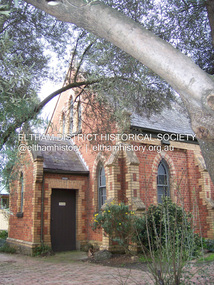
Photograph - Digital Photograph, Marguerite Marshall, Uniting Church, Main Road, Eltham, 19 August 2008
... .; p97 The pretty Uniting Church building at the corner of John and Main Roads Eltham has served the community since 1881.1 Originally called the Eltham Wesleyan Church, the church became the Eltham Methodist Church in 1902, the year it united with the Primitive Methodists.2 As the church community developed, influencing and being influenced by the wider community, its buildings changed accordingly. ....; p97 The pretty Uniting Church building at the corner of John and Main Roads Eltham has served the community since 1881.1 Originally called the Eltham Wesleyan Church, the church became the Eltham Methodist Church in 1902, the year it united with the Primitive Methodists.2 As the church community developed, influencing and being influenced by the wider community, its buildings changed accordingly. ...Eltham's original Wesleyan Methodist Church Covered under Heritage Overlay, Nillumbik Planning Scheme. Published: Nillumbik Now and Then / Marguerite Marshall 2008; photographs Alan King with Marguerite Marshall.; p97 The pretty Uniting Church building at the corner of John and Main Roads Eltham has served the community since 1881.1 Originally called the Eltham Wesleyan Church, the church became the Eltham Methodist Church in 1902, the year it united with the Primitive Methodists.2 As the church community developed, influencing and being influenced by the wider community, its buildings changed accordingly. Eltham Wesleyans first worshiped together in 1850 at the home of William and Mary Crozier on 24 acres (9.7ha) bounded by Mount Pleasant Road and Pitt Street. From 1855 the Wesleyans worshipped in a slab-and-bark hut; then in 1858 in a chapel on Henry Street close to Maria Street (now Main Road). Meanwhile, in 1860, the Primitive Methodists opened a brick chapel at the corner of Susan and Bridge Streets. The John Street building – in the Early English Gothic style with biochrome brick window frames, buttress heads and pinnacle – was designed by architects Crouch and Wilson. Church member George Stebbing built the church as he did Eltham’s St Margaret’s Anglican Church and Shillinglaw Cottage. The Church Honour Roll is a poignant reminder of how church members have served the wider community: 27 members enlisted and 11 died in World War One. Despite the Great Depression, 1931 was a time of expansion for the church. Its red-brick hall was opened by prominent Methodist and philanthropist F J Cato of the Moran and Cato Grocery chain. The hall enabled the church to attract people from outside through activities like its gymnasium – with 40 boys and youth participating – and the girls’ callisthenics club, which competed at the Ballarat South Street Competitions. The church also held concerts, bazaars, picnics and sports, with badminton and tennis played on the church court at 23 John Street. Two stained-glass windows commemorate tragic events. A dove representing the Holy Spirit and Comforter marked the death in 1936 of member Effie Lowerson from scarlet fever at 14 years. The other depicting the Biblical story A sower went forth to sow, commemorates Ross Gangell, who died in 1961 at 23 years of a rare blood condition. Eltham’s population expanson resulted in the growth of the church and an extension in 1971, designed by member and architect Colin Jones. The church was linked to the hall and additions included a foyer, vestry, meeting room and toilets. The design reflected the Eltham style of the time, with its simplicity, extensive clear glass, reused baked clay-bricks from the 1881 church, heavy ceiling beams and solomite (compressed straw) ceiling. On June 26, 1977 the church became part of the new Uniting Church in Australia consisting of the former Methodist and Congregational and most of the Presbyterian Churches. In 1981 membership peaked at 159 – about 20 years after most Protestant churches – and continued to reach out to the wider community.3 In 1987, 147 children attended Selihoo, the weekly after-school program organised with St Margaret’s Anglican Church. From 1993, the church with other local churches, participated in LINC (Love in the Name of Christ), helping the wider community in various ways including babysitting, transport, gardening and visiting. Despite such initiatives, church numbers declined, and on June 23, 1996, the church merged with the Montmorency Uniting Church.4 However, the church continued to proclaim its message of love in community service and strong social justice action, such as in Jubilee 2000, supporting debt relief to the world’s 45 poorest countries. Some of the many church members who have had an outstanding impact on the wider community include Philip Shillinglaw, farmer and poet, and Arthur Bird (after whom the Arthur Bird Reserve is named), a pioneer orchardist and the Sunday School Superintendent for 33 years. Others were: the Rev Dr Cliff Wright, who established the Methodist Youth Fellowship and was prominent in the World Council of Churches, the Rev Brian Howe, who became Deputy Prime Minister and Tim Marshall, awarded the Order of Australia in 2000 for his work on salinity.This collection of almost 130 photos about places and people within the Shire of Nillumbik, an urban and rural municipality in Melbourne's north, contributes to an understanding of the history of the Shire. Published in 2008 immediately prior to the Black Saturday bushfires of February 7, 2009, it documents sites that were impacted, and in some cases destroyed by the fires. It includes photographs taken especially for the publication, creating a unique time capsule representing the Shire in the early 21st century. It remains the most recent comprehenesive publication devoted to the Shire's history connecting local residents to the past. nillumbik now and then (marshall-king) collection, eltham uniting church, eltham methodist church -
 Glen Eira Historical Society
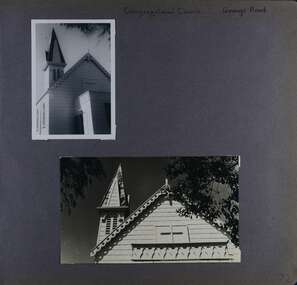
Album - Album page, Congregational Church, Grange Road, Circa 1972
... building, erected in 1885 (89?) in South Melbourne and relocated to Glenhuntly in 1909. It is a highly individual picturesque timber structure with distinctive spire and timber enrichment. It has aesthetic, historical and social significance. Its aesthetic value is derived from the choice of materials and picturesque Gothic Revival character showing American influence. Its historical value is derived from its survival as a rare example of a Primitive ...This photograph is part of the Caulfield Historical Album 1972. This album was created in approximately 1972 as part of a project by the Caulfield Historical Society to assist in identifying buildings worthy of preservation. The album is related to a Survey the Caulfield Historical Society developed in collaboration with the National Trust of Australia (Victoria) and Caulfield City Council to identify historic buildings within the City of Caulfield that warranted the protection of a National Trust Classification. Principal photographer thought to be Trevor Hart, member of Caulfield Historical Society. Most photographs were taken between 1966-1972 with a small number of photographs being older and from unknown sources. All photographs are black and white except where stated, with 386 photographs over 198 pages. This church has since become the Greek Orthodox Church. From Victorian Heritage Database: Citation for Greek Orthodox Church HO84 https://vhd.heritagecouncil.vic.gov.au/places/43587 (as at 19/10/2020) The former Primitive Methodist, later Congregational, church at 152 Grange Road, Glenhuntly, is a small timber building, erected in 1885 (89?) in South Melbourne and relocated to Glenhuntly in 1909. It is a highly individual picturesque timber structure with distinctive spire and timber enrichment. It has aesthetic, historical and social significance. Its aesthetic value is derived from the choice of materials and picturesque Gothic Revival character showing American influence. Its historical value is derived from its survival as a rare example of a Primitive Methodist Church building whilst its social value hinges on its early roles as a place of worship for the Primitive Methodists in South Melbourne and the Congregationalists in Glenhuntly.Page 72 of Photograph Album with two photographs (one portrait and one landscape) of the upper exterior and tower of the Congregational Church on Grange RoadHand written: Congregational Church, Grange Road [top right] / 72 [bottom right] trevor hart, congregational church, grange road, gothic revival, carnegie, glen huntly, glenhuntly, greek orthodox church, primitive methodist church, spire, timber buildings -
 Glen Eira Historical Society
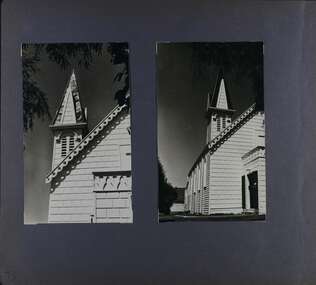
Album - Album page, Congregational Church, Grange Road, Circa 1972
... building, erected in 1885 (89?) in South Melbourne and relocated to Glenhuntly in 1909. It is a highly individual picturesque timber structure with distinctive spire and timber enrichment. It has aesthetic, historical and social significance. Its aesthetic value is derived from the choice of materials and picturesque Gothic Revival character showing American influence. Its historical value is derived from its survival as a rare example of a Primitive ...This photograph is part of the Caulfield Historical Album 1972. This album was created in approximately 1972 as part of a project by the Caulfield Historical Society to assist in identifying buildings worthy of preservation. The album is related to a Survey the Caulfield Historical Society developed in collaboration with the National Trust of Australia (Victoria) and Caulfield City Council to identify historic buildings within the City of Caulfield that warranted the protection of a National Trust Classification. Principal photographer thought to be Trevor Hart, member of Caulfield Historical Society. Most photographs were taken between 1966-1972 with a small number of photographs being older and from unknown sources. All photographs are black and white except where stated, with 386 photographs over 198 pages. This church has since become the Greek Orthodox Church. From Victorian Heritage Database: Citation for Greek Orthodox Church HO84 https://vhd.heritagecouncil.vic.gov.au/places/43587 (as at 19/10/2020) The former Primitive Methodist, later Congregational, church at 152 Grange Road, Glen Huntly, is a small timber building, erected in 1885 (89?) in South Melbourne and relocated to Glenhuntly in 1909. It is a highly individual picturesque timber structure with distinctive spire and timber enrichment. It has aesthetic, historical and social significance. Its aesthetic value is derived from the choice of materials and picturesque Gothic Revival character showing American influence. Its historical value is derived from its survival as a rare example of a Primitive Methodist Church building whilst its social value hinges on its early roles as a place of worship for the Primitive Methodists in South Melbourne and the Congregationalists in Glenhuntly.Page 73 of Photograph Album with two photographs (both portrait) of front and side views of the spire of the Congregational Church on Grange RoadHand written: 73 [bottom left] trevor hart, congregational church, grange road, gothic revival, carnegie, glen huntly, glenhuntly, greek orthodox church, primitive methodist church, spire, timber buildings -
 Kiewa Valley Historical Society
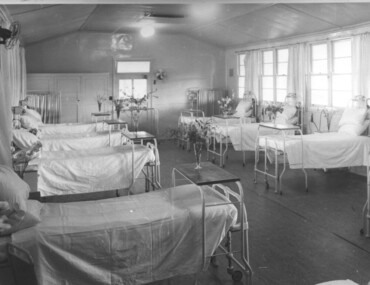
Photograph Tawonga Hospital, A ward at Tawonga Hospital, 1949/50
... building was purchased in Mt. Beauty from the S.E.C. A photographic record of a typical open plan style ward in that era. There were no private rooms. There are portable screens stored at the end of the room to provide "privacy" at the bedside when needed. There is a fan on the wall for cooling. Depicts the rather primitive ...This photo is of a ward - probably the female ward, as there a many floral arrangements - of the original hospital at Tawonga. This was situated at the corner of Ryders Lane and Kiewa Valley Highway. The building was transported from Bonegilla where it was originally a part of the Bonegilla Military Hospital. The hospital was opened on 24th September, 1949 with a capacity of 12 beds, but was later increased to 35 beds by enclosing the verandahs on 3 sides of the building. 'Add ons' provided theatre, offices, stores and a nurses home. Construction was commenced by the Hospital and Charities Commission with considerable input from the S.E.C., providing the removal and re-erection of the building, the accommodation for nursing staff and carried all work necessary to make the building operational as a hospital. Up until this time the nearest hospital was at Yackandandah. The hospital remained on this site until 1961 when a larger, more suitable building was purchased in Mt. Beauty from the S.E.C.A photographic record of a typical open plan style ward in that era. There were no private rooms. There are portable screens stored at the end of the room to provide "privacy" at the bedside when needed. There is a fan on the wall for cooling. Depicts the rather primitive conditions of that era when compared with todays standards.Black and white photograph of a ward in the Tawonga District Hospitalhospital, ward, tawonga -
 Kiewa Valley Historical Society
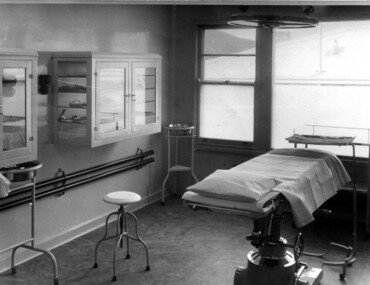
Photograph Tawonga District Hospital, Theatre at Tawonga District Hospital, 1949/50
... building was transported from Bonegilla where it was originally a part of the Bonegilla Military Hospital. It started with 12 beds and eventually increased to a total of 35 beds. "Add ons" provided theatre, offices, stores and Nurses Home. It was officially opened on 24th September, 1949. Up until this time, any person requiring hospitalisation had to travel to Yackandandah. This photograph is of the theatre and there was no anaesthetic or recovery rooms. While rather primitive...building was transported from Bonegilla where it was originally a part of the Bonegilla Military Hospital. It started with 12 beds and eventually increased to a total of 35 beds. "Add ons" provided theatre, offices, stores and Nurses Home. It was officially opened on 24th September, 1949. Up until this time, any person requiring hospitalisation had to travel to Yackandandah. This photograph is of the theatre and there was no anaesthetic or recovery rooms. While rather primitive ...The original Tawonga District Hospital was situated at the corner of Ryder's Lane and Kiewa Valley Highway. The construction was initiated by the Hospital and Charities Commission with considerable assistance from the State Electricity Commission.The building was transported from Bonegilla where it was originally a part of the Bonegilla Military Hospital. It started with 12 beds and eventually increased to a total of 35 beds. "Add ons" provided theatre, offices, stores and Nurses Home. It was officially opened on 24th September, 1949. Up until this time, any person requiring hospitalisation had to travel to Yackandandah. This photograph is of the theatre and there was no anaesthetic or recovery rooms. While rather primitive by todays standard, it met the demands of the construction days as well as that of the Kiewa Valley community. Shows the rather spartan conditions and equipment of the theatre in the original Tawonga District Hospital compared to the present day hospital. Black and white photograph of the operating theatre in the original Tawonga District Hospitalhospital, operating theatre, tawonga -
 Bendigo Historical Society Inc.
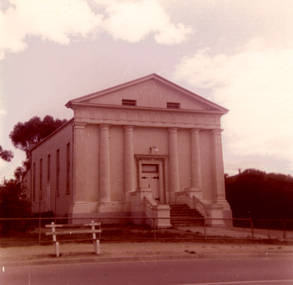
Document - National Trust Collection: Eaglehawk East Methodist Church, 1980s
... The letter addresses the Education Department's negotiations to purchase the former Primitive Methodist Church and its adjacent Sunday School building in Eaglehawk.Proposed Plans. ...The letter addresses the Education Department's negotiations to purchase the former Primitive Methodist Church and its adjacent Sunday School building in Eaglehawk.Proposed Plans. ...The Eaglehawk East Uniting Church, has closed and the property was sold in 1980 (to the education department). The Primitive Methodist Chapel was erected about 1865, and was used as a school by the education department for a period for 1881. It became part of the Uniting Church in 1977. Eaglehawk East Methodist Church - correspondance between the National Trust and the Education Department. This item contains the following six documents: 3084.40a Colour Photo of the Eaglehawk East Methodist Church in the 1980s 3084.40b National Trust Survey Data Sheet 1977 on the Eaglehawk East Methodist Church 3084.40c This document is a letter from the National Trust to the Eaglehawk East Methodist Church, dated August 24, 1978. The key points are:Recognition by the National TrustThe Eaglehawk East Methodist Church building has been officially recorded by the National Trust for its architectural and historical significance. 3084.40d This document is a letter from the National Trust of Australia (Victoria) dated July 31, 1981, regarding the former Primitive Methodist Church in Eaglehawk. The letter addresses the Education Department's negotiations to purchase the former Primitive Methodist Church and its adjacent Sunday School building in Eaglehawk.Proposed Plans. The Education Department is considering demolishing the Sunday School to create an extended exterior play area for the school.There is a possibility that the former Church building could be repurposed as an activities room for the school. The National Trust recorded the former Church in 1978, noting it was built in 1856 during the gold period and features a classic style facade.Trust's Position 3084.40e This document is a memorandum from the National Trust of Australia (Victoria), dated August 10, 1982. It is addressed to the Office of the Director General, Education Department. 3084.40f This document is a letter from the National Trust of Australia (Victoria) dated January 13, 1987, addressed to the Executive Director of Personnel and Resources at the Education Department. The National Trust is conducting a review of classified and recorded churches in Victoria. history, national trust bendigo collection, bendigo, eaglehawk east methodist church -
 Bendigo Historical Society Inc.
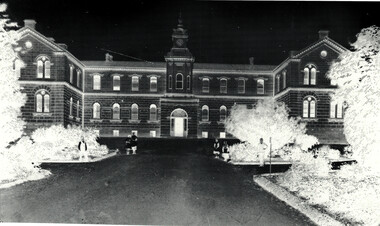
Document - National Trust Collection: Bendigo Base Hospital, 1853-1970s
... The first building was a primitive affair of slab and weatherboard daubed with clay somewhere near the middle of the present Short St - which at the time extended to the brow of the hill behind the Sacred Heart Cathedral site. ...The first building was a primitive affair of slab and weatherboard daubed with clay somewhere near the middle of the present Short St - which at the time extended to the brow of the hill behind the Sacred Heart Cathedral site. ...The hospital was first mooted in 1853. The first site chosen was "Hospital Hill" between Rowan and Mackenzie Streets and behind the present Lister House School of Nursing. The first building was a primitive affair of slab and weatherboard daubed with clay somewhere near the middle of the present Short St - which at the time extended to the brow of the hill behind the Sacred Heart Cathedral site. The new building was greatly need to serve the hundreds of diggers then active on the field. Messrs Vahland and Gezchmann, Architects, designed a new building of stone and brick, the cenre portion of the hospital to hold 100 beds. This centre portion cost 12,000 pounds and was erected in three months. Patients were transferred from the old site on Hospital Hill to the new building in December 1858.Black and White photo negative of the front of the hospital; Notes on the History of "The Bendigo Gold District Hospital"; letters re classification by the National Trust of Australia (Victoria).history, national trust bendigo collection, bendigo, bendigo base hospital, bnedigo hospital, bnedigo gold district hospital -
 Bendigo Historical Society Inc.
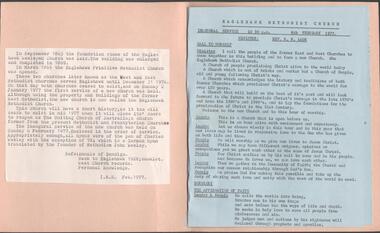
Book - INAUGURAL SERVICE EAGLEHAWK METHODIST CHURCH, 1977
... The building was enlarged and completed in 1869. In March 1865 the Eaglehawk Primitive Methodist Church was opened. ...Eaglehawk Methodist Church Wesleyan Church Eaglehawk Primitive Methodist Church The inaugural service of the Eaglehawk Methodist Church, 6 Feb 1977. In September 1863 the foundation stone of the Eaglehawk Wesleyan Church was laid. The building ...The inaugural service of the Eaglehawk Methodist Church, 6 Feb 1977. In September 1863 the foundation stone of the Eaglehawk Wesleyan Church was laid. The building was enlarged and completed in 1869. In March 1865 the Eaglehawk Primitive Methodist Church was opened. These two churches later known as the West and East Methodist Churches served Eaglehawk until December 31st 1976. On that day both churches ceased to exist, and on Sunday 2nd January 1977 the first service of a new church was held. Although using the property and buildings of the former West Methodist, the new church is now called the Eaglehawk Methodist Church. This church will have a short history, as it too will cease to exist in mid 1977 when it will close its' doors to reopen as the Uniting Church of Australia, a church formed from the present Methodist and Presbyterian Churches. The Inaugural Service of the new church was held on Sunday 6th February 1977. Enclosed is the order of service. Appropriately enough all hymns were of the pen of Charles Wesley with the exception of 784 which is a German hymn translated buy the founder of Methodism John Wesley.eaglehawk methodist church, wesleyan church, eaglehawk primitive methodist church -
 Bendigo Historical Society Inc.
Document - RAE'S CRUSHING BATTERY - THE RICH VICTORIA HILL & ITS HISTORICAL ASSOCIATIONS
... buildings and mines. Mentioned are:- North Old Chum Mine, Ballerstedt's First Open-cut, Quartz Veins (Spurs), rock formations pitching North, Prospecting shafts 1929, Concrete dam, Engine beds of Lansells Big 180 Mine, Lansells Big 180 Shaft, twenty stampers crushing battery, Lansell's Cleopatra Needle type chimney, Victoria Quartz Mine, Victoria Quartz dams, Rae's Open-cut, Quartz once roasted here to an intense heat, Anticlinal Arch New Chum Line, small primitive tunnels, Prospecting tunnels, Floyd's small 5 head crushing battery, Great Central Victoria (Midway) Shaft, Great Central Victoria engine-bed, Ballerstedt's small 24 yard claim, The Humboldt, Adventure ground, The Advance, Luffsman & Sterry's Claim, A round shaft. ...buildings and mines. Mentioned are:- North Old Chum Mine, Ballerstedt's First Open-cut, Quartz Veins (Spurs), rock formations pitching North, Prospecting shafts 1929, Concrete dam, Engine beds of Lansells Big 180 Mine, Lansells Big 180 Shaft, twenty stampers crushing battery, Lansell's Cleopatra Needle type chimney, Victoria Quartz Mine, Victoria Quartz dams, Rae's Open-cut, Quartz once roasted here to an intense heat, Anticlinal Arch New Chum Line, small primitive tunnels, Prospecting tunnels, Floyd's small 5 head crushing battery, Great Central Victoria (Midway) Shaft, Great Central Victoria engine-bed, Ballerstedt's small 24 yard claim, The Humboldt, Adventure ground, The Advance, Luffsman & Sterry's Claim, A round shaft. ...The first five pages are photocopies of photos:- 2 of Rae's Crushing Works; Victoria Quartz on Victoria Hill, Ironbark; Looking North from Old Chum Hill to the Victoria Hill; Victoria Hill - from Rae's Open Cut. Introduction covers location of buildings and mines. Mentioned are:- North Old Chum Mine, Ballerstedt's First Open-cut, Quartz Veins (Spurs), rock formations pitching North, Prospecting shafts 1929, Concrete dam, Engine beds of Lansells Big 180 Mine, Lansells Big 180 Shaft, twenty stampers crushing battery, Lansell's Cleopatra Needle type chimney, Victoria Quartz Mine, Victoria Quartz dams, Rae's Open-cut, Quartz once roasted here to an intense heat, Anticlinal Arch New Chum Line, small primitive tunnels, Prospecting tunnels, Floyd's small 5 head crushing battery, Great Central Victoria (Midway) Shaft, Great Central Victoria engine-bed, Ballerstedt's small 24 yard claim, The Humboldt, Adventure ground, The Advance, Luffsman & Sterry's Claim, A round shaft. Small piece of paper with 'Notes on Victoria Hill complete. Notes prepared by Albert Richardson.document, gold, rae's crushing battery, rae's crushing battery, rae's crushing works, victoria quartz mine, from old chum hill, victoria hill from rae's open cut, ironbark, hercules & energetic, midway, wittscheibe, great central victoria, mr & mrs conroy, central nell gwynne, gold mines hotel, john brown knitwear factory, new chum & victoria, rotary club of bendigo south, north old chum, ballerstedt's first open-cut, lansell's big 180 shaft, cleopatra needle type chimney, a roberts & sons, mr e j dunn, h harkness & sons, eureka extd, new chum railway, pearl, inrush of water at victoria quartz, floyd's small 5 head crushing battery, great central victoria (midway), ballertedt's small 24 yard claim, humboldt, humboldt, great central victoria, victoria hill, bendigo & vicinity 1895 p51, j n macartney 1st edition 1871, bendigo goldfield registry 1871, plan of new chum line, mr rae anderson, annals of bendigo obituary 1904, bendigo advertiser, b m l records mines dept, patterson's goldfields of victoria, dickers mining record 23/11/1861, australian mining standard special edition 1/6/1899 p40, bendigo mines ltd, chinese joss house, fortuna, the victoria goldfield 1851 to 1954, the victoria hill 1854 to 1949 -
 Bendigo Historical Society Inc.
Photograph - SANDHURST POST OFFICE
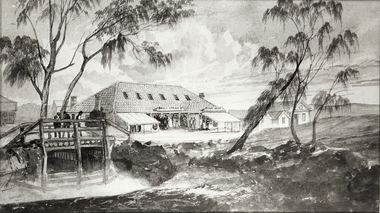
... Lean-to verandahs/ buildings in front of main building. LH front is creek and primitive wooden bridge (short span). ...Lean-to verandahs/ buildings in front of main building. LH front is creek and primitive wooden bridge (short span). ...Black and white photograph of a sketch of building (post office) with high roof and six skylight windows. Lean-to verandahs/ buildings in front of main building. LH front is creek and primitive wooden bridge (short span). Inscriptions: on back - written in ballpoint pen. 'Bendigo Vic Post Office, Sandhurst Vic 1850's' History: James Lerk 18/2/2000: 'View Point Bendigo, Post Office, looking West'buildings, post office, view point -
 Bendigo Historical Society Inc.
Photograph - CORNISH COLLECTION: PHOTOGRAPHS OF CHURCH BUILDINGS WITH CORNISH CONNECTIONS, 1900
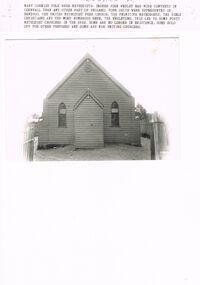
... Collection of photographs of various Bendigo church buildings with Cornish connections: a. front of simple (Methodist) wooden church with handwritten annotation of ''Webster St'' together with typewritten attachment to photo giving some of history of Methodism and the Cornish (and the four sects represented in Bendigo); b. Photo of interior of Chapel Street Gospel Hall (Mission Hall) decorated for Sunday School Anniversary (no date); c. three photos - Former Wesleyan Church, Kangaroo Flat; the former Primitive...Collection of photographs of various Bendigo church buildings with Cornish connections: a. front of simple (Methodist) wooden church with handwritten annotation of ''Webster St'' together with typewritten attachment to photo giving some of history of Methodism and the Cornish (and the four sects represented in Bendigo); b. Photo of interior of Chapel Street Gospel Hall (Mission Hall) decorated for Sunday School Anniversary (no date); c. three photos - Former Wesleyan Church, Kangaroo Flat; the former Primitive ...Collection of photographs of various Bendigo church buildings with Cornish connections: a. front of simple (Methodist) wooden church with handwritten annotation of ''Webster St'' together with typewritten attachment to photo giving some of history of Methodism and the Cornish (and the four sects represented in Bendigo); b. Photo of interior of Chapel Street Gospel Hall (Mission Hall) decorated for Sunday School Anniversary (no date); c. three photos - Former Wesleyan Church, Kangaroo Flat; the former Primitive Methodist Church, Eaglehawk; former Bible Christian Church , California Gully (''now St Judes Anglican'' - typewritten attachment to photo).photograph, building, church, john wesley. united methodist free church. wesleyan mission hall. bible christian church. uniting church. -
 Port Melbourne Historical & Preservation Society
Photograph - Methodist Church, Farrell Street during conversion to residence, Jan 2002
... religion - primitive methodist church farrell street west Two (2) colour photographs of the old Methodist church at Farrell Street West, later ? church. Showing the early stages of re-building ...Two (2) colour photographs of the old Methodist church at Farrell Street West, later ? church. Showing the early stages of re-building as a private residence in Jan. 2002.religion - primitive methodist church, farrell street west -
Glen Eira Historical Society
Article - Trinity Congregational Church, Glen Huntly
... Handwritten undated notes (refer History of Primitive Methodism in Victoria and Tasmania – Rev. M Clarke). Article includes style of church building, history of building and interior decoration. ...Handwritten undated notes (refer History of Primitive Methodism in Victoria and Tasmania – Rev. M Clarke). Article includes style of church building, history of building and interior decoration. ...Handwritten undated notes (refer History of Primitive Methodism in Victoria and Tasmania – Rev. M Clarke). Article includes style of church building, history of building and interior decoration. Also includes history of some monetary donations, purchasing of land and church opening , small handdrawn map showing where church was before removal to current site. Reprinted articles from The Victorian Independant dated January 1910 and November 1909 on the opening of the Glen Huntly venture and the Revs who participated, and then the beginning of some committees, & Fellowship groups. Also mentions the appointment of Ivan Stebbins for six months.trinity congregational church, glen huntly, tennis, grange road, mercy g.g., bevan dr., primitive methodist church, dovan a. p. rev., holley j. j. rev., eastern road., freeman w, jones j. w. rev., south melbourne, griffith a. j. rev., devenish a. s. rev., lord. t, gosman dr, jones alfred., bryant. s, stebbins ivan, orr mr., billinghurst mr, copper mr, tregaskis mr., davidson mr., congregational hall, halls, wharington mrs., pavell g., rosstown, holden mr., bishop mr., sunday schools, white a. f., cockfield mr., orr mrs., billinghurst mrs., davidson mrs., o’ donnell miss, watkins miss., billinghurst miss., davidson miss., griffith mr., newing mr. -
Glen Eira Historical Society
Article - Trinity Congregational Church, Glen Huntly
... building came from, its features and how the land in Grange Road was obtained. How, after its removal from South Melbourne to Grange Road; it was re-erected a porch and timber cross were added. Source is Caulfield Historical Society Newsletter. Trinity Congregational Church Gothic architecture Market gardens Primitive ...History of Trinity Congregational Church, Glen Huntly by J. O’ Donnell dated April 1973. Article tells where the church building came from, its features and how the land in Grange Road was obtained. How, after its removal from South Melbourne to Grange Road; it was re-erected a porch and timber cross were added. Source is Caulfield Historical Society Newsletter.trinity congregational church, gothic architecture, market gardens, primitive methodists, gables, glen huntly, grange road, towers, gas lighting, mercy g., porches, congregational union., rosstown sugarmill -
Glen Eira Historical Society
Letter - Trinity Congregational Church, Glen Huntly
... Historic Buildings Council Glen Huntly Hart Trevor Grey Karen Timber houses Filbert Street Old Calendar Greek Primitive Methodists Caulfield South Orthodox Church El Nido Grove Lyons Street Porches Market gardens. ...Roneod letter from the National Trust, Victoria, to the Congregational Union of Victoria. The correspondence gives notification that the church has been placed in the classified List and should be preserved. Dated 20/03/1973. Correspondence from Department of Planning Victoria, advising the Caulfield Historical Society, that the H. B. Council has chosen not to recommend the building for addition to the Historic Buildings Register Dated 08/10/1982. Extracted From Caulfield Conservation Study By Andrew Ward Dated January 1995 Describing Trinity Congregational Church. Includes Brief History Of The Church And Description Of Architectural Features.trinity congregational church., moran b., preston joane, grange road, caulfield., historic buildings council, glen huntly, hart trevor, grey karen, timber houses, filbert street, old calendar greek, primitive methodists, caulfield south, orthodox church, el nido grove, lyons street, porches, market gardens., gothic style, congregationalists, ward andrew, architectural features, architectural styles -
 Robin Boyd Foundation
Document - Manuscript, Robin Boyd, No Quotas for Architecture, c1969
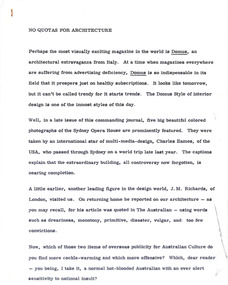
... primitive and vulgar). Boyd indicates international opinions of Australian architecture as important because many Australian buildings are being designed by overseas architects; argues for greater promotion of Australian architecture and architects....primitive and vulgar). Boyd indicates international opinions of Australian architecture as important because many Australian buildings are being designed by overseas architects; argues for greater promotion of Australian architecture and architects. ...Discusses 'Domus' (an Italian architecture and design magazine) as visually exciting and trend starter; compares recent international opinions on Australian architecture and culture (Charles Eames on Sydney Opera House, J. M. Richards on Australian architecture as primitive and vulgar). Boyd indicates international opinions of Australian architecture as important because many Australian buildings are being designed by overseas architects; argues for greater promotion of Australian architecture and architects.Typewritten (c copy), quarto, 5 pagesLast page: no image attached but this inscription "caption to illustration"; appears that Boyd wanted image of St James Building, AMP Tower and Shell House by Skidmore, Owings & Merrill attached.domus, sydney opera house, charles eames, jm richards, australian culture, globalisation, robin boyd, manuscript -
 Clunes Museum
Photograph
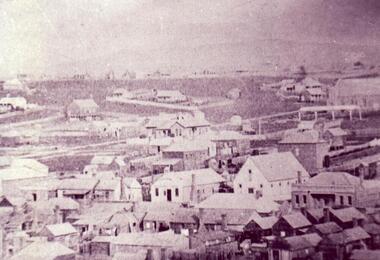
... "METHODIST CHURCH WITHOUT SPIRE AND MARKET NEXT ON PRESENT POLICE STATION PADDOCK OPPOSITE THE METHODIST CHURCH (THEN WESLEYAN) IS THE OLD CEMETERY AND THERE ARE WHITE FORMS LIKE TOMBSTONES SHOWING. local history photography photographs clunes township PRIMITIVE METHODIST CHURCH IN HILL ST. BLACK AND WHITE PHOTOGRAPH OF VERY EARLY CLUNES - BUILDINGS, CHURCHES, HOUSES Photograph PHOTOGRAPH ...BLOWN UP PHOTO OF VIEW OVER LOOKING FRASER ST. FROM "THE ROCKS". NOTE 2 CHURCHES - ONE C OF E, LATER MOVED TO PRESENT SITE, NEXT TO BLUE STONE ST. PAUL'S. CLUB HOTEL ON LEFT. "METHODIST CHURCH WITHOUT SPIRE AND MARKET NEXT ON PRESENT POLICE STATION PADDOCK OPPOSITE THE METHODIST CHURCH (THEN WESLEYAN) IS THE OLD CEMETERY AND THERE ARE WHITE FORMS LIKE TOMBSTONES SHOWING.BLACK AND WHITE PHOTOGRAPH OF VERY EARLY CLUNES - BUILDINGS, CHURCHES, HOUSESPRIMITIVE METHODIST CHURCH IN HILL ST.local history, photography, photographs, clunes township -
 Clunes Museum
Photograph
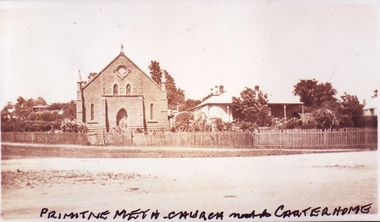
... THIS BUILDING WAS ON CNR FRASER & BAILEY STREETS local history photography photographs churches primative methodist bible christian. PRIMITIVE ...THIS BUILDING WAS ON CNR FRASER & BAILEY STREETSSEPIA PHOTOGRAPH OF PRIMITIVE METHODIST CHURCH.PRIMITIVE METHODIST CHURCH NEXT TO CARTER HOMElocal history, photography, photographs, churches primative methodist, bible christian. -
Clunes Museum
Document - DOCUMENT - COVENANT, PRIMITIVE METHODIST CHAPEL
... PRIMITIVE METHODIST CHAPEL...TALBOT LAND BUILDING...COVENANT BETWEEN TALBOT LAND BUILDING INVESTMENT SOCIETY AND THE PRIMITIVE METHODIST CHAPEL IN CLUNES DATED 29/05/1877 FOR ALLOTMENT 12 SECTION 6....LAND TO BUILD PRIMITIVE METHODIST CHAPEL ON PRIMITIVE METHODIST CHAPEL TALBOT LAND BUILDING AND INVESTMENT SOCIETY COVENANT BETWEEN TALBOT LAND BUILDING INVESTMENT SOCIETY AND THE PRIMITIVE METHODIST CHAPEL IN CLUNES DATED 29/05/1877 FOR ALLOTMENT 12 SECTION 6. ...LAND TO BUILD PRIMITIVE METHODIST CHAPEL ONCOVENANT BETWEEN TALBOT LAND BUILDING INVESTMENT SOCIETY AND THE PRIMITIVE METHODIST CHAPEL IN CLUNES DATED 29/05/1877 FOR ALLOTMENT 12 SECTION 6.primitive methodist chapel, talbot land building and investment society -
 Stawell Historical Society Inc
Photograph, Winston Lodge 1950 and 1952
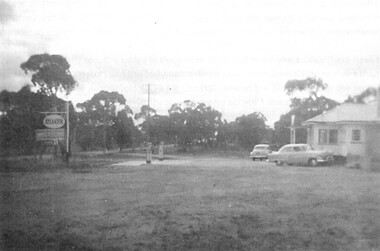
... building in Main Street. Mrs. Jenkins realised that a stopover was needed in Stawell for both truckies and travellers alike. The family believe that the daughter of Mrs. Jenkins, Lyla drew up the plans for Winston Lodge in an exercise book and the construction was erected from these primitive sketches. ...building in Main Street. Mrs. Jenkins realised that a stopover was needed in Stawell for both truckies and travellers alike. The family believe that the daughter of Mrs. Jenkins, Lyla drew up the plans for Winston Lodge in an exercise book and the construction was erected from these primitive sketches. ...For around the last 70 years, a familiar sight on the Western Highway at Stawell West has been the Roadhouse/Service Station known as ‘Winston Lodge.’ The building was constructed on Crown Land over the years 1950-1952 by local builders, Mr. Bobby Briggs and Mr. Clem Faulkner for Mrs. Winifred Jenkins. Briggs and Faulkner also handled the construction of the new E.S. and A. Bank building in Main Street. Mrs. Jenkins realised that a stopover was needed in Stawell for both truckies and travellers alike. The family believe that the daughter of Mrs. Jenkins, Lyla drew up the plans for Winston Lodge in an exercise book and the construction was erected from these primitive sketches. Winston Lodge finally opened for business on Saturday March 1st 1952 after many delays due to building material shortages and was an immediate success with local farmers and interstate truckies. The conditions were basic, but the food was excellent in the style of the period – soups, roast dinners and hot apple pies with fresh cream from a dairy on Halls Gap Road. All the cooking was done on a wood fired double oven stove with water pipes running through the firebox to provide the hot water for the Lodge. The name Winston Lodge is quite a story. The family of Mrs. Jenkins believe that a financial backer of the construction was a family by the name of Johnston. So, a combination of WINifred and JohnSTON became Winston Lodge. It was not named after the English Prime Minister of the day Sir Winston Churchill but maybe Winifred Jenkins was a supporter of the PM. Winifred eventually sold the Lodge in December 1957 and in the years since there have been many owners/proprietors and the building has been saved from demolition on more than one occasion. One of the proprietors was a Mr Len Hall, who at the time, was also the proprietor of the Café at the Stawell Drive- In Theatre where he served T-Bone steaks, hamburgers, hot dogs and fish & chips to the theatre goers. It was reported in the Stawell Times and Pleasant Creek Chronicle on Saturday March 5th 1960 that a sign had been erected at Winston Lodge to mark the opening of Stawell’s first Motel. Some small Motel units had been constructed on the Eastern side of Winston Lodge to cater for the travelling public and also for the truckies who had stopped for a meal and a comfortable bed. Even though the name ‘Winston Lodge’ disappeared from the front of the building in 2020 when renovations took place, it will always be referred to locally as ‘Winston Lodge.’ Two Black and White Photographs One building Lodge. One with Atlantic Petrol Pumps Outside. -
 Rutherglen Historical Society
Image, c1965
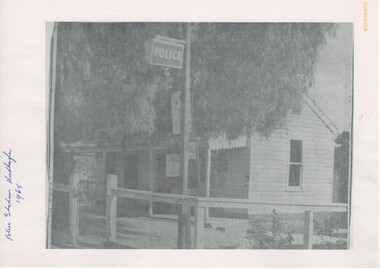
... primitive. The station is said to be more than 80 years old and entirely out of character with its surroundings -- the pleasant civic square. The condition of the buildings...primitive. The station is said to be more than 80 years old and entirely out of character with its surroundings -- the pleasant civic square. The condition of the buildings ...Caption reads: "This is the Rutherglen police station, which was described as a 'disgrace' at Rutherglen Shire Council's meeting last Friday. Walls of the tiny station are riddled with white ants and the two lock-ups at the rear are primitive. The station is said to be more than 80 years old and entirely out of character with its surroundings -- the pleasant civic square. The condition of the buildings will be brought to the attention of the Victorian Police Commissioner and Public Works Department." The two lock-ups mentioned are now (2018) property of the Rutherglen Historical Society, and are located at the back of the Museum awaiting renovations to make them into a display.Black and white photocopy, that seems to have been from a newspaper article, showing a photograph of a small cottage that served as a police station in Rutherglen for some years. The photograph and its caption are printed on two sheets of paper.Written at the left side of the photo: "Police Station Rutherglen 1965" police station, rutherglen shire, cells, lock-up -
 Ballarat Heritage Services
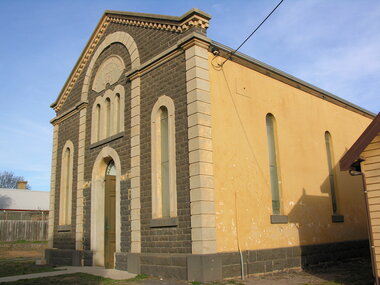
Photograph, Talbot Primative Church, c2014
... The Talbot Primitive Methodist refers to a former Primitive Methodist Church in Talbot, Victoria, Australia, that was built in 1870 and is now the home of the Talbot Arts & Historical Museum. The bluestone church building...The Talbot Primitive Methodist refers to a former Primitive Methodist Church in Talbot, Victoria, Australia, that was built in 1870 and is now the home of the Talbot Arts & Historical Museum. The bluestone church building ...The Talbot Primitive Methodist refers to a former Primitive Methodist Church in Talbot, Victoria, Australia, that was built in 1870 and is now the home of the Talbot Arts & Historical Museum. The bluestone church building, a distinctive example of Romanesque design, now houses a wide array of historical exhibits about the region's goldfields history, including mining relics, photographs, documents, and communications equipment. The building is recognized for its sophisticated and relatively large Romanesque design, featuring a novel facade combining elements of a Classical temple front and a Roman triumphal arch. FoColour photographs of Talbot Primative Church.talbot, primartive methodist church, talbot museum -
 Tarnagulla History Archive
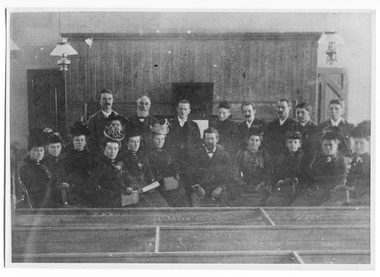
Photograph depicting a group probably in a church in Tarnagulla, c.1880s
... Primitive Methodist Church. This photograph is a reasonable copy created from an older original. tarnagulla people churches church religion faith buildings Black and white photograph depicting a group of people, dressed in dark clothing probably in a church in Tarnagulla. ...Murray Comrie Collection. May be the Primitive Methodist Church. This photograph is a reasonable copy created from an older original.Black and white photograph depicting a group of people, dressed in dark clothing probably in a church in Tarnagulla. tarnagulla, people, churches, church, religion, faith, buildings
