
Showing 156 items matching "prize giving"
-
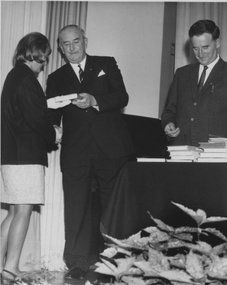 University of Melbourne, Burnley Campus Archives
Photograph - Black and white print, Information Branch Victorian Department of Agriculture, Prize Giving, 1975
... Prize Giving......prize giving...(2-3) Unidentified prize giver. ...(2-3) Unidentified prize giver. Prize Giving Photograph Black and white print Information Branch Victorian Department of Agriculture ...Black and white photographs (1) Eric Littlejohn (Principal), student receiving prize from ?. (2-3) Unidentified prize giver. Stamped on reverse, "Photograph by Information Branch Victorian Department of Agriculture Ref No. D993D."eric littlejohn, principal, students, graduation, prize giving -
 Whitehorse Historical Society Inc.
Article, School concert and prize giving, 1933
... School concert and prize giving...Article on Mitcham State School concert and prize giving 22 December 1933, noting that Alwyn Till passed through the seventh and eighth grades in one year!...School concert and prize giving Article Article ...Article on Mitcham State School concert and prize giving 22 December 1933.Article on Mitcham State School concert and prize giving 22 December 1933, noting that Alwyn Till passed through the seventh and eighth grades in one year!Article on Mitcham State School concert and prize giving 22 December 1933. mitcham state school no 2904, till, alwyn -
Federation University Historical Collection
Certificate, Ballarat School of Mines and Industries Technical School No. 10 Prize Giving Certificate of Merit Awarded to Allan Bernaldo, c1917, 1917
... Ballarat School of Mines and Industries Technical School No. 10 Prize Giving Certificate of Merit Awarded to Allan Bernaldo, c1917...Prize giving certificate of merit awarded to Allan Bernaldo in recognition of the Gold Medal presented by the President of the Ballarat School of Mines, W.H. ...Ballarat School of Mines and Industries Technical School No. 10 Prize Giving Certificate of Merit Awarded to Allan Bernaldo, c1917 Certificate ...Prize giving certificate of merit awarded to Allan Bernaldo in recognition of the Gold Medal presented by the President of the Ballarat School of Mines, W.H. Middleton, to the most meritorious st student - Architectural Diploma Course. ballarat school of mines, technical school no 10, ballarat technical art school, ballarat technical art school no 10, allan bernaldo, certificate, award -
University of Melbourne, Burnley Campus Archives
Newspaper - Newspaper Cutting, The Age, The Burnley Students - Women as Horticulturalists, 1899
... ...prize giving...Copy of article in the Age dated 15 December, 1899 p. 7 on the prize giving at Burnley....the age charles bogue luffman female students burnley school of horticulture c b luffmann prize giving students Copy of article in the Age dated 15 December, 1899 p. 7 on the prize giving at Burnley. ...Copy of article in the Age dated 15 December, 1899 p. 7 on the prize giving at Burnley.the age, charles bogue luffman, female students, burnley school of horticulture, c b luffmann, prize giving, students -
University of Melbourne, Burnley Campus Archives
Newspaper, The Age, Juveniles Steal the Show, 1948
... ...prize giving...Article in The Age 07.08.1948 "Prize giving for Commonwealth Reconstruction Training Program students." ...commonwealth reconstruction training scheme crts prize giving t h kneen graduation 1. Article in The Age 07.08.1948 "Prize giving for Commonwealth Reconstruction Training Program students." ...commonwealth reconstruction training scheme, crts, prize giving, t h kneen, graduation -
University of Melbourne, Burnley Campus Archives
Booklet, The University of Melbourne, Graduation Ceremony and Presentation of Prizes, 11.04.1997
... ...prize giving...graduation prize giving faculty of agriuculture forestry and horticulture The Victorian College of Agriculture and Horticulture a School of the Faculty of Agriculture, Forestry and Horticulture, The University of Melbourne. ...graduation, prize giving, faculty of agriuculture, forestry and horticulture -
University of Melbourne, Burnley Campus Archives
Newspaper - Newspaper Cutting, The Argus, Burnley School of Horticulture - Distribution of Prizes, 1901
... Copy of article in "The Argus" 19 December, 1901 p. 6. Prize giving - women identified by Miss or Mrs....the argus female students prizes students Copy of article in "The Argus" 19 December, 1901 p. 6. Prize giving - women identified by Miss or Mrs. ...Copy of article in "The Argus" 19 December, 1901 p. 6. Prize giving - women identified by Miss or Mrs.the argus, female students, prizes, students -
University of Melbourne, Burnley Campus Archives
Newspaper - Newspaper Cutting, The Leader, Horticultural Education- Progress of the Burnley School, 1899
... Copy of article in "The Leader" dated 23.12.1899 p. 9 by Our Horticultural Reporter. Prize giving - lists women's names identified by Miss or Mrs....the leader female students prizes students Copy of article in "The Leader" dated 23.12.1899 p. 9 by Our Horticultural Reporter. Prize giving - lists women's names identified by Miss or Mrs. ...Copy of article in "The Leader" dated 23.12.1899 p. 9 by Our Horticultural Reporter. Prize giving - lists women's names identified by Miss or Mrs.the leader, female students, prizes, students -
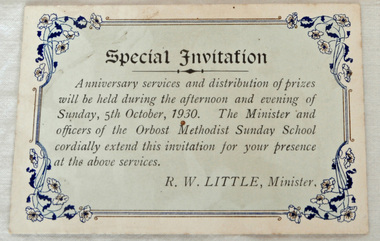 Orbost & District Historical Society
invitation, 1930
... A rectangular cardboard invitation to a service and prize-giving at the Orbost Methodist Sunday School. ...Little, Minister A rectangular cardboard invitation to a service and prize-giving at the Orbost Methodist Sunday School. ...The Orbost Methodist Church began services in April 1910, the Rev. E. Hooper as the first minister. Reverend R.W. Little was minister in 1930-31.Ministers at that time batched either in a little room at the back of the church or in Locksley House (near the state school). Sunday School at that time involved a lot of commitment on the part of the teachers towards the children and this was reflected in the efforts they went to to make Sunday School an interesting and enjoyable event. The Sunday School Anniversaries were always a big community event and children usually dressed up for the occasion. The children spent weeks practising hymns and choruses for the occasion and on the Saturday before picked armfuls of flowers from Mrs Hocking's garden ( may blossoms) to decorate the church hall. (ref. Pioneers and Pilgrims Revd Peter Gador-White).For many years the Methodist people of Orbost enjoyed the fellowship of the church and the children, in particular, were socially and spiritually involved. This item is reminiscent of that time.A rectangular cardboard invitation to a service and prize-giving at the Orbost Methodist Sunday School. The print is black on a pale blue background with a black frame and floral decorations in each cornerSpecial Invitation R.W. Little, Ministerorbost-methodist-church sunday-school -
Ballarat Clarendon College
Collection of items
... Blazer pocket, brown felt with embroidered crest; four badges CPLC school badge, House Prefect badge, CPLC Old Collegians badge and CCAC badge; The Psalms Church Hymnary; Holy Bible; Macbeth program; CPLC Ninetieth Report and Prize Giving program; The Touchstone 1966. ....All these have been the property of Emma Morrison who attended CPLC 1964-1965 edna-morrison emma-morrison 1960s Blazer pocket, brown felt with embroidered crest; four badges CPLC school badge, House Prefect badge, CPLC Old Collegians badge and CCAC badge; The Psalms Church Hymnary; Holy Bible; Macbeth program; CPLC Ninetieth Report and Prize Giving program; The Touchstone 1966. . Collection of items ...All these have been the property of Emma Morrison who attended CPLC 1964-1965Blazer pocket, brown felt with embroidered crest; four badges CPLC school badge, House Prefect badge, CPLC Old Collegians badge and CCAC badge; The Psalms Church Hymnary; Holy Bible; Macbeth program; CPLC Ninetieth Report and Prize Giving program; The Touchstone 1966. .edna-morrison, emma-morrison, 1960s -
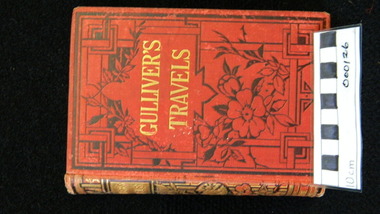 Ballarat Clarendon College
Book, Gulliver's travels: into several regions of the world, 1880
... Book plate inside front cover: CLARENDON LADIES' COLLEGE/BALLARAT/Second PRIZE/ Spelling/AWARDED TO/J McGowan/R KENNEDY PRINCIPAL/18TH December, 1879 Hand-written inscription on flyleaf: This book was a Prize/at the first Prize-giving/of the College/The College having been/ established/in 1878....Socially significant due to connection with first prize-giving ceremony for Clarendon Ladies' College. margaret-j-mcgowan elizabeth-kennedy robert-kennedy tom-kennedy clarendon-ladies-college spelling book-prize Book plate inside front cover: CLARENDON LADIES' COLLEGE/BALLARAT/Second PRIZE/ Spelling/AWARDED TO/J McGowan/R KENNEDY PRINCIPAL/18TH December, 1879 Hand-written inscription on flyleaf: This book was a Prize/at the first Prize-giving/of the College/The College having been/ established/in 1878. ...This book Gulliver's Travels was awarded to Margaret Jane McGowan as second prize for spelling. Margaret was one of the first enrolments to Clarendon Ladies' College at the age of 12. Margaret's father, Samuel, and mother, were personal friends of the Reverend Robert and Mrs. Kennedy. Margaret attended school in the same class as the Kennedy's eldest son Tom who was 11 at the time. Margaret's sister Edith was the 2nd enrolment to the college. Margaret resided at 15 Royal Terrace Webster Street, Ballarat. Her parents were employed as Carrier and forwarding agents. Margaret's married name became Steele. Archives also hold a second book prize awarded to Margaret (000127).Socially significant due to connection with first prize-giving ceremony for Clarendon Ladies' College.Red fabric cover with ornate black and gold embossed markings and borders; gold lettering on front cover and spine; embossed border on back cover; two coloured plates; 361p. Book plate inside front cover: CLARENDON LADIES' COLLEGE/BALLARAT/Second PRIZE/ Spelling/AWARDED TO/J McGowan/R KENNEDY PRINCIPAL/18TH December, 1879 Hand-written inscription on flyleaf: This book was a Prize/at the first Prize-giving/of the College/The College having been/ established/in 1878.margaret-j-mcgowan, elizabeth-kennedy, robert-kennedy, tom-kennedy, clarendon-ladies-college, spelling, book-prize -
![Book, The Poetical works of Thomas Hood, [n.d.]](/media/collectors/4f729f6897f83e0308601719/items/51edfa4c2162ef1c60697cf8/item-media/51ee078b2162ef1c60699599/item-fit-380x285.jpg?cb=6) Ballarat Clarendon College
Ballarat Clarendon CollegeBook, The Poetical works of Thomas Hood, [n.d.]
... Book plate inside front cover: CLARENDON LADIES' COLLEGE/BALLARAT/Second PRIZE/ Latin and Class work/AWARDED TO/J McGowan/R KENNEDY PRINCIPAL/18TH December, 1879 Hand-written inscription on flyleaf: This book was a Prize/at the first Prize-giving/of the College/The College having been/ established/in 1878. ...Socially significant due to connection with first prize-giving ceremony for Clarendon Ladies' College. margaret-j-mcgowan elizabeth-kennedy robert-kennedy tom-kennedy clarendon-ladies-college latin-and-class-work book-prize Book plate inside front cover: CLARENDON LADIES' COLLEGE/BALLARAT/Second PRIZE/ Latin and Class work/AWARDED TO/J McGowan/R KENNEDY PRINCIPAL/18TH December, 1879 Hand-written inscription on flyleaf: This book was a Prize/at the first Prize-giving/of the College/The College having been/ established/in 1878. ...This book The Poetical Works of Thomas Hood was awarded to Margaret Jane McGowan as second prize for Latin and Class work. Margaret was one of the first enrolments to Clarendon Ladies' College at the age of 12. Margaret's father, Samuel, and mother, were personal friends of the Reverand Robert and Mrs. Kennedy. Margaret attended school in the same class as the Kennedy's eldest son Tom who was 11 at the time. Margaret's sister Edith was the 2nd enrolment to the college. Margaret resided at 15 Royal Terrace Webster Street, Ballarat. Her parents were employed as Carrier and forwarding agents. Margaret's married name became Steele. Archives also hold a second book prize awarded to Margaret (000126). Socially significant due to connection with first prize-giving ceremony for Clarendon Ladies' College. Blue and gold decorative cloth cover, corners and edges rubbed, page edges gilt, gold lettering on front cover and spine; embossed border on back cover; two black and white plates; 414 p. Book plate inside front cover: CLARENDON LADIES' COLLEGE/BALLARAT/Second PRIZE/ Latin and Class work/AWARDED TO/J McGowan/R KENNEDY PRINCIPAL/18TH December, 1879 Hand-written inscription on flyleaf: This book was a Prize/at the first Prize-giving/of the College/The College having been/ established/in 1878. margaret-j-mcgowan, elizabeth-kennedy, robert-kennedy, tom-kennedy, clarendon-ladies-college, latin-and-class-work, book-prize -
Port Melbourne Historical & Preservation Society
Photograph - Photographs (proof sheets), Sister Norma Barnett as Honorary Mayor of Port Phillip, 1999
... The robe was made by her friends and was worn for a variety of mayoral duties (prize giving, etc). Accessorised with chain (which is not available). ...The robe was made by her friends and was worn for a variety of mayoral duties (prize giving, etc). Accessorised with chain (which is not available). ...Taken of Sister Norma BARNETT during her five days as honorary Mayor of Port Phillip in March 1999. The robe was made by her friends and was worn for a variety of mayoral duties (prize giving, etc). Accessorised with chain (which is not available). Donated by her family following the 'Women of Port Melbourne' exhibtion after Norma's deathFour proof sheets of official photographs of occasions on which a floor length purple velvet robe, edged with fake ermine trim and black braiding was worn by Sister Norma BARNETT during her five days as Honorary Mayor of Port Phillip in March 1999. Negatives in Supplementary file.dick gross, anne dunn, julie statkus, janne ray, sister norma jean barnett, local government - city of port phillip, south port community nursing home, health - aged care -
Port Melbourne Historical & Preservation Society
Costume - Robes, Norma Barnett, Honorary Mayor, City of Port Phillip, Friends and family of Sister Norma Barnett, 1999
... The robe was made by her friends and was worn for a variety of mayoral duties (prize giving, etc). Accessorised with chain (which is not available). ...The robe was made by her friends and was worn for a variety of mayoral duties (prize giving, etc). Accessorised with chain (which is not available). ...Used by Sister Norma Barnett during her five days as honorary Mayor of Port Phillip in March 1999. The robe was made by her friends and was worn for a variety of mayoral duties (prize giving, etc). Accessorised with chain (which is not available). Donated following the 'Women of Port Melbourne' exhibtion in which it had been displayed after Norma's deathA floor length purple velvet robe, edged with fake ermine trim and black braiding, worn by honorary City of Port Phillip Mayor Norma Barnett in 1999.local government - city of port phillip, sister norma jean barnett -
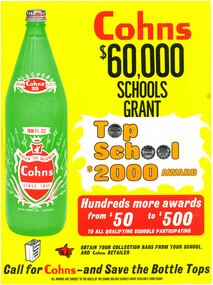 Bendigo Historical Society Inc.
Document - COHN'S $60,000 SCHOOLS GRANT COLLECTION: GRANTS TO SMALL SCHOOLS FOR BOTTLE TOP COLLECTION
... Cohn's Bendigo Bottling Company - School Grants Competition 1 Cohn's coloured poster for School Grants 2 B&W A4 poster for Cohn's $60,000 School Grants 3 Cohn's bottle top collection bag A side 4 Cohn's bottle top collection bag B side 5 Photo of Watchupga PS winner of $2,000 grant for collection of 10,000 tops by 9 student primary school A 6 Photo of Watchupga PS winner of $2,000 grant for collection of 10,000 tops by 9 student primary school B Nine foolscap sheets attached covering the program for Prize Giving Ceremony by Cohn's team...Cohn Bros Watchupga Cohn's Bendigo Bottling Company - School Grants Competition 1 Cohn's coloured poster for School Grants 2 B&W A4 poster for Cohn's $60,000 School Grants 3 Cohn's bottle top collection bag A side 4 Cohn's bottle top collection bag B side 5 Photo of Watchupga PS winner of $2,000 grant for collection of 10,000 tops by 9 student primary school A 6 Photo of Watchupga PS winner of $2,000 grant for collection of 10,000 tops by 9 student primary school B Nine foolscap sheets attached covering the program for Prize Giving Ceremony by Cohn's team Document COHN'S $60,000 SCHOOLS GRANT COLLECTION: GRANTS TO SMALL SCHOOLS FOR BOTTLE TOP COLLECTION ...Cohn's Bendigo Bottling Company - School Grants Competition 1 Cohn's coloured poster for School Grants 2 B&W A4 poster for Cohn's $60,000 School Grants 3 Cohn's bottle top collection bag A side 4 Cohn's bottle top collection bag B side 5 Photo of Watchupga PS winner of $2,000 grant for collection of 10,000 tops by 9 student primary school A 6 Photo of Watchupga PS winner of $2,000 grant for collection of 10,000 tops by 9 student primary school B Nine foolscap sheets attached covering the program for Prize Giving Ceremony by Cohn's teamcohn bros, watchupga -
 Warrnambool and District Historical Society Inc.
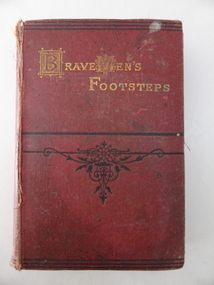
Book, Brave Men's Footsteps, 1873
... prize to Walter Wright by the Wangoom School in 1873. The name ‘Wangoon’ is on the printed book plate – is this a misprint or an alternative spelling of ‘Wangoom’? Wangoom State School, No. 645, on the Warrnambool/Wangoom Road was opened in 1865 as a Common School. The school is now closed. The Hon. William Bayles, a Melbourne businessman with property near Macarthur, first became a member of the Legislative Council for Villiers and Heytesbury in 1864 and continued until 1880. He was a prominent and popular politician in Warrnambool, regularly giving...prize to Walter Wright by the Wangoom School in 1873. The name ‘Wangoon’ is on the printed book plate – is this a misprint or an alternative spelling of ‘Wangoom’? Wangoom State School, No. 645, on the Warrnambool/Wangoom Road was opened in 1865 as a Common School. The school is now closed. The Hon. William Bayles, a Melbourne businessman with property near Macarthur, first became a member of the Legislative Council for Villiers and Heytesbury in 1864 and continued until 1880. He was a prominent and popular politician in Warrnambool, regularly giving ...This book was given as a school prize to Walter Wright by the Wangoom School in 1873. The name ‘Wangoon’ is on the printed book plate – is this a misprint or an alternative spelling of ‘Wangoom’? Wangoom State School, No. 645, on the Warrnambool/Wangoom Road was opened in 1865 as a Common School. The school is now closed. The Hon. William Bayles, a Melbourne businessman with property near Macarthur, first became a member of the Legislative Council for Villiers and Heytesbury in 1864 and continued until 1880. He was a prominent and popular politician in Warrnambool, regularly giving prizes to pupils of schools in his electorate and in 1872 he offered a £10 prize for the best student in the district. No specific information has been found on Walter Wright or any family named Wright residing in the Wangoom area. There was a piano tuner named W. Wright in the Warrnambool area in the 1870s. Was this Walter’s father? This book is of interest because of the connection with Wangoom School, the Hon. William Bayles and Walter Wright. More interest will be created if information comes to light on Walter Wright. This is a hard cover book of 333 pages plus 32 pages of advertisements for books published by Henry S. King and Co. The cover is dark red with an ornamental pattern in black on the front cover and lettering in gold on the front cover and spine. The book has three full page black and white illustrations with the illustration next to the first page missing. There is a printed book plate pasted onto the inside of the front cover with blue printing and ornamentation and a handwritten name and date. The cover is partly detached from the binding and the cover and pages are somewhat stained and the cover is frayed. ‘State School, No. 645 Wangoon (sic), Class 3rd, Prize Presented to Walter Wright by the Hon. William Bayles, M.P. for Villiers and Heytesbury, Christmas 1873’. wangoom state school, walter wright -
 Flagstaff Hill Maritime Museum and Village
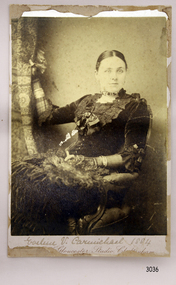
Photograph, late 1800's
... PRIZE MEDALIST PARIS EXHIBIT’N 1867” Printed text “No. …………” “COUNTY OF GLOUCESTER STUDIO / 20a / PROMENADE VILLAS / CHELTENHAM” and “Autotype Prints or Permanent Porcelain enlargements can be made from this plate” Photograph of Miss Eva Carmichael sitting on a chair holding a curtain. Text below photograph is partly unreadable but gives ...Miss Eva Carmichael is one of two survivors of the Loch Ard shipwreck.. Loch Ard was bound for Melbourne in 1878 loaded with passengers and cargo when it ran into a rocky reef at the base of Mutton Bird Island, near Port Campbell. Of the 54 crew members and passengers on board, only two survived: an apprentice, Tom Pearce and a young woman passenger, Eva Carmichael, who lost all of her family in the tragedy. The wreck of Loch Ard still lies at the base of Mutton Bird Island and much of the cargo has been salvaged. Some was washed up into what is now known as Loch Ard Gorge following the shipwreck. Cargo and artefacts have also been illegally salvaged over many years before protective legislation was introduced. The photograph is significant for its association with the wreck of the Loch Ard. This wreck has been protected as a Historic Shipwreck since 11 March 1982, under the Commonwealth Historic Shipwrecks Act (1976) Flagstaff Hill’s collection of artefacts from Loch Ard is significant for being one of the largest collections of artefacts from this shipwreck in Victoria. It is significant for its association with the shipwreck, which is on the Victorian Heritage Register. The collection is significant because of the relationship between the objects, as together they have a high potential to interpret the story of the Loch Ard. The Loch Ard collection is archaeologically significant as the remains of a large international passenger and cargo ship. The Loch Ard collection is historically significant for representing aspects of Victoria’s shipping history and its potential to interpret sub-theme 1.5 of Victoria’s Framework of Historical Themes (living with natural processes). The collection is also historically significant for its association with the Loch Ard, which was one of the worst and best known shipwrecks in Victoria’s history. The Loch Ard collection meets the following criteria for assessment: Criterion A: Importance to the course, or pattern, of Victoria’s cultural history. Criterion B: Possession of uncommon, rare or endangered aspects of Victoria’s cultural history. Criterion C: Potential to yield information that will contribute to an understanding of Victoria’s cultural history. Photograph of Miss Eva Carmichael sitting on a chair holding a curtain. Text below photograph is partly unreadable but gives the name of the photographic studio. A printed on the back "County of Gloucester Studio Cheltenham" with the address and other informaion.Reverse has crest that includes “PRIZE MEDALIST PARIS EXHIBIT’N 1867” Printed text “No. …………” “COUNTY OF GLOUCESTER STUDIO / 20a / PROMENADE VILLAS / CHELTENHAM” and “Autotype Prints or Permanent Porcelain enlargements can be made from this plate” flagstaff hill, warrnambool, shipwrecked-coast, flagstaff-hill, flagstaff-hill-maritime-museum, maritime-museum, shipwreck-coast, flagstaff-hill-maritime-village, photograph of miss eva carmichael, eva carmichael, loch ard shipwreck, county of gloucester studio -
 The Beechworth Burke Museum
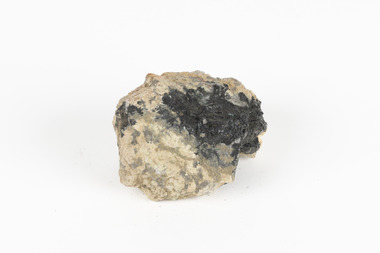
Geological specimen - Tourmaline (schorl), Unknown
... prized gemstones. Tourmaline crystals can come in various shades, including pink, green, blue, brown, black, and colourless. They are often transparent or translucent. Tourmaline's chemical composition is complex, but it typically includes elements such as aluminium, iron, magnesium, sodium, lithium, and potassium. The specific arrangement of these elements in the crystal lattice gives...prized gemstones. Tourmaline crystals can come in various shades, including pink, green, blue, brown, black, and colourless. They are often transparent or translucent. Tourmaline's chemical composition is complex, but it typically includes elements such as aluminium, iron, magnesium, sodium, lithium, and potassium. The specific arrangement of these elements in the crystal lattice gives ...Tourmaline is a group of minerals belonging to the complex borosilicate mineral class. These minerals are known for their striking and varied colours, making them prized gemstones. Tourmaline crystals can come in various shades, including pink, green, blue, brown, black, and colourless. They are often transparent or translucent. Tourmaline's chemical composition is complex, but it typically includes elements such as aluminium, iron, magnesium, sodium, lithium, and potassium. The specific arrangement of these elements in the crystal lattice gives rise to the different colours and properties of tourmaline specimens. Tourmaline specimens from Beechworth, Victoria, Australia, are a notable part of the region's mineral heritage. These tourmalines are of interest to mineral collectors and enthusiasts. While the tourmaline found in Beechworth is not as well-known as some other tourmaline varieties, it has unique characteristics and a historical context associated with the gold mining areas in Beechworth.The significance of tourmaline in Beechworth, Victoria, Australia, lies in its unique geological and historical context, contributing to both scientific and cultural aspects. The tourmaline mined in Beechworth is a rare and unique variety of tourmaline that is primarily found in the historic gold mining areas surrounding Beechworth. Its occurrence is closely linked to the geological processes that shaped the region during the Gold Rush era. The discovery of tourmaline in Beechworth adds to the rich mineral heritage of the area, which was historically known for gold mining. The specimens serve as a tangible connection to the region's mining history and contribute to preserving its geological legacy. The presence of tourmaline in Beechworth showcases the mineralogical diversity of the area. Tourmaline is known for its wide range of colours and unique properties, making it a valuable subject of study for mineralogists and geologists. Tourmaline specimens from Beechworth have educational significance, providing opportunities for research and study. They offer insights into the geological processes and mineral formation in the region, contributing to a better understanding of Earth's geological history.A hand-sized solid mineral specimen in shades of brown, green, light grey and dark greyTOURMALINE (schorl) / (Silicate of boron and aluminum) burke museum, beechworth, indigo shire, geological, geological specimen, mineralogy, tourmaline -
 Federation University Historical Collection
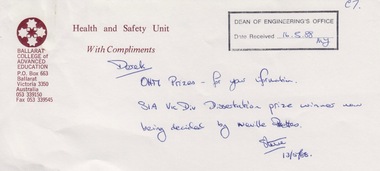
Document - Document - Correspondence, VIOSH: Letters from Steve Cowley to prize givers for the Graduate Diploma in Occupational Hazard Management, 1988
... VIOSH: Letters from Steve Cowley to prize givers for the Graduate Diploma in Occupational Hazard Management, 1988. ...Victorian Institute of Occupational Safety and Health (VIOSH) Australia is the Asia-Pacific centre for teaching and research in occupational health and safety (OHS) and is known as one of Australia's leaders on the field. VIOSH has a global reputation for its innovative approach within the field of OHS management. VIOSH had its first intake of students in 1979. At that time the Institution was known as the Ballarat College of Advanced Education. In 1990 it became known as Ballarat University College, then in 1994 as University of Ballarat. It was 2014 that it became Federation University. VIOSH Australia students are safety managers, senior advisors and experienced OHS professionals. They come from all over Australia and industry. Students are taught active research and enquiry; rather than textbook learning and a one-size fits all approach. VIOSH accepts people into the Graduate Diploma of Occupational Hazard Management who have no undergraduate degree - on the basis of extensive work experience and knowledge. Three letters written to associations/groups that provide prizes for the students of the Graduate Diploma in Occupational Hazard Management from Steve Cowley. Letters are to Mr Wayne Hughes - Managing Director, Industrial Rehabilitation Service. The prize is awarded to the "Best Final Year Student" and is a cheque for $500.00. Second letter is to Mr Raeburn Epthorp and award goes to the best Human Factors student. The third letter is to Mr Gordon Lewis - General Manager, National Safety Council of Australia. The award is for the best overall academic performance during the course. It is the "Max Eise Perpetual Trophy". The N.S.C.A. provide a miniature replica for the student to keep. The OHM Annual Dinner to be held on 7th July 1988 in the Bistro, Ballarat College of Advanced Education. Type written letters - single page. Memo page .Ballarat College of Advanced Education letterhead on letters. Date 13th May 1988. Signature of Steve Cowley.viosh, victorian institute of occupational safety and health, occupational hazard management, steve cowley, ohm course co-ordinator, wayne hughes, industrial rehabilitation service, best final student award, raeburn epthorp, human factors student, gordon lewis, national safety council of australia, ohm annual dinner, awards presentations, max eise perpetual trophy -
Federation University Historical Collection
Book - Book - Scrapbook, Ballarat School of MInes: Scrapbook of Newspaper Cuttings, Book 2, June 1976 - August 1977
... The papers concerned are The Courier, Ballarat, The Australian, The Age over the period from June 1976 to August 1977. staffing advertisements graeme beanland new principal technical colleges under strain meeting on farm apprenticeships drop in apprenticeship intake business studies course new college concept for ballarat big year ahead for school of mines 1977 courses ballarat school for bricklayers deputation moves to retain girls' high school t a f e in the ballarat region barry stoddart top marks in plumbing exam time for entries for external studies studying without classes adult education courses counselling goes public farming courses nursing bursaries for smb students remedial teachertraining for woolgrowers parents concerned says principal smb principal questions education values smb honors council president founders' prize for glen glasson new course to help building industry new teaching method gives hope for poor readers mr thompsonwill open bricklaying school first need is for tradesmen workshop tackles reading problem cabinet gets hot reception the official history of the school of mines satellite learning for aust? ...Collection of newspaper articles related to Ballarat School Of Mines.They cover activities and advertisements for staff. The papers concerned are The Courier, Ballarat, The Australian, The Age over the period from June 1976 to August 1977.Book with deep red and white cover back and front, spiral bound. staffing advertisements, graeme beanland new principal, technical colleges under strain, meeting on farm apprenticeships, drop in apprenticeship intake, business studies course, new college concept for ballarat, big year ahead for school of mines, 1977 courses, ballarat school for bricklayers, deputation moves to retain girls' high school, t a f e in the ballarat region, barry stoddart top marks in plumbing exam, time for entries for external studies, studying without classes, adult education courses, counselling goes public, farming courses, nursing bursaries for smb students, remedial teachertraining for woolgrowers, parents concerned says principal, smb principal questions education values, smb honors council president, founders' prize for glen glasson, new course to help building industry, new teaching method gives hope for poor readers, mr thompsonwill open bricklaying school, first need is for tradesmen, workshop tackles reading problem, cabinet gets hot reception, the official history of the school of mines, satellite learning for aust?, apprenticeship week exhibition, fijian education officer visits schools in ballarat -
 Ballarat Clarendon College
Book, Samuel G. Green, The painters of Florence: from the thirteenth to tthe sixteenth century, 1914
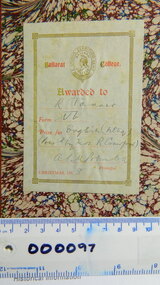
... Book prize awarded to Ralph Tanner (1921) for excellence in English in Form Vb; prize presented by Mrs R Crawford (possibly wife of Robert C Crawford, Dux of School 1881) The book plate notation that the prize was presented by Mrs R Crawford, presumably a member of the wider school community, has social significance. It gives ...Book prize awarded to Ralph Tanner (1921) for excellence in English in Form Vb; prize presented by Mrs R Crawford (possibly wife of Robert C Crawford, Dux of School 1881)The book plate notation that the prize was presented by Mrs R Crawford, presumably a member of the wider school community, has social significance. It gives evidence of the degree of social connectedness maintained by former students throughout their lifetime and that of their immediate family members. Red calf binding with gold embossing and borders to front and back covers; raised bands on spine with 6 compartments and gold title lettering and ornate decorations; marbled endpapers and page edges; book plate on front cover verso; school crest embossed on front cover; black and white illustrations and frontispiece;Book plate on front cover verso: Ballarat College and crest / Awarded to / R Tanner / Form Vb / Prize for English (?) / (Presented by Mrs R Crawford) / A S M Polson / Principal / Christmas 1918ralph-tanner, 1918, ballarat-college, r-crawford, book-prize, english, a-s-m-polson -
 Ballarat Clarendon College
Clock
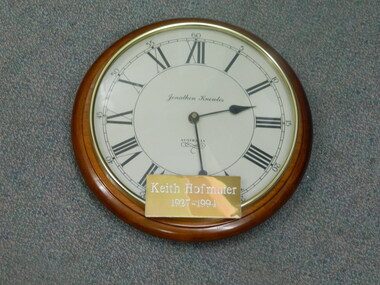
... He continued to give generously to the school and the Weatherly Library throughout his life. He endowed poetry and music prizes in memory of his daughter Ann who died in an accident. ...He continued to give generously to the school and the Weatherly Library throughout his life. He endowed poetry and music prizes in memory of his daughter Ann who died in an accident. ...Keith Charles Hofmaier (1927 - 1994) was one of Ballarat College's most distinguished sons. He attended the school from 1941 - 1945 serving as librarian, school prefect (1945) and member of the Rowing Firsts (1945). After school he became a successful farmer, well-known historian, organist, Freemason, philanthropist and community worker. He continued to give generously to the school and the Weatherly Library throughout his life. He endowed poetry and music prizes in memory of his daughter Ann who died in an accident. The Students' Representative Council gave a clock tot he school library in memory of his contribution to the school in 1994. Wooden surround, glass front roman numerals on pale yellow face, battery operated; clock accompanied by frame description. Plaque on clock glass: Keith Hofmaier 1927 - 1994keith charles hofmaier, weatherly library, ballarat college -
 Flagstaff Hill Maritime Museum and Village
Document - Location Chart, The Mahogany Ship, 2007
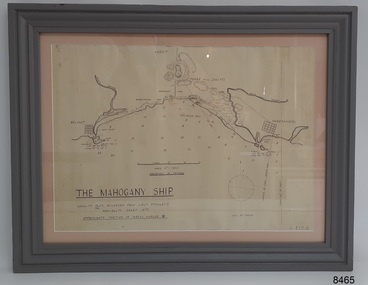
... prize for finding the wreck or parts of it. People have written books, painted images, made videos and told tales of the ship but it continues to remain a mystery or even a fable. The chart is significant for its possible link to one of Victoria’s and Australia’s maritime mysteries, the Mahogany Ship (also known as the Ancient Wreck). It is one of very few known relics that could give ...This chart shows a possible site for the fabled wreck called the 'Mahogany Ship'. Flagstaff Hill’s collection includes other objects that some say could be relics from this Ancient Wreck, (also called the Gold Ship, or the Ancient Vessel). The chart shows the coordinates for the Summits of Griffith Island and of Middle Island. It also has the depths of the sea at various intervals and shows the shore and sand dunes, lighthouses and other reference points. The mystery of the Mahogany Ship began in 1836 when two shipwrecked sealers discovered the remains of an “ancient vessel” in the sand dunes about four miles west of Warrnambool. Since the last recorded sightings in the 1880’s the true origin of the Mahogany Ship has remained one of Australia’s most famous historical mysteries or fables. One of the more recent theories is that the vessel was one of the Portuguese ships exploring the Australian coast in 1522. For over one hundred years searchers have attempted to locate and identify the wreck. The search continues for the tangible evidence which will once and for all establish the Mahogany Ship’s place in Australia’s History.The chart represents the worldwide interest in locating the wreck of the Mahogany Ship. Locating the actual wreck or proving the existence of a Portuguese ship's wreck could change the history of the discovery of Australia. A Mahogany Ship committee was formed to gather and research information about the discovery of the wrecked ship. A large amount of money was offered as a prize for finding the wreck or parts of it. People have written books, painted images, made videos and told tales of the ship but it continues to remain a mystery or even a fable. The chart is significant for its possible link to one of Victoria’s and Australia’s maritime mysteries, the Mahogany Ship (also known as the Ancient Wreck). It is one of very few known relics that could give evidence of the existence and history of the vessel. It is listed on the Victorian Heritage Register S438 as it is one of Victoria’s oldest recorded shipwrecks. The identity of the vessel has the potential to change Australia’s history.A chart in a wooden frame, behind glass. The chart shows the approximate position of the mystery Ancient Wreck, later called the "Mahogany Ship". The chart is a copy and is based on the Admiralty Chart by Lieut. Stanley, dated 1872. Lower left: "THE MAHOGANY SHIP" "LOCALITY PLAN, ENLARGED FROM LIEUT. STANLEY'S ADMIRALTY CHART 1872" "APPROXIMATE POSITION OF WRECK MARKED [symbol of a Portuguese cross]" Other labels on chart: "BELFAST" "PORT FIARY" "GRIFFITHS I" "RIVER MOYNE" "RIVER MERRI" "ARMSTRONG BAY" " GORMANS LANE" "TOWER HILL" "KOROIT" "HELEN ROCK" "WARRNAMBOOL" "LADY BAY" "MIDDLE I" "LIGHT HO." Lower right: "G 410 B" Label on the back; "This chart presented to the Mahogany Ship Committee and Flagstaff Hill by Avis Quarrell, April 2007"warrnambool, shipwrecked coast, flagstaff hill maritime museum, shipwreck coast, mahogany ship, ancient vessel, ancient wreck, portuguese ship, coastal reserve, fabled wreck, gold ship, griffiths island, belfast (now port fairy), koroit, location plan, leuit. stanley, admiralty chart 1872, tower hill, merri river, moyne river, middle island, helen rock, armstrong bay, griffiths land -
 City of Moorabbin Historical Society (Operating the Box Cottage Museum)
Booklet - Schedule Booklet, horticultural prizes, "1879 Schedule of Prizes Brighton Horticultural Society", 1879
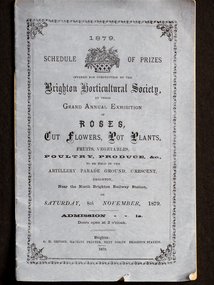
... The Proprietors of the English, Scottish and Australian Chartered Bank offered an second prize of three Guineas Commencing in 1856, the Brighton Horticultural Society only disbanded in 2009, and most of their archival holdings were given to the Brighton Historical Society. This booklet gives...The Proprietors of the English, Scottish and Australian Chartered Bank offered an second prize of three Guineas Commencing in 1856, the Brighton Horticultural Society only disbanded in 2009, and most of their archival holdings were given to the Brighton Historical Society. This booklet gives ...This booklet from 1879 was given to the Moorabbin Historical Society when the Robert Keys Leader Cup Trophy, 1882-1883 was re-discovered at 'Box Cottage' Museum in 2009. The Leader Cup Trophy, MAV 00001, is also itemised in this booklet (p9) The Leader Newspaper offered the 'Silver Cup, value Five Guineas for the best fruit garden in the Brighton District. The Proprietors of the English, Scottish and Australian Chartered Bank offered an second prize of three Guineas Commencing in 1856, the Brighton Horticultural Society only disbanded in 2009, and most of their archival holdings were given to the Brighton Historical Society. This booklet gives a good idea of the large varieties of plants, poultry and the skills of the pioneer settlers of the Brighton District.This Booklet describes the Schedule of Prizes for the 1879 Grand Annual Exhibition of the Brighton Horticultural Society in Brighton Victoria. The Booklet was donated to the Moorabbin Historical Society in 2009 upon the disbanding of the Brighton Horticultural Society..at that time. The Moorabbin Historical Society possesses the 1882 'Leader Cup Trophy' (cat 00001) presented to Robert Keys for the best Fruit Garden. This booklet is kept in the same cabinet as the Robert Key's Silver Trophy. After Henry Dendy's Special Survey in 1841 allotments of land were sold or rented to pioneer settlers who developed market gardens , fruit gardens and poultry farms in the Brighton area. Their produce was sold at the St Kilda and Melbourne Markets for the growing population of MelbourneBooklet with mauve paper cover and 16 pages listing the Schedule of prizes for the 1879 annual exhibition of the Brighton Horticultural Society to be held in Brighton, Victoria."1879/ SCHEDULE OF PRIZES/OFFERED FOR COMPETITION BY THE/ BRIGHTON HORTICULTURAL SOCIETY,/ AT THEIR/ GRAND ANNUAL EXHIBITION/ OF / ROSES,/ CUT FLOWERS, POT PLANTS,/ FRUITS, VEGETABLES,/ POULTRY, PRODUCE, &c.,/TO BE HELD IN THE/ ARTILLERY PARADE GROUND, CRESCENT, / BRIGHTON,/ Near the North Brighton Railway Station, / ON / SATURDAY, 8th NOVEMBER, 1879./ ADMISSION 1s. / Doors open at 2 o'clock. / Brighton: / G. H. ORFORD, MACHINE PRINTER, NEXT NORTH BRIGHTON STATION. / 1879 ;melbourne, keys robert, trophy, leader newspaper, leader cup, brighton, silver, moorabbin, bentleigh, markets, dendy henry, st kilda, bent thomas, market gardens, brighton horticultural society, fruit gardens, banks chartered -
Glenelg Shire Council Cultural Collection
Book, Alone, c. 1889
... At age twenty-three she won a $50 prize from the Southern Era periodical for her article on temperance. Encouraged, she published her first novel, Alone, to great acclaim. Despite giving...At age twenty-three she won a $50 prize from the Southern Era periodical for her article on temperance. Encouraged, she published her first novel, Alone, to great acclaim. Despite giving ...Blue cloth-covered binding. Title and author on spine in blue lettering against a gold design. 320pp.fictionromance, female author, woman, 1854, american -
Phillip Island and District Historical Society Inc.
Book, Cowper, Willliam et al, life and works of William Cowper, complete in one volume / ed.Rev. T.S. Grimshawe, 1865
... Prize, English, 5th Class, 1st Division, awarded to M'Gregor. Alexander Morrison A.M., Principal. 11th December 1866'. Stamped 'Phillip Island & District Historical Society'. Inscribed 'I am giving...Prize, English, 5th Class, 1st Division, awarded to M'Gregor. Alexander Morrison A.M., Principal. 11th December 1866'. Stamped 'Phillip Island & District Historical Society'. Inscribed 'I am giving ...Labelled 'Scotch College Melbourne, Second Prize, English, 5th Class, 1st Division, awarded to M'Gregor. Alexander Morrison A.M., Principal. 11th December 1866'. Stamped 'Phillip Island & District Historical Society'. Inscribed 'I am giving this book to Mrs. Gliddon with love from Jessie McGregor (Watson) 1955'.c. mcgregor, william cowper, j gliddon -
 Mission to Seafarers Victoria
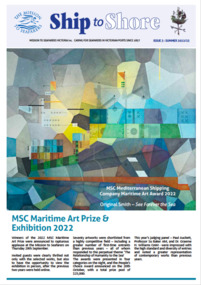
Magazine (item) - Newsletter, Mission to Seafarers Victoria, Ship to Shore , Issue 3 2022, November 2022
... give updates about shipping and seafaring news, staff, events, board Committee, heritage. It is sent by post or email to supporters, members, volunteers and friends of the mission. It is also available to the public in the Flying Angel club and online on the website. Ship to Shore is a valable source of information ship to shore mission to seamen mission to seafarers flinders street melbourne victoria news events art prize ...Ship to Shore was first printed in 1997. Inspired by the Jottings From Our Log, this modern version is generally published quarterly (Summer, Autumn, Winter, Spring) Articles are written by the mission's staff and give updates about shipping and seafaring news, staff, events, board Committee, heritage. It is sent by post or email to supporters, members, volunteers and friends of the mission. It is also available to the public in the Flying Angel club and online on the website.Ship to Shore is a valable source of informationship to shore, mission to seamen, mission to seafarers, flinders street, melbourne, victoria, news, events, art prize, exhibitions, concerts, open house, seafaring life, shipping, sailors, seamen, sponsors, marketing, festival, flying angel, staff, chaplains, heritage, collection, archives, sue dight, 2022, maritime art prize, williamstown historical society, phillip cornish, amaga, victorian collections, vc day -
 Mission to Seafarers Victoria
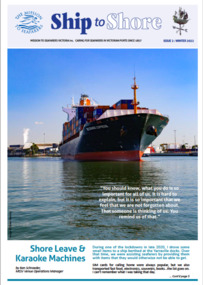
Magazine (item) - Newsletter, Mission to Seafarers Victoria, Ship to Shore , Issue 2 2022, November 2022
... give updates about shipping and seafaring news, staff, events, board Committee, heritage. It is sent by post or email to supporters, members, volunteers and friends of the mission. It is also available to the public in the Flying Angel club and online on the website. Ship to Shore is a valable source of information ship to shore mission to seamen mission to seafarers flinders street melbourne victoria news events art prize ...Ship to Shore was first printed in 1997. Inspired by the Jottings From Our Log, this modern version is generally published quarterly (Summer, Autumn, Winter, Spring) Articles are written by the mission's staff and give updates about shipping and seafaring news, staff, events, board Committee, heritage. It is sent by post or email to supporters, members, volunteers and friends of the mission. It is also available to the public in the Flying Angel club and online on the website.Ship to Shore is a valable source of informationship to shore, mission to seamen, mission to seafarers, flinders street, melbourne, victoria, news, events, art prize, exhibitions, concerts, open house, seafaring life, shipping, sailors, seamen, sponsors, marketing, festival, flying angel, staff, chaplains, heritage, collection, archives, 2022, maritime art prize, phillip cornish, weathervane, walter richmond butler (1864–1949) -
 Mission to Seafarers Victoria
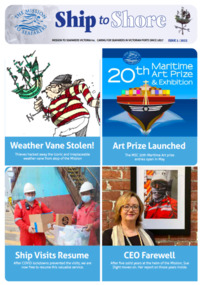
Magazine (item) - Newsletter, Mission to Seafarers Victoria, Ship to Shore , Issue 1 2022, November 2022
... give updates about shipping and seafaring news, staff, events, board Committee, heritage. It is sent by post or email to supporters, members, volunteers and friends of the mission. It is also available to the public in the Flying Angel club and online on the website. Ship to Shore is a valable source of information ship to shore mission to seamen mission to seafarers flinders street melbourne victoria news events art prize ...Ship to Shore was first printed in 1997. Inspired by the Jottings From Our Log, this modern version is generally published quarterly (Summer, Autumn, Winter, Spring) Articles are written by the mission's staff and give updates about shipping and seafaring news, staff, events, board Committee, heritage. It is sent by post or email to supporters, members, volunteers and friends of the mission. It is also available to the public in the Flying Angel club and online on the website.Ship to Shore is a valable source of informationship to shore, mission to seamen, mission to seafarers, flinders street, melbourne, victoria, news, events, art prize, exhibitions, concerts, open house, seafaring life, shipping, sailors, seamen, sponsors, marketing, festival, flying angel, staff, chaplains, heritage, collection, archives, 2022, maritime art prize, phillip cornish, weathervane, walter richmond butler (1864–1949), sue dight, theft -
 Mission to Seafarers Victoria
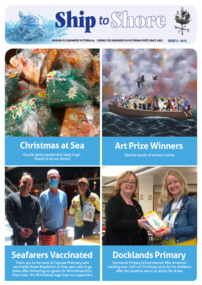
Magazine (item) - Newsletter, Mission to Seafarers Victoria, Ship to Shore , Issue 3 2021, November 2022
... give updates about shipping and seafaring news, staff, events, board Committee, heritage. It is sent by post or email to supporters, members, volunteers and friends of the mission. It is also available to the public in the Flying Angel club and online on the website. Ship to Shore is a valable source of information ship to shore mission to seamen mission to seafarers flinders street melbourne victoria news events art prize ...Ship to Shore was first printed in 1997. Inspired by the Jottings From Our Log, this modern version is generally published quarterly (Summer, Autumn, Winter, Spring) Articles are written by the mission's staff and give updates about shipping and seafaring news, staff, events, board Committee, heritage. It is sent by post or email to supporters, members, volunteers and friends of the mission. It is also available to the public in the Flying Angel club and online on the website.Ship to Shore is a valable source of informationship to shore, mission to seamen, mission to seafarers, flinders street, melbourne, victoria, news, events, art prize, exhibitions, concerts, open house, seafaring life, shipping, sailors, seamen, sponsors, marketing, festival, flying angel, staff, chaplains, heritage, collection, archives, maritime art prize, sue dight, 2021, docklands primary school, community, docklands, covid 19, vaccination, covid vaccine, xmas, christmas, pandemic
