
Showing 137 items matching "property law"
-
 Federation University Historical Collection
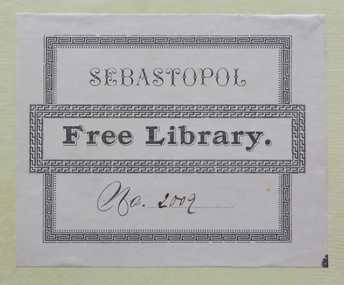
Book, A Handbook of Property Law, 1859
... A Handbook of Property Law......property law...A Handbook of Property Law Book Book ...Brown soft covered book that was formerly No 2009 in the Sebastopol Free Library Collection. sebastopol free library, sebastopol library, property law, lord st leonards, bookplate, library plate -
 Federation University Historical Collection
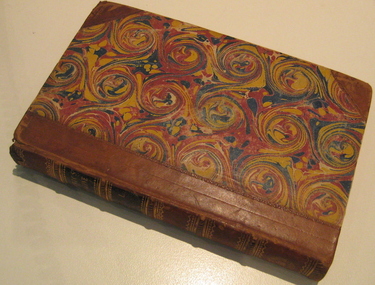
Book, Lord St Leonards, A Handy Book on Property Law in a Series of Letters, 1859
... A Handy Book on Property Law in a Series of Letters...A Handy Book on Property Law in a Series of Letters Book Lord St Leonards William Blackwood & Sons ...This book was formerly in the circulating collection of the Sebastopol Free Library.Brown hard covered book with gold lettering. 232 pages including comprehensive index. The inside cover has a bookplate which stated 'Sebastopol Free Library No. 2009'.stamped inside 'Free Library Sebastopol' -
 RMIT GSBL Justice Smith Collection
Report, Duggan, A. J. et al, Personal property securities law: a blueprint for reform : discussion paper, 1992
... Personal property securities law: a blueprint for reform : discussion paper...law) -- victoria...personal property -- queensland...security (law) -- queensland security (law) -- victoria personal property -- queensland personal property -- victoria ISBN: 0730623246 Queensland Law Reform Commission Discussion paper No. 39 Law Reform Commission of Victoria Discussion paper No.28 Personal property securities law: a blueprint for reform : discussion paper Report Duggan, A. ...Queensland Law Reform Commission Discussion paper No. 39 Law Reform Commission of Victoria Discussion paper No.28ISBN: 0730623246security (law) -- queensland, security (law) -- victoria, personal property -- queensland, personal property -- victoria -
Koorie Heritage Trust
Education Kit, Aboriginal Affairs Victoria et al, Aboriginal Heritage Bill - Exposure Draft. (2005), 2005
... | Cultural property -- Protection -- Law and legislation -- Victoria.... | Cultural property -- Protection -- Law and legislation -- Victoria. | Sacred sites (Australian Aboriginal) -- Law and legislation -- Victoria. | Law - Administrative law - Victoria. | Cultural heritage - Protection. | Cultural heritage - Repatriation. | Cultural heritage - Repatriation - Human remains. ...Exposure draft; sets out the eight objectives of the proposed Act in the protection of Aboriginal cultural heritage in Victoria, strengthen the involvement of Aboriginal people in cultural heritage management; establish an Aboriginal cultural heritage registervii, 110 p. ; 30 cm. 10 information loose sheets; pamphlet folder 32 cm.Exposure draft; sets out the eight objectives of the proposed Act in the protection of Aboriginal cultural heritage in Victoria, strengthen the involvement of Aboriginal people in cultural heritage management; establish an Aboriginal cultural heritage registervictoria. parliament aboriginal heritage bill. | cultural property -- protection -- law and legislation -- victoria. | sacred sites (australian aboriginal) -- law and legislation -- victoria. | law - administrative law - victoria. | cultural heritage - protection. | cultural heritage - repatriation. | cultural heritage - repatriation - human remains. -
Koorie Heritage Trust
Document - Printed Sheets, Aboriginal Affairs Victoria, Proposed Victorian Aboriginal cultural Heritage Legislation: Discussion Paper, 1997
... Aboriginal Australians -- Antiquities -- Law and legislation -- Victoria. | Sacred sites (Aboriginal Australian) -- Victoria. | Cultural property -- Protection -- Law and legislation -- Victoria. | Cultural heritage - Protection - Law and legislation | Government policy - State and territory - Victoria....Aboriginal Australians -- Antiquities -- Law and legislation -- Victoria. | Sacred sites (Aboriginal Australian) -- Victoria. | Cultural property -- Protection -- Law and legislation -- Victoria. | Cultural heritage - Protection - Law and legislation | Government policy - State and territory - Victoria. ..."The Victorian Government is proposing new legislation to protect the State's significant significant Aboriginal cultural heritage. This legislation will replace the existing 'Archaeological and Aboriginal Relics Preservation Act 1972' and enabled the Commonwealth Government to consider repealing Part IIA of the 'Aboriginal and Torres Strait Islander Heritage Protection Act 1984 (Cth). This paper outlines key issues to be considered during the preparation of the new legislation, as a basis for consultation with interested parties during August and September 1997."23 p.; appendices; map; refs.; 30 cm."The Victorian Government is proposing new legislation to protect the State's significant significant Aboriginal cultural heritage. This legislation will replace the existing 'Archaeological and Aboriginal Relics Preservation Act 1972' and enabled the Commonwealth Government to consider repealing Part IIA of the 'Aboriginal and Torres Strait Islander Heritage Protection Act 1984 (Cth). This paper outlines key issues to be considered during the preparation of the new legislation, as a basis for consultation with interested parties during August and September 1997."aboriginal australians -- antiquities -- law and legislation -- victoria. | sacred sites (aboriginal australian) -- victoria. | cultural property -- protection -- law and legislation -- victoria. | cultural heritage - protection - law and legislation | government policy - state and territory - victoria. -
RMIT GSBL Justice Smith Collection
Book, Wiseman, H. Dallas, The law relating to the transfer of land : comprising the Transfer of Land Act 1928 (Victoria) and other acts affecting the transfer of land with commentary, notes of Australasian decisions, forms in general use and rulings and practice of the office of titles, 1931
... real property -- victoria...transfer (law...victoria. transfer of land act 1928 real property -- victoria transfer (law) -- victoria land titles -- registration and transfer -- victoria Second edition The law relating to the transfer of land : comprising the Transfer of Land Act 1928 (Victoria) and other acts affecting the transfer of land with commentary, notes of Australasian decisions, forms in general use and rulings and practice of the office of titles Book Wiseman, H. ...Second editionvictoria. transfer of land act 1928, real property -- victoria, transfer (law) -- victoria, land titles -- registration and transfer -- victoria -
RMIT GSBL Justice Smith Collection
Report, Australian Law Reform Commission, Lands acquisition and compensation : report no. 14, 1980
... government purchasing of real property -- australia...compensation (law...government purchasing of real property -- australia compensation (law) -- australia eminent domain -- australia ISBN: 0642034281 Lands Acquisition and Compensation Report No. 14 Lands acquisition and compensation : report no. 14 Report Australian Law Reform Commission Australian Government Publishing Service ...Lands Acquisition and Compensation Report No. 14 ISBN: 0642034281 government purchasing of real property -- australia, compensation (law) -- australia, eminent domain -- australia -
 Bay Steamers Maritime Museum
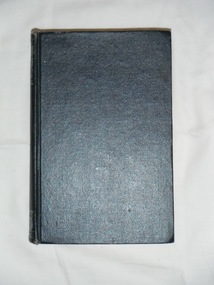
Book, Newnes Marine Engineering Volume 1 Marine Steam Engines and Turbines Marine Steam Boilers
... Hand wirtten in blue pen "The property of / Law Praid / S. Townhead Rd / Cotehill" Hand written in pencil ET $15 / 2 vols"...Hand wirtten in blue pen "The property of / Law Praid / S. Townhead Rd / Cotehill" Hand written in pencil ET $15 / 2 vols" Black leather look hard cover book of 588 pages Newnes Marine Engineering Volume 1 Marine Steam Engines and Turbines Marine Steam Boilers Book W.J. ...Black leather look hard cover book of 588 pagesHand wirtten in blue pen "The property of / Law Praid / S. Townhead Rd / Cotehill" Hand written in pencil ET $15 / 2 vols" -
Port Melbourne Historical & Preservation Society
Document - Sale Notices, Relating to properties in Port Melbourne, "Sale Notices", 1960 - 1979
... 29 thick volumes of letters, forms, memoranda, etc. sent to the Building and Rates Departments of the former City of Port Melbourne by property owners, law firms and others. The items concern matters relating to properties and mostly are part of the process of putting a property up for sale. ...Index of each volume was carried out by Margaret Bride 2013 and Jack Bolt 2017/18. local government - city of port melbourne built environment - domestic 29 thick volumes of letters, forms, memoranda, etc. sent to the Building and Rates Departments of the former City of Port Melbourne by property owners, law firms and others. The items concern matters relating to properties and mostly are part of the process of putting a property up for sale. ...Index of each volume was carried out by Margaret Bride 2013 and Jack Bolt 2017/18.29 thick volumes of letters, forms, memoranda, etc. sent to the Building and Rates Departments of the former City of Port Melbourne by property owners, law firms and others. The items concern matters relating to properties and mostly are part of the process of putting a property up for sale. Those realting to a particular property are generally grouped together and are usually arranged in alphabetical order of streets. The volumes extend from early 1960s to late 1979. They have card front and back covers, metal holders and taped spines . (.01) prior to 30.09 1962 (.02) 1.10.1962 to 30.09.1963 (.03) 1963/64 (.04) 01.10.1964 to 30.09.1965 ; A-F (.05) 01.10.1964 to 30.09.1965 ; G-Z (.06) 01.10.1965 to 30.09.1966 (.07) 1966 to 1967 (.08) 01.10.1967 to 30.09.1968 (.09) 1968 to 1969, A-G (.10) 1968 to 1969, H-Z (.11) 01.10.1969 to 30.09.1970, A-K (.12) 01.10.1969 to 30.09.1970, L-Z (.13) 01.10.1970 to 30.09.1971, A-L (.14) 01.10.1970 to 30.09.1971, M-Z (.15) 01.10.1972 to 30.09.1973, A-H (.16) 01.10.1972 to 30.09.1973, I-Z (.17) 01.10.1973 to 30.09.1974, A-Glocal government - city of port melbourne, built environment - domestic -
 Flagstaff Hill Maritime Museum and Village
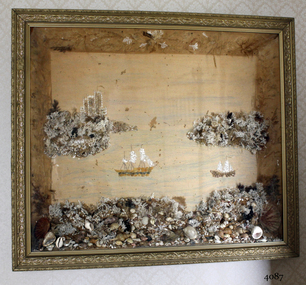
Artwork, other - Wall decoration, late 19th century
... law by marriage. The diorama is now part of the Giles Collection. Anna married William Wilson in 1860, who had arrived in Australia from County Tarrane in about 1850, aged 19. In 1869 they moved to their new property...law by marriage. The diorama is now part of the Giles Collection. Anna married William Wilson in 1860, who had arrived in Australia from County Tarrane in about 1850, aged 19. In 1869 they moved to their new property ...This unusual wall decoration was created by Anna Wilson (nee Henry), daughter of pioneer John Stephenson Henry, who arrived in Australia from Ireland with his children in 1851. Family documents confirm that Anna most probably made the diorama for her sister-in-law, who married a member of the Giles family. The diorama was later given to Vera Giles who was a family friend and possibly related to Anna’s sister-in-law by marriage. The diorama is now part of the Giles Collection. Anna married William Wilson in 1860, who had arrived in Australia from County Tarrane in about 1850, aged 19. In 1869 they moved to their new property called ‘Glenlyall’ in Cooramook, north of Grassmere, Victoria, where he lived for 49 years until his death in 1918. He left behind a family of four sons and a daughter. The Giles Family There are many 19th century items of furniture, linen and crockery donated to Flagstaff Hill Maritime Village by Vera and Aurelin Giles. The items are associated with the Giles Family and are known as the “Giles Collection”. These items mostly came from the simple home of Vera’s parents-in-law, Henry Giles and his wife Mary Jane (nee Freckleton), whose photos are in the parlour. They married in 1880. Henry Giles was born at Tower Hill in 1858. He was a labourer on the construction of the Breakwater before leaving in 1895 to build bridges in N.S.W. for about seven years. Mary Jane was born in 1860 at Cooramook. She attended Mailor’s Flat State School where she was also a student teacher before, as family legend has it, she became a governess at “Injemiara” where her grandfather, Francis Freckleton, once owned land. Henry and Mary’s family of six, some of whom were born at Mailor’s Flat and later children at Wangoom, lived with their parents at Wangoom and Purnim west, where Henry died in 1933 and Mary Jane in 1940. The family of the creator Anna Wilson nee Henry and her husband William Wilson are of significance to the early history of Victoria and the South West of Victoria in particular, being pioneer families who farmed the land, built the towns and cities and contributed to their communities. The Giles family collection has social significance at a local level, because it illustrates the level of material support the Warrnambool community gave to Flagstaff Hill when the Museum was established. Wall decoration, diorama with decorative gild frame and glass front. The 3-dimensional seascape includes sailing boats, land and sea, all made from materials such as shells, coral and seaweed. The work was made by Anna Wilson. It is part of the Giles Collection.Noneflagstaff hill, warrnambool, shipwrecked-coast, flagstaff-hill, flagstaff-hill-maritime-museum, maritime-museum, shipwreck-coast, flagstaff-hill-maritime-village, giles collection, henry giles, tower hill, cooramook, warrnambool breakwater, mailor’s flat, wangoom, 19th century household goods, 19th century decor, 19th century handcraft, handcraft, wall hanging, diorama of a seascape -
Federation University Historical Collection
Book, Handbook of the Law relating to State Education and State School Teachers, 1905s
... this book attempted to collect and place under convenient headings the various acts dealing with State Education and State School Teachers. education state schools education acts school property attendance truency free education employment teacher registration teacher training Brown soft covered book of 74 pages relating to law relating to State Education and State School teachers. ...this book attempted to collect and place under convenient headings the various acts dealing with State Education and State School Teachers.Brown soft covered book of 74 pages relating to law relating to State Education and State School teachers.education, state schools, education acts, school property, attendance, truency, free education, employment, teacher registration, teacher training -
 Federation University Historical Collection
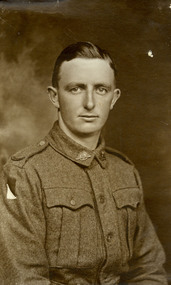
Photograph - Photograph - Sepia Postcard, Henry Smerdon Holmes, c 1915
... In 1938 Harry and Edith purchased a property at Derrinallum, Victoria and called it 'Launchley Park' on their first son's return from World War 2. In 1953 Harry purchased William and Charlotte's portion of 'Sauchieburn' for his son, Bill, and daughter-in-law Margaret. ...In 1938 Harry and Edith purchased a property at Derrinallum, Victoria and called it 'Launchley Park' on their first son's return from World War 2. In 1953 Harry purchased William and Charlotte's portion of 'Sauchieburn' for his son, Bill, and daughter-in-law Margaret. ...HENRY SMERDON (Harry) HOLMES was born in 1897 at the family property, ’Sauchieburn’, 17 km north of Ballarat, in the Ascot district. He was the youngest of four children. After finishing his education at St Patrick’s College, Ballarat, Henry joined the Holmes family farming interests. At the age of 18 he enlisted and served with AIF in Egypt, France and Belgium 1915-1918. Henry served at the famous battlegrounds of Ypes and Somme in the Australian Army 8th Battalion https://www.awm.gov.au/collection/U51448 He was a Driver with the 4th D.A.C.https://www.awm.gov.au/collection/U51219 According to his Soldier's Pay Books (Cat. No. 20112) Holmes Registration number was 7983. He was Catholic and enlisted in the Third Military District on 17 September 1915, and embarked on 8 November 1915. Holmes was in the 18th AASC Unit with the rank of Driver at that time. On 15 November 1918 Holmes was promoted to Lance Corporal. He received leave on: * 3 August 1917 - London (10 days) * 19 February 1918 - Paris (10 days) * 27 August 1918 - London (14 days) In 1922 Harry married Edith Pickford of 'Yeovil', Clunes, and they lived at 'Sauchieburn' with Henry's brother Willie. In 1933 Harry and Edith built a new timber home 'Launchley' (Ascot) on the rise east of 'Sauchieburn' on the Ballarat - Maryborough Road. The home was built by Con Zilles to the designs of Clegg and Morrow. In 1938 Harry and Edith purchased a property at Derrinallum, Victoria and called it 'Launchley Park' on their first son's return from World War 2. In 1953 Harry purchased William and Charlotte's portion of 'Sauchieburn' for his son, Bill, and daughter-in-law Margaret. [Source: Unpublished notes by Jane Dyer ( nee Chatham)]Sepia photographic postcard of a World War 1 Australian soldier in uniform, Henry Smerdon Holmes from Ascot Victoria.Verso in pen "The boys say this isn't to (sic) bad so it will show you any changes. Heaps of love to all. Harrychatham, chatham family collection, holmes, harry holmes, henry holmes, smerdon, world war, world war 1, world war i, uniform -
 Flagstaff Hill Maritime Museum and Village
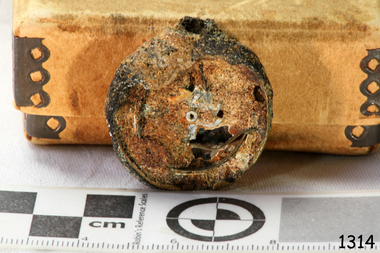
Instrument - Fob Watch, ca 1878
... Although they never owned that property, it was their home when James died in 1937. Elizabeth’s nephew, Alfred Sandle Ford (1894-1981), and a nephew-in-law were overseas during World War I. ...Although they never owned that property, it was their home when James died in 1937. Elizabeth’s nephew, Alfred Sandle Ford (1894-1981), and a nephew-in-law were overseas during World War I. ...The story of this gold fob watch is intriguing. The letter is dated March 6, 1905, 27 years after the Loch Ard was wrecked. It appears to be a quick personal note from a relative or friend who briefly writes the history of the enclosed ‘souvenir’ watch, found in Loch Ard Gorge at Port Campbell. Although the finder is not named, it is likely the letter’s author. The writer mentions that the letter and watch would be sent once photographs of the area where the watch was found had been added. The fancy, lined envelope’s date stamp is October 12th, 1917 (12.10.17), almost 12 years after the letter was written. It has a postmark from Florence (Firenze), Italy. The handwriting on the envelope differs from that of the letter, and there is no further mention of photographs being included. The condition of the watch certainly shows the effects of time in the sea. Some inner workings can be seen through broken encrustations and missing sections of its case. The winding knob on the top is recognisable even though it is covered by sand and other adhesions from the sea. Its dainty size and gold case suggest that it was made for a well-to-do female. The watch, envelope and letter were donated along with a 1971 newspaper cutting, all neatly folded and tucked with the watch into a small, strong cardboard box with metal reinforcing on the corners and a fitted lid. The newspaper article gives context to the watch, telling the story of the Loch Ard shipwreck tragedy and the two survivors, but does not refer to the watch. Perhaps one of the 17 passengers sailing on the Loch Ard, including members of the Carmichael family, owned the watch, or maybe it was amongst the cargo, as the ship’s manifest includes ‘clocks and watches £25’. . Considering the dates of the letter and the envelope, did the finder of the ‘souvenir’ watch take it to Europe? Was it used for good luck during service in the military? . Comparing the different writing on the letter and the envelope, does it suggest that the watch’s finder was overseas and asked someone to send the envelope to the intended recipient, with postage from Italy? ABOUT the address, “Glencove”: The details on the envelope are faint and obscured by stiff creases in the paper. The address appears to be “Mrs J. Mortton, Glencove, Portsea, Victoria, Australia”; though the family at that address had the surname “Morton”. Mrs J. Morton, formerly Elizabeth Ford, married her second husband, James Morton, in 1904, the year before the date of the letter. The couple lived at the Nepean Hotel before they were at “Glencove”. Although they never owned that property, it was their home when James died in 1937. Elizabeth’s nephew, Alfred Sandle Ford (1894-1981), and a nephew-in-law were overseas during World War I. Alfred Ford had moved to Melbourne as a young boy with his father. He entered service as Second Lieutenant in 1915, naming his father, Alfred Sandle Ford, as his next of kin. He served in Egypt, France and Belgium with the Australian Imperial Forces as a member of the Field Artillery Brigades. He returned to Melbourne in 1919 and worked in Richmond and Box Hill. He later married Frances Whyburn. Previously, in 1872, Elizabeth Ford’s sister, Julia Ford, acquired the 1-acre property with a 3-room house that became known as “Glencove”, Portsea. The building was originally the first school in the area, established before Crown Land sales. In the Parish of Nepean, it was first assessed for rates in 1871. Julia Ford (1843-1912) and Elizabeth Ford (1859-1957) were daughters of James Sandle Ford (1811-1890), a well-known pioneer of Portsea, formerly a convict limeburner. James Ford acquired several Crown allotments in Portsea. In 1872, he converted his old hotel into the large residential establishment known as the Nepean Hotel, which his family largely ran until it was demolished in 1971. During those years, different family members lived at the Nepean Hotel or Glencove. In 1877, Julia Ford married a significant landowner, John Cain, a limeburner from Rye. They had five daughters, four of whom were never married; Kathleen (1880-1949), Mabel (1881-1973), who was the last family member to own the house until her death, Hilda (1884-1974) and Julia Ethel (1888-1949). Some of the newspaper records refer to “Glencove”, Portsea, inform that: 1927 - Dr. and Mrs. J. E. Shilliday are staying with Mrs. R. B. Sanderson at Glencove. (Australasian) 1937 - James Morton died at his property, Glencove, Portsea, aged 83 years (Argus) 1949 - Julia Ethel Cain died at Glencove, Portsea. (Argus) 1949 - Probate application by sisters of Julia Ethel Cain, deceased, formerly of Nepean Hotel, Portsea, but late of Glencove, Nepean Highway, Portsea. The connection of the watch with the sands of Loch Ard Gorge and to the ship Loch Ard contributes to our knowledge of personal items brought to Australia in 1878, whether as the belongings of a passenger or as cargo; a gold watch would be intended for a wealthy buyer. The little artefact helps us understand the survival of artefacts in the powerful sea, over a quarter of a century after the wreck of the ship. Although many people would have visited the shipwreck site, the length of time before it was found helps us understand the effects of the sea on shipwreck artefacts. The survival of the carefully packaged watch and related documents shows the respectful understanding of preservation of historic artefacts, even from almost 150 years ago at the time of writing (2025). Ladies' fob watch, thought to be gold. It is now covered in encrustation. A bump on the edge would be the winding mechanism for the watch. A small section of the back of the case has broken away, and an engraved surface can be seen. Face and hands are missing, revealing the spring workings inside. Donated with the watch were two documents and a newspaper cutting about the story of the shipwreck of the Loch Ard. They are all in a strong cardboard box with reinforced corners on the base and lid. Found at Loch Ard Gorge and said to have been from the Loch Ard. The three donated documents are: - 1. A rectangular envelope made of cream waxy paper lined with black and white diagonally striped paper. The top right corner, usually meant for a postage stamp, has been torn off, partly exposing text on a rectangular printed logo. A round black postmark stamp near the top centre shows the post office location and date. The address on the front is handwritten in black ink. The creases on the envelope suggest it has been folded three times. 2. A letter on cream rectangular paper features clear, handwritten script in black ink. The unevenly cut bottom edge has two short black vertical lines, possibly the tops of tall written letters. There are creases where the page has been folded three times. 3. A newspaper clipping featuring text, an illustration, and handwritten details of the newspaper’s source.1. Envelope: - Address: ”Australia (per Postage) / [looks like “Mrs J. Mortton”] / Glencove, (Portsea) / Victoria” Postmark: “FIRENZE” 12 10 17” “ - - - -PORTEN – (illegible)” Logo inside envelope: “BUSTA BRE--- / Earliera Lialia” [Italian; Busta = envelope, Earliera == earlier] 2. Letter: - “I am sending you a ‘souvenir’ from the wreck of the Loch Ard 28 years ago at Port Campbell. It is the remains of a lady’s gold watch found in the gorge where Miss Carmichael & Tom Pearce (the only two saved) were washed up. This souvenir was lying there ever since. I went down into the awful gorge & saw the cave where these two unfortunates (or fortunate perhaps, as they were saved) lived until rescued. I also saw the graves of those who were washed up from the wreck. One grave contains Dr and Mrs Carmichael & six of their children. Later on, when I can get some good views of that wild coast I will send them to you. 6/3/05.” 3. Newspaper cutting: - History of the Lochard. Refer to the Sydney Morning Herald, Nov. 28th, 1971: “Loch Ard: the wreck that became a legend” flagstaff hill, warrnambool, shipwreck coast, flagstaff hill maritime museum, maritime museum, flagstaff hill maritime village, great ocean road, loch ard, eva carmichael, tom pearce, loch ard gorge, loch ard souvenir, port campbell, miss carmichael, mrs carmichael, dr carmichael, 1878, loch ard: the wreck that became a legend, ladies fob watch, gold watch, fob watch, pocket watch, horology, accessory, time keeping, scientific instrument, ladies' watch, ladies' pocket watch, lady's watch, souvenir watch, survivor, clocks and watches, diagonally striped envelope lining, firenze, busta, earliera, florence, italy, glencove, portsea, victoria, 1905, 1917, nepean hotel, moreton, morton, elizabeth morton, mrs j. morton, james morton, elizabeth ford, julia ford, alfred sandle ford, frances whyburn, james sandle ford, john cain, kathleen cain, mabel cain, hilda cain, julia ethel cain, australian imperial forces, field artillery brigades, limeburner -
 Flagstaff Hill Maritime Museum and Village
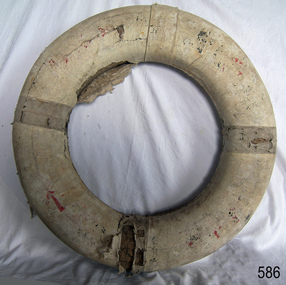
Equipment - Lifebuoy
... Laws were passed over time that has required aeroplanes and water going-vessels to carry life-preservers on board. The lifebuoy is an example of equipment carried on vessels in the late 19th and early 20th century to help preserve life. There were many lives lost in Australia’s colonial period, particularly along the coast of South West Victoria. The lifebuoy was once the property ...This lifebuoy is part of the lifesaving equipment that would be carried on vessels in the late 19th and early 20th century. The strips of cork wood have been joined together to make the ring shape. The broad arrow symbol indicates that it was once the property of the British or Australian defence force. A lifebuoy, or life-preserver, is used as a buoyancy device to keep a person afloat in the. It is usually connected by a rope to a person in a safe area such a nearby vessel or on shore. The lifebuoy is thrown to a person in distress in the water, allowing the rescuer to pull the person to safety. The lifebuoy is a made from a buoyant material such as cork or rubber and is usually covered with canvas for protection and to make it easy to grip. The first use of life saving devices in recent centuries was by the Nordic people, who used light weight wood or cork blocks to keep afloat. From the early 20th century Kapok fibre was used as a filling for buoys. Light weight balsa wood was used as a filler after WW1. In 1928 Peter Markus invented and patented the first inflatable life-preserver. By WW2 foam was combined with Kapok. Laws were passed over time that has required aeroplanes and water going-vessels to carry life-preservers on board. The lifebuoy is an example of equipment carried on vessels in the late 19th and early 20th century to help preserve life. There were many lives lost in Australia’s colonial period, particularly along the coast of South West Victoria. The lifebuoy was once the property of the British or Australian defence force.Lifebuoy, round cork object with canvas wrapped around it and rope attached to one side. Broad arrow mark and other red marks indecipherable. Painted white.Symbol of broad arrow. indecipherable markings.flagstaff hill, warrnambool, shipwrecked-coast, flagstaff-hill, flagstaff-hill-maritime-museum, maritime-museum, shipwreck-coast, flagstaff-hill-maritime-village, life rings, lifebuoy, safety ring, life-saving buoy, ring buoy, life preserver, personal floating device, floatation device, safety equipment, government lifebuoy, broad arrow -
 Federation University Historical Collection
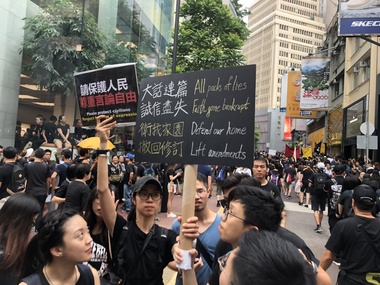
Photograph - Colour, Jarrod Watt, Crowds Gather on June 16 on the Streets of Causeway Bay, 2019, 17/06/2019
... properties in the city – as well as the government’s “patriotic education” drive, and the large numbers of mainland tourists who flock to Hong Kong. Many Hong Kongers are also concerned about China’s growing control over the city’s news media, as they increasingly self-censor and follow Beijing’s tacit orders. https://www.theguardian.com/world/2019/jun/10/what-are-the-hong-kong-protests-about-explainer carrie lam hong kong protests extraditions protest protestors Photograph crowds gathering on June 16 on the streets of Causeway Bay before an estimated 2 million people take part in march protesting the government's push for extradition laws to China and demanding an apology from the chief executrive Carrie Lam. ...Carrie Lam, Hong Kong’s chief executive, had plenty of political support in the territory’s pro-Beijing legislature to pass a bill that would allow extraditions to mainland China. The legislators were set to begin discussing the bill in early June, and intended to vote on it just weeks later. A series of protests took place, and after a June 16 protest saw the largest turnout yet, Ms. Lam made a major concession: She postponed the bill, at least temporarily. It was an undeniable victory for the protesters — but it did little to quell the unrest. Since the bill could later be reintroduced, protesters felt they remained in danger. The police tactics to break up the demonstrations on June 12, including the use of more than 150 tear gas canisters to push protesters far away from the government office, created a new set of demands from the protesters. Now, instead of just calling for the withdrawal of the bill and Ms. Lam’s resignation, they said they wouldn’t be content unless there was an independent investigation of officers’ conduct. They also wanted the release of protesters arrested on June 12, and for the government to rescind its description of the demonstrations as a “riot,” a designation that carries legal significance. None of that has happened. Many analysts say Ms. Lam is unlikely to step down, nor would Beijing accept her resignation if she offered it. She has more wiggle room on the other demands, but has not indicated any willingness to budge. The Hong Kong Protests are a leaderless, digital movement.There is no single leader or group deciding on or steering the strategy, tactics and goals of the movement. Instead, protesters have used forums and messaging apps to decide next steps. Anyone can suggest a course of action, and others then vote on whether they support it. The most popular ideas rise to the top, and then people rally to make them happen. At its best, this structure has empowered many people to participate and have their voices heard. Protesters say it keeps them all safe by not allowing the government to target specific leaders. Their success in halting the extradition bill, which was shelved by the territory’s chief executive, speaks to the movement’s power. Despite the lack of a clear leader, protesters have shown extensive coordination at the demonstrations, having planned the specifics online beforehand. Supply stations are set up to distribute water, snacks, gloves, umbrellas and shields made of cardboard. Volunteer first aid workers wear brightly colored vests. People form assembly lines to pass supplies across long distances, with protesters communicating what they need through a series of predetermined hand signals. Anyone walking in dangerous areas without a helmet or a mask is quickly offered one. No individual can speak on behalf of the protesters, which makes negotiations difficult, if not impossible. (https://www.nytimes.com/2019/07/02/world/asia/hong-kong-protest-explained.html, accessed 07/07/2019) Hong Kong’s amended extradition law would allow the extradition of suspects to mainland China for the first time. Supporters say the amendments are key to ensuring the city does not become a criminal refuge, but critics worry Beijing will use the law to extradite political opponents and others to China where their legal protections cannot be guaranteed. The government claims the push to change the law, which would also apply to Taiwan and Macau, stems from the killing last year of a Hong Kong woman while she was in Taiwan with her boyfriend. Authorities in Taiwan suspect the woman’s boyfriend, who remains in Hong Kong, but cannot try him because no extradition agreement is in place. Under the amended law, those accused of offences punishable by seven years or more in prison could be extradited. The new legislation would give Hong Kong’s leader, known as the chief executive, authority to approve extradition requests, after review by the courts. Hong Kong’s legislature, the legislative council, would not have any oversight over the extradition process. Many Hong Kongers fear the proposed extradition law will be used by authorities to target political enemies. They worry the new legislation spells the end of the “one country, two systems” policy, eroding the civil rights enjoyed by Hong Kong residents since the handover of sovereignty from the UK to China in 1997. Many attending the protests on Sunday said they could not trust China as it had often used non-political crimes to target government critics, and said they also feared Hong Kong officials would not be able to reject Beijing’s requests. Legal professionals have also expressed concern over the rights of those sent across the border to be tried. The conviction rate in Chinese courts is as high as 99%. Arbitrary detentions, torture and denial of legal representation of one’s choosing are also common. Many in the protests on Sunday 09 June 2019 said they felt overwhelmed by a sense of helplessness in the face of mainland China’s increasing political, economic and cultural influence in Hong Kong. Hong Kong’s top political leader is not elected by ordinary voters but by a 1,200-strong election committee accountable to Beijing. Half of its legislature are chosen through indirect electoral systems that favour pro-Beijing figures. Many Hong Kongers also cited the jailing of leaders and activists from the 2014 Occupy Central movement– a 79-day mass civil disobedience movement – as well as the disqualification of young localist lawmakers as signs of the erosion of civil freedoms. Resentment towards China has been intensified by soaring property prices – with increasing numbers of mainland Chinese buying properties in the city – as well as the government’s “patriotic education” drive, and the large numbers of mainland tourists who flock to Hong Kong. Many Hong Kongers are also concerned about China’s growing control over the city’s news media, as they increasingly self-censor and follow Beijing’s tacit orders. https://www.theguardian.com/world/2019/jun/10/what-are-the-hong-kong-protests-about-explainerPhotograph crowds gathering on June 16 on the streets of Causeway Bay before an estimated 2 million people take part in march protesting the government's push for extradition laws to China and demanding an apology from the chief executrive Carrie Lam. Nearly 2 million’ people take to streets, forcing public apology from Hong Kong leader Carrie Lam as suspension of controversial extradition bill fails to appease protesters. (https://www.scmp.com/news/hong-kong/politics/article/3014737/nearly-2-million-people-take-streets-forcing-public-apology )carrie lam, hong kong protests, extraditions, protest, protestors -
 Federation University Historical Collection
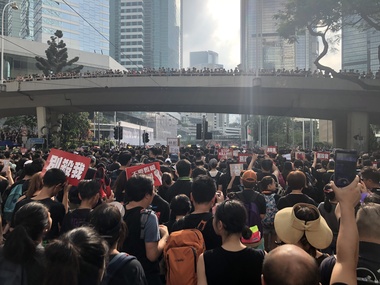
Photograph - Photograph - Colour, Jarrod Watt, Street Protests in Hong Kong against proposed extradition laws, 2019, 17/06/2019
... properties in the city – as well as the government’s “patriotic education” drive, and the large numbers of mainland tourists who flock to Hong Kong. Many Hong Kongers are also concerned about China’s growing control over the city’s news media, as they increasingly self-censor and follow Beijing’s tacit orders. https://www.theguardian.com/world/2019/jun/10/what-are-the-hong-kong-protests-about-explainer carrie lam hong kong protests extraditions protest protestors Photograph of a crowd or protestors against proposed extradition laws gathering on the streets of Causeway Bay, Hong Kong, leading down to the gathering area. ...Carrie Lam, Hong Kong’s chief executive, had plenty of political support in the territory’s pro-Beijing legislature to pass a bill that would allow extraditions to mainland China. The legislators were set to begin discussing the bill in early June, and intended to vote on it just weeks later. A series of protests took place, and after a June 16 protest saw the largest turnout yet, Ms. Lam made a major concession: She postponed the bill, at least temporarily. It was an undeniable victory for the protesters — but it did little to quell the unrest. Since the bill could later be reintroduced, protesters felt they remained in danger. The police tactics to break up the demonstrations on June 12, including the use of more than 150 tear gas canisters to push protesters far away from the government office, created a new set of demands from the protesters. Now, instead of just calling for the withdrawal of the bill and Ms. Lam’s resignation, they said they wouldn’t be content unless there was an independent investigation of officers’ conduct. They also wanted the release of protesters arrested on June 12, and for the government to rescind its description of the demonstrations as a “riot,” a designation that carries legal significance. None of that has happened. Many analysts say Ms. Lam is unlikely to step down, nor would Beijing accept her resignation if she offered it. She has more wiggle room on the other demands, but has not indicated any willingness to budge. The Hong Kong Protests are a leaderless, digital movement.There is no single leader or group deciding on or steering the strategy, tactics and goals of the movement. Instead, protesters have used forums and messaging apps to decide next steps. Anyone can suggest a course of action, and others then vote on whether they support it. The most popular ideas rise to the top, and then people rally to make them happen. At its best, this structure has empowered many people to participate and have their voices heard. Protesters say it keeps them all safe by not allowing the government to target specific leaders. Their success in halting the extradition bill, which was shelved by the territory’s chief executive, speaks to the movement’s power. Despite the lack of a clear leader, protesters have shown extensive coordination at the demonstrations, having planned the specifics online beforehand. Supply stations are set up to distribute water, snacks, gloves, umbrellas and shields made of cardboard. Volunteer first aid workers wear brightly colored vests. People form assembly lines to pass supplies across long distances, with protesters communicating what they need through a series of predetermined hand signals. Anyone walking in dangerous areas without a helmet or a mask is quickly offered one. No individual can speak on behalf of the protesters, which makes negotiations difficult, if not impossible. (https://www.nytimes.com/2019/07/02/world/asia/hong-kong-protest-explained.html, accessed 07/07/2019) Hong Kong’s amended extradition law would allow the extradition of suspects to mainland China for the first time. Supporters say the amendments are key to ensuring the city does not become a criminal refuge, but critics worry Beijing will use the law to extradite political opponents and others to China where their legal protections cannot be guaranteed. The government claims the push to change the law, which would also apply to Taiwan and Macau, stems from the killing last year of a Hong Kong woman while she was in Taiwan with her boyfriend. Authorities in Taiwan suspect the woman’s boyfriend, who remains in Hong Kong, but cannot try him because no extradition agreement is in place. Under the amended law, those accused of offences punishable by seven years or more in prison could be extradited. The new legislation would give Hong Kong’s leader, known as the chief executive, authority to approve extradition requests, after review by the courts. Hong Kong’s legislature, the legislative council, would not have any oversight over the extradition process. Many Hong Kongers fear the proposed extradition law will be used by authorities to target political enemies. They worry the new legislation spells the end of the “one country, two systems” policy, eroding the civil rights enjoyed by Hong Kong residents since the handover of sovereignty from the UK to China in 1997. Many attending the protests on Sunday said they could not trust China as it had often used non-political crimes to target government critics, and said they also feared Hong Kong officials would not be able to reject Beijing’s requests. Legal professionals have also expressed concern over the rights of those sent across the border to be tried. The conviction rate in Chinese courts is as high as 99%. Arbitrary detentions, torture and denial of legal representation of one’s choosing are also common. Many in the protests on Sunday 09 June 2019 said they felt overwhelmed by a sense of helplessness in the face of mainland China’s increasing political, economic and cultural influence in Hong Kong. Hong Kong’s top political leader is not elected by ordinary voters but by a 1,200-strong election committee accountable to Beijing. Half of its legislature are chosen through indirect electoral systems that favour pro-Beijing figures. Many Hong Kongers also cited the jailing of leaders and activists from the 2014 Occupy Central movement– a 79-day mass civil disobedience movement – as well as the disqualification of young localist lawmakers as signs of the erosion of civil freedoms. Resentment towards China has been intensified by soaring property prices – with increasing numbers of mainland Chinese buying properties in the city – as well as the government’s “patriotic education” drive, and the large numbers of mainland tourists who flock to Hong Kong. Many Hong Kongers are also concerned about China’s growing control over the city’s news media, as they increasingly self-censor and follow Beijing’s tacit orders. https://www.theguardian.com/world/2019/jun/10/what-are-the-hong-kong-protests-about-explainerPhotograph of a crowd or protestors against proposed extradition laws gathering on the streets of Causeway Bay, Hong Kong, leading down to the gathering area. carrie lam, hong kong protests, extraditions, protest, protestors -
 Federation University Historical Collection
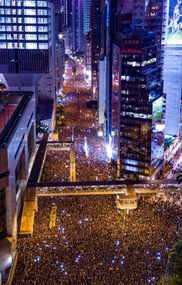
Photograph - Colour, Jarrod Watt, Street Protests in Hong Kong against proposed extradition laws, 2019, 17/06/2019
... properties in the city – as well as the government’s “patriotic education” drive, and the large numbers of mainland tourists who flock to Hong Kong. Many Hong Kongers are also concerned about China’s growing control over the city’s news media, as they increasingly self-censor and follow Beijing’s tacit orders. https://www.theguardian.com/world/2019/jun/10/what-are-the-hong-kong-protests-about-explainer carrie lam hong kong protests extraditions protest protestors admiralty Photograph of a crowd on the streets of Hong Kong to protest against proposed extradition laws, heading towards Admiralty. ...Carrie Lam, Hong Kong’s chief executive, had plenty of political support in the territory’s pro-Beijing legislature to pass a bill that would allow extraditions to mainland China. The legislators were set to begin discussing the bill in early June, and intended to vote on it just weeks later. A series of protests took place, and after a June 16 protest saw the largest turnout yet, Ms. Lam made a major concession: She postponed the bill, at least temporarily. It was an undeniable victory for the protesters — but it did little to quell the unrest. Since the bill could later be reintroduced, protesters felt they remained in danger. The police tactics to break up the demonstrations on June 12, including the use of more than 150 tear gas canisters to push protesters far away from the government office, created a new set of demands from the protesters. Now, instead of just calling for the withdrawal of the bill and Ms. Lam’s resignation, they said they wouldn’t be content unless there was an independent investigation of officers’ conduct. They also wanted the release of protesters arrested on June 12, and for the government to rescind its description of the demonstrations as a “riot,” a designation that carries legal significance. None of that has happened. Many analysts say Ms. Lam is unlikely to step down, nor would Beijing accept her resignation if she offered it. She has more wiggle room on the other demands, but has not indicated any willingness to budge. The Hong Kong Protests are a leaderless, digital movement.There is no single leader or group deciding on or steering the strategy, tactics and goals of the movement. Instead, protesters have used forums and messaging apps to decide next steps. Anyone can suggest a course of action, and others then vote on whether they support it. The most popular ideas rise to the top, and then people rally to make them happen. At its best, this structure has empowered many people to participate and have their voices heard. Protesters say it keeps them all safe by not allowing the government to target specific leaders. Their success in halting the extradition bill, which was shelved by the territory’s chief executive, speaks to the movement’s power. Despite the lack of a clear leader, protesters have shown extensive coordination at the demonstrations, having planned the specifics online beforehand. Supply stations are set up to distribute water, snacks, gloves, umbrellas and shields made of cardboard. Volunteer first aid workers wear brightly colored vests. People form assembly lines to pass supplies across long distances, with protesters communicating what they need through a series of predetermined hand signals. Anyone walking in dangerous areas without a helmet or a mask is quickly offered one. No individual can speak on behalf of the protesters, which makes negotiations difficult, if not impossible. (https://www.nytimes.com/2019/07/02/world/asia/hong-kong-protest-explained.html, accessed 07/07/2019) Hong Kong’s amended extradition law would allow the extradition of suspects to mainland China for the first time. Supporters say the amendments are key to ensuring the city does not become a criminal refuge, but critics worry Beijing will use the law to extradite political opponents and others to China where their legal protections cannot be guaranteed. The government claims the push to change the law, which would also apply to Taiwan and Macau, stems from the killing last year of a Hong Kong woman while she was in Taiwan with her boyfriend. Authorities in Taiwan suspect the woman’s boyfriend, who remains in Hong Kong, but cannot try him because no extradition agreement is in place. Under the amended law, those accused of offences punishable by seven years or more in prison could be extradited. The new legislation would give Hong Kong’s leader, known as the chief executive, authority to approve extradition requests, after review by the courts. Hong Kong’s legislature, the legislative council, would not have any oversight over the extradition process. Many Hong Kongers fear the proposed extradition law will be used by authorities to target political enemies. They worry the new legislation spells the end of the “one country, two systems” policy, eroding the civil rights enjoyed by Hong Kong residents since the handover of sovereignty from the UK to China in 1997. Many attending the protests on Sunday said they could not trust China as it had often used non-political crimes to target government critics, and said they also feared Hong Kong officials would not be able to reject Beijing’s requests. Legal professionals have also expressed concern over the rights of those sent across the border to be tried. The conviction rate in Chinese courts is as high as 99%. Arbitrary detentions, torture and denial of legal representation of one’s choosing are also common. Many in the protests on Sunday 09 June 2019 said they felt overwhelmed by a sense of helplessness in the face of mainland China’s increasing political, economic and cultural influence in Hong Kong. Hong Kong’s top political leader is not elected by ordinary voters but by a 1,200-strong election committee accountable to Beijing. Half of its legislature are chosen through indirect electoral systems that favour pro-Beijing figures. Many Hong Kongers also cited the jailing of leaders and activists from the 2014 Occupy Central movement– a 79-day mass civil disobedience movement – as well as the disqualification of young localist lawmakers as signs of the erosion of civil freedoms. Resentment towards China has been intensified by soaring property prices – with increasing numbers of mainland Chinese buying properties in the city – as well as the government’s “patriotic education” drive, and the large numbers of mainland tourists who flock to Hong Kong. Many Hong Kongers are also concerned about China’s growing control over the city’s news media, as they increasingly self-censor and follow Beijing’s tacit orders. https://www.theguardian.com/world/2019/jun/10/what-are-the-hong-kong-protests-about-explainerPhotograph of a crowd on the streets of Hong Kong to protest against proposed extradition laws, heading towards Admiralty. carrie lam, hong kong protests, extraditions, protest, protestors, admiralty -
 Federation University Historical Collection
Photograph - Colour Photograph, Street Protests in Hong Kong against proposed extradition laws, 2019, 17/06/2019
... properties in the city – as well as the government’s “patriotic education” drive, and the large numbers of mainland tourists who flock to Hong Kong. Many Hong Kongers are also concerned about China’s growing control over the city’s news media, as they increasingly self-censor and follow Beijing’s tacit orders. https://www.theguardian.com/world/2019/jun/10/what-are-the-hong-kong-protests-about-explainer carrie lam hong kong protests extraditions protest protestors admiralty Crowds mass on Queens Way in Hong Kong as an estimated 2 million people march in protest at the government's refusal to withdraw a controverisal law allowing people to be extradited to mainland China. ...Carrie Lam, Hong Kong’s chief executive, had plenty of political support in the territory’s pro-Beijing legislature to pass a bill that would allow extraditions to mainland China. The legislators were set to begin discussing the bill in early June, and intended to vote on it just weeks later. A series of protests took place, and after a June 16 protest saw the largest turnout yet, Ms. Lam made a major concession: She postponed the bill, at least temporarily. It was an undeniable victory for the protesters — but it did little to quell the unrest. Since the bill could later be reintroduced, protesters felt they remained in danger. The police tactics to break up the demonstrations on June 12, including the use of more than 150 tear gas canisters to push protesters far away from the government office, created a new set of demands from the protesters. Now, instead of just calling for the withdrawal of the bill and Ms. Lam’s resignation, they said they wouldn’t be content unless there was an independent investigation of officers’ conduct. They also wanted the release of protesters arrested on June 12, and for the government to rescind its description of the demonstrations as a “riot,” a designation that carries legal significance. None of that has happened. Many analysts say Ms. Lam is unlikely to step down, nor would Beijing accept her resignation if she offered it. She has more wiggle room on the other demands, but has not indicated any willingness to budge. The Hong Kong Protests are a leaderless, digital movement.There is no single leader or group deciding on or steering the strategy, tactics and goals of the movement. Instead, protesters have used forums and messaging apps to decide next steps. Anyone can suggest a course of action, and others then vote on whether they support it. The most popular ideas rise to the top, and then people rally to make them happen. At its best, this structure has empowered many people to participate and have their voices heard. Protesters say it keeps them all safe by not allowing the government to target specific leaders. Their success in halting the extradition bill, which was shelved by the territory’s chief executive, speaks to the movement’s power. Despite the lack of a clear leader, protesters have shown extensive coordination at the demonstrations, having planned the specifics online beforehand. Supply stations are set up to distribute water, snacks, gloves, umbrellas and shields made of cardboard. Volunteer first aid workers wear brightly colored vests. People form assembly lines to pass supplies across long distances, with protesters communicating what they need through a series of predetermined hand signals. Anyone walking in dangerous areas without a helmet or a mask is quickly offered one. No individual can speak on behalf of the protesters, which makes negotiations difficult, if not impossible. (https://www.nytimes.com/2019/07/02/world/asia/hong-kong-protest-explained.html, accessed 07/07/2019) Hong Kong’s amended extradition law would allow the extradition of suspects to mainland China for the first time. Supporters say the amendments are key to ensuring the city does not become a criminal refuge, but critics worry Beijing will use the law to extradite political opponents and others to China where their legal protections cannot be guaranteed. The government claims the push to change the law, which would also apply to Taiwan and Macau, stems from the killing last year of a Hong Kong woman while she was in Taiwan with her boyfriend. Authorities in Taiwan suspect the woman’s boyfriend, who remains in Hong Kong, but cannot try him because no extradition agreement is in place. Under the amended law, those accused of offences punishable by seven years or more in prison could be extradited. The new legislation would give Hong Kong’s leader, known as the chief executive, authority to approve extradition requests, after review by the courts. Hong Kong’s legislature, the legislative council, would not have any oversight over the extradition process. Many Hong Kongers fear the proposed extradition law will be used by authorities to target political enemies. They worry the new legislation spells the end of the “one country, two systems” policy, eroding the civil rights enjoyed by Hong Kong residents since the handover of sovereignty from the UK to China in 1997. Many attending the protests on Sunday said they could not trust China as it had often used non-political crimes to target government critics, and said they also feared Hong Kong officials would not be able to reject Beijing’s requests. Legal professionals have also expressed concern over the rights of those sent across the border to be tried. The conviction rate in Chinese courts is as high as 99%. Arbitrary detentions, torture and denial of legal representation of one’s choosing are also common. Many in the protests on Sunday 09 June 2019 said they felt overwhelmed by a sense of helplessness in the face of mainland China’s increasing political, economic and cultural influence in Hong Kong. Hong Kong’s top political leader is not elected by ordinary voters but by a 1,200-strong election committee accountable to Beijing. Half of its legislature are chosen through indirect electoral systems that favour pro-Beijing figures. Many Hong Kongers also cited the jailing of leaders and activists from the 2014 Occupy Central movement– a 79-day mass civil disobedience movement – as well as the disqualification of young localist lawmakers as signs of the erosion of civil freedoms. Resentment towards China has been intensified by soaring property prices – with increasing numbers of mainland Chinese buying properties in the city – as well as the government’s “patriotic education” drive, and the large numbers of mainland tourists who flock to Hong Kong. Many Hong Kongers are also concerned about China’s growing control over the city’s news media, as they increasingly self-censor and follow Beijing’s tacit orders. https://www.theguardian.com/world/2019/jun/10/what-are-the-hong-kong-protests-about-explainerCrowds mass on Queens Way in Hong Kong as an estimated 2 million people march in protest at the government's refusal to withdraw a controverisal law allowing people to be extradited to mainland China. Chants demanded the chief executive apologise and the legislation be withdrawn, while many held signs protesting police violence. Nearly 2 million protesters flooded the streets of Hong Kong on Sunday, organisers claimed, delivering a stunning repudiation of Chief Executive Carrie Lam Cheng Yuet-ngor’s governance and forcing a public apology out of the city’s leader over her campaign to bulldoze a controversial extradition bill through the legislature. A day after Lam suspended her push for the bill, expecting it to defuse a crisis that has seen violent clashes between mostly young protesters and police, the centre of Hong Kong was brought to a complete standstill as the masses marched to chastise her for refusing to withdraw the bill or apologise when first asked to, and declaring that nothing short of her resignation would satisfy them now. (https://www.scmp.com/news/hong-kong/politics/article/3014737/nearly-2-million-people-take-streets-forcing-public-apology ) carrie lam, hong kong protests, extraditions, protest, protestors, admiralty -
Federation University Historical Collection
Photograph - Photograph - Sepia Postcard, Henry Smerdon Holmes, c 1915
... In 1938 Harry and Edith purchased a property at Derrinallum, Victoria and called it 'Launchley Park' on their first son's return from World War 2. In 1953 Harry purchased William and Charlotte's portion of 'Sauchieburn' for his son, Bill, and daughter-in-law Margaret. ...In 1938 Harry and Edith purchased a property at Derrinallum, Victoria and called it 'Launchley Park' on their first son's return from World War 2. In 1953 Harry purchased William and Charlotte's portion of 'Sauchieburn' for his son, Bill, and daughter-in-law Margaret. ...HENRY SMERDON (Harry) HOLMES was born in 1897 at the family property, ’Sauchieburn’, 17 km north of Ballarat, in the Ascot district. He was the youngest of four children. After finishing his education at St Patrick’s College, Ballarat, Henry joined the Holmes family farming interests. At the age of 18 he enlisted and served with AIF in Egypt, France and Belgium 1915-1918. Henry served at the famous battlegrounds of Ypes and Somme in the Australian Army 8th Battalion. He was a Driver with the 4th D.A.C. According to his Soldier's Pay Books (Cat. No. 20112) Holmes Registration number was 7983. He was Catholic and enlisted in the Third Military District on 17 September 1915, and embarked on 8 November 1915. Holmes was in the 18th AASC Unit with the rank of Driver at that time. On 15 November 1918 Holmes was promoted to Lance Corporal. He received leave on: * 3 August 1917 - London (10 days) * 19 February 1918 - Paris (10 days) * 27 August 1918 - London (14 days) In 1922 Harry married Edith Pickford of 'Yeovil', Clunes, and they lived at 'Sauchieburn' with Henry's brother Willie. In 1933 Harry and Edith built a new timber home 'Launchley' (Ascot) on the rise east of 'Sauchieburn' on the Ballarat - Maryborough Road. The home was built by Con Zilles to the designs of Clegg and morrow. In 1938 Harry and Edith purchased a property at Derrinallum, Victoria and called it 'Launchley Park' on their first son's return from World War 2. In 1953 Harry purchased William and Charlotte's portion of 'Sauchieburn' for his son, Bill, and daughter-in-law Margaret. (Unpublished notes by Jane Dyer)Black and white photograph of an Australian World War One in uniform and standing in front of a tent in a studio. The soldier is Henry S. Holmes.Verso in pen "The boys say this isn't to (sic) bad so it will show you any changes. Heaps of love to all. Harrychatham, chatham family collection, holmes, harry holmes, henry holmes, smerdon, world war, world war 1, world war i, world war one., tent, recruitment camp, studion photograph -
 Marysville & District Historical Society
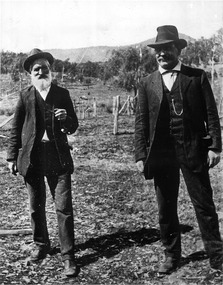
Photograph (item) - Black and white photograph, Unknown
... law William Lawlor. The Gorman's owned over 600 acres north of Acheron, the home property being 'Hillside'. ...law William Lawlor. The Gorman's owned over 600 acres north of Acheron, the home property being 'Hillside'. ...A copy of a black and white photograph of John James Gorman and his father-in-law William Lawlor. The Gorman's owned over 600 acres north of Acheron, the home property being 'Hillside'. The eldest son married William Lawlor's (Buxton) eldest daughter.A copy of a black and white photograph of John James Gorman and his father-in-law William Lawlor.acheron, buxton, victoria, australia, gorman family, john hall gorman, mary gorman, mary wood, john james gorman, photograph -
 Flagstaff Hill Maritime Museum and Village
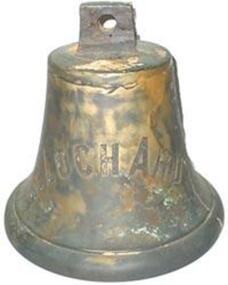
Equipment - Ship's Bell, Loch Ard
... property in 1887. In 1942, the Princetown A.R.P. (Air Raid Precautions, part of the World War 2 Air Raid Warden Service) and Observation group accepted the offer of the Loch Ard Bell from Mrs R.E. McArthur of Glenample homestead, for sounding an air raid alarm. Mrs McArthur was the daughter-in-law...property in 1887. In 1942, the Princetown A.R.P. (Air Raid Precautions, part of the World War 2 Air Raid Warden Service) and Observation group accepted the offer of the Loch Ard Bell from Mrs R.E. McArthur of Glenample homestead, for sounding an air raid alarm. Mrs McArthur was the daughter-in-law ...This Loch Ard ship's bell was kindly loaned by Heritage Victoria. The Loch Ard was an 85-metre, three-masted square-rigged iron clipper that sank in bad weather after hitting Mutton Bird Island, near Port Campbell, on June 1, 1878, just days after completing its three-month journey from Britain. Loch Ard carried some of the finest items that 19th-century Europe had to offer, intended for display at Melbourne’s International Exhibition in 1880. Before the modern age, a ship’s bell was one of the most important functional objects on a ship, used to regulate the daily routine of life, sound the time, and to signal watches and emergencies to everyone on board. The Loch Ard Bell is made of lead, bronze and copper alloy, and weighs 33 kg. It is missing its clapper. The bell disappeared after being recovered from the wreck in the 1960s, and reappeared in November 2003 when it was soon returned to Heritage Victoria staff. Ship bells are used for time-keeping, with codes to signify every half-hour and the fourth hour, to mark the time to change the watch or shift. They are also used in emergencies, to warn of fire and other danger, and to alert nearby vessels of their presence, especially in poor weather. Ship bells are usually cast or engraved with the ship’s name and often its launch date. If time allowed during an imminent disaster, seamen would save the ship’s bell, but if the ship sank, its bell would be searched for by those who discovered the wreck, as proof of the ship’s identification. Some ships, such as the famous luxury sailing ship Schomberg, had two bells: the main deck bell and a small bell used in the pilot house. The location of another bell from the Loch Ard is currently unknown. Sometime after the initial salvaging of the wreckage of the Loch Ard, a ship's bell for the Loch Ard was washed up. It was used for several years to summon men to meals at Glenample homestead, where part-owner Hugh Gibson and his family had previously sheltered the Loch Ard survivors, Tom Pearce and Eva Carmichael, as they recovered. Gibson's business partner, Peter McArthur, purchased Gibson's share of the property in 1887. In 1942, the Princetown A.R.P. (Air Raid Precautions, part of the World War 2 Air Raid Warden Service) and Observation group accepted the offer of the Loch Ard Bell from Mrs R.E. McArthur of Glenample homestead, for sounding an air raid alarm. Mrs McArthur was the daughter-in-law of Peter McArthur, and the mother of Colin McArthur, who had then inherited Glenample. Since then, the bell's whereabouts is unclear.Ship's bell: a cast bell of metal alloy - lead, bronze and copper. It has a square flat head with a central hole, a flat head, a band at the shoulder and waist, and a rounded sound bow. It no longer has its clapper. The surface is uneven and discoloured, and a vertical split has been mended at some stage. This ship's name has been cast into the bell's body. The bell was recovered from the wreck of the sailing ship Loch Ard in 1967, and is on loan from Heritage Victoria. "LOCH ARD"flagstaff hill maritime museum and village, great ocean road, shipwreck coast, flagstaff hill, warrnambool, maritime museum, loch ard, loch ard gorge, victorian heritage register, ship bell, ship's bell, loch ard bell, marine equipment, signal, alarm, marinter's watch, shipwreck artefact, shipwreck discovery -
 Flagstaff Hill Maritime Museum and Village
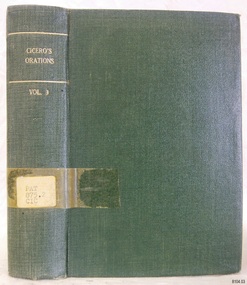
Book - Ancient Political Speeches/Reference, Henry George Bohn, The Orations of Marcus Tullius Cicero Vol 3, 1852
... It gives readers an unparalleled look at the inner workings of Roman property law, religious courts, and criminal defense strategies. ...The Orations of Marcus Tullius Cicero, Vol. 3 contains some of the most dramatic political speeches in ancient history. Volume 3 of this 1852 edition pivots away from the sweeping state conspiracies found in other volumes and focuses intensely on Cicero's personal political survival and highly dramatic legal defense trials. To understand its contents, you have to look at Cicero's life right before these speeches were given. In 58 BC, Cicero’s bitter enemy, Clodius, passed a law that forced Cicero into exile and destroyed his homes. A year later, Cicero was triumphantly recalled to Rome. Volume 3 is entirely made up of the legal battles and political speeches that followed his return as he fought to reclaim his property, protect his allies, and attack his enemies. If Volume 4 is about Cicero trying to save the dying Roman Republic from Mark Antony, Volume 3 is about Cicero saving his own skin, rebuilding his career, and fighting the corrupt gang politics of 1st-century BC Rome.The Orations of Marcus Tullius Cicero Vol 3 Author: C D Yonge Publisher: Henry G Bohn Date: 1852 Green cloth hard cover with Library label, title & Vol number on spine in gold letteringnon-fictionThe Orations of Marcus Tullius Cicero, Vol. 3 contains some of the most dramatic political speeches in ancient history. Volume 3 of this 1852 edition pivots away from the sweeping state conspiracies found in other volumes and focuses intensely on Cicero's personal political survival and highly dramatic legal defense trials. To understand its contents, you have to look at Cicero's life right before these speeches were given. In 58 BC, Cicero’s bitter enemy, Clodius, passed a law that forced Cicero into exile and destroyed his homes. A year later, Cicero was triumphantly recalled to Rome. Volume 3 is entirely made up of the legal battles and political speeches that followed his return as he fought to reclaim his property, protect his allies, and attack his enemies. If Volume 4 is about Cicero trying to save the dying Roman Republic from Mark Antony, Volume 3 is about Cicero saving his own skin, rebuilding his career, and fighting the corrupt gang politics of 1st-century BC Rome.warrnambool, shipwrecked-coast, flagstaff-hill, flagstaff-hill-maritime-museum, maritime-museum, flagstaff-hill-maritime-village, shipwrecked-artefact, book, a life, guy de maupassant, warrnambool mechanics’ institute, pattison collection, warrnambool library, corangamite regional library service, warrnambool city librarian, mechanics’ institute library, victorian library board, warrnambool books and records, warrnambool children’s library, ralph eric pattison, marcus tullius cicero, c.d. yonge, bohn's classical library, english translations -
 Flagstaff Hill Maritime Museum and Village
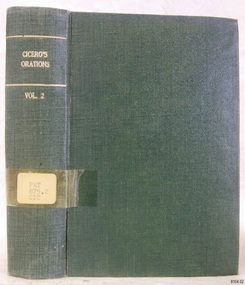
Book - Ancient Political Speeches/Reference, Henry George Bohn, The Orations of Marcus Tullius Cicero Vol 2, 1852
... It gives readers an unparalleled look at the inner workings of Roman property law, religious courts, and criminal defense strategies. ...Volume 2 of the 1852 Henry G. Bohn edition is arguably the most famous and politically explosive volume in the entire four-part series. While Volume 3 handles his personal survival and Volume 4 addresses his final stand against Mark Antony, Volume 2 captures Cicero at the absolute absolute peak of his political power. This volume contains the speeches from his consulship (the highest office in Rome) in 63 BC, where he single handedly uncovered and dismantled a bloody coup designed to burn down the city of Rome. This volume allows the reader to see Cicero when he was the undisputed "Father of the Fatherland" (Pater Patriae), in this is the volume. It showcases him navigating political bribery, fighting for the cultural value of the arts, and ultimately crushing a domestic terrorist plot against the Roman state.The Orations of Marcus Tullius Cicero Vol 2 Author: C D Yonge Publisher: Henry G Bohn Date: 1852 Green cloth hard cover with Library label, title & Vol number on spine in gold letteringnon-fictionVolume 2 of the 1852 Henry G. Bohn edition is arguably the most famous and politically explosive volume in the entire four-part series. While Volume 3 handles his personal survival and Volume 4 addresses his final stand against Mark Antony, Volume 2 captures Cicero at the absolute absolute peak of his political power. This volume contains the speeches from his consulship (the highest office in Rome) in 63 BC, where he single handedly uncovered and dismantled a bloody coup designed to burn down the city of Rome. This volume allows the reader to see Cicero when he was the undisputed "Father of the Fatherland" (Pater Patriae), in this is the volume. It showcases him navigating political bribery, fighting for the cultural value of the arts, and ultimately crushing a domestic terrorist plot against the Roman state.warrnambool, shipwrecked-coast, flagstaff-hill, flagstaff-hill-maritime-museum, maritime-museum, flagstaff-hill-maritime-village, shipwrecked-artefact, book, a life, guy de maupassant, warrnambool mechanics’ institute, pattison collection, warrnambool library, corangamite regional library service, warrnambool city librarian, mechanics’ institute library, victorian library board, warrnambool books and records, warrnambool children’s library, ralph eric pattison, marcus tullius cicero, c.d. yonge, bohn's classical library, english translations -
 Flagstaff Hill Maritime Museum and Village
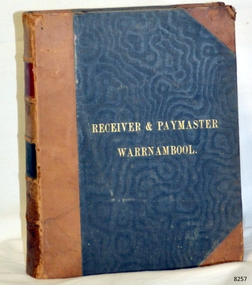
Book - Reference/Legal Statutes, John Ferres, Government Printer, The Victorian Legal Statutes Vol 3, Receiver Paymaster/Warrnambool, 1866
... laws that built day-to-day society in 19th-century Victoria. These include: · Police Offences and Public Order: The legal frameworks for policing the goldfield boomtowns, managing public behaviour, and running early colonial prisons. · Public Works and Infrastructure: The acts authorising the construction of roads, bridges, and early municipal water supplies across the fast-growing colony. · Railways: The specific general legislation governing the expansion of Victoria's heavily subsidised, state-expanding railway networks. · Property and Land Transfer: Crucial laws managing land ownership, inheritance, and the foundational transfers of property as the colony shifted away from old squatter runs to permanent towns. · Wines, Beer, and Spirits: The colonial acts regulating the licensing of hotels and public houses, and managing the highly lucrative, tightly controlled alcohol trade. ...This volume is part of the first comprehensive consolidation of laws for the Colony of Victoria after it separated from New South Wales and established its own parliament. Specifically, Volume 3 is the final part of the core "Public and General" Victorian colonial laws. The first three volumes of the 1866 consolidation were organised alphabetically by legal topic. Volume 3 specifically contains all the major public acts running from P to W. Because it covers the tail end of the alphabet, it holds some of the most critical laws that built day-to-day society in 19th-century Victoria. These include: · Police Offences and Public Order: The legal frameworks for policing the goldfield boomtowns, managing public behaviour, and running early colonial prisons. · Public Works and Infrastructure: The acts authorising the construction of roads, bridges, and early municipal water supplies across the fast-growing colony. · Railways: The specific general legislation governing the expansion of Victoria's heavily subsidised, state-expanding railway networks. · Property and Land Transfer: Crucial laws managing land ownership, inheritance, and the foundational transfers of property as the colony shifted away from old squatter runs to permanent towns. · Wines, Beer, and Spirits: The colonial acts regulating the licensing of hotels and public houses, and managing the highly lucrative, tightly controlled alcohol trade.The Victorian Statutes Vol 3 Various Legal Statues /Warrnambool Publisher: John Ferres Government Printer Melbourne Date: 1866 Further Information: Three quarter leather. Corners worn lettering in gilt. non-fictionThis volume is part of the first comprehensive consolidation of laws for the Colony of Victoria after it separated from New South Wales and established its own parliament. Specifically, Volume 3 is the final part of the core "Public and General" Victorian colonial laws. The first three volumes of the 1866 consolidation were organised alphabetically by legal topic. Volume 3 specifically contains all the major public acts running from P to W. Because it covers the tail end of the alphabet, it holds some of the most critical laws that built day-to-day society in 19th-century Victoria. These include: · Police Offences and Public Order: The legal frameworks for policing the goldfield boomtowns, managing public behaviour, and running early colonial prisons. · Public Works and Infrastructure: The acts authorising the construction of roads, bridges, and early municipal water supplies across the fast-growing colony. · Railways: The specific general legislation governing the expansion of Victoria's heavily subsidised, state-expanding railway networks. · Property and Land Transfer: Crucial laws managing land ownership, inheritance, and the foundational transfers of property as the colony shifted away from old squatter runs to permanent towns. · Wines, Beer, and Spirits: The colonial acts regulating the licensing of hotels and public houses, and managing the highly lucrative, tightly controlled alcohol trade.flagstaff hill, warrnambool, shipwrecked coast, flagstaff hill maritime museum, maritime museum, shipwreck coast, flagstaff hill maritime village, great ocean road, book, pattison collection, warrnambool library, warrnambool mechanics’ institute, ralph eric pattison, corangamite regional library service, warrnambool city librarian, mechanics’ institute library, victorian library board, warrnambool books and records, warrnambool children’s library -
 City of Moorabbin Historical Society (Operating the Box Cottage Museum)
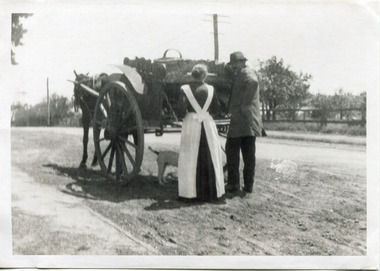
Photograph - Photograph, Black & White Mrs J.L.Smith & Butcher, 1915
... J.L.Smith at first rented a cottage 'Law Muir Den' & Shed from Mr Box and commenced business as a wood merchant - sawing logs into shorter pieces using one horse to power the saw. He purchased the property...J.L.Smith at first rented a cottage 'Law Muir Den' & Shed from Mr Box and commenced business as a wood merchant - sawing logs into shorter pieces using one horse to power the saw. He purchased the property ...The Butcher Mr Bill Ellin delivering meat to Mrs J.L.Smith in front of the house Law Muir Den 510 Centre Rd Bentleigh c 1915. Groceries, Ice, Milk, Bread, Eggs, Poultry were delivered to housewives by the traders in horse drawn carts, Also Hawkers and Pedlars plied their wares by visiting the cottages. John Logan Smith 1860-1932 , the son of Irish immigrants James and Marianne Smith was born at their home near the 'Toll Gates' on Point Nepean Road and Dendy Street. East Brighton. At that time the area had many orchards that were later replaced by market gardens. J.L.Smith at first rented a cottage 'Law Muir Den' & Shed from Mr Box and commenced business as a wood merchant - sawing logs into shorter pieces using one horse to power the saw. He purchased the property, added to the buildings , began trading in fuel and fodder as well and installed a chaff cutting mill powered by 10hp steam engine. The business prospered 1909 following the death of Tommy Bent, J/L Smith was nominated for Councillor of the Shire of Moorabbin. WW1 1914 - 18 both John and Mary Ann supported local War Relief Auxiliaries and their son Vic served as a Signaler in AIF. As Motor transport was increasing 1926 J L Smith built a small Garage on the opposite corner (Woolworths Supermarket 2005) , employed a good mechanic ( Reg Hunt ) and developed another successful business. The Grain Store was managed by family until 1930. In 1932 JL Smith assisted a man whose car had broken down, pushing it to the garage and sadly suffered a heart attack and died. He is buried in Cheltenham Cemetery. J.L.Smith was an early settler in East Brighton now Bentleigh and established successful Wood cutting, Grain & Chaff cutting and Motor garage businesses in Centre Road . He was elected Councillor of the Shire of Moorabbin and, with Mary Ann, his family were involved with local Church, Red Cross, and other community organizations.A Black and white photograph c 1915 showing the Butcher delivering meat to Mrs J.L Smith Bentleighsmith j l, smith mary ann, stanley helen, smith vic, smith harry redvers, chaff cutter, horse drawn carts, toll gates brighton, motor cars 1900, steam engines, early settlers, bentleigh, parish of moorabbin, city of moorabbin, county of bourke, moorabbin roads board, shire of moorabbin, henry dendy's special survey 1841, bent thomas, charman s, highett william, ormond francis, market gardeners, vineyards, orchards, william ellin, butcher -
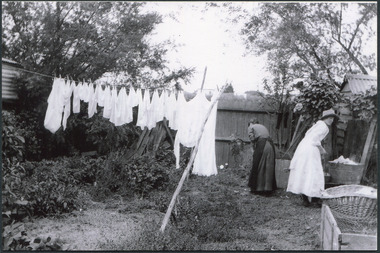 City of Moorabbin Historical Society (Operating the Box Cottage Museum)
Photograph - Washing Day at 'Law Muir Den' Mrs J L Smith c1910, c1910
... Mary Ann Smith was married John Logan Smith 1860-1932 who at first rented a cottage 'Law Muir Den' & Shed from Mr Box and commenced business as a wood merchant - sawing logs into shorter pieces using one horse to power the saw. He purchased the property...Mary Ann Smith was married John Logan Smith 1860-1932 who at first rented a cottage 'Law Muir Den' & Shed from Mr Box and commenced business as a wood merchant - sawing logs into shorter pieces using one horse to power the saw. He purchased the property ...Mrs J.L.Smith and Ada Smith in the backyard of the house Law Muir Den 510 Centre Rd Bentleigh c 1910. . The early settler women usually devoted a whole day to washing as it was very labourious. A fire was lit in a stone pit and a large tub of water boiled. Soap that had been made, usually in the previous Autumn, from fat drippings and caustic soda, was flaked into the tub to form suds. The clothes were moved around in the tub with a long wooden paddle that was also used to lift the clothes out of the tub into another tub of cold rinsing water..Stains were removed by scrubbing soap on the cloth against a scrubbing board. Clothes were wrung by hand or a mechanical wringer and hung on the clothes line to dry. Mary Ann Smith was married John Logan Smith 1860-1932 who at first rented a cottage 'Law Muir Den' & Shed from Mr Box and commenced business as a wood merchant - sawing logs into shorter pieces using one horse to power the saw. He purchased the property, added to the buildings , began trading in fuel and fodder as well and installed a chaff cutting mill powered by 10hp steam engine. The business prospered As Motor transport was increasing 1926 J L Smith built a small Garage on the opposite corner (Woolworths Supermarket 2005) , employed a good mechanic ( Reg Hunt ) and developed another successful business. J.L.Smith was an early settler in East Brighton now Bentleigh and established successful Wood cutting, Grain & Chaff cutting and Motor garage businesses in Centre Road . He was elected Councillor of the Shire of Moorabbin and, with Mary Ann, his family were involved with local Church, Red Cross, and other community organizations.Photograph, Black & White, showing 2 women washing clothes in a large tub, set over a fire in a stone pit, in the back yard. Clothes are hanging from a rope line strung between 2 trees and held up with a wooden 'prop' -
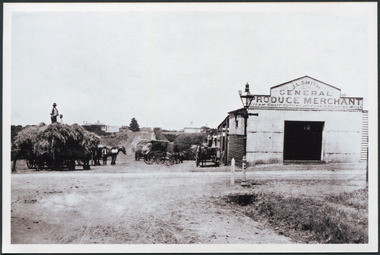 City of Moorabbin Historical Society (Operating the Box Cottage Museum)
Photograph, Black & White J. L. Smith Hay & Grain Store Bentleigh c1910, c1910
... J.L.Smith at first rented a cottage 'Law Muir Den' & Shed from Mr Box and commenced business as a wood merchant - sawing logs into shorter pieces using one horse to power the saw. He purchased the property...J.L.Smith at first rented a cottage 'Law Muir Den' & Shed from Mr Box and commenced business as a wood merchant - sawing logs into shorter pieces using one horse to power the saw. He purchased the property ...John Logan Smith 1860-1932 , the son of Irish immigrants James and Marianne Smith was born at their home near the 'Toll Gates' on Point Nepean Road and Dendy Street. East Brighton. At that time the area had many orchards that were later replaced by market gardens. J.L.Smith at first rented a cottage 'Law Muir Den' & Shed from Mr Box and commenced business as a wood merchant - sawing logs into shorter pieces using one horse to power the saw. He purchased the property, added to the buildings , began trading in fuel and fodder as well and installed a chaff cutting mill powered by 10hp steam engine. The business prospered 1909 following the death of Tommy Bent, J/L Smith was nominated for Councillor of the Shire of Moorabbin. WW1 1914 - 18 both John and Mary Ann supported local War Relief Auxiliaries and their son Vic served as a Signaler in AIF. As Motor transport was increasing 1926 J L Smith built a small Garage on the opposite corner (Woolworths Supermarket 2005) , employed a good mechanic ( Reg Hunt ) and developed another successful business. The Grain Store was managed by family until 1930. In 1932 JL Smith assisted a man whose car had broken down, pushing it to the garage and sadly suffered a heart attack and died. He is buried in Cheltenham Cemetery. J.L.Smith was an early settler in East Brighton now Bentleigh and established successful Wood cutting, Grain & Chaff cutting and Motor garage businesses in Centre Road . He was elected Councillor of the Shire of Moorabbin and, with Mary Ann, his family were involved with local Church, Red Cross, and other community organizations.Black & white photograph of the Hay & Grain Store of John Logan Smith 1860-1932 on the corner of Jasper Rd and Centre Rd Bentleigh ( East Brighton) c1910. A Horse drawn cart loaded with hay and another outside the first building used by J L Smith -
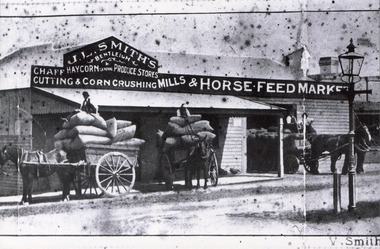 City of Moorabbin Historical Society (Operating the Box Cottage Museum)
Photograph, Black & White, J.L.Smith Hay & Grain Store c1916 Bentleigh, 1916
... J.L.Smith at first rented a cottage 'Law Muir Den' & Shed from Mr Box and commenced business as a wood merchant - sawing logs into shorter pieces using one horse to power the saw. He purchased the property...J.L.Smith at first rented a cottage 'Law Muir Den' & Shed from Mr Box and commenced business as a wood merchant - sawing logs into shorter pieces using one horse to power the saw. He purchased the property ...John Logan Smith 1860-1932 , the son of Irish immigrants James and Marianne Smith was born at their home near the 'Toll Gates' on Point Nepean Road and Dendy Street. East Brighton. At that time the area had many orchards that were later replaced by market gardens. J.L.Smith at first rented a cottage 'Law Muir Den' & Shed from Mr Box and commenced business as a wood merchant - sawing logs into shorter pieces using one horse to power the saw. He purchased the property, added to the buildings , began trading in fuel and fodder as well and installed a chaff cutting mill powered by 10hp steam engine. The business prospered 1909 following the death of Tommy Bent, J/L Smith was nominated for Councillor of the Shire of Moorabbin. WW1 1914 - 18 both John and Mary Ann supported local War Relief Auxiliaries and their son Vic served as a Signaler in AIF. As Motor transport was increasing 1926 J L Smith built a small Garage on the opposite corner (Woolworths Supermarket 2005) , employed a good mechanic ( Reg Hunt ) and developed another successful business. The Grain Store was managed by family until 1930. In 1932 JL Smith assisted a man whose car had broken down, pushing it to the garage and sadly suffered a heart attack and died. He is buried in Cheltenham Cemetery J.L.Smith was an early settler in East Brighton now Bentleigh and established successful Wood cutting, Grain & Chaff cutting and Motor garage businesses in Centre Road . He was elected Councillor of the Shire of Moorabbin and, with Mary Ann, his family were involved with local Church, Red Cross, and other community organizations.Black & White photograph of J L Smith Hay & Grain Store and Crushing Mill Jasper Rd / Centre Rd Bentleigh 1916. A veranda has been added to the store, new signage attached and a Gas light and hitching post are in foreground. 3 Horse drawn carts loaded with grain bags and drivers sitting on top of loadV. Smithgas street light, hitching posts, smith vic, photography, smith j l; smith mary ann, stanley helen, smith vic, smith harry redvers, chaff cutter, horse drawn carts, toll gates brighton, motor cars 1900, steam engines, early settlers, bentleigh, parish of moorabbin, city of moorabbin, county of bourke, moorabbin roads board, shire of moorabbin, henry dendy's special survey 1841, were j.b.; bent thomas, o'shannassy john, king richard, charman s, highett william, ormond francis, maynard dennis, market gardeners, vineyards, orchards -
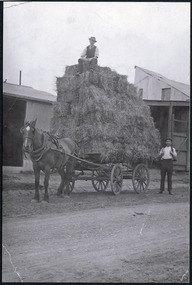 City of Moorabbin Historical Society (Operating the Box Cottage Museum)
Photographs, x 2 ,Black & White, F Smith Horse drawn cart loaded, Baled Straw, Grain, c1920
... J.L.Smith at first rented a cottage 'Law Muir Den' & Shed from Mr Box and commenced business as a wood merchant - sawing logs into shorter pieces using one horse to power the saw. He purchased the property...J.L.Smith at first rented a cottage 'Law Muir Den' & Shed from Mr Box and commenced business as a wood merchant - sawing logs into shorter pieces using one horse to power the saw. He purchased the property ...John Logan Smith 1860-1932 , the son of Irish immigrants James and Marianne Smith was born at their home near the 'Toll Gates' on Point Nepean Road and Dendy Street. East Brighton. At that time the area had many orchards that were later replaced by market gardens. J.L.Smith at first rented a cottage 'Law Muir Den' & Shed from Mr Box and commenced business as a wood merchant - sawing logs into shorter pieces using one horse to power the saw. He purchased the property, added to the buildings , began trading in fuel and fodder as well and installed a chaff cutting mill powered by 10hp steam engine. The business prospered 1909 following the death of Tommy Bent, J/L Smith was nominated for Councillor of the Shire of Moorabbin. WW1 1914 - 18 both John and Mary Ann supported local War Relief Auxiliaries and their son Vic served as a Signaler in AIF. As Motor transport was increasing 1926 J L Smith built a small Garage on the opposite corner (Woolworths Supermarket 2005) , employed a good mechanic ( Reg Hunt ) and developed another successful business. The Grain Store was managed by family until 1930. In 1932 J L Smith assisted a man whose car had broken down, pushing it to the garage and sadly suffered a heart attack and died. He is buried in Cheltenham Cemetery. J.L.Smith was an early settler in East Brighton now Bentleigh and established successful Wood cutting, Grain & Chaff cutting and Motor garage businesses in Centre Road . He was elected Councillor of the Shire of Moorabbin and, with Mary Ann, his family were involved with local Church, Red Cross, and other community organizations.2 x Black & White photographs showing horse drawn carts loaded with (a) Hay and (b) bags of grain outside J.L.Smith Grain & Chaff Store Centre Rd Bentleigh c1920smith frank, smith arch, smith tom, smith j l; smith mary ann, stanley helen, smith vic, smith harry redvers, chaff cutter, horse drawn carts, toll gates brighton, motor cars 1900, steam engines, early settlers, bentleigh, parish of moorabbin, city of moorabbin, county of bourke, moorabbin roads board, shire of moorabbin, henry dendy's special survey 1841, were j.b.; bent thomas, o'shannassy john, king richard, charman s, highett william, ormond francis, maynard dennis, market gardeners, vineyards, orchards -
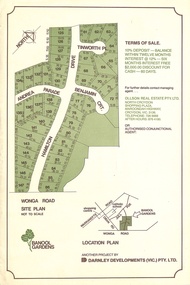 Ringwood and District Historical Society
Flyer, Land Sale Advertisement - Banool Gardens Subdivision, Ringwood, Vic. c.1985
... - "Part of original Banool property (Mahon, sold to Stallman, sold to McMahon, sold to Len Macley etc etc). Hamilton Drive named after Lynn Hamilton McMahon, Tinworth Place after his son-in-law, David Tinworth". .... - "Part of original Banool property (Mahon, sold to Stallman, sold to McMahon, sold to Len Macley etc etc). Hamilton Drive named after Lynn Hamilton McMahon, Tinworth Place after his son-in-law, David Tinworth". ...Double-sided advertisement for Banool Gardens subdivision with site plan, location plan, terms of sale, and summary of homesite features and local services & facilities. Subdivision includes Wonga Road, Hamilton Drive, Tinworth Place, Andrea Parade and Benjamin Court, Ringwood North. Managing agent - Ollson Real Estate Pty. Ltd., North Croydon Shopping Plaza, Maroondah Highway. Croydon, Vic. 3136. Telephone 726 9988 After Hours 876 4190. Project by Darnley Developments (Vic.) Pty. Ltd. Accompanying handwritten notation by Richard Carter R.E.S.I. - "Part of original Banool property (Mahon, sold to Stallman, sold to McMahon, sold to Len Macley etc etc). Hamilton Drive named after Lynn Hamilton McMahon, Tinworth Place after his son-in-law, David Tinworth".
