
Showing 39 items matching "psyche"
-
 Flagstaff Hill Maritime Museum and Village
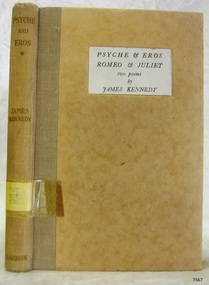
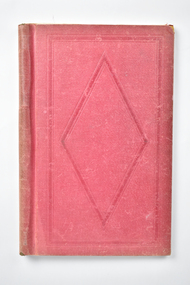
Book, Psyche & Eros Romeo & Juliet
... Psyche & Eros Romeo & Juliet...Psyche & Eros Romeo & Juliet two peoms Author: James Kennedy Publisher: Arthur Barron Date: 1935 ...His aim was to foster portraiture, as well as support artists, and perpetuate the memory of great Australians. warrnambool shipwrecked-coast flagstaff-hill flagstaff-hill-maritime-museum maritime-museum shipwreck-coast flagstaff-hill-maritime-village shipwrecked-artefact book warrnambool mechanics’ institute pattison collection warrnambool library ralph eric pattison warrnambool city librarian mechanics’ institute library victorian library board warrnambool books and records warrnambool children’s library psyche & eros romeo & juliet james kennedy Label on spine has typed text PAT 821 KEN Pastedown front endpaper has sticker from Warrnambool Public Library covered by a sticker from Corangamite Regional Library Service Front loose endpaper has a stamp from Corangamite Regional Library Service Psyche & Eros Romeo & Juliet two peoms Author: James Kennedy Publisher: Arthur Barron Date: 1935 Psyche & Eros Romeo & Juliet Book ...This item is from the ‘Pattison Collection’, a collection of books and records that was originally owned by the Warrnambool Mechanics’ Institute, which was founded in Warrnambool in 1853. By 1886 the Warrnambool Mechanics’ Institute (WMI) had grown to have a Library, Museum and Fine Arts Gallery, with a collection of “… choice productions of art, and valuable specimens in almost every branch and many wonderful national curiosities are now to be seen there, including historic relics of the town and district.” It later included a School of Design. Although it was very well patronised, the lack of financial support led the WMI in 1911 to ask the City Council to take it over. In 1935 Ralph Pattison was appointed as City Librarian to establish and organise the Warrnambool Library as it was then called. When the WMI building was pulled down in 1963 a new civic building was erected on the site and the new Warrnambool Library, on behalf of the City Council, took over all the holdings of the WMI. At this time some of the items were separated and identified as the ‘Pattison Collection’, named after Ralph Pattison. Eventually the components of the WMI were distributed from the Warrnambool Library to various places, including the Art Gallery, Historical Society and Flagstaff Hill. Later some were even distributed to other regional branches of Corangamite Regional Library and passed to and fro. It is difficult now to trace just where all of the items have ended up. The books at Flagstaff Hill Maritime Village generally display stamps and markings from Pattison as well as a variety of other institutions including the Mechanics’ Institute itself. RALPH ERIC PATTISON Ralph Eric Pattison was born in Rockhampton, Queensland, in 1891. He married Maude Swan from Warrnambool in 1920 and they set up home in Warrnambool. In 1935 Pattison accepted a position as City Librarian for the Warrnambool City Council. His huge challenge was to make a functional library within two rooms of the Mechanics’ Institute. He tirelessly cleaned, cleared and sorted a disarrayed collection of old books, jars of preserved specimens and other items reserved for exhibition in the city’s museum. He developed and updated the library with a wide variety of books for all tastes, including reference books for students; a difficult task to fulfil during the years following the Depression. He converted all of the lower area of the building into a library, reference room and reading room for members and the public. The books were sorted and stored using a cataloguing and card index system that he had developed himself. He also prepared the upper floor of the building and established the Art Gallery and later the Museum, a place to exhibit the many old relics that had been stored for years for this purpose. One of the treasures he found was a beautiful ancient clock, which he repaired, restored and enjoyed using in his office during the years of his service there. Ralph Pattison was described as “a meticulous gentleman whose punctuality, floorless courtesy and distinctive neat dress were hallmarks of his character, and ‘his’ clock controlled his daily routine, and his opening and closing of the library’s large heavy doors to the minute.” Pattison took leave during 1942 to 1942 to serve in the Royal Australian Navy, Volunteer Reserve as Lieutenant. A few years later he converted one of the Museum’s rooms into a Children’s Library, stocking it with suitable books for the younger generation. This was an instant success. In the 1950’s he had the honour of being appointed to the Victorian Library Board and received more inspiration from the monthly conferences in Melbourne. He was sadly retired in 1959 after over 23 years of service, due to the fact that he had gone over the working age of council officers. However he continued to take a very keen interest in the continual development of the Library until his death in 1969. WARRNAMBOOL PUBLIC LIBRARY The Warrnambool Mechanics’ Institute (WMI) was formed by a voluntary community group in 1863, within six years of Warrnambool’s beginnings, and its Reading Room opened in 1854. The WMI operated until 1963, at which time it was one of the oldest Mechanics’ Institutes in Victoria. Mechanics’ Institutes offered important services to the public including libraries, reading rooms and places to display and store collections of all sorts such as curiosities and local historical relics. In 1886 a Museum and Fine Arts Gallery were added to the WMI and by the beginning of the 20th century there was also a billiards room and a School of Art. By this time all Mechanics’ Institutes in country Victoria had museums attached. Over the years the Warrnambool Mechanics’ Institute Library was also known as the Warrnambool Public Library the Warrnambool Library and the Free Library. Early funding from the government was for the “Free Library”. The inscription in a book “Science of Man” was for the “Warrnambool Public Library”, donated by Joseph Archibald in 1899. Another inscription in the book “Catalogue of Plants Under Cultivation in the Melbourne Botanic Gardens 1 & 2, 1883” was presented to the “Warrnambool Library” and signed by the author W.R. Guilfoyle. In 1903 the Warrnambool Public Library decided to add a Juvenile Department to library and stock it with hundreds of books suitable for youth. In 1905 the Public Library committee decided to update the collection of books and added 100 new novels plus arrangements for the latest novels to be included as soon as they were available in Victoria. In July 1911 the Warrnambool Council took over the management of the Public Library, Art Gallery, Museum and Mechanics’ Institute and planned to double the size of the then-current building. In 1953, when Mr. R. Pattison was Public Librarian, the Warrnambool Public Library’s senior section 10,000 of the 13,000 books were fiction. The children’s section offered an additional 3,400 books. The library had the equivalent of one book per head of population and served around 33 percent of the reading population. The collection of books was made up of around 60 percent reference and 40 percent fiction. The library was lending 400 books per day. In 1963 the Warrnambool City Council allocated the site of the Mechanics’ Institute building, which included the Public Library, Museum and Art Gallery, for the new Municipal Offices and the Collections were dispersed until 1971. The Warrnambool Library took over the Mechanics’ Institute Library’s holdings on behalf of the Warrnambool City Council. Since the closure of the Warrnambool Mechanics’ Institute the exact location and composition of the original WMI books and items has become unclear. Other materials have been added to the collection, including items from Terang MI, Warrnambool Court House and Customs House. Many of the books have been identified as the Pattison Collection, named after the Librarian who catalogued and numbered the books during his time as Warrnambool Public Librarian in the time before the Mechanics’ Institute closed. It seems that when Warrnambool became part of the Corangamite Regional Library some of the books and materials went to its head office in Colac and then back to Warrnambool where they were stored at the Art Gallery for quite some time. Some then went to the Warrnambool Historical Society, some stayed at the Art Gallery and some were moved to Flagstaff Hill Maritime Village. The various stamps and labels on the books held at Flagstaff Hill show the variety of the collection’s distribution and origin. The books in the collection at Flagstaff Hill Maritime Village date from the 1850’s to the late 1950’s and include rare and valuable volumes. Many of the books are part of the “Pattison Collection” after the Warrnambool’s Public Librarian, Mr. R. Pattison The Pattison Collection, along with other items at Flagstaff Hill Maritime Village, was originally part of the Warrnambool Mechanics' Institute’s collection. The Warrnambool Mechanics’ Institute Collection is primarily significant in its totality, rather than for the individual objects it contains. Its contents are highly representative of the development of Mechanics' Institute libraries across Australia, particularly Victoria. A diversity of publications and themes has been amassed, and these provide clues to our understanding of the nature of and changes in the reading habits of Victorians from the 1850s to the middle of the 20th century. The collection also highlights the Warrnambool community’s commitment to the Mechanics’ Institute, reading, literacy and learning in the regions, and proves that access to knowledge was not impeded by distance. These items help to provide a more complete picture of our community’s ideals and aspirations. The Warrnambool Mechanics Institute book collection has historical and social significance for its strong association with the Mechanics Institute movement and the important role it played in the intellectual, cultural and social development of people throughout the latter part of the nineteenth century and the early twentieth century. The collection of books is a rare example of an early lending library and its significance is enhanced by the survival of an original collection of many volumes. The Warrnambool Mechanics' Institute’s publication collection is of both local and state significance. The Warrnambool Mechanics' Institute Collection is primarily significant in its totality, rather than for the individual objects it contains. Its contents are highly representative of the development of Mechanics' Institute libraries across Australia, particularly Victoria. A diversity of publications and themes has been amassed, and these provide clues to our understanding of the nature of and changes in the reading habits of Victorians from the 1850s to the middle of the 20th century. The collection also highlights the Warrnambool community’s commitment to the Mechanics’ Institute, and to reading, literacy and learning in the regions, and proves that access to knowledge was not impeded by distance. These items help to provide a more complete picture of our community’s ideals and aspirations. As with many Mechanics' Institutes in Australia, the one which operated in Warrnambool was established and overseen for many years by key individuals associated with the development of the city itself. The WMI publication collection is historically significant because of its association with local people, places and the key historical themes in the development of Warrnambool of rural development, industry, farming, education, and community. The collection documents and illustrates the changing interests, focus and tastes of Victorians, especially those in regional cities. Generally the individual items in the collection are not particularly rare, as examples of all probably exist in other public collections in Victoria. It is primarily because there are so very few surviving Mechanics' Institute collections in Victoria, which lends this overall collection its significance. Many items in the WMI Collection have the potential to support further research, both as individual objects and through the collection in its entirety. This material is significant for its ability to assist in the interpretation of the history of the area and adds to the general understanding of the development of the township. Many components of the WMI publication collection complement and reinforce the Flagstaff Hill Maritime Museum Collection, the Warrnambool Art Gallery Collection, and that in the Warrnambool Historical Society, and also contribute to a clearer understanding of the original Warrnambool Mechanics' Institute collections. This will greatly enhance the appreciation of the few surviving Mechanics' Institute collections across Victoria, and also in New South Wales. The similarities and differences between the small number of collections that have survived can provide further insights into how the people of Victoria in general, and Warrnambool in particular, constructed a civic culture of adult learning to foster an informed citizenry. The Warrnambool Mechanics' Institute publication collection is of both local and state significance. (This Statement of Significance is quoted from the Significance Assessment : Warrnambool Mechanics’ Institute Book Collection at Flagstaff Hill Maritime Museum, February 2009, by Annette Welkamp, Cultural Connections, for Delise Oldfied, FHMV) References Juvenile Department in Warrnambool Public Library In August 1903 The Age newspaper reported in its Warrnambool news section that “With the object of discouraging boys from reading literature of the “penny dreadful” class, the committee of the local public library has decided to open a juvenile department and to stock it with hundreds of suitable books attractive to the youthful mind.” 100 new novels added to Warrnambool Public Library Shelves In November 1905 The Argue newspaper’s Warrnambool news section announced “The committee of the Public Library is bringing the collection of books more up to date. It has recently added 100 new novels to the shelves, and arrangements have been made for a supply of the latest novels immediately they arrive in the state.” Warrnambool Town Council takes over Mechanics’ Institute, Art Gallery, Public Library, Museum – and will double the building’s size In 1912 The Age reported in its Warrnambool news section “Considerable improvements are being effected by the town council in the most picturesque part of Liebig Street. Between the fire brigade station and the mechanics’ institute and art gallery a vacant block of land is being transformed a garden for carpet bedding and flowering plants. The council, which recently took over the control of the art gallery, public library, museum and mechanics’ institute, is doubling the size of the substantial stone building containing these institutions. The new building will contain a supper room for use in conjunction with functions in the town hall, adjoining, and a new reading room.” Mr Pattison, Public Librarian, says Library has a book per head of population In 1953 The Age reported an interview with the Public Librarian, Mr. R. Pattison, who said “Warrnambool has an insatiable thirst for reading. And its reading recipe contains a strong dash of fiction – 73 percent of it. Fiction makes up 10,000 of the 13,000 books in the senior section of the public library. That works out at a book per head of population. Warrnambool today is really book minded. This city has an almost insatiable thirst for knowledge as well as fiction. We’re lending 400 books a day. We supply 33 percent of the reading population of Warrnambool.” The reporter goes on to say “Warrnambool Public Library also has an ultra-modern children’s section of 3,400 books, open to every boy and girl attending school in Warrnambool. Mr Pattison hopes to show travel-talk films and install a radiogram in the children’s section “later on”. But it won’t disturb adult reading next door because the junior section is sound proof. “ Mechanics’ Institutes and Museums Mechanics’ Institutes were important sites for collecting in country Victoria … Warrnambool … all had museums attached to Mechanics’ Institutes before the end of the twentieth century” Warrnambool Mechanics’ Institute Ms Tierney said FHMV holds the collection of the Warrnambool Mechanics’ Institute in three different locations on its site. “The Mechanics’ Institute opened in 1871, was demolished in the 1960s and was one of the oldest in Victoria. “FHMV intends to create a new storage area and bring the collection together in one place which will greatly facilitate access and research. “The collection consists of books and archives dating from the 1850s to 1959s. “Some of the books are rare and valuable but it is unclear as to their relevance to the history of Warrnambool or Victoria,” Ms Tierney said. Warrnambool TAFE History South West TAFE has a long and proud history of providing technical and specialist education, with links back to the formation of the Mechanic’s Institute in 1853. Warrnambool Art Gallery’s History The Warrnambool Art Gallery began in 1886 when retired police officer Joseph Archibald opened its doors in a building behind the mechanics institute in Liebig Street. The Gallery began with an eclectic mix of artworks and museum curios. Before long Archibald mobilised public support and paid for a new gallery annex. Loans and grants allowed the Gallery collection to grow with significant early acquisitions by French, German, and Belgian artists, which were less expensive than British works. Despite its enthusiastic start the economic downturn of the 1890s brought the Collection to a halt. In 1910 the Council took control of the Mechanics Institute and ran the Gallery there until 1963 when the building was allocated for municipal offices. The Collection was dispersed on loan to galleries in Shepparton and Hamilton and not reunited until 1971. In 1986 the Gallery’s Centenary year, a permanent home was built next to the ‘Civic Green’ and named in memory of one its champions Sir Fletcher Jones O.B.E. 2016 Warrnibald Entries Joseph Archibald established the Warrnambool Museum and Art Gallery in 1886 while his son Jules Francois Archibald founded the Archibald Prize through his bequest of 1919. His aim was to foster portraiture, as well as support artists, and perpetuate the memory of great Australians. Psyche & Eros Romeo & Juliet two peoms Author: James Kennedy Publisher: Arthur Barron Date: 1935 Label on spine has typed text PAT 821 KEN Pastedown front endpaper has sticker from Warrnambool Public Library covered by a sticker from Corangamite Regional Library Service Front loose endpaper has a stamp from Corangamite Regional Library Service warrnambool, shipwrecked-coast, flagstaff-hill, flagstaff-hill-maritime-museum, maritime-museum, shipwreck-coast, flagstaff-hill-maritime-village, shipwrecked-artefact, book, warrnambool mechanics’ institute, pattison collection, warrnambool library, ralph eric pattison, warrnambool city librarian, mechanics’ institute library, victorian library board, warrnambool books and records, warrnambool children’s library, psyche & eros romeo & juliet, james kennedy -
 Bendigo Art Gallery
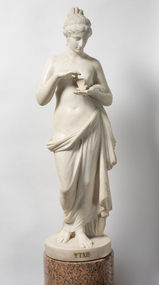
Sculpture, UNKNOWN, Psyche, unknown
... Psyche...Bendigo Art Gallery 42 View Street Bendigo goldfields Psyche Sculpture UNKNOWN ... -
 Ballarat Clarendon College
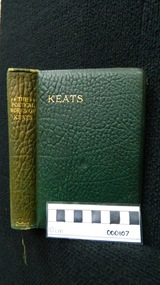
Book, The poetical works of John Keats, 1917
... Dark green padded and textured calf binding with gold printing on front cover and spine; gold detail to inside edge of cover; marbled end-pages and gilt edge; hinges generally firm; book plate inside front cover; quote from Psyche handwritten on verso of frontispiece; ...This book is signed by Principal Elspeth Carson who lead the inaugural year of Clarendon Presbyterian Ladies College (previously Clarendon Ladies College). minnie-monteith elspeth-carson clarendon-presbyterian-ladies-college. 1920 rehfisch book-prize Book plate inside front cover: school crest / Clarendon presbyterain / ladies' College / Ballarat / Form VIa / Prize Special - Violin / Gift of Miss Rehfisch / Awarded to / Minnie Monteith / E Carson / Principal / December 1920 Dark green padded and textured calf binding with gold printing on front cover and spine; gold detail to inside edge of cover; marbled end-pages and gilt edge; hinges generally firm; book plate inside front cover; quote from Psyche handwritten on verso of frontispiece; The poetical works of John Keats Book Humphrey Milford ...Book prize awarded to Minnie Monteith for excellence in Violin by Elspeth Carson in 1920. Book donated to the school by Minnie's nephew R H McCarthy of WA in 2013. Minnie went on to achieve Dux of the school during her final year (1921). She also held the role of Head Prefect in 1921. The book prize was provided by Miss Refisch (possibly S Rehfisch who entered the school in 1902.)Minnie was both Dux of the school and Head Prefect in her final year at CPLC. This book is signed by Principal Elspeth Carson who lead the inaugural year of Clarendon Presbyterian Ladies College (previously Clarendon Ladies College).Dark green padded and textured calf binding with gold printing on front cover and spine; gold detail to inside edge of cover; marbled end-pages and gilt edge; hinges generally firm; book plate inside front cover; quote from Psyche handwritten on verso of frontispiece; Book plate inside front cover: school crest / Clarendon presbyterain / ladies' College / Ballarat / Form VIa / Prize Special - Violin / Gift of Miss Rehfisch / Awarded to / Minnie Monteith / E Carson / Principal / December 1920minnie-monteith, elspeth-carson, clarendon-presbyterian-ladies-college. 1920, rehfisch, book-prize, -
 Wyndham Art Gallery (Wyndham City Council)
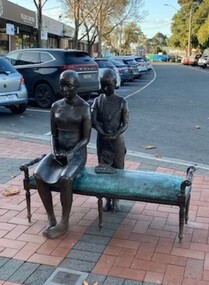
Sculpture, Elizabeth Presa, Oasis, 2000
... ...Psyche...Australian sculpture Psyche Philosophy Public Art Oasis Sculpture Elizabeth Presa ...Oasis is a bronze sculpture depicting a mother and a child waiting. The artwork reinforced that the Centre is a meeting place with the two figures apparently waiting, the mother seated on an ornate seat and the daughter standing behind her. The sculpture was cast at the Perrin Sculpture Foundry, Cheltenham, Victoria.australian sculpture, psyche, philosophy, public art -
 National Wool Museum
Book - Scrapbook, 1940s
... Scrapbook contains articles relating to colour and the human psyche, including articles relating to how men react to women wearing different colours, and studies into conditions such as synaesthesia. ...Scrapbook contains articles relating to colour and the human psyche, including articles relating to how men react to women wearing different colours, and studies into conditions such as synaesthesia. ...A colourist’s scrapbook, possibly belonged to A. M. Collins. Scrapbook contains articles relating to colour and the human psyche, including articles relating to how men react to women wearing different colours, and studies into conditions such as synaesthesia. The scrapbook provides an interesting insight into a designer’s thoughts, inspiration and working life. Red bound book containing published, hand written and printed text. Contains some loose items. colour, design, colour theory, synaesthesia, inspiration, working life, scrapbook, wool, clothing, fashion -
 Bialik College
Film (Item) - Play called "The Soul Miners"
... The Soul Miner is a powerful journey into the psyche of a man who reached his breaking point, and crossed over. ...The Soul Miner is a powerful journey into the psyche of a man who reached his breaking point, and crossed over. ...The Soul Miner is a play about a returned soldier. Inspired by WW1 poetry of Owen and Sassoon. It looks at the story of Jim a Gallipoli veteran, and the effect of war and trauma of [sic] his memories. The Soul Miner is a powerful journey into the psyche of a man who reached his breaking point, and crossed over. Please contact [email protected] to request access to this record.'Eli Erez' Play called "The Soul Miners" We found this on our desk- not sure where it's from Love Av (Reception)theatre, 2000s, bialik college, student work, visual and performing arts -
 Federation University Art Collection
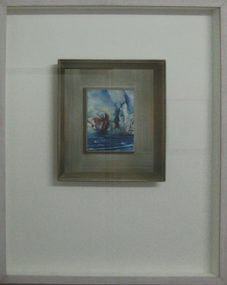
Painting, James Gleeson, 'Bellerophon Entreats the Aid of Poseidon' by James Gleeson, 1956 /1959
... James GLEESON (21 November 1915-20 October 2008) Born Hornsby, Sydney, New South Wales The paintings of James Gleeson reveal powerful and complex relationships between the human psyche and human experience - between myth and reality. ...Federation University Art Collection Artworks are displayed at Federation University Australia campuses at Ballarat, Gippsland (Churchill), Stawell and Horsham. goldfields James GLEESON (21 November 1915-20 October 2008) Born Hornsby, Sydney, New South Wales The paintings of James Gleeson reveal powerful and complex relationships between the human psyche and human experience - between myth and reality. ...James GLEESON (21 November 1915-20 October 2008) Born Hornsby, Sydney, New South Wales The paintings of James Gleeson reveal powerful and complex relationships between the human psyche and human experience - between myth and reality. This item is part of the Federation University Art Collection. The Art Collection features over 2000 works and was listed as a 'Ballarat Treasure' in 2007.Australian Surrealismartwork, art, james gleeson, surrealism, australian surrealism -
 Kiewa Valley Historical Society
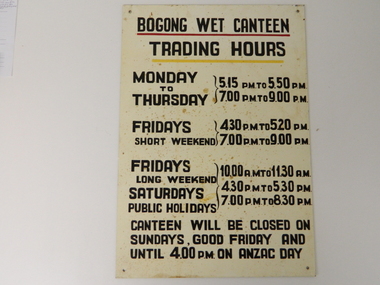
Sign Canteen Painted, Circa 1950
... It is one of the "human" factors which was clearly used in the big 1930's to the 1970's "landscape redevelopment" schemes which started in the early 1900's and is highly regarded as lifting the Australian psyche of only primary producers to an industrial level, equal to any in the world....It is one of the "human" factors which was clearly used in the big 1930's to the 1970's "landscape redevelopment" schemes which started in the early 1900's and is highly regarded as lifting the Australian psyche of only primary producers to an industrial level, equal to any in the world. ...This sign is a part of the "human" factor required for remote and difficult, large impact (both labour and other resources) projects. It is one of the "human" factors which was clearly used in the big 1930's to the 1970's "landscape redevelopment" schemes which started in the early 1900's and is highly regarded as lifting the Australian psyche of only primary producers to an industrial level, equal to any in the world.This "Wet Canteen" sign was installed at the entrance of the Bogong "workers" village "provision's hut" detailing the operational times for the SEC Victorian staff and construction workers, involved in the building of the Kiewa Hydro Electricity Scheme to obtain alcoholic beverages. This facility lasted for over the extensive period (1938 to 1961) of the "Schemes" building phase. This large project was the forerunner when industrial legislation provided for the welfare of workers living in the Bogong Village. The provision of facilities such as a "wet canteen" was of the utmost importance not only to ensure that the long running project was both successful, production wise, but also that its employees were not only physically but also mentally healthy. This sign details that all aspects required for a fit and productive labour force were in place, in this remote and demanding work environment. The majority of heavy equipment and machinery used was either made in England or Europe. A section of the specialised workforce came from local and European expertise in dam construction and water management in alpine terrain. The majority of labour came from migrants and some specialists recruited from England and Europe. At this point in time, the quality of the machines used came from England, Europe and the USA and could not be matched from anywhere else in the developed world. With a specialised workforce came the responsibility of providing all the "comforts of home" including alcoholic beverages. On site accommodation for the workforce is still a requirement for some mining areas but high market returns have produced fly in/out labour.This anodised metal sign has been "block" stenciled on. Black lettering and numbers with the main headings underlined with a red and a yellow line(emphasising the headings)In black stenciled type "BOGONG WET CANTEEN" underneath this "TRADING HOURS" Below this "MONDAY TO THURSDAY 5.15 PM TO 5.50 PM, 7.00 PM TO 9.00 PM" "FRIDAYS SHORT WEEKEND 4.30 PM TO 5.20 PM 7.00 PM TO 9.00 PM" Below this "FRIDAYS LONG WEEKEND 10.00AM TO 11.30 AM" Below this "SATURDAYS PUBLIC HOLIDAYS 4.30 PM TO 5.30 PM 7.00 PM TO 8.30 PM" bELOW THIS "CANTEEN WILL BE CLOSED ON SUNDAYS, GOOD FRIDAY AND UNTIL 4.00 PM ON ANZAC DAY"saucer, plate, secv, state electricity commission of victoria, canteen, bogong mess hall, recreational amenities, socialisation of sec vic kiewa hydro scheme labour force -
 National Wool Museum
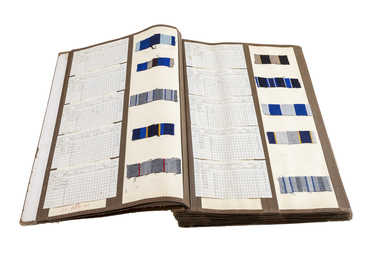
Book - Fabric Sample Book, Ernest Waddington, c.1930
... Despite societies psyche at this time, there is a surprising amount of colour and what may be viewed as daring designs. ...Despite societies psyche at this time, there is a surprising amount of colour and what may be viewed as daring designs. weaving textile design textile mills textile mills waddington mr ernest weaving textile design textile mills E. ...Fabric sample book produced by Ernest Waddington with specifications circa 1930. Such a book would work as a catalogue of a designer’s previous Mastercards. Mastercards are specification sheets that are sent to mills in order to produce commercial amounts of fabrics for tailoring into final products, such as suits. Keeping a catalogue of previous designs is useful for designers to take inspiration from in future designs and for re-releases of iconic designs. This sample book is also notable because of its period of creation. It was created in the Great Depression. Despite societies psyche at this time, there is a surprising amount of colour and what may be viewed as daring designs. Large, light brown book bound with string containing fabric samples and notes. Pages stitched at borders. Large cream paper label with "Patterns" written diagonally across, pasted on cover.E. Waddingtonweaving textile design textile mills textile mills, waddington, mr ernest, weaving, textile design, textile mills -
 Federation University Art Collection
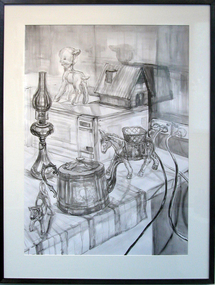
Drawing - Wash on paper, 'Spring Lamb' by Michelle Zuccolo, 2008
... Michelle Zuccolo's work is underpinned by an interest in the human psyche, expressed in related portraiture paintings, life drawing and sculpture.This work was a finalist in the Adelaide Perry Drawing Prize, and she won the 2021 $3,000 Local Art Prize for the painting Habitat (2020), which raises questions about interactions between introduced and native species. ...Michelle Zuccolo's work is underpinned by an interest in the human psyche, expressed in related portraiture paintings, life drawing and sculpture.This work was a finalist in the Adelaide Perry Drawing Prize, and she won the 2021 $3,000 Local Art Prize for the painting Habitat (2020), which raises questions about interactions between introduced and native species. ...Michelle ZUCCOLO Born Orbost, Victoria Between 2004 and 2007 Michelle Zuccolo undertook a Master of Arts, (Visual Arts part-time by research) at the University of Ballarat (later Federation University Australia). Her BA (Fine Art) was awarded by the Victoria College of Art and Design, and she has a DipEd from Melbourne College of Advanced Education. Michelle Zuccolo's work is underpinned by an interest in the human psyche, expressed in related portraiture paintings, life drawing and sculpture.This work was a finalist in the Adelaide Perry Drawing Prize, and she won the 2021 $3,000 Local Art Prize for the painting Habitat (2020), which raises questions about interactions between introduced and native species. The Federation University Art Collection features over 2000 works and was listed as a 'Ballarat Treasure' in 2007.Framed drawingart, artwork, michelle zuccolo, lamb, available, alumni -
 Kiewa Valley Historical Society
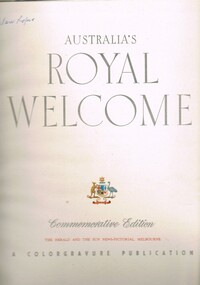
Book - Non Fiction History, Australia's Royal Welcome 1954, circa 1954
... This self reliance psyche was essentially a by product of World War II, and the isolation felt by the Australian People. ...This self reliance psyche was essentially a by product of World War II, and the isolation felt by the Australian People. ...This publication covers the mid 1900s and relates to a period where the majority of the Australian population was engrossed with the Queen of Australia, even though her Highness did not reside on this continent. The period covered was before the great immigration insurgence from Europe.The Labour Party's "White Australian" policy was a hinderance and a barrier towards the Asian and African prospective immigrants. The motto Queen and Country was still very ingrained in the rural population. This period in Australian domestic self reliance, brought about the growing strength and very active trade union movement and their staunch support for the Tariff protection against a growing swell of imported goods. This self reliance psyche was essentially a by product of World War II, and the isolation felt by the Australian People. The Queen (royalty) was the binding force holding the British Empire together which was emphasised with her popularity when touring Australia Queen Elizabeth's visited the MCG twice in 1954 1. to attend an assembly of ex-servicemen and women's organisations 2. to attend a Children's Display. She also visited Government House and visited Country Victoria on the Royal train from 24th Feb - 9th March.The Kiewa Valley and all the rural areas in the region were still very much tied to the "mother land" and trade between Britain and Australia was very strong. Trade with Asian manufacturers was minimal and needed the late 1900s to see both the trade and immigration barriers fall. This book was produced during a time when the majority of Australians looked more to England for trade and companionship. The agricultural trade with England and Europe was very high and the motto of the time was "Australia grows on the sheep's back". Late 1900's saw the motto "Australia grows on the miner's back" The Queen was still very popular then which was emphasised by the large crowds which greeted her on tour. Residents of Mt Beauty including Cubs, Brownies, Scouts and Guides travelled to Benalla to see the Queen. Clare Roper was a founding member of the KVHS and attended a garden party at Buckingham Palace representing the local CWA. She has purchased this book and therefore giving this a close historical significance connection, it has good provenance and interpretive capacity. This hard(blue coloured) covered book contains thirty six double sided pages. Both the first and last pages (inside cover included) has the royal crest of Australia (kangaroo and emu) balancing the individual six states crests ,united under the royal crown. The first six double pages, each portraying a coloured free hand sketches of various Australian scenery enclosing the Queen's day by day and State by State itinerary. There are 115 black and white photographs and 25 coloured photographs contained in this book.Third page has free hand penned signature "Clare Roper"1954 royal tour, queen elizabeth ii monarchy, british empire in the 1900s, god save the queen. -
 Mission to Seafarers Victoria
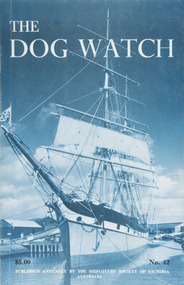
Journal (item) - Periodicals-Annual, Shiplovers' Society of Victoria, The Annual Dog Watch
... Watson - 24 H.M.A.S. Psyche - D. Ricketts - 29 S.V. Eye of the Wind - Captain Richard Grono - 35 HMAS Shropshire in the Philippines Pt. 1 - F. ...Watson - 24 H.M.A.S. Psyche - D. Ricketts - 29 S.V. Eye of the Wind - Captain Richard Grono - 35 HMAS Shropshire in the Philippines Pt. 1 - F. ...This journal provides the reader with glimpses of the adventures and hardships of a seaman's life. Many of the stories are of sailing ships.Contributes to our knowledge of the importance of shipping and places on record those stories of the sea which would otherwise be lost.Contents Foreword - Ranald MacDonald - 5 Editorial - - 7 Early Settlements in Victoria - The Late George R. Leggett - 9 Sailors From The Sea - Jean M. MacKenzie - 11 The Wreck Of The Newfield - - 16 The Mosquito Fleet - George F. Lay - 19 "Pilot Missing" A Tragedy of Port Phillip - The Late Capt. Hartley R. Watson - 24 H.M.A.S. Psyche - D. Ricketts - 29 S.V. Eye of the Wind - Captain Richard Grono - 35 HMAS Shropshire in the Philippines Pt. 1 - F. Hoolahan - 43 Genius Who Also Builds Ships - J.B. Thomson - 49 Around the Devon Coastline - S.J. Buckland - 57 When She Sank a Fortune Went With Her - E. Harper - 64 The Heaving Line - R.N. Thiele - 67 The Falls of Clyde in the Twenties - Capt. F.S. Moody, Jr. - 75 Memories of the Audiffred Building San Francisco - Capt. Fred Klebingat - 79 The Wreck of a Sloop - The Late Captain R.G. Edwards - 94 Deep Sea to San Pedro - W.P. Shemmeld - 98 First Fleet re-enactment Voyage - - 107 Book Reviews - - 108sailing ships, steamships, shipping, seafaring life, shiplovers' society of victoria, dog watch -
 Duldig Studio museum + sculpture garden
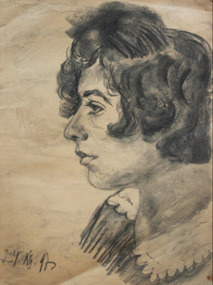
Drawing, Slawa Horowitz-Duldig, Portrait of Rella by Slawa Horowitz-Duldig 1917, 1917
... Amongst the group are several portraits that indicate the artist’s interest in conveying the inner psyche of a subject, as well as capturing a likeness. ...Amongst the group are several portraits that indicate the artist’s interest in conveying the inner psyche of a subject, as well as capturing a likeness. ...Slawa Horowitz-Duldig) was both an artist and a designer, and both aspects of her practice are represented in the collection. There is an archive of approximately 255 drawings by Slawa dating from 1917 until 1922. Slawa’s sketchbooks from this period provide an insight into her early training and demonstrate the artist’s early interest in portraiture. A number of the drawings have been framed, but the majority remains 'in situ'. Slawa was a student at the Viennese Kunstschule für Frauen und Mädchen (the Viennese Art School for Women and Girls) (KFM) from 1917 until 1921, and in 1922 she became a student of Anton Hanak. The KFM School had been established in 1897 as a private school, and it was highly regarded both for its teaching staff and academic curriculum. By 1918 it had introduced stringent admission policy similar to those of the Austrian Academy of Fine Arts, and obtained government funding for its academic program, and began to focus on students seeking to pursue careers as professional artists. In 1921 when Slawa applied to the Austrian Academy of Arts for a place in its program, her application was unsuccessful, as her work was considered advanced, and a place in the third or fourth year of the program was not available. In 1922 she became a private student of Anton Hanak. Many of the portrait images from this early period concentrate on capturing the physical appearance of the face of the model. A number of these studies, in which the subject is not identified, display an academic approach to the genre. Her technical skills in capturing precise facial features of the model, the expression of eyes and the texture of hair are evident. These drawings were perhaps completed in the studio of the KFM School. There are also portraits of friends and family members, including her sister Rella and others, perhaps parents and grandparents, who have yet to be identified conclusively. It is these images of family and friends that particularly demonstrate Slawa’s confidence with pen, charcoal and crayon on paper. Amongst the group are several portraits that indicate the artist’s interest in conveying the inner psyche of a subject, as well as capturing a likeness. Ann Carew 2016The drawings from this period give us an insight into the artist’s early training, and the teaching methods of Viennese Kunstschule für Frauen und Mädchen, one of the first professional art schools for women in Vienna. The drawings and sketchbooks have artistic, interpretative and research significance as records of the art education of women in Vienna in the early 20th century. Ann Carew 2016Charcoal over pencil sketch on paper of Slawa's sister Rella.Artist signature in the bottom left corner. -
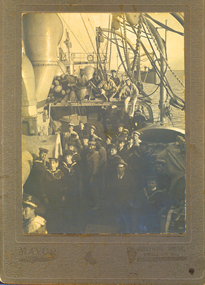 Port Melbourne Historical & Preservation Society
Photograph - Crew of the Katoomba, 1904
... He later served on ‘HMS Challenger’ and ‘HMS Psyche’ which included voyages to Fiji, the New Hebrides, Singapore and New Zealand as well as regular cruises to Australian ports. ...He later served on ‘HMS Challenger’ and ‘HMS Psyche’ which included voyages to Fiji, the New Hebrides, Singapore and New Zealand as well as regular cruises to Australian ports. ...James Bryance CONDER (aka James Brycanne CONDER) Artist, poet and four-navy veteran, 1872 - 1954. In 1889 he served in the Merchant Marine Service sailing on the ships ‘Ellora’ and ‘Avenger’. in 1891, aged 19, he joined the Royal Navy in Australia serving on the flagship of the Australian Station, ‘HMS Orlando’, when it escorted ships of the new Australasian Auxiliary Squadron in coastal voyages. After serving 6 months he returned to family in Melbourne rather than sign on for 12 years. Instead he joined the Victorian Colonial Navy and was posted, in succession, to the ‘HMVS Cerberus’, ‘HMVS Nelson’ and the gunboat ‘HMVS Albert’. In 1896 he left the navy, married Victoria Agnes NIHILL and joined the Victorian Police Force. In 1904 CONDOR returned to the sea as part of the Commonwealth Naval Forces, an amalgamation of the colonial navies formed after federation and later becoming the Royal Australian Navy. On his first ship, ‘HMS Katoomba’, as bosun yeoman, he helped train new recruits. He later served on ‘HMS Challenger’ and ‘HMS Psyche’ which included voyages to Fiji, the New Hebrides, Singapore and New Zealand as well as regular cruises to Australian ports. In 1909, CONDER left the Navy and undertook shored-based civilian work until 1913 when he joined the Royal Australian Naval College at Osborne House in Geelong. He remained with the Naval College until 1937 through its moves to Jervis Bay, NSW and then to Crib Point, Victoria training midshipmen according to the practices of the Royal Navy. In later life, CONDER produced two handwritten journals for his family illustrated with his own paintings and drawings. Two original sets were made. One remains in the family while the other is held by the Australian National Maritime Museum in Sydney. PMHPS hold several items relating to James CONDER including photocopies of his journals ‘Notes from a Sailors Log - Under Canvas - Part I The Merchant Service’ (Cat No 2700.01) and ‘Notes from a Sailors Log - Under Steam - Part II The Navy’ (Cat No 2700.02), a photocopy of his Certificate of Service (Cat No 2700.03), a booklet of his life story (Cat No 2700.04) and several digital items (Cat No 2476.01 - 2476.09). Digital copy of b&w photograph of the crew of the 'Katoomba'armed services - navy, hms katoomba, james bryance conder, ran - royal australian navy -
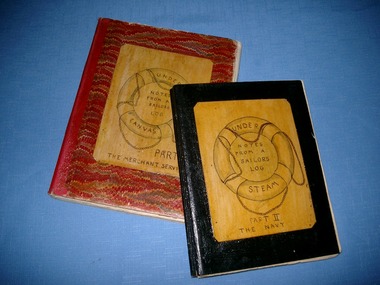 Port Melbourne Historical & Preservation Society
Photograph - James CONDER's journals, Glen Stuart, Aug 2008
... He later served on ‘HMS Challenger’ and ‘HMS Psyche’ which included voyages to Fiji, the New Hebrides, Singapore and New Zealand as well as regular cruises to Australian ports. ...He later served on ‘HMS Challenger’ and ‘HMS Psyche’ which included voyages to Fiji, the New Hebrides, Singapore and New Zealand as well as regular cruises to Australian ports. ...James Bryance CONDER (aka James Brycanne CONDER) Artist, poet and four-navy veteran, 1872 - 1954. In 1889 he served in the Merchant Marine Service sailing on the ships ‘Ellora’ and ‘Avenger’. in 1891, aged 19, he joined the Royal Navy in Australia serving on the flagship of the Australian Station, ‘HMS Orlando’, when it escorted ships of the new Australasian Auxiliary Squadron in coastal voyages. After serving 6 months he returned to family in Melbourne rather than sign on for 12 years. Instead he joined the Victorian Colonial Navy and was posted, in succession, to the ‘HMVS Cerberus’, ‘HMVS Nelson’ and the gunboat ‘HMVS Albert’. In 1896 he left the navy, married Victoria Agnes NIHILL and joined the Victorian Police Force. In 1904 CONDOR returned to the sea as part of the Commonwealth Naval Forces, an amalgamation of the colonial navies formed after federation and later becoming the Royal Australian Navy. On his first ship, ‘HMS Katoomba’, as bosun yeoman, he helped train new recruits. He later served on ‘HMS Challenger’ and ‘HMS Psyche’ which included voyages to Fiji, the New Hebrides, Singapore and New Zealand as well as regular cruises to Australian ports. In 1909, CONDER left the Navy and undertook shored-based civilian work until 1913 when he joined the Royal Australian Naval College at Osborne House in Geelong. He remained with the Naval College until 1937 through its moves to Jervis Bay, NSW and then to Crib Point, Victoria training midshipmen according to the practices of the Royal Navy. In later life, CONDER produced two handwritten journals for his family illustrated with his own paintings and drawings. Two original sets were made. One remains in the family while the other is held by the Australian National Maritime Museum in Sydney. PMHPS hold several items relating to James CONDER including photocopies of his journals ‘Notes from a Sailors Log - Under Canvas - Part I The Merchant Service’ (Cat No 2700.01) and ‘Notes from a Sailors Log - Under Steam - Part II The Navy’ (Cat No 2700.02), a photocopy of his Certificate of Service (Cat No 2700.03), a booklet of his life story (Cat No 2700.04) and several digital items (Cat No 2476.01 - 2476.09).Colour digital photograph of of of the original two sets of James CONDER's handwritten and illustrated journals made for his family, '‘Notes from a Sailors Log - Under Canvas - Part I The Merchant Service’ (Cat No 2700.01) and ‘Notes from a Sailors Log - Under Steam - Part II The Navy’ (Cat No 2700.02). Displayed in 'Navy in Port' exhibition Aug/Sept 2008armed services - navy, transport - shipping, james bryance conder, merchant navy, royal naval squadron, victorian colonial navy, ran - royal australian navy -
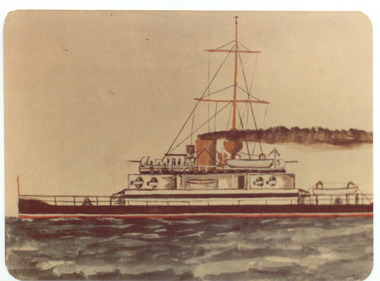 Port Melbourne Historical & Preservation Society
Photograph - HMVS Cerberus by James CONDER
... He later served on ‘HMS Challenger’ and ‘HMS Psyche’ which included voyages to Fiji, the New Hebrides, Singapore and New Zealand as well as regular cruises to Australian ports. ...He later served on ‘HMS Challenger’ and ‘HMS Psyche’ which included voyages to Fiji, the New Hebrides, Singapore and New Zealand as well as regular cruises to Australian ports. ...James Bryance CONDER (aka James Brycanne CONDER) Artist, poet and four-navy veteran, 1872 - 1954. In 1889 he served in the Merchant Marine Service sailing on the ships ‘Ellora’ and ‘Avenger’. in 1891, aged 19, he joined the Royal Navy in Australia serving on the flagship of the Australian Station, ‘HMS Orlando’, when it escorted ships of the new Australasian Auxiliary Squadron in coastal voyages. After serving 6 months he returned to family in Melbourne rather than sign on for 12 years. Instead he joined the Victorian Colonial Navy and was posted, in succession, to the ‘HMVS Cerberus’, ‘HMVS Nelson’ and the gunboat ‘HMVS Albert’. In 1896 he left the navy, married Victoria Agnes NIHILL and joined the Victorian Police Force. In 1904 CONDOR returned to the sea as part of the Commonwealth Naval Forces, an amalgamation of the colonial navies formed after federation and later becoming the Royal Australian Navy. On his first ship, ‘HMS Katoomba’, as bosun yeoman, he helped train new recruits. He later served on ‘HMS Challenger’ and ‘HMS Psyche’ which included voyages to Fiji, the New Hebrides, Singapore and New Zealand as well as regular cruises to Australian ports. In 1909, CONDER left the Navy and undertook shored-based civilian work until 1913 when he joined the Royal Australian Naval College at Osborne House in Geelong. He remained with the Naval College until 1937 through its moves to Jervis Bay, NSW and then to Crib Point, Victoria training midshipmen according to the practices of the Royal Navy. In later life, CONDER produced two handwritten journals for his family illustrated with his own paintings and drawings. Two original sets were made. One remains in the family while the other is held by the Australian National Maritime Museum in Sydney. PMHPS hold several items relating to James CONDER including photocopies of his journals ‘Notes from a Sailors Log - Under Canvas - Part I The Merchant Service’ (Cat No 2700.01) and ‘Notes from a Sailors Log - Under Steam - Part II The Navy’ (Cat No 2700.02), a photocopy of his Certificate of Service (Cat No 2700.03), a booklet of his life story (Cat No 2700.04) and several digital items (Cat No 2476.01 - 2476.09).Colour digital photograph of a drawing of HMVS Cerberus by James CONDER.armed services - navy, transport - shipping, james bryance conder, ran - royal australian navy, victorian colonial navy, royal australian naval college, merchant navy, hmvs cerberus, royal naval squadron -
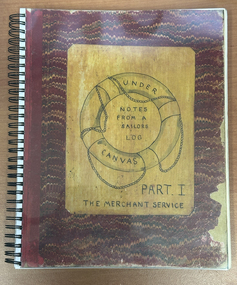 Port Melbourne Historical & Preservation Society
Document - James CONDER Journal, James Brycanne Conder, NOTES FROM A SAILORS LOG - UNDER CANVAS - PART I THE MERCHANT SERVICE
... He later served on ‘HMS Challenger’ and ‘HMS Psyche’ which included voyages to Fiji, the New Hebrides, Singapore and New Zealand as well as regular cruises to Australian ports. ...He later served on ‘HMS Challenger’ and ‘HMS Psyche’ which included voyages to Fiji, the New Hebrides, Singapore and New Zealand as well as regular cruises to Australian ports. ...James Bryance CONDER (aka James Brycanne CONDER) Artist, poet and four-navy veteran, 1872 - 1954. In 1889 he served in the Merchant Marine Service sailing on the ships ‘Ellora’ and ‘Avenger’. in 1891, aged 19, he joined the Royal Navy in Australia serving on the flagship of the Australian Station, ‘HMS Orlando’, when it escorted ships of the new Australasian Auxiliary Squadron in coastal voyages. After serving 6 months he returned to family in Melbourne rather than sign on for 12 years. Instead he joined the Victorian Colonial Navy and was posted, in succession, to the ‘HMVS Cerberus’, ‘HMVS Nelson’ and the gunboat ‘HMVS Albert’. In 1896 he left the navy, married Victoria Agnes NIHILL and joined the Victorian Police Force. In 1904 CONDOR returned to the sea as part of the Commonwealth Naval Forces, an amalgamation of the colonial navies formed after federation and later becoming the Royal Australian Navy. On his first ship, ‘HMS Katoomba’, as bosun yeoman, he helped train new recruits. He later served on ‘HMS Challenger’ and ‘HMS Psyche’ which included voyages to Fiji, the New Hebrides, Singapore and New Zealand as well as regular cruises to Australian ports. In 1909, CONDER left the Navy and undertook shored-based civilian work until 1913 when he joined the Royal Australian Naval College at Osborne House in Geelong. He remained with the Naval College until 1937 through its moves to Jervis Bay, NSW and then to Crib Point, Victoria training midshipmen according to the practices of the Royal Navy. In later life, CONDER produced two handwritten journals for his family illustrated with his own paintings and drawings. Two original sets were made. One remains in the family while the other is held by the Australian National Maritime Museum in Sydney. PMHPS hold several items relating to James CONDER including photocopies of his journals ‘Notes from a Sailors Log - Under Canvas - Part I The Merchant Service’ (Cat No 2700.01) and ‘Notes from a Sailors Log - Under Steam - Part II The Navy’ (Cat No 2700.02), a photocopy of his Certificate of Service (Cat No 2700.03), a booklet of his life story (Cat No 2700.04) and several digital items (Cat No 2476.01 - 2476.09).A spiral bound photocopy of a sailor's log; dark red marbled covers; front cover has tan inset with title in and around a sketch of a lifebuoy. Under Canvas - Part I The Merchant Service. See Under Steam - Part II The Navy (Cat No 2700.02)transport - shipping, james bryance conder, merchant navy -
 Port Melbourne Historical & Preservation Society
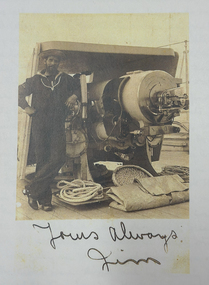
Photograph - James CONDER in uniform, c. 1905
... He later served on ‘HMS Challenger’ and ‘HMS Psyche’ which included voyages to Fiji, the New Hebrides, Singapore and New Zealand as well as regular cruises to Australian ports. ...He later served on ‘HMS Challenger’ and ‘HMS Psyche’ which included voyages to Fiji, the New Hebrides, Singapore and New Zealand as well as regular cruises to Australian ports. ...James Bryance CONDER (aka James Brycanne CONDER) Artist, poet and four-navy veteran, 1872 - 1954. In 1889 he served in the Merchant Marine Service sailing on the ships ‘Ellora’ and ‘Avenger’. in 1891, aged 19, he joined the Royal Navy in Australia serving on the flagship of the Australian Station, ‘HMS Orlando’, when it escorted ships of the new Australasian Auxiliary Squadron in coastal voyages. After serving 6 months he returned to family in Melbourne rather than sign on for 12 years. Instead he joined the Victorian Colonial Navy and was posted, in succession, to the ‘HMVS Cerberus’, ‘HMVS Nelson’ and the gunboat ‘HMVS Albert’. In 1896 he left the navy, married Victoria Agnes NIHILL and joined the Victorian Police Force. In 1904 CONDOR returned to the sea as part of the Commonwealth Naval Forces, an amalgamation of the colonial navies formed after federation and later becoming the Royal Australian Navy. On his first ship, ‘HMS Katoomba’, as bosun yeoman, he helped train new recruits. He later served on ‘HMS Challenger’ and ‘HMS Psyche’ which included voyages to Fiji, the New Hebrides, Singapore and New Zealand as well as regular cruises to Australian ports. In 1909, CONDER left the Navy and undertook shored-based civilian work until 1913 when he joined the Royal Australian Naval College at Osborne House in Geelong. He remained with the Naval College until 1937 through its moves to Jervis Bay, NSW and then to Crib Point, Victoria training midshipmen according to the practices of the Royal Navy. In later life, CONDER produced two handwritten journals for his family illustrated with his own paintings and drawings. Two original sets were made. One remains in the family while the other is held by the Australian National Maritime Museum in Sydney. PMHPS hold several items relating to James CONDER including photocopies of his journals ‘Notes from a Sailors Log - Under Canvas - Part I The Merchant Service’ (Cat No 2700.01) and ‘Notes from a Sailors Log - Under Steam - Part II The Navy’ (Cat No 2700.02), a photocopy of his Certificate of Service (Cat No 2700.03), a booklet of his life story (Cat No 2700.04) and several digital items (Cat No 2476.01 - 2476.09).Sepia digital photograph of James CONDER in uniform, sent to family with greeting 'Yours Always, Jim'. This photo is included in the early pages of CONDER's journal ‘Notes from a Sailors Log - Under Steam - Part II The Navy’ (Cat No 2700.02)."Yours always / Jim"armed services - navy, transport - shipping, james bryance conder, ran - royal australian navy, victorian colonial navy -
 Port Melbourne Historical & Preservation Society
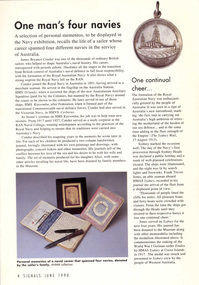
Magazine - Article, One Man's Four Navies
... He later served on ‘HMS Challenger’ and ‘HMS Psyche’ which included voyages to Fiji, the New Hebrides, Singapore and New Zealand as well as regular cruises to Australian ports. ...He later served on ‘HMS Challenger’ and ‘HMS Psyche’ which included voyages to Fiji, the New Hebrides, Singapore and New Zealand as well as regular cruises to Australian ports. ...James Bryance CONDER (aka James Brycanne CONDER) Artist, poet and four-navy veteran, 1872 - 1954. In 1889 he served in the Merchant Marine Service sailing on the ships ‘Ellora’ and ‘Avenger’. in 1891, aged 19, he joined the Royal Navy in Australia serving on the flagship of the Australian Station, ‘HMS Orlando’, when it escorted ships of the new Australasian Auxiliary Squadron in coastal voyages. After serving 6 months he returned to family in Melbourne rather than sign on for 12 years. Instead he joined the Victorian Colonial Navy and was posted, in succession, to the ‘HMVS Cerberus’, ‘HMVS Nelson’ and the gunboat ‘HMVS Albert’. In 1896 he left the navy, married Victoria Agnes NIHILL and joined the Victorian Police Force. In 1904 CONDOR returned to the sea as part of the Commonwealth Naval Forces, an amalgamation of the colonial navies formed after federation and later becoming the Royal Australian Navy. On his first ship, ‘HMS Katoomba’, as bosun yeoman, he helped train new recruits. He later served on ‘HMS Challenger’ and ‘HMS Psyche’ which included voyages to Fiji, the New Hebrides, Singapore and New Zealand as well as regular cruises to Australian ports. In 1909, CONDER left the Navy and undertook shored-based civilian work until 1913 when he joined the Royal Australian Naval College at Osborne House in Geelong. He remained with the Naval College until 1937 through its moves to Jervis Bay, NSW and then to Crib Point, Victoria training midshipmen according to the practices of the Royal Navy. In later life, CONDER produced two handwritten journals for his family illustrated with his own paintings and drawings. Two original sets were made. One remains in the family while the other is held by the Australian National Maritime Museum in Sydney. PMHPS hold several items relating to James CONDER including photocopies of his journals ‘Notes from a Sailors Log - Under Canvas - Part I The Merchant Service’ (Cat No 2700.01) and ‘Notes from a Sailors Log - Under Steam - Part II The Navy’ (Cat No 2700.02), a photocopy of his Certificate of Service (Cat No 2700.03), a booklet of his life story (Cat No 2700.04) and several digital items (Cat No 2476.01 - 2476.09).Article, 'One Man's Four Navies', about James CONDER from National Maritime Museum's 'Signals' magazine, Issue 12, 1 June 1990. armed services - navy, transport - shipping, james bryance conder, ran - royal australian navy, royal naval squadron, victorian colonial navy -
 Port Melbourne Historical & Preservation Society
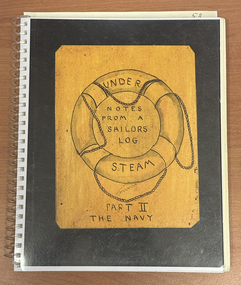
Document - James CONDER Journal, James Brycanne Conder, NOTES FROM A SAILORS LOG - UNDER STEAM - PART II THE NAVY
... He later served on ‘HMS Challenger’ and ‘HMS Psyche’ which included voyages to Fiji, the New Hebrides, Singapore and New Zealand as well as regular cruises to Australian ports. ...He later served on ‘HMS Challenger’ and ‘HMS Psyche’ which included voyages to Fiji, the New Hebrides, Singapore and New Zealand as well as regular cruises to Australian ports. ...James Bryance CONDER (aka James Brycanne CONDER) Artist, poet and four-navy veteran, 1872 - 1954. In 1889 he served in the Merchant Marine Service sailing on the ships ‘Ellora’ and ‘Avenger’. in 1891, aged 19, he joined the Royal Navy in Australia serving on the flagship of the Australian Station, ‘HMS Orlando’, when it escorted ships of the new Australasian Auxiliary Squadron in coastal voyages. After serving 6 months he returned to family in Melbourne rather than sign on for 12 years. Instead he joined the Victorian Colonial Navy and was posted, in succession, to the ‘HMVS Cerberus’, ‘HMVS Nelson’ and the gunboat ‘HMVS Albert’. In 1896 he left the navy, married Victoria Agnes NIHILL and joined the Victorian Police Force. In 1904 CONDOR returned to the sea as part of the Commonwealth Naval Forces, an amalgamation of the colonial navies formed after federation and later becoming the Royal Australian Navy. On his first ship, ‘HMS Katoomba’, as bosun yeoman, he helped train new recruits. He later served on ‘HMS Challenger’ and ‘HMS Psyche’ which included voyages to Fiji, the New Hebrides, Singapore and New Zealand as well as regular cruises to Australian ports. In 1909, CONDER left the Navy and undertook shored-based civilian work until 1913 when he joined the Royal Australian Naval College at Osborne House in Geelong. He remained with the Naval College until 1937 through its moves to Jervis Bay, NSW and then to Crib Point, Victoria training midshipmen according to the practices of the Royal Navy. In later life, CONDER produced two handwritten journals for his family illustrated with his own paintings and drawings. Two original sets were made. One remains in the family while the other is held by the Australian National Maritime Museum in Sydney. PMHPS hold several items relating to James CONDER including photocopies of his journals ‘Notes from a Sailors Log - Under Canvas - Part I The Merchant Service’ (Cat No 2700.01) and ‘Notes from a Sailors Log - Under Steam - Part II The Navy’ (Cat No 2700.02), a photocopy of his Certificate of Service (Cat No 2700.03), a booklet of his life story (Cat No 2700.04) and several digital items (Cat No 2476.01 - 2476.09).A spiral bound photocopy of a sailor's log; dark red marbled covers; front cover has tan inset with title in and around a sketch of a lifebuoy. Under Steam - Part II The Navy. See Under Canvas - Part I The Merchant Service (Cat No 2700.01)transport - shipping, hmvs cerberus, james bryance conder, armed services - navy, ran - royal australian navy -
 Port Melbourne Historical & Preservation Society
Booklet, Robert Murphy, James Conder - A Maritime Life - 1872-1954, c. 2000
... He later served on ‘HMS Challenger’ and ‘HMS Psyche’ which included voyages to Fiji, the New Hebrides, Singapore and New Zealand as well as regular cruises to Australian ports. ...He later served on ‘HMS Challenger’ and ‘HMS Psyche’ which included voyages to Fiji, the New Hebrides, Singapore and New Zealand as well as regular cruises to Australian ports. ...James Bryance CONDER (aka James Brycanne CONDER) Artist, poet and four-navy veteran, 1872 - 1954. In 1889 he served in the Merchant Marine Service sailing on the ships ‘Ellora’ and ‘Avenger’. in 1891, aged 19, he joined the Royal Navy in Australia serving on the flagship of the Australian Station, ‘HMS Orlando’, when it escorted ships of the new Australasian Auxiliary Squadron in coastal voyages. After serving 6 months he returned to family in Melbourne rather than sign on for 12 years. Instead he joined the Victorian Colonial Navy and was posted, in succession, to the ‘HMVS Cerberus’, ‘HMVS Nelson’ and the gunboat ‘HMVS Albert’. In 1896 he left the navy, married Victoria Agnes NIHILL and joined the Victorian Police Force. In 1904 CONDOR returned to the sea as part of the Commonwealth Naval Forces, an amalgamation of the colonial navies formed after federation and later becoming the Royal Australian Navy. On his first ship, ‘HMS Katoomba’, as bosun yeoman, he helped train new recruits. He later served on ‘HMS Challenger’ and ‘HMS Psyche’ which included voyages to Fiji, the New Hebrides, Singapore and New Zealand as well as regular cruises to Australian ports. In 1909, CONDER left the Navy and undertook shored-based civilian work until 1913 when he joined the Royal Australian Naval College at Osborne House in Geelong. He remained with the Naval College until 1937 through its moves to Jervis Bay, NSW and then to Crib Point, Victoria training midshipmen according to the practices of the Royal Navy. In later life, CONDER produced two handwritten journals for his family illustrated with his own paintings and drawings. Two original sets were made. One remains in the family while the other is held by the Australian National Maritime Museum in Sydney. PMHPS hold several items relating to James CONDER including photocopies of his journals ‘Notes from a Sailors Log - Under Canvas - Part I The Merchant Service’ (Cat No 2700.01) and ‘Notes from a Sailors Log - Under Steam - Part II The Navy’ (Cat No 2700.02), a photocopy of his Certificate of Service (Cat No 2700.03), a booklet of his life story (Cat No 2700.04) and several digital items (Cat No 2476.01 - 2476.09). 'James Conder - A Maritime Life - 1872-1954', A5 booklet 20 pp incl cover, 'developed by Robert Murphy for the many family members descended from James Conder'.armed services - navy, transport - shipping, police, arts and entertainment - visual arts, hmvs cerberus, james bryance conder, ran - royal australian navy, victorian colonial navy, victoria police, royal australian naval college, robert murphy, painting, royal naval squadron -
 Port Melbourne Historical & Preservation Society
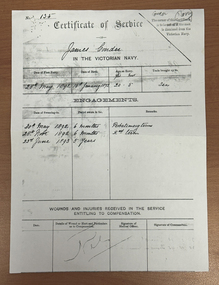
Certificate - Photocopy, Certificate of Service, James Condor, Navy, 1904 - 1959
... He later served on ‘HMS Challenger’ and ‘HMS Psyche’ which included voyages to Fiji, the New Hebrides, Singapore and New Zealand as well as regular cruises to Australian ports. ...He later served on ‘HMS Challenger’ and ‘HMS Psyche’ which included voyages to Fiji, the New Hebrides, Singapore and New Zealand as well as regular cruises to Australian ports. ...James Bryance CONDER (aka James Brycanne CONDER) Artist, poet and four-navy veteran, 1872 - 1954. In 1889 he served in the Merchant Marine Service sailing on the ships ‘Ellora’ and ‘Avenger’. in 1891, aged 19, he joined the Royal Navy in Australia serving on the flagship of the Australian Station, ‘HMS Orlando’, when it escorted ships of the new Australasian Auxiliary Squadron in coastal voyages. After serving 6 months he returned to family in Melbourne rather than sign on for 12 years. Instead he joined the Victorian Colonial Navy and was posted, in succession, to the ‘HMVS Cerberus’, ‘HMVS Nelson’ and the gunboat ‘HMVS Albert’. In 1896 he left the navy, married Victoria Agnes NIHILL and joined the Victorian Police Force. In 1904 CONDOR returned to the sea as part of the Commonwealth Naval Forces, an amalgamation of the colonial navies formed after federation and later becoming the Royal Australian Navy. On his first ship, ‘HMS Katoomba’, as bosun yeoman, he helped train new recruits. He later served on ‘HMS Challenger’ and ‘HMS Psyche’ which included voyages to Fiji, the New Hebrides, Singapore and New Zealand as well as regular cruises to Australian ports. In 1909, CONDER left the Navy and undertook shored-based civilian work until 1913 when he joined the Royal Australian Naval College at Osborne House in Geelong. He remained with the Naval College until 1937 through its moves to Jervis Bay, NSW and then to Crib Point, Victoria training midshipmen according to the practices of the Royal Navy. In later life, CONDER produced two handwritten journals for his family illustrated with his own paintings and drawings. Two original sets were made. One remains in the family while the other is held by the Australian National Maritime Museum in Sydney. PMHPS hold several items relating to James CONDER including photocopies of his journals ‘Notes from a Sailors Log - Under Canvas - Part I The Merchant Service’ (Cat No 2700.01) and ‘Notes from a Sailors Log - Under Steam - Part II The Navy’ (Cat No 2700.02), a photocopy of his Certificate of Service (Cat No 2700.03), a booklet of his life story (Cat No 2700.04) and several digital items (Cat No 2476.01 - 2476.09). Photocopy of James CONDER's Certificate of Servicearmed services - navy, transport - shipping, james bryance conder, ran - royal australian navy, royal naval squadron, victorian colonial navy, merchant navy, victoria police, police -
 Port Melbourne Historical & Preservation Society
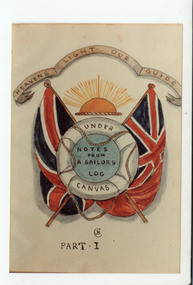
Photograph - Title page drawing from James Conder Journal Part I
... He later served on ‘HMS Challenger’ and ‘HMS Psyche’ which included voyages to Fiji, the New Hebrides, Singapore and New Zealand as well as regular cruises to Australian ports. ...He later served on ‘HMS Challenger’ and ‘HMS Psyche’ which included voyages to Fiji, the New Hebrides, Singapore and New Zealand as well as regular cruises to Australian ports. ...James Bryance CONDER (aka James Brycanne CONDER) Artist, poet and four-navy veteran, 1872 - 1954. In 1889 he served in the Merchant Marine Service sailing on the ships ‘Ellora’ and ‘Avenger’. in 1891, aged 19, he joined the Royal Navy in Australia serving on the flagship of the Australian Station, ‘HMS Orlando’, when it escorted ships of the new Australasian Auxiliary Squadron in coastal voyages. After serving 6 months he returned to family in Melbourne rather than sign on for 12 years. Instead he joined the Victorian Colonial Navy and was posted, in succession, to the ‘HMVS Cerberus’, ‘HMVS Nelson’ and the gunboat ‘HMVS Albert’. In 1896 he left the navy, married Victoria Agnes NIHILL and joined the Victorian Police Force. In 1904 CONDOR returned to the sea as part of the Commonwealth Naval Forces, an amalgamation of the colonial navies formed after federation and later becoming the Royal Australian Navy. On his first ship, ‘HMS Katoomba’, as bosun yeoman, he helped train new recruits. He later served on ‘HMS Challenger’ and ‘HMS Psyche’ which included voyages to Fiji, the New Hebrides, Singapore and New Zealand as well as regular cruises to Australian ports. In 1909, CONDER left the Navy and undertook shored-based civilian work until 1913 when he joined the Royal Australian Naval College at Osborne House in Geelong. He remained with the Naval College until 1937 through its moves to Jervis Bay, NSW and then to Crib Point, Victoria training midshipmen according to the practices of the Royal Navy. In later life, CONDER produced two handwritten journals for his family illustrated with his own paintings and drawings. Two original sets were made. One remains in the family while the other is held by the Australian National Maritime Museum in Sydney. PMHPS hold several items relating to James CONDER including photocopies of his journals ‘Notes from a Sailors Log - Under Canvas - Part I The Merchant Service’ (Cat No 2700.01) and ‘Notes from a Sailors Log - Under Steam - Part II The Navy’ (Cat No 2700.02), a photocopy of his Certificate of Service (Cat No 2700.03), a booklet of his life story (Cat No 2700.04) and several digital items (Cat No 2476.01 - 2476.09).Colour digital photograph of the title page handdrawn by James GONDER from ‘Notes from a Sailors Log - Under Canvas - Part I The Merchant Service’ (Cat No 2700.01).armed services - navy, transport - shipping, james bryance conder, ran - royal australian navy, victorian colonial navy, royal australian naval college, merchant navy, royal naval squadron -
 Port Melbourne Historical & Preservation Society
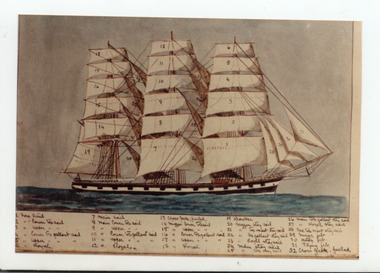
Photograph - Sailing ship showing sail configuration
... He later served on ‘HMS Challenger’ and ‘HMS Psyche’ which included voyages to Fiji, the New Hebrides, Singapore and New Zealand as well as regular cruises to Australian ports. ...He later served on ‘HMS Challenger’ and ‘HMS Psyche’ which included voyages to Fiji, the New Hebrides, Singapore and New Zealand as well as regular cruises to Australian ports. ...James Bryance CONDER (aka James Brycanne CONDER) Artist, poet and four-navy veteran, 1872 - 1954. In 1889 he served in the Merchant Marine Service sailing on the ships ‘Ellora’ and ‘Avenger’. in 1891, aged 19, he joined the Royal Navy in Australia serving on the flagship of the Australian Station, ‘HMS Orlando’, when it escorted ships of the new Australasian Auxiliary Squadron in coastal voyages. After serving 6 months he returned to family in Melbourne rather than sign on for 12 years. Instead he joined the Victorian Colonial Navy and was posted, in succession, to the ‘HMVS Cerberus’, ‘HMVS Nelson’ and the gunboat ‘HMVS Albert’. In 1896 he left the navy, married Victoria Agnes NIHILL and joined the Victorian Police Force. In 1904 CONDOR returned to the sea as part of the Commonwealth Naval Forces, an amalgamation of the colonial navies formed after federation and later becoming the Royal Australian Navy. On his first ship, ‘HMS Katoomba’, as bosun yeoman, he helped train new recruits. He later served on ‘HMS Challenger’ and ‘HMS Psyche’ which included voyages to Fiji, the New Hebrides, Singapore and New Zealand as well as regular cruises to Australian ports. In 1909, CONDER left the Navy and undertook shored-based civilian work until 1913 when he joined the Royal Australian Naval College at Osborne House in Geelong. He remained with the Naval College until 1937 through its moves to Jervis Bay, NSW and then to Crib Point, Victoria training midshipmen according to the practices of the Royal Navy. In later life, CONDER produced two handwritten journals for his family illustrated with his own paintings and drawings. Two original sets were made. One remains in the family while the other is held by the Australian National Maritime Museum in Sydney. PMHPS hold several items relating to James CONDER including photocopies of his journals ‘Notes from a Sailors Log - Under Canvas - Part I The Merchant Service’ (Cat No 2700.01) and ‘Notes from a Sailors Log - Under Steam - Part II The Navy’ (Cat No 2700.02), a photocopy of his Certificate of Service (Cat No 2700.03), a booklet of his life story (Cat No 2700.04) and several digital items (Cat No 2476.01 - 2476.09).Colour digital photograph of a drawing by James CONDER showing the sail configuration for a sailing ship.armed services - navy, transport - shipping, james bryance conder, ran - royal australian navy, victorian colonial navy, royal australian naval college, merchant navy, royal naval squadron -
 Kiewa Valley Historical Society
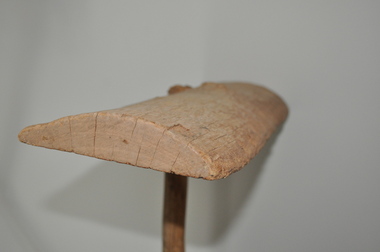
Squeegee - Tea Tree, circa mid to late 1900's
... Part of the natural psyche of the rural Australian inhabitants is the ability to produce inventions that overcome physical restrictive conditions, "the man/woman of all trades" is an apt description of the pioneers of yesteryear and of those to come. timber dairy farm rural implement The squeegee handle is a long branch made from a tea tree, inserted into the upper flat side of a slab of tea tree wood which is flat on one side and curved on the other, the natural curve of the tree trunk. ...This "home made" squeegee was manufactured in the mid to late 1900's by an ingenuous dairyman as a solution to the removal of cow "pats" from the concrete floors of his "milking" sheds. The tea tree made squeegee (being made from nature's anti bacterial material) was an excellent hygienic implement to use. This "home made" wooden squeegee is very significant to the Kiewa Valley and its surrounding regions because it highlights the natural ingenuity found in the pioneer farmer, grazier and other rural folk. It demonstrates the "mother of invention and adaptation" is very strong in rural areas where "off the shelf" products were a rare quantity. Part of the natural psyche of the rural Australian inhabitants is the ability to produce inventions that overcome physical restrictive conditions, "the man/woman of all trades" is an apt description of the pioneers of yesteryear and of those to come.The squeegee handle is a long branch made from a tea tree, inserted into the upper flat side of a slab of tea tree wood which is flat on one side and curved on the other, the natural curve of the tree trunk. This squeegee was used on dairies for removing cow manure.timber, dairy, farm, rural, implement -
 Kiewa Valley Historical Society
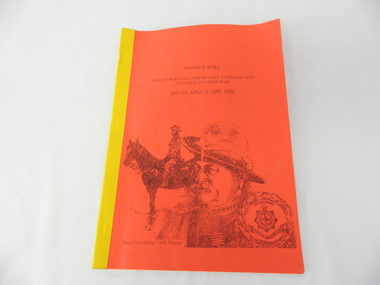
Book - Non Fiction History, Honour Roll - South Africa 1899 - 1902 Albury-Wodonga and District Residents Who Served In The Boer War, reprinted 03/2008
... The degree of adaptability, by these servicemen, to suit the environment in which they fought provided the first real insight into the Australian psyche "of those living and surviving on the harsh Australian outback" history boer war ex-servicemen and women albury and wodonga Author's complimentary inscription "To Mount Beauty Museum with compliments" signed Ian R Docking This book has a bright red soft cover and is bound with bright yellow tape. ...Historical information of soldiers from the Albury-Wodonga district who fought in the Boer War in South Africa 1899 - 1902. In 1996 the then curator for the 8/13 VMR Museum, the Hon Colonel John Neale, commissioned the author to research a group of returned servicemen and women from the Boer War and had lived within 100 km radius of the Albury/Wodonga townships.The Boer War was the second war in South Africa and was the result of heavy taxes and non voting rights of the local white Boer population. Colonial forces including the Australian Light Horse contingent where called upon by England to overthrow the rebellion. This War was the first engagement of Australian troops fighting on foreign soil.This Honour Roll details the pay rates, the battle highlights, weapons used and maps covering the first Australian contingent of soldiers who fought in the Transvaal (Boer War).. Listed are the names of those soldiers who lived within 100klms of Albury and Wodonga.The soldiers are listed by Location, Rank, Initial,Name and Unit. The significance of both the War and those who served in it is two fold. Firstly it demonstrates that the tie between the Colonial outreaches of England's Empire to "the Motherland" were extremely strong at this point in time. This union remained strong up until the middle of World War II when England could not help Australia to defend itself against possible invasion by Japan. The alliance between Australia and the United States of America replaced the British/Australian pact. Secondly the attitude of, and the high degree of horsemanship of those from the Albury and Wodonga area. The degree of adaptability, by these servicemen, to suit the environment in which they fought provided the first real insight into the Australian psyche "of those living and surviving on the harsh Australian outback"This book has a bright red soft cover and is bound with bright yellow tape. There is a drawing of two Australian soldiers on the front, one on horsebackAuthor's complimentary inscription "To Mount Beauty Museum with compliments" signed Ian R Docking history, boer war, ex-servicemen and women, albury and wodonga -
 Kiewa Valley Historical Society
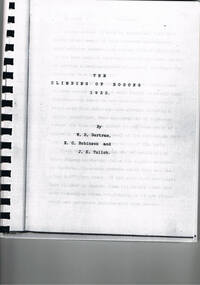
Book - Non Fiction History, The Climbing Of Bogong 1932, 1933
... This book details the the determination and true spirit of the Australian psyche to overcome extreme hardships and have the endurance to fulfill an adventure in the early 1900's. climbing mount bogong victorian alps in winter snow at mt bogong 1920's winter sports skiing, mt bogong, book, snow, cross country skiing The Climbing Of Bogong Mountain 1932. ...The historical documented account of the first winter traverse from Mt Hotham across Mt Bogong. The extreme winter conditions of the region was a barrier for all except the three pioneers of this expedition.This book details the the determination and true spirit of the Australian psyche to overcome extreme hardships and have the endurance to fulfill an adventure in the early 1900's.A photo copy of a black spiral bound book written in 1933 covering the memoirs and photos of only the first (at the time of writing) winter climbing of Mount Bogong in1932. It was written by Jack K.Tulloh (a journalist), E.C. Robinson and W.D. Bertram. This book was photocopied and rebound for the 60th anniversary of the climb.The Climbing Of Bogong Mountain 1932. First page author's dedication: To Bill from Jack 17/2/1933. Second page address: To jack Eddie & Bill " In recognition of your epic journey 50 years ago" John, Helen, David, Iain, Andrew & Hamish, also written in freestyle underneath and in brackets "Bertrams all" underneath signed by Gwen Tulloh, Barbara Betram and Ann Robinson The third page written in free hand " Inscribed by those who lunched9WELL0 on the golden anniversary of the trip 17/8/82. Next to a photo of the three climbers their signatures.climbing mount bogong, victorian alps in winter, snow at mt bogong 1920's winter sports, skiing, mt bogong, book, snow, cross country skiing -
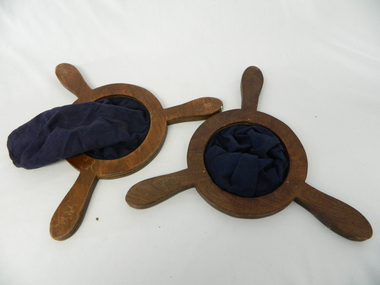 Kiewa Valley Historical Society
Church Collection Receptacles, circa1900s
... The ingrained Australian psyche of supporting anyone that needed help, was a result of this period. religion collection receptacles christian offerings church protocols Church collection/donation bag. ...This church collection bag is quite unique in that it has three grip handles, not the usual two. Why three. It may represent the holy trinity of, the father,the son and the holy spirit. Historically this might be used to reinforce the holy trinity belief which at the time of this item's construction was under threat. The threat came from splinter Christian sects such as the Church Of Jesus Christ of the Latter-Day Saints which have a Godhead of a council of three deities and there are other christian religions of only one deity covering the father,the son and the holy spirit.This collection bag for offerings, was the main method available towards the upkeep of the church and its parish during this era. Broadcasting of religious services was not as prolific as in the late 1900s and into the 2000s. It was a time when visualisation of the support of religion(especially in rural ares) was an important social factor. The God "fearing" beliefs within society of this period, provided the strong moral fabric which permitted settlements that did not have a strong law enforcement section to prosper and develop without fear or "favour". The collection bag was, and is still, a physical endorsement of support towards the church and what it stands for. This was a time when it was a social requirement to be seen in the church building and supporting fellow parishioners. The ingrained Australian psyche of supporting anyone that needed help, was a result of this period.Church collection/donation bag. Simple construction of two round frames with three opposing handles nailed together to hold firm a small dark blue cloth pocket/bag. All fastened by nails to the handle/frame and the large pocket allows for a reasonable amount of coin or notes to be offered.religion, collection receptacles, christian offerings, church protocols -
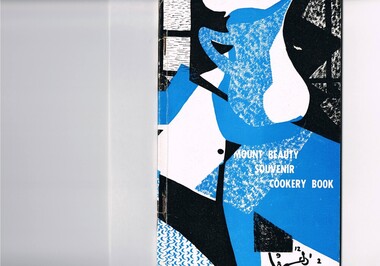 Kiewa Valley Historical Society
Book - Reference Cooking, Mount Beauty Souvenir Cookery Book x2, Circa 1962
... The book demonstrates the strong rural psyche of rallying together for the good of all and united for something which would be of benefit to all. ...This cookery book was printed in the early 1960s for the purpose of obtaining the necessary funds for the construction of the Mount Beauty swimming pool. The advertisements within this book covers local traders of this time frame, for example, the Bogong Hotel which is no longer operational. the culinary measurements are in Imperial measures(pounds and ounces). The book has sections for continental dishes and sweets (Australian flavour), special dishes for Lent, cakes (farmhouse fruit cake), jams, marmalades (home made), marrow and apple chutney. Some of these recipes are early 20th Century related and in the 2000s are not sought after. The food "take away" lifestyle has been responsible for the demise of a lot of the recipes in this book. The swing away from home grown produce has been not only a lifestyle change but also the faster pace of living in rural areas. The specialisation and redefined development of the local produce store (previously provided everything the rural shopper needed) was a forced move due to larger and cheaper city born fresh food supermarkets. Although there are still some local produce store within the region these will in time vanish. This cookery book was produced just after Mount Beauty was released from an SEC "closed" community in 1961(see KVHS 0134) and the town then had to fend for itself. This book was compiled and produced because the town needed a swimming pool (which possible would have been provided had the SEC still been responsible). The book demonstrates the strong rural psyche of rallying together for the good of all and united for something which would be of benefit to all. The period 1961 to the 1970s was one of great change for Mount Beauty. The SEC protective cage was a blessing for some but a goal for others. The independence that was gained after the SEC left provided for a drastic "make over" in regards to the facilities provided for the "locals" and that for the tourists. An increase in tourist related industries such as snow skiing in winter, hang gliding and gliding, mountain bike rallies, bush walking and horse riding, all of which have supply outlets in the town, has provided a more cosmopolitan atmosphere. These activities and the greater interaction with populations outside of the region has reduced the "hermit" type feel of the town psyche.This recipe book consists of eighty nine pages in black and white print. It contains black and white sketches, recipes of local domestic cooks and advertisements covering local traders. The cover is approximately 280 g/m2 in weight and the pages are at 90 g/m2 in weight. The cover has a design in the style of Abstract Expressionism (period 1950-1960s) of identifiable (clock,jug,fruit,window) and abstract objects in tints of blue and shades of black. This was designed by Cheryl Ryder of the Mount Beauty High School, under supervision of Mr I Baker (Art Teacher)On the foreword(page two and page three) "Mt. Beauty Souvenir Cookery Book First Edition" . This foreword was presented by Rosa Kinnear, President, Ladies' Auxiliary 2nd copy - no inscriptionrecipe, cooking, food, domestic, kitchen, local history, comfort food, pioneer cleaning methods -
 Kiewa Valley Historical Society
Book - Reference Teaching Infants, The Teacher in the Modern Elementary School, 1941
... The one thing that it did not address was the easy going Australian psyche of "she'll be right mate" of the Australia rural community. ...This teacher's aid publication was used by the teachers in the The Bogong Primary School from 1941 and also the Mount Beauty Primary School from its establishment in 1947. Both had most of their pupils recruited from SEC(Victoria) Hydro Electricity Scheme employees working for a limited time scale. Rural based children benefited greatly by the decision by the SEC to provide these facilities for their worker's families. This bypass of the "typical rural provisions" offered to other schools, by the Victorian Department of Education was a bonus to the Kiewa Valley educational community. These schools had a higher level of facilities available to them than other "typical" rural schools. Treasured facilities such as a comprehensive library, movie projector, tape recorder and public address system placed these two schools at the level of the Greater Public School of city or the larger towns rather than the small rural schools in Victoria.This item was used in Mount Beauty Primary School as part of a teacher's curriculum. The fact that it is in a rural area, in an enclosed SEC construction worker's village in the Kiewa Valley did present a slightly different learning atmosphere than in the larger towns and cities. The majority of parents within the Kiewa Valley, had a slight resentment of the "high and mighty" attitude of city dwellers with a "plum in their mouths" and the effectiveness that city bred teachers had to achieve was to overcome these ingrained mores. The majority of students at this primary school had parents who were working for (the closed "village" of the SEC Hydro Electricity Scheme. In the 1940s this school would have children from multi-cultural backgrounds as many of the parents were recruited as labourers or with European technical backgrounds. In the book,the black and white photographs detailing the classroom sizes and configurations point to larger classes and slightly different teaching methods than that which existed in Australia. This teacher's aid book presents the Australian rural teachers with an advanced American approach to teaching methods. These methods were based on the then modern "group" psychological teachings and were a good guide in the development of a more effective and progressive teaching platform. The one thing that it did not address was the easy going Australian psyche of "she'll be right mate" of the Australia rural community. The socio-economic identity of the Kiewa Valley rural community was not that of the typical city community (American) and this was a challenge for city based and trained teachers. The principles that the book presents is not constrained by the date of publication or its time of use (1954).This hard cardboard covered book is sleeveless but bound by a red cloth glued onto a thick cardboard base. It has the title printed in gold script on the spine with horizontal and fifteen black horizontal lines at the top and bottom. The front cover has the title printed in gold coloured letters (the first and last words are in freehand script style)On the spine and front cover is printed "The TEACHER IN THE MODERN ELEMENTARY School" school organisation, developmental stages of children, subliminal classroom mental and physical stimulation, usa 1940s teacher aids.
