
Showing 45 items matching "pulled fabric"
-
 Embroiderers Guild, Victoria
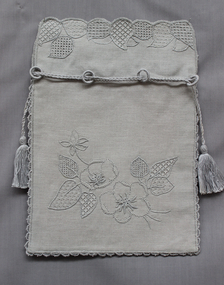
Accessory - Grey Linen Pulled Thread Bag, Lenore Bull, Early 21st C
... ...Pulled fabric...Embroidery Bags Pulled fabric Tassels Gray linen bag, pulled thread design of flowers and leaves. ...Gray linen bag, pulled thread design of flowers and leaves. Top of bag front and back has a row of leaves in different pulled stitches. Drawstring of handmade cord and buttonholed rings. Drawstrings finished with tassels. Buttonholed edge of scallops. Lined with pink silk.embroidery, bags, pulled fabric, tassels -
 Embroiderers Guild, Victoria
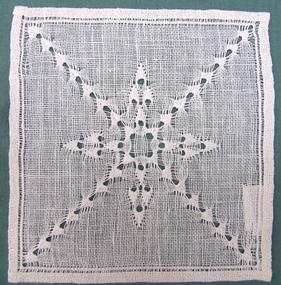
Textile - Pulled and Drawn Thread Small Mat, 1960-80
... Fine ecru linen with a pulled fabric design which shows a simple use of stitches and drawn thread hem....Embroidery Drawn fabric Mats Switzerland 1960-80 Fine ecru linen with a pulled fabric design which shows a simple use of stitches and drawn thread hem. ...Purchased by the donor at "Heimatwerk" in Zurich in 1977.Fine ecru linen with a pulled fabric design which shows a simple use of stitches and drawn thread hem.embroidery, drawn fabric, mats, switzerland, 1960-80 -
 Embroiderers Guild, Victoria
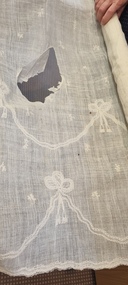
Textile - 18th C Tambour Embroidered Muslin Panel, c 1800
... fabric... Pulled thread...Fine cotton muslin fabric embroidered with fine chain stitch tambour embroidered garlands, bows and tassels, with pulled thread work centres in various patterns, scattered motifs across ground. ...Found in cupboard in collection room, nil identification other than label saying "this handwork is very old" White work White lawn Drawn fabric Pulled thread Tambour work Tambour Garment Veil 18th Century 19th century Petticoats Fine cotton muslin fabric embroidered with fine chain stitch tambour embroidered garlands, bows and tassels, with pulled thread work centres in various patterns, scattered motifs across ground. ...Found in cupboard in collection room, nil identification other than label saying "this handwork is very old"Fine cotton muslin fabric embroidered with fine chain stitch tambour embroidered garlands, bows and tassels, with pulled thread work centres in various patterns, scattered motifs across ground. Looks like it was gathered across the top so may have been part of a skirt or petticoat or veil. white work, white lawn, drawn fabric, pulled thread, tambour work, tambour, garment, veil, 18th century, 19th century, petticoats -
 Bendigo Military Museum
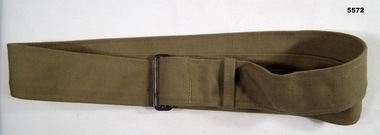
Uniform - BELT
... Khaki coloured cotton fabric belt with keeper and pull through metal buckle. Fabric is double thickness with hemmed edges....See Catalogue No. 5527.2 for his service record. clothing belt Khaki coloured cotton fabric belt with keeper and pull through metal buckle. Fabric is double thickness with hemmed edges. ...Part of the Leo Reoch Cohn Collection. See Catalogue No. 5527.2 for his service record.Khaki coloured cotton fabric belt with keeper and pull through metal buckle. Fabric is double thickness with hemmed edges.clothing, belt -
 Embroiderers Guild, Victoria
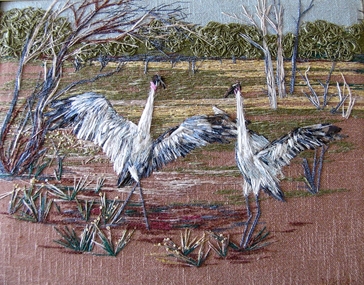
Artwork, other - Picture, "Waltzing Brolgas", Circa 1970
... The piece is freely embroidered in a variety of threads pulled from other fabrics and the birds are done in shredded chiffon. ...The piece is freely embroidered in a variety of threads pulled from other fabrics and the birds are done in shredded chiffon. ...The picture depicts 2 dancing brolgas in a bush landscape. The piece is freely embroidered in a variety of threads pulled from other fabrics and the birds are done in shredded chiffon. The background fabrics are linens grading from light brown into the foreground to blue for the sky. embroidery, picture, 1960-80, australia, creative embroidery -
 Glenelg Shire Council Cultural Collection
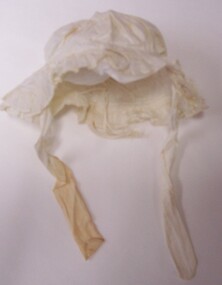
Headwear - Child's Bonnet, Mrs. Annie Finnigan (Mrs. John), 1905
... Child's bonnet made in fine cream cotton fabric. 2 gathered frills at front. 2 rows of fine thread threaded through head piece to pull up for gathering. ...Made for son of Portland Lighthouse Keeper, Matthew Edward Mabbitt. childs clothing child bonnet headwear hat Portland Lighthouse Child's bonnet made in fine cream cotton fabric. 2 gathered frills at front. 2 rows of fine thread threaded through head piece to pull up for gathering. ...Made for son of Portland Lighthouse Keeper, Matthew Edward Mabbitt.Child's bonnet made in fine cream cotton fabric. 2 gathered frills at front. 2 rows of fine thread threaded through head piece to pull up for gathering. Fabric gathered into circular insert at back. 2 hemmed ties.childs clothing, child, bonnet, headwear, hat, portland lighthouse -
 Mont De Lancey
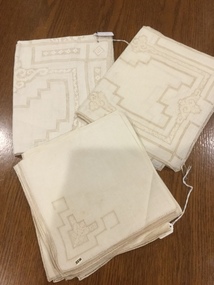
Table linen
... All pieces have pulled thread, or drawn fabric, as well as embroidered detailing, patterns and edging....All pieces have pulled thread, or drawn fabric, as well as embroidered detailing, patterns and edging. ...A set of cream linen table linen comprising: one rectangular centro piece or runner, four rectangular place mats and eight square serviettes. All pieces have pulled thread, or drawn fabric, as well as embroidered detailing, patterns and edging.table linen., household textiles. -
 Royal Australian and New Zealand College of Obstetricians & Gynaecologists (RANZCOG)
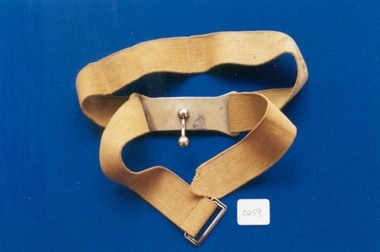
Tourniquet used by Dr Lorna Lloyd-Green, pre1974
... Tourniquet, consisting of woven fabric belt, central metal buckle and fastening buckle. The fabric is pulled through the central metal buckle on both sides and is secured to fastening buckle at one end. ...Tourniquet, consisting of woven fabric belt, central metal buckle and fastening buckle. The fabric is pulled through the central metal buckle on both sides and is secured to fastening buckle at one end. ...Tourniquet, consisting of woven fabric belt, central metal buckle and fastening buckle. The fabric is pulled through the central metal buckle on both sides and is secured to fastening buckle at one end. Teh belt is made of a closely woven material, possibly cotton. -
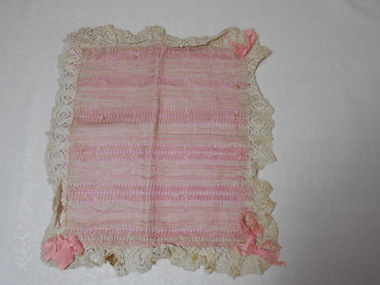 Bendigo Historical Society Inc.
Textile - PINK COTTON LINGERIE BAG
... Front has overlay of cream coloured tapestry fabric with pulled thread work embroidered with pink cross stitch and line patterns. ...Front has overlay of cream coloured tapestry fabric with pulled thread work embroidered with pink cross stitch and line patterns. ...Textiles, pink cotton lingerie or stocking bag with fold over envelope style flap at back over opening. Front has overlay of cream coloured tapestry fabric with pulled thread work embroidered with pink cross stitch and line patterns. Three decorative 2 cm pink satin ribbon bows in three corners. Fourth ribbon detached (stored in bag). 4 cm gathered cream lace edging on four sides.textiles, domestic, pink cotton lingerie bag -
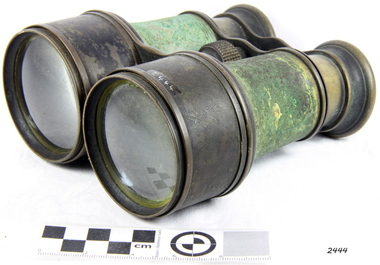 Flagstaff Hill Maritime Museum and Village
Instrument - Binoculars, Late 19th Century
... Binoculars solid brass black covered with Green fabric around cylinders binoculars are complete with geared focusing and pull out lens hoods....An item that was produced in large quality by a well known maker who supplied the British military during the late 19th and early 20th century. flagstaff hill warrnambool flagstaff-hill-maritime-museum shipwreck-coast flagstaff-hill-maritime-village binoculars the duke binocular james henry steward military maker signaling gun laying optician Inscribed "The Duke Binocular" Binoculars solid brass black covered with Green fabric around cylinders binoculars are complete with geared focusing and pull out lens hoods. ...James Henry Steward (1817–1896) were opticians and scientific instrument makers and became established as J.H. Steward in London in 1852. He advertised himself as a “Head Optician” and on the 1st of February, 1913 became incorporated as J.H. Steward Limited. The company produced a large range of items for military use and advertised in their catalogs that they produced instruments for ‘reconnoitering, sketching, night Marching, signaling and gun Laying’. They were well thought of with their work to such a standard that they were made opticians to 'British & Foreign Governments, the National Rifle Associations of England, India, Canada & the Colonies and the National Artillery Association. An item that was produced in large quality by a well known maker who supplied the British military during the late 19th and early 20th century.Binoculars solid brass black covered with Green fabric around cylinders binoculars are complete with geared focusing and pull out lens hoods.Inscribed "The Duke Binocular"flagstaff hill, warrnambool, flagstaff-hill-maritime-museum, shipwreck-coast, flagstaff-hill-maritime-village, binoculars, the duke binocular, james henry steward, military maker, signaling, gun laying, optician -
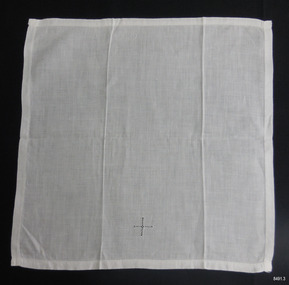 Flagstaff Hill Maritime Museum and Village
Ceremonial object - Chalice cover, 1907 to mid 20th century
... The church was funded and attended by the local community in the early 1900's and is now listed on the Victorian Heritage Database (VHD 118083) as a building of historical and social significance. flagstaff hill warrnambool maritime museum shipwreck coast great ocean road st andrews anglican church dennington dennington church warrnambool church 1907 ecclesiastical linen communion linen hand worked linen religious service religious ceremony ceremonial linen Chalice cover drawn-thread needlework Pulled-thread symbol [cross] Chalice cover, part of a set of Ecclesiastical Linen once used in St. Andrew's Anglican Church, Dennington, Victoria, between the years 1907 and 2003. The white fabric ...This item is part of the collection of Ecclesiastical Linen once used by St. Andrews Anglican Church on the corner of the Esplanade and 14 Drummond St, Dennington, Victoria. The first Anglican service was conducted on December 22nd, 1907. The church was decommissioned in January 2003. This item is part of the Ecclesiastical Linen collection, which is significant for its examples of handworked embroidery and drawn-thread work from the early 20th century. The items are also examples of a collection used for religious services during this period. The Ecclesiastical Linen is also significant for its association with the early development of the local township of Dennington and the importance the the community of setting aside land in the 1850's for the purpose of religious worship. The Ecclesiastical Linen is also significant for its connection to St Andrews Anglican Church, Dennington. The church was funded and attended by the local community in the early 1900's and is now listed on the Victorian Heritage Database (VHD 118083) as a building of historical and social significance. Chalice cover, part of a set of Ecclesiastical Linen once used in St. Andrew's Anglican Church, Dennington, Victoria, between the years 1907 and 2003. The white fabric has been hand stitched and a drawn-thread design of a cross has been handworked into the fabric. Pulled-thread symbol [cross]flagstaff hill, warrnambool, maritime museum, shipwreck coast, great ocean road, st andrews anglican church dennington, dennington church, warrnambool church 1907, ecclesiastical linen, communion linen, hand worked linen, religious service, religious ceremony, ceremonial linen, chalice cover, drawn-thread, needlework -
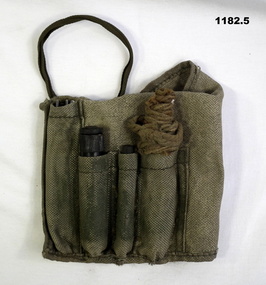 Bendigo Military Museum
Equipment - RIFLE CLEANING KIT, 1962-1972
... For SLR 7.62 Rifle. .1) Combination tool - metal. .2) Oil Bottle - plastic. .3) Brush - Plastic handle. .4) Pull through - metal, cord and cloth. .5.) CanvasPouch Khaki colour fabric tie....SLR cleaning kit accessory On printed label “7.62 SLR/ T Cornelius RAASC” For SLR 7.62 Rifle. .1) Combination tool - metal. .2) Oil Bottle - plastic. .3) Brush - Plastic handle. .4) Pull through - metal, cord and cloth. .5.) CanvasPouch Khaki colour fabric tie. ...Souvenired by Tony Cornelius. Refer Cat No 1874.2 for his service history.For SLR 7.62 Rifle. .1) Combination tool - metal. .2) Oil Bottle - plastic. .3) Brush - Plastic handle. .4) Pull through - metal, cord and cloth. .5.) CanvasPouch Khaki colour fabric tie.On printed label “7.62 SLR/ T Cornelius RAASC”slr, cleaning kit, accessory -
 Warrnambool RSL Sub Branch
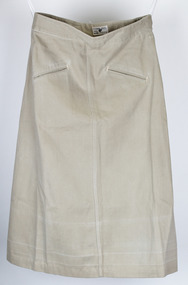
Skirt, 1940s
... fabric. A-line skirt constructed of four panels with two darts on the back and two pockets on the front (as per photograph in Supplementary File). Side fastening on the left side with a series of four steel hook and eye fasteners. Two fasteners on the back waistband which are tightened by pulling...fabric. A-line skirt constructed of four panels with two darts on the back and two pockets on the front (as per photograph in Supplementary File). Side fastening on the left side with a series of four steel hook and eye fasteners. Two fasteners on the back waistband which are tightened by pulling ...This skirt belonged to Joan Elizabeth Peck who served with the Royal Australian Air Force in the Second World War. Joan was born on 27 July 1919 in Acton England and enlisted in Echuca on the 6 January 1943. At the time of her discharge from the RAAF in 1945, Joan was serving as an Aircraftwoman with the 2 Air Observers School in Mount Gambier. Throughout the war, the Mt Gambier base operated under the Empire Air Training Scheme.This skirt was donated by the owner, Joan Peck, and has significant provenance. The inscriptions throughout facilitate significant research ability, though records are not publicly accessible and digitised at this time. Joan Peck’s uniform is also significant as an item of social history, revealing the role of local women in the home front war effort. Light khaki coloured skirt in cotton fabric. A-line skirt constructed of four panels with two darts on the back and two pockets on the front (as per photograph in Supplementary File). Side fastening on the left side with a series of four steel hook and eye fasteners. Two fasteners on the back waistband which are tightened by pulling through two steel rings. Peach-cream coloured bias binding on interior of hem. Label attached to the interior waistband of the skirt back, to the left and right of which is a handwritten inscription.Waistband label reads: “V298/MADE IN/AUSTRALIA/1942/SIZE PECK” Inscription handwritten on waistband interior: “105135.” To the right of the interior label: “J. E. PECK”skirt, uniform, second world war, royal australian air force, world war ii, women -
 Bendigo Historical Society Inc.
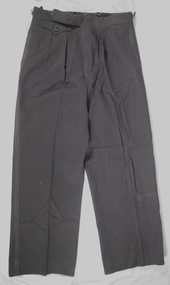
Clothing - MEN'S SUIT TROUSERS Spare pair
... fabric. There is a fly opening at the front with three buttons and a metal hook and catch at the waist. There is a tightening band affixed to each side of the waist with a pull through metal catch. ...fabric. There is a fly opening at the front with three buttons and a metal hook and catch at the waist. There is a tightening band affixed to each side of the waist with a pull through metal catch. ...Social The pants are of a woollen material with braided stripes down each side from top of waistline to bottom of cuff. The pockets are of cotton fabric. There is a fly opening at the front with three buttons and a metal hook and catch at the waist. There is a tightening band affixed to each side of the waist with a pull through metal catch. Six buttons are affixed to the inside of the waistband to allow for the attachment of braces. The waistline is satin and hessian lined. There are pockets on the left front and back and deep side pockets on each side. This is a spare set of trousers for the Tails suit in box 1010.clothing, tails suit trousers -
 Bendigo Historical Society Inc.
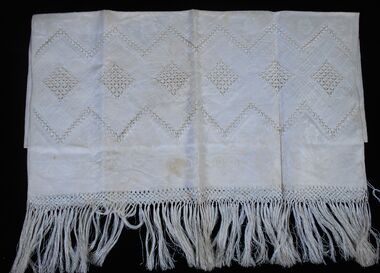
Textile - FAVALORO COLLECTION: DOUBLE DAMASK TABLE RUNNER/COVER WITH PULLED THREAD EMBROIDERY, Early - mid 1900's
... Damask weave fabric, with a design of a rose, with buds, and two stems of leaves, and a lovely soft sheen. Two bands of six zig zag peaks, are made by using pulled thread embroidery, and form a border either side of a row of pulled threadwork diamond shapes, 7 cm x 7 cm. ...Damask weave fabric, with a design of a rose, with buds, and two stems of leaves, and a lovely soft sheen. Two bands of six zig zag peaks, are made by using pulled thread embroidery, and form a border either side of a row of pulled threadwork diamond shapes, 7 cm x 7 cm. ...Textiles. Damask weave fabric, with a design of a rose, with buds, and two stems of leaves, and a lovely soft sheen. Two bands of six zig zag peaks, are made by using pulled thread embroidery, and form a border either side of a row of pulled threadwork diamond shapes, 7 cm x 7 cm. This decorative border is at each end of the runner, which also is completed with a 12 cm deep fringe. A geometric patterned weave forms the background to the pulled thread embroidery, while a single rose and bud weave is tucked into each zig zag, and a scroll design features at each fringed end.textiles, domestic, double damask table runner -
 Bendigo Historical Society Inc.
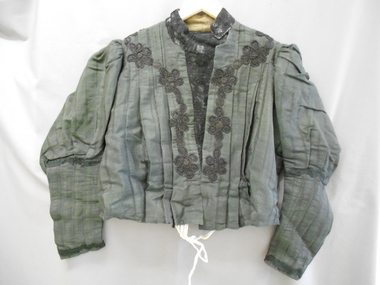
Clothing - ANDREW - MONSANT COLLECTION: LADIES DRESS - BODICE AND SKIRT, LADIES DRESS, 1909
... Fabric has alternating stripes of pulled thread pattern and wider stripes of small dot pattern. ...Fabric has alternating stripes of pulled thread pattern and wider stripes of small dot pattern. ...BHS CollectionWaist length dark green cotton bodice. Fabric has alternating stripes of pulled thread pattern and wider stripes of small dot pattern. Front opening with deep V to waist with lined lace insert extending from throat to waist. LHS of bodice fastened to lace insert with five press studs. Stand up collar of lined black lace (%cm) fastened with two hook and eyes. The bodice is made from five pieces. The two front sections have three knife pleats facing out and falling from the shoulder. The pleats are stitched down for twenty cms from the shoulders. On either side of the front opening is decorative embroidered black lace that extends across the shoulders to the back of the collar. There are two side panels from under the arm. The back section has three box pleats falling from the collars and tapering to the waist. The hem of the bodice is fastened with black cotton tape. Leg of mutton sleeves are trimmed with black embroidered brais at elbow and wrist. Lower sleeves have pintucks from elbow to wrist. The sleeves are lined with black cotton fabric. The back of the bodice is lined with black cotton fabric almost to the hem. A three cm piece of white and blue cotton tape is attached across the lower back with cotton ties at either end. The underarm panels are lined with brown cotton fabric and green satin inserted sections. The front has a separate lining with front opening and shaped with darts. Fastened with six buttons and buttonholes. Two shoulder pads on each side- one white piece under the shoulder and a green satin piece under the gathered section of each sleeve. Dark green full length skirt. Cotton fabric with alternating stripes of pulled thread pattern and wider stripe of small dot pattern. Skirt is made of three sections. Centre front panel widens slightly to hemline. Side panels continue around to join at centre back. Darts at both hips to shape sides. Panels widen to hemline. Inverted pleats at either side of back opening create fullness. Back opening(30cm) has insert of black satin joined to LHS of opening to enlarge the opening. Insert attached to waist band with two press studs. Two other press studs attach skirt to RHS of insert. Brown cotton waistband hand stitched to skirt. Ties attached to waistband at back opening- one cotton tape, one satin ribbon. Front centre panel has a piece of black satin stitched as lining from eighteen cm below waist (57cm deep). Stitched across and attached to side seams. Lower edge trimmed with black lace. Second piece of satin lining stitched to centre seam and stitched around the hip to partway across back.(Looks like a nylon petticoat cut in two pieces and stitched inside skirt as a lining). Hemline has fifteen cm piece of cotton lining attached and lower edge of hem has fringed cotton binding attached.. Side seams of front panel have decorative trim of embroidered braid extending seventy-six cms from waist. Braid then turned ninety degrees and continued in a horizontal zig zag line around to centre back seam (both sides) twenty cms above hem. Hand and machine stitched.costume, female, ladies dress- bodice. -
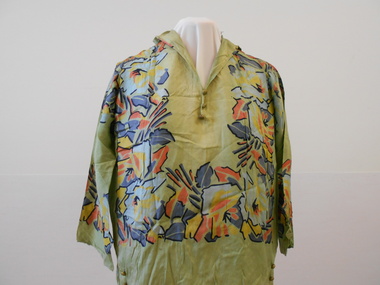 Bendigo Historical Society Inc.
Clothing - LADIES LONG SLEEVED TOP, 1960's-1970's
... fabric with abstract patterns in grey, black, blue, yellow and orange.4 cm stand up collar. Front slit opening from throat with narrow hand stitched hem. Three 1 cm decorative metallic look shank buttons at lower end of slit. Top made from two pieces-falling straight to hipline. No shaping. On either side of side seams at hip level are three decorative metallic look shank buttons on the front and three corresponding loops on the back. If fastened together the top is pulled...fabric with abstract patterns in grey, black, blue, yellow and orange.4 cm stand up collar. Front slit opening from throat with narrow hand stitched hem. Three 1 cm decorative metallic look shank buttons at lower end of slit. Top made from two pieces-falling straight to hipline. No shaping. On either side of side seams at hip level are three decorative metallic look shank buttons on the front and three corresponding loops on the back. If fastened together the top is pulled ...Green long sleeved ladies top. Leaf green fabric with abstract patterns in grey, black, blue, yellow and orange.4 cm stand up collar. Front slit opening from throat with narrow hand stitched hem. Three 1 cm decorative metallic look shank buttons at lower end of slit. Top made from two pieces-falling straight to hipline. No shaping. On either side of side seams at hip level are three decorative metallic look shank buttons on the front and three corresponding loops on the back. If fastened together the top is pulled in and tightened at the hip level. Long sleeves are straight without shaping. Press studs at centre of openings at wrist.costume, female, ladies long sleeved top -
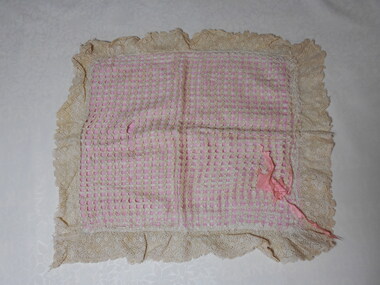 Bendigo Historical Society Inc.
Textile - LINGERIE BAG
... Cream coloured tapestry fabric on both sides. All over pulled thread work to form lattice pattern. ...Cream coloured tapestry fabric on both sides. All over pulled thread work to form lattice pattern. ...Textiles, lingerie or stocking bag. Cream coloured tapestry fabric on both sides. All over pulled thread work to form lattice pattern. All over cross stitch pattern on lattice with cream coloured thread. Cream coloured 5 cm gathered lace edging on four sides. 12 cm opening on one side. Lined with pink cotton fabric. Hand made.textiles, domestic, lingerie bag. -
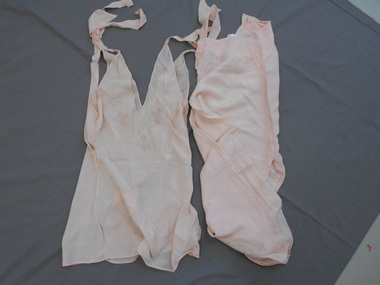 Bendigo Historical Society Inc.
Clothing - PINK SILK PYJAMAS
... pulled thread embroidery, in a floral design, outlines the V neckline in the front. A tiny 10 cm x 10 cm heart shaped pocket is bound at the edges and sits at lower right front. A small dart, 1 cm x 6 cm long is below the armholes, on each side seam. Fabric...pulled thread embroidery, in a floral design, outlines the V neckline in the front. A tiny 10 cm x 10 cm heart shaped pocket is bound at the edges and sits at lower right front. A small dart, 1 cm x 6 cm long is below the armholes, on each side seam. Fabric ...Clothing. Deep V neckline, front and back, has a tapered tie, at the shoulder to 4.5 cm, and slanted at the lower edge of the tie. The V neckline has a fine binding finish as do the armholes, and the lower edge of the bodice. Shadow, and pulled thread embroidery, in a floral design, outlines the V neckline in the front. A tiny 10 cm x 10 cm heart shaped pocket is bound at the edges and sits at lower right front. A small dart, 1 cm x 6 cm long is below the armholes, on each side seam. Fabric is cut on the cross to add flair. A two cm x 60 cms tie attaches at each side seam, and would tie at the back. Clothing. Pyjama pants have a V shaped waistband 11 cm deep at front and back, below which is a small 1.5 cm wide pleat on either side of front and back. An 11 cm deep plackett on both side seams - on the left hand side two x 1 cm pearl buttons and buttonholes fasten the plackett. The two buttons on the right hand side are missing. A panel of shadow embroidery decorates the outside lower edge of the trouser leg. Fabric is woven with a floral design. Lower edge of legs are finished with a fine binding. 11 cm peak at waistband. Pants with hem 88 cms, width at ankles 64 cms.Silk and Rayon Made in Chinacostume, female, pink silk pyjamas (bodice) -
 St Vincent's Hospital Melbourne Archives
Uniform - St Vincent's Hospital Melbourne nurse's veil, circa 1937
... fabric veil. It has machine embroidered dark navy capital letters "SRN VICTORIA" on one end. The veil has a deep pulled- thread, hand- stitched hem. ...fabric veil. It has machine embroidered dark navy capital letters "SRN VICTORIA" on one end. The veil has a deep pulled- thread, hand- stitched hem. ...Nurse Isabel Kilpatrick graduated from St Vincent's Hospital Melbourne Training School in 1937. During the three training years, nurses wore a cap. At graduation, nurses gained their nursing or "sisters" veil or " captail". It was worn proudly as recognition of achievement and identified the sister as now a Victorian State Registered Nurse or SRN.isobel kilpatrick, nurses veil, captail, state registered nurse, st vincent's hospital melbourne, nurse training, graduation veil -
St Vincent's Hospital Melbourne Archives
Uniform - St Vincents Hospital Melbourne nurses' veil belonging to graduate Kathleen Morgan in 1942
... fabric veil. It has machine embroidered dark navy capital letters "SRN VICTORIA" on one end. It has a deep pulled- thread- hand- stitched hem....fabric veil. It has machine embroidered dark navy capital letters "SRN VICTORIA" on one end. It has a deep pulled- thread- hand- stitched hem. ...Nurse Kathleen Morgan graduated from St Vincent's Hospital Melbourne Training School in 1942. At graduation, nurses gained their nursing or "sisters" veil as a Victorian state registered nurse.st. vincent's hospital melbourne nurse training, kathleen morgan, nurses veil -
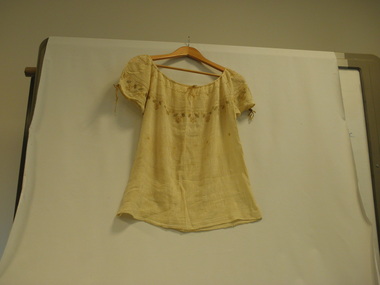 Ithacan Historical Society
Photograph, Embroidered Blouse
... pull out each fine white tapestry thread until only the embroidery remained around the yolk of the blouse. Throughout the centuries and up until the 1970s-80s, the women of Ithaca spun, wove, embroidered and knitted. Mothers prepared their daughters' 'glory boxes' trousseau (prikia), weaving bedspreads, rag mats (koureloudes) for everyday use, finer wool rugs for formal use, as well as linen sheets, pillowcases, blankets, towels and tablecloths. Linen was also woven to make the mattress that the young brides would take to their future homes. Mothers also wove and embroidered the fabric ...The blouse was made in Greece about 1945. The method used to create this fine embroidery was to copy a design from a cross stitch embroidery book guided by fine white tapestry threads tacked onto the yolk; when the design was finished, the embroiderer would pull out each fine white tapestry thread until only the embroidery remained around the yolk of the blouse.Throughout the centuries and up until the 1970s-80s, the women of Ithaca spun, wove, embroidered and knitted. Mothers prepared their daughters' 'glory boxes' trousseau (prikia), weaving bedspreads, rag mats (koureloudes) for everyday use, finer wool rugs for formal use, as well as linen sheets, pillowcases, blankets, towels and tablecloths. Linen was also woven to make the mattress that the young brides would take to their future homes. Mothers also wove and embroidered the fabric for their daughters' underwear and petticoats, nightgowns, etc. Sewing of the garments was also done by hand. The girls embroidered handicrafts using various stitches, they crocheted lace, netted pillows and even linen carpets. The handicrafts were usually embroidered by hand in cross-stitch using linen and cotton fabric. At the time there were merchants who travelled to the villages to sell machine made goods for the trousseaus, but most of the dowries consisted of the beautifully crafted work of the women. In the 30's the SINGER Company came to Ithaca and taught the girls sewing on the machine. A handwoven silk blouse. Colour - ecru. Hand embroidered, hand sewn, very fine white tapestry was tacked round the yolk; a gusset was sewn under each short puff sleeve at the armpit; two-tone hand made silk thread cords were passed through the hollow border of the sleeves and neckline. -
 Embroiderers Guild, Victoria
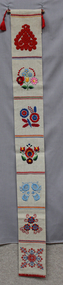
Textile - Sampler/Bell pull, Merle Whittle, Sept-1983
... Result of class with Gabriella Szokolyai Embroidery Hungary Bell Pull flower floral surface stitchery Fabric label " Hungarian Sampler: 1-, 2-Kalocsa, 3- Paloc, 4- Matyo, 5- ,6- Buzsak, 7- , Sept. 1983 with Gabriella Szokluai, Merle Whittle Long bell pull with 7 panels of different panels depicting Hungarian embroidery. ...Result of class with Gabriella SzokolyaiLong bell pull with 7 panels of different panels depicting Hungarian embroidery. Some stitches of which are listed on the back. Top edge is in a narrow rod with red cord and tassels.Fabric label " Hungarian Sampler: 1-, 2-Kalocsa, 3- Paloc, 4- Matyo, 5- ,6- Buzsak, 7- , Sept. 1983 with Gabriella Szokluai, Merle Whittleembroidery, hungary, bell pull, flower, floral, surface stitchery -
 Embroiderers Guild, Victoria
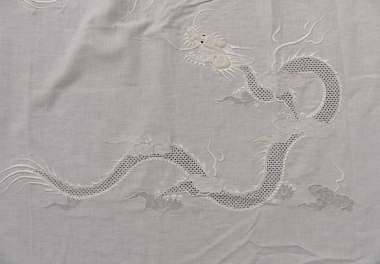
Textile - Chinese Whitework Table cloth, 20th century
... Embroidery Surface stitchery Drawn fabric 20th century Oriental Table Cloth Drawn fabric White linen table cloth and eight napkins, four with people motifs and four with dragons. Filled with pulled thread embroidery. ...From the estate of Dorothy Giderson. Dorothy Giderson Biography in the Museum folder.White linen table cloth and eight napkins, four with people motifs and four with dragons. Filled with pulled thread embroidery. Large cloth with motifs to match napkins.embroidery, surface stitchery, drawn fabric, 20th century, oriental, table cloth, drawn fabric -
 Embroiderers Guild, Victoria
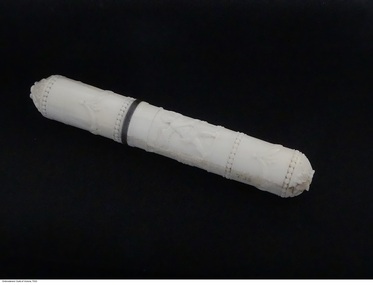
Tool - Ivory bodkin case, Bokin case
... A Bodkin is shaped like an oversized sewing needle with a blunt point and large eye and is used to pull a drawstring through a fabric casing- an essential to clothes fastenings for centuries....A Bodkin is shaped like an oversized sewing needle with a blunt point and large eye and is used to pull a drawstring through a fabric casing- an essential to clothes fastenings for centuries. ...A Bodkin is shaped like an oversized sewing needle with a blunt point and large eye and is used to pull a drawstring through a fabric casing- an essential to clothes fastenings for centuries.When most clothes were laced, bodkins were essential tool for dressing. This is a luxury item in which to store bodkins Cylindrical ivory bodkin case decorated with bas relief classical design of two cherubs, four 'beaded' rings and flower and leaf motifs on each end. Cap has horn edging. Containing three bodkinsbodkin -
Embroiderers Guild, Victoria
Tool - Brass, Bodkin case
... A Bodkin is shaped like an oversized sewing needle with a blunt point and large eye and is used to pull a drawstring through a fabric casing- an essential to clothes fastenings for centuries....A Bodkin is shaped like an oversized sewing needle with a blunt point and large eye and is used to pull a drawstring through a fabric casing- an essential to clothes fastenings for centuries. ...A Bodkin is shaped like an oversized sewing needle with a blunt point and large eye and is used to pull a drawstring through a fabric casing- an essential to clothes fastenings for centuries.When most clothes were laced, bodkins were essential tool for dressing. This is a luxury item in which to store bodkins Cylindrical ivory bodkin case decorated with bas relief classical design of two cherubs, four 'beaded' rings and flower and leaf motifs on each end. Cap has horn edging. Containing three bodkinsbodkin -
Embroiderers Guild, Victoria
Tool - Bodkin, Bodkin case
... A Bodkin is shaped like an oversized sewing needle with a blunt point and large eye and is used to pull a drawstring through a fabric casing- an essential to clothes fastenings for centuries....A Bodkin is shaped like an oversized sewing needle with a blunt point and large eye and is used to pull a drawstring through a fabric casing- an essential to clothes fastenings for centuries. ...A Bodkin is shaped like an oversized sewing needle with a blunt point and large eye and is used to pull a drawstring through a fabric casing- an essential to clothes fastenings for centuries.When most clothes were laced, bodkins were essential tool for dressing. This is a luxury item in which to store bodkins Cylindrical ivory bodkin case decorated with bas relief classical design of two cherubs, four 'beaded' rings and flower and leaf motifs on each end. Cap has horn edging. Containing three bodkinsbodkin -
Embroiderers Guild, Victoria
Tool - Bodkin, Bodkin case
... A Bodkin is shaped like an oversized sewing needle with a blunt point and large eye and is used to pull a drawstring through a fabric casing- an essential to clothes fastenings for centuries....A Bodkin is shaped like an oversized sewing needle with a blunt point and large eye and is used to pull a drawstring through a fabric casing- an essential to clothes fastenings for centuries. ...A Bodkin is shaped like an oversized sewing needle with a blunt point and large eye and is used to pull a drawstring through a fabric casing- an essential to clothes fastenings for centuries.When most clothes were laced, bodkins were essential tool for dressing. This is a luxury item in which to store bodkins Cylindrical ivory bodkin case decorated with bas relief classical design of two cherubs, four 'beaded' rings and flower and leaf motifs on each end. Cap has horn edging. Containing three bodkinsbodkin -
Embroiderers Guild, Victoria
Tool - Bodkin, Bodkin case
... A Bodkin is shaped like an oversized sewing needle with a blunt point and large eye and is used to pull a drawstring through a fabric casing- an essential to clothes fastenings for centuries....A Bodkin is shaped like an oversized sewing needle with a blunt point and large eye and is used to pull a drawstring through a fabric casing- an essential to clothes fastenings for centuries. ...A Bodkin is shaped like an oversized sewing needle with a blunt point and large eye and is used to pull a drawstring through a fabric casing- an essential to clothes fastenings for centuries.When most clothes were laced, bodkins were essential tool for dressing. This is a luxury item in which to store bodkins Cylindrical ivory bodkin case decorated with bas relief classical design of two cherubs, four 'beaded' rings and flower and leaf motifs on each end. Cap has horn edging. Containing three bodkinsbodkin -
 Embroiderers Guild, Victoria
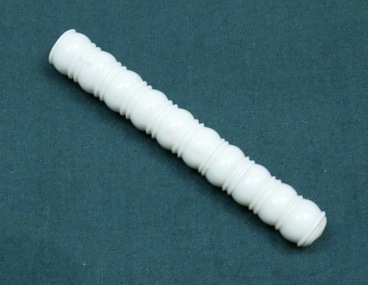
Tool - Ivory bodkin case, Bodkin case, late 18th to 19th century
... A Bodkin is shaped like an oversized sewing needle with a blunt point and large eye and is used to pull a drawstring through a fabric casing- an essential to clothes fastenings for centuries....A Bodkin is shaped like an oversized sewing needle with a blunt point and large eye and is used to pull a drawstring through a fabric casing- an essential to clothes fastenings for centuries. ...A Bodkin is shaped like an oversized sewing needle with a blunt point and large eye and is used to pull a drawstring through a fabric casing- an essential to clothes fastenings for centuries.When most clothes were laced, bodkins were essential tool for dressing. This is a luxury item in which to store bodkins Cylindrical ivory bodkin case decorated with concentric creating a segmented appearancebodkin case, ivory
