
Showing 29 items matching "pulley system"
-
 Flagstaff Hill Maritime Museum and Village
Equipment - Block, Tangyes engineering, Early 20th century
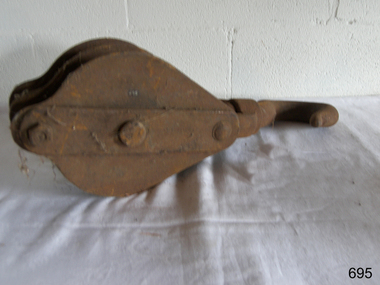
... ...pulley system...Flagstaff Hill has a wide variety of these simple but very important pieces of equipment. warrnambool Flagstaff Hill Maritime Museum and Village Maritime Museum Maritime Village Great Ocean Road Shipwreck Coast block metal block two sheave block marine technology rigging Tangye ship rigging block with hook and becket becket block sailing block cargo block Tangyes block vintage nautical pulley rigging equipment pulley system functional machine machine lifting equipment marine equipment Richard Tangye & Brothers James Tangye and Brothers Tangye Brothers and Price Tangye Brothers Tangye Brothers & Holman Tangyes Ltd. ...This metal block may have been used as part of a boat or ship's rigging or winch. The becket is the loop or ring where a shackle could be attached to use as a pulley. The two-sheaved block has a mechanical advantage over a single-sheave block, using less power to lift a load. The block was made by Tangyes, established in Birmingham, UK, in 1857, and renowned for producing high-quality, reliable machines, equipment, and tools in the late 19th and early 20th centuries. Richard Tangye (1833–1906) and four of his brothers—James, Joseph, Edward, and George—were the sons of Joseph Tangye, a Quaker Cornish miner. In 1857, they founded the engineering firm Richard Tangye & Brothers in Birmingham, UK. In 1860, the firm became Tangye Brothers and moved to Cornwall Works in Birmingham. The business encouraged inventors to join the company and develop their patents there, as happened with Weston’s differential pulley block, invented by the Englishman Thomas Aldridge Weston in 1854. Tangye bought the patent in 1858, giving the firm the sole right to manufacture it. The design received a medal for “original application, practical utility and success” at the 1862 International Exhibition in London. Also in 1858, the Tangye firm was commissioned by Brunel’s shipping company to manufacture hydraulic lifting jacks, or rams, to launch the steamship SS Great Eastern. The success of this project brought favourable attention to the firm, and it became involved in other notable projects, including the erection of Cleopatra’s Needle in London in 1878 and work on the Forth Road Bridge in Scotland. The firm underwent several name changes over the years, including James Tangye and Brothers (1857), Tangye Brothers and Price (1859), Tangye Brothers (1860), Tangye Brothers & Holman (1876), Tangye Brothers (by 1878), Tangye Ltd. (1881), and then simply Tangye. Its machinery and equipment were exported worldwide. In 1884, a branch with showrooms, offices, and a warehouse was opened in Melbourne at Cornwall House, Collins Street West. The firm was well known for producing high-quality machinery for agriculture and industry. Even today, new Tangye machinery is available for a subsidiary of Allspeeds. An extensive account of the firm’s history, names, inventions, and further references is available in Grace’s Guide, which also includes references to and diagrams of the Tangye horizontal steam engine. The block is significant for its connection to the renowned and innovative Tangye machine makers, respected for their high quality and standards. The block's maker,, Tangyes, also manufactured an 1880s steam engine, sold by a Melbourne merchant, and locally significant for its use in a late-19th century cheese factory. The block also represents the many blocks used in many industries, including the marine concerns, for rigging and lifting. Flagstaff Hill has a wide variety of these simple but very important pieces of equipment.Becket block: a metal block with two sheaves, a hook, a becket attachment point, and straps. Inscription embossed. Made by Tangyes."TANGYES"warrnambool, flagstaff hill maritime museum and village, maritime museum, maritime village, great ocean road, shipwreck coast, block, metal block, two sheave block, marine technology, rigging, tangye, ship rigging, block with hook and becket, becket block, sailing block, cargo block, tangyes block, vintage, nautical pulley, rigging equipment, pulley system, functional machine, machine, lifting equipment, marine equipment, richard tangye & brothers, james tangye and brothers, tangye brothers and price, tangye brothers, tangye brothers & holman, tangyes ltd., cornwall works -
 Bendigo Military Museum
Memorabilia - DIORAMA, KOKODA, Post WW2
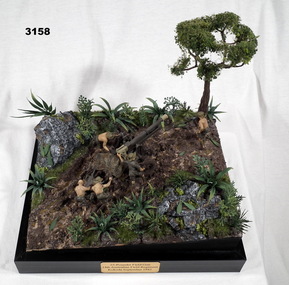
... Diorama mounted on black base. 1/35 scale model of 25 pounder field gun with 5 man crew maneuvering a gun into position around a tree with a pulley system. ...Diorama inspired by image from State Library of Victoria image No H98 104 / 2102. military history-army arms-ordnance handcrafts Kokoda In black print on gold name plate attached to front of black base:: “25 Pounder Field Gun 14th Australian Field Regiment, Kokoda, September 1942” Diorama mounted on black base. 1/35 scale model of 25 pounder field gun with 5 man crew maneuvering a gun into position around a tree with a pulley system. Memorabilia DIORAMA, KOKODA Justin Weston ...Diorama inspired by image from State Library of Victoria image No H98 104 / 2102.Diorama mounted on black base. 1/35 scale model of 25 pounder field gun with 5 man crew maneuvering a gun into position around a tree with a pulley system. In black print on gold name plate attached to front of black base:: “25 Pounder Field Gun 14th Australian Field Regiment, Kokoda, September 1942”military history-army, arms-ordnance, handcrafts, kokoda -
 Whitehorse Historical Society Inc.
Functional object - Flower Pot Mould
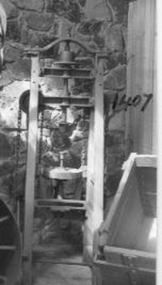
... The 'pedal' operates a chain and pulley system....The 'pedal' operates a chain and pulley system. Functional object Flower Pot Mould ...Mould for making flower pots (terra cotta). Made of steel framing with a 'pedal' operated moulding shaft for forming pots of various sizes. The 'pedal' operates a chain and pulley system.ceramics, terracotta -
 Christ Church Anglican Parish of Warrnambool
Sanctuary Lamp
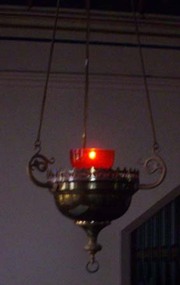
... The lamp hangs from a pulley system by three brass chains. These are connected to three ornate 'wings' attached to the bowl....The lamp hangs from a pulley system by three brass chains. These are connected to three ornate 'wings' attached to the bowl. ...This sanctuary lamp was presented to by the Reverend Albert Thomas Hope in memory of his wife.Brass sanctuary lamp with inner red glass light holder. Connected to electricity. The lamp hangs from a pulley system by three brass chains. These are connected to three ornate 'wings' attached to the bowl.sanctuary lamp, christ church warrnambool, beatrice hope, reverend albert thomas hope, -
 El Dorado Museum Association Inc.
Photograph - Digital Image
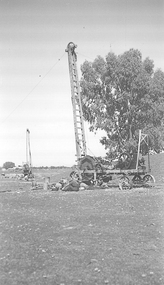
... Digital image copied from a black and white photograph of churn drill, attached to tall, ladder-like, pulley system, undertaking tests in field, with large tree behind it. ...Drilling tests. mining gold gold mining tin tin mining churn drill drilling machinery el dorado eldorado Digital image copied from a black and white photograph of churn drill, attached to tall, ladder-like, pulley system, undertaking tests in field, with large tree behind it. ...Drilling tests.mining, gold, gold mining, tin, tin mining, churn drill, drilling, machinery, el dorado, eldorado -
 Orbost & District Historical Society
buggy wheel lifter, 1910 -1920
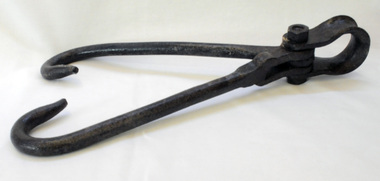
... The hooks fit under the rim to enable the wheel to be lifted with a pulley / crane system operated by a man or a horse....The hooks fit under the rim to enable the wheel to be lifted with a pulley / crane system operated by a man or a horse. buggy wheel lifter Russell, John snr ...This item was made by John Russell Senior, a blacksmith, wheelwright, farmer and later chairman of the Orbost Butter Factory, makers of Sunny South Butter (today part of Murray Goulburn Co Ltd). The buggy lifter was handed down to George Henry Russell (Doug), the second son between 1970 and 1973.Blacksmiths played an essential part in the regional parts of Victoria and were required to use their ingenuity and skills to design and make tools needed on local farms. This item is an example of a tool specifically designed for a horse-drawn wagon. Horse-drawn wagons are an important part of Australia’s agricultural history. Light buggies were popular with farmers for trips into town before the common use of motorised vehicles.A metal buggy wheel lifter. It has two hooks connected at the top by a bolt and a shackle. The hooks fit under the rim to enable the wheel to be lifted with a pulley / crane system operated by a man or a horse.tool buggy-lifter russell-john blacksmith wheelwright -
 Orbost & District Historical Society
double bag hook, late 19th -first half 20th century
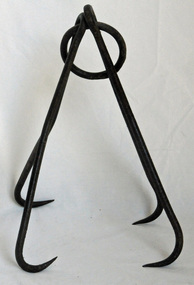
... This hook was probably used in lift sacks of corn / maize to the lofts in the barns using a pulley beam system sometimes driven by a small tractor or a horse....This hook was probably used in lift sacks of corn / maize to the lofts in the barns using a pulley beam system sometimes driven by a small tractor or a horse. ...This hook was probably used in lift sacks of corn / maize to the lofts in the barns using a pulley beam system sometimes driven by a small tractor or a horse.This item is connected to the agricultural history of the Snowy River flats of the Orbost district. Intensive farming for maize was an integral part of the history of Orbost.A double bag hook consisting of two double metal hooks on a metal ring.bag-hook rural -
 Flagstaff Hill Maritime Museum and Village
Equipment - Bosun's Chair, ca. mid-20th century
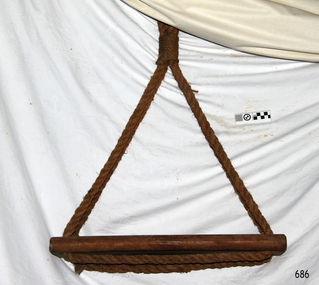
... It looks a little like a child's swing but usually has a pulley system that allows the user to adjust the length of the hanging piece of rope, and in so-doing adjusts the height above the floor or ground or sea. ...It looks a little like a child's swing but usually has a pulley system that allows the user to adjust the length of the hanging piece of rope, and in so-doing adjusts the height above the floor or ground or sea. ...The bosun’s chair is a typical piece of equipment included on board a vessel in the late 19th and early 20th century. The nautical word 'bosun' is an abbreviation of the word 'boatswain' who is the person responsible for the repair and maintenance of the vessel. It could be used when rigging the sails and for rescue at sea, along with a thick rope anchored on shore or a rope between ships. It could also be used to move passengers to and from a ship as well as cargo on, to and from the vessel. A bosun's chair is a simple piece of equipment made from a short plank of wood and a sturdy piece of rope. It looks a little like a child's swing but usually has a pulley system that allows the user to adjust the length of the hanging piece of rope, and in so-doing adjusts the height above the floor or ground or sea. In modern times a harness would also be worn by the bosun’s chair user for safety reasons. Bosun's chairs are also used by window cleaners, construction workers and painters. The bosun’s chair is sometimes just a short plank, or even a canvas sling. The bosun's chair is significant for its association with maritime equipment carried on board a vessel in the late 19th and early 20th century for maintenance and safety purposes. It was occasionally used to save lives. The bosun's chair is also significant as an early version of equipment still used today. Since its invention there have been many safety features added in certain industries such as window cleaning and painting.Bosuns chair; flat smooth rectangular piece of wood, with rope passing through two holes at each end of plank and looped together above plank to form a suspended seat swing. Loops a are joined with knot work and ends are spliced together under the seat.flagstaff hill, warrnambool, maritime village, maritime museum, flagstaff hill maritime museum & village, shipwreck coast, great ocean road, bosun's chair, bosuns chair, boatswains chair, rigging, maritime equipment, bosun's seat, life saving, marine technology, ship rigging -
 Flagstaff Hill Maritime Museum and Village
Equipment - Bosun's Chair, ca. mid-20th century
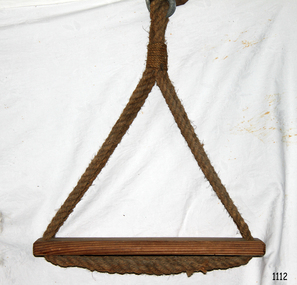
... It looks a little like a child's swing but usually has a pulley system that allows the user to adjust the length of the hanging piece of rope, and in so-doing adjusts the height above the floor or ground or sea. ...It looks a little like a child's swing but usually has a pulley system that allows the user to adjust the length of the hanging piece of rope, and in so-doing adjusts the height above the floor or ground or sea. ...The bosun’s chair is a typical piece of equipment included on board a vessel in the late 19th and early 20th century. The nautical word 'bosun' is an abbreviation of the word 'boatswain' who is the person responsible for the repair and maintenance of the vessel. It could be used when rigging the sails and for rescue at sea, along with a thick rope anchored on shore or a rope between ships. It could also be used to move passengers to and from a ship as well as cargo on, to and from the vessel. A bosun's chair is a simple piece of equipment made from a short plank of wood and a sturdy piece of rope. It looks a little like a child's swing but usually has a pulley system that allows the user to adjust the length of the hanging piece of rope, and in so-doing adjusts the height above the floor or ground or sea. In modern times a harness would also be worn by the bosun’s chair user for safety reasons. Bosun's chairs are also used by window cleaners, construction workers and painters. The bosun’s chair is sometimes just a short plank, or even a canvas sling. The bosun's chair is significant for its association with maritime equipment carried on board a vessel in the late 19th and early 20th century for maintenance and safety purposes. It was occasionally used to save lives. The bosun's chair is also significant as an early version of equipment still used today. Since its invention there have been many safety features added in certain industries such as window cleaning and painting.Bosuns chair, rectangular slab of wood with two holes at both ends through which rope ends are threaded for support and the loops above the seat are tied with sailor's knotting to form a triangle. flagstaff hill, warrnambool, maritime village, maritime museum, flagstaff hill maritime museum & village, shipwreck coast, great ocean road, bosun's chair, bosuns chair, boatswains chair, rigging, maritime equipment, bosun's seat, life saving, marine technology, ship rigging -
 Warrnambool and District Historical Society Inc.
Functional object - Canisters, Cash Carriers from Swintons Store, Early 20th century
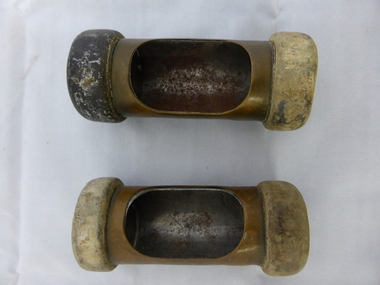
... William Lamson of Massachusetts, U.S.A. first patented cash carriers in 1882 and originally the cash balls were carried from counter to cashier via a wire and pulley system. These Swinton cash carriers were carried via pneumatic tubes. ...William Lamson of Massachusetts, U.S.A. first patented cash carriers in 1882 and originally the cash balls were carried from counter to cashier via a wire and pulley system. These Swinton cash carriers were carried via pneumatic tubes. ...These cash carriers were used in the Warrnambool business of Swintons Pty Ltd. They were manufactured by Lamson of U.S.A. William Lamson of Massachusetts, U.S.A. first patented cash carriers in 1882 and originally the cash balls were carried from counter to cashier via a wire and pulley system. These Swinton cash carriers were carried via pneumatic tubes. William and Ann Swinton migrated to Australia in 1854 and for a decade William Swinton worked as a builder and carpenter in the Warrnambool area, erecting many buildings, including the Wangoom Presbyterian Church. In 1865 he opened a store in Timor Street, Warrnambool, selling groceries, hardware, glassware and china. By 1888 the business was known as William Swinton and Sons. Branch stores were opened in Cudgee, Nullawarre, Wangoom, West Warrnambool and South Warrnambool. After William Swinton’s death his son Robert became the first managing director of Swintons Pty Ltd. In 1934 the business split, with George Swinton and Sons selling furnishings, clothing and glassware and Swintons Pty Ltd selling seeds, produce and hardware. Today the Swinton family still operates a furniture and bedding store in Timor Street. These cash carriers are of great interest firstly as a memento of business practices in the past and secondly because they were used in the Warrnambool business of Swintons Pty Ltd. The current Swinton business in Timor Street Warrnambool is the oldest family business in Warrnambool and, with the name Swinton associated with Timor Street businesses for 152 years, it is amongst the oldest family businesses in Australia. These are two cash carriers. They are brass cylinders made with a large opening at the top with an inner lining which can close over the opening. The cylinder has two wooden holders at each end attached to the brass with three metal screws at each end. The brass is somewhat rusted and the wooden ends are worn. These cash carriers were sent from the cash counter in a shop or business to the cashier via pneumatic tubes. ‘Lamson Patent’ ‘RCM/Lamson’ swinton family, warrnambool, history of warrnambool -
 Mission to Seafarers Victoria
Photograph - Photograph, Black and white, S.S. "Hororata's" Football Team, April 1923, April 1923
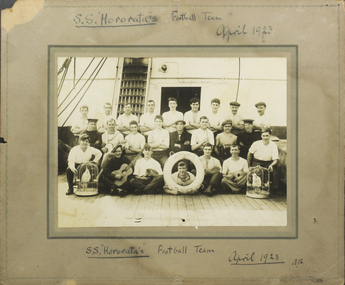
... Behind them is a ladder and what appears to be a door opening and on the left side of the photograph are some ropes and a pulley system....Behind them is a ladder and what appears to be a door opening and on the left side of the photograph are some ropes and a pulley system. S.S. "Hororata's" Football Team, April 1923 Photograph Photograph, Black and white ...This is a photograph of crew members that formed the football team of the S.S. Hororata. The vessel was ordered by the New Zealand Shipping Co Ltd of London, completed in 1914. In august of that year she was requisitioned ( as A20) for transport of the Australian expeditionary force in WW1. In WW2 she was known as the SS Waroonga and torpedoed in 1943. (Internet ref 2018) This vessel was a regular visitor to Melbourne and crews visited and contributed donations to the MTS.This photograph provides an early record of the many crew based football (soccer) teams that would enjoy matches when ashore with other crews. The Mission to seamen organised and promoted many such matches and encouraged the friendly competition during outings. In addition this particular group photograph is of interest as it indicates the many talents and interests of the crew through the items and animals the individuals are posed with. Sepia toned photograph of the S.S. "Hororata" Football Team dated April 1923. The photograph has been mounted onto a brown cardboard frame with the text 'S.S. "Hororata's" Football Team/April 1923' on the top and the bottom. The photograph itself is of 24 men in three rows, 9 on the top row, 8 in the middle row and 7 on the bottom row. The man in the bottom row furthest left is kneeling behind a bird cage with a cockatoo in it. The man second from the left is holding a guitar. The man third from the left is holding a cat. The man fourth from the left is lying down peeking through the buoy with the text "S.S. Hororata's/Plymouth". The man second from the right is holding a lute and the man furthest right on the bottom row is also kneeling behind a bird cage with a cockatoo. In the middle row, the man second from the left is holding a banjo. The man third from the right is holding a flute. The man second from the right is holding an accordion. All other men in the middle and top rows have their arms crossed. The men are situated on the ships deck. Behind them is a ladder and what appears to be a door opening and on the left side of the photograph are some ropes and a pulley system.On lower edge of mount handwritten in black ink: S.S. "Hororata" Football Team April 1923hat, 1923, uniform, pulley, cap, banjo, guitar, rope, cockatoo, accordion, flute, cat, ladder, ss hororata football team, ss hororata, lute, ww1, ww2, troopship, ship crew, deck, soccer, football, sports, crew photo, crews and ships -
 Flagstaff Hill Maritime Museum and Village
Equipment - Bosun's Chair, ca. 1922
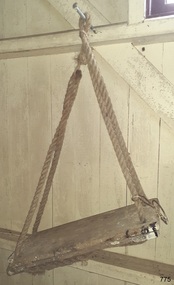
... It looks a little like a child's swing but usually has a pulley system that allows the user to adjust the length of the hanging piece of rope, and in so-doing adjusts the height above the floor or ground or sea. ...It looks a little like a child's swing but usually has a pulley system that allows the user to adjust the length of the hanging piece of rope, and in so-doing adjusts the height above the floor or ground or sea. ...This Bosun's char was part of the equipment on the vessel 'Reginald M. It is typical of items included on board a vessel in the late 19th and early 20th century. The nautical word 'bosun' is an abbreviation of the word 'boatswain' who is the person responsible for the repair and maintenance of the vessel. It could be used when rigging the sails and for rescue at sea, along with a thick rope anchored on shore or a rope between ships. It could also be used to move passengers to and from a ship as well as cargo on, to and from the vessel. A bosun's chair is a simple piece of equipment made from a short plank of wood and a sturdy piece of rope. It looks a little like a child's swing but usually has a pulley system that allows the user to adjust the length of the hanging piece of rope, and in so-doing adjusts the height above the floor or ground or sea. In modern times a harness would also be worn by the bosun’s chair user for safety reasons. Bosun's chairs are also used by window cleaners, construction workers and painters. The bosun’s chair is sometimes just a short plank, or even a canvas sling. The REGINALD M - The vessel “Reginald M” was a two-masted coastal ketch, owned and built by Mr. Jack (John) Murch of Birkenhead, Port of Adelaide, South Australia. Its construction took approximately 6 months and it was launched at Largs Bay in 1922. The vessel had many owners and adventures over the years until it was purchased by Flagstaff Hill Maritime Museum & Village in 1975 from the Melbourne Ferry Company at auction. It was then used as an active display until 2016. Visitors could go aboard, turn the ship's wheel, go below deck and get the feel of the captain's quarters, sailors' quarters and the storage space available. The Reginald M was a popular exhibit for young and old, until 2016.This bosun's chair is significant for its connection to the maritime history. It has been used for rigging, painting, maintenance and importantly for life saving and safety. The bonus's chair is also significant because of its connection to the history of the vessel REGINALD M, the coastal trading ketch from South Australia built in 1922 and in existence until 2016. Its flat bottom, single chine shape illustrates a very simple but robust method of construction, compared to other round bilged examples of trading vessels. The Reginald M is listed on the Australian Register of Historic Vessels (ARHV Number: HV000562.)Bosun's chair; seat is a rectangular plank of wood with a hole drilled in each corner and three reinforcing wood lengths attached below the plank. The ends of two looped thick ropes have been threaded through the holes in the plank, crossed over then spliced together. The loops of rope above the plank have been tied with light rope. A roughly made wire hook is attached at the base of one length of rope. Top surface reveals indents where the bottom wooden pieces are joined to the top and some of the metal fixtures can be seen along the edge. There are remnants of white paint on the top.flagstaff hill, warrnambool, maritime village, maritime museum, flagstaff hill maritime museum & village, shipwreck coast, great ocean road, bosun's chair, bosuns chair, boatswains chair, rigging, maritime equipment, bosun's seat, life saving, marine technology, ship rigging -
 Flagstaff Hill Maritime Museum and Village
Deadeye, circa 1873
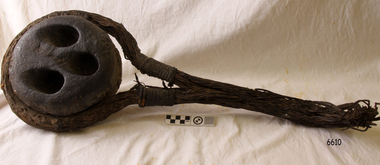
... Connecting a Lower deadeye to its corresponding Upper deadeye was a rope (called a lanyard) which looped up and down through the three “eyes” of each disc, to form a pulley system. The hitching of the two deadeyes with a looped lanyard provided the means of tightening, or loosening, the tension on the mast rigging ― essentially by pulling against the chain-plates bolted to the outside of the hull. ...Connecting a Lower deadeye to its corresponding Upper deadeye was a rope (called a lanyard) which looped up and down through the three “eyes” of each disc, to form a pulley system. The hitching of the two deadeyes with a looped lanyard provided the means of tightening, or loosening, the tension on the mast rigging ― essentially by pulling against the chain-plates bolted to the outside of the hull. ...This example of a sailing ship’s ‘dead-eye’ is from the wreck of the LOCH ARD, which sank near Port Campbell in 1878. The vessel was an iron hulled clipper ship constructed for the Loch Line in 1873. It was part of a fleet of similar merchant ships owned by that company, which specialised in bringing passengers and goods from London via the Great Circle route to Melbourne, and returning to Britain via Cape Horn with the colony’s wool clip. Deadeyes were a common feature of sailing ship technology in the nineteenth century. They were a simple, cheap, and hard-wearing device that, in conjunction with another deadeye, provided an effective means of levering, or tightening, attached ropes and stays. Lower deadeyes were fixed to the sides of the ship by an encircling metal collar (inset in a flattish groove chiselled around the outer circumference of the disc), which was bolted to iron bars attached to the hull (called chain-plates). Upper deadeyes were looped by a strong hemp or wire rope (inset in a rounded groove carved around the outer circumference of the disc), which was joined to the bottom ends of the rigging which reached up to secure the masts into position (called shrouds or stays). Connecting a Lower deadeye to its corresponding Upper deadeye was a rope (called a lanyard) which looped up and down through the three “eyes” of each disc, to form a pulley system. The hitching of the two deadeyes with a looped lanyard provided the means of tightening, or loosening, the tension on the mast rigging ― essentially by pulling against the chain-plates bolted to the outside of the hull. It was a procedure that could be performed by sailors at sea and in emergencies. For example, after a gale the stays may have stretched and the masts worked loose, requiring retightening. Or, in the extreme circumstance of shipwreck, the lanyards might need to be released on the weather side, so that the masts fall away from the stricken vessel. The shipwreck of the LOCH ARD is of State significance. Victorian Heritage Register S417.A well-preserved ship’s deadeye with wire loop rope still attached. The original tar coating for water-proofing still remains, colouring the entire artefact black. It is wrapped in hessian cloth and hemp cord and is currently in storage under secure and stable conditions. This deadeye was recovered from the wreck of the LOCH ARD. The artefact is a typical deadeye, comprising a thick round wooden disc, pierced by 3 similarly sized and shaped holes from one flat side through to the other, in a triangle formation. The survival of the wire cable loop-rope suggests it was an Upper Deadeye, connected to the shrouds (mast rigging). Previous number PWO 2388.flagstaff hill, warrnambool, shipwrecked-coast, flagstaff-hill, flagstaff-hill-maritime-museum, maritime-museum, shipwreck-coast, flagstaff-hill-maritime-village, deadeye, loch ard, rigging -
 Maldon Vintage Machinery Museum Inc
Horizontal Oil Engine
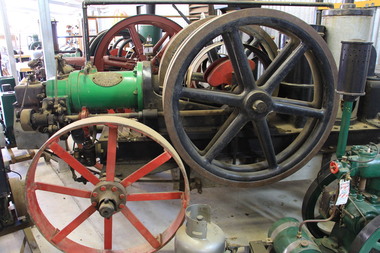
... Two double flywheels and flat belt pulley. Water cooled exhaust system at the crank end of the engine. ...Two double flywheels and flat belt pulley. Water cooled exhaust system at the crank end of the engine. ...Austral 8 HP oil engine on 4 wheeled steel chassis with wrought iron wheels. Two double flywheels and flat belt pulley. Water cooled exhaust system at the crank end of the engine. Galvanised iron fuel tank slung under the engine. Painted green and black with red wheels.On an oval brass plate on the side of the engine :- "The Austral Oil Engine / Ronaldson Bros / Makers / No 663 / & Tippett / Ballarat Victoria"machinery ... engine ... oil ... metalwork -
 Orbost & District Historical Society
pulley
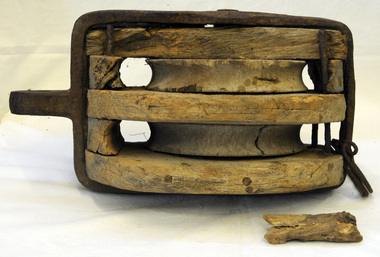
... Pulleys are simple devices for increasing mechanical advantage in a wire, chain or rope system. ...Pulleys are simple devices for increasing mechanical advantage in a wire, chain or rope system. ...This pulley was found by Geoff Stevenson, on a beach near Cape Conran (east of Orbost). It probably came from a sailing ship which was wrecked there. Pulleys are simple devices for increasing mechanical advantage in a wire, chain or rope system. A pulley consists of a wheel with a specialized rim that rotates on an axle and carries some type of cable or chain. Ships used a variety of blocks (pulleys) for various tasks, such as stowing cargo or handling the sails. A large wooden pulley encased in iron. It was probably used on a sailing ship. pulley cape-conran sailing-ship maritime -
 Flagstaff Hill Maritime Museum and Village
Equipment - Canvas Bag, mid-to-late 19th century
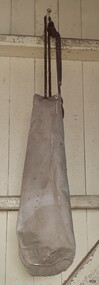
... It could be worn on the shoulder or as a backpack or winched out to a vessel on the block and pulley system. The strong canvas could be weatherproof and waterproof to a large extent, provided the drawstring was pulled tight. ...It could be worn on the shoulder or as a backpack or winched out to a vessel on the block and pulley system. The strong canvas could be weatherproof and waterproof to a large extent, provided the drawstring was pulled tight. ...This drawstring canvas bag is amongst the Rocket Rescue equipment. It could have been used to carry equipment, clothing or provisions between the crew on the shore and the victims of a shipwreck or other rescue need. It could be worn on the shoulder or as a backpack or winched out to a vessel on the block and pulley system. The strong canvas could be weatherproof and waterproof to a large extent, provided the drawstring was pulled tight. Saving lives in Warrnambool – The coastline of South West Victoria is the site of over 600 shipwrecks and many lost lives; even in Warrnambool’s Lady Bay, there were around 16 known shipwrecks between 1850 and 1905, with eight lives lost. Victoria’s Government responded to the need for lifesaving equipment and, in 1858, the provision of rocket and mortar apparatus was approved for the lifeboat stations. In 1859 the first Government-built lifeboat arrived at Warrnambool Harbour and a shed was soon built for it on the Tramway Jetty, followed by a rocket house in 1864 to safely store the rocket rescue equipment. In 1878 the buildings were moved to the Breakwater (constructed from 1874-1890), and in 1910 the new Lifeboat Warrnambool arrived with its ‘self-righting’ design. For almost a hundred years the lifesaving and rescue crews, mostly local volunteers, trained regularly to rehearse and maintain their rescue skills. They were summoned when needed by alarms, gunshots, ringing bells and foghorns. In July 1873 a brass bell was erected at Flagstaff Hill specifically to call the rescue crew upon news of a shipwreck. Some crew members became local heroes but all served an important role. Rocket apparatus was used as recently as the 1950s. Rocket Rescue Method - The Government of Victoria adopted lifesaving methods based on Her Majesty’s Coast Guard in Great Britain. It authorised the first line-throwing rescue system in 1858. Captain Manby’s mortar powered a projectile connected to a rope, invented in 1808. The equipment was updated to John Dennett’s 8-foot shaft and rocket method that had a longer range of about 250 yards. From the 1860s the breeches buoy apparatus was in use. The apparatus was suspended on a hawser line and manually pulled to and from the distressed vessel carrying passengers and items. In the early 1870s Colonel Boxer’s rocket carried the light line, which was faked, or coiled, in a particular way between pegs in a faking box to prevent twists and tangles when fired. The angle of firing the rocket to the vessel in distress was measured by a quadrant-type instrument on the side of the rocket machine. Decades later, in about 1920, Schermuly invented the line-throwing pistol that used a small cartridge to fire the rocket. The British Board of Trade published instructions for both the beach rescue crew and ship’s crew. It involved setting up the rocket launcher on shore at a particular angle measured by the quadrant, inserting a rocket that had a lightweight line threaded through its shaft, and then firing it across the stranded vessel, the line issuing freely from the faking board. A tally board was then sent out to the ship with instructions in four languages. The ship’s crew would haul on the line to bring out the heavier, continuous whip line, then secure the attached whip block to the mast or other sturdy part of the ship. The rescue crew on shore then hauled out a stronger hawser line, which the ship’s crew fixed above the whip block. The hawser was then tightened using the block on the shore end of the whip. The breeches buoy and endless whip are then attached to the traveller block on the hawser, allowing the shore crew to haul the breeches buoy to and from the vessel, rescuing the stranded crew one at a time. Beach apparatus equipment - In the mid-1800s the equipment could include a line throwing set, coiled line in a wooden carrying case, rockets, cartridges, breeches buoy, hawser and traveller block, line-throwing pistol, beach cart, hand barrow, sand anchor, crotch pole, and tools such as spade, pick, mallet and hawser cutter. Around the 1860s Warrnambool had a Rocket House installed beside the Harbour. This canvas bag is significant for its connection with local history, maritime history and marine technology. Lifesaving has been an important part of the services performed from Warrnambool's very early days, supported by State and Local Government, and based on the methods and experience of Great Britain. Hundreds of shipwrecks along the coast are evidence of the rough weather and rugged coastline. Ordinary citizens, the Harbour employees, and the volunteer boat and rescue crew saved lives in adverse circumstances. Some were recognised as heroes, others went unrecognised. In Lady Bay, Warrnambool, there were around 16 known shipwrecks between 1850 and 1905. Many lives were saved but tragically, eight lives were lost.Canvas bag; thick beige canvas bag, cylindrical with a round base. The top has a thin rope in a drawstring closure. flagstaff hill maritime museum and village, flagstaff hill, maritime museum, maritime village, warrnambool, great ocean road, lady bay, shipwreck, life-saving, lifesaving, rescue crew, rescue, rocket rescue, rocket crew, lifeboat men, beach rescue, line rescue, rescue equipment, volunteer lifesavers, volunteer crew, life saving rescue crew, lifesaving rescue crew, rocket apparatus, survival kit, rescue kit, canvas bag, storage bag, carry bag, equipment bag, drawerstring bag -
 Flagstaff Hill Maritime Museum and Village
Deadeye, circa 1873
... Connecting a Lower deadeye to its corresponding Upper deadeye was a rope (called a lanyard) which looped up and down through the three “eyes” of each disc, to form a pulley system. The hitching of the two deadeyes with a looped lanyard provided the means of tightening, or loosening, the tension on the mast rigging ― essentially by pulling against the chain-plates bolted to the outside of the hull. ...Connecting a Lower deadeye to its corresponding Upper deadeye was a rope (called a lanyard) which looped up and down through the three “eyes” of each disc, to form a pulley system. The hitching of the two deadeyes with a looped lanyard provided the means of tightening, or loosening, the tension on the mast rigging ― essentially by pulling against the chain-plates bolted to the outside of the hull. ...This example of a sailing ship’s ‘dead-eye’ is from the wreck of the LOCH ARD, which sank near Port Campbell in 1878. The vessel was an iron hulled clipper ship constructed for the Loch Line in 1873. It was part of a fleet of similar merchant ships owned by that company, which specialised in bringing passengers and goods from London via the Great Circle route to Melbourne, and returning to Britain via Cape Horn with the colony’s wool clip. Deadeyes were a common feature of sailing ship technology in the nineteenth century. They were a simple, cheap, and hard-wearing device that, in conjunction with another deadeye, provided an effective means of levering, or tightening, attached ropes and stays. Lower deadeyes were fixed to the sides of the ship by an encircling metal collar (inset in a flattish groove chiselled around the outer circumference of the disc), which was bolted to iron bars attached to the hull (called chain-plates). Upper deadeyes were looped by a strong hemp or wire rope (inset in a rounded groove carved around the outer circumference of the disc), which was joined to the bottom ends of the rigging which reached up to secure the masts into position (called shrouds or stays). Connecting a Lower deadeye to its corresponding Upper deadeye was a rope (called a lanyard) which looped up and down through the three “eyes” of each disc, to form a pulley system. The hitching of the two deadeyes with a looped lanyard provided the means of tightening, or loosening, the tension on the mast rigging ― essentially by pulling against the chain-plates bolted to the outside of the hull. It was a procedure that could be performed by sailors at sea and in emergencies. For example, after a gale the stays may have stretched and the masts worked loose, requiring retightening. Or, in the extreme circumstance of shipwreck, the lanyards might need to be released on the weather side, so that the masts fall away from the stricken vessel. HISTORY OF THE LOCH ARD The LOCH ARD belonged to the famous Loch Line which sailed many ships from England to Australia. Built in Glasgow by Barclay, Curdle and Co. in 1873, the LOCH ARD was a three-masted square rigged iron sailing ship. The ship measured 262ft 7" (79.87m) in length, 38ft (11.58m) in width, 23ft (7m) in depth and had a gross tonnage of 1693 tons. The LOCH ARD's main mast measured a massive 150ft (45.7m) in height. LOCH ARD made three trips to Australia and one trip to Calcutta before its final voyage. LOCH ARD left England on March 2, 1878, under the command of Captain Gibbs, a newly married, 29 year old. She was bound for Melbourne with a crew of 37, plus 17 passengers and a load of cargo. The general cargo reflected the affluence of Melbourne at the time. On board were straw hats, umbrella, perfumes, clay pipes, pianos, clocks, confectionary, linen and candles, as well as a heavier load of railway irons, cement, lead and copper. There were items included that intended for display in the Melbourne International Exhibition in 1880. The voyage to Port Phillip was long but uneventful. At 3am on June 1, 1878, Captain Gibbs was expecting to see land and the passengers were becoming excited as they prepared to view their new homeland in the early morning. But LOCH ARD was running into a fog which greatly reduced visibility. Captain Gibbs was becoming anxious as there was no sign of land or the Cape Otway lighthouse. At 4am the fog lifted. A man aloft announced that he could see breakers. The sheer cliffs of Victoria's west coast came into view, and Captain Gibbs realised that the ship was much closer to them than expected. He ordered as much sail to be set as time would permit and then attempted to steer the vessel out to sea. On coming head on into the wind, the ship lost momentum, the sails fell limp and LOCH ARD's bow swung back. Gibbs then ordered the anchors to be released in an attempt to hold its position. The anchors sank some 50 fathoms - but did not hold. By this time LOCH ARD was among the breakers and the tall cliffs of Mutton Bird Island rose behind the ship. Just half a mile from the coast, the ship's bow was suddenly pulled around by the anchor. The captain tried to tack out to sea, but the ship struck a reef at the base of Mutton Bird Island, near Port Campbell. Waves broke over the ship and the top deck was loosened from the hull. The masts and rigging came crashing down knocking passengers and crew overboard. When a lifeboat was finally launched, it crashed into the side of LOCH ARD and capsized. Tom Pearce, who had launched the boat, managed to cling to its overturned hull and shelter beneath it. He drifted out to sea and then on the flood tide came into what is now known as LOCH ARD Gorge. He swam to shore, bruised and dazed, and found a cave in which to shelter. Some of the crew stayed below deck to shelter from the falling rigging but drowned when the ship slipped off the reef into deeper water. Eva Carmichael had raced onto deck to find out what was happening only to be confronted by towering cliffs looming above the stricken ship. In all the chaos, Captain Gibbs grabbed Eva and said, "If you are saved Eva, let my dear wife know that I died like a sailor". That was the last Eva Carmichael saw of the captain. She was swept off the ship by a huge wave. Eva saw Tom Pearce on a small rocky beach and yelled to attract his attention. He dived in and swam to the exhausted woman and dragged her to shore. He took her to the cave and broke open case of brandy which had washed up on the beach. He opened a bottle to revive the unconscious woman. A few hours later Tom scaled a cliff in search of help. He followed hoof prints and came by chance upon two men from nearby Glenample Station three and a half miles away. In a state of exhaustion, he told the men of the tragedy. Tom returned to the gorge while the two men rode back to the station to get help. By the time they reached LOCH ARD Gorge, it was cold and dark. The two shipwreck survivors were taken to Glenample Station to recover. Eva stayed at the station for six weeks before returning to Ireland, this time by steamship. In Melbourne, Tom Pearce received a hero's welcome. He was presented with the first gold medal of the Royal Humane Society of Victoria and a £1000 cheque from the Victorian Government. Concerts were performed to honour the young man's bravery and to raise money for those who lost family in the LOCH ARD disaster. Of the 54 crew members and passengers on board, only two survived: the apprentice, Tom Pearce and the young woman passenger, Eva Carmichael, who lost all of her family in the tragedy. Ten days after the LOCH ARD tragedy, salvage rights to the wreck were sold at auction for £2,120. Cargo valued at £3,000 was salvaged and placed on the beach, but most washed back into the sea when another storm developed. The wreck of LOCH ARD still lies at the base of Mutton Bird Island. Much of the cargo has now been salvaged and some was washed up into what is now known as LOCH ARD Gorge. Cargo and artefacts have also been illegally salvaged over many years before protective legislation was introduced. One of the most unlikely pieces of cargo to have survived the shipwreck was a Minton porcelain peacock - one of only nine in the world. The peacock was destined for the Melbourne International Exhibition in 1880. It had been well packed, which gave it adequate protection during the violent storm. Today, the Minton peacock can be seen at the Flagstaff Hill Maritime Museum in Warrnambool. From Australia's most dramatic shipwreck it has now become Australia's most valuable shipwreck artefact and is one of very few 'objects' on the Victorian State Heritage Register. The shipwreck of the LOCH ARD is of State significance. Victorian Heritage Register S417. Flagstaff Hill’s collection of artefacts from LOCH ARD is significant for being one of the largest collections of artefacts from this shipwreck in Victoria. It is significant for its association with the shipwreck, which is on the Victorian Heritage Register (VHR S417). The collection is significant because of the relationship between the objects, as together they have a high potential to interpret the story of the LOCH ARD. The LOCH ARD collection is archaeologically significant as the remains of a large international passenger and cargo ship. The LOCH ARD collection is historically significant for representing aspects of Victoria’s shipping history and its potential to interpret sub-theme 1.5 of Victoria’s Framework of Historical Themes (living with natural processes). The collection is also historically significant for its association with the LOCH ARD, which was one of the worst and best known shipwrecks in Victoria’s history. A reasonably well-preserved ship’s deadeye with rust-stained wire loop-rope still attached. It retains portions of its original hemp cord and hessian wrapping. The flat sides of this thick wooden disc have three holes drilled through in a triangular configuration. The artefact is from the shipwreck of the LOCH ARD (1878). The survival of the loop-rope (wire cable) indicates it was an Upper Deadeye, connected to the shrouds (mast rigging).flagstaff hill, warrnambool, shipwrecked coast, flagstaff hill maritime museum, maritime museum, shipwreck coast, flagstaff hill maritime village, great ocean road, loch line, loch ard, captain gibbs, eva carmichael, tom pearce, glenample station, mutton bird island, loch ard gorge, deadeye, rigging -
 Flagstaff Hill Maritime Museum and Village
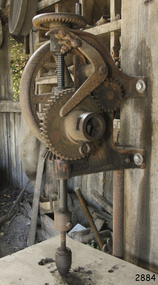
Drill Press, 1920s-1950s
... The heavy design of the flywheel enables it to maintain momentum” and is “fitted with pulleys for belt drive if desired” The hand crank drives an automatic feed to work off a cam-follow system opposite a large wheel. ...The heavy design of the flywheel enables it to maintain momentum” and is “fitted with pulleys for belt drive if desired” The hand crank drives an automatic feed to work off a cam-follow system opposite a large wheel. ...This drill once belonged to Goodall and Sons, who were blacksmiths in Terang. The smith was called upon to do a variety of work. In the early 1900s he was often the nearest person to be able to perform an engineer’s services for many miles around. The Dawn Ball-bearing Post Drill no. 611 is described in McPherson’s Catalogue as a “drilling machine with adjustable automatic feed, with improved Dawn coupler and ball-bearing thrust’. The heavy design of the flywheel enables it to maintain momentum” and is “fitted with pulleys for belt drive if desired” The hand crank drives an automatic feed to work off a cam-follow system opposite a large wheel. Made by Dawn Manufacturing Co. Australia 1920-1950. DAWN MANUFACTURING CO. Dawn Manufacturing Co. was founded in Coburg, Melbourne, in 1917 by the four Blake brothers, who were all engineers. After World War I Dawn was supplying drills Australia wide and the company was growing at a healthy rate. During the depression they remained busy, with employees working 60-80 hour weeks. Dawn was contracted to supply vices and clamps to the Australian Defence Department and munitions factory during the World War II. In 1959 the company was taken over by G.N. Raymond Group, then in 1973 the Siddons Ramset Limited acquired Dawn. In December 1991, Dawn became a unit of the United States owned Stanley Works Pty. Ltd. In November 1998 Dawn became 100 per cent Australian owned. HENRY GOODALL & SONS Henry Goodall (1870-1936) was proprietor of garages as H. Goodall & Sons Pty. Ltd., at both Terang (McKinnon and High Streets) and Mortlake (Dunlop Street). His business was in operation in at least in 1916 and perhaps well before, considering the date of the tyre bender and its use for wagons with wooden wheels. It was still in operation in 1953, chasing up debtors in Mount Gambier Court. Amongst the employees of H. Goodall & Sons Pty. Ltd. was Ernie Entwistle, a blacksmith (a soldier who died in 1916 ) and Alfred Hodgetts, radio expert (killed in a fatal accident in 1943, when he was in his early 30s ). Henry Goodall was involved in the community as a Justice of Peace, a deputy coroner, President of the Mortlake Hospital, trustee of the Soldiers’ Memorial Hall, and as a prominent Freemason. He and his wife had two sons (Charles and John) and one daughter (Mrs. Chas. Newton, of Skipton). The drill is locally significant as it was used by a local company in Terang and Mortlake in their blacksmith, wheelwright and garage business. It is an example of the tools of the blacksmiths’ trade in Victoria in the 1920s-1950s.Dawn Ball-bearing Post Drill no. 611, made by Dawn of Melbourne, model no 611. Hand operated drill press. Self-feeding blacksmiths’ drill-press. This drill once belonged to Harry Goodall & Sons, blacksmiths of Terang. Dated 1920s-1950s. Gear ratio 2:1 main drive, 6" diam, 3:1 reduction gear. "Dawn", "Melbourne"flagstaff hill, warrnambool, shipwrecked-coast, flagstaff-hill, flagstaff-hill-maritime-museum, maritime-museum, shipwreck-coast, flagstaff-hill-maritime-village, h. goodall & sons of terang, terang blacksmith, h. goodall & sons pty ltd, mortlake, ernie entwistle blacksmith, alfred hodgetts radio expert, charles goodall, john goodall, mrs. chas. newton nee goodall, terang 1900s, warrnambool district 1900s, post drill, blacksmith’s drill, dawn post drill, dawn ball-bearing post drill no. 611, blacksmiths, dawn of melbourne -
 Federation University Historical Collection
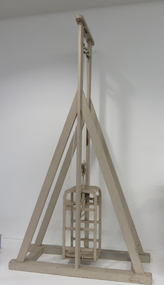
Unknown - Object, Allan Mine Cage Safety Brake, c1873, c1873
... system. Note the pair of clutch levers designed to grab the side guides if tension ceases in the suspending rope from the poppet head pulley. ...system. Note the pair of clutch levers designed to grab the side guides if tension ceases in the suspending rope from the poppet head pulley. ...A mining safety cage was used in a mine lift. It was fitted with mechanisms to prevent the cage from dropping if the lifting rope broke. In the 1870s in Victoria, deaths and injuries from falling cages in vertical shafts of gold mines were a major problem. The inventor of this safety cage was Robert Allan, a machinery maker of Creswick Rd, Ballarat. He said his cage featured a ‘dissolving’ fulcrum. Others called it an eccentric (off centre) system. Note the pair of clutch levers designed to grab the side guides if tension ceases in the suspending rope from the poppet head pulley. Also, the hinged ‘lids’; designed to protect miners trapped in a braked cage from falling rope, and to enable rescue of the miners. This model was presented to The Ballarat School of Mines Council in November 1876. This model was shown at the Smeaton Show in November 1874, Ballarat School of Mines Museum from 1876, and examined by the 1879 Victorian Board of Inquiry (Pg 15 of FedUni Catalogue 3437) From the Argus of 13 November 1874: At Smeaton Show, Robert Allan of Ballarat won 1st prize for a Model of a Mining Cage, a Butter working machine, a Cheese press and a Curd Mill. By 1878 an Allan Safety-Cage was in operation in the Number 6 shaft of the Band and Albion Consols mine in Ballarat. This cage was judged the best inspected by the Victorian Board of Inquiry by 1879, p. 39.Mining was a big industry in Ballarat in the late 1800s and a lot of deaths were recorded because of mining accidents, the development of the mining safety cage brake limited the deaths and injuries from falling cages in vertical shafts. The model also has links to the Ballarat School of Mines, being presented to the council in 1876. Ballarat School of Mines is the oldest Technical School in Australia and is a predecessor of Federation University. The model is significant to Ballarat's mining history.Model of a mine safety cafe. A grey painted wooden frame with metal model of cage and safety brake system. When tension ceases in rope a pair of crutch levers grab strongly onto the wooden guide strips which run down the sides of a vertical shaft. This safety cage was discussed in "Safety Mining Cages. Report of the Board of Enquiry on Safety Cages 1878-9; together with proceedings of the Board and Appendices".safety cage, mine cage safety brake, robert allan, model, safety cage model, machine maker, millwright, mining, gold mining, tools, equipment, victorian board of inquiry -
 Flagstaff Hill Maritime Museum and Village
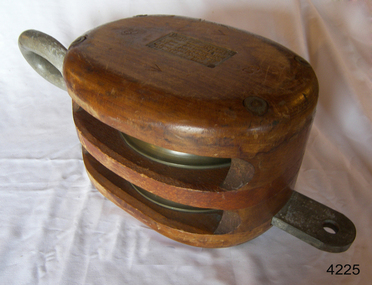
Equipment - Rope Block, After 1950
... These systems were used extensively for construction in the ancient world, and continue to be used today for various applications, especially at sea, where non-motorised lifting systems are highly useful. A basic block and tackle includes a single fixed pulley or block, and at least one additional pulley, linked with rope, to form a complete set. ...These systems were used extensively for construction in the ancient world, and continue to be used today for various applications, especially at sea, where non-motorised lifting systems are highly useful. A basic block and tackle includes a single fixed pulley or block, and at least one additional pulley, linked with rope, to form a complete set. ...A block and tackle is a simple but highly effective lifting device, thought to have been invented by Archimedes. These systems were used extensively for construction in the ancient world, and continue to be used today for various applications, especially at sea, where non-motorised lifting systems are highly useful. A basic block and tackle includes a single fixed pulley or block, and at least one additional pulley, linked with rope, to form a complete set. Depending on the size of the load being lifted, additional sets may be used to further distribute the weight.A mid-twentieth example of a wooden block that shows advances in the design of the marine block compared to late 19th century blocks, with hook and pin and its compliance plate meeting the marine standards of the time.Two sheave rope block; two metal sheaves in polished wooden block with a metal inner pin with a ring on top and a bucket on the bottom. Rectangle carved into one cheek with inscriptions on the attached compliance plate with inscriptions. Stamped within a lozenge: "2 ↑ CS"flagstaff hill museum, flagstaff hill village, shipwreck coast, flagstaff hill, block & tackle, rope, lifting heavy weights, ship rigging, cargo lifiting, two sheave block, compliance plate, marine technology -
 Flagstaff Hill Maritime Museum and Village
Equipment - Block, After 1950
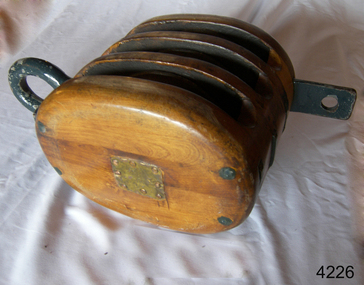
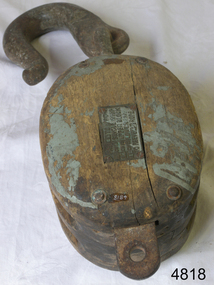
... These systems were used extensively for construction in the ancient world, and continue to be used today for various applications, especially at sea, where non-motorized lifting systems are highly useful. A basic block and tackle includes a single fixed pulley or block, and at least one additional pulley, linked with rope, to form a complete set. ...These systems were used extensively for construction in the ancient world, and continue to be used today for various applications, especially at sea, where non-motorized lifting systems are highly useful. A basic block and tackle includes a single fixed pulley or block, and at least one additional pulley, linked with rope, to form a complete set. ...A block and tackle is a simple but highly effective lifting device, thought to have been invented by Archimedes. These systems were used extensively for construction in the ancient world, and continue to be used today for various applications, especially at sea, where non-motorized lifting systems are highly useful. A basic block and tackle includes a single fixed pulley or block, and at least one additional pulley, linked with rope, to form a complete set. Depending on the size of the load being lifted, additional sets may be used to further distribute the weight.A mid-twentieth example of a wooden block that shows advances in the design of the marine block compared to late 19th century blocks, with hook and pin and its compliance plate meeting the marine standards of the time.Block, three-sheave rope block, wooden with metal sheaves. Metal ring and connecting tab, painted blue-grey. A brass compliance plate is on one cheek. One one side there are eight nails. flagstaff hill museum, flagstaff hill village, shipwreck coast, flagstaff hill, block & tackle, rope, lifting heavy weights, ship rigging, cargo lifiting, marine technology, marine block, three sheave block -
 Flagstaff Hill Maritime Museum and Village
Equipment - Rope Block, Early-to-mid 20th century
... These systems were used extensively for construction in the ancient world, and continue to be used today for a variety of applications, especially at sea, where non-motorized lifting systems are highly useful. A basic block and tackle includes a single fixed pulley or block, and at least one additional pulley, linked with rope, to form a complete set. ...These systems were used extensively for construction in the ancient world, and continue to be used today for a variety of applications, especially at sea, where non-motorized lifting systems are highly useful. A basic block and tackle includes a single fixed pulley or block, and at least one additional pulley, linked with rope, to form a complete set. ...A block and tackle is a simple but highly effective lifting device, thought to have been invented by Archimedes. These systems were used extensively for construction in the ancient world, and continue to be used today for a variety of applications, especially at sea, where non-motorized lifting systems are highly useful. A basic block and tackle includes a single fixed pulley or block, and at least one additional pulley, linked with rope, to form a complete set. Depending on the size of the load being lifted, additional sets may be used to further distribute the weight.This wooden two-sheave block is part of a ship's rigging. Its an example of rigging equipment in use from the early-to-mid 20th century and an example of the evolution of rigging equipment since the 17th century.Block; two sheave wooden tackle block with metal rollers and a large metal hook. It has a compliance plate on the side with an inscription. Stamped inside a lozenge; "2 ↑ CS" flagstaff hill museum, flagstaff hill village, shipwreck coast, flagstaff hill, block & tackle, rope, lifting heavy weights, ship rigging, cargo lifiting, rope block, marine technology, ship equipment, rigging, two sheave block -
 Warrnambool and District Historical Society Inc.
Equipment - Artefact, Lamson's Rapid Wire Cash Carrier, Youngers, C Early 20th century
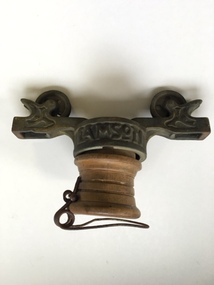
... Apart from having strong links to one of Warrnambool's largest and longest running businesses, the object itself is of considerable interest with thousands of the original ball systems and Rapid Wire cash carriers being in use around the world. warrnambool, youngers youngers warrnambool lamson lamson rapid wire cash carrier wire cash carrier Lamson is cast into the brass on either side of therim of the top circular section. . AUS is on the side of this same section. Cylindrical brass top with central circular part with section either side which have two small pulleys ...Lamson was established in Australia in 1898 with the idea for a store security money handling system being patented in the latter part of the 19th century.The practise of taking money from the counter and customer to the cashier was time consuming and cumbersome.Some bright ideas were employed including tying the money and dockets in a hankerchief and throwing it to the cashier. The first attempt to improve this was the ball system where a ball containing the cash was rolled to the cashier on an elevated track. The rapid wire system superseded this in the early 1900's and for the next 50 years it became a popular part of money handling in stores around Australia. This particular Lamson's cash carrier was installed in Youngers department store which was situated in Liebig Street. The success of Youngers store was partly responsible for the shift to Liebig St as the main commercial district. The Warrnambool Standard reported in 1901 that Younger and Co would operate on a wholly cash basis replacing incidental trades of goods such as potatoes and other farm produce.This item has strong social and historical significance. Apart from having strong links to one of Warrnambool's largest and longest running businesses, the object itself is of considerable interest with thousands of the original ball systems and Rapid Wire cash carriers being in use around the world. Cylindrical brass top with central circular part with section either side which have two small pulleys. A wooden cylindrical section slots in below with a wire clip attached at the bottom.Lamson is cast into the brass on either side of therim of the top circular section. . AUS is on the side of this same section. warrnambool,, youngers, youngers warrnambool, lamson, lamson rapid wire cash carrier, wire cash carrier -
 Parks Victoria - Maldon State Battery
Belt, canvas
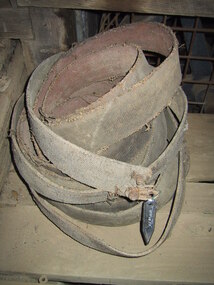
... The flat belt is a simple system of power transmission that can deliver high power at high speeds. The belts were used with pulley wheels....The flat belt is a simple system of power transmission that can deliver high power at high speeds. The belts were used with pulley wheels. ...Flat belts were widely used in line shafting to transmit power in mining applications. The flat belt is a simple system of power transmission that can deliver high power at high speeds. The belts were used with pulley wheels.Long canvas belting with frayed edges, wrapped up in coil. -
 Parks Victoria - Wilsons Promontory Lightstation
Anvil
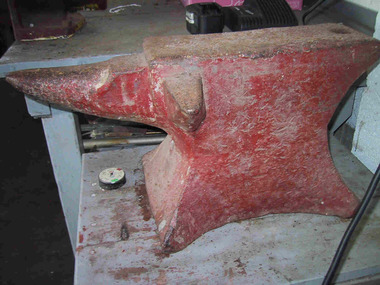
... As a lightstation manager Chris Richter used the anvil to manufacture pulley blocks for sash windows, repair brass door hinges & sharpen cold chisels, crowbars and picks and other lightkeepers have used this anvil for many fabricating jobs such as manufacturing ducting for the generator room ventilation system."...As a lightstation manager Chris Richter used the anvil to manufacture pulley blocks for sash windows, repair brass door hinges & sharpen cold chisels, crowbars and picks and other lightkeepers have used this anvil for many fabricating jobs such as manufacturing ducting for the generator room ventilation system." ...As quoted from Wikipedia, ‘An anvil is a block with a hard surface on which another object is, struck. The block is as massive as it is practical, because the higher the inertia of the anvil, the more efficiently it causes the energy of the striking tool to be transferred to the work piece’. The lightstation’s anvil is a red-painted iron block with a conical beak or horn at one end that was used for hammering curved pieces of metal. It would have stood on a heavy free-standing pedestal, such as a large tree stump, to allow complete access to the item being hammered. Some anvils display the manufacturer’s name in the metal on the side, but this is not the case here, and its age, although unknown appears to be quite old, perhaps c.1900. It appears to have had a lot of use, and although no record of this survives, it is presumed that a forge operated on site for hammering, cutting, shaping and repairing tools such as bolts, nails, hooks, chain segments, pulley blocks, hinges, crow bars, picks, chisels, horseshoes and harness hardware. A hames hook (which forms part of the collar worn by a draught horse) survives at the lightstation as do many other heavy metal tools and pieces of equipment. The anvil is an example of the necessary resourcefulness and self sufficiency practiced by lightkeepers working and living in a remotely located workplace and home, and many of the iron items in the collection may have been repaired or even made on its working surface. As a lightstation manager Chris Richter used the anvil to manufacture pulley blocks for sash windows, repair brass door hinges & sharpen cold chisels, crowbars and picks and other lightkeepers have used this anvil for many fabricating jobs such as manufacturing ducting for the generator room ventilation system."The lightship only came in every three months with supplies and there would have been repairs to do between visits from a blacksmith - who would have had to travel on the ship. Also, the ship was only anchored in the bay long enough to unload supplies and collect and deliver lightkeeping staff – probably not enough time to get much smithy work done – especially if the weather packed it in and the ship had to depart. Lightkeepers in our time had to be self sufficient, resourceful and innovative and I imagine that would have been the case in the past." It has second level contributory significance.Red painted blacksmith's anvil. -
 Melbourne Tram Museum
Document - Report, P. J. Pringle for the Tramway Board, "Yoke Frames for Supporting line pulleys in tunnel", 18/10/1916 12:00:00 AM
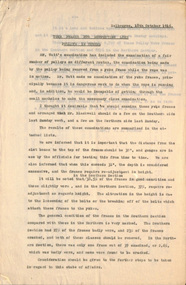
... pulleys in tunnel", dated 18/10/1916 by Mr. P. J. Pringle for the Tramway Board. Report on issues with the cable tramway yokes looking at the problems with wear, cracking, dimensions, and depth that the grip could run. Noted differences between the south and north sides of the system...pulleys in tunnel", dated 18/10/1916 by Mr. P. J. Pringle for the Tramway Board. Report on issues with the cable tramway yokes looking at the problems with wear, cracking, dimensions, and depth that the grip could run. Noted differences between the south and north sides of the system ...Report - four foolscap sheets, clipped in top left hand corner titled "Yoke Frames for Supporting line pulleys in tunnel", dated 18/10/1916 by Mr. P. J. Pringle for the Tramway Board. Report on issues with the cable tramway yokes looking at the problems with wear, cracking, dimensions, and depth that the grip could run. Noted differences between the south and north sides of the system. Work done by Mr Blackwell and Mr. Watt. Has two sheets of tables listing the problems.trams, tramways, cable trams, cable grip, cables, maintenance, track repairs -
 Melbourne Tram Museum
Document - Folder, William Pollock, "The Melbourne Cable Tramway System", c1940
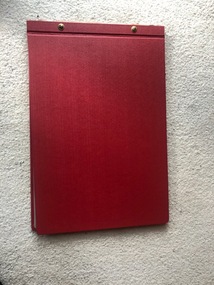
... System” – photocopied special size sheet folded. See image htd4715i4.jpg 2 – Drawing – Typical Power House layout - image htd4715i5.jpg 3 – Drawing – Head of Cable Driver – htd4715i6.jpg 4 – Drawing – Rope Drive – htd4715i7.jpg 5 – Photocopy of a Fuel and Water test sheet for the Esplanade Power House – two sheets – 14/5/1918 – htd4715i8.jpg and htd4715i9.jpg 6 – Section of Cable Tram track – htd4715i10.jpg 7 – Tar Burner used by MTOC 1893 – 1900 - htd4715i11.jpg 8 – Yoke Bracket for line drums – A1 Pulley – htd4715i12.jpg 9 – Tunnel Yoke – htd4715i13.jpg 10 – Elevating Wheel or Pulley with shield plate – htd4715i14.jpg 11 – Curve Pulleys, curve drum and rubbing bar – 2 sheets – htd4715i15.jpg and htd4715i16.jpg 12 – Curve or Conical drum – htd4715i17.jpg 13 – Cable Separating pulley or cone line drum – htd4715i18.jpg 14 – Yoke Pulley or General Pulley – htd4715i19.jpg 15 – Yoke Bracket for Drums – htd4715i20.jpg 16 – Automatic Switch Gear – htd4715i21.jpg 17 – Hand operated switch gear – htd4715i22.jpg 18 – Hand pickup – htd4715i23.jpg 19 & 20 – Photo of bunched strands and damaged cable – htd4715i24 21 – Diagram of Rope – Clarendon St Rope No. 41 – htd4715i25.jpg 22 – Strand Alarm – htd4715i26.jpg 23 – Rope History – two sheets – htd4715i27 and htd4715i28.jpg 24 – Rope Splice – htd4715i29.jpg 25 – Cable Grip – htd4715i30.jpg 26 – Crown Pulley – two sheets – htd4715i30 and htd4715i31...System” – photocopied special size sheet folded. See image htd4715i4.jpg 2 – Drawing – Typical Power House layout - image htd4715i5.jpg 3 – Drawing – Head of Cable Driver – htd4715i6.jpg 4 – Drawing – Rope Drive – htd4715i7.jpg 5 – Photocopy of a Fuel and Water test sheet for the Esplanade Power House – two sheets – 14/5/1918 – htd4715i8.jpg and htd4715i9.jpg 6 – Section of Cable Tram track – htd4715i10.jpg 7 – Tar Burner used by MTOC 1893 – 1900 - htd4715i11.jpg 8 – Yoke Bracket for line drums – A1 Pulley – htd4715i12.jpg 9 – Tunnel Yoke – htd4715i13.jpg 10 – Elevating Wheel or Pulley with shield plate – htd4715i14.jpg 11 – Curve Pulleys, curve drum and rubbing bar – 2 sheets – htd4715i15.jpg and htd4715i16.jpg 12 – Curve or Conical drum – htd4715i17.jpg 13 – Cable Separating pulley or cone line drum – htd4715i18.jpg 14 – Yoke Pulley or General Pulley – htd4715i19.jpg 15 – Yoke Bracket for Drums – htd4715i20.jpg 16 – Automatic Switch Gear – htd4715i21.jpg 17 – Hand operated switch gear – htd4715i22.jpg 18 – Hand pickup – htd4715i23.jpg 19 & 20 – Photo of bunched strands and damaged cable – htd4715i24 21 – Diagram of Rope – Clarendon St Rope No. 41 – htd4715i25.jpg 22 – Strand Alarm – htd4715i26.jpg 23 – Rope History – two sheets – htd4715i27 and htd4715i28.jpg 24 – Rope Splice – htd4715i29.jpg 25 – Cable Grip – htd4715i30.jpg 26 – Crown Pulley – two sheets – htd4715i30 and htd4715i31 "The Melbourne Cable Tramway System" Document Folder William Pollock William Pollock ...Folder - heavy red covers with two screw sets containing a photocopy of a report by William Pollock, prepared after the closure of the cable tram system titled ""The Melbourne Cable Tramway System". Image numbers listed: Folder – htd4715i1 Inside of folder – htd4715i2.jpg Report –Photocopy of a 14 foolscap sheets, paper titled “The Melbourne Cable Tramway System” by William Pollock, describing the system in detail, listing 26 appendices. Has notes on each Power Station, including a table of opening, closing, power produced and cables, fuel, permanent way (track), cables, underground gear, tunnels, flooding and the grip. Image – htd4714i3.pdf Appendix 1 – Handwritten table “Cost the Melbourne Tramway System” – photocopied special size sheet folded. See image htd4715i4.jpg 2 – Drawing – Typical Power House layout - image htd4715i5.jpg 3 – Drawing – Head of Cable Driver – htd4715i6.jpg 4 – Drawing – Rope Drive – htd4715i7.jpg 5 – Photocopy of a Fuel and Water test sheet for the Esplanade Power House – two sheets – 14/5/1918 – htd4715i8.jpg and htd4715i9.jpg 6 – Section of Cable Tram track – htd4715i10.jpg 7 – Tar Burner used by MTOC 1893 – 1900 - htd4715i11.jpg 8 – Yoke Bracket for line drums – A1 Pulley – htd4715i12.jpg 9 – Tunnel Yoke – htd4715i13.jpg 10 – Elevating Wheel or Pulley with shield plate – htd4715i14.jpg 11 – Curve Pulleys, curve drum and rubbing bar – 2 sheets – htd4715i15.jpg and htd4715i16.jpg 12 – Curve or Conical drum – htd4715i17.jpg 13 – Cable Separating pulley or cone line drum – htd4715i18.jpg 14 – Yoke Pulley or General Pulley – htd4715i19.jpg 15 – Yoke Bracket for Drums – htd4715i20.jpg 16 – Automatic Switch Gear – htd4715i21.jpg 17 – Hand operated switch gear – htd4715i22.jpg 18 – Hand pickup – htd4715i23.jpg 19 & 20 – Photo of bunched strands and damaged cable – htd4715i24 21 – Diagram of Rope – Clarendon St Rope No. 41 – htd4715i25.jpg 22 – Strand Alarm – htd4715i26.jpg 23 – Rope History – two sheets – htd4715i27 and htd4715i28.jpg 24 – Rope Splice – htd4715i29.jpg 25 – Cable Grip – htd4715i30.jpg 26 – Crown Pulley – two sheets – htd4715i30 and htd4715i31trams, tramways, drawings, tramcars, cable trams, trackwork, mto co, reports -
 Melbourne Tram Museum
Drawing - Appendices to report - set of 24, William Pollock, "The Melbourne Cable Tramway System", 1890s to 1930s
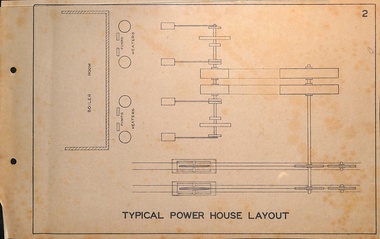
... Original prints - dyeline or blue prints of drawings used in W R Pollock's report on the Cable Tram System engine houses and the cable rope 1 - Typical Power House layout 2 - Section of Cable Driver 3 - Layout of rope drive 4 - Section of Cable Track 5 - Tar burner (see item 9696 for the actual item 6 - Yoke brackets for line drums 7 - Tunnel Yoke 8 - Elevating wheel 9 - Curve Pulley 10 - Curve Pulleys - different to above 11 - Curve drums 12 - cable separating pulley 13 - Yoke Pulley 14 - Yoke brackets for drums (one sheet - two scans) 15 - Automatic Switch gear 16 - Hand operated switch gear 17 - Hand pickup 18 - cable ways - section B 19 - Diagram of Rope - Clarendon St No. 41 20 - Strand Alarm 21 - Rope Splice 22 - Cable Grip 23 - Crown Pulley - Longitudinal section 24 - Crown Pulley - cross section though line....Yields information about the cable operations, drawings, pulleys, and how the various facilities or equipment was provided for. cable trams Cable Grip cable ropes Grip Tram engine houses drawings MTOCo MMTB Set of 24 drawings that were used as an appendices to W R Pollocks Report "The Melbourne Cable Tramway System" "The Melbourne Cable Tramway System" Drawing Appendices to report - set of 24 William Pollock ...Original prints - dyeline or blue prints of drawings used in W R Pollock's report on the Cable Tram System engine houses and the cable rope 1 - Typical Power House layout 2 - Section of Cable Driver 3 - Layout of rope drive 4 - Section of Cable Track 5 - Tar burner (see item 9696 for the actual item 6 - Yoke brackets for line drums 7 - Tunnel Yoke 8 - Elevating wheel 9 - Curve Pulley 10 - Curve Pulleys - different to above 11 - Curve drums 12 - cable separating pulley 13 - Yoke Pulley 14 - Yoke brackets for drums (one sheet - two scans) 15 - Automatic Switch gear 16 - Hand operated switch gear 17 - Hand pickup 18 - cable ways - section B 19 - Diagram of Rope - Clarendon St No. 41 20 - Strand Alarm 21 - Rope Splice 22 - Cable Grip 23 - Crown Pulley - Longitudinal section 24 - Crown Pulley - cross section though line.Yields information about the cable operations, drawings, pulleys, and how the various facilities or equipment was provided for.Set of 24 drawings that were used as an appendices to W R Pollocks Report "The Melbourne Cable Tramway System"cable trams, cable grip, cable ropes, grip tram, engine houses, drawings, mtoco, mmtb -
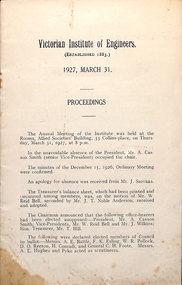 Melbourne Tram Museum
Journal - Victorian Institute of Engineers, William Pollock, "Melbourne Cable Tramway System", 1927
... Covers the motive power, the steam engines themselves, horse power required for the system of cables, operations, effects of flooding on the cable, the cables themselves, rope materials, changing ropes over, use of pulleys, supervision of the ropes, wearing of the rope, repairs, operation of the cables, bunched strands, splicing of new ropes into old ropes, keeping of records, and country of manufacture. ...Covers the motive power, the steam engines themselves, horse power required for the system of cables, operations, effects of flooding on the cable, the cables themselves, rope materials, changing ropes over, use of pulleys, supervision of the ropes, wearing of the rope, repairs, operation of the cables, bunched strands, splicing of new ropes into old ropes, keeping of records, and country of manufacture. ...Paper presented to the 31/3/1927 Annual meeting of the Victorian Institute of Engineers by W R Pollock, titled "Melbourne Cable Tramway System". Covers the motive power, the steam engines themselves, horse power required for the system of cables, operations, effects of flooding on the cable, the cables themselves, rope materials, changing ropes over, use of pulleys, supervision of the ropes, wearing of the rope, repairs, operation of the cables, bunched strands, splicing of new ropes into old ropes, keeping of records, and country of manufacture. Followed by a series of questions and answers from attendees; operation of the grip, could ropes be made in Australia and loading on the cable.Yields information about the cables used in the cable trams system, its operations, repairs and wear.Journal - printed, centre stapled, 24 pages - proceedings of 31/3/1927.Has some corrections to the text of the cable tram paper.cable trams, cable grip, cable ropes, grip tram, engine houses, winding house
