
Showing 12 items matching "pulpwood"
-
 Puffing Billy Railway
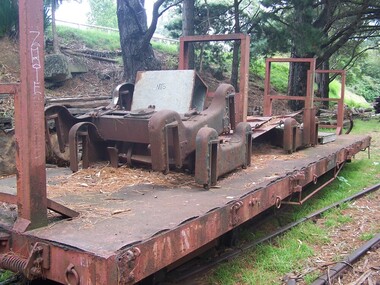
19 NQ, Pulpwood Truck, 26/11/1898
... Pulpwood Truck...19 NQ - Pulpwood Truck Untrafficable NQ Pulpwood wagon. ...19 NQ - Pulpwood wagon - Pulpwood Truck made of Steel and metal ...19 NQ - Pulpwood Truck Untrafficable NQ Pulpwood wagon. ...19 NQ - Pulpwood Truck Untrafficable NQ Pulpwood wagon. In the 1950s, NQR 19 was modified by the removal of its sides and ends and the installation of intermediate upright staunchions to carry pulp-wood on the Beech Forest line. This modification was permanent and the vehicle became 19 NQ. 19 NQ - Service History 26/11/1898 NWS Built new NQ 19 was modified by having upright frames added to allow it to carry pulp-wood. Vehicle Length 25 feet 2 inches ( 7671 mm) Coupled Length 27 feet 4 inches (8330 mm) Width 6 feet 3 inches (1905 mm) Weight 5 tons Capacity 11 tons In use 14 To be restored 6 *NQR 19.VA - 26/11/1898 NWS Built new - / /1926 - To NQ 19.VA - NQ 19.VA - /10/1958 NWS Modified To Pulpwood Carrier Only vehicle modified to this configuration Purchased by Puffing Billy Preservation Society. Sec 65/2711. RS 65/6012. "An NM (13) and pulpwood wagon .... for displayat Museum.....scrap value to be charged direct to the PBPS."Historic - Victorian Railways Narrow Gauge - Rolling Stock - Pulpwood wagon - Pulpwood Truck19 NQ - Pulpwood wagon - Pulpwood Truck made of Steel and metal 19 NQ puffing billy railway, pbr, rolling stock , 19 nq, pulpwood wagon - pulpwood truck, victorian railways, narrow gauge rolling stock -
 Marysville & District Historical Society
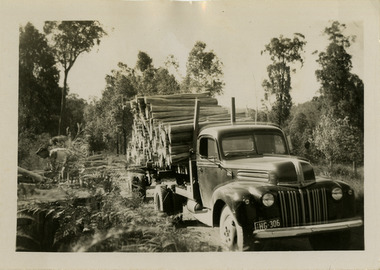
Photograph (item) - Black and white photograph, Post 1939 Black Friday bushfires
... ...pulpwood...A black and white photograph taken of the collection of pulpwood after the 1939 Black Friday bushfires. ...A black and white photograph taken of the collection of pulpwood after the 1939 Black Friday bushfires....Pulpwood after '39 fires 01...A black and white photograph taken of the collection of pulpwood after the 1939 Black Friday bushfires. ...A black and white photograph taken of the collection of pulpwood after the 1939 Black Friday bushfires. The Black Friday bushfires on January 13, 1939 were one of the worst natural disasters in Australian history, burning nearly two million hectares across Victoria and claiming 71 lives.A black and white photograph taken of the collection of pulpwood after the 1939 Black Friday bushfires.Pulpwood after '39 fires 01marysville, victoria, australia, 1939 black friday bushfires, pulpwood, photograph -
 Marysville & District Historical Society
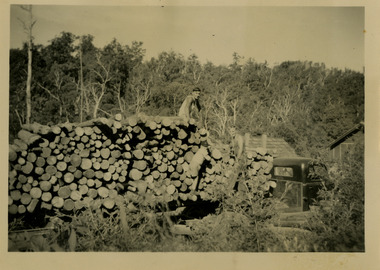
Photograph (item) - Black and white photograph, Post 1939 Black Friday bushfires
... ...pulpwood...A black and white photograph taken of a pulpwood harvest that was carried out after the 1939 Black Friday bushfires. ...A black and white photograph taken of a pulpwood harvest that was carried out after the 1939 Black Friday bushfires. ...pulpwood harvest/ post 1939 fires 554...A black and white photograph taken of a pulpwood harvest that was carried out after the 1939 Black Friday bushfires. ...A black and white photograph taken of a pulpwood harvest that was carried out after the 1939 Black Friday bushfires. The Black Friday bushfires on January 13th 1939 were one of the worst natural disasters in Australian history, burning nearly two million hectares across Victoria and claiming 71 lives.A black and white photograph taken of a pulpwood harvest that was carried out after the 1939 Black Friday bushfires.pulpwood harvest/ post 1939 fires 554marysville, victoria, australia, 1939 black friday bushfires, pulpwood, photograph -
 Department of Energy, Environment and Climate Action
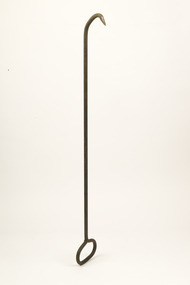
Pulpwood billet hook
... Pulpwood was often split by hand or with black powder splitting guns into more manageable sizes and cut into 8 foot lengths (or billets). ...Pulpwood was often split by hand or with black powder splitting guns into more manageable sizes and cut into 8 foot lengths (or billets). ...Pulpwood was often split by hand or with black powder splitting guns into more manageable sizes and cut into 8 foot lengths (or billets). Billets were first stacked endwise to drain the sap and lighten the load before they were loaded by hand onto flat bed trucks for transport to the mills. This long length metal hook was used to pull and manoeuvre the pulpwood billets onto the truck. The advent of excavators in logging operations in the 1970s led to the loading and carting pulpwood in long tree lengths.Long steel tool with handle on one end and hook on the other. -
 Otway Districts Historical Society
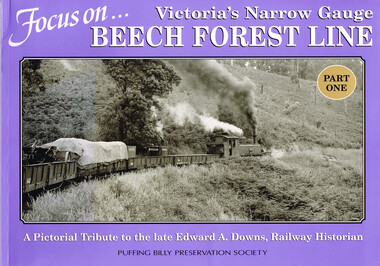
Book, Puffing Billy Preservation Society, Focus on Beech Forest Line, Part One, January 2004
... The line continued to survive on pulpwood long after other VR narrow gauge lines had ceased operation but finally, on 30 June 1962, a dilapidated G42 hauled the last train of goods wagons and vans to Beech Forest and return....The line continued to survive on pulpwood long after other VR narrow gauge lines had ceased operation but finally, on 30 June 1962, a dilapidated G42 hauled the last train of goods wagons and vans to Beech Forest and return. ...In the earliest years of the Colac-Beech Forest-Crowes line all trains were hauled by NA-class 2-6-2 tank locomotives. From 1926, with the introduction of articulated Beyer Garrett locomotive G41, it hauled the majority of trains with the NAs providing supplementary service as required. Late in 1945 Garratt G41 was again out of action undergoing repairs at the depot in Colac so regular traffic again was handled by an NA for a short time. The line continued to survive on pulpwood long after other VR narrow gauge lines had ceased operation but finally, on 30 June 1962, a dilapidated G42 hauled the last train of goods wagons and vans to Beech Forest and return.Focus on Victoria's Narrow Gauge: Beech Forest Line, Part One. John E. Thompson. Puffing Billy Preservation Society; Belgrave (Vic); Jan 2004. vi, 42 p.; illus; maps. Soft cover. ISBN 0 9579792 4 Xvictorian railways; narrow gauge; beech forest; colac; crowes; edward a. downs; john e. thompson; -
 Otway Districts Historical Society
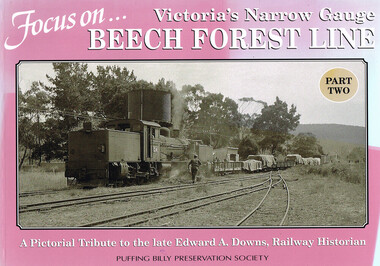
Book, Focus on Beech Forest Line, Part Two, November 2006
... After this the line survived on pulpwood traffic long after the other narrow gauge lines had ceased regular operation until, on 30 June 1962, a dilapated G42 Garrett hauled the last train of goods wagons and vans to Beech Forest and return....After this the line survived on pulpwood traffic long after the other narrow gauge lines had ceased regular operation until, on 30 June 1962, a dilapated G42 Garrett hauled the last train of goods wagons and vans to Beech Forest and return. ...In the earliest years of the Colac-Beech Forest-Crowes line all trains were hauled by NA-class 2-6-2 tank locomotives. From 1926, with the introduction of articulated Beyer Garrat locomotive G41, it hauled the majority of trains with the NA-class providing supplementary service as required. Late in 1945 G41 was out of action undergoing repairs at the depot in Colac so regular traffic again was handled by an NA-class for a short time before the Garratt returned. After this the line survived on pulpwood traffic long after the other narrow gauge lines had ceased regular operation until, on 30 June 1962, a dilapated G42 Garrett hauled the last train of goods wagons and vans to Beech Forest and return.Focus on Victoria's Narrow Gauge Beech Forest Line, Part Two. A pictorial tribute to the late Edward A. Downs, Railway Historian. John E. Thompson. Puffing Billy Preservation Society; Belgrave (Vic); November 2006. iv, 42 p.; illus; maps. Soft cover. ISBN 0 9579792 6 6victorian railways; narrow gauge; beech forest; colac; crowes; john e. thompson; edward a. downs; railway; -
 Puffing Billy Railway
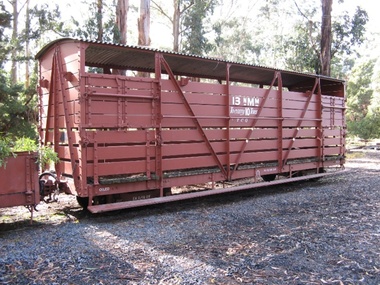
13 NMM, 5/ 6/1917
... "An NM (13) and pulpwood wagon .... for displayat Museum.....scrap value to be charged direct to the PBPS." 19/ 4/1967 BEL Sold (to) Puffing Billy Preservation Society..."An NM (13) and pulpwood wagon .... for displayat Museum.....scrap value to be charged direct to the PBPS." 19/ 4/1967 BEL Sold (to) Puffing Billy Preservation Society Historic - Victorian Railways - Narrow Gauge Rolling Stock - Livestock Van - Cattle Truck Victorian Heritage Register (VHR) Number H2187 - The Puffing Billy Rolling Stock Collection puffing billy railway puffing billy victorian railways nmm cattle truck 13 nmm 13 NMM 13 NMM Livestock Van - Cattle Truck made of wrought iron and timber 13 NMM - Victorian Railways - Newport Workshop ...13 NMM ( 13 NM ) Livestock Van - Cattle Truck In traffic NMM CATTLE TRUCK. Four of these were built during 1899-1901 and eleven more were built during 1909 and 1917, a total of 15. They were numbered 1-15. VR Service History : NMM 13.VA - 5/ 6/1917 NWS Built new - / /1926 - To NM 13.VA - *NM 13.VA - / 8/1928 - Modified AC Malco Purchased by Puffing Billy Preservation Society. Sec 65/2711. RS 65/6012. "An NM (13) and pulpwood wagon .... for displayat Museum.....scrap value to be charged direct to the PBPS." 19/ 4/1967 BEL Sold (to) Puffing Billy Preservation SocietyHistoric - Victorian Railways - Narrow Gauge Rolling Stock - Livestock Van - Cattle Truck Victorian Heritage Register (VHR) Number H2187 - The Puffing Billy Rolling Stock Collection 13 NMM Livestock Van - Cattle Truck made of wrought iron and timber13 NMMpuffing billy railway, puffing billy, victorian railways, nmm cattle truck, 13 nmm -
 Otway Districts Historical Society
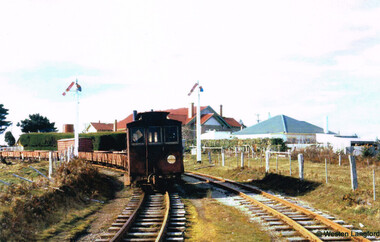
Photograph, Langford, Weston, Goods train arriving at Beech Forest, 1961, 9 August 1961
... From 1 July 1960 onwards, when pulpwood (hardwood) stopped being shipped from Beech Forest, a maximum of only 7,000 tonnes/year would be shipped to Colac. ...From 1 July 1960 onwards, when pulpwood (hardwood) stopped being shipped from Beech Forest, a maximum of only 7,000 tonnes/year would be shipped to Colac. ...From late in 1960 VR took what were the first definite steps to close the Colac-Beech Forest line. 1,101 tonnes of freight per year flowed from Colac to Beech Forest because of increasing competition from the roads. From 1 July 1960 onwards, when pulpwood (hardwood) stopped being shipped from Beech Forest, a maximum of only 7,000 tonnes/year would be shipped to Colac. Including special trips passenger revenue earned a little more than $200 per annum. The issue of second-hand sleepers stopped entirely and the two track gangs only patrolled the track and tightened loose bolts. The line did not earn its way and on 4 November 1960 it was recommended that services over the narrow gauge line be discontinued.The rear of a goods train from Colac arrives at Beech Forest on 9 August 1961. The other line is the former Crowes line truncated at Weeaproinah in January 1955. In the background is the Beech Forest Hall and Shire of Otway offices. Colour.colac; beech forest; railway; -
 Department of Energy, Environment and Climate Action
Log Branding Hammers (various)
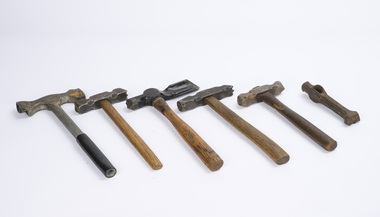
... Other local configurations were used by sawmillers, post cutters and pulpwood contactors. Forest regulations state that an authorised officer may use the crown mark to identify produce which has been sold and may be removed from the forest, whereas the broad arrow can be used to brand and mark trees which are not to be felled, or to indicate forest produce which has been seized. ...Other local configurations were used by sawmillers, post cutters and pulpwood contactors. Forest regulations state that an authorised officer may use the crown mark to identify produce which has been sold and may be removed from the forest, whereas the broad arrow can be used to brand and mark trees which are not to be felled, or to indicate forest produce which has been seized. ...Metal branding hammers were the most common way to control the sale and movement of hardwood timber produce like logs, railway sleepers, fence posts, and poles from Victorian State forests. Royalty was also paid on this basis. Hammers most commonly had a crown stamp on one end with a unique number in the middle which identified its owner, and a crows foot or broad arrow on the other. The broad arrow was a symbol traditionally used in Britain and its colonies to mark government property. Other local configurations were used by sawmillers, post cutters and pulpwood contactors. Forest regulations state that an authorised officer may use the crown mark to identify produce which has been sold and may be removed from the forest, whereas the broad arrow can be used to brand and mark trees which are not to be felled, or to indicate forest produce which has been seized. Hammers were traditionally only ever issued to forest officers and were an important, and closely guarded tool-of-trade. They were not transferred between staff and lending hammers was not permitted. But it was an onerous task for staff to hammer and tally hundreds of logs, or thousands of fence posts each week, so in about 1990 a system was introduced whereby hammers were allocated to logging contractors to grade logs and tally them instead. But there was still spot checking by authorised officers. A register was kept, and contractors paid a substantial deposit to make sure they didn't lose them, but they occasionally turn up by fossickers with metal detectors. While branding hammers are still used in some smaller locations, plastic tags and barcodes are now more common.Log Grading hammersforests commission victoria (fcv), hand tools, forest harvesting -
 Department of Energy, Environment and Climate Action
Log Branding Hammer
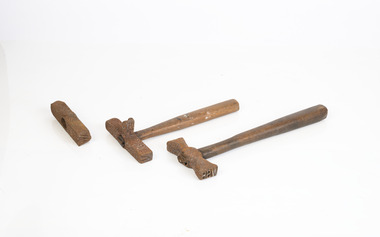
... Other local configurations were used by sawmillers, post cutters and pulpwood contactors. Forest regulations state that an authorised officer may use the crown mark to identify produce which has been sold and may be removed from the forest, whereas the broad arrow can be used to brand and mark trees which are not to be felled, or to indicate forest produce which has been seized. ...Other local configurations were used by sawmillers, post cutters and pulpwood contactors. Forest regulations state that an authorised officer may use the crown mark to identify produce which has been sold and may be removed from the forest, whereas the broad arrow can be used to brand and mark trees which are not to be felled, or to indicate forest produce which has been seized. ...Metal branding hammers were the most common way to control the sale and movement of hardwood timber produce like logs, railway sleepers, fence posts, and poles from Victorian State forests. Royalty was also paid on this basis. Hammers most commonly had a crown stamp on one end with a unique number in the middle which identified its owner, and a crows foot or broad arrow on the other. The broad arrow was a symbol traditionally used in Britain and its colonies to mark government property. Other local configurations were used by sawmillers, post cutters and pulpwood contactors. Forest regulations state that an authorised officer may use the crown mark to identify produce which has been sold and may be removed from the forest, whereas the broad arrow can be used to brand and mark trees which are not to be felled, or to indicate forest produce which has been seized. Hammers were traditionally only ever issued to forest officers and were an important, and closely guarded tool-of-trade. They were not transferred between staff and lending hammers was not permitted. But it was an onerous task for staff to hammer and tally hundreds of logs, or thousands of fence posts each week, so in about 1990 a system was introduced whereby hammers were allocated to logging contractors to grade logs and tally them instead. But there was still spot checking by authorised officers. A register was kept, and contractors paid a substantial deposit to make sure they didn't lose them, but they occasionally turn up by fossickers with metal detectors. While branding hammers are still used in some smaller locations, plastic tags and barcodes are now more common.Log Grading hammersforests commission victoria (fcv), hand tools, forest harvesting -
 Department of Energy, Environment and Climate Action
Forest Metriverter, Side Rule
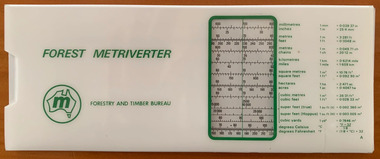
... Eventually, the measurement of logs and sawn timber changed from imperial, and excruciating, measures such as super feet of sawn timber, billets and cunits (100 cubic feet) of stacked pulpwood and hoppus log volumes to simpler cubic metres. ...Eventually, the measurement of logs and sawn timber changed from imperial, and excruciating, measures such as super feet of sawn timber, billets and cunits (100 cubic feet) of stacked pulpwood and hoppus log volumes to simpler cubic metres. ...Device to convert Imperial measurements of length, area, weight etc to the metric system. Decimal currency was spectacularly introduced in an overnight overthrow on 14 February 1966, but it took another 8 years before metrication finally arrived in the forest and timber industry. Eventually, the measurement of logs and sawn timber changed from imperial, and excruciating, measures such as super feet of sawn timber, billets and cunits (100 cubic feet) of stacked pulpwood and hoppus log volumes to simpler cubic metres. Measuring firewood was a particular nightmare. For example, there were standard chords, stove cords, kitchen cords, running cords, face cords, thrown chords, fencing cords, country cords, long cords, raummeter or steres (1m x 1m x 1m). A standard cord of firewood had a volume of 128 cubic feet, measured as a pile 8 feet long, 4 feet high and 4 feet wide (3.624 m3). And how about this for confusing…. in Victoria, an imperial or long ton (by measure) of green firewood was a stack 5 feet long billets (2 axelengths at 2′ 6″ each), one axelength high (2′ 6″) and two axelengths long (5 feet) equalling 62.5 cubic feet. For added befuddlement, there were three different sorts of tons: Imperial tons or long tons, American short tons and metric tonnes (spelled with two n’s). Not forgetting that a cubic imperial ton of firewood (40 cubic feet) which equalled 1.133 cubic metre. The metrication process began in 1974 and was completed by 1976 but the transition was not without its challenges along the supply chain for foresters, overseers, logging contractors, sawmillers, hardware stores and builders alike. Timber lengths changed from feet to metres but were still sold in multiples of one foot or 0.3 m (1.8, 2.1, 2.4, 2.7 etc) whereas a menacing lump of 4-Bee-2 transformed into a rather less colourful 100mm by 50mm. Measurement and calculations of area also became so much easier in hectares rather than complicated acres, roods and perches. The Forest Metriverter slide-rule was issued by the Forestry and Timber Bureau to make metric conversions easier.Forest MetriverterRoss Pennyforest measurement, surveying, forests commission victoria (fcv) -
 Department of Energy, Environment and Climate Action
Splitting Gun, Black Powder
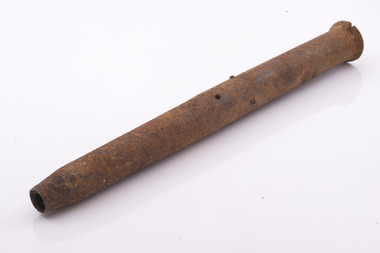
... Commonly used to split pulpwood but now rare Forest Harvesting Five marking rings used to guide how far the gun was in the log Black Powder Splitting Gun Black Powder Splitting Gun ...Black powder splitting guns were commonly used to split large logs into more manageable pieces before the advent of excavators and front-end loaders in bush logging operations. A typical splitting gun used in Victorian forests was a piece of high-grade steel about 1-1/2 to 2 inches in diameter and about 16 inches long, and slightly tapered at one end. They had a ¾ inch hole drilled about 9 inches deep into the centre of the shaft with a small pilot hole drilled from the outside to load the fuse. The tube was carefully loaded with an amount of black gunpowder using a funnel and spoon. Experience being the guide on how much powder to use, which depended on log size, species and difficulty of splitting the wood. The hole was stopped with a piece of wadded paper and the gun positioned at the end of a length of the log to be split. The splitting gun was then belted into the log with a large wooden maul or even the back of an axe to a depth of about 3 to 4 inches. There were often markings as a guide. This also had the effect of tamping the black powder inside the gun. Preferably the gun was backed up by another large log to absorb the shock and avoid it flying off in the bush somewhere. I have seen guns where a length of string and coloured flag could be attached to help find them. A length of fuse was then inserted in the small hole and lit. Kaboom !!!! Needless to say, the splitting gun was a dangerous implement.Commonly used to split pulpwood but now rareBlack Powder Splitting GunFive marking rings used to guide how far the gun was in the logforest harvesting
