
Showing 25 items matching "queen elizabeth hospital"
-
 Kew Historical Society Inc
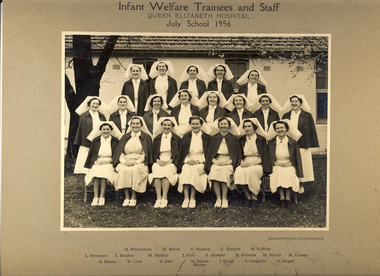
Photograph, Infant Welfare Trainees and Staff, Queen Elizabeth Hospital, 1956
... Infant Welfare Trainees and Staff, Queen Elizabeth Hospital......queen elizabeth hospital...In 1951, the facility reopened as the Queen Elizabeth Maternal and Child Health Centre that also operated as an Infant Welfare and Mothercraft Training School. The Centre provided after-care for nursing mothers and babies transferring from maternity hospitals, and specialised care for babies referred by private practitioners and the Social Welfare Department – babies who were premature, frail or had feeding or similar problems. ...Photograph, mounted on card of Infant Welfare Trainees and Staff, Queen Elizabeth Hospital, 1956. The photograph lists the names of the individuals below the photograph. ...Obverse: Infant Welfare Trainees and Staff, Queen Elizabeth Hospital, July School 1956 Reverse: "Presented to Kew Historical Soc by Dr Darbyshire following a 50 year birthday display at the Denmark Street Maternal and Child Health Centre [Kew] in May 1980. ...Infant Welfare Trainees and Staff, Queen Elizabeth Hospital Photograph Photograph Allan Studios ...Carlton Refuge/Carlton Home was established in 1857 in Madeline Street, Carlton (relocating in 1890 to Keppel Street, Carlton). The Carlton Home provided maternity care for married and unmarried mothers, and residential care for infants and toddlers unable to be at home with their mother. It also operated a day-care centre for children. Most of the residents were mothers or children on private placements. The Children's Welfare Department used the Carlton Home as a maternity home for wards, a foster home for infant wards, and for children requiring placements under the infant life protection provisions of the Children's Welfare Act. By the late 1940s, the home was in a bad state of repair and it closed in 1949. In 1951, the facility reopened as the Queen Elizabeth Maternal and Child Health Centre that also operated as an Infant Welfare and Mothercraft Training School. The Centre provided after-care for nursing mothers and babies transferring from maternity hospitals, and specialised care for babies referred by private practitioners and the Social Welfare Department – babies who were premature, frail or had feeding or similar problems. (Source: DHHS)The photograph is a valuable primary resource relating to training for maternal and infant welfare centres in Kew, Victoria. It has a strong provenance through inscriptions linking it to the Denmark Street Maternal and Child Health Centre.Photograph, mounted on card of Infant Welfare Trainees and Staff, Queen Elizabeth Hospital, 1956. The photograph lists the names of the individuals below the photograph. They include: Back Row {L-R] M Whittenbury, M Bolton, E Haebich, G Barnard, M Griffiths / Middle Row [L-R] L Stevenson, T Boucher, M Madden, J Price, A Glowrey, R Helmore, M Murfet, M Lindsay / Front Row [L-R] R Buxton, W Crick, G Stott, M Buxton Matron, J Keogh, B Longmuir, E Borgelt.Obverse: Infant Welfare Trainees and Staff, Queen Elizabeth Hospital, July School 1956 Reverse: "Presented to Kew Historical Soc by Dr Darbyshire following a 50 year birthday display at the Denmark Street Maternal and Child Health Centre [Kew] in May 1980. [Illegible]."denmark street maternal and child health centre, baby health centres --- kew (vic), queen elizabeth hospital, infant welfare -
 Ballarat Tramway Museum
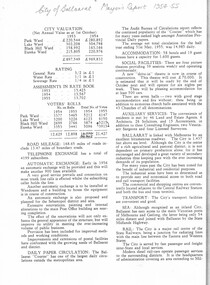
Document - Photocopy, Neville Gower, "Mayor's Report 1954-1955", Jul. 1997
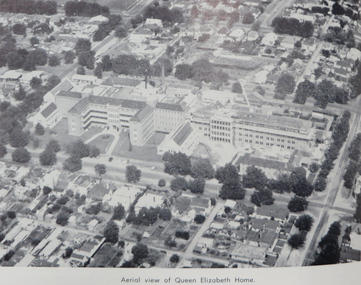
... Three pages covering trams, railways telephone exchange problems, photo of Queen Elizabeth hospital, photo from Ballarat Town Hall looking east in 1874 and today (1955). ...Three pages covering trams, railways telephone exchange problems, photo of Queen Elizabeth hospital, photo from Ballarat Town Hall looking east in 1874 and today (1955). ...Photocopy of part of City of Ballarat's Mayor's Report for 1954 - 1955. Three pages covering trams, railways telephone exchange problems, photo of Queen Elizabeth hospital, photo from Ballarat Town Hall looking east in 1874 and today (1955). Originals held in the Ballarat Library. trams, tramways, city of ballaarat, trams, railways, civic history -
 Geoffrey Kaye Museum of Anaesthetic History
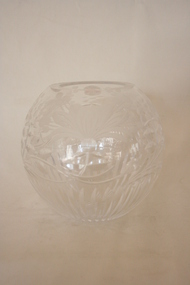
Decorative object - Vase, crystal, Royal Brierley, Unknown
... During a visit to Ulimaroa in 1994, Dr Richard Howell (Coventry, West Midlands), Griselda Cooper (Queen Elizabeth Hospital, Birmingham) and David Greaves (Ashington Hospital, Northumberland) presented the College with a Royal Brierley etched vase. ...During a visit to Ulimaroa in 1994, Dr Richard Howell (Coventry, West Midlands), Griselda Cooper (Queen Elizabeth Hospital, Birmingham) and David Greaves (Ashington Hospital, Northumberland) presented the College with a Royal Brierley etched vase. ...During a visit to Ulimaroa in 1994, Dr Richard Howell (Coventry, West Midlands), Griselda Cooper (Queen Elizabeth Hospital, Birmingham) and David Greaves (Ashington Hospital, Northumberland) presented the College with a Royal Brierley etched vase. This gift was accepted on behalf of the college by the Registrar, Mrs Joan Sheales. Royal Brierley is a crystal glass manufacturer based in Brierley Hill, Dudley, West Midlands. It is one of the oldest crystal glass manufacturers in England which dates back to the early 17th century.Medium sized round shaped crystal vase, hand made, decorated with etched floral motifs.[LABEL] SINCE 1776 / Royal Brierley / HANDMADE / IN / ENGLANDdr howell, dr cooper, dr greaves, royal brierley -
 Federation University Historical Collection
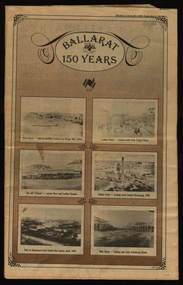
Newspaper, Ballarat 150 Years: Supplement to the Ballarat Courier, 1988, 17/03/1988
... Articles include: 1838-the pastoral period begins; First White Settlers arrive (Anderson, Winter, Yuille, Kirkland, Learmonth); Learmonths - Pioneer Settlers; The Rush to Ballarat; Last of the Aborigines; Eureka Affair Gains New Importance; Mining-After the rush; SMB - First Technical School; Clubs Play their Part; Ballarat Yuilles had Wealthy Ancestors; Town, Country Share a Close Relationship; Many Sides to Metals Industry; True Victorian City; Five Severe Recessions; Financiers to the Fore; Ready for War; City Rich in Sport Facilities; Visitors to most exciting place; No Place for a Nervous Lady; Theatres Provide Welcome Diversion for Mines; Might Achievers Among famous Citizens; Life Seemed Different After the War; Ballarat School of Mines Eastern Station Hotel; Memorial (Her Majesty's) Last of Many Theatres; Art Gallery at its Best; Pilgrimage to Yuille Cairn at Sebastopol Images include: Jelbart tractor; Sunshine Harvester; Bailey's Mansion; Pennyweight Hotel; Bridge Mall; Blue Riband Mine, Black Hill, Burrumbeet Shooting party; A wendouree rowing club; Motor Cycle Racing; Women bowlers, Queen Elizabeth; Gong Gong Methodist Church; Arbour day at Waterloo Farm, Smythes Rd; Gold panners (1890s); Ballarat Cricket Team (1902); William Peart; D'Angri's store; Sturt St Advertisements include: Rehfisch and Co.; UFS Dispensaries; Deutscher Mower Sales and Service; Haymes Paint; Cincotta's; Abraham's Sportscene; McK's; McKay Macleod; St John of God Hospital; Benjamins Real Estate; Ballarat Water Board; Cornell's Pharmacy; Laminex Industries; Coltman Mitre 10; Lal Lal Iron Mine; Heinz Bros; Crockers; Frank ford travel; S.J. ...Articles include: 1838-the pastoral period begins; First White Settlers arrive (Anderson, Winter, Yuille, Kirkland, Learmonth); Learmonths - Pioneer Settlers; The Rush to Ballarat; Last of the Aborigines; Eureka Affair Gains New Importance; Mining-After the rush; SMB - First Technical School; Clubs Play their Part; Ballarat Yuilles had Wealthy Ancestors; Town, Country Share a Close Relationship; Many Sides to Metals Industry; True Victorian City; Five Severe Recessions; Financiers to the Fore; Ready for War; City Rich in Sport Facilities; Visitors to most exciting place; No Place for a Nervous Lady; Theatres Provide Welcome Diversion for Mines; Might Achievers Among famous Citizens; Life Seemed Different After the War; Ballarat School of Mines Eastern Station Hotel; Memorial (Her Majesty's) Last of Many Theatres; Art Gallery at its Best; Pilgrimage to Yuille Cairn at Sebastopol Images include: Jelbart tractor; Sunshine Harvester; Bailey's Mansion; Pennyweight Hotel; Bridge Mall; Blue Riband Mine, Black Hill, Burrumbeet Shooting party; A wendouree rowing club; Motor Cycle Racing; Women bowlers, Queen Elizabeth; Gong Gong Methodist Church; Arbour day at Waterloo Farm, Smythes Rd; Gold panners (1890s); Ballarat Cricket Team (1902); William Peart; D'Angri's store; Sturt St Advertisements include: Rehfisch and Co.; UFS Dispensaries; Deutscher Mower Sales and Service; Haymes Paint; Cincotta's; Abraham's Sportscene; McK's; McKay Macleod; St John of God Hospital; Benjamins Real Estate; Ballarat Water Board; Cornell's Pharmacy; Laminex Industries; Coltman Mitre 10; Lal Lal Iron Mine; Heinz Bros; Crockers; Frank ford travel; S.J. ...A supplement to celebrate 150 since the establishment of the Port Phillip Colony (Victoria).40 page newspaper published to celebrate the Sesquicentenary of Ballarat. Articles include: 1838-the pastoral period begins; First White Settlers arrive (Anderson, Winter, Yuille, Kirkland, Learmonth); Learmonths - Pioneer Settlers; The Rush to Ballarat; Last of the Aborigines; Eureka Affair Gains New Importance; Mining-After the rush; SMB - First Technical School; Clubs Play their Part; Ballarat Yuilles had Wealthy Ancestors; Town, Country Share a Close Relationship; Many Sides to Metals Industry; True Victorian City; Five Severe Recessions; Financiers to the Fore; Ready for War; City Rich in Sport Facilities; Visitors to most exciting place; No Place for a Nervous Lady; Theatres Provide Welcome Diversion for Mines; Might Achievers Among famous Citizens; Life Seemed Different After the War; Ballarat School of Mines Eastern Station Hotel; Memorial (Her Majesty's) Last of Many Theatres; Art Gallery at its Best; Pilgrimage to Yuille Cairn at Sebastopol Images include: Jelbart tractor; Sunshine Harvester; Bailey's Mansion; Pennyweight Hotel; Bridge Mall; Blue Riband Mine, Black Hill, Burrumbeet Shooting party; A wendouree rowing club; Motor Cycle Racing; Women bowlers, Queen Elizabeth; Gong Gong Methodist Church; Arbour day at Waterloo Farm, Smythes Rd; Gold panners (1890s); Ballarat Cricket Team (1902); William Peart; D'Angri's store; Sturt St Advertisements include: Rehfisch and Co.; UFS Dispensaries; Deutscher Mower Sales and Service; Haymes Paint; Cincotta's; Abraham's Sportscene; McK's; McKay Macleod; St John of God Hospital; Benjamins Real Estate; Ballarat Water Board; Cornell's Pharmacy; Laminex Industries; Coltman Mitre 10; Lal Lal Iron Mine; Heinz Bros; Crockers; Frank ford travel; S.J. Weir; Ludbrook Plumbing Service; Mars; Robert Sim Building Supplies, Frank Day; Sectrol Systems; Thornton Richardsballarat, anniversary, sydney abraham, cincotta, eureka, ballarat school of mines, mining, ballarat club, lal lal iron mine, ballarat rangers, victorian rifles, 3rd battalion victorian rifles, ballarat militia, white flat, celia scott, adelphi theatre, victoria theatre, montezuma theatre, charlie napier, juliamatthews, royal theatre, dick richards, henry sutton, eleanor lucus, martin hosking, newington estate, saleyards, g. gay & co, ballarat books, old benev' alleviated distress on goldfields -
 Federation University Historical Collection
Booklet, City of Ballarat Mayor's Report, 1957-1958, 1958
... queen mother...raaf school of radio...city engineer's department...public health report...finance...mr k. h. mitchell...mr f. j. rogers...building surveyor's department...mr j. b. menhennet...mr r. g. campbell...city health inspector...mr. r. g. biggs...weights and measures inspector...mr. w. mccormack...libraries...mr r. a. mccallum...streets, parks and gardens...water supply and sewerage...ballaarat's voluntary community committees...service clubs...city traffic...mr. j. h. sorrell...sturt street gardens...ballarat base hospital...st john of god hospital...queen elizabeth...Ballarat was created a municipality on 17 December 1855, declared a Borough on October 1863, Proclaimed a City on 09 September 1970. city of ballarat mayor's report annual report jack chisholm city of ballarat coat of arms arms of ballarat john a. chisholm arthur nicholson alan pittard gordon scott arthur mason frederick oliver oscar curnow frank woodward william roff francis cutts nathaniel callow kenneth webb mrs john a. chisholm queen mother raaf school of radio city engineer's department public health report finance mr k. h. mitchell mr f. j. rogers building surveyor's department mr j. b. menhennet mr r. g. campbell city health inspector mr. r. g. biggs weights and measures inspector mr. w. mccormack libraries mr r. a. mccallum streets, parks and gardens water supply and sewerage ballaarat's voluntary community committees service clubs city traffic mr. j. h. sorrell sturt street gardens ballarat base hospital st john of god hospital queen elizabeth centre black hill black hill reclaimation Ballarat Benenevolent Asylum Green covered book City of Ballarat Mayor's Report, 1957-1958 Booklet Booklet John Fraser & Son Printers ...Ballarat was created a municipality on 17 December 1855, declared a Borough on October 1863, Proclaimed a City on 09 September 1970.Green covered bookcity of ballarat, mayor's report, annual report, jack chisholm, city of ballarat coat of arms, arms of ballarat, john a. chisholm, arthur nicholson, alan pittard, gordon scott, arthur mason, frederick oliver, oscar curnow, frank woodward, william roff, francis cutts, nathaniel callow, kenneth webb, mrs john a. chisholm, queen mother, raaf school of radio, city engineer's department, public health report, finance, mr k. h. mitchell, mr f. j. rogers, building surveyor's department, mr j. b. menhennet, mr r. g. campbell, city health inspector, mr. r. g. biggs, weights and measures inspector, mr. w. mccormack, libraries, mr r. a. mccallum, streets, parks and gardens, water supply and sewerage, ballaarat's voluntary community committees, service clubs, city traffic, mr. j. h. sorrell, sturt street gardens, ballarat base hospital, st john of god hospital, queen elizabeth centre, black hill, black hill reclaimation, ballarat benenevolent asylum -
 Heidelberg Repatriation Hospital
Memorabilia - Memento, Baron, Royal Visit 1954, Circa 1954
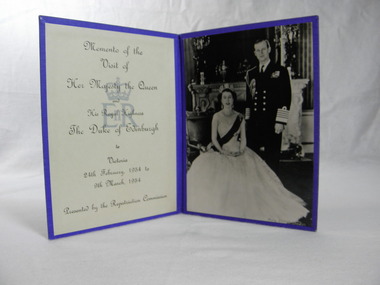
... Handed out to patients and visitors to commemorate the visit of her Royal Highness Queen Elizabeth II and Prince Phillip to Victoria in 1954 and in particular the Heidelberg Repatriation Hospital. ...Handed out to patients and visitors to commemorate the visit of her Royal Highness Queen Elizabeth II and Prince Phillip to Victoria in 1954 and in particular the Heidelberg Repatriation Hospital. ...Handed out to patients and visitors to commemorate the visit of her Royal Highness Queen Elizabeth II and Prince Phillip to Victoria in 1954 and in particular the Heidelberg Repatriation Hospital. This brought much excitement to the patients at Heidelberg.Recognises a significant Royal visit to Heidelberg Repatriation Hospital. Acknowleges the role of the Hospital in the treatment of War Veterans to receive such a visit and World War II had ceased in 1945, only nine years earlier.Blue cardboard folder of 4 sides, with a single fold containing 1 photo and inscription. Photo is of Queen Elizabeth sitting down and Prince Phillip standing to the left of her in front of a fireplace, with commemorative acknowledgement of the visit.Page 1 shows the Commonwealth Emblem with the words "Royal Visit 1954" inscribed under it. Page 2 has the inscription " Memento of the Visit of Her Majesty and his Royal Highness The Duke of Edinburgh to Victoria 24th February, 1954 to 9th March, 1954 presented by the Repatriation Commission" over a crown and the letters EIIRbritish royalty, 1954, 1954 royal visit, royal visit australia, memento, australian coat of arms -
 Heidelberg Repatriation Hospital
Memorabilia - Memento, Baron, Royal Visit 1954, Circa 1954
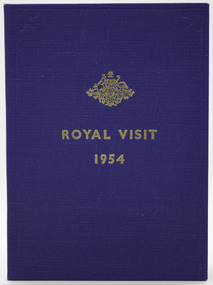
... Handed out to patients and visitors to commemorate the visit of her Royal Highness Queen Elizabeth II and Prince Phillip to Victoria in 1954 and in particular the Heidelberg Repatriation Hospital. ...Handed out to patients and visitors to commemorate the visit of her Royal Highness Queen Elizabeth II and Prince Phillip to Victoria in 1954 and in particular the Heidelberg Repatriation Hospital. ...Handed out to patients and visitors to commemorate the visit of her Royal Highness Queen Elizabeth II and Prince Phillip to Victoria in 1954 and in particular the Heidelberg Repatriation Hospital. This brought much excitement to the patients at Heidelberg.Recognises a significant Royal visit to Heidelberg Repatriation Hospital. Acknowleges the role of the Hospital in the treatment of War Veterans to receive such a visit and World War II had ceased in 1945, only nine years earlier.Blue cardboard folder of 4 sides, with a single fold containing 1 photo and inscription. Photo is of Queen Elizabeth sitting down and Prince Phillip standing to the left of her in front of a fireplace, with commemorative acknowledgement of the visit.Page 1 shows the Commonwealth Emblem with the words "Royal Visit 1954" inscribed under it. Page 2 has the inscription " Memento of the Visit of Her Majesty and his Royal Highness The Duke of Edinburgh to Victoria 24th February, 1954 to 9th March, 1954 presented by the Repatriation Commission" over a crown and the letters EIIRbritish royalty, 1954, 1954 royal visit, royal visit australia, memento, australian coat of arms -
 Bendigo Military Museum
Newspaper - NEWSPAPER WW2, Daily News, 23.7.1940
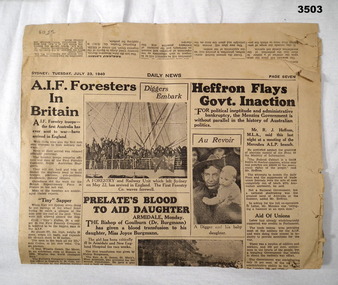
... A double page from Daily News, Sydney 23.7.1940 containing various articles relating to the war including a visit by Queen Elizabeth to wounded at a London Military Hospital....documents - newspapers military history - army Daily A double page from Daily News, Sydney 23.7.1940 containing various articles relating to the war including a visit by Queen Elizabeth to wounded at a London Military Hospital. Daily News Newspaper NEWSPAPER WW2 ...A double page from Daily News, Sydney 23.7.1940 containing various articles relating to the war including a visit by Queen Elizabeth to wounded at a London Military Hospital.documents - newspapers, military history - army, daily -
 Bendigo Military Museum
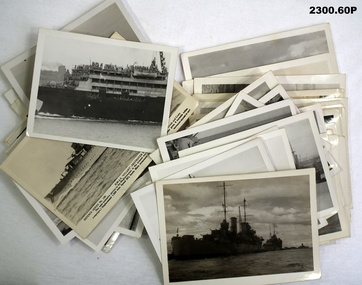
Photograph - PHOTOGRAPHS, NAVY WW2, c.WWII
... .33) - .34) Hobart striking heavy weather .35) HMS Jupiter .36) British submarine entering Alex .37) Queen Mary .38) Queen Elizabeth .39) Nieuw Amsterdam .40) - .41) Achilles .42) HMS Aircraft carrier - Illustrious .43) Symbol of Hobart's Pom-Pom .44) - .45) - .46) - .47) - .48) Mohoja and Oronties .49) Mohoja .50) - .51) - .52) HMAS Murchison 1954 .53) Strathmore .54) - .55) - .56 - .57 - .58) HMAS Vendetta .59) HMAS Cowra .60) - .1) Ship .2) Submarine conning tower .3) Ship .4) Hospital ship .5) Ship at anchor .6) Launch at ships side .7) Ships at anchor .8) Sunken ship .9) Ship .10) Group on launch .11) Ship firing a broadside .12) Wooden sailing vessel .13) Ship .14) Ship .15) Pilot station .16) Ship .17) Ship .18) Ship.s deck and biplane .19) Partially sunken ship .20) Two ships .21) Ship .22) Ship - damaged .23) Ship .24) Statue and colonade .25) Searchlights .26) Ships deck at sea .27) Aircraft .28) Ship .29) Ship .30) Troop ship .31) Swimmers at ships side .32) Ship .33) Ship .34) Ship deck at sea .35) Ship .36) Submarine .37) Ship .38) Ship .39) Ship .40) Two ships at sea .41) Ship .42) Aircraft carrier .43) Ships symbol .44) Sketch of Berbera .45) Sketch of biplanes .46) Boat at pier .47) Tug boat .48) Ship .49) Ship at wharf .50) Ships at wharf .51) Aircraft carrier .52) Ship .53) Ship at wharf .54) Ships at wharf .55) Ship .56) Two ships .57) Tug boat .58) Diagram comparing the size of two ships .59) Ship sailing past lighthouse .60) Postcard HMAS "Stuart". ...Photographs collected by Earnest Albert Simmons W/2129 Royal Australian Navy. Enlisted 30 June 1941 and discharged 14 October 1946 with the rank of Leading Stoker. Posting at discharge was HMAS Lonsdale..1) Ship .2) Submarine conning tower .3) Ship .4) Hospital ship .5) Ship at anchor .6) Launch at ships side .7) Ships at anchor .8) Sunken ship .9) Ship .10) Group on launch .11) Ship firing a broadside .12) Wooden sailing vessel .13) Ship .14) Ship .15) Pilot station .16) Ship .17) Ship .18) Ship.s deck and biplane .19) Partially sunken ship .20) Two ships .21) Ship .22) Ship - damaged .23) Ship .24) Statue and colonade .25) Searchlights .26) Ships deck at sea .27) Aircraft .28) Ship .29) Ship .30) Troop ship .31) Swimmers at ships side .32) Ship .33) Ship .34) Ship deck at sea .35) Ship .36) Submarine .37) Ship .38) Ship .39) Ship .40) Two ships at sea .41) Ship .42) Aircraft carrier .43) Ships symbol .44) Sketch of Berbera .45) Sketch of biplanes .46) Boat at pier .47) Tug boat .48) Ship .49) Ship at wharf .50) Ships at wharf .51) Aircraft carrier .52) Ship .53) Ship at wharf .54) Ships at wharf .55) Ship .56) Two ships .57) Tug boat .58) Diagram comparing the size of two ships .59) Ship sailing past lighthouse .60) Postcard HMAS "Stuart". .1) Hobart and Glascow at Colombo .2) British submarine returning to Alexandria after claiming a victory - note Skull and X Bones .3) HMS Glascow at Colombo .4) Ex Italian hospital ship taken over by British. RAMB II .5) HMS Exeter .6) The landing party returning .7) Part fleet at Colombo .8) British ammunition ship sunk by sabotage in Alex Harbour .9) HMS Exeter .10) On the approach of the island. Note twin Lewis guns .11) HMS Ajax bombarding Bardia .12) A native boat used along coasts and Indian Ocean .13) RMS Georgie refoated at Pt? 1941 .14) HMS Carthage .15) Pilot station at Colombo .16) Aquitania .17) Ajax on patrol with Hobart and battle fleet .18) Hobart rolling in the Bight .19) HMS Gnat (river gun boat) hit by torpedo at Tobruk .20) - .21) Mauritania .22) Italian cruiser sunk by HMAS Sydney .23) Greek destroyer .24) Memorial of Mohomed Pasha Alexandria. Presented by Musso .25) Searchlight at Alexandria .26) Hobart pile driving in heavy weather .27) Lockheed Hudson dive bombing .28) - .29) HMS Galatea? x 1 turret at stern .30) Troops on Aquitania .31) Boys swimming in the middle lakes at Ismalia in the centre of Sues Canal .32) A water NG ? .33) - .34) Hobart striking heavy weather .35) HMS Jupiter .36) British submarine entering Alex .37) Queen Mary .38) Queen Elizabeth .39) Nieuw Amsterdam .40) - .41) Achilles .42) HMS Aircraft carrier - Illustrious .43) Symbol of Hobart's Pom-Pom .44) - .45) - .46) - .47) - .48) Mohoja and Oronties .49) Mohoja .50) - .51) - .52) HMAS Murchison 1954 .53) Strathmore .54) - .55) - .56 - .57 - .58) HMAS Vendetta .59) HMAS Cowra .60) - photographs, ran, hmas -
 Bendigo Historical Society Inc.
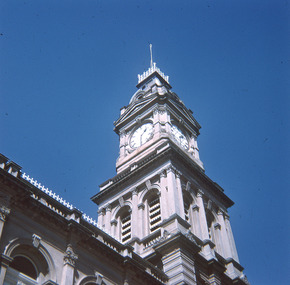
Negative - Edith Perry Collection: Photos of Bendigo - Slides, 1970s
... Box of forty four Slides - Contents contains slides of Bendigo 11070.1 Old Bendigo Post Office 11070.1b Bendigo Easter Parade 11070.1c High Street Bendigo Sacred Heart Cathedral 11070.1d Deborah Mine Bendigo 11070.1e Bendigo Easter Parade 11070.1f Bendigo Easter Parade 11070.1g Lake Weroona Bendigo 11070.1h St John of God Hospital Bendigo 11070.1i 57 Forest Street Bendigo 11070.1j Goldmines Hotel Bendigo 11070.1k City of Greater Bendigo Council Offices Lytleton Terrace 11070.1l Shamrock Hotel Bendigo 11070.1m Latrobe University Bandigo 11070.1n Charing Cross Bendigo 11070.1o Central Deborah Mine Bendigo 11070.1p Pall Mall Bendigo 11070.1q Creche - Queen Victoria Gardens Bendigo 11070.1r High Street Bendigo Sacred Heart Cathedral 11070.1s Bendigo Fernery 11070.1t the Stables Gallery - Bendigo Pottery 11070.1u Discovery of Gold Statue 11070.1v Central Deborah Mine 11070.1x Sacred Heart Cathedral 11070.1x St Pauls Cathedral 11070.1y Lily Street - looking over the CBD 11070.1z Chinese Dragon 11070.1aa Chinese Joss House 11070.1ab Rosalind Park 11070.1ac the Fountain Bendigo 11070.1ad the Bendigo Law Courts and Police Station 11070.1ae the Latrobe University 11070.1af the Ann Caudle Centre 11070.1ag the Queen Elizabeth Oval 11070.1ah School 11070.1ai Easter Procession 11070.1aj Unknown 11070.1ak Old Bendigo Post Office 11070.1al Mt Alvernia Hospital 11070.1am Sale Yards 11070.1an House Bendigo 11070.1ap Olympic Pool 11070.1aq Old Post Office and Law Courts 11070.1ar City of Greater Bendigo Offices Lytleton Terrace 11070.1as Central Deborah Mine 11070.1at Lake Eppalock ...photos bendigo Box of forty four Slides - Contents contains slides of Bendigo 11070.1 Old Bendigo Post Office 11070.1b Bendigo Easter Parade 11070.1c High Street Bendigo Sacred Heart Cathedral 11070.1d Deborah Mine Bendigo 11070.1e Bendigo Easter Parade 11070.1f Bendigo Easter Parade 11070.1g Lake Weroona Bendigo 11070.1h St John of God Hospital Bendigo 11070.1i 57 Forest Street Bendigo 11070.1j Goldmines Hotel Bendigo 11070.1k City of Greater Bendigo Council Offices Lytleton Terrace 11070.1l Shamrock Hotel Bendigo 11070.1m Latrobe University Bandigo 11070.1n Charing Cross Bendigo 11070.1o Central Deborah Mine Bendigo 11070.1p Pall Mall Bendigo 11070.1q Creche - Queen Victoria Gardens Bendigo 11070.1r High Street Bendigo Sacred Heart Cathedral 11070.1s Bendigo Fernery 11070.1t the Stables Gallery - Bendigo Pottery 11070.1u Discovery of Gold Statue 11070.1v Central Deborah Mine 11070.1x Sacred Heart Cathedral 11070.1x St Pauls Cathedral 11070.1y Lily Street - looking over the CBD 11070.1z Chinese Dragon 11070.1aa Chinese Joss House 11070.1ab Rosalind Park 11070.1ac the Fountain Bendigo 11070.1ad the Bendigo Law Courts and Police Station 11070.1ae the Latrobe University 11070.1af the Ann Caudle Centre 11070.1ag the Queen Elizabeth Oval 11070.1ah School 11070.1ai Easter Procession 11070.1aj Unknown 11070.1ak Old Bendigo Post Office 11070.1al Mt Alvernia Hospital 11070.1am Sale Yards 11070.1an House Bendigo 11070.1ap Olympic Pool 11070.1aq Old Post Office and Law Courts 11070.1ar City of Greater Bendigo Offices Lytleton Terrace 11070.1as Central Deborah Mine 11070.1at Lake Eppalock Negative Edith Perry Collection: Photos of Bendigo - Slides ...Box of forty four Slides - Contents contains slides of Bendigo 11070.1 Old Bendigo Post Office 11070.1b Bendigo Easter Parade 11070.1c High Street Bendigo Sacred Heart Cathedral 11070.1d Deborah Mine Bendigo 11070.1e Bendigo Easter Parade 11070.1f Bendigo Easter Parade 11070.1g Lake Weroona Bendigo 11070.1h St John of God Hospital Bendigo 11070.1i 57 Forest Street Bendigo 11070.1j Goldmines Hotel Bendigo 11070.1k City of Greater Bendigo Council Offices Lytleton Terrace 11070.1l Shamrock Hotel Bendigo 11070.1m Latrobe University Bandigo 11070.1n Charing Cross Bendigo 11070.1o Central Deborah Mine Bendigo 11070.1p Pall Mall Bendigo 11070.1q Creche - Queen Victoria Gardens Bendigo 11070.1r High Street Bendigo Sacred Heart Cathedral 11070.1s Bendigo Fernery 11070.1t the Stables Gallery - Bendigo Pottery 11070.1u Discovery of Gold Statue 11070.1v Central Deborah Mine 11070.1x Sacred Heart Cathedral 11070.1x St Pauls Cathedral 11070.1y Lily Street - looking over the CBD 11070.1z Chinese Dragon 11070.1aa Chinese Joss House 11070.1ab Rosalind Park 11070.1ac the Fountain Bendigo 11070.1ad the Bendigo Law Courts and Police Station 11070.1ae the Latrobe University 11070.1af the Ann Caudle Centre 11070.1ag the Queen Elizabeth Oval 11070.1ah School 11070.1ai Easter Procession 11070.1aj Unknown 11070.1ak Old Bendigo Post Office 11070.1al Mt Alvernia Hospital 11070.1am Sale Yards 11070.1an House Bendigo 11070.1ap Olympic Pool 11070.1aq Old Post Office and Law Courts 11070.1ar City of Greater Bendigo Offices Lytleton Terrace 11070.1as Central Deborah Mine 11070.1at Lake Eppalock photos, bendigo -
 Bendigo Historical Society Inc.
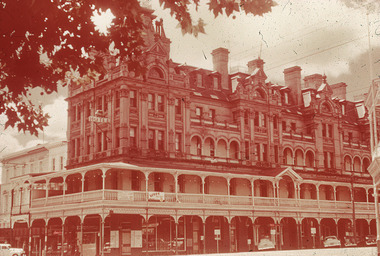
Slide - Ian Qualtrough Collection: Photos of Bendigo, 1950-1970 abt
... Ian Qualtrough Collection: Twelve Coloured Slides of Bendigo - photographer unknown This item contains the following Slides: 11073.1a Shamrock Hotel Bendigo 11073.1b Lookout tower Rosalind Park Bendigo 11073.1c Creche Bendigo 11073.1d Sacred Heart Cathedral Bendigo 11073.1e Queen Elizabeth Oval Bendigo 11073.1f Gold Mine Bendigo 11073.1g Home and Hospital for the Aged Bendigo 11073.1h School of Mines (Bendigo Tech) 11073.1i Olympic Pool Bendigo 11073.1j Cenotaph and City Family Hotel Bendigo 11073.1k Law Courts and Post Office Bendigo 11073.1l Bendigo from the lookout tower...He loved pulling things to pieces and getting them to work, especially if they did not do so before. photos bendigo ian qualtrough collection Ian Qualtrough Collection: Twelve Coloured Slides of Bendigo - photographer unknown This item contains the following Slides: 11073.1a Shamrock Hotel Bendigo 11073.1b Lookout tower Rosalind Park Bendigo 11073.1c Creche Bendigo 11073.1d Sacred Heart Cathedral Bendigo 11073.1e Queen Elizabeth Oval Bendigo 11073.1f Gold Mine Bendigo 11073.1g Home and Hospital for the Aged Bendigo 11073.1h School of Mines (Bendigo Tech) 11073.1i Olympic Pool Bendigo 11073.1j Cenotaph and City Family Hotel Bendigo 11073.1k Law Courts and Post Office Bendigo 11073.1l Bendigo from the lookout tower Slide Ian Qualtrough Collection: Photos of Bendigo ...Ian Qualtrough (1948-2019) a resident of Golden Square suffered from autism. During his life time he collected many things, records, slides, clock, match box cars, pens and radios. He loved pulling things to pieces and getting them to work, especially if they did not do so before. Ian Qualtrough Collection: Twelve Coloured Slides of Bendigo - photographer unknown This item contains the following Slides: 11073.1a Shamrock Hotel Bendigo 11073.1b Lookout tower Rosalind Park Bendigo 11073.1c Creche Bendigo 11073.1d Sacred Heart Cathedral Bendigo 11073.1e Queen Elizabeth Oval Bendigo 11073.1f Gold Mine Bendigo 11073.1g Home and Hospital for the Aged Bendigo 11073.1h School of Mines (Bendigo Tech) 11073.1i Olympic Pool Bendigo 11073.1j Cenotaph and City Family Hotel Bendigo 11073.1k Law Courts and Post Office Bendigo 11073.1l Bendigo from the lookout towerphotos, bendigo, ian qualtrough collection -
 Bendigo Historical Society Inc.
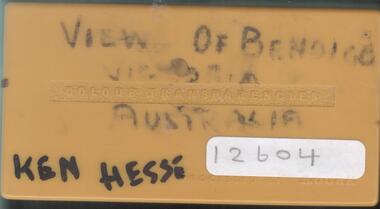
Photograph - Ken Hesse Collection: Photos of Bendigo, 1950-1960s
... hospital for the aged bendigo anne caudle centre ken hesse collection . A box of twenty-eight photographic slides containing various views of Bendigo. Included are buildings and streetscapes. Item part of Mr. Ken Hesse Collection. This item contains the following photos: 12604 Colour photo of the slide box 12604a The Queen Elizabeth ...Ken Hesse was a former president of the Bendigo Rotary Club and in 1997 the Bendigo Rotary club unveiled a memorial plaque at the corner of Sydney Myer Place and Midland Highway , Rosiland Park.A box of twenty-eight photographic slides containing various views of Bendigo. Included are buildings and streetscapes. Item part of Mr. Ken Hesse Collection. This item contains the following photos: 12604 Colour photo of the slide box 12604a The Queen Elizabeth Oval from the lookout tower; football match in progress 12604b A holden car going up a hill besides a park 12604c View of Bendigo from the lookout in Rosalind Park 12604d The old post office and law courts in Pall Mall 12604e Looking up Mitchell Street, the fountain, an Eaglehawk bound tram and the Fountain Plaza 12604f Mirradong Home for the Blind, McIvor Road Bendigo 12604g Wildflower 12604h View overlooking East Bendigo in the distance 12604i The Sacred Heart Cathedral front from McKenzie Street 12604j A Bendigo Church 12604k Spectators at a procession Charing Cross Bendigo 12604l St Aidan's Orphanage Bendigo 12604m Old Bendigo Showgrounds (Tom Flood Centre) 12604n Old Bendigo Showgrounds (Tom Flood Centre) 12604o Kangaroos and emu at the Botanical Gardens 12604o The Benevolent Home (Anne Caudel Centre) 12604q The Benevolent Home looking towards White Hills 12604r The Benevolent Home (Anne Caudel Centre) 12604s Bendigo Town Hall 12604t Bendigo Senior Citizens Club - at the rear of the library 12604u Bendigo Art Gallery in View Street 12604v Bendigo old show grounds (Tom Flood Centre) 12604w Former Bendigo Teachers College Osborne Street 12604x Charing Cross from High Street 12604y Lake Weeroona 12604z Looking over the old Municipal Pool and Barnard Street towards North Bendigo 12604za The Benevolent Home (Anne Caudle Centre) 12604zb The Benevolent Home (Anne Caudle Centre) 12604zc From the lookout looking towards White Hills.history, bendigo, bendigo home and hospital for the aged, bendigo anne caudle centre, ken hesse collection -
 Bendigo Historical Society Inc.
Book - JOAN O'SHEA COLLECTION: 150TH ANNIVERSARY OF BENDIGO BOOKLET, 1850 - 1950's
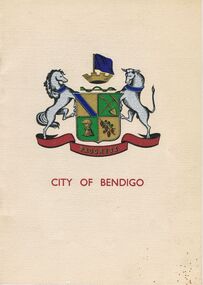
... Icons of Bendigo The Bendigo base Hospital,Law Courts & Post Office, Primary Schools, Housing, Industry including Butter Production, Poultry Farming, Livestock Sales & Tomato Growing, Slaughter House & ordnance factory. The Present Recreation Photos: Bendigo Bowling Club, Queen Elizabeth...Icons of Bendigo The Bendigo base Hospital,Law Courts & Post Office, Primary Schools, Housing, Industry including Butter Production, Poultry Farming, Livestock Sales & Tomato Growing, Slaughter House & ordnance factory. The Present Recreation Photos: Bendigo Bowling Club, Queen Elizabeth ...Joan O'Shea Collection. Buff Coloured Booklet City of Bendigo. 150th anniversary of Bendigo 1850s to 1950s. Image on cover coat of arms for City of Bendigo underneath word progress, left hand side horse, right hand side bullock. History of Bendigo: From Sheep Run to Provincial City in 100 years. Map of Bendigo and Surrounds Railways, Water Courses & Storage, Power, Municipal Boundaries & Land Available for Industry. Municipal District Creation 1855, Borough Proclamation 1863, Proclaimed City 1871, Area: 7992 Acres Population as of last census City of Bendigo 28,722, City of Bendigo and adjacent Urban Areas 36,909. City of Bendigo Map, The Past Prior to 1850. Icons of Bendigo The Bendigo base Hospital,Law Courts & Post Office, Primary Schools, Housing, Industry including Butter Production, Poultry Farming, Livestock Sales & Tomato Growing, Slaughter House & ordnance factory. The Present Recreation Photos: Bendigo Bowling Club, Queen Elizabeth Oval, Municipal Lawn Tennis Courts The Future of Bendigo, Bendigo Photographs From The 1950s,Cambridge Press Bendigobendigo, history, progress of bendigo 1850s on. -
 Bendigo Historical Society Inc.
Slide - Images by Arthur Pulfer, About 1957-1970
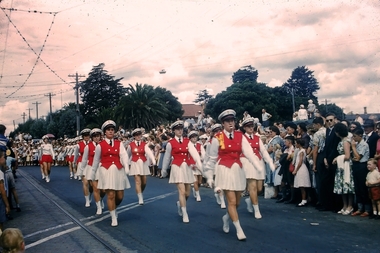
... This item contains the following slides: 7795.2a Public Toilets Williamson Street Bendigo 7795.2b The Bendigo Easter Parade - - Easter Sunday 1959 - Marching Girls and brass band turning into Rosalind Park from Mitchell Street with the Rifle Brigade Hotel in the background. 7795.2c Charing Cross (High Street) Bendigo Cenotaph 7795.2d The Conservatory and gardens, Pall Mall Bendigo looking towards Rosalind Park 7795.2e Alexandra Fountain and Fountain Plaza, Cenotaph and Lyric Theatre rear top right. 7795.2f From the lookout in Rosalind Park, Bendigo - cricket match on the Queen Elizabeth Oval - looking westward. 7795.2g Rosalind Park "sound shell" Orchestra and Spectators - Herald Sun Van in the backround. 7795.2h Tom Flood centre (showgrounds) - Bendigo Show 1958 - with the Benevolent Home (Anne Caudle Centre) and the Bendigo Base Hospital in the background. 7795.2i The Bendigo Easter Parade - Easter Monday 1959 - Marching Girls coming out of Mollison Street to come down Mitchell Street. 7795.2j Bendigo Ambulance headquarters opening September 1958 7795.2k Bendigo Ambulance headquarters opening September 1958 7795.2l The Bendigo Easter Parade - - Easter Monday 1959 - Brass Band coming out of Mollison Street to come down Mitchell Street. 7795.2m Peacock at White Hill Botanical Gardens 7795.2n Bendigo from One Tree Hill Lookout 7795.2o W H Gardiner Reserve Golden Square Bendigo...This item contains the following slides: 7795.2a Public Toilets Williamson Street Bendigo 7795.2b The Bendigo Easter Parade - - Easter Sunday 1959 - Marching Girls and brass band turning into Rosalind Park from Mitchell Street with the Rifle Brigade Hotel in the background. 7795.2c Charing Cross (High Street) Bendigo Cenotaph 7795.2d The Conservatory and gardens, Pall Mall Bendigo looking towards Rosalind Park 7795.2e Alexandra Fountain and Fountain Plaza, Cenotaph and Lyric Theatre rear top right. 7795.2f From the lookout in Rosalind Park, Bendigo - cricket match on the Queen Elizabeth Oval - looking westward. 7795.2g Rosalind Park "sound shell" Orchestra and Spectators - Herald Sun Van in the backround. 7795.2h Tom Flood centre (showgrounds) - Bendigo Show 1958 - with the Benevolent Home (Anne Caudle Centre) and the Bendigo Base Hospital in the background. 7795.2i The Bendigo Easter Parade - Easter Monday 1959 - Marching Girls coming out of Mollison Street to come down Mitchell Street. 7795.2j Bendigo Ambulance headquarters opening September 1958 7795.2k Bendigo Ambulance headquarters opening September 1958 7795.2l The Bendigo Easter Parade - - Easter Monday 1959 - Brass Band coming out of Mollison Street to come down Mitchell Street. 7795.2m Peacock at White Hill Botanical Gardens 7795.2n Bendigo from One Tree Hill Lookout 7795.2o W H Gardiner Reserve Golden Square Bendigo Slide Images by Arthur Pulfer. ...Arthur William Pulfer was born on 18 April 1918, in Bendigo, Victoria, Australia, his father, Harold Victor Pulfer, was 30 and his mother, Elsie Maud Rumball, was 26. He married Norma Stewart in Bendigo, Victoria, Australia. He died on 6 March 2001, in his hometown, at the age of 82, and was buried in the Bendigo Cemetery.Many images from by Arthur Pulfer copied to slides. Fifteen Slides of the Bendigo Easter parade, includes the Bendigo Show, Rosalind Park Sound Shell and lookout; One Tree Hill Lookout and Williamson Street Toilet Block. This item contains the following slides: 7795.2a Public Toilets Williamson Street Bendigo 7795.2b The Bendigo Easter Parade - - Easter Sunday 1959 - Marching Girls and brass band turning into Rosalind Park from Mitchell Street with the Rifle Brigade Hotel in the background. 7795.2c Charing Cross (High Street) Bendigo Cenotaph 7795.2d The Conservatory and gardens, Pall Mall Bendigo looking towards Rosalind Park 7795.2e Alexandra Fountain and Fountain Plaza, Cenotaph and Lyric Theatre rear top right. 7795.2f From the lookout in Rosalind Park, Bendigo - cricket match on the Queen Elizabeth Oval - looking westward. 7795.2g Rosalind Park "sound shell" Orchestra and Spectators - Herald Sun Van in the backround. 7795.2h Tom Flood centre (showgrounds) - Bendigo Show 1958 - with the Benevolent Home (Anne Caudle Centre) and the Bendigo Base Hospital in the background. 7795.2i The Bendigo Easter Parade - Easter Monday 1959 - Marching Girls coming out of Mollison Street to come down Mitchell Street. 7795.2j Bendigo Ambulance headquarters opening September 1958 7795.2k Bendigo Ambulance headquarters opening September 1958 7795.2l The Bendigo Easter Parade - - Easter Monday 1959 - Brass Band coming out of Mollison Street to come down Mitchell Street. 7795.2m Peacock at White Hill Botanical Gardens 7795.2n Bendigo from One Tree Hill Lookout 7795.2o W H Gardiner Reserve Golden Square Bendigohistory, bendigo, james lerk collection, bendigo easter parade, bendigo conservatory, one tree hill lookout, marching girls bendigo, brass bands bendigo, bendigo rosalind park, arthur pulfer -
 Bendigo Historical Society Inc.
Document - BASIL MILLER COLLECTION: TRAMS, c1963
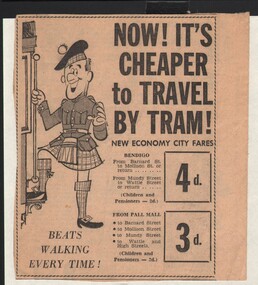
... Queen Elizabeth Oval, on Friday, 29th November, 1963, at 7.45 pm. lists business to be conducted. B. c. Masterson, Hon. Secretary, 7 View Street, Kangaroo Flat. Advertisement: Genuine Car Sales, 243 Barnard Street, Bendigo. Phone 3-6530 - After hours 3-5592. 1956 Ford perfect Sedan. Full price 185 pounds or Dep. 60 pounds. Advertisements for Gleneagles Private Hospital...Queen Elizabeth Oval, on Friday, 29th November, 1963, at 7.45 pm. lists business to be conducted. B. c. Masterson, Hon. Secretary, 7 View Street, Kangaroo Flat. Advertisement: Genuine Car Sales, 243 Barnard Street, Bendigo. Phone 3-6530 - After hours 3-5592. 1956 Ford perfect Sedan. Full price 185 pounds or Dep. 60 pounds. Advertisements for Gleneagles Private Hospital ...Newspaper clipping. Bendigo Advertiser. Now! It's Cheaper to Travel By Tram! New economy city fares. Bendigo: From Barnard St. to Mollison St. or return... From Mundy Street to Wattle Street or return... 4d. (Children and Pensioners - 2d.) From Pall Mall : to Barnard Street, to Mollison Street, to Mundy Street, to Wattle and High Streets. 3d. (Children and Pensioners - 2d.) Beats walking every time! Advertisement on reverse: Sandhurst Football Club. Notice is hereby given that the Annual General Meeting of the above Club will be held in the Club rooms Queen Elizabeth Oval, on Friday, 29th November, 1963, at 7.45 pm. lists business to be conducted. B. c. Masterson, Hon. Secretary, 7 View Street, Kangaroo Flat. Advertisement: Genuine Car Sales, 243 Barnard Street, Bendigo. Phone 3-6530 - After hours 3-5592. 1956 Ford perfect Sedan. Full price 185 pounds or Dep. 60 pounds. Advertisements for Gleneagles Private Hospital and Dad and Dave Café.organization, business, bendigo trams -
 Ballarat Tramway Museum
Book, H.P. James, "Out of the Past", 1940
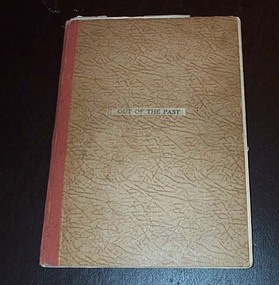
... On facing page a photo of Queen Elizabeth, a printer colour cover or sheet about Walt Disney's "Pinocchio", a newspaper cutting regarding Father's Day and a black and white photograph of a young girl in a hospital carriage being pushed by a man. ...On facing page a photo of Queen Elizabeth, a printer colour cover or sheet about Walt Disney's "Pinocchio", a newspaper cutting regarding Father's Day and a black and white photograph of a young girl in a hospital carriage being pushed by a man. ...ESCo Employee Hours Work Record book that has been used by an ESCo/SEC inspector, H. P. James as a record / note book for his personal collection or papers or journal titled "Out of the Past". Book sewn with string in 36 page sections, blank end papers, board covers with stipple paper out sides and Rexene cloth binding. Comprising plain paper end papers and 104 printed pages (52 leaves), with each sheet printed in black on feint ruled paper for recording the hours worked and other details of drivers and conductors employed by ESCo. Printed for daily use, with Day and date page headings - made out for the 1930's. Images: Book - i1 Inside front cover - i2 Members Certificate - i3 Has been used to gather mementos such as photos, articles, newspaper clippings, letters and other miscellaneous documents on Ballarat local history. Newspaper cuttings etc often have side notes written by Mr. James. Inside front cover has certificate recording Mr. James membership to the Ballarat Historical Society for 1940. Receipt signed by Edward Crimmins. Also a newspaper cutting on the cost of pensions to Lord Nelson's family. On facing page a photo of Queen Elizabeth, a printer colour cover or sheet about Walt Disney's "Pinocchio", a newspaper cutting regarding Father's Day and a black and white photograph of a young girl in a hospital carriage being pushed by a man. Pages numbered odd numbers only in the top right hand corner in pencil. Primary items are: 1 - Coloured cover to a writing tablet, titled "Australian Birds". Underlying this on the back of the writing tablet is two newspaper cuttings: the Ballarat Historical Society - reports on the 6th Annual meeting of the Society. 3 - Photo of the pattern Ballaarat Horse Tram company tram outside the Duncan and Fraser's Carriage Works in Adelaide with hand written notes underneath, including a sketch of a horse tram drivers seat - see Reg. Item 2527. 4, 6 - Group of nine black and white printed cards (15 illustrations) of early Ballarat pasted onto the sheet - see Reg. Item 2528. 5, 7 & 9 - Printed notes titled "Valedictory to Bob Haines" - see Reg. Item 2529. On page 9 in the left hand margin, a printed list of Church Officers; Church of England. 8 - Newspaper cuttings titled "The Heralds Man's Quiz" and the answers adjacent. City of Ballaarat - Public Inoculation Depot - Influenza form for HP James of ESCo - See Reg. Item 2530. Page Numbering from this point changes - even numbers in top right hand corner of folios instead of odd numbers. 9A - Newspaper cuttings about a Theatre Show, 54 years service of Mr. E. R. Bodycomb (Ballarat Gas) and planting of trees in the Avenue of Honour - with a red line around H. P. James names and a reproduction of the opening photograph of ESCo Electric Trams - noting 30 years ago - See Reg. Item 310.2. ESCo 4d Ticket - Purple - Grenville St to Sebastopol Terminus - See Reg Item 2531. ESCo 3d Adult Transfer Ticket - See Reg. Item 2532. Illustration - cartoon - H.P. James - See Reg. Item 2533. 10 - Newspaper cutting "From Horse Tram to Trolley Bus" - See Reg Item 2534. Newspaper cutting "Melbourne's First Tramcars" - See Reg Item 2535. An inscription or written note from T. Thomas etc. on lower edge of the sheet. 11,12 - Newspaper cuttings about the Passing of Melbourne's Cable Trams, including a photo of cable trailer No. 1 - See Reg. Item 2536. Other cuttings about early residents of the Ballarat district. 13 - Newspaper cutting dated 2/5/1936 about the donation from the CTA to the Ballarat Hospital. 14 - Newspaper cuttings - Photo of Ballarat Bicycle and Tricycle Club in the Gardens, the issue of a stamp to commemorate the Centenary of Ballarat, radio stations in Sydney, Ballarat Choirs and fire brigade demonstrations trophies. 16 - Copy of the "City of Ballaarat Regulation No. 13" concerning Hackney and Stage coaches working within the City - See Reg. item 2537. 18, 20 - Newspaper cutting - "The Working Classes in Early Ballarat" - Nathan Spielvogel 21 - handwritten note on "Doctor" Thomas Blackett who died during 1940. 22 - Miscellaneous cuttings from the Melbourne Sun. 23 - Newspaper cuttings "Story of South Street", Show Grounds, and "The Alfred" Hall and a photograph of the 1938 Floral Carpet at Alfred Hall. 24 - Newspaper cutting - obituary and hand written note on Ballarat identity Mr. J. P. Bourke. 25 - Newspaper cutting - cartoon "Tiddley" Winks and Wally - Stan Cross (later "Wally and the Major" 26 - Newspaper cutting - "Ballarat in the sixties" - General R.E. Williams and "Early Recollections" - Arthur Reid. 27 - Handwritten note re Mrs. Bill Danks, dated Jan. 1941 - Tobacconist in Bridge St. 28 - Newspaper cutting - "First Town Hall" and note on "City Hall". 30 - Newspaper cuttings - "Good Friday, Now and Then - T.P. Long, Mont Albert and "On Fashions" James R. Pound. 32 - Newspaper cutting "School and School life in old Ballarat" - Nathan F. Spielvogel. 34 - Newspaper cutting continued from page 32 and Obituary - Mr. Archie Dawson and Tom Blackett. 35 - Newspaper cutting of Ballarat - 4 photos - include Bridge St. with a tram. 36 - Newspaper cutting - "Ballarat - Pastoral and Industrial Resources" from a Melbourne paper, 17/2/1940. 38 - Newspaper cuttings - obituaries - Mr. R. E. Tunbridge, Graeme Dowling and Thomas Crosthwaite. 39 - Illustration - black and white - Late Mr. P. J. Pringle - See Reg. Item 2538. 40 - Handwritten notes on Ballarat Trams and the power station staff - See Reg. Item 2539. 41 - Handwritten notes on Ballarat Pie Stalls 42 - Newspaper cuttings - cartoon "Professor Nimbus", photo of the Norwegian town of Hell (Railway station); bicycles on a Copenhagen bridge following German occupation and dragon flies in Melbourne. 43 - Newspaper cutting on the official opening of the Ballarat Historical Society's Museum. 44 - Newspaper cuttings and associated handwritten notes on a fire in Ballarat, poultry fanciers, historical dates for August. 46 - Newspaper cuttings - "Victoria's first profitable goldfield" - Ballarat and the unveiling of the Sovereign Hill direction pillar. 48 - Newspaper cutting - "Worked 27 years without holiday" - See Reg. Item. 2540. - Other newspaper cuttings - thoughts of a visitor to Ballarat from Sydney and H.P. James - Liquor control in Ballarat and "This Week at the Zoo". 50 - Handwritten notes on clothing. 51 - Handwritten note on a visit to W. H. Middleton 52 - Newspaper cuttings "The Kings Empire", "Ballarat Birthdays" for Sept and Oct and an obituary on Mr. W. H. Middleton. 54 - Newspaper cuttings "Richmond has Links With Early Goldfields" - Malcolm McCullum and "England's Greatest Battle" 55, 56 - Newspaper cuttings - "Ballarat Birthdays" for November and December, a photograph of Nick Oliver - former Ballarat fireman and "Railway Birthday" - birth of the VR. 57, 58 - Handwritten notes on Ballarat tram timetables, weekly tickets, motorman's record cards, tourist tickets and sample tickets or cards, See Reg. Item 2541. Lunch Hour Weekly Ticket - Reg. Item 2542 Morning and Evening Weekly Ticket - Reg. Item 2543 Motorman's Record - Reg. Item 2544 Tourist Ticket - 1/- - Reg. Item 2545. 60 - Newspaper cuttings - parts 1 and 2 - "The Two Ballarat" by Nathan Spielvogel. 62 - Newspaper cuttings - continued from page 60, the death of comedians Sam Mayo and Gus Bluett and some handwritten notes on comedians. 64 - Newspaper cuttings on cricket, choir rules, a Methodist ladies function at the home of H.P. James, Footballer Percy Beames and entertaining air force recruits at the showgrounds. 66 - Newspaper cuttings - "The Anvil Chorus" - Hitler and Mussolini and "Strength against Nazi Threat". 68 - Newspaper cuttings - 50 years ago in Ballarat, Social function at H.P. James house, coldest morning in Ballarat and the death of Col. A. W. Bennett. 70 - Newspaper cuttings - about the sale of spirits in early Ballarat, the first motorcars in Ballarat and handwritten note about Mr. Jago. 72 - Newspaper cuttings - misc. about horse racing, trainers and racing. 73 - Newspaper cuttings and handwritten notes about Ballarat Schools. 74 - Newspaper cuttings - Bruno Hauptmann (Charles Lindbergh) and the death of actor Darcy Kelway. 75, 76 - Newspaper cuttings - Rail services to and from Ballarat, effects of the war and Ballarat 70 years ago, the invasions of Britain and "A stroll down Memory Lane" - T.P. Long of Mont Albert. 77,78 - Newspaper cuttings - Lake Wendouree - Nathan Spielvogel, the opening of the new Ballarat Historical Society's Museum and farewell function of Mr. James Shannon. 79 - Newspaper cuttings - about boats on lake Wendouree. 99 - Obituary and hand written note re Mr. Arthur M. David. 100 - Newspaper cuttings - cartoon "Wally and the Major", Dr William Maloney, Gus Bluett and "Old Rowley" - in connection with the Melbourne Cup of 1940. 101 - Cartoon advertisement for Kolynos Dental Cream Inside rear cover - Programme for the Centenary of Thanksgiving Service - Back to Ballarat 1934, dated 4/11/1934 (has been affected by other sheets of paper due to their acidic nature), printed notes titled "A ramble on stilts with Freddie" written by Baker James. Many in pencil and inktrams, tramways, h.p. james, esco, horse trams, ballarat, civic history -
 Surrey Hills Historical Society Collection
Photograph, Matron Elizabeth Maitland Anderson
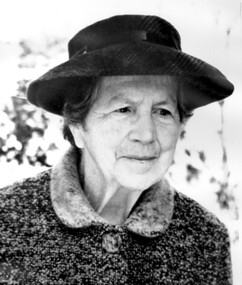
... queen victoria hospital...elgar private nursing home...elgar road...mont albert road...nurses...nursing homes...health professionals...melbourne home and centre for moral re-armament...miss elizabeth...Elizabeth Anderson opened Mosgiel Prvate Hospital in 1923 and was the Matron there from 1923-1950. She had been Matron of the Queen Victoria Hospital for four years. ...Elizabeth Anderson opened Mosgiel Prvate Hospital in 1923 and was the Matron there from 1923-1950. She had been Matron of the Queen Victoria Hospital for four years. ...Elizabeth Maitland Anderson was born c1887, daughter of William Anderson and Elizabeth MacKay. After she retired she lived at the Loyal Orange Lodge in Station Street, Box Hill South. She died on 14 May 1974 at Box Hill. She was cremated and ashes interred at Springvale Cemetery – Banksia, Wall H, Niche 302. Elizabeth Anderson opened Mosgiel Prvate Hospital in 1923 and was the Matron there from 1923-1950. She had been Matron of the Queen Victoria Hospital for four years. She lived next to the hospital at 297 Mont Albert Road from 1923-1930s. 'Mosgiel' was very highly regarded by medical practitioners and patients alike. After her retirement in 1950, along with with Doctors Roberta and Agnes Donaldson, she opened the Elgar Private Nursing Home in Elgar Road. Elizabeth Anderson was particularly involved with Moral Re-Armament and supported activities that took place in the Melbourne Home and Centre for Moral Re-Armament.A black and white photograph of an older lady wearing a hat and a coat.mosgiel private hospital, queen victoria hospital, elgar private nursing home, elgar road, mont albert road, nurses, nursing homes, health professionals, melbourne home and centre for moral re-armament, miss elizabeth maitland anderson, dr roberta donaldson, dr amelia roberta donaldson, dr agnes donaldson -
 Friends of Ballarat Botanical Gardens History Group
Work on paper - Interview with George Seddon by John Garner, 24 April 2006, Gardener and Foreman at the Ballarat Botanical Gardens, 24 April, 2006
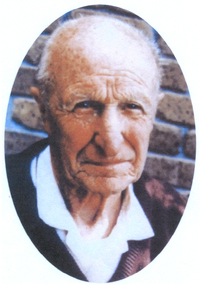
... Queen Elizabeth to the Ballarat Botanical Gardens, 1954. Also snow in the gardens, November 1949 at 7.30am, matron and nursing sisters from the Ballarat Base Hospital....Queen Elizabeth to the Ballarat Botanical Gardens, 1954. Also snow in the gardens, November 1949 at 7.30am, matron and nursing sisters from the Ballarat Base Hospital. ...George Seddon, Gardener and Foreman, Ballarat Botanical Gardens. Carole Townsend, daughter of George Seddon at opening of the "Faces in the Street: Portraits of Ballarat Lives" exhibition at the Gold Museum. Courier newspaper. Also Royal Visit of Queen Elizabeth to the Ballarat Botanical Gardens, 1954. Also snow in the gardens, November 1949 at 7.30am, matron and nursing sisters from the Ballarat Base Hospital.Firsthand account of a Gardener and Foreman of the Ballarat Botanical Gardens for 25 years, c.1952-1977.All visibleAll visiblejohn garner collection, garner, dr, seddon, gardener, ballarat, ballarat botanical gardens, interview, townsend, courier, newspaper, gardens, foreman, tom beaumont, keel house, quarantine, begonias, statues, ballarat city council, changes in the ballarat botanical gardens over time., queen elizabeth, mayor, 1954, snow, nurses -
 Returned Nurses RSL Sub-branch
Newspaper - Photocopy of a newspaper clipping, The Mercury, Recollections of a war nurse, August 7 1995
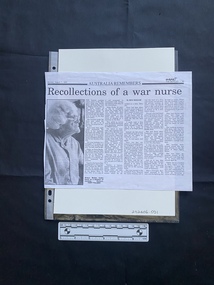
... hospital in Bougainville, where she met a sick fellow Tasmanian, Raymond Burke of the 2/27th. Ray soon returned to the fighting but when the war was over he returned to Bougainville and they were married.. Grace's nursing background meant she was invited to join the the board of Mary Ogilvy Home, where she later became the matron for seventeen years until her retirement. Today she is a resident and is a a keen moviegoer. World War 2 World War Two WWII Queen Mary Sandy Bay Coogan's Collins Street Pacific Commodore RB Irving Queen Elizabeth ...A brief biography on Grace Burke.A Tasmanian native, Grace had to fight to be involved in the nursing life as her father was opposed it, calling a dirty, filthy job. As luck would have it she chance on the matron of the matron of a nursing home at Lindisfare who spoke to her father, allowing her to go there to help out. She then move to Campbell Town Hospitown Hospital for nurse trainin, then Sydney for a midwifery course. When war broke out she enlisted and was posted to the Middle Eat in 1942. 1945 saw her at the army hospital in Bougainville, where she met a sick fellow Tasmanian, Raymond Burke of the 2/27th. Ray soon returned to the fighting but when the war was over he returned to Bougainville and they were married.. Grace's nursing background meant she was invited to join the the board of Mary Ogilvy Home, where she later became the matron for seventeen years until her retirement. Today she is a resident and is a a keen moviegoer.A photocopy of a newspaper clipping featuring a large black and white photo and five columns of text. The photo is of the head and shoulders of an older woman looking into the distance.'HOBART'[ink, photocopied, top right]world war 2, world war two, wwii, queen mary, sandy bay, coogan's, collins street, pacific, commodore rb irving, queen elizabeth, aquatania, hmas sydney, port moresby, japan, duntroon, burma, south africa, hobart, colebrook, conara, fingal, anzac, evandal, grace dyer, colonel leah -
 Returned Nurses RSL Sub-branch
Photograph - 6x4.5 coloured photograph, unknown
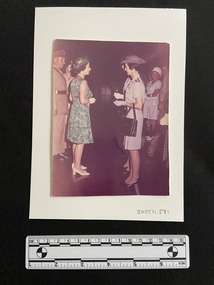
... Queen Elizabeth II...Townsville...4 camp hospital...Captain Jan McCarthy and another Austrlian Army Nurse meeting Queen Elizabeth II at a reception held in the Townsville officer's mess at the Quarantine Station camp hospital. ...Captain Jan McCarthy and another Austrlian Army Nurse meeting Queen Elizabeth II at a reception held in the Townsville officer's mess at the Quarantine Station camp hospital. ...Captain Jan McCarthy and another Austrlian Army Nurse meeting Queen Elizabeth II at a reception held in the Townsville officer's mess at the Quarantine Station camp hospital. Coloured photograph of two Army Nurses meeting Queen Elizabeth II in the Army mess hall. There is an Officer standing to the side of the Queen and the two nurses are standing opposite in uniform and heels.'Jan McCarthy / meeting Queen EII / Townsville / 4 camp hospital / Quarantine / Station / reception in Townsville / officer's mess / (Captain McCarthy at the time)' [Handwritten in pencil on the back of the photograph]jan mccarthy, queen elizabeth ii, townsville, 4 camp hospital quarentine station -
 Returned Nurses RSL Sub-branch
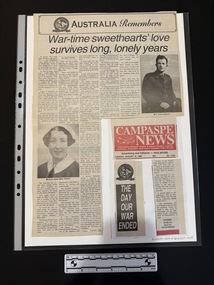
Newspaper - Newspaper clipping, [Campaspe News], War-time sweethearts' love survives long, lonely years, [c1995]
... Mary Everard met Lance Gibson met in South Australia when Lance and a mate rang the local hospital to see if there were any off duty nurses who would go to the pictures with them. After several other outings the pair both ended up travelling on the Queen Elizabeth I to Egypt, Mary as nurse in the Australian Army Nursing Service and Lance as a lieutenant in the 2/3rd Australian Machine Gun Battalion. ...Mary Everard met Lance Gibson met in South Australia when Lance and a mate rang the local hospital to see if there were any off duty nurses who would go to the pictures with them. After several other outings the pair both ended up travelling on the Queen Elizabeth I to Egypt, Mary as nurse in the Australian Army Nursing Service and Lance as a lieutenant in the 2/3rd Australian Machine Gun Battalion. ...Mary Everard met Lance Gibson met in South Australia when Lance and a mate rang the local hospital to see if there were any off duty nurses who would go to the pictures with them. After several other outings the pair both ended up travelling on the Queen Elizabeth I to Egypt, Mary as nurse in the Australian Army Nursing Service and Lance as a lieutenant in the 2/3rd Australian Machine Gun Battalion. After spending much of the three week journey together, they continued to spend what free time they had together. When Lance found out he was to ship out to Indonesia in January 1942 the couple came to an understanding that they would marry after war. Several weeks after Lance's departure, Mary's unit returned to Australia on the Strathallen, where they nursed in hospitals in Queensland. Lance became a POW of the Japanese, one of the lucky 72 out of 257 Australians in his group to survive the war. Mary and Lance were married in November 1946 and now have three children and eight grandchildren.A large newspaper clipping featuring a large title, five columns of text and two black and white photos. One photo is of the face of a nurse in uniform, while the other photo is of a man in uniform.wwii, ww2, world war two, prisoner of war, mary gibson, gaza, middle east, sydney, concorde army hospital, brisbane, hughenden, darwin, atherton tablelands, java, dutch, cycle camp, singapore, japan, formosa, taiwan, nagasaki, american, korean, manchuria, ransom camp, govenor of singapore, russian, manila, red cross, vatican, nanneella -
 Returned Nurses RSL Sub-branch
Newspaper - Newspaper clipping, [Campaspe News], War-time sweethearts' love survives long, lonely years, [c1995]
... Mary Everard met Lance Gibson met in South Australia when Lance and a mate rang the local hospital to see if there were any off duty nurses who would go to the pictures with them. After several other outings the pair both ended up travelling on the Queen Elizabeth I to Egypt, Mary as nurse in the Australian Army Nursing Service and Lance as a lieutenant in the 2/3rd Australian Machine Gun Battalion. ...Mary Everard met Lance Gibson met in South Australia when Lance and a mate rang the local hospital to see if there were any off duty nurses who would go to the pictures with them. After several other outings the pair both ended up travelling on the Queen Elizabeth I to Egypt, Mary as nurse in the Australian Army Nursing Service and Lance as a lieutenant in the 2/3rd Australian Machine Gun Battalion. ...Mary Everard met Lance Gibson met in South Australia when Lance and a mate rang the local hospital to see if there were any off duty nurses who would go to the pictures with them. After several other outings the pair both ended up travelling on the Queen Elizabeth I to Egypt, Mary as nurse in the Australian Army Nursing Service and Lance as a lieutenant in the 2/3rd Australian Machine Gun Battalion. After spending much of the three week journey together, they continued to spend what free time they had together. When Lance found out he was to ship out to Indonesia in January 1942 the couple came to an understanding that they would marry after war. Several weeks after Lance's departure, Mary's unit returned to Australia on the Strathallen, where they nursed in hospitals in Queensland. Lance became a POW of the Japanese, one of the lucky 72 out of 257 Australians in his group to survive the war. Mary and Lance were married in November 1946 and now have three children and eight grandchildren.A large newspaper clipping featuring a large title, five columns of text and two black and white photos. One photo is of the face of a nurse in uniform, while the other photo is of a man in uniform.wwii, ww2, world war two, prisoner of war, mary gibson, gaza, middle east, sydney, concorde army hospital, brisbane, hughenden, darwin, atherton tablelands, java, dutch, cycle camp, singapore, japan, formosa, taiwan, nagasaki, american, korean, manchuria, ransom camp, govenor of singapore, russian, manila, red cross, vatican, nanneella -
 City of Melbourne Libraries
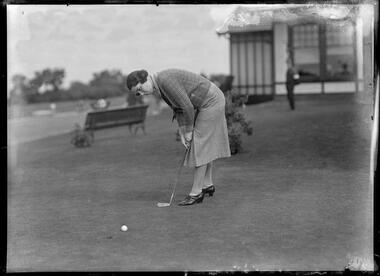
Photograph, Bull, Hugh Jones, 1897-1993, Miss Betty Nankivell
... Dr Elizabeth “Betty” Nankivell (1907-2003), later Mrs Forward, graduated in 1937 from Melbourne University with a degree in medicine. She worked at Queen Victoria and Royal Adelaide Hospitals. ...Dr Elizabeth “Betty” Nankivell (1907-2003), later Mrs Forward, graduated in 1937 from Melbourne University with a degree in medicine. She worked at Queen Victoria and Royal Adelaide Hospitals. ...Dr Elizabeth “Betty” Nankivell (1907-2003), later Mrs Forward, graduated in 1937 from Melbourne University with a degree in medicine. She worked at Queen Victoria and Royal Adelaide Hospitals. During WWII, she practised medicine in Morwell, and in 1945 joined the Royal Australian Army Medical Corp (R.A.A.M.C.). Betty lived and worked in many South East Asian countries, including 10 years of private practise in Kuala Lumpur, before retiring in 1970 to live in Melbourne. Photographer notations on slide: "Vic Women's Golf Ch'ship B98" Published: The Age 3 September 1935 p. 7 Published title: "EXCITING GOLF DUEL." Published caption: MISS B. NANKIVELL, whose victory over Miss Pam Barton was the outstanding feature of the play in the Australian Championship yesterday. Trove article identifier: http://nla.gov.au/nla.news-article203852987 Description: Action shot of golfer Betty Nankivell putting on golf course. She wears a checked cardigan, straight skirt, stockings, heeled shoes and a tie, no hat. The clubhouse structure is blurred in the background. Research by project volunteer, Fiona Collyer: Dr Elizabeth “Betty” Nankivell, Mrs Forward Betty Nankivell (1907 – 2003) was a champion Victorian golfer and medical doctor. She competed in the Australian Women’s Golf Championship at Royal Melbourne in 1935 against the visiting British Team. She eliminated 18 year old British champion Pam Barton, but was defeated by the eventual winner of the tournament, Mrs J B Walker in the semi finals. In 1938, Betty won the SA Golf Championships at Kooyonga SA. Betty graduated from Melbourne University with a degree in medicine in 1937 and worked at Queen Victoria Hospital and at Royal Adelaide Hospital as R.M.O. (Resident Medical Officer). During the war years, Betty practised medicine in Morwell, Victoria, and in 1945 joined the R.A.A.M.C. (Royal Australian Army Medical Corp) for the Malaya Medical Service. In 1946, she married Alan Forward OBE, a Colonel in the British Army and later the Commissioner of Road Transport in Malaya, and lived and worked in many S E Asian countries including 10 years in private practice in Kuala Lumpur. Betty continued to play golf throughout her life, retiring in 1970, and died in Melbourne in 2003. Sources: Melbourne University: Journal of the University of Melbourne Medical Society: vol. 2, no. 1Photographer notations on slide: "Miss Nankivell B98".golf, women golfers, royal melbourne golf club -
 City of Melbourne Libraries
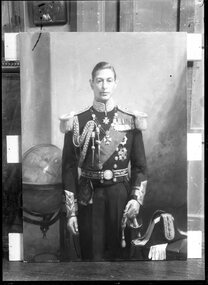
Photograph, Bull, Hugh Jones, 1897-1993, "A Royal Portrait" (Duke of York), 1933
... hospital and convalescence home for wounded soldiers. Many servicemen from the Castlemaine area recuperated there and had fond memories of the kindness of the teenage Lady Elizabeth Bowes-Lyon (1900-2002, later Duchess of York) who spent the war years running errands and aiding in the welfare and morale of the patients. In 1927, the Duke and Duchess of York (later King George VI and Queen...hospital and convalescence home for wounded soldiers. Many servicemen from the Castlemaine area recuperated there and had fond memories of the kindness of the teenage Lady Elizabeth Bowes-Lyon (1900-2002, later Duchess of York) who spent the war years running errands and aiding in the welfare and morale of the patients. In 1927, the Duke and Duchess of York (later King George VI and Queen ...Published: The Age, Sat 14 October 1933 Published title: A Royal Portrait Published caption: "Seen at his studio, Alphington, Mr. W. B. Mclnnes's portrait of the Duke of York, which he painted recently on commission from the trustees of the Castlemaine Gallery, at St. John’s Wood, London, impresses as a vital record of one whose natural habitat is a palace, and whose place in life is one of near relationship to the throne of England. The Duke is painted in the uniform of the admiral of the fleet, a highly ornate vesture entailing much elaboration of gold and numerous medals, in dealing with which the artist has not failed to centre his attention on the head, and has succeeded in producing what is undoubtedly a soundly painted portrait and a good likeness. During the five fittings Mr. Mclnnes, apart from the ordinary social amenities, found his Royal sitter little inclined to talk, though he spoke feelingly of his trip to Australia and the pleasure it had given him: but with the Duchess the tendency to be sociable was much more clearly pronounced. She took, and expressed, a keen interest in the social and political matters of the day with a special concern for the supremacy of England and Australia in all questions relating to sport, such as cricket, tennis and golf. She spoke well of her portrait painted by Quinn, and regretted that she would not see the two hung side by side at the Castlemaine Gallery." Description: An unframed painting of a standing, middle-aged man dressed in the uniform of a Royal Navy admiral of the Fleet with medals, sash, ornate belt, cuffs and epaulettes. His left hand rests on the handle of a sword in its scabbard and his bicorn hat and white gloves are on a table beside him. To his right is a globe of the world showing Australia. Research by project volunteer, Fiona Collyer: In 1933, Castlemaine Art Gallery trustees commissioned artist W.B. McInnes (1889-1939) to paint a portrait of Prince Albert, Duke of York as a companion piece to the portrait of his wife, the Duchess of York, that the gallery had commissioned Australian official war artist James Quinn (1869-1951) to paint in 1930. During the First World War, the Duchess’s childhood home, Glamis Castle in Scotland was used as a makeshift military hospital and convalescence home for wounded soldiers. Many servicemen from the Castlemaine area recuperated there and had fond memories of the kindness of the teenage Lady Elizabeth Bowes-Lyon (1900-2002, later Duchess of York) who spent the war years running errands and aiding in the welfare and morale of the patients. In 1927, the Duke and Duchess of York (later King George VI and Queen Elizabeth) came to Australia to formally open the newly built Parliament House in Canberra and to tour the country. While visiting Victoria in April, they embarked on a whistle-stop train journey to Bendigo, stopping at Kyneton for ten minutes and Castlemaine for 15 minutes. At Kyneton, an excited crowd of 10,000 people welcomed the couple with “three cheers and three cheers for Baby Betty” before the Duchess was presented with a bouquet of locally grown roses and the Duke a bound album of photographs of noted beauty spots of the district. Next the Royal Couple stopped at Castlemaine to the cheers of 15,000 people. There the couple were presented with a basket of prime quality Harcourt apples and a pair of cot blankets, manufactured at Castlemaine Woollen Mills, a birthday gift for baby Princess Betty. The Duchess recognised Colonel W.E. James, of the Seventh Battalion, who had convalesced at Glamis Castle in 1917, and they chatted before the train departed, while the Duke shook hands with returned soldiers. Last stop was the town of Bendigo which was colourfully decorated with bunting and flags, arches and flowers. 3000 pigeons were released on their arrival and the liberated birds circled overhead for several minutes as if to welcome the Royal Couple. A crowd of 50,000 cheering people lined the streets in bright sunshine as the couple drove by. From an arch over Hargreaves Street, pretty girls showered the pair with rose petals. The Duke was presented with a gold nugget and an album, handsomely bound in morocco, of a history of the Bendigo mining industry, while the Duchess received a bouquet of prize winning white chrysanthemums. After 75 minutes in Bendigo they journeyed back to Melbourne for a State reception. While the couple were in Melbourne, the Duke often played lawn tennis at the Government House courts with three times Grand Slam champion Norman Brookes, who declared that while he considered the Duke a second class player whose serve lacked sting, he had a fine backhand and with time and practice he could become a first class player. The federal Parliament had previously been situated in Melbourne, but Canberra was chosen as the location for Australia’s capital as a compromise between fierce rival states, Victoria and NSW. It is written in the Constitution that the federal capital would be in “the State of NSW... distant not less than one hundred miles from Sydney.” The word Canberra is thought to derive from the local Ngunnawal word “Kanbarra” meaning “meeting place”. The Provisional Parliament House was a large, white, three storey building facetiously dubbed “The Wedding Cake”, plonked down in a bare, former sheep paddock. It was decorated for the event with Union Jacks and Australian red ensign flags. On 9 May, the day of the opening, the expectant crowd assembled in front of the building. Only two of the spectators were Aboriginal. One was Jimmy Clements (1847-1927, aka Nangar or Yangar, but popularly known as “King Billy”), accompanied by his three dogs. (The title “King” or “Queen” was often given by white settlers to Aborigines who were seen as allies and could maintain good relations between First Nations groups and the colonists. Some were given inscribed brass breastplates or gorgets to wear.) Jimmy was an excellent horse breaker and expert tracker for the police. He was also the nephew of “Queen” Nellie Hamilton (1842-1897) of the Canberra-Queanbeyan region, home of the Ngambri and Ngunnawal people. Nellie was the oldest surviving full-blooded Aboriginal woman in the district. The other was George John Noble (1840s-1928, aka Ooloogan, also “Marvellous” due to his regular use of the word). Both were initiated Wiradjuri walamira elders: “clever men” believed to have the ability to heal physical and spiritual ailments. They were also travelling showmen, skilled at boomerang and spear throwing and often performed at country agricultural shows and football matches. They had walked barefoot for three days from the Brungle Mission, near Gundagai. 11 May 1927, The Argus reported that “King Billy... claims sovereign rights to the Federal Territory” which the National Archives of Australia describes as “possibly the first recorded instance of Aboriginal protest at Parliament House in Canberra.” 10 May 1927, The Argus reported on Jimmy Clements: “During the wait great interest was taken in the appearance near the east stand of an aborigine, a member of the Gundagai tribe, and a well known character in the district. He was very old and grey and ruggedly picturesque. He was determined to go his own way in spite of the arguments of two inspectors and one sergeant of police. Immediately and instinctively the crowd in the stands rallied to his side. There were choruses of advice and encouragement for him to do as he pleased. A well-known clergyman stood up and called out that the aborigine had a better right than any man present to a place on the steps of the House of Parliament and in the Senate during the ceremony. The old man’s persistence and the sympathy of the crowd won him an excellent position and also a shower of small change that must have amounted to 30/ or 40/ [shillings].” At 10.30 am, Australia’s eighth Prime Minister, Mr Stanley Bruce (1923-1929) welcomed the Royal couple onto the crimson carpeted portico. Unfortunately, Dame Nellie Melba’s rendition of “God Save the King” and the greater part of the Duke’s reply was drowned out by the roar of squadrons of aeroplanes circling overhead. A brief religious service followed, conducted by leaders of the Methodist, Presbyterian and Anglican churches. Interestingly, there was no Roman Catholic representation at the ceremony even though around one quarter of Australians were Catholic at the time. The Duke unlocked the front doors with a golden key, then unveiled a statue of his father King George V by sculptor Sir Bertram Mackennal in the King’s Hall. Then the official party, Senators, members of the House of Representatives and invited guests entered the Senate chamber where the Duke read a message from the King, establishing Canberra as the seat of the Federal Government, watched on by Australia’s elite. The conclusion of the ceremony was announced by a gay fanfare of trumpets from the entrance of Parliament House and a 21 gun salute and answered by cheers from the crowd. The dignitaries then feasted on a luncheon of turtle soup, poached schnapper, fillets of beef, roast chicken and ham, straw potatoes, green peas, Canberra Pudding (a pudding made with dripping, dried fruit and jam), fruit, ices, coffee and cheese. They toasted the King with non-alcoholic fruit punch as the Federal Capital Territory (later ACT) was a “dry” area and no speeches were made. The diary entry that day of Ethel Baird, Lady Stonehaven, the wife of the Governor-General, is brief and to the point: “To P.H. & waited for Yorks. Ceremony went off without a hitch. Ghastly Banquet Lunch.” Later that day, the Duke mounted a coal black mare, police horse Number 303 which had been hastily re-named “Black Bess” for the occasion, to receive the final salute from the assembled troops and returned soldiers dressed in mufti. The RAAF squadron were flying overhead in “V” formations when suddenly, one of the planes, piloted by Flying Officer Francis Charles Ewen, left the formation, nose-diving 900 metres from Parliament House and landing behind the Y.W.C.A. refreshment marquee. Francis, aged only 28, tragically died of his wounds later that day. The Federal Capital Commission contracted Sargent’s Pies of Sydney to supply 5000 meals for the event. They supplied pies, sausage rolls, scones and sandwiches with the agreed price of 3 shillings a head. Only 1200 meals were served and the uneaten remainder dumped, with the Commission bearing the cost of the unsold food. An estimated crowd of 20,000 attended the opening, far fewer than the expected 100,000. Many visitors travelled long distances, bringing their own hampers of food and camping in tents as there was very limited accommodation available. Thousands of people around Australia listened to the ceremony broadcast on the wireless, with receiving sets installed in schools, public halls and workplaces and it was also filmed for posterity. The next morning, the Royal couple, along with Prime Minister Bruce and Mrs Bruce held an informal public reception on the steps of Parliament House where early settlers, residents and visitors to Canberra filed past them. The Press widely reported Jimmy Clements’ encounter with the Duke and Duchess. The Sun-Pictorial reported 11 May 1927: "MET THE DUKE. ABORIGINE KING HE APPROVED Sugarbag: Sports Suit. John Clements, otherwise King Billy, a full blooded aborigine king, aged 86, was among the 2000 who filed past the Duke and the Duchess at the public reception at Canberra to day. “How you likem Duke and Duchess Billy?” he was asked afterwards. “I think they are both very nice.” he replied in good English. King Billy was a very bedraggled figure, with tangled locks and a beard which almost hid his wrinkled and black face. He wore an old sports suit and carried a sugarbag. Passing the Duke and Duchess he turned full towards them. The crowd cheered, and the Duke and Duchess smiled. The Duke was particularly amused.” The Canberra Times reported 13 May 1927: "A REAL AUSTRALIAN. A quaint but pathetic figure stood in broad relief in the queue of ranks at the reception. Where his dusky forbears have gathered in native ceremonial for centuries past, a lone representative of a fast vanishing race saluted visiting Royalty. Despite the grotesque garb and untamed mane the aborigine comported himself not without dignity. With his three faithful dogs, he made an immediate target for a battery of cameras.” "The Argus reported 11 May 1927: "...an ancient aborigine who calls himself King Billy and who claims sovereign rights to the federal Territory walked slowly forward alone and saluted the Duke and Duchess. They cheerily acknowledged his greeting. The old aborigine, with his long, matted beard and nondescript clothing, is a popular identity of Canberra, and must be one of the most extraordinary figures who has received a Royal salute.” The Sun (Sydney) reported 10 May 1927: “Suddenly, in the midst of the forest of green and white colored hats of women, appeared a head with a shaggy leonine mane and a patriarchal beard. Jacky, the aboriginal, an identity of the district, who is also known as the King of Canberra, had arrived to testify to his loyalty. He saluted the Duke with an excellent dash, and shambled past with his faithful sheep dog aide-de-camp at his heels. The Duke and Duchess were highly amused at this quaint figure moving along with a sort of bodyguard of shrieking young boys and girls.” The Sydney Morning Herald 11 May 1927 mistook Jimmy for his friend “Marvellous”: “...the appearance of an aged aboriginal widely known in the district as “Marvellous, the uncrowned king of Queanbeyan." His beaming black countenance was almost hidden beneath a shock of hair and beard. Bare-footed and carrying a sugar bag in one hand and a tiny Australian flag in the other, he at first mistook a policeman at the foot of the steps for the Duke. To his great embarrassment and to the vast amusement of the onlookers, the policeman became the object of a hearty salutation. However, "Marvellous" was quickly shepherded back to a position in the procession and as he passed along brought his hand up to an approved military salute for the benefit of their Royal Highnesses. The Duke returned it with a special wave.” The Labor Daily 11 May 1927 irreverently reported on the scene: "People March Past. Some 400 people, old identities of Canberra marched past. They were mostly aged ladies with memories faithfully preserving the traditions of other days and curtsied reverently. The younger generations, who speedily joined the procession, behaved differently however. Surely it was the most motley collection that ever passed before Royalty. Men without collars jostled others well dressed. Fat women, young women, children of all heights and ages were there. The oldest inhabitants, in the persons of the abo, "Marbly", and his companion were present. The poor old fellows evidently were keen to get closer to the Duke than the procession dared go, but they were overawed by the stern glances of military men.” The Canberra Times reported 13 May 1927: "...and towards the end of the procession, a full-blooded aboriginal, bareheaded and barefooted, and carrying an old swag on his back, made a picturesque figure as he several times saluted the Royal couple, his old eyes beaming inexpressible delight.” The Register reported 11 May 1927: "PUBLIC MARCH PAST. Old “Jacky”, an aboriginal identity of the district, who has been following the proceedings of the various ceremonies with apparently great interest, appeared in the march past. He halted in front of the steps and raised his hand to his shaggy grey locks in an attempt at a salute. Smiling, the Duke returned the salute, and the Duchess bestowed a charming smile on the figure of mingled pathos and comedy.” Tweed Daily reported 12 May 1927: “King Billy” WAS THERE. Appropriately enough, the inevitable “King Billy” with his refreshing impression of possum and gum-leaves, was present at the dedication of the Federal capital at Canberra. Bare-footed, in a dingy old suit and battered felt hat, he wandered on to the empty stand after the illustrious assemblage had passed into Parliament House. A desolate figure in all that he stood for, he proved, an amiable representative of the dispossessed race. He cheerfully waved a Union Jack for the camera man, and grinned into the very eye of a movie man’s camera without flinching.” Footage of Jimmy filmed that day features in the film “The Birth Of White Australia” produced in 1928 and shows him enthusiastically waving a small Union Jack flag in front of Parliament House with his three dogs at his feet. The caption reads " "King Billy" calls for cheers for the son of the great white King across the seas. “Mine tinkit that pfellers father budgeree King liket me” supposedly says Jimmy." Jimmy told the Daily Telegraph, 13 May 1927 “I have opened your Parliament House on my own ground, now you can go and look at it." Jimmy died on 28 August 1927, aged 80. The Herald newspaper on 30 August 1927, published an illustration depicting Jimmy’s dog standing on his grave, his customary chimney pot hat leaning on his headstone. The caption reads: “The Dead King — His Only Mourner. Drawn by Will Dyson (King Billy, last of the Canberra aborigines, lived just long enough to see the Duke of York open Australia’s capital on the site where his tribe once roamed. He died in the Queanbeyan Hospital yesterday morning.)” A letter published in the Sydney Morning Herald, 19 September 1927 reported: "Old King Billy... Sir, ...I would like to mention... the passing away of one, if not the last remaining aboriginal chieftains. He may be called “Old King Billy,” and his death occurred here in Queanbeyan a few weeks ago. The removal of this well-known black has left another big gap in all that remains distinctively Australian in character. He was one of the last remaining tribe of the Monaro district, and one of the most predominant personalities throughout the Commonwealth. ...he had lived through 80 years all told. He was on many occasions sought by artists for his splendid physique and personality as a model, and many a journey he has had to make to Sydney on that account. A more striking and pronounced type could not be found. ...A very fine cast in lifelike form is to be seen in the Australian Museum, Sydney ...his last important appearance in public was at the Commonwealth celebrations at Canberra, to which territory he partly belonged. ...we have no aborigine statue chiselled to the memory of their race, a more fitting and lasting memorial could not be undertaken than to have one modelled from this fine figure and erected to the memory of his race at Canberra... It would be a fitting adornment if planted with the Australian gumtrees for any avenue or garden. [King Billy] ...a very intelligent fellow, responding readily to kindness and common sense. Hoping yet to see a befitting testimonial and a lasting memorial to a race that is rapidly and I may say, unfortunately, disappearing, I am etc., SYDNEY R.OAKLEY, Queanbeyan." The “lifelike form” referred to by the correspondent was a sculpture that Jimmy Clements had posed for: “The Wunderlich Aboriginal Group” for The Australian Museum in Sydney. In 1925, Mr Ernest Wunderlich, director of Wunderlich Limited, manufacturer of building materials and President of the Board of Trustees at The Australian Museum, commissioned renowned sculptor George Rayner Hoff (sculptor of the Anzac Memorial in Hyde Park, Sydney, National War Memorial in Adelaide, and “Lion” the original Holden Motor Company car emblem) to sculpt a life sized Aboriginal family group diorama as a gift to the Museum. There was much concern at this time that the Aboriginal population and especially the “full blooded” were fading into oblivion so fast that they may soon become extinct. Three “full blooded” Aborigines were chosen for models. An article in The Australian Museum magazine, July/September 1926 about The Wunderlich Aboriginal Group explained “...it will not be many years before the aborigine, in New South Wales and Victoria at least, will be an entity of the past. Every year sees a shrinkage in their number, and the coastal tribes that once roamed the Sydney district are, unfortunately, no longer with us. ...the man, who is hurling a boomerang, is Yangar, or “Jimmy Clements,” son of Gayan-Bleuet-Galoom, the late “King of Orange,” western New South Wales. “Jimmy” is an old man, but well preserved. He has a very retentive memory and recollects the various tribal customs and initiation ceremonies, but regarding these he is extremely reticent and will not communicate his “honoured secrets.” The female figure is “Nellie Walker,” a daughter of Geri-Bungel, and a native of Bombala, Monaro district, southern New South Wales. The boy is Harold Marsh, aged nine years, who was born at Kinchela, Macleay River, northern New South Wales. He is now living at the Brewarrina settlement... In the selection of aborigines great care had to be taken to ensure that the individuals were pure bloods, and to the Aborigines’ Protection Board and the Police Department of this State thanks are due for the valuable assistance rendered by them.” Ngarigo woman, Nellie Bungil Walker (1867-1932) had five children, two died as babies and her remaining children were taken from her. She worked as a domestic and was living at La Perouse Aboriginal Community, Sydney at the time of her sculpture’s creation. In the years after the sculpture was made, Nellie and Rayner remained friends. Yaegl boy Harold “Harry” Marsh was from the Kinchela Aboriginal Training Home for boys near Kempsey, (1924-1970), an agricultural training institution under the jurisdiction of the Aboriginal Protection Board to house Aboriginal boys forcibly removed from their families “in the interest of the moral or physical welfare” of the boys. The boys at Kinchela were aged 5-15 years old and referred to as numbers, not names and any connection to Aboriginal culture or language was forbidden. Brutal and cruel physical punishment and sexual assaults were rampant. Survivors recall being flogged and chained naked to a huge Morton Bay fig tree overnight or “sent down the line” where every boy was ordered to punch the “wrong doer” as hard as possible for fear that they would be next. The Kinchela children are acknowledged as part of the Stolen Generation. In 1925, Rayner Hoff created a terracotta bust “Harry Marsh” which is in the collection of the Art Gallery of New South Wales. The figures of the trio were modelled in clay before being cast in plaster and hand-coloured by Museum artist Miss Ethel A. King. The finished figures were completed with wigs and fur pelts and with Jimmy hurling a boomerang and Nellie holding a dilly-bag. They were placed in a glass cabinet in the Australian Ethnology Gallery. The subjects were not named. The Sydney Morning Herald 1 July 1926 critiqued the sculptures. "A GROUP OF STATUARY. MUSEUM’S ACQUISITION. Artistically the group is very fine, for the sculptor has caught his subjects in attitudes that reveal all the stalwart athletic lines of their bodies... The man, who is depicted as about 60 years of age, is bearded, immense, and savagely primitive-is throwing a boomerang, and beside him a boy, aged about 11 years is following beneath a shading hand, the flight of birds at which the hunter aims. Behind them, patient, obedient, stand(s) the woman waiting with her dilly bag to gather the spoils.” In 1996, Nellie’s daughter, Victoria Kempsey née Walker, happened to visit The Australian Museum and saw the sculpture of her mother, displayed semi-naked in a glass cabinet, alongside glass cabinets of taxidermied animals. She had last seen her mother 62 years previously when Nellie was dying from tuberculosis. Greatly distressed, Victoria wrote to the Museum requesting that they remove the sculpture, which they did. In 2023, a documentary was produced called “Her Name Is Nanny Nellie” which follows the journey of Nellie Walker’s great-granddaughter Auntie Irene Ridgeway discovering Nellie’s story, honouring her life and restoring her sculpture. Irene told Refinery29 Australia that “It was about reclaiming her life, reclaiming her history and who she really was as a real person. She was not a naked and unnamed lady standing in a museum. It's giving them back their families, they weren't just there to be looked at as flora and fauna or as 'natives'." The documentary was written and directed by Irene’s son Daniel King and premiered at the 2023 Adelaide Film Festival and broadcast on NITV. The restored sculpture of Nellie, dressed in 1920s style clothing was displayed at The Australian Museum, Sydney in The Bayala Nura Gallery in 2023. Irene wanted Nellie to be depicted in the way she actually was when she posed for the sculpture in 1925. The other two sculptures were not displayed due to ongoing conversations with family members and the fragility of the sculptures. It is anticipated that they may be displayed in the future. Melbourne born William Beckwith (Bill) McInnes (1889-1939) studied drawing at National Gallery School in Melbourne from the age of 14 under the tuition of artist Frederick McCubbin before succeeding his former teacher as Master of Drawing at the School from 1916-1934. He was acting Director of the NGV and Head of the National Gallery School from 1934. In 1927, Bill and official war artist H. Septimus Power were commissioned to paint the opening of the new federal Parliament House in Canberra. Septimus painted the general scene of the arrival of the Royal entourage in front of Parliament House, while Bill depicted the ceremony inside the Senate chamber. Bill was widely acclaimed for his landscapes and lauded as the heir to great Australian landscape artist Arthur Streeton. He won the Archibald Prize seven times (including the inaugural, a portrait of architect Desbrowe Annear) which made him a highly sought after portrait painter and he earned kudos for his commission to paint the Duke of York. During the breaks in painting the portrait, the pair chatted and Bill was surprised by the Duke’s wide knowledge of Australian affairs. The Duke was particularly interested to hear how the rabbit crisis was being handled. Bill’s work is held in major Australian galleries including the NGV, which has 12 of his paintings in their collection. Bill was married to fellow artist Violet McInnes and they lived at “The Poplars” in Alphington with their six children. Violet painted still life of flowers and portraits. In 1941, she entered her portrait of fellow artist Sybil Craig into the Archibald Prize and in 1945 Violet was appointed an official war artist. Defending his traditional style Bill said “...we in Australia have not been bitten by Cubism or Futurism or other of the “isms”...and I am glad of it”. References: THE DUCHESS OF YORK. (1931, December 7). The Argus (Melbourne, Vic. : 1848 - 1957), p. 8. Retrieved April 3, 2025, from http://nla.gov.au/nla.news-article4427568 WAR NURSE (1930, March 11). The Sun (Sydney, NSW : 1910 - 1954), p. 1. Retrieved April 3, 2025, from http://nla.gov.au/nla.news-article223714728 The Royal Visit. (1927, April 29). The Age (Melbourne, Vic. : 1854 - 1954), p. 9. Retrieved April 4, 2025, from http://nla.gov.au/nla.news-article205813465 Canberra. (1927, April 30). Advocate (Burnie, Tas. : 1890 - 1954), p. 5. Retrieved January 10, 2025, from http://nla.gov.au/nla.news-article68233606 Australian Dictionary of Biography, Nangar, https://adb.anu.edu.au/biography/nangar-33736 Australian Dictionary of Biography, Jimmy Clements, https://en.wikipedia.org/wiki/Jimmy_Clements Wikipedia, George John Noble, https://en.wikipedia.org/wiki/George_John_Noble PARLIAMENT AT CANBERRA. (1927, May 14). The Australasian (Melbourne, Vic. : 1864 - 1946), p. 37 (METROPOLITAN EDITION). Retrieved December 25, 2024, from http://nla.gov.au/nla.news-article140733921 CANBERRA CEREMONY (1927, May 10). The Argus (Melbourne, Vic. : 1848 - 1957), p. 19. Retrieved November 3, 2024, from http://nla.gov.au/nla.news-article3853643 CANBERRA. (1927, May 11). The Argus (Melbourne, Vic. : 1848 - 1957), p. 20. Retrieved November 24, 2024, from http://nla.gov.au/nla.news-article3853897 THE FINAL SCENES (1927, May 11). The Labor Daily (Sydney, NSW : 1924 - 1938), p. 5. Retrieved January 10, 2025, from http://nla.gov.au/nla.news-article236614453 TWIN SONS (1927, May 10). The Sun (Sydney, NSW : 1910 - 1954), p. 11. Retrieved April 4, 2025, from http://nla.gov.au/nla.news-article223616143 National Archives of Australia, Aboriginal [Jimmy Clements, a Wiradjuri elder] on steps of Parliament House (King Billy), https://recordsearch.naa.gov.au/SearchNRetrieve/Interface/ViewImage.aspx?B=3050026 Sydney Morning Herald, The chant of Jimmy Clements: I’ll do the honours on my ground, thanks, https://www.smh.com.au/national/the-chant-of-jimmy-clements-i-ll-do-the-honours-on-my-ground-thanks-20241023-p5kkt5.html MET THE DUKE (1927, May 11). The Sun News-Pictorial (Melbourne, Vic. : 1922 - 1954; 1956), p. 14. Retrieved November 3, 2024, from http://nla.gov.au/nla.news-article275177101 PUBLIC MARCH PAST. (1927, May 11). The Register (Adelaide, SA : 1901 - 1929), p. 11. Retrieved April 2, 2025, from http://nla.gov.au/nla.news-article54271512 A REAL AUSTRALIAN (1927, May 13). The Canberra Times (ACT : 1926 - 1995), p. 12. Retrieved December 18, 2024, from http://nla.gov.au/nla.news-article1213124 THE PEOPLE'S DAY (1927, May 13). The Canberra Times (ACT : 1926 - 1995), p. 3. Retrieved April 3, 2025, from http://nla.gov.au/nla.news-article1213105 KING BILLY" WAS THERE. (1927, May 12). Tweed Daily (Murwillumbah, NSW : 1914 - 1949), p. 2. Retrieved November 27, 2024, from http://nla.gov.au/nla.news-article190193273 A BUSY DAY. (1927, May 11). The Sydney Morning Herald (NSW : 1842 - 1954), p. 15. Retrieved November 3, 2024, from http://nla.gov.au/nla.news-article16374845 Nothing Wrong With Canberra Opening, Says "King Billy" (1927, May 13). The Daily Telegraph (Sydney, NSW : 1883 - 1930), p. 2. Retrieved November 3, 2024, from http://nla.gov.au/nla.news-article245750627 THIS IS MARVELLOUS! (1927, May 11). The Sun News-Pictorial (Melbourne, Vic. : 1922 - 1954; 1956), p. 16. Retrieved December 9, 2024, from http://nla.gov.au/nla.news-article275177155 Mildenhall's Canberra, Royal Visit, May 1927. Canberra citizens passing the Royal Party on the front steps of Parliament House at the Civic Reception 1927 [photograph], https://mildenhall.moadoph.gov.au/rephoto/62 Australian Dictionary of Biography, 1927 - Jimmy Clements, John Noble, and the Opening of Parliament House, https://adb.anu.edu.au/the-quest-for-indigenous-recognition/jimmy-clements YouTube, The Birth of White Australia (1928), amateurish racism on the big screen [Jimmy Clements at 11.12 minutes in], https://www.youtube.com/watch?v=OByX4iPsTgo YouTube, We Were Just Little Boys, https://m.youtube.com/watch?v=u4Hw9d91k2E WASTE AT CANBERRA. (1927, May 20). The South Eastern Times (Millicent, SA : 1906 - 1954), p. 1. Retrieved April 4, 2025, from http://nla.gov.au/nla.news-article200058308 YouTube, Museum of Australian Democracy at Old Parliament House, Whispers in the Corridors-An Aboriginal Presence, https://www.youtube.com/watch?v=fwifXP61M5Y History Snoop, Air Fatality in Canberra Scars an Historic Day in Australia, https://www.historysnoop.com/air-fatality-in-canberra/ YouTube, NFSA Films, The Opening Of Canberra, Australia's Capital City, https://www.youtube.com/watch?v=pOA8llA0iE0 Pauline Conolly, Pudding & Pies at Parliament House, https://paulineconolly.com/2022/pudding-and-pies-at-parliament-house/ THE MENU (1927, May 5). The Sun (Sydney, NSW : 1910 - 1954), p. 13 (FINAL EXTRA). Retrieved April 2, 2025, from http://nla.gov.au/nla.news-article223623278 PROMISING (1927, May 7). The Sun (Sydney, NSW : 1910 - 1954), p. 2. Retrieved December 15, 2024, from http://nla.gov.au/nla.news-article223616208 The Dead King -- His Only Mourner (1927, August 30). The Herald (Melbourne, Vic. : 1861 - 1954), p. 6. Retrieved November 3, 2024, from http://nla.gov.au/nla.news-article244196114 The VOICE of the CITY (1927, August 31). The Daily Telegraph (Sydney, NSW : 1883 - 1930), p. 4. Retrieved December 26, 2024, from http://nla.gov.au/nla.news-article246406061 THE LAST OF HIS TRIBE. (1927, September 2). Bairnsdale Advertiser and Tambo and Omeo Chronicle (Vic. : 1882 - 1946), p. 6. Retrieved December 24, 2024, from http://nla.gov.au/nla.news-article269318935 GONE WEST. (1927, September 17). The Irwin Index (Mingenew, WA : 1926 - 1956), p. 1. Retrieved December 23, 2024, from http://nla.gov.au/nla.news-article251554113 King Billy Dead. (1927, September 10). The Port Macquarie News and Hastings River Advocate (NSW : 1882 - 1950), p. 5. Retrieved December 1, 2024, from http://nla.gov.au/nla.news-article112534982 DEATH OF KING BILLY OF CANBERRA. (1927, September 16). Huon Times (Franklin, Tas. : 1910 - 1933), p. 5. Retrieved December 23, 2024, from http://nla.gov.au/nla.news-article136428435 OLD KING BILLY. (1927, September 19). The Sydney Morning Herald (NSW : 1842 - 1954), p. 5. Retrieved November 19, 2024, from http://nla.gov.au/nla.news-article16404722 "Marvellous" is Dead. (1928, March 30). The Gundagai Times and Tumut, Adelong and Murrumbidgee District Advertiser (NSW : 1868 - 1931), p. 2. Retrieved December 8, 2024, from http://nla.gov.au/nla.news-article122748136 LAST OF LACHLAN RIVER TRIBE (1926, May 3). Evening News (Sydney, NSW : 1869 - 1931), p. 7. Retrieved December 18, 2024, from http://nla.gov.au/nla.news-article117289515 Coal Strike Effects (1926, June 11). The Daily Telegraph (Sydney, NSW : 1883 - 1930), p. 14. Retrieved November 30, 2024, from http://nla.gov.au/nla.news-article245759732 SBS On Demand, Her name is Nanny Nellie, https://www.sbs.com.au/ondemand/movie/her-name-is-nanny-nellie/2300137539512 The Australian Museum Magazine, Vol. 2, No. 11, July-Sept 1926, The Wunderlich Aboriginal Group, https://shorturl.at/uViTe ABC News, King Billy and Marvellous were not invited to the 1927 opening of Parliament House — but that didn't stop their fight for sovereignty, https://shorturl.at/HGpjC Museum of Australian Democracy at Old Parliament House, The thieving diva: behind the scenes of the opening ceremony at Parliament House, https://www.moadoph.gov.au/explore/stories/heritage/the-thieving-diva-behind-the-scenes-of-the-opening-ceremony-at-parliament Refinery29, Beyond a museum glass case: one First Nations woman's quest to reclaim her ancestors' story, https://www.refinery29.com/en-au/my-name-is-nelly-documentary-irene-ridgeway-interview Sydney Morning Herald, Why it took 100 years to restore the dignity of Nanny Nellie, https://www.smh.com.au/national/why-it-took-100-years-to-restore-the-dignity-of-nanny-nellie-20230719-p5dpjo.html Australian Museum, Meeting Nanny Nellie, https://australian.museum/publications/explore_summer2024/nanny-nellie/ ABORIGINES. (1926, July 1). The Sydney Morning Herald (NSW : 1842 - 1954), p. 14. Retrieved November 29, 2024, from http://nla.gov.au/nla.news-article16302447 Wikipedia, Kinchela Aboriginal Boys Training Home, https://en.wikipedia.org/wiki/Kinchela_Aboriginal_Boys%27_Training_Home Art Gallery NSW, Harry Marsh by Rayner Hoff, https://www.artgallery.nsw.gov.au/collection/works/59.2000/ Art Gallery of South Australia, Lion (produced for the Holden Motor Company) by Rayner Hoff, https://www.agsa.sa.gov.au/collection-publications/collection/works/lion-produced-for-the-holden-motor-company/27253/ Wikipedia, William Beckwith McInnes, https://en.wikipedia.org/wiki/William_Beckwith_McInnes DUKE OF YORK PORTRAIT UNIVEILED IN CASTLEMAINE GALLERY (1933, December 4). The Sun News-Pictorial (Melbourne, Vic. : 1922 - 1954; 1956), p. 18. Retrieved April 4, 2025, from http://nla.gov.au/nla.news-article276125581 Castlemaine Art Museum, Portrait of His Royal Majesty the Duke of York, https://collection.castlemaineartmuseum.org.au/objects/181/portrait-of-his-royal-majesty-the-duke-of-yorkPhotographer notations on slide: "Portrait of Duke of York by W.B. McInnes 1933 B4".1930-1939, aboriginal culture, royal visits, openings (events), sculpture, land rights, museums, museum displays -
St Vincent's Hospital Melbourne Archives
Certificate - The General Nursing Council for England and Wales Certificate and Correspondence for Nurse Margaret Slattery in 1956
... Hospital circa 1950. Following that she travelled and nursed in the UK and then began a nurse exchange program through the International Nursing Council, The Australian Nurses Federation and the American Trained Nurses Association Exchange Program in 1955. Margaret Slattery The England and Wales nursing certificate booklet has an indented seal mark, the receipt has a brown two pence postage stamp of Queen Elizabeth ...Margaret Slattery completed her general nurse training at St Vincent's Hospital Melbourne in 1947 and her midwifery training at Royal Women's Hospital circa 1950. Following that she travelled and nursed in the UK and then began a nurse exchange program through the International Nursing Council, The Australian Nurses Federation and the American Trained Nurses Association Exchange Program in 1955.The England and Wales nursing certificate booklet has an indented seal mark, the receipt has a brown two pence postage stamp of Queen Elizabeth at the cost of four pounds, four pence. margaret slattery
