
Showing 69 items matching "queen victoria hospital (melbourne)"
-
 Alfred Hospital Nurses League - Nursing History Collection
Certificate - Midwifery Certificate, Queen Victoria memorial Hospital, The Queen Victoria Memorial Hospital, Melbourne, Midwifery Certificate, [ca. 1970]
... The Queen Victoria Memorial Hospital, Melbourne, Midwifery Certificate...Queen Victoria Memorial Hospital (Melbourne)...hospital. This certificate was obtained by Nancy Ann Caroline Willis-Jones at The Queen Victoria Memorial Hospital, Melbourne in 1970...Inside fixed to one side is the certificate [blue print on cream background within a simple border] of The Queen Victoria Memorial Hospital, Melbourne Obstetric Department, . ...Embossed in gilt on the front cover in centre is the logo of The Queen Victoria Memorial Hospital, Melbourne The certificate has the recipient's name in full: Nancy Ann Caroline Willis-Jones [black handwrite] and the signatures of the hospital's president, manager, matron, medical superintendant and two lectures. ...hospital. This certificate was obtained by Nancy Ann Caroline Willis-Jones at The Queen Victoria Memorial Hospital, Melbourne in 1970 A postgraduate nursing qualification gained by an Alfred graduate Midwifery certificate Midwifery Training Queen Victoria Memorial Hospital (Melbourne) Nancy Willis Jones Embossed in gilt on the front cover in centre is the logo of The Queen Victoria Memorial Hospital, Melbourne The certificate has the recipient's name in full: Nancy Ann Caroline Willis-Jones [black handwrite] and the signatures of the hospital's president, manager, matron, medical superintendant and two lectures. ...After completing their general training, many nurses went on to gain a midwifery qualification at a midwifery hospital. This certificate was obtained by Nancy Ann Caroline Willis-Jones at The Queen Victoria Memorial Hospital, Melbourne in 1970A postgraduate nursing qualification gained by an Alfred graduateBlue leather-bound folder. Inside fixed to one side is the certificate [blue print on cream background within a simple border] of The Queen Victoria Memorial Hospital, Melbourne Obstetric Department, . The other side has a pocket containing a card with a record of midwifery training detailing time spent on various wards and practical instructions. The reverse of this card lists clinical discussions lists number and hours spent in clinical discussions and demonstrations, doctor's clinics, patient case histories, lectures attende and examination resultsEmbossed in gilt on the front cover in centre is the logo of The Queen Victoria Memorial Hospital, Melbourne The certificate has the recipient's name in full: Nancy Ann Caroline Willis-Jones [black handwrite] and the signatures of the hospital's president, manager, matron, medical superintendant and two lectures. The record of midwifery of midwifery training has handwritten the number of weeks spent in wards [both day and night duty] and numbers for various practical procedures. Name of nurse is handwritten at top, dates (from 1.12.69 to 30.11.1970.) - (leave days) and signed by the hospital matronr. The reverse of this card numbers has handwritten entries against various categories [all entries blue ink}The card has been laminated. Previous catalogue number handwritten [black ink on white out] at top right of front covermidwifery certificate, midwifery training, queen victoria memorial hospital (melbourne), nancy willis jones -
 Alfred Hospital Nurses League - Nursing History Collection
Book - Illustrated book, Emma Russell, Bricks or spirit: the Queen Victoria Hospital, Melbourne, 1977
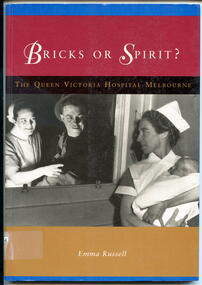
... Bricks or spirit: the Queen Victoria Hospital, Melbourne...Queen Victoria Hospital (Melbourne)...) Queen Victoria Memorial Hospital (Melbourne) Queen Victoria Medical Centre(Melbourne) Monash Medical Centre Hospitals-Victoria -History A history of the Queen Victoria hospital. ...A history of the Queen Victoria hospital. In 1896 eleven female doctors led by Constance Stone opened the Victoria hospital for women and children. After three different city locations, it ceased to exist as a separate entity in 1987, when amalgamation saw it form part of the Monash Medical Centre in Clayton.Illustrated book. Multicolour front cover with title and authors name, as well as illustration (black and white photo) of a 'receiving" window, where fathers or other visitors could view a newborn. Nurse and man standing on one side and nurse holding a baby on the other. Title, authors name and publishers mark in white print on gold coloured spine. The back cover has a cream background with a summary of the book printed on it. There are also three photos of the hospitals three homes: St David's Church Hall, Mint Place and Lonsdale St.non-fictionA history of the Queen Victoria hospital. In 1896 eleven female doctors led by Constance Stone opened the Victoria hospital for women and children. After three different city locations, it ceased to exist as a separate entity in 1987, when amalgamation saw it form part of the Monash Medical Centre in Clayton.queen victoria hospital (melbourne), queen victoria memorial hospital (melbourne), queen victoria medical centre(melbourne), monash medical centre, hospitals-victoria -history -
![Front of postcard 'Give Generoursly' , Queen Victoria Womens Centre [ca.2000]](/media/collectors/50187a8f023fd7201471f198/items/6a5b112875095107b5cd3695/item-media/6a5b11b475095107b5cd424f/item-fit-380x285.jpg?cb=6) Alfred Hospital Nurses League - Nursing History Collection
Alfred Hospital Nurses League - Nursing History CollectionPostcard - Set of black and white postcards, Queen Victroria Womens Centre, Postcards featuring the Queen Victoria Hospital, Melbourne, [ca.2000]
... Postcards featuring the Queen Victoria Hospital, Melbourne...Queen Victoria Hospital (Melbourne)...The Queen Victoria Hospital was a historic, women-led medical facility in Melbourne founded in 1896 by Dr. ...hospital at 210 Lonsdale Street now houses the Queen Victoria Women's Centre. Amongst its services the hospital provided midwifery training. These postcards were created from historical photographs and sold at the Queen Victoria Women's centre, they include images of nurses Collection of historic photographs of a Victorian Hospital Queen Victoria Hospital (Melbourne) Hospitals - Victoria - History Postcards created from black and white photographs. ...The Queen Victoria Hospital was a historic, women-led medical facility in Melbourne founded in 1896 by Dr. Constance Stone. It relocated to Clayton in 1987, becoming part of Monash Health.The sole remaining heritage tower of the former hospital at 210 Lonsdale Street now houses the Queen Victoria Women's Centre. Amongst its services the hospital provided midwifery training. These postcards were created from historical photographs and sold at the Queen Victoria Women's centre, they include images of nursesCollection of historic photographs of a Victorian HospitalPostcards created from black and white photographs. On hthe reverse of each are a description of the image, the words "Queen Victoria Women's Centre" and acknowledgement 'photo courtesy of Souther Health Monash Medical Centre Historiical Collectionqueen victoria hospital (melbourne), hospitals - victoria - history -
 Returned Nurses RSL Sub-branch
Book - Illustrated paperback book, Emma Russell, Bricks or spirit? : The Queen Victoria Hospital Melbourne, 1997
... : The Queen Victoria Hospital Melbourne...: The Queen Victoria Hospital Melbourne Book Illustrated paperback book Emma Russell Australian Scholarly Publishing Monash Medical Centre, Southern Health Care Network ...A history of the Queen Victoria Hospital and the women who worked there.Paperback book with spine and cover in blue, mustard yellow and brick red. Cover also has a black and white photograph of a nurse holding an infant with a nurse and man looking on through a window.fictionA history of the Queen Victoria Hospital and the women who worked there.queen victorian hospital, melbourne, women's health -
 Melbourne Tram Museum
Postcard, Rose Stereograph Co, "The Queen Victoria Memorial Hospital Melbourne", mid 1940s
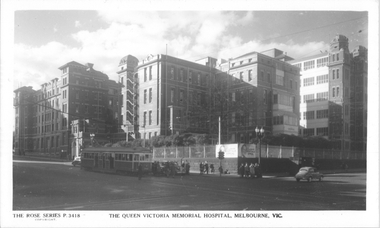
... "The Queen Victoria Memorial Hospital Melbourne"...Rose Series postcard P.3418, titled "The Queen Victoria Memorial Hospital Melbourne", with W2 359? southbound in Swanston Street at Lonsdale Street Many pedestrians are waiting at the tram stop or waiting to cross the road...."The Queen Victoria Memorial Hospital Melbourne" Postcard Rose Stereograph Co. ...Rose Series postcard P.3418, titled "The Queen Victoria Memorial Hospital Melbourne", with W2 359? southbound in Swanston Street at Lonsdale Street Many pedestrians are waiting at the tram stop or waiting to cross the road.Yields information Swanston St and the "The Queen Victoria Memorial Hospital Melbourne" late 1940s.Postcard - printed real photograph with Rose Stereograph Co. name on the rear. Two copies held.tramways, trams, swanston st, lonsdale st, hospital, w2 class, tram 359, rose series -
 Alfred Hospital Nurses League - Nursing History Collection
Booklet, Queen Victoria memorial Hospital, The Queen Victoria Hospital brochure - midwifery training 1966, 1966
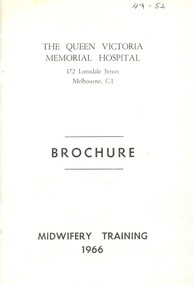
... ...Queen Victoria Hospital (Melbourne)...Booklet given to prospective midwifery trainees by the Queen Victoria Memorial Hospital Melbourne in 1966....Booklet given to prospective midwifery trainees by the Queen Victoria Memorial Hospital Melbourne in 1966. Of significance to the AHNL as many Alfred graduates completed midwifery training at the Queen Victoria Memorial Hospital Melbourne. nursing education midwifery Queen Victoria Hospital (Melbourne) Information about midwifery training at the Queen Victoria Memorial Hospital, Melbourne in the 1960's. previous catalogue number written in black ink at top right of front cover. ...Information about midwifery training at the Queen Victoria Memorial Hospital, Melbourne in the 1960's.Booklet with black print. Title on front cover.non-fictionInformation about midwifery training at the Queen Victoria Memorial Hospital, Melbourne in the 1960's.nursing education, midwifery, queen victoria hospital (melbourne) -
 Greensborough Historical Society
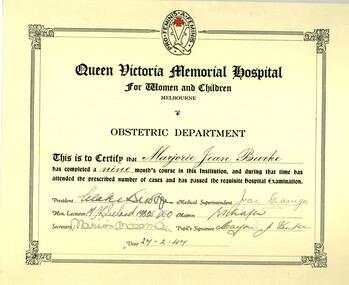
Document - Certificate, Queen Victoria Hospital, Obstetrics Certificate for Marjorie Jean Burke, 27/02/1947
... ...queen victoria hospital melbourne...Obstetrics certificate for Marjorie Jean Burke issued by the Queen Victoria Memorial Hospital for Women and Children in Melbourne....When Miss Burke returned to Australia, she was employed at Diamond Valley Community Hospital as a nurse in 1953 and as Deputy Matron 1954-1971. marjorie jean burke nurses diamond valley community hospital queen victoria hospital melbourne Certificate typed on cream card. ...Obstetrics certificate for Marjorie Jean Burke issued by the Queen Victoria Memorial Hospital for Women and Children in Melbourne.Miss Burke was a nurse, midwife and infant welfare sister. This collection covers her many qualifications throughout Australia and Great Britain, including references both professional and personal. When Miss Burke returned to Australia, she was employed at Diamond Valley Community Hospital as a nurse in 1953 and as Deputy Matron 1954-1971.Certificate typed on cream card.marjorie jean burke, nurses, diamond valley community hospital, queen victoria hospital melbourne -
 Greensborough Historical Society
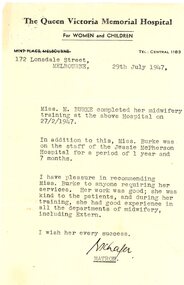
Document - Professional reference, Queen Victoria Hospital, Professional reference for Marjorie Jean Burke, 29/07/1947
... ...queen victoria hospital melbourne...Professional reference for Marjorie Jean Burke issued by the matron of Queen Victoria Memorial Hospital for Women and Children in Melbourne....When Miss Burke returned to Australia, she was employed at Diamond Valley Community Hospital as a nurse in 1953 and as Deputy Matron 1954-1971. marjorie jean burke nurses diamond valley community hospital queen victoria hospital melbourne Reference typed on cream letterhead. ...Professional reference for Marjorie Jean Burke issued by the matron of Queen Victoria Memorial Hospital for Women and Children in Melbourne.Miss Burke was a nurse, midwife and infant welfare sister. This collection covers her many qualifications throughout Australia and Great Britain, including references both professional and personal. When Miss Burke returned to Australia, she was employed at Diamond Valley Community Hospital as a nurse in 1953 and as Deputy Matron 1954-1971.Reference typed on cream letterhead.marjorie jean burke, nurses, diamond valley community hospital, queen victoria hospital melbourne -
 Monash Health Historical Collections
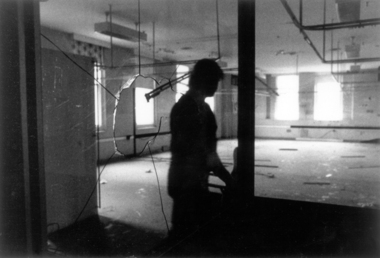
Queen Victoria Hospital Lonsdale Street post-1987 or 1990s, b/w photograph, 1996
... The Queen Victoria Hospital Melbourne", Australian Scholarly Publishing, Melbourne 1997...The Queen Victoria Hospital Melbourne", Australian Scholarly Publishing, Melbourne 1997 b/w photograph Queen Victoria Hospital Lonsdale Street post-1987 or 1990s ...These copies acquired August 1999 from Public Relations.b/w x 56 photos used in Emma Russell's book "Bricks or Spirit? The Queen Victoria Hospital Melbourne", Australian Scholarly Publishing, Melbourne 1997 -
 Royal Australian and New Zealand College of Obstetricians & Gynaecologists (RANZCOG)
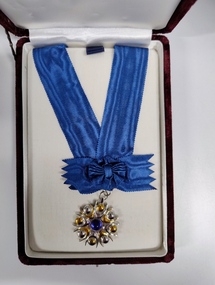
Medal - AOFOG Fellowship medal presented to Dame Ella Macknight, 1993
... Ella Macknight was an Australian obstetrician and gynaecologist, who worked at the Queen Victoria Hospital, Melbourne. She was appointed as a Dame Commander of the Order of the British Empire on 1 January 1969 for services to medicine. ...Ella Macknight was an Australian obstetrician and gynaecologist, who worked at the Queen Victoria Hospital, Melbourne. She was appointed as a Dame Commander of the Order of the British Empire on 1 January 1969 for services to medicine. ...Ella Macknight was an Australian obstetrician and gynaecologist, who worked at the Queen Victoria Hospital, Melbourne. She was appointed as a Dame Commander of the Order of the British Empire on 1 January 1969 for services to medicine. (Wikipedia) Her name has been misspelled on the engraving on this medal.Silver coloured medal with gold coloured decoration on a blue ribbon. The medal is a physical representation of the AOFOG (Asia and Oceania Federation of Obstetrics and Gynaecology) logo, consisting of a translucent central blue circle (possibly made of glass) surrounded by eight abstract torso figures in alternating gold and silver colours. The base of the torso sits adjacent to the central blue circle, and depicts a figure with its arms raised straight up. The torso neighbour each other around the circumference of the central blue circle to form a circular pattern. The figure at the top of the medal has a silver torso and gold head, and these colours interchange from figure to figure (eg. the figure on either side has a gold torso and silver head). The medal is engraved with the text 'Dame Ella McKnight/FELLOW/OF/AOFOG/1993'. The ribbon has two velcro fastenings. The medal is in a protective case, the outside of which is lined with red velvet. Included in the case is a runsheet printed on paper for the ceremony in which Ella MacKnight was presented with this medal. The ceremony was held at PICC Plenary Hall on 14 November, 1993. The velvet case in stored inside a while, rectangular cardboard box, consisting of two parts - lid and base. Sticker attached to top of the cardboard box reads ' DAME ELLA MCKNIGHT/FELLOW/1993'. Dame Ella McKnight/FELLOW/OF/AOFOG/1993'obstetrics, gynaecology, awards -
 Royal Australian and New Zealand College of Obstetricians & Gynaecologists (RANZCOG)
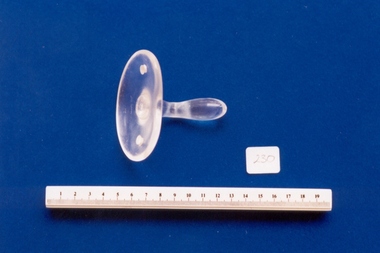
Pessary used by Dr Olga Bolitho, and associated with Dame Ella MacKnight
... Used by Olga Bolitho once or twice, according to correspondence dated 14/5/00 from Olga Bolitho [held with the donation form] Dame Ella Macknight was an obstetrician and gynaecologist who worked at the Queen Victoria Hospital, Melbourne. She was appointed as a Dame Commander of the Order of the British Empire on 1 January 1969 for services to medicine. ...Used by Olga Bolitho once or twice, according to correspondence dated 14/5/00 from Olga Bolitho [held with the donation form] Dame Ella Macknight was an obstetrician and gynaecologist who worked at the Queen Victoria Hospital, Melbourne. She was appointed as a Dame Commander of the Order of the British Empire on 1 January 1969 for services to medicine. ...This pessary belonged to Dr Olga Bolitho who inherited it from Dame Ella MacKnight. Used by Olga Bolitho once or twice, according to correspondence dated 14/5/00 from Olga Bolitho [held with the donation form] Dame Ella Macknight was an obstetrician and gynaecologist who worked at the Queen Victoria Hospital, Melbourne. She was appointed as a Dame Commander of the Order of the British Empire on 1 January 1969 for services to medicine. She gained her MB BS in 1928 from the University of Melbourne. After qualifying as an obstetrician and gynaecologist, (MD, Melb.1931, DGO Melb 1936), she was associated with the Queen Victoria Hospital from 1935-1977. Her appointments included honorary obstetrician and gynaecologist from 1935-1964; vice-president of the Committee of Management for 1963-1971 and president from 1971-1977. She was president of the Council of the Royal College of Gynaecologists from 1970-1972.After her death in 1996, her family set up a post graduate scholarship in her honour with the Royal College of Gynaecologists & Obstetricians.Clear plastic pessary. Pessary is circular, with a wide flange and a short stem. The stem is attached to the flange, rather than the pessary being moulded as one piece. There are two small holes in the flange, either side of the stem.intrauterine device, pessary -
 Royal Australian and New Zealand College of Obstetricians & Gynaecologists (RANZCOG)
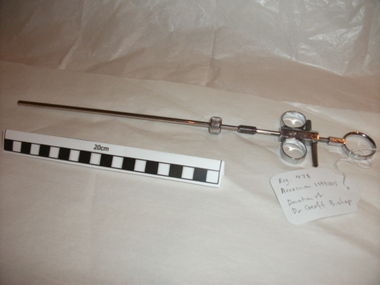
Forceps, Palmer's diathermy, c1969
... On returning to Australia, Bishop and Grimwade together with Mr Peter Paterson introduced gynaecological laparoscopy to Melbourne, practising at the Queen Victoria Memorial Hospital (QVMH), Melbourne in 1969. ...On returning to Australia, Bishop and Grimwade together with Mr Peter Paterson introduced gynaecological laparoscopy to Melbourne, practising at the Queen Victoria Memorial Hospital (QVMH), Melbourne in 1969. ...Part of the laparoscopy equipment donated by Dr Geoff Bishop. Dr Geoffrey Bishop, whilst at the Department of O and G, University of Liverpool, UK, began laparoscopy in 1969. On returning to Australia, Bishop and Grimwade together with Mr Peter Paterson introduced gynaecological laparoscopy to Melbourne, practising at the Queen Victoria Memorial Hospital (QVMH), Melbourne in 1969. The College, through the Victorian State Committee of the Australian Council, RCOG, ran training courses in laparoscopy for local and interstate gynaecologists. These were conducted by Bishop, Grimwade and Paterson. They established protocols, with particular reference to safety, for the conduct of laparoscopy. Laparoscopy was used initially for diagnosis and for limited treatment using diathermy for conditions such as endometriosis. The real impetus came with the great upsurge of tubal sterilization in the early 1970s. Early techniques included diathermy and division of the Fallopian tubes using the Palmer forceps. [Dr Peter Renou, former honoury curator.]Palmer's diathermy forceps. It has two pronds for grasping that retracts with a screw mechanism. Purchased by Geoff Bishop as an additional part of original laparoscopy set, also included in this accession 1999005.laparoscopy, tubal ligation, infertility investigation -
 Royal Australian and New Zealand College of Obstetricians & Gynaecologists (RANZCOG)
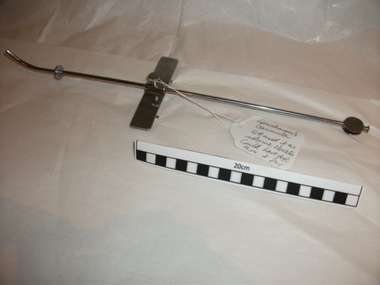
Cannula, Spackman's, c1969
... On returning to Australia, Bishop and Grimwade together with Mr Peter Paterson introduced gynaecological laparoscopy to Melbourne, practising at the Queen Victoria Memorial Hospital (QVMH), Melbourne in 1969. ...On returning to Australia, Bishop and Grimwade together with Mr Peter Paterson introduced gynaecological laparoscopy to Melbourne, practising at the Queen Victoria Memorial Hospital (QVMH), Melbourne in 1969. ...Part of the laparoscopy equipment donated by Dr Geoff Bishop. Dr Geoffrey Bishop, whilst at the Department of O and G, University of Liverpool, UK, began laparoscopy in 1969. On returning to Australia, Bishop and Grimwade together with Mr Peter Paterson introduced gynaecological laparoscopy to Melbourne, practising at the Queen Victoria Memorial Hospital (QVMH), Melbourne in 1969. The College, through the Victorian State Committee of the Australian Council, RCOG, ran training courses in laparoscopy for local and interstate gynaecologists. These were conducted by Bishop, Grimwade and Paterson. They established protocols, with particular reference to safety, for the conduct of laparoscopy. Laparoscopy was used initially for diagnosis and for limited treatment using diathermy for conditions such as endometriosis. The real impetus came with the great upsurge of tubal sterilization in the early 1970s. Early techniques included diathermy and division of the Fallopian tubes using the Palmer forceps. [Dr Peter Renou, former honoury curator.]This Spackman's cannula was used by Dr Geoff Bishop during gynaecological laparscopioc surgery.He used this decice as a uterine elevator. Also, for testing tubal patency by inserting dye through it. Manufacturers stamp: ANAX.laparoscopy, tubal ligation, infertility investigation -
 Royal Australian and New Zealand College of Obstetricians & Gynaecologists (RANZCOG)
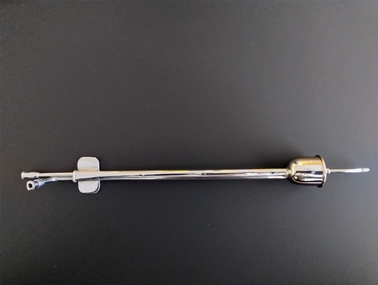
Infertility cannula used by Dr Geoff Bishop, Precious, c1969
... On returning to Australia, Bishop and Grimwade together with Mr Peter Paterson introduced gynaecological laparoscopy to Melbourne, practising at the Queen Victoria Memorial Hospital (QVMH), Melbourne in 1969. ...On returning to Australia, Bishop and Grimwade together with Mr Peter Paterson introduced gynaecological laparoscopy to Melbourne, practising at the Queen Victoria Memorial Hospital (QVMH), Melbourne in 1969. ...Part of a set of laparoscopy equipment donated by Dr Geoff Bishop. Dr Geoffrey Bishop, whilst at the Department of O and G, University of Liverpool, UK, began laparoscopy in 1969. On returning to Australia, Bishop and Grimwade together with Mr Peter Paterson introduced gynaecological laparoscopy to Melbourne, practising at the Queen Victoria Memorial Hospital (QVMH), Melbourne in 1969. The College, through the Victorian State Committee of the Australian Council, RCOG, ran training courses in laparoscopy for local and interstate gynaecologists. These were conducted by Bishop, Grimwade and Paterson. They established protocols, with particular reference to safety, for the conduct of laparoscopy. Laparoscopy was used initially for diagnosis and for limited treatment using diathermy for conditions such as endometriosis. The real impetus came with the great upsurge of tubal sterilization in the early 1970s. Early techniques included diathermy and division of the Fallopian tubes using the Palmer forceps. [Dr Peter Renou, former honorary curator.] This object was used by Dr Geoff Bishop during gynaecological laparoscopic surgery. This instrument is commonly used for suction. It is also used for testing tubal patency by inserting dye through it. Cannula. Consists of a slender shaft with fittings at each end. There are two points for tubal attachments at one end, set into separate small metal tubes at ninety degrees to each other. At the other end, there is a bell cap enclosing a curved nozzle. The nozzle is punctured with six small holes. Manufacturers stamp on plate near the attachment points reads 'PRECIOUS'.infertility, gynaecology -
Ballarat Clarendon College
Leather coin purse
... Marion Wanliss attended the University of Melbourne (MB BS 1920; MD 1929); after research into cancer as a postgraduate in Vienna, she practised as a physician at the Queen Victoria Memorial Hospital. ...Marion Wanliss attended the University of Melbourne (MB BS 1920; MD 1929); after research into cancer as a postgraduate in Vienna, she practised as a physician at the Queen Victoria Memorial Hospital. ...Coin purse possibly the property of Marion Boyd Wanliss (1896 - 1984), daughter of old collegian Newton Wanliss or Newton's second wife, Margaret Hannah Bannister. . Marion Wanliss attended the University of Melbourne (MB BS 1920; MD 1929); after research into cancer as a postgraduate in Vienna, she practised as a physician at the Queen Victoria Memorial Hospital. She was also a prominent conservationist. Leather coin purse envelope style with metal fixtures; shield shaped clasp at front; three sections of concertina design. Engraved on metal border of purse flap: M Wanliss, Ballaratmarion-wanliss, newton-wanliss -
 Eltham District Historical Society Inc
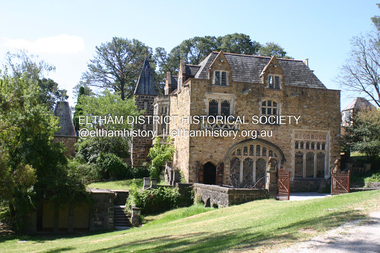
Photograph - Digital Photograph, Alan King, Great Hall, Montsalvat, 8 January 2008
... Melbourne where Lil, now qualified, worked as an anaesthetist at St Vincent’s Hospital. They bought a small house in Brighton and Jörgensen rented a large building in Queen Street for his studio until the Royal Automobile Club of Victoria bought it in 1955. ...Melbourne where Lil, now qualified, worked as an anaesthetist at St Vincent’s Hospital. They bought a small house in Brighton and Jörgensen rented a large building in Queen Street for his studio until the Royal Automobile Club of Victoria bought it in 1955. ...Great Hall at Montsalvat built 1938-52, designed by Justus Jorgensen Covered under National Estate, National Trust of Australia (Victoria) State Significance, Victorian Heritage and Heritage Overlay, Nillumbik Planning Scheme. Published: Nillumbik Now and Then / Marguerite Marshall 2008; photographs Alan King with Marguerite Marshall.; p129 At first glance, Montsalvat, the artists’ community at Hillcrest Avenue, Eltham, could belong to another time and place. The French provincial Gothic-style buildings blend picturesquely with the introduced and native trees and farm animals on the five hectare property. But Montsalvat belongs very much to today’s Eltham, having inspired much of its creative activity and style. The use of mud-brick and recycled building materials, for which Eltham is so well-known, was largely popularised by Montsalvat. Montsalvat – unique in Victoria and probably in Australia – is registered by the National Trust and National Estate.1 Montsalvat, named after the castle of the Knights of the Holy Grail, has attracted artists and intellectuals since it was founded in 1934. For years at weekends, artists, lawyers, philosophers, politicians and others, who shared a love for what Montsalvat stood for, gathered for a meal and stimulating discussion. The focus for this gathering of talent was Justus Jörgensen, an eccentric man with vision and charisma. It was Jörgensen’s foresight that saw the creation of Montsalvat, which in 1975 was formed into a trust to benefit the Victorian people. The property was then valued at about three million dollars. It is now visited by thousands of people annually. Born in 1894 and brought up a Catholic, Jörgensen had trained as an architect. He later studied painting at the National Gallery School under artist, Frederick McCubbin, then joined the studio of artist Max Meldrum. In 1924, Jörgensen married medical student Lillian Smith, and with artist friends they travelled to Europe to study the great masters. In London Jörgensen exhibited in several major galleries. One of his still life paintings was included in the book The Art of Still Life by Herbert Furst, which featured 100 of the greatest ever still life paintings.2 In 1929, Jörgensen returned to Melbourne where Lil, now qualified, worked as an anaesthetist at St Vincent’s Hospital. They bought a small house in Brighton and Jörgensen rented a large building in Queen Street for his studio until the Royal Automobile Club of Victoria bought it in 1955. While designing and overseeing the building of a studio for his friend the famous cartoonist Percy Leason, in Lavender Park Road, Jörgensen decided to buy land for a country retreat in Eltham. So the building of Montsalvat began. Jörgensen gathered around a dozen of his friends and students from his Queen Street studio. They set to work, first at weekends then some decided to live permanently on the site. Jörgensen had seen mud-brick buildings in Spain and recognised that Eltham’s clay soil was ideal for mud-bricks and although labour intensive, it was a very cheap way of building. Jörgensen’s students and friends worked under his direction with the help of local tradesmen, including carpenter, Len Jarrold and later stone mason, Horrie Judd. In return Jörgensen would give the students a painting lesson or two. It was the Great Depression when many were out of work. Jörgensen also inspired people to give generously of money and materials. With their help Jörgensen found second-hand materials for building. Friends donated slate for roofing, discarded firebricks were used for flooring and windows and doors and a cast-iron circular staircase came from a wrecker. The students’ day started at 7am with building and domestic chores, shared equally between the sexes. The first building was used by his friends at weekends and then became a home for his wife Lil. It consisted of three rooms and an attic under a high-pitched roof. Jörgensen then built a similar structure with the same high-pitched roof as a more permanent home for his students. The two buildings were joined together with a tower and a studio for Jörgensen. While excavating for the studio a reef of yellow mud-stone was found and then used in construction. The next building was the Great Hall, to be used for dining, exhibitions and meetings and completed in 1958, after a halt during the war. Whelan the Wrecker donated the stone-framed windows from the building that housed the Victorian Insurance Co. in Collins Street, which had been demolished in the 1930s. The swimming pool was donated and cubicles were built for the students with their initials marked in tiles on each doorstep.1 One of Jörgensen’s great abilities was to recognise how to use material which harmonised. He would comb through wreckers’ yards for what he needed. Regarding his buildings as sculptural pieces, his first consideration was for the aesthetic quality of a building and only then for its functionality.2 At Montsalvat, Jörgensen found he was able to put his ideas into practice without compromise and those who worked with him had to conform to his ideas. With the Jörgensens, the colony’s original nucleus consisted of the Skipper family – Mervyn and wife Lena, daughters Helen and Sonia and son Matcham,who was to become an eminent jeweller and sculptor represented in National Gallery collections throughout Australia and in European museums.3 Other members were Arthur Munday, Lesley Sinclair, Helen Lempriere, Ian Robertson, John Smith, George Chalmers, John Busst and Sue Van der Kellan; also Jörgensen’s three sons – Max, Sebastian and Sigmund – and Saskia, Sonia Skipper and Arthur Munday’s daughter. Montsalvat went through some hard times when local gossips spread rumours of sexual shenanigans at Montsalvat. However Montsalvat also had many local supporters – especially amongst the local tradespeople. The colony was certainly unconventional – with Jörgensen’s wife Lil (and son Max) and life-time partner Helen Skipper, (mother of Sebastian and Sigmund) living at Montsalvat. Sonia Skipper says in her biography that the group were ‘very conscious of their responsibilities to each other and a desire to make their relationships work’.4 By World War Two many buildings around the Great Hall were completed. Jörgensen was a pacifist, as were most of his students. Some of the Montsalvat community enlisted while others engaged in essential services like dairy farming and market gardening for the war effort. It was then that Jörgensen constructed farm buildings. After the war many well-known personalities such as Clifton Pugh, landscape gardener Gordon Ford, and builder Alistair Knox, were drawn to Montsalvat. They learnt that building was not a ‘sacred cow’ only for professionals, but that anyone who was willing to get their hands dirty could do it. The post-war shortage of materials also encouraged builders to follow Montsalvat’s lead in reusing materials. When Jörgensen died in 1975, his influence did not – thanks largely to the vigilance of his son, Sigmund, who became its administrator. The weekend dinners have gone, but in 2008 about 14 artists still work at Montsalvat – some living there – including a couple who have been there since its early days. Under Sigmund’s direction Montsalvat further expanded its activities which included festivals, art exhibitions, concerts and weddings. Sigmund completed the Chapel, then the Long Gallery next to the pool, After the barn burnt down, he replaced it in 1999 (the builder was Hamish Knox, Alistair’s son) with a new gallery and entrance and added a restaurant. Sigmund has been careful that any new building blends in with the character of Montsalvat. In 2006 Montsalvat was restructured for its continued financial viability and with the help of Arts Victoria a new executive officer was appointed. A representative board from the wider community was established, which includes members from the former Montsalvat Trust including Sigmund Jörgensen – who is now the heritage and arts adviser to the new company Montsalvat Ltd.5 Today, visiting Montsalvat one still sees artists, students and visitors enjoying the unique and beautiful surroundings.This collection of almost 130 photos about places and people within the Shire of Nillumbik, an urban and rural municipality in Melbourne's north, contributes to an understanding of the history of the Shire. Published in 2008 immediately prior to the Black Saturday bushfires of February 7, 2009, it documents sites that were impacted, and in some cases destroyed by the fires. It includes photographs taken especially for the publication, creating a unique time capsule representing the Shire in the early 21st century. It remains the most recent comprehenesive publication devoted to the Shire's history connecting local residents to the past. nillumbik now and then (marshall-king) collection, eltham, great hall, montsalvat -
 Geoffrey Kaye Museum of Anaesthetic History
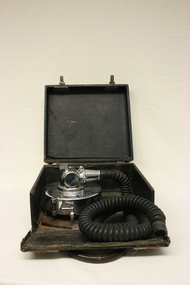
Machine - Small ether inhaler
... Hospital in Sydney during the 1930s. The inhaler is compact and portable. Initially, Small experimented with other agents for the relief of labour pain but was not happy with any of them. He also tried various agents on himself, including nitrous oxide/oxygen, chloroform and ethyl chloride. Finally he settled on ether via a Clover inhaler as the best analgesic. This inhaler is only described in use in Australia and New Zealand, although it was used for almost 40 years. ether small thomas analgesia obstetrics anaesthesia anaesthetic royal women's sydney queen victoria melbourne ...Dr Thomas Small designed this ether anaesthesia and analgesia machine while he was an Honorary Medical Officer at the Royal Women's Hospital in Sydney during the 1930s. The inhaler is compact and portable. Initially, Small experimented with other agents for the relief of labour pain but was not happy with any of them. He also tried various agents on himself, including nitrous oxide/oxygen, chloroform and ethyl chloride. Finally he settled on ether via a Clover inhaler as the best analgesic. This inhaler is only described in use in Australia and New Zealand, although it was used for almost 40 years. Black leather box with leather handle, lockable latches on either side and drop down front case panel containing a metal ether inhaler and length of black corrugated rubber hose with one end attached to the inhaler and the other end open for attaching a mask. The metal inhaler drum is circular and attached to the floor of the case with a small tap/lever to one side and a mixing valve on the top near the hose connection. The lever has incised gradings of quarter increments from 0 to 1. The box is designed for the ether inhaler to be portable.ether, small, thomas, analgesia, obstetrics, anaesthesia, anaesthetic, royal women's, sydney, queen victoria, melbourne -
 Royal Australian and New Zealand College of Obstetricians & Gynaecologists (RANZCOG)
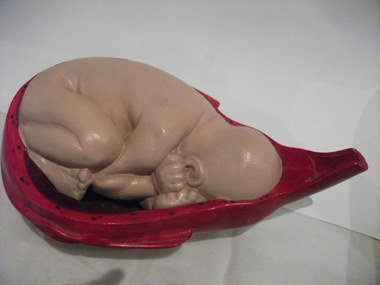
Obstetric teaching model
... Originally this six part teaching model was used and owned by the former Queen Victoria Womens' Hospital, Lonsdale/ Swanston Streets, Melbourne. With the amalgamation of hospitals, the models were transferred to the Monash Medical Centre, Clayton....Originally this six part teaching model was used and owned by the former Queen Victoria Womens' Hospital, Lonsdale/ Swanston Streets, Melbourne. With the amalgamation of hospitals, the models were transferred to the Monash Medical Centre, Clayton. ...Originally this six part teaching model was used and owned by the former Queen Victoria Womens' Hospital, Lonsdale/ Swanston Streets, Melbourne. With the amalgamation of hospitals, the models were transferred to the Monash Medical Centre, Clayton.Foetus in uterus, cervix not dilated. Painted plaster. The birth process in six stages; first of six models.teaching aid, obstetric delivery -
 Royal Australian and New Zealand College of Obstetricians & Gynaecologists (RANZCOG)
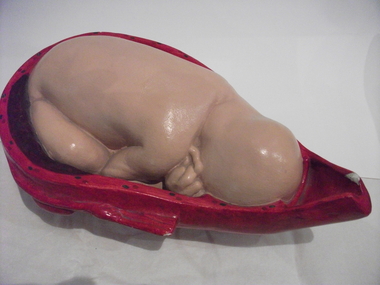
Obstetric teaching model
... Originally this six part teaching model was used and owned by the former Queen Victoria Womens' Hospital, Lonsdale/ Swanston Streets, Melbourne. With the amalgamation of hospitals, the models were transferred to the Monash Medical Centre, Clayton....Originally this six part teaching model was used and owned by the former Queen Victoria Womens' Hospital, Lonsdale/ Swanston Streets, Melbourne. With the amalgamation of hospitals, the models were transferred to the Monash Medical Centre, Clayton. ...Originally this six part teaching model was used and owned by the former Queen Victoria Womens' Hospital, Lonsdale/ Swanston Streets, Melbourne. With the amalgamation of hospitals, the models were transferred to the Monash Medical Centre, Clayton.Foetus in uterus, head engaged, cervix partially dilated.. Painted plaster. The birth process in six stages;second of six models.teaching aid, obstetric delivery -
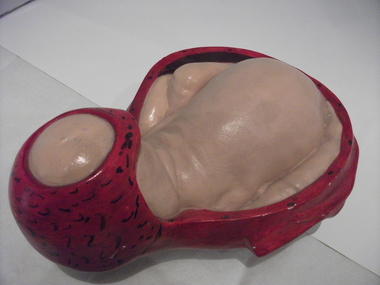 Royal Australian and New Zealand College of Obstetricians & Gynaecologists (RANZCOG)
Obstetric teaching model
... Originally this six part teaching model was used and owned by the former Queen Victoria Womens' Hospital, Lonsdale/ Swanston Streets, Melbourne. With the amalgamation of hospitals, the models were transferred to the Monash Medical Centre, Clayton....Originally this six part teaching model was used and owned by the former Queen Victoria Womens' Hospital, Lonsdale/ Swanston Streets, Melbourne. With the amalgamation of hospitals, the models were transferred to the Monash Medical Centre, Clayton. ...Originally this six part teaching model was used and owned by the former Queen Victoria Womens' Hospital, Lonsdale/ Swanston Streets, Melbourne. With the amalgamation of hospitals, the models were transferred to the Monash Medical Centre, Clayton.Foetus in uterus, head crowning.. Painted plaster. The birth process in six stages; third of six models.teaching aid, obstetric delivery -
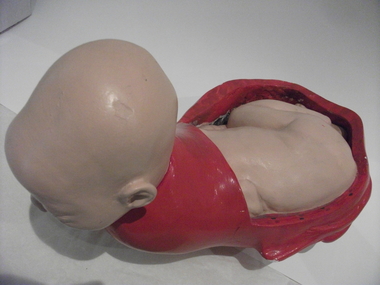 Royal Australian and New Zealand College of Obstetricians & Gynaecologists (RANZCOG)
Obstetric teaching model
... Originally this six part teaching model was used and owned by the former Queen Victoria Womens' Hospital, Lonsdale/ Swanston Streets, Melbourne. With the amalgamation of hospitals, the models were transferred to the Monash Medical Centre, Clayton....Originally this six part teaching model was used and owned by the former Queen Victoria Womens' Hospital, Lonsdale/ Swanston Streets, Melbourne. With the amalgamation of hospitals, the models were transferred to the Monash Medical Centre, Clayton. ...Originally this six part teaching model was used and owned by the former Queen Victoria Womens' Hospital, Lonsdale/ Swanston Streets, Melbourne. With the amalgamation of hospitals, the models were transferred to the Monash Medical Centre, Clayton.Foetus, head fully emerged. Painted plaster. The birth process in six stages; fourth of six models.teaching aid, obstetric delivery -
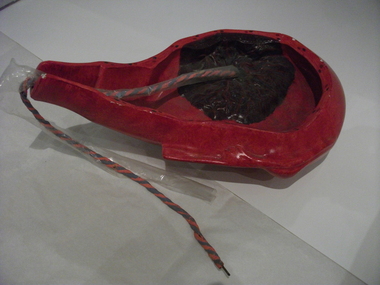 Royal Australian and New Zealand College of Obstetricians & Gynaecologists (RANZCOG)
Obstetric teaching model
... Originally this six part teaching model was used and owned by the former Queen Victoria Womens' Hospital, Lonsdale/ Swanston Streets, Melbourne. With the amalgamation of hospitals, the models were transferred to the Monash Medical Centre, Clayton....Originally this six part teaching model was used and owned by the former Queen Victoria Womens' Hospital, Lonsdale/ Swanston Streets, Melbourne. With the amalgamation of hospitals, the models were transferred to the Monash Medical Centre, Clayton. ...Originally this six part teaching model was used and owned by the former Queen Victoria Womens' Hospital, Lonsdale/ Swanston Streets, Melbourne. With the amalgamation of hospitals, the models were transferred to the Monash Medical Centre, Clayton.Placenta with attached umbilical cord, uterus still enlarged. Painted plaster. The birth process in six stages; fifth of six models.teaching aid, obstetric delivery -
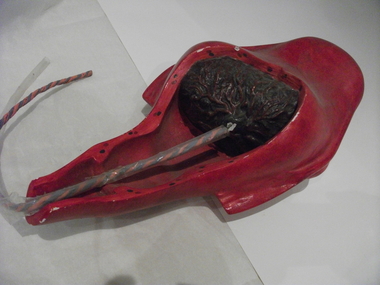 Royal Australian and New Zealand College of Obstetricians & Gynaecologists (RANZCOG)
Obstetric teaching model
... Originally this six part teaching model was used and owned by the former Queen Victoria Womens' Hospital, Lonsdale/ Swanston Streets, Melbourne. With the amalgamation of hospitals, the models were transferred to the Monash Medical Centre, Clayton....Originally this six part teaching model was used and owned by the former Queen Victoria Womens' Hospital, Lonsdale/ Swanston Streets, Melbourne. With the amalgamation of hospitals, the models were transferred to the Monash Medical Centre, Clayton. ...Originally this six part teaching model was used and owned by the former Queen Victoria Womens' Hospital, Lonsdale/ Swanston Streets, Melbourne. With the amalgamation of hospitals, the models were transferred to the Monash Medical Centre, Clayton.Placenta with attached umbilical cord, uterus smaller, cervix more contracted. [end of series]. Painted plaster. The birth process in six stages;sixth of six models.teaching aid, obstetric delivery -
 Alfred Hospital Nurses League - Nursing History Collection
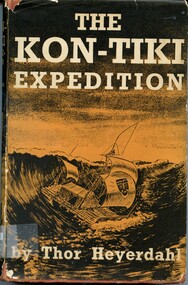
Book - Illustrated book, Thor Heyerdahl 1914-2002 et al, The Kon-Tiki expedition: by raft across the South Seas
... On the front-end page is an inscription in black ink: ' The Queen Victoria Memorial Hospital 172 Lonsdale St, Melbourne The Natalie Morris memorial Prize awarded to Audrey B. ...On the front-end page is an inscription in black ink: ' The Queen Victoria Memorial Hospital 172 Lonsdale St, Melbourne The Natalie Morris memorial Prize awarded to Audrey B. ...The story of a daring voyage by the author and five companions on board a primitive raft from the coast of Peru to the Pacific Islands. Mr. Heyerdahl was convinced that the original Polynesians had come by sea from South America, and to prove that such a voyage was possible at that remote period, he and his party built the 'Kon-Tiki', similar to the rafts then used and embarked on it. After a voyage full of danger, but packed with interest they reached the islands where the Kon-Tiki was wrecked on a coral reef.Illustrated book with dustjacket. Book is bound in front cover, with image of a Polynesian mask embossed on the front. Title, author's and publisher's names are stamped in gilt on spine. Front cover of dustjacket has a black and light brown illustration of a raft at sea, along with title and author's name printed in white. The spine has similar information plus publisher's name in light brown print along with another illustration of a raft and a Polynesian mask. The back of the dust jacket (again in black and light brown) is a route map and labeled diagram of a raft (the Kon-Tiki). non-fictionThe story of a daring voyage by the author and five companions on board a primitive raft from the coast of Peru to the Pacific Islands. Mr. Heyerdahl was convinced that the original Polynesians had come by sea from South America, and to prove that such a voyage was possible at that remote period, he and his party built the 'Kon-Tiki', similar to the rafts then used and embarked on it. After a voyage full of danger, but packed with interest they reached the islands where the Kon-Tiki was wrecked on a coral reef.thor heyerdahl, kon-tiki expedition, ethnology-polynesia, ahnl -
 Alfred Hospital Nurses League - Nursing History Collection
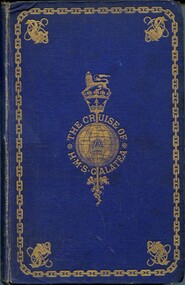
Book, John Milner 1822-1927 et al, The cruise of H. M. S. Galatea, 1869
... The assassination attempt lead to the naming of two hospitals: Prince Alfred Hospital, Sydney and the Alfred Hospital Melbourne Of significance to the AHNL as the Alfred Hospital was named after Prince Alfred after the assassination attempt in Sydney HRH Prince Alfred Duke of Edinburgh Voyages around the world Australia - description - travel 1860's South Africa - description - travel -1860's In 1867, Prince Alfred, Queen Victoria's second son, commissioned the Galatea for a voyage around the world which would include the first royal visit to Australia. ...In 1867, Prince Alfred, Queen Victoria's second son, commissioned the Galatea for a voyage around the world which would include the first royal visit to Australia. Stopping along the way in Rio de Janeiro and Cape Town, Alfred was received with great ceremony at each port of call. These visits provided the ship's chaplain John Milner (1822-97) and the artist Oswald Brierly (1817-94) with ample material for this chronicle, published in 1869, which gives background details of each region alongside scenes from the tour, enhanced by illustrations based on Brierly's sketches. The authors drew on various recollections and writings, including a letter from Alfred to his brother describing an elephant hunt in South Africa. The tour was abruptly curtailed in Sydney when a Fenian sympathiser attempted to assassinate the prince, an act which boosted support for the British royal family. More »Illustrated book with blue cloth cover, gilt stamped decorations on front and spinenon-fictionIn 1867, Prince Alfred, Queen Victoria's second son, commissioned the Galatea for a voyage around the world which would include the first royal visit to Australia. Stopping along the way in Rio de Janeiro and Cape Town, Alfred was received with great ceremony at each port of call. These visits provided the ship's chaplain John Milner (1822-97) and the artist Oswald Brierly (1817-94) with ample material for this chronicle, published in 1869, which gives background details of each region alongside scenes from the tour, enhanced by illustrations based on Brierly's sketches. The authors drew on various recollections and writings, including a letter from Alfred to his brother describing an elephant hunt in South Africa. The tour was abruptly curtailed in Sydney when a Fenian sympathiser attempted to assassinate the prince, an act which boosted support for the British royal family. More »hrh prince alfred duke of edinburgh, voyages around the world, australia - description - travel 1860's, south africa - description - travel -1860's -
 Alfred Hospital Nurses League - Nursing History Collection
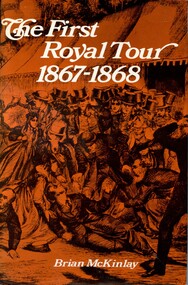
Book - Illustrated book, Rigby Limited, The first royal tour 1867-1868, 1970
... After the assassination attempt two hospitals were named after Prince Alfred: Prince Alfred Hospital, Sydney and the Alfred Hospital Melbourne Of significance to the AHNL as the Alfred Hospital was named after Prince Alfred after the assassination attempt in Sydney HRH Prince Alfred Duke of Edinburgh Australia - description - travel 1860's South Africa - description - travel -1860's Voyages around the world In July, 1867, the Australian colonies were electrified by the news that they were to be visited by royalty. Prince Alfred, Duke of Edinburgh, second son of Queen Victoria ...In July, 1867, the Australian colonies were electrified by the news that they were to be visited by royalty. Prince Alfred, Duke of Edinburgh, second son of Queen Victoria and commander of H.M.S. Galatea, was en route from Europe. He landed in South Australia on a blazing November day, and he was welcomed with an exuberant Colonial loyalty which, as one of his equerries sniffly remarked "seemed ignorant of protocol." During his visits to South Australia, Victoria, Tasmania, New South Wales, and Queensland, the Prince was swept along on a tide of frenzied enthusiasm. Each State tried to outdo the others in the splendour of its receptions and the garishness of its decorations. In Melbourne, a Free Banquet in honour of the Prince turned into a drunken fiasco. On the goldfields, he lunched down a mine and "helped himself rather liberally from a selection of nuggets. He was cheered by convicts in Tasmania, wrangled over by Queensland politicians and bombarded with bouquets, Declarations of Loyalty, and innumerable speeches. Surrounded by city fathers, Bishops, brass bands, fireworks and uproarious multitudes, he went from one triumph to another. Finally, he was shot in Sydney, and his recovery was accompanied by even more passionate demonstrations of loyalty. These were inflamed by revulsion against the would-be assassin, who was hurried to the gallows as the Prince sailed for home. His departure closed a colourful chapter in Australian history, of which the author writes with humour and gustoIllustrated book with dustjacket. Book has a blue cloth binding with title, author and publisher's name stamped in gilt on spine. Dustjacket has an orange and black print of the assassination attempt on Prince Alfred, Duke of Edinburgh in Sydney 1868. Title and author's name overprinted in white on front and spinenon-fictionIn July, 1867, the Australian colonies were electrified by the news that they were to be visited by royalty. Prince Alfred, Duke of Edinburgh, second son of Queen Victoria and commander of H.M.S. Galatea, was en route from Europe. He landed in South Australia on a blazing November day, and he was welcomed with an exuberant Colonial loyalty which, as one of his equerries sniffly remarked "seemed ignorant of protocol." During his visits to South Australia, Victoria, Tasmania, New South Wales, and Queensland, the Prince was swept along on a tide of frenzied enthusiasm. Each State tried to outdo the others in the splendour of its receptions and the garishness of its decorations. In Melbourne, a Free Banquet in honour of the Prince turned into a drunken fiasco. On the goldfields, he lunched down a mine and "helped himself rather liberally from a selection of nuggets. He was cheered by convicts in Tasmania, wrangled over by Queensland politicians and bombarded with bouquets, Declarations of Loyalty, and innumerable speeches. Surrounded by city fathers, Bishops, brass bands, fireworks and uproarious multitudes, he went from one triumph to another. Finally, he was shot in Sydney, and his recovery was accompanied by even more passionate demonstrations of loyalty. These were inflamed by revulsion against the would-be assassin, who was hurried to the gallows as the Prince sailed for home. His departure closed a colourful chapter in Australian history, of which the author writes with humour and gustohrh prince alfred duke of edinburgh, australia - description - travel 1860's, south africa - description - travel -1860's, voyages around the world -
 Alfred Hospital Nurses League - Nursing History Collection
Book - Illustrated book (photocopy), Norman J Marshall, The Melbourne School of Nursing 1950-1963, 1985
... In 1954, the Queen Victoria Hospital withdrew its association from the MSN. Following this, in 1955, the name of the School was changed to The Royal Melbourne Hospital and Associated Hospitals School of Nursing. ...In 1954, the Queen Victoria Hospital withdrew its association from the MSN. Following this, in 1955, the name of the School was changed to The Royal Melbourne Hospital and Associated Hospitals School of Nursing. ...History of the Melbourne School of Nursing, includes list of all graduatesIllustrated book with white comb binding. Has clear plastic protective covers front and back. Title printed [in black ink] on white paper and fixed to larger pale green cardboardnon-fictionHistory of the Melbourne School of Nursing, includes list of all graduatesmelbourne school of nursing-history, the royal melbourne hospital and associated hospitals school of nursing, the royal melbourne hospital -
 Sunshine and District Historical Society Incorporated
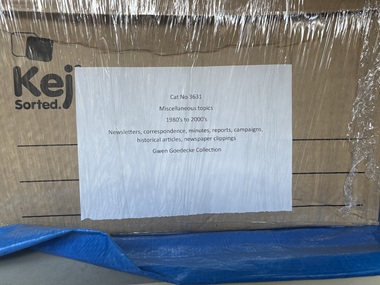
Archive - Gwen Goedecke Collection - Miscellaneous Topics
... | Docklands Task Force - correspondence, information Bulletins on Docklands, Explore Docklands including history and map (all 1991) |Referendum on a Republic (flyer) - information regarding the referendum in 1999 by the Constitution Centenary Foundation |A Whole Year of Celebration (flyer) re Victoria turning 150 years old (1984) From Citzen to Councillor - A Guide for Prospective Councillors (3rd edition (1999) by the Municipal Association of Victoria | PUBLIC FIRST Campaign - a Coalition opposed to privatisation of public utilities - newsletter containing operating principles, organisational roles etc |Environment Victoria - Newspaper 52/53 Forestry in Victoria Western Suburbs Action - by the Conservation Council of Victoria (1984) |Police and Community Youth Clubs - report (1999) Managing Cultural Equity: The Philosophy, Politics and Institutional Behaviours |The Age souvenir pages Melbourne 150' (1992) |PUBLICATIONS|The Australin Municipal journal #64 (June 1985) by the Municipal Association of Victoria| Make Melbourne Marvellous - by the Socialist Alternative Melbourne Collective (The Sam Collective) 1985|Self Help Resource Directory - 2nd edition by a Collective of Self Help Groups (Victoria 1982)|Industrial Waste Project Information Kit (MMBW 1986)|Western Region Environment Commission Minutes July 1985 together with a copy of the Draft Industrial Waste Strategy for Victoria (1985) by the EPA|Interim Directory of Government Departments and Authorities VIC from the Department of the Premier (1979)|National strategies for Managing Hazardous Waste - Conference papers (1985) by the Commonwealth Department of Arts, Heritage and Environment, EPA and the MMBW|The Mt. Cottrell Project - project of the Western Region Commission - a final year thesis (1973)|Gwen's notes and photocopies of articles from a publication Melbourne's Development & Planning |Queen Victoria Hospital...| Docklands Task Force - correspondence, information Bulletins on Docklands, Explore Docklands including history and map (all 1991) |Referendum on a Republic (flyer) - information regarding the referendum in 1999 by the Constitution Centenary Foundation |A Whole Year of Celebration (flyer) re Victoria turning 150 years old (1984) From Citzen to Councillor - A Guide for Prospective Councillors (3rd edition (1999) by the Municipal Association of Victoria | PUBLIC FIRST Campaign - a Coalition opposed to privatisation of public utilities - newsletter containing operating principles, organisational roles etc |Environment Victoria - Newspaper 52/53 Forestry in Victoria Western Suburbs Action - by the Conservation Council of Victoria (1984) |Police and Community Youth Clubs - report (1999) Managing Cultural Equity: The Philosophy, Politics and Institutional Behaviours |The Age souvenir pages Melbourne 150' (1992) |PUBLICATIONS|The Australin Municipal journal #64 (June 1985) by the Municipal Association of Victoria| Make Melbourne Marvellous - by the Socialist Alternative Melbourne Collective (The Sam Collective) 1985|Self Help Resource Directory - 2nd edition by a Collective of Self Help Groups (Victoria 1982)|Industrial Waste Project Information Kit (MMBW 1986)|Western Region Environment Commission Minutes July 1985 together with a copy of the Draft Industrial Waste Strategy for Victoria (1985) by the EPA|Interim Directory of Government Departments and Authorities VIC from the Department of the Premier (1979)|National strategies for Managing Hazardous Waste - Conference papers (1985) by the Commonwealth Department of Arts, Heritage and Environment, EPA and the MMBW|The Mt. Cottrell Project - project of the Western Region Commission - a final year thesis (1973)|Gwen's notes and photocopies of articles from a publication Melbourne's Development & Planning |Queen Victoria Hospital ...Letter to Community Activists re Transport needs of Melbourne from the People for Environmentally Sustainable Transport (dated?)| Docklands Task Force - correspondence, information Bulletins on Docklands, Explore Docklands including history and map (all 1991) |Referendum on a Republic (flyer) - information regarding the referendum in 1999 by the Constitution Centenary Foundation |A Whole Year of Celebration (flyer) re Victoria turning 150 years old (1984) From Citzen to Councillor - A Guide for Prospective Councillors (3rd edition (1999) by the Municipal Association of Victoria | PUBLIC FIRST Campaign - a Coalition opposed to privatisation of public utilities - newsletter containing operating principles, organisational roles etc |Environment Victoria - Newspaper 52/53 Forestry in Victoria Western Suburbs Action - by the Conservation Council of Victoria (1984) |Police and Community Youth Clubs - report (1999) Managing Cultural Equity: The Philosophy, Politics and Institutional Behaviours |The Age souvenir pages Melbourne 150' (1992) |PUBLICATIONS|The Australin Municipal journal #64 (June 1985) by the Municipal Association of Victoria| Make Melbourne Marvellous - by the Socialist Alternative Melbourne Collective (The Sam Collective) 1985|Self Help Resource Directory - 2nd edition by a Collective of Self Help Groups (Victoria 1982)|Industrial Waste Project Information Kit (MMBW 1986)|Western Region Environment Commission Minutes July 1985 together with a copy of the Draft Industrial Waste Strategy for Victoria (1985) by the EPA|Interim Directory of Government Departments and Authorities VIC from the Department of the Premier (1979)|National strategies for Managing Hazardous Waste - Conference papers (1985) by the Commonwealth Department of Arts, Heritage and Environment, EPA and the MMBW|The Mt. Cottrell Project - project of the Western Region Commission - a final year thesis (1973)|Gwen's notes and photocopies of articles from a publication Melbourne's Development & Planning |Queen Victoria Hospital / Women's Centre - - newspaper clippings (1980's to 2000's) -correspondence, campaigns -a report by the Ministerial Advisory Committee (2000) |The Crow Collection Association - Ecosa Exchange Newsletters (80's and 90's) - Copies of extracts from Eureka Street, a Jesuit publication, with notations/comments from Ruth Crow (1993) -news articles, correspondence, phamplets, price lists, broad details of subject areas in the Crow Collection (1991) -report to the Committee of Management (1991) by Sheila Byard -article from the Australian Society (1985) on Ruth and Maurice Crow - Plan for Melbourne - parts 2&3 by Ruth and Maurice Crow (1972)john "jack" augustine tighe, gwenyth "gwen" goedecke, mayor -
 St Kilda Historical Society
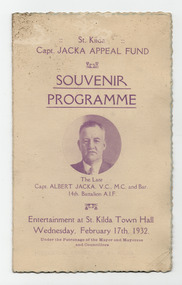
Ephemera - Special event program, Capt. Jacka Appeal Fund Souvenir Programme, 1932
... Queen of Song'. Albert Jacka, a St Kilda Councillor, collapsed on 14 December 1931 after a council meeting and was admitted to Caulfield Military Hospital. He died on 17 January 1932 at the age of 39. He is most well-known for his military service in WWI, having received the Victoria Cross medal for his actions during the Gallipoli campaign and two more decorations for his bravery on the Western Front. He received a hero's welcome on his return to Melbourne...Queen of Song'. Albert Jacka, a St Kilda Councillor, collapsed on 14 December 1931 after a council meeting and was admitted to Caulfield Military Hospital. He died on 17 January 1932 at the age of 39. He is most well-known for his military service in WWI, having received the Victoria Cross medal for his actions during the Gallipoli campaign and two more decorations for his bravery on the Western Front. He received a hero's welcome on his return to Melbourne ...Concert program of entertainment as aprt of fundraising for the Jacka Appeal, held on 17 February 1932 at St Kilda Town Hall. The headline performer was Gladys Moncreiff, 'Australia's Queen of Song'. Albert Jacka, a St Kilda Councillor, collapsed on 14 December 1931 after a council meeting and was admitted to Caulfield Military Hospital. He died on 17 January 1932 at the age of 39. He is most well-known for his military service in WWI, having received the Victoria Cross medal for his actions during the Gallipoli campaign and two more decorations for his bravery on the Western Front. He received a hero's welcome on his return to Melbourne in January 1920 and an estimated 50,000 people turned up to watch his funeral procession to St Kilda Cemetery, where he was buried with full military honours. The Albert Jacka Fund had two objectives: the erection of a simple, suitable and inexpensive memorial stone over the grave of the dead hero; the placing of the residue of the fund in the hands of trustees for the benefit of his widow and child.Folded cream card with scalloped edges and printed in purplealbert jacka, jacka appeal, gladys moncreiff -
 National Wool Museum
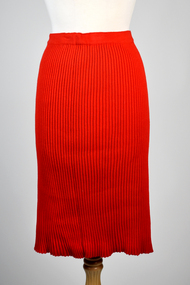
Textile - Skirt, Tina Knitwear, 1980-2000
... She had been a Matron nurse at the Queen Victoria Hospital when she met my parents in the 1970s. She returned to live in New Zealand in the 1980s but came back to Melbourne every year to stay for 2 weeks with the sole purpose of visiting my parents (she adored them) and order garments. ...She had been a Matron nurse at the Queen Victoria Hospital when she met my parents in the 1970s. She returned to live in New Zealand in the 1980s but came back to Melbourne every year to stay for 2 weeks with the sole purpose of visiting my parents (she adored them) and order garments. ...Part of a selection of garments knitted by ‘Tina Knitwear’. Tina Knitwear was a successful made to order knitwear business in Brighton from the mid-1960s to around 2010, run by Assunta and Franco Liburti. Daughter Melissa Persi writes: Our parents Assunta (Mum) and Franco (Dad) Liburti ran a successful made to order knitwear business in Brighton from the mid-1960s to around 2010. Assunta was affectionately known to her family as Assuntina, therefore the business was named "Tina Knitwear" after her. Assunta and Franco were born in the beautiful seaside town of Terracina in Italy in 1933 and 1930 respectively. As was so common in Italy in the 1950s, Assunta who was in her late teens and early twenties learnt the intricate skills of machine knitting, dressmaking and pattern making. Franco on the other hand, learnt the building trade with his 2 brothers and specialised in bricklaying and tiling. As was so common after the war, Assunta and Franco yearned for a better life so they decided that they would get engaged and then migrate to Australia to be married and raise their family in Australia, a land of much opportunity which they no longer felt their beloved Italy held for them. Assunta migrated to Australia first in 1957 and later Franco joined her in 1958 where they were married. For the first few years, Franco (also known as Frank) worked as bricklayer /tiler on buildings such as the Robert Menzies building at Monash University in Clayton and various buildings in the Melbourne CBD. Assunta on the other hand put her machine knitting skills to use working in factories doing piece machine knitting for various knitwear companies. The hours were long, the conditions were difficult, and travel was onerous without a car. After their 2 older children were born, it was decided that dad would leave the building trade and they would start their own made to order knitwear business. That way they could work from home and raise their family together. Mum taught dad everything he needed to know so he could operate the knitwear machinery. They purchased COPPO knitting machines from Italy and a Linking machine from Germany. Initially they had a knitwear shopfront in Bay Street Brighton where a store assistant would take the orders and client’s measurements and Assunta would then make the garments from a small workshop in their home. Unfortunately, the assistants were not skilled dressmakers and often measurements and orders were incorrectly taken. Assunta being the perfectionist and highly skilled machinist that she was, decided that she needed to oversee the entire process from meeting the client, to taking their order, right thru to the fittings and completion of the garment. It therefore made sense that they should close the shop front and run their business from their own home in Brighton and hence “Tina Knitwear” was born. Together, for more than 40 years they ran their very respected and successful business and were well known in the Bayside area. They specialised in made to order knitwear for both men and women using mainly pure wool (from Patons, Wangaratta Mills, Japan and Italy) but also lurex and estacel. Over those years, many of their clients became their close friends. It wasn't unusual for clients to come to order garments and then end up in the kitchen chatting over a cup of Italian espresso coffee and homemade biscuits. Some of their clients were especially memorable and became lifelong friends. Mrs Connell was a dear friend of mum’s, each year she would buy tickets for the “Gown of the Year” fashion show. She would insist on taking Assunta and her 2 daughters so that we could see the latest fashions. Then there was their dear friend Ms Griffiths. She had been a Matron nurse at the Queen Victoria Hospital when she met my parents in the 1970s. She returned to live in New Zealand in the 1980s but came back to Melbourne every year to stay for 2 weeks with the sole purpose of visiting my parents (she adored them) and order garments. For those 2 solid weeks, mum and dad would only knit for Ms Griffiths and she would go back to New Zealand with at least 5 or 6 new outfits. I actually think she enjoyed mum’s homemade pasta almost as much as her new clothes! Over the years, my parents learnt to speak English very well given that majority of their clients were not Italian speaking. Their oldest child John born in 1960 learnt to speak English with the help of those clients who were such a big part of our childhood. Mum and dad always went above and beyond to ensure their clients were satisfied. Mum was an absolute perfectionist and it showed in her attention to detail and the quality of their beautiful work. You only need to look at the garments that have stood the test of time or speak to their clients to know that this is true. Their clients would always comment on how well their clothes would last and much of their clients came via word of mouth and recommendations. Occasionally there would be disagreements because mum had found an error in dad's knitting (either a wrong stitch or a sizing mistake mainly) and would ask him to redo a piece, he would argue back saying that it was fine, but we always knew who would win the argument and that the piece would get remade! Similarly, we recall discussions where mum would ask dad to find a particular colour of wool in the garage where the stock was kept. He would try to convince her that they were out of stock of that colour and that the client should choose a different colour. She would insist they had it and then after hours of searching, he would return into the house sheepishly holding the wool! Our childhood is full of beautiful memories of mum and dad always being present, clients coming and going, mum humming her favourite songs as she worked often late into the night and sometimes, we even fell asleep to the hum of the machinery. They put their heart and soul into "Tina Knitwear" and took pride in providing only the best quality garments for their clients. In Italian there is a saying “lei ha le mani d’oro” which literally translated means “she has hands of gold”. Franco enjoyed his work but for Assunta, it was more than just work and there is no better way to describe her skills, passion and dedication to her machine knitting… she truly did have “hands of gold”. We will forever be grateful that our parents’ life journey gave us the opportunity to live in a home filled with creativity, dedication and passion, amazing work ethic and mutual respect, lifelong friendships and a lifetime of love. Red ribbed skirt with elastic waistband.knitwear, clothing, italy, migrants, brighton, knitting machine, linking machine, garments, business, family, community
