
Showing 37 items matching "queen victoria memorial hospital"
-
 Returned Nurses RSL Sub-branch
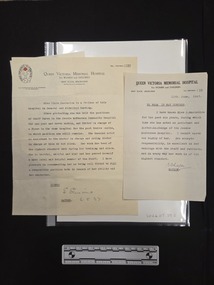
Document - Typed documents, Queen Victoria Memorial Hospital, 1937-1939
... ...Queen Victoria Memorial Hospital...These documents provide recommendations regarding Clare Macintire's time as a trainee and a staff member at the Queen Victoria Memorial Hospital in support of her application to join the Australian Army Nursing Service. ...The third page includes the header of the Queen Victoria Memorial Hospital, and provides a reference from Matron E. ...Queen Victoria Memorial Hospital...Document Typed documents Queen Victoria Memorial Hospital ...These documents provide recommendations regarding Clare Macintire's time as a trainee and a staff member at the Queen Victoria Memorial Hospital in support of her application to join the Australian Army Nursing Service. Part of a series of items related to Clare Rothwell Macintire. Clare Rothwell Macintire was born 27 July 1910 in Essendon and enlisted with the Royal Australian Airforce on 3 August 1943. Her service number was 500432. Three pages of typewritten trainee reference on cream paper. The first page is printed with the logo and header of the Queen Victoria Memorial Hospital, and provides a reference from Matron Ethel Simons, including a hand-written signature and date. The second page includes the address of Freemasons' Hospital and provides a reference from Matron Jean Mackey. The third page includes the header of the Queen Victoria Memorial Hospital, and provides a reference from Matron E. Schafer.At bottom of first page: 'E. Simons / 6 . 5 . 37' At bottom of third page: 'E Schafer'army nurse, clare rothwell macintire, wwii, world war two, ww2, queen victoria memorial hospital, freemasons' hospital, matron ethel simons, matron jean mackey, matron e schafer -
 Port Melbourne Historical & Preservation Society
Certificate - Queen Victoria Memorial Hospital, Life Governor Certificate, Mrs Peter Freyer, 1924
... Queen Victoria Memorial Hospital, Life Governor Certificate, Mrs Peter Freyer....01 - Queen Victoria Memorial Hospital - Lfe Governor Certificate:.02 - St Vincent's Hospital Life Governor certificate to Mrs Peter Freyer (1924)...Health - General health .01 - Queen Victoria Memorial Hospital - Lfe Governor Certificate:.02 - St Vincent's Hospital Life Governor certificate to Mrs Peter Freyer (1924) Certificate Queen Victoria Memorial Hospital, Life Governor Certificate, Mrs Peter Freyer Arbuckle Waddell Pty Ltd Advocate Press ....01 - Queen Victoria Memorial Hospital - Lfe Governor Certificate:.02 - St Vincent's Hospital Life Governor certificate to Mrs Peter Freyer (1924)health - general health -
 Alfred Hospital Nurses League - Nursing History Collection
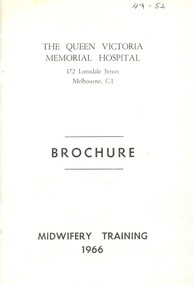
Booklet, Queen Victoria memorial Hospital, The Queen Victoria Hospital brochure - midwifery training 1966, 1966
... Booklet given to prospective midwifery trainees by the Queen Victoria Memorial Hospital Melbourne in 1966....Queen Victoria memorial Hospital...Booklet given to prospective midwifery trainees by the Queen Victoria Memorial Hospital Melbourne in 1966. Of significance to the AHNL as many Alfred graduates completed midwifery training at the Queen Victoria Memorial Hospital Melbourne. nursing education midwifery Queen Victoria Hospital (Melbourne) Information about midwifery training at the Queen Victoria Memorial Hospital, Melbourne in the 1960's. previous catalogue number written in black ink at top right of front cover. ...Information about midwifery training at the Queen Victoria Memorial Hospital, Melbourne in the 1960's.Booklet with black print. Title on front cover.non-fictionInformation about midwifery training at the Queen Victoria Memorial Hospital, Melbourne in the 1960's.nursing education, midwifery, queen victoria hospital (melbourne) -
 Melbourne Tram Museum
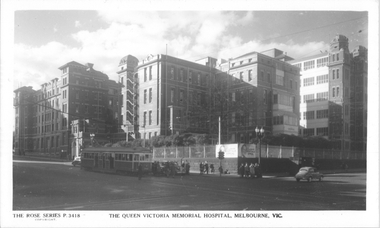
Postcard, Rose Stereograph Co, "The Queen Victoria Memorial Hospital Melbourne", mid 1940s
... "The Queen Victoria Memorial Hospital Melbourne"...Rose Series postcard P.3418, titled "The Queen Victoria Memorial Hospital Melbourne", with W2 359? ...Rose Series postcard P.3418, titled "The Queen Victoria Memorial Hospital Melbourne", with W2 359? ...Rose Series postcard P.3418, titled "The Queen Victoria Memorial Hospital Melbourne", with W2 359? southbound in Swanston Street at Lonsdale Street Many pedestrians are waiting at the tram stop or waiting to cross the road.Yields information Swanston St and the "The Queen Victoria Memorial Hospital Melbourne" late 1940s.Postcard - printed real photograph with Rose Stereograph Co. name on the rear. Two copies held.tramways, trams, swanston st, lonsdale st, hospital, w2 class, tram 359, rose series -
 Queen Victoria Women's Centre
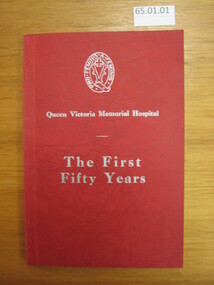
Book, N.S Ecersley Pty. Ltd, A History: The First Fifty Years, 1951
... Book written about the first 50 years of the Queen Victoria Memorial Hospital ...The Queen Victoria Memorial Hospital crest on the front cover. ...Book written about the first 50 years of the Queen Victoria Memorial Hospital hospitals books historic buildings women health professionals The Queen Victoria Memorial Hospital crest on the front cover. 59 pages. ...Book written about the first 50 years of the Queen Victoria Memorial Hospital 59 pages. Red cover with silver text. Internal, white paper with black ink, black and white images throughout. The Queen Victoria Memorial Hospital crest on the front cover. hospitals, books, historic buildings, women health professionals -
 Queen Victoria Women's Centre
Large Framed Photograph
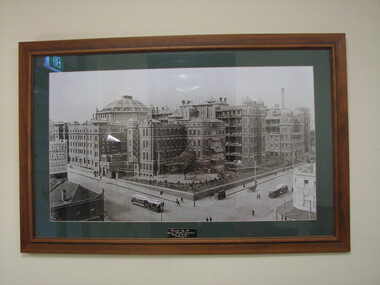
... Black and white framed reprint of a photograph of the Queen Victoria Memorial Hospital c. 1912 from the corner of Swanston and Lonsdale street. ...hospital Photographs historic sites Plaque at the bottom of the frame reads "Presented by the Women's Christian Temperance Union of Victoria 9th February 1999" Black and white framed reprint of a photograph of the Queen Victoria Memorial Hospital c. 1912 from the corner of Swanston and Lonsdale street. ...Black and white framed reprint of a photograph of the Queen Victoria Memorial Hospital c. 1912 from the corner of Swanston and Lonsdale street. Plaque at the bottom of the frame reads "Presented by the Women's Christian Temperance Union of Victoria 9th February 1999"hospital, photographs, historic sites -
 Alfred Hospital Nurses League - Nursing History Collection
Book - Illustrated book, Emma Russell, Bricks or spirit: the Queen Victoria Hospital, Melbourne, 1977
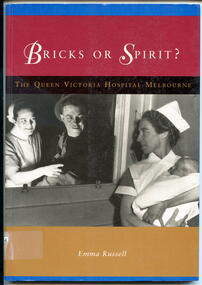
... Queen Victoria Hospital (Melbourne)...Queen Victoria Memorial...Queen Victoria hospital in September. Of significance to the AHNL as it is the history of another Victorian hospital, also many Alfred graduates undertook midwifery training there. Also some Queen Victoria general nurse trainees came to the Alfred for male nursing experience. Queen Victoria Hospital (Melbourne) Queen Victoria Memorial ...A history of the Queen Victoria hospital. In 1896 eleven female doctors led by Constance Stone opened the Victoria hospital for women and children. After three different city locations, it ceased to exist as a separate entity in 1987, when amalgamation saw it form part of the Monash Medical Centre in Clayton.Illustrated book. Multicolour front cover with title and authors name, as well as illustration (black and white photo) of a 'receiving" window, where fathers or other visitors could view a newborn. Nurse and man standing on one side and nurse holding a baby on the other. Title, authors name and publishers mark in white print on gold coloured spine. The back cover has a cream background with a summary of the book printed on it. There are also three photos of the hospitals three homes: St David's Church Hall, Mint Place and Lonsdale St.non-fictionA history of the Queen Victoria hospital. In 1896 eleven female doctors led by Constance Stone opened the Victoria hospital for women and children. After three different city locations, it ceased to exist as a separate entity in 1987, when amalgamation saw it form part of the Monash Medical Centre in Clayton.queen victoria hospital (melbourne), queen victoria memorial hospital (melbourne), queen victoria medical centre(melbourne), monash medical centre, hospitals-victoria -history -
 Returned Nurses RSL Sub-branch
Document - Printed document, 113 Australian General Hospital, 113 AUSTRALIAN GENERAL HOSPITAL - STANDING ORDERS FOR PATIENTS
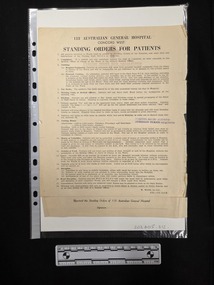
... ...Queen Victoria Memorial Hospital...Army Nurse Clare Rothwell MacIntire WWII World War Two WW2 Queen Victoria Memorial Hospital Freemasons' Hospital 113 Australian General Hospital Australian Red Cross Society Stamped on right side of sheet: 'VISITING HOURS ALTERED / ADMISSION TICKETS REQUIRED' One-page printed document on buff foolscap paper with a perforated strip at the bottom. ...Part of a series of items related to Clare Rothwell Macintire. Clare Rothwell Macintire was born 27 July 1910 in Essendon and enlisted with the Royal Australian Airforce on 3 August 1943. Her service number was 500432. One-page printed document on buff foolscap paper with a perforated strip at the bottom. On one side is a numbered list of 113 Australian General Hospital Concord West standing orders for patients printed in black ink; on the reverse is a list of Australian Red Cross Societypatient amenities printed in red ink.Stamped on right side of sheet: 'VISITING HOURS ALTERED / ADMISSION TICKETS REQUIRED'army nurse, clare rothwell macintire, wwii, world war two, ww2, queen victoria memorial hospital, freemasons' hospital, 113 australian general hospital, australian red cross society -
 Queen Victoria Women's Centre
Photograph, c.1992
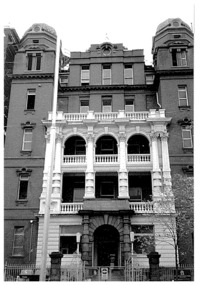
... Photo of whole facade of block E of the Queen Victoria Memorial Hospital. Taken from Lonsdale street. ...Photo of whole facade of block E of the Queen Victoria Memorial Hospital. Taken from Lonsdale street. ...Black and white photograph. Photo of whole facade of block E of the Queen Victoria Memorial Hospital. Taken from Lonsdale street. Before restoration and after the hospital had moved to Clayton.historic buildings, hospitals, cultural structures and establishments -
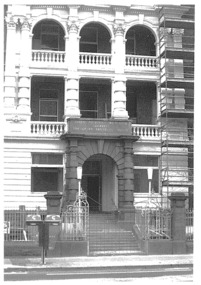 Queen Victoria Women's Centre
Photograph, c.1992
... Photo of block E's facade of the Queen Victoria Memorial Hospital which was to be QVWC. Before restoration and after the hospital had moved to Clayton. ...Photo of block E's facade of the Queen Victoria Memorial Hospital which was to be QVWC. Before restoration and after the hospital had moved to Clayton. ...Black and white photograph. Photo of block E's facade of the Queen Victoria Memorial Hospital which was to be QVWC. Before restoration and after the hospital had moved to Clayton. Taken from Lonsdale street, scaffolding left of frame. historic buildings, hospitals, charitable organisations, cultural structures and establishments -
 Queen Victoria Women's Centre
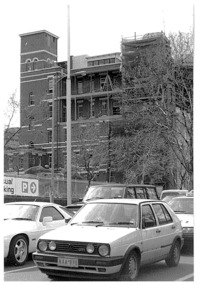
Photograph, c.1992
... Photo o western side of block E of the Queen Victoria Memorial Hospital which was to be the QVWC before the restoration and after the hospital had moved to Clayton. ...Photo o western side of block E of the Queen Victoria Memorial Hospital which was to be the QVWC before the restoration and after the hospital had moved to Clayton. ...Black and white photograph. Photo o western side of block E of the Queen Victoria Memorial Hospital which was to be the QVWC before the restoration and after the hospital had moved to Clayton. From Lonsdale street with a number of cars in the foreground of photograph. Scaffolding at right of frame. historic buildings, hospitals, cultural structures and establishments -
 Greensborough Historical Society
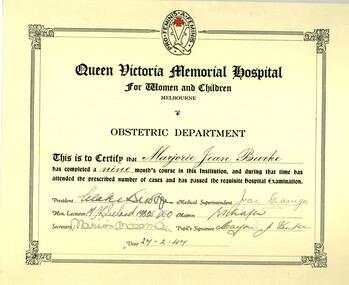
Document - Certificate, Queen Victoria Hospital, Obstetrics Certificate for Marjorie Jean Burke, 27/02/1947
... Obstetrics certificate for Marjorie Jean Burke issued by the Queen Victoria Memorial Hospital for Women and Children in Melbourne....Obstetrics certificate for Marjorie Jean Burke issued by the Queen Victoria Memorial Hospital for Women and Children in Melbourne. ...Obstetrics certificate for Marjorie Jean Burke issued by the Queen Victoria Memorial Hospital for Women and Children in Melbourne.Miss Burke was a nurse, midwife and infant welfare sister. This collection covers her many qualifications throughout Australia and Great Britain, including references both professional and personal. When Miss Burke returned to Australia, she was employed at Diamond Valley Community Hospital as a nurse in 1953 and as Deputy Matron 1954-1971.Certificate typed on cream card.marjorie jean burke, nurses, diamond valley community hospital, queen victoria hospital melbourne -
 Greensborough Historical Society
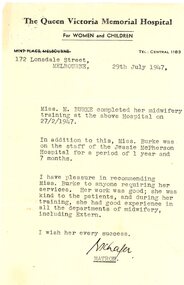
Document - Professional reference, Queen Victoria Hospital, Professional reference for Marjorie Jean Burke, 29/07/1947
... Professional reference for Marjorie Jean Burke issued by the matron of Queen Victoria Memorial Hospital for Women and Children in Melbourne....Professional reference for Marjorie Jean Burke issued by the matron of Queen Victoria Memorial Hospital for Women and Children in Melbourne. ...Professional reference for Marjorie Jean Burke issued by the matron of Queen Victoria Memorial Hospital for Women and Children in Melbourne.Miss Burke was a nurse, midwife and infant welfare sister. This collection covers her many qualifications throughout Australia and Great Britain, including references both professional and personal. When Miss Burke returned to Australia, she was employed at Diamond Valley Community Hospital as a nurse in 1953 and as Deputy Matron 1954-1971.Reference typed on cream letterhead.marjorie jean burke, nurses, diamond valley community hospital, queen victoria hospital melbourne -
 Queen Victoria Women's Centre
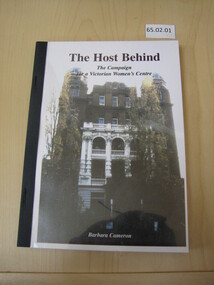
Book, Barbara Cameron, The Host Behind: The Campaign for a Victorian Women's Centre, 2005
... This book details the campaign and restoration of the Queen Victoria Memorial Hospital to create a women's centre in the spirit of the Hospital's founders "for women, by women". ...This book details the campaign and restoration of the Queen Victoria Memorial Hospital to create a women's centre in the spirit of the Hospital's founders "for women, by women". women social services historic buildings cultural structures and establishments woman professionals books 138 pages. ...Written for the 10 years since the QVWC centre opened. This book details the campaign and restoration of the Queen Victoria Memorial Hospital to create a women's centre in the spirit of the Hospital's founders "for women, by women". 138 pages. Plastic cover. Cardboard inner cover with colour image of the QVWC building. White paper and black ink throughout. women social services, historic buildings, cultural structures and establishments, woman professionals, books -
Ballarat Clarendon College
Leather coin purse
... Marion Wanliss attended the University of Melbourne (MB BS 1920; MD 1929); after research into cancer as a postgraduate in Vienna, she practised as a physician at the Queen Victoria Memorial Hospital. She was also a prominent conservationist. ...Marion Wanliss attended the University of Melbourne (MB BS 1920; MD 1929); after research into cancer as a postgraduate in Vienna, she practised as a physician at the Queen Victoria Memorial Hospital. She was also a prominent conservationist. marion-wanliss newton-wanliss Engraved on metal border of purse flap: M Wanliss, Ballarat Leather coin purse envelope style with metal fixtures; shield shaped clasp at front; three sections of concertina design. ...Coin purse possibly the property of Marion Boyd Wanliss (1896 - 1984), daughter of old collegian Newton Wanliss or Newton's second wife, Margaret Hannah Bannister. . Marion Wanliss attended the University of Melbourne (MB BS 1920; MD 1929); after research into cancer as a postgraduate in Vienna, she practised as a physician at the Queen Victoria Memorial Hospital. She was also a prominent conservationist. Leather coin purse envelope style with metal fixtures; shield shaped clasp at front; three sections of concertina design. Engraved on metal border of purse flap: M Wanliss, Ballaratmarion-wanliss, newton-wanliss -
 Queen Victoria Women's Centre
Postcard Series, c.2004
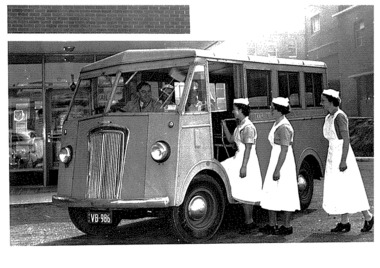
... Woman Pathologist, 1890s to early 1900s Queen Victoria Hospital at the corner of Lonsdale and Swanston Streets 1950's Multicultural Nurses 'Give Generously' Infants in the Queen Vic Hospital maternity ward A Van donated by auxiliaries, used to transport nurses and deliver supplies to nursing homes. Around 1957. Queen Vic nurses in the 1900s Nurses in a recovery room, 1960s Matron with a blind patient and her guide dog in 1963 Queen Victoria Memorial...Woman Pathologist, 1890s to early 1900s Queen Victoria Hospital at the corner of Lonsdale and Swanston Streets 1950's Multicultural Nurses 'Give Generously' Infants in the Queen Vic Hospital maternity ward A Van donated by auxiliaries, used to transport nurses and deliver supplies to nursing homes. Around 1957. Queen Vic nurses in the 1900s Nurses in a recovery room, 1960s Matron with a blind patient and her guide dog in 1963 Queen Victoria Memorial ...All photos used courtesy of Southern Health Monash Medical Centre Historical Collection. 10 postcards. Black and white photographs. standard A6 size. Woman Pathologist, 1890s to early 1900s Queen Victoria Hospital at the corner of Lonsdale and Swanston Streets 1950's Multicultural Nurses 'Give Generously' Infants in the Queen Vic Hospital maternity ward A Van donated by auxiliaries, used to transport nurses and deliver supplies to nursing homes. Around 1957. Queen Vic nurses in the 1900s Nurses in a recovery room, 1960s Matron with a blind patient and her guide dog in 1963 Queen Victoria Memorial Hospital (Mint Place) ward on a verandah 1920shosptial, postcards, historic site, charitable organisations -
 Alfred Hospital Nurses League - Nursing History Collection
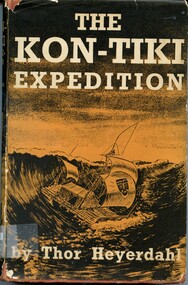
Book - Illustrated book, Thor Heyerdahl 1914-2002 et al, The Kon-Tiki expedition: by raft across the South Seas
... On the front-end page is an inscription in black ink: ' The Queen Victoria Memorial Hospital 172 Lonsdale St, Melbourne The Natalie Morris memorial Prize awarded to Audrey B. ...On the front-end page is an inscription in black ink: ' The Queen Victoria Memorial Hospital 172 Lonsdale St, Melbourne The Natalie Morris memorial Prize awarded to Audrey B. ...The story of a daring voyage by the author and five companions on board a primitive raft from the coast of Peru to the Pacific Islands. Mr. Heyerdahl was convinced that the original Polynesians had come by sea from South America, and to prove that such a voyage was possible at that remote period, he and his party built the 'Kon-Tiki', similar to the rafts then used and embarked on it. After a voyage full of danger, but packed with interest they reached the islands where the Kon-Tiki was wrecked on a coral reef.Illustrated book with dustjacket. Book is bound in front cover, with image of a Polynesian mask embossed on the front. Title, author's and publisher's names are stamped in gilt on spine. Front cover of dustjacket has a black and light brown illustration of a raft at sea, along with title and author's name printed in white. The spine has similar information plus publisher's name in light brown print along with another illustration of a raft and a Polynesian mask. The back of the dust jacket (again in black and light brown) is a route map and labeled diagram of a raft (the Kon-Tiki). non-fictionThe story of a daring voyage by the author and five companions on board a primitive raft from the coast of Peru to the Pacific Islands. Mr. Heyerdahl was convinced that the original Polynesians had come by sea from South America, and to prove that such a voyage was possible at that remote period, he and his party built the 'Kon-Tiki', similar to the rafts then used and embarked on it. After a voyage full of danger, but packed with interest they reached the islands where the Kon-Tiki was wrecked on a coral reef.thor heyerdahl, kon-tiki expedition, ethnology-polynesia, ahnl -
 Royal Australian and New Zealand College of Obstetricians & Gynaecologists (RANZCOG)
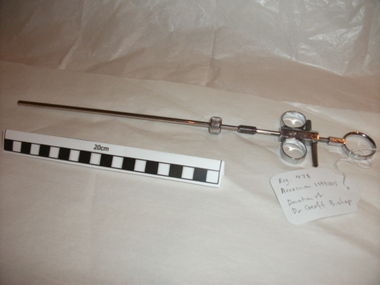
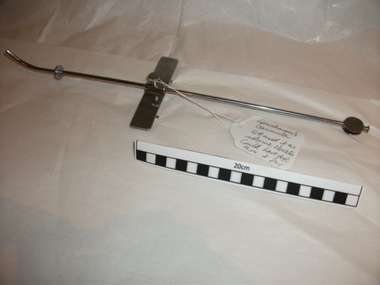
Forceps, Palmer's diathermy, c1969
... On returning to Australia, Bishop and Grimwade together with Mr Peter Paterson introduced gynaecological laparoscopy to Melbourne, practising at the Queen Victoria Memorial Hospital (QVMH), Melbourne in 1969. ...On returning to Australia, Bishop and Grimwade together with Mr Peter Paterson introduced gynaecological laparoscopy to Melbourne, practising at the Queen Victoria Memorial Hospital (QVMH), Melbourne in 1969. ...Part of the laparoscopy equipment donated by Dr Geoff Bishop. Dr Geoffrey Bishop, whilst at the Department of O and G, University of Liverpool, UK, began laparoscopy in 1969. On returning to Australia, Bishop and Grimwade together with Mr Peter Paterson introduced gynaecological laparoscopy to Melbourne, practising at the Queen Victoria Memorial Hospital (QVMH), Melbourne in 1969. The College, through the Victorian State Committee of the Australian Council, RCOG, ran training courses in laparoscopy for local and interstate gynaecologists. These were conducted by Bishop, Grimwade and Paterson. They established protocols, with particular reference to safety, for the conduct of laparoscopy. Laparoscopy was used initially for diagnosis and for limited treatment using diathermy for conditions such as endometriosis. The real impetus came with the great upsurge of tubal sterilization in the early 1970s. Early techniques included diathermy and division of the Fallopian tubes using the Palmer forceps. [Dr Peter Renou, former honoury curator.]Palmer's diathermy forceps. It has two pronds for grasping that retracts with a screw mechanism. Purchased by Geoff Bishop as an additional part of original laparoscopy set, also included in this accession 1999005.laparoscopy, tubal ligation, infertility investigation -
 Royal Australian and New Zealand College of Obstetricians & Gynaecologists (RANZCOG)
Cannula, Spackman's, c1969
... On returning to Australia, Bishop and Grimwade together with Mr Peter Paterson introduced gynaecological laparoscopy to Melbourne, practising at the Queen Victoria Memorial Hospital (QVMH), Melbourne in 1969. ...On returning to Australia, Bishop and Grimwade together with Mr Peter Paterson introduced gynaecological laparoscopy to Melbourne, practising at the Queen Victoria Memorial Hospital (QVMH), Melbourne in 1969. ...Part of the laparoscopy equipment donated by Dr Geoff Bishop. Dr Geoffrey Bishop, whilst at the Department of O and G, University of Liverpool, UK, began laparoscopy in 1969. On returning to Australia, Bishop and Grimwade together with Mr Peter Paterson introduced gynaecological laparoscopy to Melbourne, practising at the Queen Victoria Memorial Hospital (QVMH), Melbourne in 1969. The College, through the Victorian State Committee of the Australian Council, RCOG, ran training courses in laparoscopy for local and interstate gynaecologists. These were conducted by Bishop, Grimwade and Paterson. They established protocols, with particular reference to safety, for the conduct of laparoscopy. Laparoscopy was used initially for diagnosis and for limited treatment using diathermy for conditions such as endometriosis. The real impetus came with the great upsurge of tubal sterilization in the early 1970s. Early techniques included diathermy and division of the Fallopian tubes using the Palmer forceps. [Dr Peter Renou, former honoury curator.]This Spackman's cannula was used by Dr Geoff Bishop during gynaecological laparscopioc surgery.He used this decice as a uterine elevator. Also, for testing tubal patency by inserting dye through it. Manufacturers stamp: ANAX.laparoscopy, tubal ligation, infertility investigation -
 Royal Australian and New Zealand College of Obstetricians & Gynaecologists (RANZCOG)
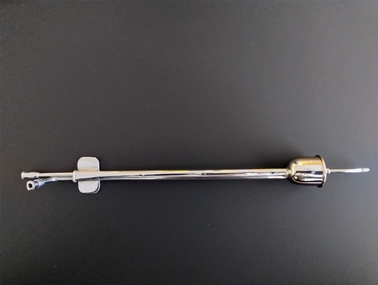
Infertility cannula used by Dr Geoff Bishop, Precious, c1969
... On returning to Australia, Bishop and Grimwade together with Mr Peter Paterson introduced gynaecological laparoscopy to Melbourne, practising at the Queen Victoria Memorial Hospital (QVMH), Melbourne in 1969. ...On returning to Australia, Bishop and Grimwade together with Mr Peter Paterson introduced gynaecological laparoscopy to Melbourne, practising at the Queen Victoria Memorial Hospital (QVMH), Melbourne in 1969. ...Part of a set of laparoscopy equipment donated by Dr Geoff Bishop. Dr Geoffrey Bishop, whilst at the Department of O and G, University of Liverpool, UK, began laparoscopy in 1969. On returning to Australia, Bishop and Grimwade together with Mr Peter Paterson introduced gynaecological laparoscopy to Melbourne, practising at the Queen Victoria Memorial Hospital (QVMH), Melbourne in 1969. The College, through the Victorian State Committee of the Australian Council, RCOG, ran training courses in laparoscopy for local and interstate gynaecologists. These were conducted by Bishop, Grimwade and Paterson. They established protocols, with particular reference to safety, for the conduct of laparoscopy. Laparoscopy was used initially for diagnosis and for limited treatment using diathermy for conditions such as endometriosis. The real impetus came with the great upsurge of tubal sterilization in the early 1970s. Early techniques included diathermy and division of the Fallopian tubes using the Palmer forceps. [Dr Peter Renou, former honorary curator.] This object was used by Dr Geoff Bishop during gynaecological laparoscopic surgery. This instrument is commonly used for suction. It is also used for testing tubal patency by inserting dye through it. Cannula. Consists of a slender shaft with fittings at each end. There are two points for tubal attachments at one end, set into separate small metal tubes at ninety degrees to each other. At the other end, there is a bell cap enclosing a curved nozzle. The nozzle is punctured with six small holes. Manufacturers stamp on plate near the attachment points reads 'PRECIOUS'.infertility, gynaecology -
 Melbourne Tram Museum
Book, Victorian Government Information Bureau?, "The Garden City of Australia / Twenty-four views of Melbourne", c1950
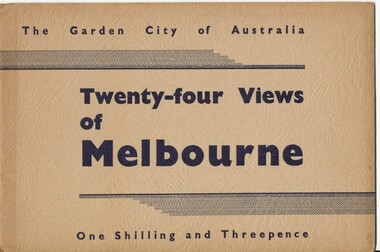
... Page Photo details by 1 Skyline of the City of Melbourne from Yarra Bank Victorian Railways 2 Collins St from Spring St (with trams) ditto 3 Princes Bridge, River Yarra ditto 4 St Kilda Rd from Flinders St Station ditto 5 St Pauls Cathedral ditto 6 Bourke St Shopping Centre - with double deck buses no details of photographer 7 Elizabeth St - with trams and buses Victorian Railways 8 Swanston St with modern skyscrapers (Collins) ditto 9 Aerial view, city of Melbourne ditto 10 Parliament House ditto 11 Public Library, Museum and Art Gallery ditto 12 St Kilda Rd, Looking towards the City trams 772 and W2 ditto 13 Kings Domain - Pioneer Monument ditto 14 Royal Melbourne Hospital - with back view inset ditto 15 Alexandra Gardens and the Shrine of Remembrance ditto 16 Alexandra Gardens and Government House ditto 17 Captain Cook's House - Fitzroy Gardens ditto 18 Albert Park Lake no details of photographer 19 Melbourne Boys School, MacRobertson's Girls High School and Melbourne Uni - no details of photographer 20 Scene in the Botanical Gardens Victorian Railways 21 Aerial view of St Kilda with Brighton in background Victorian Railways 22 Melbourne Cricket ground, taken during the testimonial match to Sir Donald Bradman - no details 23 Queen Victoria Memorial Hospital and Exhibition Buildings and Aquarium - Victorian Railways 24 Dandenong - Showing Silvan Dam Victorian Railways The testimonial match took place in Melbourne during December 1948 (Reference Sir Donald Bradman Museum). ...Page Photo details by 1 Skyline of the City of Melbourne from Yarra Bank Victorian Railways 2 Collins St from Spring St (with trams) ditto 3 Princes Bridge, River Yarra ditto 4 St Kilda Rd from Flinders St Station ditto 5 St Pauls Cathedral ditto 6 Bourke St Shopping Centre - with double deck buses no details of photographer 7 Elizabeth St - with trams and buses Victorian Railways 8 Swanston St with modern skyscrapers (Collins) ditto 9 Aerial view, city of Melbourne ditto 10 Parliament House ditto 11 Public Library, Museum and Art Gallery ditto 12 St Kilda Rd, Looking towards the City trams 772 and W2 ditto 13 Kings Domain - Pioneer Monument ditto 14 Royal Melbourne Hospital - with back view inset ditto 15 Alexandra Gardens and the Shrine of Remembrance ditto 16 Alexandra Gardens and Government House ditto 17 Captain Cook's House - Fitzroy Gardens ditto 18 Albert Park Lake no details of photographer 19 Melbourne Boys School, MacRobertson's Girls High School and Melbourne Uni - no details of photographer 20 Scene in the Botanical Gardens Victorian Railways 21 Aerial view of St Kilda with Brighton in background Victorian Railways 22 Melbourne Cricket ground, taken during the testimonial match to Sir Donald Bradman - no details 23 Queen Victoria Memorial Hospital and Exhibition Buildings and Aquarium - Victorian Railways 24 Dandenong - Showing Silvan Dam Victorian Railways The testimonial match took place in Melbourne during December 1948 (Reference Sir Donald Bradman Museum). ...Book, brown cover patterned (Deer skin?), titled "The Garden City of Australia / Twenty-four views of Melbourne" with 24 pages (smaller than cover) printed pages stapled inside. Inside front cover is a map of Melbourne, with specific buildings marked, inside rear cover - Where to go in Melbourne, General Information and Sight seeing tours. On rear cover is printer details. Page Photo details by 1 Skyline of the City of Melbourne from Yarra Bank Victorian Railways 2 Collins St from Spring St (with trams) ditto 3 Princes Bridge, River Yarra ditto 4 St Kilda Rd from Flinders St Station ditto 5 St Pauls Cathedral ditto 6 Bourke St Shopping Centre - with double deck buses no details of photographer 7 Elizabeth St - with trams and buses Victorian Railways 8 Swanston St with modern skyscrapers (Collins) ditto 9 Aerial view, city of Melbourne ditto 10 Parliament House ditto 11 Public Library, Museum and Art Gallery ditto 12 St Kilda Rd, Looking towards the City trams 772 and W2 ditto 13 Kings Domain - Pioneer Monument ditto 14 Royal Melbourne Hospital - with back view inset ditto 15 Alexandra Gardens and the Shrine of Remembrance ditto 16 Alexandra Gardens and Government House ditto 17 Captain Cook's House - Fitzroy Gardens ditto 18 Albert Park Lake no details of photographer 19 Melbourne Boys School, MacRobertson's Girls High School and Melbourne Uni - no details of photographer 20 Scene in the Botanical Gardens Victorian Railways 21 Aerial view of St Kilda with Brighton in background Victorian Railways 22 Melbourne Cricket ground, taken during the testimonial match to Sir Donald Bradman - no details 23 Queen Victoria Memorial Hospital and Exhibition Buildings and Aquarium - Victorian Railways 24 Dandenong - Showing Silvan Dam Victorian Railways The testimonial match took place in Melbourne during December 1948 (Reference Sir Donald Bradman Museum). Possibly arranged by the Victorian Government Information Bureau given the number of Victorian Railways photographs.trams, tramways, melbourne, st kilda rd, swanston st, bourke st, victorian railways, flinders st station, gardens -
 Eltham District Historical Society Inc
Document - Folder, Harry Gilham, Communal Gravesite, Eltham Cemetery, 2009-2010
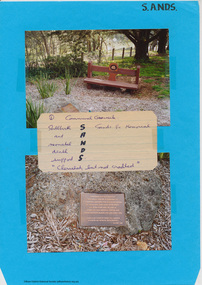
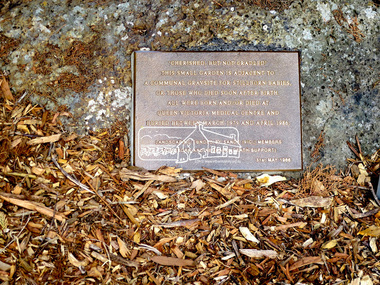
... Queen Victoria Medical Centre itself was founded in 1896 and at the time was one of only three hospitals worldwide founded, managed and staffed by women. The Centre has since merged and amalgamated with the Monash Medical Centre. H.G's research also indicated that the communal burial sites within Eltham Cemetery was also for bodies that were donated for science. Communal Graves Eltham Cemetery S.A.N.D.S. Stillbirth and Neonatal Death Support Memorial ...Information page with photos about the memorial to still born babies at Eltham cemetery, Mt Pleasant Road, Eltham which lies under the trees on the west side of cemetery. A plaque within a garden bed states: “Cherished, but not cradled. This small garden is adjacent to a communal gravesite for stillborn babies, or those who died soon after birth. They were all born and /or died at Queen Victoria Medical Centre and buried between March 1979 and April 1986.” The landscaping was funded by Stillborn and Neonatal death Support (SANDS) Vic. Members. It also initially had a low wooden seat in place. (No longer in place April 2022) The Queen Victoria Medical Centre itself was founded in 1896 and at the time was one of only three hospitals worldwide founded, managed and staffed by women. The Centre has since merged and amalgamated with the Monash Medical Centre. H.G's research also indicated that the communal burial sites within Eltham Cemetery was also for bodies that were donated for science.communal graves, eltham cemetery, s.a.n.d.s., stillbirth and neonatal death support, memorial to still born babies, women in eltham cemetery tour, memorial -
 Eltham District Historical Society Inc
Photograph, Jim Connor, Memorial to still born babies, Eltham Cemetery, 1 Mar 2016
... Queen Victoria Medical Centre itself was founded in 1896 and at the time was one of only three hospitals worldwide founded, managed and staffed by women. The Centre has since merged and amalgamated with the Monash Medical Centre. Records in EDHS files also indicate that the communal burial sites within Eltham Cemetery was also for bodies that were donated for science. Tomorrow's history documented today eltham jim connor collection Eltham Cemetery SANDS Stillbirth and Neonatal Death Support Memorial ...Plaque in the memorial to still born babies at Eltham cemetery, Mt Pleasant Road, Eltham which lies under the trees on the west side of cemetery. The plaque within a garden bed states: “Cherished, but not cradled. This small garden is adjacent to a communal gravesite for stillborn babies, or those who died soon after birth. They were all born and /or died at Queen Victoria Medical Centre and buried between March 1979 and April 1986.” The landscaping was funded by Stillborn and Neonatal death Support (SANDS) Vic. Members. It also initially had a low wooden seat in place. (No longer in place April 2022) The Queen Victoria Medical Centre itself was founded in 1896 and at the time was one of only three hospitals worldwide founded, managed and staffed by women. The Centre has since merged and amalgamated with the Monash Medical Centre. Records in EDHS files also indicate that the communal burial sites within Eltham Cemetery was also for bodies that were donated for science. Tomorrow's history documented todayeltham, jim connor collection, eltham cemetery, sands, stillbirth and neonatal death support, memorial to still born babies, memorial plaque, plaque, women in eltham cemetery tour -
 Eltham District Historical Society Inc
Photograph, Communal gravesite for stillborn babies or those who died soon after birth, Eltham cemetery, August 2007
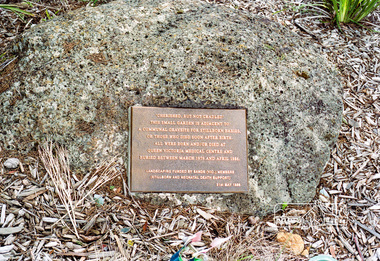
... Queen Victoria Medical Centre itself was founded in 1896 and at the time was one of only three hospitals worldwide founded, managed and staffed by women. The Centre has since merged and amalgamated with the Monash Medical Centre. EDHS records indicate that the communal burial site was also fo bodies that were donated to science. eltham cemetery Communal grave Stillborn plaque memorial plaque Memorial to still born babies Women in Eltham Cemetery tour Kodak GC 400-9 Roll of 35mm colour negative film, 6 strips Communal gravesite for stillborn babies or those who died soon after birth, Eltham cemetery Photograph Photograph ...A memorial to still born babies at Eltham cemetery lies under the trees on the west side. A plaque within a garden bed states: “Cherished, but not cradled. This small garden is adjacent to a communal gravesite for stillborn babies, or those who died soon after birth. They were all born and /or died at Queen Victoria Medical Centre and buried between March 1979 and April 1986.” The landscaping was funded by Stillborn and Neonatal death Support (SANDS) Vic. Members. It also initially had a low wooden seat in place. (No longer in place as of April 2022) The Queen Victoria Medical Centre itself was founded in 1896 and at the time was one of only three hospitals worldwide founded, managed and staffed by women. The Centre has since merged and amalgamated with the Monash Medical Centre. EDHS records indicate that the communal burial site was also fo bodies that were donated to science. Roll of 35mm colour negative film, 6 stripsKodak GC 400-9eltham cemetery, communal grave, stillborn, plaque, memorial plaque, memorial to still born babies, women in eltham cemetery tour -
 Eltham District Historical Society Inc
Photograph, Memorial to still born babies, Eltham cemetery, August 2007
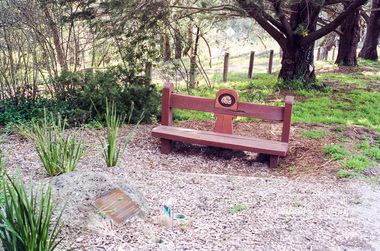
... Queen Victoria Medical Centre itself was founded in 1896 and at the time was one of only three hospitals worldwide founded, managed and staffed by women. The Centre has since merged and amalgamated with the Monash Medical Centre. EDHS records also indicate that it was also a communal gravesite for bodies that were donated to science. eltham cemetery communal grave stillborn Memorial to still born babies Women in Eltham Cemetery tour memorial garden SANDS stillborn and Neonatal Death support Kodak GC 400-9 Roll of 35mm colour negative film, 6 strips Memorial to still born babies, Eltham cemetery Photograph Photograph ...A memorial to still born babies lies under the trees on the west side of Eltham cemetery, Mt Pleasant Road, Eltham. A plaque within a garden bed states: “Cherished, but not cradled. This small garden is adjacent to a communal gravesite for stillborn babies, or those who died soon after birth. They were all born and /or died at Queen Victoria Medical Centre and buried between March 1979 and April 1986.” The landscaping was funded by Stillborn and Neonatal death Support (SANDS) Vic. Members. It also initially had a low wooden seat in place. (No longer in place April 2022) The Queen Victoria Medical Centre itself was founded in 1896 and at the time was one of only three hospitals worldwide founded, managed and staffed by women. The Centre has since merged and amalgamated with the Monash Medical Centre. EDHS records also indicate that it was also a communal gravesite for bodies that were donated to science. Roll of 35mm colour negative film, 6 stripsKodak GC 400-9eltham cemetery, communal grave, stillborn, memorial to still born babies, women in eltham cemetery tour, memorial, garden, sands, stillborn and neonatal death support -
 Wodonga & District Historical Society Inc
Book - Schlink of Prince Alfred - A Biography of Sir Herbert Schlink, Kempson Maddox, 1978
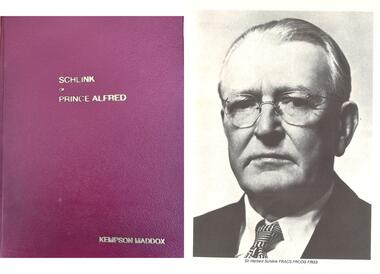
... Victoria to German migrants Albert Joseph Schlink and Franziska Trudewind. Herbert initially enrolled in the Faculty of Arts at the University of Sydney, but after one year he transferred to medicine and graduated in 1907. This marked the beginning of a brilliant career. Herbert was appointed as Honorary Gynaecological Surgeon at Royal Prince Alfred, Sydney NSW from 1922. As a director of the hospital board from 1926, Schlink as Chairman (1934-62) supervised the opening of Gloucester House, King George V Memorial Hospital for Mothers and Babies, Queen ...A detailed biography of the life and achievements of Sir Herbert Schlink. He was born on 28 March 1883 in Wodonga, Victoria to German migrants Albert Joseph Schlink and Franziska Trudewind. Herbert initially enrolled in the Faculty of Arts at the University of Sydney, but after one year he transferred to medicine and graduated in 1907. This marked the beginning of a brilliant career. Herbert was appointed as Honorary Gynaecological Surgeon at Royal Prince Alfred, Sydney NSW from 1922. As a director of the hospital board from 1926, Schlink as Chairman (1934-62) supervised the opening of Gloucester House, King George V Memorial Hospital for Mothers and Babies, Queen Mary Nurses' Home, the neurosurgical and psychiatric blocks, the (Sir Earle) Page Chest Pavilion and the hospital chapel. As a gynaecologist, Herbert pioneered the use of cobalt ray therapy in treating pelvic cancer and instigated the systematic follow-up of cancer patients. In 1954, Herbert was created Knight Bachelor for his public services and his service to medicine. He had previously received the Silver Jubilee Medal from his Majesty King George V, and the Coronation Medals of 1937 and 1953.This book is bound in maroon leather with gold lettering. It includes biographical information and images. The appendix includes an extensive Curriculum Vitae containing a list of medical publications by Sir Herbert Schlink and develops made at the Royal Prince Alfred Hospital during his Chairmanship. The book has an extensive bibliographical references and an index.fictionA detailed biography of the life and achievements of Sir Herbert Schlink. He was born on 28 March 1883 in Wodonga, Victoria to German migrants Albert Joseph Schlink and Franziska Trudewind. Herbert initially enrolled in the Faculty of Arts at the University of Sydney, but after one year he transferred to medicine and graduated in 1907. This marked the beginning of a brilliant career. Herbert was appointed as Honorary Gynaecological Surgeon at Royal Prince Alfred, Sydney NSW from 1922. As a director of the hospital board from 1926, Schlink as Chairman (1934-62) supervised the opening of Gloucester House, King George V Memorial Hospital for Mothers and Babies, Queen Mary Nurses' Home, the neurosurgical and psychiatric blocks, the (Sir Earle) Page Chest Pavilion and the hospital chapel. As a gynaecologist, Herbert pioneered the use of cobalt ray therapy in treating pelvic cancer and instigated the systematic follow-up of cancer patients. In 1954, Herbert was created Knight Bachelor for his public services and his service to medicine. He had previously received the Silver Jubilee Medal from his Majesty King George V, and the Coronation Medals of 1937 and 1953.sir herbert schlink, schlink family of wodonga -
!['Save Fairfield Hospital' badge, [1990s]](/media/collectors/5bb42dc221eaf31100db1d3b/items/5c9af03221ea720f88da88fb/item-media/5c9af03f21ea720f88daaa65/item-fit-380x285.jpg?cb=6) Australian Nursing & Midwifery Federation
Australian Nursing & Midwifery Federation'Save Fairfield Hospital' badge, [1990s]
... Fairfield Hospital opened in 1904 as the Queen's Memorial Infectious Diseases Hospital, the first purpose-built isolation hospital for infectious diseases in Victoria. ...Fairfield Hospital opened in 1904 as the Queen's Memorial Infectious Diseases Hospital, the first purpose-built isolation hospital for infectious diseases in Victoria. ...Fairfield Hospital opened in 1904 as the Queen's Memorial Infectious Diseases Hospital, the first purpose-built isolation hospital for infectious diseases in Victoria. Its 22-acre site was located on a bank of the Yarra River. It was renamed Fairfield Hospital in 1948. In its later years, the hospital was a centre for AIDS treatment in Victoria, and a passionate campaign fought against its planned closure in the 1990s. Fairfield Hospital finally closed in June 1996. One section of the site was gazetted as a Public Park and Memorial Garden (containing an AIDS Garden).Circular white and red plastic badge. Silver metal, plastic-coated, with safety pin fastener adhered to back. Badge printed with the red text 'SAVE FAIRFIELD HOSPITAL'. Silver metal, plastic-coated, with safety pin fastener adhered to back.medicine, health, public institutions, fairfield, victoria, city of darebin, melbourne, politics, political protest, public protest, campaigning, badges, buttons, pins, public health, infectious diseases, aids -
 Darebin Art Collection
Painting, Katherine Hattam, 'Powerlines Merri Creek', 2010
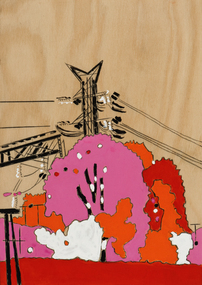
... Memorial Painting Prize. Her work is represented in public, corporate, educational and private collections such as the National Gallery of Australia, state and regional art galleries, The Darling Foundation, Smorgen Collection, Artbank, Queen Victoria Hospital, National Australia Bank and La Trobe University Museum of Art....Memorial Painting Prize. Her work is represented in public, corporate, educational and private collections such as the National Gallery of Australia, state and regional art galleries, The Darling Foundation, Smorgen Collection, Artbank, Queen Victoria Hospital, National Australia Bank and La Trobe University Museum of Art. ...Katherine Hattam’s exuberant work, Powerlines Merri Creek equalises the natural environment with man-made constructions as she explores the hybrid landscape of local waterways and their locations. Hattam’s art practice comprises drawing, collage, printmaking and sculpture. She employs a contemplative process in revealing the relationships and tensions between objects, space and placement.Hattam has exhibited widely as a solo artist as well as in group shows for over five decades. She has won the Robert Jacks Drawing Prize (2006), Banyule Works on Paper Art Award (2005) and has been short-listed in the Dobell Drawing Prize, the National Works on Paper Prize and the Arthur Guy Memorial Painting Prize. Her work is represented in public, corporate, educational and private collections such as the National Gallery of Australia, state and regional art galleries, The Darling Foundation, Smorgen Collection, Artbank, Queen Victoria Hospital, National Australia Bank and La Trobe University Museum of Art.Painting -
 Royal District Nursing Service (now known as Bolton Clarke)
Photograph - Photograph, black and white, c.1960
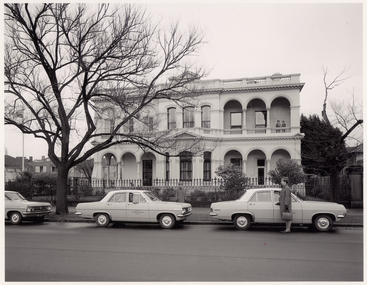
... 'Airlie' was used by Queen Victoria Memorial Hospital nurses as a Nurses Home prior to Melbourne District Nursing Service (MDNS), moving into this building as their Headquarters and Nursing Home in 1953. ...This photograph shows the Melbourne District Nursing Service (MDNS), Headquarter and Nursing Home at 452 St. Kilda Road, Melbourne. The cars in front of the building are part of the MDNS fleet of cars and are Australian built Holden vehicles of the 1960s. The MDNS Trained nurses (Sisters) seen are wearing their grey uniform coats and hats which had a red Maltese cross in the centre front. Under their coats the Sisters wore grey cotton frocks. The Melbourne District Nursing Service (MDNS) building at 452 St. Kilda Road, Melbourne was originally called 'Airlie Mansion', the childhood home of Stanley Melbourne Bruce, the Prime Minister of Australia 1923-1929. 452 St. Kilda Road, Melbourne is listed on the Victorian Heritage Register. 'Airlie' was used by Queen Victoria Memorial Hospital nurses as a Nurses Home prior to Melbourne District Nursing Service (MDNS), moving into this building as their Headquarters and Nursing Home in 1953. MDNS was given Royal patronage in 1966 and continued to occupy the building as Royal District Nursing Service (RDNS) until 1996. Royal District Nursing Service (RDNS) has had various modes of transport over the last 130 plus years. At first, from 1885 as Melbourne District Nursing Society (MDNS), their Trained nurses (Nurses) walked the streets and lane ways amid the slums of central Melbourne. As the Society expanded public transport was used, and bicycles were bought by the Society in 1903 and used in inner areas until 1945. During the Spanish flu epidemic, in 1919, MDNS appealed for assistance to procure Motor vehicles so the Nurses could visit an influx of cases. Through trusts, grants and donations four 'Ford T Model' cars were procured which enabled the Nurses to triple their visits. Through constant use the cars were in such a poor state they were sold in 1927. A Motor Auxiliary was formed in 1929 to take Sisters to patients, and some Sisters used their own cars; even a motorcycle was used by one Sister in 1933. All these forms of transport were intermingled and in the early 1950s, and now as Melbourne District Nursing Service, seven Ford Prefect cars were bought followed by twelve Ford Anglia cars 1955. Having received Royal patronage; the now Royal District Nursing Service (RDNS) had its own fleet of Holden vehicles by the mid 1960s and the Motor Auxiliary ceased operating in 1971 as by then all staff employed were required to have a driving licence. Seat-belts had been introduced to Victoria in 1959 and District fitted them to their cars from 1962, even though they did not become compulsory until 1970. The Holden vehicles were replaced with grey Holden Torana vehicles. After several years the fleet was changed to white Toyota Corolla vehicles. The Melways Directory of maps was introduced in 1966, which was a boon to the Sisters though it was a few years before it went beyond Seville, so a large paper map was used by the Sisters visiting patients in the areas passed Seville. By 2009 there were 598 cars in the fleet and the Sisters travelled 9 million 200,000 kilometres – this is equivalent to 12 trips to the moon and back. Black and white photograph of two Melbourne District Nursing Service (MDNS) Holden vehicles parked outside MDNS Headquarters, which is seen in the background of the photograph. To the right is a MDNS Sister, who is wearing her grey peaked hat over her drawn back long hair. and is wearing her grey coat and carrying a square nursing case with the capital letters 'RDNS' written on it; she is standing side-on, looking to her left, and her right hand is on the door handle of the front door of the right hand car. To her left is another car, with a MDNS Sister standing on the grass behind the bonnet. She is wearing glasses and her uniform hat is worn over short dark hair. She is wearing a grey coat, scarf and both gloved hands are holding the handles of bags. On the drivers door of this car the words 'Melbourne District Nursing Service' are written in capital letters. On the far left hand side of the photograph, half of a third Holden vehicle is seen and a large tree is on the nature strip between this and the middle car. Behind the vehicles, bushes and a large tree can be seen on the left hand side behind the cast iron fence. Several other bushes and small trees are seen. In the background is MDNS Headquarters; a large white two storey Italian style building, which has three, roman column, arched Arcadia on either side of a polygon shaped bay window on the ground floor, and three long windows to the left and a three arched Arcade to the right on the second floor. Two Sisters in uniform are standing on the veranda of the 2nd floor between the far right hand arch. To the left and right of the building, parts of single storey hip roof buildings can be seen.melbourne district nursing service, mdns, rdns, royal district nursing service, rdns headquarters, rdns transport, mdns uniforms -
 Royal District Nursing Service (now known as Bolton Clarke)
Photograph - Photograph, black and white, Barry Sutton, 24.06.1971
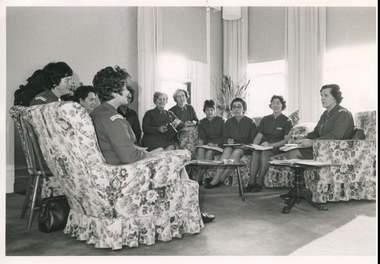
... She completed her General Nursing Training at the Royal Adelaide Hospital and her Midwifery Certificate at the Queen Victoria Memorial Hospital in Melbourne. Mary worked in the Midwifery section of Melbourne District Nursing Society from 1943–1945, and then qualified as a Maternal and Child Health Nurse. ...Miss Evans, the Director of Nursing of Royal District Nursing Service (RDNS) is holding a meeting with some RDNS Sisters in a room at RDNS Headquarters, 452 St. Kilda Road, Melbourne. Mary Evans was born in Adelaide in 1915. She completed her General Nursing Training at the Royal Adelaide Hospital and her Midwifery Certificate at the Queen Victoria Memorial Hospital in Melbourne. Mary worked in the Midwifery section of Melbourne District Nursing Society from 1943–1945, and then qualified as a Maternal and Child Health Nurse. Gaining a Scholarship from MDNS in 1959, she studied and investigated District Nursing practices in England, Sweden, Denmark, Norway, Finland, Canada and the USA, which had a profound impact on the planning of MDNS. As Deputy Matron, then Matron from 1963, she began implementing her 5 point plan of - Education, Liaison, Ancillary Services, MDNS Centres in strategic areas and Home Health Aides. Miss Mary Evans retired as Director of Nursing of, the now, Royal District Nursing Service in 1978 and became an adviser to the Australian Council of Community Nursing Services. In 1981 she was awarded an O.B.E. for services to District Nursing, and as recognition for her leading role in Community nursing in Australia. From 1986-1990 she was heavily involved in the running of the Baxter Retirement Village. She was also Vice President of the Airdrie Retirement place for nurses in Canterbury. Mary Evans was placed on the Honour Roll of Victorian Women in 2001. Miss Mary Evan, O.B.E. died in early 2004.Black and white photograph of Miss Mary Evans, Director of Nursing of the Royal District Nursing Service (RDNS), with a group of RDNS staff. Miss Evans is sitting in a floral patterned lounge chair on the far right hand side. The other staff are sitting in a semi-circle in matching lounge chairs and couches. In attendance are Sisters: P. Holdsworth, B. Harris, E. Holland, M. Campbell, H. Beckett, J. Wilkinson, J. Tarn, E. Anderson. Some are partly hidden. Miss Evans has short dark curled hair and is wearing her grey uniform skirt and jacket. The rdns insignia can be seen on her upper left sleeve. The Sisters are wearing their grey short sleeve uniform frocks; some are wearing cardigans. The RDNS Insignia can be seen on the upper sleeve of some Sisters. A small round table with papers on it, sits beside Miss Evans and a rectangular coffee table in front of some of the Sisters. A plain carpet is on the floor and in the background two windows with long side curtains can be seen.Photographer Stamp. Quote No. 5 Aroyal district nursing service, rdns, rdns matron, miss mary evans, sister pat holdsworth, sister betty harris, sister e. holland, sister m. campbell, sister h. beckett, sister joanne wilkinson, sister joan tarn, sister ellen anderson
