
Showing 17 items matching "queensland war memorials"
-
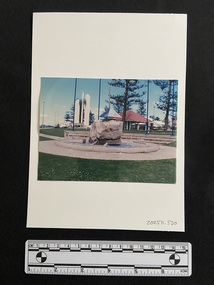 Returned Nurses RSL Sub-branch
Photograph - 5.5x4 coloured photograph, 1996
... Memorial...Centaur...War memorials...Tweed Heads...Queensland...memorial of the men and women who lost their lives in the forty-one Allied and Australian Naval and Merchant ships sunk along Australia's coastline during World War Two. It is planned to place a marker in the ground adjacent to the pyramid; this marker and the point of the pyramid will align with the site of the sinking. [Taken from ANZAC Square record] AHS Centaur Memorial Centaur War memorials Tweed Heads Queensland ...Centaur Memorial in Tweed Heads In Queensland. 'Memorial information: Description- A steel pyramid supported by a 15 tonne pink granite stone from Turallin near Millmerran on the Darling Downs. The bolder symbolises the ecology, the pyramid represents the spirit of those who died in the Centaur sinking and the whole effect is of flotation. The tip of the pyramid can be removed to expose an oil fuelled lamp which burns on the night of the anniversary of the sinking. Scrolls containing the names of those on board are also contained in the pyramid. A Walk of Remembrance leads from the memorial to the cliff top. The Centaur Memorial along with theUnited States Destroyer, USS Mugford Memorial were unveiled on 14 May 1993, the 50th anniversary of the sinking of the Australian Hospital Ship. The Walk of Remembrance is dedicated to the memorial of the men and women who lost their lives in the forty-one Allied and Australian Naval and Merchant ships sunk along Australia's coastline during World War Two. It is planned to place a marker in the ground adjacent to the pyramid; this marker and the point of the pyramid will align with the site of the sinking. [Taken from ANZAC Square record] Coloured photograph of a stone memorial set in a pond with a concrete edge and surrounded by small stones. The pond is on flat grassy land and behind it are stone steps for seating. In the background are trees and a pavillion.'Centaur / Memorial. / Danger Pond / Tweed Heads' [Handwritten in blue ink on the back of the photograph] 'SEP 96 05633 M8NAA' [Printed on the back of the photograph]ahs centaur memorial, centaur, war memorials, tweed heads, queensland war memorials -
 Lara RSL Sub Branch
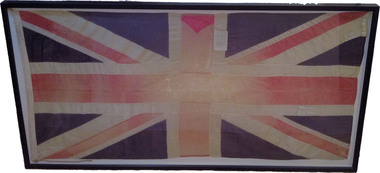
Flag, Australian Flag (Union Jack) 1900
... War Memorial records that the fighting conditions in South Africa extremely hard on men and horses. Australians fighting in South Africa were doing so as part of Colony based Regiments such as the Victorian Mounted Rifles, New South Wales Lancers, Queensland Mounted Infantry as well as units from the other states. ...War Memorial records that the fighting conditions in South Africa extremely hard on men and horses. Australians fighting in South Africa were doing so as part of Colony based Regiments such as the Victorian Mounted Rifles, New South Wales Lancers, Queensland Mounted Infantry as well as units from the other states. ...There is a Union Jack brought back from South Africa by 1229 Trooper Fredrick James Smith. Between 1899 and 1902, around 16,500 Australians served in South Africa during the Boer War. This was the largest international deployment of troops from the Australian Colonies before Australian Federation. Of the 16,500 men who served in South Africa, 606 were killed in action or died of diseases. The Australian War Memorial records that the fighting conditions in South Africa extremely hard on men and horses. Australians fighting in South Africa were doing so as part of Colony based Regiments such as the Victorian Mounted Rifles, New South Wales Lancers, Queensland Mounted Infantry as well as units from the other states. Australians were awarded six Victoria Crosses during the campaign along with many other decorations. In May of 1902 the treaty of Vereeniging was signed officially ending the Boer War. The Boer War is commemorated in many Towns and Cities around Australia. The Lara RSL Sub Branch holds some memorabilia from the Boer War. There is a Union Jack brought back from South Africa by 1229 Trooper Fredrick James Smith. He was a resident of Lara and was a member of the 5th Victorian Mounted Rifles. It was reported that he carried this flag into battle. The Lara RSL also holds the flag staff of the China, South African and Old Veterans Association. Both these items are of national significance. Both the flag and flag staff were used in marches in Geelong each year until 1916 when Anzac Day commenced. The flag and flag staff were donated to the Lara RSL sub Branch when he joined in 1928. Fredrick James Smith was born at Lara in 1879, the son of Mr/Mrs Smith from Lara. He was a farm hand from Horton Vale, Anakie when he joined F Company of the 5th Victorian Mounted Rifles at the beginning of February 1901. Two weeks later, he left for South Africa on the 15th February. Before leaving, he purchased the flag from W. Libby & Son Geelong. Frederick Left for South Africa on the 15 February 1901 on the Orient. He saw service between March 1901 - March 1902 in east Transvaal and Natal frontier under the British Major General S. Beatson then Pulteney, including the defeat at Wilmansrust where 18 soldiers were killed and 42 wounded (12th June 1901 - heaviest casualties of any Australian contingent,); and the successful intervention at Onverwacht on the 4th January 1902. The 5th Victorian Mounted Rifles suffered: 36 killed or died of wounds, 13 died of disease of a contingent of 46 Officers, 971 Other Ranks and 1099 horses. They returned to Australia on the 26th April 1902 on the Custodian after sailing from Point Natal in South Africa on the 5th April. On his return, Tropper Smith (Saddler Private) joined the South African Soldiers Association of Victoria – Geelong Branch, and after 1928, he joined the Lara RSL. He was buried in Western Cemetery on the 19th June 1968 at the age of 89. Enrolled February 1901 Departed for South Africa on 15 February 1901 Establishment: 46 Officers, 971 Other Ranks with 1099 horses Mobilised at Pretoria: 24 March -- 4 April 1901 Typical company: 1 Captain, 4 Lieutenants, 1 company sergeant-major, 1 company quartermaster-sergeant, 1 sergeant-farrier, 1 sergeant-saddler, 5 sergeants, 6 corporals, 3 shoeing-smiths, 3 saddlers, 1 bugler, 99 privates. Total in company: 126 with 131 horses. Engagements: Rhenoster Kop, Klippan, Kornfontein, Drivelfontein, Wilmansrust, Kambuladraai, H'Lobane, Luchiel's Nek, Loch's Kraal, Vryheid, Onverwacht, Johnston Hoek Killed in action (or died): six Officers, 48 Other Ranks VC Winner: Lieut. L. C. Maygar News article Leader (Melbourne) Saturday 31st May 1902, page 42 - Dear Cinderella. — This is the second time I have written to you. I was very sorry at not seeing my first letter in "The Leader". But I hope to say, that this one will be in. The last time I wrote to you I told you that my brother (Fredrick Smith) went to the Boer War in South Africa, and that he was supposed to be killed in the Wilmansrust disaster. But this time I am going to tell you about his return, and the grand welcome he got from the residents of Lara. Mother, Father, and my Brother, went down to Melbourne, to meet the boat. You can just imagine how rejoiced we all were to see him back again. The railway station was decorated some thing beautiful with flags of all description all the colours you could think of. He has bought a lot of Boer curios home and some Kaffir bracelets. They are such funny looking things. The residents of Lara, also gave my brother a grand social and ball there were over four hundred people present, They presented him with a hand some gold chain, and locket suitably inscribed, and a pair of gold sleeve links, they were magnificent. The ball was very nice. . I had a few dances. I enjoyed myself grand. I think this is all I can tell you this time. I must conclude with love. I remain yours sincerely - BESSIE SMITH. Age 14-years. This flag is of national significance as it was used in the Boer War by Private Fredrick James Smith (SN:1229) of the 5th Victorian Mounted Rifles, F Company in their deployment to South Africa between 1901 and 1902. The flag was taken into the Wilmansrust engagement in which 19 soldiers died and 41 were wounded. On return to Australia, the flag was used in marches by the South Africa, China Old Veterans Association - Geelong. This flag represents a unique part of Australian history from which the movie, Breaker Morant was taken. It is of spiritual significance as the Boer War was where the first Australian received the Imperial Victoria Cross, and the spirit of Anzac was conceived, giving birth in World War 1. The Flag represents the spirit of Australians who fought and died in South Africa.Cotton Union Jack flag approx 221cm wide by 109cm tall with small repair patches and center section cotton deteriorated.Has the word "Lara" inscribed in black on bottom part of the flag heading. Has the flag makers name "W.Libby & Son" on the top part of the flag heading.boer war, union jack flag, south africa, wilmansrust, 5th victorian mounted rifles, f coy, private fredrick james smith, service number 1229, february 1901, april 1902, south africa china old veterans association -
 Mission to Seafarers Victoria
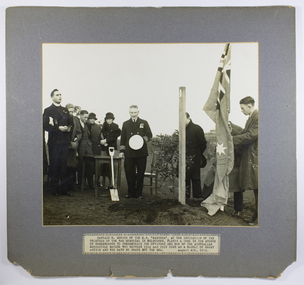
Photograph - Photograph, Black and white, Herald, Captain R. Sunter of the M.S. Manunda , at the invitation of the War memorial in Melbourne, plants a tree, 04 August 1934
... war memorial...mercantile marine memorial tree...melbourne...shrine of remembrance...wandilla...hospital ship...adelaide steamship company...memorial trees...queensland...Depicts one of the few memorials specifically commissioned for Merchant seamen of WW1 and in later years also a focus for those who died in WW2 and other conflicts. padre oliver captain robert sunter m.s. manunda war memorial mercantile marine memorial tree melbourne shrine of remembrance wandilla hospital ship adelaide steamship company memorial trees queensland kauri Typed caption in upper case: CAPTAIN R. ...On the 4 August 1934, to mark the 20th anniversary of the Great Britain declaration of war on Germany, 106 trees were planted, during a ceremony, on the lawns of the newly created garden of the Shrine of Remembrance. The Shrine of Remembrance was built to provide a place to grieve and remember Victorians killed in the First World War (1914-18). Prince Henry, the Duke of Gloucester and son of King George V, officially opened the Shrine before a crowd of 300,000 people in November 1934. Captain Robert Sunter, commander of the coastal liner Manunda, Adelaide Steamship Company, was chosen to plant a Queensland kauri (tree - number 100) on the main avenue from Domain Rd leading to the Shrine of Remembrance. The photograph was published in the Herald (4 August 1934, p. 40). In the Argus (Melbourne, Vic. : 1848 - 1957), Friday 3 August 1934, page 8 In Memory of the Merchant Service- Captain Sunter to Plant Tree at the Shrine Tomorrow will be the 20th anniversary of Great Britain's declaration of war on Germany, and at 10 and. Captain R. Sunter, the commander of the coastal liner Manunda, will plant a tree in the Shrine! of Remembrance reserve In memory of the officers and men of the Australian merchant service who gave their lives during the war. The tree, , which will be No.100 in the reserve, will bear the following inscription based on the wording of the ' British Mercantile Marine memorial at Tower Hill. London: "1914-1918. In remembrance of the officers and men of the Australian Mercantile Marine who died for King and Country and have no grave but the sea. Planted August 4, 1934." During the war 12 ships of the Australian merchant service were sunk and 95 officers and men lost their lives.The Shrine of Remembrance committee recently asked the director of navigation (Captain J. K. Davis) to nominate a member of the mercantile marine to plant a tree in the reserve. Captain Davis passed on the request to the secretary of the Merchant Service Guild of Australia (Captain T. D. Snape) and, after having conferred with various sections of the sea-going service, Captain Snape announced yesterday that Captain Sunter had been chosen unanimously. Captain Sunter has a distinguished war record as commander of the hospital ship Wandilla. Born at South Shields, in England, in 1878, he is a son of the late Canon Sunter, of Adelaide. He served an apprenticeship in sailing ships, and soon after obtaining his master a certificate entered the service of the Adelaide Steamship Company, where he has remained. In the Wandilla during the war Captain Sunter became known to thousands of wounded soldiers and troops." Padre Frank Oliver of MtS can be seen assisting with dedication at far left. Captain Robert Sunter who also served in WW1, a friend of the seamen and the mission, died a month later in Cairns. A window funded by crew of the Manunda and friends was dedicated to his memory in St Peter's Chapel, MtSV in February 1936 by Padre Oliver. (see item 0038).Depicts one of the few memorials specifically commissioned for Merchant seamen of WW1 and in later years also a focus for those who died in WW2 and other conflicts. Mounted black and white photograph of a group of people at a tree planting, minister of religion at far left, on dark grey mount with typed caption label on the lower edge of mountTyped caption in upper case: CAPTAIN R. SUNTER OF THE M.S. “MANUNDA”, AT THE INVITATION OF THE TRUSTEES OF THE WAR MEMORIAL IN MELBOURNE , PLANTS A TREE IN THE AVENUE OF REMEMBRANCE TO COMMEMORATE THE OFFICERS AND MEN OF THE AUSTRALIAN MERCANTILE MARINE WHO BETWEEN 1914 AND 1918 DIED AS A RESULT OF ENEMY ACTION AND WHO HAVE NO GRAVE BUT THE SEA. AUGUST 4TH 1934padre oliver, captain robert sunter, m.s. manunda, war memorial, mercantile marine memorial tree, melbourne, shrine of remembrance, wandilla, hospital ship, adelaide steamship company, memorial trees, queensland kauri -
 Bendigo Military Museum
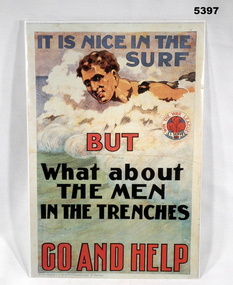
Poster - POSTER, RECRUITMENT WW1, Reproduced by the ANZAC Day Commemoration Committee of Queensland in/ conjunction The Australian War Memorial"
... Reproduced by the ANZAC Day Commemoration Committee of Queensland in/ conjunction The Australian War Memorial"....Poster POSTER, RECRUITMENT WW1 Reproduced by the ANZAC Day Commemoration Committee of Queensland in/ conjunction The Australian War Memorial". William Brooks Co LtdL ...Wording on poster; "IT IS NICE IN THE /SURF /BUT/ What about/ THE MEN/ IN THE TRENCHES/ GO AND HELP"Poster - paper, glossy white, black, blue and red print with background illustration of a young man in the surf. Poster is mounted on a section of brown cardboard with tape on back.poster, ww1, recruitment -
 4th/19th Prince of Wales's Light Horse Regiment Unit History Room
Medal, J Williams, Visit of Prince of Wales 1920, 1920
... War I and to strengthen links to the Empire. The Prince toured extensively, and his tour was one of the most popular royal visits ever. Wherever he went public holidays were declared, foundation stones laid, memorials unveiled and receptions and balls. The Prince made a point of meeting ex-servicemen and women. He spent nine days in Victoria, eleven days in New South Wales, four days in Tasmania, eleven days in Western Australia, six days in South Australia and eight days in Queensland...War I and to strengthen links to the Empire. The Prince toured extensively, and his tour was one of the most popular royal visits ever. Wherever he went public holidays were declared, foundation stones laid, memorials unveiled and receptions and balls. The Prince made a point of meeting ex-servicemen and women. He spent nine days in Victoria, eleven days in New South Wales, four days in Tasmania, eleven days in Western Australia, six days in South Australia and eight days in Queensland ...In 1920 the Prince of Wales visited Australia to extend official thanks for its support during World War I and to strengthen links to the Empire. The Prince toured extensively, and his tour was one of the most popular royal visits ever. Wherever he went public holidays were declared, foundation stones laid, memorials unveiled and receptions and balls. The Prince made a point of meeting ex-servicemen and women. He spent nine days in Victoria, eleven days in New South Wales, four days in Tasmania, eleven days in Western Australia, six days in South Australia and eight days in Queensland. The Prince was seen as the embodiment of the White Australia, symbolic of the spirit of his race. His presence strengthened the identity of the young Australian nation as a member of the Empire, resisting the influence of other powers and other races.Dimensions: 27 mm (Diameter) Weight: 9.11 g Dimension Comment: 32 mm height to top of loop Obverse Description: 3/4 bust of Prince in uniform wearing cap; around in two lines, H.R.H. PRINCE OF WALES / WELCOME TO AUSTRALIA Reverse Description: Wreath of eucalypt and oak with Prince of Wales' plume at top; within, TO COMMEMORATE / THE VISIT OF / . H.R.H.. / PRINCE OF WALES / TO AUSTRALIA / . / 1920 Edge Description: Plain Inscriptions: H.R.H. PRINCE OF WALES WELCOME TO AUSTRALIA TO COMMEMORATE THE VISIT OF H.R.H. PRINCE OF WALES TO AUSTRALIA 1920 Shape: Round with loop Material: Gilt medal, prince of wales -
 Monbulk RSL Sub Branch
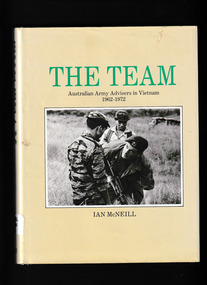
Book, The Team : Australian Army advisers in Vietnam 1962-1972, 1984
... University of Queensland Press in association with the Australian War Memorial...Vietnam war 1961-1975 – Australian involvement Vietnam war 1961-1975 – Regimental histories - Australia the official history of the Australian army training team in Vietnam between 1962 and 1972 Index, bibliography, notes, ill, maps, p.534. The Team : Australian Army advisers in Vietnam 1962-1972 Book University of Queensland Press in association with the Australian War Memorial Ian McNeill ...the official history of the Australian army training team in Vietnam between 1962 and 1972Index, bibliography, notes, ill, maps, p.534.the official history of the Australian army training team in Vietnam between 1962 and 1972vietnam war 1961-1975 – australian involvement, vietnam war 1961-1975 – regimental histories - australia -
 Bendigo Historical Society Inc.
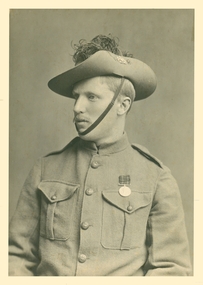
Document - Arthur T. Pattinson, 1962
... Queensland, Victoria and New South Wales, setting up studios along the way. The family ended up moving with him, travelling to Sydney, Narrandera, Bendigo, Newtown, Geelong and Deniliquin. John Walker Jack Walker Boer War Memorial ...10570 South African (Boer) War Memorial Bendigo. The monument commemorates those who died in service or were killed in action while serving in the South African (Boer) War. It is a bronze statue of a soldier on a granite base. Leader (Melbourne), 19 November 1904. “There was a large assemblage on the afternoon of 11th November, when the ceremony of unveiling the soldiers' memorial statue was performed by Brigadier-General Gordon in the presence of a muster of branches of the defence forces. The statue, which is in bronze, is mounted on a massive granite base, on the foot of which is the following inscription: — "Bendigo's tribute to the memory of the Australian soldiers who, in the South African war of 1899 - 1902 gave their lives for Queen and Empire. The statue was modelled by Mr. J. Walker, a young Bendigonian, who has been studying for two or three years under Mr. A. T. Woodward art instructor at the local school of mines.“ Ola Cohn recalled in her autobiography meeting John Walker as a sculpture student at the Bendigo School of Mines and that he had later received the commission for the Boer War Memorial although she neglects to mention its location. John Walker was born in Bendigo and first studied sculpture at the Bendigo School of Art. Walker, then went to England to study at the Royal College of Art London, and in Paris at the Académie Colarossi and Julian Academy. John Walker worked as a sculptor in both Bendigo and West Brunswick before turning to chicken farming in the Bendigo suburb of White Hills. The photo of A. T. Pattinson was taken by George Leake Massingham, a professional photographer, who had seven children, one of whom died at birth. After arriving in Australia from England, he established himself as a travelling photographer, an occupation he continued after his marriage. He travelled throughout country Queensland, Victoria and New South Wales, setting up studios along the way. The family ended up moving with him, travelling to Sydney, Narrandera, Bendigo, Newtown, Geelong and Deniliquin. Correspondence re Boer War Memorial Bendigo Boer War Memorial Bendigo. Letters and photo from and to Mrs Wilson, eldest daughter of Mr Arthur T. Pattinson who was a model for the Boer War sculpture. 10570a A black and white photo of Trooper Arthur T. Pattinson restored by BHS Volunteers. 10570b The original photo as sent by Mrs Wilson to Harold Curnow (Bendigo Historical Society) in 1962. The photo is mounted on heavy brown cardboard and has an old catalogue number of "P680" inscribed on it. The cardboard is torn and held together with sticky tape. On the front in italics is printed G.L. Massingham, Bendigo. 10570c Notes on the rear of the photo from Mrs Wilson state that "the photo is of Arthur T. Pattinson (Rusty), an Australian Light Horse trooper who served in the Boer War. The Boer War Memorial in Pall Mall Bendigo represents a trooper on guard. The sculptor was Jack Walker who used Pattinson as a model, and it is regarded as an excellent likeness." 10570d A letter from Harold Curnow back to Mrs Wilson on Jan 4th, 1963, acknowledging receipt of the photo and a letter received, noting the significance of the historical information. 10570e Handwritten letter 29/11/1962 from Mrs Wilson to Mr Curnow introducing herself as Mr. Pattinson's eldest daughter and answering the letter he wrote to her father. She mentions the bad health of her parents. Arthur modelled for the statue at least two to three times per week in a studio on the top floor of a building in Bull St. He was the original model to the best of her knowledge. Another model possibly Mr P. Handmear may have sat as a model for renovations (*). The rifle was a light horse rifle issued to Pattinson as he was still serving in 1904. Arthur and Handmear were boys together and very close. * Note - the plaster model was repaired prior to casting in metal. 10570f An obituary notice: 18/11/64 "On Nov. 17 at Frankston, Emma, wife of the late A. T. Pattinson (Rusty), late of Bendigo. 10570g Letter Nov. 20th, 1962, from Harold Curnow to Mr Arthur T. Pattinson, Kent St., Mornington, Vic. "Dear Mr Pattinson, Last week your brother, Brit., whom I have known for many years, supplied the Bendigo Advertiser with some interesting information regarding your role as the model for the late Jack Walker when he was making the statue for the Boer War Memorial here. Yesterday however, another claimant to the distinction of being the model was advanced in the Bendigo Advertiser by Mr Richard Marshall, of Moran Street, Bendigo who said that the soldier's model was Phillip Handmear. I understand that your brother has sent the newspaper cuttings on to you. When he called to see me yesterday, he suggested that I write to you for further particulars. Can you recall the discussion you had with Jack Walker when he approached you about acting as the model and do you remember how many times you posed for him, and whether the work was done in the house, in the yard, or in one of the outbuildings at Moran Street? In short, any details at all. At this point in time we are considering an interesting facet in Bendigo's history, so any seemingly unimportant incidents could really be useful if we knew about them. Have you any old newspaper cuttings mentioning your name in connection with the memorial? Do you remember any remarks that passed between you and Jack Walker during the long sessions you must have put in on this work? This could be very important. And do you recall where the rifle came from? Did you or Jack Walker borrow it from the military authorities? Back in 1934 Jack Walker recalled having had to pull the plaster model down and remake it when he discovered it was slightly off-balance and was slowly toppling forward. He told me he had to get his model to pose again. Do you know anything about this? Could it have been that he got Mr. Handmear in for the final stage of the work? That, of course, would apply only if you were not available. Incidentally, I never heard of Mr Handmear until I saw his name in yesterday's "Advertiser". In any case I intended contacting your brother or you to enquire whether any member of your family has an old photograph of you in your Boer War uniform, that is, one taken about the time of or just after the Boer War. I am sure that members of the Bendigo Branch of the Royal Historical Society would be most interested to see it. I hope you will have the time and inclination to consider the many points I have raised in this letter because the subject has aroused a lot of interest in Bendigo. Hoping you are well and quite as active as you wish, I remain, with all good wishes, Yours sincerely, Harold Curnow". john walker, jack walker, boer war memorial bendigo, arthur pattinson, soldiers' memorial bendigo -
 St Kilda Historical Society
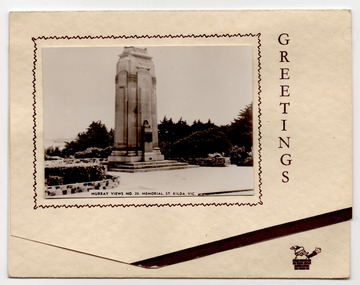
Ephemera - Seasonal card, Greetings, mid 20th century
... Memorial, St Kilda. Vic', appears to have been taken in the mid 20th century. Murray Views was established in 1929 by photographer Fred Murray in Gympie, Queensland, initially to supply postcards of local views. The company soon expanded its reach through Queensland and interstate. Murray Views St Kilda Cream coloured card, folded into three sections, and printed in brown. A black and white photograph of St Kilda War ...A greeting card for Christmas and New Year. The photograph, 'Murray Views No. 26. Memorial, St Kilda. Vic', appears to have been taken in the mid 20th century. Murray Views was established in 1929 by photographer Fred Murray in Gympie, Queensland, initially to supply postcards of local views. The company soon expanded its reach through Queensland and interstate.Cream coloured card, folded into three sections, and printed in brown. A black and white photograph of St Kilda War Memorial is affixed to the first section. The message 'May the Joys of the CHRISTMAS SEASON remain with you throughout the NEW YEAR', and a drawn image of Santa Claus waving from a chimney, are printed on the third section. murray views, st kilda -
 Wangaratta RSL Sub Branch
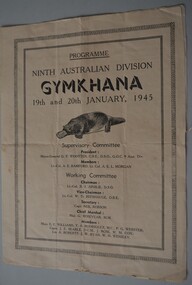
Programme, 9th Australian Division Gymkhana, C1945
... Queensland. The event featured a wide array of sporting, military, and horse racing events to boost morale and physical readiness. The carnival was a massive logistical gathering for the "Magnificent 9th" prior to their final amphibious deployments to Borneo. The Australian War Memorial...Queensland. The event featured a wide array of sporting, military, and horse racing events to boost morale and physical readiness. The carnival was a massive logistical gathering for the "Magnificent 9th" prior to their final amphibious deployments to Borneo. The Australian War Memorial ...Programme of the 9th Australian Division Gymkhana held 19th and 20th January 1945 at Herberton Racecourse, Atherton Tableland, Queensland. The event featured a wide array of sporting, military, and horse racing events to boost morale and physical readiness. The carnival was a massive logistical gathering for the "Magnificent 9th" prior to their final amphibious deployments to Borneo. The Australian War Memorial maintains historical film coverage of this specific event. Item belonged to Robert Francis ISKOV VX15237 served with the 59th Battalion/Hume Regiment CMF before joining the 2/14th Battalion at Caulfield in September 1940. He disembarked for the Middle East in November, 1940 and fought in the Syrian campaign in 1941. In 1942 the 2/14th Battalion returned to Australia and sent to Papua where he fought at the Battle of Isurava before the battalion was sent to Gona. In 1943 Bob returned to Australia to undertake officer training and in 1945 with the 2/23rd Battalion sailed to Morotai and served with the battalion on Tarakan. He returned to Australia in November, 1945 and discharged a month later Large beige coloured paper folded in half to form four pages with black image of a platypus and lettering on cover 19th and 20th January 1945ww2, bob iskov, amf, 9th division, gymkhana, 1945, herberton, programme -
 Melton City Libraries
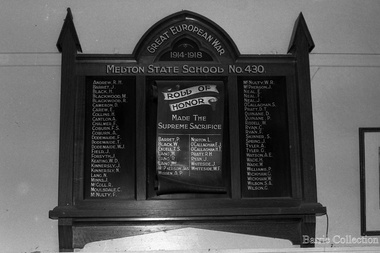
Photograph, Melton State School 430 honour board, 1970
... Father: Thomas Lang Teacher Melton 430 Brother of Thomas Lang died 18th July 1918 buried Cairo • LANG, R William Roy Number 2818 Rank: Driver Unit: 1st Australian Light Horse Machine Gen Squadron Date of death 31st October 1917 of wounds Beersheba War Cemetery Israel Started school October 1899 Aged 9 Previous school Camperdown SS 114 Date of Birth: 24th Jan 1890 Son of William John and Mary Lang of Langlands Jandowae Queensland Nephew of Thomas Lang Melton • LANG, Thomas John Thomas NZ CC M Number 15/118 Rank: Lieutenant Unit: Army Pay Department Date of death 18th July 1918 of disease Cairo War Memorial Cemetery Started school November 1896 aged 16 years - Previous school Coliban 1920 Son of Thomas Lang, teacher Melton No 430 • McPHERSON Jas Mrs M: James Sept 1897 Previous Graham St Port Melb Son of Alexander farmer Melton • MISSEN, A P Frederick M Started school August 1899 age 7 years Son of Frederick, fruiterer Melton His sister Adelaide May 11years Previous Ascot Vale 2608 • NORTON, Lewis Thomas CC M Number 1809 Rank: Private Unit: 29th Battalion (Infantry) Date of death 30th September 1918 Cemetery Bellicourt British Cemetery, France Started school March 1901 age 9 years Previous school Galaquil Son of Thomas Norton of Parwan • O’CALLAGHAN, EJ Edward Edward M • O’CALLAGHAN, HT Thomas .. ...Father: Thomas Lang Teacher Melton 430 Brother of Thomas Lang died 18th July 1918 buried Cairo • LANG, R William Roy Number 2818 Rank: Driver Unit: 1st Australian Light Horse Machine Gen Squadron Date of death 31st October 1917 of wounds Beersheba War Cemetery Israel Started school October 1899 Aged 9 Previous school Camperdown SS 114 Date of Birth: 24th Jan 1890 Son of William John and Mary Lang of Langlands Jandowae Queensland Nephew of Thomas Lang Melton • LANG, Thomas John Thomas NZ CC M Number 15/118 Rank: Lieutenant Unit: Army Pay Department Date of death 18th July 1918 of disease Cairo War Memorial Cemetery Started school November 1896 aged 16 years - Previous school Coliban 1920 Son of Thomas Lang, teacher Melton No 430 • McPHERSON Jas Mrs M: James Sept 1897 Previous Graham St Port Melb Son of Alexander farmer Melton • MISSEN, A P Frederick M Started school August 1899 age 7 years Son of Frederick, fruiterer Melton His sister Adelaide May 11years Previous Ascot Vale 2608 • NORTON, Lewis Thomas CC M Number 1809 Rank: Private Unit: 29th Battalion (Infantry) Date of death 30th September 1918 Cemetery Bellicourt British Cemetery, France Started school March 1901 age 9 years Previous school Galaquil Son of Thomas Norton of Parwan • O’CALLAGHAN, EJ Edward Edward M • O’CALLAGHAN, HT Thomas .. ...HONOR BOARD Melton State School No 430 Supreme Sacrifice • BARRET, P Peter Maurice Barrett Number 5051 Rank: Private Unit: Private Date of death 18th August 1918 of wounds age 21 St Sever Cemetery Extension, Rouen, France Started school August 1904 5 years 10 months Previous school St Michaels Nth Melb Son of Maurice Barrett labourer Melton Brother of John Barrett • BLACK, William William M • EXELL, T S Number 2758 Rank: Trooper 3rd Battalion Imperial Camel Corps Date of death 30th November 1917 of wounds aged 20 years Cairo War Memorial Cemetery Egypt Started school September 1907 aged 10 Previous school Boisdale 3017 Son of George, farmer Melton Railway Station (Melton South) Year of 1918 • LANG, Horace Thomas Number 903 Rank: Corporal Unit: 24th Battalion Date of death: 5th May 1917. Court if enquiry confirmed Dec 1917. Aged 24 Date of birth 27th April 1893 Spring Hill – Kyneton Commemorated Villers-Bretonneux France Started school November 1997. Father: Thomas Lang Teacher Melton 430 Brother of Thomas Lang died 18th July 1918 buried Cairo • LANG, R William Roy Number 2818 Rank: Driver Unit: 1st Australian Light Horse Machine Gen Squadron Date of death 31st October 1917 of wounds Beersheba War Cemetery Israel Started school October 1899 Aged 9 Previous school Camperdown SS 114 Date of Birth: 24th Jan 1890 Son of William John and Mary Lang of Langlands Jandowae Queensland Nephew of Thomas Lang Melton • LANG, Thomas John Thomas NZ CC M Number 15/118 Rank: Lieutenant Unit: Army Pay Department Date of death 18th July 1918 of disease Cairo War Memorial Cemetery Started school November 1896 aged 16 years - Previous school Coliban 1920 Son of Thomas Lang, teacher Melton No 430 • McPHERSON Jas Mrs M: James Sept 1897 Previous Graham St Port Melb Son of Alexander farmer Melton • MISSEN, A P Frederick M Started school August 1899 age 7 years Son of Frederick, fruiterer Melton His sister Adelaide May 11years Previous Ascot Vale 2608 • NORTON, Lewis Thomas CC M Number 1809 Rank: Private Unit: 29th Battalion (Infantry) Date of death 30th September 1918 Cemetery Bellicourt British Cemetery, France Started school March 1901 age 9 years Previous school Galaquil Son of Thomas Norton of Parwan • O’CALLAGHAN, EJ Edward Edward M • O’CALLAGHAN, HT Thomas .. M Number 3859 Rank: Private Unit: 57th Battalion (Infanrty) Date of death 26th September 1917 Bedford House Cemetery, Belgium Started school 11th March 1901 Aged 10 years Father: John O’Callaghan farmer of Melton • PRATT, R H Robert Henry Number: 2203 Rank: Private Unit: 46th Battalion (Infantry) Date of death, 12th April 1917 Favreuil British Cemetery, France Started school in May 1903 aged 6 years Father: Matthew Pratt, Labourer Melton • RYAN J James or John David: RYAN J ? Started August 1896 Previous Christian Brother St Kilda John 11-5 or James 9-11 Charles 6-11 returned from WW1 Frank 8-5 returned Father Daniel Publican • WHITESIDE, John Edward M Number 2182 Rank: Trooper Unit 13th Light Horse Date of death 4th September 1918 of illness aged 29 years Alexandria (Hadra) War Memorial Cemetery, Egypt Started school July 1897 age 8 Son of Edward Whiteside Labourer Melton Brother of Edward. • WHITESIDE, W F Number: 3995 Rank: Private Unit: 22nd Battlion Date of death, 28th July 1916, died of wounds aged 21 years Puchevillers British Cemetery, France Started school in 1901 Year of birth circa 1895 Brother Edward died 4th September 1918 Father: Edward Whiteside. Labourer Year of 1917 • ANDREW. R H • BARRETT, J John Maurice • BLACK, Harold David • BLACKWOOD, Maxwell James A • BLACKWOOD, Roy .. • CAMERON David or (Donald) William M • CAREW, Edward Edward M • COLLINS, H John Henry H Thomas CC M • CANTLON, A Alfred CC • CHALMER, Frank Ernest CC M • COBURN, A Frederick CC M • COBURN, FS CC M • DODEMAIDE, Frank William • DODEMAIDE, Thomas .. • DODEMAIDE, W J William John M • FIELD, J • FORSYTH J • KEATING, WD William Edward M • KINNERSLY James Edward CC • KINNERSLY Norman Chas Edward CC • LANG Norman William • MINNS, J CC M • McCOLL R Alex R J. McColl • MOULSDALE Charles William M • McNULTY, Frederick James CC • McNULTY, W R CC • McPHERSON J which one? • NEAL, Elvine J Neal M • NEAL, Frank John M • NEAL, John William John M (husband of Isabella) • O’CALLAGHAN, Stephen Edward M • PRATT, David T Matthew CC M • QUINANE, David Peter • QUINANE, Peter .. • RIDDELL, William M • RYAN, Charles Daniel • RYAN Frank .. • SKINNER, Stanley John S’John CC M • SPRING, James George • TYLER, A • TYLER, George George • WATSON, Albert Ernest Alexander M • WADE, Howard James • WADE, Walter .. might be connected with CC • WILLIAMS, Percy Mr Williams • WICKHAM, George George M • WICKHAM, W M • WILSON, Stanley [ Alfred and Maude] M • WILSON, Gordon .. M SUPREME SACRIFICE Roll of Honor Melton State School No 430 Years of 1916,1917 and 1918 -
 8th/13th Victorian Mounted Rifles Regimental Collection
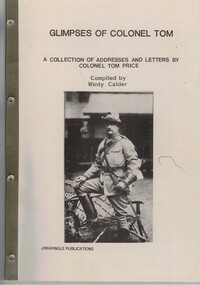
Book, Glimpses of Colonel Tom
... war, serving in Queensland until 1904 when he was medically discharged. He retired to Victoria again and died in 1911 at the age of 68. Price Calder VMR Victorian Mounted Rifles Presented to the 8/13 Victorian Mounted Rifles Royal Australian Armoured Corps as a memorial to Colonel Tom Price and the original Victorian Mounted Rifles and as a tribute to the men who carry on a fine tradition. ...This is a supplement to Winty Calder's earlier work 'Heroes and Gentlemen'. Thomas Caradoc Rose Price CB, often known as Colonel Tom Price, was an Australian soldier, and acting commandant of the Commonwealth Military Forces in Victoria in 1902. Joining the British Indian Army in his early years, he served 20 years in India before returning to Australia. In 1885, he raised the Victorian Mounted Rifles, and was instrumental in establishing the concept of light horse units within the Australian Army. In 1900, he led a Victorian contingent during the Second Boer War, and was the only Australian officer during that war to command a force of British regulars. He remained in the Australian military after the war, serving in Queensland until 1904 when he was medically discharged. He retired to Victoria again and died in 1911 at the age of 68.Soft cover book with adhesive binding on spine, A4 size, 56 pages being a collection of addresses and letters of Colonel Tom Price, compiled by Winty Calder, published by Jimaringle Publications 1985. Gift letter on reverso of front cover.Presented to the 8/13 Victorian Mounted Rifles Royal Australian Armoured Corps as a memorial to Colonel Tom Price and the original Victorian Mounted Rifles and as a tribute to the men who carry on a fine tradition. Winty Calder 4 October 1985.price, calder, vmr, victorian mounted rifles -
 Returned Nurses RSL Sub-branch
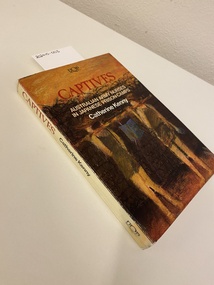
Book, Catherine Kenny et al, Captives : Australian army nurses in Japanese prison camps
... War Memorial as well as from the women themselves." Blurb on back cover of book. 'Donated by / Simonette de Tournover' [Towards bottom inside page Colour front cover, drawn image of people carrying a pole with a rectangular bucket suspended on the pole, the people wear hats and the sky is an orangey colour. Back cover has some quotes from nurses featured in the book as well as a blurb describing the book. Book is covered in clear contact. Captives : Australian army nurses in Japanese prison camps Book Catherine Kenny Cynthia Breusch Christopher McVinish University of Queensland ..."Hunger and humiliation were just some of the privations endured by those members of the Australian Army Nursing Service who were captives of the Japanese during World War II. Of the thirty-two held in Sumatra and on Banka Island, twenty-four survived the severe physical conditions in the prison camps. Another group captured in Rabaul were held in Japan, where the cold was as bitter as their hunger. This is the dramatic account of those Australian nurses, of their struggles and their support for each other through the long years of war and captivity. In includes the horrifying story of Vivian Bullwinkel, the sole survivor of the callous massacre on Banka Island where twenty-three women were ordered into the sea and shot. It records the degradation of the daily 'tenko', the starvation and appalling lack of hygiene, but also tells how the women were at times able to rise above these miseries through their concerts and the soaring harmonies of the voice choir. Catherine Kenny interviewd many of the nurses and collected photographs, diaries and letters from the Australian War Memorial as well as from the women themselves." Blurb on back cover of book.Colour front cover, drawn image of people carrying a pole with a rectangular bucket suspended on the pole, the people wear hats and the sky is an orangey colour. Back cover has some quotes from nurses featured in the book as well as a blurb describing the book. Book is covered in clear contact.non-fiction"Hunger and humiliation were just some of the privations endured by those members of the Australian Army Nursing Service who were captives of the Japanese during World War II. Of the thirty-two held in Sumatra and on Banka Island, twenty-four survived the severe physical conditions in the prison camps. Another group captured in Rabaul were held in Japan, where the cold was as bitter as their hunger. This is the dramatic account of those Australian nurses, of their struggles and their support for each other through the long years of war and captivity. In includes the horrifying story of Vivian Bullwinkel, the sole survivor of the callous massacre on Banka Island where twenty-three women were ordered into the sea and shot. It records the degradation of the daily 'tenko', the starvation and appalling lack of hygiene, but also tells how the women were at times able to rise above these miseries through their concerts and the soaring harmonies of the voice choir. Catherine Kenny interviewd many of the nurses and collected photographs, diaries and letters from the Australian War Memorial as well as from the women themselves." Blurb on back cover of book.wwii, world war 2, world war two, japan, pow, pows, prisoners of war, prisoner of war, australian army nursing service, mitliary nursing, australian army -
 Returned Nurses RSL Sub-branch
Book, Catherine Kenny et al, Captives : Australian army nurses in Japanese prison camps
... War Memorial as well as from the women themselves." Blurb on back cover of book. Colour front cover, drawn image of people carrying a pole with a rectangular bucket suspended on the pole, the people wear hats and the sky is an orangey colour. Back cover has some quotes from nurses featured in the book as well as a blurb describing the book. Captives : Australian army nurses in Japanese prison camps Book Catherine Kenny Cynthia Breusch Christopher McVinish University of Queensland ..."Hunger and humiliation were just some of the privations endured by those members of the Australian Army Nursing Service who were captives of the Japanese during World War II. Of the thirty-two held in Sumatra and on Banka Island, twenty-four survived the severe physical conditions in the prison camps. Another group captured in Rabaul were held in Japan, where the cold was as bitter as their hunger. This is the dramatic account of those Australian nurses, of their struggles and their support for each other through the long years of war and captivity. In includes the horrifying story of Vivian Bullwinkel, the sole survivor of the callous massacre on Banka Island where twenty-three women were ordered into the sea and shot. It records the degradation of the daily 'tenko', the starvation and appalling lack of hygiene, but also tells how the women were at times able to rise above these miseries through their concerts and the soaring harmonies of the voice choir. Catherine Kenny interviewd many of the nurses and collected photographs, diaries and letters from the Australian War Memorial as well as from the women themselves." Blurb on back cover of book.Colour front cover, drawn image of people carrying a pole with a rectangular bucket suspended on the pole, the people wear hats and the sky is an orangey colour. Back cover has some quotes from nurses featured in the book as well as a blurb describing the book. non-fiction"Hunger and humiliation were just some of the privations endured by those members of the Australian Army Nursing Service who were captives of the Japanese during World War II. Of the thirty-two held in Sumatra and on Banka Island, twenty-four survived the severe physical conditions in the prison camps. Another group captured in Rabaul were held in Japan, where the cold was as bitter as their hunger. This is the dramatic account of those Australian nurses, of their struggles and their support for each other through the long years of war and captivity. In includes the horrifying story of Vivian Bullwinkel, the sole survivor of the callous massacre on Banka Island where twenty-three women were ordered into the sea and shot. It records the degradation of the daily 'tenko', the starvation and appalling lack of hygiene, but also tells how the women were at times able to rise above these miseries through their concerts and the soaring harmonies of the voice choir. Catherine Kenny interviewd many of the nurses and collected photographs, diaries and letters from the Australian War Memorial as well as from the women themselves." Blurb on back cover of book.wwii, world war 2, world war two, japan, pow, pows, prisoners of war, prisoner of war, australian army nursing service, mitliary nursing, australian army -
 Returned Nurses RSL Sub-branch
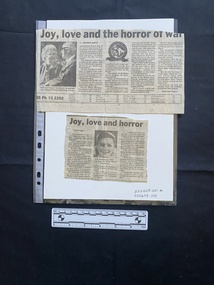
Newspaper - Newspaper clippings, Amanda Smith, Joy, love and the horror of war, [1995]
... war hospitals in queensland during the war. WWII WW2 World War Two World War 2 Veteran Affairs Minister Con Sciacca Pacific Rupert Goodman Australian Medical Women's Army Service VP Day Middle East Tobruk Jerusalem Ceylon Borneo POW St Lucia Kokoda Track The Centaur Centaur Moreton Bay Two newspaper clippings, one story continued over two pages. The larger clipping has a large title with four columns of text and two embedded black and white images. The larger image on the left is a photo of an older couple looking at each other. The smaller image is an Anzac memorial ...In the build up to Brisbane's World War II commemorations, "Australia Remembers", ex-servicewoman Win Goodman remembers watching the matron of the Redbank Hospital sliding down the banisters whooping with joy the day the war ended. Win, (then Win Ruthning) worked as a radiographer in war hospitals in queensland during the war.Two newspaper clippings, one story continued over two pages. The larger clipping has a large title with four columns of text and two embedded black and white images. The larger image on the left is a photo of an older couple looking at each other. The smaller image is an Anzac memorial pin design for 1945 - 1995. The smaller clipping has a title above three columns of text with a centred, embedded black and white image. The image is a photo headshot of a young woman.wwii, ww2, world war two, world war 2, veteran affairs minister, con sciacca, pacific, rupert goodman, australian medical women's army service, vp day, middle east, tobruk, jerusalem, ceylon, borneo, pow, st lucia, kokoda track, the centaur, centaur, moreton bay -
 Returned Nurses RSL Sub-branch
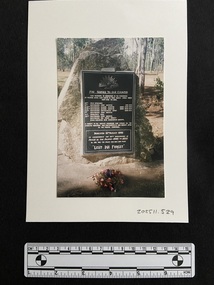
Photograph - 6x4 coloured photograph
... War memorial for units that served in World War II. It is located in the Rocky Creek Memorial Park in Tolga (Far North Queensland). ...War memorial for units that served in World War II. It is located in the Rocky Creek Memorial Park in Tolga (Far North Queensland). ...War memorial for units that served in World War II. It is located in the Rocky Creek Memorial Park in Tolga (Far North Queensland). 'Memorial information: Dedicated 15th August 1995. The Memorial Park is a unique design of individual plaques, set amongst the trees and located along the lines of the original locations of units stations at the Rocky Creek Medical and other facilities during the Second World War. Built on the old camp site of the Convalescent Depot of the 2/2nd Australian General Hospital, where thousands received treatment in 1942-1945. Atherton Shire Council supplies plaques and a local businessman supplies boulders. In 1997 there were 3 plaques and by August 2000 there were 36. The numbers will have increased since these figures. The park has been chosen as the appropriate location due to the cultural, spiritual, historical and sentimental value to the local community. Several Army Divisions camped on the Atherton Tablelands during 1942-45. Approximately 60,000 Australian soldiers were treated for war related conditions at these hospitals, by a caring and efficient staff of approximately 2,000. Many were rehabilitated at the adjoining 2/1 Convalescence Depot. The complex was recognised as the largest military hospital in the Southern Hemisphere.' [Taken from the ANZAC Square website]Coloured photograph of a large memorial plaque set on stone for units that served in World War II, trees behind in the distance. A floral wreath has been placed at its base.'Rocky Creek Memorial / Park - Tolga FNQ' [Handwritten in pencil on the back of the photograph]rocky creek memorial park, war memorials, world war 1939-1945, ww2, wwii -
 Returned Nurses RSL Sub-branch
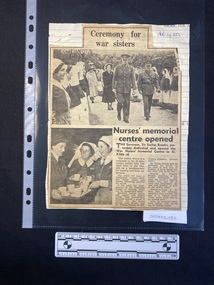
Newspaper - Newspaper clippings, The Argus, 'Ceremony for war sisters: Nurses' memorial centre opened' [front of page], 'Nurses' memorial centre opened' [back of page], 20 Feb 1950
... War Nurses Memorial Centre, the author was reminded of two instances of senseless loss of nurses' live during the war. May 1943, the Australian hospital ship, the Centaur, was torpedoed by the Japanese, resulting in 299 dead, eleven of them nurses, and only 64 survivors. Also the Banka massacre, where 22 nurses were shot by the Japanese, after surviving the sinking of their ship. Only one nurse survived the massacre. Melbourne WWII WW2 St Kilda Road Muriel Violet Turner Laing Thomas Blamey Annie Moriah Sage Muriel Brooks Queensland ...Front page - Governor, Sir Dallas Brooks, opens the War Nurses' Memorial Centre on St Kilda Road. The centre is a memorial to the 75 Australian nurses who lost their lives in the war. The centre will offer various rooms for use and house the the headquarters of the Australian College of Nursing. General Sir Thomas Blamey, chairman of the Centre Committee said there was hardly a fighting soldier who had not at some time experienced the care and devotion to duty of the service sisters. Back page - Left hand clipping - About 500 people, including more than 100 service and civilian nurses attended the ceremony that opened the War Nurses Memorial Centre. The centre is a refurbished and converted house. The crowd also included former POWs and relatives of the 75 nursing sisters who lost their lives in the 1939-45 war. Dr Garnet Leary gave 100 pounds towards the establishment of a nurses' library in the centre. Back page - Right hand clippings - top - The author heard a service broadcasted from St Paul's Cathedral and felt overwhelming gratitude towards nurses. bottom - After the dedication of the War Nurses Memorial Centre, the author was reminded of two instances of senseless loss of nurses' live during the war. May 1943, the Australian hospital ship, the Centaur, was torpedoed by the Japanese, resulting in 299 dead, eleven of them nurses, and only 64 survivors. Also the Banka massacre, where 22 nurses were shot by the Japanese, after surviving the sinking of their ship. Only one nurse survived the massacre. Three newspaper clippings have been glued to either side of a lined sheet of paper. Front of page - A newspaper clipping of two black and white photos and a short story in two columns. the larger photo is of two men in military uniform walking through women in nurses uniforms lined up on either side of a path. The smaller photo is of three women, all wearing nurse's uniforms, one woman holding a tray with cups. Back of page -Two newspaper clippings have been glued to a lined sheet of paper. The left hand clipping consists of a large black and white photo of a crowd of people and nurses outside a nice house, and a column of text. The right hand clipping is of two separate paragraphs of text, both appear to be letters to the editor.'Feb 19 50.' [blue ink, front of page, top right]melbourne, wwii, ww2, st kilda road, muriel violet turner laing, thomas blamey, annie moriah sage, muriel brooks, queensland, vivian bullwinkel, heidelberg military hospital -
 Returned Nurses RSL Sub-branch
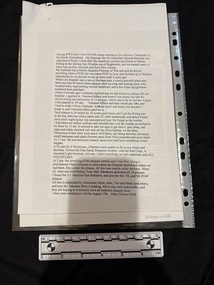
Document - Bundle of photocopied papers relating to the Rocky Creek War Memorial Park, Riverine Herald, [unknown], 'Mary's adventures continue', [Photocopied photos], 'Rocky Creek War Memorial Park Plaque Summary (Sorted by Unit Number), 'Rocky Creek War Memorial Park : VP Day "Military Muster"' & [photocopy of photograph], unknown
... Photocopied bundle of papers relating to Kathleen Mary Gibson (neé Everard) and plaques at the Rocky Creek War Memorial Park (near Atherton in northern Queensland). First page is some sort of correspondence or speech by Mary Gibson outlining her process of having a plaque for the 2/2 Australian General Hospital added to those at Rocky Creek, that Veteran's Affairs paid for it and that she attended the unveiling of other plaques at the Rocky Creek War Memorial Park. ...Photocopied bundle of papers relating to Kathleen Mary Gibson (neé Everard) and plaques at the Rocky Creek War Memorial Park (near Atherton in northern Queensland). First page is some sort of correspondence or speech by Mary Gibson outlining her process of having a plaque for the 2/2 Australian General Hospital added to those at Rocky Creek, that Veteran's Affairs paid for it and that she attended the unveiling of other plaques at the Rocky Creek War Memorial Park. ...Photocopied bundle of papers relating to Kathleen Mary Gibson (neé Everard) and plaques at the Rocky Creek War Memorial Park (near Atherton in northern Queensland). First page is some sort of correspondence or speech by Mary Gibson outlining her process of having a plaque for the 2/2 Australian General Hospital added to those at Rocky Creek, that Veteran's Affairs paid for it and that she attended the unveiling of other plaques at the Rocky Creek War Memorial Park. Second page is a photocopy of article 'Mary's adventures continue' from p9 of the Riverine Herald on 23 August 2002 with a photo of Mary in uniform looking at a plaque mounted on a rock. The article is about her 'quest to dedicate a plaque to the 2/2 Australian General Hospital' where it was located during WWII. Third page is a black and white photocopy of a panoramic photo showing the arches near a carpark that indicate the 'Rocky Creek War Memorial Park : Their service our heritage'. Fourth page is a black and white photocopy of a panoramic photo showing some people in military uniforms and many others in loose lines in the mid ground and large gum trees in the background. The photo is annotated with handwriting and an arrow 'NASHOS / wore BLUE / SHIRTS'. Fifth page is a photocopied page showing a table titled 'Rocky Creek War Memorial Park Plaque Summary (Sorted by Unit Number)'. It includes the Unit, date of unveiling and other basic information. Sixth page is a photocopy of the Program of Events that took place on Sunday 11 August 2002 at the Rocky Creek War Memorial Park VP Day "Military Muster" including the unveiling of the 2/2nd Australian General Hospital plaque by Mary Gibson. Seventh and final page is a light photocopy of a panoramic photograph showing rocks with plaques on them amongst large gum trees.Small bundle of photocopied papers variously writing, tables, photos & program of events. All are photocopied on to white paper and all ink is black.'NASHOS / wore BLUE / SHIRTS' [with an arrow, fourth page, blue ink]wwii, ww2, world war two, kathleen mary gibson (neé everard), 2/2 australian general hospital, memorial
