
Showing 13 items matching "quinine"
-
 Bendigo Military Museum
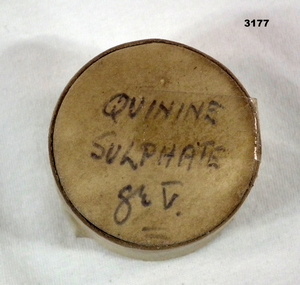
Container - PILL BOX, Possible WW2 era
... ...quinine...Label: “Quinine Sulphate”...military equipment - medicine Containers quinine Label: “Quinine Sulphate” Circular cardboard pill box with label, holds numerous brown coloured pills. ...Circular cardboard pill box with label, holds numerous brown coloured pills. Label: “Quinine Sulphate”military equipment - medicine, containers, quinine -
 Blacksmith's Cottage and Forge
Tin - quinine, Unknown
... ...quinine...QUININE 5 GR....Domestsic item - medicinal tin medicine domestic item quinine QUININE 5 GR. Small tin with inscription on hinged lid Tin - quinine ...Domestsic item - medicinalSmall tin with inscription on hinged lidQUININE 5 GR.tin, medicine, domestic item, quinine -
 Running Rabbits Military Museum operated by the Upwey Belgrave RSL Sub Branch
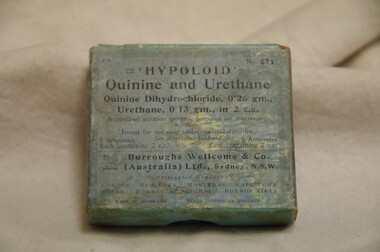
Medical Equipment
... Box containing quinine and Urethane...Equipment 1914 General Box containing quinine and Urethane Medical Equipment ...Box containing quinine and Urethaneequipment, 1914, general -
 Flagstaff Hill Maritime Museum and Village
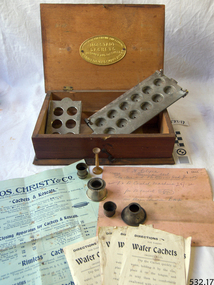
Equipment - Cachet Machine, Christy & Co, Early 20th Century
... Cachet machine for making Cachets or Koseals of pharmaceuticals such as quinine or sulphanol. Materials contained in wooden box. ...Cachet machine for making Cachets or Koseals of pharmaceuticals such as quinine or sulphanol. Materials contained in wooden box. ...Cachets Unpalatable drugs were cached using gelatine or a similar compound. The standard cachet machine consisted of three metal plates drilled with holes of different diameter for the size of the cachet used. The first half of the cachet was then fitted in the base plate. The centre plate was then used to mask the rims of the cachets to prevent powder deposit. Funnels were then used to deposit an appropriate dose of the powdered drug into the lower part of the cachet. Tampers were used if the drug had to be compressed. When the cachets were filled, moisture was applied to the rims of the cachet halves in the top plate. The centre plate was then removed and the two cachet halves brought together. After a few minutes the cachets were dry and could be removed. Capsules Another option was to use capsules. Again mechanisation supplanted the earlier models. The early models however are still used in clinical studies using the “double blind” method, where neither the clinician or the patient are aware which capsule contains the active agent or the placebo, as identical capsules are used for both. Each machine consists of two plates with openings to fit the capsules. The two levers at the front allow the upper plate to be raised or lowered. In the first instance the upper plate is raised half way and the empty lower halves of the capsules are inserted. This allows the operator to ensure that all the openings contain empty capsule halves. The upper plate is then raised to the maximum and the well is filled with a previously determined dose of the drug. A similar technique is used for the placebo. The upper plate is then lowered to half way, and the empty top half of the capsule is inserted in order to close and seal the previously filled half of the capsule. The upper plate is then lowered fully and the capsules can then be removed. https://www.samhs.org.au/Virtual%20Museum/Medicine/drugs_nonsurg/capsule/capsule.htm This cachet machine was donated to Flagstaff Hill Maritime Village by the family of Doctor William Roy Angus, Surgeon and Oculist. It is part of the “W.R. Angus Collection” that includes historical medical equipment, surgical instruments and material once belonging to Dr Edward Ryan and Dr Thomas Francis Ryan, (both of Nhill, Victoria) as well as Dr Angus’ own belongings. The Collection’s history spans the medical practices of the two Doctors Ryan, from 1885-1926 plus that of Dr Angus, up until 1969. ABOUT THE “W.R.ANGUS COLLECTION” Doctor William Roy Angus M.B., B.S., Adel., 1923, F.R.C.S. Edin.,1928 (also known as Dr Roy Angus) was born in Murrumbeena, Victoria in 1901 and lived until 1970. He qualified as a doctor in 1923 at University of Adelaide, was Resident Medical Officer at the Royal Adelaide Hospital in 1924 and for a period was house surgeon to Sir (then Mr.) Henry Simpson Newland. Dr Angus was briefly an Assistant to Dr Riddell of Kapunda, then commenced private practice at Curramulka, Yorke Peninsula, SA, where he was physician, surgeon and chemist. In 1926, he was appointed as new Medical Assistant to Dr Thomas Francis Ryan (T.F. Ryan, or Tom), in Nhill, Victoria, where his experiences included radiology and pharmacy. In 1927 he was Acting House Surgeon in Dr Tom Ryan’s absence. Dr Angus had become engaged to Gladys Forsyth and they decided he further his studies overseas in the UK in 1927. He studied at London University College Hospital and at Edinburgh Royal Infirmary and in 1928, was awarded FRCS (Fellow from the Royal College of Surgeons), Edinburgh. He worked his passage back to Australia as a Ship’s Surgeon on the Australian Commonwealth Line’s T.S.S. Largs Bay. Dr Angus married Gladys in 1929, in Ballarat. (They went on to have one son (Graham 1932, born in SA) and two daughters (Helen (died 12/07/1996) and Berenice (Berry), both born at Mira, Nhill ) According to Berry, her mother Gladys made a lot of their clothes. She was very talented and did some lovely embroidery including lingerie for her trousseau and beautifully handmade baby clothes. Dr Angus was a ‘flying doctor’ for the A.I.M. (Australian Inland Ministry) Aerial Medical Service in 1928 . Its first station was in the remote town of Oodnadatta, where Dr Angus was stationed. He was locum tenens there on North-South Railway at 21 Mile Camp. He took up this ‘flying doctor’ position in response to a call from Dr John Flynn; the organisation was later known as the Flying Doctor Service, then the Royal Flying Doctor Service. A lot of his work during this time involved dental surgery also. Between 1928-1932 he was surgeon at the Curramulka Hospital, Yorke Peninsula, South Australia. In 1933 Dr Angus returned to Nhill and purchased a share of the Nelson Street practice and Mira hospital (a 2 bed ward at the Nelson Street Practice) from Dr Les Middleton one of the Middleton Brothers, the current owners of what previously once Dr Tom Ryan’s practice. Dr Tom and his brother had worked as surgeons included eye surgery. Dr Tom Ryan performed many of his operations in the Mira private hospital on his premises. He had been House Surgeon at the Nhill Hospital 1902-1926. Dr Tom Ryan had one of the only two pieces of radiology equipment in Victoria during his practicing years – The Royal Melbourne Hospital had the other one. Over the years Dr Tom Ryan had gradually set up what was effectively a training school for country general-practitioner-surgeons. Each patient was carefully examined, including using the X-ray machine, and any surgery was discussed and planned with Dr Ryan’s assistants several days in advance. Dr Angus gained experience in using the X-ray machine there during his time as assistant to Dr Ryan. When Dr Angus bought into the Nelson Street premises in Nhill he was also appointed as the Nhill Hospital’s Honorary House Surgeon 1933-1938. His practitioner’s plate from his Nhill surgery is now mounted on the doorway to the Port Medical Office at Flagstaff Hill Maritime Village, Warrnambool. When Dr Angus took up practice in the Dr Edward and Dr Tom Ryan’s old premises he obtained their extensive collection of historical medical equipment and materials spanning 1884-1926. A large part of this collection is now on display at the Port Medical Office at Flagstaff Hill Maritime Village in Warrnambool. In 1939 Dr Angus and his family moved to Warrnambool where he purchased “Birchwood,” the 1852 home and medical practice of Dr John Hunter Henderson, at 214 Koroit Street. (This property was sold in1965 to the State Government and is now the site of the Warrnambool Police Station. and an ALDI store is on the land that was once their tennis court). The Angus family was able to afford gardeners, cooks and maids; their home was a popular place for visiting dignitaries to stay whilst visiting Warrnambool. Dr Angus had his own silk worm farm at home in a Mulberry tree. His young daughter used his centrifuge for spinning the silk. Dr Angus was appointed on a part-time basis as Port Medical Officer (Health Officer) in Warrnambool and held this position until the 1940’s when the government no longer required the service of a Port Medical Officer in Warrnambool; he was thus Warrnambool’s last serving Port Medical Officer. (Masters of immigrant ships arriving in port reported incidents of diseases, illness and death and the Port Medical Officer made a decision on whether the ship required Quarantine and for how long, in this way preventing contagious illness from spreading from new immigrants to the residents already in the colony.) Dr Angus was a member of the Australian Medical Association, for 35 years and surgeon at the Warrnambool Base Hospital 1939-1942, He served with the Australian Department of Defence as a Surgeon Captain during WWII 1942-45, in Ballarat, Victoria, and in Bonegilla, N.S.W., completing his service just before the end of the war due to suffering from a heart attack. During his convalescence he carved an intricate and ‘most artistic’ chess set from the material that dentures were made from. He then studied ophthalmology at the Royal Melbourne Eye and Ear Hospital and created cosmetically superior artificial eyes by pioneering using the intrascleral cartilage. Angus received accolades from the Ophthalmological Society of Australasia for this work. He returned to Warrnambool to commence practice as an ophthalmologist, pioneering in artificial eye improvements. He was Honorary Consultant Ophthalmologist to Warrnambool Base Hospital for 31 years. He made monthly visits to Portland as a visiting surgeon, to perform eye surgery. He represented the Victorian South-West subdivision of the Australian Medical Association as its secretary between 1949 and 1956 and as chairman from 1956 to 1958. In 1968 Dr Angus was elected member of Spain’s Barraquer Institute of Barcelona after his research work in Intrasclearal cartilage grafting, becoming one of the few Australian ophthalmologists to receive this honour, and in the following year presented his final paper on Living Intrasclearal Cartilage Implants at the Inaugural Meeting of the Australian College of Ophthalmologists in Melbourne In his personal life Dr Angus was a Presbyterian and treated Sunday as a Sabbath, a day of rest. He would visit 3 or 4 country patients on a Sunday, taking his children along ‘for the ride’ and to visit with him. Sunday evenings he would play the pianola and sing Scottish songs to his family. One of Dr Angus’ patients was Margaret MacKenzie, author of a book on local shipwrecks that she’d seen as an eye witness from the late 1880’s in Peterborough, Victoria. In the early 1950’s Dr Angus, painted a picture of a shipwreck for the cover jacket of Margaret’s book, Shipwrecks and More Shipwrecks. She was blind in later life and her daughter wrote the actual book for her. Dr Angus and his wife Gladys were very involved in Warrnambool’s society with a strong interest in civic affairs. He had an interest in people and the community They were both involved in the creation of Flagstaff Hill, including the layout of the gardens. After his death (28th March 1970) his family requested his practitioner’s plate, medical instruments and some personal belongings be displayed in the Port Medical Office surgery at Flagstaff Hill Maritime Village, and be called the “W. R. Angus Collection”.Cachet machines were in widespread use in earlier days when doctors would make their own cachets and capsules. Cachet machine for making Cachets or Koseals of pharmaceuticals such as quinine or sulphanol. Materials contained in wooden box. Manufactured by Thos Christy & Co, Old Swan Lane, Upper Thames Street London.Metal plague on inside of lid reads: ‘Morstadt Cachets Improved & patented Christy & Co Old Swan Lane EC’. flagstaff hill, warrnambool, shipwrecked-coast, flagstaff-hill, flagstaff-hill-maritime-museum, maritime-museum, shipwreck-coast, flagstaff-hill-maritime-village, medical equipment, tablet making set, cachet machine, pharmaceuticals, chemist equipment, medication -
Frankston RSL Sub Branch
Tablets, Atabrine, ca 1940s
... Larger doses of "Quinine" and "Atabrine" is also used to treat the effects of Malaria. ...Larger doses of "Quinine" and "Atabrine" is also used to treat the effects of Malaria. ...Unusual World War ll souvenir consisting of a small bottle containing a number of "Atabrine" tablets which has been mounted on a wooden base. These were originally issued to RAAF Leading Aircraftman, Frederick Charles Carey, service number 116991. "Atabrine" was extensively used as a preventative measure to protect servicemen serving in tropical areas from Malarial infection. "Atabrine" is a proprietary name for "Mepacrine" which was one of the first substitutes for "Quinine" a naturally occurring Malaria preventative. Larger doses of "Quinine" and "Atabrine" is also used to treat the effects of Malaria. The wooden base of this item has a label with the following inscription: "W.W.II ATABRINE", "THE S-W PACIFIC SERVICEMAN'S ANTI-MALARIAL TREATMENT", "F. CAREY", the bottle has a label with the following handwritten note: "Attabrine? tablets Malaria F Carey"tablet, atabrine, malaria, tropics, tropical, new guinea, papua -
 Bendigo Historical Society Inc.
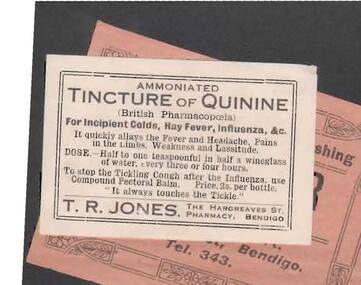
Document - CAMBRIDGE PRESS COLLECTION: LABEL - HOP BEER
... Stuck to the front of it is a white label with black printing for Ammoniated Tincture of Quinine. Label gives the dose and what it can be used for. ...Stuck to the front of it is a white label with black printing for Ammoniated Tincture of Quinine. Label gives the dose and what it can be used for. ...Orange label with black printing for Hop Beer brewed by C. J. Glover, Chapel Street, Bendigo. Has a decorative border with flowers and leaves. Stuck to the front of it is a white label with black printing for Ammoniated Tincture of Quinine. Label gives the dose and what it can be used for. T. R. Jones, The Hargreaves St. Pharmacy, Bendigo.business, printers, cambridge press, cambridge press collection, t r jones, c j glover -
 Emerald Museum & Nobelius Heritage Park
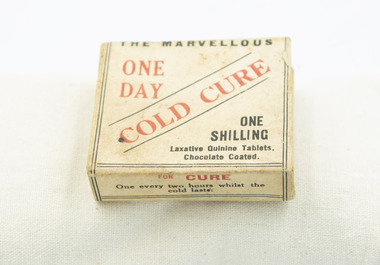
Container - Medicinal tablet box, Rocke & Tompsitt one Day cold cure tablet box, pre 1966
... The marvellous One day Cold Cure/One Shilling/laxative quinine tablets, chocolate coated/Cure - one every two hours whilst the cold lasts/Quite harmless, rapidly curs cold, influenza, Neuralgia, headache etc....The marvellous One day Cold Cure/One Shilling/laxative quinine tablets, chocolate coated/Cure - one every two hours whilst the cold lasts/Quite harmless, rapidly curs cold, influenza, Neuralgia, headache etc. ...Typical medication produced by Rocke & Tompsitt, of Flinders St., Melbourne.Rocke & Tompsitt were a long established drug company from the 19th century. Small box containing 'The Marvellous One Day Cold Cure' Produced by Rocke Tompsitt & Co., MelbourneThe marvellous One day Cold Cure/One Shilling/laxative quinine tablets, chocolate coated/Cure - one every two hours whilst the cold lasts/Quite harmless, rapidly curs cold, influenza, Neuralgia, headache etc./Rocke Tompsitt & Co. wholesale druggists, Melbourne/for prevention one every four hours -
 Warrnambool and District Historical Society Inc.
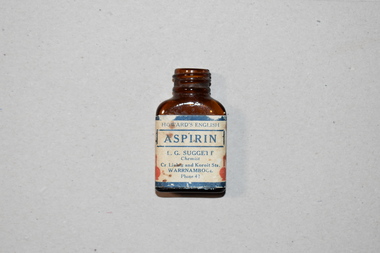
Aspirin Bottle, Howard and Sons, Early 1930s (contents)
... This firm had its origins in the late 18th century and manufactured pharmaceutical products, especially quinine and aspirin. The latter was used as a painkiller for headaches and minor health problems. ...This firm had its origins in the late 18th century and manufactured pharmaceutical products, especially quinine and aspirin. The latter was used as a painkiller for headaches and minor health problems. ...This bottle contained aspirin made by the firm of Howard and Sons of England. This firm had its origins in the late 18th century and manufactured pharmaceutical products, especially quinine and aspirin. The latter was used as a painkiller for headaches and minor health problems. The distributor of this bottle of aspirin was Len Suggett, a chemist in Warrnambool. James Barnes established a chemists business in Warrnambool in the mid 1920s and Len Suggett was the manager. After the death of Barnes in 1939 Len Suggett bought the business. The business was at the corner of Liebig and Koroit Streets (102 Liebig Street) until about 1950 when it was moved to another site across the road in Liebig Street.This bottle has local provenance as it came from the pharmacy of Len Suggett who was a well-known businessman in Warrnambool for many years and therefore the item has some significance as a memento of that business. This is a small brown glass bottle. It is empty but originally contained aspirin. The main body of the bottle has a label (white with dark blue edging) covering all sides of the bottle. The label is somewhat stained and frayed. The bottle has no stopper or lid. Howard’s English Aspirin L.G. Suggett Chemist Cr Liebig and Koroit Streets Warrnambool Phone 42 -
 Bendigo Military Museum
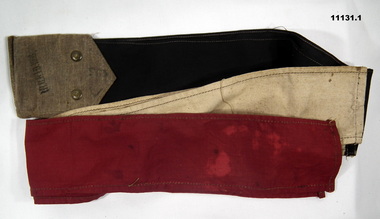
Equipment - AIR DROP MESSAGE RIBBON, 1918
... Ba77oms from Q NR ALJ Date 3 "We are about to drop you quinine/books/tobacco. To indicate where you want items dropped, place a cross (in a circle) made from any handy material such as towels etc. ...Ba77oms from Q NR ALJ Date 3 "We are about to drop you quinine/books/tobacco. To indicate where you want items dropped, place a cross (in a circle) made from any handy material such as towels etc. ...The message reads= "To O.C. Ba77oms from Q NR ALJ Date 3 "We are about to drop you quinine/books/tobacco. To indicate where you want items dropped, place a cross (in a circle) made from any handy material such as towels etc. The aircraft will fire a red very light and the drop supplies on next dive where you indicate. Stand clear when A/C dives in - and don't be long making cross - Good Luck - 3 Blindies in AU. Aircraft will be watching you - so indicate (fallen position as best you can). Written by (Signature) ACDO. Time of origin 1700/L1. Two calico ribbons. Each ribbon has 3 colours, black, white, red. The ribbons are of equal length. Width 9.5 cms. They terminate at a small canvas pocket with 2 brass press studs. 2. Piece of mild steel, rounded ends. 3. Message paper. Light brown colour of strong quality. Message form with boxes to write words in, to and from lines at top.Stamped on flap is a broad arrow with indecipherable numbers. Stamped on back is IH. G.R.I.D. 1918.ww2, messages, air drop -
 Bendigo Military Museum
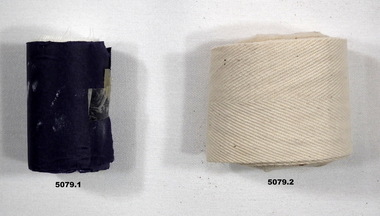
Equipment - MEDICAL ITEMS, c1939-1945
... Ammoniated Tincture/Quinine. Prepared in Accordance with the British Pharmacopoeia. ...Ammoniated Tincture/Quinine. Prepared in Accordance with the British Pharmacopoeia. ...Francis Metternick - served in Merchant Navy WW2 - British or Australian ??1. Gauze bandage - white cotton, Dark Blue Paper wrap. 2. Pressure bandage - cotton twill - cream. 3. Container for Iodine - black plastic, brown screw top glass tube - attached to brown screw top. 4. Glass bottle with brown stopper containing liquid. 5. Glass syringes and i measurement pipette & 4 solid tapered glass tubes. 6. Dressings - 2 cotton, pink in blue labelled paper wrap,3.B Hax Iodine, Tincture British Pharmacopoeia Hack, 72 Red Lion Street, London, WC1. 4. Ammoniated Tincture/Quinine. Prepared in Accordance with the British Pharmacopoeia. Dose from half to one teaspoonful in a wine glass & water, Boots, Nottingham. 6. Boric Lint, Antiseptic dressing for surgical purposes. Australian Herbal stores, 10 Bath Street, Jersey C1. medical equipment, bandages, syringes -
 Ballarat Tramway Museum
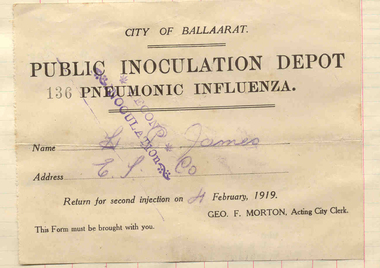
Certificate, City of Ballaarat, "Public Inoculation Depot / Pneumonic Influenza", 1919
... Item 2529), and notes he was the "Dispenser-Inspector" of two quinine powders to each man and that they had to wear gauze masks. ...Item 2529), and notes he was the "Dispenser-Inspector" of two quinine powders to each man and that they had to wear gauze masks. ...Certificate contained within Reg. Item 2526, page 8 titled "Public Inoculation Depot / Pneumonic Influenza". Printed form on paper with perforated left hand edge, to record the H.P. James of ESCo had received the two injections for the Spanish Influenza outbreak of 1919. Formed signed by Geo. F. Morton as Acting Town Clerk. Has been stamped that the second injection had been received. The required date for the 2nd injection was 4/2/1919. H.P. James refers to the outbreak in the item on the retirement of Bob Haines (Reg. Item 2529), and notes he was the "Dispenser-Inspector" of two quinine powders to each man and that they had to wear gauze masks. S Note Item Not formally Numbered. A photocopy of the manuscript is held with the work sheet.Has stamped number '136' on form.tramways, trams, esco, tram crews, personnel, influenza -
 Mont De Lancey
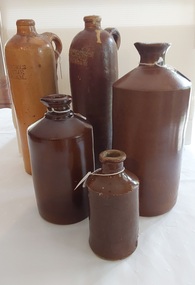
Functional object - Bottles, Unknown
... In fact they actually contained "'Seltzer Spa water' or a form of Quinine Tonic, both supposed to be health drinks. ...In fact they actually contained "'Seltzer Spa water' or a form of Quinine Tonic, both supposed to be health drinks. ...These bottles were common in the late 1800's and 1900's. Bottle Nos 1 and 2 were made by Angus & Co, a Sydney company producing ink and gums (glue and clag) from about 1880 to 1920. Their products were sold in stoneware and glass containers in varying sizes. 1. Small pottery bottle referred to as a "Penny Ink" bottle, made by Angus & Co. The small bottle got its name because of the price of 1d. = 1 penny. This bottle is missing. Nos. 3 and 4 The two tall thin Erven Lucas bottles with handles at the top were usually referred to as "Dutch Gins". In fact they actually contained "'Seltzer Spa water' or a form of Quinine Tonic, both supposed to be health drinks. These types of bottles first arrived in Australia with the Gold-seekers from Europe. Early samples are somewhat crudely made. The potter would have formed the bottle with a young apprentice applying the handle, name stamp and the glaze prior to being fired in the kiln. There is evidence of fingerprints from these processes on both samples.A collection of five handmade rare stoneware bottles with a salt glaze: 1. Small pottery bottle referred to as a "Penny Ink" bottle, made by Angus & Co. The small bottle got its name because of the price of 1d. = 1 penny. This is missing. 2. Medium glazed brown pottery bottle with a pouring spout (Angus & Co Ink Commercial). 3. Medium glazed brown pottery bottle with a pouring spout (Bourne Denby). 4. Large glazed brown pottery bottle with a pouring spout (Bourne Denby). Sample is from England probably sold for 2/- or 2/6d. Two shillings or two shillings & sixpence. 5. and 6. Two tall thin brown pottery bottles, one with a broken cork stopper and one without a stopper with Erven Lucas Bols - Het Lootsje Amsterdam stamped at the top of both. They were usually referred to as "Dutch Gins". 6. Green/black bottle is a traditional Dutch Gin with tapering sides, which made it easy to remove from the mold after being blown by hand and the cork top was applied by an apprentice. This sample dates from approximately 1900. Earlier samples are very crude with later samples being machine made with embossing.(This bottle is missing, 13.10.2022). 2. 'Angus & Co Ink Commercial' 3 and 4. 'Bourne Denby' stamped inside an oval lined shape. 5. and 6.Erven Lucas Bols - Het Lootsje Amsterdambeverage bottles, bottles, storage containers, stoneware bottles -
 Bendigo Historical Society Inc.
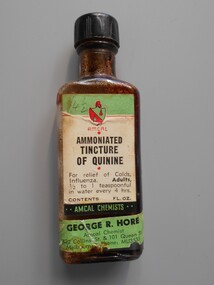
Container - PHARMACY COLLECTION: QUININE BOTTLE, 1940's
... Container PHARMACY COLLECTION: QUININE BOTTLE ...Object. Glass bottle with black plastic screw top. Green, white & red paper label, with black print Amcal ammoniated tincture of quinnine for relief of colds, influenza.Amcal Chemists. George R.Hore, 432 Collins Street, & 101 Collins Street Melbourne. Phone MU3535.medicine, first aid, quinnine bottle
