
Showing 83 items matching "raaf transports"
-
 Moorabbin Air Museum
Book - Australian military aircraft, Australia's Military Aircraft
... ...RAAF transports...Australian military aircraft Aircraft 1915 - 1919 RAAF fighters & fighter bombers RAAF bombers RAAF & army helicopters RAAF reconnaisance aircraft RAAF transports RAAF communications aircraft Warbirds RAAF trainers Royal Australian Navy Fleet Air Arm History & specifications of Australia military aircraft from WW1 to 1988. ...History & specifications of Australia military aircraft from WW1 to 1988.non-fictionHistory & specifications of Australia military aircraft from WW1 to 1988.aircraft 1915 - 1919, raaf fighters & fighter bombers, raaf bombers, raaf & army helicopters, raaf reconnaisance aircraft, raaf transports, raaf communications aircraft, warbirds, raaf trainers, royal australian navy fleet air arm -
 Bendigo Military Museum
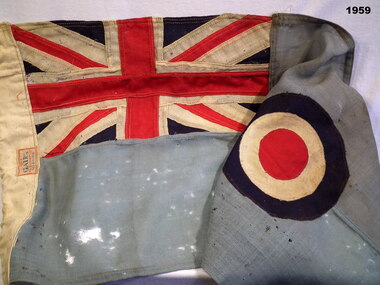
Flag - R.A.A.F ENSIGN, Gairs, c.1939 - 1945
... This Ensign was last flown over “Lae” in New Guinea in 1946 by No 33 RAAF Transport Sqd. Item belonged to Maxwell Lennox Matheson No 418447 RAAF, enlisted 22.5.42 age 19 years. ...RAAF 33rd Transport Sqd ensign. Light green/blue fabric lower half, top right hand quarter. ...This Ensign was last flown over “Lae” in New Guinea in 1946 by No 33 RAAF Transport Sqd. Item belonged to Maxwell Lennox Matheson No 418447 RAAF, enlisted 22.5.42 age 19 years. ...This Ensign was last flown over “Lae” in New Guinea in 1946 by No 33 RAAF Transport Sqd. Item belonged to Maxwell Lennox Matheson No 418447 RAAF, enlisted 22.5.42 age 19 years. At discharge from the RAAF on 19.2.48 he held the rank of Flight Lieut. RAAF 33rd Transport Sqd ensign. Light green/blue fabric lower half, top right hand quarter. Union Jack in top left hand corner. Canvas inner edge with rope looped at top (stitched) looped at bottom (tied).“IWB 2005”, written on canvas edgeflags - military, raaf, ensign -
 National Vietnam Veterans Museum (NVVM)
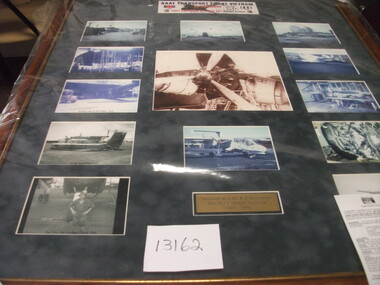
Photograph - Photograph, Collage
... Thirteen Photograph showing scenes of verious boats, aircraft in stages of repair and assembly. RAAF Transport Flight Vietnam 1964-1972...Thirteen Photograph showing scenes of verious boats, aircraft in stages of repair and assembly. RAAF Transport Flight Vietnam 1964-1972 Photograph Photograph, Collage Creative Framing ...Framed Collage. Thirteen Photograph showing scenes of verious boats, aircraft in stages of repair and assembly. RAAF Transport Flight Vietnam 1964-1972Donated by LAC KR Matthews Engfitt 35 SQN Vietnam 1969-1970photograph, collage, raaf, 35 squadron -
 National Vietnam Veterans Museum (NVVM)
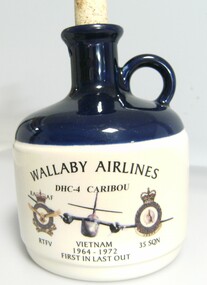
Memorabilia - Ceramic port jug
... On reverse of Jug is the story of RAAF Transport Flight Vietnam and No 35 Squadron RAAF. ...On reverse of Jug is the story of RAAF Transport Flight Vietnam and No 35 Squadron RAAF. ...This item was donated by Colin Laurence Grey OAM. Colin was the driving force behind many of the displays at the National Vietnam Veterans Museum. He will be remembered for his expertise, and boundless enthusiasm for all things Australian. Colin organised teams of like-minded souls to bring home and restore many important historical aircraft. His success has been recognised and rewarded with an Order of Australian Medal 2000, and he is named in the Worldwide Who’s Who 2014-2015. Colin’s skills as an engineer, tool maker, boiler maker and organiser enabled him to restore steam trains, trucks, tanks, infantry weapons, various aircraft including a MIG-15 jet fighter and his largest project the Consolidated B-24 Liberator bomber. He even replicated two dinosaur skeletons for Museum Victoria. In 1989 Colin joined the fledgling B-24 Liberator Memorial Fund as Project Manager/Restoration Co-Ordinator with the task to build a volunteer organisation that could find the AUD$10m required, source parts and materials for the largest aircraft restoration in Australia. The B-24 program had 10 volunteers, 60 sponsors and an international support network that provided parts, tooling, aviation equipment and political support. Colin’s combined engineering, academic and logistical skills provided the basis for advancing the skills of a very disparate group of volunteers form all walks of life. Colin established links with Centrelink, Corrections Victoria, RMT Uni and the ADF to develop the skills base of many less fortunate individuals of all ages and backgrounds. Colin’s work in this area gained him an AOM (2000). He featured in an ABC Australian Stories program and was awarded a life membership of the organisation. Colin was a founding member and President of the Oceania Aviation Museum Inc. which was instrumental in the historic listing of the joint WW2 USAAC/RAAF facility at Werribee and the Preserve Point Cook Aerodrome Group. Colin developed best practice engineering and fund-raising programs for a volunteer group, the Phillip Island Aquatic Centre. Colin’s constant learning, curiosity, passion and contribution to all things Australian have been an inspiration and a great example to all of us. He will be sorely missed and fondly remembered.Blue and beige coloured decanter with a cork stopper. Top is dark blue with handle. Bottom half is beige with Wallaby Airlines printed in blue ink. Has RAAF emblem with RTFV underneath a Caribou (DHC-4) and 35 SQN emblem. Vietnam 1964-1972 First In Last Out written in blue along bottom.Vietnam 1964-1972 First in Last Out written in blue along bottom. On reverse of Jug is the story of RAAF Transport Flight Vietnam and No 35 Squadron RAAF. Known as WAllaby Airlinesvietnam history - 1945 - 1975, raaf, bottles, 35 squadron, wallaby airlines, caribou, ceramic jug, colin grey, medal of the order of australia -
 National Vietnam Veterans Museum (NVVM)
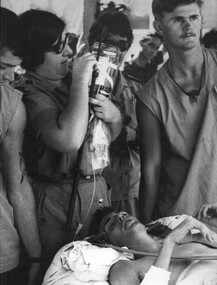
Photograph, Gibbons, Denis, Adjusting the Drip Bottle
... A black and white photograph at 1st Australian Field Hospital Medics Rob Swincer and Mick O'Halloran steady a stretcher as Capt Ann Hall adjusts the drip bottle for a wounded Digger being transported ambulance to be medivaced by RAAF transport back to Australia...Photograph 1st Australian Field Hospital Rob Swincer (Medic) Mick O'Halloran Digger Capt Ann Hall RAAF C130 Medivac Flight Gibbons Collection Catalogue Medics Vung Tau Wounded Serviceman Nurses A black and white photograph at 1st Australian Field Hospital Medics Rob Swincer and Mick O'Halloran steady a stretcher as Capt Ann Hall adjusts the drip bottle for a wounded Digger being transported ambulance to be medivaced by RAAF transport back to Australia Adjusting the Drip Bottle Photograph Gibbons, Denis ...Denis Gibbons (1937 – 2011) Trained with the Australian Army, before travelling to Vietnam in January 1966, Denis stayed with the 1st Australian Task Force in Nui Dat working as a photographer. For almost five years Gibbons toured with nine Australian infantry battalions, posting compelling war images from within many combat zones before being flown out in late November 1970 after sustaining injuries. The images held within the National Vietnam Veterans Museum make up the Gibbons Collection.A black and white photograph at 1st Australian Field Hospital Medics Rob Swincer and Mick O'Halloran steady a stretcher as Capt Ann Hall adjusts the drip bottle for a wounded Digger being transported ambulance to be medivaced by RAAF transport back to Australiaphotograph, 1st australian field hospital, rob swincer (medic), mick o'halloran, digger, capt ann hall, raaf, c130 medivac flight, gibbons collection catalogue, medics, vung tau, wounded serviceman, nurses -
 National Vietnam Veterans Museum (NVVM)
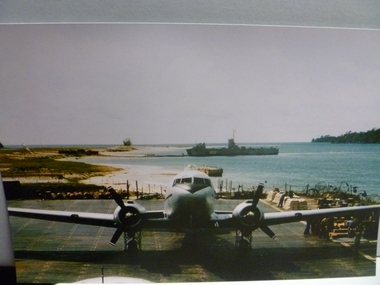
Photograph
... Colour photo of RAAF Dakota from Transport Flight Butterworth...Colour photo of RAAF Dakota from Transport Flight Butterworth Photograph Photograph ...Colour photo of RAAF Dakota from Transport Flight Butterworth -
 National Vietnam Veterans Museum (NVVM)
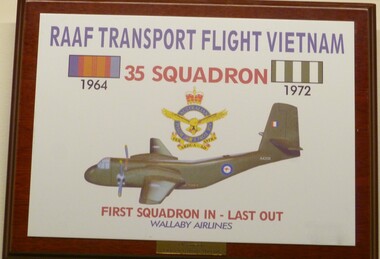
Print - A Framed Print, First Squadron In - Last Out
... Inscription reads - RAAF Transport Flight Vietnam. 36 Squadron 1964-1972. ...Inscription reads - RAAF Transport Flight Vietnam. 36 Squadron 1964-1972. ...Coloured print in a red timber frame white background with a brass presentation strip at the bottom of the frame. Inscription reads - RAAF Transport Flight Vietnam. 36 Squadron 1964-1972. Two flags - South Vietnam and the Vietnam Campaign. RAAF insignia above Caribou. First Squadron In - Last Out. Wallaby Airlines.Presented to Vietnam Veterans Museum. On back - Affordable Trophies Michelton Phone 3354 1730royal australian air foce, raaf, 35 squadron, wallaby airlines, caribou -
 National Vietnam Veterans Museum (NVVM)
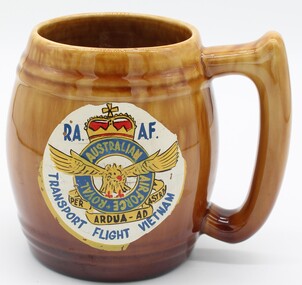
Functional object - Mug, Ceramic
... RAAF...Transport flight...It commemorates the service of RAAF Transport veterans in Vietnam. ...Painted circle on front bears the RAAF eagle emblem with the words Transport Flight Vietnam beneath....RAAF/ Australian Royal Airforce/ Per Ardua-AD/ Transport Flight Vietnam ...It commemorates the service of RAAF Transport veterans in Vietnam. Mug RAAF Transport flight Vietnam stein Henderson K B Henderson Kevin Henderson RAAF/ Australian Royal Airforce/ Per Ardua-AD/ Transport Flight Vietnam Brown glazed "beer" mug/stein with handle. ...This item was donated by Flight Lieutenant Kevin Bruce Henderson, pilot with Transport Flight Vietnam 1964-5 and RAAF No. 37 Squadron 1967-70. It commemorates the service of RAAF Transport veterans in Vietnam. Brown glazed "beer" mug/stein with handle. Painted circle on front bears the RAAF eagle emblem with the words Transport Flight Vietnam beneath.RAAF/ Australian Royal Airforce/ Per Ardua-AD/ Transport Flight Vietnam mug, raaf, transport flight, vietnam, stein, henderson, k b henderson, kevin henderson -
 National Vietnam Veterans Museum (NVVM)
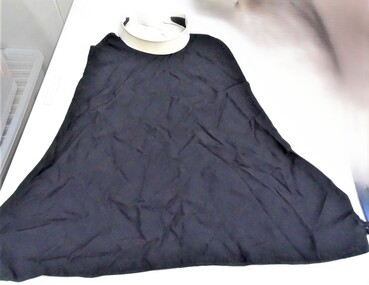
Uniform - Clerical collar with shirt front
... This item was worn by Reverend George Ashworth, Service No:O315515, who served as a Chaplain with the Royal Australian Air Force (RAAF) at Base Squadron Ubon in Thailand and Vung Tau in Vietnam with RAAF Transport Flight Vietnam, 1965-66....This item was worn by Reverend George Ashworth, Service No:O315515, who served as a Chaplain with the Royal Australian Air Force (RAAF) at Base Squadron Ubon in Thailand and Vung Tau in Vietnam with RAAF Transport Flight Vietnam, 1965-66. Robes Vietnam Geelong RSL Ashworth Chaplain RAAF 1965 - 1966 Cleric Reverend Chaplain George Ashworth A white detachable plastic collar with black taffeta dicky shirt front attached to the collar and secured around the middle by a band of elastic with fastening button and loop at the back. ...This item was worn by Reverend George Ashworth, Service No:O315515, who served as a Chaplain with the Royal Australian Air Force (RAAF) at Base Squadron Ubon in Thailand and Vung Tau in Vietnam with RAAF Transport Flight Vietnam, 1965-66.A white detachable plastic collar with black taffeta dicky shirt front attached to the collar and secured around the middle by a band of elastic with fastening button and loop at the back.robes, vietnam, geelong rsl, ashworth, chaplain raaf, 1965 - 1966, cleric, reverend, chaplain, george ashworth -
 National Vietnam Veterans Museum (NVVM)
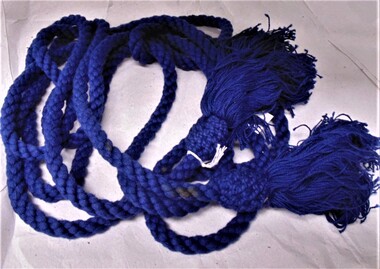
Uniform - Blue cincture cord
... This item was worn by Reverend George Ashworth, Service No:O315515, who served as a Chaplain with the Royal Australian Air Force (RAAF) at Base Squadron Ubon in Thailand and Vung Tau in Vietnam with RAAF Transport Flight Vietnam, 1965-66....This item was worn by Reverend George Ashworth, Service No:O315515, who served as a Chaplain with the Royal Australian Air Force (RAAF) at Base Squadron Ubon in Thailand and Vung Tau in Vietnam with RAAF Transport Flight Vietnam, 1965-66. Priest Vietnam Robes Ashworth chaplain cleric Blue braided cord with tassels at ends used to tie clerical robes. ...This item was worn by Reverend George Ashworth, Service No:O315515, who served as a Chaplain with the Royal Australian Air Force (RAAF) at Base Squadron Ubon in Thailand and Vung Tau in Vietnam with RAAF Transport Flight Vietnam, 1965-66.Blue braided cord with tassels at ends used to tie clerical robes. The official colour for the Chaplain Corps is sometimes noted as blue representing the heavens. priest, vietnam, robes, ashworth, chaplain, cleric -
 National Vietnam Veterans Museum (NVVM)
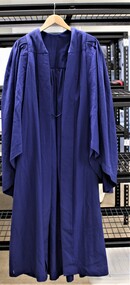
Uniform - Clerical robe
... This item was worn by Reverend George Ashworth, Service No:O315515, who served as a Chaplain with the Royal Australian Air Force (RAAF) at Base Squadron Ubon in Thailand and Vung Tau in Vietnam with RAAF Transport Flight Vietnam, 1965-66....This item was worn by Reverend George Ashworth, Service No:O315515, who served as a Chaplain with the Royal Australian Air Force (RAAF) at Base Squadron Ubon in Thailand and Vung Tau in Vietnam with RAAF Transport Flight Vietnam, 1965-66. Clergy Ecclsiastic Priest robes Chaplain Ashworth cleric George Ashworth Blue gabardine (cotton) robe. ...This item was worn by Reverend George Ashworth, Service No:O315515, who served as a Chaplain with the Royal Australian Air Force (RAAF) at Base Squadron Ubon in Thailand and Vung Tau in Vietnam with RAAF Transport Flight Vietnam, 1965-66.Blue gabardine (cotton) robe. Pintucked shoulders. Bat wing sleeve. Full length. No buttons.clergy, ecclsiastic, priest robes, chaplain, ashworth, cleric, george ashworth -
 National Vietnam Veterans Museum (NVVM)
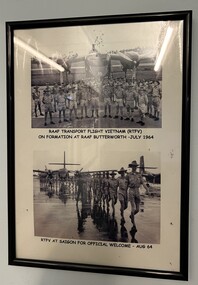
Photograph - Two Black and White Framed Photographs, RAAF Transport Flight Vietnam and RTFV at Saigon 1964, July / Aug 1964
... RAAF Transport Flight Vietnam and RTFV at Saigon 1964......RAAF Transport Flight Vietnam...Under this photograph reads RAAF Transport Flight Vietnam (RTFV) on Formation at RAAF Butterworth - July 1964. ...Under this photograph reads RAAF Transport Flight Vietnam (RTFV) on Formation at RAAF Butterworth - July 1964. ...In a black frame there are two black and white photographs. The top one is of several soldiers in formation in front of a plane. Under this photograph reads RAAF Transport Flight Vietnam (RTFV) on Formation at RAAF Butterworth - July 1964. The bottom photograph shows the soldiers marching in line away from the plane. Under the photograph reads RTFV at Saigon For Official Welcome - Aug 64 with the 2. RTFV at Saigon for official welcome - Aug 64. Both groups are photographed in front of aircraft.rtfv 35 squadron, transport, photograph, australian soldiers, raaf transport flight vietnam, rtfv -
 National Vietnam Veterans Museum (NVVM)
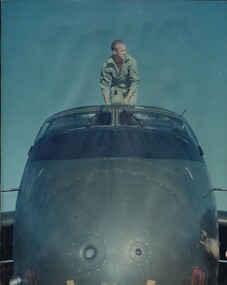
Photograph, Gibbons, Denis, Early Morning Check
... A colour photograph of the Loadmaster on board an RAAF Caribou transport aircraft carrying out an early morning check, including washing the windscreen, prior to commencing the days alloted tasks. ...Photograph RAAF Caribou 35 Squadron Gibbons Collection Catalogue Denis Gibbons Photographer Vietnam War Loadmaster A colour photograph of the Loadmaster on board an RAAF Caribou transport aircraft carrying out an early morning check, including washing the windscreen, prior to commencing the days alloted tasks. ...Denis Gibbons (1937 – 2011) Trained with the Australian Army, before travelling to Vietnam in January 1966, Denis stayed with the 1st Australian Task Force in Nui Dat working as a photographer. For almost five years Gibbons toured with nine Australian infantry battalions, posting compelling war images from within many combat zones before being flown out in late November 1970 after sustaining injuries. The images held within the National Vietnam Veterans Museum make up the Gibbons Collection. A colour photograph of the Loadmaster on board an RAAF Caribou transport aircraft carrying out an early morning check, including washing the windscreen, prior to commencing the days alloted tasks. The Caribou's of 35 Squandron were Australia's aerial work horses in Vietnam.photograph, raaf, caribou, 35 squadron, gibbons collection catalogue, denis gibbons, photographer, vietnam war, loadmaster -
 National Vietnam Veterans Museum (NVVM)
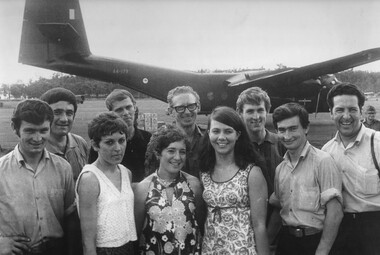
Photograph, Gibbons, Denis, Tasmanian Concert Party
... A black and white photograph of the musicians of the Official Jun 69 Tasmanian Concert Party including Diana Dalton, Richard Hall, Maxwell Kettle, Ross Kettle, William Kettle, Judith Little, William Loughlin, Peter Richman and Janice Voss pose in front of their RAAF Caribou transport....Photograph Tasmanian Concert Party Entertainment Diana Dalton Richard Hall Maxwell Kettle Ross Kettle William Kettle Judith Little William Loughin Peter Richman Janice Voss RAAF Caribou Gibbons Collection Catalogue Official Jun 69 Tasmanian Concert Party Denis Gibbons A black and white photograph of the musicians of the Official Jun 69 Tasmanian Concert Party including Diana Dalton, Richard Hall, Maxwell Kettle, Ross Kettle, William Kettle, Judith Little, William Loughlin, Peter Richman and Janice Voss pose in front of their RAAF Caribou transport. Tasmanian Concert Party Photograph Gibbons, Denis ...Denis Gibbons (1937 – 2011) Trained with the Australian Army, before travelling to Vietnam in January 1966, Denis stayed with the 1st Australian Task Force in Nui Dat working as a photographer. For almost five years Gibbons toured with nine Australian infantry battalions, posting compelling war images from within many combat zones before being flown out in late November 1970 after sustaining injuries. The images held within the National Vietnam Veterans Museum make up the Gibbons Collection. A black and white photograph of the musicians of the Official Jun 69 Tasmanian Concert Party including Diana Dalton, Richard Hall, Maxwell Kettle, Ross Kettle, William Kettle, Judith Little, William Loughlin, Peter Richman and Janice Voss pose in front of their RAAF Caribou transport.photograph, tasmanian concert party, entertainment, diana dalton, richard hall, maxwell kettle, ross kettle, william kettle, judith little, william loughin, peter richman, janice voss, raaf, caribou, gibbons collection catalogue, official jun 69 tasmanian concert party, denis gibbons -
 National Vietnam Veterans Museum (NVVM)
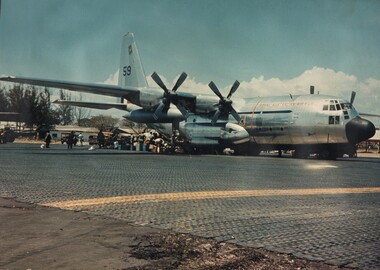
Photograph, Gibbons, Denis, C130 Hercules
... A colour photograph of RAAF C130 Hercules transport, operating between Australia and Vietnam and carrying passengers and supplies. ...Photograph RAAF C-130 Hercules Medivac Gibbons Collection Catalogue Wounded Serviceman Denis Gibbons Photographer Vietnam War Diggers A colour photograph of RAAF C130 Hercules transport, operating between Australia and Vietnam and carrying passengers and supplies. ...Denis Gibbons (1937 – 2011) Trained with the Australian Army, before travelling to Vietnam in January 1966, Denis stayed with the 1st Australian Task Force in Nui Dat working as a photographer. For almost five years Gibbons toured with nine Australian infantry battalions, posting compelling war images from within many combat zones before being flown out in late November 1970 after sustaining injuries. The images held within the National Vietnam Veterans Museum make up the Gibbons Collection. A colour photograph of RAAF C130 Hercules transport, operating between Australia and Vietnam and carrying passengers and supplies. Probably the most important task of the aircraft was the medivac transport of wounded and sick Diggers back to Australia.photograph, raaf, c-130 hercules, medivac, gibbons collection catalogue, wounded serviceman, denis gibbons, photographer, vietnam war, diggers -
 National Vietnam Veterans Museum (NVVM)
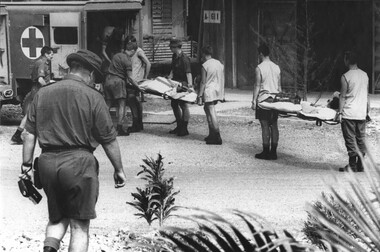
Photograph, Gibbons, Denis, Patient Loading
... A black and white photograph of 1st Australian Field Hospital Medics Richard Sneigowski, Ron Gillespie and Ray Yates load medivac patients for the short journey Vung Tau Military Airfield to be loaded onto an RAAF C130 medical transport aircraft for the flight back to Australia....Photograph 1st Australian Field Hospital Vung Tau Airfield Vung Tau Richard Sneigowski Ron Gillespie (Medic) Ray Yates (Medic) Gibbons Collection Catalogue RAAF C130 Medivac Flight Medics A black and white photograph of 1st Australian Field Hospital Medics Richard Sneigowski, Ron Gillespie and Ray Yates load medivac patients for the short journey Vung Tau Military Airfield to be loaded onto an RAAF C130 medical transport aircraft for the flight back to Australia. ...Denis Gibbons (1937 – 2011) Trained with the Australian Army, before travelling to Vietnam in January 1966, Denis stayed with the 1st Australian Task Force in Nui Dat working as a photographer. For almost five years Gibbons toured with nine Australian infantry battalions, posting compelling war images from within many combat zones before being flown out in late November 1970 after sustaining injuries. The images held within the National Vietnam Veterans Museum make up the Gibbons Collection.A black and white photograph of 1st Australian Field Hospital Medics Richard Sneigowski, Ron Gillespie and Ray Yates load medivac patients for the short journey Vung Tau Military Airfield to be loaded onto an RAAF C130 medical transport aircraft for the flight back to Australia.photograph, 1st australian field hospital, vung tau airfield, vung tau, richard sneigowski, ron gillespie (medic), ray yates (medic), gibbons collection catalogue, raaf, c130 medivac flight, medics -
 National Vietnam Veterans Museum (NVVM)
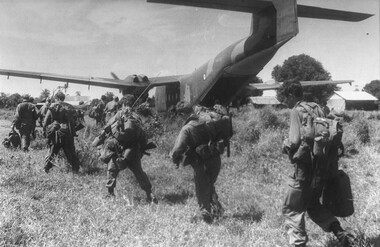
Photograph, Gibbons, Denis, Back To Base
... A black and white photograph of An RAAF 35 Squadron Caribou transport aircraft, after landing in a paddock outside of the Vietnamese village of Xuyen Moc, collects members of the 5th Battalon, Royal Australian Regiment, following their successful operations in the area....Photograph Caribou RAAF 35 Squadron 5 RAR Xuyen Moc Gibbons Collection Catalogue Royal Australian Air Force 5th Battalion The Royal Australian Regiment Vietnamese Villages Denis Gibbons A black and white photograph of An RAAF 35 Squadron Caribou transport aircraft, after landing in a paddock outside of the Vietnamese village of Xuyen Moc, collects members of the 5th Battalon, Royal Australian Regiment, following their successful operations in the area. ...Denis Gibbons (1937 – 2011) Trained with the Australian Army, before travelling to Vietnam in January 1966, Denis stayed with the 1st Australian Task Force in Nui Dat working as a photographer. For almost five years Gibbons toured with nine Australian infantry battalions, posting compelling war images from within many combat zones before being flown out in late November 1970 after sustaining injuries. The images held within the National Vietnam Veterans Museum make up the Gibbons Collection.A black and white photograph of An RAAF 35 Squadron Caribou transport aircraft, after landing in a paddock outside of the Vietnamese village of Xuyen Moc, collects members of the 5th Battalon, Royal Australian Regiment, following their successful operations in the area.photograph, caribou, raaf, 35 squadron, 5 rar, xuyen moc, gibbons collection catalogue, royal australian air force, 5th battalion, the royal australian regiment, vietnamese villages, denis gibbons -
 National Vietnam Veterans Museum (NVVM)
Photograph, Gibbons, Denis, Heliborn Assault 2
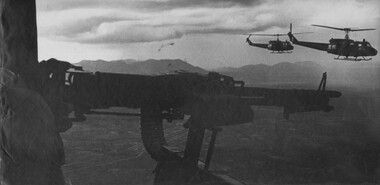
... A black and white photograph of RAAF Huey 'slick' Helicopters transporting Diggers from the 1st Australian Task Force Base, Nui Dat, Phuoc Tuy Province, to their drop zone to commence operations. ...Photograph Huey Helicopter RAAF 1 ATF Nui Dat Phuoc Tuy Province M 60 Machine Gun 7.62 Gibbons Collection Catalogue Denis Gibbons Photographer Vietnam War Diggers A black and white photograph of RAAF Huey 'slick' Helicopters transporting Diggers from the 1st Australian Task Force Base, Nui Dat, Phuoc Tuy Province, to their drop zone to commence operations. ...Denis Gibbons (1937 – 2011) Trained with the Australian Army, before travelling to Vietnam in January 1966, Denis stayed with the 1st Australian Task Force in Nui Dat working as a photographer. For almost five years Gibbons toured with nine Australian infantry battalions, posting compelling war images from within many combat zones before being flown out in late November 1970 after sustaining injuries. The images held within the National Vietnam Veterans Museum make up the Gibbons Collection.A black and white photograph of RAAF Huey 'slick' Helicopters transporting Diggers from the 1st Australian Task Force Base, Nui Dat, Phuoc Tuy Province, to their drop zone to commence operations. The machine gun depicted in the forefront of the photograph is a 7.62mm belt-fed weapon.photograph, huey helicopter, raaf, 1 atf, nui dat, phuoc tuy province, m 60 machine gun 7.62, gibbons collection catalogue, denis gibbons, photographer, vietnam war, diggers -
 National Vietnam Veterans Museum (NVVM)
Photograph, Gibbons, Denis, Catching Up
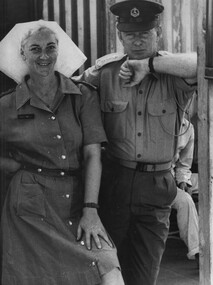
... A black and white photograph of Capt Shirley Southwell (RAANC) and her brother Capt Terry Southwell 5th Battalion Royal Australian Regiment, snatch a few moments together as they watch the sick being loaded aboard ambulances for RAAF medivac C130 medivac transport to Australia...Photograph 1st Australian Field Hospital RAANC Nurse Capt Shirley Southwell Capt Terry Southwell 5 RAR RAAF Medivac C130 Medivac Flight Gibbons Collection Catalogue Vung Tau A black and white photograph of Capt Shirley Southwell (RAANC) and her brother Capt Terry Southwell 5th Battalion Royal Australian Regiment, snatch a few moments together as they watch the sick being loaded aboard ambulances for RAAF medivac C130 medivac transport to Australia Catching Up Photograph Gibbons, Denis ...Denis Gibbons (1937 – 2011) Trained with the Australian Army, before travelling to Vietnam in January 1966, Denis stayed with the 1st Australian Task Force in Nui Dat working as a photographer. For almost five years Gibbons toured with nine Australian infantry battalions, posting compelling war images from within many combat zones before being flown out in late November 1970 after sustaining injuries. The images held within the National Vietnam Veterans Museum make up the Gibbons Collection.A black and white photograph of Capt Shirley Southwell (RAANC) and her brother Capt Terry Southwell 5th Battalion Royal Australian Regiment, snatch a few moments together as they watch the sick being loaded aboard ambulances for RAAF medivac C130 medivac transport to Australiaphotograph, 1st australian field hospital, raanc, nurse, capt shirley southwell, capt terry southwell, 5 rar, raaf, medivac, c130 medivac flight, gibbons collection catalogue, vung tau -
 Melbourne Tram Museum
Photograph - Digital Image, Cheryl Williams, "Electric Tram Driver's Certificate No. 407", Original 1929
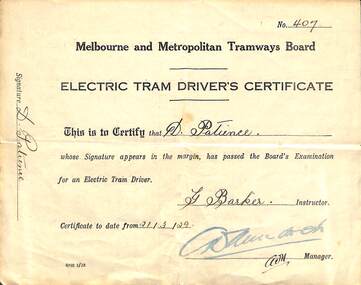
... Ran in the Stawell Gift of 1925 (injured foot during the race), was a Navigator on Transport RAF/RAAF flights during WW2. War memorabilia to the War Memorial Canberra. ...Ran in the Stawell Gift of 1925 (injured foot during the race), was a Navigator on Transport RAF/RAAF flights during WW2. War memorabilia to the War Memorial Canberra. ...Digital image of "Electric Tram Driver's Certificate No. 407", issued to D. (Daniel) Patience, signed by G. Barker Instructor, with "A. W. Murdoch" stamp authorising the document, dated 23/3/1929. Donated by Betty (daughter - aged 90) and Cheryl Williams (grand daughter) of Daniel. Reported to have been the first driver leaving the then new Camberwell depot. Born in Avoch Scotland, was a police constable there, before emigrating to Melbourne. Was a cable tram Gripman in the Albert Park Area. Became an electric tram driver, then signalman at St Kilda Junction and trained as an inspector, but did not like the green uniform. Ran in the Stawell Gift of 1925 (injured foot during the race), was a Navigator on Transport RAF/RAAF flights during WW2. War memorabilia to the War Memorial Canberra. Cheryl advised 26/11/2019 - My grandfather was born 2nd June 1903 and died 11th Nov 1977.trams, tramways, drivers, gripmen, camberwell depot, signalmen, certificates -
 Orbost & District Historical Society
book, The Gearchange, C 2015
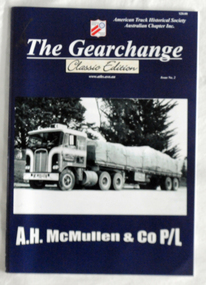
... Cream from the farms was transported to the butter factory and for almost twenty years Fuel was carted from Melbourne to the RAAF base at Sale by McMullens. ...Cream from the farms was transported to the butter factory and for almost twenty years Fuel was carted from Melbourne to the RAAF base at Sale by McMullens. ...The American Truck History Association is an international organization, with over 21,000 members in the United States, Australia, Canada, and 20 other countries worldwide. A.H. McMullen & Co P/L, established by Arthur McMillan in February, 1951, had a long history as transport operators in Orbost and Gippsland districts. The company became Gippsland's largest transport company. It carted timber from the Orbost/ Cann River district district sawmills to the railway station. Two trains a day left the sloaded with timber. Beans were carted from Fisher's Bean Factory to Melbourne and Sydney. Cream from the farms was transported to the butter factory and for almost twenty years Fuel was carted from Melbourne to the RAAF base at Sale by McMullens. In 1970 the company was sold to F.J. Stephens and then to Mayne Nickless Transport. (ref.Deborah Hall "In Times Gone By') A.H. McMullen was a significant business in the mid 20th century in Orbost. This book is a useful reference source.A 40pp book with a dark blue cover titled "The Gearchange". It is a "Classic Edition Issue No. 2" and features A.H. McMullan & C0 P/L. It has a cost of $20.00. It contains illustrations, photographs and text.transport mcmullen-transport-orbost trucking -
 Bendigo Military Museum
Photograph - Royal Australian Survey Corps personnel on survey operations in PNG and possibly Indonesia, c1975
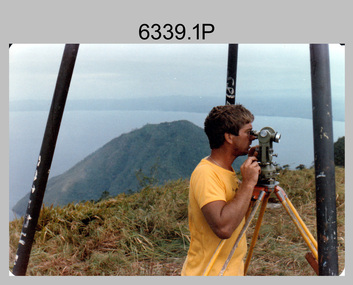
... (Iroquois helicopters) withdrew with the Australian force from Vietnam in December 1971, RAAF supported RA Svy operations with the UH-1H Iroquois helicopter for tasks of transport and resupply of survey teams. ... (Iroquois helicopters) withdrew with the Australian force from Vietnam in December 1971, RAAF supported RA Svy operations with the UH-1H Iroquois helicopter for tasks of transport and resupply of survey teams. ...This is a set of two photographs of Royal Australian Survey Corps and RAAF personnel on survey operations in PNG and possibly Indonesia circa 1975. The identified surveyor - Peter Presser served 20 years in the Australian Regular Army from 1970 to 1990. The UH-1H Iroquois helicopter (serial number partially obscured) appearing in photo 6339.2P was probably A2-379. From 1957 helicopter transport of survey parties revolutionised transport in remote areas. The most common helicopter used by the Royal Australian Survey Corps (RA Svy) up to 1972 was the civilian Bell 47G-2 and the Sioux Light Observation Helicopters (LOH), the Australian Army’s equivalent. These light observation helicopters had a limiting load carrying capacity of up to about 500 pounds. By comparison, one Aerodist team including two people weighed up to 1,500 pounds. After No. 9 Squadron (9SQN) RAAF (Iroquois helicopters) withdrew with the Australian force from Vietnam in December 1971, RAAF supported RA Svy operations with the UH-1H Iroquois helicopter for tasks of transport and resupply of survey teams. The UH-1H was capable of carrying at least three times that of the smaller Bell 47G-2/Sioux LOH helicopter and could also winch personnel and stores into difficult locations. A2-379 crashed killing the aircraft captain (FLTLT Ralph Taylor 9SQN) on impact and seriously injuring four near Wamena, Irian Jaya, Indonesia on survey Operation Cenderawasih 1977 (supporting 2 Fd Svy Sqn – Doppler satellite survey). Source: Royal Australian Survey Corps – Aerodist Years 1964-1975 by Peter Jensen.This is a set of two photographs of Royal Australian Survey Corps and RAAF personnel on survey operations in PNG and possibly Indonesia circa 1975. The photographs were printed on photographic paper and are part of the Army Survey Regiment’s Collection. The photographs were scanned at 300 dpi. .1) - Colour, black & white, c1975, Peter Presser undertaking survey observations in PNG with a Wild T2 Theodolite. .2) - Photo, black & white, c1975. Survey operations L to R: unidentified (x2), Peter Presser, unidentified. .1P and .2P – No annotations. royal australian survey corps, rasvy, army survey regiment, army svy regt, fortuna, asr -
 Bendigo Military Museum
Photograph - PHOTOGRAPHS, RAAF WW2, c.WWII
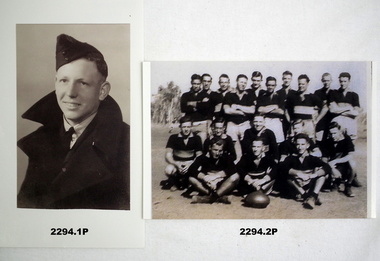
... .1) Arthur John Gorsuch Hando No 116921 enlisted in the RAAF on 19.7.1942 age 18 years. At discharge on 12.4.1946 he held the rank of LAC in No 6 Transport Movement Office RAAF. .2) - .5) Photographs reflect service life in Darwin during World War II.....1) Arthur John Gorsuch Hando No 116921 enlisted in the RAAF on 19.7.1942 age 18 years. At discharge on 12.4.1946 he held the rank of LAC in No 6 Transport Movement Office RAAF. .2) - .5) Photographs reflect service life in Darwin during World War II. photography-photographs military history- army - airforce RAAF .1) ARTHUR HANDO, Air Force 2nd World War. .2) A HANDO 4th from top, 5 RC Air Force footy team. .3) 2nd World War, Darwin, ARTHUR J HANDO. ....1) Arthur John Gorsuch Hando No 116921 enlisted in the RAAF on 19.7.1942 age 18 years. At discharge on 12.4.1946 he held the rank of LAC in No 6 Transport Movement Office RAAF. .2) - .5) Photographs reflect service life in Darwin during World War II..1) Portrait of WWII Airmen - copy of original. .2) Group photograph of a football team - copy of original. .3) Group sitting on truck - copy of original. .4) x 2 Trucks - copy of original. .5) Group of 3 - copy of original..1) ARTHUR HANDO, Air Force 2nd World War. .2) A HANDO 4th from top, 5 RC Air Force footy team. .3) 2nd World War, Darwin, ARTHUR J HANDO. Pop 1st one sitting on car, no hat. .5) A HANDO.photography-photographs, military history- army - airforce, raaf -
 Bendigo Military Museum
Literary work - DIARIES WW2, C. 1942
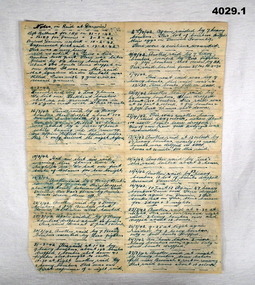
... RAAF. Enlisted 22-8-1941, Discharged 5-12-1945. Serving in 9 Transport and Movement....RAAF. Enlisted 22-8-1941, Discharged 5-12-1945. Serving in 9 Transport and Movement. ...Diary written by LAC John Morrison No. 42562 RAAF. Enlisted 22-8-1941, Discharged 5-12-1945. Serving in 9 Transport and Movement..1) Diary, ruled paper, blue ink, both sides, dated 31-1-1942 to 24-11-42 detailing the raids on Darwin. .2) Document, typed in black re: Darwin air raids beginning 19-2-42, 4-3-42 and 16-3-42. This is .1) beginning to be typed out.diary, lierary work, raaf, darwin -
 Bendigo Military Museum
Map - MAP of LONDON, The Authentic Map of London
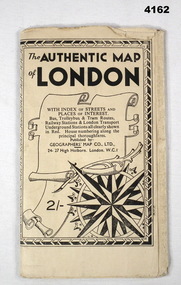
... RAAF. Refer cCat No 3536P for his service details. map london Black and white folded street map with transport routes/stations marked in orange. ...Map of London with also places of interest. Part of th collection of Frederick Gardner Davey DFC No 410533 RAAF. Refer cCat No 3536P for his service details.Black and white folded street map with transport routes/stations marked in orange. Cover is black and white print, features a scroll and compass design inside a B & W border, written details in black type, street index printed on inside of the cover.map, london -
 Bendigo Military Museum
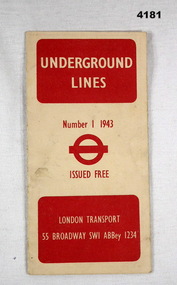
Map - UNDERGROUND LINES, London Transport, 1943
... RAAF collection. Refer Cat No 3536P for his service details. Map London Underground Cream card with red print on the cover, has two fold out sections to give a map of the London Underground. Map UNDERGROUND LINES London Transport ...Item part of the Fredrick Gardner Davey DFC No 410533 RAAF collection. Refer Cat No 3536P for his service details.Cream card with red print on the cover, has two fold out sections to give a map of the London Underground.map, london, underground -
 Bendigo Military Museum
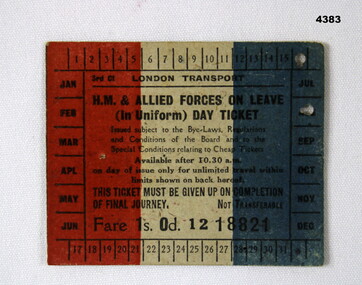
Souvenir - RAILWAY TICKET, Bell Punch Coy LTD, C. WW2
... Part of the Frederick Gardner Davey DFC RAAF collection.Refer Cat No 3536P. Souvenir leave pass transport ticket Clipped holes 0n “16” and “Aug” Rectangular card ticket with black type on both sides, front has a red stripe on left and blue on the right, around the outer edges are date spaces which can be clipped to indicate the day used, back has details of train/bus and tram services available for use. ...H.M and Allied Forces on leave (in uniform) day ticket issued to service personnel for use in London during WW2, ticket used on 16th August, year not known. Part of the Frederick Gardner Davey DFC RAAF collection.Refer Cat No 3536P.Rectangular card ticket with black type on both sides, front has a red stripe on left and blue on the right, around the outer edges are date spaces which can be clipped to indicate the day used, back has details of train/bus and tram services available for use.Clipped holes 0n “16” and “Aug”souvenir, leave pass, transport ticket -
 Bendigo Military Museum
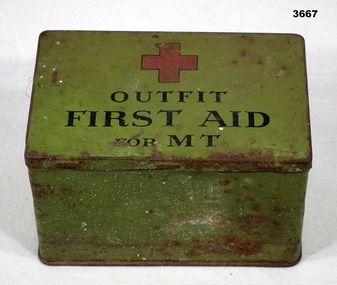
Equipment - BOX, FIRST AID, Johnson & Johnson, c.1930 - 1945
... Original owner was WO Donald McKindlay WOOLCOCK, RAAF 5158 “MT” possibly means Motor Transport...Original owner was WO Donald McKindlay WOOLCOCK, RAAF 5158 “MT” possibly means Motor Transport Kit first aid MT At top: “A Red Cross” In black print below: “OUTFIT FIRST AID FOR MT” Green metal, box with red cross & black print. ...Original owner was WO Donald McKindlay WOOLCOCK, RAAF 5158 “MT” possibly means Motor TransportGreen metal, box with red cross & black print. Contents include bandages, gauze, field dressing.At top: “A Red Cross” In black print below: “OUTFIT FIRST AID FOR MT” kit, first aid, mt -
 Waverley RSL Sub Branch
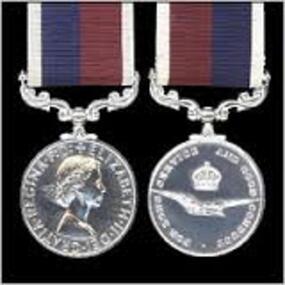
R.A.A.F. Long Service Medal
... They were able to move around between small units, such as RAAF radar stations, where they could plug into the local power supply and work immediately. b. Transportable ...Awarded to Alan Bowers (A236814) who was a R.A.A.F. dental mechanic who serverd during WWII including service in Darwin, and then continued in the R.A.A.F. for some years after the end of WWII The Royal Australian Air Force (and all Commonwealth Air Forces) Long Service and Good Conduct Medal: Awarded to NCOs and ORs of the RAAF (RAF, RCAF etc) for 15 years service. A cupro-nickel plated medal, the obverse features the sovereign's head, the reverse features the crown and eagle emblem of the RAAF (and RAF). Officers are eligible for the award provided they have served a minimum 12 years in the ranks. The riband is dark blue and maroon with white edges. This medal ceased to be awarded in Australia in 1975 when it was replaced by the National Medal (and sbsequently the DFSM and DLSM) in the Australian system of honours and awards. http://www.heritagemedals.com.au/medals-1/service-long-service/air-force-long-service-and-good-conduct-medal.html History of the RAAF Dental Branch It took six years following the formation of the RAAF in 1921 for the first Dental Clinic to be established at Point Cook, Victoria. On 10th June 1927 Flying Officer James Carl Rosenbrock commenced work as an RAAF Dental Officer for the FlyingTraining School at Point Cook. As personnel numbers were still relatively small, Rosenbrock was also responsible for the dental care of all Victorian RAAF units, which involved treating members at 1AD Laverton, as well as Air Force Headquarters at Victoria Barracks in Melbourne. As Army Dental Officers were currently caring for RAAF personnel at Richmond, NSW, the Senior Dental Officer of the 3rd Military District in Victoria (SDO 3MD) requested through the military board that a similar arrangement be established, where that the newly appointed RAAF Dentist provide part time dental services to the Army units stationed at Queenscliff. This was seen as an effective reciprocal arrangement, with both units having a Dental Officer in attendance for, in total, around 3-4 weeks a year. Rosenbrock continued to serve as the sole RAAF Dental Officer until the middle of 1933, when the Air Board asked for his service to be terminated following ‘behaviour unbecoming of a RAAF officer'. He had borrowed several sums of money, of around 40 Pounds or so, from junior ranks on base (as well as from the Regimental Sergeant Major) and had failed to pay the money back. He was replaced by a fellow Victorian, FLGOFF Norman Henry Andrews, on the 18th Sep 1933, who went on to become our first Director of Dental Services, and was instrumental in establishing the organisations and conditions of the Branch that are still present today. Through a fair amount of persistence and hard work on the part of Norman Andrews, the RAAF Dental Branch began to expand from 1937, with the introduction of 2 additional positions, at RAAF station Richmond, and at the FlyingTraining School at Point Cook. This gave the RAAF 3 uniformed Dental Officers, which was expanded to 5 in the months leading up to WW2. 4 of these Dental Officers were based in Victoria and 1 at Richmond, with the other two RAAF units being cared for by the Army (as in the case of Pearce in WA) or by civilians (as in Darwin). With the sudden increase in RAAF personnel required at the outbreak of WW2, the number of RAAF Dental Officers increased dramatically, from 5 in 1939, 28 in 1940, 64 in 1941, 147 in 1942, 193 in 1943, 219 in 1944, and peaking at 227 in 1945. RAAF Dental Officers were required to work in a variety of locations, both in and out of Australia. Between 1940 and 1942 a massive construction programme occurred, with new dental clinics being established around Australia. Priority was given to aircrew training units in order to get these personnel dentally fit for operational deployment, but Dental Officers could equally find themselves posted to recruit depots, fixed stations, medical clearance stations, mobile dental sections, and RAAF and civilian hospitals. RAAF Dental Officers were posted to the large dental centres at Ascot Vale (Vic) and Bradfield Park (NSW) when first appointed, where they received military and clinical training, before being deployed to their needed location. Mobile Dental Units When Japan entered the war in 1941, the rapid deployment of troops to northern operational areas with less than ideal dental fitness was extremely high. As a result, the RAAF deployed a range of mobile dental units, either alone or with medical sections, to support the increasing number of isolated deployed personnel within Australia and overseas. There were three types of mobile unit used: a. Mobile Dental Unit – relied on using either a semi-trailer to get around or by building a surgery directly on to the truck chassis, and installing hydraulic chairs, units, x-rays, and laboratory equipment. They were able to move around between small units, such as RAAF radar stations, where they could plug into the local power supply and work immediately. b. Transportable Dental Units – used for stops of longer duration, where field equipment was carried in panniers from one unit to another by road or rail and housed in whatever accommodation was available at the destination. They were often carried within Australia on Tiger Moths and Dakota aircraft. c. Itinerant Dental Units – in some areas, the dental equipment was installed at the RAAF unit and the Dental Officer and their staff would travel from unit to unit, using the equipment available at each location. RAAF Dental BadgeAs the war developed in Europe, it soon became obvious that the RAF Dental support was not capable of supporting the increasing numbers of RAAF aircrew that were being sent for service with the RAF, with only enough Dental Officers available to provide one to every 2000 men ( instead of the preferred 1 to 600). As a result, the RAAF provided a mobile dental unit, fitted out in a caravan and pulled by a Ford V8 Coupe, to travel around England in support of RAAF personnel at various squadrons. Some degree of tact was needed to ensure that the RAF did not take this as a comment on the treatment they were providing, but it proved successful in maintaining a satisfactory state of dental fitness in RAAF personnel, and a second mobile unit was soon dispatched. They were also set up with a laboratory on board as well as the surgery, which was a major difference between the RAF and RAAF, as the RAF did not provide dentures for their troops (the RAAF would, providing they had served for 6 years). In 1943 the RAF was no longer able to provide Dental support to Australian troops in the Middle East, which resulted in the need for a transportable dental unit to be deployed from Australia. It functioned in a similar manner to the RAF, by moving from one squadron to another. It served in the Middle East and Africa, from Cairo across North Africa, to Italy, and eventually back to England to treat returned prisoners of war. GPCAPT Norman Andrews The growth and development of the RAAF Dental Branch owes a debt to one man in particular, GPCAPT Norman Andrews. As the second RAAF Dental Officer to enlist on 18 Sep 1933, Andrews became the principal architect of the structure and organisation of the RAAF Dental Branch leading up to and during WW2. Until early 1940, the RAAF Dental Branch was administered by the Director of Medical Services (Air), which placed it under the control of the Army Medical staff. The Army would provide their Inspector of Dental Services for advice whenever needed. In April 1940, the RAAF Medical service separated from the Army, resulting in the control of the RAAF Dental Branch shifting back to the RAAF. Andrews became the first Director of Dental Services, when the position was created in 1943 as recognition of the higher profile the Dental Branch was now playing in the RAAF Medical service. Until this time, Andrews's title had been as the Dental Staff Officer to the RAAF Medical Service. Andrews was responsible for the establishment of the war-time structure of the Dental service, establishing new dental centres at all major bases, creating mobile and transportable dental units, ensuring the continual growth of the Branch, maintaining professional development of staff through the establishment of a professional journal, and by organising renowned lecturers to speak at RAAF bases. He also believed in visiting as many dental units as possible to see for himself what conditions were like and to talk first-hand to staff in remote units. His itinerary during the war years, both in and out of Australia, shows a large number of trips in a variety of modes of transport in order to reach remote areas where units were serving. He was promoted to GPCAPT in July 1944, as the numbers of Dental Officers soon peaked at 227 towards the end of the war (1 GPCAPT, 9 WGCDRs, 60 SQNLDRs, and 157 FLTLTs). After the war, with the reduction in RAAF personnel required in uniform, the Dental Branch also reduced its numbers significantly. By 1947 there were only 18 Dental Officers serving (many part-time), with 1 GPCAPT, 1 WGCDR, 10 SQNLDRs, and 6 FLTLTs, and only 13 by 1950. With the decrease in Branch personnel numbers, the ‘powers to be' saw fit to reduce the Director of Dental Service rank to WGCDR, and as a result Norman Andrews found that in order to continue serving in the RAAF he would have to wear a reduced rank. This appears to have been a contributing factor in his decision to discharge at the relatively early age of 43 and accept an administrative job as Director of the Victorian Government's School Dental Service. Norman Andrews holds the proud honour of being the founder of the RAAF Dental Branch, which during the war was instrumental in educating servicemen of the importance of dental health and maintaining the dental fitness of troops in a variety of areas. Dental Orderlies (Assistants) The dental orderly mustering was first introduced in 1937. Until that time, medical orderlies were assigned to assist the Dental officer with their duties. As early as 1931 it had been noted by both RAAF and Army Dental Officers working in Victoria and Richmond that a lot of the troubles they were having would be solved by appointing a permanent Dental Orderly. Often they would find that the medical orderly they were assigned was a different one each day, and as a result the administration and work in general was very inefficient. By 1937, with the increase in Dental Officers to 3, it was realised that a Dental Orderly mustering needed to be created. Dental Mechanics/Technicians Before WW2, dental laboratory work was provided by civilian laboratories, as most RAAF units were stationed around metropolitan areas. At this time, service personnel were still required to pay for their own dentures, unless they had served for six years or had their dentures damaged during performance of their duties. In July 1940, mainly in response to the development of more remote RAAF dental units and the increasing demand for dental prostheses, the Dental Mechanic mustering was established. Unfortunately there was a very limited pool of civilian dental mechanics to recruit from, and as a result the RAAF set up a training school at Laverton (which was later moved to Ascot Vale) in June 1941 which conducted an intensive 6 month course in Dental mechanics. Dental mechanics were quickly in demand. In all fixed and mobile dental units at least 1 Mechanic was supplied for each Dental Officer, and indeed the RAAF supplied Dental Mechanics throughout all its deployments, something the RAF were unwilling, or unable, to do. Two grades of dental mechanic existed: the Senior Mechanic (with the rank of NCO), who was competent in all phases of laboratory work; and the Junior Mechanic, who could only handle routine work and not more advanced denture work. The progression to Senior required a further trade test in techniques including setting up, clasp-forming, casting and backing teeth. During the course of the War, two special courses were held for Mechanics. The first, directed at senior mechanics so that they could instruct others, was in 1942 when Acrylic Resin was first introduced as a denture base material, as an alternative to the current option of vulcanite. Later, towards the end of the War, a ‘refresher' course was provided for those that had served for the greatest period of time in order to allow them retraining in techniques that they had not practised during their service and which were common in civilian life. This included cast base dentures, crowns and bridges, partial dentures, and retainers. Towards the end of the War, a course was held with WAAAF trainees to train them as Mechanics. However, as the War was soon to end they never had the opportunity to progress within the mustering to become Senior Mechanics. The RAAF Dental Branch has survived 75 years of turbulence, with reviews of its viability occurring regularly every few years from as early as 1937. The Branch continues to provide excellent service to the ADF community and, despite reduced manpower, will continue to play an important role in Air Force Health operations. http://www.defence.gov.au/health/about/docs/RAAFDental.pdf40cm cupro-nickel plated medal, the obverse features the sovereign's head, the reverse features the crown and eagle emblem of the RAAF (and RAF). A23814 BOWERS.A. A. F.r.a.a.f long service medal, r.a.a.f good conduct, r.a.a.f. dental service medal -
 Running Rabbits Military Museum operated by the Upwey Belgrave RSL Sub Branch
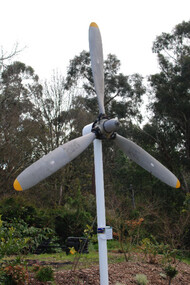
Propeller for a DHC-4 Caribou light transport
... RAAF Caribou Aircraft Propeller for a DHC-4 Caribou light transport Propeller for a DHC-4 Caribou light transport DeHaveland Canada ...DHC-4 Caribou light transport The Royal Australian Air Force DHC-4 Caribou was a versatile tactical light transport aircraft . Its main operational role was tactical air transport in support of the Australian Army. The Caribou was last operated by No 38 Squadron from RAAF Base Townsville in December 2009. The Caribou is a twin-engined high-wing monoplane with full-span double-slotted Fowler flaps and fully-reversible propellers, which allow it to achieve its trademark steep approach with very short take-offs and landings on unprepared runways. The high wing and distinctive high placement of the tail provide easy access to a large cargo compartment, while the low-pressure tyres permit operation on unprepared runways. It was the last piston-engined aircraft in the Air Force and was our only aircraft to employ the Low Altitude Parachute Extraction System (LAPES), where up to 2000kg of sled-mounted cargo is extracted from the aircraft by a parachute from a metre above the ground. The Caribou is equipped with GPS satellite navigation and night-vision equipment, giving it the capability to operate in any weather, day or night, to either land or drop soldiers and equipment by parachute with pinpoint accuracy. The Caribou is not pressurised and is not fitted with auto-pilot or weather radar. The first Caribou arrived in Australia in April 1964 and they were deployed to Vietnam from July 1964 to February 1972 and carried over 600,000 passengers and a huge quantity of cargo while they were there. Since 1997 the Caribou participated in famine-relief operations in Papua New Guinea and Irian Jaya during Operations SIERRA, PLES DRAI and AUSINDO JAYA, as well as the tsunami-relief operation in PNG in 1999 and operations in East Timor and the Solomon Islands since 1999. Their service life was over 40 years. raaf caribou aircraft
