
Showing 39 items matching "received telegram"
-
 Eltham District Historical Society Inc
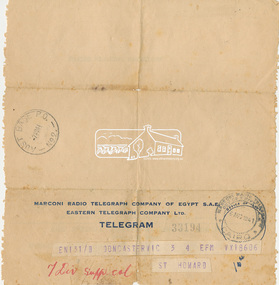
Telegram, Birthday greetings to Sefton Howard (VX18606); Telegram received from D. Thomson in Cairo, Egypt, 6 August 1941, 1941
... Birthday greetings to Sefton Howard (VX18606); Telegram received from D. Thomson in Cairo, Egypt, 6 August 1941...2nd AIF, Cairo, Dave Thomson, Egypt, Letters, Lew Howard Collection, Second World War, Sefton Thomas Cranton Howard, WW2 Digital file only - scanned by EDHS from item on loan Birthday greetings to Sefton Howard (VX18606); Telegram received from D. Thomson in Cairo, Egypt, 6 August 1941 Telegram ...Digital file only - scanned by EDHS from item on loan 2nd aif, cairo, dave thomson, egypt, letters, lew howard collection, second world war, sefton thomas cranton howard, ww2 -
 Federation University Historical Collection
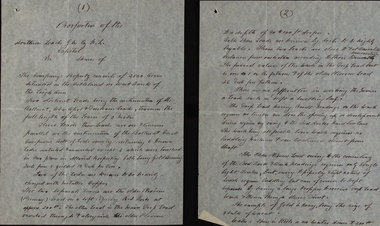
Ephemera, Various papers relating to Richard Squire Mines
... ...Received Telegram...Pearson William Barrett Ballarat Deep Lead Extension Harwood & Pincott Edmund Woodlock leigh river tunnel syndicate Federal Debt Collecting Coy The Southern Extension of Main Ballarat Gold Fields Telegram Received Telegram Mt Mercer Lease Souvenir Telegram Mining Date stamps Various papers relating to Richard Squire Mines including telegrams, reports, receipts, letters and newspaper clippings. .1 Souvenir Telegram .2 Telegram .3 Telegram .4 Telegram .5 Telegram .6 Telegram .7 Telegram .8 Telegram .9 Telegram .10 Telegram .11 Telegram .12 Telegram .13 Telegram .14 Telegram .15 Telegram .16 Newspaper article Mt Mercer Lease 8109, Ballarat .17 Report on the Southern Extension of Main Ballarat Goldfield .18 Letter from Harwood & Pincott Solicitors and Notaries re: Agreement .19 Ballarat Deep Leads Extensions .20 Leigh River Tunnel Syndicate Voucher x 4 .21 Debt Collector Letter .22 HY. ...In 1905 Richard Squire was manager of the West Berry Consols at Allendale, and developed an improved system of mine ventilation, which was supported in "The Age."[4] He was successful in combating and remedying the gas and ventilation troubles of the Deep Mines of Creswick and Allendale Districts after all had failed. MINE MANAGERS’ ASSOCIATION. Ballarat Branch. ... Mr R. B. Squire, manager of the West Berry Consols, at Allendale, submitted a paper detailing what he had done tor the betterment of ventilation in the alluvial mines of Smeaton and Mary borough districts- Members gave Mr Squire every credit for the results that he claimed to have effected; the adoption of his ideas had testified to their value to mine-owners. It was painted out, however, that for want of a thorough debate of the subject with experienced men the author had unwittingly included some general statements that required modifying in some points and extending in others, in justice to other workers among the earlier and the present day managers of mines. It was decided to invite the author to meet a sub-committee on this subject!Various papers relating to Richard Squire Mines including telegrams, reports, receipts, letters and newspaper clippings. .1 Souvenir Telegram .2 Telegram .3 Telegram .4 Telegram .5 Telegram .6 Telegram .7 Telegram .8 Telegram .9 Telegram .10 Telegram .11 Telegram .12 Telegram .13 Telegram .14 Telegram .15 Telegram .16 Newspaper article Mt Mercer Lease 8109, Ballarat .17 Report on the Southern Extension of Main Ballarat Goldfield .18 Letter from Harwood & Pincott Solicitors and Notaries re: Agreement .19 Ballarat Deep Leads Extensions .20 Leigh River Tunnel Syndicate Voucher x 4 .21 Debt Collector Letter .22 HY. W. Pearson Account .23 William Barrett Mining and General Blacksmith Quote and Account .24 Letter from Department of Mines, Melbourne dated 5th December 1934 .25 Letter from Mines Department, Melbourne dated 27th August 1937 .26 Documentsrelating to the purcghase of a wreath for R. Woolley .27 Prospectus of the Southern Leads .28 Propsal prospectus of Leigh River .29 Letter to Tom Squire from his brother Jim .30 Letter to Mr Squire from C Hayes regarding wages owed .31 3 copies of report on mine 8th August 1935 .32 Letter regarding unpaid account .33 Contributary causes of Collapse at Mt Mercer .34 Letter from D. Crawford re payment for timber .35 Letter from John McLeod apologising for not sending cheque .36 Letter from Department of Mines regarding Neil Cameron purchases of portions 64, 65. 66 and 71 .37 3 Letters from Department of Mines granting an extension of time to pay overdue rent. .38 Letter from Department of Mines regarding Mining Lease No. 8217 .39 Letter from Department of Mines regarding Lease Rents .40 Letter from the Department of Mines regarding further boring at Mt Mercer .41 Letter from E.R Hodge requesting that Richard Squire meet with Board members of Glenfine South .42 Letter from G Brown regarding Leases not being paid for .43 Letter from daughter Judy .44 Newspaper article regarding Berry United Deep Leads .45 Envelope addressed to R.T Squire Box 2 Tresco .46 Letter to Richard Squire from A.L. Read Date stamps richard squire, tom squire, jim squire, reports, contributary causes, account, c. hayes, proposal, prospectus, leigh river, southern leads, una cooperative society ltd., wreath, r. woolley, department of mines, e. woodlock, a.l. read, geo brown, hy. w. pearson, william barrett, ballarat deep lead extension, harwood & pincott, edmund woodlock, leigh river tunnel syndicate, federal debt collecting coy, the southern extension of main ballarat gold fields, telegram, received telegram, mt mercer lease, souvenir telegram, mining -
 Federation University Historical Collection
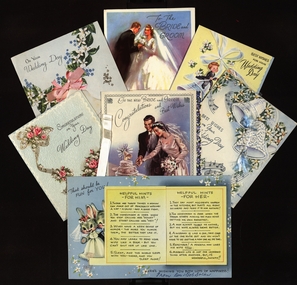
Correspondence, Chatham-Holmes Collection: Mary Elizabeth Holmes: Wedding Cards received - marriage to Philip Chatham, 1957, 1957
... Cards, letters and telegrams received on the occasion of the marriage of Mary Elizabeth Holmes to Philip Chatham....mary elizabeth holmes philip chatham marriage cards letters telegrams wedding invitation chatham-holmes collection Cards, letters and telegrams received on the occasion of the marriage of Mary Elizabeth Holmes to Philip Chatham. ...Cards, letters and telegrams received on the occasion of the marriage of Mary Elizabeth Holmes to Philip Chatham.mary elizabeth holmes, philip chatham, marriage, cards, letters, telegrams, wedding invitation, chatham-holmes collection -
 Federation University Historical Collection
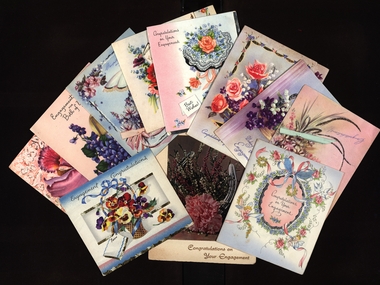
Correspondence, Chatham-Holmes Collection: Mary Elizabeth Holmes: Engagement Cards and Letters, 1956, 1956
... Various cards, letters and telegrams received by Mary Elizabeth Holmes on the occasion of her engagement to Philip Chatham in 1956....mary elizabeth holmes philip chatham engagement cards telegrams letters 1956 ascot launchley Various cards, letters and telegrams received by Mary Elizabeth Holmes on the occasion of her engagement to Philip Chatham in 1956. ...Various cards, letters and telegrams received by Mary Elizabeth Holmes on the occasion of her engagement to Philip Chatham in 1956.mary elizabeth holmes, philip chatham, engagement, cards, telegrams, letters, 1956, ascot, launchley -
 Returned Nurses RSL Sub-branch
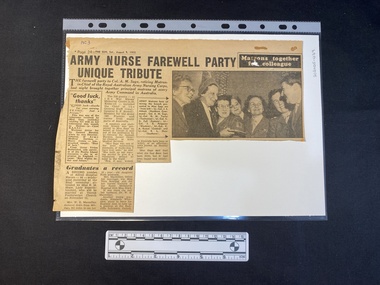
Newspaper - Newspaper clipping, The Sun, Army nurse farewell party : unique tribute, August 9 1952
... Miss Sage also received telegrams from well wishers.. ...Miss Sage also received telegrams from well wishers.. Annie Moriah Sage Sydney Fairbairn Rowell Josiah Francis Samuel Burston Harry Crowe Vivien Bullwinkel Banka Island G M Taylor C A Fall Jean Elsie Ferguson Joan Stevenson Abbott C A Kestal Edith Lydia Shaw 'NC3' [blue ink, top left, front of page] 'NC3' [blue ink, top right, back of page] A newspaper clipping from a larger page, consisting of three columns of text next to a black and white photo of a group of women, one of which is presenting something to another. ...The farewell party for Col Annie Sage, retiring Matron-in-Chief of the Royal Australian Army Nursing Corps (RAANC) brought together principal matrons of every Army Command in Australia, as part of the 250 guests. Guests included nurses from many parts of Australia, as well as the Chief of the General Staff, Minister for the Army and the former Director-General of Army Medical Services. A brooch was presented to Miss Sage on behalf of friends in and out of the profession by the former Director-General, who said "Miss Sage was one of the most outstanding examples of leadership I have ever seen." Miss Sage also received telegrams from well wishers.. A newspaper clipping from a larger page, consisting of three columns of text next to a black and white photo of a group of women, one of which is presenting something to another.'NC3' [blue ink, top left, front of page] 'NC3' [blue ink, top right, back of page]annie moriah sage, sydney fairbairn rowell, josiah francis, samuel burston, harry crowe, vivien bullwinkel, banka island, g m taylor, c a fall, jean elsie ferguson, joan stevenson abbott, c a kestal, edith lydia shaw -
 Alfred Hospital Nurses League - Nursing History Collection
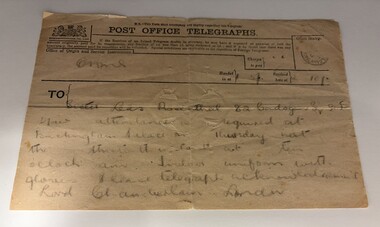
Ephemera - Telegram, Eyre & Spottiswoode Ltd, Telegram from Lord Chamberlain to Leah Rosenthal, 1919
... Leah Rosenthal received this telegram to attend Buckingham Palace to receive the Associate Royal Red Cross at Buckingham Palace in April 1919. ...Leah Rosenthal received this telegram to attend Buckingham Palace to receive the Associate Royal Red Cross at Buckingham Palace in April 1919. ...Leah Rosenthal received this telegram to attend Buckingham Palace to receive the Associate Royal Red Cross at Buckingham Palace in April 1919. Leah Rosenthal had volunteered to join the Queen Alexandra Imperial Nursing Service Reserve in 1914 and served in France during World War I. Of significance as Leah Rosenthal was a graduate of the Alfred HospitalLight brown paper with black print, and penciled messageOld catalogue number written on back at top leftleah rosenthal, world war 1914-1918 -
 4th/19th Prince of Wales's Light Horse Regiment Unit History Room
Documents, South African War
... A collection of photocopied newspaper articles, line drawings and photos about the Boer War, together with transcripts of some telegrams received by 2nd Bn A.C.H while in South Africa, and a section of 1st Australian Commonwealth Horse diary from 12 Feb to 28 Feb on their departure from Melbourne...Boer War A collection of photocopied newspaper articles, line drawings and photos about the Boer War, together with transcripts of some telegrams received by 2nd Bn A.C.H while in South Africa, and a section of 1st Australian Commonwealth Horse diary from 12 Feb to 28 Feb on their departure from Melbourne South African War Documents ...A collection of photocopied newspaper articles, line drawings and photos about the Boer War, together with transcripts of some telegrams received by 2nd Bn A.C.H while in South Africa, and a section of 1st Australian Commonwealth Horse diary from 12 Feb to 28 Feb on their departure from Melbourneboer war -
 Northern District School of Nursing. Managed by Bendigo Historical Society Inc.
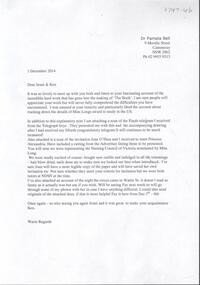
Document - Memories of Dr Pamela Bell (nee Thacker) NDSN School 28
... Two pages of typewritten memories of NDSN School 28 from Dr Pamela Bell nee Thacker together with a two page description of the night circus members joined their party and copy of a telegram received on her finals and a drawing received from the Telegraph boys after receiving her fiftieth congratulatory telegram. ...Northern District School of Nursing Nursing Nurse education Two pages of typewritten memories of NDSN School 28 from Dr Pamela Bell nee Thacker together with a two page description of the night circus members joined their party and copy of a telegram received on her finals and a drawing received from the Telegraph boys after receiving her fiftieth congratulatory telegram. ...Northern District School of NursingTwo pages of typewritten memories of NDSN School 28 from Dr Pamela Bell nee Thacker together with a two page description of the night circus members joined their party and copy of a telegram received on her finals and a drawing received from the Telegraph boys after receiving her fiftieth congratulatory telegram. Also included is a copy of an invitation to a reception for Princess Alexandra and a Bendigo Advertiser article about the invitees.nursing, nurse education -
 Harcourt Valley Heritage & Tourist Centre
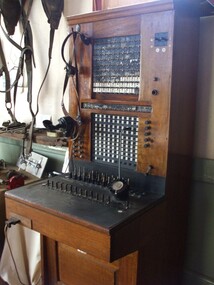
manuel telephone exchange
... Nearby stood pigeonholes with various items of stationary. Many telegrams were received each day, particularly advising fruit growers on interstate markets. ...Nearby stood pigeonholes with various items of stationary. Many telegrams were received each day, particularly advising fruit growers on interstate markets. ...A manual telephone exchange, manufactured by British Ericson, History Originally in use at Cohuna. When Cohuna was converted to automatic dialing this exchange was relocated to Harcourt, to become the third and last in a bank of three exchanges. At this time Harcourt exchange was expanded to 260 lines. It was connected to the district central exchange at Castlemaine. Operated by mains power with battery back-up. Harcourt exchange was operated by Betty McLean, Miss Mitchell, Josie Hogarth, Mr. & Mrs. Heighway, Bill & Valerie Milford, Irene Bolitho and others. Decommissioned approx. 1970. Incoming calls prompted the fall of a shutter. The operator made the connection by plugging the line into the number requested. While responding to calls the operator needed her hands free to jot down the billing particulars or to write out each telegram. Nearby stood pigeonholes with various items of stationary. Many telegrams were received each day, particularly advising fruit growers on interstate markets. Most telegrams were phoned through by the operator. This exchange was restored in 2004 - 2005 by Trevor Grant.. Many people relate to this exchange. It is a survivor of the pre-electronic era when ‘telephonist’ was a common occupation. A vital element in the communications between households and between district orchardists and their suppliers and clients.A manual telephone exchange, manufactured by British Ericson complete with operator hands-free headset/earphones and speaker mouthpiece. Wooden case with one hundred shutters and sockets. Accommodates twelve lines with extension leads with associated switches. Operated by mains power with battery back-up. Decommissioned approx. 1970. Incoming calls prompted the fall of a shutter. The operator made the connection by plugging the line into the number requested. This exchange was restored in 2004 - 2005 by Trevor Grant. -
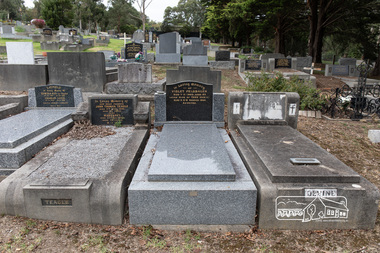 Eltham District Historical Society Inc
Photograph, Peter Pidgeon, Grave of Violet Feldbauer (nee Teagle), Eltham Cemetery, Victoria, 5 April 2021
... Valerie noted: “I will never forget the sound my mother made when she received the telegram saying Dad had died months earlier, ostensibly from Malaria, but he died during the march. ...Valerie noted: “I will never forget the sound my mother made when she received the telegram saying Dad had died months earlier, ostensibly from Malaria, but he died during the march. ...FELDBAUER / TEAGLE Theodore Albert ‘Curly’ Feldbauer was born 15 October 1909 at Melbourne, the son of Theodore Henry (a naturalised German) and Jessie Margarette Feldbauer. The family moved several times during his childhood but before he was 20 he was living and working in the Eltham district. He became a well-known local sportsman. He played cricket for the Montmorency Imperials in 1929 and 1930 in the Eltham Cricket Association and excelled as a footballer and football coach. There are press references at the time to minor misdemeanours and accidents: evidently he was up for a brawl or two, but he was also able to do a recitation at a social night to launch the Eltham Girls Club in 1932. He married a local girl, Violet Amelda Teagle, in 1933, the 12th of 13 Teagle offspring who lived in Frank Street. Curly and Violet’s first child, June, was born the following year. By 1935 Curly was honorary secretary of the Research Cricket Club. He continued playing cricket regularly, mainly for Research, through till the 1940 season, after the war had begun. The girls started at Research State School in 1939 and 1940, respectively. They lived near Violet’s parents in Frank Street. Curly and Violet’s daughter, Valerie Waller recalls: “We lived near my Teagle grandparents, who had a cow. Dad took over the milking. He would rest his head against the cow and sing to her. When he left to join the army, it took weeks before she would settle down to allow anyone else to milk her.” Curly’s service record is not yet accessible from the National Archives of Australia. Valerie Waller gives us some insight into that period between Curly joining and ultimately embarking for Singapore: “Before he sailed to Singapore, Mum would travel by train, to Seymour, to spend a few hours with him. He sent her postcards and called her his “dear love”. His idea was that the sooner everyone eligible joined up, the sooner the war would be over. He had a great love for Australia.” “While he was a prisoner, Mum received a few postcards from him, not in his neat handwriting, but in block letter printing, to tell her he had received no mail or parcels from her. He must have felt we’d forgotten him, because, of course, Mum had sent lots of parcels and letters, and the Japanese hadn’t handed them on.” Theo was one of over 2,000 Allied prisoners of war held in the Sandakan POW camp in north Borneo, having been transferred there from Singapore as part of B Force. The 1,494 POWs that made up B Force were transported from Changi [Singapore] on 7 July 1942 on board the tramp ship Ubi Maru, arriving in Sandakan Harbour on 18 July 1942. Sergeant Feldbauer, aged 35, died as a prisoner of the Japanese on 27 March 1945 at Sandakan Number 1 Camp. The Japanese recorded his death from Malaria. He has no known grave, but it is believed to be at Sandakan Number 2 Camp. His death was not reported in Australia until some months later. Valerie noted: “I will never forget the sound my mother made when she received the telegram saying Dad had died months earlier, ostensibly from Malaria, but he died during the march. The sound still haunts me.” Violet’s husband Theo is recognised on the Eltham Roll of Honour, which was commissioned by the Eltham War Memorial Trust to be hung in the Baby Health Centre opened in 1952; the first of three buildings, the others being the Eltham Kindergarten and Children’s Library, that were established as the Eltham War Memorial a living memorial, with a specific focus for the welfare of children of the district. Violet and Theo’s son Albert, being the youngest child of the children of soldier fathers attending a school in the district, was given the honour of turning the first sod for the Eltham War Memorial Building, 15 July 1950. In Loving Memory of Violet Feldbauer Died 7. 11 .1982 aged 88 Loved wife of Theo (Curly) Died P.O.W. Borneo 1945 Re-united Alongside Violet lay her parents, John Thomas and Margaret TeagleBorn Digitaleltham cemetery, gravestones, charles louis layfield, edwina may layfield (nee teagle), john thomas teagle, margaret teagle, theodore feldbauer, violet feldbauer (nee teagle), annie lillian devine, frederick raymond devine, eltham war memorial, honour board, roll of honour -
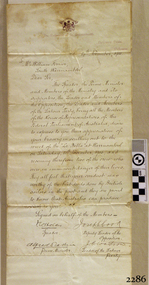 Flagstaff Hill Maritime Museum and Village
Letter - William Ferrier, 14th November 1905
... received warm food and clothing, medical attention and a place to sleep. In the following days, an unidentified body of a young person has washed ashore; it was either Watson or Denham. The body was buried in the Warrnambool cemetery with an appropriate gravestone and inscription. William Ferrier became a national hero as news of the daring rescue spread. In recognition of his bravery in the two daring rescues, he was awarded the Silver Medal for Bravery by the Royal Humane Society and was honoured in the letter from the Prime Minister and the Parliament of the Commonwealth, telegrams...received warm food and clothing, medical attention and a place to sleep. In the following days, an unidentified body of a young person has washed ashore; it was either Watson or Denham. The body was buried in the Warrnambool cemetery with an appropriate gravestone and inscription. William Ferrier became a national hero as news of the daring rescue spread. In recognition of his bravery in the two daring rescues, he was awarded the Silver Medal for Bravery by the Royal Humane Society and was honoured in the letter from the Prime Minister and the Parliament of the Commonwealth, telegrams ...The letter to William Ferrier of South Warrnambool from the Prime Minister and the Parliament of the Commonwealth recognised the significance of William’s brave and courageous lifesaving act to the people of Australia; “They all feel that your conduct was worthy of the best deeds done by British sailors in the past and they are proud to know that Australia can produce such as you.” The story of that brave rescue follows on below … The ship from which the sailors were rescued was the three-masted, iron and steel barquentine the La Bella, built in Norway in 1893. She was one of two iron and steel ships by Johan Smith, The company was one of the leading shipping families in Tvedestrand, Norway. She was significant to Norwegian shipping, being one of only 27 iron and steel ships ever built in Norway. She was registered in New Zealand and engaged from 1902 in inter-colonial trading of timber in the Pacific, between New Zealand and Australia and was often in Port Phillip Bay, Victoria. On 5th October 1905, the twelve-year-old La Bella left Lyttleton, New Zealand carrying a cargo of timber bound for Warrnambool, Australia. She was manned by a crew of twelve: the Master, (Captain Mylius, previously 1st Mate of La Bella, appointed Captain to La Bella on 6th February 1903) 2 Mates, Cook, six able seamen, one ordinary seaman and a boy. Bad weather en route caused her to shelter at Burnie on Tasmania's North West coast. On November 10th, the 37th day of her journey, La Bella approached Warrnambool. Captain Mylius steered her towards Lady Bay Channel in heavy south-west seas and evening mist. He ordered the helmsman to steer for the light. As the ship came round, a tremendous sea struck her on the port quarter, causing her to breach broadside in a north-westerly direction into breakers. The helm was brought round twice more, but each time heavy seas broke over her, the third time throwing the La Bella on to a submerged reef in Lady Bay now known as La Bella Reef (about 100 yards from the Warrnambool breakwater). The sea was so rough that it even wrenched a one-and-a-half ton anchor from its fastenings and into the sea. As Captain Mylius headed to the steel wheelhouse, intending to send up a rocket flare, a huge sea slammed the steel door into him (resulting in massive bruising front and back) Despite his injuries he still managed to set off a blue light, which he held up in his hands. La Bella’s lifeboats were filled with seawater and broke up on their chocks. The blue light was the first indication to people on the shore that there was a ship in distress. The Harbour Master, Captain Roe (who lived in the Harbour Master’s House opposite Flagstaff Hill), organised a group of volunteers to crew the lifeboat because the trained crew was unavailable; the crewmen were working on a steamer in Port Fairy at the time. He then poured oil onto the water to try and smooth the sea. At around 11 pm three of the crew took shelter in the steel forecastle but the sea crashed into it and broke it up. While the rest of the crew and onlookers watched helplessly in the moonlight the bodies were washed away into the sea, never to be seen again. Some of the crew lashed themselves to the weather rail to keep from being washed away. Watson, the ordinary seaman, became tangled in the rigging lines and was too weak to move, so the 2nd Mate, Robertson, put a line onto him so that he wouldn’t wash off. Around 11 pm three of the crew were unconscious from exhaustion. The situation on La Bella was becoming dangerous. The 2nd Mate moved to the ‘house’ and soon afterwards the ship slipped in the heavy sea. The lashings of the 1st Mate and the ‘boy’ Denham had kept them safe until about 2 am when they were washed overboard; no one was able to help. One by one, the exhausted crew were being washed overboard, too weak to hold on any longer. During the night the La Bella had broken into two and the deckhouse ran out towards the sea. Two more men drowned when trying to reach the lifeboat. By sunrise, the only survivors of the twelve were the Master, 2nd Mate and three seamen. Early in the morning, Captain Roe used the rocket apparatus on shore to try and shoot a line to the ship for a safer rescue but each attempt fell short of the target. Several attempts were made by the lifeboat to rescue the stricken sailors, but the rough conditions made this difficult for the boat to get close enough to the ship and the lifeboat had to return to shore. During a final attempt to reach the ship Captain Mylius ordered his men to jump into the sea. Leonard Robertson, 2nd mate, jumped and swam towards the lifeboat, taking hold of the boat hook offered to him. Oscar Rosenholme managed to reach the boat floating on a piece of timber from the ship’s load and a third survivor, Noake, also made the boat. Along with the lifeboat rescue crew, 25-year-old William Ferrier rowed his small dingy through the heavy seas and managed to rescue the Captain, whom he landed on the breakwater. Ferrier then returned to the ship to attempt a final rescue, losing his oars and rowlocks into the high sea. Using just a spare paddle he skulled towards the La Bella, reaching her stern in time to cut loose the lone surviving sailor, Payne, from the lashing that held him to the ship; the terrified sailor dropped from the ship and into the dingy. Shortly after the last man was rescued, the La Bella was lifted by a huge wave and crashed back down on the reef; she broke up and sank. The ordeal had lasted ten hours. The survivors were taken to the nearby Bay View Hotel and gratefully received warm food and clothing, medical attention and a place to sleep. In the following days, an unidentified body of a young person has washed ashore; it was either Watson or Denham. The body was buried in the Warrnambool cemetery with an appropriate gravestone and inscription. William Ferrier became a national hero as news of the daring rescue spread. In recognition of his bravery in the two daring rescues, he was awarded the Silver Medal for Bravery by the Royal Humane Society and was honoured in the letter from the Prime Minister and the Parliament of the Commonwealth, telegrams and a cheque for £20 from the Governor-General, over £150 subscribed by the public, including Warrnambool and district and readers of The Argus, and a gold medal from the Glenelg Dinghy Club of South Australia. Ferrier’s rescue efforts are one of the most heroic in Victoria’s shipwreck history. (William Ferrier’s son, Frank, received a similar award almost fifty years later when he helped rescue four members of the crew on the yacht Merlan after it ran on to a reef near the Point Lonsdale Lighthouse. ) The wreck of La Bella now lies on her port side in 13 metres of sheltered water inside the reef she struck. The bow section is relatively intact and part of the stern has drifted north-easterly towards the mouth of the Hopkins River. The reef the La Bella struck now bears its name. Those five rescued from the La Bella were Captain George Mylius, Leonard Robertson (2nd Mate, 21 years old), R. Payne, Oscar Rosenholme and Jack Noake. Those seven who lost their lives were Mr Coulson (1st mate), Charles Jackman (cook) Gustave Johnson, Pierre Johann and Robert Gent (all able seamen), Harry Watson (ordinary seaman) and Jack Denham (ship’s boy), Captain Mylius was found guilty of careless navigation; he had sailed into the bay without the services of a pilot. His Master Certificate was suspended for twelve months. Later he was also charged with the manslaughter of one of the crew who had died when the La Bella was wrecked but found not guilty. The event’s adverse publicity and damage to his career took a toll on his health and he died of a heart attack six months after the wreck; he was only thirty-seven. His body was buried in the Melbourne General Cemetery. The La Bella was “the best documented of all sailing ships owned in New Zealand”. Her record books, ship logs, correspondence and supporting papers are still available. At the time of the tragedy, she was owned by Messers David C.Turnbull and Co. of Timaru, New Zealand timber merchants and shipping agents, who had purchased her on 13th December 1901. A detailed account of the last journey of La Bella can be read in “Leonard Robertson, the Whangaroa & La Bella” written by Jack Churchouse, published in 1982 by Millwood Press Ltd, Wellington, NZ. As well as this letter, Flagstaff Hill’s La Bella Collection includes a photograph of the wrecked La Bella, a brass rail holder and a postcard of William Ferrier with four of the survivors. Some 15 – 17 ships are believed to have sunk in Lady Bay, but only two have been discovered on the seafloor; the “La Bella” and the “Edinburgh Castle”. Both wrecks are popular diving sites and are preserved as significant historical marine and marine archaeological sites. This original congratulatory letter sent to William Ferrier by the Prime Minister and Government of Australia demonstrates the importance attached to his efforts for Victoria and to Australia. The letter is part of the La Bella Collection and is significant at both a local and state level. Its connection to the La Bella shipwreck and the rescue of five survivors highlights the dangers of Victoria’s Shipwreck Coast. The letter to William Ferrier from the Australian Government acknowledges the bravery of ordinary Australians who risked their lives to save victims of shipwrecks along the coast. The letter is significant to the history of Warrnambool as it honours William Ferrier, a local fisherman whose descendants continue to live in the area. It highlights the way of life of people who lived in coastal towns in 19th century Victoria and the effects of shipwrecks upon them. The letter connects to the postcard of William Ferrier with four of the five rescued crew, the photograph of the wreck of the La Bella and the artefact from the wreck, the rail holder. This letter is significant because of its association with the sailing ship “La Bella”. The “La Bella” is of local and state and national significance. It is one of the only two shipwrecks discovered in Lady Bay, Warrnambool, out of the 15-17 shipwrecks in the bay. Letter to William Ferrier of South Warrnambool from the Prime Minister and Members of Parliament commending him on his bravery. The printed letterhead includes a coat of arms in the top centre and the official address. The letter is very neatly hand written in black pen and includes 4 signatures of Members of Parliament. The rectangular paper is cream coloured with some yellow/brown discolouring. It has the letterhead on the right hand side of it and the written letter begins below the letterhead. The paper has been folded so that the right side becomes the cover page of the letter. The writing is continued onto the inside right hand page of the folded paper and the writing ends here. There is more recent writing on the bottom right hand corner of the back page. The paper has been officially folded in half a total 3 times and there is heavy discolouration on the sections that form the front and back of the folded letter. There is a 4th fold line that is less pronounced that the other folds and would make the paper the size to fit into a pocket. At several fold creases the paper has worn through. The edges of the paper have minor tears. The printed coat of arms is that of the House of Representatives. Underneath is printed “The Parliament of the Commonwealth, / Parliament House / Melbourne”. The hand written, letter is dated “14th November, 1905” and addressed to “Mr. William Ferrier / South Warrnambool” The letter begins “The Speaker, the Prime Minister and Members of the Ministry and its supporters, the Leader and Members of the Opposition, the Leader and Members of the Labour Party, being all the Members of the House of Representatives of the Federal Parliament of Australia” … It continues “desire to express to you their appreciation of your bravery in skulling out to the wreck of the “La Bella” at Warrnambool on Saturday, 11th November, 1905, and recovering therefrom two of the crew who were in imminent danger of their lives. They all feel that your conduct was worthy of the best deeds done by British sailors in the past and they are proud to know that Australia can produce such as you.” The letter is “Signed on behalf of the Members – Speaker (Frederick Holder ), Deputy Leader of the Opposition (Joseph Cook ), Prime Minister (Alfred Deakin), Leader of the Labour Party ( J.C. Watson)” On the back of the letter is blue ink handwriting “OWNER / G. FERRIER / TO. BE. PHOTOGRAPHED / 27-4-76”la bella, william ferrier, bill ferrier, lady bay, 1905, 10th november 1905, 11th november 1905, parliament of the commonwealth, prime minister, australian government, new zealand, flagstaff hill, warrnambool, shipwrecked coast, flagstaff hill maritime museum, maritime museum, shipwreck coast, flagstaff hill maritime village -
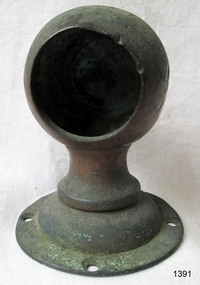 Flagstaff Hill Maritime Museum and Village
Functional object - Rail holder, About 1893, when the ship was made
... received warm food and clothing, medical attention and a place to sleep. In the following days an unidentified body of a young person was washed ashore; it was either Watson or Denham. The body was buried in the Warrnambool cemetery with an appropriate gravestone and inscription. William Ferrier became a national hero as news of the daring rescue spread. In recognition of his bravery in the two daring rescues he was awarded the Silver Medal for Bravery by the Royal Humane Society and was honoured in the letter from the Prime Minister and the Parliament of the Commonwealth, telegrams...received warm food and clothing, medical attention and a place to sleep. In the following days an unidentified body of a young person was washed ashore; it was either Watson or Denham. The body was buried in the Warrnambool cemetery with an appropriate gravestone and inscription. William Ferrier became a national hero as news of the daring rescue spread. In recognition of his bravery in the two daring rescues he was awarded the Silver Medal for Bravery by the Royal Humane Society and was honoured in the letter from the Prime Minister and the Parliament of the Commonwealth, telegrams ...This brass rail holder fixture would have been used to hold the end of a rail in place. There is no information as to where the fitting or rail would have been placed on the ship; sailing ships had many brass fittings. It was recovered from the wreck of the La Bella, which lies at the bottom of the Warrnambool Harbour. Some 15 ships are believed to have been wrecked in Lady Bay, but only two have been discovered on the sea floor; the La Bella and the Edinburgh Castle. Both wrecks are popular diving sites and are preserved as significant historical marine and marine archaeological sites. The story of the final voyage of the La Bella is summarised as follows … The ship from which the sailors were rescued was the three-masted, iron and steel barquentine the La Bella, built in Norway in 1893. She was one of two iron and steel ships by Johan Smith, the company being one of the leading shipping families in Tvedestrand, Norway. She was significant to Norwegian shipping, being one of only 27 iron and steel ships ever built in Norway. She was registered in New Zealand and engaged from 1902 in inter-colonial trading of timber in the pacific, between New Zealand and Australia and was often in Port Phillip Bay, Victoria. On 5th October, 1905, the twelve year old La Bella left Lyttleton, New Zealand carrying a cargo of timber bound for Warrnambool, Australia . She was manned by a crew of twelve: the Master, (Captain Mylius, previously 1st Mate of La Bella, appointed Captain to La Bella on 6th February 1903) 2 Mates, Cook, six able seamen, one ordinary seaman and a boy. . Bad weather en route caused her to shelter at Burnie on Tasmania's North West coast. On November 10th, the 37th day of her journey, La Bella approached Warrnambool. Captain Mylius steered her towards Lady Bay Channel in heavy south-west seas and evening mist. He ordered the helmsman to steer for the light. As the ship came round, a tremendous sea struck her on the port quarter, causing her to breach broadside in a north-westerly direction into breakers. The helm was brought round twice more, but each time heavy seas broke over her, the third time throwing the La Bella on to a submerged reef in Lady Bay now known as La Bella Reef (about 100 yards from the Warrnambool breakwater). The sea was so rough that it even wrenched a one-and-a-half ton anchor from its fastenings and into the sea. As Captain Mylius headed to the steel wheelhouse, intending to send up a rocket flare, a huge sea slammed the steel door into him (resulting in massive bruising front and back) Despite his injuries he still managed to set off a blue light, which he held up in his hands. La Bella’s lifeboats were filled with sea water and broke up on their chocks. The blue light was the first indication to people on shore that there was a ship in distress. The Harbour Master, Captain Roe (who lived in the Harbour Master’s House opposite Flagstaff Hill), organised a group of volunteers to crew the lifeboat because the trained crew was unavailable; the crewmen were working on a steamer in Port Fairy at the time. He then poured oil onto the water to try and smooth the sea. At around 11pm three of the crew took shelter in the steel forecastle but the sea crashed into it and broke it up. While the rest of the crew and onlookers watched helplessly in the moonlight the bodies were washed away into the sea, never to be seen again. Some of the crew lashed themselves to the weather rail to keep from being washed away. Watson, the ordinary seaman, became tangled in the rigging lines and was too weak to move, so the 2nd Mate, Robertson, put a line onto him so that he wouldn’t wash off. Around 11pm three of the crew were unconscious from exhaustion. The situation on La Bella was becoming dangerous. The 2nd Mate moved to the ‘house’ and soon afterwards the ship slipped in the heavy sea. The lashings of the 1st Mate and the ‘boy’ Denham had kept them safe until about 2am when they were washed overboard; no one was able to help. One by one, the exhausted crew were being washed overboard, too weak to hold on any longer. During the night the La Bella had broken into two and the deckhouse ran out towards the sea. Two more men drowned when trying to reach the lifeboat. By sunrise the only survivors of the twelve were the Master, 2nd Mate and three seamen. Early in the morning Captain Roe used the rocket apparatus on shore to try and shoot a line to the ship for a safer rescue but each attempt fell short of the target. Several attempts were made by the lifeboat to rescue the stricken sailors, but the rough conditions made this difficult for the boat to get close enough to the ship and the lifeboat had to return to shore. During a final attempt to reach the ship Captain Mylius ordered his men to jump into the sea. Leonard Robertson, 2nd mate, jumped and swam towards the lifeboat, taking hold of the boat hook offered to him. Oscar Rosenholme managed to reach the boat floating on a piece of timber from the ship’s load and a third survivor, Noake, also made the boat. Along with the lifeboat rescue crew, 25 year old William Ferrier rowed his small dingy through the heavy seas and managed to rescue the Captain, whom he landed on the breakwater. Ferrier then returned to the ship to attempt a final rescue, losing his oars and rowlocks into the high sea. Using just a spare paddle he skulled towards the La Bella, reaching her stern in time to cut loose the lone surviving sailor, Payne, from the lashing that held him to the ship; the terrified sailor dropped from the ship and into the dingy. Shortly after the last man was rescued, the La Bella was lifted by a huge wave and crashed back down on the reef; she broke up and sank. The ordeal had lasted ten hours. The survivors were taken to the nearby Bay View Hotel and gratefully received warm food and clothing, medical attention and a place to sleep. In the following days an unidentified body of a young person was washed ashore; it was either Watson or Denham. The body was buried in the Warrnambool cemetery with an appropriate gravestone and inscription. William Ferrier became a national hero as news of the daring rescue spread. In recognition of his bravery in the two daring rescues he was awarded the Silver Medal for Bravery by the Royal Humane Society and was honoured in the letter from the Prime Minister and the Parliament of the Commonwealth, telegrams and a cheque for £20 from the Governor General, over £150 subscribed by the public, including Warrnambool and district and readers of The Argus, and a gold medal from the Glenelg Dinghy Club of South Australia. Ferrier’s rescue efforts are one of the most heroic in Victoria’s shipwreck history. (William Ferrier’s son, Frank, received a similar award almost fifty years later, when he helped rescue four members of the crew on the yacht Merlan, after it ran on to a reef near the Point Lonsdale Lighthouse. ) The wreck of La Bella now lies on her port side in 13 metres of sheltered water inside the reef she struck. The bow section is relatively intact and part of the stern has drifted north-easterly towards the mouth of the Hopkins River. The reef the La Bella struck now bears its name. Those five rescued from the La Bella were Captain George Mylius, Leonard Robertson (2nd Mate, 21 years old), R. Payne, Oscar Rosenholme and Jack Noake. Those seven who lost their lives were Mr Coulson (1st mate), Charles Jackman (cook) Gustave Johnson, Pierre Johann and Robert Gent (all able seamen), Harry Watson (ordinary seaman) and Jack Denham (ship’s boy), Captain Mylius was found guilty of careless navigation; he had sailed into the bay without the services of a pilot. His Master Certificate was suspended for twelve months. Later he was also charged with manslaughter of one of the crew who had died when the La Bella was wrecked, but found not guilty. The event’s adverse publicity and damage to his career took a toll on his health and he died of a heart attack six months after the wreck; he was only thirty-seven. His body was buried in the Melbourne General Cemetery. The La Bella was “the best documented of all sailing ships owned in New Zealand”. Her record books, ship logs, correspondence and supporting papers are still available. At the time of the tragedy, she was owned by Messers David C.Turnbull and Co. of Timaru, New Zealand timber merchants and shipping agents, who had purchased her on 13th December 1901. A detailed account of the last journey of La Bella can be read in “Leonard Robertson, the Whangaroa & La Bella” written by Jack Churchouse, published in 1982 by Millwood Press Ltd, Wellington, NZ. Some 15 – 17 ships are believed to have sunk in Lady Bay, but only two have been discovered on the seafloor; the “La Bella” and the “Edinburgh Castle”. Both wrecks are popular diving sites and are preserved as significant historical marine and marine archaeological sites. As well as this letter, Flagstaff Hill’s La Bella Collection includes a photograph of the wrecked La Bella, a brass rail holder and a postcard of William Ferrier with four of the survivors. This original congratulatory letter sent to William Ferrier by the Prime Minister and Government of Australia demonstrates the importance attached to his efforts for Victoria and to Australia. The letter is part of the La Bella Collection and is significant at both a local and state level. Its connection to the La Bella shipwreck and the rescue of five survivors highlights the dangers of Victoria’s Shipwreck Coast. The letter to William Ferrier from the Australian Government acknowledges the bravery of ordinary Australians who risked their lives to save victims of shipwrecks along the coast. The letter is significant to the history of Warrnambool as it honours William Ferrier, a local fisherman whose descendants continue to live in the area. It highlights the way of life of people who lived in coastal towns in 19th century Victoria and the effects of shipwrecks upon them. The letter connects to the postcard of William Ferrier with four of the five rescued crew, the photograph of the wreck of the La Bella and the artefact from the wreck, the rail holder. This item is significant because of its association with the sailing ship “La Bella” . the “La Bella” is of local and state and national significance. It is one of the only two shipwrecks discovered in Lady Bay, Warrnambool, out of the 15-17 shipwrecks in the bay. Brass rail holder from the wreck "La Bella". This rail holder would have been used as a fitting for the end of a rail. It is made up of two parts and looks a little like a goblet in shape. The top is a hollow spherical shape with a circular hole cut out on one side, into which the end of a round rail would fit. There are two gouge marks close to each other on one side of the hole, about one centimetre apart, at 1 and 2 o’clock position. The sphere has a hollow pipe-like stem with a screw thread turned into the outside of the lower section and the bottom of the stem has been flared out after having the base fitted. The base is round and has a mound in the centre. The edge has four evenly spaced fixture holes around its edge. The metal shows signs of pitting and has mild encrustation. The fitting of the base is loose, allowing it to swivel in a complete circle. The top of the sphere is rough and has a dent in it. Underneath the base there is verdigris; some has flaked off and reveals a bright golden colour underneath. rail holder, brass rail holder, la bella, lady bay, norway, 1893, new zealand, captain mylius, william ferrier, flagstaff hill, warrnambool, shipwrecked coast, flagstaff hill maritime museum, maritime museum, shipwreck coast, flagstaff hill maritime village -
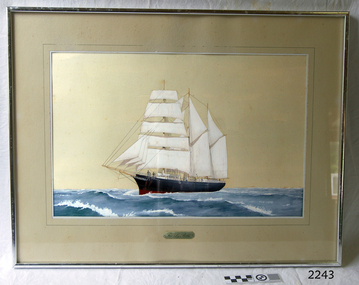 Flagstaff Hill Maritime Museum and Village
Painting - Maritime painting, The La Bella, 1980s
... received warm food and clothing, medical attention and a place to sleep. In the following days an unidentified body of a young person was washed ashore; it was either Watson or Denham. The body was buried in the Warrnambool cemetery with an appropriate gravestone and inscription. William Ferrier became a national hero as news of the daring rescue spread. In recognition of his bravery in the two daring rescues he was awarded the Silver Medal for Bravery by the Royal Humane Society and was honoured in the letter from the Prime Minister and the Parliament of the Commonwealth, telegrams...received warm food and clothing, medical attention and a place to sleep. In the following days an unidentified body of a young person was washed ashore; it was either Watson or Denham. The body was buried in the Warrnambool cemetery with an appropriate gravestone and inscription. William Ferrier became a national hero as news of the daring rescue spread. In recognition of his bravery in the two daring rescues he was awarded the Silver Medal for Bravery by the Royal Humane Society and was honoured in the letter from the Prime Minister and the Parliament of the Commonwealth, telegrams ...This painting of the “La Bella” is associated with Flagstaff Hill’s collection of artefacts from the wreck of the “La Bella”. It was painted around the 1980s by maritime artist Philip J. Gray. Some 15 – 17 ships are believed to have sunk in Lady Bay, but only two have been discovered on the seafloor; the “La Bella” and the “Edinburgh Castle”. Both wrecks are popular diving sites and are preserved as significant historical marine and marine archaeological sites. The Kosnar Picture Framing and Mirrors Shop identified the "GRAY 3135, Y04/111" as their job number for the framing and said that the label "ANOTHER KOSNAR FEATURE" was last used before about 1990. About artist Philip J. Gray “Philip is one of Australia’s leading maritime artists and his meticulous research and social commentary paintings of ships, such as, the Loch Ard and Schomberg form an important part of Warrnambool’s Flagstaff Hill Maritime Museum.” [Dr Marion Manifold, Artist and Art Historian, 2014] Philip James Gray was born in London but has lived most of his life in Australia. He graduated from a London school of art as an illustrator, specialising in technical and scientific illustration as well as other commercial and applied art. He was also a student for a time of Fyffe Christie - British figurative artist, mural painter and humanitarian – who had a great influence on his career. Philip has always worked as a professional artist and illustrator. Many publications on maritime history have featured his work. His paintings have been released and sold all over the world as limited edition prints. The State Library of Victoria’s ‘Latrobe Collection’ holds two of his paintings. His street painting of ‘The Ashes Contest’ decorates the brick wall of Old Bakery Laneway in Sunbury and a Sunbury café owner commissioned him to paint the ‘Sunbury Pop Festival’ as a remembrance of local history. Philip has been an active member of the Sunbury Art Society in Victoria for several years, serving on the committee for some of that time and being involved in exhibitions. He enjoys helping new artists and sharing his skills and experience. About the “La Bella” The wreck of the La Bella lies at the bottom of the Warrnambool Harbour in Lady Bay. Some 15 ships are believed to have been wrecked there but only two have been discovered on the sea floor; the La Bella and the Edinburgh Castle. Both wrecks are popular diving sites and are preserved as significant historical marine and marine archaeological sites. The story of the final voyage of the La Bella is summarised as follows … The ship from which the sailors were rescued was the three-masted, iron and steel barquentine the La Bella, built in Norway in 1893. She was one of two iron and steel ships by Johan Smith, the company being one of the leading shipping families in Tvedestrand, Norway. She was significant to Norwegian shipping, being one of only 27 iron and steel ships ever built in Norway. La Bella was registered in New Zealand and engaged from 1902 in inter-colonial trading of timber in the pacific, between New Zealand and Australia and was often in Port Phillip Bay, Victoria. On 5th October 1905 the twelve year old La Bella left Lyttleton, New Zealand carrying a cargo of timber bound for Warrnambool, Australia . She was manned by a crew of twelve: the Master, (Captain Mylius, previously 1st Mate of La Bella, appointed Captain to La Bella on 6th February 1903) 2 Mates, Cook, six able seamen, one ordinary seaman and a boy. Bad weather en-route caused her to shelter at Burnie on Tasmania's North West coast. On November 10th, the 37th day of her journey, La Bella approached Warrnambool. Captain Mylius steered her towards Lady Bay Channel in heavy south-west seas and evening mist. He ordered the helmsman to steer for the light. As the ship came round, a tremendous sea struck her on the port quarter, causing her to breach broadside in a north-westerly direction into breakers. The helm was brought round twice more, but each time heavy seas broke over her, the third time throwing the La Bella on to a submerged reef in Lady Bay now known as La Bella Reef (about 100 yards from the Warrnambool breakwater). The sea was so rough that it even wrenched a one-and-a-half ton anchor from its fastenings and into the sea. As Captain Mylius headed to the steel wheelhouse, intending to send up a rocket flare, a huge sea slammed the steel door into him (resulting in massive bruising front and back) Despite his injuries he still managed to set off a blue light, which he held up in his hands. La Bella’s lifeboats were filled with sea water and broke up on their chocks. The blue light was the first indication to people on shore that there was a ship in distress. The Harbour Master, Captain Roe (who lived in the Harbour Master’s House opposite Flagstaff Hill), organised a group of volunteers to crew the lifeboat because the trained crew was unavailable; the crewmen were working on a steamer in Port Fairy at the time. He then poured oil onto the water to try and smooth the sea. At around 11pm three of the crew took shelter in the steel forecastle but the sea crashed into it and broke it up. While the rest of the crew and onlookers watched helplessly in the moonlight the bodies were washed away into the sea, never to be seen again. Some of the crew lashed themselves to the weather rail to keep from being washed away. Watson, the ordinary seaman, became tangled in the rigging lines and was too weak to move, so the 2nd Mate, Robertson, put a line onto him so that he wouldn’t wash off. Around 11pm three of the crew were unconscious from exhaustion. The situation on La Bella was becoming dangerous. The 2nd Mate moved to the ‘house’ and soon afterwards the ship slipped in the heavy sea. The lashings of the 1st Mate and the ‘boy’ Denham had kept them safe until about 2am when they were washed overboard; no one was able to help. One by one, the exhausted crew were being washed overboard, too weak to hold on any longer. During the night the La Bella had broken into two and the deckhouse ran out towards the sea. Two more men drowned when trying to reach the lifeboat. By sunrise the only survivors of the twelve were the Master, 2nd Mate and three seamen. Early in the morning Captain Roe used the rocket apparatus on shore to try and shoot a line to the ship for a safer rescue but each attempt fell short of the target. Several attempts were made by the lifeboat to rescue the stricken sailors, but the rough conditions made this difficult for the boat to get close enough to the ship and the lifeboat had to return to shore. During a final attempt to reach the ship Captain Mylius ordered his men to jump into the sea. Leonard Robertson, 2nd mate, jumped and swam towards the lifeboat, taking hold of the boat hook offered to him. Oscar Rosenholme managed to reach the boat floating on a piece of timber from the ship’s load and a third survivor, Noake, also made the boat. Along with the lifeboat rescue crew, 25 year old William Ferrier rowed his small dingy through the heavy seas and managed to rescue the Captain, whom he landed on the breakwater. Ferrier then returned to the ship to attempt a final rescue, losing his oars and rowlocks into the high sea. Using just a spare paddle he skulled towards the La Bella, reaching her stern in time to cut loose the lone surviving sailor, Payne, from the lashing that held him to the ship; the terrified sailor dropped from the ship and into the dingy. Shortly after the last man was rescued, the La Bella was lifted by a huge wave and crashed back down on the reef; she broke up and sank. The ordeal had lasted ten hours. The survivors were taken to the nearby Bay View Hotel and gratefully received warm food and clothing, medical attention and a place to sleep. In the following days an unidentified body of a young person was washed ashore; it was either Watson or Denham. The body was buried in the Warrnambool cemetery with an appropriate gravestone and inscription. William Ferrier became a national hero as news of the daring rescue spread. In recognition of his bravery in the two daring rescues he was awarded the Silver Medal for Bravery by the Royal Humane Society and was honoured in the letter from the Prime Minister and the Parliament of the Commonwealth, telegrams and a cheque for £20 from the Governor General, over £150 subscribed by the public, including Warrnambool and district and readers of The Argus, and a gold medal from the Glenelg Dinghy Club of South Australia. Ferrier’s rescue efforts are one of the most heroic in Victoria’s shipwreck history. (William Ferrier’s son, Frank, received a similar award almost fifty years later, when he helped rescue four members of the crew on the yacht Merlan, after it ran on to a reef near the Point Lonsdale Lighthouse. ) The wreck of La Bella now lies on her port side in 13 metres of sheltered water inside the reef she struck. The bow section is relatively intact and part of the stern has drifted north-easterly towards the mouth of the Hopkins River. The reef the La Bella struck now bears its name. Those five rescued from the La Bella were Captain George Mylius, Leonard Robertson (2nd Mate, 21 years old), R. Payne, Oscar Rosenholme and Jack Noake. Those seven who lost their lives were Mr Coulson (1st mate), Charles Jackman (cook) Gustave Johnson, Pierre Johann and Robert Gent (all able seamen), Harry Watson (ordinary seaman) and Jack Denham (ship’s boy). Captain Mylius was found guilty of careless navigation; he had sailed into the bay without the services of a pilot. His Master Certificate was suspended for twelve months. Later he was also charged with manslaughter of one of the crew who had died when the La Bella was wrecked, but found not guilty. The event’s adverse publicity and damage to his career took a toll on his health and he died of a heart attack six months after the wreck; he was only thirty-seven. His body was buried in the Melbourne General Cemetery. The La Bella was “the best documented of all sailing ships owned in New Zealand”. Her record books, ship logs, correspondence and supporting papers are still available. At the time of the tragedy she was owned by Messers David C.Turnbull and Co. of Timaru, New Zealand timber merchants and shipping agents, who had purchased her on 13th December 1901. A detailed account of the last journey of La Bella can be read in “Leonard Robertson, the Whangaroa & La Bella” written by Jack Churchouse, published in 1982 by Millwood Press Ltd, Wellington, NZ.This painting of the La Bella by Philip J. Gray is part of the La Bella Collection and is significant at both a local and state level. Its connection to the La Bella shipwreck and the rescue of five survivors highlights the dangers of Victoria’s Shipwreck Coast. The painting connects with other objects and artefacts associated with the wreck of the La Bella. This painting is significant because of its association with the sailing ship “La Bella” . the “La Bella” is of local and state and national significance. It is one of the only two shipwrecks discovered in Lady Bay, Warrnambool, out of the 15-17 shipwrecks in the bay. Large framed painting of the three masted barquentine "La Bella" fully rigged. Painted by Phillip J Gray. A fine printed line squares off the painting. Beneath painting and line is a gold plate with black copper plate designating "La Bella" is encased in glass, surrounded by a silver-metal frame. Yellow and brown paper label is adhered to back of painting. Picture framed by Kosnar in Melbourne."The La Bella" on gold plaque Logo of "K" inside a brown square. "GRAY 3135, Y04/111", "ANOTHER KOSNAR FEATURE" flagstaff hill, warrnambool, shipwrecked-coast, flagstaff-hill, flagstaff-hill-maritime-museum, maritime-museum, shipwreck-coast, flagstaff-hill-maritime-village, painting, la bella, artist phillip j gray, maritime painting, lady bay warrnambool -
 Federation University Historical Collection
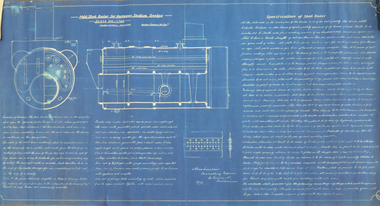
Plan, Mild Steel Boiler for Yarrawee Suction Dredge, 16 January 1907
... Alex Sinclair Snr was at that stage in Malaya, and received the news of the bankruptcy by telegram. Upon telegraphing his employers for funds to return home, he received the reply that there were no such funds available. ...Alex Sinclair Snr was at that stage in Malaya, and received the news of the bankruptcy by telegram. Upon telegraphing his employers for funds to return home, he received the reply that there were no such funds available. ...George Milford, a long term staff member of Thompsons Foundry Castlemaine, remembers discussing Alexander Sinclair with this son, Alex Sinclair Jnr. "When Alex Jnr was a boy, his father, a senior design engineer, was sent to Malaya to oversee the erection on site of a suction cutter dredge for Thompsons. This was an adaptation of the idea of a bucket-dredge, where gold is won from alluvial gravels. In the 1915-1920 era, the Thompsons Engineering Department designed a suction-cutter dredge, by which hydraulic suction with a revolving cutter at the end of a long proboscis would collect the alluvial soil and deliver it into the dredge for recovery of the precious metals. Export marketing was then ‘all the go’, and the tin dredges were ordered from Thompsons, using the new cutter design. The dredges were, of course, shipped to Malaya in pieces, ready to be assembled on site. A number of Thompsons employees were selected to travel to Malaya to assemble the dredges. There were fourteen men in the gang. These men sailed on 1st July 1925, their number including Delmenico, McKay and Charles Albert Hauser, an engine driver. C A Hauser died of malaria in Malaya shortly after arrival. Components for a further three of these dredges were in transit or on site when the first suction-cutter dredge was assembled and tested. The designers had failed to take into account the fact that, in the jungle floor in Malaya, many trees grow up, and fall down, in tropical conditions, and become submerged still waterlogged in the floor of the jungle, and in the tin-bearing gravels. The suction-cutter dredge was found to be inefficient in these circumstances, the price of tin had fallen and the Malayan client reneged on the contract. Faced with an outlay of over £4,000 on which no money would be received, the company went bankrupt on 25th August 1925. Alex Sinclair Snr was at that stage in Malaya, and received the news of the bankruptcy by telegram. Upon telegraphing his employers for funds to return home, he received the reply that there were no such funds available. Alex Sinclair Jnr told the story of how his father worked as a labourer in Malaya for two years, while his mother took in washing and ironing during the same period, until together they had assembled enough money to pay for his father’s return Anyone who talks about “the good old days” is talking nonsense!"Large blue printed paper plan outlining the conditions of contract for the making of a steel boiler. The Blueprint includes design drawings and written contract specifying materials, time frame and costs. Signed on front 'Alec Sinclair Consulting Engineer, 31 Queen Street, Melbourne'. Stamped on verso 'Printed by Paterson & Co, Colonial Mutual Chambers, Collins St, Melbourne'. blueprint, designs and plans, yarrawee suction dredge, conditions of contract, thompsons foundry castlemaine, george milford -
Federation University Historical Collection
Correspondence, Correspondence regarding results for Prem Chandra Akhil, 1971, 23/12/1970
... .1 Telegram post marked Ballarat 23 December 1970 from Mr Prem Chandra Akhil requesting a reference and result of Diploma of Mining Engineering to be sent to him in Fiji. .2 Copy of results and reference sent to Mr Prem Chandra Akhil. .3 A hand written letter from Mr Prem Chandra Akhil noting a response had not been received.....1 Telegram post marked Ballarat 23 December 1970 from Mr Prem Chandra Akhil requesting a reference and result of Diploma of Mining Engineering to be sent to him in Fiji. .2 Copy of results and reference sent to Mr Prem Chandra Akhil. .3 A hand written letter from Mr Prem Chandra Akhil noting a response had not been received. ....1 Telegram post marked Ballarat 23 December 1970 from Mr Prem Chandra Akhil requesting a reference and result of Diploma of Mining Engineering to be sent to him in Fiji. .2 Copy of results and reference sent to Mr Prem Chandra Akhil. .3 A hand written letter from Mr Prem Chandra Akhil noting a response had not been received..1 Australia Post telegram .2 Typed results and reference of Mr Prem Chandra Akhil .3 Hand written query from Mr Prem Chandra Akhilprem chandra akhil, engineering, fiji, results, telegram, overseas telegram, reference, ballarat school of mines -
 Flagstaff Hill Maritime Museum and Village
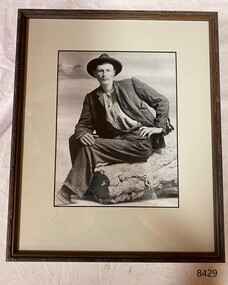
Photograph - William Ferrier, Henna Street Picture Framers, 2005
... received warm food and clothing, medical attention and a place to sleep. William Ferrier became a national hero as news of the daring rescue spread. In recognition of his bravery in the two daring rescues, he was awarded the Silver Medal for Bravery by the Royal Humane Society and was honoured in the letter from the Prime Minister and the Parliament of the Commonwealth, telegrams and a cheque for £20 from the Governor-General, over £150 subscribed by the public, including Warrnambool and district and readers of The Argus, and a gold medal from the Glenelg Dinghy Club of South Australia. ...received warm food and clothing, medical attention and a place to sleep. William Ferrier became a national hero as news of the daring rescue spread. In recognition of his bravery in the two daring rescues, he was awarded the Silver Medal for Bravery by the Royal Humane Society and was honoured in the letter from the Prime Minister and the Parliament of the Commonwealth, telegrams and a cheque for £20 from the Governor-General, over £150 subscribed by the public, including Warrnambool and district and readers of The Argus, and a gold medal from the Glenelg Dinghy Club of South Australia. ...The photograph of William Ferrier was given to Avis Quarrell by Lewis Ferrier, 3rd youngest son of William during the centenary of the wreck of the La Bella. The photograph was framed by the Henna Street Picture Framers, Warrnambool in 2005. The photograph is of William Ferrier, the 25-year-old fisherman from South Warrnambool, whose rescue of two sailors from the wrecked La Bella made him an overnight national hero. The La Bella was wrecked on 10th November 1905,and the remains of the vessel now lie on her port side in 13 metres of sheltered water inside the reef she struck. The bow section is relatively intact and part of the stern has drifted north-easterly towards the mouth of the Hopkins River. The reef the La Bella struck now bears its name. Several attempts were made by the Warrnambool lifeboat crew to rescue the stricken sailors on the La Bella, but the rough conditions made this difficult for the boat to get close enough to the ship and the lifeboat had to return to shore. A another rescue attempt was made by Ferrier who rowed a small dingy through the heavy seas and managed to rescue the Captain George Mylius, whom he landed on the breakwater. Ferrier then returned to the ship to attempt a final rescue, losing his oars and rowlocks into the high sea. Using just a spare paddle he swam towards the La Bella, reaching her stern in time to cut loose the lone surviving sailor, Payne, from the ropes and debris that held him to the ship; the terrified sailor dropped from the ship and into the dingy. Shortly after the last man was rescued, the La Bella was lifted by a huge wave and crashed back down on the reef; she broke up and sank. The survivors were taken to the nearby Bay View Hotel and gratefully received warm food and clothing, medical attention and a place to sleep. William Ferrier became a national hero as news of the daring rescue spread. In recognition of his bravery in the two daring rescues, he was awarded the Silver Medal for Bravery by the Royal Humane Society and was honoured in the letter from the Prime Minister and the Parliament of the Commonwealth, telegrams and a cheque for £20 from the Governor-General, over £150 subscribed by the public, including Warrnambool and district and readers of The Argus, and a gold medal from the Glenelg Dinghy Club of South Australia. Ferrier’s rescue efforts are one of the most heroic in Victoria’s shipwreck history.This photograph is significant at both a local and state level. Its connection to the La Bella shipwreck and the rescue of survivors highlights the dangers of Victoria’s Shipwreck Coast and demonstrates the bravery of ordinary Australians like William Ferrier who risked their lives to save victims of shipwrecks along the coast. Moreover, the photograph has an association with the sailing ship ‘La Bella’, as it is one of the only two shipwrecks discovered in Lady Bay, Warrnambool, out of the 15-17 shipwrecks known to have been wrecked in the bay.Framed sepia photograph, mounted behind glass. Portrait of a man seated on a log. He is wearing a brimmed hat, dark coloured jacket and trousers, and a light coloured collarless shirt with buttons. The figure in the photograph is William Ferrier.flagstaff hill, warrnambool, maritime museum, shipwreck coast, la bella, william ferrier, rescue, hero william ferrier -
 Glenelg Shire Council Cultural Collection
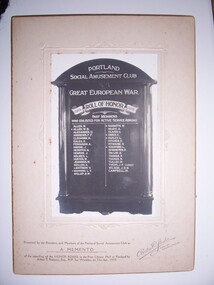
Photograph - Photograph - Portland Social Amusement Club, n.d
... During the gathering telegrams of con gratulation were received from Mr W. B. Shevill and also from Mr Jno. ...During the gathering telegrams of con gratulation were received from Mr W. B. Shevill and also from Mr Jno. ...The Portland Social Amusement Club was founded in 1897. Taken from Trove. Portland Guardian Monday May 26 1913: Portland Social Amusement Club. The members of the above Club celebrated the 16th anniversary of its foundation on Tuesday evening last, when the usual banquet. and social gathering was held. During the afternoon, a numerous band of the lady members attended at the, Free Library Hall and made the necessary arrangements, so that on arrival at the scene at 8 p.m. those attending were very pleasurably surprised to find most taste fully decorated tables actually groaning with the weight of all those good things which appeal so strongly, it is said, to the average man, and perhaps we may also add, woman also. At any rate, he would indeed be hard to please, who was not fully satisfied with all that was placed before him on that eventful evening. The attendance this year overtopped that of previous years, as over 80 ladies and gentlemen took part in what must be considered as one of the most successful of the many 'successful gatherings that have taken place. This 16th anniversary was the 431st ordinary gathering that had occurred, and, as the President (Mr. F. A.Row) justly said, it would appear that the Club, which many years ago was given but six months live, had proved the falsity of the attempted prophecy. After the principal business of the gathering had been transacted, the usual Club dinner speeches were made. The President gave "The King," which after being duly honored, was followed by the principal toast of the evening, "The day we celebrate." To Mr D. McDonald the toast of the Absent and Foundation members was entrusted, and as usual, that veteran discharged his duty well. II i cferred to the fact that of the 34 foundation members who started the Club in 1897,only five were present that evening. Mr W. T. Bennett, as one of the five referred to, responded, and hoped that in the glorious future that appeared before Portland, the Club, which had been started in the days of its adversity, would flourish in a like manner. Mr Grant proposed the toast of "Our Visitors." and in the name of the Club welcomed them to this the most important gathering of the year. Mr J. R. Woods responded in his usual happy way, and acknowledged that, until he had been the Club's guest during the years of his mayoralty of the town, he had no idea that it had enrolled among its members the number of ladies and gentlemen that it had or that its functions were upon the scale that he had since found to be the case. Mr G. H. .ennett upheld the claims of the ladies, especially those belonging to the Club. He evidently spoke with much feeling, and. waxed more than usually poetical in his eulogy of the graces and skill of the gentler sex. He rather upset the equilibrium of three of the younger portion of the gentlemen present by asking them to respond, but they all managed to "upstand" and make their acknowledgments. Mr T. F. Cruse was particularly happy in proposing the toast of. "The President and Members of Committee," who, he claimed, had done so much towards the success of the Club, and were deserving of the best that the members could give. Mr T. E. C. Henry, upon the invitation of the .President, responded,-end pointed out that [whilst it might appear that the work of the committee was light, it was not so in reality, as any member who desired a seat upon the Board would soon find out after.his or her election. The singing of Auld Lang Syne brought this portion of the entertainment to a close. In the dance which followed, some opportunity to view the ladies' dresses was afforded, and it could then be easily seen that the anniversary gathering of the Club was considered by the lady members at least, if not .by others, to be important enough to demand special treatment in the matter of dress. Many elaborate and beautiful costumes graced the scene, and everyone appeared to thoroughly enjoy themselves. The function was kept going merrily until about 2 a.m.; when the break up occurred. During the gathering telegrams of con gratulation were received from Mr W. B. Shevill and also from Mr Jno. Homers, both old members, the former a foundation one. Mr O'Donnell apologised for his own and Mrs O'Donnell's absence.Photograph of Portland Social Amusement Club -
 Flagstaff Hill Maritime Museum and Village
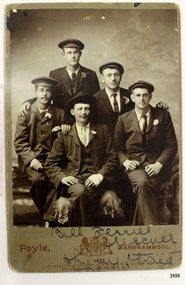
Postcard - People, Bill Ferrier - rescuer, 11th November, 1905
... received warm food and clothing, medical attention and a place to sleep. In the following days, an unidentified body of a young person had washed ashore; it was either Watson or Denham. The body was buried in the Warrnambool cemetery with an appropriate gravestone and inscription. William Ferrier became a national hero as news of the daring rescue spread. In recognition of his bravery in the two daring rescues, he was awarded the Silver Medal for Bravery by the Royal Humane Society and was honoured in the letter from the Prime Minister and the Parliament of the Commonwealth, telegrams...received warm food and clothing, medical attention and a place to sleep. In the following days, an unidentified body of a young person had washed ashore; it was either Watson or Denham. The body was buried in the Warrnambool cemetery with an appropriate gravestone and inscription. William Ferrier became a national hero as news of the daring rescue spread. In recognition of his bravery in the two daring rescues, he was awarded the Silver Medal for Bravery by the Royal Humane Society and was honoured in the letter from the Prime Minister and the Parliament of the Commonwealth, telegrams ...The postcard shows a photograph of William Ferrier, the 25-year-old Warrnambool fisherman from South Warrnambool whose rescue of two sailors from the wrecked La Bella made him an overnight National hero, quoted as “one of the most heroic rescues in Victoria’s shipwreck history”. The La Bella was wrecked on 10th November 1905 and the photograph was taken on the next day. In the photograph, William Ferrier is seated in the centre, with four of the five survivors beside him: (from left to right) Leonard Robertson, R. Payne, Oscar Rosenholme and Jack Noake. The photograph was taken by Foyle Photography Studio in Warrnambool, originally owned by James Charles Foyle. He previously had a photographic studio in Melbourne 1882 1887, then opened “Foyle’s Photo Card Studios” in Liebig St, Warrnambool. James Foyle died on 13th July 1905 and his son and daughter, Charles and Lilian Foyle continued on with the business until 1945. This photograph was most likely taken by either Charles or Lilian Foyle. The story of William Ferrier’s brave act follows on below … The ship from which the sailors were rescued was the three-masted, iron and steel barquentine the La Bella, built in Norway in 1893. She was one of two iron and steel ships by Johan Smith, the company was one of the leading shipping families in Tvedestrand, Norway. She was significant to Norwegian shipping, being one of only 27 iron and steel ships ever built in Norway. She was registered in New Zealand and engaged from 1902 in inter-colonial trading of timber in the Pacific, between New Zealand and Australia and was often in Port Phillip Bay, Victoria. On 5th October 1905, the twelve-year-old La Bella left Lyttleton, New Zealand carrying a cargo of timber bound for Warrnambool, Australia. She was manned by a crew of twelve: the Master, (Captain Mylius, previously 1st Mate of La Bella, appointed Captain to La Bella on 6th February 1903) 2 Mates, Cook, six able seamen, one ordinary seaman and a boy. Bad weather en route caused her to shelter at Burnie on Tasmania's North West coast. On November 10th, the 37th day of her journey, La Bella approached Warrnambool. Captain Mylius steered her towards Lady Bay Channel in heavy south-west seas and evening mist. He ordered the helmsman to steer for the light. As the ship came round, a tremendous sea struck her on the port quarter, causing her to breach broadside in a northwesterly direction into breakers. The helm was brought round twice more, but each time heavy seas broke over her, the third time throwing the La Bella on to a submerged reef in Lady Bay now known as La Bella Reef (about 100 yards from the Warrnambool breakwater). The sea was so rough that it even wrenched a one-and-a-half ton anchor from its fastenings and into the sea. As Captain Mylius headed to the steel wheelhouse, intending to send up a rocket flare, a huge sea slammed the steel door into him (resulting in massive bruising front and back) Despite his injuries he still managed to set off a blue light, which he held up in his hands. La Bella’s lifeboats were filled with seawater and broke up on their chocks. The blue light was the first indication to people on the shore that there was a ship in distress. The Harbour Master, Captain Roe (who lived in the Harbour Master’s House opposite Flagstaff Hill), organised a group of volunteers to crew the lifeboat because the trained crew was unavailable; the crewmen were working on a steamer in Port Fairy at the time. He then poured oil onto the water to try and smooth the sea. At around 11 pm three of the crew took shelter in the steel forecastle but the sea crashed into it and broke it up. While the rest of the crew and onlookers watched helplessly in the moonlight the bodies were washed away into the sea, never to be seen again. Some of the crew lashed themselves to the weather rail to keep from being washed away. Watson, the ordinary seaman, became tangled in the rigging lines and was too weak to move, so the 2nd Mate, Robertson, put a line onto him so that he wouldn’t wash off. Around 11 pm three of the crew were unconscious from exhaustion. The situation on La Bella was becoming dangerous. The 2nd Mate moved to the ‘house’ and soon afterwards the ship slipped in the heavy sea. The lashings of the 1st Mate and the ‘boy’ Denham had kept them safe until about 2 am when they were washed overboard; no one was able to help. One by one, the exhausted crew were being washed overboard, too weak to hold on any longer. During the night the La Bella had broken into two and the deckhouse ran out towards the sea. Two more men drowned when trying to reach the lifeboat. By sunrise, the only survivors of the twelve were the Master, 2nd Mate and three seamen. Early in the morning, Captain Roe used the rocket apparatus on shore to try and shoot a line to the ship for a safer rescue but each attempt fell short of the target. Several attempts were made by the lifeboat to rescue the stricken sailors, but the rough conditions made this difficult for the boat to get close enough to the ship and the lifeboat had to return to shore. During a final attempt to reach the ship Captain Mylius ordered his men to jump into the sea. Leonard Robertson, 2nd mate, jumped and swam towards the lifeboat, taking hold of the boat hook offered to him. Oscar Rosenholme managed to reach the boat floating on a piece of timber from the ship’s load and a third survivor, Noake, also made the boat. Along with the lifeboat rescue crew, 25-year-old William Ferrier rowed his small dingy through the heavy seas and managed to rescue the Captain, whom he landed on the breakwater. Ferrier then returned to the ship to attempt a final rescue, losing his oars and rowlocks into the high sea. Using just a spare paddle he skulled towards the La Bella, reaching her stern in time to cut loose the lone surviving sailor, Payne, from the lashing that held him to the ship; the terrified sailor dropped from the ship and into the dingy. Shortly after the last man was rescued, the La Bella was lifted by a huge wave and crashed back down on the reef; she broke up and sank. The ordeal had lasted ten hours. The survivors were taken to the nearby Bay View Hotel and gratefully received warm food and clothing, medical attention and a place to sleep. In the following days, an unidentified body of a young person had washed ashore; it was either Watson or Denham. The body was buried in the Warrnambool cemetery with an appropriate gravestone and inscription. William Ferrier became a national hero as news of the daring rescue spread. In recognition of his bravery in the two daring rescues, he was awarded the Silver Medal for Bravery by the Royal Humane Society and was honoured in the letter from the Prime Minister and the Parliament of the Commonwealth, telegrams and a cheque for £20 from the Governor-General, over £150 subscribed by the public, including Warrnambool and district and readers of The Argus, and a gold medal from the Glenelg Dinghy Club of South Australia. Ferrier’s rescue efforts are one of the most heroic in Victoria’s shipwreck history. (William Ferrier’s son, Frank, received a similar award almost fifty years later when he helped rescue four members of the crew on the yacht Merlan after it ran on to a reef near the Point Lonsdale Lighthouse. ) The wreck of La Bella now lies on her port side in 13 metres of sheltered water inside the reef she struck. The bow section is relatively intact and part of the stern has drifted north-easterly towards the mouth of the Hopkins River. The reef the La Bella struck now bears its name. Those five rescued from the La Bella were Captain George Mylius, Leonard Robertson (2nd Mate, 21 years old), R. Payne, Oscar Rosenholme and Jack Noake. Those seven who lost their lives were Mr Coulson (1st mate), Charles Jackman (cook) Gustave Johnson, Pierre Johann and Robert Gent (all able seamen), Harry Watson (ordinary seaman) and Jack Denham (ship’s boy), Captain Mylius was found guilty of careless navigation; he had sailed into the bay without the services of a pilot. His Master Certificate was suspended for twelve months. Later he was also charged with manslaughter of one of the crew who had died when the La Bella was wrecked but found not guilty. The event’s adverse publicity and damage to his career took a toll on his health and he died of a heart attack six months after the wreck; he was only thirty-seven. His body was buried in the Melbourne General Cemetery. The La Bella was “the best documented of all sailing ships owned in New Zealand”. Her record books, ship logs, correspondence and supporting papers are still available. At the time of the tragedy, she was owned by Messers David C.Turnbull and Co. of Timaru, New Zealand timber merchants and shipping agents, who had purchased her on 13th December 1901. A detailed account of the last journey of La Bella can be read in “Leonard Robertson, the Whangaroa & La Bella” written by Jack Churchouse, published in 1982 by Millwood Press Ltd, Wellington, NZ. As well as this postcard, Flagstaff Hill’s La Bella Collection includes a photograph of the wrecked La Bella, a brass rail holder and the letter from the Prime Minister and other Members of Parliament that was sent to William Ferrier to commend him for his bravery. Some 15 – 17 ships are believed to have sunk in Lady Bay, but only two have been discovered on the seafloor; the “La Bella” and the “Edinburgh Castle”. Both wrecks are popular diving sites and are preserved as significant historical marine and marine archaeological sites. This postcard is part of the La Bella Collection and is significant at both a local and state level. Its connection to the La Bella shipwreck and the rescue of five survivors highlights the dangers of Victoria’s Shipwreck Coast. The photograph of William Ferrier and four of the five survivors demonstrates the bravery of ordinary Australians who risked their lives to save victims of shipwrecks along the coast. The postcard is significant to the history of Warrnambool as it portrays William Ferrier, a local fisherman whose descendants continue to live in the area. It highlights the way of life of people who lived in coastal towns in 19th century Victoria and the effects of shipwrecks upon them. The postcard connects to the congratulatory letter which was sent to William Ferrier by the Prime Minister and Government of Australia and demonstrates the importance they attached to his efforts for Victoria and to Australia. The postcard is also an example of the photography of Foyle Photographers who were in the town of Warrnambool from the late 1800’s. Charles and Lillian Foyle took over the business when their father James died in 1905. Lillian Foyle is significant as the first woman photographer in Warrnambool. It is not known whether Charles of Lillian took this photograph. This postcard is significant because of its association with the sailing ship “La Bella”. The “La Bella” is of local and state and national significance. It is one of the only two shipwrecks discovered in Lady Bay, Warrnambool, out of the 15-17 shipwrecks in the bay. Sepia photograph of William (Bill) Ferrier (seated in the middle), heroic rescuer of two crew members of the La Bella, wrecked at Warrnambool. The photograph is a postcard and shows five men dressed formally in suits and hats. Printed below the photograph are the name and place of the photographer, a royal crest and the details of two patrons of the photographer. Also below the photograph are some handwritten words in black pen. On the back of the postcard is a handwritten message in the same writing as the front.Printed on the front of the card is “Foyle, WARRNAMBOOL” “PATRONS: / HIS ROYAL HIGHNESS THE DUKE OF CORNWALL & YORK. / HIS EXCELLENCY LORD BRAS_ EY, R.O.B.” Handwritten on the front of the card is “Bill Ferrier / rescuer / Oh my hero _ _ _ “ Handwritten on the back of the card is a message. “La Bella” Wrecked off W.Bool Breakwater Nov. 1906 (_ _ _ _ show night) Payne Noake Rosenholme Robertson and Capt Mylius (saved) (moonlight bright) Watson (_ _ _ _ boy) Richwoud [possibly Richmond] drowned” and signed “Desdewoua [possibly Desdemona] Slogos”la bella, foyle, william ferrier, bill ferrier, lady bay, 1905, 10th november 1905, 11th november 1905, parliament of the commonwealth, royal humane society medal, flagstaff hill, warrnambool, shipwrecked coast, flagstaff hill maritime museum, maritime museum, shipwreck coast, flagstaff hill maritime village -
 Red Cliffs Military Museum
Telegram, Telegram to Lt. Frank William Tickle from Buckingham Palace, 14/03/1919 (exact)
... Telegram -Across top - Post Office (British Emblem) Telegraphs Left hand side & across top - Office of Origin, OHMS, Buckingham Palace handed in at 6.45p, Received here at 10.30p. ...Telegram -Across top - Post Office (British Emblem) Telegraphs Left hand side & across top - Office of Origin, OHMS, Buckingham Palace handed in at 6.45p, Received here at 10.30p. ...part of the Lt. Frank William Tickle CollectionTelegram sent to Lt. Frank William Tickle inviting him to Buckingham Palace from Lord Chamberlain, London.Envelope inscription - No Charge for Delivery top left hand corner. Lt. Frank Tickle 1st T.B. Telegram -Across top - Post Office (British Emblem) Telegraphs Left hand side & across top - Office of Origin, OHMS, Buckingham Palace handed in at 6.45p, Received here at 10.30p. To Lt. Frank William Tickle 1st T, Bde. A.I.F. 8th B Message - Your attendance is required at Buckingham Palace on Thursday next the 20th Inst. at 10.20 ock am. Service Dress. Please telegram acknowledgment. Lord Chamberlain London Office Stamp top right hand corner - Sutton Way Camp 14 mr 19 War Ministerww1, military, cross, lt, frank, tickle, william, collection, telegram -
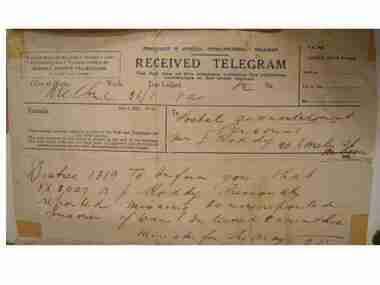 Red Cliffs Military Museum
Telegram, Telegram from Minister for the Army to Mrs. Roddy, 5:MMMM, 1941 (estimated)
... Telegram contains the following/ particulars in the order named/ Office of Origin, Words, Time Lodged, No/ (hand written)Melbourne, 36/1, 9a, 12 , 2./ Top right hand corner: T.G. 42 (not stamped)/Office Date Stamp/sent at...../Ch'nl No..../ By ....(all of which have no markings)/ Mid Document: Remarks. This message has been recieved subject to the/post and telegraph act/ and regulations./ The time received...Telegram contains the following/ particulars in the order named/ Office of Origin, Words, Time Lodged, No/ (hand written)Melbourne, 36/1, 9a, 12 , 2./ Top right hand corner: T.G. 42 (not stamped)/Office Date Stamp/sent at...../Ch'nl No..../ By ....(all of which have no markings)/ Mid Document: Remarks. This message has been recieved subject to the/post and telegraph act/ and regulations./ The time received ...A hand written telegram from the Minister for the Army to Mrs. J. Roddy to inform her of the capture of VX8007 A.J. RoddyCOMMONWEALTH OF AUSTRALIA POSTMASTER GENERAL's DEPARTMENT/ RECIEVED TELEGRAM/ Typed section of Telgram: FUNDS MAYBE QUICKLY, SAFELY AND/ECONOMICLY TRANSFERRED BY/ MONEY ORDER TELEGRAM/ PLEASE TURN OVER./ RECIEVED TELEGRAM./ The first line of this Telegram contains the following/ particulars in the order named/ Office of Origin, Words, Time Lodged, No/ (hand written)Melbourne, 36/1, 9a, 12 , 2./ Top right hand corner: T.G. 42 (not stamped)/Office Date Stamp/sent at...../Ch'nl No..../ By ....(all of which have no markings)/ Mid Document: Remarks. This message has been recieved subject to the/post and telegraph act/ and regulations./ The time received at this office is shown at the end of this message./The date stamp indicates the date both of lodgement and of reception/ inless otherwise shown after the particulars/ of the time lodged.// Beside this is: TO (hand written) Postal acknowledgement/ Personal/ Mrs. J. Roddy 20 Emily St/Merbein 6365.// Under this handwrittten in ink: Distre 1319 To inform you that/ VX8007 A J Roddy Previously/ reported missing is now reported/ Prisoner of War Interned Carinthia/ Minister for the Army/ 9.25 ww11, pow, a j, roddy, vx8007, 1941, carinthia -
 Orbost & District Historical Society
telegram, April 1899
... received at 2:47. This item is associated with the P.S. Curlip and the Richardson family, early Orbost pioneers. telegram-richardson-curlip communications-19th-century "You may enter - engine driver Curlip within two miles outside Entrance Snowy River." ...This message concerned the P.S. Curlip's entry to the Snowy River Lakes Entrance. It was logged at 2:45 and received at 2:47.This item is associated with the P.S. Curlip and the Richardson family, early Orbost pioneers.A white paper telegram with blue print and details hand-written in black ink. It has been sent fro Orbost to "Allen Richardson Marlo". The handwritten message is difficult to decipher."You may enter - engine driver Curlip within two miles outside Entrance Snowy River."telegram-richardson-curlip communications-19th-century -
 Bendigo Historical Society Inc.
Document - Abbott Collection: Telegram
... Time received 8.43 am May 4th, 1895 From London addressed to Abbott Tanner Bendigo. Text on the telegram: prices rising. ...Telegram Abbott Business Electric Telegraph Victoria, British and Australian line. Original date and time: May 3rd, 1895, at 1.50 pm. Number of words: 6. Time received ...Electric Telegraph Victoria, British and Australian line. Original date and time: May 3rd, 1895, at 1.50 pm. Number of words: 6. Time received 8.43 am May 4th, 1895 From London addressed to Abbott Tanner Bendigo. Text on the telegram: prices rising. Signature at the bottom: Boutchers.telegram, abbott, business -
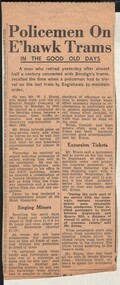 Bendigo Historical Society Inc.
Document - BASIL MILLER COLLECTION: TRAMS, c1950s
... Received callers wishing him well in his retirement, was besieged with telephone calls and telegrams in his office the S.E.C. buildings, received a presentation of a framed photograph of himself at work from the tramway inspectors and a presentation from the staff and employees. ...telegrams SEC buildings repairs ticket prices singing miners tram prices sick pay Newspaper clipping. Clipping possibly from 1958. Policemen On Eaglehawk Trams. In the Good Old Days. A man who retired yesterday after almost half a century connected with the Bendigo's trams, recalled the time when a policeman had to travel on the last tram to Eaglehawk to maintain order. He was Mr Evans, began in 1910 as a conductor, became a motorman, then traffic inspector, appointed tramways superintendent in May, 1928. When he retires he will be in his 48th year of service.. Received ...Newspaper clipping. Clipping possibly from 1958. Policemen On Eaglehawk Trams. In the Good Old Days. A man who retired yesterday after almost half a century connected with the Bendigo's trams, recalled the time when a policeman had to travel on the last tram to Eaglehawk to maintain order. He was Mr Evans, began in 1910 as a conductor, became a motorman, then traffic inspector, appointed tramways superintendent in May, 1928. When he retires he will be in his 48th year of service.. Received callers wishing him well in his retirement, was besieged with telephone calls and telegrams in his office the S.E.C. buildings, received a presentation of a framed photograph of himself at work from the tramway inspectors and a presentation from the staff and employees. Complimentary dinner at the Hotel Shamrock. Wages for conductors in 1910, 1 pound 2/6 for 60 hours, Motormen received 1 pound 10. No windscreen in trams. No sick pay.Tram drivers had to attend broken trolley wires, repairs or replacements in controllers and general equipment, to rerail trams when derailed, adjust brakes. Welsh, Cornish and Irish miners often sang on the trams. Policemen had to travel on the last tram at night to maintain order. Tram ticket obtained from conductors. 'Passengers could travel between Eaglehawk and Quarry Hill, a distance of almost 11 miles, at a charge of sixpence return,' said Mr Evans. Combination tickets included return tram fares and admission to the theatre. The prices varied according to the theatre seats.bendigo trams, ram, policeman, conductor, superintendent 1928, motorman, began 1910, telegrams, sec buildings, repairs, ticket prices, singing miners, tram prices, sick pay -
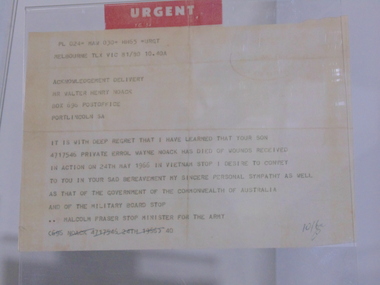 National Vietnam Veterans Museum (NVVM)
Document - Telegram
... A copy of the urgent telegram was was sent to Mr Walter Henry Noack (father of Errol Noack) saying " It is with deep regret that I have learned that your son 4717546 Private Erroll Wayne Noack has died of wounds received in action on 24th May 1966 in Vietnam. ...Telegram Noack Errol Pte Noack Killed in Action Malcolm Fraser Minister For The Army A copy of the urgent telegram was was sent to Mr Walter Henry Noack (father of Errol Noack) saying " It is with deep regret that I have learned that your son 4717546 Private Erroll Wayne Noack has died of wounds received in action on 24th May 1966 in Vietnam. ...A copy of the urgent telegram was was sent to Mr Walter Henry Noack (father of Errol Noack) saying " It is with deep regret that I have learned that your son 4717546 Private Erroll Wayne Noack has died of wounds received in action on 24th May 1966 in Vietnam. I desire to convey to you in your sad bereavement my sincere personal sympathy as well as that of the Government Of The Commonwealth Of Australia and of the Military Board. .. Malcolm Fraser - Minister for the Armytelegram, noack, errol, pte noack, killed in action, malcolm fraser, minister for the army -
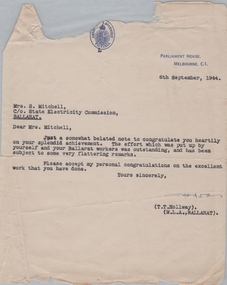 Ballarat Tramway Museum
Letter - Congratulations to Sylvia Mitchell, T. T. Hollway, 6/9/1944
... Demonstrates one of many congratulatory letters and telegrams received by Sylvia. Most Popular Conductress Sylvia Mitchell tramways Red Cross SECV T T Hollway Letter - typed on quarto size Victorian Parliamentary letterhead. ...Letter from T T Hollway, MLA Ballarat, congratulating Sylvia Mitchell on her splendid achievement. Dated 6/9/1944. Demonstrates one of many congratulatory letters and telegrams received by Sylvia.Letter - typed on quarto size Victorian Parliamentary letterhead.most popular conductress, sylvia mitchell, tramways, red cross, secv, t t hollway -
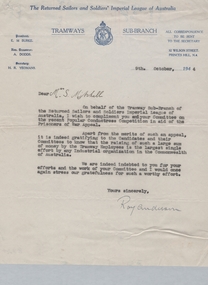 Ballarat Tramway Museum
Letter - Congratulations to Sylvia Mitchell, Tramways Sub branch RSSILA, 9/10/1944
... Demonstrates one of many congratulatory letters and telegrams received by Sylvia. Most Popular Conductress Sylvia Mitchell tramways Red Cross RSL Tramways sub branch Letter - typed on quarto size on Tramways Sub branch RSSILA letterhead Tramways Sub branch RSSILA Letter Congratulations to Sylvia Mitchell ...Letter from Roy Anderson of the Tramways Sub-branch of The Returned Sailors and Soldiers Imperial League of Australia, complimenting Sylvia Mitchell on her success and recording such a large sum is the largest single effort by an industrial organisation in the Commonwealth. Demonstrates one of many congratulatory letters and telegrams received by Sylvia.Letter - typed on quarto size on Tramways Sub branch RSSILA letterheadmost popular conductress, sylvia mitchell, tramways, red cross, rsl, tramways sub branch -
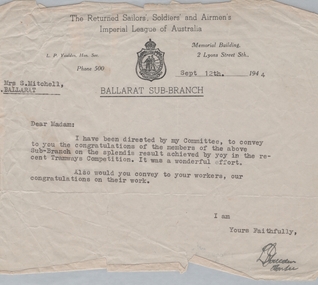 Ballarat Tramway Museum
Letter - Congratulations to Mitchell, Ballarat RSL Sub-branch, 12/9/1944
... Demonstrates one of many congratulatory letters and telegrams received by Sylvia. Most Popular Conductress Sylvia Mitchell tramways Red Cross RSL Ballarat Letter - typed on Ballarat RSL Sub-branch letterhead. ...Letter from L P Youlden Secretary Ballarat RSL sub-branch congratulating Sylvia Mitchell and her workers on the fundraising achievement - dated 12/9/1944.Demonstrates one of many congratulatory letters and telegrams received by Sylvia.Letter - typed on Ballarat RSL Sub-branch letterhead.most popular conductress, sylvia mitchell, tramways, red cross, rsl, ballarat -
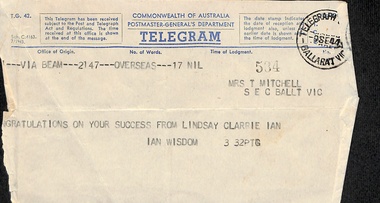 Ballarat Tramway Museum
Document - Telegram - Congratulations to Sylvia Mitchell 8 of 9, Post Master Generals Department, 9/9/1944
... Telegram from the Lindsay, Clarrie, Ian and Ian Wisdom congratulating Sylvia Mitchell - 9/9/1944. Received...Telegram from the Lindsay, Clarrie, Ian and Ian Wisdom congratulating Sylvia Mitchell - 9/9/1944. Received ...Telegram from the Lindsay, Clarrie, Ian and Ian Wisdom congratulating Sylvia Mitchell - 9/9/1944. Received from Overseas via Beam.Demonstrates a telegram congratulating Sylvia Mitchell.Telegram - typed on PMG Telegram paper - 9/9/1944most popular conductress, sylvia mitchell, tramways, red cross, ballarat, telegram -
 Melbourne Tram Museum
Postcard - Collins Street East, Melbourne, 1905
... Collins Street. cable trams horse drawn carts pedestrians young trees church spires quickly communicating telephones telegrams Printed below photograph: 'Collins Street East, Melbourne', handwritten in ink on front: 'The Seasons Greetings to you both from all at Footscray. Will send parcel at the first opportunity. Received ...Photograph looks west along Collins Street. It shows cable trams, horse drawn carts and pedestrians with young trees, church spires and double and triple storey buildings. Postcards were a common way of quickly communicating with others before the telephones and were cheaper than telegrams. Yields information about early Collins Street and an early communication method.Postcard with location and handwritten note on front and postcard markings, stamp and address on rear. Printed below photograph: 'Collins Street East, Melbourne', handwritten in ink on front: 'The Seasons Greetings to you both from all at Footscray. Will send parcel at the first opportunity. Received S B with thanks. Nellie'. On rear are postcard markings, a stamp of Queen Victoria, post office cancellation mark of 1905 and an address: 'Mrs Laidlaw, 25 Little Myers St, Geelong'collins street., cable trams, horse drawn carts, pedestrians, young trees, church spires, quickly communicating, telephones, telegrams -
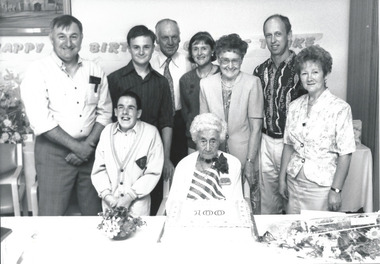 Melbourne Legacy
Photograph, 100th Birthday, 1994
... She had a wonderful day and Telegrams and messages were received from the Queen, The Australian Governor General, Prime Minister Keating, Governor of Victoria and Premier Jeff Kennett."...She had a wonderful day and Telegrams and messages were received from the Queen, The Australian Governor General, Prime Minister Keating, Governor of Victoria and Premier Jeff Kennett." ...Photograph of 100th birthday celebrations for Gladys Troke on 20 December 1994. The picture was published in The Answer in April 1995 with the story saying: "Latrobe Valley Group Legacy widow Gladys Broke, 100 years old on 20th December 1994 celebrated her birthday at Latrobe Valley Village Hostel with 100 family members and friends, some of whom had made the trip from England. She had a wonderful day and Telegrams and messages were received from the Queen, The Australian Governor General, Prime Minister Keating, Governor of Victoria and Premier Jeff Kennett."A record of a widow reaching 100 years of age and being celebrated by Legacy.Black and white photo of the 100th birthday of Gladys Troke.widows, answer, birthday
