
Showing 20 items matching "recreational equipment"
-
 Mont De Lancey
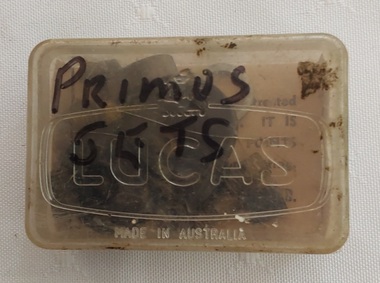
Domestic object - Primus Jet Parts, Primus Trading Company, c. 1950's
... ...Recreational equipment...Camping equipment Recreational equipment Cooking stoves Cooking equipment Kerosene cooking stoves The plastic box lid has a "King of the Road" lion emblem at the top and 'Made in Australia' stamped at the bottom. ...The original Primus stove was designed to be "soot-free" by vaporizing kerosene before ignition, a process requiring a precisely drilled, small-aperture jet nipple. Early jet parts were made of brass, designed for longevity and maintenance by the user. In 1962 Optimus bought the Primus brand name for liquid fueled stoves. Together with the brand name they also got spare parts and partly finished stoves. Bahco retained the Primus brand name for liquid gas products.A small lidded plastic container with Primus Jet parts, 9 washers, 11 jet nipples, 2 tiny open cylinders and 1 tiny screw. The lidded plastic box has a cardboard insert with details about an automotive Joseph Lucas Contact Set of points which are not contained in this box. The plastic box lid has a "King of the Road" lion emblem at the top and 'Made in Australia' stamped at the bottom. Handwritten on the lid and base of the box in black texta is 'Primus Jets'. The cardboard in the bottom of the plastic box says 'This Contact Set is treated with a preservative. IT IS ESSENTIAL that the POINTS are wiped clean before fitting. JOSEPH LUCAS (AUST.) PTY. LTD.'camping equipment, recreational equipment, cooking stoves, cooking equipment, kerosene cooking stoves -
 Flagstaff Hill Maritime Museum and Village
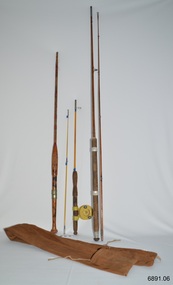
Functional object - Fishing Rods, 20th century
... equipment...recreational fishing...Dr Angus assisted Dr Tom Ryan, a pioneer in the use of X-rays and in ocular surgery. flagstaff hill warrnambool shipwrecked coast flagstaff hill maritime museum maritime museum shipwreck coast flagstaff hill maritime village great ocean road dr w r angus dr ryan surgical instrument t.s.s. largs bay warrnambool base hospital nhill base hospital mira hospital flying doctor fishing rod kit fishing equipment recreational fishing fishing rod and reel Reel is imprinted “JUNIOR / CAPSTAN / 14 / MADE IN AUSTRALIA”. ...This fishing rod kit was donated to Flagstaff Hill Maritime Village by the family of Doctor William Roy Angus, Surgeon and Oculist. It is part of the “W.R. Angus Collection” that includes historical medical equipment, surgical instruments and material once belonging to Dr Edward Ryan and Dr Thomas Francis Ryan, (both of Nhill, Victoria) as well as Dr Angus’ own belongings. The Collection’s history spans the medical practices of the two Doctors Ryan, from 1885-1926 plus that of Dr Angus, up until 1969. ABOUT THE “W.R.ANGUS COLLECTION” Doctor William Roy Angus M.B., B.S., Adel., 1923, F.R.C.S. Edin.,1928 (also known as Dr Roy Angus) was born in Murrumbeena, Victoria in 1901 and lived until 1970. He qualified as a doctor in 1923 at University of Adelaide, was Resident Medical Officer at the Royal Adelaide Hospital in 1924 and for a period was house surgeon to Sir (then Mr.) Henry Simpson Newland. Dr Angus was briefly an Assistant to Dr Riddell of Kapunda, then commenced private practice at Curramulka, Yorke Peninsula, SA, where he was physician, surgeon and chemist. In 1926, he was appointed as new Medical Assistant to Dr Thomas Francis Ryan (T.F. Ryan, or Tom), in Nhill, Victoria, where his experiences included radiology and pharmacy. In 1927 he was Acting House Surgeon in Dr Tom Ryan’s absence. Dr Angus had become engaged to Gladys Forsyth and they decided he further his studies overseas in the UK in 1927. He studied at London University College Hospital and at Edinburgh Royal Infirmary and in 1928, was awarded FRCS (Fellow from the Royal College of Surgeons), Edinburgh. He worked his passage back to Australia as a Ship’s Surgeon on the Australian Commonwealth Line’s T.S.S. Largs Bay. Dr Angus married Gladys in 1929, in Ballarat. (They went on to have one son (Graham 1932, born in SA) and two daughters (Helen (died 12/07/1996) and Berenice (Berry), both born at Mira, Nhill ) According to Berry, her mother Gladys made a lot of their clothes. She was very talented and did some lovely embroidery including lingerie for her trousseau and beautifully handmade baby clothes. Dr Angus was a ‘flying doctor’ for the A.I.M. (Australian Inland Ministry) Aerial Medical Service in 1928 . Its first station was in the remote town of Oodnadatta, where Dr Angus was stationed. He was locum tenens there on North-South Railway at 21 Mile Camp. He took up this ‘flying doctor’ position in response to a call from Dr John Flynn; the organisation was later known as the Flying Doctor Service, then the Royal Flying Doctor Service. A lot of his work during this time involved dental surgery also. Between 1928-1932 he was surgeon at the Curramulka Hospital, Yorke Peninsula, South Australia. In 1933 Dr Angus returned to Nhill and purchased a share of the Nelson Street practice and Mira hospital (a 2 bed ward at the Nelson Street Practice) from Dr Les Middleton one of the Middleton Brothers, the current owners of what previously once Dr Tom Ryan’s practice. Dr Tom and his brother had worked as surgeons included eye surgery. Dr Tom Ryan performed many of his operations in the Mira private hospital on his premises. He had been House Surgeon at the Nhill Hospital 1902-1926. Dr Tom Ryan had one of the only two pieces of radiology equipment in Victoria during his practicing years – The Royal Melbourne Hospital had the other one. Over the years Dr Tom Ryan had gradually set up what was effectively a training school for country general-practitioner-surgeons. Each patient was carefully examined, including using the X-ray machine, and any surgery was discussed and planned with Dr Ryan’s assistants several days in advance. Dr Angus gained experience in using the X-ray machine there during his time as assistant to Dr Ryan. When Dr Angus bought into the Nelson Street premises in Nhill he was also appointed as the Nhill Hospital’s Honorary House Surgeon 1933-1938. His practitioner’s plate from his Nhill surgery is now mounted on the doorway to the Port Medical Office at Flagstaff Hill Maritime Village, Warrnambool. When Dr Angus took up practice in the Dr Edward and Dr Tom Ryan’s old premises he obtained their extensive collection of historical medical equipment and materials spanning 1884-1926. A large part of this collection is now on display at the Port Medical Office at Flagstaff Hill Maritime Village in Warrnambool. In 1939 Dr Angus and his family moved to Warrnambool where he purchased “Birchwood,” the 1852 home and medical practice of Dr John Hunter Henderson, at 214 Koroit Street. (This property was sold in1965 to the State Government and is now the site of the Warrnambool Police Station. and an ALDI store is on the land that was once their tennis court). The Angus family was able to afford gardeners, cooks and maids; their home was a popular place for visiting dignitaries to stay whilst visiting Warrnambool. Dr Angus had his own silk worm farm at home in a Mulberry tree. His young daughter used his centrifuge for spinning the silk. Dr Angus was appointed on a part-time basis as Port Medical Officer (Health Officer) in Warrnambool and held this position until the 1940’s when the government no longer required the service of a Port Medical Officer in Warrnambool; he was thus Warrnambool’s last serving Port Medical Officer. (Masters of immigrant ships arriving in port reported incidents of diseases, illness and death and the Port Medical Officer made a decision on whether the ship required Quarantine and for how long, in this way preventing contagious illness from spreading from new immigrants to the residents already in the colony.) Dr Angus was a member of the Australian Medical Association, for 35 years and surgeon at the Warrnambool Base Hospital 1939-1942, He served with the Australian Department of Defence as a Surgeon Captain during WWII 1942-45, in Ballarat, Victoria, and in Bonegilla, N.S.W., completing his service just before the end of the war due to suffering from a heart attack. During his convalescence he carved an intricate and ‘most artistic’ chess set from the material that dentures were made from. He then studied ophthalmology at the Royal Melbourne Eye and Ear Hospital and created cosmetically superior artificial eyes by pioneering using the intrascleral cartilage. Angus received accolades from the Ophthalmological Society of Australasia for this work. He returned to Warrnambool to commence practice as an ophthalmologist, pioneering in artificial eye improvements. He was Honorary Consultant Ophthalmologist to Warrnambool Base Hospital for 31 years. He made monthly visits to Portland as a visiting surgeon, to perform eye surgery. He represented the Victorian South-West subdivision of the Australian Medical Association as its secretary between 1949 and 1956 and as chairman from 1956 to 1958. In 1968 Dr Angus was elected member of Spain’s Barraquer Institute of Barcelona after his research work in Intrasclearal cartilage grafting, becoming one of the few Australian ophthalmologists to receive this honour, and in the following year presented his final paper on Living Intrasclearal Cartilage Implants at the Inaugural Meeting of the Australian College of Ophthalmologists in Melbourne In his personal life Dr Angus was a Presbyterian and treated Sunday as a Sabbath, a day of rest. He would visit 3 or 4 country patients on a Sunday, taking his children along ‘for the ride’ and to visit with him. Sunday evenings he would play the pianola and sing Scottish songs to his family. One of Dr Angus’ patients was Margaret MacKenzie, author of a book on local shipwrecks that she’d seen as an eye witness from the late 1880’s in Peterborough, Victoria. In the early 1950’s Dr Angus, painted a picture of a shipwreck for the cover jacket of Margaret’s book, Shipwrecks and More Shipwrecks. She was blind in later life and her daughter wrote the actual book for her. Dr Angus and his wife Gladys were very involved in Warrnambool’s society with a strong interest in civic affairs. He had an interest in people and the community They were both involved in the creation of Flagstaff Hill, including the layout of the gardens. After his death (28th March 1970) his family requested his practitioner’s plate, medical instruments and some personal belongings be displayed in the Port Medical Office surgery at Flagstaff Hill Maritime Village, and be called the “W. R. Angus Collection”. The W.R. Angus Collection is significant for still being located at the site it is connected with, Doctor Angus being the last Port Medical Officer in Warrnambool. The collection of medical instruments and other equipment is culturally significant, being an historical example of medicine from late 19th to mid-20th century. Dr Angus assisted Dr Tom Ryan, a pioneer in the use of X-rays and in ocular surgery. Fishing rod kit with three rod handles and two ends, stored in brown fabric bag (2 compartments and tape fastening). Part of the W.R. Angus Collection. (1) Cork rod handle with wooden rod, plus wooden rod end. (2) wooden rod handle with 'crocodile skin' pattern carved into handle. (3) wooden handle with yellow plastic rod and reel, and yellow plastic rod end. Reel is Junior Capstan 14, Made in Australia. Reel is imprinted “JUNIOR / CAPSTAN / 14 / MADE IN AUSTRALIA”. flagstaff hill, warrnambool, shipwrecked coast, flagstaff hill maritime museum, maritime museum, shipwreck coast, flagstaff hill maritime village, great ocean road, dr w r angus, dr ryan, surgical instrument, t.s.s. largs bay, warrnambool base hospital, nhill base hospital, mira hospital, flying doctor, fishing rod kit, fishing equipment, recreational fishing, fishing rod and reel -
 Wodonga & District Historical Society Inc
Functional object - Fibre glass fishing rod, John (Jack) Bowden, 1962
... equipment...Recreational Fishing...Fishing Fishing equipment Recreational Fishing Southern Aurora A hand made fibre-glass fishing rod with wooden handle and agate runners Fibre glass fishing rod Functional object Fibre glass fishing rod John (Jack) Bowden ...This fishing rod was donated to the Wodonga Historical Society by Mr. David Brown who is a retired Victorian Railways driver. It was made for him by Mr. Jack Bowden in 1962. Mr. Bowden was the driver of the Southern Aurora when it crashed with a freight train at Violet Town on 7 February 1969. The Sydney – Melbourne passenger train was bound for Melbourne. At about 7.05 a.m. the “Southern Aurora” collided head-on with the Melbourne-Albury goods train near Violet Town. 8 people lost their lives in the crash and 117 were injured. Driver John Bowden had died of cardiac arrest at some time before the collision. The driver of the goods train, Lawrence Rosevear, a good friend and workmate of Jack Bowden had tried to apply the brake when he realised the Aurora was not slowing down, but was unable to stop the impact. Lawrence also died in the crashThis was made by a local train driver who was died in the "Southern Aurora" train tragedy.A hand made fibre-glass fishing rod with wooden handle and agate runnersfishing, fishing equipment, recreational fishing, southern aurora -
 Flagstaff Hill Maritime Museum and Village
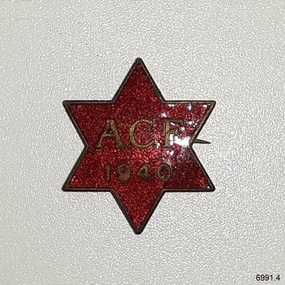
Badge - ACF Australian Comforts Fund badge, P J King Pty Ltd, 1940
... They also provided sporting equipment, recreational music, writing materials and postcards. ...They also provided sporting equipment, recreational music, writing materials and postcards. ...This Australian Comforts Fund badge is part of a set of eleven badges collected from the 1920s to the 1940s by Dr W. R. Angus. The badge was sold by the ACF in 1940 to raise funds for gifts to send to the Australian troops serving overseas. The badge is one of a set of badges that represents various organisations that he had interests in. The Australian Comforts Fund was a mostly female, volunteer-run organisation officially recognised by the Government. It began in 1916 as an amalgamation of groups of people who wanted to support the Australian troops abroad with Items of comfort to supplement the essential items provided by the Australian Military Forces. The ACF raised funds to purchase goods, pack them and send them overseas. One of their fund-raising activities was 'button days' where buttons such as this one were given to those who gave donations. The ACF closed down after World War I but was re-formed at the start of World War II. Items that the ACF sent to the troops included personal toiletry items such as toothbrushes and toothpaste, magazines, pyjamas, singlets and socks. They also provided sporting equipment, recreational music, writing materials and postcards. Special hampers were sent to the troops at Christmas time. The maker, P J King, (Percy John King), originally established his engraving and ie casting business in Russell Street, Melbourne in 1893 in partnership with Charles Walder Bridgland, continuing on his own from 1899. Percy and his son John Howard King set up a new business P J King Pty Ltd in 1928 making uniform buttons. In the late 1980s, it merged with two other companies that then became J J Cash, now known as Cash's Australia. The set of badges was donated to Flagstaff Hill Maritime Village by the family of Doctor Angus, Surgeon and Oculist. It is part of the “W.R. Angus Collection” which includes historical medical equipment, surgical instruments and material belonging to Dr Edward Ryan and Dr Thomas Francis Ryan, (both of Nhill, Victoria) and Dr Angus’ own belongings. The Collection’s history spans the medical practices of the two Doctors Ryan, from 1885-1926 plus that of Dr Angus, up until 1969. The W.R. Angus Collection: - The W.R. Angus Collection includes historical medical equipment, surgical instruments and material belonging to Dr Edward Ryan and Dr Thomas Francis Ryan, (both of Nhill, Victoria) and Dr Angus’ own belongings. The Collection’s history spans the medical practices of the two Doctors Ryan, from 1885-1926 plus that of Dr Angus, up until 1969. It includes historical medical and surgical equipment and instruments from the doctors Edward and Thomas Ryan of Nhill, Victoria. Dr Angus married Gladys in 1927 at Ballarat, the nearest big city to Nhill where he began as a Medical Assistant. He was also Acting House surgeon at the Nhill hospital where their two daughters were born. During World War II He served as a Military Doctor in the Australian Defence Force. Dr Angus and his family moved to Warrnambool in 1939, where Dr Angus operated his own medical practice. He later added the part-time Port Medical Officer responsibility and was the last person appointed to that position. Dr Angus and his wife were very involved in the local community, including the planning stages of the new Flagstaff Hill and the layout of the gardens there. Dr Angus passed away in March 1970.This badge represents the efforts of the women volunteers in Australia to support the Australian troops overseas in WWI and WWII. This badge is one of a set of significant badges that connects Doctor Angus with Australian organisations of the early-to-mid 20th century, including those relating to military service support. The W.R. Angus Collection is significant for still being located at the site it is connected with, Doctor Angus being the last Port Medical Officer in Warrnambool. The Collection includes historical medical objects that date back to the late 1800s.The ACF Badge is a star-shaped, gold, glittered red enamel and metal badge. The star has six points. The enamel surface is textured. The border and front inscription of the badge is gold. It is the badge of the Australian Comfort Fund, made by P.J. King and dated 1940. This badge is part of a set of badges collected by Dr W R Angus. the set represents organisations that he was involved in, and is part of the W.R. Angus Collection.Front: “ACF / 1940” Reverse embossed “P.J. KING”flagstaff hill, warrnambool, maritime museum, maritime village, great ocean road, shipwreck coast, metal badges, enamel badges, organisation badges, acf, presbyterian brotherhood, oikumene, w.r. angus, flagstaff hill maritime museum and village, australian comforts fund, button day, volunteer, australian military forces, christmas hamper, 1940 acf badge, fund-raising, p j king pty ltd, percy john king, donor's badge, world war ii, 1939-1945, australians at war, voluntary work, volunteers, home front, w.r. angus collection -
 Flagstaff Hill Maritime Museum and Village
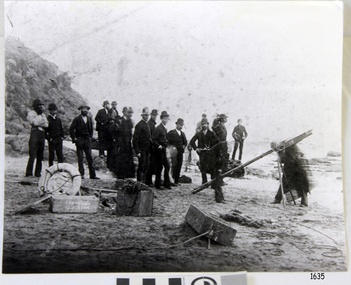
Photograph - Shipwreck rescue, c. 1890's
... Equipment in shore-to-ship rescues. Flagstaff Hill’s Fiji collection is of historical significance at a State level because of its association with the wreck Fiji, which is on the Victorian Heritage Register VHR S259. The Fiji is archaeologically significant as the wreck of a typical 19th century international sailing ship with cargo. It is educationally and recreationally ...CONTEXT – UPDATED The photograph taken on Sunday, September 6, 1891, shows the Port Campbell Rocket Rescue Crew and Equipment at Wreck Beach, Moonlight Head, preparing to save the stranded men on the wreck of the barque Fiji. The man standing in the middle, front of the photograph, facing the ocean, is Herbert Maxwell Morris, a farmer at Barruppa near Princetown, who is also a member of the Rocket Rescue Crew. The Rocket Rescue lifesaving method used an explosive rocket to shoot a light line from the shore across to the distressed vessel. The line was then secured to the ship’s mast, and a heavy, continuous line was sent out with a ‘breaches buoy’ attached (a buoy similar to the seat of a pair of trousers). The stranded seafarers would sit in the seats and be pulled along the line to safety. A lot of skill was needed to set up the line to reach its target, and the crew trained regularly to keep up their skills. The FIJI and the RESCUE: - The three-masted iron barque Fiji was built at Belfast, Ireland, in 1875 by Harland and Wolfe for a Liverpool-based shipping company. The ship departed Hamburg on May 22, 1891, bound for Melbourne under the command of Captain William Vickers with a crew of 25. The Cape Otway light was sighted on September 5, 1891. However, the bearing was different from Captain Vickers’ calculations. At about 2:30 am the next morning, the land was reported only 4-5 miles away. The captain tried to redirect the ship in the rough weather without success, and the Fiji struck rock only 300 yards (274 metres) from shore. The crew burned blue lights and fired rockets to signal distress. The lifeboats either capsized or were swamped and smashed to pieces. Two younger crewmen volunteered to swim to the shore with a line. One, a Russian named Daniel Carkland, drowned after he was swept away when the line broke. The other, Julius Gebauhr, a 17-year-old German able seaman, reached shore safely on his second attempt but had cut the line loose with his sheath-knife when it tangled in kelp. He climbed the cliffs in search of help. Later that morning, a young man named William (Willie) Ward reported that he saw the wreck of the ship close to shore near Moonlight Head from the cliffs, and the alarm for help was sent to Princetown, six miles away. At around the same time, a Mott’s party of land selectors, including F. J. Stansmore and Leslie Dickson, was travelling on horseback from Princetown towards Moonlight Head. They were near Ryans Den when they found Gebauhr in the scrub, bleeding and dressed only in a singlet, socks and a belt with his sheath-knife. They thought the man might be an escaped lunatic, due to his wild and shaggy-looking state and what seemed to be gibberish speech. After Gebauhr threw his knife away, they realised that he was speaking half-English, half-German as he talked about the wreck. They gave him food, brandy and clothing, and he was taken to a nearby guest house, Rivernook, owned by John Evans, where he was cared for. Most of the party went off to the wreck site. Stanmore and Dickson rode for help from both Port Campbell, for the two Rocket Rescue Crew buggies, and from Warrnambool, for the lifeboat. The vessel S.S. Casino sailed from Portland towards the scene. Half of the Port Campbell Rocket Crew and equipment arrived after a 25-mile journey and set up the rocket tripod on the beach below the cliffs. By this time, the weary crew of the Fiji had been clinging to the jib-boom for almost 15 hours, calling frantically for help. The Office in Charge of the Rocket Crew, W. Tregear, ordered the rocket to be fired, but the light line broke and the rocket was carried away. A second line was successfully set up by Herbert Morris. It crossed the ship and was secured. The anxious sailors tried to come ashore along the line, but some were washed off as the line sagged with too many on it at one time. Other nearly exhausted crewmen made their way through masses of seaweed and were often smothered by waves. Only 14 of the 24 who had remained on the ship made it to shore. Rocket Crew members and onlookers on the beach took turns to go into the surf and drag the half-drowned seamen to safety. These rescuers included Bill (William James) Robe, Herbert Maxwell Morris, Edwin Vinge, Hugh Cameron, Fenelon Mott, Arthur Wilkinson and Peter Carmody, who was also involved in the rescue of men from the Newfield. Arthur Wilkinson, a 29-year-old land selector from Geelong, swam out to help one of the ship’s crewmen, a carpenter named John Plunken, who was trying to swim from the ship to the shore. Two or three times, both men almost reached the shore but were washed back to the wreck, where they were both hauled back on board. Wilkinson was unconscious, possibly from hitting his head on the anchor before they were brought up. Plunken survived, but Wilkinson later died, and his body washed up the next day. The 26-year-old Bill Robe hauled out the last man; it was the captain, and he’d been tangled in the kelp. Only 20 minutes later, the wreck of the Fiji was smashed apart, and it settled in about 6 metres of water. Of the 26 men on the Fiji, 11 in total lost their lives. The remains of 7 bodies were washed onto the beach. Their coffins were made from timbers from the wrecked Fiji, and they were buried on the cliff top above the wreck. The survivors were taken to Rivernook and cared for over the next few days. Funds were raised by locals soon after the wreck in aid of the sufferers of the Fiji disaster. Captain Vickers was severely reprimanded for his mishandling of the ship. His Master's Certificate was suspended for 12 months. There was public criticism of the rescue. The important canvas ‘breeches buoy’ and heavy line for the Rocket Rescue were in the half of the rocket outfit that didn’t make it in time for the rescue, as they had been delayed at the Gellibrand River ferry. The communications to Warrnambool were down, so the call for help didn’t get through on time. The boat that was notified of the wreck failed to reach it in time. Much cargo looting occurred. One looter was caught with a small load of red and white rubber balls. Essence of peppermint mysteriously turned up in many settlers' homes. Sailcloth was salvaged and used for horse rugs and tent flies. Soon after the wreck, “Fiji tobacco” was advertised around Victoria. A Customs officer, trying to prevent some of the looting, was assaulted by looters and thrown over a cliff. He managed to cling to a bush lower down until rescued. In 1894, some coiled fencing wire was salvaged from the wreck. Hundreds of coils are still strewn over the site of the wreck, encrusted and solidified. The hull is broken, but the vessel’s iron ribs can be seen along with some of the cargo of concrete and pig iron. Captain Vickers presented Bill Robe with his silver-cased pocket watch, the only possession that he still had, as a token for having saved his life and the lives of some of the crew. Years later, Bill used the pocket watch to pay a debt, and it was handed down through that family. Seaman Julius Gebauhr later gave his knife, in its handcrafted leather sheath, to F. J. Stansmore for caring for him when he came ashore. The knife handle had a personal inscription on it. A marble headstone on the cliffs overlooking Wreck Beach pays tribute to the men who lost their lives when Fiji ran aground. The scene of the wreck is marked by the anchor from the Fiji, erected by Warrnambool skin divers in 1967. Captain Vickers’ pocket watch and Julius Gebauhr’s sheath knife are among the artefacts salvaged from the Fiji that are now part of the Fiji collection at Flagstaff Hill Maritime Village. The man identified in the photograph, Herbert Maxwell Morris, was the nephew of the Victorian era artist, William Morris. Herbert had sailed from England to Australia; he was about 25 years old when he joined the Rocket Rescue Crew at Port Campbell, where he lived. His successful rocket line firing at the Fiji wreck site was noted by author Jack Loney in one of his historic shipwreck books. Later, Morris moved from his property at Baruppa to Laver’s Hill to run a more profitable enterprise. This photograph is significant as an image of a historical event, being the willingness of local volunteers to aid in the saving of lives of stranded seafarers. It gives a clear picture of the use of Rocket Rescue Equipment in shore-to-ship rescues. Flagstaff Hill’s Fiji collection is of historical significance at a State level because of its association with the wreck Fiji, which is on the Victorian Heritage Register VHR S259. The Fiji is archaeologically significant as the wreck of a typical 19th century international sailing ship with cargo. It is educationally and recreationally significant as one of Victoria's most spectacular historic shipwreck dive sites with structural features and remains of the cargo evident. It also represents aspects of Victoria’s shipping history and its potential to interpret sub-theme 1.5 of Victoria’s Framework of Historical Themes. The Fiji collection meets the following criteria for assessment; Importance to the course, or pattern, of Victoria’s cultural history, possession of uncommon, rare or endangered aspects of Victoria’s cultural history, and potential to yield information that will contribute to an understanding of Victoria’s cultural history. Black and white photograph of the Rocket Rescue Crew from Pt Campbell on Wreck Beach, Moonlight Head, at the barque 'Fiji' wreck site. September 6, 1891.warrnambool, shipwrecked coast, flagstaff hill, flagstaff hill maritime museum, maritime museum, shipwreck coast, flagstaff hill maritime village, shipwrecked artefact, pocket watch, fob watch fiji, william vickers, william robe, bill robe, gebauhr, stansmore, carmody, wreck bay, moonlight head, fiji shipwreck 1891, rocket crew, port campbell rocket crew, lifesaving crew, photograph of rocket crew, herbert morris, warrnambool, shipwreck artefact, mott, william ward, rocket rescue, breeches buoy, rivernook guest house -
 Flagstaff Hill Maritime Museum and Village
Souvenir - Rope Sample, before September 1891
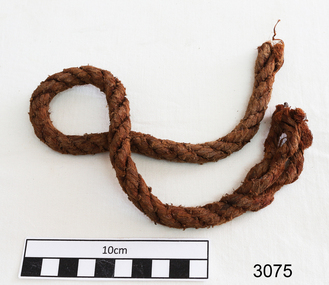
... recreationally significant as one of Victoria's most spectacular historic shipwreck dive sites with structural features and remains of the cargo evident. It also represents aspects of Victoria’s shipping history and its potential to interpret sub-theme 1.5 of Victoria’s Framework of Historical Themes (living with natural processes). flagstaff hill warrnambool shipwrecked coast flagstaff hill maritime museum maritime museum shipwreck coast flagstaff hill maritime village great ocean road rope the fiji william boyce distress signal rocket rescue life saving equipment Printed on the envelope: "Shire of Hampden / PO Box 84, Camperdown 3260" Hand written "rope of wreck of Fiji / 7cm / Mr Wm "Boyce" Display card with rope includes words "Piece of Rope from the Fiji distress rockets and was donated to Flagstaff Hill by a private donor in 1989" Rope, plaited, brown in colour, cut straight at one end, and the other end is separated into 3 pieces, from distress rockets used during the wreck of the sailing ship Fiji. ...The rope was part of the distress rocket used during the time that the sailing ship Fiji was in distress, before it became a wreck. The three-masted iron barque Fiji had been built in Belfast, Ireland, in 1875 by Harland and Wolfe for a Liverpool based shipping company. The ship departed Hamburg on 22nd May 1891 bound for Melbourne, under the command of Captain William Vickers with a crew of 25. The ship’s manifest shows that she was loaded with a cargo of 260 cases of dynamite, pig iron, steel goods, spirits (whisky, schnapps, gin, brandy), sailcloth, tobacco, coiled fencing wire, concrete, 400 German pianos (Sweet Hapsburg), concertinas and other musical instruments, artists supplies including brushes, porcelain, furniture, china, and general cargo including candles. There were also toys in anticipation for Christmas, including wooden rocking horses, miniature ships, dolls with china limbs and rubber balls. On September 5th, one hundred days out from Hamburg in squally and boisterous south west winds the Cape Otway light was sighted on a bearing differing from Captain Vickers’ calculation of his position. At about 2:30am, Sunday 6th September 1891 land was reported 4-5 miles off the port bow. The captain tried to put the ship on the other tack, but she would not respond. He then tried to turn her the other way but just as the manoeuvre was being completed the Fiji struck rock only 300 yards (274 metres) from shore. The place is known as Wreck Bay, Moonlight Head. Blue lights were burned and distress rockets fired whilst an effort was made to lower boats but all capsized or swamped and smashed to pieces. Two of the younger crewmen volunteered to swim for the shore, taking a line. One, a Russian named Daniel Cartland, drowned after he was swept away when the line broke. The other, 17 year old able seaman Julius Gebauhr, a German, reached shore safely on his second attempt but without the line, which he had cut lose with his sheath-knife when it become tangled in kelp. He rested on the beach a while then climbed the steep cliffs in search of help. At about 10am on the Sunday morning a party of land selectors - including F. J. Stansmore, Leslie Dickson (or Dixon) and Mott - found Gebauhr. They were near Ryan's Den, on their travels on horseback from Princetown towards Moonlight Head, and about 5km from the wreck. Gebauhr was lying in the scrub in a poor state, bleeding and dressed only in singlet, socks and a belt with his sheath-knife, ready for all emergencies. At first they were concerned about his wild and shaggy looking state and what seemed to be gibberish speech, taking him to be an escaped lunatic. They were reassured after he threw his knife away and realised that he was speaking half-English, half-German. They gave him food and brandy and some clothing and were then able to gain information about the wreck. Some of the men took him to River nook, a nearby guest house owned by John Evans, where he was cared for. Stansmore and Dickson rode off to try and summon help. Others went down to the site of the wreck. Messages for rescuing the rest of the crew were sent both to Port Campbell for the rocket rescue crew and to Warrnambool for the lifeboat. The S.S. Casino sailed from Portland towards the scene. After travelling the 25 miles to the scene, half of the Port Campbell rocket crew and equipment arrived and set up the rocket tripod on the beach below the cliffs. By this time the crew of the Fiji had been clinging to the jib-boom for almost 15 hours, calling frantically for help. Mr Tregear from the Rocket Crew fired the line. The light line broke and the rocket was carried away. A second line was successfully fired across the ship and made fast. The anxious sailors then attempted to come ashore along the line but, with as many as five at a time, the line sagged considerably and some were washed off. Others, nearly exhausted, had to then make their way through masses of seaweed and were often smothered by waves. Only 14 of the 24 who had remained on the ship made it to shore. Many onlookers on the beach took it in turns to go into the surf and drag half-drowned seamen to safety. These rescuers included Bill (William James) Robe, Edwin Vinge, Hugh Cameron, Fenelon Mott, Arthur Wilkinson and Peter Carmody. (Peter Carmody was also involved in the rescue of men from the Newfield.) Arthur Wilkinson, a 29 year old land selector, swam out to the aid of one of the ship’s crewmen, a carpenter named John Plunken. Plunken was attempting to swim from the Fiji to the shore. Two or three times both men almost reached the shore but were washed back to the wreck. A line was thrown to them and they were both hauled aboard. It was thought that Wilkinson struck his head on the anchor before s they were brought up. He remained unconscious. The carpenter survived this ordeal but Wilkinson later died and his body was washed up the next day. It was 26 year old Bill Robe who hauled out the last man, the captain, who had become tangled in the kelp. The wreck of the Fiji was smashed apart within 20 minutes of the last man being brought ashore, and it settled in about 6m of water. Of the 26 men on the Fiji, 11 in total lost their lives. The remains of 7 bodies were washed onto the beach and their coffins were made from timbers from the wrecked Fiji. They were buried on the cliff top above the wreck. The survivors were warmed by fires on the beach then taken to River nook and cared for over the next few days. Funds were raised by local communities soon after the wreck in aid of the sufferers of the Fiji disaster. Captain Vickers was severely reprimanded for his mishandling of the ship. His Masters Certificate was suspended for 12 months. At the time there was also a great deal of public criticism at the slow and disorganised rescue attempt to save those on board. The important canvas ‘breech buoy’ or ‘bucket chair’ and the heavy line from the Rocket Rescue was in the half of the rocket outfit that didn’t make it in time for the rescue: they had been delayed at the Gellibrand River ferry. Communications to Warrnambool were down so the call for help didn’t get through on time and the two or three boats that had been notified of the wreck failed to reach it in time. Much looting occurred of the cargo that washed up on the shore, with nearly every visitor leaving the beach with bulky pockets. One looter was caught with a small load of red and white rubber balls, which were duly confiscated and he was ‘detained’ for 14 days. Essence of peppermint mysteriously turned up in many settlers homes. Sailcloth was salvaged and used for horse rugs and tent flies. Soon after the wreck “Fiji tobacco” was being advertised around Victoria. A Customs officer, trying to prevent some of the looting, was assaulted by looters and thrown over a steep cliff. He managed to cling to a bush lower down until rescued. In 1894 some coiled fencing wire was salvaged from the wreck. Hundreds of coils are still strewn over the site of the wreck, encrusted and solidified. The hull is broken but the vessel’s iron ribs can be seen along with some of the cargo of concrete and pig iron. Captain Vickers presented Bill Robe with his silver-cased pocket watch, the only possession that he still had, as a token for having saved his life and the lives of some of the crew. (The pocket watch came with 2 winding keys, one to wind it and one to change the hands.) Years later Bill passed the watch to his brother-in-law Gib (Gilbert) Hulands as payment of a debt and it has been passed down the family to Gilbert Hulands’ grandson, John Hulands. Seaman Julius Gebauhr later gave his knife, in its hand crafted leather sheath, to F. J. Stansmore for caring for him when he came ashore. The knife handle had a personal inscription on it. A marble headstone on the 200m high cliffs overlooking Wreck Beach, west of Moonlight Head, paying tribute to the men who lost their lives when Fiji ran aground. The scene of the wreck is marked by the anchor from the Fiji, erected by Warrnambool skin divers in 1967.This rope is part of the collection of artefacts from the wreck of the Fiji. Flagstaff Hill’s Fiji collection is of historical significance at a State level because of its association with the wreck Fiji, which is on the Victorian Heritage Register VHR S259. The Fiji is archaeologically significant as the wreck of a typical 19th century international sailing ship with cargo. It is educationally and recreationally significant as one of Victoria's most spectacular historic shipwreck dive sites with structural features and remains of the cargo evident. It also represents aspects of Victoria’s shipping history and its potential to interpret sub-theme 1.5 of Victoria’s Framework of Historical Themes (living with natural processes).Rope, plaited, brown in colour, cut straight at one end, and the other end is separated into 3 pieces, from distress rockets used during the wreck of the sailing ship Fiji. Rope was in envelope printed with an address, and a description, and there was a display card with further details on it. Printed on the envelope: "Shire of Hampden / PO Box 84, Camperdown 3260" Hand written "rope of wreck of Fiji / 7cm / Mr Wm "Boyce" Display card with rope includes words "Piece of Rope from the Fiji distress rockets and was donated to Flagstaff Hill by a private donor in 1989"flagstaff hill, warrnambool, shipwrecked coast, flagstaff hill maritime museum, maritime museum, shipwreck coast, flagstaff hill maritime village, great ocean road, rope, the fiji, william boyce, distress signal, rocket rescue, life saving equipment -
 Queenscliffe Maritime Museum
Equipment - Switches
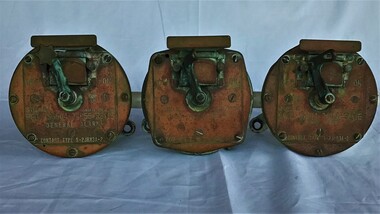
... Switches from HMAS Canberra taken prior to scuttling in October 2009 Ex HMAS Canberra was the first ex naval vessel to be scuttled off Barwon Heads to form an artificial reef and to facilitate recreational diving. switches navy ships hmas canberra Contact Type S-2JRM3A-2 3 Marine Alarm Switches on metal frame; General, Unknown usage, Collision Alarm Equipment Switches ...Switches from HMAS Canberra taken prior to scuttling in October 2009Ex HMAS Canberra was the first ex naval vessel to be scuttled off Barwon Heads to form an artificial reef and to facilitate recreational diving.3 Marine Alarm Switches on metal frame; General, Unknown usage, Collision AlarmContact Type S-2JRM3A-2switches, navy ships, hmas canberra -
 Queenscliffe Maritime Museum
Equipment - Tap, brass
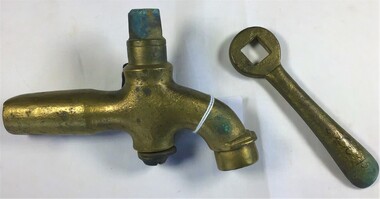
... It is educationally and recreationally significant as a coherently intact example of a British built iron clipper Shipwrecks Victoria Tower Tap with Key Brass tap with key (handle) Equipment Tap, brass ...Along with the wrecks of the Light of the Age (1868 - American-built wooden clipper ship) and Sussex (1871 - Blackwall frigate) nearby these vessels represent the three major design classes, and span the evolution of commercial and immigrant sailing ships used by the British in the colonial Australian trade in the last half of the nineteenth century. Taken as a group, it can be seen that the Great Ocean Road area wrecks constitute an extremely rich resource of historical and archaeological information.The Victoria Tower is archaeologically significant as the wreck of an international inward-bound passenger and cargo vessel. It is educationally and recreationally significant as a coherently intact example of a British built iron clipper Brass tap with key (handle)shipwrecks, victoria tower, tap with key -
 Kiewa Valley Historical Society
Mantle for Gas Lantern
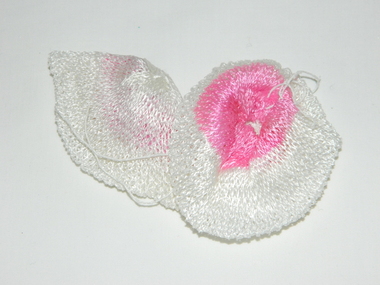
... The outdoor recreational industry has significantly provided for, if only at holiday time, an industry that has a relatively high employment rate and beneficial to local communities. lighting gas heating camping outdoor equipment lamp The gas mantle is in a fabric, pear shaped, of rayon fabric impregnated with cerium. ...Originally these mantles where produced to be used in gas street lights in Europe and North America cities.There use started in 1891. These mantles were used before electrical power street lighting was installed. They have been used ever since until safety concerns regarding radiation from their thorium infused particles made alternate mobile lamps more attractive. The age of open flame recreational lighting is fast coming to a close. The greater use of battery and generator powered lighting(ease of operation) has brought the costing of these alternative lighting to an acceptable level. The age of miniaturisation and volatility of the open flame has seen a greater swing to smaller and more stable lighting. These incandescent gas mantles were initially used in the Coleman White Gas LanternsThe Kiewa Valley, with its closeness to the Victorian Alps, allows greater opportunity for the "happy" campers to enjoy the outdoors. The lighting provided by the incandescent gas lamps allow the adventurer at heart to enjoy an alternative lifestyle and still having the comforts of "home" at their finger tips. The numerous camping facilities in the Kiewa Valley and the upper alpine region is testament that those living in the cities need a break from the day to day grind and go to a quieter and more spiritual environment. Artificial lighting, as provided by mobile apparatus, is highly valued by the urban gypsy. The outdoor recreational industry has significantly provided for, if only at holiday time, an industry that has a relatively high employment rate and beneficial to local communities.The gas mantle is in a fabric, pear shaped, of rayon fabric impregnated with cerium. It's appearance is similar to a very small fishing net. The fabric is very ply-able until it is heated by an open flame then it becomes more rigid and lets out an incandescent white light. Its colour is white to off white. It has a draw string fastened a t the bottom (to wrap around the flame source)lighting, gas, heating, camping, outdoor equipment lamp -
 Kiewa Valley Historical Society
Camera Tele Ektra, Circa 1970s to 1980s
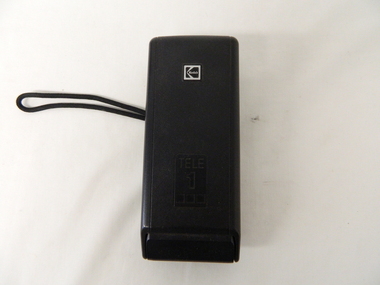
... recreational/life style/non professional) capture of the altering socio economic balance of rural based activities provided the catalyst for greater appreciation by city dwellers to the benefits of rural life. The greater levels of communicative avenues, especially the visual (photography, pictures, television and the internet), from the beginning of this period and throughout the time frame (1970 to the 2000s) has cut the major restraints of what was rural "isolationism". The significance of this type of camera, being a small two lens (normal, telescopic) and portable piece of equipment ...From the 1970's onward the relative isolation of regional areas was improving in "leaps and bounds". Social amenities, and life styles were changing at a great rate. Items such as this camera (recreational/life style/non professional) capture of the altering socio economic balance of rural based activities provided the catalyst for greater appreciation by city dwellers to the benefits of rural life. The greater levels of communicative avenues, especially the visual (photography, pictures, television and the internet), from the beginning of this period and throughout the time frame (1970 to the 2000s) has cut the major restraints of what was rural "isolationism".The significance of this type of camera, being a small two lens (normal, telescopic) and portable piece of equipment, allowed non professional tourists, locals or visitors to visually display the uniqueness of the Kiewa Valley and Alpine regions. This method of promotional and intimate visual reproduction of not only physical but also through personal involvement, of the photographer to the audience, a greater psychological impact, by the nature of intimacy involved. This type of photography is one of the most effective stimuli to promote the unique qualities of the Kiewa Valley region.This Item is dual lens (22mm,44mm) camera comprising of an elongated oblong shape, black hard plastic shell. It has a slightly rough surface(for a better fingers grip), two latches are located at the back, one to release the camera from its hinged protective cover and one to move to the next picture frame (film is within a cartridge).On swing cover "Kodak Tele 1 " on back in small print "MADE IN USA" On camera body "KODAK TELE EKTRA 1" underneath "CAMERA" and on slide switch(front) to change lenses:"Tele" and "Norm" kodak two lens camera, photographic hobby usa made camera -
 4th/19th Prince of Wales's Light Horse Regiment Unit History Room
Booklet, Arbuckle Waddell Pty Ltd, Physical and Recreational Training 1941, (Reprinted with Amendment No 1 1942), 1942
... Physical training Soft covered booklet dealing with various aspects of physical training, the dimensions of various sports grounds, unarmed combat, and improvised training equipment Physical and Recreational Training 1941, (Reprinted with Amendment No 1 1942) Booklet Arbuckle Waddell Pty Ltd ...Soft covered booklet dealing with various aspects of physical training, the dimensions of various sports grounds, unarmed combat, and improvised training equipmentphysical training -
 Warrnambool and District Historical Society Inc.
Binoculars, Carl Zeiss, 1940s
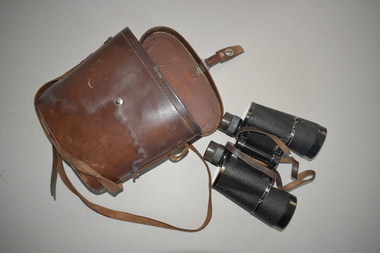
... recreational and military use. The Carl Zeiss factory in Jena, Germany was founded in 1846 and manufactured optical systems such as cameras, binoculars and riflescopes and industrial measurement devices and medical equipment. ...recreational and military use. The Carl Zeiss factory in Jena, Germany was founded in 1846 and manufactured optical systems such as cameras, binoculars and riflescopes and industrial measurement devices and medical equipment. ...Binoculars have been in existence for over 100 years for recreational and military use. The Carl Zeiss factory in Jena, Germany was founded in 1846 and manufactured optical systems such as cameras, binoculars and riflescopes and industrial measurement devices and medical equipment. Binoculars are still commonly used today. These binoculars have no known local provenance and are retained for display purposes.These are a pair of black binoculars with a brown leather strap. It is contained within a brown leather case. The case has a brown leather strap and metal buckle and a metal and leather clasp. Carl Zeiss Jena Binoctar 1389040 7 X 50 vintage optical goods, history of warrnambool -
 Sunbury Family History and Heritage Society Inc.
Photograph, Rosa McCall, 2001
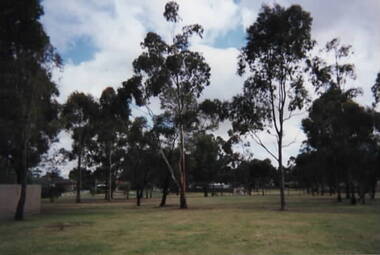
... There is limited playground equipment in the ground and a plaque acknowledging the work done by nearby resident Roger Free who took on the task as a volunteer caretaker of the park. The area was developed as a park because there is a natural underground spring running diagonally across the land from Ligar Street to Miller Street. This is one of many parks and recreational ...This small park in Sunbury is bounded by Ligar, Miller, Pasley and Neill Streets on the west side of the railway line. There is limited playground equipment in the ground and a plaque acknowledging the work done by nearby resident Roger Free who took on the task as a volunteer caretaker of the park. The area was developed as a park because there is a natural underground spring running diagonally across the land from Ligar Street to Miller Street. This is one of many parks and recreational areas that have been established in Sunbury. A non-digital coloured photograph of an open parkland with gum trees growing across the area.roger free, ligar street, neill street, pasley street, miller street, sunbury, parkland -
 Trafalgar Holden Museum
Equipment - Brass fly Terret
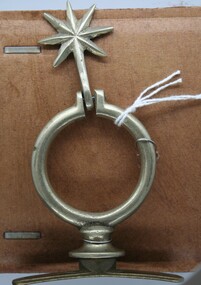
... imported and sold by Holden and Frost during the late 19th century and early 20th century for the purpose of equine accessory sold by Holden and Frost as a rider accessory equine military recreational c1900 Fly terret brass fly terrets as used in riders accessory Equipment Brass fly Terret ...imported and sold by Holden and Frost during the late 19th century and early 20th century for the purpose of equine accessorysold by Holden and Frost as a rider accessory brass fly terrets as used in riders accessoryequine, military, recreational, c1900, fly terret -
 Parks Victoria - Mount Buffalo Chalet
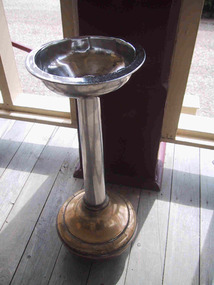
Spittoon
... Appendix A.3, Snow sports equipment and other recreational items. (Pg 166 Historica). ...Appendix A.3, Snow sports equipment and other recreational items. (Pg 166 Historica). ...Probably original to Mt Buffalo Chalet. Listed in the Draft Inventory of Significant Collection items. Appendix A.3, Snow sports equipment and other recreational items. (Pg 166 Historica). "Smoker's were well-catered for at the Chalet, and Smoking Rooms in similar resort establishments were considered to be a necessary facility. A guest house in the Blue Mountains in 1905 offered the' full comforts of a refined home' with views, spacious verandahs, tennis court and smoking room. James Boyce commented on expectorating smokers in the the Chalet's public rooms and recommended the provision of spittoons." (Pg 101. Historica) PROV . Undated photo of bedroom sitting room with same chrome ashtray, there are 3 in the MBC Collection. (Fif 52. Pg 63 Historica) Similar ashtray sighted on Ebay listed as Victorian Railways Spitoon, February 2012.3 x Brass and chrome standing spittoons with bulbous bases and bowl on a stem. -
 Parks Victoria - Mount Buffalo Chalet
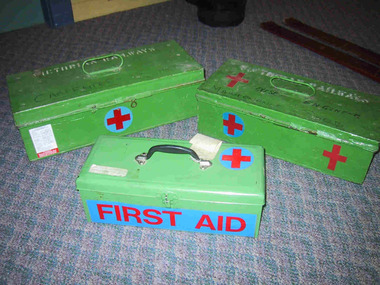
Cases, first aid
... equipment and to the need for remedial items such as bedpans and invalid cups.' (Pg 110. Historica) For many years whilst under Railways Management the First Aid Room was opposite the stairs leading down to the Café, on the left hand side leading up to the Dining Room. Here skiing and recreational...equipment and to the need for remedial items such as bedpans and invalid cups.' (Pg 110. Historica) For many years whilst under Railways Management the First Aid Room was opposite the stairs leading down to the Café, on the left hand side leading up to the Dining Room. Here skiing and recreational ...Used at the Chalet or by the Victorian Railways for administering first aid. 'A range of first aid supplies, including older types of stretchers and syringes emphasise the importance given over the years to emergency equipment and to the need for remedial items such as bedpans and invalid cups.' (Pg 110. Historica) For many years whilst under Railways Management the First Aid Room was opposite the stairs leading down to the Café, on the left hand side leading up to the Dining Room. Here skiing and recreational injuries were attended to.Listed in Draft Inventory of Significant Collection items. Appendix A.3.Staff Equipment. (Pg 167 Historica).Seven green painted tin first aid cases with hinged lids. Two cases have "Victorian Railways"stamped on them. All have a blue circle with a redcross marked on them.Yes -
 Parks Victoria - Mount Buffalo Chalet
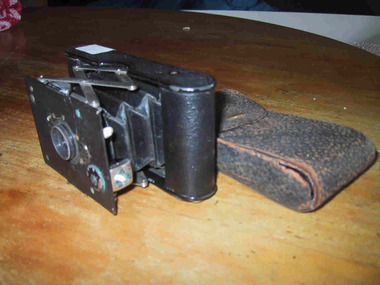
Camera
... Appendix A.3, Snow sports equipment and other recreational items. (Pg 166 Historica). ...The Vest Pocket Kodak cameras were a best-selling folding camera series made by Eastman Kodak (Rochester), from 1912 to 1926. They were the first cameras to use the smaller 127 film reels.(http://camerapedia.wikia.com/wiki/Vest_Pocket_Kodak) One of the items collected by Roger Jones.Listed in Draft Inventory of Significant Collection items. Appendix A.3, Snow sports equipment and other recreational items. (Pg 166 Historica)..1 Camera, small black metal with extendable leather sleeve with lens. Is covered in leatherette. .2 Camera case - brown leather with press stud closure."V.P AUTOGRAPHIC KODAK SPECIAL" -
 Parks Victoria - Mount Buffalo Chalet
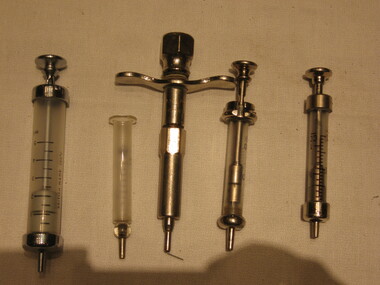
Syringes
... equipment and to the need for remedial items such as bedpans and invalid cups.' (Pg. 110. Historica) For many years whilst under Railways Management the First Aid Room was opposite the stairs leading down to the Café, on the left hand side leading up to the Dining Room. Here skiing and recreational...equipment and to the need for remedial items such as bedpans and invalid cups.' (Pg. 110. Historica) For many years whilst under Railways Management the First Aid Room was opposite the stairs leading down to the Café, on the left hand side leading up to the Dining Room. Here skiing and recreational ...'A range of first aid supplies, including older types of stretchers and syringes emphasise the importance given over the years to emergency equipment and to the need for remedial items such as bedpans and invalid cups.' (Pg. 110. Historica) For many years whilst under Railways Management the First Aid Room was opposite the stairs leading down to the Café, on the left hand side leading up to the Dining Room. Here skiing and recreational injuries were attended to.Listed in Draft Inventory of Significant Collection items. Appendix A.3.Staff Equipment. (Pg 167 Historica).Syringes: from .01 till ..04 they have a scale ,they are made with Glass, .01 5ml .02 1ml, .03 20ml, .04 22ml, .05 are made with metal..01 British made 200`C, Everett .02 Gima .03 JJEFF, record british make original .04 original record .05 W.G.LTD Sydney -
 Parks Victoria - Mount Buffalo Chalet
Honour Board
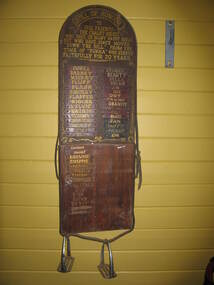
... Appendix A.3, Snow sports equipment and other recreational items. (Pg 166 Historica). ...Was located in the stables at Mount Buffalo Chalet. It was used to record the names of horses that were ridden by Chalet guests when they were holidaying at the Chalet. 'Admiring the rugged beauty of the Buffalo Plateau and exploring its scenic attractions ...quickly became part of the Mount Buffalo Chalet tourist experience...The Chalet facilitated the experience by hosting guided tours, including trail rides on horseback...the horses remained at the Chalet for decades, and have been remembered with great affection, as demonstrated by the honour roll for Chalet horses and various commemorative plaques.' (Pg 98. Historica) Many of these horses are still remmbered by former guest of the Chalet. Granite and Punka were legendary and plaques in their honor are mounted on the large granite boulders in the stableyards.Listed in Draft Inventory of Significant Collection items. Appendix A.3, Snow sports equipment and other recreational items. (Pg 166 Historica).Wooden plaque with names painted onto strips of leather fixed to a board. The board is made of two sections of wood and is arched at the top and squared at the base. The piece at the top that appears to be earlier and has gold painted inscriptions with decorative scrolling around the edge. The board has leather strapping around the edge and two stirrups threaded onto leather at the base. The upper section of the board has all the names painted onto leather strips. The lower section of the board has some names painted onto strips but also some names are scratched directly onto the wood.At top of plaque, "ROLL OF HONOUR /TO / OUR FRIENDS - / THE CHALET HORSES, / WHO GAVE US MANY HAPPY HOURS / BUT WHO HAVE SINCE MOVED / "DOWN THE HILL". FROM THE / TIME OF "PUNKA" / WHO SERVED / FAITHFULLY FOR 20 YEARS" Underneat this are the names of the individual horses starting with , "PUNKA....." -
 Royal District Nursing Service (now known as Bolton Clarke)
Photograph - Document/Letter, 1900
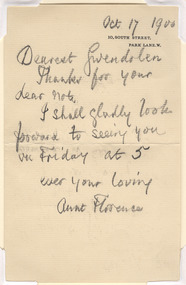
... equipment and found help to assist in the laundry. The wards were scrubbed from floor to ceiling. Florence set a high standard of care with fresh air, hygiene, clean clothing, sufficient food and regular dressing of wounds being carried out. She realized the importance of psychological needs, and soldiers were assisted to write letters to relatives, and took part in education and recreational ...A letter dated 8th May 1973 details how the letter from Florence Nightingale was forwarded to Mrs E.G. (Janet) Wilson in 1955 by Gwendolen, Florence Nightingale's niece. The explanatory letter was forwarded by Elsa Halenstein and given to Royal District Nursing Service and remains in its Archives. From 1948 Mrs. Wilson served on the Committee of Management of Melbourne District Nursing Society (later Service), serving as President from October 1964-1967. In 1949 Mrs. Hallenstein served on the MDNS Committee of Management, becoming President of the now Royal District Nursing Service from 1967-1974. Florence Nightingale was the founder of modern nursing. Melbourne District Nursing Society (MDNS) only employed Trained nurses from its inception in 1885. They followed Florence Nightingale's basic rules of good hygiene, cleanliness, good nutrition and fresh air, which they learned during their Nursing Training at a Hospital, and taught to their patients by instruction and demonstration. In those days Trained nurses were called 'Nurse'. In 1892 MDNS employed Lucy Smith who, through the Nightingale Fund, did her nursing training at the Nightingale Training School at St. Thomas's Hospital in London. She was the first nurse from this school to work at MDNS. Florence Nightingale, born on the 12th of May 1820, was named after the place of her birth in Italy. Born into a wealthy family she was schooled at home where she excelled in her studies; spoke several languages fluently, and was taught home management. She believed she was ‘called’ to reduce human suffering and tended to ill members of her family and tenants on the family estate. She worked as a nurse at Salisbury Infirmary where she learned about nursing sanitation and hospital practice. Florence then enrolled at the Institution of Protestant Deaconesses at Kaiserswerth, Germany where she learned basic nursing skills, the importance of patient observation, and hospital organization. In 1853 she became Superintendent of the Institution for Sick Gentlewomen in Distressed Circumstances in London, where she reformed health care, working conditions, and hospital efficiency. The Crimean War broke out in late 1853 and a newspaper reported the injured and sick soldiers were being cared for by an “incompetent and ineffective medical establishment and that most basic supplies were not available for care”. After an outcry from the public, Florence was asked to lead a group of 38 nurses, whom she had trained, to Scutari where the wounded soldiers were sent. After arriving at the Barrack Hospital in October 1854, she found the soldiers were being cared for in overcrowded and filthy conditions; contaminated water, faeces on the floors and rats running freely. There were few supplies and equipment. Florence bought supplies and equipment and found help to assist in the laundry. The wards were scrubbed from floor to ceiling. Florence set a high standard of care with fresh air, hygiene, clean clothing, sufficient food and regular dressing of wounds being carried out. She realized the importance of psychological needs, and soldiers were assisted to write letters to relatives, and took part in education and recreational activities. Of a night Florence walked through the wards, carrying a lamp to light her way, to check on ill and wounded soldiers and became known as “The Lady with the Lamp”. She gained the respect of the soldiers and the establishment, and later, the public through the soldier’s letters and reports in the newspaper. After visiting Crimea she contracted ‘Crimean Fever’ from which she never really recovered. When she returned to London she was regarded a heroine. The public had given freely to buy her a gift but Florence preferred this money be used to establish a fund, which became known as the Nightingale Fund. Florence had kept excellent records on the running of the Barrack Hospital, medical and nursing staff efficiency, and the causes of illness and death. Many nurses from the training school became Matrons in many countries throughout the world. Florence pushed the Government for legislation to improve drainage and sanitation in homes and in the building of hospitals with fresh air a priority. She wrote the book ‘Notes on Nursing’ and many writings on health reform. She died, aged 90 years, in her home at 10 South Street, Park Lane on the 13th of August 1910. A handwritten letter, written in lead pencil, by Florence Nightingale. It is written to her niece Gwendolen.. The letter is on buff coloured paper and has the date 'Oct 17 1900'/ written in the top right hand corner; below this is, in capital letters, the two line black printed address - '10, South Street,/ Park Lane, W'/ is stamped. The bulk of the letter reads over eight lines: "Dearest Gwendolen",/ "Thanks for your / dear note,/ I shall gladly look / forward to seeing you, / on Friday at 5 ,/ ever your loving, / Aunt Florence./ . rdns, royal district nursing service, miss florence nightingale, mrs e.g. (janet) wilson, mrs d. (elsa) hallenstein
