
Showing 121 items matching "requires framing"
-
 Federation University Historical Collection
Drawing - Portrait, Jersey Cow, c1990s
... ...requires framing...Cow jersey Cow Christine Rushworth alumni requires framing pastel drawing of a jersey Cow Jersey Cow Drawing Portrait ...Christine Rushworth was a TAFE Visual Arts Student when this work was undertaken. pastel drawing of a jersey Cowcow, jersey cow, christine rushworth, alumni, requires framing -
![Work on paper - Artwork - Printmaking, Wes Walters, [Untitled] by Wes Walters](/media/collectors/530576742162ef0fa09a2288/items/55c2e9ce2162f1199004812f/item-media/6325a5174a20a02ec900bcdc/item-fit-380x285.jpg?cb=6) Federation University Art Collection
Federation University Art CollectionWork on paper - Artwork - Printmaking, Wes Walters, [Untitled] by Wes Walters
... ...requires framing...The Art Collection features over 1000 works and was listed as a 'Ballarat Treasure' in 2007. wes walters walters printmaking etching requires framing Limited Edition print. [Untitled] by Wes Walters Work on paper Artwork - Printmaking Wes Walters ...Wes WALTERS (06 August 1928 - 19 August 2014) Born Mildura, Victoria From 1940 t0 1945 Wes Walters attended the Ballarat High School. He then studied architecture at the Gordon Institute in Geelong, followed by art at the Ballarat School of Mines (a division of the Ballarat School of Mines). During his time at the Ballarat Technical Art School (later Federation University Australia) Walters studied under Neville Bunning and Taylor Kelloch, and was awarded the Ballarat Ladies Art Association Scholarship in 1948. He next moved to Melbourne to work as a commercial artist with the George Patterson advertising agency. Each evening Walters studied life drawing at the Victoria Artists’ Society and taught himself anatomy. Wes Walters excelled in both abstract and realist art. He won the Art Gallery of Ballarat’s Minnie Crouch Prize for watercolour art in 1953 and 1956. He won the prestigious Archibald Prize in 1879 for his portrait of Phillip Adams. This item is part of the Federation University Art Collection. The Art Collection features over 1000 works and was listed as a 'Ballarat Treasure' in 2007.Limited Edition print.wes walters, walters, printmaking, etching, requires framing -
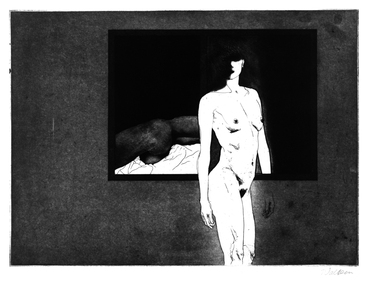 Federation University Art Collection
Work on paper - Artwork - Printmaking, Wes Walters, [Untitled] by Wes Walters
... ...requires framing...The Art Collection features over 1000 works and was listed as a 'Ballarat Treasure' in 2007. wes walters walters printmaking etching life drawing requires framing Limited edition print. [Untitled] by Wes Walters Work on paper Artwork - Printmaking Wes Walters ...Wes WALTERS (06 August 1928 - 19 August 2014) Born Mildura, Victoria From 1940 t0 1945 Wes Walters attended the Ballarat High School. He then studied architecture at the Gordon Institute in Geelong, followed by art at the Ballarat School of Mines (a division of the Ballarat School of Mines). During his time at the Ballarat Technical Art School (later Federation University Australia) Walters studied under Neville Bunning and Taylor Kelloch, and was awarded the Ballarat Ladies Art Association Scholarship in 1948. He next moved to Melbourne to work as a commercial artist with the George Patterson advertising agency. Each evening Walters studied life drawing at the Victoria Artists’ Society and taught himself anatomy. Wes Walters excelled in both abstract and realist art. He won the Art Gallery of Ballarat’s Minnie Crouch Prize for watercolour art in 1953 and 1956. He won the prestigious Archibald Prize in 1879 for his portrait of Phillip Adams. This item is part of the Federation University Art Collection. The Art Collection features over 1000 works and was listed as a 'Ballarat Treasure' in 2007.Limited edition print.wes walters, walters, printmaking, etching, life drawing, requires framing -
![Painting - Acrylic, charcoal & ink on canvas, Pelchen, Anthony, [Drawing] by Anthony Pelchen, 1988](/media/collectors/530576742162ef0fa09a2288/items/534748179821f420f8c039ef/item-media/55713b1f2162f116e4e626e1/item-fit-380x285.jpg?cb=6) Federation University Art Collection
Federation University Art CollectionPainting - Acrylic, charcoal & ink on canvas, Pelchen, Anthony, [Drawing] by Anthony Pelchen, 1988
... ...requires framing...The Art Collection features over 2000 works and was listed as a 'Ballarat Treasure' in 2007. art artwork anthony pelchen Horsham Campus Art Collection alumni requires framing Large drawing with multi pages [Drawing] by Anthony Pelchen Painting Acrylic, charcoal & ink on canvas Pelchen, Anthony ...Anthony PELCHEN (1960- ) Born Horsham Anthony Pelchen studied economics at Monash University and a decade later painting at the Victorian College of the Arts. Since 1992 he has exhibited widely in artist-run, institutional and alternative spaces in Melbourne, with projects in Japan and Denmark. He has been included in various national surveys of drawing and painting and undertaken residencies in Australia. In 2008/9 he was included in Drought – Cross Cultural Collaborations, presenting cross media work at the NGV/ACMI/ Federation Square. In July 2010 he was awarded an Asialink residency in Malaysia. This item is part of the Federation University Art Collection. The Art Collection features over 2000 works and was listed as a 'Ballarat Treasure' in 2007.Large drawing with multi pagesart, artwork, anthony pelchen, horsham campus art collection, alumni, requires framing -
![Artwork, [Cityscape]](/media/collectors/530576742162ef0fa09a2288/items/534748189821f420f8c03a86/item-media/599681af21ea6912a8bde7fe/item-fit-380x285.jpg?cb=6) Federation University Art Collection
Federation University Art CollectionArtwork, [Cityscape]
... ...requires framing...The Art Collection features over 2000 works and was listed as a 'Ballarat Treasure' in 2007. art artwork barry pillar cityscape streetscape requires framing Signed lower left 'Barry Pillar' Framed coloured lithograph on paper showing a busy city street. ...This item is part of the Federation University Art Collection. The Art Collection features over 2000 works and was listed as a 'Ballarat Treasure' in 2007.Framed coloured lithograph on paper showing a busy city street.Signed lower left 'Barry Pillar'art, artwork, barry pillar, cityscape, streetscape, requires framing -
![Painting - Watercolour, [Untitled Landscape] by David Alexander, 1987](/media/collectors/530576742162ef0fa09a2288/items/534748189821f420f8c03afa/item-media/5569acac2162f11298df6b2e/item-fit-380x285.jpg?cb=6) Federation University Art Collection
Federation University Art CollectionPainting - Watercolour, [Untitled Landscape] by David Alexander, 1987
... ...requires framing...The Art Collection features over 2000 works and was listed as a 'Ballarat Treasure' in 2007. art artwork david alexander landscape requires framing Watercolour of a montainous landscape. ...This item is part of the Federation University Art Collection. The Art Collection features over 2000 works and was listed as a 'Ballarat Treasure' in 2007.Watercolour of a montainous landscape.art, artwork, david alexander, landscape, requires framing -
![Painting - Artwork, [Wharf], 1964, 1964](/media/collectors/530576742162ef0fa09a2288/items/534748189821f420f8c03b14/item-media/537ec30a2162ef1a2cc384d1/item-fit-380x285.jpg?cb=6) Federation University Art Collection
Federation University Art CollectionPainting - Artwork, [Wharf], 1964, 1964
... ...requires framing...The Art Collection features over 2000 works and was listed as a 'Ballarat Treasure' in 2007. art artwork ross b.g. ross watercolour requires framing boats wharf Unframed watercolour showing architecture alongside a wharf with three boats. ...This item is part of the Federation University Art Collection. The Art Collection features over 2000 works and was listed as a 'Ballarat Treasure' in 2007.Unframed watercolour showing architecture alongside a wharf with three boats. art, artwork, ross, b.g. ross, watercolour, requires framing, boats, wharf -
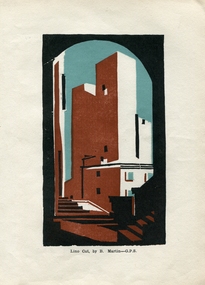 Federation University Art Collection
Work on paper - Printmaking - Linocut, [City Scape] by B. Martin, 1930s
... ...requires framing...Attended the Ballarat Technical Art School. linocut printmaking alumni architecture b. martin requires framing Lino cut, by B. Martin Linocut of high rise buildings through an archway [City Scape] by B. ...Attended the Ballarat Technical Art School.Linocut of high rise buildings through an archwayLino cut, by B. Martinlinocut, printmaking, alumni, architecture, b. martin, requires framing -
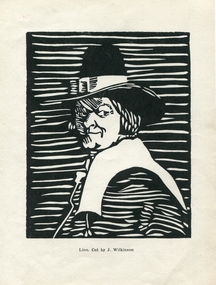 Federation University Art Collection
Work on paper - Print - linocut, Portrait by Jeff Wilkinson, c1937
... ...requires framing...Jeff WILKINSON linocut printmaking alumni portrait j. wilkinson jeff wilkinson requires framing Lino. cut by J. Wilkinson Linocut of a portrait of a man wearing a hat. ...Jeff WILKINSONLinocut of a portrait of a man wearing a hat.Lino. cut by J. Wilkinsonlinocut, printmaking, alumni, portrait, j. wilkinson, jeff wilkinson, requires framing -
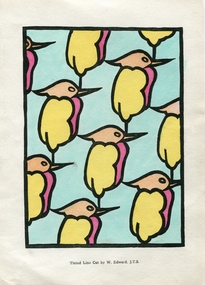 Federation University Art Collection
Work on paper - Printmaking - Linocut, [Kookaburras] by W. Edward, 1930s
... ...requires framing...Edward attended the Ballarat Junior Technical School. art artwork printmaking kookaburra bird requires framing w. edward Ballarat Junior Technical School Linocut featuring kookaburras. ...W. Edward attended the Ballarat Junior Technical School.Linocut featuring kookaburras.art, artwork, printmaking, kookaburra, bird, requires framing, w. edward, ballarat junior technical school -
![Work on paper - Print - linocut, [Yacht] by N. Roberts and [Dog] by J. Pittard, 1930s](/media/collectors/530576742162ef0fa09a2288/items/60bad6bb223bd0e42128f28d/item-media/60bad712223bd0e42128f5f8/item-fit-380x285.jpg?cb=6) Federation University Art Collection
Federation University Art CollectionWork on paper - Print - linocut, [Yacht] by N. Roberts and [Dog] by J. Pittard, 1930s
... ...requires framing...linocut printmaking alumni dog yacht bird fauna requires framing n. roberts j. pittard Linocut of a yacht and dogs. ...Linocut of a yacht and dogs.linocut, printmaking, alumni, dog, yacht, bird, fauna, requires framing, n. roberts, j. pittard -
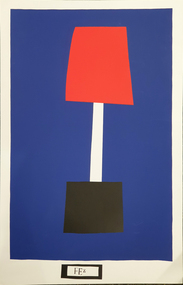 Federation University Art Collection
'Fez' by Bob Jenyns
... ...requires framing...Bob Jenyns requires framing 'Fez' by Bob Jenyns ...bob jenyns, requires framing -
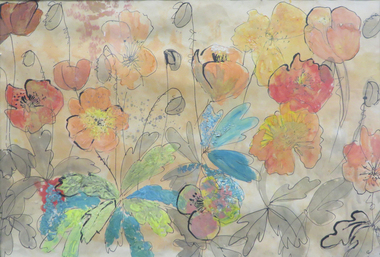 Federation University Art Collection
Painting - Artwork, Untitled by Neville Bunning
... ...requires framing...neville bunning requires framing flowers flora Watercolour on paper featuring flowers. ...Watercolour on paper featuring flowers.neville bunning, requires framing, flowers, flora -
Federation University Art Collection
Work on paper, Digital Print by Ashleigh Freeman
... requires framing...requires framing DVC Art Award Digital print by Ashleigh Freeman Digital Print by Ashleigh Freeman Work on paper ...Digital print by Ashleigh Freemanrequires framing, dvc art award -
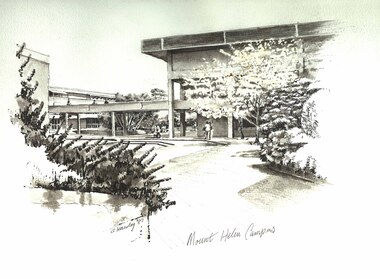 Federation University Art Collection
Drawing - Artwork - Drawing, Hawley, Graeme, Mount Helen Campus by Graham Hawley, 1987
... ...requires framing...The Art Collection features over 2000 works and was listed as a 'Ballarat Treasure' in 2007. art artwork mt helen campus watercolour watercolor watercolourist watercolorist requires framing e.j. barker library mt helen library graham Hawley Ballarat Mount Helen Campus Ink Drawing of Mount Helen Campus on paper. ...This item is part of the Federation University Art Collection. The Art Collection features over 2000 works and was listed as a 'Ballarat Treasure' in 2007.Ink Drawing of Mount Helen Campus on paper.art, artwork, mt helen campus, watercolour, watercolor, watercolourist, watercolorist, requires framing, e.j. barker library, mt helen library, graham hawley, ballarat, mount helen campus -
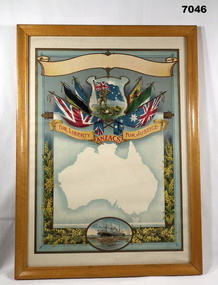 Bendigo Military Museum
Certificate - CERTIFICATE, FRAMED, Goldsworthy & Davey Artists, WW1
... Certificate template - possibly available to Shires and localities to customise as required. frame - timber, with varnish finish in natural tones, glass front and cardboard back....Certificate template - possibly available to Shires and localities to customise as required. frame - timber, with varnish finish in natural tones, glass front and cardboard back. ...Red print on Certificate template. "For Liberty ANZACS FOR JUSTICE". This is a blank certificate.Certificate - paper, red print on scroll, illustrated in colour - top to bottom, blank scroll; 2 soldiers and flag surrounded by 6 flags, silhouette in white of Australian map, oval shape with ship and troops. Further side decoration yellow and green wattle flowers and foliage. Pale blue background. Certificate template - possibly available to Shires and localities to customise as required. frame - timber, with varnish finish in natural tones, glass front and cardboard back.framed, ww1, certificate -
 Eltham District Historical Society Inc
Photograph, 68 Mount Pleasant Road, Eltham, c.1983, 1983
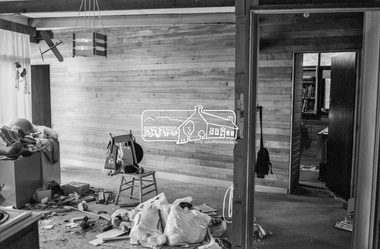
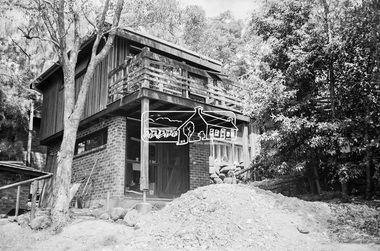
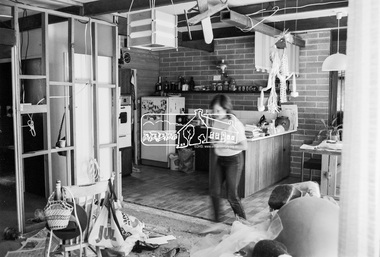
... Graham organised the brick walls where required, raised all frame work and laid the steel tray roof. ...Graham organised the brick walls where required, raised all frame work and laid the steel tray roof. ...An early Alistair Knox design and build, this home was purchased by George Coop in 1968. Eltham builder, Graham Rose, extended the original Alistair Knox structure over the foundation excavation dug by George. Graham organised the brick walls where required, raised all frame work and laid the steel tray roof. George did all external/internal wall cladding, made all opening windows, sliding and swinging doors, stairs and general interior timber cabinet work. Bedroom wardrobe doors came from scrapped Victorian Railways country coaches. Most of the timbers used in the extension were re-purposed from the Templestowe Cool Store and the Port Melbourne wool, hide & skin store.Digital TIFF file Scan of 35mm Ilford XP1 black and white transparencyalistair knox design, eltham, graham rose, houses, mount pleasant road -
 Eltham District Historical Society Inc
Photograph, 68 Mount Pleasant Road, Eltham, c.1983, 1983
... Graham organised the brick walls where required, raised all frame work and laid the steel tray roof. ...Graham organised the brick walls where required, raised all frame work and laid the steel tray roof. ...An early Alistair Knox design and build, this home was purchased by George Coop in 1968. Eltham builder, Graham Rose, extended the original Alistair Knox structure over the foundation excavation dug by George. Graham organised the brick walls where required, raised all frame work and laid the steel tray roof. George did all external/internal wall cladding, made all opening windows, sliding and swinging doors, stairs and general interior timber cabinet work. Bedroom wardrobe doors came from scrapped Victorian Railways country coaches. Most of the timbers used in the extension were re-purposed from the Templestowe Cool Store and the Port Melbourne wool, hide & skin store.Digital TIFF file Scan of 35mm Ilford XP1 black and white transparencyalistair knox design, eltham, graham rose, houses, mount pleasant road -
 Eltham District Historical Society Inc
Photograph, 68 Mount Pleasant Road, Eltham, c.1983, 1983
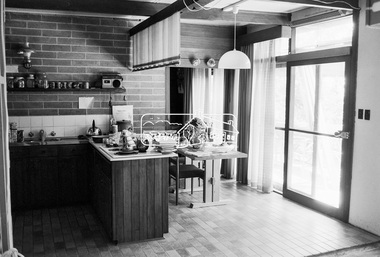
... Graham organised the brick walls where required, raised all frame work and laid the steel tray roof. ...Graham organised the brick walls where required, raised all frame work and laid the steel tray roof. ...An early Alistair Knox design and build, this home was purchased by George Coop in 1968. Eltham builder, Graham Rose, extended the original Alistair Knox structure over the foundation excavation dug by George. Graham organised the brick walls where required, raised all frame work and laid the steel tray roof. George did all external/internal wall cladding, made all opening windows, sliding and swinging doors, stairs and general interior timber cabinet work. Bedroom wardrobe doors came from scrapped Victorian Railways country coaches. This particular view shows the original Alistair Knox design and materials. The photo was taken where the original external wall was located and knocked down to add the extension.Digital TIFF file Scan of 35mm Ilford XP1 black and white transparencyalistair knox design, eltham, graham rose, houses, mount pleasant road -
 Eltham District Historical Society Inc
Photograph, 68 Mount Pleasant Road, Eltham, c.1983, 1983
... Graham organised the brick walls where required, raised all frame work and laid the steel tray roof. ...Graham organised the brick walls where required, raised all frame work and laid the steel tray roof. ...An early Alistair Knox design and build, this home was purchased by George Coop in 1968. Eltham builder, Graham Rose, extended the original Alistair Knox structure over the foundation excavation dug by George. Graham organised the brick walls where required, raised all frame work and laid the steel tray roof. George did all external/internal wall cladding, made all opening windows, sliding and swinging doors, stairs and general interior timber cabinet work. Bedroom wardrobe doors came from scrapped Victorian Railways country coaches. Most of the timbers used in the extension were re-purposed from the Templestowe Cool Store and the Port Melbourne wool, hide & skin store.Digital TIFF file Scan of 35mm Ilford XP1 black and white transparencyalistair knox design, eltham, graham rose, houses, mount pleasant road -
 Flagstaff Hill Maritime Museum and Village
Tool - Wood Mitre & Trimmer Guillotine, Early 20th century
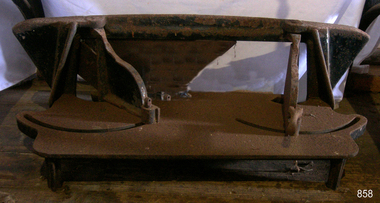
... Also used in picture frame making or cabinet woodworking, by placing a piece of timber in one side after setting the desired angle and pulling a handle that operates a guillotine blade thereby cutting the timber or decorative trim to the required angle....Also used in picture frame making or cabinet woodworking, by placing a piece of timber in one side after setting the desired angle and pulling a handle that operates a guillotine blade thereby cutting the timber or decorative trim to the required angle. ...The mitre trimmer is a classic hand-powered tool for picture framers and trim carpenters that has remained relatively unchanged for decades. It is heavy, simple, and sturdily built of cast iron with tempered steel guillotine blades. It is used for taking super accurate, paper-thin slices off the ends of mitres and butt joints, and leaving behind a glassy-smooth surface. Also used in picture frame making or cabinet woodworking, by placing a piece of timber in one side after setting the desired angle and pulling a handle that operates a guillotine blade thereby cutting the timber or decorative trim to the required angle.A significant tool still in use today in many cabinet makers workshops. The subject tool gives insight into how this type of tool development, design and use has not progressed since it’s original invention. It is still for sale from many tool manufacturing companies and use in small craftsmen boutique workshops today as it was many decades ago.Cast Iron wood Trimmer bench like construction on raised feet with 2 adjustable gates. Noneflagstaff hill, warrnambool, shipwrecked-coast, flagstaff-hill, flagstaff-hill-maritime-museum, maritime-museum, shipwreck-coast, flagstaff-hill-maritime-village, cabinet makers tools, picture framing, mitre cutting, wood trimming -
 Mission to Seafarers Victoria
Print, Our God and the Sailor We Adore, Unknown
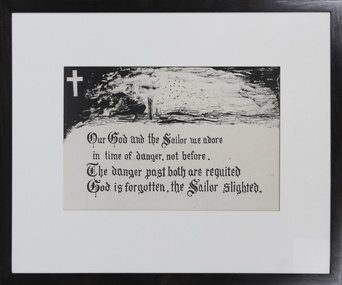
... The quote is by English poet Thomas Jordan (c. 1612–1685). ship god sailor artwork-paintings sea Our God and the Sailor we adore in time of danger, not before The danger past both are required God is forgotten, the Sailor slighted. Print in black ink on white cardboard frame and black wooden frame depicting a ship Our God and the Sailor We Adore Print ...The quote is by English poet Thomas Jordan (c. 1612–1685).Print in black ink on white cardboard frame and black wooden frame depicting a ship Our God and the Sailor we adore in time of danger, not before The danger past both are required God is forgotten, the Sailor slighted.ship, god, sailor, artwork-paintings, sea -
 Flagstaff Hill Maritime Museum and Village
Artwork, other - Diorama with seaweed specimens, Richard Foster Norton, 1860
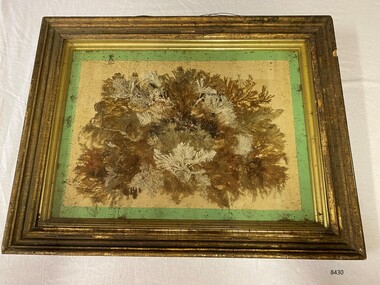
... frame links the artwork to the Pigeon Hill property, which was located on Allansford Road (corner of Staffords Road – north side of the Princes Highway-A1). In the 1860s, the property known as Pigeon Hill was owned by William Wall who was a publican who ran several hotels in Warrnambool and district. In 1860 Wall, was running a hotel in Wangoom, near Pigeon Hill. Further research is required...frame links the artwork to the Pigeon Hill property, which was located on Allansford Road (corner of Staffords Road – north side of the Princes Highway-A1). In the 1860s, the property known as Pigeon Hill was owned by William Wall who was a publican who ran several hotels in Warrnambool and district. In 1860 Wall, was running a hotel in Wangoom, near Pigeon Hill. Further research is required ...The diorama of mounted specimens of seaweed was framed by Richard Foster Norton for Thomas Watson and is dated 1860. Watson was the Warrnambool District Surveyor at the time (1860). The inscription on the back of the frame links the artwork to the Pigeon Hill property, which was located on Allansford Road (corner of Staffords Road – north side of the Princes Highway-A1). In the 1860s, the property known as Pigeon Hill was owned by William Wall who was a publican who ran several hotels in Warrnambool and district. In 1860 Wall, was running a hotel in Wangoom, near Pigeon Hill. Further research is required to determine the exact location, but Pigeon Hill could also have been the name for that area and may have had other people living there. Thomas Watson was a member of the local horticultural society. Another possible creator of the artwork is Samuel Hannaford, a biologist with a particular interest in collecting marine flora. Hannaford left Warrnambool in 1857 and went to Geelong, so it is possible he collected the specimens had them framed in Geelong, and then arranged for their return to Watson. The other known seaweed collector was Henry Watts, who lived in Warrnambool in the mid-19th century. The seaweed collection in this box was possibly one of Watts' and could have been prepared for the Victorian Exhibition of 1861, Richard Foster Norton, also known as R.F Norton, was one of only a handful of picture framers in 1850s Melbourne. Norton was born on the 24th of July 1822 in Yelvertoft, Northamptonshire and prior to his arrival in Australia, Norton is listed in England as having the occupation of a painter. It appears that he established his business in Melbourne in 1854 or 1855. Between 1855 and 1865 he operated from 87, then 83, and later 80 Collins Street. In the Argus newspaper, Norton advertised his business as a Print seller, Carver, Gilder and Picture Frame manufacturer, supplying the growing demand for artworks and decorative furnishings in the colony during the Gold Rush. Norton also had a Geelong branch in Market Square, where this work was produced. This framed work is highly significant. Previous research has found that only six frames are in existence that can be attributed to be made Norton, dating from the late 1850’s to the mid 1860’s. Moreover, Thomas Watson the owner of the artwork, is one of the government surveyors of the region during the mid-19th century.Diorama in deep wooden frame, behind glass. Seaweed specimens have been mounted within the frame. The back of the frame has handwritten inscriptions including the framer's label (portions missing). The diorama was framed by Richard Fraser Norton. Printed label; "RICHARD FOS --- Picture Framer and -- MANUF -- CARVER, GILDER, ---- PAINTINGS CLEANED, LINED AND --- GLASSES RESILVERED, FRAMES --- Architectual Decorations created to any design in Paper Mache, Carlton Pierre, or Composition, Country Orders promptly attended to, The Order Suppl ---, BRANCH ESTABLISHMENT, MARKET SQUARE, GEELONG" flagstaff hill, warrnambool, maritime museum, richard foster norton, r.f norton, picture framers, melbourne, geelong, artwork and decorative furnishings, gold rush, seaweed, botanical specimens, 1860, pigeon hill, district surveyor, thomas watson, william wall, wangoom, samuel hannaford, henry watts, victorian exhibition, 1861, yelvertoft, northamptonshire, market square -
 Flagstaff Hill Maritime Museum and Village
Equipment - Stevenson Screen, Thomas Stevenson, ca. 1910
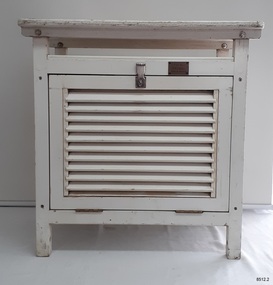
... required at the Cape Otway Light station either, due to the automated system. The meteorological instruments donated with the screen were used for measuring temperature and humidity. They are mounted on a metal bracket that fits across the screw holes on the screen’s internal frame...required at the Cape Otway Light station either, due to the automated system. The meteorological instruments donated with the screen were used for measuring temperature and humidity. They are mounted on a metal bracket that fits across the screw holes on the screen’s internal frame ...Stevenson screens were first introduced in Australia in the 1880s and were widely installed by 1910. The screens have been used to shelter and protect thermometers and other meteorological instruments from rain and direct heat while the holes and double-louvre walls allowed air to flow around them. Sometimes other meteorological instruments were included in the weather stations, so there were different Stevenson Screen sizes. This authentic, original Stevenson screen was previously owned by the Australian Bureau of Meteorology and was used for many years for weather readings at the Cape Otway Light Station in southwest Victoria. The Lighthouse Keepers recorded the readings for minimum and maximum temperatures at 9 a.m. every day from January 1865 until April 1994. The equipment was sheltered in a Stevenson Screen from 1902 until April 15 1994, when the mercury thermometer was replaced by a platinum resistance probe within an Automatic Weather Station (AWS). This Stevenson screen is one of the two screens that then became redundant. The other Stevenson screen was kept to display to visitors. Lightkeepers were no longer required at the Cape Otway Light station either, due to the automated system. The meteorological instruments donated with the screen were used for measuring temperature and humidity. They are mounted on a metal bracket that fits across the screw holes on the screen’s internal frame. The glass-covered Relative Humidity (RH) sensor was made by the renowned precision instrument maker, Rotronic AG of Switzerland, which was founded in 1965. The firm made its first electronic temperature and humidity instrument in 1967. Meteorological records have been collected in Australia from the 1800s. The records were collated, published and used as a basis for weather forecasts. Many sectors, such as maritime and agriculture industries, have relied on these figures for making important decisions. The quality and placement of the meteorological instruments used to measure temperature and humidity are of utmost importance for accuracy. In early colonial times, there were no national standards for meteorological instruments that would allow for accurate figures and comparisons. Once the Bureau of Meteorology was established (around 1908 to 1910) the department installed Stevenson screens throughout Australia, many at lighthouses and light stations, and the measuring instruments were standardised. The Stevenson Screen was named after its inventor, Scottish Civil Engineer Thomas Stevenson (1818-1887) who was also the father of Robert Louis Stevenson, author. Stevenson developed the small thermometer screen around 1867. It had double-louvred walls around the sides and a top of two asbestos sheets with an air space between them and was thickly painted with a white coating that reflected the sun’s rays. This design was modified in 1884 by Edward Mawley of the Royal Meteorological Society. Standards were set for the locations of the screens and instruments, including their distance above ground level and the direction the door faced.Stevenson screens played a significant part in providing a standardised shelter for all meteorological instruments used by the Australian Bureau of Meteorology from about 1910 until 1994. The readings from the instruments gave the meteorological statistics on which weather forecasts throughout Australia were based. This Stevenson screen was used locally at Cape Otway, along the Great Ocean Road in southwest Victoria, so contributed towards our local forecasts and weather warnings.Stevenson screen, original, from the Australian Bureau of Meteorology’s weather station at the Cape Otway Lighthouse. The screen is a white wooden cupboard with a slanted cover raised above the top. The top has ten drilled ventilation holes, and the sides and door are made of downward-slanting double louvres. Two brass hinges join the door to the lower edge of the screen and a metal fitting at the top edge allows for a padlock closure. The screen is supported on four short legs, each with a hole drilled from side to side for fitting to a frame. Inside the screen are two wooden frames fitted with hooks and screws. The floor has three boards; one across the back and one across the front at the same level, and a board wider than the space between these boards is fitted higher, overlapping them slightly. Inside the screen, a pair of electronic instruments with short electric cables is mounted on a metal bracket with drilled holes in it. One of the instruments is a Relative Humidity (RH) probe. It is 26 cm long and is a glass tube with a filter on one end and an electrical connection on the other. It has inscriptions on its label, showing that was made by Rotronic AG, Switzerland. The other instrument is a Resistance Temperature Device (RTD) thermometer. It is 22.5 cm long and has a narrow metal probe joined to a hexagonal metal fitting. A brass plate on the front of the screen has impressed inscriptions. The screen is Serial Number 01/C0032, Catalogue Number 235862.Stamped into brass plate "CAT. NO. / 253862 / SERIAL NO. 01/C0032" On instrument’s electrical fitting; “CD2” [within oval ‘+’ above S] “Serie693 op65 / 220/380V~16A” On instrument’s glass; “rotronic ag” “SWISS MADE” “CE / CH-8303 / Bassersdorf” Symbol for [BARCODE] “ART NO MP 101A_T4-W4W” “POWER 4.8.30VDC“ “OP. RANGE: 0-100%RH/-40+60° C” “OUT H 0-100% 0-1V” “OUT T -40+60°C -0.4..+0.6V” “SERIE NO 19522 009”flagstaff hill maritime museum and village, warrnambool, maritime museum, maritime village, great ocean road, shipwreck coast, cotton region shelter, instrument shelter, thermometer shelter, thermoscreen, thermometer screen, measuring instruments, meteorological instrument, weather recording, weather station, lighthouse equipment, light station equipment, stevenson screen, marine instruments, mercury thermometer, platinum resistance probe, aws, automatic weather station, rotronic ag, swiss made, meteorological device, weather forecast, weather prediction, weather records, meteorological forecast, meteorological record, australian bureau of meteorology, bureau of meteorology, bureau, bom, relative humidity, rh, relative humidity probe, resistance temperature device, rtd, thermometer, temperature, humidity, cape otway, cape otway lighthouse, cape otway light station, rotronic, switzerland, swiss instrument, thomas stevenson, double-louvered walls, edward mawley, royal meteorological society, 01/c0032, serial number, cat. no. 235862, serial no. 01/c00323 -
 Geelong RSL Sub Branch
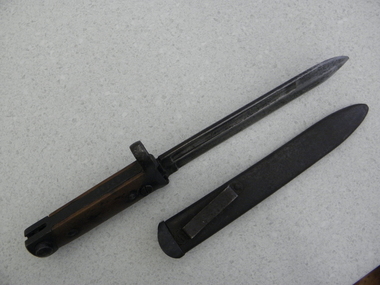
Bayonet, No maker, Early 20th Century
... frame. The bayonet has a release button to free the the blade to a position as required. ...frame. The bayonet has a release button to free the the blade to a position as required. ...There are no distinguishing features on the item to be able to link it to any one event.Metal bayonet with wooden and medal handle, four screws holding the wood to the metal frame. The bayonet has a release button to free the the blade to a position as required. There is a metal scabbard to house the bayonet blade, there is a metal loop on the scabbard to hang onto a belt. There is a round sight on top of the bayonet.T4 37248military, bayonet, australian army. -
 Geelong RSL Sub Branch
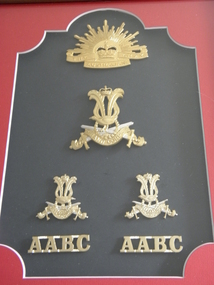
AABC Badges, Late 20th Century
... AABC Musicians arfe also required to qualify in soldering skills eg - Admin, Drivers. The badges are originals and have been framed in a wooden frame. ...The Badges are those worn by the Australian Army Band Corps. The AABC was formed on 02 August 1968. AABC Musicians arfe also required to qualify in soldering skills eg - Admin, Drivers.The badges are originals and have been framed in a wooden frame.Oblong timber framed Badges of the Australian Army Band Corps. One x Rising Sun Hat Badge One x AABC Hat Badge Two x AABC Collar Badges Two x AABC Epaulette BadgesNoneaabc -
 Red Cliffs Military Museum
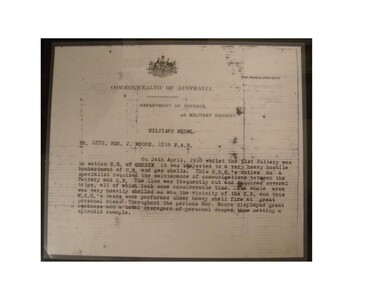
Certificate, Commendation notice for Military Medal, 1918 (estimated)
... framed certificates medal 1918 military moore joseph world war 1 corbie 51st battery 4th district No 1272, BDR. J. Moore, 13th F.A.B./ On 24th April, 1918 whilst the 51st Battery was/ in acrion N.E. of Cordie it was subjected to a very heavy hostile/ bombardment of H.E. and gas shells. This N.C.O.'s duries as a/ specialist required ...Associated with BDR. Joseph Moore grouped framed certificatesPhotocopy of original dispatch notice for Military Medal to No 1272 BDR J. Moore, 13th F.A.B.No 1272, BDR. J. Moore, 13th F.A.B./ On 24th April, 1918 whilst the 51st Battery was/ in acrion N.E. of Cordie it was subjected to a very heavy hostile/ bombardment of H.E. and gas shells. This N.C.O.'s duries as a/ specialist required the maintenance of communications between the/ Battery an C.P. The line was frequently cut and required several/ trips, all of which took some considerable time. The whole area/ was very heavily shelled as was the vicinity of the C.P. and this/ N.C.O.'s tasks were performed under heavy shell fire ar great/ personel risk. Throughout the periods Bdr. Moore displayed great/ coolness and total disregard of personal danger thus setting a/ splendid examplemedal, 1918, military, moore, joseph, world, war, 1, corbie, 51st, battery, 4th, district -
 Red Cliffs Military Museum
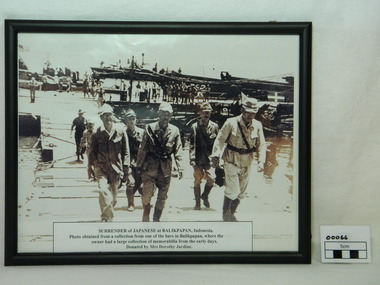
Framed Photograph, Surrender of Japanese at Balikpapan, 1945
... frame and glass covered. The Japanese Command staff with a Japanese general and aid-d-camp (Captian)carring his breif case along with other staff members. In the background here are 2 American PT boats with American naval personal .Note American flag flying in the top left corner. There are several American landing craft next to a Japanese landing barge. The Japanese landing bardge has the required...frame and glass covered. The Japanese Command staff with a Japanese general and aid-d-camp (Captian)carring his breif case along with other staff members. In the background here are 2 American PT boats with American naval personal .Note American flag flying in the top left corner. There are several American landing craft next to a Japanese landing barge. The Japanese landing bardge has the required ...Japanese Commanders crossing a pontoon bridge under guard by Australian soldier on the way to the official surrender of Japanese forces in Balikpapan in (Dutch East Indies) Indonesia 1945. This was a major event in the ending of World War 2. Following the japanese surrender the Local population began it push for independance. Framed photograph (copy) of Japanese Commanders surrendering at Balikpapan. Black frame and glass covered. The Japanese Command staff with a Japanese general and aid-d-camp (Captian)carring his breif case along with other staff members. In the background here are 2 American PT boats with American naval personal .Note American flag flying in the top left corner. There are several American landing craft next to a Japanese landing barge. The Japanese landing bardge has the required surrender markings which is a green square with a white cross on top right of photo. The Australian soldier following the Japanese soldiers is wearing slouch hat and gungle green uniform. Along the docks are native workers.Paper discription on lower photograph with details of item description, where photo obtained from and donated by.ww2, japanese, surrender, balikpapan, generals, americans, pt boats, japanese landing bardge, american landing craft, dutch east indies -
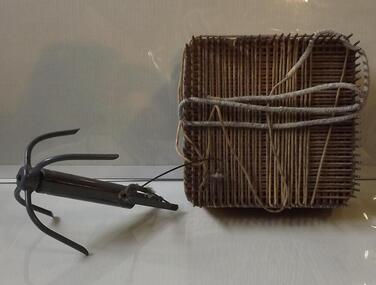 Seaworks Maritime Museum
Line-throwing Rocket, England
... REQUIRE TIME EXPIRE.../ROCKETS TO BE DUMPED UNDFIRED AT SEA/THEY SHOULD NOT BE USED FOR PRACTISE. Metal frame ...Metal frame containing line which is attached to the rocket and grappling hook.WMA 13 (on line box) Remains of orange sticker with logo of some kind and the word '..ISTOL' visible/ On rocket the words 'SCHERMULY INTERNATIONAL/N0 2/ 41 MM LINE-THROWING ROCKET/A SCHERMULY ICARUS PRODUCT/MADE IN ENGLAND/ WARNING/ DO NOT FIRE WITHOUT A LINE ATTACHED/REGULATIONS REQUIRE TIME EXPIRE.../ROCKETS TO BE DUMPED UNDFIRED AT SEA/THEY SHOULD NOT BE USED FOR PRACTISE. -
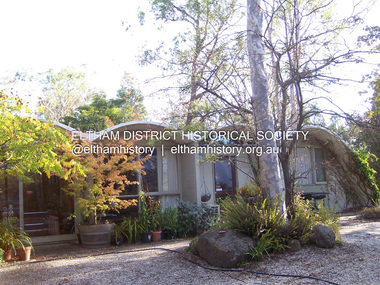 Eltham District Historical Society Inc
Photograph - Digital Photograph, Marguerite Marshall, Rice House, 69 Ryans Road, Eltham, 27 March 2007
... The valleys between the arches collect water, requiring annual painting with a waterproof material to prevent leaking. Lorna framed the house with native and exotic plants, which provide privacy and as a bonus, the garden attracted the rare Eltham Copper Butterfly. ...The valleys between the arches collect water, requiring annual painting with a waterproof material to prevent leaking. Lorna framed the house with native and exotic plants, which provide privacy and as a bonus, the garden attracted the rare Eltham Copper Butterfly. ...Built in 1953, the Rice House was leading Melbourne architect Kevin Borland's first commssion and was one of two houses of its kind. The design of the shell-like structure was inspired by the Arch of Ctesiphon, built in the second century south of Baghdad. Cement with a waterproofing agent was applied in layers to a form of regularly spaced timber arches covered in hessian. This ctesiphon system was developed in the United Kingdom by engineer J.H. de Waller in 1947. Commissioned in 1951 by Harrie and Lorna Rice, after Harrie, then an art student, met Borland at The Age Small Homes Service. Borland suggested they buy land in Eltham because at that time it was the only council in Melbourne that would grant a permit for such an innovative house. Covered under Victorian Heritage. Inspired by an ancient arch in Iraq, a house stands on top of a hill in a private position, off Ryans Road, Eltham. One of only two houses of its kind, it was leading Melbourne architect Kevin Borland’s first commissioned house, which he built in 1953. The shell-like structure, partially screened by giant trees and cacti, was inspired by the Arch of Ctesiphon south of Baghdad, built in the second century.1 Cement with a waterproofing agent was applied in layers to a form of regularly spaced timber arches tightly covered by hessian. This ctesiphon system was developed in the United Kingdom by engineer J H de Waller in 1947. This house was the first of three such structures built in Victoria, of which only one other remains, although substantially altered.2 It is the Wood House and supermarket, at the corner of Cleveland Road and High Street Road, Ashwood, designed by Robin Boyd in 1952. The Rice House demonstrates Kevin Borland’s innovative and experimental work. It is an outstanding example of the post-war period of experimentation in domestic architecture in Melbourne – by Robin Boyd, Kevin Borland and others – for The Age Small Homes Service from 1947 to 1953. This was partly an expression of late-Modernism and also necessitated by the post-war shortage of building materials. In Eltham, the post-war shortage of building materials largely resulted in mud-brick houses. Examples of Borland’s public work include contributions to the Olympic Swimming Pool in Melbourne and the Preshil Junior School in Kew. After more than 50 years of living in the house, Harrie and Lorna Rice still love it. Facing north-east with large windows overlooking the garden and two courtyards, it is well lit and benefits from a through breeze. The couple commissioned the extraordinary house after Harrie, then an art student, met Borland in 1951 at The Age Small Homes Service. Harrie was so impressed by the recently graduated Borland’s enthusiasm, that he asked him to design them an interesting house for a low budget. The unusual design presented several hurdles for the young couple before they could construct it. Borland suggested that they buy land in Eltham, because at that time it had the only council in Melbourne that would allow such an innovative house. Another hurdle was to gain finance for this remarkable house. The State Savings Bank Manager refused finance on the grounds that it was ‘unliveable’ and a ‘disgrace’. Fortunately, through a family connection, the couple borrowed money from the National Bank. But they discovered years later, that the bank’s evaluation stated the two ‘concrete sheds’ were of no value! The house built in off-white concrete, consists of two sections. The main house has four arches supported by brick and concrete walls that create a series of inter-connected rooms. Inside, the ceiling follows the roofline. Originally this section was only ten square metres, because of building restrictions at the time. But in 1973 Borland added two rooms and a carport. The second structure of two arches was originally a garage and a studio for art teacher Harrie Rice. To accommodate the growing family, in the mid 1950s, Borland converted the second structure into two children’s bedrooms, a kitchenette, a bathroom and a living room. The two structures were originally linked by a covered way of suspended draped-concrete, but this collapsed in the 1980s. The design has several maintenance problems. Cracks developed where two halves of the shells were joined. Then the material sprayed over the cracks became brittle, causing leaks. Fortunately Harrie found another material he could use. The valleys between the arches collect water, requiring annual painting with a waterproof material to prevent leaking. Lorna framed the house with native and exotic plants, which provide privacy and as a bonus, the garden attracted the rare Eltham Copper Butterfly. Published: Nillumbik Now and Then / Marguerite Marshall 2008; photographs Alan King with Marguerite Marshall.; p157 Comments about the Rice House on Lost Eltham page on Facebook June 2018 https://www.facebook.com/Lost-Eltham-1535993463348408/ Kate Borland: My dad designed this house. It is the Rice house and it is being renovated to its original glory as we speak.... Katherine Fox: I remember Harry and Lorna's, there was a secret room...! And the best loo with a view as I recall. Katherine Fox: Love this house! Wish I'd known it was up for sale. Looking forward to seeing progress if possible...If I recall correctly, the concrete swag over the walk-way collapsed at some stage. Marcus Skipper: In our little green Landrover, my dad and Alister Knox drove up dirt roads, a dirt track through the bush and finally to the ridge to check out this joint in about 1960. After the war at some time, they were all together at RMIT studying building design. Alister was the only one to graduate. A situation that resulted, my father would joke, in Alister having a career wherein his qualifications exceeded his talent. World Peace had broken out and all were hip to the ‘People’s’ century. Kevin went with the Modernist’s concrete, Alister went with the peasant’s mudbrick. “If this is the future,” my dad said,”I don’t like it.” And we drove back to medieval Montsalvat.This collection of almost 130 photos about places and people within the Shire of Nillumbik, an urban and rural municipality in Melbourne's north, contributes to an understanding of the history of the Shire. Published in 2008 immediately prior to the Black Saturday bushfires of February 7, 2009, it documents sites that were impacted, and in some cases destroyed by the fires. It includes photographs taken especially for the publication, creating a unique time capsule representing the Shire in the early 21st century. It remains the most recent comprehenesive publication devoted to the Shire's history connecting local residents to the past. nillumbik now and then (marshall-king) collection, eltham, rice house, ryans road, kevin borland
