
Showing 20 items matching "research scientist"
-
 University of Melbourne, Burnley Campus Archives
Document, CSIRO, Research Scientist in Pasture Evaluation, 08.10.1968
... Research Scientist in Pasture Evaluation......research scientist...Advertisement for job with Division of Tropical Pastures, CSIRO, Qld.: Research Scientist or Senior Research Scientist...CSIRO pasture evaluation tropical pastures research scientist senior research scientist job advertisement careers Advertisement for job with Division of Tropical Pastures, CSIRO, Qld.: Research Scientist or Senior Research Scientist Research Scientist in Pasture Evaluation Document CSIRO ...Advertisement for job with Division of Tropical Pastures, CSIRO, Qld.: Research Scientist or Senior Research Scientistcsiro, pasture evaluation, tropical pastures, research scientist, senior research scientist, job advertisement, careers -
 Uniting Church Archives - Synod of Victoria
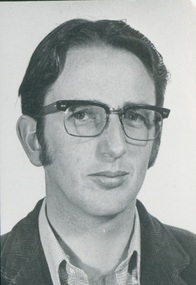
BW photo, 1977
... Dr Barrie Pittock is clerk of the Melbourne regional Meeting of the Society of Friends and a member of the Victorian Council of Churches executive. He is a research scientist with the CSIRO and has written on aboriginal affairs....Dr Barrie Pittock is clerk of the Melbourne regional Meeting of the Society of Friends and a member of the Victorian Council of Churches executive. He is a research scientist with the CSIRO and has written on aboriginal affairs. ...Dr Barrie Pittock is clerk of the Melbourne regional Meeting of the Society of Friends and a member of the Victorian Council of Churches executive. He is a research scientist with the CSIRO and has written on aboriginal affairs.BW photo of Dr Barrie Pittock, wearing spectacles.Barry [sic] Pittock. Church and Nation 21 September 1977 p5barrie pittock; society of friends (quakers); victorian council of churches -
Federation University Historical Collection
Book, Henry Sutton The Innovative Man: Australian Inventor, Scientist and Engineer, 2018, 2018
... Henry Sutton’s contribution to Australian and world innovation has been methodically researched and documented in this book and is the first fully documented account of this forgotten and unrecognised extraordinary Australian. lorayne branch henry sutton ballarat school of mines former sutton's music store innovation inventions scientist microscopy cycle agency automobile club of victoria wireless telegraphy anne tattie anne sutton sutton autocar photography Hardcovered book of 397 pages. ...Nikola Tesla once said “Let the future tell the truth and evaluate each one according to his work and accomplishments” In his lifetime Henry Sutton not only helped shape Ballarat’s history but also that of Australia and the world. Very few people have crossed as many scientific fields as Henry Sutton. His life’s work spanned all avenues of science and engineering and he stands alone in history as one of Australia’s first true men of science and innovation. Based on previously unavailable personal papers as well as articles and letters published in journals worldwide, this book captures the personal triumphs and tragedies of this remarkable Australian. By age 26 Henry Sutton had won world acclaim and graced the world stage among the giants of the scientific world. Henry Sutton stood as an equal alongside such men as Alexander Graham Bell, Nikola Tesla and Thomas Edison. Although applauded around the world in his day for his remarkable achievements, Henry Sutton went largely unnoticed in Australia by his peers and the public. It is not until you begin to document, in one place, his enormous body of work that you start to gain the true picture and depth of his remarkable achievements. It is a national travesty that these achievements have slipped largely unrecognised between the pages of Australian scientific history for over a century. Henry Sutton’s inventions and contribution to science has been a part of the evolution of many inventions, including the light globe, telephone, battery, television and wireless technology all of which are now part of our everyday lives. Henry Sutton’s contribution to Australian and world innovation has been methodically researched and documented in this book and is the first fully documented account of this forgotten and unrecognised extraordinary Australian.Hardcovered book of 397 pages. The cover features a black and white image of Henry Sutton. Gift of Lorayne Branch (author)lorayne branch, henry sutton, ballarat school of mines, former sutton's music store, innovation, inventions, scientist, microscopy, cycle agency, automobile club of victoria, wireless telegraphy, anne tattie, anne sutton, sutton autocar, photography -
 Greensborough Historical Society
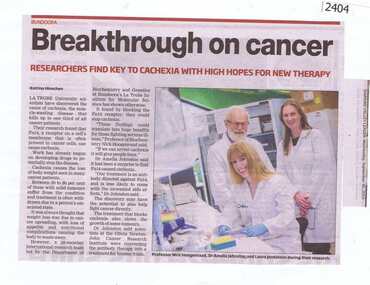
Newspaper Clipping, Breakthrough on cancer, 30/09/2015
... Scientists at La Trobe University have discovered the cause of a muscle-wasting disease (cachexia) seen in cancer patients. cancer research la trobe university News clipping, black text, colour image. ...Scientists at La Trobe University have discovered the cause of a muscle-wasting disease (cachexia) seen in cancer patients.News clipping, black text, colour image.cancer research, la trobe university -
 Mission to Seafarers Victoria
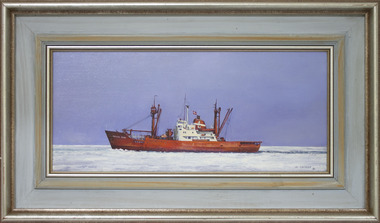
Painting, Ib Odfeldt, MS Nella Dan 1961, 1995
... This image depicts one such Merchant ship, manned by expert merchant seafarers and crucial to the exploration by Australian scientists of the substantial Australian Antarctic territories throughout the 20th C. nella dan anare antarctica icebreakers explorations merchant vessels artwork maritime art ib odfeldt artwork-paintings Australian National Antarctic Research Expeditions (ANARE) hobbies asma australian society of maritime artists Artist signature at lwr right corner PAINTED.: IB ODFELDT 95 At the back: Square loose label: 3076 Leonard Joel Bottom corner on the frame in Pencil: POW 2894 (National Trust accession number) Framed , oil on board painting depicting a red hulled , single funnel ship cutting through sea ice MS Nella Dan 1961 Painting Painting Ib Odfeldt Leonard Joel Auctions ...A depiction of the MS Nella Dan an active primary vessel built in 1961 by the Aarlborg Shipyard PTY Ltd, and regularly chartered by the Australian National Antarctic Research Expeditions (ANARE) in the 20th C. The ship ran aground in December 1987 and unable to be salvaged, had to be scuttled in deep water off Macquarie Island. See link above, this record. The ship was named after Nel Law wife of the Director of the Antarctic Division, DR Phil Law. "Ib Odfeldt (b. 1944) is a self-taught painter and sculptor spending many years inspired by and interest in ships and marine art whilst working as an engineer in the Danish Merchant Navy. His paintings demonstrate a keen eye for technical accuracy and skill. The balance and setting of his works have attracted interest in many commissions by lovers of marine and shipping works. In 2002 Ib was awarded the Southern Ocean Maritime Art Prize and this acquisition of the Nella Dan is presented in the foyer of the Tasmanian Maritime Museum in Hobart." (The ASMA 2019 National Exhibition - Maritime Museum of Tasmania catalogue). According to the artist, the painting was part of an exhibition he held at "Melbourne maritime museum " (Polly Woodside) to celebrate ANARE (ARTIC SHOW). He donated two paintings of the Nella Dan. Ib Odfledt has also entered the Maritime Art Prize several times. (2012)Maritime ArtFramed , oil on board painting depicting a red hulled , single funnel ship cutting through sea iceArtist signature at lwr right corner PAINTED.: IB ODFELDT 95 At the back: Square loose label: 3076 Leonard Joel Bottom corner on the frame in Pencil: POW 2894 (National Trust accession number)nella dan, anare, antarctica, icebreakers, explorations, merchant vessels, artwork, maritime art, ib odfeldt, artwork-paintings, australian national antarctic research expeditions (anare), hobbies, asma, australian society of maritime artists -
 Greensborough Historical Society
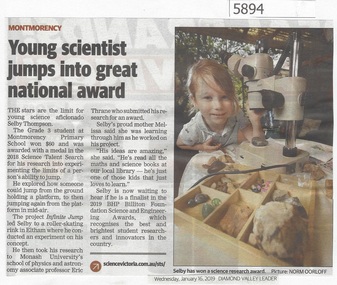
Newspaper Clipping, Diamond Valley Leader, Young scientist jumps into great national award, 16/01/2019
... The Grade 3 student at Montmorency Primary School won $60 and was awarded with a medal in the 2018 Science Talent Search for his research into experimenting the limits of a person's ability to jump. selby thompson montmorency primary school 2018 science talent search News article 1 page, black text and colour image . Young scientist ...The stars are the limit for young science aficionado Selby Thompson. The Grade 3 student at Montmorency Primary School won $60 and was awarded with a medal in the 2018 Science Talent Search for his research into experimenting the limits of a person's ability to jump.News article 1 page, black text and colour image .selby thompson, montmorency primary school, 2018 science talent search -
 Flagstaff Hill Maritime Museum and Village
Container - Medical container, Late 19th century or early 20th century
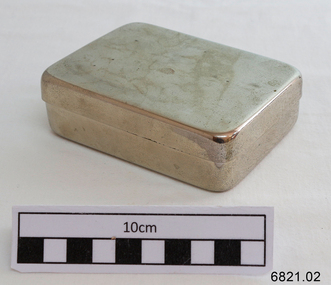
... In 1904 French Scientist Leon Guillet undertook extensive research on many iron-chromium alloys. ...In 1904 French Scientist Leon Guillet undertook extensive research on many iron-chromium alloys. ...THE DISCOVERY OF STAINLESS STEEL Harry Brearley Since the dawn of man colonies have raced against each other to uncover new technologies, to be the first to stamp their names on a discovery, and although we’ve evolved over millions of years, the urge to be the first remains at the very core of our nature. This sense of passion and pride can lead some of the more unscrupulous humans to claim others discoveries as their own. Of course many breakthroughs are genuinely made in tandem, or are simultaneously occurring, but unless you can categorically prove that you were the pioneer of these incredible findings, then the other party involved will always dispute the fact. And so we come to stainless steel. The first point to note is that ‘inventor’ is a very ambiguous term. Is this the first person to think, to document, to patent, or to produce? The second point is that stainless steel wasn’t truly defined until 1911, so are we to cast aside those chromium-iron alloys that don’t quite meet the minimum requirement of 10.5% chromium? It seems like anyone and everyone has a different claim to being labelled the ‘inventor’ of stainless steel; from Britain, Germany, France, Poland, the U.S.A., and even Sweden. The cogs were set in motion by Englishmen Stoddart and Faraday circa 1820 and Frenchman Pierre Berthier in 1821. These scientists, among others, noted that iron-chromium alloys were more resistant to attack by certain acids, but tests were only carried out on low chromium content alloys. Attempts to produce higher chromium alloys failed primarily because of scientists not understanding the importance of low carbon content. In 1872 another pair of Englishmen, Woods and Clark, filed for patent of an acid and weather resistant iron alloy containing 30-35% chromium and 2% tungsten, effectively the first ever patent on what would now be considered a stainless steel. However, the real development came in 1875 when a Frenchman named Brustlein detailed the importance of low carbon content in successfully making stainless steel. Brustlein pointed out that in order to create an alloy with a high percentage of chromium, the carbon content must remain below around 0.15%. Thus ensued two decades of stagnation for the development of stainless steel, and while many scientists attempted to create a low carbon stainless steel, none succeeded. Hans Goldschmidt It wasn’t until 1895, when Hans Goldschmidt of Germany developed the aluminothermic reduction process for producing carbon-free chromium, that development of stainless steels became a reality. In 1904 French Scientist Leon Guillet undertook extensive research on many iron-chromium alloys. Guillet’s work included studies on the composition of what would now be known as 410, 420, 442, 446 and 440-C. In 1906 Guillet went on to analyse iron-nickel-chrome alloys, which would now be considered the basics of the 300 series. However, while noting the chemical composition of his alloys, Guillet failed to acknowledge the potential corrosion resistance of his materials. Albert Portevin In 1909 Englishman Giesen published an in-depth work regarding chromium-nickel steels, while the French national, Portevin, studied what is now regarded as 430 stainless steel. However, it wasn’t until 1911 that the importance of a minimum chromium content was discovered by Germans P. Monnartz and W. Borchers. Monnartz and Borchers discovered the correlation between chromium content and corrosion resistance, stating that there was a significant boost in corrosion resistance when at least 10.5% chromium was present. The pair also published detailed works on the effects of molybdenum on corrosion resistance. It is at this point we introduce Harry Brearley, born in Sheffield, England in 1871, he was appointed lead researcher at Brown Firth Laboratories in 1908. In 1912 Brearley was given a task by a small arms manufacturer who wished to prolong the life of their gun barrels which were eroding away too quickly. Brearley set out to create an erosion resistant steel, not a corrosion resistant one, and began experimenting with steel alloys containing chromium. During these experiments Brearley made several variations of his alloys, ranging from 6% to 15% chromium with differing levels of carbon. On the 13th August 1913 Brearley created a steel with 12.8% chromium and 0.24% carbon, argued to be the first ever stainless steel. The circumstances in which Brearley discovered stainless steel are covered in myth; some enchanted tales of Brearley recite him tossing his steel into the rubbish, only to notice later that the steel hadn’t rusted to the extent of its counterparts, much like Alexander Fleming’s experience 15 years later. Other more plausible, (but less attractive), accounts claim it was necessary for Brearley to etch his steels with nitric acid and examine them under a microscope in order to analyse their potential resistance to chemical attack. Brearley found that his new steel resisted these chemical attacks and proceeded to test the sample with other agents, including lemon juice and vinegar. Brearley was astounded to find that his alloys were still highly resistant, and immediately recognised the potential for his steel within the cutlery industry. The Half Moon Brearley struggled to win the support of his employers, instead choosing to produce his new steel at local cutler R. F. Mosley. He found difficulty producing knife blades in the new steel that did not rust or stain and turned to his old school friend, Ernest Stuart, Cutlery Manager at Mosley’s Portland Works, for help. Within 3 weeks, Stuart had perfected the hardening process for knives. Brearley had initially decided to name his invention ‘Rustless Steel’, but Stuart, dubbed it ‘Stainless Steel’ after testing the material in a vinegar solution, and the name stuck. And that’s how Harry Brearley discovered stainless steel…. well, not quite… During the 5 year period between 1908 and Brearley’s discovery in 1913 many other scientists and metallurgists have potential claims to Brearley’s title. In 1908 the Germans entered the fray, the Krupp Iron Works in Germany produced a chrome-nickel steel for the hull of the Germania yacht. The Half Moon, as the yacht is now known, has a rich history and currently lies on the seabed off the east coast of Florida. Whether the steel contains the minimum 10.5% chromium content remains inconclusive. Employees of the Krupp works, Eduard Maurer and Benno Strauss, also worked from 1912-1914 on developing austenitic steels using <1% carbon, <20% nickel and 15-40% chromium. Not happy with Europe hogging the glory, the USA got in on the act. Firstly, Elwood Haynes, after becoming disenchanted at his rusty razor, set out to create a corrosion resistant steel, which he supposedly succeeded in doing during 1911. Two other Americans, Becket and Dantsizen, worked on ferritic stainless steels, containing 14-16% chromium and 0.07-0.15% carbon, in the years 1911-1914. Elwood Haynes During 1912 Max Mauermann of Poland is rumoured to have created the first stainless steel, which he later presented to the public during the Adria exhibition in Vienna, 1913. Finally, a recently discovered article, which was published in a Swedish hunting and fishing magazine in 1913, discusses a steel used for gun barrels, (sound familiar?), which seems to resemble stainless steel. Although this is purely speculation, the Swedes have still made an audacious claim that they were in fact responsible for the first practical application for stainless steel. That concludes the shambolic discovery of stainless steel! Although there is much mystery and speculation behind the discovery of this wonderful material, there is no question that without the combined effort of all the above scientists and metallurgists, (and all the many more that were not mentioned), we would not have such a rich and versatile metal at our fingertips. https://bssa.org.uk/bssa_articles/the-discovery-of-stainless-steel/#:~:text=On%20the%2013th%20August%201913,the%20first%20ever%20stainless%20steel. This stainless steel container was donated to Flagstaff Hill Maritime Village by the family of Doctor William Roy Angus, Surgeon and Oculist. It is part of the “W.R. Angus Collection” that includes historical medical equipment, surgical instruments and material once belonging to Dr Edward Ryan and Dr Thomas Francis Ryan, (both of Nhill, Victoria) as well as Dr Angus’ own belongings. The Collection’s history spans the medical practices of the two Doctors Ryan, from 1885-1926 plus that of Dr Angus, up until 1969. ABOUT THE “W.R.ANGUS COLLECTION” Doctor William Roy Angus M.B., B.S., Adel., 1923, F.R.C.S. Edin.,1928 (also known as Dr Roy Angus) was born in Murrumbeena, Victoria in 1901 and lived until 1970. He qualified as a doctor in 1923 at University of Adelaide, was Resident Medical Officer at the Royal Adelaide Hospital in 1924 and for a period was house surgeon to Sir (then Mr.) Henry Simpson Newland. Dr Angus was briefly an Assistant to Dr Riddell of Kapunda, then commenced private practice at Curramulka, Yorke Peninsula, SA, where he was physician, surgeon and chemist. In 1926, he was appointed as new Medical Assistant to Dr Thomas Francis Ryan (T.F. Ryan, or Tom), in Nhill, Victoria, where his experiences included radiology and pharmacy. In 1927 he was Acting House Surgeon in Dr Tom Ryan’s absence. Dr Angus had become engaged to Gladys Forsyth and they decided he would take time to further his studies overseas in the UK in 1927. He studied at London University College Hospital and at Edinburgh Royal Infirmary and in 1928, was awarded FRCS (Fellow from the Royal College of Surgeons), Edinburgh. He worked his passage back to Australia as a Ship’s Surgeon on the on the Australian Commonwealth Line’s T.S.S. Largs Bay. Dr Angus married Gladys in 1929, in Ballarat. (They went on to have one son (Graham 1932, born in SA) and two daughters (Helen (died 12/07/1996) and Berenice (Berry), both born at Mira, Nhill ) Dr Angus was a ‘flying doctor’ for the A.I.M. (Australian Inland Ministry) Aerial Medical Service in 1928 . The organisation began in South Australia through the Presbyterian Church in that year, with its first station being in the remote town of Oodnadatta, where Dr Angus was stationed. He was locum tenens there on North-South Railway at 21 Mile Camp. He took up this ‘flying doctor’ position in response to a call from Dr John Flynn; the organisation was later known as the Flying Doctor Service, then the Royal Flying Doctor Service. A lot of his work during this time involved dental surgery also. Between 1928-1932 he was surgeon at the Curramulka Hospital, Yorke Peninsula, South Australia. In 1933 Dr Angus returned to Nhill where he’d previously worked as Medical Assistant and purchased a share of the Nelson Street practice and Mira hospital from Dr Les Middleton one of the Middleton Brothers, the current owners of what was once Dr Tom Ryan’s practice. Dr L Middleton was House Surgeon to the Nhill Hospital 1926-1933, when he resigned. [Dr Tom Ryan’s practice had originally belonged to his older brother Dr Edward Ryan, who came to Nhill in 1885. Dr Edward saw patients at his rooms, firstly in Victoria Street and in 1886 in Nelson Street, until 1901. The Nelson Street practice also had a 2 bed ward, called Mira Private Hospital ). Dr Edward Ryan was House Surgeon at the Nhill Hospital 1884-1902 . He also had occasions where he successfully performed veterinary surgery for the local farmers too. Dr Tom Ryan then purchased the practice from his brother in 1901. Both Dr Edward and Dr Tom Ryan work as surgeons included eye surgery. Dr Tom Ryan performed many of his operations in the Mira private hospital on his premises. He too was House Surgeon at the Nhill Hospital 1902-1926. Dr Tom Ryan had one of the only two pieces of radiology equipment in Victoria during his practicing years – The Royal Melbourne Hospital had the other one. Over the years Dr Tom Ryan gradually set up what was effectively a training school for country general-practitioner-surgeons. Each patient was carefully examined, including using the X-ray machine, and any surgery was discussed and planned with Dr Ryan’s assistants several days in advance. Dr Angus gained experience in using the X-ray machine there during his time as assistant to Dr Ryan. Dr Tom Ryan moved from Nhill in 1926. He became a Fellow of the Royal Australasian College of Surgeons in 1927, soon after its formation, a rare accolade for a doctor outside any of the major cities. He remained a bachelor and died suddenly on 7th Dec 1955, aged 91, at his home in Ararat. Scholarships and prizes are still awarded to medical students in the honour of Dr T.F. Ryan and his father, Dr Michael Ryan, and brother, John Patrick Ryan. ] When Dr Angus bought into the Nelson Street premises in Nhill he was also appointed as the Nhill Hospital’s Honorary House Surgeon 1933-1938. His practitioner’s plate from his Nhill surgery states “HOURS Daily, except Tuesdays, Fridays and Saturday afternoons, 9-10am, 2-4pm, 7-8pm. Sundays by appointment”. This plate is now mounted on the doorway to the Port Medical Office at Flagstaff Hill Maritime Village, Warrnambool. Dr Edward Ryan and Dr Tom Ryan had an extensive collection of historical medical equipment and materials spanning 1884-1926 and when Dr Angus took up practice in their old premises he obtained this collection, a large part of which is now on display at the Port Medical Office at Flagstaff Hill Maritime Village in Warrnambool. During his time in Nhill Dr Angus was involved in the merging of the Mira Hospital and Nhill Public Hospital into one public hospital and the property titles passed on to Nhill Hospital in 1939. In 1939 Dr Angus and his family moved to Warrnambool where he purchased “Birchwood,” the 1852 home and medical practice of Dr John Hunter Henderson, at 214 Koroit Street. (This property was sold in1965 to the State Government and is now the site of the Warrnambool Police Station. ). The Angus family was able to afford gardeners, cooks and maids; their home was a popular place for visiting dignitaries to stay whilst visiting Warrnambool. Dr Angus had his own silk worm farm at home in a Mulberry tree. His young daughter used his centrifuge for spinning the silk. Dr Angus was appointed on a part-time basis as Port Medical Officer (Health Officer) in Warrnambool and held this position until the 1940’s when the government no longer required the service of a Port Medical Officer in Warrnambool; he was thus Warrnambool’s last serving Port Medical Officer. (The duties of a Port Medical Officer were outlined by the Colonial Secretary on 21st June, 1839 under the terms of the Quarantine Act. Masters of immigrant ships arriving in port reported incidents of diseases, illness and death and the Port Medical Officer made a decision on whether the ship required Quarantine and for how long, in this way preventing contagious illness from spreading from new immigrants to the residents already in the colony.) Dr Angus was a member of the Australian Medical Association, for 35 years and surgeon at the Warrnambool Base Hospital 1939-1942, He served as a Surgeon Captain during WWII1942-45, in Ballarat, Victoria, and in Bonegilla, N.S.W., completing his service just before the end of the war due to suffering from a heart attack. During his convalescence he carved an intricate and ‘most artistic’ chess set from the material that dentures were made from. He then studied ophthalmology at the Royal Melbourne Eye and Ear Hospital and created cosmetically superior artificial eyes by pioneering using the intrascleral cartilage. Angus received accolades from the Ophthalmological Society of Australasia for this work. He returned to Warrnambool to commence practice as an ophthalmologist, pioneering in artificial eye improvements. He was Honorary Consultant Ophthalmologist to Warrnambool Base Hospital for 31 years. He made monthly visits to Portland as a visiting surgeon, to perform eye surgery. He represented the Victorian South-West subdivision of the Australian Medical Association as its secretary between 1949 and 1956 and as chairman from 1956 to 1958. In 1968 Dr Angus was elected member of Spain’s Barraquer Institute of Barcelona after his research work in Intrasclearal cartilage grafting, becoming one of the few Australian ophthalmologists to receive this honour, and in the following year presented his final paper on Living Intrasclearal Cartilage Implants at the Inaugural Meeting of the Australian College of Ophthalmologists in Melbourne In his personal life Dr Angus was a Presbyterian and treated Sunday as a Sabbath, a day of rest. He would visit 3 or 4 country patients on a Sunday, taking his children along ‘for the ride’ and to visit with him. Sunday evenings he would play the pianola and sing Scottish songs to his family. One of Dr Angus’ patients was Margaret MacKenzie, author of a book on local shipwrecks that she’d seen as an eye witness from the late 1880’s in Peterborough, Victoria. In the early 1950’s Dr Angus, painted a picture of a shipwreck for the cover jacket of Margaret’s book, Shipwrecks and More Shipwrecks. She was blind in later life and her daughter wrote the actual book for her. Dr Angus and his wife Gladys were very involved in Warrnambool’s society with a strong interest in civic affairs. Their interests included organisations such as Red Cross, Rostrum, Warrnambool and District Historical Society (founding members), Wine and Food Society, Steering Committee for Tertiary Education in Warrnambool, Local National Trust, Good Neighbour Council, Housing Commission Advisory Board, United Services Institute, Legion of Ex-Servicemen, Olympic Pool Committee, Food for Britain Organisation, Warrnambool Hospital, Anti-Cancer Council, Boys’ Club, Charitable Council, National Fitness Council and Air Raid Precautions Group. He was also a member of the Steam Preservation Society and derived much pleasure from a steam traction engine on his farm. He had an interest in people and the community He and his wife Gladys were both involved in the creation of Flagstaff Hill, including the layout of the gardens. After his death (28th March 1970) his family requested his practitioner’s plate, medical instruments and some personal belongings be displayed in the Port Medical Office surgery at Flagstaff Hill Maritime Village, and be called the “W. R. Angus Collection”. The W.R. Angus Collection is significant for still being located at the site it is connected with, Doctor Angus being the last Port Medical Officer in Warrnambool. The collection of medical instruments and other equipment is culturally significant, being an historical example of medicine from late 19th to mid-20th century. Dr Angus assisted Dr Tom Ryan, a pioneer in the use of X-rays and in ocular surgery. Medical box; rectangular stainless steel base and separate lid, from the W.R. Angus Collection.warrnambool, flagstaff hill maritime museum, great ocean road, dr w r angus, dr ryan, surgical instrument, t.s.s. largs bay, warrnambool base hospital, nhill base hospital, mira hospital, flying doctor, medical treatment, stainless steel medical container, medical container, stainless steel -
 Eltham District Historical Society Inc
Photograph - Digital Photograph, Marguerite Marshall, 'Worlingworth', 10-26 Banoon Road, Eltham, 30 January 2006
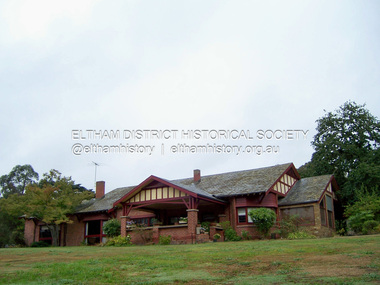
... Although Thomson is now recognised for his huge contribution, during his lifetime he suffered opposition and his life has been described as ‘tragic’.1 Thomson failed to gain the recognition as a scientist that he felt he deserved and he failed to alter government policy towards Aboriginal people. But towards the end of his life in 1970, anthropologists were moving towards the type of research he had done and the movement to grant land rights to Aborigines was strengthening. ...Although Thomson is now recognised for his huge contribution, during his lifetime he suffered opposition and his life has been described as ‘tragic’.1 Thomson failed to gain the recognition as a scientist that he felt he deserved and he failed to alter government policy towards Aboriginal people. But towards the end of his life in 1970, anthropologists were moving towards the type of research he had done and the movement to grant land rights to Aborigines was strengthening. ...'Worlingworth', Eltham, home of noted anthropologist the late Professor Donald Thomson and his wife Dorita Thomson. Covered under Heritage Overlay, Nillumbik Planning Scheme. Published: Nillumbik Now and Then / Marguerite Marshall 2008; photographs Alan King with Marguerite Marshall.; p127 Dubbed as ‘Australia’s Lawrence of Arabia’ anthropologist Donald Thomson lived much of his life in Eltham, at Banoon Road. On his retirement as Professor of Anthropology in 1968, The University of Melbourne professorial board compared Thomson to Lawrence of Arabia because of his work for Aborigines and his controversial personality. Although Thomson is now recognised for his huge contribution, during his lifetime he suffered opposition and his life has been described as ‘tragic’.1 Thomson failed to gain the recognition as a scientist that he felt he deserved and he failed to alter government policy towards Aboriginal people. But towards the end of his life in 1970, anthropologists were moving towards the type of research he had done and the movement to grant land rights to Aborigines was strengthening. Thomson is best known for his anthropological fieldwork in Cape York, Arnhem Land and Central Australia, but he is also known for his scholarly contributions to ornithology and ecology. Thomson documented every aspect of the daily and ritual life of the Aboriginal world of Cape York and Arnhem Land in the 1930s and 1940s. The huge collection in Museum Victoria includes 11,000 photographs, 7500 items of material culture, 1000 botanical and zoological specimens and 4500 pages of field-notes.2 The film Ten Canoes used Thomson’s photographs as a source. Thomson bought the Eltham property known as Worlingworth in 1934. The single-storey 60-square house standing by the Yarra River was built in 1922-23. It is one of the last in Eltham to survive with its farm setting intact. It is also one of the few substantial residences built in the Eltham Shire from the late 19th century to the early 20th century, which signalled a major change in the area towards the residential municipality it is today.3 The original section, built in the mid 1860s, of rose pink hand-made bricks and stone quarried on the property, was incorporated in the new red-brick house built in 1922. An immense oak tree by the house grew from an acorn brought by Patrick Armstrong who first bought the land in March 14, 1862. Armstrong named Worlingworth after his forbears’ village in Suffolk, England. Worlingworth saw grand days when Commander Alan A Barlee (R.N.) bought it in 1922 after winning the Calcutta Sweep. The property then included a nine-hole golf course, a tennis court, a bowling green, a boathouse and a boat-ramp.4 For most of his career Thomson, who was born in 1901, was attached to The University of Melbourne. In 1935 he represented the Commonwealth Government at Caledon Bay in east Arnhem Land to investigate and mediate for four Aborigines accused of killing five Japanese and three Europeans. In 1938 Thomson was awarded a PhD in Anthropology at Cambridge University, and during his career, he received several medals from British Societies, who perhaps appreciated his work better than their Australian counterparts. From World War Two, Thomson suffered a string of hardships, beginning with severe wounding in Dutch New Guinea (for his military service in New Guinea he was awarded an OBE) and he was invalided from service in 1944. That year he was diagnosed with diabetes. A fire in 1946 destroyed what Thomson regarded as perhaps the best record he had made of Aboriginal life – the 20,000 feet, (6096m) of film he had shot in Arnhem Land. In 1954 he and wife, Gladys, divorced. The next year he married his technical assistant, Dorita McColl. Several times during his career Thomson had major disagreements. For instance Professor P Elkin constantly opposed his work. He also opposed Thomson when he campaigned vigorously in 1947 against the establishment of a rocket range at Woomera, South Australia, because of the threat it posed Aborigines. Thomson resigned in frustration from the Victorian Aborigines Welfare Board in 1967, after serving for ten years, because he found that his advice was disregarded. His ashes were scattered over Caledon Bay from the air.This collection of almost 130 photos about places and people within the Shire of Nillumbik, an urban and rural municipality in Melbourne's north, contributes to an understanding of the history of the Shire. Published in 2008 immediately prior to the Black Saturday bushfires of February 7, 2009, it documents sites that were impacted, and in some cases destroyed by the fires. It includes photographs taken especially for the publication, creating a unique time capsule representing the Shire in the early 21st century. It remains the most recent comprehenesive publication devoted to the Shire's history connecting local residents to the past. nillumbik now and then (marshall-king) collection, banoon road, donald thomson, dorita thomson, eltham, worlingworth -
 Eltham District Historical Society Inc
Document - Folder, Aerospace Industry, 1958-1961
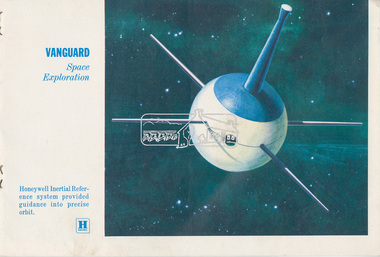
... Discussion paper: Work on Artificial Satellites; Weapons Research Establishment, Salisbury, South Australia (Paper presented by Chief Scientist, Department of Supply, Australia (Forwarded through Senior Representative, Department of Supply, London), 11 September 1958. ...Discussion paper: Work on Artificial Satellites; Weapons Research Establishment, Salisbury, South Australia (Paper presented by Chief Scientist, Department of Supply, Australia (Forwarded through Senior Representative, Department of Supply, London), 11 September 1958. ...honeywell, scout rocket, echo satellite, mercury rocket, centaur rocket, advent rocket, mariner satellite, dyna soar, x-15, midas rocket, tiros satellite, discoverer rocket, vanguard satellite, aerospace industry, alan gardiner collection, space industry -
 Warrnambool and District Historical Society Inc.
Book, Agricultural Notes 1909-1912, Circa 1909
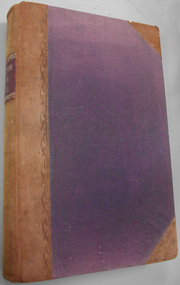
... Perkins was an agricultural scientist and viticulturist and his teaching of European viticultural methods was his first major contribution to Australian agriculture. He was appointed Principal of Roseworthy College in 1904. He also did research...Perkins was an agricultural scientist and viticulturist and his teaching of European viticultural methods was his first major contribution to Australian agriculture. He was appointed Principal of Roseworthy College in 1904. He also did research ...A. J. Perkins was an agricultural scientist and viticulturist and his teaching of European viticultural methods was his first major contribution to Australian agriculture. He was appointed Principal of Roseworthy College in 1904. He also did research into stock, cereal growing manure use and wheat varieties.Comprehensive notes on agriculture which were well used as a reference point for farmers and is well linked to the district through George Rolfe and his familyMaroon hard cover with tan suede corners and spine. 270 pages with purple text Agriculture Notes 1909-1912 on spine. G Rolfe Webb handwritten in block capitals inside front cover. Sticker inside front cover: Bound by F Binns and Co., Adelaide. Lectures by Pro. A J Perkins in grey lead above title. warrnambool, boorcan, bonnington, g. rolfe webb, a. j webb, roseworthy college -
 Bendigo Historical Society Inc.
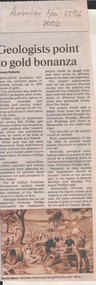
Newspaper - Kangaroo Flat Gold Mine Collection:, Department of Conservation and Environment, May 25/26 2002
... Research Centre for Landscape, Environments and Mineral Exploration and the CSIRO. ('Age' newspaper, 28th April, 2002. https://www.theage.com.au/national/going-to-ground-for-state-secrets-20020428-gdu5tz.html Scientists will send shocks through the Victorian earth which will be reflected back and recorded on instruments that will reveal the density of the rocks below....Research Centre for Landscape, Environments and Mineral Exploration and the CSIRO. ('Age' newspaper, 28th April, 2002. https://www.theage.com.au/national/going-to-ground-for-state-secrets-20020428-gdu5tz.html Scientists will send shocks through the Victorian earth which will be reflected back and recorded on instruments that will reveal the density of the rocks below. ...Victoria will be sliced in half during the next two years by earth scientists who expect to reveal hidden mineral wealth and better understand land degradation caused by salinity. By using instruments that send vibrations into the earth, geologists will peel back the surface layers to expose a hidden landscape of buried hills, valleys and fossil streams, undiscovered gold and mineral wealth, and giant extinct volcanos. The $3 million project, called the Victorian Geotraverse, will attempt to expose the processes that shaped the state and helped form its mineral wealth. The project will be discussed at a conference, Victoria Undercover, in Benalla this week. Project leader Neil Phillips, chief of CSIRO Exploration and Mining, said the project would attempt to discover where the rest of Victoria's gold deposits might be found and where the next salinity disaster might strike. Using this process they will cut a 500-kilometre swathe through the Grampians, Bendigo, Benalla and Wodonga, curving down to Mallacoota on the far east coast. The project will involve 12 earth science agencies including the Victorian Department of Natural Resources and Environment, Geoscience Australia, the Cooperative Research Centre for Landscape, Environments and Mineral Exploration and the CSIRO. ('Age' newspaper, 28th April, 2002. https://www.theage.com.au/national/going-to-ground-for-state-secrets-20020428-gdu5tz.html Scientists will send shocks through the Victorian earth which will be reflected back and recorded on instruments that will reveal the density of the rocks below.'Australian' newspaper article, 25/26th May, 2002, 'Geologists point to gold bonanza'. Article describes the $5 million Geotraverse research in Victoria, undertaken by CSIRO geologists, that 'estimate the northern plains of Victoria conceal up to 5000 tonnes of gold'. Image on bottom of article, possibly S.T. Gill watercolour, titled 'Victorian miners pan for gold in the mid-1800's'.bendigo mining n.l., bendigo, mining, gold, csiro, geologist, geology, victorian geotraverse project -
 Alfred Hospital Nurses League - Nursing History Collection
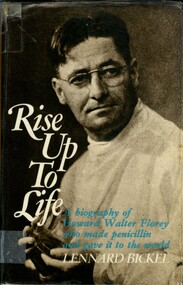
Book - Illustrated book, Lennard Bickel 1913-2002, Rise up to life: a biography of Howard Walter Florey who made penicillin and gave it to the world, 1972
... Howard Florey Penicillin history of medicine-biography "Rise Up to Life" follows Howard Florey’s career from his university days in Adelaide, through the period of his greatest research projects at Oxford, Cambridge and Sheffield which culminated in his success with penicillin, to the final years of his life when he was the first Australian to be elected President of the Royal Society. But this biography goes beyond exploring with insight and sympathy the life of a great scientist ..."Rise Up to Life" follows Howard Florey’s career from his university days in Adelaide, through the period of his greatest research projects at Oxford, Cambridge and Sheffield which culminated in his success with penicillin, to the final years of his life when he was the first Australian to be elected President of the Royal Society. But this biography goes beyond exploring with insight and sympathy the life of a great scientist to give the reader a vivid and dramatic picture of the scientific processes that led up to a new discovery and a new era in medicine.Illustrated book with dustjacket. Book is bound in brown cloth with abbreviated title, author's name and printer's mark embossed in gilt on spine. Dustjacket has title printed in white and green and author's name in white print on a black and white photograph of a man with dark hair, wearing glasses and a white coat (Walter Florey), Abbreviated title (in white) author's name (in green) and printer's mark (in black) are printed on a brown background on the spine. The back of the dust jacket has a black and white photo of Penicillin notatum growing in a petri dish."Rise Up to Life" follows Howard Florey’s career from his university days in Adelaide, through the period of his greatest research projects at Oxford, Cambridge and Sheffield which culminated in his success with penicillin, to the final years of his life when he was the first Australian to be elected President of the Royal Society. But this biography goes beyond exploring with insight and sympathy the life of a great scientist to give the reader a vivid and dramatic picture of the scientific processes that led up to a new discovery and a new era in medicine.howard florey, penicillin, history of medicine-biography -
 Warrnambool and District Historical Society Inc.
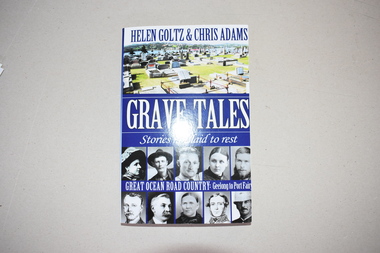
Book, Grave Tales, 2017
... scientist Frank Burnet, the unionist William McLean, Dick the bushranger and Captain Pye, V.C. This book is of interest as it gives information on a variety of historical figures buried in cemeteries in the Great Ocean Road districts (Geelong to Port Fairy). It will be useful to researchers ...This book details the lives of some people of the past who are buried in cemeteries along the Great Ocean Road. Of particular interest to Warrnambool and district readers are the documented lives of Jack Denham of the La Bella shipwreck, early Warrnambool settlers, Agnes and James Ruttleton, William Sharrock, hero of the Nestor sinking, the Rutledge brothers and the Mills brothers of Port Fairy, the scientist Frank Burnet, the unionist William McLean, Dick the bushranger and Captain Pye, V.C. This book is of interest as it gives information on a variety of historical figures buried in cemeteries in the Great Ocean Road districts (Geelong to Port Fairy). It will be useful to researchers. This is a soft cover book of 290 pages. It has black and white and coloured photographs on the front and back covers and printing on the spine and back and front covers. The pages contain an introduction, 22 chapters, black and white photographs and maps and illustrations. western district of victoria, warrnambool, jack denham, agnes ruttleton, william sharrock, rutledge brothers, mills brothers, frank burnet, william mclean -
 Victorian Aboriginal Corporation for Languages
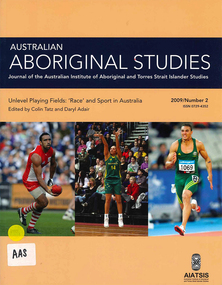
Periodical, Australian Institute of Aboriginal and Torres Strait Islander Studies, Australian Aboriginal studies : journal of the Australian Institute of Aboriginal and Torres Strait Islander Studies, 2009
... Just as social scientists thought that racial anthropology and biology had ended with the cataclysm of the Second World War, so some influential researchers and sports commentators have rekindled the pre-war debate about the muscular merits of ?...Just as social scientists thought that racial anthropology and biology had ended with the cataclysm of the Second World War, so some influential researchers and sports commentators have rekindled the pre-war debate about the muscular merits of ? ...Darkness and a little light: ?Race? and sport in Australia Colin Tatz (AIATSIS & Australian National University) and Daryl Adair (University of Technology Sydney) Despite ?the wonderful and chaotic universe of clashing colors, temperaments and emotions, of brave deeds against odds seemingly insuperable?, sport is mixed with ?mean and shameful acts of pure skullduggery?, villainy, cowardice, depravity, rapaciousness and malice. Thus wrote celebrated American novelist Paul Gallico on the eve of the Second World War (Gallico 1938 [1988]:9-10). An acute enough observation about society in general, his farewell to sports writing also captures the ?clashing colors? in Australian sport. In this ?land of the fair go?, we look at the malice of racism in the arenas where, as custom might have it, one would least want or expect to find it. The history of the connection between sport, race and society - the long past, the recent past and the social present - is commonly dark and ugly but some light and decency are just becoming visible. Coming to terms: ?Race?, ethnicity, identity and Aboriginality in sport Colin Tatz (AIATSIS & Australian National University) Notions of genetic superiority have led to some of the world?s greatest human calamities. Just as social scientists thought that racial anthropology and biology had ended with the cataclysm of the Second World War, so some influential researchers and sports commentators have rekindled the pre-war debate about the muscular merits of ?races? in a new discipline that Nyborg (1994) calls the ?science of physicology?. The more recent realm of racial ?athletic genes?, especially within socially constructed black athletic communities, may intend no malice but this search for the keys to their success may well revive the old, discredited discourses. This critical commentary shows what can happen when some population geneticists and sports writers ignore history and when medical, biological and sporting doctrines deriving from ?race? are dislocated from any historical, geographic, cultural and social contexts. Understanding discourses about race, racism, ethnicity, otherness, identity and Aboriginality are essential if sense, or nonsense, is to be made of genetic/racial ?explanations? of sporting excellence. Between the two major wars boxing was, disproportionately, a Jewish sport; Kenyans and Ethiopians now ?own? middle- and long-distance running and Jamaicans the shorter events; South Koreans dominate women?s professional golf. This essay explores the various explanations put forward for such ?statistical domination?: genes, biochemistry, biomechanics, history, culture, social dynamics, the search for identity, alienation, need, chance, circumstances, and personal bent or aptitude. Traditional games of a timeless land: Play cultures in Aboriginal and Torres Strait Islander communities Ken Edwards (University of Southern Queensland) Sports history in Australia has focused almost entirely on modern, Eurocentric sports and has therefore largely ignored the multitude of unique pre- European games that are, or once were, played. The area of traditional games, especially those of Aboriginal and Torres Strait Islander peoples, is an important aspect of the cultural, social and historical experiences of Indigenous communities. These activities include customs of play that are normally not associated with European notions of competitive sport. Overall, this paper surveys research undertaken into traditional games among Indigenous Australians, as well as proposals for much needed further study in this area. Culture, ?race? and discrimination in the 1868 Aboriginal cricket tour of England David Sampson As a consequence of John Mulvaney?s important historical research, the Aboriginal cricket and performance tour of Britain in 1868 has in recent decades become established as perhaps the most famous of all public events in contact history involving Aborigines, white settlers and the British metropolis. Although recognition of its importance is welcome and significant, public commemorations of the tour have enveloped the tour in mythologies of cricket and nation. Such mythologies have obscured fundamental aspects of the tour that were inescapable racial and colonial realities of the Victorian era. This reappraisal of the tour explores the centrality of racial ideology, racial science and racial power imbalances that enabled, created and shaped the tour. By exploring beyond cricketing mythology, it restores the central importance of the spectacular performances of Aboriginal skills without which the tour would have been impossible. Such a reappraisal seeks to fully recognise the often trivialised non-cricketing expertise of all of the Aboriginal performers in 1868 for their achievement of pioneering their unique culture, skills and technologies to a mass international audience. Football, ?race? and resistance: The Darwin Football League, 1926?29 Matthew Stephen (Northern Territory Archive Service) Darwin was a diverse but deeply divided society in the early twentieth century. The Commonwealth Government introduced the Aboriginals Ordinance 1911 in the Northern Territory, instituting state surveillance, control and a racially segregated hierarchy of whites foremost, then Asians, ?Coloureds? (Aborigines and others of mixed descent) and, lastly, the so-called ?full-blood? Aborigines. Sport was important in scaffolding this stratification. Whites believed that sport was their private domain and strictly controlled non-white participation. Australian Rules football, established in Darwin from 1916, was the first sport in which ?Coloured? sportsmen challenged this domination. Football became a battleground for recognition, rights and identity for all groups. The ?Coloured? community embraced its team, Vesteys, which dominated the Northern Territory Football League (NTFL) in the 1920s. In 1926, amidst growing racial tension, the white-administered NTFL changed its constitution to exclude non-white players. In reaction, ?Coloured? and Chinese footballers formed their own competition - the Darwin Football League (DFL). The saga of that colour bar is an important chapter in Australia?s football history, yet it has faded from Darwin?s social memory and is almost unknown among historians. That picture - Nicky Winmar and the history of an image Matthew Klugman (Victoria University) and Gary Osmond (The University of Queensland) In April 1993 Australian Rules footballer Nicky Winmar responded to on-field racist abuse by lifting his jersey and pointing to his chest. The photographic image of that event is now famous as a response to racial abuse and has come to be seen as starting a movement against racism in football. The racial connotations in the image might seem a foregone conclusion: the power, appeal and dominant meaning of the photograph might appear to be self-evident. But neither the fame of the image nor its racial connotation was automatic. Through interviews with the photographers and analysis of the use of the image in the media, we explore how that picture came to be of such symbolic importance, and how it has remained something to be re-shown and emulated. Rather than analyse the image as a photograph or work of art, we uncover some of its early history and explore the debates that continue to swirl around its purpose and meaning. We also draw attention to the way the careful study of photographs might enhance the study of sport, race and racism. ?She?s not one of us?: Cathy Freeman and the place of Aboriginal people in Australian national culture Toni Bruce (University of Waikato) and Emma Wensing (Independent scholar) The Sydney 2000 Olympic Games generated a national media celebration of Aboriginal 400 metre runner Cathy Freeman. The construction of Freeman as the symbol of national reconciliation was evident in print and on television, the Internet and radio. In contrast to this celebration of Freeman, the letters to the editor sections of 11 major newspapers became sites for competing claims over what constitutes Australian identity and the place of Aboriginal people in national culture. We analyse this under-explored medium of opinion and discuss how the deep feelings evident in these letters, and the often vitriolic responses to them, illustrate some of the enduring racial tensions in Australian society. Sport, physical activity and urban Indigenous young people Alison Nelson (The University of Queensland) This paper challenges some of the commonly held assumptions and ?knowledges? about Indigenous young people and their engagement in physical activity. These include their ?natural? ability, and the use of sport as a panacea for health, education and behavioural issues. Data is presented from qualitative research undertaken with a group of 14 urban Indigenous young people with a view to ?speaking back? to these commentaries. This research draws on Critical Race Theory in order to make visible the taken-for-granted assumptions about Indigenous Australians made by the dominant white, Western culture. Multiple, shifting and complex identities were expressed in the young people?s articulation of the place and meaning of sport and physical activity in their lives. They both engaged in, and resisted, dominant Western discourses regarding representations of Indigenous people in sport. The paper gives voice to these young people in an attempt to disrupt and subvert hegemonic discourses. An unwanted corroboree: The politics of the New South Wales Aboriginal Rugby League Knockout Heidi Norman (University of Technology Sydney) The annual New South Wales Aboriginal Rugby League Knockout is so much more than a sporting event. Involving a high level of organisation, it is both a social and cultural coming together of diverse communities for a social and cultural experience considered ?bigger than Christmas?. As if the planning and logistics were not difficult enough, the rotating-venue Knockout has been beset, especially since the late 1980s and 1990s, by layers of opposition and open hostility based on ?race?: from country town newspapers, local town and shire councils, local business houses and, inevitably, the local police. A few towns have welcomed the event, seeing economic advantage and community good will for all. Commonly, the Aboriginal ?influx? of visitors and players - people perceived as ?strangers?, ?outsiders?, ?non-taxpayers? - provoked public fear about crime waves, violence and physical safety, requiring heavy policing. Without exception, these racist expectations were shown to be totally unfounded. Research report: Recent advances in digital audio recorder technology provide considerable advantages in terms of cost and portability for language workers.b&w photographs, colour photographs, tablessport and race, racism, cathy freeman, nicky winmar, rugby league, afl, athletics, cricket, digital audio recorders -
 Lakes Entrance Historical Society
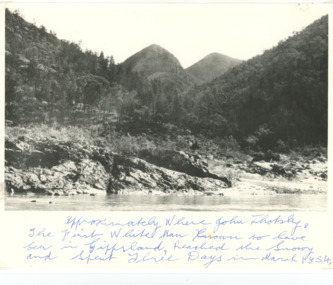
Photograph - Snowy River Buchan c1977
... scientist explorer Dr. Lhotsky explored the Australian Alps south of Mt Kosciusko (not named at that date)as far as McKillops Bridge (unnamed then) between 1834 and 1839. His claims were largely ignored he being labelled imposter and humbug but recent research...scientist explorer Dr. Lhotsky explored the Australian Alps south of Mt Kosciusko (not named at that date)as far as McKillops Bridge (unnamed then) between 1834 and 1839. His claims were largely ignored he being labelled imposter and humbug but recent research ...Polish scientist explorer Dr. Lhotsky explored the Australian Alps south of Mt Kosciusko (not named at that date)as far as McKillops Bridge (unnamed then) between 1834 and 1839. His claims were largely ignored he being labelled imposter and humbug but recent research indicates his rightful place amongst Victorias early explorersBlack and white photograph of Snowy River at Suggan Buggan VictoriaApproximately where John Lhotsky the first white man known to have been in Gippsland reached the Snowy and spent three days in March 1834topography, rivers -
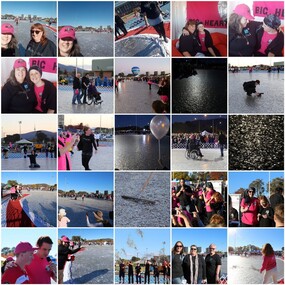 Ballarat Heritage Services
Digital photographs, L.J. Gervasoni, RIP Connie Johnson mosaic of Love Your Sister Big Heart Project, c2017
... scientists and mathematicians with the mechanics. Most importantly though, 100% of every donated coin will be passed on to the country’s best cancer researchers, IN FULL. ...scientists and mathematicians with the mechanics. Most importantly though, 100% of every donated coin will be passed on to the country’s best cancer researchers, IN FULL. ...THE BIG HEART PROJECT Connie’s health is in decline and she’s slowly succumbing to the perils of cancer. She is beyond treatment now. But before she goes, she is determined to break a world-record of her own, to match her brother’s. She has called it The Big Heart Project and it will be Connie’s final fundraising act for Love Your Sister before she retires to be with her nearest and dearest. The world record for longest line of coins stands at 75.4kms and is held by a town in Austria. To break the record, Connie needs to collect 3.951 million five cent coins! Thousands of families around the country have already purchased metres ($2.90) and Connie will lay the coins in the shape of a MASSIVE love heart, visible from space, this coming May 10, at the Lyneham Netball Courts in her hometown of Canberra. Schools nationally are participating in ‘Five Cent Fridays’ and Bendigo Bank are providing a collection depot at each of their branches. The Royal Australian Mint are supplying the coins and Questacon have tasked their best scientists and mathematicians with the mechanics. Most importantly though, 100% of every donated coin will be passed on to the country’s best cancer researchers, IN FULL. You can donate a metre ($2.90) for a cancery loved on http://www.loveyoursister.org/big-heart-project Digital imagescancer, breast cancer, connie johnson, constance johnson, charity, 5c, 5 cents, coins, big heart project, love your sister, northbourne avenue, canberra -
University of Melbourne, Burnley Campus Archives
Newspaper - Newspaper Cutting, The Herald, Plant Research Laboratory, 1928
... Descriptions of the new building to be erected and a history of the Burnley Gardens and College. plant research laboratory the herald burnley gardens plant science laboratory insectorium (1) Article in "The Herald" May 9, 1928 "Quarters for Scientists-Building in Burnley Gardens." (2) Article in "Richmond Guardian" 10.11.1928 "The Swan Street Improvements." ...Descriptions of the new building to be erected and a history of the Burnley Gardens and College.(1) Article in "The Herald" May 9, 1928 "Quarters for Scientists-Building in Burnley Gardens." (2) Article in "Richmond Guardian" 10.11.1928 "The Swan Street Improvements." plant research laboratory, the herald, burnley gardens, plant science laboratory, insectorium -
 Falls Creek Historical Society
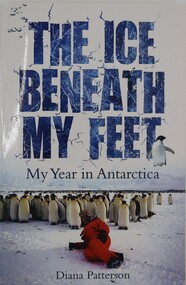
Book - The Ice Beneath my Feet, Diana Patterson, 2010
... Diana Patterson Women Scientists Diana Patterson was searching for her path in life when she was bitten by the Antarctic bug in her late twenties. With dogged determination, she set her sights on becoming the leader at one of Australia's Antarctic research stations - a lofty aspiration, considering this was definitely a bloke's world. ...Diana Patterson was searching for her path in life when she was bitten by the Antarctic bug in her late twenties. With dogged determination, she set her sights on becoming the leader at one of Australia's Antarctic research stations - a lofty aspiration, considering this was definitely a bloke's world. She was knocked back four times, but it didn't deter her - and at the age of 38 Diana became the first woman in charge of Mawson, a small, mostly male community of scientists and tradies living in each other's pockets 24/7, thousands of miles from the comforts of home. The Ice Beneath My Feet is an intimate and riveting account of Diana's Antarctic dream. The day-to-day reality of life in this frozen environment and the adventures of the delightful, vital characters we meet along the way (men, huskies, penguins!) are utterly captivating, and a must-read for anyone with a love for adventure.A publication of 358 pages including 16 pages of illustrations, maps and photographs. The front cover features a photo of the author in front of a flock of penguins. The back cover includes a synopsis and photographs.non-fictionDiana Patterson was searching for her path in life when she was bitten by the Antarctic bug in her late twenties. With dogged determination, she set her sights on becoming the leader at one of Australia's Antarctic research stations - a lofty aspiration, considering this was definitely a bloke's world. She was knocked back four times, but it didn't deter her - and at the age of 38 Diana became the first woman in charge of Mawson, a small, mostly male community of scientists and tradies living in each other's pockets 24/7, thousands of miles from the comforts of home. The Ice Beneath My Feet is an intimate and riveting account of Diana's Antarctic dream. The day-to-day reality of life in this frozen environment and the adventures of the delightful, vital characters we meet along the way (men, huskies, penguins!) are utterly captivating, and a must-read for anyone with a love for adventure. diana patterson, women scientists -
 Melbourne Tram Museum
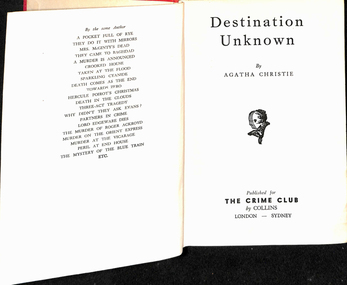
Book, Agatha Christie, "Destination unknown", 1954
... scientist who has disappeared and may have defected to the Soviet Union. Soon she finds herself in a group of oddly-assorted travellers being transported to the unknown destination of the title. The destination turns out to be a secret scientific research...scientist who has disappeared and may have defected to the Soviet Union. Soon she finds herself in a group of oddly-assorted travellers being transported to the unknown destination of the title. The destination turns out to be a secret scientific research ...Book, hard cover, 12 sections, sewn with end papers, 210 pages, titled "Destination unknown", written by Agatha Christie, published by The Crime Club, 1954. Has the stamp of the Footscray Tramway Library, asking it to be returned within 14 days inside the front cover and in many places throughout the book, along with Number "606" on the inside front cover and on the spine of the book. The book was part of a library run by the depot staff to provide materials during broken shifts and to take home. From Wikipedia - accessed 26/12/2019: Plot summary Hilary Craven, a deserted wife and bereaved mother, is planning suicide in a Moroccan hotel, when she is asked by British secret agent Jessop to undertake a dangerous mission as an alternative to taking an overdose of sleeping pills. The task, which she accepts, is to impersonate the wife of Thomas Betterton, a nuclear scientist who has disappeared and may have defected to the Soviet Union. Soon she finds herself in a group of oddly-assorted travellers being transported to the unknown destination of the title. The destination turns out to be a secret scientific research facility disguised as a modern leper colony and medical research center at a remote location in the Atlas Mountains. The scientists are well-treated, but they are not allowed to leave the facility, and they are locked in secret areas deep inside the mountain whenever government officials and other outsiders visit. Hilary Craven successfully passes herself as Betterton's wife Olive, because he is miserable and wants desperately to escape. Hilary discovers that the facility was built by the fabulously wealthy and somewhat villainous Mr Aristides, for financial rather than political ends. He has lured the world's best young scientists to it with various deceptions so that he can later sell their services back to the world's governments and corporations for a huge profit. She falls in love with Andrew Peters, a handsome young American who was in the group with her on their journey to the facility. With the help of clues she has left along the way, Jessop eventually locates and rescues her and the others held there. Peters turns out also to be on a mission, intent on bringing Betterton to justice for the murder of his first wife. Betterton, revealed to also be a scientific fraud who plagiarized his work, is arrested. Hilary no longer wants to die, and she and Peters are free to begin their life together.On the top of the first page "13/3" indicating the price, "m/arz"? on the bottom left hand corner and inside the front cover the label of "Robertson & Mullens Ltd" booksellers.trams, tramways, footscray depot, libraries, novels, personnel, crews, shifts -
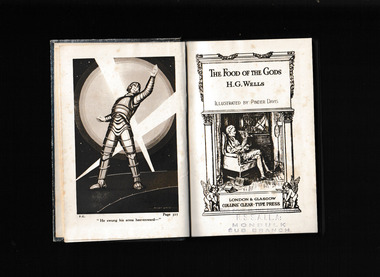 Mrs Aeneas Gunn Memorial Library
Book, HG Wells, The food of the gods, 1904
... research in the field of growth, Mr. Bensington and Professor Redwood light upon a new mysterious element, a food that causes greatly accelerated development. Initially christening their discovery The Food of the Gods, the two scientists ...Published in 1904, this forgotten classic is sci-fi and dystopia at its best, written by the creator and master of the genreFollowing extensive research in the field of growth, Mr. Bensington and Professor Redwood light upon a new mysterious element, a food that causes greatly accelerated development. Initially christening their discovery The Food of the Gods, the two scientists are overwhelmed by the possible ramifications of their creation. Needing room for experiments, Mr. Besington chooses a farm that offers him the chance to test on chickens, which duly grow monstrous, six or seven times their usual size. With the farmer, Mr. Skinner, failing to contain the spread of the Food, chaos soon reigns as reports come in of local encounters with monstrous wasps, earwigs, and rats. The chickens escape, leaving carnage in their wake. The Skinners and Redwoods have both been feeding their children the compound illicitlytheir eventual offspring will constitute a new age of giants. Public opinion rapidly turns against the scientists and society rebels against the world's new flora and fauna. Daily life has changed shockingly and now politicians are involved, trying to stamp out the Food of the Gods and the giant race. Comic and at times surprisingly touching and tragic, Wells' story is a cautionary tale warning against the rampant advances of science but also of the dangers of greed, political infighting, and shameless vote-seeking. Collapse summaryIll, p.311.fictionPublished in 1904, this forgotten classic is sci-fi and dystopia at its best, written by the creator and master of the genreFollowing extensive research in the field of growth, Mr. Bensington and Professor Redwood light upon a new mysterious element, a food that causes greatly accelerated development. Initially christening their discovery The Food of the Gods, the two scientists are overwhelmed by the possible ramifications of their creation. Needing room for experiments, Mr. Besington chooses a farm that offers him the chance to test on chickens, which duly grow monstrous, six or seven times their usual size. With the farmer, Mr. Skinner, failing to contain the spread of the Food, chaos soon reigns as reports come in of local encounters with monstrous wasps, earwigs, and rats. The chickens escape, leaving carnage in their wake. The Skinners and Redwoods have both been feeding their children the compound illicitlytheir eventual offspring will constitute a new age of giants. Public opinion rapidly turns against the scientists and society rebels against the world's new flora and fauna. Daily life has changed shockingly and now politicians are involved, trying to stamp out the Food of the Gods and the giant race. Comic and at times surprisingly touching and tragic, Wells' story is a cautionary tale warning against the rampant advances of science but also of the dangers of greed, political infighting, and shameless vote-seeking. Collapse summary science fiction - england, artificial foods
