
Showing 208 items matching "return to study"
-
 Federation University Historical Collection
Book, Ballarat School of Mines Proposed New Programs for 1979, 1979
... ...return to study...Ballarat School of Mines is a predecessor institution of Federation University Australia. ballarat school of mines courses electric motor control electrical drafting camping and caravan park managers course child care record keeping for small businesses introduction to sheetmetal return to study Yellow soft covered report with proposed new programs for 1979 at the Ballarat School of Mines. ...Ballarat School of Mines is a predecessor institution of Federation University Australia. Yellow soft covered report with proposed new programs for 1979 at the Ballarat School of Mines. ballarat school of mines, courses, electric motor control, electrical drafting, camping and caravan park managers course, child care, record keeping for small businesses, introduction to sheetmetal, return to study -
 Ringwood and District Historical Society
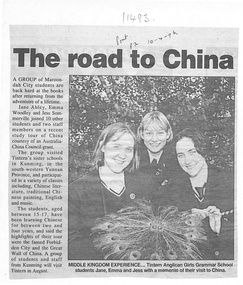
Article, Tintern CEGS RIngwood East - Newspaper Clipping 10-4-1996 "The Road to China"
... Article and photograph - The Road to China - students return from study tour of China. ...Caption: "Middle Kingdom Experience....Tintern Anglican Girls Grammar School students Jane, Emma and Jess with a memento of their visit to China" Article and photograph - The Road to China - students return from study tour of China. Tintern CEGS RIngwood East - Newspaper Clipping 10-4-1996 "The Road to China" Article ...Article and photograph - The Road to China - students return from study tour of China. Caption: "Middle Kingdom Experience....Tintern Anglican Girls Grammar School students Jane, Emma and Jess with a memento of their visit to China" -
University of Melbourne, Burnley Campus Archives
Booklet, Tasy Mouzakis, Back to the Books, May 2000
... Planning a return to study. Ed. Tasy Mouzakis. Produced by the Victorian Tertiary Admissions Centre....tasy mouzakis victorian tertiary asmissions centre study returning to study students Planning a return to study. ...tasy mouzakis, victorian tertiary asmissions centre, study, returning to study, students -
 Eltham District Historical Society Inc
Film - Video (VHS), Educational Media Centre Education Unit, RMIT, Becoming a Student Again, 1982
... Video originally donated to Eltham Living and Learning Centre by Marion Steel. Return to study skills Course Semester 1, 1989...Video originally donated to Eltham Living and Learning Centre by Marion Steel. Return to study skills Course Semester 1, 1989 Video Recording VHS video cassette recording converted to MP4 00:31:01 duration 1.42GB Becoming a Student Again Film Video (VHS) Educational Media Centre Education Unit, RMIT ...Video originally donated to Eltham Living and Learning Centre by Marion Steel. Return to study skills Course Semester 1, 1989video recording -
 Federation University Art Collection
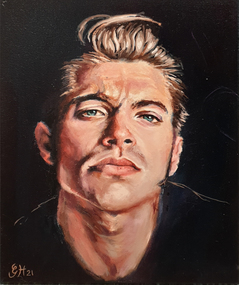
Painting, Garth Horsfield, Defiant Man by Garth Horsfield, 2021
... Garth HORSFEILD (19 June 1970 - ) Born Ballarat, Victoria Returning to study after a partially completed degree and pursuing art and music, Garth Horsfield returned to the Federation University Arts Academy where he completed a Bachelor of Visual Arts in 2021. ...Garth HORSFEILD (19 June 1970 - ) Born Ballarat, Victoria Returning to study after a partially completed degree and pursuing art and music, Garth Horsfield returned to the Federation University Arts Academy where he completed a Bachelor of Visual Arts in 2021. ...My practice questions the definition of masculinity, from the position that there is more to the story than the mainstream narrative. My subjects consist of aesthetic beings seen through the lens of the classical principles of shape and form such as danseurs, youths, other ages and shapes. Sometiimes I have exculded faces to emphasize the interesting dynamic line unique to the male shape. Any symbols of sexual politics have been omitted, to concentrate on how the concept of maculinity pays alongside modern notions of beauty. Garth HORSFEILD (19 June 1970 - ) Born Ballarat, Victoria Returning to study after a partially completed degree and pursuing art and music, Garth Horsfield returned to the Federation University Arts Academy where he completed a Bachelor of Visual Arts in 2021. Portrait of a young man.dvc art award, alumni, garth horsfield, portrait, masculinity, male, men, available -
 Federation University Art Collection
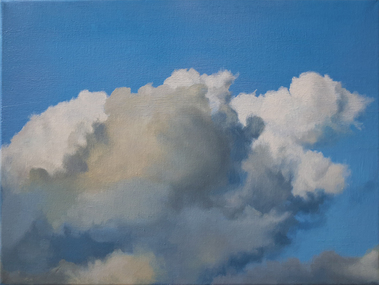
Painting, Garth Horsfield, 'Bakery Hill Clouds' by Garth Horsfield, 2021
... Garth HORSFEILD (19 June 1970 - ) Born Ballarat, Victoria Returning to study after a partially completed degree and pursuing art and music, Garth Horsfield returned to the Federation University Arts Academy where he completed a Bachelor of Visual Arts in 2021. ...Garth HORSFEILD (19 June 1970 - ) Born Ballarat, Victoria Returning to study after a partially completed degree and pursuing art and music, Garth Horsfield returned to the Federation University Arts Academy where he completed a Bachelor of Visual Arts in 2021. ...My practice questions the definition of masculinity, from the position that there is more to the story than the mainstream narrative. My subjects consist of aesthetic beings seen through the lens of the classical principles of shape and form such as danseurs, youths, other ages and shapes. Sometiimes I have exculded faces to emphasize the interesting dynamic line unique to the male shape. Any symbols of sexual politics have been omitted, to concentrate on how the concept of maculinity pays alongside modern notions of beauty. Garth HORSFEILD (19 June 1970 - ) Born Ballarat, Victoria Returning to study after a partially completed degree and pursuing art and music, Garth Horsfield returned to the Federation University Arts Academy where he completed a Bachelor of Visual Arts in 2021. Painted clouds on a blue skydvc art award, alumni, garth horsfield, clouds, sky -
 Returned Nurses RSL Sub-branch
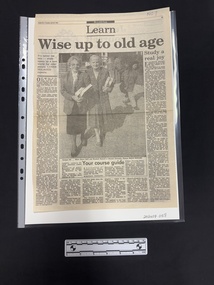
Newspaper - Newspaper clipping, Herald Sun, 'Wise up to old age', 'Your course guide' & 'Study a real joy', Tuesday, April 20, 1993
... 'Wise up to old age' article is general about returning to studies when older, giving options to do so for a reader and mentioning two older students Eileen Stuart and Elizabeth Birchall. ...'Wise up to old age' article is general about returning to studies when older, giving options to do so for a reader and mentioning two older students Eileen Stuart and Elizabeth Birchall. ...'Wise up to old age' article is general about returning to studies when older, giving options to do so for a reader and mentioning two older students Eileen Stuart and Elizabeth Birchall. 'Your course guide' article under the photo of Eileen Stuart & Elizabeth Birchall provides contacts for adult education classes in Melbourne. 'Study a real joy' article brief biographical article about Elizabeth Birchall including her writing and war service.Full page, three articles using six columns of text surrounding a large black and white photograph of two older women holding books, standing outsideworld war 2, wwii, ww2, spanish civil war, elizabeth birchall, eileen stuart, monash university, adult education -
 Federation University Art Collection
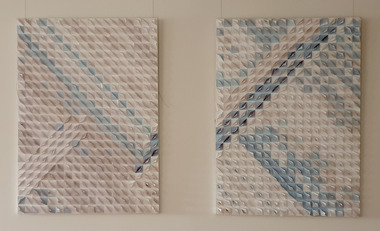
Mixed media, 'Line of Sight' by Debbie Lloyd, 2007
... Debbie LLOYD Debbie Lloyd returned to study in 2005 completing a Bachelor of Fine Arts (Visual Arts) degree at the University of Ballarat (now Federation University) in 2007, with honours the following year. ...Debbie LLOYD Debbie Lloyd returned to study in 2005 completing a Bachelor of Fine Arts (Visual Arts) degree at the University of Ballarat (now Federation University) in 2007, with honours the following year. ...Debbie LLOYD Debbie Lloyd returned to study in 2005 completing a Bachelor of Fine Arts (Visual Arts) degree at the University of Ballarat (now Federation University) in 2007, with honours the following year. She returned to the university as Artist in Residence in 2009. During her time at the University Debbie exhibited in many group exhibitions and her work was selected for the National Graduates Show at PICA in Western Australia. Debbie’s first solo exhibition was held at Space22 in Ballarat, towards the end of 2010. This item is part of the Federation University Art Collection. The Art Collection features over 1000 works and was listed as a 'Ballarat Treasure' in 2007.Two artworks featuring a third dimension created with folded paper. Artist's Statement: "My artwork explores the visual experience that can be achieved using black and white, lineal patterns or by creating illusion and surface movement through the simple manipulation and repetition of forms. In these works I have used everyday objects, and shapes, repeated, reconfigured and recontextualised to provide the viewer with visual challenges that slow down and complicate the reading of the work. In the words of a former lecturer of mine, who kindly delivered the opening speech at one of my exhibitions – There is in Debbie’s work a belief in the transcendental power of repetition, a tribute in many respects to the fact that human kind is defined by nothing more noble and uplifting than its ability and obligation to persist." (http://100thgallery.com/gallery/debbie-lloyd/, accessed 08 May 2018) art, artwork, debbie lloyd, available, recycling, envelopes -
 Greensborough Historical Society
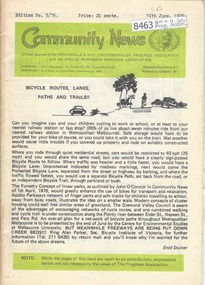
Newsletter, Greenhills and North Greensborough Progress Association, Community News: official journal of the Greenhills and Nth. Greensborough Progress Association and the Apollo Parkways Progress Association.10th June,1976. Edition No. 5/76, 10/06/1976
... This edition includes a report on the The Apollo Parkways Progress Association's May1976 meeting, Bicycle routes, lanes, paths and trails, Thoughts from young cyclists, It can happen to you [youth deaths on our roads], Lament for a traffic statistic, Returning to study, I can do it too!!, This and that, Cameo of Les James, How does the working mum cope?...This edition includes a report on the The Apollo Parkways Progress Association's May1976 meeting, Bicycle routes, lanes, paths and trails, Thoughts from young cyclists, It can happen to you [youth deaths on our roads], Lament for a traffic statistic, Returning to study, I can do it too!!, This and that, Cameo of Les James, How does the working mum cope? ...This edition includes a report on the The Apollo Parkways Progress Association's May1976 meeting, Bicycle routes, lanes, paths and trails, Thoughts from young cyclists, It can happen to you [youth deaths on our roads], Lament for a traffic statistic, Returning to study, I can do it too!!, This and that, Cameo of Les James, How does the working mum cope?, From the O'Donnells, Diminishing community spirit?, School news, Greenhills basketball, Scout and Guide news, Nursing Mothers Association. Supplement to "Community News". No. 6/76. Diamond Valley Shire: South-East Councillors' report, From the Chamber Council, Art and craft survey, Letter to the Editor. A digital copy of this Newsletter is available from Greensborough Historical Society. Newsletter, 24 p., illus.greenhills and north greensborough progress association, greenhills, apollo parkways progress association, apollo parkways -
 Ballarat Tramway Museum
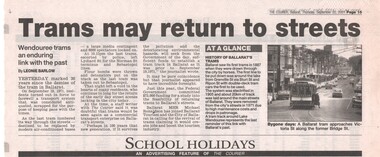
Newspaper, The Courier Ballarat, "Trams may return to streets", 20/09/2001 12:00:00 AM
... Newspaper clipping from The Courier Ballarat, Thursday 20/9/2001, page 15, titled "Trams may return to streets", about the 30th anniversary of the closure of Ballarat Tramways, the possible return, and the feasibility study also being undertaken. ...Closure Ballarat Tram Revival Newspaper clipping from The Courier Ballarat, Thursday 20/9/2001, page 15, titled "Trams may return to streets", about the 30th anniversary of the closure of Ballarat Tramways, the possible return, and the feasibility study also being undertaken. ...Newspaper clipping from The Courier Ballarat, Thursday 20/9/2001, page 15, titled "Trams may return to streets", about the 30th anniversary of the closure of Ballarat Tramways, the possible return, and the feasibility study also being undertaken. Also has a paragraph giving a very potted history of the tramway, "History of Ballarat's trams". Photo with article is of 31 at Main and Victoria streets, in Bridge St. Written by Leonie Barlow,closure, ballarat, tram revival -
 Warrnambool and District Historical Society Inc.
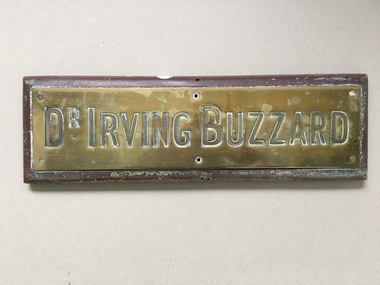
Brass Plate, Dr Irving Buzzard
... His study of medicine was interrupted by his enrolment in the AIF in World War 1, where he served on the hospital ship " Kanowns". After discharge in 1916 he returned...His study of medicine was interrupted by his enrolment in the AIF in World War 1, where he served on the hospital ship " Kanowns". After discharge in 1916 he returned ...Irving Buzzard was born in Moonee Ponds in 1897. His study of medicine was interrupted by his enrolment in the AIF in World War 1, where he served on the hospital ship " Kanowns". After discharge in 1916 he returned to his studies, graduating in 1922. he came to Warrnambool in 1929 after purchasing the Cambourne Clinic from Dr Hedley Dunstan. He practised as a GP until the outbreak of WW2. His speciality was gynaecology and obstetrics. He retired from Warrnambool practice in 1964 and moved to Melbourne.he was involved in many different organisations , being a member of local sporting clubs as well as community groups such as Rotary and the freemasons. He died in June 1981.A link to one of Warrnambool's longest serving doctors of the 20th century which has historical and social significance.Small rectangular brass plate with six screw holes. Mounted on timber which is painted brown. Name is stamped and while namDr Irving Buzzardwarrnambool, warrnambool doctors, dr irving buzzard, cambourne clinic doctors -
 Surrey Hills Historical Society Collection
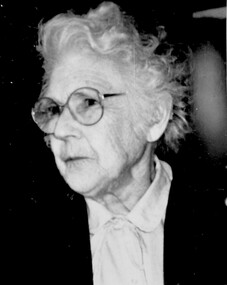
Photograph, Mrs Mona Webster
... After discharge on 10 May 1919, Clarence returned to his studies. He joined a legal firm in the city which became Pearce & Webster (later Pearce Webster Dugdale). ...After discharge on 10 May 1919, Clarence returned to his studies. He joined a legal firm in the city which became Pearce & Webster (later Pearce Webster Dugdale). ...Born in 1900, Mona was the daughter of Florence Jane McDowall Stuart (1867-1936) and George Hudson Grant (1864-1910) who married in 1899. He was a surveyor and they lived in Albany Crescent, Surrey Hills. Her full name was Jessie Mona Stuart Grant and she had a sister Mollie. In 1924 she married Clarence William Willoughby Webster (1895-1980) - SERN 33286. Clarence was born in Thorpedale where his father was a teacher. He was living in View Street Mont Albert and was a law student when he enlisted on 3 October 1916. After discharge on 10 May 1919, Clarence returned to his studies. He joined a legal firm in the city which became Pearce & Webster (later Pearce Webster Dugdale). Mona and Clarence lived in Surrey Hills and Mont Albert in a number of homes for the remainder of their lives. A black and white portrait of an older lady wearing round wire-rimmed glasses.writers, authors, view street, surrey hills, mont albert, victoria crescent, mrs mona webster, mr clarence webster, jessie mona stuart grant (miss), jessie mona stuart webster (mrs) -
 Surrey Hills Historical Society Collection
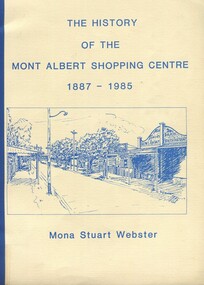
Book, Box Hill Historical Society et al, The history of the Mont Albert Shopping Centre, 1986
... After discharge on 10 May 1919, Clarence returned to his studies. He joined a legal firm in the city which became Pearce & Webster (later Pearce Webster Dugdale). ...After discharge on 10 May 1919, Clarence returned to his studies. He joined a legal firm in the city which became Pearce & Webster (later Pearce Webster Dugdale). ...Born in 1900, Mona was the daughter of Florence Jane McDowall Stuart (1867-1936) and George Hudson Grant (1864-1910) who married in 1899. He was a surveyor and they lived in Albany Crescent, Surrey Hills. Her full name was Jessie Mona Stuart Grant and she had a sister Mollie. In 1924 she married Clarence William Willoughby Webster (1895-1980) - SERN 33286. Clarence was born in Thorpedale where his father was a teacher. He was living in View Street Mont Albert and was a law student when he enlisted on 3 October 1916. After discharge on 10 May 1919, Clarence returned to his studies. He joined a legal firm in the city which became Pearce & Webster (later Pearce Webster Dugdale). Mona and Clarence lived in Surrey Hills and Mont Albert in a number of homes for the remainder of their lives.A history of the Mont Albert Shopping Centre in Hamilton Street, Mont Albert, including the early land use, and a chronology of shop owners. Index, photos., 39p. Compiled by local resident, Mona Webster.On front cover: top RH corner "Kay Kirkwood/98995158"phoenix park estate, mont albert, hamilton street, (mr) - mckerdy, (mr) - andrew, (mr) - dunn, (lady) emma hamilton, railways, churchill street, surrey hills golf club, (mrs) mona webster -
 Federation University Historical Collection
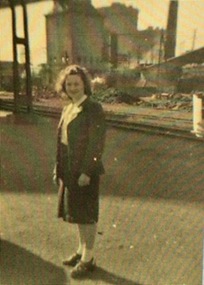
Article - Article - Women, Ballarat School of Mines: Women of Note; Jeanette Perkins, First Female Geology Student, (1927 - )
... In 1951 Jeanette and Alf Watson moved to Melbourne where she commenced work as a metallurgical chemist at the Maribyrnong Ordnance Factory while studying geology part time: Alf returned to study at the University of Melbourne. ...In 1951 Jeanette and Alf Watson moved to Melbourne where she commenced work as a metallurgical chemist at the Maribyrnong Ordnance Factory while studying geology part time: Alf returned to study at the University of Melbourne. ...Jeanette Perkins was born in 1927 at Ballarat. She attended Alfredton State School and Pleasant Street State School before completing her secondary schooling at Ballarat High School (BHS). During her later years at BHS Perkins decided that she wanted to become a geologist, but was ineligible for university when she failed Leaving Certificate maths. She attended an interview with the principal (Heseltine) at the Ballarat School of Mines (SMB) and announced that she wanted to be a geologist. Heseltine was, according to Perkins, aghast: he informed her that there had never been a female geologist at SMB and they didn't want one. But Perkins persisted. Only then did Heseltine reluctantly enrol her in the School's Applied Chemistry Course which offered the most geological subjects, moreover, it was the only one he considered available to a 'mere' female. After graduating Perkins was employed as a metallurgical chemist with M.B. Johns Valves, Ballarat. In 1949 she married Alfred Watson. In 1951 Jeanette and Alf Watson moved to Melbourne where she commenced work as a metallurgical chemist at the Maribyrnong Ordnance Factory while studying geology part time: Alf returned to study at the University of Melbourne. Once again, Watson set a precedent by becoming the first female student to study geology part-time at the Melbourne Technical College. Increasing demands brought about by her growing family, she turned to part-time lecturing second and third year stratigraphy and palaeontology at RMIT. In 1957 the Watsons moved to the Mary Kathleen Uranium Mine in NW Queensland where he was appointed electrical design engineer. After their return to Melbourne in 1960, Jeanette taught herself to SCUBA dive and quickly developed a passion for the sport and the marine environment. She taught senior science to secondary students for 10 years whilst working towards a Masters degree. In 1991 Jeanette Watson was awarded a Doctorate from Deakin University.women of note, ballarat school of mines, alfredton state school, pleasant street state school, ballarat high school, leaving certificate maths, interview with principal, heseltine, geologist, applied chemistry course, no female geologists, metallurgical chemist, married 1949, melbourne, ordinance factory, part time study, melbourne technical college, rmit, part time lecturer, scuba diving, science teacher for ten years, masters degree, doctorate, deakin university -
 Ballarat Tramway Museum
Newspaper, Herald Sun, "Tram plan for tourist sites", 6/08/1999 12:00:00 AM
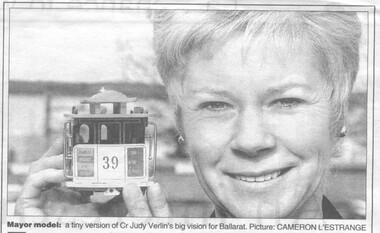
... Newspaper clipping from the Herald Sun dated August 6, 1999, page 23, about the possibility of tourist trams returning to Ballarat. Mentions feasibility studies and quotes the Mayor, Judy Verlin about the plan and other studies such as the Maunsell study. ...Study Maunsell Sturt St. Newspaper clipping from the Herald Sun dated August 6, 1999, page 23, about the possibility of tourist trams returning to Ballarat. ...Newspaper clipping from the Herald Sun dated August 6, 1999, page 23, about the possibility of tourist trams returning to Ballarat. Mentions feasibility studies and quotes the Mayor, Judy Verlin about the plan and other studies such as the Maunsell study. Has photo of Judy Verlin holding a miniature cable tram and a photo of an ESCO tram in Sturt St. with Town Hall in background. Item written by Scott Thompson, Urban affairs reporter and picture by Cameron L'Estrange. ballarat revival, feasibility study, maunsell, sturt st. -
 Sunshine and District Historical Society Incorporated
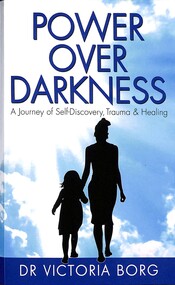
Book - Power Over Darkness A Journey of Self-Discovery, Trauma & Healing, Infinity Books USA, LLC, 2022
... "I have been living in Brimbank since I emigrated from Malta in 1972. I returned to study as a mature-age student at Victoria University, St. ..."I have been living in Brimbank since I emigrated from Malta in 1972. I returned to study as a mature-age student at Victoria University, St. ...A memoir of the author's journey on mental illness and self-discovery.A soft covered book with title and author's name written on frontnon-fictionA memoir of the author's journey on mental illness and self-discovery.mental illness and self discovery, trauma and healing, reconciliation -
 Ballarat Tramway Museum
Newspaper, The Courier Ballarat, "Return of trams viable study", "New Push for Trams", "Taking tourism to the next level", "More tourists, more jobs expected", "Tram plan worthy of expected debate", 11/07/2002 12:00:00 AM
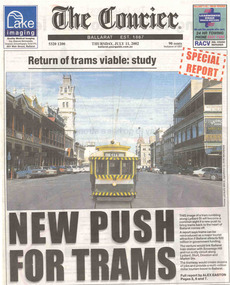
... "Return of trams viable study", "New Push for Trams", "Taking tourism to the next level", "More tourists, more jobs expected", "Tram plan worthy of expected debate"...Set of three cuttings from The Courier, Ballarat dated Thursday 11/7/2002 regarding the reintroduction of trams to Ballarat. 2241.1 - Page 1 and 2 of The Courier, with page 1 titled "Return of trams viable study" and "New Push for Trams" as the commencement of a Special report showing a digitally constructed image of No. 13 in Lydiard St. ...Looks at the $20million cost. "Return of trams viable study", "New Push for Trams", "Taking tourism to the next level", "More tourists, more jobs expected", "Tram plan worthy of expected debate" Newspaper The Courier Ballarat ...Set of three cuttings from The Courier, Ballarat dated Thursday 11/7/2002 regarding the reintroduction of trams to Ballarat. 2241.1 - Page 1 and 2 of The Courier, with page 1 titled "Return of trams viable study" and "New Push for Trams" as the commencement of a Special report showing a digitally constructed image of No. 13 in Lydiard St. North. Note the tram does not have a driver. Introduces reports by Alex Easton on pages 2, 6 and 7. On Page 2, titled "Taking tourism to the next level", has details of the Council viewpoints on the proposal, public consultation, a map of the route, and notes on the construction issues. Has a digital image of 13 crossing Sturt St. into Lydiard St. North. See images No. 1 to 3. 2241.2 - page 6 of The Courier, which joins with page 7 using the titled "More tourists, more jobs expected". Has Sections reviewing the study outcomes, benefits and a summary of the study. Page 6 has a photo of a passenger boarding No. 21, decorated as the Myers Christmas tram in Sturt St and a photo of Bridge St. in 1971 (very poor quality reproduction). See images No. 4 and 5. 2241.3 - page 7 of The Courier, has Sections detailing the history of Ballarat Trams, proposals for the City Tramway, costs, consultation, and comments from Peter Hiscock. Has a photo of Peter Hiscock and Mayor David Vendy in front of No. 13 at the BTM depot. See image No. 6. Also has a photo of Dianne Smith, Executive Director of Ballarat Tourism. On page 8, as part of The Courier's editorial Section, has comments on the proposals, titled "Tram plan worth of extended debate". Looks at the $20million cost. ballarat revival, editorial, ballarat city tramway, lydiard st. nth -
 National Wool Museum
Textile - Quilt, 1921
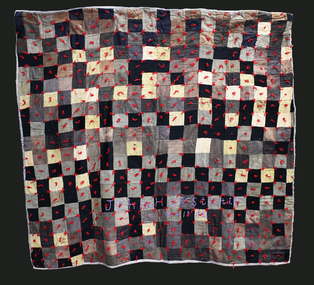
... John began to study engineering at the State University of Iowa before serving in the US Army Engineer Corps in The Great War. He enlisted when he became eligible and served briefly before the Great War ended. He then returned...John began to study engineering at the State University of Iowa before serving in the US Army Engineer Corps in The Great War. He enlisted when he became eligible and served briefly before the Great War ended. He then returned ...Now 100 years old, this quilt belonged to the donor’s grandfather John William Huffstutter. John was Born in 1898 in a log cabin in the Ozark mountains of Missouri, USA. Tragically, John’s mother died when he was four years old. John said that he could always remember her voice calling his name as he hid under the porch in one of the many thunderstorms that frequent the area with his dog. John was raised by his grandmother and was treated as the youngest to her other children, growing up with his aunties and uncles rather than brothers and sisters. John began to study engineering at the State University of Iowa before serving in the US Army Engineer Corps in The Great War. He enlisted when he became eligible and served briefly before the Great War ended. He then returned to his engineering studies in Iowa, and shortly after finishing his studies got his first job with Westinghouse in Pittsburgh at age 23. It was when John was leaving for this job that he was given the quilts as a reminder of home from his grandmother Sarah Jane "Sallie" Tindall Coble, and her daughter (John's Aunt) Ottie Maude Coble Bittick. Widowed at age 78, John took to sleeping in his screen porch under one of these quilts. John remembered one winter in Missouri waking in his log cabin to find snow covering him and his quilt. When he died at age 94, the quilt he used was completely worn out and discarded. This remaining quilt was shipped to Australia, where Carol’s (the donor) immediate family had emigrated in 1970. Opening the box that contained the quilt released a wave of comforting smells, emotions, and a flood of childhood memories. Carol distinctly remembers sleeping under these quilts for afternoon naps at her grandparents' house. The quilt is 74 x 80 inches (1880 x 2030mm), matching the size of a modern-day king bed. It is made of various four-inch (100mm) squares. These squares are made of old men woollen suits in dark colours of browns and greys. The quilt is layered with a wool backing fabric and a batting lawyer of unknown material, possibly cotton or wool. The quilt is tied together with red wool yarn and the backing fabric is folded over the edge to be used as a binding. Embroidered across the front of the quilt in purple wool yarn is "John Huffstutter", "13 Oct 1921". A small, printed cloth label "HUFFSTUTTER" is pinned on the reverse of the quilt. The quilt is well-worn but in good condition considering its age. The care instructions passed down by word of mouth with the quilt were to "never wash, only air".Front embroidered. Purple handstitching: "John Huffstutter / 13 Oct 1921" Reverse. Printed cloth label: "HUFFSTUTTER"ozark, missouri, usa, textile history, quilt heritage -
 Surrey Hills Historical Society Collection
photograph, Dr Una Porter
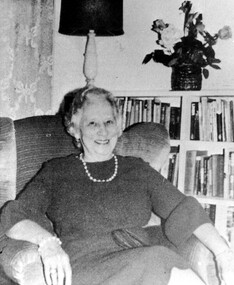
... Una became very close to her father and assisted him in establishing hospitals and missions in Arnhem Land, Fiji and India. Una returned to formal study and matriculated at the age of 30. ...Una became very close to her father and assisted him in establishing hospitals and missions in Arnhem Land, Fiji and India. Una returned to formal study and matriculated at the age of 30. ...Dr Unice (Una) Beatrice Porter, OBE, CBE (1900 - 1996) Una Porter was the youngest daughter of Frederick John Cato and his wife Fanny (née Bethune). She had 3 sisters and 4 brothers. Her father was of course the prominent businessman and co-founder of the Moran & Cato grocery company who was known for his generosity and commitment to the Methodist Church. Given this background it is not surprising that Una inherited a deep and lasting Christian faith that would become the driving force behind her own career and philanthropic activities. Una was educated at Methodist Ladies College and the English boarding school "Farringtons" however her formal education ended at the age of 14 due to ill health. By the outbreak of the First World War her sisters were married and her brothers enlisted. Una became very close to her father and assisted him in establishing hospitals and missions in Arnhem Land, Fiji and India. Una returned to formal study and matriculated at the age of 30. A niece with diabetes was the catalyst which led Una to study medicine. She enrolled at the University of Melbourne in 1933 and subsequently specialised in psychiatry with training at Prince Henry's Hospital, the Royal Park Mental Hospital and the Children's Hospital. In 1946 she took a post at the Ballarat Mental Hospital. Here she was the first female member of staff, overseeing 512 female patients. She later worked in private practice and was instrumental in the establishment of a psychiatric clinic at the Queen Victoria Hospital. Throughout her life, Una maintained a strong link with the Young Women's Christian Association (YWCA) and in 1963 was elected as the World President of this organisation and in 1964 she was elected Woman of the Year. Una's philanthropic work was extensive. In addition to administering the F.J. Cato Charitable and Benevolent Trust and later the James and Una Porter Trust Fund, she made substantial personal donations to hospitals, universities and community organisations including the University of Melbourne, Monash University, Epworth Hospital, Methodist Ladies College, Cato College, Queen Victoria Hospital and the YWCA. It is estimated that she gave over $1 million to various hospitals and institutions. Some of her projects included establishing a scholarship for rural female students to attend university, a Chair in Psychiatry, and extensive research into early childhood development. Una B. Porter was appointed O.B.E. (1961) and C.B.E. (1968) in recognition of her services to the community. At the age of 46 Una married James Roland Porter, an ex-RAAF squadron leader and a lifelong friend. Until this time, Dr Porter had lived at the Cato family home, ‘Kawarau’ at 192-198 Tooronga Road, Hawthorn (later Stephanie’s restaurant). In spite of having qualified as a doctor and with all her philanthropic activities, at age 43 the electoral rolls give her status as ‘home duties’! Dr Porter’s connection with Surrey Hills came after her marriage. In 1948 she and her husband bought 8 Kent Road. A black and white photograph of a screened image of a lady sitting in a winged-back chair. She is wearing a knee length dress with three-quarter length sleeves, and beads around her neck and wrist.psychiatrist, philanthropist, queen victoria hospital, mont albert, surrey hills, 8 kent road, dr una porter, mr james porter, dr unice beatrice porter, mr frederick cato, miss unice beatrice cato, mrs fanny cato, miss fanny bethune, young women's christian association, fj cato charitable and benevolent trust, james and una porter trust fund, methodist ladies college -
 Flagstaff Hill Maritime Museum and Village
Uniform - Sailor's Shirt, 1920's
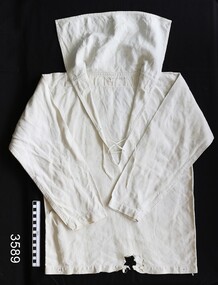
... 'Larg's Bay' returning from the U.K. in 1928 after studies. It was donated to Flagstaff Hill Maritime Village by the family of Doctor William Roy Angus, Surgeon and Oculist. ...'Larg's Bay' returning from the U.K. in 1928 after studies. It was donated to Flagstaff Hill Maritime Village by the family of Doctor William Roy Angus, Surgeon and Oculist. ...This sailor's white linen shirt or top was acquired by Dr Angus when working as a Ship's Surgeon on S.S. 'Larg's Bay' returning from the U.K. in 1928 after studies. It was donated to Flagstaff Hill Maritime Village by the family of Doctor William Roy Angus, Surgeon and Oculist. It is part of the “W.R. Angus Collection” which includes historical medical equipment, surgical instruments and material once belonging to Dr Edward Ryan and Dr Thomas Francis Ryan, (both of Nhill, Victoria) as well as Dr Angus’ belongings. The Collection’s history spans the medical practices of the two Doctors Ryan, from 1885-1926 plus that of Dr Angus, up until 1969. ABOUT THE “W.R.ANGUS COLLECTION” Doctor William Roy Angus M.B., B.S., Adel., 1923, F.R.C.S. Edin.,1928 (also known as Dr Roy Angus) was born in Murrumbeena, Victoria in 1901 and lived until 1970. He qualified as a doctor in 1923 at University of Adelaide, was Resident Medical Officer at the Royal Adelaide Hospital in 1924 and for a period was house surgeon to Sir (then Mr.) Henry Simpson Newland. Dr Angus was briefly an Assistant to Dr Riddell of Kapunda, then commenced private practice at Curramulka, Yorke Peninsula, SA, where he was physician, surgeon and chemist. In 1926, he was appointed as new Medical Assistant to Dr Thomas Francis Ryan (T.F. Ryan, or Tom), in Nhill, Victoria, where his experiences included radiology and pharmacy. In 1927 he was Acting House Surgeon in Dr Tom Ryan’s absence. Dr Angus had become engaged to Gladys Forsyth and they decided he would take time to further his studies overseas in the UK in 1927. He studied at London University College Hospital and at Edinburgh Royal Infirmary and in 1928, was awarded FRCS (Fellow from the Royal College of Surgeons), Edinburgh. He worked his passage back to Australia as a Ship’s Surgeon on the on the Australian Commonwealth Line’s SS Largs Bay. Dr Angus married Gladys in 1929, in Ballarat. (They went on to have one son (Graham 1932, born in SA) and two daughters (Helen (died 12/07/1996) and Berenice (Berry), both born at Mira, Nhill ) Dr Angus was a ‘flying doctor’ for the A.I.M. (Australian Inland Ministry) Aerial Medical Service in 1928 . The organisation began in South Australia through the Presbyterian Church in that year, with its first station being in the remote town of Oodnadatta, where Dr Angus was stationed. He was locum tenens there on North-South Railway at 21 Mile Camp. He took up this ‘flying doctor’ position in response to a call from Dr John Flynn; the organisation was later known as the Flying Doctor Service, then the Royal Flying Doctor Service. A lot of his work during this time involved dental surgery also. Between 1928-1932 he was surgeon at the Curramulka Hospital, Yorke Peninsula, South Australia. In 1933 Dr Angus returned to Nhill where he’d previously worked as Medical Assistant and purchased a share of the Nelson Street practice and Mira hospital from Dr Les Middleton one of the Middleton Brothers, the current owners of what was once Dr Tom Ryan’s practice. Dr L Middleton was House Surgeon to the Nhill Hospital 1926-1933, when he resigned. [Dr Tom Ryan’s practice had originally belonged to his older brother Dr Edward Ryan, who came to Nhill in 1885. Dr Edward saw patients at his rooms, firstly in Victoria Street and in 1886 in Nelson Street, until 1901. The Nelson Street practice also had a 2 bed ward, called Mira Private Hospital ). Dr Edward Ryan was House Surgeon at the Nhill Hospital 1884-1902 . He also had occasions where he successfully performed veterinary surgery for the local farmers too. Dr Tom Ryan then purchased the practice from his brother in 1901. Both Dr Edward and Dr Tom Ryan work as surgeons included eye surgery. Dr Tom Ryan performed many of his operations in the Mira private hospital on his premises. He too was House Surgeon at the Nhill Hospital 1902-1926. Dr Tom Ryan had one of the only two pieces of radiology equipment in Victoria during his practicing years – The Royal Melbourne Hospital had the other one. Over the years Dr Tom Ryan gradually set up what was effectively a training school for country general-practitioner-surgeons. Each patient was carefully examined, including using the X-ray machine, and any surgery was discussed and planned with Dr Ryan’s assistants several days in advance. Dr Angus gained experience in using the X-ray machine there during his time as assistant to Dr Ryan. Dr Tom Ryan moved from Nhill in 1926. He became a Fellow of the Royal Australasian College of Surgeons in 1927, soon after its formation, a rare accolade for a doctor outside any of the major cities. He remained a bachelor and died suddenly on 7th Dec 1955, aged 91, at his home in Ararat. Scholarships and prizes are still awarded to medical students in the honour of Dr T.F. Ryan and his father, Dr Michael Ryan, and brother, John Patrick Ryan. ] When Dr Angus bought into the Nelson Street premises in Nhill he was also appointed as the Nhill Hospital’s Honorary House Surgeon 1933-1938. His practitioner’s plate from his Nhill surgery states “HOURS Daily, except Tuesdays, Fridays and Saturday afternoons, 9-10am, 2-4pm, 7-8pm. Sundays by appointment”. This plate is now mounted on the doorway to the Port Medical Office at Flagstaff Hill Maritime Village, Warrnambool. Dr Edward Ryan and Dr Tom Ryan had an extensive collection of historical medical equipment and materials spanning 1884-1926 and when Dr Angus took up practice in their old premises he obtained this collection, a large part of which is now on display at the Port Medical Office at Flagstaff Hill Maritime Village in Warrnambool. During his time in Nhill Dr Angus was involved in the merging of the Mira Hospital and Nhill Public Hospital into one public hospital and the property titles passed on to Nhill Hospital in 1939. In 1939 Dr Angus and his family moved to Warrnambool where he purchased “Birchwood,” the 1852 home and medical practice of Dr John Hunter Henderson, at 214 Koroit Street. (This property was sold in1965 to the State Government and is now the site of the Warrnambool Police Station. ). The Angus family was able to afford gardeners, cooks and maids; their home was a popular place for visiting dignitaries to stay whilst visiting Warrnambool. Dr Angus had his own silk worm farm at home in a Mulberry tree. His young daughter used his centrifuge for spinning the silk. Dr Angus was appointed on a part-time basis as Port Medical Officer (Health Officer) in Warrnambool and held this position until the 1940’s when the government no longer required the service of a Port Medical Officer in Warrnambool; he was thus Warrnambool’s last serving Port Medical Officer. (The duties of a Port Medical Officer were outlined by the Colonial Secretary on 21st June, 1839 under the terms of the Quarantine Act. Masters of immigrant ships arriving in port reported incidents of diseases, illness and death and the Port Medical Officer made a decision on whether the ship required Quarantine and for how long, in this way preventing contagious illness from spreading from new immigrants to the residents already in the colony.) Dr Angus was a member of the Australian Medical Association, for 35 years and surgeon at the Warrnambool Base Hospital 1939-1942, He served as a Surgeon Captain during WWII1942-45, in Ballarat, Victoria, and in Bonegilla, N.S.W., completing his service just before the end of the war due to suffering from a heart attack. During his convalescence he carved an intricate and ‘most artistic’ chess set from the material that dentures were made from. He then studied ophthalmology at the Royal Melbourne Eye and Ear Hospital and created cosmetically superior artificial eyes by pioneering using the intrascleral cartilage. Angus received accolades from the Ophthalmological Society of Australasia for this work. He returned to Warrnambool to commence practice as an ophthalmologist, pioneering in artificial eye improvements. He was Honorary Consultant Ophthalmologist to Warrnambool Base Hospital for 31 years. He made monthly visits to Portland as a visiting surgeon, to perform eye surgery. He represented the Victorian South-West subdivision of the Australian Medical Association as its secretary between 1949 and 1956 and as chairman from 1956 to 1958. In 1968 Dr Angus was elected member of Spain’s Barraquer Institute of Barcelona after his research work in Intrasclearal cartilage grafting, becoming one of the few Australian ophthalmologists to receive this honour, and in the following year presented his final paper on Living Intrasclearal Cartilage Implants at the Inaugural Meeting of the Australian College of Ophthalmologists in Melbourne In his personal life Dr Angus was a Presbyterian and treated Sunday as a Sabbath, a day of rest. He would visit 3 or 4 country patients on a Sunday, taking his children along ‘for the ride’ and to visit with him. Sunday evenings he would play the pianola and sing Scottish songs to his family. One of Dr Angus’ patients was Margaret MacKenzie, author of a book on local shipwrecks that she’d seen as an eye witness from the late 1880’s in Peterborough, Victoria. In the early 1950’s Dr Angus, painted a picture of a shipwreck for the cover jacket of Margaret’s book, Shipwrecks and More Shipwrecks. She was blind in later life and her daughter wrote the actual book for her. Dr Angus and his wife Gladys were very involved in Warrnambool’s society with a strong interest in civic affairs. Their interests included organisations such as Red Cross, Rostrum, Warrnambool and District Historical Society (founding members), Wine and Food Society, Steering Committee for Tertiary Education in Warrnambool, Local National Trust, Good Neighbour Council, Housing Commission Advisory Board, United Services Institute, Legion of Ex-Servicemen, Olympic Pool Committee, Food for Britain Organisation, Warrnambool Hospital, Anti-Cancer Council, Boys’ Club, Charitable Council, National Fitness Council and Air Raid Precautions Group. He was also a member of the Steam Preservation Society and derived much pleasure from a steam traction engine on his farm. He had an interest in people and the community He and his wife Gladys were both involved in the creation of Flagstaff Hill, including the layout of the gardens. After his death (28th March 1970) his family requested his practitioner’s plate, medical instruments and some personal belongings be displayed in the Port Medical Office surgery at Flagstaff Hill Maritime Village, and be called the “W. R. Angus Collection”. The W.R. Angus Collection is significant for still being located at the site it is connected with, Doctor Angus being the last Port Medical Officer in Warrnambool. The collection of medical instruments and other equipment is culturally significant, being a historical example of medicine from late 19th to mid-20th century. Dr Angus assisted Dr Tom Ryan, a pioneer in the use of X-rays and ocular surgery. Sailor’s shirt (or top); white linen 1920s-era shirt with a square collar at the back. The neck slit has eyelets with lacing threaded across. Pocket inside on left breast. Hem has four eyelet holes, two at the front, and two at the back. It is part of the W.R. Angus CollectionMaker's tag "MADE BY / - - - - JONES / S - - - - E -", size tag "2.", hand written "LOGAN". flagstaff hill, flagstaff hill maritime museum and village, warrnambool, maritime museum, maritime village, great ocean road, shipwreck coast, sailor’s shirt, sailor’s top, sailor’s uniform, uniform, w r angus, largs bay, 1928, 1920s, ship’s doctor -
 Federation University Historical Collection
Booklet - Book, Albert Steane, Freemasonic Records Ballarat and District 1854 - 1957, 16/10/1957 (exact)
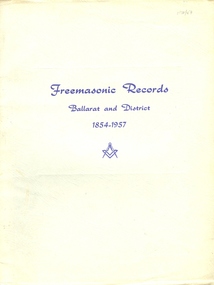
... These P.E. demonstrations were given to assist the organization and introduction of P.E. training in London schools.On returning to Ballarat I resumed my position at the Ballarat East Sloyd Centre and continued my studies at the Ballarat Art School gaining the Drawing Teachers' Certificate." ...These P.E. demonstrations were given to assist the organization and introduction of P.E. training in London schools.On returning to Ballarat I resumed my position at the Ballarat East Sloyd Centre and continued my studies at the Ballarat Art School gaining the Drawing Teachers' Certificate." ...Born at the Victorian town of Sandhurst (now Bendigo, Albert Steane attended the Gravel Hill State School until the fourth class, then transferred to the Central School 1976 where he gained the Merit Certificate. The monitor system of teacher training had been introduced and he passed as a fourth, third, second and first class pupil teacher. At about 16 years of age Steane was appointed a teacher monitor at £12 per annum. Albert Steane was awarded the Teachers' Certificate of Competency in 1897. He was the first headmaster of the Ballarat Technical School, and opened the Sloyd (woodwork) Centre in 1902 at the Ballarat East Art School (later known as the Ballarat East Free Library). According to the Ballarat Courier of 23 March 1957 Steane established the Ballarat Junior Technical School in February 1913, a part of the School of Mines and Industries Ballarat. The beginning classes with 86 pupils were held at a temporary site at the Dana Street School. Classrooms were so scattered that Steane recalled without his motorbike he would never have covered the ground! By 9 September 1921 the Junior Technical School Building was officially opened on the site of the old Ballarat Gaol. In a confidential report of 1916 Steane was described as one of the best organizers in schools at that time, and he was noted for his strong but fair discipline. In the 1926 school report the Chief Inspector wrote that 'no boy is neglected'. Steane held the position of headmaster at the Ballarat Junior Technical School for 29 years retiring on 16 April 1942. Steane is known for the teaching of Sloyd or woodwork, which was an important point in his career, and for his love of gymnastics. He was made a life member of the Ballarat Y.M.C.A. in 1968 aged 91 years. The teaching of woodwork in Victoria began in 1901 and Steane was chosen, among 18 others for the inaugural training course at Queensberry State School in Melbourne. Because of his lifelong love of gymnastics Steane organized a gymnastic display for the Education Department in 1902 at Bendigo's Golden Jubilee Exhibition. He was one of those instrumental in establishing the Ballarat Y.M.C.A. and directed its physical culture evening classes in 1906. In 1908 Steane toured the world visiting the Swedish Naas Institute and the Gymnastic Festival in Germany. Steane in his reminiscences recalls: "In 1908 I obtained leave of absence and undertook a world trip to further my knowledge of both manual art training and physical training. On this trip I visited U.S.A., Canada, Scotland, England and Europe. Notable events were the attendance at the great 11th Deutche Turnfest at Frankfurt, inspection of the Naas Training School for Sloyd at Naas, Sweden inorgorated [sic] by Otto Solomon, and attendance at Physical Education Demonstrations at London given by the Swedish institution. These P.E. demonstrations were given to assist the organization and introduction of P.E. training in London schools.On returning to Ballarat I resumed my position at the Ballarat East Sloyd Centre and continued my studies at the Ballarat Art School gaining the Drawing Teachers' Certificate." Steane died, aged 93 years, on 13 July 1970, at Sydney, leaving his widow Grace Elliott Steane and children Eric and Violet. Steane is listed on the University of Ballarat Honour Roll at https://www.ballarat.edu.au/curator/honour-roll/honourroll_steane.shtml Printed green book with soft cover. The book lists all masonic bodies, including lodges and chapters, that have worked within 30 miles of Ballarat during the first 100 years of Freemasonry in the district. Includes a Loose, one page addenda et Corrigenda.The image of Albert Steane in the front of the book is inscribed "Yours faithfully A.W. Steane."ballarat, freemason, freemasonic, lodge, albert steane, a a w steane, a j dean, mark lodges, royal ark mariners, royal arch chapters, masonic orders -
Federation University Historical Collection
Book - Nursing Book, Dorothy E. Reilly, Graduate Professional Education Through Outreach: A Nursing Case Study, 1990
... return promptly." Blue, pink and white soft covered book of 194 pages. Graduate Professional Education Through Outreach: A Nursing Case Study Book Nursing Book United States of America New York New York Dorothy E. ...Blue, pink and white soft covered book of 194 pages. non-fictionnursing, margaret stevens, university of ballarat school of nursing, dorothy reilly, dorothy e reilly, staffmember, scarlet fever, diptheria, women -
 Federation University Historical Collection
Document, Letter to Returned Soldiers' Association, 1916, 28/08/1916
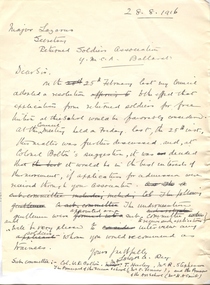
... Many returned soldiers were unprepared for the workforce after demobilisation because of war injuries, or lost study opportunity during the years of their service. ...Many returned soldiers were unprepared for the workforce after demobilisation because of war injuries, or lost study opportunity during the years of their service. ...Ballarat Shool of Mines played an important role in training returned World War One servicemen via the Repatriation Vocational Training Scheme. Operating from 1917 to 1922, this scheme offered trades-based training to a large number of returned soldiers, depending on aptitude and level of disability. Many returned soldiers were unprepared for the workforce after demobilisation because of war injuries, or lost study opportunity during the years of their service. The Scheme was designed to give ex-servicemen the skills to find jobs, boost post-war economic recovery and add to social cohesion. It operated from 1917 to 1922. White paper with handwritten script in ink. The rough draft letter relates to free tuition for returned soldiers at the Ballarat School of Mines28.8.1916 Major Lazarus Secretary Returned Soldiers Association Y.M.C.A. Ballarat Dear Sir. On the 25th February last my Council adopted a resolution to the effect that application from returned soldiers for free tuition at this school would be favorably considered. At the Council meeting held on Friday last, the 25th inst., the matter was further discussed and, at Colonel Bolton's suggestion, it was decided that it would be in the best interests of the movement, if application for admission were received through your association. The undermentioned gentlemen were appointed as a sub-committee to receive such application and will be very pleased to interview any soldiers whom you would recommend as trainees. Yours faithfully Joseph A. Day Sub committee:- Col. W.K. Bolton, Mr T. Hurley. W.R. Stephenson, The Principal of the Science School (Mr E. Fenner), and the Principal of the Art School (Mr H.H. Smith)repatriation, repatriation vocational training scheme, ballarat school of mines, world war, world war 1, bolton, colonel bolton, w.k. bolton, joseph day, t. hurley, r. stephenson, fenner, h.h. smith, returned soldiers, returned soldiers association, balllarat ymca, major lazarus, world war one, repatriation -
 Federation University Historical Collection
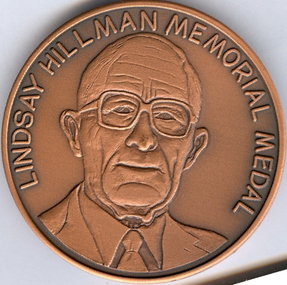
Medal, Ballarat School of Mines Hillman Award (medal), c1992
... studies at the School. Hillman was particularly active and excelled in a wide range of sporting interests and in student activities. In 1928 and 1928 he was awarded the Ballarat School of Mines Honour blazer by the Old Boys' association for all round athletic ability, leadership and scholarship. After spending two years with the Melbourne City Council Electric Supply Department gaining industrial experience Hillman was awarded his Diploma of electrical engineering in 1931, returning...studies at the School. Hillman was particularly active and excelled in a wide range of sporting interests and in student activities. In 1928 and 1928 he was awarded the Ballarat School of Mines Honour blazer by the Old Boys' association for all round athletic ability, leadership and scholarship. After spending two years with the Melbourne City Council Electric Supply Department gaining industrial experience Hillman was awarded his Diploma of electrical engineering in 1931, returning ...Lindsay F.J. Hillman was born in Ballarat in 1910, and attended the Ballarat Junior Technical School. He became a cadet in Electrical Engineering Laboratory at the Ballarat School of Mines where he gained eventually gained a student Teachership for diploma studies at the School. Hillman was particularly active and excelled in a wide range of sporting interests and in student activities. In 1928 and 1928 he was awarded the Ballarat School of Mines Honour blazer by the Old Boys' association for all round athletic ability, leadership and scholarship. After spending two years with the Melbourne City Council Electric Supply Department gaining industrial experience Hillman was awarded his Diploma of electrical engineering in 1931, returning to the School in 1932 to teach apprentices and senior students. Hillman was appointed lecturer in Engineering Design and Graphics in 1937, lecturer in Engineering Design and Civil Engineering in 1944, Lecturer-in-Charge of Mechanical and Civil Engineering in 1948 and Head of the Electrical Engineering Department in 1949, a position he held until his retirement in 1973. In 1975 Lindsay Hillman was appointed to the Council of the Ballarat School of Mines and played an active role in school affairs.As Vice-President of Council from 1981 until his death in 1991 Hillman took a leading part in the implementation of many of the major building projects on the Lydiard Street Campus. The L.F.J. Hillman Award was established by the Ballarat School of Mines Council in conjunction with and through the generosity of the Hillman family in honour of the late Lindsay Frederick John Hillman. The bronze medal was presented annually to an enrolled student in an accredited course in the field of electrical/electronics studies at the Ballarat School of Mines. specific Criteria for the Award consisted of a balance of academic performance, leadership qualities, commitment to further study and involvement in sporting and/or community groups. Bronze medal designed depicting the portrait of Lindsay Hillman. The medal has a copper finish, and is presented in a blue hinged box. The first Hillman Award was presented in 1992. The recipients are: 1992 - Brett A. Hovey 1993 - Nil 1994 - Brent L. Ferguson 1995 - Kirsty McKenzie 1996 - Peter J. White 2000 - Roger Bush 2001 - Thomas Edward George 2002 - Mark William Holden 2003 - David James Hopwood 2004 - Leighton Dunn 2005 - Donald Pirouet 2006 - Mark Irvin 2007 - Ricky Wilson 2008 - Luther Dean 2009 - Daniel Thatcher 2010 - Craig Coulter 2011 - Sarah Draper 2012 - Rhys Hendrickson 2013 - Jayden Hooper "Lindsay Hillman Memorial Medal" Verso: "The School of Mines and Industries Ballarat, Est. 1870 Presented to "ballarat school of mines, hillman, lindsay hillman, medal, numismatics, honour blazer, electrical engineering, electronics, hillman medal, hillman award -
 Federation University Historical Collection
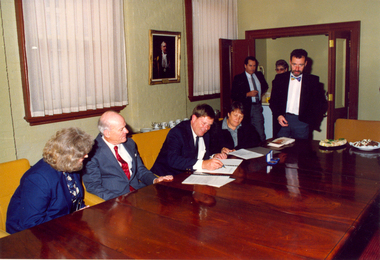
Photographs - Colour, Hillman Award Agreement and Presentation, 1991, 1991
... studies at the School. Hillman was particularly active and excelled in a wide range of sporting interests and in student activities. In 1928 and 1928 he was awarded the Ballarat School of Mines Honour blazer by the Old Boys' association for all round athletic ability, leadership and scholarship. After spending two years with the Melbourne City Council Electric Supply Department gaining industrial experience Hillman was awarded his Diploma of electrical engineering in 1931, returning...studies at the School. Hillman was particularly active and excelled in a wide range of sporting interests and in student activities. In 1928 and 1928 he was awarded the Ballarat School of Mines Honour blazer by the Old Boys' association for all round athletic ability, leadership and scholarship. After spending two years with the Melbourne City Council Electric Supply Department gaining industrial experience Hillman was awarded his Diploma of electrical engineering in 1931, returning ...Lindsay F.J. Hillman was born in Ballarat, and attended the Ballarat Junior Technical School. He became a cadet in Electrical Engineering Laboratory at the Ballarat School of Mines where he gained eventually gained a student Teachership for diploma studies at the School. Hillman was particularly active and excelled in a wide range of sporting interests and in student activities. In 1928 and 1928 he was awarded the Ballarat School of Mines Honour blazer by the Old Boys' association for all round athletic ability, leadership and scholarship. After spending two years with the Melbourne City Council Electric Supply Department gaining industrial experience Hillman was awarded his Diploma of electrical engineering in 1931, returning to the School in 1932 to teach apprentices and senior students. Hillman was appointed lecturer in Engineering Design and Graphics in 1937, lecturer in Engineering Design and Civil Engineering in 1944, Lecturer-in-Charge of Mechanical and Civil Engineering in 1948 and Head of the Electrical Engineering Department in 1949, a position he held until his retirement in 1973. In 1975 Lindsay Hillman was appointed to the Council of the Ballarat School of Mines and played an active role in school affairs.As Vice-President of Council from 1981 until his death in 1991 Hillman took a leading part in the implementation of many of the major building projects on the Lydiard Street Campus. The L.F.J. Hillman Award was established by the Ballarat School of Mines Council in conjunction with and through the generosity of the Hillman family in honour of the late Lindsay Frederick John Hillman. The bronze medal was presented annually to an enrolled student in an accredited course in the field of electrical/electronics studies at the Ballarat School of Mines. specific Criteria for the Award consisted of a balance of academic performance, leadership qualities, commitment to further study and involvement in sporting and/or community groups. The first Hillman Award was presented in 1991. The recipients are: 1991: Paul Donald 1992 - Brett A. Hovey 1994 - Brent L. Ferguson 1995 - Kirsty McKenzie 1996 - Peter J. WhiteEighteen colour photographs of the signing of the Hillman award agreement and the first presentation of the award in 1991 to Paul Donald . .2) Gregor Hillman, Judith Tinney and Caroline Bethune .4) Judith Tinney or Caroline Bethune and Bill Gribble sign the agreement .8) Gregor Hillman, Judith Tinney and Caroline Bethune sign the agreement, along with President of the Ballarat School of Mines, Bill Gribble. .10) Paul Donald with his L.F.J. Hillman Award, 1991 .11) Ballarat School of Mines Principal, Peter Shiells, speaks at the lectern watched on by members of the Hillman family.ballarat school of mines, hillman, lindsay hillman, medal, numismatics, electrical engineering, electronics, gregor hillman. judith tinney, caroline bethune, tinney, bethune, hovey, ferguson, mckenzie, white, paul donald, donald -
 Federation University Historical Collection
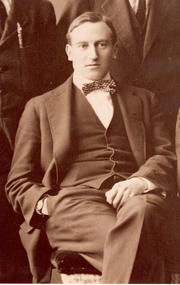
Photograph - Photograph - Black and White, Harold Herbert of the Ballarat Technical Art School, 1919
... Harold Herbert undertook further studies in England returning to Ballarat with all new entrepreneurial ideas. ...Harold Herbert undertook further studies in England returning to Ballarat with all new entrepreneurial ideas. ...Harold Brocklebank Herbert (16.09.1891-1945) Harold Herbert was one of the first pupils at the school starting in 1891, commencing as a 15 years old he studied Applied Design and Architecture at the Ballarat Technical School of design attached to the Ballarat Fine Art Galery, transferring to the Ballarat Technical Art school attached to the Ballarat School of Mines. He was a certificated Art Teacher with the Victorian Education Department. His talents were identified by Ballarat’s Ponsonby Carew-Smith who rose to become Art Inspector with the Victorian Education Department. His teaching career included being appointed Principal of the Sale Technical Art School in 1898. Harold Herbert undertook further studies in England returning to Ballarat with all new entrepreneurial ideas. He worked at the Ballarat Technical Art School between 1915-19. Harold Herbert was involved with the design of the Ballarat Arch of Victory, and was responsible for the reproductions in ‘The Education Department’s Record of War Service. Had been principal of the Sale Technical Art School since 1898, and had undertaken further studies in England returning to Ballarat with all sorts of entrepreneurial ideas. In 1924 the Ballarat School of Mines Students’ Magazine reported “We are perfectly safe in claiming on behalf of our school, that no institution of its kind has turned out a greater number of men and women students who have since “made good” while some have achieved enviable prominence in the world of art. Amongst these later, the most brilliant is Harold B. Herbert whose work is so widely and justly appreciated throughout Australia and whose achievements are watched by his old school with the greatest pride. He commenced at the School when he was about 15 years of age, and followed a course of training very similar to what most students are doing the most valuable qualities shown by him during his career as a student were a passion for drawing and a capacity for taking pains, so essential in all artwork. He was appointed as Assistant Art Teacher at Ballarat on completion of his course, and later assistant in the office of Art Inspector. All of his spare time was devoted to out-door sketching and commercial drawing and he showed an ability in practical design for various crafts quite equal to the ability he has since displayed in depictive art. His return to this School as senior master and his departure to devote himself entirely to fine art are quite recent happenings with which all students are familiar. The wonderful exhibition he held in Melbourne on return from a sketching trip abroad has place him amongst the leading artists of Australia. Upon his death in 1945 the Ballarat School of Mines Student's Magazine recorded: "The death of the famous water-colour artist, Harold Herbert, will be a distinct loss to art in Australia. he was educated at the Ballarat Art School which it was situated in Sturt Street, and the gave promise of becoming a famous artist then. his talents were recognised, and in water-colour work he quickly made a name for himself. his landscapes in water-colour are in the principle galleries of the world, and many of them are to be found in the Ballarat gallery and in other provincial galleries. In 1941 he was appointed official war artist for the COmmonwealth, and he served in the Middle East and Syria. Exhibitions of his war pictures have been seen at different times in Melbourne."Portrait of a young man in a suit. He is Harold Brocklehurst Herbert, staffmember of the Ballarat Technical Art School (a division of the Ballarat Technical Art School). The photograph is a detail of the Ballarat School of Mines Magazine Committee, 1919. (http://victoriancollections.net.au/items/54923a682162f116140de59c)harold herbert, harold b. herbert, harold brocklebank herbert, ballarat school of mines, ballarat technical art school, art, arch of victory -
 The Beechworth Burke Museum
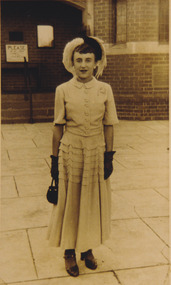
Audio - Oral History, Jennifer Williams, Mrs Pam Croswaite, 2000
... Pam went to university to become a pharmacist, studying in Beechworth and Melbourne. She returned to Beechworth to raise her family after quitting her work and travelling with her navy husband to England twice. ...Pam went to university to become a pharmacist, studying in Beechworth and Melbourne. She returned to Beechworth to raise her family after quitting her work and travelling with her navy husband to England twice. ...Mrs Pam Croswaite was born 1928 in Beechworth. Her father was one of the Zwar brothers who co-owned the Beechworth Tannery until it was sold in the 1950s. Her grandfather was the founder of the Zwar Bros. Tannery and one of the first car owners in Beechworth. Pam went to university to become a pharmacist, studying in Beechworth and Melbourne. She returned to Beechworth to raise her family after quitting her work and travelling with her navy husband to England twice. In 1984 she returned to work as a pharmacist at Mayday Hills psychiatric facility, the former 'Beechworth Lunatic Asylum'. Her grandfather, on her mother's side, was the former superintendent of the psychiatric facility. She retired in 1993, but remained active in the community in the choir and book clubs. This oral history recording was part of a project conducted by Jennifer Williams in the year 2000 to capture the everyday life and struggles in Beechworth during the twentieth century. This project involved recording seventy oral histories on cassette tapes of local Beechworth residents which were then published in a book titled: Listen to what they say: voices of twentieth century Beechworth. These cassette tapes were digitised in July 2021 with funds made available by the Friends of the Burke.Pam's story is significant because of her familial links to the Zwar Bros, who owned the tannery and employed a large percentage of the township and her work as a pharmacist in the Mayday Hills facility. She was the granddaughter of the tannery's founder and daughter of one of the three brothers who owned it until the 1950s. She become a pharmacist after studying in Melbourne and via correspondence from home, which demonstrates how university study was conducted in the 1940s. She worked in the psychiatric facility Mayday Hills, the former 'lunatic asylum', as a pharmacist after her separation form her husband from 1984 to 1993. Pam's story also demonstrated the expectation of women to leave their work to raise their families and the general expectations of women during the 1930s,40s and 50s. The project is significant because it records locally important stories and memories of the township in the 1900s. By recording the memories of some of the older members of the community, information on Beechworth's evolution as a township can be preserved. This is a digital copy of a recording that was originally captured on a cassette tape. The cassette tape is black with a horizontal white strip and is currently stored in a clear flat plastic rectangular container. It holds up 40 minutes of recordings on each side.beechworth, burke museum, beechworth lunatic asylum, mayday hills, zwar bros. tannery, beechworth tannery, pharmacist -
 Mission to Seafarers Victoria
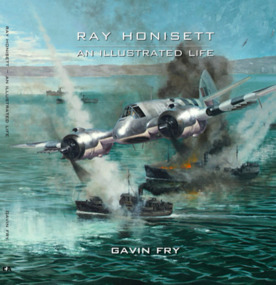
Book, Gavin Fry, Ray Honisett, An Illustrated Life, 2021
... returned to his art training and exhibits as a painter in Newcastle and Melbourne. Gavin holds the degrees of Bachelor of Arts [Hons] and Master of Arts from Monash University and Master of Philosophy from Leicester University. He has entered the ANL Maritime Art Prize several times. ray honisett gavin fry The first comprehensive study ...The first comprehensive study of the life and work of Ray Honisett [1931-2019], one of the most significant illustrators of his generation and the doyen of Australian aviation art.164 pages, softcover with colour illustrations.non-fictionThe first comprehensive study of the life and work of Ray Honisett [1931-2019], one of the most significant illustrators of his generation and the doyen of Australian aviation art.ray honisett, gavin fry -
Federation University Historical Collection
Costume, Ballarat School of Mines Blazer, 1938
... He was studying for his Electrical Diploma and practice Electrical Engineering. He finished his army service in the British Occupation Force in Japan before returning to be discharged in May 1947. ...He was studying for his Electrical Diploma and practice Electrical Engineering. He finished his army service in the British Occupation Force in Japan before returning to be discharged in May 1947. ...This blazer was worn by Keith Wylie from 1939 until 1942 when he joined the army and was commissioned in the Corps of Aust. Elect. & Mech. Engineers. He was studying for his Electrical Diploma and practice Electrical Engineering. He finished his army service in the British Occupation Force in Japan before returning to be discharged in May 1947. He completed his remaining 2 subjects at S.M.B. in 1947. Green woollen unlined blazer with embroidered emblem on breast pocket. The edges are bound including the three pockets and the sleeve cuff 9 cm from the edge. There are three green buttons at the front. The internal edges are bound are there is tape stitched to the inside where the top of the side pockets are stitched. There are 5 places where a small piece of tape has been stuck to fabric to stop the fraying of small holes.Embroidered makers fabric patch attached behind the breast pocket - Paterson, Powell & Sandford Pty Ltd. Quality Drapers Ballaratballarat school of mines, blazer, coat of arms, keith wylie -
Federation University Historical Collection
Article - Article - Women, Ballarat Technical Art School: Women of Note; Amalie Feild (later Colquhoun), (1894-1974)
... Amalie Feild was the first recipient of a scholarship to study stained glass and pottery design at the Sydney Technical School After marrying Archibald Colquhoun She became better known as Amalie Colquhoun. Upon returning...Amalie Feild was the first recipient of a scholarship to study stained glass and pottery design at the Sydney Technical School After marrying Archibald Colquhoun She became better known as Amalie Colquhoun. Upon returning ...Amalie Feild studied at the Ballarat Technical Art School, and was appointed Instructor in Stained Glass and Pottery. Amalie Feild was the first recipient of a scholarship to study stained glass and pottery design at the Sydney Technical School After marrying Archibald Colquhoun She became better known as Amalie Colquhoun. Upon returning to Ballarat she established a pottery school, and designed stained glass windows for churches in Ballarat. The Uniting Church in Lydiard Street Ballarat has four panels and the Ballarat High School has World War 1 memorial windows by Amalie. More than 100 old students, teachers and others associated with the Ballarat Technical Art School assembled at a gathering at the Alexandria on Saturday night in honor of Mr. H. H. Smith, who has retired from the school after 35 years as principal. Mr. D. Johnston, acting principal, and a former student, handed over a portrait in oils of Mr. Smith painted by Mrs. Amalie Colquhoun, of Melbourne, another former student, who was also among the visitors. The portrait will be hung in the Ballarat Fine Art Gallery. amalie colquhoun, amalie feild, ballarat technical art school, scholarship, stained glass, pottery design, sydney technical school, h h smith retirement, portrait by amalie, ballarat fine art gallery, student and teacher, pottery school, stained glass design, uniting church windows, ballarat high school, world war 1 memorial windows
