
Showing 25 items matching "rice family"
-
 Orbost & District Historical Society
Photograph - Pumpkin boat photos, Helena Warren, c. 1910-1920
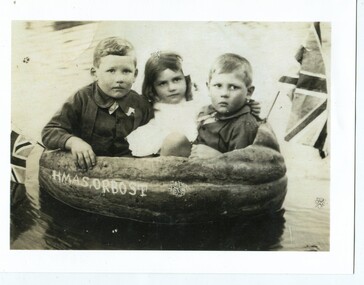
... ...Walter Rice family...Some of these photos in the pumpkin series appear to have been creatively manipulated. 2694.2 The Walter Rice family: Eileen (b.1908), Myrtle (b.1909), Laura (b.1912), Gilbert (b.1913), Thelma (b.1914), Cecil (b.1912). ...Some of these photos in the pumpkin series appear to have been creatively manipulated. 2694.2 The Walter Rice family: Eileen (b.1908), Myrtle (b.1909), Laura (b.1912), Gilbert (b.1913), Thelma (b.1914), Cecil (b.1912). ...These photographs are part of a series of b/w photos produced and marketed as postcards by Helena Warren. Mrs Warren, of Newmerella, Orbost was a well known photographer and local press correspondent during 1900s-1950s. She took many photos of local people, soldiers going to war, and of local events. Some of these photos in the pumpkin series appear to have been creatively manipulated. 2694.2 The Walter Rice family: Eileen (b.1908), Myrtle (b.1909), Laura (b.1912), Gilbert (b.1913), Thelma (b.1914), Cecil (b.1912). These photographs are significant because they are wonderful examples of the work of local photographer, Helena Warren. Two b/w photographs of children posed in large pumpkin boats. 2694.1 has 3 children (2 boys, 1 girl) and has the label HMAS ORBOST printed in white paint on the outside of the pumpkin boat. 2294.2 has 7children and two babies posed in a pumpkin boat. The label HMAS VICTOR is painted in white paint on the outside of the pumpkin boat. 2264.1 HMAS ORBOST 2264.2 HMAS VICTORpumpkins, pumpkin boats, helena warren, walter rice family -
 Mont De Lancey
Card - Thank You Card, 2011
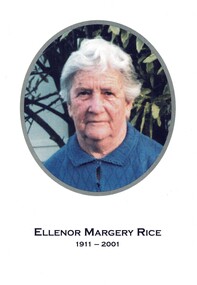
... ...Rice Family...FRONT Ellenor Margery Rice/1911-2001 CENTRE L-R To Alvan and Jill,/Many thanks for your/lovely card and message of/sympathy/With best regards,/Robert + Norma Rice/and Family THE FAMILY OF THE LATE/ELLENOR MARGERY RICE/WISH TO CONVEY THEIR/SINCERE APPRECIATION FOR/YOUR EXPRESSIONS OF SYMPATHY/AT THE TIME OF THEIR RECENT/SAD BEREAVEMENT ACCOMPANYING INSCRIPTION Wm Gowling/Rob. ...Condolences Card Cards Greeting cards Alvan Sebire Jill Sebire Ellenor Rice (nee Gowling) Robert Rice Norma Rice 2010s Rice Family Sebire family Gowling Family FRONT Ellenor Margery Rice/1911-2001 CENTRE L-R To Alvan and Jill,/Many thanks for your/lovely card and message of/sympathy/With best regards,/Robert + Norma Rice/and Family THE FAMILY OF THE LATE/ELLENOR MARGERY RICE/WISH TO CONVEY THEIR/SINCERE APPRECIATION FOR/YOUR EXPRESSIONS OF SYMPATHY/AT THE TIME OF THEIR RECENT/SAD BEREAVEMENT ACCOMPANYING INSCRIPTION Wm Gowling/Rob. ...Card thanking Alvan and Jill Sebire for their condolences for the death of Ellenor Rice (nee Gowling) from Robert and Norma Rice.A6 card handwriting insided, photo and typed text. Accompanied with a small written pen inscriptionFRONT Ellenor Margery Rice/1911-2001 CENTRE L-R To Alvan and Jill,/Many thanks for your/lovely card and message of/sympathy/With best regards,/Robert + Norma Rice/and Family THE FAMILY OF THE LATE/ELLENOR MARGERY RICE/WISH TO CONVEY THEIR/SINCERE APPRECIATION FOR/YOUR EXPRESSIONS OF SYMPATHY/AT THE TIME OF THEIR RECENT/SAD BEREAVEMENT ACCOMPANYING INSCRIPTION Wm Gowling/Rob. Rice/???/So[?]ento/Wm Gowling + Mary Eliza/nee Kelly/Mrs E. M. Ricecondolences card, cards, greeting cards, alvan sebire, jill sebire, ellenor rice (nee gowling), robert rice, norma rice, 2010s, rice family, sebire family, gowling family -
 Port Melbourne Historical & Preservation Society
Photograph - Rice's Butcher shop, 251 Bay Street, Port Melbourne, 1940s
... Donated by Rice family, who operated this shop since it was built in the 1870s...Donated by Rice family, who operated this shop since it was built in the 1870s built environment - commercial business and traders - butchers edward rice henry rice ernest rice barry rice Photograph of Rice's Butcher shop 251 Bay St, 1940s Photograph Rice's Butcher shop, 251 Bay Street, Port Melbourne ...Donated by Rice family, who operated this shop since it was built in the 1870sPhotograph of Rice's Butcher shop 251 Bay St, 1940sbuilt environment - commercial, business and traders - butchers, edward rice, henry rice, ernest rice, barry rice -
 Orbost & District Historical Society
black and white photograph, Warren, Mrs H, first half 20th century
... These children are the Rice family. In 1925 Walter Rice built a general store in Marlo and in 1930 built the "Ozone Picture Theatre" also in Marlo....These children are the Rice family. In 1925 Walter Rice built a general store in Marlo and in 1930 built the "Ozone Picture Theatre" also in Marlo. ...These children are the Rice family. In 1925 Walter Rice built a general store in Marlo and in 1930 built the "Ozone Picture Theatre" also in Marlo.This item is associated with a popular activity of the Orbost community in the first half of the 20th century. Pumpkins have been been part of the district's agricultural history since settlement. It is associated with Walter Rice a prominent citizen of Marlo in the early 20th century.A black / white photograph of a group of six children sitting in a pumpkin in water. there is a flag on each side and "HMAS VICTOR" on the side of the pumpkin.pumkins-orbost warren-helena rice-walter -
 Torquay and District Historical Society
Domestic object - Jam pot
... The Rice family owned Two Bays Private Hotel, purchased in 1919 when it was a small cottage called "Cooee". ...The Rice family owned Two Bays Private Hotel, purchased in 1919 when it was a small cottage called "Cooee". ...The Rice family owned Two Bays Private Hotel, purchased in 1919 when it was a small cottage called "Cooee". It was immediately extended and named "Two Bays". Effie ran the guesthouse for 29 years. She was the daughter of Mrs Edwards (later Mrs Wolfe) one of Torquay's pioneers, who established other guesthouses - Melba and St Heliers. Effie Rice bought Melba House from her mother and renamed it Pioneer House. Silver plated jam pot with lid and 2 handles. Opaque glass insert, removableE.E. Riceguesthouses -
 Torquay and District Historical Society
Flyer - Flyer, guesthouse, "Two Bays" private hotel Torquay, 1952
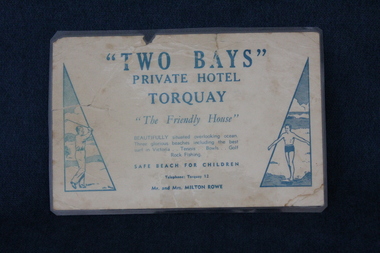
... The Rice family owned Two Bays Private Hotel, purchased in 1919 when it was a small cottage called "Cooee". ...The Rice family owned Two Bays Private Hotel, purchased in 1919 when it was a small cottage called "Cooee". ...The Rice family owned Two Bays Private Hotel, purchased in 1919 when it was a small cottage called "Cooee". It was immediately extended and renamed "Two Bays". Effie Rice ran the guesthouse for 29 years, selling in 1948 to Fred Vairy. Milton and Florence Rowe became the managers and later purchased the business. The next owners were the Williams from c1957 and then John and Wilma Pettigroves until in 1985 Two Bays was sold and demolished for a new apartment complex.Two sided flyer advertising the Two Bays guesthouse in Torquay. On the front is an advertisement for the guesthouse, on the back is a map of the Bellarine Peninsulaguesthouses -
 Torquay and District Historical Society
Badge - Badge, guesthouse
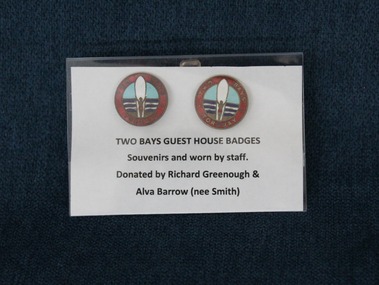
... The Two Bays guesthouse badges were souvenirs but were also worn by staff. The Rice family owned Two Bays Private Hotel, purchased in 1919 when it was a small cottage called "Cooee". ...The Two Bays guesthouse badges were souvenirs but were also worn by staff. The Rice family owned Two Bays Private Hotel, purchased in 1919 when it was a small cottage called "Cooee". ...The Two Bays guesthouse badges were souvenirs but were also worn by staff. The Rice family owned Two Bays Private Hotel, purchased in 1919 when it was a small cottage called "Cooee". It was immediately extended and renamed "Two Bays". Effie Rice ran the guesthouse for 29 years, selling in 1948 to Fred Vairy. Milton and Florence Rowe became the managers and later purchased the business. The next owners were the Williams from c1957 and then John and Wilma Pettigroves until in 1985 Two Bays was sold and demolished for a new apartment complex.Two badges from the Two Bays guesthouse in Torquay. On the front is painted a beach scene with a surfer and surf board and surrounding it the name of the guesthouse. Two Bays Torquayguesthouses -
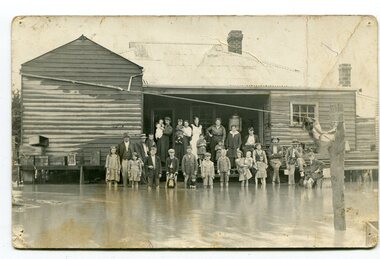 Orbost & District Historical Society
black and white photograph, poss. 1920
... In the photograph are the Rice family, Billy Nixon' family and Charlie Johnston. ...In the photograph are the Rice family, Billy Nixon' family and Charlie Johnston. ...In the photograph are the Rice family, Billy Nixon' family and Charlie Johnston. William Nixon, son of James Nixon and Alice (Roberts) Nixon was married to Ilma Muriel (Cadwallader) Nixon on 2 Apr 1902 in Orbost. They had six children - Llewella Adele (Nixon) King, Sydney William Columbo Nixon, Arthur Harry Nixon, Jack Warton Nixon, Claudine Frances (Nixon) Taylor and Daphne Joyce (Nixon) Menz Damage estimated at £500,000 was caused by the 1934 floods in the Orbost district. This 1934 flood was devastating, destroying a section of the 1922 Orbost bridge, wrecking fences, bridges and roads, dumping silt and debris on the rich river flats and drowning cattle. Note: although this card has the date 1934 written onto the rear, the flood incident depicted most likely dates from 1920 (ref. Weekly Times, Saturday 6 March 1920 p 41 when this photo was printed).This item is a pictorial record of a flood in 1920 (ref. Weekly Times, Saturday 6 March 1920 p41). Snowy River flood are a feature of the Orbost area. These floods cover the rich agricultural land. A black / white photograph / postcard of a group of people standing in floodwaters outside a timber building. Included are young children and babies being held by women. Two boys are holding dogs in front of them.on back - "Billy Nixon's house (now Downys 1991)"orbost - floods - nixon - 1920 -
 Federation University Historical Collection
Document, Agreement under the Miners Act, 1890, Part 2, 1919
... Rice of Mt Mercer. The agreement is unsigned, but dated 1919. Gift of the Squire Family, 2014...Rice of Mt Mercer. The agreement is unsigned, but dated 1919. Gift of the Squire Family, 2014 Agreement under the Miners Act, 1890, Part 2 Document Document ...Richard Squire was a former student of the Ballarat School of Mines. A large sheet of paper with seals - an agreement under the Miners Act, 1890, Part 2 between Richard Brereton Squire of 66 Lewistram Road, Windsor and Alfred Rice of Mt Mercer. The agreement is unsigned, but dated 1919. Gift of the Squire Family, 2014squire, richard squire, ballarat school of mines, alfred rice, mt mercer, mining, mount mercer -
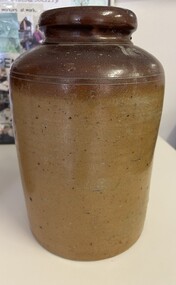 Greensborough Historical Society
Container - Jar, Hoffman Australia, Earthenware storage jar, 1930s
... rice away from rodent attack. it has a wide mouth to enable easy withdrawal of produce. Originally it would have had a large cork stopper or cloth fastened with a string to seal it. This item was recovered from the abandoned barn of the Pope family ...This is an unmarked earthenware storage jar possibly made by the Hoffman's Pottery of Brunswick Victoria. It displays a dark treacle glaze typical of Hoffman's Pottery in the 1930s. this jar would have been used to store foods such as biscuits, flour or rice away from rodent attack. it has a wide mouth to enable easy withdrawal of produce. Originally it would have had a large cork stopper or cloth fastened with a string to seal it.This item was recovered from the abandoned barn of the Pope family in 1971, when the property was sold to the Shire of Diamond Valley. This barn was located on the northern side of Pope Place and sketched by Ron Reynolds for the book "Greensborough and Greenhills".Glazed stoneware jar with dark treacle glaze to top, wide neck. Stopper missing.hoffman pottery, stoneware jars -
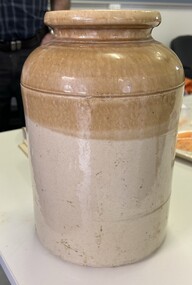 Greensborough Historical Society
Container - Jar, Hoffman Australia, Earthenware storage jar, 1930s
... rice away from rodent attack. it has a wide mouth to enable easy withdrawal of produce. Originally it would have had a large cork stopper or cloth fastened with a string to seal it. This item was recovered from the abandoned barn of the Pope family ...This is an unmarked earthenware storage jar possibly made by the Hoffman's Pottery of Brunswick Victoria. It displays a dark treacle glaze typical of Hoffman's Pottery in the 1930s. this jar would have been used to store foods such as biscuits, flour or rice away from rodent attack. it has a wide mouth to enable easy withdrawal of produce. Originally it would have had a large cork stopper or cloth fastened with a string to seal it.This item was recovered from the abandoned barn of the Pope family in 1971, when the property was sold to the Shire of Diamond Valley. This barn was located on the northern side of Pope Place and sketched by Ron Reynolds for the book "Greensborough and Greenhills".Glazed stoneware jar with light treacle glaze to top, wide neck. Stopper missing.hoffman pottery, stoneware jars -
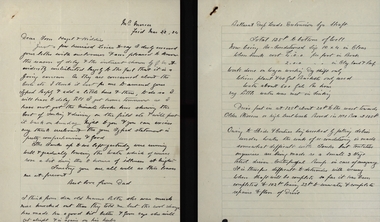 Federation University Historical Collection
Letter, Letters from Richard Squire to his son Tom 1934
... Rice Lillas L. E. Walker Secretary for Mines Pipeclay Sandstone Mr Saville Weymouth & Carroll Suction Pipe Valves Financiers Gold Mines of Australia Mr Hanley Hunter Sadowa Coy Kerang Shareholder Buninyong Stanley Hunter Len Fran Max Dr Jones Honeycomb Rock Booth Sandy McNab Emily Shaw John Cock Ross Creek Mitchell Rowe Neil Cameron Walker Kidney Disease Holst Nellie Ronaldson's Ronaldson & Tippett Brokers Investors Lockett Miller & Co Wellesly John Sharpe Elizabeht Ellen Old Lawaluk Mining Handwritten letters from Richard Squire to his son Tom and Family reporting happening at the mine Letters from Richard Squire to his son Tom 1934 Letter ...In 1905 Richard Squire was manager of the West Berry Consols at Allendale, and developed an improved system of mine ventilation, which was supported in "The Age."[4] He was successful in combating and remedying the gas and ventilation troubles of the Deep Mines of Creswick and Allendale Districts after all had failed.[5] MINE MANAGERS’ ASSOCIATION. Ballarat Branch. ... Mr R. B. Squire, manager of the West Berry Consols, at Allendale, submitted a paper detailing what he had done tor the betterment of ventilation in the alluvial mines of Smeaton and Mary borough districts- Members gave Mr Squire every credit for the results that he claimed to have effected; the adoption of his ideas had testified to their value to mine-owners. It was painted out, however, that for want of a thorough debate of the subject with experienced men the author had unwittingly included some general statements that required modifying in some points and extending in others, in justice to other workers among the earlier and the present day managers of mines. It was decided to invite the author to meet a sub-committee on this subject![6]Handwritten letters from Richard Squire to his son Tom and Family reporting happening at the mine richard squire, tom squire, engine trouble, basil, f.l. smythe broker, trembath, w. ryall, mt mercer, flu, plant, skids, pump, c. hayes, illness, poppet, carburetor, mum, ned, shaft, balance weight, hazel squire, pearson, pulleys, syndicate, goon, len hopkins, suction, dunstown, lease, jim squire, bannockburn, nina, albert, mrs trenery, connie, jay, judy squire, cohuna, bladder attack, reports, estimates, dunstan & coy, jelbarts, barrett, flat fields, brown, gold estates, berry leads, parsley roots, share book, meredith, reef, pay sheet, colin, mr gibbs, l.r.g plan, banagwanth, mcnaughton bores, glenfine, allan, william thomas, john lynch, crawford, shelford, liz the car, trucks, chandlers, ballarat trustees, cameron, elaine, mrs read, clark, j. hayes, dunlop, dr lawrence, eye specialist, reid, mullock bank, jack squire, herman, peter's legal inc. ballarat, freddie reid, j.r. whipp, a.b. reid, grenville, leigh river plan, johnstone's, premier petrol coy, chandler's, ballarat deep leads extension, harwood & pincott, a. rice, lillas, l. e. walker, secretary for mines, pipeclay, sandstone, mr saville, weymouth & carroll, suction pipe, valves, financiers, gold mines of australia, mr hanley hunter, sadowa coy, kerang shareholder, buninyong, stanley hunter, len, fran, max, dr jones, honeycomb rock, booth, sandy mcnab, emily shaw, john cock, ross creek, mitchell, rowe, neil cameron, walker, kidney disease, holst, nellie, ronaldson's, ronaldson & tippett, brokers, investors, lockett, miller & co, wellesly, john sharpe, elizabeht ellen, old lawaluk, mining -
 Orbost & District Historical Society
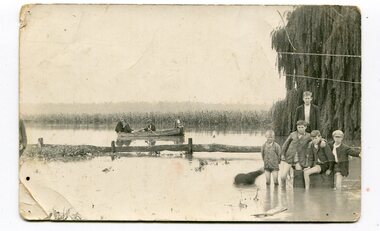
black and white photograph, 1934
... It is associated with local families. floods-orbost-1934 nixon-william johnston-charles on back - "M. C. Rice Orbost 19 /1/20 M Gilbert. ...This photograph was taken during the flood of 1934 in Orbost. The people in the photograph are related to Billie and Ilma Nixon and Charlie Johnston. Damage estimated at £500,000 was caused by the 1934 floods in the Orbost district. This 1934 flood was devastating, destroying a section of the 1922 Orbost bridge, wrecking fences, bridges and roads, dumping silt and debris on the rich river flats and drowning cattle.This item is a pictorial record of a significant event in Orbost's history. It is associated with local families.A black / white photograph / postcard of floodwaters. On the right is a young man with four young boys sitting on a log. In the bckground is a rowing boat with one man rowing and three others sitting on the edges . A field of maize / corn is in the background and a large willow tree on the right.on back - "M. C. Rice Orbost 19 /1/20 M Gilbert. Mostly Billy Nixons & Charlie Johnstons 1934" [Note alteration: W C Rice rather than M C Rice].floods-orbost-1934 nixon-william johnston-charles -
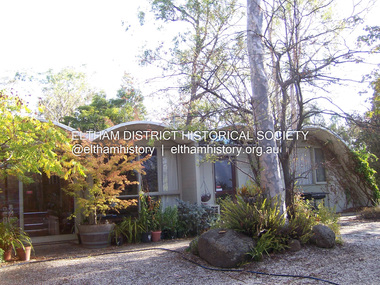 Eltham District Historical Society Inc
Photograph - Digital Photograph, Marguerite Marshall, Rice House, 69 Ryans Road, Eltham, 27 March 2007
... The second structure of two arches was originally a garage and a studio for art teacher Harrie Rice. To accommodate the growing family, in the mid 1950s, Borland converted the second structure into two children’s bedrooms, a kitchenette, a bathroom and a living room. ...The second structure of two arches was originally a garage and a studio for art teacher Harrie Rice. To accommodate the growing family, in the mid 1950s, Borland converted the second structure into two children’s bedrooms, a kitchenette, a bathroom and a living room. ...Built in 1953, the Rice House was leading Melbourne architect Kevin Borland's first commssion and was one of two houses of its kind. The design of the shell-like structure was inspired by the Arch of Ctesiphon, built in the second century south of Baghdad. Cement with a waterproofing agent was applied in layers to a form of regularly spaced timber arches covered in hessian. This ctesiphon system was developed in the United Kingdom by engineer J.H. de Waller in 1947. Commissioned in 1951 by Harrie and Lorna Rice, after Harrie, then an art student, met Borland at The Age Small Homes Service. Borland suggested they buy land in Eltham because at that time it was the only council in Melbourne that would grant a permit for such an innovative house. Covered under Victorian Heritage. Inspired by an ancient arch in Iraq, a house stands on top of a hill in a private position, off Ryans Road, Eltham. One of only two houses of its kind, it was leading Melbourne architect Kevin Borland’s first commissioned house, which he built in 1953. The shell-like structure, partially screened by giant trees and cacti, was inspired by the Arch of Ctesiphon south of Baghdad, built in the second century.1 Cement with a waterproofing agent was applied in layers to a form of regularly spaced timber arches tightly covered by hessian. This ctesiphon system was developed in the United Kingdom by engineer J H de Waller in 1947. This house was the first of three such structures built in Victoria, of which only one other remains, although substantially altered.2 It is the Wood House and supermarket, at the corner of Cleveland Road and High Street Road, Ashwood, designed by Robin Boyd in 1952. The Rice House demonstrates Kevin Borland’s innovative and experimental work. It is an outstanding example of the post-war period of experimentation in domestic architecture in Melbourne – by Robin Boyd, Kevin Borland and others – for The Age Small Homes Service from 1947 to 1953. This was partly an expression of late-Modernism and also necessitated by the post-war shortage of building materials. In Eltham, the post-war shortage of building materials largely resulted in mud-brick houses. Examples of Borland’s public work include contributions to the Olympic Swimming Pool in Melbourne and the Preshil Junior School in Kew. After more than 50 years of living in the house, Harrie and Lorna Rice still love it. Facing north-east with large windows overlooking the garden and two courtyards, it is well lit and benefits from a through breeze. The couple commissioned the extraordinary house after Harrie, then an art student, met Borland in 1951 at The Age Small Homes Service. Harrie was so impressed by the recently graduated Borland’s enthusiasm, that he asked him to design them an interesting house for a low budget. The unusual design presented several hurdles for the young couple before they could construct it. Borland suggested that they buy land in Eltham, because at that time it had the only council in Melbourne that would allow such an innovative house. Another hurdle was to gain finance for this remarkable house. The State Savings Bank Manager refused finance on the grounds that it was ‘unliveable’ and a ‘disgrace’. Fortunately, through a family connection, the couple borrowed money from the National Bank. But they discovered years later, that the bank’s evaluation stated the two ‘concrete sheds’ were of no value! The house built in off-white concrete, consists of two sections. The main house has four arches supported by brick and concrete walls that create a series of inter-connected rooms. Inside, the ceiling follows the roofline. Originally this section was only ten square metres, because of building restrictions at the time. But in 1973 Borland added two rooms and a carport. The second structure of two arches was originally a garage and a studio for art teacher Harrie Rice. To accommodate the growing family, in the mid 1950s, Borland converted the second structure into two children’s bedrooms, a kitchenette, a bathroom and a living room. The two structures were originally linked by a covered way of suspended draped-concrete, but this collapsed in the 1980s. The design has several maintenance problems. Cracks developed where two halves of the shells were joined. Then the material sprayed over the cracks became brittle, causing leaks. Fortunately Harrie found another material he could use. The valleys between the arches collect water, requiring annual painting with a waterproof material to prevent leaking. Lorna framed the house with native and exotic plants, which provide privacy and as a bonus, the garden attracted the rare Eltham Copper Butterfly. Published: Nillumbik Now and Then / Marguerite Marshall 2008; photographs Alan King with Marguerite Marshall.; p157 Comments about the Rice House on Lost Eltham page on Facebook June 2018 https://www.facebook.com/Lost-Eltham-1535993463348408/ Kate Borland: My dad designed this house. It is the Rice house and it is being renovated to its original glory as we speak.... Katherine Fox: I remember Harry and Lorna's, there was a secret room...! And the best loo with a view as I recall. Katherine Fox: Love this house! Wish I'd known it was up for sale. Looking forward to seeing progress if possible...If I recall correctly, the concrete swag over the walk-way collapsed at some stage. Marcus Skipper: In our little green Landrover, my dad and Alister Knox drove up dirt roads, a dirt track through the bush and finally to the ridge to check out this joint in about 1960. After the war at some time, they were all together at RMIT studying building design. Alister was the only one to graduate. A situation that resulted, my father would joke, in Alister having a career wherein his qualifications exceeded his talent. World Peace had broken out and all were hip to the ‘People’s’ century. Kevin went with the Modernist’s concrete, Alister went with the peasant’s mudbrick. “If this is the future,” my dad said,”I don’t like it.” And we drove back to medieval Montsalvat.This collection of almost 130 photos about places and people within the Shire of Nillumbik, an urban and rural municipality in Melbourne's north, contributes to an understanding of the history of the Shire. Published in 2008 immediately prior to the Black Saturday bushfires of February 7, 2009, it documents sites that were impacted, and in some cases destroyed by the fires. It includes photographs taken especially for the publication, creating a unique time capsule representing the Shire in the early 21st century. It remains the most recent comprehenesive publication devoted to the Shire's history connecting local residents to the past. nillumbik now and then (marshall-king) collection, eltham, rice house, ryans road, kevin borland -
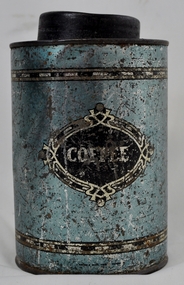 Kiewa Valley Historical Society
Tin Coffee Cylindrical, circa mid to late 1900's
... This "insignificant" coffee tin is very significant as it demonstrates that the Kiewa Valley was becoming more accessible to reliable coffee supplies and general food items.The container was part of a "set" of containers that included tea, sugar,biscuits,flour, rice and other family condiments. This type of kitchen storage containers was brought about through changing patterns in tea and coffee useage and overall consumption. ...This "coffee" tin has by the "art deco" appearance its origins in the late 1950's to 1960's. This time period was one of accelerated growth both in the physical (housing) sense and the mental (new ideas and inventions) changes in "attitudes". These occurred more rapidly in cities but had its effects on the rural environment. The drinking of coffee was spurred on by easier distribution of imported food and drinks. Advertising by stronger radio links and then by television brought the variety of foods and drinks to semi isolated rural regions. The accessibility through greater information channels becoming available brought with it unbelievable ranges of goods and foodstuffs. Rural regions still relied on bulk supplies and relatively larger storage containers than those in cities. This "bulk" buying and storage "syndrome" was a lingering result of many years of "drought" periods when road transports met delays from flooded roadways in supplying population centres in the Kiewa Valley. The construction phases in building the SEC Vic Hydro electricity Scheme in the eastern sections of the Victorian Alps brought many changes to the quiet rural regions in the Kiewa Valley. Changes in population and social mores. The influx of a varied , mostly temporary, and "European flavoured cuisine" changes the "cuppa tea only" flavour to the have a "coffee break". The subliminal influence of the "American" films changed those children growing up in the post 1950s from the "English tea" to the "American coffee". This "Americanisation process has influenced not only rural Australia but also other areas throughout the world.This "insignificant" coffee tin is very significant as it demonstrates that the Kiewa Valley was becoming more accessible to reliable coffee supplies and general food items.The container was part of a "set" of containers that included tea, sugar,biscuits,flour, rice and other family condiments. This type of kitchen storage containers was brought about through changing patterns in tea and coffee useage and overall consumption. Household demands for faster "self help" cooking especially beveridges and the greater choice of kitchen "utensils" was brought on by easier access to products due to a lessening of the area's "isolation" by having a reliable (all weather) road system and an ever increasing population growth. The need for travelling goods/merchant supply caravans to service the area became a diminishing factor, as a result of the establishment of grocery stores in Tawonga and Mount Beauty in the supply of previously "hard to get" groceries. This transition was precipitated by the SEC Vic Hydro Scheme of the 1940's to 1960's which increased the valley's population level three fold.This cylindrical tin has a pull/push lid(for easy access to the contents). The container is labelled for "coffee" however it has no commercial manufacturer's label to establish that it was bought with coffee ingredients in it. The majority of the container's external surface has a "metallic" light blue colour with two sets of silver rings confining black (horizontal spotted) rectangles. "COFFEE" within an elongated spherical "art deco" four pointed banner of silver and black colouringkitchen containers, domestic food storage, bulk stocks of dried condiments -
 Bendigo Historical Society Inc.
Document - PETER ELLIS COLLECTION: HISTORY OF SHO NOBURU TAKASUKA
... Accompanied by various pictures of Sho and his family. Mr. Isaburo (Jo) Takasuka. Ichiko. Rice growers. Japanese. ...Accompanied by various pictures of Sho and his family. Mr. Isaburo (Jo) Takasuka. Ichiko. Rice growers. Japanese. ...19 page history of Sho Noboru Takasuka. A Great Australian. Accompanied by various pictures of Sho and his family. Mr. Isaburo (Jo) Takasuka. Ichiko. Rice growers. Japanese. House of Representatives Rikken Seiyukai Party Japan. Shire President of Huntly, Victoria.person, individual, sho takasuka -
National Wool Museum
Canister
... Rice canister, part of a set of 3 kitchen canisters. From "Waverly" at Rainbow, owned by the Strauss family....Rice canister, part of a set of 3 kitchen canisters. From "Waverly" at Rainbow, owned by the Strauss family. ...Rice canister, part of a set of 3 kitchen canisters. From "Waverly" at Rainbow, owned by the Strauss family.SAGOsheep stations - history, waverly, rainbow -
National Wool Museum
Canister
... Rice canister, part of a set of 3 kitchen canisters. From "Waverly" at Rainbow, owned by the Strauss family...Rice canister, part of a set of 3 kitchen canisters. From "Waverly" at Rainbow, owned by the Strauss family Sheep stations - history Waverly Rainbow TEA Canister ...Rice canister, part of a set of 3 kitchen canisters. From "Waverly" at Rainbow, owned by the Strauss familyTEAsheep stations - history, waverly, rainbow -
National Wool Museum
Canister
... Rice canister, part of a set of 3 kitchen canisters. From "Waverly" at Rainbow, owned by the Strauss family...Rice canister, part of a set of 3 kitchen canisters. From "Waverly" at Rainbow, owned by the Strauss family Sheep stations - history Waverly Rainbow RICE PAT No 12816 3 81 ICO Canister ...Rice canister, part of a set of 3 kitchen canisters. From "Waverly" at Rainbow, owned by the Strauss familyRICE PAT No 12816 3 81 ICOsheep stations - history, waverly, rainbow -
Clunes Museum
Administrative record - ORDER BOOKS, 1926 - 1932
... ORDER FORM IN ORDER BOOK REQUESTING THE LOCAL TRADESMAN SUPPLY THE NEEDY FAMILY WITH GROCERIES, KEROSENE AND CANDLES, ALSO MEAT. BUTTER, SUGAR, FLOUR, JAM, POTATOES, CRISPIES, RICE, TEA COCOA, BLANKETS, CLOTHING, PASS TO BALLARAT, (PROBABLY TRAIN TICKET) SEEM TO BE REGULAR SUPPLIES. ...ORDER FORM IN ORDER BOOK REQUESTING THE LOCAL TRADESMAN SUPPLY THE NEEDY FAMILY WITH GROCERIES, KEROSENE AND CANDLES, ALSO MEAT. BUTTER, SUGAR, FLOUR, JAM, POTATOES, CRISPIES, RICE, TEA COCOA, BLANKETS, CLOTHING, PASS TO BALLARAT, (PROBABLY TRAIN TICKET) SEEM TO BE REGULAR SUPPLIES. ...ORDER FORM IN ORDER BOOK REQUESTING THE LOCAL TRADESMAN SUPPLY THE NEEDY FAMILY WITH GROCERIES, KEROSENE AND CANDLES, ALSO MEAT. BUTTER, SUGAR, FLOUR, JAM, POTATOES, CRISPIES, RICE, TEA COCOA, BLANKETS, CLOTHING, PASS TO BALLARAT, (PROBABLY TRAIN TICKET) SEEM TO BE REGULAR SUPPLIES. BLANKETS AND TRAIN TICKET NOT AS REGULAR REQUESTS..1 DARK BLUE PATTERNED ORDER BOOK. CLUNES LADIES BENEVOLENT SOCIETY TO CLUNES BUSINESS HOUSES TO SUPPLY NEEDY FAMILIES WITH GROCERIES, CANDLES, KEROSENE AND MEAT. .2 GREY MOTTLED COVER - DETAILS AS ABOVE 1926. .3 PLAIN CREAM COVER - AS ABOVE 1932local history, social support, clunes ladies benevolent society -
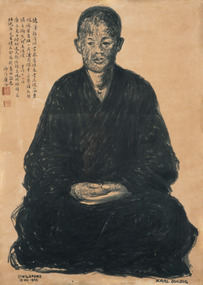 Duldig Studio museum + sculpture garden
Drawing, Karl Duldig, The Buddhist Monk, Guangqia by Karl Duldig 1940, 1940
... rice, I prefer the wind and leaves falling on my bed. Sitting quietly on my meditation cushion Is sweeter than the wheat offered by a thousand families. ...rice, I prefer the wind and leaves falling on my bed. Sitting quietly on my meditation cushion Is sweeter than the wheat offered by a thousand families. ...The Buddhist monk Guangqia visited Karl Duldig’s studio on two consecutive days, in the company of the noted Chinese writer, Professor Yu Dafu, a friend of Karl’s. Karl made two portraits of the monk, the first depicting him sitting, and the second in a standing pose. The portraits were drawn using a Chinese brush and Indian ink. Surviving sketches in the Studio’s collection indicate that Karl thought about creating a life-size sculpture later on, but this was not realised. Guangqia added inscriptions in his own hand to both drawings and stamped them with a red seal. The seated drawing has an inscription in which he quoted from a Buddhist poem, ‘A Contented Mind’ by the scholar Lingfeng of Mt Tiantai. In the summer I went to visit the Austrian sculptor Duldig with Professor Yu Da Fu. My virtue is slight – I cannot accept your offerings and gifts; I am amply rewarded by the clouds and springs. Rather than a table laden with pearl-like rice, I prefer the wind and leaves falling on my bed. Sitting quietly on my meditation cushion Is sweeter than the wheat offered by a thousand families. The pity is that I am gradually growing old; My bitter journey is not worthy of your offerings. The second drawing has a quote from a Buddhist poem on the study of Chán (Zen) Buddhism, by the famed Chán master, Dàjiàn Huìnéng (638–713): The portrait, with its figure positioned on a scroll-like ground and inscription is reminiscent of traditional Zen Buddhist portraiture. In this school of portraiture, which stretched back to at least the thirteenth century, monks were depicted sitting or standing facing the viewer, and typically the monk added an autographic inscription to the portrait. The portraits were often passed from master to disciple, continuing the disciples’ journey of spiritual enlightenment and were revered for their association with remarkable or holy priests. The Buddhist monk, Guangqai who added his inscription and stamp to the drawings would most certainly have been aware of this tradition. It is likely that Karl was aware of this tradition, one of the points where the studio’s collections of art works from Singapore intersect with the earlier Viennese collections can be found in the Library where a catalogue of an exhibition, 'Ausstellung Ostasiatischer Malerie und Graphik' is held. The Viennese Friends of Asian Art and Culture and the Albertina Museum staged this exhibition of East Asian painting and graphic works in 1932. Such was the internationalism of Duldig’s education in Vienna, that adaption to a new environment and culture in the Straits Settlement was swift, and he was able to interpret the artistic traditions of the place, and make them his own. It is part of the strength of the collection, that in many cases contemporary supporting documentation for the works of art is available. In this case there is a photograph of the Monk with Yu Ta-fu, and Karl and Eva Duldig, outside the studio at the time the drawings were made. Ann Carew 2016The portraits of Guangqai have national and international aesthetic significance. The works of art demonstrate the artist’s skill in capturing the physical appearance and demeanour of his subject, and his ability to adapt his working methods to incorporate traditional Asian materials and cultural practices. The portrait is one of few examples in Melbourne of a central European modernist artists working in, and engaging with Asia, during this period and it is culturally and aesthetically significant for this reason. The portraits are also historically interesting in documenting the life and experiences of Karl Duldig in the Straits Settlement (Singapore). Ann Carew 2016Brush drawing in chinese ink on paper. Seated Buddhist Monk. Chinese calligraphy hand written in black ink. Two red stamps under calligraphy.Signed Karl Duldig in l.r. corner. Dated Singapore 1940 in l.l. corner. -
 Kew Historical Society Inc
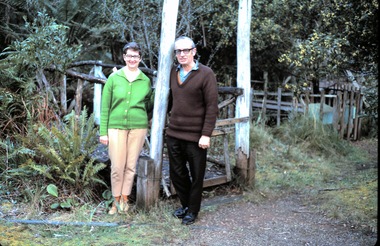
Biographical information, Ronald Horace Setford (1915–1988)
... family business until 1964 and then worked at J S Kidd and Co Pty Ltd as a storeman until his retirement in December 1973. Ron married Grace Muriel Agnes Perrey (1915-2001) in 1936 and they first lived in Kew around 1940, at 38 Marshall Avenue. Ron served in the Citizen Military Forces as a sapper with the 9 Australian Army Transport Company, Royal Australian Engineers, signing up a week after Darwin had been bombed. He spent time in Darwin, Wayville (South Australia), Herberton and Grovely (Queensland). Afterwards he refused to eat rice...family business until 1964 and then worked at J S Kidd and Co Pty Ltd as a storeman until his retirement in December 1973. Ron married Grace Muriel Agnes Perrey (1915-2001) in 1936 and they first lived in Kew around 1940, at 38 Marshall Avenue. Ron served in the Citizen Military Forces as a sapper with the 9 Australian Army Transport Company, Royal Australian Engineers, signing up a week after Darwin had been bombed. He spent time in Darwin, Wayville (South Australia), Herberton and Grovely (Queensland). Afterwards he refused to eat rice ...Ronald Horace Setford was born in April 1915 at 18 Church Street, Hawthorn, at his family’s home above their decorator shop. He was the second of three sons born to Horace Turner Setford (1880-1944) and Mabel Crofts (1887-1943). He attended Hawthorn West Primary School and then Swinburne before beginning work in his family’s business ‘Setford and Son’ in October 1930. This was formalised in April 1931 when he became a carpentry and joinery apprentice. In 1934 he graduated as a grade four carpenter. Ron worked in the family business until 1964 and then worked at J S Kidd and Co Pty Ltd as a storeman until his retirement in December 1973. Ron married Grace Muriel Agnes Perrey (1915-2001) in 1936 and they first lived in Kew around 1940, at 38 Marshall Avenue. Ron served in the Citizen Military Forces as a sapper with the 9 Australian Army Transport Company, Royal Australian Engineers, signing up a week after Darwin had been bombed. He spent time in Darwin, Wayville (South Australia), Herberton and Grovely (Queensland). Afterwards he refused to eat rice, never spoke of the war, nor took part in any ANZAC day proceedings. In 1941, Ron and Grace bought their block of land at 9 Tanner Avenue, East Kew, part of the Old Golf Links Estate, for £225. It was not until December 1945 that Ron started building their home and they moved in during May 1947. Ron and Grace remained there for thirty-seven years until the house was sold to their nephew in 1984. It has since been demolished. Ron’s great passion was photography and in the early 1960s he purchased his Minolta camera. Slide evenings at Tanner Avenue were a regular occurrence. Ron made his own title slides, interval slides and end slides. As well as many holiday photos (around Australia and their world trip in 1966), he enjoyed photographing local landmarks, flowers, insects and family. One of Ron’s photography projects was to record the progress of the building of the Eastern Freeway. This was near their home, and he’d walk down to the works on a regular basis, dressed smartly, with his camera in hand. The workers thought he was an official photographer, and he was allowed on site to take his photos. In 1984, Ron and Grace downsized and moved to Bayswater. Ron passed away on 31 October 1988 at the Maroondah Hospital in Ringwood East, at age 73. His ashes were spread on his beloved rose bushes at Tanner Avenue. Lauren Thomson, 2025ron setford, 9 tanner avenue -- kew east (vic, setford and son -- 18 church st (hawthorn), grace muriel agnes perrey, 9 australian army transport company, j s kidd and co pty ltd, eastern freeway, f19 freeway -
 Mont De Lancey
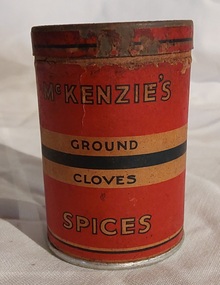
Domestic object, Jas. F. McKenzie & Co Pty Ltd, Container of Ground Cloves, 1930's - 1960's
... By 1861, the range of goods had expanded to include: coffee mixed with chicory; black and white peppers; mixed spice; ground cloves, ginger, pimento and cinnamon; ground rice; maize meal; brosemeal (made from peas); and oatmeal in tins, bags or barrels. This ground cloves container was a product for cooking use in the family kitchen in the 1930's - 1960. ...By 1861, the range of goods had expanded to include: coffee mixed with chicory; black and white peppers; mixed spice; ground cloves, ginger, pimento and cinnamon; ground rice; maize meal; brosemeal (made from peas); and oatmeal in tins, bags or barrels. This ground cloves container was a product for cooking use in the family kitchen in the 1930's - 1960. ...In the 1850s, Galt and McKenzie advertised their roasted and ground coffee alongside ground pepper and pimento, supplying these commodities in bulk to grocers, merchants and store-keepers. By 1861, the range of goods had expanded to include: coffee mixed with chicory; black and white peppers; mixed spice; ground cloves, ginger, pimento and cinnamon; ground rice; maize meal; brosemeal (made from peas); and oatmeal in tins, bags or barrels. This ground cloves container was a product for cooking use in the family kitchen in the 1930's - 1960. A small vintage cardboard cylindrical container of McKenzie's Ground Cloves with a red and navy striped printed paper label with white print explaining the manfacturer details and instructions for use. 2 ozs. Net. There is an aluminium base and removable lid. It has ground cloves powder inside.'McKenzie's Ground Cloves' '2 oz. Nett.'kitchen equipment, kitchen ingredients, cooking, spices -
Emerald Museum & Nobelius Heritage Park
Domestic object - Kitchen cannisters, Sunray, mid-20th century
... family since then. Karen Alexander, grand-daughter of C T Alexander, has donated a range of items from the property including domestic, wood-working and agricultural. These cannisters were in use in kitchens in mid-20th century and originated from an Emerald farm. kitchen cannister 1950s Alexander Aluminium label fixed to the side of each cannister with two studs: 'Flour', 'Sugar', 'Tea', 'Rice', 'Coffee' 'Sunray Brand' with a sunray graphic on bottom of each cannister Five graduating aluminium kitchen cannisters with brown bakelite knobs. ...These cannisters originated from a farming property originally bought by C T Alexander in 1920 and which has remained in the Alexander family since then. Karen Alexander, grand-daughter of C T Alexander, has donated a range of items from the property including domestic, wood-working and agricultural.These cannisters were in use in kitchens in mid-20th century and originated from an Emerald farm.Five graduating aluminium kitchen cannisters with brown bakelite knobs. These are in good condition with the usual marks and patina consistent with their age. They are separately labelled with raised names on the side of each container. These are in order of the size of each container: 'Flour', 'Sugar', 'Tea', 'Rice' and 'Coffee'. Maker's name 'Sunray' is on the base.Aluminium label fixed to the side of each cannister with two studs: 'Flour', 'Sugar', 'Tea', 'Rice', 'Coffee' 'Sunray Brand' with a sunray graphic on bottom of each cannisterkitchen cannister, 1950s, alexander -
 Sunshine and District Historical Society Incorporated
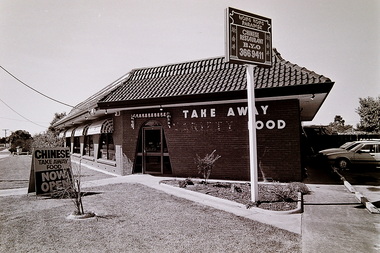
Photograph - Hong Kong Paradise Chinese Restaurant 44 Arthur Street St. Albans 1990 Photographs, Carmel Bazzano, 22nd March 1990
... For decades, especially from the 1950s to the 1980s, Chinese restaurants were the first “non‑European” cuisine many Australians tried, the most common suburban family restaurant, a gateway to broader multicultural dining. Dishes like special fried rice, sweet‑and‑sour pork, and lemon chicken became part of Australian food culture. ...These photographs, taken by The Advocate in 1990, were produced as part of the newspaper's regular feature highlighting local businesses and commercial enterprises throughout the district. Hong Kong Paradise operated on Arthur Street, St Albans and was active from roughly the late 1980s through the late 1990's or maybe into the early 2000's.For decades, especially from the 1950s to the 1980s, Chinese restaurants were the first “non‑European” cuisine many Australians tried, the most common suburban family restaurant, a gateway to broader multicultural dining. Dishes like special fried rice, sweet‑and‑sour pork, and lemon chicken became part of Australian food culture.6799.01 - Hong Kong Paradise Chinese Restaurant 44 Arthur Street St. Albans 1990 Photographs (Advocate 160.2).JPG 6799.02 - Hong Kong Paradise Chinese Restaurant 44 Arthur Street St. Albans 1990 Photographs (Advocate 160.2).JPG 6799.03 - Hong Kong Paradise Chinese Restaurant 44 Arthur Street St. Albans 1990 Photographs (Advocate 160.2).JPG 6799.04 - Hong Kong Paradise Chinese Restaurant 44 Arthur Street St. Albans 1990 Photographs (Advocate 160.2).JPG hong kong paradise chinese restaurant, arthur street, st. albans
