
Showing 116 items matching "rmit university"
-
 Trafalgar Holden Museum
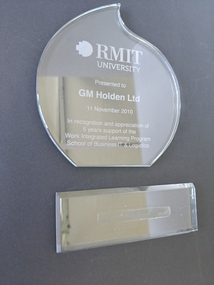
Award - rmit university award
... rmit university award...rmit university, presented to GMH Holden Ltd, 11 november 2010, in recognition and appreciation of 5 years support of the work integrated learning program, school of business IT and logistics...Award Trophy rmit university, presented to GMH Holden Ltd, 11 november 2010, in recognition and appreciation of 5 years support of the work integrated learning program, school of business IT and logistics glass award on glass mounting plate Award rmit university award ...glass award on glass mounting platermit university, presented to GMH Holden Ltd, 11 november 2010, in recognition and appreciation of 5 years support of the work integrated learning program, school of business IT and logisticsaward, trophy -
 RMIT Design Archives
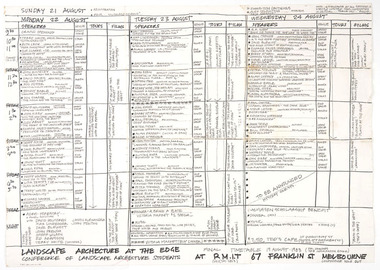
Photocopies, Landscape Architecture at the Edge: Conference of Landscape Architecture Students
... ...RMIT University......RMIT University...Fooke, Maggie RMIT University de Gryce, Jerry - Inspiring Place Pty. ...Handwritten timetable by Maggie Fooke and Jerry de Gryce. Fooke wrote the headlines and de Gryce the smaller print.ink, paper -
 RMIT Design Archives
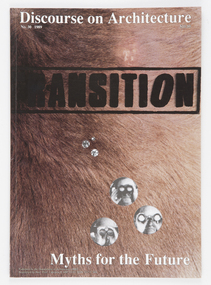
Magazines, Transition, No. 30, Spring 1989
... RMIT University, School of Achitecture and Design...RMIT University, School of Achitecture and Design...ink paper Transition, No. 30, Spring 1989 Magazines RMIT University, School of Achitecture and Design RMIT University, School of Achitecture and Design ...ink, paper -
 RMIT Design Archives
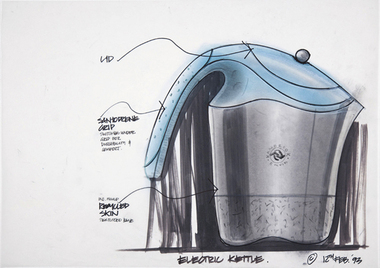
Design drawings, Paul Taylor for Form Australia, Kambrook Axis Kettle concept rendering
... ...rmit university...The drawing is part of the Centre for Design collection, RMIT University. Simon Lockrey, 2017 ...Design drawing of KambrookKettle by Paul Taylor for Form Australia as part of the Centre for Design at RMIT University, featuring electric kettle drawn in black pen + ink with blue ink where kettle lid is. ...The drawing is part of the Centre for Design collection, RMIT University. Simon Lockrey, 2017 The drawing is historically significant as an early eco-design project. household appliances industrial design sustainability rmit university LID / SANHOPRENE / GRIP / RECYCLED SKIN / ELECTRIC KETTLE. c 12TH FEB. '93 Design drawing of KambrookKettle by Paul Taylor for Form Australia as part of the Centre for Design at RMIT University, featuring electric kettle drawn in black pen + ink with blue ink where kettle lid is. ...The Axis Kettle was developed through the EcoRedesign project funded by the Federal Government and based at RMIT in the 1980s and 1990s. The project involved the expertise of significant Victorian designers such as Paul Taylor, Gerry Mussett, Liam Fennessy and Michael Grima, as well as prominent sustainability experts such as academics John Gertsakis, Chris Ryan and Alan Pears. Axis changed the way kettles were used, guiding users to save resources through their behaviour. It is regarded globally by academics from prominent design institutions such as Loughborough and Delft as one of the first successful eco-design projects. The drawing is part of the Centre for Design collection, RMIT University. Simon Lockrey, 2017 The drawing is historically significant as an early eco-design project. Design drawing of KambrookKettle by Paul Taylor for Form Australia as part of the Centre for Design at RMIT University, featuring electric kettle drawn in black pen + ink with blue ink where kettle lid is. Written design descriptions appear along side the image and title below.LID / SANHOPRENE / GRIP / RECYCLED SKIN / ELECTRIC KETTLE. c 12TH FEB. '93household appliances, industrial design, sustainability, rmit university -
 Koorie Heritage Trust
Book, Brearley, Laura, Gulpa Ngawal : Indigenous deep listening, 2010
... ...RMIT University, Melbourne...Gulpa Ngawal : Indigenous deep listening Book Brearley, Laura RMIT University, Melbourne Tolo, Jacob (Graphic design) ...An in depth look at the Indigenous Deep Listening Project run by RMIT University undertaken by many well known Aboriginal arts identities.96P. photographs; facs. refs.An in depth look at the Indigenous Deep Listening Project run by RMIT University undertaken by many well known Aboriginal arts identities.aboriginal australians -- social life and customs. | aboriginal australians -- research. | aboriginal australians -- education (higher) -- australia. | koori (australian people) -- social life and customs. | aboriginal australian students. | ethnoscience -- australia. | indigenous peoples -- communication. -
 RMIT Design Archives
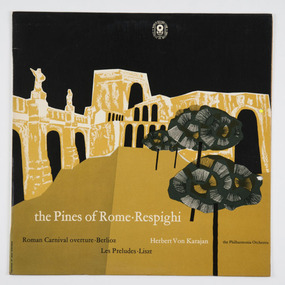
Record sleeve, The Pines of Rome - Respighi
... ...rmit university...Robinson studied for a year at the Melbourne Technical College (RMIT University), and in his early career worked for Peter Clemenger and the graphic designer, Max Forbes. ...Robinson studied for a year at the Melbourne Technical College (RMIT University), and in his early career worked for Peter Clemenger and the graphic designer, Max Forbes. ...Max Robinson (1934-2018) designed this record sleeve for the World Record Club in 1961. Robinson studied for a year at the Melbourne Technical College (RMIT University), and in his early career worked for Peter Clemenger and the graphic designer, Max Forbes. He produced a number of striking record covers for the World Record Club in the late 1950s and early 1960s. Robinson’s work is familiar to many Australians – he designed the new $10 note in 1993, which featured Banjo Paterson and Dame Mary Gilmore. The World Record Club’s operated in Melbourne from 1957 until 1976; it was a mail order service, and its art director, Geoff Digby commissioned young designers and artist to design the record sleeves. It is regarded now as one of most representative collection of Australian designers’ work of its period, and highlights the years of transition from ‘commercial art’ to ‘graphic design’. The album cover was donated to the Archive by the World Record Club’s art director, Geoff Digby. Ann Carew, 2020This record sleeve is historically significant for its association with Max Robinson, who was inducted into the Australian Graphic Design Association’s (AGDA) Hall of Fame in recognition for his work as graphic artist, but also his tireless advocacy for graphic design in Australia. It is aesthetically significant as an early example of the design work of Max Robinson. It is historically significant for its association with the World Record Club, an organisation that produced a representative collection of Australian graphic designers’ work from 1957 until 1976. the Pines of Rome . Respighi / Roman Carnival overture . Berlioz / Herbert Von Karajan / the Philharmonia Orchestra / Les Preludes . Lisztworld record club, max robinson, rmit university, rmit design archives, geoff digby, record sleeve design, graphic design -
 RMIT Design Archives
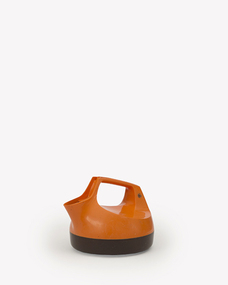
Domestic object - Object, General Electric KE12 Kettle, designed by Barry Hudson
... ...rmit university...He established Barry Hudson Industrial Design in the 1980s and began a teaching career at the former MTC, now known as RMIT University. Ann Carew, 2020 ...He established Barry Hudson Industrial Design in the 1980s and began a teaching career at the former MTC, now known as RMIT University. Ann Carew, 2020 1978 the Kettle won an Australian Design Award and the Prince Philip Prize for Australian Design. kettle industrial design rmit university domestic appliances Orange and brown electric kettle General Electric KE12 Kettle, designed by Barry Hudson Domestic object Object Hudson, Barry General Electric ...The GE12 Electric Kettle was designed by Barry Hudson for General Electric and in 1978 won the Australian Design and the Prince Philip Prize awards for Australian Design. The kettle was innovative in many ways; it was an early example of an all plastic electric kettle with a single-handed opening-spout. According to design historian Ian Wong ‘The use of an integral hinge for the spout opening mechanism utilised the unique live hinge property of polypropylene, now common but at the time a novel use and very efficient to manufacture.’ The kettle was available in Carpentaria Orange, Blaze Yellow and Lime Green with a contrasting base. Barry Hudson (1935-2008) studied Mechanical Engineering at the Melbourne Technical College (MTC). In the 1970s he was Research and Development Manager at General Electric, and he also worked with the industrial design practice Rosenfeldt, Gherardin and Associates. He established Barry Hudson Industrial Design in the 1980s and began a teaching career at the former MTC, now known as RMIT University. Ann Carew, 2020 1978 the Kettle won an Australian Design Award and the Prince Philip Prize for Australian Design.Orange and brown electric kettlekettle, industrial design, rmit university, domestic appliances -
Federation University Historical Collection
Book - Book - Prospectus, Working Men's College, Melbourne, Prospectus, 1899 twelfth edition, 1899
... ...rmit university...The college was the predecessor to the current-day Royal Melbourne Institute of Technology (RMIT University). Adjoining the college in the 1890s were the Supreme Court of Victoria (later the Melbourne Magistrates' Court) and the Melbourne Gaol - both which are now part of RMIT today. ...The college was the predecessor to the current-day Royal Melbourne Institute of Technology (RMIT University). Adjoining the college in the 1890s were the Supreme Court of Victoria (later the Melbourne Magistrates' Court) and the Melbourne Gaol - both which are now part of RMIT today. ...Used at School of Mines Ballarat. The Working Men’s College was founded in 1881 by a prominent grazier and philanthropist, The Hon. Francis Ormond, who donated £5000 towards the establishment of the college. The Council of the Melbourne Trades Hall then matched Ormond's initial donation by rallying its members. On 4 June 1887, the college opened in its purpose-built building on the corners of Bowen Street and La Trobe Street in Melbourne, with a gala ceremony. It became the third official provider of higher education in the new Colony of Victoria (the Melbourne Athenaeum was founded in 1839 and the University of Melbourne in 1853). The college was the predecessor to the current-day Royal Melbourne Institute of Technology (RMIT University). Adjoining the college in the 1890s were the Supreme Court of Victoria (later the Melbourne Magistrates' Court) and the Melbourne Gaol - both which are now part of RMIT today. A list of Scholarship Governors and Life Governors is included. The former have donated 250 Pounds Sterling and upwards, the later have donated 20 Pounds and over but less than 250 Pounds Sterling. The Patron of The Working Men's College was His Excellency The Right Honourable Lord Brassey. The President of the Council was Professor W C Kernot. Orange soft covered book with assorted photographs and advertisements.working mans college, melbourne, prospectus, w.c. kernot, c.s. paterson, f.h. bromley, j. nixon, b. douglass, w.e. murphy, james smith, thos smith, robert hayes, j.l. bagley, w.h. embling, john hancock, rev. j. reid, d. mcivor, a.j.arnot, c.e. oliver, e. findley, fred.a. campbell, r l jellery, president, council of 1898, hon francis ormond, philanthropist, 5000 pounds, melbourne trades hall, matched donation, patron, right hon. lord brassey, royal melbourne institute of technology, rmit, rmit university -
 Sunshine and District Historical Society Incorporated
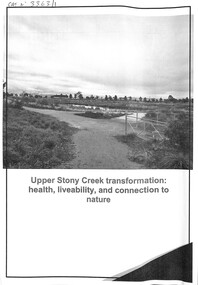
Document - Stony Creek
... 3363.01 - Upper Stony Creek transformation Health, livability and connection to nature RMIT University Report February 2023...Stony Creek Sunshine Albion 3363.01 - Upper Stony Creek transformation Health, livability and connection to nature RMIT University Report February 2023 Collection of documents on the Stony Creek Document Stony Creek ...3363.01 - Upper Stony Creek transformation Health, livability and connection to nature RMIT University Report February 2023stony creek, sunshine, albion -
 RMIT Design Archives
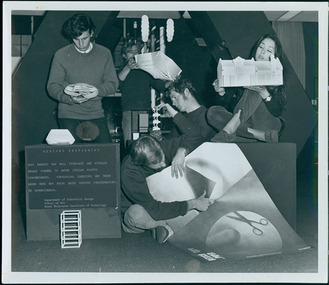
Photograph - Photographs, Students from RMIT School of Art display their works with paper
... ...rmit university...The exhibition attracted press attention, Bulletin critic Brian Hoad noting You are told that in the tradition of Gropius and his Bauhaus experiments of the ‘twenties they are attempting to bridge the gulf between the fine arts and the technical crafts to produce one day from among their numbers a new type of creative thinker. design rmit university bauhaus industrial design Photograph featuring students in 'Designs Performing' exhibit. ...In 1969 RMIT lecturer Gerard Herbst arranged an exhibition the work of his Industrial Design students at the NGV’s Design Centre. In ‘Design with Paper' the students explored the characteristics of a sheet of paper, an exercise based on similar ones set by Josef Albers at the Bauhaus, Germany and Black Mountain College, USA. The exhibition attracted press attention, Bulletin critic Brian Hoad noting You are told that in the tradition of Gropius and his Bauhaus experiments of the ‘twenties they are attempting to bridge the gulf between the fine arts and the technical crafts to produce one day from among their numbers a new type of creative thinker. Photograph featuring students in 'Designs Performing' exhibit. Students are from the RMIT Industrial Design course.design, rmit university, bauhaus, industrial design -
 RMIT Design Archives
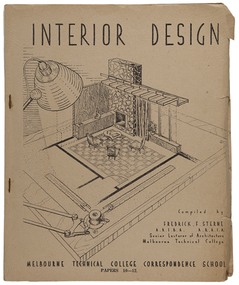
Booklet - Documents, Interior Design: Melbourne Technical College Correspondence School, Papers 10-12, c.1948
... ...RMIT University...Suzie Attiwell, 2017 Interior Design RMIT University Interior Design: Melbourne Technical College Correspondence School, Papers 10-12 Booklet Documents Sterne, Frederick Sterne, Frederick ...Emigre Frederick Sterne set up a four-year Interior Design program for the Melbourne Technical College c. 1948. It was the first program of its kind in Australia, On the cover the hand-written words ‘Interior Design’ have a sense of pride in their hand and the drawing of an interior – probably Sterne’s – emerging from the drawing board illuminated by artificial light that projects a future. Suzie Attiwell, 2017interior design, rmit university -
 RMIT Design Archives
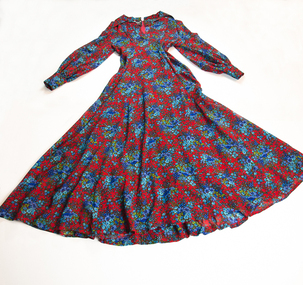
Textile - Woman's dress, Norma Tullo, Garment Designer, Shirley Lyle, Textile Designer, Woman's Dress
... ...rmit university...The garment is historically significant for the use of a merino wool showcasing its versatility for dress fabrics. wool rmit design archives rmit university woman's dress textile design australian fashion Inscribed, black label on back neck left of zip, 'TULLO/IN/PEPPINELLA/AUSTRALIA MERINO WOOL'; Inscribed, white satin label on back neck right of zip, 'DRY CLEAN ONLY'; Inscribed, white satin label underneath above label, 'SIZE 12/To Fit Bust 34"/To Fit Waist Full length woman's dress with full skirt and long sleeves, collared with open neck and pleat work on bodice. ...This light woollen evening dress is made from Peppinella, a new fabric Norma Tullo introduced into her range in 1973. The fabric was used exclusively by Tullo, and came from the wool of Peppin Merino (first introduced into Australia in 1858 by the Peppin brothers). According to the papers of the day Tullo’s 1973 winter collection featured ‘St. Trinian’s styles to garments dripping lace, in bold plain colours to floral prints.” Shirley Lyle designed the floral fabric. Norma Tullo (1935-2019) was one of the leading fashion designers of her time, establishing her label in 1956. After establishing a business the Old Metropole Arcade in Melbourne in 1956, with three sewing machines, Tullo's ready to wear fashions for young women became sought after, and her business flourished. In 1966 the Japanese department store chain Isetan Co Ltd began to mass-produce her garments for their stores across Japan. Tullo closed her label in 1977, and later worked for Fletcher Jones. Ann Carew, 2020The dress is historically significant as a dress designed by Norma Tullo, a leading fashion designer of the 1960s and 1970s. During this period the Australian Wool Industry strove to promote wool, and to develop light woollen fabrics to compete with new synthetic fibres such as rayon. The garment is historically significant for the use of a merino wool showcasing its versatility for dress fabrics. Full length woman's dress with full skirt and long sleeves, collared with open neck and pleat work on bodice. Material is predominately red with a repeated pattern featuring posie of blue and mauve flowers.Inscribed, black label on back neck left of zip, 'TULLO/IN/PEPPINELLA/AUSTRALIA MERINO WOOL'; Inscribed, white satin label on back neck right of zip, 'DRY CLEAN ONLY'; Inscribed, white satin label underneath above label, 'SIZE 12/To Fit Bust 34"/To Fit Waistwool, rmit design archives, rmit university, woman's dress, textile design, australian fashion -
 Bendigo Historical Society Inc.
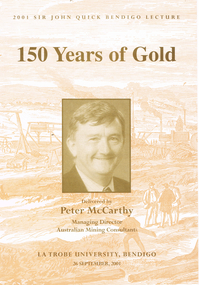
Book - LONG GULLY HISTORY GROUP COLLECTION: 150 YEARS OF GOLD
... RMIT... Melbourne University...BENDIGO History long gully history group The Long Gully History Group - 150 Years of Gold Peter McCarthy Australian Mining Consultants La Trobe University Bendigo Robertson Hyetts Sir John Quick Quick Hyett and Rymer Quick and Hyett National Library of Australia Charles Joseph La Trobe James Gumm Hargreaves Melbourne Argus Henry Frenchham The Times Gibbons James Esmond Dr Barker Thomas Hiscock Alfred Clarke Geelong Advertiser Wat Tyler Dunlop and Regan Commissioner Doveton Sub Commissioner Armstrong Captain Dana Argus Armstrong Stewart Gibson Margaret Kennedy Convict's Prevention Act Micky O'Halloran Throckmorton Anti-Gold-License Association G E Thomson Dr Jones 'Captain' Edward Brown Eureka Rebellion Sir John Quick Mark Twain Australian Federation Mining Exchanges Alfred Deakin The Amalgamated Miner's Association Robert Clark Britian's National Miners' Association Silicosis Tuberculosis Walter Summons Bendigo Amalgamated Mines Great War Gold Mines of Australia Bendigo Mines Limited Nell Gwynne Carshalton Shaft Napoleon Shaft George Lansell Fortuna Villa The Four Deborah Mines World War Two Central Deborah North Deborah William Kelly The Edwards Works Newstead Dredge Jim Crow Dredge Adelong Dredge Calder Freeway Bendigo Mining NL Randolph Bedford CRA Ltd Sovereign Hill Ballarat Historical Park Association RMIT Melbourne University Macquarie University Australasian Institute of Mining and Metallurgy Institution of Engineers Australia Mineral Industry Consultants Association Joint Ore Reserves Committee CEO Institute Anthea McCarthy Michele Matthews Sir John Quick Committee City of Greater Bendigo The Hon Justice Michael Kirby Mr Don Blackmore Murray Darling Basin Commission Dr Janet McCalman Australian Research Council Dr John White Visy Industries Dr Al Luloff Mrs Delys Sargeant The Rt Hon Ninian Stephen Book titled 150 Years of Gold delivered by Peter McCarthy, Managing Director Australian Mining Consultants at La Trobe University, Bendigo on 26 September, 2001, the 2001 Sir John Quick Bendigo Lecture. ...Book titled 150 Years of Gold delivered by Peter McCarthy, Managing Director Australian Mining Consultants at La Trobe University, Bendigo on 26 September, 2001, the 2001 Sir John Quick Bendigo Lecture. Book cover, inside and out has a beige copy of a wood engraving of Hustlers Reef, Sandhurst with a tan tone photo of Peter McCarthy on the centre front. Mining is mentioned from the late 1840s to the present day. In the back is a career history of Peter McCarthy and a short life story of Sir John Quick. Also in the back is a list of past lectures from 1994 to 2000.bendigo, history, long gully history group, the long gully history group - 150 years of gold, peter mccarthy, australian mining consultants, la trobe university bendigo, robertson hyetts, sir john quick, quick hyett and rymer, quick and hyett, national library of australia, charles joseph la trobe, james gumm, hargreaves, melbourne argus, henry frenchham, the times, gibbons, james esmond, dr barker, thomas hiscock, alfred clarke, geelong advertiser, wat tyler, dunlop and regan, commissioner doveton, sub commissioner armstrong, captain dana, argus, armstrong, stewart gibson, margaret kennedy, convict's prevention act, micky o'halloran, throckmorton, anti-gold-license association, g e thomson, dr jones, 'captain' edward brown, eureka rebellion, sir john quick, mark twain, australian federation, mining exchanges, alfred deakin, the amalgamated miner's association, robert clark, britian's national miners' association, silicosis, tuberculosis, walter summons, bendigo amalgamated mines, great war, gold mines of australia, bendigo mines limited, nell gwynne, carshalton shaft, napoleon shaft, george lansell, fortuna villa, the four deborah mines, world war two, central deborah, north deborah, william kelly, the edwards works, newstead dredge, jim crow dredge, adelong dredge, calder freeway, bendigo mining nl, randolph bedford, cra ltd, sovereign hill, ballarat historical park association, rmit, melbourne university, macquarie university, australasian institute of mining and metallurgy, institution of engineers australia, mineral industry consultants association, joint ore reserves committee, ceo institute, anthea mccarthy, michele matthews, sir john quick committee, city of greater bendigo, the hon justice michael kirby, mr don blackmore, murray darling basin commission, dr janet mccalman, australian research council, dr john white, visy industries, dr al luloff, mrs delys sargeant, the rt hon ninian stephen -
 Federation University Historical Collection
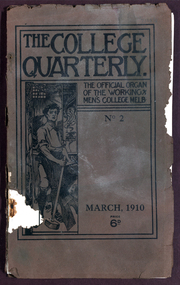
Booklet - Magazine, College Quarterly: The Official Organ of the Working Men's College Melbourne, 2010, 03/1910
... The Working Men's College later became the Royal Melbourne Institute of Technology (RMIT), and is now RMIT University....The Working Men's College later became the Royal Melbourne Institute of Technology (RMIT), and is now RMIT University. c. dowel working men's college rmit Charcoal green soft covered magazine of the Working Men's College. ...The Working Men's College later became the Royal Melbourne Institute of Technology (RMIT), and is now RMIT University.Charcoal green soft covered magazine of the Working Men's College. Articles include: * On the Beginning of Things (Robet Haddon) * An Annual Out-door day * Powlett Coal * The Arts and Crafts Society * Gordon College * Big Guns * The Aeroplane * The Department of Engineering (W.M. Kernot) * British Craftsmanship (Robert J. Haddon) * The Education of an artist in Australia (Archibald Colquhoun) * The Ordeal of Eyes * Modelling and the Sculptors Art (J.S. Davie) * Wrought Iron - Old & NEw (John G. Lothian) * Some Lately Departed Students. (A. Coates, S. Rennick, W. McLean, J. Douglas, H. Colwell, L. Ritchie, B. Caldwell, V. Bowen, W. Williams, T. Richardson., L. Leslie) * Sport * Correspondence * NEws from Fiji (J. Herbert Beath) * A Student in China (R.C.S. Ogilby * College Examination Results, 1909 Images: Wilfred N. Kernot, Engineering classes and rooms, Blacksmithing workshop, Antique drawing roomc. dowel, working men's college, rmit -
Port Melbourne Historical & Preservation Society
Document - Research report, Heritage study of "Clareville" and McCormack Gallery", Robyn Clinch, Heritage Study of "Clareville"and the "McCormack Gallery" Port Melbourne, Jan 2008
... Submitted as part of the requirements for the subject "Heritage Planning"at RMIT University for the degree of Master of Social Science Environment....Submitted as part of the requirements for the subject "Heritage Planning"at RMIT University for the degree of Master of Social Science Environment. w Built Environment - Civic Built Environment - Domestic Port Melbourne Temperance Hall Town Planning Heritage Robyn CLINCH Clareville McCormack Gallery Frederick WILLIAMS William Hutcheson GRESHAM Jane DIXON Maxwell INGLES John GALL James John BARTLETT Edward W M SUFFOLK Ann McGRATH SUFFOLK Edward Dicker MATHEWS Elizabeth Payne Beck MATHEWS Thomas McCORMACK Mathew McCORMACK Catherine Larkin McCORMACK Maryann Farnan McCORMACK Alexander James DOIG Alice Bevan DOIG Stephen SPADIER Harriet Jane Blackell SPADIER Cricketers Arms Hotel Heritage Study of "Clareville"and the "McCormack Gallery" Port Melbourne - A4 bound with red plastic comb. 62 pages with red back. ...Submitted as part of the requirements for the subject "Heritage Planning"at RMIT University for the degree of Master of Social Science Environment.wHeritage Study of "Clareville"and the "McCormack Gallery" Port Melbourne - A4 bound with red plastic comb. 62 pages with red back. Contains comparative studies from Port and South Melbourne, photos and mapsbuilt environment - civic, built environment - domestic, port melbourne temperance hall, town planning, heritage, robyn clinch, clareville, mccormack gallery, frederick williams, william hutcheson gresham, jane dixon, maxwell ingles, john gall, james john bartlett, edward w m suffolk, ann mcgrath suffolk, edward dicker mathews, elizabeth payne beck mathews, thomas mccormack, mathew mccormack, catherine larkin mccormack, maryann farnan mccormack, alexander james doig, alice bevan doig, stephen spadier, harriet jane blackell spadier, cricketers arms hotel -
Port Melbourne Historical & Preservation Society
Book - Heritage study, former Temperance Hall, Port Melbourne, Jan 2008
... Completed by donor as part of the requirements for the subject "Heritage Planning" at RMIT University for the degree of Master of Social Science (Environment and Planning)...Completed by donor as part of the requirements for the subject "Heritage Planning" at RMIT University for the degree of Master of Social Science (Environment and Planning) Port Melbourne Temperance Hall Built Environment - Civic Robyn CLINCH Social Activities Town Planning Heritage Port Melbourne Dispensary Independent Order of Rechabites Heritage study of the former Temperance Hall, including a study of selected comparative buildings in the locality. ...Completed by donor as part of the requirements for the subject "Heritage Planning" at RMIT University for the degree of Master of Social Science (Environment and Planning)Heritage study of the former Temperance Hall, including a study of selected comparative buildings in the locality. White 86 page book with clear and red plastic cover/binding. January 2008port melbourne temperance hall, built environment - civic, robyn clinch, social activities, town planning, heritage, port melbourne dispensary, independent order of rechabites -
 Melbourne Tram Museum
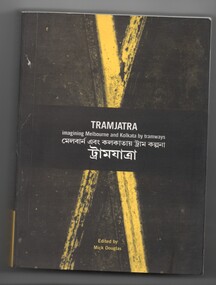
Book, Mick Douglas, "Tramjatra - imaging Melbourne and Kolkata by tramways", 2005
... Book - 304 pages, plus card cover with fold out section both ends, perfect bound, titled "Tramjatra - imaging Melbourne and Kolkata by tramways" (Calcutta), edited by Mick Douglas, published by RMIT University Press, 2005. Tram journeys. ...Trams tramways Melbourne Calcutta Tramways RMIT Book - 304 pages, plus card cover with fold out section both ends, perfect bound, titled "Tramjatra - imaging Melbourne and Kolkata by tramways" (Calcutta), edited by Mick Douglas, published by RMIT University Press, 2005. Tram journeys. Has a table of contents, with a side by side page translation - English and Bagla looking at journeys, passengers, the networks and images on the Melbourne and Kolkata tramway systems. ...Book - 304 pages, plus card cover with fold out section both ends, perfect bound, titled "Tramjatra - imaging Melbourne and Kolkata by tramways" (Calcutta), edited by Mick Douglas, published by RMIT University Press, 2005. Tram journeys. Has a table of contents, with a side by side page translation - English and Bagla looking at journeys, passengers, the networks and images on the Melbourne and Kolkata tramway systems. Provides list of contributors, images.trams, tramways, melbourne, calcutta, tramways, rmit -
 Federation University Art Collection
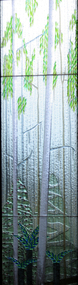
Artwork - slumped glass windows, 'Seasons' by Graham Stone, 1992
... He has taught at Monash University, then RMIT University. He was a founding member of Ausglass, Coordinator of the Cold Glass Access Workshop at the Meat Market Craft centre, and Editor of Ausglass Magazine. ...He has taught at Monash University, then RMIT University. He was a founding member of Ausglass, Coordinator of the Cold Glass Access Workshop at the Meat Market Craft centre, and Editor of Ausglass Magazine. artwork artists glass stained glass slumped glass gippsland campus graham stone Four slumped glass windows in the Crofton Hatsell Room at Federation University Gippsland campus. ...Graham STONE Graham Stone has worked with glass for over 25 years. He has taught at Monash University, then RMIT University. He was a founding member of Ausglass, Coordinator of the Cold Glass Access Workshop at the Meat Market Craft centre, and Editor of Ausglass Magazine. Four slumped glass windows in the Crofton Hatsell Room at Federation University Gippsland campus.artwork, artists, glass, stained glass, slumped glass, gippsland campus, graham stone -
 RMIT Design Archives
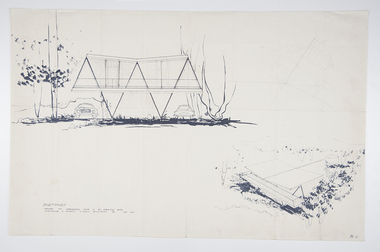
Diazotypes, House at Dromana for G. McCraith Esq
... The house and an archive relating to its design, construction and use by the McCraith family was gifted to RMIT University by the descendants of the its original owners, the Dixon-Ward family, in 2013....The house and an archive relating to its design, construction and use by the McCraith family was gifted to RMIT University by the descendants of the its original owners, the Dixon-Ward family, in 2013. ...This is a design drawing for a McCraith House (Larrakeyeah), Dromana, also known as 'The Butterfly House' , which was commissioned by Gerald and Ellen 'Nell' McCraith, and designed in 1955 by architect David Chancellor, Chancellor & Patrick. It is one of the few modernist houses on the Victorian Heritage Register. The house and an archive relating to its design, construction and use by the McCraith family was gifted to RMIT University by the descendants of the its original owners, the Dixon-Ward family, in 2013.Sketchesarchitecture, domestic architecture, mid-century modern, beachhouses -
 RMIT Design Archives
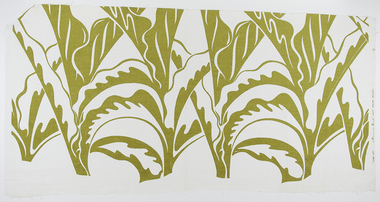
Textile lengths, Canna leaf
... Following Burke’s death in 1994, her life-long companion Miss Fabie Chamberlain donated the contents of Burke’s studio to RMIT University....Following Burke’s death in 1994, her life-long companion Miss Fabie Chamberlain donated the contents of Burke’s studio to RMIT University. Textile Australian Flora RMIT Design Archives Printed on selvedge 'CANNA LEAF' a "Frances Burke" UNIT COLOUR DESIGN' Single colour screenprint, white fabric with chartreuse coloured print of positive large format design featuring large stylised canna leaf motif. ...Dr. Frances Mary Burke (1907 - 1994) was a textile designer and printer, businesswoman, artist and Australian design advocate and retailer. Burke’s modern abstract textile designs incorporated motifs and colours inspired by Australian Indigenous art, Pacific Island cultures, Australian flora and fauna, English gardens, and the sea and its wildlife. Following Burke’s death in 1994, her life-long companion Miss Fabie Chamberlain donated the contents of Burke’s studio to RMIT University.Single colour screenprint, white fabric with chartreuse coloured print of positive large format design featuring large stylised canna leaf motif.Printed on selvedge 'CANNA LEAF' a "Frances Burke" UNIT COLOUR DESIGN'textile, australian flora, rmit design archives -
 Ballarat Heritage Services
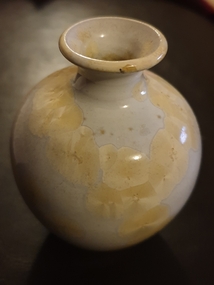
Ceramic - Studio Pottery, Pottery Vase with Crystaline Glaze by David Williams
... In 1980, he completed a BA in Fine Art from Phillip Institute of Technology (now part of RMIT University). He produces mainly crystalline glazed bowls, platters, vases, lampbases and other domestic ware. ...In 1980, he completed a BA in Fine Art from Phillip Institute of Technology (now part of RMIT University). He produces mainly crystalline glazed bowls, platters, vases, lampbases and other domestic ware. ...David WILLIAMs David Williams established Toolangi Pottery in Toolangi, Victoria, in 1977. In 1980, he completed a BA in Fine Art from Phillip Institute of Technology (now part of RMIT University). He produces mainly crystalline glazed bowls, platters, vases, lampbases and other domestic ware. His works are marked with an impressed stamp reading 'David Williams' or 'David WIlliams Handcrafted in Australia ' and he also used a cursive 'DP Williams'.Photograph of a hand thrown ceramic vase with crystalline glaze. It is signed on the base with a cursive 'DP Williams'. ceramics, pottery, david williams, crystaline glaze, crystalline glaze, toolangi pottery, studio pottery, australian studio pottery -
 RMIT Design Archives
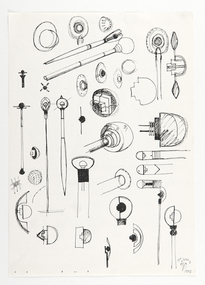
Design drawings, Ian Wong, designer, Sheet of sketches for RMIT University's ceremonial mace
... RMIT University's first ceremonial mace was commissioned by Professor David Beanland, Vice-Chancellor, Royal Melbourne Institute of Technology in 1992, and designed by Ian Wong, a lecturer in Industrial Design. ...RMIT University's first ceremonial mace was commissioned by Professor David Beanland, Vice-Chancellor, Royal Melbourne Institute of Technology in 1992, and designed by Ian Wong, a lecturer in Industrial Design. ...RMIT University's first ceremonial mace was commissioned by Professor David Beanland, Vice-Chancellor, Royal Melbourne Institute of Technology in 1992, and designed by Ian Wong, a lecturer in Industrial Design. It was the result of a collaborative effort, with staff from industrial design, gold & silversmithing, sculpture, engineering, applied physics, and optical technology working on its production. Materials used include carbon fibre, optical fibres, computer chips, honeycomb aluminium, gold, titanium and crystal. This design drawing shows how the University's distinctive pixel log (that conveys a sense of being at the forefront of technology) was incorporated into the design of the top element of the mace. Michelle Novacco, 2017Sketches of designs for RMIT ceremonial maceSigned bottom right corner, 'IAN WONG / iw / 1992 'ceremonial mace, industrial design -
 National Wool Museum
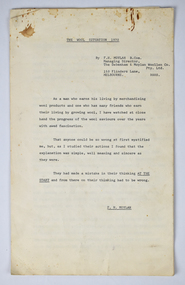
Archive - Report, Fred Moylan, The Wool Situation, 1970
... Source: Publication Moylan Woollens produced by the RMIT University Textile Resource Centre. ...Source: Publication Moylan Woollens produced by the RMIT University Textile Resource Centre. Frederick Moylan The Debenham & Moylan Woollen Co. ...Fred Moylan OAM born in Melbourne 1923, founded Moylan Woolen in 1950, at the beginning of an extended period of prosperity for the Australian wool industry. Moylan Woollens initial main focus was in the wholesale wool trade. In 1958-1959 the business diversified into angora farming and distribution. In 1967 the company merged with Debenhams Australia to form Debenham and Moylan Woollen Co Pty Ltd, later in 1980 the company was sold to Richard Allen. Moylan was a key business figure in the formation of the Australian Wool Bureau and Woolmark. He was awared the Member of the Order of Australia in 1997 for his contribution to the Australian and international wool industry. Source: Publication Moylan Woollens produced by the RMIT University Textile Resource Centre. Seven page single sided printed report with black typed text on cream paper.THE WOOL SITUATION 1970 / By F. H. MOYLAN B. Com. / Managing Director, / The Debenham & Moylan Woollen Co. / Pty. Ltd. / 153 Flinders Lane, / MELBOURNE. / 3000.frederick moylan, the debenham & moylan woollen co. pty. ltd, report, wool, industry -
 Federation University Historical Collection
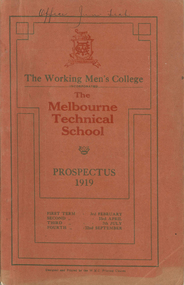
Book - Book - Prospectus, W.M.C Printing Classes, The Working Men's College, The Melbourne Technical School, Prospectus, 1919, 1919
... The college was the predecessor to the current-day Royal Melbourne Institute of Technology (RMIT University). Adjoining the college in the 1890s were the Supreme Court of Victoria (later the Melbourne Magistrates' Court) and the Melbourne Gaol - both which are now part of RMIT today. ...The college was the predecessor to the current-day Royal Melbourne Institute of Technology (RMIT University). Adjoining the college in the 1890s were the Supreme Court of Victoria (later the Melbourne Magistrates' Court) and the Melbourne Gaol - both which are now part of RMIT today. ...The Working Men’s College was founded in 1881 by a prominent grazier and philanthropist, The Hon. Francis Ormond, who donated £5000 towards the establishment of the college. The Council of the Melbourne Trades Hall then matched Ormond's initial donation by rallying its members. On 4 June 1887, the college opened in its purpose-built building on the corners of Bowen Street and La Trobe Street in Melbourne, with a gala ceremony. It became the third official provider of higher education in the new Colony of Victoria (the Melbourne Athenaeum was founded in 1839 and the University of Melbourne in 1853). The college was the predecessor to the current-day Royal Melbourne Institute of Technology (RMIT University). Adjoining the college in the 1890s were the Supreme Court of Victoria (later the Melbourne Magistrates' Court) and the Melbourne Gaol - both which are now part of RMIT today. An Index at the back lists all courses available. There is also an Index to Advertisements. Orange/red soft covered book with assorted photographs and advertisements.Office Jun Tech written on front cover.melbourne, prospectus, w.c. kernot, james smith, thos smith, a.e. smith, c.e. oliver, r. solly, s. barker, r. fiddes brown, t.f. bride, daniel white, f.e. shillabeer, d.avery, a.h. merrin, chas gray, w.h. haigh, j.h. hewison, h. burgess, sir d.v. hennessy, w.s. busby, r.b. lemmon, s.n. rodda, j. lemmon, r.b. mccomas, working men's college, melbourne technical school, charles gray, heads of departments, j sarvaas engineering, g b pritchard mining and metallurgy, e s richards chemistry, a hart mathematics, g r pitkeithly art and applied art, r j haddon architecture, instructors-in-charge, e carlton, coach and body building, r j dorey, blacksmithing, j dewar, plumbing gasfitting sheet metal work, h haile, sheep and wool, g leslie, printing, r h mcleod, correspondence courses, f parkin, pattern-making, w penrose, turning and fitting, machinery erecting, d skidmore, moulding, librarian a hart -
 Federation University Historical Collection
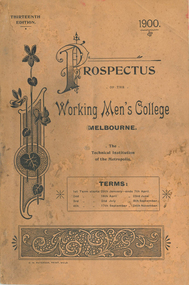
Book - Book - Prospectus, The Working Men's College Melbourne, Prospectus,1900, 1900
... The college was the predecessor to the current-day Royal Melbourne Institute of Technology (RMIT University). Adjoining the college in the 1890s were the Supreme Court of Victoria (later the Melbourne Magistrates' Court) and the Melbourne Gaol - both which are now part of RMIT today. ...The college was the predecessor to the current-day Royal Melbourne Institute of Technology (RMIT University). Adjoining the college in the 1890s were the Supreme Court of Victoria (later the Melbourne Magistrates' Court) and the Melbourne Gaol - both which are now part of RMIT today. ...The Working Men’s College was founded in 1881 by a prominent grazier and philanthropist, The Hon. Francis Ormond, who donated £5000 towards the establishment of the college. The Council of the Melbourne Trades Hall then matched Ormond's initial donation by rallying its members. On 4 June 1887, the college opened in its purpose-built building on the corners of Bowen Street and La Trobe Street in Melbourne, with a gala ceremony. It became the third official provider of higher education in the new Colony of Victoria (the Melbourne Athenaeum was founded in 1839 and the University of Melbourne in 1853). The college was the predecessor to the current-day Royal Melbourne Institute of Technology (RMIT University). Adjoining the college in the 1890s were the Supreme Court of Victoria (later the Melbourne Magistrates' Court) and the Melbourne Gaol - both which are now part of RMIT today. A list of Scholarship Governors and Life Governors is included. The former have donated 250 Pounds Sterling and upwards, the later have donated 20 Pounds and over but less than 250 Pounds Sterling. The Patron of The Working Men's College was His Excellency The Right Honourable Lord Brassey. The President of the Council was Professor W C Kernot. The majority of classes were at night and on Saturdays. Tan soft covered book of 112 pages. The thirteenth edition of the Working Men's College (later Royal Melbourne Institute of Technology [RMIT]). It inlcudes the following photographic images: Main Building, Assaying, 1899 council (W.C. Kernot, W.H. Embling, Thomas smith, F.H. Bromley, John Reid, R.H. Solly, E. Findley, D. McIvor, James Robb, John Hancock, C.E. Oliver, A.J. Arnot, James Smith, Joseph Nixon, R.L.Jellery. C.S. Paterson), UNveiling the Ormond Statue, Victorian Lead and Shot Works, Francis Ormond, Telegraphy room, Lecture Theatre, photography, painting class, wool sorting, plumbing, Remington typewriter, W. Ison, H.D. Evans, library, Verdon prize, Denton Hat Mills. working men's college melbourne, rmit, w.c. kernot, w.h. embling, ormond statue, f. ormond, electricity, surveying, architecture, photography, assaying, dressmaking, veterinary science, plumbing, letterpress printing, w. ison, h.d. evans, library, denton hat mills, literary and commercial department, typewriting department, languages, telegraphy, department of music, department of mathematics, department of engineering, 'department of architecture, department of art and applied art, department of mining and metallurgy, department of chemistry, department of household economy, department of agriculture and rural industries, woodworking, carpentry and joinery, turning and fitting, coachbuilding and carriagedrafting -
 RMIT Design Archives
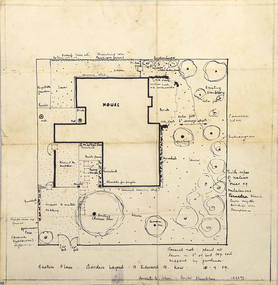
Diazotypes, Sketch Plan: Garden Layout - 13 Edward St. Kew
... John commenced his architectural studies at Swinburne Technical College prior to WW2, and subsequently studied at Melbourne Technical College (now RMIT University) from 1944 to 1946. Phyllis studied architecture at Melbourne Technical College from 1942, before transferring to Melbourne University's Architectural Atelier in 1944 They both completed their Bachelor of Architecture in 1949, with Phyllis topping the fourth year, and John coming in second. ...John commenced his architectural studies at Swinburne Technical College prior to WW2, and subsequently studied at Melbourne Technical College (now RMIT University) from 1944 to 1946. Phyllis studied architecture at Melbourne Technical College from 1942, before transferring to Melbourne University's Architectural Atelier in 1944 They both completed their Bachelor of Architecture in 1949, with Phyllis topping the fourth year, and John coming in second. ...John and Phyllis Murphy designed this house and garden in Kew for Sir Frank and Lady Macfarlane Burnet in 1959, the year before Burnet and Peter Medaware received the Nobel Prize for discovering acquired immunological tolerance. For the most highly honoured scientist to have worked in Australia, Burnet's house is modest - single storey with two bedrooms. Typical of post-war suburban housing thought, the garden is a generous, and the planting a mix of existing shrubs and trees, old favourites such as camelias, hydrangeas, lilacs, and a unusually 'a thick copse of native trees'. John Murphy (1920-2004) and Phyllis Murphy (nee Slater) (1924-) are alumni of RMIT. John commenced his architectural studies at Swinburne Technical College prior to WW2, and subsequently studied at Melbourne Technical College (now RMIT University) from 1944 to 1946. Phyllis studied architecture at Melbourne Technical College from 1942, before transferring to Melbourne University's Architectural Atelier in 1944 They both completed their Bachelor of Architecture in 1949, with Phyllis topping the fourth year, and John coming in second. They established their architectural practice in 1950. One early project was their design with Kevin Borland and Peter McIntyre for the Olympic Swimming Pool (1956). Ann Carew 2018dye, paper, garden design, kew -
 Vision Australia
Administrative record - Text, Royal Victorian Institute for the Blind annual report 1980-1981, 1980-1981
... Articles in annual report include: the development of an educational camp at Romsey through the bequest of Mrs Cecelia Tye, a new Family Group home at Andrews Street, East Burwood, new program developed for Trans Australia Airlines providing mobility instruction to air hostesses when guiding blind passengers, three kiosks at RMIT, Melbourne University and RVIB providing employment and training for blind workers, a short term contract assembling motorcycles, introduction of paperless Brailler (Digicasette), beginning of Il Globo becoming available as an audio magazine and provision of up to $3000 interest home loan for blind people. ...Articles in annual report include: the development of an educational camp at Romsey through the bequest of Mrs Cecelia Tye, a new Family Group home at Andrews Street, East Burwood, new program developed for Trans Australia Airlines providing mobility instruction to air hostesses when guiding blind passengers, three kiosks at RMIT, Melbourne University and RVIB providing employment and training for blind workers, a short term contract assembling motorcycles, introduction of paperless Brailler (Digicasette), beginning of Il Globo becoming available as an audio magazine and provision of up to $3000 interest home loan for blind people. royal victorian institute for the blind Corporation records 1 volume of printed material Royal Victorian Institute for the Blind annual report 1980-1981 Administrative record Text ...Articles in annual report include: the development of an educational camp at Romsey through the bequest of Mrs Cecelia Tye, a new Family Group home at Andrews Street, East Burwood, new program developed for Trans Australia Airlines providing mobility instruction to air hostesses when guiding blind passengers, three kiosks at RMIT, Melbourne University and RVIB providing employment and training for blind workers, a short term contract assembling motorcycles, introduction of paperless Brailler (Digicasette), beginning of Il Globo becoming available as an audio magazine and provision of up to $3000 interest home loan for blind people. 1 volume of printed materialroyal victorian institute for the blind, corporation records -
 Ararat Gallery TAMA
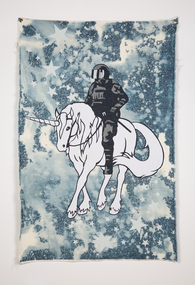
Tony Garifalakis, Mounted Stardust Unit, 2013
... Garifalakis completed a Master of Fine Art at RMIT University, and has exhibited extensively in Australia and internationally. ...Garifalakis completed a Master of Fine Art at RMIT University, and has exhibited extensively in Australia and internationally. ...ony Garifalakis' practice over the past two decades has constituted an examination of social relations and the semiotics of power. Garifalakis completed a Master of Fine Art at RMIT University, and has exhibited extensively in Australia and internationally. His works are represented in major public collections, including the National Gallery of Victoria and the Art Gallery of New South Wales. These three works are from Garifalakis’ series of denim works titled, Mutually Assured Destruction. The artist says of these works: “This series of works are denim collages that juxtapose political and corporate iconography with cute and benign clip art imagery. The aim being to confuse, collapse or diffuse any power these symbols might contain. The use of this particular iconography is undermined by the material it is made with. The denim becomes a tool that correlates global and political organizations with outlaw groups, gangs and criminality. I am interested in denim’s association to outlaw groups and gangs. Denim is currently a billion dollar global industry; I am aware that any cultural identification it has to a counterculture or outlaw status is obsolete and outdated. I am interested in exploring this idea – how a globally commonplace material once contained a completely different set of signifiers. The focus of these works is the material – denim. They are monochromatic works that aim to highlight the material that they are made with. In addition to the collage technique I have ‘drawn’ on some of these works by employing elements associated with biker and gang jackets such as – stitching, studs, chains, safety pins, etc.” -
 Ararat Gallery TAMA
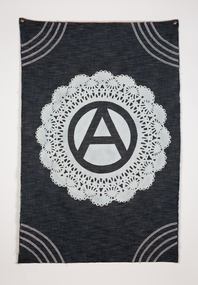
Tony Garifalakis, Anarchodandyism, 2013
... Garifalakis completed a Master of Fine Art at RMIT University, and has exhibited extensively in Australia and internationally. ...Garifalakis completed a Master of Fine Art at RMIT University, and has exhibited extensively in Australia and internationally. ...ony Garifalakis' practice over the past two decades has constituted an examination of social relations and the semiotics of power. Garifalakis completed a Master of Fine Art at RMIT University, and has exhibited extensively in Australia and internationally. His works are represented in major public collections, including the National Gallery of Victoria and the Art Gallery of New South Wales. These three works are from Garifalakis’ series of denim works titled, Mutually Assured Destruction. The artist says of these works: “This series of works are denim collages that juxtapose political and corporate iconography with cute and benign clip art imagery. The aim being to confuse, collapse or diffuse any power these symbols might contain. The use of this particular iconography is undermined by the material it is made with. The denim becomes a tool that correlates global and political organizations with outlaw groups, gangs and criminality. I am interested in denim’s association to outlaw groups and gangs. Denim is currently a billion dollar global industry; I am aware that any cultural identification it has to a counterculture or outlaw status is obsolete and outdated. I am interested in exploring this idea – how a globally commonplace material once contained a completely different set of signifiers. The focus of these works is the material – denim. They are monochromatic works that aim to highlight the material that they are made with. In addition to the collage technique I have ‘drawn’ on some of these works by employing elements associated with biker and gang jackets such as – stitching, studs, chains, safety pins, etc.” -
 Ararat Gallery TAMA
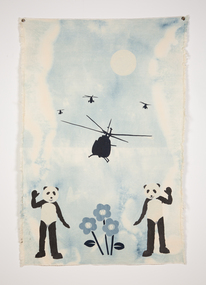
Tony Garifalakis, NWO Cameltoe, 2012
... Garifalakis completed a Master of Fine Art at RMIT University, and has exhibited extensively in Australia and internationally. ...Garifalakis completed a Master of Fine Art at RMIT University, and has exhibited extensively in Australia and internationally. ...ony Garifalakis' practice over the past two decades has constituted an examination of social relations and the semiotics of power. Garifalakis completed a Master of Fine Art at RMIT University, and has exhibited extensively in Australia and internationally. His works are represented in major public collections, including the National Gallery of Victoria and the Art Gallery of New South Wales. These three works are from Garifalakis’ series of denim works titled, Mutually Assured Destruction. The artist says of these works: “This series of works are denim collages that juxtapose political and corporate iconography with cute and benign clip art imagery. The aim being to confuse, collapse or diffuse any power these symbols might contain. The use of this particular iconography is undermined by the material it is made with. The denim becomes a tool that correlates global and political organizations with outlaw groups, gangs and criminality. I am interested in denim’s association to outlaw groups and gangs. Denim is currently a billion dollar global industry; I am aware that any cultural identification it has to a counterculture or outlaw status is obsolete and outdated. I am interested in exploring this idea – how a globally commonplace material once contained a completely different set of signifiers. The focus of these works is the material – denim. They are monochromatic works that aim to highlight the material that they are made with. In addition to the collage technique I have ‘drawn’ on some of these works by employing elements associated with biker and gang jackets such as – stitching, studs, chains, safety pins, etc.”
