
Showing 118 items matching "round picture"
-
 Flagstaff Hill Maritime Museum and Village
Decorative object - Flue Cover Art, 1890s to 1930s
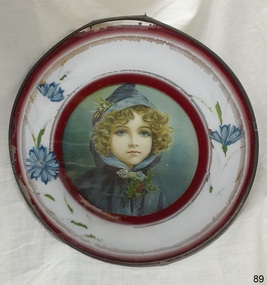
... ...round picture...They were usually round and illustrated with a lithograph or chromograph print. The picture was then mounted on card, covered with glass, and framed with a brass or tin rim. ...The round metal frame forms a deep, white-painted, crimson-edged border for the illustration. The hand-painted blue flowers on the glass front form add to the border and give a 3-dimensional effect. The picture...Warrnambool Flagstaff Hill Maritime Museum picture handpainted portrait girl in blue cape metal frame round picture illustration print holly Christmas child in blue cape silver and blue clasp holly sprig late 19th century early 20th century 1890s-1930s Victorain Edwardian flue cover flue cover art wall art chimney flue cover chimney hole cover stove pipe cover fireplace flue cover antique Victorian glass frame Chromograph Lithograph tin brass lithograph print Chromo print Christmas girl blue cape blonde girl Flue cover, metal and glass. ...In the late 19th and early-20th centuries household heaters burned wood and coal for heating. In winter the warm air from the fireplace would flow into the room through a round flue in the face of the chimney. In the warmer months the unnecessary heater and flue was removed and the chimney cleaned. Homemakers then covered the circular flue hole with a decorative and usually inexpensive wall hanging to prevent draughts and dust. The practice was especially popular in France and Germany where a lot of the artwork originated. The covers were no longer needed after households changed over to more modern designs of heaters. The flue covers were known as Wall Art or Flue Cover Art. They were usually round and illustrated with a lithograph or chromograph print. The picture was then mounted on card, covered with glass, and framed with a brass or tin rim. The border was commonly gilt with a black stripe around the centre. There were numerous illustrations, many with a European appearance, and were easily bought through local merchants for a small price.This pretty flue cover is significant for representing a common domestic wall decoration from the late Victorian to the Edwardian eras, when solid fuel heaters were used in low to high income homes. The picture is similar to many other flue cover images, apart from the holly clutched in the girl’s hand, which gives the cover a Christmas theme. This flue cover is the only one in our collection and appears to have a unique design; the hand painted floral decoration on the glass and the two crimson rings around the edges of the frame’s white border haven’t been seen on other flue covers. Flue cover, metal and glass. Print of a young girl with blue eyes and curly blonde hair, a hooded blue cape, a silver clasp with blue stones, and a sprig of holly in her hand. The round metal frame forms a deep, white-painted, crimson-edged border for the illustration. The hand-painted blue flowers on the glass front form add to the border and give a 3-dimensional effect. The picture is between the cardboard backing and the glass front, with the metal frame holding them together. There is a metal chain attached for hanging the cover.warrnambool, flagstaff hill maritime museum, picture, handpainted, portrait, girl in blue cape, metal frame, round picture, illustration, print, holly, christmas, child in blue cape, silver and blue clasp, holly sprig, late 19th century, early 20th century, 1890s-1930s, victorain, edwardian, flue cover, flue cover art, wall art, chimney flue cover, chimney hole cover, stove pipe cover, fireplace flue cover, antique, victorian, glass frame, chromograph, lithograph, tin, brass, lithograph print, chromo print, christmas girl, blue cape, blonde girl -
 Glenelg Shire Council Cultural Collection
Souvenir - View Ware Dish - Portland Harbour, n.d
... Round. Picture of the Harbour at Portland, colour image, showing baths and piers...souvenir view ware Portland Harbour Round. Picture of the Harbour at Portland, colour image, showing baths and piers Souvenir View Ware Dish - Portland Harbour ...Round. Picture of the Harbour at Portland, colour image, showing baths and pierssouvenir, view ware, portland harbour -
Glenelg Shire Council Cultural Collection
Souvenir - Souvenir Fridge Magnet - Portland vintage Car Club, n.d
... Magnet, round, picture of red vintage car in garden setting; white lettering. ...Front: 'PORTLAND VINTAGE CAR CLUB POWERHOUSE MUSEUM' - family car Back: 5.6 diam Magnet, round, picture of red vintage car in garden setting; white lettering. ...Magnet, round, picture of red vintage car in garden setting; white lettering. Magnet in clear cellophane packet.Front: 'PORTLAND VINTAGE CAR CLUB POWERHOUSE MUSEUM' - family car Back: 5.6 diam -
Coal Creek Community Park & Museum
Tin container, Stephen F. WHitman & Son Inc
... Round tin with picture depicting city landscape....Whitman's Chocolates Land Sea and Air One Pound net....... Round tin with picture depicting city landscape. Tin container Stephen F. ...Round tin with picture depicting city landscape.Whitman's Chocolates Land Sea and Air One Pound net....... -
 Bendigo Historical Society Inc.
Slide - BENDIGO HOUSE VIEWS, Aug 1964
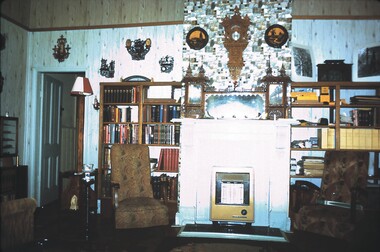
... On the mantlepiece are pictures and above it is clock and a round picture on each side. Behind the clock is a patterned area. ...On the mantlepiece are pictures and above it is clock and a round picture on each side. Behind the clock is a patterned area. ...Slide. Bendigo Views. View of a lounge room with a light green fireplace with a gas heater in it. To the right of the fireplace is an armchair with bookshelves behind it. To the left of the fireplace is another armchair with bookshelves behind it. On top of the bookshelf is a model of the Sydney Harbour Bridge. In the corner is a doorway with another cupboard on the left. On the mantlepiece are pictures and above it is clock and a round picture on each side. Behind the clock is a patterned area. There are other objects hanging on the wall.slide, bendigo, bendigo views, bendigo views -
 Whitehorse Historical Society Inc.
Painting - Picture
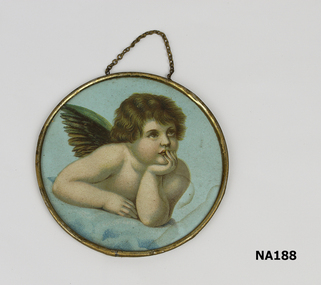
... Round gold framed picture of pensive cherub with wings on blue background, gilt chain and cardboard backing....illustrations reproductions Round gold framed picture of pensive cherub with wings on blue background, gilt chain and cardboard backing. ...Round gold framed picture of pensive cherub with wings on blue background, gilt chain and cardboard backing.illustrations, reproductions -
 Bendigo Historical Society Inc.
Slide - BENDIGO HOUSE VIEWS, Jun 1965
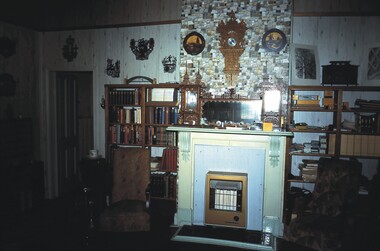
... On the stonework is hanging a clock and a round picture on each side of it. One picture has a Dutch windmill in it and the other is a building. ...On the stonework is hanging a clock and a round picture on each side of it. One picture has a Dutch windmill in it and the other is a building. ...A fireplace with a mantle piece with a mirror on it and a number of small ornaments. The fireplace has a gas heater in it and a hearth. Above the fireplace is stonework. On the stonework is hanging a clock and a round picture on each side of it. One picture has a Dutch windmill in it and the other is a building. Next is another bookcase with various objects on it. There are two pictures and a black object on the bookcase. There is an armchair in front of each bookcase. There is a cabinet to the left of the door. Above the cabinet and the door are ornaments hanging on the wall. There is a smokers' stand near the armchair nearest the door and behind it is a stand with a cup and saucer on it.slide, bendigo, bendigo views, bendigo views -
 Whitehorse Historical Society Inc.
Container - Tin, Not known
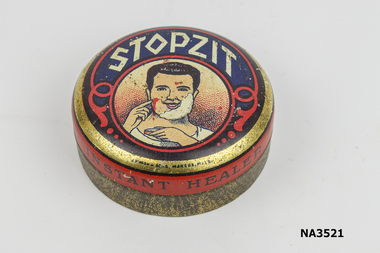
... A small round tin with coloured picture of part shaved man with bleeding cuts and name 'Stopzit'...Not known personal effects-toilet requisites shaving Stopzit, Instant Healer, Apply Lightly A small round tin with coloured picture of part shaved man with bleeding cuts and name 'Stopzit' Container Tin ...Not knownA small round tin with coloured picture of part shaved man with bleeding cuts and name 'Stopzit'Stopzit, Instant Healer, Apply Lightlypersonal effects-toilet requisites, shaving -
 Tatura Irrigation & Wartime Camps Museum
Audio - CD, 80 Years in Australia
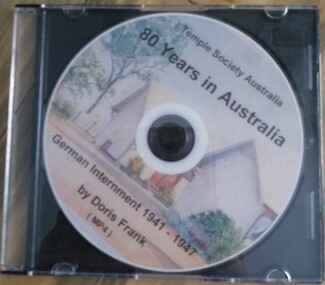
... Black multi ring folder containing CD and 9 pages of typing. Round CD with coloured picture of hut and trees. Writing in black. ...Templer Society Ernst Lewandowsky Alfons Konig Lothar Bohmer Dr Wilhelm Eilers Rudolf Girschik Fritz Lippmann Wilhelm Eppinger Hedwig Schnerring Wilhelm Fugmann Dr Martin Winkle Doris Frank Camp 10 Loveday SA Camp 1A Internment camp Richard Graze Oscar Hahn Ekkehard Beinssen Werner Glockemann Templer Society of Australia 80 Years in Australia German Internment 1941 -1947 by Doris Frank (MP4) Black multi ring folder containing CD and 9 pages of typing. Round CD with coloured picture of hut and trees. Writing in black. ...The CD tells the story of the Templer Society of Australia and how they came to Australia. The story of 10 Templer families. The typed sheets are a transcript of what is on the CD.Black multi ring folder containing CD and 9 pages of typing. Round CD with coloured picture of hut and trees. Writing in black. In black and clear case.Templer Society of Australia 80 Years in Australia German Internment 1941 -1947 by Doris Frank (MP4)templer society, ernst lewandowsky, alfons konig, lothar bohmer, dr wilhelm eilers, rudolf girschik, fritz lippmann, wilhelm eppinger, hedwig schnerring, wilhelm fugmann, dr martin winkle, doris frank, camp 10 loveday sa, camp 1a internment camp, richard graze, oscar hahn, ekkehard beinssen, werner glockemann -
 Anglesea and District Historical Society
Invitation Card, 1988
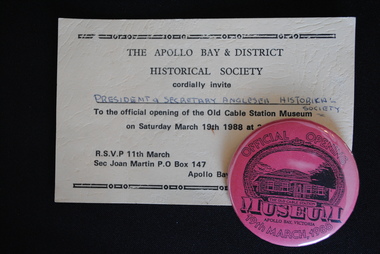
... Included is a pink round pin with a picture of the museum and opening details....picture of museum. Invitation to opening of the Old Cable Station Museum in Apollo Bay on March 19, 1988 at 2pm. The invitation is printed in black on a yellow card. Included is a pink round ...Invitation to opening of the Old Cable Station Museum in Apollo Bay on March 19, 1988 at 2pm. The invitation is printed in black on a yellow card. Included is a pink round pin with a picture of the museum and opening details.THE APOLLO BAY & DISTRICT / HISTORICAL SOCIETY / cordially invite / PRESIDENT & SECRETARY ANGLESEA HISTORICAL SOCIETY / To the official opening of the Old Cable Station Museum / on Saturday March 19th 1988 at 2 pm. / R.S.V.P. 11 March / Sec: Joan Martin P.O Box 147 / Apollo Bay. Pink pin with picture of museum.apollo bay & district historial society, old cable station museum, 1988 -
 Bendigo Historical Society Inc.
Medal - GOLD JUBILEE EXHIBITION MEDAL, 1901
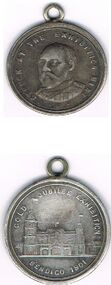
... A small round medal has a picture of the Town Hall decorated for the event. ...A small round medal has a picture of the Town Hall decorated for the event. ...Gold Jubilee Exhibition Medal: Medal struck at Exhibition Mint to commemorate the Gold Jubilee Exhibition Bendigo 1901. A small round medal has a picture of the Town Hall decorated for the event. On the back is a picture of King Edward V11 with the words inscribed 'Struck at the Exhibition Mint. Box 625numismatics, medals - commemorative, gold jubilee exhibition medal. 1901 edward v11 -
 Ballarat Tramway Museum
Photograph - Framed Photographs, Floral Tram, No. 29, 1938
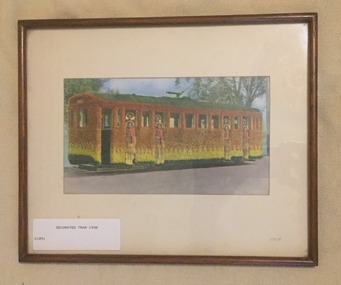
... Has two rounded screw hooks with picture wire between them....Has two rounded screw hooks with picture wire between them. Floral Tram, No. 29 Photograph Framed Photographs ...In 1938, the SEC Ballarat decoarated a tram with paper flowers for the Floral Festival. Has four ladies dressed in matching clothes standing inside the tram and four inside the doorways. Photographed in Wendouree Parade with Lake Wendouree in the background. The story is that it rained on the day and the ink in the dresses ran. See Reg Item 5188 for a coloured postcard of the ladies standing outside the tram. Yields information about a tram decorated for the 1939 floral festival colour scheme and has a strong association with the people involved in it. Demonstrates the colours used.Framed photograph of the 1939 Floral Tram, No. 29, photographed in Wendouree Parade, rendered, hand painted, in colour. March 1939. Frame - wooden, light brown frame, glazed, with a cut cardboard piece framing the photograph and most of the damage around the print. Has two rounded screw hooks with picture wire between them.Has a label on the front of the glass "Decorated Tram 1938" and number 01291. On the cardboard piece are the initials upside down "FKN"trams, tramways, floral tram, decorated trams, tram 29 -
 Bendigo Historical Society Inc.
Document - MALONE COLLECTION: GREETING CARDS, 1903
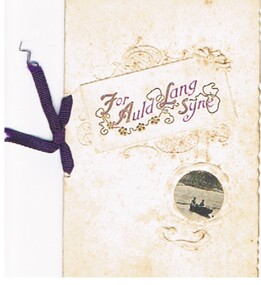
... An embossed medallion hangs from the rectangle with a small round black & white picture of two men in a boat. On the insert on the right is printed a verse and on the right is a black & white photo of a stream with snow & some trees on the bank. ...An embossed medallion hangs from the rectangle with a small round black & white picture of two men in a boat. On the insert on the right is printed a verse and on the right is a black & white photo of a stream with snow & some trees on the bank. ...Document. Greeting Cards. Whitish card with embossed rectangle on the angle with; 'For Auld Lang Syne' printed in purple with gold & purple capitals. Around the rectangle is more embossing and scrollwork. An embossed medallion hangs from the rectangle with a small round black & white picture of two men in a boat. On the insert on the right is printed a verse and on the right is a black & white photo of a stream with snow & some trees on the bank. Further along the stream is a stone bridge. Card & insert held together with a purple ribbon. Pattern cut edges.person, greeting cards, malone collection, malone collection, greeting cards -
 Ballarat Tramway Museum
Souvenir - Teaspoon, Perfection Plate, BTPS Teaspoon - tram 26, late 1980's early 1990's
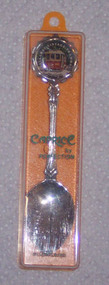
... round inset at the top of the tea spoon, contained within a plastic case. The teaspoon made by Perfection Plate, of the Caprice style or type. The case has yellow plastic base, with clear top with the words "Caprice by Perfection" On the rear of the case is the wording "Perfection". The teaspoon is silver plated, with the tram in a picture...round inset at the top of the tea spoon, contained within a plastic case. The teaspoon made by Perfection Plate, of the Caprice style or type. The case has yellow plastic base, with clear top with the words "Caprice by Perfection" On the rear of the case is the wording "Perfection". The teaspoon is silver plated, with the tram in a picture ...Souvenir Teaspoon featuring Ballarat tram No. 26 in a round inset at the top of the tea spoon, contained within a plastic case. The teaspoon made by Perfection Plate, of the Caprice style or type. The case has yellow plastic base, with clear top with the words "Caprice by Perfection" On the rear of the case is the wording "Perfection". The teaspoon is silver plated, with the tram in a picture 22mm round. The teaspoon is marked "Caprice" on the rear. Tea spoon is 116mm long x 25mm wide. Case is 125mm high, 32mm wide, by 16mm deep. Made late 1980's, or early 1990's. See Reg Item 3556 for another example of this teaspoon. trams, tramways, teaspoons, sales items, btps -
 Ballarat Tramway Museum
Souvenir - Teaspoon, Perfection Plate, BTPS Teaspoon - tram 26, early 2000's
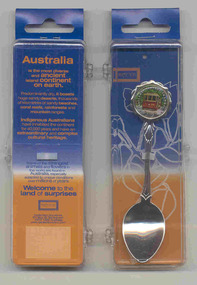
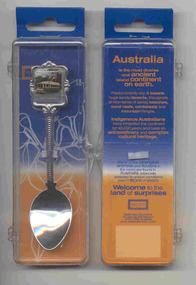
... The teaspoon is silver plated, with the tram in a picture 22mm round. Tea spoon is 116mm long x 25mm wide. ...The teaspoon is silver plated, with the tram in a picture 22mm round. Tea spoon is 116mm long x 25mm wide. ...Souvenir Teaspoon featuring Ballarat tram No. 26 in a round inset at the top of the tea spoon, contained within a plastic case. The teaspoon made by Perfection Plate, of the Caprice style or type. The case is clear plastic, hinged on the left hand side, with a clip on the right hand side and wrapped in plastic. Inside and on top of the case for display purposes is a folded sheet of cardboard, printed with a decorative design on the spoon side and a short item about Australia - the island continent. On the base of the item is details of the manufacturer, and web site. The teaspoon is silver plated, with the tram in a picture 22mm round. Tea spoon is 116mm long x 25mm wide. Case is 163mm high, 43mm wide, by 16mm deep. Made early 2000's. See Reg Item 3207 for an earlier example of this teaspoon. trams, tramways, teaspoons, sales items, btm -
 Ballarat Tramway Museum
Souvenir - Teaspoon, Perfection Plate, BTPS Teaspoon - tram 26, early 2000's
... The teaspoon is silver plated, with the tram in a picture 22mm round. Tea spoon is 116mm long x 25mm wide. ...The teaspoon is silver plated, with the tram in a picture 22mm round. Tea spoon is 116mm long x 25mm wide. ...Souvenir Teaspoon featuring Ballarat tram No. 33 in a Square inset at the top of the tea spoon, contained within a plastic case. The teaspoon made by Perfection Plate, of the Galaxy style or type. The teaspoon made by Perfection Plate, of the Caprice style or type. The case is clear plastic, hinged on the left hand side, with a clip on the right hand side and wrapped in plastic. Inside and on top of the case for display purposes is a folded sheet of cardboard, printed with a decorative design on the spoon side and a short item about Australia - the island continent. On the base of the item is details of the manufacturer, and web site. The teaspoon is silver plated, with the tram in a picture 22mm round. Tea spoon is 116mm long x 25mm wide. Case is 163mm high, 43mm wide, by 16mm deep. Made early 2000's. See Reg Item 3205 for an earlier example of this teaspoon. trams, tramways, teaspoons, sales items, btm -
 Flagstaff Hill Maritime Museum and Village
Print - Lithograph, sea rescue, R.N. Duffield, Australian cruiser “MELBOURNE” (Tons 5600) rescuing crew of sinking four-masted schooner “HELEN B. STERLING” of Halifax NS Canada, Tons 1343 in a gale in the Pacific Ocean, 19-11-1924
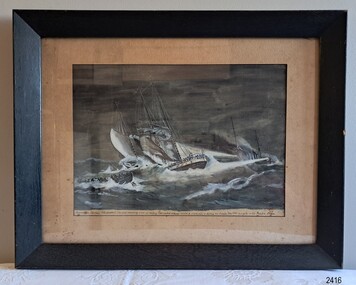
... Inscriptions include text on the bow of the sinking vessel, a handwritten title below the picture, and a handwritten name in the print’s lower right corner. On the reverse are two oval, black ink stamps and a round cream label with printed text. ...Inscriptions include text on the bow of the sinking vessel, a handwritten title below the picture, and a handwritten name in the print’s lower right corner. On the reverse are two oval, black ink stamps and a round cream label with printed text. ...This framed lithograph print in watercolour and gouache was produced on November 19th, 1924, by 20th-century marine artist, Mr R.N. Duffield. It depicts the event of a sea rescue that took place two years earlier. The framer was A.L. Frith of Footscray, Melbourne, who actively advertised from 1933 to 1935. The now disbanded Shiplovers' Society of Victoria (1930-2018) donated the print, and it seems likely that this print was framed for that organisation. This graphic image shows the conditions in which the rescue from the wrecked Helen B. Sterling happened. Captain George Harris was master of the American-owned, four-masted windjammer. His wife Edith and their ten-year-old son Leslie were on board, along with a crew of fifteen seamen. The ship set off from Newcastle, NSW, on January 5th, 1922, loaded with a cargo of coal to deliver to the Society Islands and on to San Francisco. Young Leslie later wrote a lively school composition for his teacher about his experiences on board the Helen B Sterling. He tells of a fire that broke out the day after they departed and burned a hole in a beam. Then another troublesome time on the 9th, when a strong gale blew a sail off the ship. Finally, he tells of the highlight of his voyage when, on the 18th January, the ship was right in the path of a strong cyclone, which broke the mainmast. Huge waves crashed over both sides of the deck, meeting in the middle, and the ship began to sink. The rescue from the wreck was an exciting time for the young boy, and even more so when one of his cats survived after being carefully wrapped in a pillowcase and thrown down from the ship for the boy. Reporters later wrote about Leslie’s comments, “... what had grieved him most was the thought that he might never see his two little sisters again”. Captain Harris said in a published statement, “… the gale was the worst he had met in his 12 years’ experience at sea. All went well for the first week. We then encountered a strong blow from the south-east. We tried the gasoline pump, but the engine broke down, and we had to do the pumping by hand. We at once shortened sail, but the sea increased in fury to such an extent that men were washed from the pumps. I was below at 5:30 on Sunday morning [January 22nd, 1922] when the main mast went over the side, … I at once sent out SOS signals, and got word that HMAS Melbourne was coming to our assistance. I had made a mistake with regard to our position, but did not know it until 11:30 o’clock, when I sent out the correct location. This was picked up by the Melbourne and I received the following reply: “We will reach you about 2 am. Keep a good heart. The Melbourne will do all she can.” Our ship was practically awash when we were taken off.” (Ref: the ‘Helen B. Sterling Disaster’, Maitland Weekly Mercury, NSW, 4-2-1922.) Officers from the Royal Australian Navy, Captain Henry J Feakes (later Rear-Admiral) and Commander Wilfrid Ward Hunt, were on board the light cruiser, HMAS Melbourne (1913-1928), when it left Sydney for New Zealand. After the SOS was received, the ship sped at full steam towards the sinking Helen B. Sterling. They found the vessel at about midnight and shone bright search lights on the distressed ship to illuminate the desperate scene. The Melbourne was unable to move close to the schooner, so sixteen seamen, including Commander Hunt, volunteered to man the Melbourne’s lifesaving 12-oared cutter. They rowed the sea boat with great urgency towards the victims of the sinking ship, keen to save lives no matter what the conditions. When the cutter was close to the Sterling, a line was secured between the Sterling and the cutter. The weary, waterlogged and anxious men on board could be rescued, one at a time, in the breeches buoy equipment, which looked like canvas shorts with a lifesaving ring in the waistband. The victims were hauled along the line and pulled aboard by many willing hands. All eighteen crew and passengers were saved, including Captain Harris and his family. The seamen of the Melbourne received a heroes’ welcome when they arrived in New Zealand. The grateful survivors were taken to Auckland, where they received the care and comfort they needed. Melbourne’s Lord Mayor, Cr. Swanston, on behalf of the citizens of Melbourne, formally recognised the heroic rescue efforts of the seamen of the HMAS Melbourne on March 2nd, 1922, at a special presentation. Two large flags, a White Ensign and an Australian “Jack" Flag, were presented to the Captain of HMAS Melbourne, and souvenirs were awarded to the sea boat’s crew and its Commander, Wilfred Ward Hunt. Commander Hunt was also presented with an original watercolour depicting the heroic rescue from the wreck of the Helen B. Sterling, painted just after the event by renowned marine artist Arthur V Gregory (1867-1957), and he received a silver cigarette case bearing the City’s coat of arms and the inscription, "To Commander Ward Hunt from the Citizens of Melbourne as a memento of the rescue of the crew of Helen B. Stirling by H.M.A.S. Melbourne, on 23.1.22". Both the painting and the cigarette case are now treasured items inherited by his grandson; a reminder of “… a very fine naval gentleman who believed in leading by example." R.N. DUFFIELD: - The Lithograph print in our collection by 20th-century English artist R.N. Duffield is dated Nov. 19, 1924. It is very similar to, and possibly created from, the original A V Gregory watercolour presented to Commander Hunt and dated 1922. Mr R.N. Duffield has art works in the Yarmouth Museums, Norfolk Museums Collection; “Orient Liner Otranto …,” and "Convoy of six ships at sea", both painted in watercolour and gouache during the 1940s. Some of his other works, also painted in watercolour and gouache, have been advertised for sale on Internet sites. Some details differ between the original A.V. Gregory and this Lithograph Print: - -the words on the bow on the original watercolour are “Helen B. Sterling, Blain”, which is in Washington, USA, where the Sterling Shipping Company was registered from around 1919; the words on the print are “Helen B. Sterling, Halifax, N S”, for Nova Scotia, Canada, which is the hometown of Sterling Shipping Company founder’s wife, Helen B Sterling. -The watercolour is coloured and has fine details; the print is monochrome - The A V Gregory signed the watercolour in 1922, on the lower left; the print is signed with the Lithographer’s name on the lower right; “R N Duffield, Nov. 19. 1924” ARTHUR VICTOR GREGORY (1867-1957): - A.V. Gregory is a renowned marine artist who worked in watercolour and gouache. He painted actively between 1899 and 1932, creating over 3o0 works. South Melbourne, Victoria, was where he lived and worked. This Lithograph print is significant in that it depicts the rescuing of the passengers and crew of the schooner “Helen B Stirling”. At the time this was a significant event that made most Australian and New Zealand papers because of the involvement of the Australian cruiser “Melbourne”. The image demonstrates the perilous conditions experienced by seafarers. It includes an example of the line and breeches buoy method used to save lives at sea from the 1860s and into the 20th century. It reflects a time in our history when sail and steam ships cruised the world’s seas together, the former trading with a cargo of coal from Newcastle, the latter defending our country in World War I. The print is part of Flagstaff Hill Maritime Museum’s Collection of maritime artworks that depict famous events, vessels and locations, showing the evolution of sea craft, and aiding the interpretation of our maritime history. The Lithograph print is behind glass in a black painted timber frame and mounted under a cream matte. The vivid image depicts a sea rescue in progress. The night scene is illuminated by a light beaming from a steamship, the Cruiser HMAS Melbourne. It reveals figures on the deck of a sinking sailing ship, the schooner Helen B. Sterling, as foaming waves roll across it. The stricken ship has a broken main mast, and a sail has been detached. A small figure is floating in the choppy sea, secured in a breeches buoy that is attached to a rescue line between a lifesaving cutter and the sailing ship. The crewmen in the cutter are ready to haul the shipwrecked victim aboard, while the figures on the foundering ‘Sterling’ watch them. The print’s paper-covered wooden backboard is attached to the frame with small tacks. A metal hanging wire is secured to two dissimilar eyelet screws. Inscriptions include text on the bow of the sinking vessel, a handwritten title below the picture, and a handwritten name in the print’s lower right corner. On the reverse are two oval, black ink stamps and a round cream label with printed text. The hand-painted print was reproduced from a lithograph, signed in the lower right, by R.N. Duffield of England, on November 19th, 1924. A Frith of Footscray, Melbourne framed it. Painted on the ship’s bow: “HELEN B. STERLING / HALIFAX N S” [Nova Scotia, Canada] Handwritten below the print: “AUSTRALIAN CRUISER “MEMBOURNE” (Tons 5600) rescuing crew of sinking four-masted schooner “HELEN B. STERLING” of Halifax NS Canada, Tons 1343 in a gale in the Pacific Ocean.” Handwritten on lower right: “R.N. DUFFIELD / Nov. 19. 1924” (underlined) On paper label: “Phone: / Footscray 398 [some of the text has torn off] / “A. FRITH / PICTURE FRAMER / Manufacturer / 17 Paisley Street / Footscray.“ On both oval stamps: “SHIPLOVERS SOCIETY OF VICTORIA / LIBRARY” flagstaff hill, flagstaff hill maritime museum and village, warrnambool, maritime museum, maritime village, great ocean road, shipwreck coast, lithograph, lithograph print, reproduction print, helen b. sterling, the sterling, american owned schooner, halifax, halifax n s, halifax nova scotia, nova scotia, halifax n s canada, schooner, windjammer, sailing ship, four-masted ship, captain george harris, george harris, edith harris, leslie harris, sterling shipping line, hmas melbourne, hmas melbourne (1), cruiser hmas melbourne, the melbourne, australian cruiser, captain henry j feakes, commander wilfred ward hunt, sinking ship, shipwreck, sea rescue, gale, cyclone, 1922 rescue, shipwreck rescue, breeches buoy, line rescue, rescue line, lifesaving, cutter, cutter melbourne, sea boat, lifesaving crew, 12-oar cutter, shipwreck victim, r.n. duffield, marine artist, nov. 19. 1924, 20th century artist, a frith, footscray picture framer, shiplovers’ society of victoria, shiplovers’ society library, watercolour, a v gregory, arthur victor gregory, melbourne artist, newcastle coal, newcastle nsw, society islands, san fracisco, aukland new zealand, school composition, ship’s cat, sos signal, lord mayor cr. swanston, heroes, cigarette case -
 Flagstaff Hill Maritime Museum and Village
Print - Picture
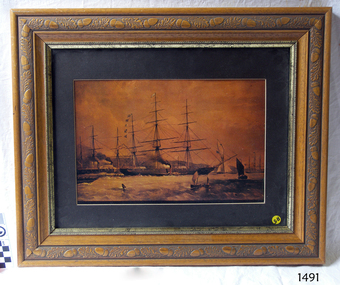
... Handwritten inscriptions on a round yellow sticker on the front and a white rectangular sticker on the back. Print Picture ...Print of a ship in the late 1800s set against a background of other ships (one of a steam paddle) and a reddish sky. Wooden decorative frame, with carved oak leaves and acorns and gold edging to print. Handwritten inscriptions on a round yellow sticker on the front and a white rectangular sticker on the back.Yellow sticker "A5". White sticker "67"flagstaff hill, warrnambool -
Blacksmith's Cottage and Forge
Badges, circa 1930s
... 2 identical metal badges with uneven round shapes. Lettering on blue background and relief picture of horse, cow, sheep, plough, sheaf in copper....Local history Civic cast badges civic memento Back to Bacchus Marsh October 1930 2 identical metal badges with uneven round shapes. Lettering on blue background and relief picture of horse, cow, sheep, plough, sheaf in copper. ...Donation from Mrs Noel Bond whose husband grew up in Bacchus Marsh and his father was shire engineer.Local history Civic2 identical metal badges with uneven round shapes. Lettering on blue background and relief picture of horse, cow, sheep, plough, sheaf in copper.Back to Bacchus Marsh October 1930cast, badges, civic memento -
 Flagstaff Hill Maritime Museum and Village
Card - Commemorative, Julian Aird, 'Illumination', Early 21st Century
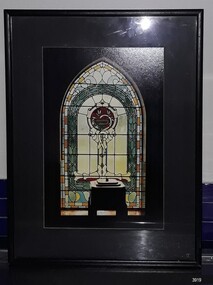
... Connell stained glass window baptism font gbert John Connell St Nicholas Seamen's Church warrnambool hospital Dr Connell Memorial Window Eastern View Picture Framers Steven & Annemarie Hocking Written by hand in black pen " 'ILLUMINATION' / MARITIME MUSEUM WARRNAMBOOL", "JULIAN AIRD / TEL/FAX. 03 52890457" " Printed on adhesive label "EASTERN VIEW / PICTURE FRAMERS" "Proprietors Steven & Annemarie Hocking / 162 Malop Street, Geelong, Vic, 3220 / Ph. (03) 5229 5935" Logo on label in centre of oval with text [2 tall water birds facing each other with a water fountain between them] This photograph captures the light shining through an arched, stained glass window behind a baptismal font. Rectangular framed photograph, portrait view, behind glass, with black frame and matt. A cord for hanging it is attached at the black, and there is a black, round ...The photograph was created by Geelong artist Julian Aird and framed by a business in Geelong. The window in the photograph is of the 1928 stained glass window and the baptism fold in the St Nicholas' Seamen's Chapel at Flagstaff Hill Maritime Village, which were installed at Flagstaff Hill's for the Chapel's opening in 1981. About the Window - The window in this photograph, once known as the Dr Connell Memorial Window, was a feature of an external wall adjacent to the Women’s and Children’s Wards of Warrnambool Hospital. Honorary Doctors had played a significant role in the operation of the hospital between the years 1900 to 1939. One of these doctors was Dr. Connell, who passed away in 1928. The green glass memorial nameplate has an inscription that dedicates the window to Dr. Connell. The inscription reads: "A tribute to Egbert John Connell M.B.B.S. who for 30 years rendered devoted and valuable service to this institution. Obiit April 4th 1928, A.D." The photograph's significance lies in the subject of the stained glass window, and its connection with the history of the local Warrnambool Base Hospital, dating to Dr Connell's work there in the early 20th century.This photograph captures the light shining through an arched, stained glass window behind a baptismal font. Rectangular framed photograph, portrait view, behind glass, with black frame and matt. A cord for hanging it is attached at the black, and there is a black, round felt pad on each lower rear corner. The photograph by Julian Aird is titled 'Illumination' and was framed in Geelong. Details of title, and photographer are handwritten on the back and and printed label gives the contact details of the framer. Written by hand in black pen " 'ILLUMINATION' / MARITIME MUSEUM WARRNAMBOOL", "JULIAN AIRD / TEL/FAX. 03 52890457" " Printed on adhesive label "EASTERN VIEW / PICTURE FRAMERS" "Proprietors Steven & Annemarie Hocking / 162 Malop Street, Geelong, Vic, 3220 / Ph. (03) 5229 5935" Logo on label in centre of oval with text [2 tall water birds facing each other with a water fountain between them]flagstaff hill maritime museum & village, maritime museum, maritime village, great ocean road, shipwreck coast, ulian aird, illumination, photograph, dr. connell, stained glass window, baptism font, gbert john connell, st nicholas seamen's church, warrnambool hospital, dr connell memorial window, eastern view picture framers, steven & annemarie hocking -
 Flagstaff Hill Maritime Museum and Village
Container - Wooden Box, 1930s
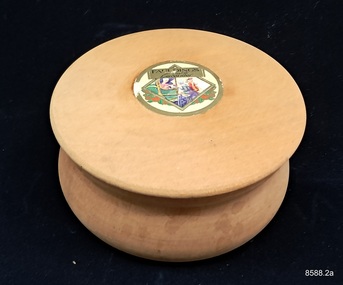
... Flagstaff Hill Maritime Museum and Village Great Ocean Road Shipwreck Coast Warrnambool Shipwtreck Coast Dr W R Angus Faulding's Lavender Powder Cosmetic Faulding's Old English Lavender, and picture of old English men and women in period costume. Container, wooden powder box with separate lid. Round ...One pharmaceutical enterprise which put greater emphasis on the manufacturing side of its business and whose successors strengthened this emphasis was Faulding's. A pharmacist, Francis H. Faulding, started his shop in Adelaide in 1841 and formed a partnership with an English physician, L. Scammel, in 1861. From its beginnings the firm showed a flare for innovation. After Simpson's discovery of the anaesthetic properties of chloroform in 1847, Francis Faulding was the first to import chloroform; in 1858 he distributed cocaine preparations; in 1864 he produced the first olive oil from South Australian olives and, after J. Lister's reports in Lancet on the reduction of mortality after surgery with the use of phenol, Faulding began production of antiseptics ('Solyptol') in 1867. Faulding was also the first to utilize the medicinal and antiseptic properties of eucalyptus oil which was obtained from distilleries on Kangaroo Island The Second World War in Europe disrupted the supply of cod liver oil, an important source of Vitamin A. Faulding chemists found an alternative source in white schnapper shark, which sustained supplies in Australia as well as generated exports to the UK . When supplies of I.G. Farben's newly discovered sulpha drugs ran out, Faulding became involved in the national program organised by the Medical Equipment Control Committee (MECC) and, jointly with universities, synthesised sulphanilamide. Following the transfer of American knowhow. Faulding's was also the first private enterprise to produce yet another life saving drug of military importance, penicillin. After the war basic synthesis of antibiotics became difficult to sustain by private enterprise because of the gigantic scale advantages of competing US producers, and competition in the synthesis of new drugs demanded huge investment in R & D; Fauldings maintained their business by a combination of marketing, wholesaling and producing consumer and medical products. In the 1970s, however, Fauldings set a remarkable precedent in research strategy and achievement in the Australian pharmaceutical business. They decided to concentrate their research on drugs which had proven efficacy, but which also suffered from certain shortcomings restricting their clinical usefulness, and to seek advances overcoming these shortcomings. This was an imaginative new strategy, a way of grafting Australian knowhow on to major products, in keeping with local resources and yet offering opportunities for sophisticated skill. At the same time it promised to open internatiSurgeon and onal markets, since the major producers of the basic drugs could hardly ignore significant advances. https://www.samhs.org.au/Virtual%20Museum/Medicine/drugs_nonsurg/Fauldings_drug/Fauldings_drugs.html This decorative gift box once containing Faulding’s Old English Lavender soap or powder belonged to Dr. Angus' wife, Gladys. It was donated to Flagstaff Hill Maritime Village by his daughter, Bernice McDade. It is part of the “W.R. Angus Collection” that includes historical medical equipment, surgical instruments and material once belonging to Dr Edward Ryan and Dr Thomas Francis Ryan, (both of Nhill, Victoria) as well as Dr Angus’ own belongings. The Collection’s history spans the medical practices of the two Doctors Ryan, from 1885-1926 plus that of Dr Angus, up until 1969. Powder or soap in boxes such as this was perfumed and used as part of a women’s personal grooming in the early to mid 20th century. Faulding’s Company began in Adelaide, Australia, in 1845 and made a wide range of cosmetic and perfume products as well as pharmaceuticals. The company is still in operation today. ABOUT THE “W.R.ANGUS COLLECTION” Doctor William Roy Angus M.B., B.S., Adel., 1923, F.R.C.S. Edin.,1928 (also known as Dr Roy Angus) was born in Murrumbeena, Victoria in 1901 and lived until 1970. He qualified as a doctor in 1923 at University of Adelaide, was Resident Medical Officer at the Royal Adelaide Hospital in 1924 and for a period was house surgeon to Sir (then Mr.) Henry Simpson Newland. Dr Angus was briefly an Assistant to Dr Riddell of Kapunda, then commenced private practice at Curramulka, Yorke Peninsula, SA, where he was physician, surgeon and chemist. In 1926, he was appointed as new Medical Assistant to Dr Thomas Francis Ryan (T.F. Ryan, or Tom), in Nhill, Victoria, where his experiences included radiology and pharmacy. In 1927 he was Acting House Surgeon in Dr Tom Ryan’s absence. Dr Angus had become engaged to Gladys Forsyth and they decided he further his studies overseas in the UK in 1927. He studied at London University College Hospital and at Edinburgh Royal Infirmary and in 1928, was awarded FRCS (Fellow from the Royal College of Surgeons), Edinburgh. He worked his passage back to Australia as a Ship’s Surgeon on the on the Australian Commonwealth Line’s T.S.S. Largs Bay. Dr Angus married Gladys in 1929, in Ballarat. (They went on to have one son (Graham 1932, born in SA) and two daughters (Helen (died 12/07/1996) and Berenice (Berry), both born at Mira, Nhill ) According to Berry, her mother Gladys made a lot of their clothes. She was very talented and did some lovely embroidery including lingerie for her trousseau and beautifully handmade baby clothes. Dr Angus was a ‘flying doctor’ for the A.I.M. (Australian Inland Ministry) Aerial Medical Service in 1928 . Its first station was in the remote town of Oodnadatta, where Dr Angus was stationed. He was locum tenens there on North-South Railway at 21 Mile Camp. He took up this ‘flying doctor’ position in response to a call from Dr John Flynn; the organisation was later known as the Flying Doctor Service, then the Royal Flying Doctor Service. A lot of his work during this time involved dental surgery also. Between 1928-1932 he was surgeon at the Curramulka Hospital, Yorke Peninsula, South Australia. In 1933 Dr Angus returned to Nhill and purchased a share of the Nelson Street practice and Mira hospital (a 2 bed ward at the Nelson Street Practice) from Dr Les Middleton one of the Middleton Brothers, the current owners of what previously once Dr Tom Ryan’s practice. Dr Tom and his brother had worked as surgeons included eye surgery. Dr Tom Ryan performed many of his operations in the Mira private hospital on his premises. He had been House Surgeon at the Nhill Hospital 1902-1926. Dr Tom Ryan had one of the only two pieces of radiology equipment in Victoria during his practicing years – The Royal Melbourne Hospital had the other one. Over the years Dr Tom Ryan had gradually set up what was effectively a training school for country general-practitioner-surgeons. Each patient was carefully examined, including using the X-ray machine, and any surgery was discussed and planned with Dr Ryan’s assistants several days in advance. Dr Angus gained experience in using the X-ray machine there during his time as assistant to Dr Ryan. When Dr Angus bought into the Nelson Street premises in Nhill he was also appointed as the Nhill Hospital’s Honorary House Surgeon 1933-1938. His practitioner’s plate from his Nhill surgery is now mounted on the doorway to the Port Medical Office at Flagstaff Hill Maritime Village, Warrnambool. When Dr Angus took up practice in the Dr Edward and Dr Tom Ryan’s old premises he obtained their extensive collection of historical medical equipment and materials spanning 1884-1926. A large part of this collection is now on display at the Port Medical Office at Flagstaff Hill Maritime Village in Warrnambool. In 1939 Dr Angus and his family moved to Warrnambool where he purchased “Birchwood,” the 1852 home and medical practice of Dr John Hunter Henderson, at 214 Koroit Street. (This property was sold in1965 to the State Government and is now the site of the Warrnambool Police Station. and an ALDI sore is on the land that was once their tennis court). The Angus family was able to afford gardeners, cooks and maids; their home was a popular place for visiting dignitaries to stay whilst visiting Warrnambool. Dr Angus had his own silk worm farm at home in a Mulberry tree. His young daughter used his centrifuge for spinning the silk. Dr Angus was appointed on a part-time basis as Port Medical Officer (Health Officer) in Warrnambool and held this position until the 1940’s when the government no longer required the service of a Port Medical Officer in Warrnambool; he was thus Warrnambool’s last serving Port Medical Officer. (Masters of immigrant ships arriving in port reported incidents of diseases, illness and death and the Port Medical Officer made a decision on whether the ship required Quarantine and for how long, in this way preventing contagious illness from spreading from new immigrants to the residents already in the colony.) Dr Angus was a member of the Australian Medical Association, for 35 years and surgeon at the Warrnambool Base Hospital 1939-1942, He served as a Surgeon Captain during WWII1942-45, in Ballarat, Victoria, and in Bonegilla, N.S.W., completing his service just before the end of the war due to suffering from a heart attack. During his convalescence he carved an intricate and ‘most artistic’ chess set from the material that dentures were made from. He then studied ophthalmology at the Royal Melbourne Eye and Ear Hospital and created cosmetically superior artificial eyes by pioneering using the intrascleral cartilage. Angus received accolades from the Ophthalmological Society of Australasia for this work. He returned to Warrnambool to commence practice as an ophthalmologist, pioneering in artificial eye improvements. He was Honorary Consultant Ophthalmologist to Warrnambool Base Hospital for 31 years. He made monthly visits to Portland as a visiting surgeon, to perform eye surgery. He represented the Victorian South-West subdivision of the Australian Medical Association as its secretary between 1949 and 1956 and as chairman from 1956 to 1958. In 1968 Dr Angus was elected member of Spain’s Barraquer Institute of Barcelona after his research work in Intrasclearal cartilage grafting, becoming one of the few Australian ophthalmologists to receive this honour, and in the following year presented his final paper on Living Intrasclearal Cartilage Implants at the Inaugural Meeting of the Australian College of Ophthalmologists in Melbourne In his personal life Dr Angus was a Presbyterian and treated Sunday as a Sabbath, a day of rest. He would visit 3 or 4 country patients on a Sunday, taking his children along ‘for the ride’ and to visit with him. Sunday evenings he would play the pianola and sing Scottish songs to his family. One of Dr Angus’ patients was Margaret MacKenzie, author of a book on local shipwrecks that she’d seen as an eye witness from the late 1880’s in Peterborough, Victoria. In the early 1950’s Dr Angus, painted a picture of a shipwreck for the cover jacket of Margaret’s book, Shipwrecks and More Shipwrecks. She was blind in later life and her daughter wrote the actual book for her. Dr Angus and his wife Gladys were very involved in Warrnambool’s society with a strong interest in civic affairs. He had an interest in people and the community They were both involved in the creation of Flagstaff Hill, including the layout of the gardens. After his death (28th March 1970) his family requested his practitioner’s plate, medical instruments and some personal belongings be displayed in the Port Medical Office surgery at Flagstaff Hill Maritime Village, and be called the “W. R. Angus Collection”.Fauldings Company is a very historical Australian company, still in operating today. The powder box is an example of fashion and grooming in the 1930's in Australia. The W.R. Angus Collection is significant for still being located at the site it is connected with, Doctor Angus being the last Port Medical Officer in Warrnambool. The collection of medical instruments and other equipment is culturally significant, being an historical example of medicine from late 19th to mid-20th century. Dr Angus assisted Dr Tom Ryan, a pioneer in the use of X-rays and in ocular surgery.Container, wooden powder box with separate lid. Round box is made from light coloured timber and was sold containing Faulding’s Old English Lavender cosmetic powder. The wooden bowl is light in colour and the lid has a decal with text and images of two ladies facing each other, a gentleman looking over his shoulder at them, and red roses. From the W.R. Angus Collection.Faulding's Old English Lavender, and picture of old English men and women in period costume.flagstaff hill maritime museum and village, great ocean road, shipwreck coast, warrnambool, shipwtreck coast, dr w r angus, faulding's, lavender, powder, cosmetic -
 Flagstaff Hill Maritime Museum and Village
Textile - Parsons' Farm Animal Series Oat Bags
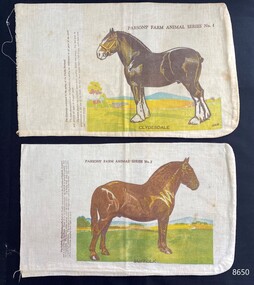
... round full appearance. The croup is straight, the legs short and free from feather. The invariable colour is chestnut, varying from light to dark. A set of two calico bags from the Parsons' company - most likely bought as oat bags. The two are: No 1. (Clydesdale) and No 3. (Suffolk) from the Parsons' Farm Animal Series. Each bag has a multicoloured ink picture ...Dry foods for domestic use were packaged in cloth bags from the late 19th century to the mid 20th century. As the bags contain the name Parsons' it could be presumed that they were oat bags as the Parsons Company packaged a variety of groceries for the Australian market including oats. The bags provide an example of calico bags used to store dry goods. Being presented as a ‘Farm Animal Series’ gives them added value as a collectable item and may have been an advertising ploy used by the company.A set of two calico bags from the Parsons' company - most likely bought as oat bags. The two are: No 1. (Clydesdale) and No 3. (Suffolk) from the Parsons' Farm Animal Series. Each bag has a multicoloured ink picture and written information about the horse described on the bag.8650.1 PARSONS' FARM ANIMAL SERIES No. 1, CLYDESDALE, The Clydesdale originated in the valley of the Clyde, Scotland. The main characteristics of the Clydesdale are ability to acclimatise in all parts of the world and perform all types of draught work. Clydesdale breeders lay emphasis upon bone, quality, weight, and action. The feet must be proportionate to the size of the horse, the hoof-head should have a full crown, with heels wide and quarters strong. 8650.2 PARSONS' FARM ANIMAL SERIES No. 3, SUFFOLK, The Suffolk, often known as the Suffolk Punch, originated in the County of Suffolk, England and is noted for its hardiness. From 15 to 16 hands in height, the Suffolk in general is smaller than the Clydesdale. The head is rather coarse, with the neck short. The body long, deep and wide with a round full appearance. The croup is straight, the legs short and free from feather. The invariable colour is chestnut, varying from light to dark.flagstaff hill maritime museum and village, great ocean road, shipwreck coast, warrnambool, calico, domestic object, textile, food storage, parsons' farm animal series, oats, clydesdale, suffolk -
 Flagstaff Hill Maritime Museum and Village
Photograph - Historical, building, Lighthouse Keeper's Quarters Warrnambool, Ca. 1917
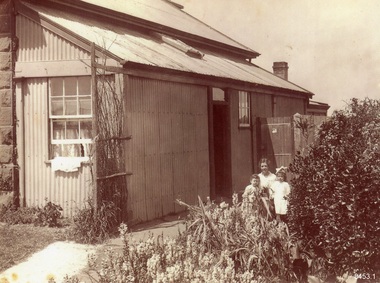
... Lighthouse Keeper's Cottage, Flagstaff Hill, Merri St Warrnambool" Stamp "John Stewart Lindsay, Pharmacist, --0 Thompson Street Warrnambool 3280" "HOWARD NICHOLL / FLAGSTAFF HILL / MERRI STREET" " KEEP OUT OF REACH OF CHILDREN / Lindsay's Pharmacy / 119 Liebig Street, Warrnambool / Tel. 5561 4310" [round symbol of mortar and pestle] Typed letter (from John Lindsay to Howard Nicholl, October 21 1997) Photograph from c. 1917 depicts the western side of the Warrnambool's Lighthouse keeper's Quarters constructed in bluestone, which was where the Assistant Lighthouse Keeper resided. The image shows the corrugated iron lean-to, and other rooms that were added to the original building after 1872, which were removed in the 1970s due to their poor condition. The members of the family pictured ...This photograph of the Warrnambool Lighthouse Keeper's Quarters was donated together with an accompanying letter written by John Lindsay on October 21st, 1997. The letter was addressed to Howard Nicholl, the Director of Flagstaff Hill at that time. The following information was gleaned from the contents of the letter and the labels attached to the photograph:- The photograph of the Cottage was taken in about 1917. The woman is Gertrude Shade, married to James Shade, who was the Warrnambool Town Council's Officer responsible for keeping records of Shipping activity entering and leaving the busy Port of Warrnambool. The couple and their children, Janet and William, were residents of the Assistant Lighthouse Keeper's Quarters at that time. The family is pictured in the garden on the west side of the building. A washhouse, these days referred to as a laundry, is behind the building and had already been removed when the Flagstaff Hill Planning Board had access to the site in 1972. The corrugated iron veranda was replaced in the 1980s with a smaller covered entry. Janet Shade married the man who lived across the road, Stewart Lindsay, in 1935. Stewart was employed by Nestle at the age of sixteen, working in the export department. He was acting Manager when the Manager became ill, supervising the loading of dairy products and biscuits into the holds of the waiting ships, where they were then exported to Indonesia. Many of the ships were registered in Liberia and the seamen were called 'lascar seamen, or Indian Sailors. Janet and Stewart had a son, John Stewart Lindsay, who was a Pharmacist, a member of the Warrnambool City Council, the Mayor of the City of Warrnambool, a former Director of Flagstaff Hill, and Chairman of the Flagstaff Hill Advisory Committee.This photograph has significance as a historical record of the Warrnambool Lighthouse Kerr'er's Quarters in 1917. The photograph connects the cottage to local families, to local industry, to the Port of Warrnambool, and to overseas exports from Warrnambool. Photograph from c. 1917 depicts the western side of the Warrnambool's Lighthouse keeper's Quarters constructed in bluestone, which was where the Assistant Lighthouse Keeper resided. The image shows the corrugated iron lean-to, and other rooms that were added to the original building after 1872, which were removed in the 1970s due to their poor condition. The members of the family pictured were residents at the time; Gertrude Shade (Mrs James Shade), her daughter Janet and her son William. Inscriptions are on the reverse and the accompanying envelope. Typed label "Gertrude Shade with William and Janet. Lighthouse Keeper's Cottage, Flagstaff Hill, Merri St Warrnambool" Stamp "John Stewart Lindsay, Pharmacist, --0 Thompson Street Warrnambool 3280" "HOWARD NICHOLL / FLAGSTAFF HILL / MERRI STREET" " KEEP OUT OF REACH OF CHILDREN / Lindsay's Pharmacy / 119 Liebig Street, Warrnambool / Tel. 5561 4310" [round symbol of mortar and pestle] Typed letter (from John Lindsay to Howard Nicholl, October 21 1997)flagstaff hill, warrnambool, maritime museum, shipwreck coast, great ocean road, lighthouse keeper's quarters, lighthouse keeper's cottage, gertrude shade, james shade, janet shade, john stewart lindsay, stewart lindsay, nestle, warrnambool exports, port of warrnambool, planning board, 1917, howard nicholl, william shade, export to indonesia, janet lindsay, light keeper -
Glenelg Shire Council Cultural Collection
Card - Cigarette Card, 1927
... White border round card. Reverse has information relating to picture on front....White border round card. Reverse has information relating to picture on front. Card Cigarette Card ...No. 1 in a series of 25 cigarette cards from Ogden's Tobacco Company series on whaling production. Full colour, depicts scene on docks preparing whaling ship for departure. White border round card. Reverse has information relating to picture on front. -
 Geelong RSL Sub Branch
ANZAC Day 1918 Commemoratived Medal, 1918
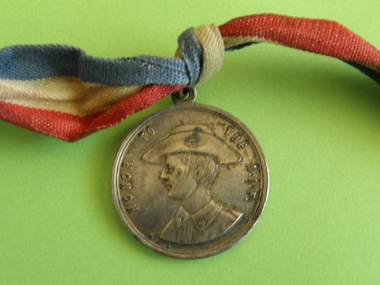
... ANZAC Day 1918 Commemorative Medal Victorian Education Department On the front of the medallion an engraved picture of a soldier, the words Honor to the AIF. One the back of the medallion ANZAC Dat 1918, Gallipoli, France, Palestine. Round ...These Medallions were made in 1918 to commemorate ANZAC Day. They were issued by the Education Department of Victoria to school children. The medal was also sold on behalf of the Australian Branch of the British Red Cross Society. The medal was made in bronze, silvered bronze, silver and gold.This medal is an original.Round silver medallion. ?Silver Bronze. Red, white and blue ribbon.On the front of the medallion an engraved picture of a soldier, the words Honor to the AIF. One the back of the medallion ANZAC Dat 1918, Gallipoli, France, Palestine.anzac day 1918 commemorative medal, victorian education department -
 Geelong RSL Sub Branch
Plate, 1990
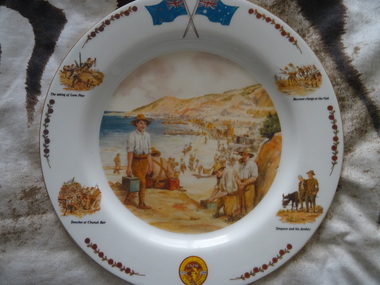
... A round plate, cream colour, a picture of Gallipoli Peninsula in the centre and smaller pictures round the ende of the plate. ...Signature of Brigadier A B Garland AM (RL) Issue Number 562 A round plate, cream colour, a picture of Gallipoli Peninsula in the centre and smaller pictures round the ende of the plate. ...This Plate was commissioned by the RSL of Australia to9 commemorate the Diamond Jubilee of the ANZAC Troops Landing at Gallipoli on 25 April 1915.The item is an original, theIssue Number is 562A round plate, cream colour, a picture of Gallipoli Peninsula in the centre and smaller pictures round the ende of the plate. The flags of Australia and New Zealand at the top of the plate.on the front of the plate 1915 to 1990, Landing at Gallipoli on 25 April 1915. On the back of the plate - This limited edition collector's plate was commissioned by the Returned and Services League of Australia to commemorate the Diamond Jubilee of the ANZAC Troops landing at Gallipoli on the 25 April 1915. Signature of Brigadier A B Garland AM (RL) Issue Number 562 gallipoli, diamond jubilee plate -
 The Beechworth Burke Museum
Photograph, 1870
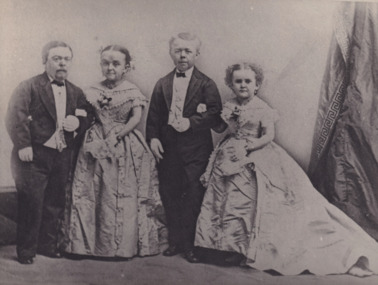
... Round the World" tour. Beechworth hosted the circus for three evening shows and two matinees. The photograph is historically significant due to the internationally renowned status of the four individuals pictured. ...Taken in 1870, the photograph depicts Charles Sherwood Stratton (known professionally as General Tom Thumb), Lavinia Stratton, George Washington Morrison Nutt (known professionally as Commodore Nutt), and Huldah Pierce Warren Bump (known professionally as Minnie Warren). They are all dressed in identical costumes worn in 1864 before Emperor Louis Napoleon and Empress Eugenia in Paris. Charles, Lavinia, George and Huldah were all American performers who traveled with the Barnum & Bailey Circus, founded by Phineas Taylor (P. T.) Barnum. They each participated in various acts including singing, dancing, miming, and celebrity impersonations, gaining international fame for their successful careers and small physical stature. The group performed in Australia in August 1870. They were joined by their touring party as part of the Barnum & Bailey Circus "Round the World" tour. Beechworth hosted the circus for three evening shows and two matinees.The photograph is historically significant due to the internationally renowned status of the four individuals pictured. In a general sense, it also provides insight into the arts in Victoria during the late nineteenth century, illustrating the type of entertainment that was enjoyed by the public during this time. The record's historical significance is further enhanced by the attire worn by the individuals in the photograph, and these garments' connections to Emperor Louis Napoleon and Empress Eugenia.Black and white rectangular photograph printed on matte photographic paper.Reverse: 4732.1 / General Tom Thumb + wife / Colonel Nutt + Minnie Warren / (?) / Beechworth / 1870 /entertainment album, general tom thumb, lavinia warren, commodore nutt, minnie warren, circus, p.t. barnum, barnum and bailey circus, beechworth, 1800s, performance, arts -
 Orbost & District Historical Society
magazine, Woman and Home, September 1940
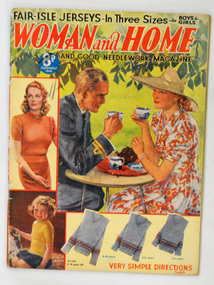
... The front cover has a a coloured picture of a man in a uniform and woman sitting at a round table drinking tea and photographs of knitted jumpers, the patterns of which are inside the magazine....The front cover has a a coloured picture of a man in a uniform and woman sitting at a round table drinking tea and photographs of knitted jumpers, the patterns of which are inside the magazine. ...Women’s magazines during WWII played a “reflecting role,” meaning they cooperated with government agendas while still including topics of readers’ interests Women’s employment rate skyrocketed during WWII. However, even though the number of women working outside the home grew rapidly most of them were still engaged entirely in homemaking. Therefore women’s magazines centered mostly on the stresses and shortages of wartime. Articles as well as advertisements presented information on “product rationing, tips on keeping the family healthy, guidelines for thrifty shopping and advice on how to look good through it all.This is an example of an English women's magazine published during WW11.It gives practical advice on needlework / knitting and evidences the widespread interest in contemporary fashion. In doing so it shows what were the fashionable, but broadly affordable, women's and children's clothing styles of their day. These magazines also reflect women's interests.A 64 pp magazine, titled Woman and Home and Good Needlework Magazine. The front cover has a a coloured picture of a man in a uniform and woman sitting at a round table drinking tea and photographs of knitted jumpers, the patterns of which are inside the magazine.Handwritten on front cover in pencil -Mehlert -
 Glenelg Shire Council Cultural Collection
Ephemera - Photograph storage sleeve, unknown
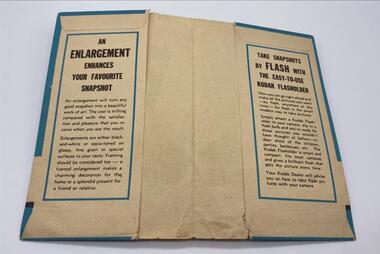
... Printed 'Photo-Finishing of Quality', 'Pictures to be treasured' Printed picture of a photo album with its cover partly open to show pictures in side. Two boxes of kodak film in the bottom right corner. Hand written in blue ink top left corner 'Bowering' Round ink stamp J.S. ...Bowering resident of Merino Victoria. womens history Ros Harris Merino Photography Printed 'Photo-Finishing of Quality', 'Pictures to be treasured' Printed picture of a photo album with its cover partly open to show pictures in side. Two boxes of kodak film in the bottom right corner. Hand written in blue ink top left corner 'Bowering' Round ink stamp J.S. ...Owned by Wilma Harris nee. Bowering resident of Merino Victoria.Photograph storage sleeve. Blue, fawn and black. Opens like a book to reveal a half page sleeve both sides. Various printed text inside and on the back cover.Printed 'Photo-Finishing of Quality', 'Pictures to be treasured' Printed picture of a photo album with its cover partly open to show pictures in side. Two boxes of kodak film in the bottom right corner. Hand written in blue ink top left corner 'Bowering' Round ink stamp J.S. McCONNELL CHEMIST MT GAMBIER. Handwritten in blue ink inside stamp 28047, E. 15/womens history, ros harris, merino, photography -
 Mission to Seafarers Victoria
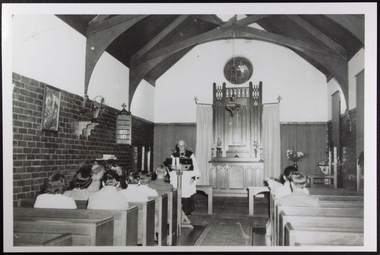
Photograph - Photograph, copy, The Age, St Nicholas' Mariners' Church, at Williamstown Mission to Seamen, with the lay reader in charge (Mr Stewart Murray) conducting a service, 14 June 1958
... The photograph wa published in the Age, 14th of June 1958. The picture shows the round stained glass dedicated on Sunday 14 December 1947 and the reredos with hangings donated by Maud Breaks in memory of her sister Louise Breaks and dedicated on 26 August 1954 by the Bishop of Geelong....The photograph wa published in the Age, 14th of June 1958. The picture shows the round stained glass dedicated on Sunday 14 December 1947 and the reredos with hangings donated by Maud Breaks in memory of her sister Louise Breaks and dedicated on 26 August 1954 by the Bishop of Geelong. ...The photograph wa published in the Age, 14th of June 1958. The picture shows the round stained glass dedicated on Sunday 14 December 1947 and the reredos with hangings donated by Maud Breaks in memory of her sister Louise Breaks and dedicated on 26 August 1954 by the Bishop of Geelong.This is a rare picture of the interior of the St Nicholas chapel which was erected behind the former E, S & A Bank building used by the Williamstown Seamen's Mission branch from 1944. Article in the Age reading: "Seamen's Window Dedicated - A window in St. Nicholas' Mariners' Church, at Williamstown, in memory of the merchant seamen who were killed on active service In the last war, was unveiled and dedicated yesterday.The ceremony was performed by the Bishop of Geelong (Rt. Rev. J. D. McKie). The window, erected by the Williamstown Lightkeepers' Auxiliary of the Victoria Missions to Seamen is placed behind the altar. It shows a quartermaster, with his hand on the wheel, and the figure of Christ pointing ahead. Bishop McKie paid a tribute to the spirit of the men who gave their lives at sea in the service of their country. He said the work of the auxiliary would still be of great value, although the war was over." The decision of the window was published in August 1947, Mrs Musther -who created the Lightkeepers' Auxiliary branch in Williamstown - ordered it from Brooks, Robinson & Co. (job books 1923-1966). The furniture and window were donated in 1979 to the Flagstaff Hill Maritime Village in Warrnanbool, and located in the chapel.Black and White Gloss print photograph - Image features a minister delivering a chapel serviceHand written in black texta; ... Mission to Seamen, Williamstown Chapel service... Circa 1957randall stewart murray, st nicholas the mariner chapel, chapel, lay reader, williamstown, victorian-seamens-mission, 139 nelson place, e,s and a bank, english, scottish and australian bank, stained-glass window, pews, lightkeepers' auxiliary, warrnambool, mrs musther, brooks, robinson & co, hymn board, david conolly
