
Showing 18 items matching "royal cafe"
-
 Charlton Golden Grains Museum Inc
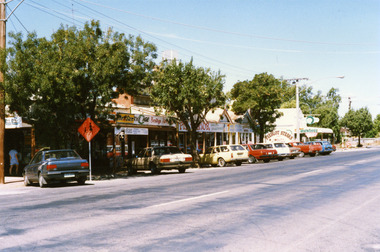
Photograph, Charlton Shire, Shops, east end of High St, Charlton c. 1987, c.1987
... ...Royal Cafe...Sold to F Jones in early 1940's. Royal Cafe built for Travaglia's c. 1912...Sold to F Jones in early 1940's. Royal Cafe built for Travaglia's c. 1912 Dudley Morse F Jones Royal Cafe Travaglia Charlton Business Colour photograph showing a row of shops. ...Newsagency established c. 1912 by Dudley & Morse. Sold to F Jones in early 1940's. Royal Cafe built for Travaglia's c. 1912Colour photograph showing a row of shops. Cars are parked in front of the shops and there are three trees. An orange school crossing sign is next to dark blue car. Person in pale blue on LH side of photo. There are a variety of signs displayed along the front of the shop verandahs. From left to right; The Sun, THE AGE, Bendigo Advertiser , FUN PARLOR, (both partially obscured by a tree), FRUIT & VEGETABLES, 7 DAYS WEEKLY, FISH & CHIPS, CHICKENS B.B.Q. Building at the end of the shops is a Butchery and has a large sign for FEEDLOT STEAKS on the side wall.dudley, morse, f jones, royal cafe, travaglia, charlton, business -
 Bendigo Historical Society Inc.
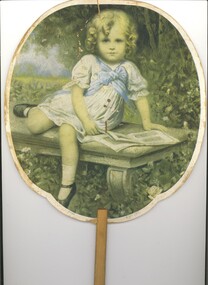
Ephemera - CAFÉ ROYAL ADVERTISING FAN
... CAFÉ ROYAL ADVERTISING FAN ...Cardboard fan advertising Café Royal 300 Hargreaves St Bendigo with a depictions of a small girl seated reading, on front , back reads Café Royal services & details, wooden handle.Steele Melbourne 2338 Made in USAcommerce, advertising, fan -
 Allan Doney Collection, Bendigo Historical Society Inc.
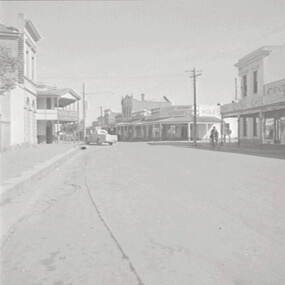
Negative - Inglewood - Street - Royal Hotel - Central Cafe, Allan Doney, 1950 -1970
... Inglewood - Street - Royal Hotel - Central Cafe...Negative Inglewood - Street - Royal Hotel - Central Cafe Allan Doney ...In the years of Allan Doney’s photography, landmark buildings succumbed to fire, neglect and redevelopment. He photographed the grey sand hills from Bendigo’s mining past, the streetscapes, poppet heads, miners’ cottages, gracious homes with ornate verandahs, trams and much more. Above all, his photographs show how much of the city has survived from the 19th century – and how much has not. Through two decades of great change, Allan Doney was there to capture ways people interacted with it. Although he travelled to many other places in Northern Victoria and beyond in search of subjects for his art, he seemed to always return to Bendigo for inspiration. -
 Ringwood and District Historical Society
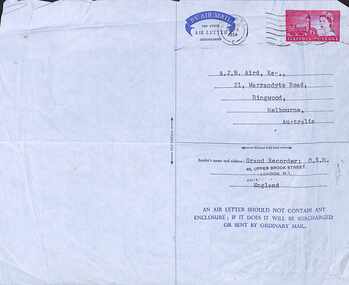
Letter, Grand Council of the Order of the Secret Monitor - Collection of Masonic Degrees and Correspondence maintained by Aird family of Ringwood, Victoria
... Aird regarding accepting the Office of Past Grand Standard Bearer and ability to attend the Grand Conclave Meeting for Investiture on 13th June, 1959, at the Cafe Royal, London....Aird regarding accepting the Office of Past Grand Standard Bearer and ability to attend the Grand Conclave Meeting for Investiture on 13th June, 1959, at the Cafe Royal, London. Grand Council of the Order of the Secret Monitor - Collection of Masonic Degrees and Correspondence maintained by Aird family of Ringwood, Victoria Letter ...Blue postmarked Airmail/Air Letter from Grand Council, O.S.M. London, dated 13th April, 1959 to A.J.B. Aird regarding accepting the Office of Past Grand Standard Bearer and ability to attend the Grand Conclave Meeting for Investiture on 13th June, 1959, at the Cafe Royal, London. -
 Federation University Historical Collection
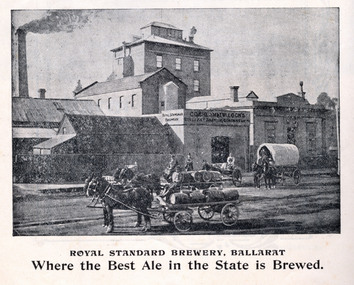
Book, Powell & Co, Guide to Ballarat the Beautiful, 1906, 1906
... Royal Hotel, McBride's Boots, John Lavis Cordial Manufacturer, R. Graham & Sons tanners, Lester's hotel, Sun Foundry, Central business College, Edwards Pyrites & Ore Reduction Co., George Farmer, Sturt Street (colour), Lake Wendouree, Ballarat East Town Hall, Lake Burrumbeet, Queen Victoria Statue, Fairy Land, Ballarat Botanical Gardens, Lal Lal Falls, Moorabool Falls, Kirks Dam, Lake Wendouree and paddle boat, Lydiard Street, Bopeep Creek, Star of the East Mine, Peter Lalor Statue, great Equatorial Telescopu at Oddie Observatory (Ballarat Observatory), Boer War monument, Entrance to Art Gallery of Ballarat, interior of Art Gallery of Ballarat, Old Curiosity Shop, Angus Rialto cafe, Ballarat Brewing Co, Royal Standard brwery, Phoenix Brewery Warrenheip, John MacLeod and Company...Royal Hotel, McBride's Boots, John Lavis Cordial Manufacturer, R. Graham & Sons tanners, Lester's hotel, Sun Foundry, Central business College, Edwards Pyrites & Ore Reduction Co., George Farmer, Sturt Street (colour), Lake Wendouree, Ballarat East Town Hall, Lake Burrumbeet, Queen Victoria Statue, Fairy Land, Ballarat Botanical Gardens, Lal Lal Falls, Moorabool Falls, Kirks Dam, Lake Wendouree and paddle boat, Lydiard Street, Bopeep Creek, Star of the East Mine, Peter Lalor Statue, great Equatorial Telescopu at Oddie Observatory (Ballarat Observatory), Boer War monument, Entrance to Art Gallery of Ballarat, interior of Art Gallery of Ballarat, Old Curiosity Shop, Angus Rialto cafe, Ballarat Brewing Co, Royal Standard brwery, Phoenix Brewery Warrenheip, John MacLeod and Company Guide to Ballarat the Beautiful, 1906 Book Powell & Co. ...A book highlighting Ballarat and surrounds for visiting tourists. Green, black and red soft covered book of 50 pages. The book includes many illustrations and advertisements. Themes of the book include: Ballarat and district, Lake Wendouree, Ballarat Botanical Gardens, Statues, gold and mining, Ballarat gold nuggets, Eureka Stockade, Ballarat School of Mines, Hepburn Lagoon, Emu River, race courses, Art gallery of Ballarat Advertisements include: Dr Lem Chinese Practictioner, Eureka Aerated Waters & Brewing Co., Sunshine Harvester, Gordon Bros., Long's biscuits, South Street, Grand National Eisteddfod of Australia, Lake View Hotel, Carlyon's Hotel, Clarendon Ladies' College, J.E. Sang Chinese Doctor and Herbalist, Reid's Ballarat Coffee Palace, Robert Sim & Co Timber Merchants, Cobb & C0 livery and stables Ballarat, Eagle Foundry, Fred A. Reed Tobacconist, Heinz bros butchers, J.J. Goller & Co. Illustrations include: Craig's Royal Hotel, McBride's Boots, John Lavis Cordial Manufacturer, R. Graham & Sons tanners, Lester's hotel, Sun Foundry, Central business College, Edwards Pyrites & Ore Reduction Co., George Farmer, Sturt Street (colour), Lake Wendouree, Ballarat East Town Hall, Lake Burrumbeet, Queen Victoria Statue, Fairy Land, Ballarat Botanical Gardens, Lal Lal Falls, Moorabool Falls, Kirks Dam, Lake Wendouree and paddle boat, Lydiard Street, Bopeep Creek, Star of the East Mine, Peter Lalor Statue, great Equatorial Telescopu at Oddie Observatory (Ballarat Observatory), Boer War monument, Entrance to Art Gallery of Ballarat, interior of Art Gallery of Ballarat, Old Curiosity Shop, Angus Rialto cafe, Ballarat Brewing Co, Royal Standard brwery, Phoenix Brewery Warrenheip, John MacLeod and Companyballarat, ballarat school of mines, buninyong, burrumbeet, cobb and co, eureka brewery, ballarat brewing co, sturt street, m1604, chinese, chinese medicine, d. lem, j.e. sang, brewery, tanners -
 Warrnambool and District Historical Society Inc.
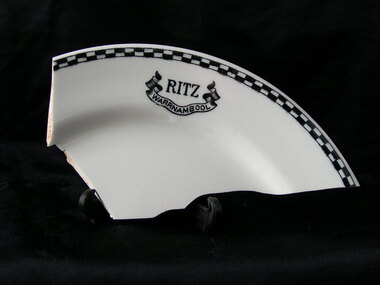
Plate, Ritz Warrnambool - fragment, Early 20th century
... The site was originally a hotel which traded under various names, including The Prince of Wales Dining Room, The Stork The Red Lion and later the Princess Royal after a fire in 1880 and it was delicensed in 1900. it later became the Mia mia cafe before a change to the Ritz. ...The site was originally a hotel which traded under various names, including The Prince of Wales Dining Room, The Stork The Red Lion and later the Princess Royal after a fire in 1880 and it was delicensed in 1900. it later became the Mia mia cafe before a change to the Ritz. ...The Ritz was situated near the corner of Lava and Liebig St. The site was originally a hotel which traded under various names, including The Prince of Wales Dining Room, The Stork The Red Lion and later the Princess Royal after a fire in 1880 and it was delicensed in 1900. it later became the Mia mia cafe before a change to the Ritz. A fragment from Warrnambool's past.Fragment of white plate with black and white check edge and logo of Ritz with Warrnambool in banner below it.Ritz Warrnambool.warrnambool, ritz cafe warrnambool -
 Port Melbourne Historical & Preservation Society
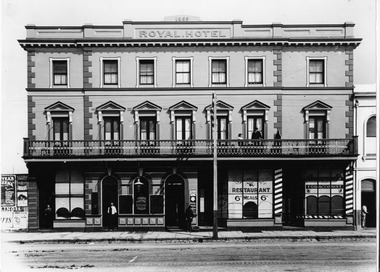
Photograph - Royal Hotel, Bay Street, Port Melbourne, 1913
... Business and Traders - Hotels Business and Traders - Cafes and Restaurants Built Environment Joseph O'SULLIVAN Lorenzo CAELLI Photograph of Royal Hotel in Bay Street c 1913 (built 1859), showing Lorenzo CAELLI's Restaurant Photograph Royal Hotel, Bay Street, Port Melbourne ...Photograph of Royal Hotel in Bay Street c 1913 (built 1859), showing Lorenzo CAELLI's Restaurantbusiness and traders - hotels, business and traders - cafes and restaurants, built environment, joseph o'sullivan, lorenzo caelli -
 Bendigo Historical Society Inc.
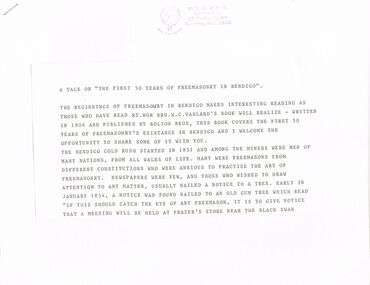
Document - TEXT OF TALK: THE FIRST 50 YEARS OF FREEMASONRY IN BENDIGO
... Cafe. mcG. W. Morse, Dunmaghlas, 36 Thomas Street Kangaroo Flat. 3555 TEXT OF TALK - ''THE FIRST 50 YEARS OF FREEMASONRY IN BENDIGO''. (Stamped on first and last page with name of Mc.G W Morse 'Dunmaghlas' 36 Thomas St, Kangaroo Flat. (author?; no date provided). Typed pages cut and mounted on 17 stapled pages. References to: W C Vahland; ''The Golden Lodge of Bendigo''; organ; Corinthian Lodge of Sandhurst; ''Black Liners''; Eaglehawk Lodge; Zenith Lodge; Golden and Corinthian Lodge; Art Union; Masonic Charity Sunday; Sandhurst Lodge; Corona Lodge; Royal Golden Chapter; Kinghts Templar; Mark Master Masons Degree; Document TEXT OF TALK: THE FIRST 50 YEARS OF FREEMASONRY IN BENDIGO ...TEXT OF TALK - ''THE FIRST 50 YEARS OF FREEMASONRY IN BENDIGO''. (Stamped on first and last page with name of Mc.G W Morse 'Dunmaghlas' 36 Thomas St, Kangaroo Flat. (author?; no date provided). Typed pages cut and mounted on 17 stapled pages. References to: W C Vahland; ''The Golden Lodge of Bendigo''; organ; Corinthian Lodge of Sandhurst; ''Black Liners''; Eaglehawk Lodge; Zenith Lodge; Golden and Corinthian Lodge; Art Union; Masonic Charity Sunday; Sandhurst Lodge; Corona Lodge; Royal Golden Chapter; Kinghts Templar; Mark Master Masons Degree;mcG. W. Morse, Dunmaghlas, 36 Thomas Street Kangaroo Flat. 3555clubs, social, freemasonry, bro. w.c. vahland, boltons brothers, bendigo gold rush, freemasons, brother r.c. mackenzie, criterian hotel, brother w. scott, brother edward salaman, grant's cafe. -
 Port Melbourne Historical & Preservation Society
Book - Borough of Sandridge, temporary liquor licenses, 1872
... Royal Hotel...George SEFTON...John BELL...Pier Hotel...Patrick MACAULAY...Chusan Hotel...James MEAGHER...Boundary Hotel...John William MARTIN...Globe Hotel...Michael Tarver QUINN...Council Club Hotel...Robert Urquhart MILLER...Miller's Cafe...Celebrations Fetes and Exhibitions Port Melbourne Town Hall Sport - Recreational Grounds James John BARTLETT Foresters Arms Hotel James MICHIE Fitzjames Hotel Spiro WILLIAMS Hibernian Hotel Charles Cooling SHARP Royal Hotel George SEFTON John BELL Pier Hotel Patrick MACAULAY Chusan Hotel James MEAGHER Boundary Hotel John William MARTIN Globe Hotel Michael Tarver QUINN Council Club Hotel Robert Urquhart MILLER Miller's Cafe Jeremiah HENNESSY Phoenix Hotel Martin JESSELL St Osyth Hotel Romulus DETHRIDGE George Hotel John William DARAN Commercial Hotel William STOWE Locomotive Hotel Thomas TURVILLE John McKENZIE Floodgate Hotel Ellen Maria HOWARD Marine Hotel Edward QUIGLEY Alfred Hotel George William FENNER Australian Eleven Hotel William Josh GLIFFORD Royal Mail Hotel Richard Walter WATTS Thomas DEGRUCHY George JULIAN Clare Castle Hotel James McELROY Brunswick Pier Hotel Business and Traders - Hotels Borough of Sandridge temporary license book: 79 stubs recording temporary liquor licenses issued 1873 to 1885 for balls etc., plus 21 unused licenses Book Borough of Sandridge, temporary liquor licenses A T Mason ...Borough of Sandridge temporary license book: 79 stubs recording temporary liquor licenses issued 1873 to 1885 for balls etc., plus 21 unused licensescelebrations fetes and exhibitions, port melbourne town hall, sport - recreational grounds, james john bartlett, foresters arms hotel, james michie, fitzjames hotel, spiro williams, hibernian hotel, charles cooling sharp, royal hotel, george sefton, john bell, pier hotel, patrick macaulay, chusan hotel, james meagher, boundary hotel, john william martin, globe hotel, michael tarver quinn, council club hotel, robert urquhart miller, miller's cafe, jeremiah hennessy, phoenix hotel, martin jessell, st osyth hotel, romulus dethridge, george hotel, john william daran, commercial hotel, william stowe, locomotive hotel, thomas turville, john mckenzie, floodgate hotel, ellen maria howard, marine hotel, edward quigley, alfred hotel, george william fenner, australian eleven hotel, william josh glifford, royal mail hotel, richard walter watts, thomas degruchy, george julian, clare castle hotel, james mcelroy, brunswick pier hotel, business and traders - hotels -
 Ballarat Tramway Museum
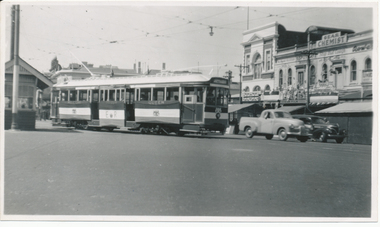
Negative - SECV Ballarat 38 decorated for the Queens visit entering Sturt St, Wal Jack, 5/03/1954
... Cafe buildings in the background. See image i2 for rear of photograph. See image i3 for hi res scan of print. See image i4 for hi res scan of negative. Yields information about the Ballarat's bogie trams, in particular No. 38 that was decorated for the Royal visit in 1954. ...Photograph of Ballarat 38 decorated for the Queens visit to Ballarat, entering Sturt St from Bridge St, Grenville St, 5-3-1954. Wal Jack Photograph. Has Gear Chemist and the Spot Cafe buildings in the background. See image i2 for rear of photograph. See image i3 for hi res scan of print. See image i4 for hi res scan of negative.Yields information about the Ballarat's bogie trams, in particular No. 38 that was decorated for the Royal visit in 1954.Negative and Digital image from the Wal Jack Ballarat Album.On rear in ink "SEC Ballarat No. 38 decorated for Queens visit, Sturt St 5-3-54". In top right hand corner is Wal Jack stamp with negative number "T64PC" written in.trams, tramways, royal visit, decorated trams, sturt st, grenville st, tram 38 -
 Stawell Historical Society Inc
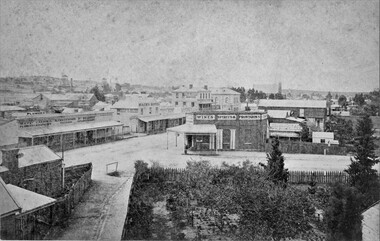
Photograph, Patrick Street and the Corner of Sloane Street with Stawell Court House in the background & St Patricks Church on the Horizon 1878
... Goodwin Cafe & Restaurant, Mack's Hotel, Grocer, Boot and Shoemaker, J. Farleys Auction Room, J.B. Wallis Royal Exchange Hotel, Stawell Court House and St Patricks Church in Distance On corner of Patrick and Sloane Streets, Melbourne Cash Store Wine Spirits & Provisions. ...Goodwin Cafe & Restaurant, Mack's Hotel, Grocer, Boot and Shoemaker, J. Farleys Auction Room, J.B. Wallis Royal Exchange Hotel, Stawell Court House and St Patricks Church in Distance On corner of Patrick and Sloane Streets, Melbourne Cash Store Wine Spirits & Provisions. ...Patrick Street Sloane Street intersection in the 1880’s (Herbert Photo) On Big Hill side of Patrick Street is Matthew Cairns Plumber & Gasfitter, R. Greenwood Tailor, Mrs. Goodwin Cafe & Restaurant, Mack's Hotel, Grocer, Boot and Shoemaker, J. Farleys Auction Room, J.B. Wallis Royal Exchange Hotel, Stawell Court House and St Patricks Church in Distance On corner of Patrick and Sloane Streets, Melbourne Cash Store Wine Spirits & Provisions. In background mining poppet head behind livery stable. St Patrick Church in distance on right. 1878Patrick St, Sloane St intersection looking south . The Stawell Library now occupies this corner.Victorian Views. C. Herbert, Photo. Stawell 1878stawell business streetscape -
Tatura Irrigation & Wartime Camps Museum
Photograph - copy, D. Clark, Royal Visit 1954, 1989 copy
... Victory Hall portico, on left, Youngs' Cafe and residence on right. on back: Royal Visit 1954 Black and white copy of photograph of welcome sign at corner of Hogan and Fraser Streets, Tatura, for Royal visit 1954. ...Photograph of decorative archway erected by Tatura Agricultural Society to greet the Queen. Victory Hall portico, on left, Youngs' Cafe and residence on right.Black and white copy of photograph of welcome sign at corner of Hogan and Fraser Streets, Tatura, for Royal visit 1954.on back: Royal Visit 1954 -
 Vision Australia
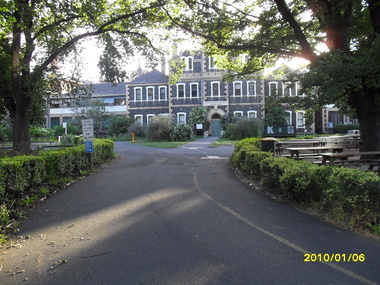
Photograph - Image, St Kilda Road building in 2010, 6/1/2010
... Cafe. The remainder of the site was then sold on to another developer. Unable to quickly proceed with their plans on developing the site for residential buildings, the site fell into some disrepair in the interim which was when these images were taken. Later the site was sold again and residential buildings now occupy part of the block. Royal ...In 2007, Vision Australia sold it's iconic 557-563 St Kilda Road site. The historic bluestone building was in need of renovation and repair, had limited space for staff and clients and with more demand for services in suburban and regional areas, did not meet the needs of the national organisation. The purchaser was mainly interested in the Ormond Hall section, which they sub-divided off and sold to the tenant of the Belgian Beer Cafe. The remainder of the site was then sold on to another developer. Unable to quickly proceed with their plans on developing the site for residential buildings, the site fell into some disrepair in the interim which was when these images were taken. Later the site was sold again and residential buildings now occupy part of the block. 20 images taken of and from St Kilda Road buildingroyal victorian institute for the blind, buildings, myer house, ferguson and urie -
Southern Sherbrooke Historical Society Inc.
Information folder - Edelston family
... Royal Melbourne Hospital School of Nursing Contract of Service by student nurse, for Cherry Edelston, dated 11 December 1957, with photo of Cherry attached. -Poem, "Growing Old" by William Powell: cover of wedding service, St John's Church of England, Malvern, 10 December 1960 for Cherry and Brian; photo of de Rooy family house destroyed by fire, April 1962: article, "Surprise shower tea for bride-elect"/Photo, "Signing the register", marriage of Cherry Edelston & Brian Fischer, 12 December 1960; article, "It was a great night for Cherry"; card, Wild Cherry Cafe, 163 Collins St; photo, Brian & Cherry Fischer; epithet, "Of all my wife's relations I like myself the best". ...Royal Melbourne Hospital School of Nursing Contract of Service by student nurse, for Cherry Edelston, dated 11 December 1957, with photo of Cherry attached. -Poem, "Growing Old" by William Powell: cover of wedding service, St John's Church of England, Malvern, 10 December 1960 for Cherry and Brian; photo of de Rooy family house destroyed by fire, April 1962: article, "Surprise shower tea for bride-elect"/Photo, "Signing the register", marriage of Cherry Edelston & Brian Fischer, 12 December 1960; article, "It was a great night for Cherry"; card, Wild Cherry Cafe, 163 Collins St; photo, Brian & Cherry Fischer; epithet, "Of all my wife's relations I like myself the best". ...Ephemera collected by Edelston family.Information folder containing items pertaining to the Edelston family. Contents: -Sheet of lined paper with hand-written names and dates of birth. -Southern Sherbrooke Historical Society data sheet, containing names and dates of birth. -Article, "Narre North lass weds leading footballer", re. Vivienne Loveridge and Geoffrey Beasley. -Article, "Doctor, 43, shot dead: Wife hit", Sun, 26th January, 1965, re. death of Dr Ronald Hyde. -Medical certificate of vaccinations and innoculations, Edwen Edelston, army record dated 1958. -Record of Services card, National Service, Edwen Edelston, dated 1958./Photo, party scene. -Baby Show certificate, Menzies Creek branch of the Red Cross Society, awarded to Leigh Edelston, plus photo of Leigh (?) and father. (2 copies) -Invitation to Robin Edelston's 21st birthday party, 24th January 1959, family photograph, and card notifying of change of venue for party. -Notice of change of venue for Robin Edelston's 21st birthday party, with small photos (apparently taken at the event) attached. -Article, "They helped Robin to celebrate". re. 21st birthday, with small photos attached. -Article, "Novel jet-age touch for spectacular Belle of Belles Ball", Dandenong Journal, 2nd November 1960 -Article, "Fourteen Belles for big Belle of Belles Ball this Friday night", also card "A. W. Edelston/builder and designer" -Royal Melbourne Hospital School of Nursing Contract of Service by student nurse, for Cherry Edelston, dated 11 December 1957, with photo of Cherry attached. -Poem, "Growing Old" by William Powell: cover of wedding service, St John's Church of England, Malvern, 10 December 1960 for Cherry and Brian; photo of de Rooy family house destroyed by fire, April 1962: article, "Surprise shower tea for bride-elect"/Photo, "Signing the register", marriage of Cherry Edelston & Brian Fischer, 12 December 1960; article, "It was a great night for Cherry"; card, Wild Cherry Cafe, 163 Collins St; photo, Brian & Cherry Fischer; epithet, "Of all my wife's relations I like myself the best". -Article, "Engagement announced at 21st birthday party", re. engagement of Cherry Edelston and Brian Fischer; thankyou card. -Article, "Married in same church as her parents", re. Cherry and Brian Fischer; bereavement card, Mrs Lillian Davie and daughter, dated August 1861; article, "'Miss City' sets the wedding date", re.Cherrie Gillingham. -Article, "Kerry Fox, many times belle, was pretty bride", re. Kerry and Edwen-Robin Edelston, Dandenong Journal, 1963, plus photo of bride and groom; card dated 4 January 1963, from Kerry & Robin to Mr & Mrs E. -Article, "Kerry Fox, hospital Ball belle at Narre Warren"; article, untitled from Weekly Times, on same subject, dated 12 December 1962. -Photo, Kerry Fox & Robin Edelston, re. Belle of Belles. -Photo, Kerry & Robin Edelston; engagement notice, Free Press, Fox-Edelston; article, "Double party: engagement, birthday, NWN"; Dandenong Journal flyer; (2 copies).edelston family -
 Melbourne Tram Museum
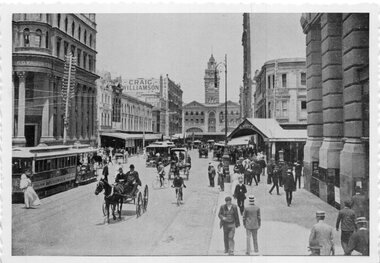
Photograph - Black & White Photograph/s, c1905
... In the background is Royal Bank, Craig Williamson, Sargent's Cafe and R. White on the corner. ...In the background is Royal Bank, Craig Williamson, Sargent's Cafe and R. White on the corner. ...Photographs, Black and White, Photo of Elizabeth St, to the north of Collins St looking south towards Flinders St and Flinders St Station. Has a bogie cable trailer in the view, along with other cable trams, horse drawn vehicles and many pedestrians. In the background is Royal Bank, Craig Williamson, Sargent's Cafe and R. White on the corner. The photograph has a serrated edge.In ink on the rear: Keith Kings stamp and number S-A-449 "Melbourne - Elizabeth St, looking south over Collins St. About 1900. Note Bogie Cable Trailer"trams, tramways, elizabeth st, collins st, cable trams -
 Melbourne Tram Museum
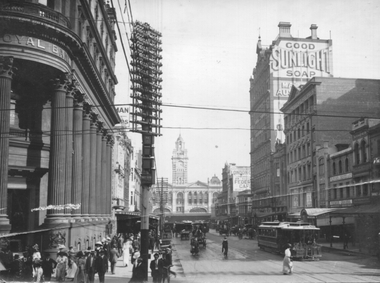
Photograph - Elizabeth St at Collins St, c1910
... The photo has the Royal Bank, Flinders St station, and many other buildings. In the view are Griffith Teas, Federal Cafe, Fletcher Chester & Co Grocers and a large sign for Good Sunlight Soap....The photo has the Royal Bank, Flinders St station, and many other buildings. In the view are Griffith Teas, Federal Cafe, Fletcher Chester & Co Grocers and a large sign for Good Sunlight Soap. ...The photograph shows Elizabeth St looking south from Collins St. The northbound cable tram set has the destination of Royal Park. The photo has the Royal Bank, Flinders St station, and many other buildings. In the view are Griffith Teas, Federal Cafe, Fletcher Chester & Co Grocers and a large sign for Good Sunlight Soap.Yields information about Elizabeth St c1910.Black and White photograph - printed on plain paper.On the rear has pencil number "KM-M-057".cable trams, tramways, collins st, elizabeth st -
 City of Melbourne Libraries
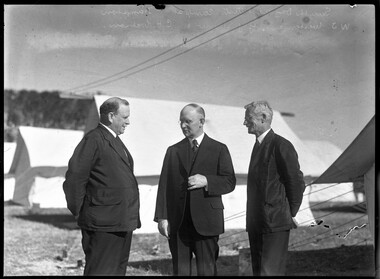
Photograph, Bull, Hugh Jones, 1897-1993, Seventh Day Adventists Camp at Hampton: W.J. Westerman, G.G. Stewart & C.H. Watson
... In December 1906 the Adventists branched out to Melbourne, opening the Sanitarium Health Food Cafe at 289 Collins Street next to the Royal Bank building. (corner Collins and Elizabeth Streets, demolished in 1939). ...In December 1906 the Adventists branched out to Melbourne, opening the Sanitarium Health Food Cafe at 289 Collins Street next to the Royal Bank building. (corner Collins and Elizabeth Streets, demolished in 1939). ...Photographer notations on slide: Seventh Day Adventists Camp at Hampton W.J. Westerman, G.G. Stewart & C.H. Watson Published: 28 December 1933 Published title: SEVENTH DAY ADVENTISTS. Published caption: “I. — The Annual Camp of the Seventh Day Adventists in Highett-road, Hampton, comprising more than 250 tents and accommodating over a thousand persons. II. —W. J. Westerman (vice-president of Australasian) and Pastor G. G. Stewart (president of Victoria), conversing with Pastor C. H. Watson (world president of the Seventh Day Adventists).- III.— Evangelist E. R. Gane and family.” SEVENTH DAY ADVENTISTS. (1933, December 28). The Age (Melbourne, Vic. : 1854 - 1954), p. 9. Retrieved August 1, 2025, from http://nla.gov.au/nla.news-article203356427 Research by project volunteer, Fiona Collyer: In December 1933, the annual Seventh Day Adventists Conference of Victoria was held, with over a 1000 participants camping for ten days at Highett Road Hampton. Pastor Charles H. Watson, world president of the Seventh Day Adventists, Walter J. Westerman, vice-president of Australasian and Pastor George G. Stewart, president of Victoria attended. Interestingly, The Age newspaper modified the original photo in their publication, placing the three men close to each other. Description: Three middle aged men dressed in suits converse in front of tents. In December 1933, delegates from all over Victoria and beyond travelled to Melbourne for the annual Seventh Day Adventists Conference of Victoria, held over ten days on a vacant allotment at Highett Road Hampton. A canvas town of 250 tents for over 1000 campers was created along with large marquees for lectures, devotional services and kitchens. Many daily visitors also attended the lectures and services. The principal speaker was Victorian born world president of the Seventh Day Adventists, Pastor Charles H. Watson (1877-1962), who travelled from Washington DC for the event. The Highett Street campers attended a busy schedule of bible readings, devotional services and health lectures during the ten days of the camp. Lecture subjects included- “Among the Head Hunters of the Solomon Islands”, “ Looking Through the Prophetic Telescope into 1934”, “Soul Surgery”, “Viewing the Celestial Land Through the Prophetic Telescope”and “The Four Horsemen of the Apocalypse”. The Seventh Day Adventist religion was established in the USA in 1863. One of its co-founders was American Ellen G. White whose writings are regarded as divinely inspired and are still adhered to today. Ellen preached on the “Eight Laws of Health”- Nutrition, exercise, water, sunshine, temperance, air, rest and trust in God. Adventists regard their bodies as holy temples and avoid food deemed by the Bible as unclean. They eat a mainly plant based diet with no caffeinated beverages and abstain from alcohol and tobacco. They believe in the observance of Saturday, the seventh day of the week in the Christian (Gregorian) and Hebrew calendars as the sabbath and the literal and imminent second coming of Jesus Christ. New converts are baptised by immersion in water. The Adventists opened the Warburton Sanitarium in 1910 as a health retreat, integrating their holistic health philosophy of physical, mental and spiritual well being. It was a resort in the hills “among picturesque mountain scenery…surrounded by tall forests and deep fern gullies…” where highly strung Melburians could alleviate their digestive maladies, stress and jaded nerves as “…worn down nervous systems mend quickly in this peaceful environment…invigorating air and an abundance of home-grown fruit, vegetables, fresh eggs, milk, and cream help to build healthy bodies”. The resort also offered hydrotherapy, massage and electrical treatments. An advertisement in The Argus- 1 December 1947 assured readers- “EVERYTHING SUNNY AGAIN." “That's how you'll feel when you say farewell to Warburton Sanitarium and Hospital after spending a holiday here. Victoria's Hydro is famous far and wide for wonders worked with sufferers from nervous and digestive disorders. Wholesome food, perfectly cooked; splendid air, regulated exercise, sweet natural sleep; these quickly correct faulty digestion, restore vitality, bring back that sunny optimism natural to healthy people. Massage and curative baths under medical supervision…” Later, after further building work, it became the Warburton Hospital with medical, casualty and obstetrics wards as well as offering strategies to stop smoking, lose weight and for stress management. The hospital ceased operation in 2001. Ellen G. White wrote “God sent me to Australia” and in 1891, accompanied by her son William C. White she arrived in Australia to start a Bible school, spread her health philosophy and for missionary work. At first health food products were imported from America, but it soon became apparent that due to the expense and the food becoming stale over the long journey, that local manufacturing was necessary. In 1898 William secured the services of American Adventist baker Edward C. Halsey, who had worked at Dr Kellogg’s Battle Creek (“Cereal City”), Sanitarium, Michigan, USA. They rented the St George’s bakery in Northcote, Melbourne, producing the first ready to eat breakfast cereal Granola, Caramel Cereal, and peanut butter. The fledgling company relocated to larger premises in Cooranbong, NSW soon after. The Sanitarium Health Food Company opened a factory in Warburton in 1925, manufacturing Granose Biscuits, Cerix Puffed Wheat, San-Bran, Bixies malted wheat flakes, Betta peanut butter, Marmite, “Kwic-Bru - A delicious health “coffee” made from choicest cereals and free from drugs that affect the heart and nerves” In 1928, Sanitarium bought out Grain Products Limited who were manufacturing a sweet cereal biscuit called Weet-Bix which soon became Australia’s favourite breakfast cereal. The Warburton factory closed in 1997, with manufacturing shifting interstate. Sanitarium breakfast cereal boxes offered free collectable cards inside and children could buy albums from grocers for sixpence and mount the cards. Subjects of the albums included- “Aboriginal Tribes, Legends, Customs”, “Australia- Yesterday and Today”, “Marvels of the Great Barrier Reef”, “Advance Australia- a Pageant of the Years”. In 1902 the Adventist’s opened the “Pure Food Vegetarian Cafe” in Sydney (In 1907 the name was changed to “Sanitarium Health Food Cafe”), Eating vegetarian food was definitely a curiosity. “Cristina” reviewed the cafe for The Australasian-27 October 1906. Topics For The Block. “Feeling somewhat like a criminal, and hoping to escape detection, I stealthily made my way into a vegetarian restaurant the other day... If my friends happened to catch me walking in there, I should henceforth be considered a crank, a faddist, and little short of a lunatic! Whom did I find within, seated with the air of habitués at the small tables, but heaps of my friends. They had all this while been pursuing their vegetarian way, layin' low and sayin' nuffin'. Flesh-eaters, now that the Sydney summer has set in apparently in good earnest, are beginning to wonder if the vegetarians are not wiser in their day and generation. Roast beef, hot cornea beef, ragouts, and meat curries, the very thought of them makes one feel hot. Frosted lemon pudding, stewed fruits, wheatmeal rolls, and tomatoes sound nice when you look at their names on the vegetarian menu. Such weird messes are served, square, unintelligible blocks of some brown substance, a few bites of which form a full and satisfying meal. Cold nut foods, granose, nuttose, and jam protose, bromose, with jelly and various "ose" sandwiches, impossible for the unbeliever to diagnose, are put before you. You drink malted nut broth, you eat gluten sticks, stewed beans, lentil patties, with vegetable sauce, any or all of which are distinctly nourishing and filling at the price. A mock (decidedly mock) veal cutlet or a red lentil roast is sufficient lunch, it appears, for anyone. Thus, "you obtain the best working results from your machinery with the least possible expenditure..." In December 1906 the Adventists branched out to Melbourne, opening the Sanitarium Health Food Cafe at 289 Collins Street next to the Royal Bank building. (corner Collins and Elizabeth Streets, demolished in 1939). Their motto was “Quality and Purity”. “Cynthia” of The Leader “Social Circle” column reviewed the cafe in 9 March 1907- “Hundreds of people have a feeling of positive affection for a diet that will be satisfying, appetising and nourishing, without having meat for its backbone. It will come as news that we have in Melbourne a cafe where you can really enjoy yourself without eating anything in the way of meat. Cream, custard, cheese and the like are not cold shouldered out of the menu, and the housewife in search of new dishes will find here ever so much in the way of suggestions. Nuts figure conspicuously in the menu, and lentil and walnut cutlets may be instanced among the delicacies. Beans are cooked in quite alluring fashion, while creamed parsnips are excellent. For sandwiches you could hardly desire anything more appetising than granosi biscuits, and nut cheese. The combination is suggestive of school lunches, and nut meat might well be employed as a variant. A visit to the cafe itself — it is next the Royal Bank in Collins-street — will surprise anyone used to the average vegetarian restaurant. Every thing is fresh, fragrant, and thoroughly modern… It is run, in connection with that curious people the Seventh Day Adventists.” However, “Adele” writing for the Evelyn Observer and Bourke East Record -13 December 1907 had a different experience- CITY RESTAURANTS. “There is no glamour from the outside. We enter the dining room at six and secure a seat at a small table, for this night we are going to dine on vegetables. Some people pride themselves on being vegetarians, and devote a great deal of their spare cash and energy to disseminating vegetarian principles. I shall not in a hurry forget the dinner we tried to get through at this vegetarian restaurant. There was put before us plate after plate of vegetables not soaked, but sodden with water, not an atom of flavouring or dressing; no attempt was made to give the slightest piquancy to potato, cabbage, turnip or carrot. I beg pardon, I am unjust, there were two caterpillars in the cabbage. It is astonishing how persistently ordinary cooks spoil vegetables in the process of cooking and how little they understand the value of vegetables on a menu.” From the extensive menu of 1924, you could order cream of green pea soup, followed by nut meat with Yorkshire pudding, egg timbales, stewed brown lentils, savoury rissoles with piquant sauce. Among the dessert offerings were creamed sago, steamed figs and walnut drops. Washed down with fermented wine and to finish, “Frucerea”, a coffee substitute essence made from fruit and cereal. A four course meal of soup, entree, vegetables and sweets cost 1/6 in 1924. Proving that plant-based food was not just a novelty, 67,000 meals were served at the cafe in 1918, rising to 73,000 in 1921. Later the Sanitarium Cafe moved to 293 Little Collins Street, (opposite Royal Arcade) sharing the building with The Lilliput Golf Course, a miniature golf course of 18 holes. The course was a replica of the fashionable Lido Course in France and was open daily from 10am to midnight with a green fee of one shilling. It featured goldfish, waterfalls and dance music. Lilliput boasted that they were “Melbourne’s coolest indoor course” Miniature golf (mini, minnie, midget, miget, Tom Thumb, Wee golf, putt-putt, pigmy, peewee, crazy golf, obstacle golf) swept the globe in the 1930s, starting in the USA, then Europe. The courses provided affordable recreation during uncertainty at the start of the Great Depression. The craze arrived in Sydney September 1930 with the first mini golf course opening in the basement of the State Theatre. It featured a replica Sydney Harbour Bridge and attracted over 1000 players a day at one shilling per game. The miniature golf bug hit Melbourne hard in 1930-31 with nearly 200 courses springing up in the CBD and suburbs within a few months. The first miniature golf course to open in Melbourne was on 4 October 1930 in the basement of recently built art deco style Wentworth House at 203 Collins Street, designed by architect Cedric Heise Ballantyne, (also designed Regent Theatre, Plaza Ballroom, Athenaeum Club, National Theatre, St Kilda, built in 1930, demolished in 1974 for the City Square) It was managed by J. C. Williamson who advertised for a “Girl Spruiker” who “Must be Young, Attractive Personality, and Able to Talk to the Public” to work at the course. The Age 26 September 1930 reported - “The Wentworth House management have spared no expense in preparing the links. Water hazards, sand bunkers, running streams, ancestral castles, moats and a cunning drawbridge have each been devised to test the skill of players, while the walls and ceiling have been "atmospherically" treated to convey an exterior effect”. Even Melbourne City Council jumped on the bandwagon, leasing the lower hall of Melbourne Town Hall to colourful car dealer and racehorse owner Mr A. G. Barlow for £43 per week for the “Kit Kat Tiny Golf Course”, opening on 11 December 1930. (Turf identity, Mr Alexander George Barlow, (1880-1937) who raced under the nom de course “A. G. Vauxhall”, owned filly Frances Tressady, who in 1923 won the Victoria Derby and Oaks Stakes double and came fifth in the Melbourne Cup. The “Frances Tressady Stakes” is held each March at Flemington Racecourse in honour of the horse, the last filly to win the Derby. Barlow was the proprietor of Barlow Brothers Pty Ltd car dealership at 442 Elizabeth Street, Melbourne. He played 14 games for Carlton Football Club (VFL) on the half-forward line from 1901-1903). Patrons could vie for The Herald Miniature Golf Championship Cup, a gold cup worth £7/7, in an eight week long competition. Sports newspaper The Sporting Globe also offered a Cup and prize money. Many courses offered prizes of theatre tickets, cash and cigarettes. Myer’s department store, hoping to cash in on the fad, advertised in Melbourne’s newspapers that their Sports Department could design and equip complete miniature golf courses using “Fairway” imitation turf at 4/6 a yard. Newspaper cartoonists loved to lampoon the fad. Both Percy Leason, cartoonist for society magazine Table Talk and Syd Miller of Smith’s Weekly depicted “real” golfers causing havoc on a mini golf course, showing that being a “real” golf player was no advantage to playing miniature golf. But bust often follows boom. With such rapid market saturation, expensive novel hazards, waning interest, long opening hours, often to midnight, and price cutting of game fees from one shilling to sixpence and then to threepence amongst some courses, the bubble was bound to burst. The Sporting Globe columnist J.M.Dillon on 20 May 1931 lamented- £100,000 LOST Failure of ‘Minnie’ Golf. “Miniature golf might have provided fun and jokes for thousands of people in Australia, but there were many for whom it panned out a tragedy. It is likely that the dead losses of those who attempted to make money out of the game in Australia were in the vicinity of £100,000. …For a while there was hardly a spare block of land, or a possible “site” in the shape of a hall, or a showroom, in Sydney and Melbourne, that some one was not after to set upon it a “minnie links.” Big amusement firms and private individuals anxious to make money began to run courses. Practically every individual who touched the game had his finger’s financially burnt. …From the approximately £60,000 invested in Melbourne alone, there must have been £25,000 lost. …There are now dozens of courses going to ruin, and many more that the owners would be happy to give away if the takers would remove from them obligations of leases, &c…” The lease on the “Kit Kat Tiny Golf Club” at the Melbourne Town Hall expired on 30 April 1931, with Mr Barlow losing £798 on the venture. The hazards and fittings, which cost £400 and included a large replica of the Town Hall, now worthless. Due to declining patronage, the Little Collins Street cafe closed in 1938, although the adjacent shop continued to sell Sanitarium products. In New Zealand, the first Sanitarium factory opened in Christchurch in 1900, with the company later opening factories in Palmerston North and Auckland. The Adventists opened vegetarian cafes, firstly at 37 Taranaki Street Wellington in 1906, followed by cafes in Auckland, Christchurch and Dunedin. Weet-Bix is also New Zealand’s favourite cereal- there the jingle is “Kiwi kids are Weet-Bix kids.” In 1955, the Australian Women’s Weekly ran an illustrated, full colour advertisement featuring New Zealand born Edmund Hillary (later Sir) 1919-2008, who, along with Sherpa Tenzing Norgay, was the first climber to reach the summit of Mount Everest on 29 March 1953. The Australian Women’s Weekly, 30 March, 1955- “WEET-BIX carried by Hillary on Himalayan adventure! c/- N.Z. Alpine Club Inc., Dunedin, New Zealand. The Manager, Sanitarium Health Food Company, Christchurch, N.Z. Dear Sir. …Weet-Bix was chosen at my special request as I had always felt that some easily prepared form of breakfast was essential to the primitive conditions of high camps. Weet-Bix fulfilled its task very well indeed. We usually had them with hot milk (powdered) and sugar, and even when we were unable to eat anything else, we usually managed to have a little Weet-Bix . . . I regard them as a great success and expect they will be more widely used in the Himalayas in future. Yours faithfully, (Signed) E.P. Hillary. Sanitarium Marmite - motto- “Too much spoils the flavour”- is as beloved with Kiwis as Vegemite is with Australians. In 1966, a fire gutted the Christchurch Marmite factory causing a nation wide shortage. Once the factory was rebuilt, Sanitarium relaunched the yeasty extract in reusable glass tumblers with printed designs such as yachts, New Zealand birds and vintage cars. These popular collectibles can still be found in the kitchen cupboards of many New Zealand baches (holiday homes). After the devastating 2011 earthquake in Christchurch damaged the Marmite factory causing shortages and panic buying, a “Marmageddon” was declared with jars of the “black gold” advertised online for up to NZ$800. Consumers were advised to spread their Marmite sparingly until production resumed. (The Christchurch plant reportedly produces around 640,000kg of Marmite per year). Sanitarium Health and Wellbeing Company is exempt from paying company income tax on their profits due to their ownership by a religious organisation. Although not a compulsory rule for salvation, Adventists are encouraged to pay a tithe of 10% of their income to the church to support the ministry in God’s work. Nowadays, there are over 25 million members of the Seventh Day Adventists Church in 200 countries. ITEMS OF INTEREST (1933, December 22). The Argus (Melbourne, Vic. : 1848 - 1957), p. 8. Retrieved July 21, 2025, from http://nla.gov.au/nla.news-article11723188 SEVENTH DAY ADVENTISTS. (1933, December 28). The Age (Melbourne, Vic. : 1854 - 1954), p. 9. Retrieved July 1, 2025, from http://nla.gov.au/nla.news-article203356427 EVANGELISTS' CAMP (1933, December 20). The Herald (Melbourne, Vic. : 1861 - 1954), p. 30. Retrieved July 1, 2025, from http://nla.gov.au/nla.news-article243213209 Master Butchers Have A Time Pilots FOR School Air Race Charity Golf At Riversdale (1931, May 1). The Sun News-Pictorial (Melbourne, Vic. : 1922 - 1954; 1956), p. 14-15. Retrieved September 4, 2025, from http://nla.gov.au/nla.news-article276159136 2000 ADVENTISTS UNDER CANVAS (1933, December 27). The Herald (Melbourne, Vic. : 1861 - 1954), p. 17. Retrieved July 1, 2025, from http://nla.gov.au/nla.news-article243223698 TOPICS FOR THE BLOCK. (1906, October 27). The Australasian (Melbourne, Vic. : 1864 - 1946), p. 45. Retrieved August 30, 2025, from http://nla.gov.au/nla.news-article139178204 https://en.wikipedia.org/wiki/Seventh-day_Adventist_Church https://www.sanitarium.com/au/about/sanitarium-story/profits-for- ENTERTAINMENT AT MENZIES'. (1906, December 6). Punch (Melbourne, Vic. : 1900 - 1918; 1925), p. 26. Retrieved August 3, 2025, from http://nla.gov.au/nla.news-article175380296 https://encyclopedia.adventist.org/article?id=9HN0&highlight=Conference SOCIAL CIRCLE (1907, March 9). Leader (Melbourne, Vic. : 1862 - 1918, 1935), p. 41. Retrieved August 3, 2025, from http://nla.gov.au/nla.news-article196649677 CITY RESTAURANTS. (1907, December 13). Evelyn Observer and Bourke East Record (Vic. : 1902 - 1917), p. 1 (MORNING.). Retrieved August 3, 2025, from http://nla.gov.au/nla.news-article61133109 Advertising (1924, May 6). The Sun News-Pictorial (Melbourne, Vic. : 1922 - 1954; 1956), p. 9. Retrieved August 3, 2025, from http://nla.gov.au/nla.news-article274271406 1930, December 5). The Herald (Melbourne, Vic. : 1861 - 1954), p. 14. Retrieved August 5, 2025, from http://nla.gov.au/nla.news-page26374135 Thousands Are Still Playing Miniature Golf (1931, January 2). The Herald (Melbourne, Vic. : 1861 - 1954), p. 11. Retrieved August 8, 2025, from http://nla.gov.au/nla.news-article242880087 MINIATURE GOLF. (1930, October 16). The Argus (Melbourne, Vic. : 1848 - 1957), p. 10. Retrieved August 8, 2025, from http://nla.gov.au/nla.news-article4209280 THE REAL GOLFER WHO FORGOT HIMSELF ON THE MINIATURE GOLF COURSE (1930, November 13). Table Talk (Melbourne, Vic. : 1885 - 1939), p. 13. Retrieved August 8, 2025, from http://nla.gov.au/nla.news-article146706596 Advertising (1930, December 5). The Herald (Melbourne, Vic. : 1861 - 1954), p. 14. Retrieved August 8, 2025, from http://nla.gov.au/nla.news-article242761991 Advertising (1931, January 9). The Herald (Melbourne, Vic. : 1861 - 1954), p. 12. Retrieved August 8, 2025, from http://nla.gov.au/nla.news-article242887972 1955, March 30). The Australian Women's Weekly (1933 - 1982), p. 38. Retrieved August 9, 2025, from http://nla.gov.au/nla.news-page4812489 £100,000 LOST (1931, May 20). Sporting Globe (Melbourne, Vic. : 1922 - 1954), p. 1 (Edition1). Retrieved August 14, 2025, from http://nla.gov.au/nla.news-article183023946 1930, December 5). The Herald (Melbourne, Vic. : 1861 - 1954), p. 14. Retrieved August 15, 2025, from http://nla.gov.au/nla.news-page26374135 Advertising (1931, January 23). The Herald (Melbourne, Vic. : 1861 - 1954), p. 14. Retrieved August 15, 2025, from http://nla.gov.au/nla.news-article242887795 MINIATURE GOLF. (1931, February 5). The Dandenong Journal (Vic. : 1927 - 1954), p. 6. Retrieved August 16, 2025, from http://nla.gov.au/nla.news-article201082526 Still Time To Enter Midge (1931, January 16). The Herald (Melbourne, Vic. : 1861 - 1954), p. 12. Retrieved August 16, 2025, from http://nla.gov.au/nla.news-article242888830 WIT OF THE WEEK (1930, October 23). Table Talk (Melbourne, Vic. : 1885 - 1939), p. 23. Retrieved August 29, 2025, from http://nla.gov.au/nla.news-article146455050 Advertising (1930, October 2). Table Talk (Melbourne, Vic. : 1885 - 1939), p. 16. Retrieved August 18, 2025, from http://nla.gov.au/nla.news-article146454620 MIDGET GOLF LINKS. (1930, September 26). The Age (Melbourne, Vic. : 1854 - 1954), p. 6. Retrieved August 18, 2025, from http://nla.gov.au/nla.news-article202235074 https://www.smh.com.au/national/fairfax-archive-mini-golf-20131125-2y608.html TURF NOTES (1923, November 6). The Ballarat Star (Vic. : 1865 - 1924), p. 6. Retrieved September 3, 2025, from http://nla.gov.au/nla.news-article213855201 Advertising (1930, October 4). The Herald (Melbourne, Vic. : 1861 - 1954), p. 10. Retrieved October 14, 2025, from http://nla.gov.au/nla.news-article242937272 LAUGHTER AND TEARS. (1930, November 15). Smith's Weekly (Sydney, NSW : 1919 - 1950), p. 21. Retrieved September 9, 2025, from http://nla.gov.au/nla.news-article234426874 Advertising (1947, December 1). The Argus (Melbourne, Vic. : 1848 - 1957), p. 5. Retrieved September 15, 2025, from http://nla.gov.au/nla.news-article22523355Photographer notations on slide: "Seventh Day Adventists Camp at Hampton W.J. Westerman, G.G. Stewart & C.H. Watson".religion, health food, mini golf, 1930-1939, tents, churches, camps -
 City of Melbourne Libraries
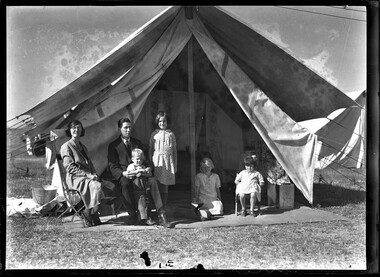
Photograph, Bull, Hugh Jones, 1897-1993, Seventh Day Adventists Camp at Hampton: E. Gane + family
... In December 1906 the Adventists branched out to Melbourne, opening the Sanitarium Health Food Cafe at 289 Collins Street next to the Royal Bank building. (corner Collins and Elizabeth Streets, demolished in 1939). ...In December 1906 the Adventists branched out to Melbourne, opening the Sanitarium Health Food Cafe at 289 Collins Street next to the Royal Bank building. (corner Collins and Elizabeth Streets, demolished in 1939). ...Photographer notations on slide: Seventh Day Adventists Camp. E Gane + family Published: 28 December 1933 Published title: SEVENTH DAY ADVENTISTS. Published caption: “I. — The Annual Camp of the Seventh Day Adventists in Highett-road, Hampton, comprising more than 250 tents and accommodating over a thousand persons. II. —W. J. Westerman (vice-president of Australasian) and Pastor G. G. Stewart (president of Victoria), conversing with Pastor C. H. Watson (world president of the Seventh Day Adventists).- III.— Evangelist E. R. Gane and family.” SEVENTH DAY ADVENTISTS. (1933, December 28). The Age (Melbourne, Vic. : 1854 - 1954), p. 9. Retrieved August 1, 2025, from http://nla.gov.au/nla.news-article203356427 Research by project volunteer, Fiona Collyer: In December 1933, evangelist Mr E.R. Gane and his family gather outside their tent during the ten day Seventh Day Adventist Conference held in Highett Road, Hampton. Description: A woman, man and four small children sit and stand in front of a tent. One child plays with a toy train. In December 1933, delegates from all over Victoria and beyond travelled to Melbourne for the annual Seventh Day Adventists Conference of Victoria, held over ten days on a vacant allotment at Highett Road Hampton. A canvas town of 250 tents for over 1000 campers was created along with large marquees for lectures, devotional services and kitchens. Many daily visitors also attended the lectures and services. The principal speaker was Victorian born world president of the Seventh Day Adventists, Pastor Charles H. Watson (1877-1962), who travelled from Washington DC for the event. The Highett Street campers attended a busy schedule of bible readings, devotional services and health lectures during the ten days of the camp. Lecture subjects included- “Among the Head Hunters of the Solomon Islands”, “ Looking Through the Prophetic Telescope into 1934”, “Soul Surgery”, “Viewing the Celestial Land Through the Prophetic Telescope”and “The Four Horsemen of the Apocalypse”. The Seventh Day Adventist religion was established in the USA in 1863. One of its co-founders was American Ellen G. White whose writings are regarded as divinely inspired and are still adhered to today. Ellen preached on the “Eight Laws of Health”- Nutrition, exercise, water, sunshine, temperance, air, rest and trust in God. Adventists regard their bodies as holy temples and avoid food deemed by the Bible as unclean. They eat a mainly plant based diet with no caffeinated beverages and abstain from alcohol and tobacco. They believe in the observance of Saturday, the seventh day of the week in the Christian (Gregorian) and Hebrew calendars as the sabbath and the literal and imminent second coming of Jesus Christ. New converts are baptised by immersion in water. The Adventists opened the Warburton Sanitarium in 1910 as a health retreat, integrating their holistic health philosophy of physical, mental and spiritual well being. It was a resort in the hills “among picturesque mountain scenery…surrounded by tall forests and deep fern gullies…” where highly strung Melburians could alleviate their digestive maladies, stress and jaded nerves as “…worn down nervous systems mend quickly in this peaceful environment…invigorating air and an abundance of home-grown fruit, vegetables, fresh eggs, milk, and cream help to build healthy bodies”. The resort also offered hydrotherapy, massage and electrical treatments. An advertisement in The Argus- 1 December 1947 assured readers- “EVERYTHING SUNNY AGAIN." “That's how you'll feel when you say farewell to Warburton Sanitarium and Hospital after spending a holiday here. Victoria's Hydro is famous far and wide for wonders worked with sufferers from nervous and digestive disorders. Wholesome food, perfectly cooked; splendid air, regulated exercise, sweet natural sleep; these quickly correct faulty digestion, restore vitality, bring back that sunny optimism natural to healthy people. Massage and curative baths under medical supervision…” Later, after further building work, it became the Warburton Hospital with medical, casualty and obstetrics wards as well as offering strategies to stop smoking, lose weight and for stress management. The hospital ceased operation in 2001. Ellen G. White wrote “God sent me to Australia” and in 1891, accompanied by her son William C. White she arrived in Australia to start a Bible school, spread her health philosophy and for missionary work. At first health food products were imported from America, but it soon became apparent that due to the expense and the food becoming stale over the long journey, that local manufacturing was necessary. In 1898 William secured the services of American Adventist baker Edward C. Halsey, who had worked at Dr Kellogg’s Battle Creek (“Cereal City”), Sanitarium, Michigan, USA. They rented the St George’s bakery in Northcote, Melbourne, producing the first ready to eat breakfast cereal Granola, Caramel Cereal, and peanut butter. The fledgling company relocated to larger premises in Cooranbong, NSW soon after. The Sanitarium Health Food Company opened a factory in Warburton in 1925, manufacturing Granose Biscuits, Cerix Puffed Wheat, San-Bran, Bixies malted wheat flakes, Betta peanut butter, Marmite, “Kwic-Bru - A delicious health “coffee” made from choicest cereals and free from drugs that affect the heart and nerves” In 1928, Sanitarium bought out Grain Products Limited who were manufacturing a sweet cereal biscuit called Weet-Bix which soon became Australia’s favourite breakfast cereal. The Warburton factory closed in 1997, with manufacturing shifting interstate. Sanitarium breakfast cereal boxes offered free collectable cards inside and children could buy albums from grocers for sixpence and mount the cards. Subjects of the albums included- “Aboriginal Tribes, Legends, Customs”, “Australia- Yesterday and Today”, “Marvels of the Great Barrier Reef”, “Advance Australia- a Pageant of the Years”. In 1902 the Adventist’s opened the “Pure Food Vegetarian Cafe” in Sydney (In 1907 the name was changed to “Sanitarium Health Food Cafe”), Eating vegetarian food was definitely a curiosity. “Cristina” reviewed the cafe for The Australasian-27 October 1906. Topics For The Block. “Feeling somewhat like a criminal, and hoping to escape detection, I stealthily made my way into a vegetarian restaurant the other day... If my friends happened to catch me walking in there, I should henceforth be considered a crank, a faddist, and little short of a lunatic! Whom did I find within, seated with the air of habitués at the small tables, but heaps of my friends. They had all this while been pursuing their vegetarian way, layin' low and sayin' nuffin'. Flesh-eaters, now that the Sydney summer has set in apparently in good earnest, are beginning to wonder if the vegetarians are not wiser in their day and generation. Roast beef, hot cornea beef, ragouts, and meat curries, the very thought of them makes one feel hot. Frosted lemon pudding, stewed fruits, wheatmeal rolls, and tomatoes sound nice when you look at their names on the vegetarian menu. Such weird messes are served, square, unintelligible blocks of some brown substance, a few bites of which form a full and satisfying meal. Cold nut foods, granose, nuttose, and jam protose, bromose, with jelly and various "ose" sandwiches, impossible for the unbeliever to diagnose, are put before you. You drink malted nut broth, you eat gluten sticks, stewed beans, lentil patties, with vegetable sauce, any or all of which are distinctly nourishing and filling at the price. A mock (decidedly mock) veal cutlet or a red lentil roast is sufficient lunch, it appears, for anyone. Thus, "you obtain the best working results from your machinery with the least possible expenditure..." In December 1906 the Adventists branched out to Melbourne, opening the Sanitarium Health Food Cafe at 289 Collins Street next to the Royal Bank building. (corner Collins and Elizabeth Streets, demolished in 1939). Their motto was “Quality and Purity”. “Cynthia” of The Leader “Social Circle” column reviewed the cafe in 9 March 1907- “Hundreds of people have a feeling of positive affection for a diet that will be satisfying, appetising and nourishing, without having meat for its backbone. It will come as news that we have in Melbourne a cafe where you can really enjoy yourself without eating anything in the way of meat. Cream, custard, cheese and the like are not cold shouldered out of the menu, and the housewife in search of new dishes will find here ever so much in the way of suggestions. Nuts figure conspicuously in the menu, and lentil and walnut cutlets may be instanced among the delicacies. Beans are cooked in quite alluring fashion, while creamed parsnips are excellent. For sandwiches you could hardly desire anything more appetising than granosi biscuits, and nut cheese. The combination is suggestive of school lunches, and nut meat might well be employed as a variant. A visit to the cafe itself — it is next the Royal Bank in Collins-street — will surprise anyone used to the average vegetarian restaurant. Every thing is fresh, fragrant, and thoroughly modern… It is run, in connection with that curious people the Seventh Day Adventists.” However, “Adele” writing for the Evelyn Observer and Bourke East Record -13 December 1907 had a different experience- CITY RESTAURANTS. “There is no glamour from the outside. We enter the dining room at six and secure a seat at a small table, for this night we are going to dine on vegetables. Some people pride themselves on being vegetarians, and devote a great deal of their spare cash and energy to disseminating vegetarian principles. I shall not in a hurry forget the dinner we tried to get through at this vegetarian restaurant. There was put before us plate after plate of vegetables not soaked, but sodden with water, not an atom of flavouring or dressing; no attempt was made to give the slightest piquancy to potato, cabbage, turnip or carrot. I beg pardon, I am unjust, there were two caterpillars in the cabbage. It is astonishing how persistently ordinary cooks spoil vegetables in the process of cooking and how little they understand the value of vegetables on a menu.” From the extensive menu of 1924, you could order cream of green pea soup, followed by nut meat with Yorkshire pudding, egg timbales, stewed brown lentils, savoury rissoles with piquant sauce. Among the dessert offerings were creamed sago, steamed figs and walnut drops. Washed down with fermented wine and to finish, “Frucerea”, a coffee substitute essence made from fruit and cereal. A four course meal of soup, entree, vegetables and sweets cost 1/6 in 1924. Proving that plant-based food was not just a novelty, 67,000 meals were served at the cafe in 1918, rising to 73,000 in 1921. Later the Sanitarium Cafe moved to 293 Little Collins Street, (opposite Royal Arcade) sharing the building with The Lilliput Golf Course, a miniature golf course of 18 holes. The course was a replica of the fashionable Lido Course in France and was open daily from 10am to midnight with a green fee of one shilling. It featured goldfish, waterfalls and dance music. Lilliput boasted that they were “Melbourne’s coolest indoor course” Miniature golf (mini, minnie, midget, miget, Tom Thumb, Wee golf, putt-putt, pigmy, peewee, crazy golf, obstacle golf) swept the globe in the 1930s, starting in the USA, then Europe. The courses provided affordable recreation during uncertainty at the start of the Great Depression. The craze arrived in Sydney September 1930 with the first mini golf course opening in the basement of the State Theatre. It featured a replica Sydney Harbour Bridge and attracted over 1000 players a day at one shilling per game. The miniature golf bug hit Melbourne hard in 1930-31 with nearly 200 courses springing up in the CBD and suburbs within a few months. The first miniature golf course to open in Melbourne was on 4 October 1930 in the basement of recently built art deco style Wentworth House at 203 Collins Street, designed by architect Cedric Heise Ballantyne, (also designed Regent Theatre, Plaza Ballroom, Athenaeum Club, National Theatre, St Kilda, built in 1930, demolished in 1974 for the City Square) It was managed by J. C. Williamson who advertised for a “Girl Spruiker” who “Must be Young, Attractive Personality, and Able to Talk to the Public” to work at the course. The Age 26 September 1930 reported - “The Wentworth House management have spared no expense in preparing the links. Water hazards, sand bunkers, running streams, ancestral castles, moats and a cunning drawbridge have each been devised to test the skill of players, while the walls and ceiling have been "atmospherically" treated to convey an exterior effect”. Even Melbourne City Council jumped on the bandwagon, leasing the lower hall of Melbourne Town Hall to colourful car dealer and racehorse owner Mr A. G. Barlow for £43 per week for the “Kit Kat Tiny Golf Course”, opening on 11 December 1930. (Turf identity, Mr Alexander George Barlow, (1880-1937) who raced under the nom de course “A. G. Vauxhall”, owned filly Frances Tressady, who in 1923 won the Victoria Derby and Oaks Stakes double and came fifth in the Melbourne Cup. The “Frances Tressady Stakes” is held each March at Flemington Racecourse in honour of the horse, the last filly to win the Derby. Barlow was the proprietor of Barlow Brothers Pty Ltd car dealership at 442 Elizabeth Street, Melbourne. He played 14 games for Carlton Football Club (VFL) on the half-forward line from 1901-1903). Patrons could vie for The Herald Miniature Golf Championship Cup, a gold cup worth £7/7, in an eight week long competition. Sports newspaper The Sporting Globe also offered a Cup and prize money. Many courses offered prizes of theatre tickets, cash and cigarettes. Myer’s department store, hoping to cash in on the fad, advertised in Melbourne’s newspapers that their Sports Department could design and equip complete miniature golf courses using “Fairway” imitation turf at 4/6 a yard. Newspaper cartoonists loved to lampoon the fad. Both Percy Leason, cartoonist for society magazine Table Talk and Syd Miller of Smith’s Weekly depicted “real” golfers causing havoc on a mini golf course, showing that being a “real” golf player was no advantage to playing miniature golf. But bust often follows boom. With such rapid market saturation, expensive novel hazards, waning interest, long opening hours, often to midnight, and price cutting of game fees from one shilling to sixpence and then to threepence amongst some courses, the bubble was bound to burst. The Sporting Globe columnist J.M.Dillon on 20 May 1931 lamented- £100,000 LOST Failure of ‘Minnie’ Golf. “Miniature golf might have provided fun and jokes for thousands of people in Australia, but there were many for whom it panned out a tragedy. It is likely that the dead losses of those who attempted to make money out of the game in Australia were in the vicinity of £100,000. …For a while there was hardly a spare block of land, or a possible “site” in the shape of a hall, or a showroom, in Sydney and Melbourne, that some one was not after to set upon it a “minnie links.” Big amusement firms and private individuals anxious to make money began to run courses. Practically every individual who touched the game had his finger’s financially burnt. …From the approximately £60,000 invested in Melbourne alone, there must have been £25,000 lost. …There are now dozens of courses going to ruin, and many more that the owners would be happy to give away if the takers would remove from them obligations of leases, &c…” The lease on the “Kit Kat Tiny Golf Club” at the Melbourne Town Hall expired on 30 April 1931, with Mr Barlow losing £798 on the venture. The hazards and fittings, which cost £400 and included a large replica of the Town Hall, now worthless. Due to declining patronage, the Little Collins Street cafe closed in 1938, although the adjacent shop continued to sell Sanitarium products. In New Zealand, the first Sanitarium factory opened in Christchurch in 1900, with the company later opening factories in Palmerston North and Auckland. The Adventists opened vegetarian cafes, firstly at 37 Taranaki Street Wellington in 1906, followed by cafes in Auckland, Christchurch and Dunedin. Weet-Bix is also New Zealand’s favourite cereal- there the jingle is “Kiwi kids are Weet-Bix kids.” In 1955, the Australian Women’s Weekly ran an illustrated, full colour advertisement featuring New Zealand born Edmund Hillary (later Sir) 1919-2008, who, along with Sherpa Tenzing Norgay, was the first climber to reach the summit of Mount Everest on 29 March 1953. The Australian Women’s Weekly, 30 March, 1955- “WEET-BIX carried by Hillary on Himalayan adventure! c/- N.Z. Alpine Club Inc., Dunedin, New Zealand. The Manager, Sanitarium Health Food Company, Christchurch, N.Z. Dear Sir. …Weet-Bix was chosen at my special request as I had always felt that some easily prepared form of breakfast was essential to the primitive conditions of high camps. Weet-Bix fulfilled its task very well indeed. We usually had them with hot milk (powdered) and sugar, and even when we were unable to eat anything else, we usually managed to have a little Weet-Bix . . . I regard them as a great success and expect they will be more widely used in the Himalayas in future. Yours faithfully, (Signed) E.P. Hillary. Sanitarium Marmite - motto- “Too much spoils the flavour”- is as beloved with Kiwis as Vegemite is with Australians. In 1966, a fire gutted the Christchurch Marmite factory causing a nation wide shortage. Once the factory was rebuilt, Sanitarium relaunched the yeasty extract in reusable glass tumblers with printed designs such as yachts, New Zealand birds and vintage cars. These popular collectibles can still be found in the kitchen cupboards of many New Zealand baches (holiday homes). After the devastating 2011 earthquake in Christchurch damaged the Marmite factory causing shortages and panic buying, a “Marmageddon” was declared with jars of the “black gold” advertised online for up to NZ$800. Consumers were advised to spread their Marmite sparingly until production resumed. (The Christchurch plant reportedly produces around 640,000kg of Marmite per year). Sanitarium Health and Wellbeing Company is exempt from paying company income tax on their profits due to their ownership by a religious organisation. Although not a compulsory rule for salvation, Adventists are encouraged to pay a tithe of 10% of their income to the church to support the ministry in God’s work. Nowadays, there are over 25 million members of the Seventh Day Adventists Church in 200 countries. ITEMS OF INTEREST (1933, December 22). The Argus (Melbourne, Vic. : 1848 - 1957), p. 8. Retrieved July 21, 2025, from http://nla.gov.au/nla.news-article11723188 SEVENTH DAY ADVENTISTS. (1933, December 28). The Age (Melbourne, Vic. : 1854 - 1954), p. 9. Retrieved July 1, 2025, from http://nla.gov.au/nla.news-article203356427 EVANGELISTS' CAMP (1933, December 20). The Herald (Melbourne, Vic. : 1861 - 1954), p. 30. Retrieved July 1, 2025, from http://nla.gov.au/nla.news-article243213209 Master Butchers Have A Time Pilots FOR School Air Race Charity Golf At Riversdale (1931, May 1). The Sun News-Pictorial (Melbourne, Vic. : 1922 - 1954; 1956), p. 14-15. Retrieved September 4, 2025, from http://nla.gov.au/nla.news-article276159136 2000 ADVENTISTS UNDER CANVAS (1933, December 27). The Herald (Melbourne, Vic. : 1861 - 1954), p. 17. Retrieved July 1, 2025, from http://nla.gov.au/nla.news-article243223698 TOPICS FOR THE BLOCK. (1906, October 27). The Australasian (Melbourne, Vic. : 1864 - 1946), p. 45. Retrieved August 30, 2025, from http://nla.gov.au/nla.news-article139178204 https://en.wikipedia.org/wiki/Seventh-day_Adventist_Church https://www.sanitarium.com/au/about/sanitarium-story/profits-for- ENTERTAINMENT AT MENZIES'. (1906, December 6). Punch (Melbourne, Vic. : 1900 - 1918; 1925), p. 26. Retrieved August 3, 2025, from http://nla.gov.au/nla.news-article175380296 https://encyclopedia.adventist.org/article?id=9HN0&highlight=Conference SOCIAL CIRCLE (1907, March 9). Leader (Melbourne, Vic. : 1862 - 1918, 1935), p. 41. Retrieved August 3, 2025, from http://nla.gov.au/nla.news-article196649677 CITY RESTAURANTS. (1907, December 13). Evelyn Observer and Bourke East Record (Vic. : 1902 - 1917), p. 1 (MORNING.). Retrieved August 3, 2025, from http://nla.gov.au/nla.news-article61133109 Advertising (1924, May 6). The Sun News-Pictorial (Melbourne, Vic. : 1922 - 1954; 1956), p. 9. Retrieved August 3, 2025, from http://nla.gov.au/nla.news-article274271406 1930, December 5). The Herald (Melbourne, Vic. : 1861 - 1954), p. 14. Retrieved August 5, 2025, from http://nla.gov.au/nla.news-page26374135 Thousands Are Still Playing Miniature Golf (1931, January 2). The Herald (Melbourne, Vic. : 1861 - 1954), p. 11. Retrieved August 8, 2025, from http://nla.gov.au/nla.news-article242880087 MINIATURE GOLF. (1930, October 16). The Argus (Melbourne, Vic. : 1848 - 1957), p. 10. Retrieved August 8, 2025, from http://nla.gov.au/nla.news-article4209280 THE REAL GOLFER WHO FORGOT HIMSELF ON THE MINIATURE GOLF COURSE (1930, November 13). Table Talk (Melbourne, Vic. : 1885 - 1939), p. 13. Retrieved August 8, 2025, from http://nla.gov.au/nla.news-article146706596 Advertising (1930, December 5). The Herald (Melbourne, Vic. : 1861 - 1954), p. 14. Retrieved August 8, 2025, from http://nla.gov.au/nla.news-article242761991 Advertising (1931, January 9). The Herald (Melbourne, Vic. : 1861 - 1954), p. 12. Retrieved August 8, 2025, from http://nla.gov.au/nla.news-article242887972 1955, March 30). The Australian Women's Weekly (1933 - 1982), p. 38. Retrieved August 9, 2025, from http://nla.gov.au/nla.news-page4812489 £100,000 LOST (1931, May 20). Sporting Globe (Melbourne, Vic. : 1922 - 1954), p. 1 (Edition1). Retrieved August 14, 2025, from http://nla.gov.au/nla.news-article183023946 1930, December 5). The Herald (Melbourne, Vic. : 1861 - 1954), p. 14. Retrieved August 15, 2025, from http://nla.gov.au/nla.news-page26374135 Advertising (1931, January 23). The Herald (Melbourne, Vic. : 1861 - 1954), p. 14. Retrieved August 15, 2025, from http://nla.gov.au/nla.news-article242887795 MINIATURE GOLF. (1931, February 5). The Dandenong Journal (Vic. : 1927 - 1954), p. 6. Retrieved August 16, 2025, from http://nla.gov.au/nla.news-article201082526 Still Time To Enter Midge (1931, January 16). The Herald (Melbourne, Vic. : 1861 - 1954), p. 12. Retrieved August 16, 2025, from http://nla.gov.au/nla.news-article242888830 WIT OF THE WEEK (1930, October 23). Table Talk (Melbourne, Vic. : 1885 - 1939), p. 23. Retrieved August 29, 2025, from http://nla.gov.au/nla.news-article146455050 Advertising (1930, October 2). Table Talk (Melbourne, Vic. : 1885 - 1939), p. 16. Retrieved August 18, 2025, from http://nla.gov.au/nla.news-article146454620 MIDGET GOLF LINKS. (1930, September 26). The Age (Melbourne, Vic. : 1854 - 1954), p. 6. Retrieved August 18, 2025, from http://nla.gov.au/nla.news-article202235074 https://www.smh.com.au/national/fairfax-archive-mini-golf-20131125-2y608.html TURF NOTES (1923, November 6). The Ballarat Star (Vic. : 1865 - 1924), p. 6. Retrieved September 3, 2025, from http://nla.gov.au/nla.news-article213855201 Advertising (1930, October 4). The Herald (Melbourne, Vic. : 1861 - 1954), p. 10. Retrieved October 14, 2025, from http://nla.gov.au/nla.news-article242937272 LAUGHTER AND TEARS. (1930, November 15). Smith's Weekly (Sydney, NSW : 1919 - 1950), p. 21. Retrieved September 9, 2025, from http://nla.gov.au/nla.news-article234426874 Advertising (1947, December 1). The Argus (Melbourne, Vic. : 1848 - 1957), p. 5. Retrieved September 15, 2025, from http://nla.gov.au/nla.news-article22523355Photographer notations on slide: "Seventh Day Adventists Camp. E Gane + family".religion, health food, mini golf, 1930-1939, tents, churches, camps
