
Showing 71 items matching "royal children's hospital (melbourne)"
-
 Alfred Hospital Nurses League - Nursing History Collection
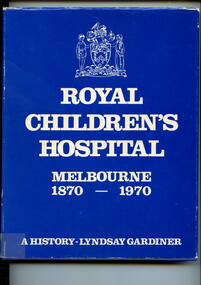
Book - Illustrated book, Lyndsay Gardiner, Royal Children's Hospital, Melbourne, 1870-1970: a history, 1970
... Royal Children's Hospital, Melbourne, 1870-1970: a history...Royal Children's Hospital (Melbourne)...Grace Wilson, 8th Matron of the Alfred, had previously been matron at RCH. Royal Children's Hospital (Melbourne) Hospitals-Victoria-History History of the Royal Children's Hospital, Melbourne, from its foundation in 1870 until 1970. ...History of the Royal Children's Hospital, Melbourne, from its foundation in 1870 until 1970.Illustrated book with dustjacket, book is bound in dark blue, with title and authors name printed in silver on spine. Dust jacket has a dark blue background with the title and author printed in white on the front. Also on the front is the RCH coat of arms printed in white.non-fictionHistory of the Royal Children's Hospital, Melbourne, from its foundation in 1870 until 1970.royal children's hospital (melbourne), hospitals-victoria-history -
 Alfred Hospital Nurses League - Nursing History Collection
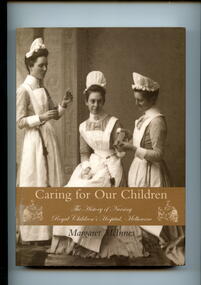
Book - Illustrated book, Margaret McInnes, Caring for our children: the history of nursing, Royal Children's Hospital, Melbourne, 2006
... Caring for our children: the history of nursing, Royal Children's Hospital, Melbourne...Royal Children's Hospital (Melbourne)...It includes references to Grace Wilson, Alfred Hospital's 8th matron, who had previously been matron at the Children's Hospital. Royal Children's Hospital (Melbourne) Paediatric Nursing-Victoria-history Nursing-Victoria-history The book is a tribute to the nursing service of the Royal Children's Hospital, Melbourne. ...The book is a tribute to the nursing service of the Royal Children's Hospital, Melbourne. From the time of the hospital's opening in 1870, the first nurse training school in 1889, and the transition to tertiary education, up to time of publication in 2006.Illustrated book with gold coloured cover with title and authors name on front and spine. Also on front cover is image of Grace Collins (1891-92) on the right with two fellow nurses. On the back cover is the RCH trained nurses' badge (red Maltese cross on gold background inside a white circle) with the motto ' Infirmis Opitulare' (to care for the sick and infirm).non-fictionThe book is a tribute to the nursing service of the Royal Children's Hospital, Melbourne. From the time of the hospital's opening in 1870, the first nurse training school in 1889, and the transition to tertiary education, up to time of publication in 2006.royal children's hospital (melbourne), paediatric nursing-victoria-history, nursing-victoria-history -
![Award - Certificate (Framed), Shirley Fraser - Honorary Life Governor of Royal Children's Hospital [Melbourne], 18/10/1973](/media/collectors/4f729f5697f83e03086015b8/items/500e73ba2162ef0f740a1166/item-media/500e778c2162ef0f740a1298/item-fit-380x285.jpg?cb=6) Greensborough Historical Society
Greensborough Historical SocietyAward - Certificate (Framed), Shirley Fraser - Honorary Life Governor of Royal Children's Hospital [Melbourne], 18/10/1973
... Shirley Fraser - Honorary Life Governor of Royal Children's Hospital [Melbourne]....Certificate awarded to Shirley Fraser (nee Black) in 1973 for her fundraising efforts for the Royal Melbourne Children's Hospital....Certificate awarded to Shirley Fraser (nee Black) in 1973 for her fundraising efforts for the Royal Melbourne Children's Hospital. This certificate is an example of Mrs Fraser's contribution to the wider community. shirley fraser shirley black honorary life governors royal childrens hospital melbourne. ...Certificate awarded to Shirley Fraser (nee Black) in 1973 for her fundraising efforts for the Royal Melbourne Children's Hospital.This certificate is an example of Mrs Fraser's contribution to the wider community.Coloured certificate in gilt wooden frame, under glass. Has the crest of the Royal Melbourne Hospital Melbourne."This is to certify that Mrs Shirley Margaret Fraser is an Honorary Life Governor of Royal Children's Hospital. 18th October 1973.shirley fraser, shirley black, honorary life governors, royal childrens hospital melbourne. -
 Wangaratta Urban Fire Brigade
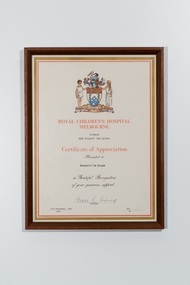
framed certificate
... certificate of appreciation from the Royal Children's Hospital Melbourne to the Wangaratta Fire Brigade for their support. ...Certificate of appreciation from the Royal Children's Hospital Melbourne. The certificate dated 17th September 1981, has a thicker gold border outside a thin red border inside. ...certificate of appreciation from the Royal Children's Hospital Melbourne to the Wangaratta Fire Brigade for their support. ...certificate of appreciation from the Royal Children's Hospital Melbourne to the Wangaratta Fire Brigade for their support. Signed by the President 17th September 1981. (no. 812)Certificate of appreciation from the Royal Children's Hospital Melbourne. The certificate dated 17th September 1981, has a thicker gold border outside a thin red border inside. And in a narrow brown wooden frame.royal children hospital, 1981 -
 The Royal Children's Hospital Archives
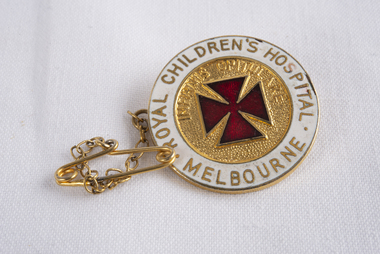
Decorative object, Royal Children's Hospital nurse's badge
... Royal Children's Hospital Melbourne. Infirmus Opitulare...Royal Children's Hospital Melbourne. Infirmus Opitulare Metal brooch with coloured inlay Royal Children's Hospital nurse's badge Decorative object ...Metal brooch with coloured inlayRoyal Children's Hospital Melbourne. Infirmus Opitulare -
![Hardcover book with black and white photo showing a children's ward with nurses in uniform and maroon coloured text. A touching story of the Melbourne Hospital for Sick Children (now the Royal Children's Hospital) [ca.1990] one of the most poignant books of Melbourne's early social history.](/media/collectors/50187a8f023fd7201471f198/items/675bb03784253782337fab7e/item-media/675bb26884253782337fe6df/item-fit-380x285.jpg?cb=6) Alfred Hospital Nurses League - Nursing History Collection
Alfred Hospital Nurses League - Nursing History CollectionBook - Hard cover Book, Grace Jennings Carmichael, Hospital Children: sketches of life and character in the Children's Hospital Melbourne, 1891
... Royal Children's Hospital (Melbourne-Vic)-anecdotes...Of significance to the AHNL as it is an insight into nursing, medical treatment and social history in Melbourne {ca.1890]. Royal Children's Hospital (Melbourne-Vic)-anecdotes Paediatric Nursing-Victoria-history A touching story of the Melbourne Hospital for Sick Children (now the Royal Children's Hospital) [ca.1990] one of the most poignant books of Melbourne's early social history. ...A touching story of the Melbourne Hospital for Sick Children (now the Royal Children's Hospital) [ca.1990] one of the most poignant books of Melbourne's early social history.Book with maroon cover, title, authors name and publisher's mark printed in gilt on spine. Dust jacket has a black and white photo of a children's hospital ward as background, with title and author's name printed in maroon on front and spine.A touching story of the Melbourne Hospital for Sick Children (now the Royal Children's Hospital) [ca.1990] one of the most poignant books of Melbourne's early social history.royal children's hospital (melbourne-vic)-anecdotes, paediatric nursing-victoria-history -
 Alfred Hospital Nurses League - Nursing History Collection
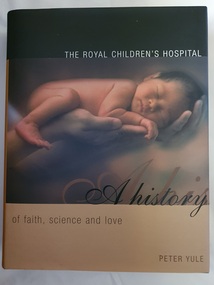
Book - Illustrated book, Peter Yule, The Royal Children's Hospital: a history of faith science and love, 1999
... Royal Children's Hospital (Melbourne)...Of significance to the AHNL as it is the history of another Victorian hospital, including hospital based. nursing training Also a former matron of RCH, Grace Wilson, was later a matron of the Alfred Hospital. Royal Children's Hospital (Melbourne) Paediatrics-Victoria-history An insight into the origins and development of the Royal Children's Hospital, Melbourne. ...An insight into the origins and development of the Royal Children's Hospital, Melbourne. Opening in 1870 with six rooms as "the Melbourne Free Hospital for Sick Children, it has grown into a major paediatric institution. As well as the hospitals history, the book provides insight into the social and economic conditions in Victoria in the late 19th and early 20th century.Illustrated book with dust jacket. Book is bound in dark green material, with title authors name and publishers mark print ed in gilt on spine. Dust jacket is black and gold in colour, with a coloured photo of newborn baby lying on adult hand on front cover. Title and author's name on front cover, also on spine with the addition of the publisher's mark. On the back cover is the RCH coat of arms.non-fictionAn insight into the origins and development of the Royal Children's Hospital, Melbourne. Opening in 1870 with six rooms as "the Melbourne Free Hospital for Sick Children, it has grown into a major paediatric institution. As well as the hospitals history, the book provides insight into the social and economic conditions in Victoria in the late 19th and early 20th century.royal children's hospital (melbourne), paediatrics-victoria-history -
 Alfred Hospital Nurses League - Nursing History Collection
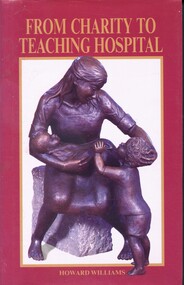
Book - Illustrated Book, Howard Williams, From charity to teaching hospital, 1989
... Royal Children's Hospital (Melbourne)...Of significance to the AHNL as it is the history of another Victorian hospital. Royal Children's Hospital (Melbourne) Ella Latham Hospital Administrators-Melbourne Medical Research Nursing Founded in 1870 as a charitable hospital for sick children of indigent parents, a role it fulfilled for over 60 years. ...Founded in 1870 as a charitable hospital for sick children of indigent parents, a role it fulfilled for over 60 years. The 1930's began a long period of gradual transformation to provide services to all children and a centre for teaching and research. The pioneer and catalyst in this period was Ella Latham, the RCH tenth and longest serving President, 1933-1954. This book also tells of many of the hardworking and unsung hospital staff who underpinned the developing services for sick and disabled children.Illustrated book with dust jacket. Book has a maroon cover with title and author's surname embossed in gold on spine. The dust jacket has a maroon background with a photograph of the sculpture "Trust' by Heather Ellis 1987, and title and author's name printed in gold ink on front cover. Title and author's surname printed in gold on spine. On the back cover there is a coloured image of the RCH crest.non-fictionFounded in 1870 as a charitable hospital for sick children of indigent parents, a role it fulfilled for over 60 years. The 1930's began a long period of gradual transformation to provide services to all children and a centre for teaching and research. The pioneer and catalyst in this period was Ella Latham, the RCH tenth and longest serving President, 1933-1954. This book also tells of many of the hardworking and unsung hospital staff who underpinned the developing services for sick and disabled children.royal children's hospital (melbourne), ella latham, hospital administrators-melbourne, medical research, nursing -
 Uniting Church Archives - Synod of Victoria
Photograph
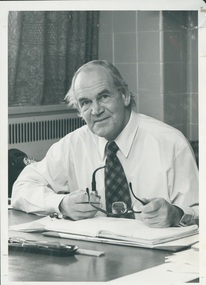
... Dr Alan Williams, Director of Pathology, Royal Children's Hospital, Melbourne. Children's Welfare Association of Victoria. ...Dr Alan Williams, Director of Pathology, Royal Children's Hospital, Melbourne. Children's Welfare Association of Victoria. ...Dr Alan WilliamsDr Alan Williams, Director of Pathology, Royal Children's Hospital, Melbourne. Children's Welfare Association of Victoria. Church and Nation 25 April 1979 p5 -
 Wangaratta Urban Fire Brigade
framed certificate
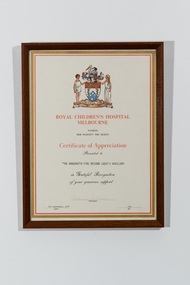
... The text under the hospitals shield/emblem is centered and says... ROYAL CHILDRENS HOSPITAL MELBOURNE PATRON HER MAJESTY THE QUEEN Certificate of Appreciation Presented to THE WANGARATTA FIRE BRIGADE LADIES AUXILLARY in Grateful Recognition of your generous support (signed by the president) 6th September 1979 No.635...The text under the hospitals shield/emblem is centered and says... ROYAL CHILDRENS HOSPITAL MELBOURNE PATRON HER MAJESTY THE QUEEN Certificate of Appreciation Presented to THE WANGARATTA FIRE BRIGADE LADIES AUXILLARY in Grateful Recognition of your generous support (signed by the president) 6th September 1979 No.635 framed certificate ...The text under the hospitals shield/emblem is centered and says... ROYAL CHILDRENS HOSPITAL MELBOURNE PATRON HER MAJESTY THE QUEEN Certificate of Appreciation Presented to THE WANGARATTA FIRE BRIGADE LADIES AUXILLARY in Grateful Recognition of your generous support (signed by the president) 6th September 1979 No.635 -
 Alfred Hospital Nurses League - Nursing History Collection
Magazine - Illustrated magazine, Pamela Atkinson, Snippets - Official journal of the operating room nurses group, 1983
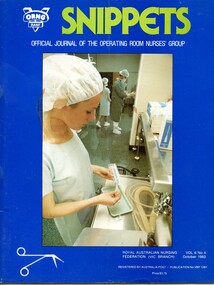
... Front cover has title [white light and light green print] the journal logo - angled scissors [white print] operating room nurses group logo [ORG RANF overprinted on V] and a coloured photograph of an operating room nurse holding a syringe and packet in anaethetic room with operating theatre and other theatre personnel in the back ground [Nurse Suzie Kendall Royal Children's Hospital, Melbourne...Front cover has title [white light and light green print] the journal logo - angled scissors [white print] operating room nurses group logo [ORG RANF overprinted on V] and a coloured photograph of an operating room nurse holding a syringe and packet in anaethetic room with operating theatre and other theatre personnel in the back ground [Nurse Suzie Kendall Royal Children's Hospital, Melbourne Snippets - Official journal of the operating room nurses group Magazine Illustrated magazine Pamela Atkinson Research Publications ...Magazine containing articles and advertisements of interest to operating room nursesIllustrated magazine with blue cover. Front cover has title [white light and light green print] the journal logo - angled scissors [white print] operating room nurses group logo [ORG RANF overprinted on V] and a coloured photograph of an operating room nurse holding a syringe and packet in anaethetic room with operating theatre and other theatre personnel in the back ground [Nurse Suzie Kendall Royal Children's Hospital, Melbournenon-fictionMagazine containing articles and advertisements of interest to operating room nurses perioperative nursing, operating room nurses-victoria-history -
 Orbost & District Historical Society
memorial plaque, early 20th Century
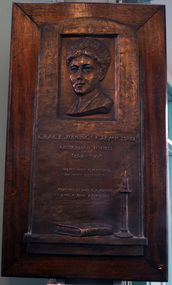
... In 1888 she went to Melbourne to be trained as a nurse at the Royal Children's Hospital, Melbourne, and in 1891 published a small volume of prose sketches, Hospital Children. ...In 1888 she went to Melbourne to be trained as a nurse at the Royal Children's Hospital, Melbourne, and in 1891 published a small volume of prose sketches, Hospital Children. ...Grace Elizabeth Jennings Carmichael (1867-1904), poet and nurse, was born on 24 February 1867 at Ballarat, Victoria, daughter of Archibald Carmichael, a miner from Perthshire, Scotland, and his wife Margaret Jennings, née Clark, from Cornwall, England. . She was educated at Melbourne and while still a child went to live on a station at Orbost, and grew up close to the bush she came to love so much. In 1888 she went to Melbourne to be trained as a nurse at the Royal Children's Hospital, Melbourne, and in 1891 published a small volume of prose sketches, Hospital Children. Having qualified she obtained a position on a station near Geelong, and subsequently married Francis Mullis. She contributed verse to the Australasian, and in 1895 Poems by Jennings Carmichael was published. She lived for a time in South Australia and then went to London, where she died in poor circumstances in 1904. Her husband, Henry Mullis, was last recorded in the workhouse in Woolrich, but then disappeared leaving the three children- Geoffrey 7 yrs, (Thomas) Clive 5 yrs & 4 year old (Archibald) Keith and one year old (Rupert) Wyatt, destitute & were sent to the Northampton workhouse, (Thomas ) Clive dying in 1906. In 1910, a group of Carmichael's admirers, discovered the whereabouts of her children, where a public fund was established to bring the children to Australia, the Victorian Government giving them free passage, arriving in Victoria in October of 1910. The children were placed in private homes and took on their mother's single name of Carmichael. In the late 1930s, plaques were unveiled in Orbost & Ballarat in honor of Grace Jennings Carmichael. The one in Orbost was part of the "Back To' celebrations. It hung in Mechanics' Institute in Orbost.This is significant to the Orbost region in that it is associated with a woman who is certainly our foremost female poet. A bronze cast memorial plaque set onto a wooden backing board. The plaque has an image of a woman, a candle and a book, and also some text (see below).Grace Jennings Carmichael, Australian poetess, 1868-1904, spent her childhood in this district, erected by Mrs G A Hunter & a few admirers.memorial-plaque grace-jennings-carmichael orbost-poet -
 Orbost & District Historical Society
letters, 1910
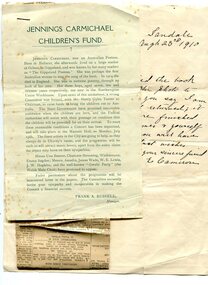
... In 1888 she went to Melbourne to be trained as a nurse at the Royal Children's Hospital, Melbourne, and in 1891 published a small volume of prose sketches, Hospital Children. ...In 1888 she went to Melbourne to be trained as a nurse at the Royal Children's Hospital, Melbourne, and in 1891 published a small volume of prose sketches, Hospital Children. ...These letters were received by Henry James of Orbost. Henry James (1860-1932) was a well-known identity in the Orbost district. He was a stock agent and auctioneer who helped to establish the seed bean industry in Orbost. He was the second secretary of the Snowy River Shipping Co. as well as a shire councillor and prominent member of MUIOOF. They concern a fund established to raise money to bring the three sons of Jennings Carmichael to Australia. A committee established by Henry Gyles Turner, a a notable Australian banker and historian, was formed to raise funds to bring the boys to Australia. Grace Elizabeth Jennings Carmichael (1867-1904), poet and nurse, was born on 24 February 1867 at Ballarat, Victoria, daughter of Archibald Carmichael, a miner from Perthshire, Scotland, and his wife Margaret Jennings, née Clark, from Cornwall, England. . She was educated at Melbourne and while still a child went to live on a station at Orbost, and grew up close to the bush she came to love so much. In 1888 she went to Melbourne to be trained as a nurse at the Royal Children's Hospital, Melbourne, and in 1891 published a small volume of prose sketches, Hospital Children. Having qualified she obtained a position on a station near Geelong, and subsequently married Francis Mullis. She contributed verse to the Australasian, and in 1895 Poems by Jennings Carmichael was published. She lived for a time in South Australia and then went to London, where she died in poor circumstances in 1904. Her husband, Henry Mullis, was last recorded in the workhouse in Woolrich, but then disappeared leaving the three children- Geoffrey 7 yrs, (Thomas) Clive 5 yrs & 4 year old (Archibald) Keith and one year old (Rupert) Wyatt, destitute & were sent to the Northampton workhouse, (Thomas ) Clive dying in 1906. In 1910, a group of Carmichael's admirers, discovered the whereabouts of her children, where a public fund was established to bring the children to Australia, the Victorian Government giving them free passage, arriving in Victoria in October of 1910. The children were placed in private homes and took on their mother's single name of Carmichael. In 1910 a small selection of her poems was published, in 1937 a plaque to her memory was unveiled at Orbost in the Mechanics Institute ( reg. 554), and a year later a replica was placed in the public library at Ballarat. Two of Jennings Carmichael's sons were present at the ceremony.Jennings Carmichael, a leading Australian poet spent much of her childhood in Orbost.Several letter written to H. James concerning the Jennings Carmichael Children's Fund. Stapled to one letter is a typed article about the Jennings Carmichael Children's Fund written by Frank a. Russell. The other letter is a three page stapled handwritten letter from St Oswald's, Ormond College, seeking information about Jennings Carmichael.james-henry jennings-carmichael correspondence -
 Wodonga & District Historical Society Inc
Photograph - Les Stone, Last Shire President and first Mayor of the Rural City of Wodonga
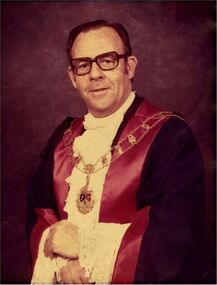
... Les worked tirelessly for numerous organizations including the Royal Children’s Hospital, Royal Melbourne Hospital (he was made a Life Governor of both), the Wodonga Good Neighbour Council, and Knights of the Southern Cross, Rotary, the St. ...Les worked tirelessly for numerous organizations including the Royal Children’s Hospital, Royal Melbourne Hospital (he was made a Life Governor of both), the Wodonga Good Neighbour Council, and Knights of the Southern Cross, Rotary, the St. ...Les Stone was the last Shire President of Wodonga and first Mayor of the Rural City of Wodonga. Born in Collingwood, Victoria on 24th August 1919, he was the first of his family to obtain a post-secondary education. He became a Christian Brother but left the ministry after 10 years and became a trained primary school teacher. Les held various teaching appointments in and around country Victoria and Wodonga, the last as Principal of Wodonga West Primary School. It was in Wodonga that Les and his wife Pam settled with their family. Their contribution to the Wodonga community and local government was outstanding. Les established a strong network in the local migrant community, helping many new arrivals at Bonegilla Migrant Reception Centre with language issues and settling them into their new environment. He worked in support of all underprivileged people in the community. In 1967 Les was elected as a Councillor for the West Riding of Wodonga Council. The following year he was elected Deputy Shire President. He was the last Shire President of Wodonga and in 1971 became the inaugural Mayor of the Rural City of Wodonga. The City of Wodonga was proclaimed on 14th March 1973 and Les was re-elected as Mayor. He chose to serve one full term as Mayor having previously served two terms as Shire President. Les Stone passed away at the Mercy Hospital Albury on 28th December 1974 at 54 years of age. He left behind an enduring legacy which included the proactive encouragement of industry to Wodonga. He also championed the selection of Wodonga as a Growth Centre. A champion and defender of local government, Les served as Chairman of the North East Region of Municipalities which comprised 13 Councils including Wodonga and Wangaratta. He also played a critical role on the Albury Wodonga Development Corporation for five years in the early period of the Whitlam decentralization scheme. Les Stone’s life of giving wasn’t just about local government and teaching. He was an old-fashioned community activist who gave far more than he took from the community. Les worked tirelessly for numerous organizations including the Royal Children’s Hospital, Royal Melbourne Hospital (he was made a Life Governor of both), the Wodonga Good Neighbour Council, and Knights of the Southern Cross, Rotary, the St. Vincent de Paul Society and St. Augustine’s Parish Council. However it is in local government that he remains best remembered. He was an active and vocal councillor and gave over 16 years of service to the people of Wodonga - his election and re-election was never once opposed. Les Stone was interned in the Lawn Cemetery in Wodonga. He was aged 54 years. The naming and dedication of the Les Stone Park in West Wodonga is an important acknowledgement of Les Stone’s life. The inscription reads: '’Leslie Edwin Stone JP was the first Mayor of Wodonga from 1972 to 1974 and a former Shire President (1972). A school teacher and principal by profession Les had a long history of involvement with the migrant community and Catholic Church. He was an acknowledged champion of decentralisation’’. These photos are significant because they document the service of an important civic leader in Wodonga.A collection of coloured images related to Les Stone, Mayor of Wodongales stone, wodonga civic leaders, wodonga council -
 The Beechworth Burke Museum
Audio - Oral history, Jennifer Williams, Mrs Florence Goonan, 10th August 2000
... children. Her father worked in the gold mines, bringing in wood. Florence recalls her Grandfather being in charge of turning on the water for the mines in Yackandandah. Florence worked as a nurse in the Yackandandah hospital, before moving to Beechworth in 1954 when her husband was employed at the Beechworth Mental Hospital. Florence had eight children. Her husband was very ill, having surgery to remove part of his stomach at the Royal Melbourne...children. Her father worked in the gold mines, bringing in wood. Florence recalls her Grandfather being in charge of turning on the water for the mines in Yackandandah. Florence worked as a nurse in the Yackandandah hospital, before moving to Beechworth in 1954 when her husband was employed at the Beechworth Mental Hospital. Florence had eight children. Her husband was very ill, having surgery to remove part of his stomach at the Royal Melbourne ...Florence Alice Gonnan was born on the 13th of June 1917 in Yackandandah, Victoria, the youngest of six children. Her father worked in the gold mines, bringing in wood. Florence recalls her Grandfather being in charge of turning on the water for the mines in Yackandandah. Florence worked as a nurse in the Yackandandah hospital, before moving to Beechworth in 1954 when her husband was employed at the Beechworth Mental Hospital. Florence had eight children. Her husband was very ill, having surgery to remove part of his stomach at the Royal Melbourne Hospital, and struggled to gain income for the family. This oral history recording was part of a project conducted by Jennifer Williams in the year 2000 to capture the everyday life and struggles in Beechworth during the twentieth century. This project involved recording seventy oral histories on cassette tapes of local Beechworth residents which were then published in a book titled: Listen to what they say: voices of twentieth century Beechworth. These cassette tapes were digitised in July 2021 with funds made available by the Friends of the Burke.Florence Alice Gonnan provides an account of life in Yackandandah from 1917 to 1954, and in Beechworth from 1954 to 2000. She provides descriptions of daily living, and how a big family with eight children survived without much income. This is a digital copy of a recording that was originally captured on a cassette tape. The cassette tape is black with a horizontal white strip and is currently stored in a clear flat plastic rectangular container. It holds up 40 minutes of recordings on each side.listen to what they say, beechworth, oral history, burke museum, gonnan, florence alice gonnan, yackandandah -
 Mission to Seafarers Victoria
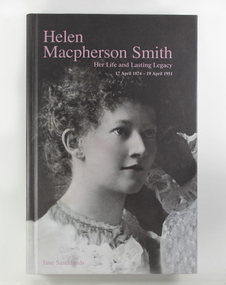
Book, Jane Sandilands, Helen Macpherson Smith: Her Life and Lasting Legacy, 17 April 1874-19 April 1951, 2011
... Melbourne, Victoria. She was also an active supporter of, and donor to, organisations including the Victorian Missions to Seamen (now Mission to Seafarers), the RSPCA, the Royal District Nursing Service, the Royal Children’s Hospital and the Royal Victorian Institute for the Blind. ...Helen Macpherson Schutt (née Smith) was a remarkable woman for her time. Born in 1874 to a prosperous Scottish-Australian family, Helen lived comfortably in the financial and social legacy of her family in Melbourne, Victoria. She was also an active supporter of, and donor to, organisations including the Victorian Missions to Seamen (now Mission to Seafarers), the RSPCA, the Royal District Nursing Service, the Royal Children’s Hospital and the Royal Victorian Institute for the Blind.Hard cover book of 145 pages; Apps A-F, Acknowledgements, Bibliography and Index, by Jane Sandilands. The mainly black cover features a photograph of Helen Macpherson Smith as a young woman. The title is printed in pink. non-fictionHelen Macpherson Schutt (née Smith) was a remarkable woman for her time. Born in 1874 to a prosperous Scottish-Australian family, Helen lived comfortably in the financial and social legacy of her family in Melbourne, Victoria. She was also an active supporter of, and donor to, organisations including the Victorian Missions to Seamen (now Mission to Seafarers), the RSPCA, the Royal District Nursing Service, the Royal Children’s Hospital and the Royal Victorian Institute for the Blind.helen macpherson smith (1874-1951), philanthropy, jane sandilands, benefactor, hmst, helen mcpherson smith trust -
 Ringwood and District Historical Society
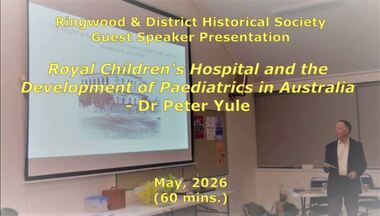
Mixed media - Video, RDHS Guest Speaker Presentation - Royal Children's Hospital and the Development of Paediatrics in Australia - Dr Peter Yule
... Melbourne. He has written a wide range of histories, including The Royal Children's Hospital: A History of Faith, Science and Love (1999), In the Public Interest: 150 Years of the Victorian Auditor-General's Office (2002), Carlton: A History (ed., 2004), and Steel Spies and Spin: The Collins Class Submarine Story (2008). ...Melbourne. He has written a wide range of histories, including The Royal Children's Hospital: A History of Faith, Science and Love (1999), In the Public Interest: 150 Years of the Victorian Auditor-General's Office (2002), Carlton: A History (ed., 2004), and Steel Spies and Spin: The Collins Class Submarine Story (2008). ...Digitised Powerpoint presentation video (3.66GB) Duration: 60 minutes. Recorded May, 2026 (Video is available for viewing at Ringwood & District Historical Society Archives by appointment)Dr Peter Yule is a freelance historian and a fellow of the School of History at the University of Melbourne. He has written a wide range of histories, including The Royal Children's Hospital: A History of Faith, Science and Love (1999), In the Public Interest: 150 Years of the Victorian Auditor-General's Office (2002), Carlton: A History (ed., 2004), and Steel Spies and Spin: The Collins Class Submarine Story (2008). He has also written VIC BAR: A history of the Victorian Bar. More recently he has written biographies of two prominent Melbourne-based financiers: W. L. Baillieu (1859-1936), who founded the prominent family dynasty; and Sir Ian Potter (1902-1994), a major figure in Australia's post-war industrial expansion. Peter will speak about his research on these two remarkable figures, and on the challenges of biography more generally. Peter is also grandson of Ringwood’s own:- Sir Lewis Ronald East (1899–1994), engineer and water commissioner, was born on 17 June 1899 at Auburn, Melbourne, second of three children of Lewis Findlay East, civil servant and later secretary of the Commonwealth Marine Branch, and his wife Annie Eleanor, née Burchett, both Victorian born. Ronald was educated at Ringwood State School. -
 Eltham District Historical Society Inc
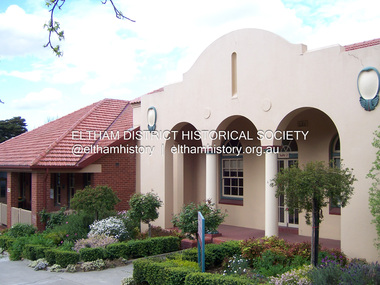
Photograph - Digital Photograph, Marguerite Marshall, Sutherland Home for Children, Diamond Creek, 27 September 2007
... hospital at Masterton. In 1881, while holidaying in Melbourne, Sutherland was so touched by seeing young people living under Princes Bridge, that this determined her future work. Meanwhile Sutherland instigated the Melbourne District Nursing Society, (now Royal District Nursing Service). She also led the founding of The Victorian Neglected Children’s...hospital at Masterton. In 1881, while holidaying in Melbourne, Sutherland was so touched by seeing young people living under Princes Bridge, that this determined her future work. Meanwhile Sutherland instigated the Melbourne District Nursing Society, (now Royal District Nursing Service). She also led the founding of The Victorian Neglected Children’s ...The Sutherland Homes for Children on Yan Yean Road, Diamond Creek cared for thousands of children from when it was opened in 1912. The site closed for this purpose in 1991 and was sold and later developed for commercial and office purposes. Covered under Heritage Overlay, Nillumbik Planning Scheme. Published: Nillumbik Now and Then / Marguerite Marshall 2008; photographs Alan King with Marguerite Marshall.; p107 The Sutherland Homes for Children at 14 Yan Yean Road, Diamond Creek, cared for thousands of children since they opened in 1912, after beginning at La Trobe Street, Melbourne in 1908. In 1994 Sutherland Homes (then called Sutherland Child, Youth and Family Services) amalgamated with Berry Street Child and Family Welfare. Together as Berry Street Victoria, they formed Victoria’s largest independent provider of support and accommodation services for children, young people and families in crisis.1 However with the move from institutional to community care, the Diamond Creek site had not been used since 1991 and was sold to private purchasers in 1999. More than 2000 former residents, staff, neighbours and friends attended a farewell in February, 2000.2 The Sutherland Homes red-brick and stuccoed building in Diamond Creek (a rare design in the Eltham Shire), was opened in 1929 by Lord Somers, the Governor of Victoria. Destitute children lived in dormitories bathed in natural light through large windows. However in 1958 as the cottage–parent system replaced the dormitory system, the first of eight residential cottages accommodating ten to 12 children was built. The site also included Special School 3660 and a farm, and the children were able to form relationships with people outside Sutherland, by staying with holiday hosts. Children were originally placed at Sutherland because of extreme poverty, or because single parents could not cope. However later, most placements occurred due to family violence, abuse or neglect. The property was originally bought from the Crown in 1869 by Timothy Mahony. Later owner, Augusta Meglin, ran a 40-acre (16ha) farm there. In 1909 she bequeathed this, including the house, orchards, vegetable gardens, vineyards and the balance of her income to The Sutherland Homes for Neglected Children. Sutherland Homes’ founder, Selina Sutherland, was known as ‘New Zealand’s Florence Nightingale’. In 1888 she became Victoria’s first licensed ‘child rescuer’3 and was to rescue around 3000 waifs from Victoria’s streets and slums.4 Born in Scotland in 1839, Sutherland joined her sister, who had emigrated with her husband to New Zealand. Sutherland trained as a nurse and led the establishment of a public hospital at Masterton. In 1881, while holidaying in Melbourne, Sutherland was so touched by seeing young people living under Princes Bridge, that this determined her future work. Meanwhile Sutherland instigated the Melbourne District Nursing Society, (now Royal District Nursing Service). She also led the founding of The Victorian Neglected Children’s Aid Society (now Oz Child) and the Presbyterian Neglected Children’s Aid Society (now Kildonan). From 1894 Miss Sutherland was Melbourne’s best known woman and cut a distinctive figure, wearing an alpine hat with a prominent feather. In 1906 Prime Minister Alfred Deakin named her Melbourne’s most successful philanthropic worker. However she was to face some difficult times. That year she suffered severely from an injured shoulder and dizzy turns and was pressured to resign as Superintendent of The Victorian Neglected Children’s Aid Society. In 1908 the committee of management offered her 12 months leave with pay. Sutherland declined – but soon after, was dismissed. However she continued her work from Latrobe Street, Melbourne, with the help of Sister Ellen Sanderson and several committee members. Sutherland attempted to register her new organisation but the Victorian Neglected Children’s Aid Society objected to the government, alleging that Sutherland, because of increasing infirmity, was unable to satisfactorily carry out such duties. They accused her of cruelty and of intoxication. However the charges were not proven, so The Sutherland Homes for Neglected Children was registered.5 Sadly, in 1909 Sutherland died, the day she was to move the children to the ‘country property’ at Diamond Creek. At her death she owned less than £10. Today Berry Street recognises Sutherland’s enormous contribution to child welfare with a memorial and an annual Selina Sutherland Award, presented to an outstanding volunteer.This collection of almost 130 photos about places and people within the Shire of Nillumbik, an urban and rural municipality in Melbourne's north, contributes to an understanding of the history of the Shire. Published in 2008 immediately prior to the Black Saturday bushfires of February 7, 2009, it documents sites that were impacted, and in some cases destroyed by the fires. It includes photographs taken especially for the publication, creating a unique time capsule representing the Shire in the early 21st century. It remains the most recent comprehenesive publication devoted to the Shire's history connecting local residents to the past. nillumbik now and then (marshall-king) collection, diamond creek, sutherland home for children -
 Kiewa Valley Historical Society
Plaques - Awards
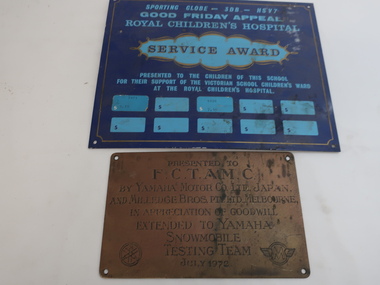
... Royal Children's Hospital Service Award. 2. Presented to F.C.T.A.M.C by Yamaha Motor Company, Japan. and Milledge Bros. Melbourne...Royal Children's Hospital. 2. Yamaha, a Japanese Company, encouraged Australian businesses to use their products. In this case the Snowmobile. The Kiewa Valley took part in the Good Friday Appeal and Yamahs snowmobiles were used at Falls Creek. Good Friday Appeal Royal Children's Hospital Yamaha Co. Japan snowmobile Falls Creek Includes: 1. Good Friday Appeal / Royal Children's Hospital Service Award. 2. Presented to F.C.T.A.M.C by Yamaha Motor Company, Japan. and Milledge Bros. Melbourne ...1. The Good Friday Appeal is held annually in Victoria with proceeds being raised for the Royal Children's Hospital. 2. Yamaha, a Japanese Company, encouraged Australian businesses to use their products. In this case the Snowmobile.The Kiewa Valley took part in the Good Friday Appeal and Yamahs snowmobiles were used at Falls Creek. 1. Blue metal plaque with holes in each corner and pale blue print informing details of Award . There is a thin gold line around the circumference. 2. Gold metal plaque with holes in each corner and black print informing details of the award.Includes: 1. Good Friday Appeal / Royal Children's Hospital Service Award. 2. Presented to F.C.T.A.M.C by Yamaha Motor Company, Japan. and Milledge Bros. Melbourne re Yamaha / Snowmobile / testing team / July 1972good friday appeal, royal children's hospital, yamaha co. japan, snowmobile falls creek -
 Geoffrey Kaye Museum of Anaesthetic History
Document - Certificate, 1980
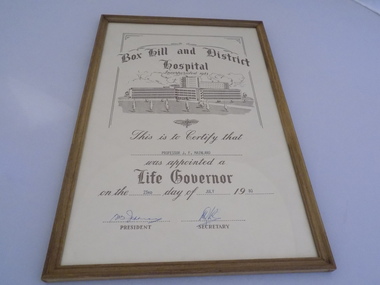
... Melbourne in 1950 with a Bachelor of Science degree. After researching and completing his medical degree, Mainland entered into the field of anaesthetics, training at the Royal Women's and Royal Children's Hospitals, later Alfred Hospital, in 1959. ...Melbourne in 1950 with a Bachelor of Science degree. After researching and completing his medical degree, Mainland entered into the field of anaesthetics, training at the Royal Women's and Royal Children's Hospitals, later Alfred Hospital, in 1959. ...The certificate and tie clips were in the possession of Dr John Mainland. Mainland graduated from the University of Melbourne in 1950 with a Bachelor of Science degree. After researching and completing his medical degree, Mainland entered into the field of anaesthetics, training at the Royal Women's and Royal Children's Hospitals, later Alfred Hospital, in 1959. He completed training in 1964 and remained at the Alfred Hospital. During his career, he also became the first anaesthetist appointed to the position of Professor in Victoria. His other achievements include manufacturing a respiratory monitoring module that accompanied astronauts on the United States moon landing and developing a stimulator to lessen the risk of deep vein thrombosis in surgical patients. Mainland became a Fellow of the Australian and New Zealand College of Anaesthetists in 1992, retiring from the profession in 1997.The certificate rests beneath a thin layer of glass kept in a light wooden frame. The certificate is cream in colour with dark brown writing. In the middle is an illustration of Box Hill and District Hospital building. At the bottom of the certificate is the signature of the President and Secretory. On the back of the frame there are two metal loops connected by a thin piece of metal wire. Hanging on this wire are two clips from the Alfred Hospital. The face of the clips is consists of the Alfred Hospital emblem in red and gold surrounded by a border of blue with the name of the hospital inscribed. Masking tape runs the border of the frame.Printed in black ink on back of frame: marlow Galleries / 968 Whitehorse Rd, Box Hill / Ph: 89 2062, 1st floor •Inscribed on face of clips: Alfred Hospital Melbourne For Service •Printed in brown ink on the certificate: Box Hill and District / Hospital / This is to Certify that / Professor J. F. Mainland / was appointed a / Life Governor / on the 23rd day of July 1980 / President Secretary •Signed in blue ink by the President and Secretarycertificate, box hill and district hospital, life governor, mainland, john, alfred hospital -
 Geoffrey Kaye Museum of Anaesthetic History
Tool - Laryngoscope, Macintosh
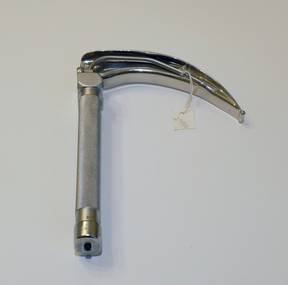
... Melbourne in 1950 with a Bachelor of Science degree. After researching and completing his medical degree, Mainland entered into the field of anaesthetics, training at the Royal Women's and Royal Children's Hospitals, later Alfred Hospital, in 1959. ...Melbourne in 1950 with a Bachelor of Science degree. After researching and completing his medical degree, Mainland entered into the field of anaesthetics, training at the Royal Women's and Royal Children's Hospitals, later Alfred Hospital, in 1959. ...A laryngoscope is an instrument used to view the larynx (voice box), which is the opening to the trachea and lungs. It consists of a “blade,” which goes into the patient’s mouth, and a handle. Prior to 1943 when Macintosh introduced his curved blade, most laryngoscope blades were long and straight. The straight blades were used to directly hold the epiglottis. Macintosh’s curved blade works differently: it indirectly opens the epiglottis by applying pressure to a space between the root of the tongue and epiglottis, called the vallecula. The flange running along the left lower edge of Macintosh’s blade was also a novel innovation. It was designed to move the tongue to the side, which improved the view of the larynx and made more room for a breathing tube. The Macintosh Laryngoscope remains one of the most popular blades worldwide. (Source: Wood Library Museum) This laryngoscope was previously owned by John Mainland, as evidenced by the name etched into the handle. Mainland graduated from the University of Melbourne in 1950 with a Bachelor of Science degree. After researching and completing his medical degree, Mainland entered into the field of anaesthetics, training at the Royal Women's and Royal Children's Hospitals, later Alfred Hospital, in 1959. He completed training in 1964 and remained at the Alfred Hospital. During his career, he also became the first anaesthetist appointed to the position of Professor in Victoria. His other achievements include manufacturing a respiratory monitoring module that accompanied astronauts on the United States moon landing and developing a stimulator to lessen the risk of deep vein thrombosis in surgical patients. Mainland became a Fellow of the Australian and New Zealand College of Anaesthetists in 1992, retiring from the profession in 1997.Oblong shaped handle with textured grip. Attached is a laryngoscope blade in a cruved shaped with light tube running through one side.Etched into top of handle: J.F. MAINLAND •Stamped into top of handle: REGD TRADE MARK / PENLON / MADE IN ENGLAND •Stamped into base of handle: CLOSE [arrow] •Etched into base of blade: MAC / 4 •Stamped into side of blade: REGD TRADE MARK / PENLON / MADE IN ENGLAND •Stamped into side of blade: STAINLESSmacintosh, robert reynolds, new zealand, laryngoscope, mainland, john, alfred hospital, moon landing -
 National Vietnam Veterans Museum (NVVM)
Booklet - Propaganda booklet, The Truth of Vietcong Terror
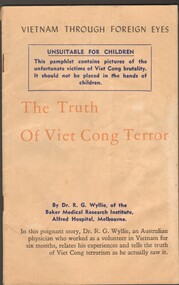
... Hospital in Melbourne. The pamphlet is a documented account of the experiences and observations of an Australian physician volunteering in Vietnam. It highlights alleged terrorist actions committed by the Viet Cong during the Vietnam War. Collected by WO2 Robert Palmer Matthews (34974) of the Royal Australian Army Ordnance Corps. The truth of Vietcong Terror Dr R.G Wyllie Baker Medical Research Institute Booklet Robert Palmer Matthews 34974 Vietcong propaganda anti-war war crimes atrocities Vietnam through Foreign Eyes/ Unsuitable for Children ...This representation of the horrors in Vietnam was authored by Dr. R. G. Wyllie of the Baker Medical Research Institute at Alfred Hospital in Melbourne. The pamphlet is a documented account of the experiences and observations of an Australian physician volunteering in Vietnam. It highlights alleged terrorist actions committed by the Viet Cong during the Vietnam War. Collected by WO2 Robert Palmer Matthews (34974) of the Royal Australian Army Ordnance Corps.Booklet: Vietnam through foreign eyes. Contains graphic black and white images of war atrocities. 23 pages long written by Dr R.G Wyllie. (Unsuitable for Children).Vietnam through Foreign Eyes/ Unsuitable for Children with why/ The Truth/ Of Vietcong Terror/ By Dr R.G. Wyllie. On Back - The Vietnamese among who we work have no doubt the war is necessary .../ Publisher information.the truth of vietcong terror, dr r.g wyllie, baker medical research institute, booklet, robert palmer matthews, 34974, vietcong, propaganda, anti-war, war crimes, atrocities -
 Port Melbourne Historical & Preservation Society
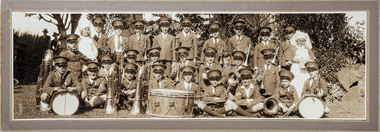
Photograph - Band at Royal Children's Hospital benefit c1928
... Melbourne circa 1934 buying a Bank House at 128 Williamstown Road (later renumbered to 400). The family consisted of Bob Watters senior and his wife Ellen (nee Oakley), children Patsy (b 1920), Bob Junior (b 1922) and Norma (b1924). The children attended Albert Park Primary, Middle Park Central School and then MacRobertson Girls High School and Melbourne Boys High School. WATTERS Bob Junior Patsy St Vincents Gardens Band at Royal Children's Hospital ...The Watters family moved from Albert Park to Garden City Port Melbourne circa 1934 buying a Bank House at 128 Williamstown Road (later renumbered to 400). The family consisted of Bob Watters senior and his wife Ellen (nee Oakley), children Patsy (b 1920), Bob Junior (b 1922) and Norma (b1924). The children attended Albert Park Primary, Middle Park Central School and then MacRobertson Girls High School and Melbourne Boys High School.Band at Royal Children's Hospital benefit c 1928. Bob Watters junior with bugle second row. Patsy Watters nurse on left. In St Vincents Gardenswatters, bob junior, patsy, st vincents gardens -
 Alfred Hospital Nurses League - Nursing History Collection
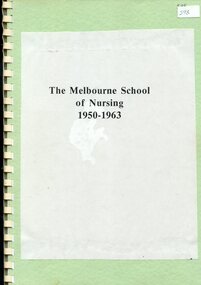
Book - Illustrated book (photocopy), Norman J Marshall, The Melbourne School of Nursing 1950-1963, 1985
... The Melbourne School of Nursing was formed in 1950 when the Royal Melbourne Hospital’s School of Nursing joined with those of the Queen Victoria Hospital, Fairfield Hospital and the Royal Women’s Hospital . It was established by the Hospitals and Charities Commission and was located in the Mayfield Centre Malvern with Miss Jean Headberry as the Dean of the School. The Royal Children’s...The Melbourne School of Nursing was formed in 1950 when the Royal Melbourne Hospital’s School of Nursing joined with those of the Queen Victoria Hospital, Fairfield Hospital and the Royal Women’s Hospital . It was established by the Hospitals and Charities Commission and was located in the Mayfield Centre Malvern with Miss Jean Headberry as the Dean of the School. The Royal Children’s ...History of the Melbourne School of Nursing, includes list of all graduatesIllustrated book with white comb binding. Has clear plastic protective covers front and back. Title printed [in black ink] on white paper and fixed to larger pale green cardboardnon-fictionHistory of the Melbourne School of Nursing, includes list of all graduatesmelbourne school of nursing-history, the royal melbourne hospital and associated hospitals school of nursing, the royal melbourne hospital -
 Eltham District Historical Society Inc
Document - Folder, Mitchell, Grace
... children. After her father died, the family moved to Creswick. She left home at age 12 to earn a wage to help the family, including as a matron at the School of Mines in Creswick and, after moving to Melbourne, as dietitian at Royal Melbourne Hospital. ...children. After her father died, the family moved to Creswick. She left home at age 12 to earn a wage to help the family, including as a matron at the School of Mines in Creswick and, after moving to Melbourne, as dietitian at Royal Melbourne Hospital. ...Grace Mitchell (nee Whieldon) was born in Yarram Gippsland, second of nine children. After her father died, the family moved to Creswick. She left home at age 12 to earn a wage to help the family, including as a matron at the School of Mines in Creswick and, after moving to Melbourne, as dietitian at Royal Melbourne Hospital. After marrying Arthur Mitchell, they moved to Mount Pleasant Road, Eltham, in 1948. Because Arthur had an accident and was not able to work, she did various jobs before starting a cake shop in their house; she also cooked at Montsalvat,. She was also a tailor and dressmaker, studied psychology and journalism, her crochet.patterns were published in 'New Idea' as a girl when she also started carving wood.She knew many artists, writers, etc.As a widow, in her late 60s, she enrolled in a diploma of arts course, majoring in sculpture and print-making. Contents Newspaper article: "Amazing Grace!", Diamond Valley News, 7 July 1981. Newspaper article: "A way with wood", The Age, ?1999. Diamond Valley News, 30 April 1985. Describes life of Grace Mitchell, just turned 80, who began carving wood as a girl. Newspaper article: "Paging women to celebrate", Heidelberg and Diamond Valley Weekly, 12 February 2008. To promote nominations for 'Celebrating Nillumbik Women', designed to honour women, Grace and Jenni Mitchell are featured. Newspaper article: "Celebrate history and her story", Diamond Valley Leader, 20 February 2008. To promote nominations for 'Celebrating Nillumbik Women', designed to honour women, Grace and Jenni Mitchell are featured. Newspaper article: "Eltham artist's will to live", Diamond Valley Leader, 27 October 2010. Grace Mitchell recovering in Austin Hospital. Order of Service: A celebration and thanksgiving for the life of Grace Mitchell, Montsalvat Eltham, 19 April 2011. Newspaper article: "Death of an Eltham icon", Diamond Valley Leader, ?20 April 2011. Obituary of Grace Mitchell with tributes from Ona Henderson, Sigmund Jogensen, Jenni Mitchell. Newspaper article: "Amazing Grace remembered", Diamond Valley Leader, 27 April 2011. Report of Service for Grace Mitchell at Montsalvat. Newspaper article: "Thanks Eltham for your kind messages", Diamond Valley Leader 18 May 2011. Letter from Jenni Mitchell, thanks for messages. Newspaper article: "Eltham all-rounder a remarkable gem", The Age, 13 May 2011. Obituary for Grace Mitchell. Newspaper article:"Search for home for ark art", Diamond Valley Leader, 11 November 2011. Grace Mitchell's work 'The Ark" 1983, is on display at local MP's office, seeking a home in a public collection. Newsletter article: "Jenni Mitchell - 'May mother Grace'", Eltham District Historical Society newsletter No.207, November 2012. Notice that Jenni Mitchell will talk about her mother's work at the November meeting. Flier: Eltham South Fine Art Studios and Gallery, 7 October-18 November 2012"Grace Mitchell 1916-2011: The Artist's Work: A Selected Retrospective". Handout: Sheet to accompany Eltham South Fine Art Studios and Gallery, 7 October-18 November 2012"Grace Mitchell 1916-2011: The Artist's Work: A Selected Retrospective". Biography of Grace Mitchell.Newspaper clippings, A4 photocopies, etcgrace mitchell, jenni mitchell, alan marshall, clifton pugh, robert helpmann, katherine hepburn, phillip institute of technology, celebrating nillumbik women, austin hospital, mount pleasant road eltham, montsalvat eltham, sigmund jorgensen, ona henderson, helen coleman, gail pritchard, school of mines creswick, mitchell's homemade cakes and pies, susan toole, eltham cemetery, arthur mitchell, mervyn hannan, vicki ward -
 Uniting Church Archives - Synod of Victoria
Photograph, Undated c.1960
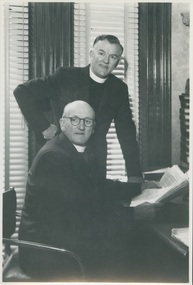
... Ordained in 1958 and served 7 years as Secretary of the Home Missions Department (1957 - 1864), 6 years as Chaplain of the Royal Melbourne and Royal Children's Hospitals (1964 - 1970) and 7 years in the Footscray Yarraville Circuit (1970 - 1977. ...Ordained in 1958 and served 7 years as Secretary of the Home Missions Department (1957 - 1864), 6 years as Chaplain of the Royal Melbourne and Royal Children's Hospitals (1964 - 1970) and 7 years in the Footscray Yarraville Circuit (1970 - 1977. ...Rev Alec Pederick (1902 - 1972). Trained at Queen's College. Commenced his ministry at Zeehan, Tasmania in 1927. In 1929 he went to Rabaul P.N.G. and to Piniqidu in 1931. Returning to Australia in 1933 was appointed to Beaufort Circuit and then to the Methodist Home Missions Department. Served as a Chaplain in the A.I.F 1942 - 1944. After discharge from the army Rev. Pederick resumed working with Home Missions, becoming General Superintendent and residing at “Otira”, the Home Mission Training College in Kew, at which he was also principal. President of Conference in 1955. Died 19 August 1972. Rev Andrew J. Pearce (1912 - 1986) Entered the Salvation Army Training College in 1934. Joined the United Aborigines Mission and served 2 years in Oolea and 10 years in Finnis Spring. Returned to Victoria in 1950 and was appointed by the Methodist Church as a Home Missionary at Lancefield. Accepted as a candidate for the ministry in 1952 and appointed Probationary Minister to Colac (Elliminyt). Ordained in 1958 and served 7 years as Secretary of the Home Missions Department (1957 - 1864), 6 years as Chaplain of the Royal Melbourne and Royal Children's Hospitals (1964 - 1970) and 7 years in the Footscray Yarraville Circuit (1970 - 1977. Retired in 1977. B & W photograph of the Revs. Alec W. Pederick (seated) and Andrew J. Pearce (standing) in the office of Otira Home Missionary Training College.alec pederick, methodist, minister, home missions, overseas missions, chaplain a.i.f., otira, president of conference, andrew pearce, salvation army, united aborigines mission, methodist, minister, home missionary, secretary home missions department, chaplain royal melbourne hospital, royal children's hospital -
 Uniting Church Archives - Synod of Victoria
Photograph, Undated c.1960
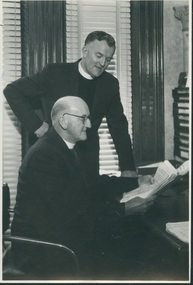
... Ordained in 1958 and served 7 years as Secretary of the Home Missions Department (1957 - 1864), 6 years as Chaplain of the Royal Melbourne and Royal Children's Hospitals (1964 - 1970) and 7 years in the Footscray Yarraville Circuit (1970 - 1977. ...Ordained in 1958 and served 7 years as Secretary of the Home Missions Department (1957 - 1864), 6 years as Chaplain of the Royal Melbourne and Royal Children's Hospitals (1964 - 1970) and 7 years in the Footscray Yarraville Circuit (1970 - 1977. ...Rev Alec Pederick (1902 - 1972). Trained at Queen's College. Commenced his ministry at Zeehan, Tasmania in 1927. In 1929 he went to Rabaul P.N.G. and to Piniqidu in 1931. Returning to Australia in 1933 was appointed to Beaufort Circuit and then to the Methodist Home Missions Department. Served as a Chaplain in the A.I.F 1942 - 1944. After discharge from the army Rev. Pederick resumed working with Home Missions, becoming General Superintendent and residing at “Otira”, the Home Mission Training College in Kew, at which he was also principal. President of Conference in 1955. Died 19 August 1972. Rev Andrew J. Pearce (1912 - 1986) Entered the Salvation Army Training College in 1934. Joined the United Aborigines Mission and served 2 years in Oolea and 10 years in Finnis Spring. Returned to Victoria in 1950 and was appointed by the Methodist Church as a Home Missionary at Lancefield. Accepted as a candidate for the ministry in 1952 and appointed Probationary Minister to Colac (Elliminyt). Ordained in 1958 and served 7 years as Secretary of the Home Missions Department (1957 - 1864), 6 years as Chaplain of the Royal Melbourne and Royal Children's Hospitals (1964 - 1970) and 7 years in the Footscray Yarraville Circuit (1970 - 1977. Retired in 1977. B & W photograph of the Revs. Alec W. Pederick (seated) and Andrew J. Pearce (standing) in the office of Otira Home Missionary Training College.alec pederick, methodist, minister, home missions, overseas missions, chaplain a.i.f., otira, president of conference, andrew pearce, salvation army, united aborigines mission, methodist, minister, home missionary, secretary home missions department, chaplain royal melbourne hospital, royal children's hospital -
 National Wool Museum
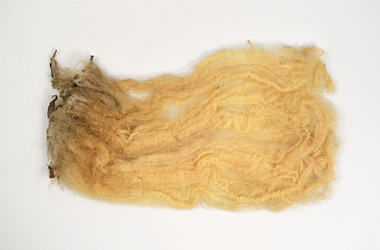
Textile - Wool Samples, CSIRO, Matilda's Wool Samples, 2005
... Melbourne's Federation Square in 2005. Her fleece was then processed into fabric by CSIRO. The fleece made enough fabric for six jackets. The jackets were auctioned at Crown Palladium Ballroom in March of that year. The winners had their jacket tailored to their measurements by Blazzer. All profits from the auction went to Celebration of Life, a fund established to support Victoria's Royal Children’s Hospital...Melbourne's Federation Square in 2005. Her fleece was then processed into fabric by CSIRO. The fleece made enough fabric for six jackets. The jackets were auctioned at Crown Palladium Ballroom in March of that year. The winners had their jacket tailored to their measurements by Blazzer. All profits from the auction went to Celebration of Life, a fund established to support Victoria's Royal Children’s Hospital ...Matilda was a Merino ewe who went missing for over 5 years on cattle country just outside of Hamilton. When she was found she had over 30 kgs of fleece that needed to be shorn. She was shorn in Melbourne's Federation Square in 2005. Her fleece was then processed into fabric by CSIRO. The fleece made enough fabric for six jackets. The jackets were auctioned at Crown Palladium Ballroom in March of that year. The winners had their jacket tailored to their measurements by Blazzer. All profits from the auction went to Celebration of Life, a fund established to support Victoria's Royal Children’s Hospital neonatal unitFour samples of wool in the different stages of process. The first two are of the raw fleece from the sheep, the second has been washed and combed, the third a fabric sample created from the wool.wool, sheep, merino wool, missing sheep, maltilda, fleece, csiro -
Clunes Museum
Document - BIOGRAPHICAL DOCUMENT
... children" 1. Photocopy RESUME OF DOCTOR WILLIAM GEORGE SOUTHEY 1910-1927 .2 Photocopy Reference written from E.O.S. Kurdan, No. 9 Indian General Hospital, dated April 4th, 1919 .3 Photocopy Reference written from Sidney V. Sewell M.D., Melbourne Hospital dated July 3rd .4 Photocopy Reference written from William R. Smith Knt. M.D., D.Sc., R.F.S.Ed Emeritus Professor Forensic Medicine and Toxicology, King's College University of London dated 15th December 1927 .5 Photocopy Reference written from E. Goodwin Rawlinson M.D., D.P.H., Asst.Director of The Royal ...1. Photocopy RESUME OF DOCTOR WILLIAM GEORGE SOUTHEY 1910-1927 .2 Photocopy Reference written from E.O.S. Kurdan, No. 9 Indian General Hospital, dated April 4th, 1919 .3 Photocopy Reference written from Sidney V. Sewell M.D., Melbourne Hospital dated July 3rd .4 Photocopy Reference written from William R. Smith Knt. M.D., D.Sc., R.F.S.Ed Emeritus Professor Forensic Medicine and Toxicology, King's College University of London dated 15th December 1927 .5 Photocopy Reference written from E. Goodwin Rawlinson M.D., D.P.H., Asst.Director of The Royal Institute of Public Health dated 14th December 1927 .6 Photocopy Reference written from J.F. Mackeddie Hon. Physician, Alfred Hospital, 110 Collins Street dated 3/7/1911 .7 Photocopy Reference written from A.E. Blackett Forster M.B., R.S., (Mel) dated 18/5/1915 .8.9 Photocopy of semi profile of Dr. Southey .10.11.12 Photocopy of semi profile of Dr. Southey with white border around image .1 Handwritten in ink, "Died in Grimsby where he was a Public Health Doctor looking after children"local history, documents, biography -
 Brighton Historical Society
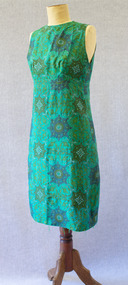
Dress, circa 1965-66
... Royal Children's Hospital as an occupational therapist. It was her 'good' dress, worn to dinner parties, balls and lunches throughout the 1960s. The hem was taken up and adjusted several times as the fashion moved towards shorter skirts. oggi melbourne designers 1960s meredith lenné Emerald green print midlength shift dress, sleeveless, with high neckline and high waist. ...This dress belonged to Meredith Lenné, a lifelong Brighton resident. She bought it around 1965-66 at Oggi, a fashion boutique at the "Paris End" of Collins Street, while she was working at the Royal Children's Hospital as an occupational therapist. It was her 'good' dress, worn to dinner parties, balls and lunches throughout the 1960s. The hem was taken up and adjusted several times as the fashion moved towards shorter skirts.Emerald green print midlength shift dress, sleeveless, with high neckline and high waist. Back zip. Hem has been let out, having been altered multiple times during the 1960s. Label reads "Oggi of Collins Street".oggi, melbourne designers, 1960s, meredith lenné
