
Showing 326 items matching "running of the school"
-
 University of Melbourne, Burnley Campus Archives
Document - Meeting Minutes, Robt. S. Brain, Government Printer, Minutes of Evidence on Technical Education/Royal Commission on Technical Education, 1901
... ...running of the school...Questions and his answers on his qualifications and the running of the school....minutes evidence technical education royal commission on technical education carl bogue luffmann luffmann parliament qualifications running of the school Printed exerpt 1901 No. 36 pp 206-210. ...minutes, evidence, technical education, royal commission on technical education, carl bogue luffmann, luffmann, parliament, qualifications, running of the school -
 Federation University Historical Collection
Document, Richard W. Richards, Notes from Richard Walter Richards on his Retirement as Principal of the Ballarat School of Mines, 1958, 1958
... Ten handwritten pages by Principal Richard Walter Richards relating to the running of the Ballarat School of Mines at the time if his retirement...Dick Richards died in 1985. dick richards richard w. richards ballarat school of mines Ten handwritten pages by Principal Richard Walter Richards relating to the running of the Ballarat School of Mines at the time if his retirement Notes from Richard Walter Richards on his Retirement as Principal of the Ballarat School of Mines, 1958 Document Richard W. ...Richard W. Richards was Principal of the Ballarat School of Mines, and was Physicist with the Shackleton Imperial Trans-Antarctic Expedition (1914-1917) . He was one of seven survivors of the Ross Sea Party who were stranded in Antarctical during Ernest Shackletyon's ill-fated 1914 expedition. xand Principal of the Ballarat School of Mines (1948-1958). Dick Richards died in 1985.Ten handwritten pages by Principal Richard Walter Richards relating to the running of the Ballarat School of Mines at the time if his retirementdick richards, richard w. richards, ballarat school of mines -
 Ballarat Tramway Museum
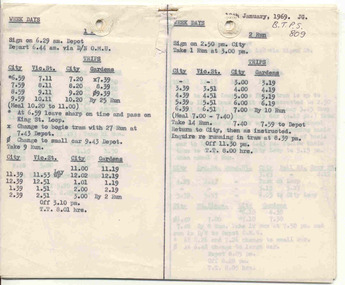
Document - Table Cards (Sheets), State Electricity Commission of Victoria (SECV), Weekdays - Motorman and Conductors, 1969, 1970
... Shows the tram operations with many short workings with some very detailed instructions, including running specials to schools....Shows the tram operations with many short workings with some very detailed instructions, including running specials to schools. Demonstrates aspects of the Ballarat Tramways at the end of the operations prior to closure. ...Each sheet or run details where the driver/conductor would sign on, time, the trips, meal breaks, finish time. Shows the tram operations with many short workings with some very detailed instructions, including running specials to schools.Demonstrates aspects of the Ballarat Tramways at the end of the operations prior to closure. Gives details of working hours, rosters for the week for crews. Shows the additional trams to the basic service on Weekdays and special instructions for picking up school children etc.Set of Table or Run sheets for the Ballarat Tramways. Two tables per sheet, punch along top edge, with ring protectors on top sheet. Groups of sheets have been stapled centrally along the top edge. See Reg Item 3424.1, 3424.2 for Saturday and Sunday. 3423.1 - Weekdays (Monday to Fridays), Motorman - dated 19th January. 1969. Has runs 1 to 28. 3423.2 - Weekdays - Conductors - dated 13th January 1970. Has runs 1C to 17C. Full scan of document added as a pdf file 5/6/2019. On front of folder in black ink " BTPS Cat No 809" (3423.1) and "810" on 3423.2.trams, tramways, timetables, sec, ballarat, crews -
 Hume City Civic Collection
Photograph
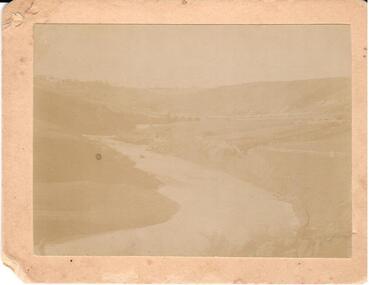
... Deep Creek running from school to reserve where swimming took place. ...Deep Creek running from school to reserve where swimming took place. ...Deep Creek running from school to reserve where swimming took place. One of a series of 4 photographs of the Bulla Valley and Deep Creek.Faded black and white photo of Deep Creek. Mounted on cardboard.deep creek, bulla bridge, waterways, bulla, george evans collection -
Glen Eira Historical Society
Article - Linlithgow Avenue, 4, Caulfield North
... Includes a brief overview of its history and some details of Favelle’s life including running a private school called Linlithgow Co-educational College from 1960-1991 in the stables of the home with her late husband. ...Includes a brief overview of its history and some details of Favelle’s life including running a private school called Linlithgow Co-educational College from 1960-1991 in the stables of the home with her late husband. ...A Real Estate guide article from the Melbourne Weekly dated Nov/Dec 1992, unattributed, on the sale of 4 Linlithgow Ave by owner Bessie Favelle. Includes a brief overview of its history and some details of Favelle’s life including running a private school called Linlithgow Co-educational College from 1960-1991 in the stables of the home with her late husband. Billy Duncan (famous jockey) was a previous owner. A colour photograph of the house and Favelle also included. The auction was set for 13/12/1992favelle bessie, linlithgow avenue, caulfield north, favelle mr, duncan billy, linlithgow co-educational college, blackburn and lockwood, myers ross -
 NMIT (Northern Melbourne Institute of TAFE)
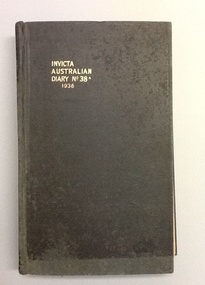
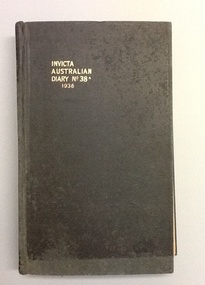
Diary - Principal's Diaries 1933-1939 CTS, Principal's Diaries, Collingwood Technical School, 1933, 1934, 1936, 1939
... These diaries contain details of the day to day running of Collingwood Technical School, including all aspects of the Principal's day. ...These diaries contain details of the day to day running of Collingwood Technical School, including all aspects of the Principal's day. ...These diaries contain details of the day to day running of Collingwood Technical School, including all aspects of the Principal's day. The Principal was Mr A. Strang. Pages are interleaved with correspondence, accounts, business cards and other ephemera.An official record of the Principal's duties and daily routine.Invicta Australian Diary No 38 [brand]. Hard cover. Page per day, handwritten entries. Interleaved with correspondence, invoices, notes, etc.All diary entries are pen and ink.collingwood technical school, principal, alex strang, diaries, nmit -
 NMIT (Northern Melbourne Institute of TAFE)
Diary - Principal's Diaries 1941-1942 CTS, Principal's Diaries, Collingwood Technical School, 1941, 1942,1942
... These diaries contain details of the day to day running of Collingwood Technical School, including all aspects of the Principal's day. ...These diaries contain details of the day to day running of Collingwood Technical School, including all aspects of the Principal's day. ...These diaries contain details of the day to day running of Collingwood Technical School, including all aspects of the Principal's day. The Principal was Mr A. Strang. Pages are interleaved with correspondence, accounts, business cards and other ephemera.An official record of the Principal's duties and daily routine.Invicta Australian Diary No 38 [brand]. Hard cover. Page per day, handwritten entries. Interleaved with correspondence, invoices, notes, etc. Also a small handwritten note by Strang dated 7.7.45All diary entries are pen and ink.collingwood technical school, principal, alex strang, diaries, nmit -
Federation University Historical Collection
Document - Document - Letter, Ballarat Junior Technical School: Report on Student Teachers George Briggs and Ian Hastie
... Two Student Teachers, George Briggs and Ian Hastie, assisted in running the school camp. They supervised the boys in some classes, organised games in recreation periods and ensured work groups satisfactorily carried out their duties. ...Two Student Teachers, George Briggs and Ian Hastie, assisted in running the school camp. They supervised the boys in some classes, organised games in recreation periods and ensured work groups satisfactorily carried out their duties. ...Two Student Teachers, George Briggs and Ian Hastie, assisted in running the school camp. They supervised the boys in some classes, organised games in recreation periods and ensured work groups satisfactorily carried out their duties. Relationships with boys and staff very satisfactory. Cream page, typed. ballarat junior technical school, head master, l garner, george briggs, ian hastie, student teachers, school camp, supervision organisation relationships very satisfactory -
 Deaf Children Australia
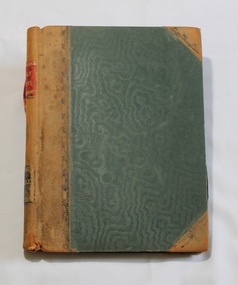
Book, Monthly Accounts V.D.& D.I
... The funds available and the expenses of running an educational and boarding school are documented in detail....The funds available and the expenses of running an educational and boarding school are documented in detail. ...The financial information relating to the Victorian Deaf & Dumb Institution has been kept in ledgers, journal, monthly accounts and Minutes of the Financial Sub-Committee. The funds available and the expenses of running an educational and boarding school are documented in detail.The financial records provide an insight into what is required to be considered at the time, from building expenses, wages and salaries, food to boot repairs. They show how funds are raised and the expenses.Green woven cover with tan leather trimming containing the handwritten accounts for the Victorian Deaf and Dumb Institution (V.D.&D.I.) from September 1945 to June 1954Spine: "MONTHLY ACCOUNTS" in gold lettering on red background "V.D.&D.I."in gold lettering on black backgrounddeaf children australia, deaf education, financial accounts -
 Deaf Children Australia
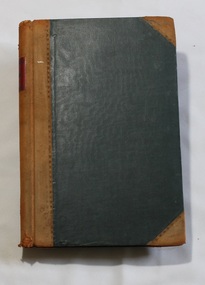
Book, Ledger
... The funds available and the expenses of running an educational and boarding school are documented in detail....The funds available and the expenses of running an educational and boarding school are documented in detail. ...The financial information relating to the Victorian Deaf & Dumb Institution has been kept in ledgers, journal, monthly accounts and Minutes of the Financial Sub-Committee. The funds available and the expenses of running an educational and boarding school are documented in detail.The financial records provide an insight into what is required to be considered at the time, from building expenses, wages and salaries, food to boot repairs. They show how funds are raised and the expenses.Green woven cover, tan leather on corners and spine, hardback book with alphabetical index pages in front and Accounts pages following. Contains Accounts of the Victorian Deaf and Dumb Institution from April 1952 to June 1958Spine: "LEDGER" with decoration in gold on red background. Decorative embossing on tan leather on coversdeaf children australia, deaf education, financial accounts -
 Deaf Children Australia
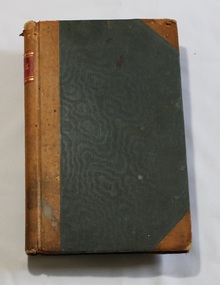
Book, Journal
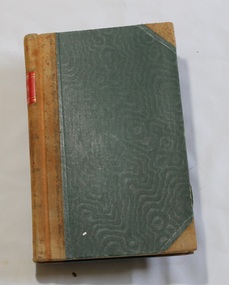
... The funds available and the expenses of running an educational and boarding school are documented in detail....The funds available and the expenses of running an educational and boarding school are documented in detail. ...The financial information relating to the Victorian Deaf & Dumb Institution has been kept in ledgers, journal, monthly accounts and Minutes of the Financial Sub-Committee. The funds available and the expenses of running an educational and boarding school are documented in detail.The financial records provide an insight into what is required to be considered at the time, from building expenses, wages and salaries, food to boot repairs. They show how funds are raised and the expenses.Green woven cover with tan leather on corners and spine, hardback account book with handwritten entries. Contains Treasurers' Statement of Accounts for the V.D.&D.I. from October 1939 to September 1956Spine: "JOURNAL" with decorations in gold lettering on red background.deaf children australia, deaf education, financial accounts, journal -
 Deaf Children Australia
Book, Journal
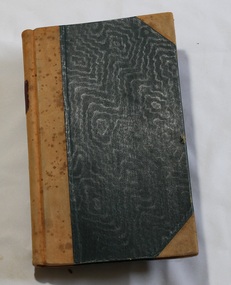
... The funds available and the expenses of running an educational and boarding school are documented in detail....The funds available and the expenses of running an educational and boarding school are documented in detail. ...The financial information relating to the Victorian Deaf & Dumb Institution has been kept in ledgers, journal, monthly accounts and Minutes of the Financial Sub-Committee. The funds available and the expenses of running an educational and boarding school are documented in detail.The financial records provide an insight into what is required to be considered at the time, from building expenses, wages and salaries, food to boot repairs. They show how funds are raised and the expenses.Green woven cover with tan leather on corners and spine, hardback account book with handwritten entries. Contains Treasurers' Statement of Accounts for the V.D.&D.I. from July 1959 to July 1977Spine: "JOURNAL" with decorations in gold lettering on red background.deaf children australia, deaf education, financial accounts, journal -
 Deaf Children Australia
Book, Investments Ledger
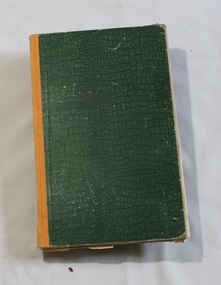
... The funds available and the expenses of running an educational and boarding school are documented in detail....The funds available and the expenses of running an educational and boarding school are documented in detail. ...The financial information relating to the Victorian Deaf & Dumb Institution has been kept in ledgers, journal, monthly accounts and Minutes of the Financial Sub-Committee. The funds available and the expenses of running an educational and boarding school are documented in detail.The financial records provide an insight into what is required to be considered at the time, from building expenses, wages and salaries, food to boot repairs. They show how funds are raised and the expenses.Green woven cover with tan leather corners and spine. Hardback account book with alphabetical index in front and accounts pages following with handwritten entries detailing investments of the V.D.&D.I. from Jarch 1952 to Jan 1989Spine: "LEDGER" in gold lettering on red background "INVESTMENT LEDGER" on dynamo tape stuck on spinedeaf children australia, deaf education, financial accounts, investments -
 Deaf Children Australia
Book, Finance Sub-Committee minutes 17/7/52
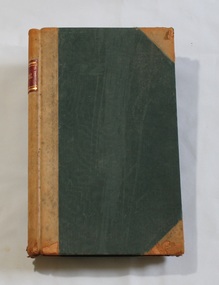
... The funds available and the expenses of running an educational and boarding school are documented in detail....The funds available and the expenses of running an educational and boarding school are documented in detail. ...The financial information relating to the Victorian Deaf & Dumb Institution has been kept in ledgers, journal, monthly accounts and Minutes of the Financial Sub-Committee. The funds available and the expenses of running an educational and boarding school are documented in detail.The financial records provide an insight into what is required to be considered at the time, from building expenses, wages and salaries, food to boot repairs. They show how funds are raised and the expenses.Green cardboard ruled blank book with orange woven tape spine containing handwritten minutes of the Financh Sub-committee of the VSCD from July 1952- . Last entry March 1957. Kindergarten sub-committee minutes included.deaf children australia, deaf education, minutes of meeting -
 Deaf Children Australia
Book, Journal - Monthly Financial Statements
... The funds available and the expenses of running an educational and boarding school are documented in detail....The funds available and the expenses of running an educational and boarding school are documented in detail. ...The financial information relating to the Victorian Deaf & Dumb Institution has been kept in ledgers, journal, monthly accounts and Minutes of the Financial Sub-Committee. The funds available and the expenses of running an educational and boarding school are documented in detail.The financial records provide an insight into what is required to be considered at the time, from building expenses, wages and salaries, food to boot repairs. They show how funds are raised and the expenses.Green woven covers with tan leather corners and cover of spine, hardback account with handwritten entries containing the Monthly Financial statements of the Victorian Deaf & Dumb Institution from May 1940-March 1951Spine: "JOURNAL" and decoration in gold lettering on red backgrounddeaf children australia, deaf education, financial accounts, journal -
 Deaf Children Australia
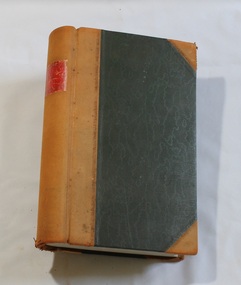
Book, Ledger
... The funds available and the expenses of running an educational and boarding school are documented in detail....The funds available and the expenses of running an educational and boarding school are documented in detail. ...The financial information relating to the Victorian Deaf & Dumb Institution has been kept in ledgers, journal, monthly accounts and Minutes of the Financial Sub-Committee. The funds available and the expenses of running an educational and boarding school are documented in detail.The financial records provide an insight into what is required to be considered at the time, from building expenses, wages and salaries, food to boot repairs. They show how funds are raised and the expenses.Green woven cover with tan leather at corners and over spine harback blank ledger book with alphabetical index in front and ledger pages following with handwritten entriesSpine: "LEDGER" in gold lettering on red backgrounddeaf children australia, deaf education, financial accounts, ledger -
 Deaf Children Australia
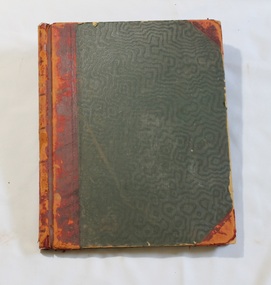
Book, Municipal Council Subscriptions
... The funds available and the expenses of running an educational and boarding school are documented in detail....The funds available and the expenses of running an educational and boarding school are documented in detail. ...The financial information relating to the Victorian Deaf & Dumb Institution has been kept in ledgers, journal, monthly accounts and Minutes of the Financial Sub-Committee. The funds available and the expenses of running an educational and boarding school are documented in detail.The Registers document where children came from, their family details and medical information, all relating to the time they were admitted and reflect the society of the time.Green woven cover with red leather over spine and corners, bound book containing ledger pages with handwritten entries. Lists donations from Shires, Boroughs, Towns, Cities and Masonic Lodges from 1913 to 1957.Spine: "MUNICIPAL COUNCIL SUBSCRIPTIONS" in gold letteringdeaf children australia, deaf education, donations, municipal councils -
 Deaf Children Australia
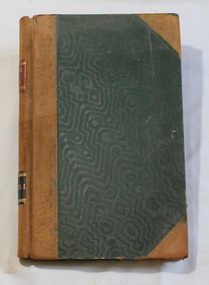
Book, Salaries and Wages V.D.&D.I
... The funds available and the expenses of running an educational and boarding school are documented in detail....The funds available and the expenses of running an educational and boarding school are documented in detail. ...The financial information relating to the Victorian Deaf & Dumb Institution has been kept in ledgers, journal, monthly accounts and Minutes of the Financial Sub-Committee. The funds available and the expenses of running an educational and boarding school are documented in detail.The Registers document where children came from, their family details and medical information, all relating to the time they were admitted and reflect the society of the time.Green woven cover with tan leather over spine and corners bound book containing printed accounts pages with handwritten entries listing the salaries and wages of the Victorian Deaf & Dumb Institution (V.D.&D.I) from 1938 to 1946.Spine: "SALARIES/AND/WAGES" "V.D.&D.I." in gold lettering on red and black background respectively.deaf children australia, deaf education, salaries, wages -
 Deaf Children Australia
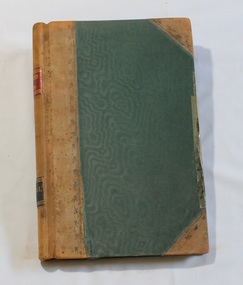
Book, Salaries and Wages V.D.&D.I
... The funds available and the expenses of running an educational and boarding school are documented in detail....The funds available and the expenses of running an educational and boarding school are documented in detail. ...The financial information relating to the Victorian Deaf & Dumb Institution has been kept in ledgers, journal, monthly accounts and Minutes of the Financial Sub-Committee. The funds available and the expenses of running an educational and boarding school are documented in detail.The Registers document where children came from, their family details and medical information, all relating to the time they were admitted and reflect the society of the time.Green woven cover with tan leather over spine and corners bound book containing printed accounts pages with handwritten entries listing the salaries and wages of the Victorian Deaf & Dumb Institution (V.D.&D.I) from 1946 to 1951.Spine: "SALARIES/AND/WAGES" in gold lettering on red background "V.D.&D.I." in gold lettering on black background. Decorative printing on leather coverdeaf children australia, deaf education, salaries, wages -
 Deaf Children Australia
Book, Cash Book
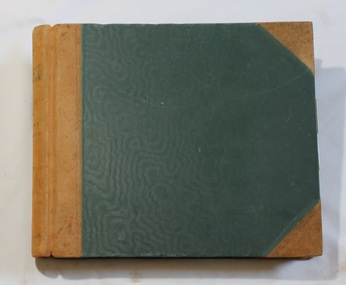
... The funds available and the expenses of running an educational and boarding school are documented in detail....The funds available and the expenses of running an educational and boarding school are documented in detail. ...The financial information relating to the Victorian Deaf & Dumb Institution has been kept in ledgers, journal, monthly accounts and Minutes of the Financial Sub-Committee. The funds available and the expenses of running an educational and boarding school are documented in detail.The Registers document where children came from, their family details and medical information, all relating to the time they were admitted and reflect the society of the time.Green woven cover with tan leather over spine and corners bound book containing printed account pages with handwritten entries of receipts and expenses from December 1967 to January 1971 of the Victorian Deaf & Dumb Institution (V.D.&D.I.)Spine: "C B/1967/DECEMBER/to/1971/JANUARY" handwritten in inkdeaf children australia, deaf education, cash book, receipts, expenses -
 Deaf Children Australia
Book, Cash Book
... The funds available and the expenses of running an educational and boarding school are documented in detail....The funds available and the expenses of running an educational and boarding school are documented in detail. ...The financial information relating to the Victorian Deaf & Dumb Institution has been kept in ledgers, journal, monthly accounts and Minutes of the Financial Sub-Committee. The funds available and the expenses of running an educational and boarding school are documented in detail.The Registers document where children came from, their family details and medical information, all relating to the time they were admitted and reflect the society of the time.Green woven cover with tan leather over spine and corners bound book containing printed account pages with handwritten entries of receipts and expenses from February 1971 to June 1974 of the Victorian Deaf & Dumb Institution (V.D.&D.I.)Spine: "1971/TO/1974" handwritten in inkdeaf children australia, deaf education, cash book, receipts, expenses -
 Kiewa Valley Historical Society
Register School Administration, Absence Register School No. 2539 Mullindolingong, circa 1910
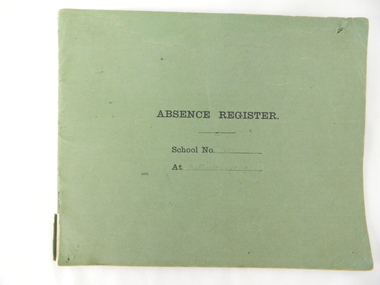
... Historical look (early 20th century) at the administrative requirements for the running of a small country school. The level of accountability was limited to a monthly report and a visit from the District Inspector. ...Historical look (early 20th century) at the administrative requirements for the running of a small country school. The level of accountability was limited to a monthly report and a visit from the District Inspector. ...Historical look (early 20th century) at the administrative requirements for the running of a small country school. The level of accountability was limited to a monthly report and a visit from the District Inspector. This was still in the era where paper reporting was utmost and faster electronic reporting had still to be implemented.The significance of this register is that it highlights the need in the early 1900s for travelling time, to and from, the duties required at a small country town to be detailed closely for a bureaucracy that was relatively isolated within the larger cities of Australia. Decentralisation of not only government but also of industry had not as yet entered the Australian environment. This register also shows that the written word was clearly hand scribed and thereby a more personal form of communication. This was still in the age where you " can tell a lot about a person from their handwriting" Lucy Goonan was Leonie Prime's relation and came from Glen Creek to teach at Mullindolingong School for a couple of years. None of the other names are 'known' names from the district.Green coloured cardboard backed book with two large staples holding each page at the left side of the spine Each page of has been folded in half from a 51cm overall length to produce each individual page of the register. This method of production of the book provides 25 double sided pages. Markings on cover " Absence Register, School No........ At ......." Markings on inside cover " ABSENCE REGISTER." Underneath this heading there are six explanatory and conditional usage. Each page is printed with the heading ABSENCE REGISTER and underneath "Roll No. 191(part of initial year reference), Record No. Name of Teacher Position Date of Absence Cause of Absence No. of times absent from beginning of year, total number of days absence and remarks requirements staff /reason/time taken during the period 1923 to 1950. Each page was printed with only three numbers of the calender year 191-.This was so that each year could be manually inserted.teachers absence register small school administration, mullindolingong school 1923 -1950 -
 Mission to Seafarers Victoria
Plaque - Memorial plaque, Mary Danne, 1927
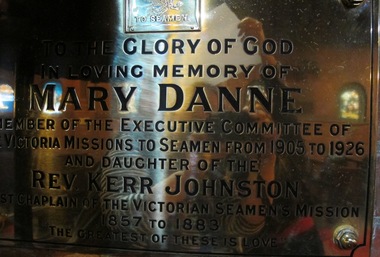
... On 9 November 1906, for King's Birthday, she hosted a sailors' picnic at the property she rented, Glenfern on Inkerman Road (see item 1637), where she was running a school, Newington. She died on the 30th of July 1926 at her residence, Seymour Grove in Camberwell. ...On 9 November 1906, for King's Birthday, she hosted a sailors' picnic at the property she rented, Glenfern on Inkerman Road (see item 1637), where she was running a school, Newington. She died on the 30th of July 1926 at her residence, Seymour Grove in Camberwell. ...Mary was the fifth daughter of Reverend Kerr Johnston and his wife Elizabeth. Mary married Reverend Richard Vallencey Danne (1846-1904), they had 8 children. One of their son Noel also became a reverend. She continued her father's work by becoming part of the Mission's committee in 1905. On 9 November 1906, for King's Birthday, she hosted a sailors' picnic at the property she rented, Glenfern on Inkerman Road (see item 1637), where she was running a school, Newington. She died on the 30th of July 1926 at her residence, Seymour Grove in Camberwell. The plaque was erected on the 9 October 1927 (AR 1927).The Kerr Johnston Family migrated to Tasmania in 1854. The Reverend took up his appointment with the Victorian Bethel Union for Seamen in 1857 and moved all his family in the "floating church", the ex water police hulk Emily, first Chaplain serving the seamen in Hobsons' Bay.Large rectangular brass plaque with smaller plaque mounted onto it of Mission to Seamen insignia. The Larger plaque is mounted to a brick wall.Mission to Seamen. To the glory of God In loving memory of Mary Danne member of the executive committee of the Victoria Missions to Seamen from 1905 to 1920 and daughter of the REv. Kerr -Johnston chaplain of the Victorian Seamen's Mission 1857 to 1883 "The greatest of these is love"mary alice isabelle danne nee johnston, 1851-1926, reverend kerr johnston, reverend richard vallencey danne, 1846-1904, bethel, hulk emily, hobson's bay, glenfern, flinders street, st peter chapel -
Federation University Historical Collection
Letter, Letter to Frederick Gladstone Procter, 1949, 1949
... School durign the past 18 months. The Council is particularly pleased with the number of improvements effected by you, very often in your own time, such as - the construction of a number of wearving looms, the framing of prints, the procuring, setting up and lighting of show cases and the assembling of a portable compressor unit for air-brush work. Yours faithfully [signed] F.E. Ferguson, Registrar These improvements, and the smooth running...School durign the past 18 months. The Council is particularly pleased with the number of improvements effected by you, very often in your own time, such as - the construction of a number of wearving looms, the framing of prints, the procuring, setting up and lighting of show cases and the assembling of a portable compressor unit for air-brush work. Yours faithfully [signed] F.E. Ferguson, Registrar These improvements, and the smooth running ...Letter to F.Gladstone Proctor, teacher in Metalcraft at the Ballarat Technical Art School, and Acting Head of the Art School in 1949. 19th August, 1949 Mr F.G. Procter, School of Mines BALLARAT Dear Mr. Procter By direction of the School Council I have pleasure in conveying to you the Council's keen appreciation of teh steling service rendered by you as Acting Head of the Art School durign the past 18 months. The Council is particularly pleased with the number of improvements effected by you, very often in your own time, such as - the construction of a number of wearving looms, the framing of prints, the procuring, setting up and lighting of show cases and the assembling of a portable compressor unit for air-brush work. Yours faithfully [signed] F.E. Ferguson, Registrar These improvements, and the smooth running of the Art School under your guidance, have been a source of great satisfaction to the Council.ballarat school of mines, f.e. ferguson, f.g. proctor, glad proctor, ballarat technical art school, acting principal, f.g. procter, glad procter -
 Ringwood and District Historical Society
Newspaper, Ringwood Secondary College - A sprint to success - Mail, 25-05-94, Page 18
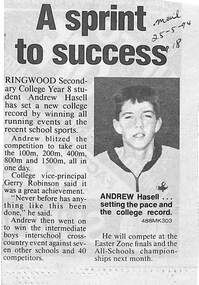
... Ringwood Secondary College year 8 student, Andrew Hasell has set a new college record by winning all running events at the recent school sports. Andrew blitzed the competition to take out the 100m, 200m, 400m, 800m and 1500m, all in one day. ...Ringwood Secondary College year 8 student, Andrew Hasell has set a new college record by winning all running events at the recent school sports. Andrew blitzed the competition to take out the 100m, 200m, 400m, 800m and 1500m, all in one day. ...Clipping glued to A4 sheet of paperRingwood Secondary College year 8 student, Andrew Hasell has set a new college record by winning all running events at the recent school sports. Andrew blitzed the competition to take out the 100m, 200m, 400m, 800m and 1500m, all in one day. College vice-principal Gerry Robinson said it was a great achievement. "Never before has anything like this been done", he said. Andrew then went on to win the boys' interschool cross country event against seven other schools and 40 competitors. -
 Orbost & District Historical Society
book, Stanley,Paul & Company, The Lady's Realm, November 1910 - April 1911
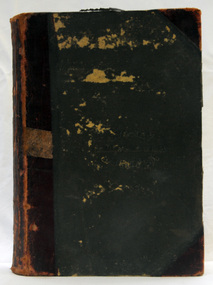
... (Wikipedia) Founded in 1833, the Sydney Mechanics' School of Arts is the longest running School of Arts (also known as a "Mechanics' Institute") and the oldest continuous lending library in Australia. ...(Wikipedia) Founded in 1833, the Sydney Mechanics' School of Arts is the longest running School of Arts (also known as a "Mechanics' Institute") and the oldest continuous lending library in Australia. ...The Lady's Realm was a illustrated monthly women's magazine published in London in the 19th century, initially edited by W. H. Wilkins. It also published 36 volumes between 1896 and 1914. The Lady's Realm was a British women's magazine published from 1896 until 1914, possibly until 1915. It primarily targeted upper-class readers as well as an aspirational middle-class audience, featuring photographs, poems, fiction, and columns by popular authors such as Marie Corelli, Frances Hodgson Burnett, Jack London, and H.G. Wells. (Wikipedia) Founded in 1833, the Sydney Mechanics' School of Arts is the longest running School of Arts (also known as a "Mechanics' Institute") and the oldest continuous lending library in Australia. These magazines reflect women's interests in the early 20th century. Women’s magazines developed rapidly through the 1800s, reflecting both marketing developments and social changes. As the century progressed, publications aimed at women changed from the middle-class drawing-room journals of the 1830s and 1840s to the cheaper, chattier, more domestic magazines of the 1880s and 1890s. This item oi an example of a publication aimed at a particular social class.A thick hard back book with a dark blue and red fabric cover. It contains short stories by various authors. "SYDNEY MECHANICS SCHOOL OF ARTS 225 PITT STREET" on front cover.literature-lady's-realm short-stories -
 Ballarat Tramway Museum
Photograph - SECV Ballarat - last days of operations - set of 13, George Stevens, 17/9/1971
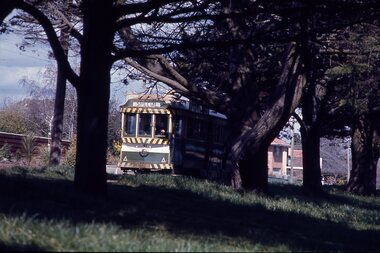
... Set of 13 Digital images, from slides taken by George Stevens on 17/9/1971: 1 - Tram 41 Running a school Special in Wendouree Parade 2 - Across the lake 3 - Tram 34 and Milko in Wendouree Parade 4 - Tram 34 Returning from the Gardens 5 - Tram 34 ditto 6 - Trams 34, 41 Passing St Aidans Drive gates 7 - Trams 34, 41 At depot junction 8 - Tram 30 Southbound in Skipton St 9 - Track Cleaner Cleaning points at Hospital Corner in Drummond St Sth 10 - Trams 35 and 30 at Hospital Corner, with 35 for Sebastopol and 30 turning into Sturt St from Drummond St Sth 11 - Tram 17 Sturt St with garden beds in the foreground. ...Set of 13 Digital images, from slides taken by George Stevens on 17/9/1971: 1 - Tram 41 Running a school Special in Wendouree Parade 2 - Across the lake 3 - Tram 34 and Milko in Wendouree Parade 4 - Tram 34 Returning from the Gardens 5 - Tram 34 ditto 6 - Trams 34, 41 Passing St Aidans Drive gates 7 - Trams 34, 41 At depot junction 8 - Tram 30 Southbound in Skipton St 9 - Track Cleaner Cleaning points at Hospital Corner in Drummond St Sth 10 - Trams 35 and 30 at Hospital Corner, with 35 for Sebastopol and 30 turning into Sturt St from Drummond St Sth 11 - Tram 17 Sturt St with garden beds in the foreground. ...Set of 13 Digital images, from slides taken by George Stevens on 17/9/1971: 1 - Tram 41 Running a school Special in Wendouree Parade 2 - Across the lake 3 - Tram 34 and Milko in Wendouree Parade 4 - Tram 34 Returning from the Gardens 5 - Tram 34 ditto 6 - Trams 34, 41 Passing St Aidans Drive gates 7 - Trams 34, 41 At depot junction 8 - Tram 30 Southbound in Skipton St 9 - Track Cleaner Cleaning points at Hospital Corner in Drummond St Sth 10 - Trams 35 and 30 at Hospital Corner, with 35 for Sebastopol and 30 turning into Sturt St from Drummond St Sth 11 - Tram 17 Sturt St with garden beds in the foreground. Has a shoe repair shop, UFS dispensary, Lance & Yorke store and a Mobil service station in the background' 12 - Tram 42 Inbound in Sturt St 13 - Trams 41 and 30 Near Doveton St, with the Town Hall in the background. Tram 30 has the destination of City.Yields information about the tramcars used on 17/9/1971 and the various locations around the system.Set of 13 digital images scanned from slides.tramways, wendouree parade, tram 34, tram 17, tram 35, tram 41, tram 30, albert st, sebastpol, drummond st sth, skipton st, passengers, drummond st nth, sturt st, hospital corner, st aidans drive -
 Brighton Historical Society
Flag, School flag, circa 1914 - 1956
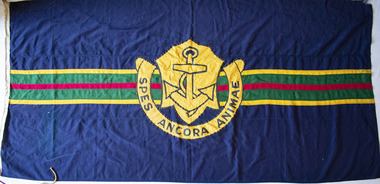
... At a time when few occupations were open to gentlewomen, running a school provided the sisters with a respectable means of supporting themselves. ...At a time when few occupations were open to gentlewomen, running a school provided the sisters with a respectable means of supporting themselves. ...This flag was used by Esperance Girls School, a private school based in Brighton from 1894-1956. Esperance was established in 1894 at 6 Normanby Street by Misses Emsie, Marion, Gussie and Daisy Beaver. The four sisters came from a formerly-prosperous land-owning family that had suffered badly as a result of the depression of the early 1890s. At a time when few occupations were open to gentlewomen, running a school provided the sisters with a respectable means of supporting themselves. Notable teachers at Esperance during the 1890s included elocution mistress Miss Jeannie Taylor, who would later become better known as the author Mrs Aeneas Gunn. In 1924 the school was sold to Miss Marian Taylor and Miss Christina McMillan, who had previously served as joint principals of Alexandra College in Hamilton between 1909 and 1913. Both women had strong family connections to Brighton: Christina was the granddaughter of early pioneer Archibald McMillan and Marian was a relative of long-serving town clerk J. H. Taylor. The new principals relocated the school to a large two-storey house on the corner of Park Street and Esperance Avenue, where it remained until its closure. They operated the school until 1950, when they sold it to a Miss Bury, who in turn sold it to the local Baptist Church in 1956. Following this final sale, the school continued for another four terms before closing.Navy blue flag, both sides featuring a large yellow-gold crest in centre, containing image of an anchor and surrounded by semicircular scroll with the motto "SPES ANCORA ANIMAE". Background features horizontal green stripe across centre, containing smaller red stripe and bordered on each side by yellow stripes.esperance girls school, flag, school flag -
 Eltham District Historical Society Inc
Photograph - Digital Photograph, Marguerite Marshall, 'Landscape', 60 Lavender Park Road, Eltham South, 24 June 2008
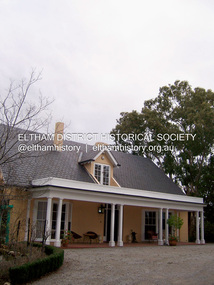
... But Leason found his niche by running an art school, painting society portraits and illustrating books and magazines....But Leason found his niche by running an art school, painting society portraits and illustrating books and magazines. ...Built by artist and cartoonist Percy Leason in 1927 in what was then New Street but renamed Lavender Park Road in the late 1950s/early 1960s. Covered under Heritage Overlay, Nillumbik Planning Scheme. Published: Nillumbik Now and Then / Marguerite Marshall 2008; photographs Alan King with Marguerite Marshall.; p121 Said to be a genius, cartoonist Percy Leason’s career was at its peak when in 1925 to 1926 he built his home at New Street (now Lavender Park Road) Eltham. The Herald newspaper owner, Sir Keith Murdoch, had hired Leason for his newly acquired Melbourne Punch magazine at a salary of £1750, making him ‘one of the highest paid cartoonists in the world’.1 With this salary and financial help from Murdoch, Leason was able to build his lovely home in Eltham. At the crest of a sweeping drive, the home now two-storey in white brick with a gabled grey slate roof and dormer windows is flanked by an extension built by another owner in the 1980s. Leason lived in the home with his wife, Isabel and children, until 1937, when he left for the United States of America, where he lived until his death in 1959. The four-bedroom house and garden would have been well-suited to bringing up his family and to entertaining their friends in style. Large airy rooms have high ceilings with moulded plaster, timber floors and several are brightened with bay windows. Leason made friends with many of the artists and personalities who gravitated to Eltham. Around 1931 Justus Jörgensen, founder of the Montsalvat Artists’ Colony, helped Leason build his large studio at the back of the house. Another friend was journalist Mervyn Skipper, father of jeweller and sculptor Matcham, and artists Helen and Sonia. Leason’s teacher, artist Max Meldrum, also visited and rented accommodation in Eltham, opposite Wingrove Park. Punch folded in 1925, but Leason continued as cartoonist for Table Talk. In 1926 Leason began the cartoons of a mythical Australian town Wiregrass, which were inspired by Kaniva, his home town. The art gallery in Main Road Eltham was named Wiregrass in Leason’s honour. Leason completed 1000 drawings from 1919 to 1937, which author Garrie Hutchinson claimed, were technically unsurpassed and had regional and universal interest. Leason’s acute observations of country life stemmed from his childhood in Kaniva in Victoria’s western Wimmera, where he was born, the son of a selector, in 1889. Meldrum claimed that Leason could name every plant and the habits of every animal.2 Leason also painted 28 portraits of the last full-blooded aboriginals in Victoria at Lake Tyers in Gippsland, most of which are in a private collection. In Sydney Leason illustrated Henry Lawson’s Selected Poems and worked for The Bulletin. Leason had begun his career at 13 as an apprentice lithographic artist at Sands and MacDougall. He attended night classes at the National Gallery and the Victorian Artists Society. Leason first visited Eltham in 1910 to paint with fellow artist William ‘Jock’ Frater. They camped near Bible and Pitt Streets and along the Diamond Creek on the site of the present Eltham Retirement Centre. Despite his success as a cartoonist, Leason wanted to be recognised as a serious painter and for his anthropological work.3 He was also conservative and felt uncomfortable with the modern art scene in Melbourne.4 So he left for the United States of America to work as a painter. Ironically his time in New York saw the burgeoning of modern art, notably by artists such as Jackson Pollock. But Leason found his niche by running an art school, painting society portraits and illustrating books and magazines.This collection of almost 130 photos about places and people within the Shire of Nillumbik, an urban and rural municipality in Melbourne's north, contributes to an understanding of the history of the Shire. Published in 2008 immediately prior to the Black Saturday bushfires of February 7, 2009, it documents sites that were impacted, and in some cases destroyed by the fires. It includes photographs taken especially for the publication, creating a unique time capsule representing the Shire in the early 21st century. It remains the most recent comprehenesive publication devoted to the Shire's history connecting local residents to the past. nillumbik now and then (marshall-king) collection, landscape, lavender park road, percy leason, new street -
 Bendigo Historical Society Inc.
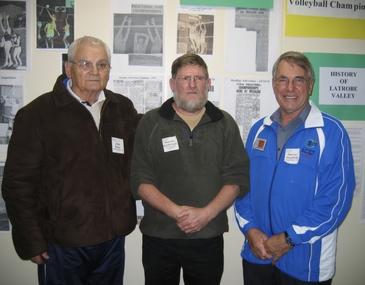
Document - The Victorian Country Volleyball Council (VCVC) Records, 1974 -1985
... Competitions were running at the Ballarat School of Mines and the YMCA’s of Bendigo, Geelong and Warrnambool. ...Competitions were running at the Ballarat School of Mines and the YMCA’s of Bendigo, Geelong and Warrnambool. ...Volleyball has been played in regional Victoria since the early-1960’s. During those early days, most competitions, like the founders of our great sport, were run by, or in conjunction with, the YMCA. Competitions were running at the Ballarat School of Mines and the YMCA’s of Bendigo, Geelong and Warrnambool. In August 1966, an invitation was extended by the Victorian Amateur Volleyball Association to play in the first State-wide event at Monash University. Geelong and Bendigo accepted the invitation with Melbourne represented by Sisu. For Bendigo players at least, this was the first exposure to ‘international rules’, which prevented upward scoops with open hands, introduced an action called a ‘dig’ and seemed to penalise most overhead actions using the fingers as ‘double hits’! Over the next few years, the sport expanded through the YMCA movement with weekly competitions starting up in Ararat, Warrnambool and Latrobe Valley. The Victorian Regional Council of YMCA’s proposed the first Victorian YMCA Championship in Warrnambool on 30th March 1968 with an entry fee of $4.00 per team. The sport continued to grow with additional regional associations affiliating with the Victorian Amateur Volleyball Association (now VVI) who provided the coaching and refereeing assistance needed to raise the standard of play. In 1970, the YMCA Championships started to give way to the Victorian Country Championships with the first ever event held in Bendigo. In 1973, a re-organisation of the VAVA saw the proposal to create separate Victorian Country and Metropolitan Volleyball Councils. The VCVC was established in 1974 and took over the organisation of the Victorian Country Championships. For the next 10-12 years, the Country Championships grew in stature with the inclusion of two divisions for open men and women and junior divisions for boys and girls. Representative teams successfully contested Australian Country Championships between Victoria, South Australia and New South Wales on several occasions. In October 1985, the VCVC voluntarily wound up the Council and handed the responsibility for the Country Championships back to Volleyball Victoria, who by that time had full-time State Executive and Coaching Directors. Since that time, the Long Weekend in June has continued to be the date of the major annual volleyball event for most regional associations, even though in 1986 the Junior Country Championships were wound up in favour of state and national schools events. A number of regional associations have ceased to exist, as have a number of regional tournaments. Regional leagues were created in both the Gippsland and Central, North-West regions, with Gippsland the only one to survive. Some associations have successfully competed in the State League competitions at various times. Following the experience gained by a number of regional administrators working on the Sydney Olympic Games, a proposal to revamp the Victorian Country Championship was put to VVI in early 2002. Later that year, the Volleyball Victoria Country Championships Commission was formed to implement the recommendations of the review and take control of the event into the future. These championships now provide regional players and officials an opportunity to participate in a consistently well-managed event, using many international protocols and a high standard of presentation. Without doubt, this event now ranks as one of the best volleyball events in Australia. Source: 2022 Country Championship regulations The management of the Country Championships by the Victorian Country Championship Commission certainly achieved the objective of raising the standard of presentation, and delivering a consistently high quality event. However, the demands on Host Associations began to take their toll, with several Associations declining the opportunity to host the event due to the high workload. Similarly, the workload of the volunteer Commissioners also took its toll, with the Commission unable to fill casual vacancies. In 2023, the Commission handed the organisation of the Championships back to VVI, who with paid staff, were better equipped to manage the event.This item contains an introduction to the VCVC, a coloured photo of the 50th Anniversary of the Country Championships at Bendigo, 2018. L-R John (Joe) Rosso (Geelong Women's Coach), Malcolm Qualtrough (Life Member Moe, Latrobe Valley, and Volleyball Victoria), Murray Mansfield (Life Member Bendigo, Volleyball Victoria and Volleyball Australia.); and an original Country Championship logo.victorian country volleyball council, vcvc, victorian amateur volleyball association, volleyball victoria
