
Showing 29 items matching "salt boxes"
-
 Mont De Lancey
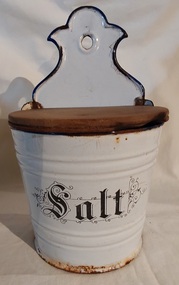
Domestic object - Salt Box
... Salt Box......Salt boxes...The Salt Box was used to store salt for cooking purposes....An early 20th century German white wall mount enamel tin wall Salt Box with a dark blue lined trim around the edges and shaped top at the back. ...The Salt Box was used to store salt for cooking purposes. ...The Salt Box was used to store salt for cooking purposes.An early 20th century German white wall mount enamel tin wall Salt Box with a dark blue lined trim around the edges and shaped top at the back. It has a wooden lift up lid, a hole for mounting it on a wall as well as 'Salt' inscribed on the front in elaborate black lettering. 'Salt' is printed on the front in elaborate letteringfood containers, salt boxes, cooking equipment -
 Federation University Historical Collection
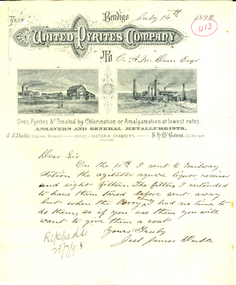
Letter - Correspondence, Letter on Bendigo United Pyrites Company Letterhead, 1898, 1898
... salt, and the gas is introduced into huge vats, where it works its way through a filter of pieces of quartz and then through the bed of roasted pyrites lying above. The action of the gas transforms the gold into chloride of gold. This is easily dissolved in water, and in that form is drawn off into huge delf jars, where the use of sulphate of iron precipitates the gold to the bottom. A small battery—eight head of stamps in two boxes...salt, and the gas is introduced into huge vats, where it works its way through a filter of pieces of quartz and then through the bed of roasted pyrites lying above. The action of the gas transforms the gold into chloride of gold. This is easily dissolved in water, and in that form is drawn off into huge delf jars, where the use of sulphate of iron precipitates the gold to the bottom. A small battery—eight head of stamps in two boxes ..."The United Pyrites Company's Works are situated about three quarters of a mile from Spargo Brothers, and are on the northern side of the Marong road, in Pinch-gut Gully. Two processes are followed at these works, viz., the amalgamating process and the treatment by means of chlorine gas. The latter is called the Newbery-Vautin system, and the mode pursued is that laid down by Mr. Cosmo Newbery and Mr Vautin, whose names have been given to the process. Mr. Edwards manages these works. Three reverbatory furnaces are used to roast the pyrites, which is weighed in the truck before being put into the furnaces. At this weighbridge a sample of each lot is kept, and if the yield is not equal to expectation, the works are carefully gone over to see where the fault occurs. Care is taken at the furnace to regulate the heat, otherwise the pyrites might slag instead of roasting evenly right through. An immense revolving furnace (made of boiler iron) was used at these works. It was found to be suitable for treating blanket sand, but was not a success for roasting coarse pyrites. The process of amalgamating by means of Chilian mills is the same in these works as at the Western Works, but the United Works are on a larger scale, and eleven mills are utilised. It is the chlorine gas process which is most interesting here. The gas is made from sulphuric acid, black oxide of manganese, and common salt, and the gas is introduced into huge vats, where it works its way through a filter of pieces of quartz and then through the bed of roasted pyrites lying above. The action of the gas transforms the gold into chloride of gold. This is easily dissolved in water, and in that form is drawn off into huge delf jars, where the use of sulphate of iron precipitates the gold to the bottom. A small battery—eight head of stamps in two boxes—is in use here to crush small consignments of stone sent for trial. Test crushings come from all the Australasian colonies, and even from India. The jars used are manufactured at Epsom, and some of the salt used is also of home manufacture, from the Salt Lakes on the Northern plains. Mr. Edwards took us over a new building in course of erection, and in which the chlorine gas is to be generated in the midst of the pyrites— a still further advancement in the new process. There is some very good machinery in this new building, and the tailings from the ordinary pyrites works will also be treated by this chlorine gas system, which has been found to work well at Mount Morgan, in Queensland. The purest of gold is obtained by this process, the gold passing in solution into a charcoal filter, from which it emerges in the shape of metallic gold. We saw some nice cakes of retorted gold at the works. One of 26oz. was from some New Zealand pyrites (2½ tons), and assayed over 23 carats. There were also cakes of Avoca gold, of silver, and of the tremulous amalgam." (The Argus, 4 February 1887)Two handwritten letters to the Ballarat School of Mines on Bendigo United Pyrites Company Letterhead.bendigo united pyrites company, pyrites, ballarat school of mines, j.j. deeble, joel deeble, joel james deeble, a.m. dean, fred j. martell, martell, s.h. cowan, letterhead -
 Flagstaff Hill Maritime Museum and Village
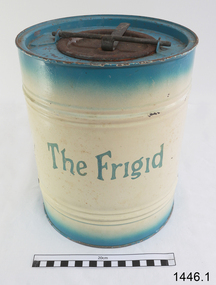
Freezer, circa 1930's
... salt, then pour into the chamber about 1 cup of cold water. After this, the ingredients for ice cream or sorbet were poured into the inner chamber, then attach the lid and turn The Frigid freezer upside down for about 40 minutes or until the right consistency is reached. Advice as given to open the freezer every 20 minutes and stir around the contents that were frozen against the sides of the inner chamber. The ingredients for the ice cream could include cream, sugar, vanilla and eggs. The label on the box...salt, then pour into the chamber about 1 cup of cold water. After this, the ingredients for ice cream or sorbet were poured into the inner chamber, then attach the lid and turn The Frigid freezer upside down for about 40 minutes or until the right consistency is reached. Advice as given to open the freezer every 20 minutes and stir around the contents that were frozen against the sides of the inner chamber. The ingredients for the ice cream could include cream, sugar, vanilla and eggs. The label on the box ...This ice cream freezer, manufactured in South Australia in the 1930's, was advertised to "keep the contents of the cream compartment frozen for many hours". It was promoted for use at picnics to keep salads cool. Its design is very similar to other freezers of The Frigid name which were made in 1939; those freezers were all one colour whereas this one is blue around the top and bottom of the barrel and cream in the centre with blue/green lettering. The process of making ice cream was to pack the outer chamber full with a combination of 3 parts ice cubes of about 1 inch (2.cm) to one part coarse salt, then pour into the chamber about 1 cup of cold water. After this, the ingredients for ice cream or sorbet were poured into the inner chamber, then attach the lid and turn The Frigid freezer upside down for about 40 minutes or until the right consistency is reached. Advice as given to open the freezer every 20 minutes and stir around the contents that were frozen against the sides of the inner chamber. The ingredients for the ice cream could include cream, sugar, vanilla and eggs. The label on the box of The Frigid shows the address of A Simpson and Son to be at Pirie Street, Adelaide. This address was used as early as 1876 and later catalogues, 1931 - 1960 still show this address. Alfred Simpson and his family emigrated from England, arriving in South Australia in 1849. He had already completed his apprenticeship as a tinplate worker but he tried various other occupations, including trying out the gold mines in Victoria, before he established himself as a tinsmith in 1853. His products included many agricultural items. His son, Alfred Muller Simpson, joined the business when he turned 21. In the 1860 Simpson's products included 'explosion proof' safes. In the late 1880's A Simpson and Son manufactured munitions and mines for the war. At the time of Alfred's death in 1891, A Simpson and Son had the largest metal manufacturing plant in Australia. From 1898 the company's reputation grew from the process of enamel plating with porcelain. During the First World War, Simpsons returned to the manufacture of munitions. Alfred M. Simpson's sons (Alfred Allen, known as Allen, and Fredrick Neighbour) joined the company when they finished their schooling. Allen was also associated with the Royal Geological Society over many years and when the CT Madigan surveyed Central Australia in 1929, the Simpson Desert was named in his honour. Cape Simpson in Antarctica is also named after him due to his assistance to Douglas Mawson. A new factory was opened at Dudley Park in the 1940s and the company began the manufacture of whitegoods. In 1963 A. Simpson and Son merged with Pope Industries to form Simpson Pope Holdings. Alfred Simpson became chairman of the board of Simpson Pope Holdings. The Simpson brand, now owned by Electrolux, continues to produce a variety of household appliances. (Reference: State Library of South Australia) A Simpson and Son was an early colonial business that has lasted well into the 20th century and the name Simpson is still associated with whitegoods. Freezer, 2 quart (1.8 litre) capacity, made by A Simpson and Son Ltd, marked "The Frigid". Cylinder shaped, constructed from enamelled sheet metal, has two catches one on the base and one on top. Inner cylinder for holding contents for freezing. Slightly rusted. Freezer is inside original cardboard box with yellow label showing manufacturer details. Circa 1930'sOutside of freezer is printed in blue"The Frigid". Box includes "THE "FRIGID" FREEZER" and branded "S & S" inside a circle.flagstaff hill, warrnambool, shipwrecked-coast, flagstaff-hill, flagstaff-hill-maritime-museum, maritime-museum, shipwreck-coast, flagstaff-hill-maritime-village, a. simpson & son limited, manufacturer, foundry, freezer, 2 quart freezer, portable freezer, kitchen appliance, the frigid, ice cream freezer, ice cream maker 1930's -
 Flagstaff Hill Maritime Museum and Village
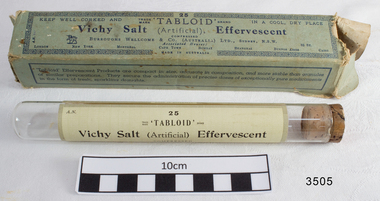
Box and glass tube, about 1912
... A rectangular box of Tabloid brand 'Vichy Salt (Artificial Effervescent), medication from Dr T.F. ...On label of box “Vichy Salt (Artificial) Effervescent”, 25 compressed tablets, made by Burroughs, Wellcome & Co. ...Australia Ltd, Sydney, NSW. “ ” “KEEP WELL CORKED AND IN A COOL DRY PLACE” A rectangular box of Tabloid brand 'Vichy Salt (Artificial Effervescent), medication from Dr T.F. ...Wellcome & Burroughs pharmaceutical company was founded in London in 1880 by American pharmacists. The first overseas branch opened in Sydney, Australia, in 1898 and by 1912 another 7 branches had opened. The box lists all of the 9 branches on it. Vichy Effervescent Salts are an antacid mixture in a tablet form. Wellcome & Burroughs company invented the name “Tabloid” to describe the process of compacting powders in measured doses to form a tablet. The label attached around the glass tube lists the same information as on the box, and also gives directions “One powdered and dissolved in wineglassful (about two ounces) of water represents an equal quantity of Vichy Water (Grand Grille Spring) in all its essential constituents and may be taken when required, as ordered by the physician.” “KEEP WELL CORKED AND IN A COOL DRY PLACE” The mineral spring waters from Vichy, France, have been used through the ages as a natural therapy, including aiding the digestive system. The Vichy tablets are made from chemicals that have similar properties. This box once containing Vichy Effervescent Salts was donated to Flagstaff Hill Maritime Village by the family of Doctor William Roy Angus, Surgeon and Oculist. It is part of the “W.R. Angus Collection” that includes historical medical equipment, surgical instruments and material once belonging to Dr Edward Ryan and Dr Thomas Francis Ryan, (both of Nhill, Victoria) as well as Dr Angus’ own belongings. The Collection’s history spans the medical practices of the two Doctors Ryan, from 1885-1926 plus that of Dr Angus, up until 1969. ABOUT THE “W.R.ANGUS COLLECTION” Doctor William Roy Angus M.B., B.S., Adel., 1923, F.R.C.S. Edin.,1928 (also known as Dr Roy Angus) was born in Murrumbeena, Victoria in 1901 and lived until 1970. He qualified as a doctor in 1923 at University of Adelaide, was Resident Medical Officer at the Royal Adelaide Hospital in 1924 and for a period was house surgeon to Sir (then Mr.) Henry Simpson Newland. Dr Angus was briefly an Assistant to Dr Riddell of Kapunda, then commenced private practice at Curramulka, Yorke Peninsula, SA, where he was physician, surgeon and chemist. In 1926, he was appointed as new Medical Assistant to Dr Thomas Francis Ryan (T.F. Ryan, or Tom), in Nhill, Victoria, where his experiences included radiology and pharmacy. In 1927 he was Acting House Surgeon in Dr Tom Ryan’s absence. Dr Angus had become engaged to Gladys Forsyth and they decided he would take time to further his studies overseas in the UK in 1927. He studied at London University College Hospital and at Edinburgh Royal Infirmary and in 1928, was awarded FRCS (Fellow from the Royal College of Surgeons), Edinburgh. He worked his passage back to Australia as a Ship’s Surgeon on the on the Australian Commonwealth Line’s T.S.S. Largs Bay. Dr Angus married Gladys in 1929, in Ballarat. (They went on to have one son (Graham 1932, born in SA) and two daughters (Helen (died 12/07/1996) and Berenice (Berry), both born at Mira, Nhill ) Dr Angus was a ‘flying doctor’ for the A.I.M. (Australian Inland Ministry) Aerial Medical Service in 1928 . The organisation began in South Australia through the Presbyterian Church in that year, with its first station being in the remote town of Oodnadatta, where Dr Angus was stationed. He was locum tenens there on North-South Railway at 21 Mile Camp. He took up this ‘flying doctor’ position in response to a call from Dr John Flynn; the organisation was later known as the Flying Doctor Service, then the Royal Flying Doctor Service. A lot of his work during this time involved dental surgery also. Between 1928-1932 he was surgeon at the Curramulka Hospital, Yorke Peninsula, South Australia. In 1933 Dr Angus returned to Nhill where he’d previously worked as Medical Assistant and purchased a share of the Nelson Street practice and Mira hospital from Dr Les Middleton one of the Middleton Brothers, the current owners of what was once Dr Tom Ryan’s practice. Dr L Middleton was House Surgeon to the Nhill Hospital 1926-1933, when he resigned. [Dr Tom Ryan’s practice had originally belonged to his older brother Dr Edward Ryan, who came to Nhill in 1885. Dr Edward saw patients at his rooms, firstly in Victoria Street and in 1886 in Nelson Street, until 1901. The Nelson Street practice also had a 2 bed ward, called Mira Private Hospital ). Dr Edward Ryan was House Surgeon at the Nhill Hospital 1884-1902 . He also had occasions where he successfully performed veterinary surgery for the local farmers too. Dr Tom Ryan then purchased the practice from his brother in 1901. Both Dr Edward and Dr Tom Ryan work as surgeons included eye surgery. Dr Tom Ryan performed many of his operations in the Mira private hospital on his premises. He too was House Surgeon at the Nhill Hospital 1902-1926. Dr Tom Ryan had one of the only two pieces of radiology equipment in Victoria during his practicing years – The Royal Melbourne Hospital had the other one. Over the years Dr Tom Ryan gradually set up what was effectively a training school for country general-practitioner-surgeons. Each patient was carefully examined, including using the X-ray machine, and any surgery was discussed and planned with Dr Ryan’s assistants several days in advance. Dr Angus gained experience in using the X-ray machine there during his time as assistant to Dr Ryan. Dr Tom Ryan moved from Nhill in 1926. He became a Fellow of the Royal Australasian College of Surgeons in 1927, soon after its formation, a rare accolade for a doctor outside any of the major cities. He remained a bachelor and died suddenly on 7th Dec 1955, aged 91, at his home in Ararat. Scholarships and prizes are still awarded to medical students in the honour of Dr T.F. Ryan and his father, Dr Michael Ryan, and brother, John Patrick Ryan. ] When Dr Angus bought into the Nelson Street premises in Nhill he was also appointed as the Nhill Hospital’s Honorary House Surgeon 1933-1938. His practitioner’s plate from his Nhill surgery states “HOURS Daily, except Tuesdays, Fridays and Saturday afternoons, 9-10am, 2-4pm, 7-8pm. Sundays by appointment”. This plate is now mounted on the doorway to the Port Medical Office at Flagstaff Hill Maritime Village, Warrnambool. Dr Edward Ryan and Dr Tom Ryan had an extensive collection of historical medical equipment and materials spanning 1884-1926 and when Dr Angus took up practice in their old premises he obtained this collection, a large part of which is now on display at the Port Medical Office at Flagstaff Hill Maritime Village in Warrnambool. During his time in Nhill Dr Angus was involved in the merging of the Mira Hospital and Nhill Public Hospital into one public hospital and the property titles passed on to Nhill Hospital in 1939. In 1939 Dr Angus and his family moved to Warrnambool where he purchased “Birchwood,” the 1852 home and medical practice of Dr John Hunter Henderson, at 214 Koroit Street. (This property was sold in1965 to the State Government and is now the site of the Warrnambool Police Station. ). The Angus family was able to afford gardeners, cooks and maids; their home was a popular place for visiting dignitaries to stay whilst visiting Warrnambool. Dr Angus had his own silk worm farm at home in a Mulberry tree. His young daughter used his centrifuge for spinning the silk. Dr Angus was appointed on a part-time basis as Port Medical Officer (Health Officer) in Warrnambool and held this position until the 1940’s when the government no longer required the service of a Port Medical Officer in Warrnambool; he was thus Warrnambool’s last serving Port Medical Officer. (The duties of a Port Medical Officer were outlined by the Colonial Secretary on 21st June, 1839 under the terms of the Quarantine Act. Masters of immigrant ships arriving in port reported incidents of diseases, illness and death and the Port Medical Officer made a decision on whether the ship required Quarantine and for how long, in this way preventing contagious illness from spreading from new immigrants to the residents already in the colony.) Dr Angus was a member of the Australian Medical Association, for 35 years and surgeon at the Warrnambool Base Hospital 1939-1942, He served as a Surgeon Captain during WWII1942-45, in Ballarat, Victoria, and in Bonegilla, N.S.W., completing his service just before the end of the war due to suffering from a heart attack. During his convalescence he carved an intricate and ‘most artistic’ chess set from the material that dentures were made from. He then studied ophthalmology at the Royal Melbourne Eye and Ear Hospital and created cosmetically superior artificial eyes by pioneering using the intrascleral cartilage. Angus received accolades from the Ophthalmological Society of Australasia for this work. He returned to Warrnambool to commence practice as an ophthalmologist, pioneering in artificial eye improvements. He was Honorary Consultant Ophthalmologist to Warrnambool Base Hospital for 31 years. He made monthly visits to Portland as a visiting surgeon, to perform eye surgery. He represented the Victorian South-West subdivision of the Australian Medical Association as its secretary between 1949 and 1956 and as chairman from 1956 to 1958. In 1968 Dr Angus was elected member of Spain’s Barraquer Institute of Barcelona after his research work in Intrasclearal cartilage grafting, becoming one of the few Australian ophthalmologists to receive this honour, and in the following year presented his final paper on Living Intrasclearal Cartilage Implants at the Inaugural Meeting of the Australian College of Ophthalmologists in Melbourne In his personal life Dr Angus was a Presbyterian and treated Sunday as a Sabbath, a day of rest. He would visit 3 or 4 country patients on a Sunday, taking his children along ‘for the ride’ and to visit with him. Sunday evenings he would play the pianola and sing Scottish songs to his family. One of Dr Angus’ patients was Margaret MacKenzie, author of a book on local shipwrecks that she’d seen as an eye witness from the late 1880’s in Peterborough, Victoria. In the early 1950’s Dr Angus, painted a picture of a shipwreck for the cover jacket of Margaret’s book, Shipwrecks and More Shipwrecks. She was blind in later life and her daughter wrote the actual book for her. Dr Angus and his wife Gladys were very involved in Warrnambool’s society with a strong interest in civic affairs. Their interests included organisations such as Red Cross, Rostrum, Warrnambool and District Historical Society (founding members), Wine and Food Society, Steering Committee for Tertiary Education in Warrnambool, Local National Trust, Good Neighbour Council, Housing Commission Advisory Board, United Services Institute, Legion of Ex-Servicemen, Olympic Pool Committee, Food for Britain Organisation, Warrnambool Hospital, Anti-Cancer Council, Boys’ Club, Charitable Council, National Fitness Council and Air Raid Precautions Group. He was also a member of the Steam Preservation Society and derived much pleasure from a steam traction engine on his farm. He had an interest in people and the community He and his wife Gladys were both involved in the creation of Flagstaff Hill, including the layout of the gardens. After his death (28th March 1970) his family requested his practitioner’s plate, medical instruments and some personal belongings be displayed in the Port Medical Office surgery at Flagstaff Hill Maritime Village, and be called the “W. R. Angus Collection”. The W.R. Angus Collection is significant for still being located at the site it is connected with, Doctor Angus being the last Port Medical Officer in Warrnambool. The collection of medical instruments and other equipment is culturally significant, being an historical example of medicine from late 19th to mid-20th century. Dr Angus assisted Dr Tom Ryan, a pioneer in the use of X-rays and in ocular surgery. A rectangular box of Tabloid brand 'Vichy Salt (Artificial Effervescent), medication from Dr T.F. Ryan's medical practice. Inside is a glass tube with rounded base and a cork stopper. The tube contains a cotton wool swab. Around the tube is a paper label listing the same information as per box label. Box is lined with white corrugated cardboard. (part of the W.R. Angus Collection)On label of box “Vichy Salt (Artificial) Effervescent”, 25 compressed tablets, made by Burroughs, Wellcome & Co. Australia Ltd, Sydney, NSW. “ ” “KEEP WELL CORKED AND IN A COOL DRY PLACE”flagstaff hill, warrnambool, shipwrecked coast, flagstaff hill maritime museum, maritime museum, shipwreck coast, flagstaff hill maritime village, great ocean road, wellcome & burroughs, vichy, tabloid, wellcome & burroughs, dr w r angus, dr t f ryan, nhill hospital, nhill, medical treatment, dental treatment, flagstaff hill, warrnambool, shipwrecked coast, flagstaff hill maritime museum, maritime museum, shipwreck coast, flagstaff hill maritime village, great ocean road, wellcome & burroughs, vichy, tabloid, wellcome & burroughs, dr w r angus, dr t f ryan, nhill hospital, nhill, medical treatment, dental treatment -
 Lorne Historical Society
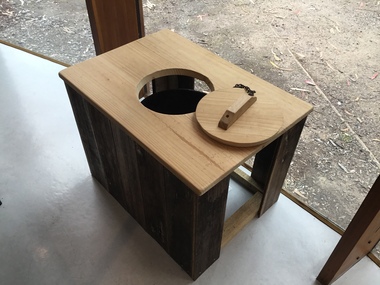
Functional object - Thunderbox, Circa 1930’s
... salt air. It is intimately associated with the early years of the development of the Great Ocean Road and the daily life of the workers. It is a typical example of the type of toilet used at the time. Great Ocean Road Construction Returned Sevicemen World War 1 Great Ocean Road Toll Houses Toilet This reclaimed timber thunder box is enclosed on three sides. ...The Great Ocean Road was built by World War 1 returned servicemen. Tolls were collected as sections of the road were completed. The first toll house was at Grassy Creek. It operated from 1922 to 1932 when it was moved to The Springs at Cathedral Rock about 5 km east of Lorne. The thunderbox is believed to have been used here at sometime between 1932 and 1936This is a rare archeological find. Items n this location are often damaged by the action of the sea and salt air. It is intimately associated with the early years of the development of the Great Ocean Road and the daily life of the workers. It is a typical example of the type of toilet used at the time. This reclaimed timber thunder box is enclosed on three sides. There is a circular hole on the top with a wooden handled lid attached by a chain. Inside is a steel can.great ocean road construction, returned sevicemen world war 1, great ocean road toll houses, toilet -
 Kiewa Valley Historical Society
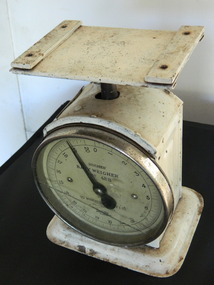
Scales - Baby
... Face of scales "Hughes" / Baby Weigher / No. 48B" "To weigh 20lb by 1 oz / British Made" "Salter" written above its logo Numbers are written facing outside. White cast metal rectangular base with rectangular box attached in centre. ...These scales may have been used by the Maternal Infant Welfare Centre sister at Mt Beauty during regular check ups of babies to make sure that the babies were gaining weight and therefore healthy.During the 1950's, Mt Beauty's population was rapidly increasing due to the post war baby boom and because the work force was young having moved into the area because of the opportunity for work on the construction of the Kiewa Hydro Electric Scheme. Letter dated 2nd July 1994 thanking the CWA, Tawonga Branch for their donation of the baby scales that were used by the baby Health Centre.White cast metal rectangular base with rectangular box attached in centre. The box has a curved top and a round face at the front. The face is covered with clear glass protecting the black marks which measure pounds and ounces. The numbers face the outside of the circumference. A black metal pointer rotates from the centre. At the top of the box in the centre a metal rod protrudes with a rectangular steel base on top and 4 screws for the container to hold the baby. The rod is attached to a spring and moves up and down moving the pointer.Face of scales "Hughes" / Baby Weigher / No. 48B" "To weigh 20lb by 1 oz / British Made" "Salter" written above its logo Numbers are written facing outside.baby scales. maternal infant welfare centre. mt beauty. healthy babies. -
 4th/19th Prince of Wales's Light Horse Regiment Unit History Room
Photo Albums - set of two, c. 1919
... box full of gold), DAMASCUS. All this gold Turkish coin secured by our troops. 14 German artillery on the way to the front near KENETRA. The ALH swooped down on the artillery around this vicinity & captured many field guns. 15 German Despatch Rider on the road to ES SALT. ...box full of gold), DAMASCUS. All this gold Turkish coin secured by our troops. 14 German artillery on the way to the front near KENETRA. The ALH swooped down on the artillery around this vicinity & captured many field guns. 15 German Despatch Rider on the road to ES SALT. ...Memorabilia of 908 Dvr Thomas Edward Whyte, 3rd Light Horse Field Ambulance, World War 1 READ THIS. During the last war I sent these pictures home through devious channels. When I lobbed back I found them all pasted in these albums by my young brother Billy. He was only a kid then! Nowadays he is serving up North. Went away with the original 9th Battn. Was in the Blitz on England and served in Libya, Tobruk, Greece, Crete and Palestine and was twice knocked. It's not long since the last upheaval 1914-18 and I wonder if these boys think as we did. This will be the last war? I sincerely hope so. TWSet of two photo albums. Photos pasted into albums with captions in white ink. Photo captions - Vol 1. (? = not legible) 1. Prisoners from ES SALT 2. Dust scene at AUJA FORD. 4th LH BDE 3. ? ? CHEOPS PYRAMID 4. Houses and domain WASSA battle 5 .Pontoon at SERAPELAI 6. SPINX (sic) & PYRAMID 7. The Nile floods occur once yearly and all irrigation centres are alternatively flooded 8. Pontoon bridge over SUEZ Canal at SERAPEUM . Constructed by Aust Engineers 9. The arrival of newspapers and mail 10. Lake IIMSAH-ISMALIA 11. Camp outside Jerusalem. Walls of old city easily discernible 12. Roman walls on beach at MONTAZEH 13. ? ? These boats are used for conveying between steamer & shore 14. Interest shown in the new issue. Through the scarcity of horses Batmen/Grooms and drivers ? allotted donkeys ? ? 15. DAMASCUS GATE JERUSALEM 16. Trumpeter ? 17 Indians making ? for railroad 18. 'SPELLO' Sinai Country 19. Police searching Egyptian labourer 20. Cavalry ?? SHA? 21. Entering ? WADI ? 22. Bedouins at ? 23 No caption 24 No caption 25 Bolar trees EZBEKIEH Gardens CAIRO 26 .Flamingos at NOUZEH Gardens ALEXANDRIA 27 BARAGE 28 KASR-ELNILL Bridge 29 NOUZEH GARDENS 30 AMGS on beach at ? 31 NOUZEH GARDENS - ALEX 32 Mascot of 7th M.V.G. 3RD ALHR 33 Printing on walls inside St Mary's Church. Depicting the Flight from Herod. (Corner torn off photo) 34 Inside Virgin Mary's Church at MATARA 35 ? painting in Church ?? 36 SUEZ Canal. Finish of Arab pony race. ZAL-A-ZIA 37 Admiralty offices at PORT SAID 38 A corner of CHEOP"s PYRAMID 39 The Spinx (sic). Nose was blown off by a shell from one of Napoleon's guns. 40 Monastry on the MT of TEMPTATION 41 Mess orderlies. Foodstuffs in locker given to troops by the AIF 42 Mid day meal on treck 43 Ambulance sand carts for conveying wounded and sick over desert sand 44 3rd ALHB 45 Kaisers Church JERUSALEM. Inside is a large painting figuring the Kaiser & Kaiserine holding a model church. 46 Bedouin women drawing water from well at EL-ARISH 47 2nd ALH BGDE doing route march on JERUSALEM-JERICHO ROAD 48 GEN HODSON GOC Anzac Mounted Divn presenting decorations & investitures on the sands at SHEIKS-ZOWAID 49 Armoured Car 50 Snow at the CEEDERS (sic) on Mt LEBANON 51 Compulsory phenyle bath for all troops in front line area 52 Austrian guns taken at point of bayonet by NZ & 2nd BGDE at GAZA 53 CACHOLETS for carrying wounded 54 The boys found some timber and made a spring board on SUEZ Canal 55 Bedouin wedding. The Bride travels in state amongst rubbish on top of camel. Her father leads conveyance. 56 Australian graves at SHALLAL 57 Camel Transport Company bring rations along beach 58 Billy the mascot holds an offensive & checks advancement 59 Exercising horses at HELMIEH Egypt 60 PONT-DE-QUOBBA Egypt. A suburb of well-to-do Egyptian merchants 61 Demolition stunt at ASLU. Bridge destroyed by Australian Engineers 62 Swimming horses in Great Bitter Lakes Egypt 63 On the move along Wadi 64 On the shores of the Bitter Lakes EL-EGYTE 65 A leave party waiting for the pontoon to swing into position 66 Carting grain 67 Egyptian Brass Band 68 French warboat (sic) in Canal 69 Russian Troops from Mesopotamia passing through SUEZ Canal 70 Prisoners coming in under escort. Turkish & German officers in lead mounted on ponies 71 Turkish prisoners 72 T.B.D in Canal 73 Old trenches on SUEZ CANAL near BITTER LAKES on W Bank 74 Monitor in Canal 75 Block house, trenches & entanglements near Post 62 76 A halt in an Egyptian village EL-MARO' 77 Mobile wireless plant 78 On the road from Canal to Railhead 79 Old Turkish guns in ancient fort at ALEXANDRIA 80 Francenia steaming through Canal 81 After MAGHDABA stunt. Convoy taking wounded form EL-ARISH to railway at 139 82 Indian Camelry 83 Virgin Mary's Church 84 Sluice gate at BARAGE Egypt 85 Hospital at lower W bank of Canal 86 Virgin Mary's tree 87 Sweetwater Canal at ISMAILIA Egypt 88 Halt and Feed. The A.M.C. attached to flying column. 89 Bringing stores ashore at JAFFA 90 H Videon & J Britton astride donks. Horses became scarce through casualties etc and units had donkeys issued to them 91 RAMLEH. The traditional burial place of St John the patron saint of England (sic). 92 Jewish Synagogue at RISHON-COUR-LE-LION (Richard the Lion Hearted) 93 Water tower at HELIOPOLIS 94 Portion of camp on HELIOPOLIS Racecourse 95 Arrival of papers 96 Sand sleigh 97 Boring plant & prisoners taken on the JIFF-JAFFA stunt. Two Austrian officers and party of Turks taken whilst building a concrete gun emplacement 98 The obelisk at MATARIA 99 In an avenue of Australian gums at ZEITOUA 100 Mountain battery gun 101 The 3rd ALH BGDE camped at HELIOPOLIS Racecourse 102 Captured Turkish guns 103 Turkish and Austrian prisoners. JORDAN VALLEY 104 The MT of Temptation Monastery built over spot where Christ spent his 40 days 105 Refugees from ES-SALT at JERICHO 106 3rd LHFA and 8th LH REGT at HELIOPOLIS 107 Fig trees at Roman Wells JIFF JAFFA 108 Inside the Blue Mosque CAIRO 109 Lagoon that was destroyed on JIFF JAFFA stunt 110 Section race at Brigade sports 111 Another tombstone at ALEX 112 Innoculating female date palm 113 Bronze tombstone in a cemetary at ALEXANDRIA 114 Luna Park at HELIOPOLIS 115 Egyptian water buffalo. Used by natives for ploughing etc 116 Russian church. Some call it the "Church of St Mary Magdelene" 117 At pyramids GIZA. Billingsley lost leg & McMullin KIA 118 Pontoon bridge over Suez Canal 119 DURBAN 120 Rescue work 121 Paddy Hanly 122 Motor train for conveying rations between Canal and Railhead. 123 At MUCKSHUBE ? 124 British ??? 125 Bedouins bringing in their harvest from the fields of ABBASSAN-EL-KEBIR Palestine 126 German HD QTRS BEERSHEBA 127 Date ? SINAI 128 Military railroad running through ? at EL-ARISH 129 Street scene at KHAN-YUNIS Palestine. Samson often called at this place to visit his girl. Napoleon narrowly escaped capture here during his ? in 1799 130 Date palms bearing fruit. These do not ? they are ?? 131 Motor ambulance convoy 132 Turkish hospital BEERSHEBA 133 MT CALVARY 134 Town Hall BEERSHEBA 135 Railway station BEERSHEBA 136 ASLUJ 137 Turkish depot MAGDABA 138 DURAN 139 3rd ALAB Hospital 140 Main Street PORT SAID 141 Stock Exchange ALEXANDRIA 142 The "Bull Ring" 14th AGH 143 (Double exposure) 144 Jewish School at DURAN Palestine 145 Damascus Gate JERUSALEM 146 Roller used for grinding clay for making bricks 147 The Harbour at ALEXANDRIA 148 Part of Napoleons Road along sea shore opposite BEELAH 149 Hotel at ALEX. Barred to the troops of course. 150 HELIOPOLIS 151 -153 ALEXANDRIA 154 Ambulance treck 155 Cacholets at the casually clearing station 156 Refugees from ES-SALT entering the Jordan Valley. Mts of MOAB in background 157 Cameliers bring in prisoners 158 The "Niagara". Casualties were from the front line by all descriptions of transport and passed through several field hospitals until they eventually reached the railway. They were sent to KANTARA by train. Despatched from there to PORT SAID by this boat 159 JERICHO 160 Turkish prisoners in JORDAN VALLEY 161 Bedouin nippers of SINAI 162 Bridge destroyed by ALH at ASLUJ 163 Railway sheds at BEERSHEBA. Portion was set afire by retreating Turks 164 ASLUJ Station 165 German Hospice 166 at ASLUJ 167 Suez Canal offices PORT SAID 168 MENA Village from top of Cheops. White lines at left are roads made by Australian troop. First Aust Contingent camped here. 169 A felukeh passing through gate at BARAGE 170 Military railway terminal EL ARISH 171 (No caption) 172 Egyptian family waiting for a train 173 Turkish prisoners and captured material coming in 174 Turkish wounded at BEERSHEBA awaiting removal 175 Two hospital ships at ALEXANDRIA 176 Some of the Bd boys 177 Race meeting 3rd ALHB at TRIPOLI- SYRIA 178 The blacksmith and Rodney Thomas swimming horse in SUEZ CANAL 179 Natives grinding grain 180 Thoroughbred 181 MUKATTAM HILLS 182 Trenches at JIFF JAFFA 183 MacBoyd as a Padre 184 Egyptian Syce having shave by travelling barber 185 The creek outside ALMINA 186 Cameliers 187 Clearing Station on beach at EL-ARISH 188 Wadi at TALLAT-EL-DUMM 189 Motor transport park 190 Some of the boys 191 Pompeys Pillar 192 at MAGHDABA 193 Hospital at JERUSALEM 194 Cheop's Pyramid 195 Golden Gate JERUSALEM 196 Hustling Turks through BEERSHEBA 197 Holy City 198 Mosque of Omar Jerusalem 199 Railway bridge destroyed by ALH at ASLUJ 200 Enemy material captured at SHERIA BEERSHEBA 201-3 These Mosques built with alabaster taken from pyramids at GIZA 204 Pontoon bridge built by our Engineers over RIVER JORDAN 205 3rd Bgde in Koil at MASAID 206 Billy McGhie throwing the weight 207 Nirazeh ? Gardens 208 Motor Ambulance Park 209 Bedouin women in Palestine village 210 ALEXANDRIA 211 Junction Stn 212 Indian Lancers 213 Motor convoy at ESSANI 214 A & B Sections 215 JERUSALEM. Once known as the 'City of Palms' and presented to Cleopatra by Anthony 216 Monastery on the Mount of Temptation. Situated on the Hills of Solomon on E side of Jordan Valley just behind JERICHO 217 DURAN A Jewish village in Palestine 218 One of our planes meets with a mishap on landing 219 Bedouin flocks around NABLUS 220 ES-SALT Road just above Jordan River 221 Halt! Action Front! Getting guns into action from pack 222 Village well 223 Gun inspection 224 WADI GHUZZEE Bridge 225-6 At GIZA Zoo Egypt 227 Syrians gathering olives 228 Smashed plane 229 MacBoyd 230 Bridge across Jordan at GORRONHOER 231 Competitors for Gretna Green. 3rd Bgde sports at TRIPOLIA 232 EL ARISH 233 Main street JAFFA 234 The beach at MARI-KHEB 235 Scene of old Cairo 236 Bedouin market 237 Bridge built over Wadi EL-ARISH. The biblical "River of Egypt". 238 Old water reservoir in native village 239 A "spello" on the track 240 Plane going out on reconnaissance 241 Bomb attached to carrier on a plane 242 Ancient Turkish gun at forts in TRIPOLI - SYRIA 243 Gun inspection 3rd AMGS 244 Old Turkish trenches outside GAZA 245 Wadi KHUZEL Bridge at SHALLA 246 BEERSHEBA 247 Street scene ZAG-A-ZIG 248 Spinx (sic) & Pyramid - GIZA 249 Egyptian Coastguards at ALEXANDRIA 250 A Palestine camp E Troop 3rd MG Sqn 251 B class horses killed in Syria 252 Scene from summit of Pyramid 253 Bert Richmond & an old Turkish Howitzer on MONTAZEH 254 LION'S WELL 255 Australian trenches outside Ferry's Post near Hill 70 256 A street scene in HELIO{PLIS 257 Electric trams at ALEXANDRIA 258 Cleaning harness 259 Swinging pontoon bridge into position at SERAPEUM 260 British Monitor in Suez Canal 261-2 Scenes of Turkish buildings at MAGHDABA. Taken by the ALH The first time in history mounted troops have attacked and taken entrenched positions 263 Aussies at Egypt's ancient monuments 264 Scenes of old CAIRO from MOKATTAM Hils 265 Bridge across canal at BARAGE, 16 miles outside CAIRO 266 Curly and Vic Norton 267 Stumpy McIntyre & Long Pikington 268 In Wadi GHUZZEL near TELL-EL-JEMM 269 Digging post holes for stables 270 Cameliers bring in prisoner. Austrian Officer in black 271 White washing mess shed 272 F Troop 3rd AMGS Sqn 273 Jews at Recruiting Depot at JERUSALEM, forming Jewish Battalion 274 In Jordan Valley, 3rd Machine Gunners have 8 horses killed by an aerial torpedo 275 Turkish prisoners 276 Cocos Island 277 Snow on the Lebanon Ranges 278 Egyptian Hotel 279 Gordon Wake. Note intruders 280 Electric trams at HELIOPOLIS Egypt. Heliopolis built by Belgian firm in 7 years 281 Sweetwater Canal at SERAPEUM 282 The ? wells at JIFF-JAFFA 283 Virgin Mary's well at MATARIA. Boyd, Simpkin & Crowley 284 Cricket for convalescents at MONTAREH 285 Indians working at cutting for military railway 286 Australian Hospital BEERSHEBA 287 Removing wrecked ambulance car from rail road 288 Engineers depot in ? at EL-ARISH 289 Water preservation scheme at SHALLAL 290 German Princes Palace at HELIOPOLOLIS 291 Some of the boys 292 Aussie aerodrome BEELAH 293 EL-JALLAH outside BETHLEHEM 294 Some of the gunners 295 Trying camels in gun carriages. Note sand caterpillar 296 Street outside old city JERUSALEM 297 D.H QRS In EL-ARISH. Hod 298 Cairo Museum 299 Wadi bridge built by Army Engineers 300 A two storied building at GALM used as German HQrs until reached by our guns 301-2 No caption 303 Ambulance with Flying Column 304 Jack Pegg 3 AMGS 305 KHAN YUNIS 306 In the Jewish village of "Rischon le Lion" 307 Wet Canteen BEELAH 308 Motor Transport LATRON 309 Gen Chauvel OC Desert Mounted Column 310 10th LH - Inverness Battery "Railhead" 311 3rd LHFA "SERAPIUM" 312 ESBEKIEN Gardens "LE CAIRE" 313 Camel training and wireless station Hill 60 314 ZAG-A-ZIG Rly Stn 315 One of the Irrigation Canal locks "HELOUAN" 316 Indian Camel Corps 317 Base at Hill 60 318 Aussie transport arriving "ALEXANDRIA" 319 3 ALHB at AL MINA 320 Main entry to city of JAFFA 321 Mosque at DAMASCUS 322 A Turk brought to earth by one of our patrols 323 Brigade boxing contrst 324 Ostrich farm ZEITOUN 325 MATERIA 326 No caption 327 Mail day 328 3rd LHFA entering HELIOPOLIS from MENA 329 M Boyd, L Simpkins, S Crowley 330 Stretcher bearers 331 French Hosp JERUSALEM 332 SERAPIUM 333 Gippo crushing wheel 334 On the move - bully and biscuits 335 V Morton, F Stokes, L Simpkins & Hanley 336 Turkish prisoners - SHERIA 337 Getting used to the mask J Antonio MM 338 Sand carts 339 Model house - MONTAZA Hospital 340 "Abdul" 341 Wood Depot "ESDUD" 342 On troop ship - from Syria 343 Turkish prisoners "JULIUS" 344 TRIPOLI 345 3rd AMGS cook house "BEELAH" 346 Breaking camp "ZEITOUN" 347 Turkish prisoners "GAZA" 348 One of our tanks. About nine were blown out of action at GAZA 349 Camp in HOD-EL-ARISH 350 German HQRS BEERSHEBA 351 Race Course TRIPOLI 352 A Locke & P Leeming 353 Sea planing in Suez Canal 354 MOASCR detail camp 355 KANTARE Suez Canal 356 Four boys of MG Sqn at cards while convalescing . Marked X was a prisoner of war for three days. Got him back with us when we countered. 357 Signal station at CANA 358 H Videon in german rig 359 ROD-EL-FARAC 360 Sweetwater Canal ZAG-A-ZOG 361 Hospital train on beach EL-ARISH 362 Jerusalem Road 363 Bedouin camel and young'un 364 Admiralty Offices, PORT SAID 365 Suez Canal PORT SAID 366 Taking wounded to clearing station 367 Hills of 10-60 MALHA 368 Junction Station 369 EL ARISH 370 Wine Distillery LATRON 371 White figures how entrance to Pyramid 372 RAPC Wireless Station 373 Sports in Canal. ANZAC Day 1916. Prince of Wales is aboard white launch. 374-5 Captured Austrian boat. 40,000 cases of benzine aboard. She was brought into Canal at Port Said. Spies set her afire. She burnt for some considerable time and eventually blew up. 376 Pumping water from Wadi on Muckshabee stunt 377 On trenches 378 Bringing in disabled battle plane 379 Giving a motor transport a lift 380 Old Turkish howitzer. MONTAZZA 381 Jerusalem country 382 Palm Hod in SINAI. Trees do not bear dates until 14 years old. No bees here. Palms innoculated by Bedouin. 383 Camel cacolets for conveying wounded 384 ESKBEKIEL Gardens Cairo 385 LAKE TIMBAH 386 Xmas dinner 1916 387 Gift billies from ACF 388 Section competition 389 In big marquees HELIOPOLIS 390 HM Landships 391 Capt Aberdeen inspecting horses 392 Football. Black vs White 393 The game 394 Old Napoleon fort. 10 mile along coast from ALEX 395 Jewish Cemetery AKRON 396 Ration fatigue 397 Blowing bottom out of Turkish Reservoir to allow soakage 398 Tilley & Farley - 14th AGH 399 At GIZA Zoo. Note height of giraffe 400 On this stunt we destroyed Turkish reservoir of 2 1/2 million gallons 401 Demolition party at wells MUCK-SHUBE 402 3rd ALH Bde HELIOPOLIS Race course 403 HMLS "Lady Wingate" 404 Turks blew out our tanks at GAZA 405 One of our aviators captured by German. Note German wearing Iron Cross. Snapped behind Turkish lines. Original of this snap was dropped at Aust aerodrome to let them know Aussie airman was alright and not killed in capture. Chivalry 406 Sausage observation balloon 407 READY 408 Bomb on carrier 409 Testing 410 B Richmond, Wireless Operator RAFC 411 Loading Bomb 412 Crash in desert 413 Bomb in YMCA at MAZRAR 414 No caption 415 LW Simpkin - Late 3LHFA 416 LEMNOS 417 Shelling the MARSDEN 418 Pontoon across Jordan River 419 Shells on Walkers Ridge 420 Sweetwater Canal 421 LAKE ISMAILIA 422 Indian Lancers on Canal 423 CAIRO Railway Station 424 Destroying Turkish water supplies. Explosives used for breaking clay at bottom of lagoon, help to absorb water 425 Exercising horses at ZEITOUN Egypt 426 In Wadi on MUG-SHUBEE stunt 427 Tractor drawing 60 lb gun towards front line 428 Sultan's mother's place at HELIOPOLIS = City of the Sun 429 Camped on the sands outside RAILHEAD, Jump off for SINAI campaign 430 G Turner & A Lockwood out for a camel ride. 431 GAZA and Nile floods from top of Pyramid 432 Baby refuses to carry his harness and his pal wears an astonished look 433 No caption 434 Turkish Officers 435 Regt HQRS at IBEETA 436 No caption 437 3rd Machine Gun Squadron 3rd ALH Bgde (my unit) 438 Camel Corps at dinner 439 KHEFREN Pyramid snapped from top of Cheops 440 CHEOPS 441 Pyramids 442 MENA from top of Pyramids 443 Snap from Pyramid showing MENA-CAIRO road running through Nile floods 444 MENA village from Pyramid 445 Band of British West Indies Regt 446 Gippo Band 447 Swimming on Med Sea 102 KmA 448 H Maddocks 449 Bedouin and Egyptians utilise any animals for their fields 450 Captured Turkish train - BEERSHEBA 451 Gardens ISMAILIA 452 Gippos used for horse lines etc 453 Canteens at HELIOPOLIS 454 3 ALHB watering in Wadi on ESSANI stunt 454 JAFFA 455 ALEX, Napoleon relics 456 Egyptian water wheel 457 SUEZ 458 WADI GHUZZEE 459 On Reconnaissance at 10-60 460 Goats and sheep captured from hostile Bedouins 461 Pontoon SERAPIUM 462 Aust trenches - Suez Canal. Turks attacked FEB 1916 463 Camel transport 464 3 ALHB Wireless Station. Col Scott 9 LH got DSO on this stunt (MUCK SHUBE) 465 ALEXANDRIA 466 Canal Hospital Ships 467 Ambulance - Sand cart 468 At old Cairo 469 No 1 Casualty Clearing Station 470 3rd Brigade on move 471 3rd LHFB- Making camp SERAPIUM 472 Watering horses 473 Moving up wadi 474 The wells at Wadi GHUZZEE 475 Camel transport SINAI 476 Turkish reservoir destroyed by ALH 477 Wall in a Luxor tomb 478 Entrance to "Temple of Bulls" 479 Bob White 480 Bedouin crops 481 Harem of Montazza, Turkish prince 482 Jack Holmes, Billy McGhee 483 MUDERIA, B Troop post 484 JIFF JAFFA 485 Natives on railroad construction 486 Aust graves SHALLAL 487 The Stumpy Mirror 488 R Nile at MANSUREH 489 Aust graves - BEELAH 490 NOUZEH Gardens - ALEXANDRIA 491 On issue from QMS. Take what comes. Fit does not matter 492 MATARA 493 German Yacht Club - ALEX 494 Old Turkish Howitzer and cannon ball 495 Field hospital 496 Gardens at BARAGE 497 A dispute's ending 498 Snow. MT LEBANON 499 Bedouin sheep 500 Combat in the air 501 no caption 502 Old Napoleon gun 503 Gordon Wake HQ car 504-5 Burying the dead at GAZA 506 Water Polo 507 Brigade boxing comp 508 Field cooker 509 Bridge on Jerusalem road, Blown up by Turks 510 Teaching horses to lay quiet. For protective purposes 511 "Major" and "Bitsy" 512 Bedouin Scarabs 513 Convalescent 514 1. W Billings. Returned to Aust 2. W McMahon KIA 515 Hospital 516 Coming good 517 1st day up - 14th AGH PORT SAID 518 Back again in Regt 519 Billy and Taffy 520 Stew 521 KHAN YUNIS 522 MENA 523 Casualties PORT SAID 524 Washing 525 Mail 526 Gun from the "Emden" mounted in Syney 527 MARSURES 528 Desert bivouac 529 HASSED 530 3RD ALH Bde. Good camp (Extra) All conv's 531 New issue 532 On to another camp (8 LH Regt) 533 Shore - JAFFA on MED SEA Photo Captions Volume 2 (Illegible = ?) 1 The Cedars on Mt Lebanon, according to tradition originated from the staves of the 12 Apostles 2000 years ago. 2 TIBERIUS taken 27th Sept '18 3 NAZARETH taken 20th Sept. German officer and Arab pony 4 TIBERIUS fell on 27th Sep. Von Saunders was the GOC of Turkish Forces in Palestine 5 Jordan Valley & Plains of Jericho run between Mts of Moab & Hills of Solomon. Distance across valley from foot of each range of hills abt 13 miles, looks ? 6 Storm on Sea of Galilee 7 DAMASCUS fell on 1st October. German vehicle park. 8 German funeral near Jerusalem 9 JENIN. German Headquarters. Fell 20th Sept. German field bakery 10 Three pages back will be seen a storm on GALILEE. Note now calm here. This photo taken near spot from which the previous one was taken. German motor launch on Galilee. 11 Captured intact on 20th Sept. German workshops JENIN 12 Turkish aerodrome captured here. Hostile aircraft landed whilst it was in our hands. Aviators greatly surprised and even indignant. Motor smash near EL FULE. 13 German Orderly Room (Ammunition box full of gold), DAMASCUS. All this gold Turkish coin secured by our troops. 14 German artillery on the way to the front near KENETRA. The ALH swooped down on the artillery around this vicinity & captured many field guns. 15 German Despatch Rider on the road to ES SALT. Unsuccessful raids carried out on ES SALT on 30th April & 4th May. This country was hard on men and horses. Goat tracks were used at times but horse were led most of the time. Stunt lasted 14 days in wet weather & horses were only unsaddled for about 2 hours during stunt. 16 Strand, ? , Tiberius, Gallilee 17 German workshop. Captured by ALH 18 One of the dead lying outside GAZA. Killed 19th April 17. We could not bury them before November 19 Some of the boys that fell in the charge at BEERSHEBA. Tibby Cotter 20 Collecting our dead for burial. They were K in A on the 19th April at GAZA. Buried seven months later, 23,000 casualties in one day 21 German U-Boat 22 Page of postage stamps and money - Struck to commemorate Gallipoli victory - Turkish war postage stamps - War duty - Turkish war bank notes 23 Pamphlet. With paper badges affixed These badges were worn by young Egyptian students. Arabic translation means "Egypt for Egyptians Long Live Egypt" This pamphlet was printed under German influence & distributed around ZAG-A-ZIG, the chief centre of hostilities during the recent Egyptian riots. The Young Egyptian Students influenced the Natives to oppose British Administration, what they called Tyranny. They professed to have sufficient competent educated men to govern their own affairs, but our Heads would not hear of it. Consequently the riots. Many ? and soldiers killed. All railways and communications disorganised. It took several months to bring things to their normal ? Pictures of medals 1. In honour of General Falkenhaugh GOC Turkish Forces 2. The Victorious Emperors of Germany, Austria and Turkey 3. Egypt Awakening 24 Those large photographs I sent you were procured for me by a pal who knew the chap that owned the negatives. The owner of these snaps belongs to the 5th Regiment of the 2nd Brigade, and he took the camera from a Turkish Officer. It had only 6 snaps of a spool of 10, and the BIll Jim finished off the spool by taking 4 of the special entry into Jerusalem. The cross indicates those taken by the Australian, the remainder were taken by the Jackos in the vicinity of BEERSHEBA and SHERIA Turkish field bakery 25 Cavalry going up to support their own line. However never had much action against the Turkish horsemen 26 Turkish Electricians in the field. I have an idea that this photo was taken to get the centre figure. He looks dinkum Australian. Note Australian leggings on Turk on the right 27 Turkish machine gunners ready for action. This is very much like the Beersheba country. Turkish officers on the right, and along side him is the range taker with his Barand Stroud. We use these instruments in the Sqn and they cost about 83 (Pound) 28 Turkish General Head Quarters just beyond SHERIA. Note hard rocky country 29 Turkish Cavalry watching a fight and getting ready to go into action. This is at SHERIA, and the heavy fighting lasted several days. Plenty of water and the Jacko's tried their hardest to hold on to this pozzie. Often our chaps met the gamer Turks in the dead of night, because both sides were on the same game, crawling down for water. This stunt is known as the Junction Fight. 30 Official entry Dec 11th. The official entry into Jerusalem. Sir G Allenby in the lead with his staff officers of the French and Italian troops accompanying him. Guard represents New Zealand, Australia, England Wales Scotland Ireland and India entering theJaffa Gate 31 Sir Ronald Storrs made Governor of JERU. Captured 9th Dec 17. Reading the Proclamation, General Allenby wearing white breeches. Troops of other nations were present, and the notables of Jerusalem. It was read from the foot of the Tower of David, a place that has been standing since the time of Christ 32 The first of the British troops entering Jerusalem. A few Turkish officers may b seen walking at the head of the column. Populace in a bad plight, very poor and no tucker, and all were greatly overjoyed at the ?? of the British Hundreds and kiddies ill treated ?? (Part of caption missing) 33 10th LH Regt first to enter JERUSALEM. Mounted officer on the right supposed to be the CO of the first troops to enter Jerusalem. Note mud on the horses. Had very wet and muddy weather 34 Dead Jacko 35 Turkish machine gun and crew 36 Hanging Armenian doctors who refused to join Turkish Army 37 Outside Damascus Gate Jerusalem 38 Turkish patrol lying outside trench at EL BUAJ 39 Burying Aussies at DAMASCUS 40 1. Djemel Pasha 2. General Limon Von Saunders GOC Turkish Forces in Palestine 41 One execution in Egypt. Executing an Egyptian offender 42 Turkish atrocities DAMASCUS 43 Turks occupying trenches outside JERICHO 44 On ASLUJ demolition stunt. Feeding and spelling. Arrived at Rendezvous too early 45 Turkish saw bayonet 46 Captured guns taken at BEERSHEBA & SHERIA 47 Our gunners obtained a direct hit on ammunition train 48 The large and small of the game. At GAZA. 74th CCS in background 49 Around JULIOUS. These Turkish shell dumps were very numerous around this vicinity 50 Captured Turkish Cavalry 51 Cavalry leaders 52 Turkish machine gun & crew 53 Enemy officers. One on left is wearing Iron Cross ribbon 54 Captured Austrian boat afire, Suez Canal Port Said. 40,000 cases of benzine aboard. Fire a mysterious outbreak 55 ? Hotchkiss gunners and enemy aircraft over ? TELL-EL-FARA 56 Types of enemy officers. One of our bikes in their possession. Recaptured later. The five pointed medals worn by these officers is called the Gallipoli Star. Issued to commemorate the Turkish victory at Gallipoli 57 Our batteries put in some good shooting amongst Turkish transport 58 Showing compactness of Turkish trenches 59 Desert homes. The only time we had cover in SINAI was when we camped near a Hod. Then we could use date palm leaves 60 JIFF JAFFA 61 ZAITZOUN 62 10th Regt MGS amongst hills outside JERUSALEM 63 Jews wailing place JERUSALEM 64-5 German post card characters 66 Post Card PHYLAE The Kiosk 67 Post Card Vue du Canal de Suez 68 Post Card No 93 Queen Street, Fort, Colombo 69 Snipers at NALIN Sth Syria. Lousy country for richochets. Nast wounds. (Aust War Memorial Melbourne) 70 Myself on Ginger. This little neddie is boshter jumper 71 Magazine cutting - Lt C H Vautin & German airman G Felmy 72 9th Regt 3rd LHB Judean Hills outside JERUSALEM. (Aust War memorial Melbourne) 73 Sand hills SINAI ? Desert (Aust War Memorial Melbourne) 74 3rd LHB spelling at GALILEE (AWM Melbourne) 75 Jordan Valley outside JERICHO (AWM Melbourne) - lovely Jordan Valley, dust and heat, 1280 ft below sea level 76 Copy of no 69 77 Watering at MATARIA 78 A desert grave - Tpr H R Olver MM 6th LH MGS Beneath this simple cross there lies a comrade true and tried He fought as fights a soldier And like a soldier died 79 B Section. When they first took our Stetsons and issued cumbersome helmets 80 Palestine types of Turkish and German officers 81 Some of the gunners amongst the snows in MT LEBANON 82 The country around JERUSALEM 83 JERUSALEM 84 Fishing ? ? at GALLILEE 85 Jerusalem taken Dec 9th. Official entry on the 11th. Jerusalem (showing) Holy City and Mosque of Omar 86 Turkish shell hits old tomb at ZERNUKAH. Capt Hurley official photographer - AWM Melbourne 87 14th AGH at PORT SAID 88 Human bones at Dead City ABBASSIA 89 3rd ALH Bde at HELIOPOLIS 90 Men wearing gloves 91 Wireless station in course of erection at MATARIA - 28 masts 92 Old slave market at ABBRASSIA. Many excavations performed on projecting wooden frame at corners 93 3rd guns on the move. The beautiful scenery between LATRON & JERUSALEM 94 Bedouin agents 95 Collecting captured enemy material 96 Captured double-engined plane 97 On the march. Country at Eastern SINAI 98 Anzac mosaic found at SHALLAL whilst trench digging now covered with gun etc ready for removal. Was sent to Canberra. 99 A Troop watering. A rotten job at a small well when horses are thirsty 100 The new Jericho road. Running through Hills of Solomon Valley in distance 101 Gun inspection 102 Draining pools at WADI AUJA. Keeping down Malaria carrying mosquitos 103 8th Regt and 3rd AMGS at BEELAH 104 A rendezvous in the Jordan Valley 105 2nd ALHB camped outside JERUSALEM 106 WADI AUJA in the Jordan Valley 107 Hospital train on the beach at EL -ARISH 108 Jacko's 109 Jerries 110 Stables of Turkish Headquarters SHALLAL 111 Early training. Every man to throw and quieten his horse for purpose of taking cover 112 A Troop 3rd Guns at TAALAT-EL-DUMM 113 Watering at WADI GHUZZEE 114 J Rushden KIA at ES-SALT 115 J Carling F Troop 3rd AMGS. Taken prisoner at EL-BURJ. Repatriated after Armistace 116 Captured enemy plane 117 Jacko gun 118 Brig-Gen Galloping Jack Royston. OC 3rd ALH Bde 119 Cleaning ammunition belts in the Hod at MASAID 120 Bringing up the fodder at ABBASSAN-EL-KEBIA 121 Some of the boys amongst the snow on MT LEBANON 122 Turkish barley crops at SHALLAL in Southern Palestine 123 The crops a few weeks after our horses had been in this vicinity 124 Clearing up after a stunt 125 On the move. 5 minute spells for the horses 126 In Jordan Valley. An airial torpedo lobbed amongst 3rd MG Transport horses & killed 28 127 Camel ration convoy coming along beach 128 Field Hospital at ET MALER 129 Desert graves at ROMANI 130 A day on the beach. Wash self, horse and clothing 131 Watering on the beach at BEELAH. Note how close fresh water is to the seashore 132 A patrol caught by a shell 133 Spello 134 Crossing the Wadi 135 Halt! Weights off and feed 136 Gas instruction 137 F Troop at TELL-EL-FARI 138 Xmas Dinner at MASAID 1916-17. Arrived back at this camp Xmas Eve after 5 nights & 4 days in saddle & the capture of MAGHDABA 139 Exercising along the beach at MARA-KHEB 140 Watering at a Bedouin well 141 At Sheikh's ZOWAID 142 3rd Gun Squadron at ABBASSAN-EL-KEBIR 143 Captured plane on its way to Australian Aerodrome 144 One of our planes about to pass over Hod 145 E & F Troop horse lines and horses 146 Sun set on Med Sea 147 Beach scene at EL-ARISH 148 Turkish transport. Small animals but they can pull big loads and they possess large hearts 149 The dressing station JIFF JAFFA ? 150-8 Types of Egyptian women - Nubian - Fellaheen - Sudanese - Low class Gippo - Egyptian - Middle Class -Egyptian Aristocracy - Turkish 159 French girls on beach at PORT SAID 160 Bedouin girls drawing water 161 Egyptian flappers at ALEXANDRIA 162 Post Card- Dame Turque 163 Post Card - Jeunne Fille Arabe 164 Graves of New Zealanders at RISCHON 165 Graves of Australians at DEIR-EL-BELAH 166 Race day. The saddling paddock 167 Bivouacs 168 3rd ALH Brigade at TRIPOLI 169 Advance party putting down horse lines at KHAN YURIS 170 Breaking the desert monotony 171 WADI QUELT. Taken from one of its precipitous banks 172 Turkish stores on N shore of DEAD SEA 173 Watering at Solomon's Pools 174 Waiting for action at - ES DUN (AWM Melbourne) 175 Camel Corps in action SINAI (AWM Melbourne) 176 ALH Time to Camp (part missing) (AWM Melbourne) 177 3rd Machine Gun Squadron IBU-HARITH, Lieut Breed, McLeod, Guppy, Whyte 178 Cartoon sketch - "A Digger" 179 Turkish Cavalry 180 Gun crew of No 2 Sub F Troop, 3rd Gun Sqdn 181 Operating base of JIFF JAFFA stunt 182 One of the British war boats that cooperated with the Land Force 183 Military railway line passing through a Hod in SINAI 184 AL-MINAH The sea port of Tripoli, Syria 185 NAZARETH Taken on 20 Sep 18 186 The Monastery on the Mt of Temptation, Taken from a cave on opposite hill. 187 JAFFA From the beach 188 In Monastery on the Mt of Temptation Rock on which Christ spent his 40 days 189 Cross indicates Garden of Gethsemane. Arrow at Russian Church of St Magdalene. MT of Olives on left 190 The Roman Bath at MONTAZAH. Hewn out of solid rock 191 Mine sweeper ashore near SHEIK'S ZOWAIL 192 Throwing "Chester" for an operation 193 The swimming pozzie at LAKE TIMSAH, ISMAILIA. Half a mile from MOASCAR, the Aust Training Depot 194 The remains of Napoleon's road. Portions can be seen running between BEELAH & GAZA 195 Camels utilised for ambulance work 196 TULKERAM taken on 19th Sep. This stunt started the previous night and this position fell to us the first day. About 60 miles from starting point 197 German officer at mess, JERUSALEM 198 German Headquarters SEMAK 199 TIBERIAS 200 Water preservation scheme at SHALLAL 201 A dip in the Jordan River. Crossed river on night 21-22 April 18 202 Watering and a wash up 203 JERICHO Taken on 21 Feb 18 204 Turkish graves 205 KHAN YUNIS. Southern Palestine, Note how sand ridges from the beach meet vegetation area. Fertile land 20 miles in width. the beginning of PHILISTIA 206 TAUBE-OVER 207 Drawing drinking water in Wadi GHUZZEE 208 The swimming pozzie in JORON 209 Landing stores at EL-ARISH 210 A camp near the wadi 211 Railway line and bridge crossing wadi above SHALLAL 212 The mid-day halt 213 Turks and Aussies at Dressing Station on beach 214 Washing day 215 Bringing supplies ashore 216 Trying mules in a 60 pounder 217 The desert winds have blown away and left this piece standing 218 Pontoons used by the Turks in their attempt to cross Suez Canal Feb 15 219 "HASSEIN" 220 "GIPPO" Mascot of 3rd AMG Sqdn 221 "Biddy" 222 Railhead camp 223 Typical Bedouin 224 Motor Submarine chaser dvr whyte, photos, ww1, light horse field ambulance -
 Royal Australian and New Zealand College of Obstetricians & Gynaecologists (RANZCOG)
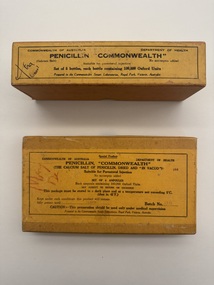
Two penicillin boxes, Commonwealth Serum Laboratories, c. 1940s
... The first box in small bold font says, 'COMMONWEALTH OF AUSTRALIA' with a large space in between 'DEPARTMENT OF HEALTH', then below this in large bold font says, 'PENICILLIN COMMONWEALTH"'. Below this in fine print says '(Calcium Salt...The first box in small bold font says, 'COMMONWEALTH OF AUSTRALIA' with a large space in between 'DEPARTMENT OF HEALTH', then below this in large bold font says, 'PENICILLIN COMMONWEALTH"'. Below this in fine print says '(Calcium Salt ...Two penicillin boxes, orange in colour. One box consists of a lid and base, and the second box only contains a lid. The first box in small bold font says, 'COMMONWEALTH OF AUSTRALIA' with a large space in between 'DEPARTMENT OF HEALTH', then below this in large bold font says, 'PENICILLIN COMMONWEALTH"'. Below this in fine print says '(Calcium Salt)', 'Suitable for parenteral injection', 'No antiseptic added'. Below this in bold print says, 'Set of 5 bottles, each bottle containing 100,000 Oxford Units/Prepared in the Commonwealth Serum Laboratories Royal Park, Victoria, Australia'. The second box which is only a lid includes writing which says 'Special Product'/COMMONWEALTH OF AUSTRALIA DEPARTMENT OF HEALTH' and below this in bold writing says 'PENICILLIN, "COMMONWEALTH"/(THE CALCIUM SALT OF PENCILLIN, DRIED AND "IN VACUO")'. In smaller font the lid says, 'Suitable for Parenteral Injection/No antiseptic added'. Lid is also printed with list of contents, storage instructions, and a caution. The best before date is stamped onto the lid '11 September '46' On the first box, there is handwriting which says 'Xtra Good'. There is also a sticker on the back of the first box which says, 'THIS ARTICLE HAS BEEN REFRIDGERATOR STORED BY THE VICTORIA DRUG CO.' and has 'PTY. LTD' crossed out. On the second box, there is handwriting on the edge of the box which says 'Pearson-W6'. drugs -
 Bendigo Historical Society Inc.
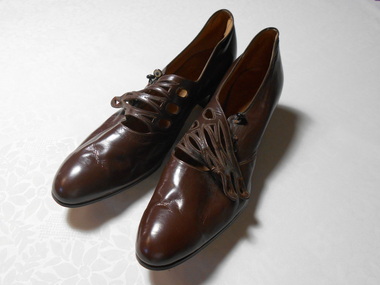
Clothing - MERLE BUSH COLLECTION: BROWN LEATHER SHOES
... Salter. Late of Bond street and Piccadilly London. Exclusive for Mutual Store Ltd''. Clothing. Brown leather ladies shoes with 3cm heels. Pointed toes. Fold over flap across the bridge of the foot with cut out pattern. Fastened on outside of shoe with three flaps with button holes and three .8cm round plastic buttons. Heads of tacks visible on heels of shoes. Old box ...Clothing. Brown leather ladies shoes with 3cm heels. Pointed toes. Fold over flap across the bridge of the foot with cut out pattern. Fastened on outside of shoe with three flaps with button holes and three .8cm round plastic buttons. Heads of tacks visible on heels of shoes. Old box 573On sole of shoe, E.Salter Handsown, Gold lettering inside shoe, ''The Countess Handsown shoe by Ernest Salter. Late of Bond street and Piccadilly London. Exclusive for Mutual Store Ltd''.costume, female, brown leather ladies shoes -
National Vietnam Veterans Museum (NVVM)
Functional Object, Ration tin with contents
... Visible contents - biscuits, salt, sweet, tea and milk. Contents freeze dried. Box B pkd 5/67...Visible contents - biscuits, salt, sweet, tea and milk. Contents freeze dried. Box B pkd 5/67 Ration tin with contents. ...Stainless steel tin. Visible contents - biscuits, salt, sweet, tea and milk. Contents freeze dried. Box B pkd 5/67landmass supplement - with instructionsration tin -
 Box Hill Historical Society
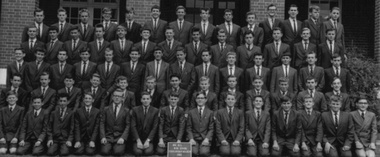
Photograph - Schools - Box Hill High, 1963
... Box Hill High School...Fox> B....Jackson> M....DeGraaf> B....Atkinson> J....Mitchell> C....Byrne> P....O'Brien. G....King> A....Watson> I....Barwick> G....Hastings> M....Collier> A....Hoel> G....Pinniger> G....Russell> D....O'Toole> M....Dale> R....Robertson> J....Daniels> E....Tregear> A....Elliot> R....Crooks> F....Lloyd> D....Bailey> K....Horsburgh> D....Harris> G....Peel> G....Geddes> R....Harnwell> A....Horne> R....Garside> B....Wells> A....Williams> R....Harris> J....Carlisle> K....Salt...Box Hill High School Fox> B. Jackson> M. DeGraaf> B. Atkinson> J. Mitchell> C. Byrne> P. O'Brien. G. King> A. Watson> I. Barwick> G. Hastings> M. Collier> A. Hoel> G. Pinniger> G. Russell> D. O'Toole> M. Dale> R. Robertson> J. Daniels> E. Tregear> A. Elliot> R. Crooks> F. Lloyd> D. Bailey> K. Horsburgh> D. Harris> G. Peel> G. Geddes> R. Harnwell> A. Horne> R. Garside> B. Wells> A. Williams> R. Harris> J. Carlisle> K. Salt ...Box Hill High School Scholarship Holders 1963.B&w photobox hill high school, fox> b., jackson> m., degraaf> b., atkinson> j., mitchell> c., byrne> p., o'brien. g., king> a., watson> i., barwick> g., hastings> m., collier> a., hoel> g., pinniger> g., russell> d., o'toole> m., dale> r., robertson> j., daniels> e., tregear> a., elliot> r., crooks> f., lloyd> d., bailey> k., horsburgh> d., harris> g., peel> g., geddes> r., harnwell> a., horne> r., garside> b., wells> a., williams> r., harris> j., carlisle> k., salt> t., goddard> r., mai> a., holden> j., kimber> a., clark> p., gion> g., talbett> g., norton> r., collings> a., santer> g., horne> m., wilson> g., holmes> p., mckibbon> c., taylor> m., hilton> m., jowett> j., howard> r., bryceson> r., tescher> t., winter> g., smith> w., katz> m., williams> k., morris> j., wishart> r., payne> d., beard> e., haines> r., gursanscky, steer> r., secondary schools -
 Yarrawonga and Mulwala Pioneer Museum
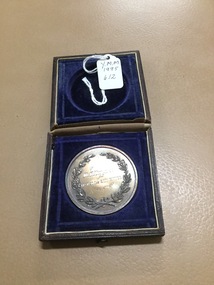
Award - Silver Medallion, For best 20 lbs salt butter Sept 4th 1884, 1884
... salt butter Sept 4th 1884. From Yarrawonga & Border Agricultural and Pastoral Association on the circumference of the medal. Silver medal in leather covered box ...Awarded to M.M.Dwyer at the local Yarrawonga Agricultural show in 1884.a local significant item pertaining to the Yarrawonga Agricultural Show and part of its history.Silver medal in leather covered box awarded to M.M.Dwyer at the Yarrawonga & Border Agricultural and Pastoral Association. Roman soldier on opposite side of the medal.Awarded to M.M.Dwyer ESQ for best 20 lbs salt butter Sept 4th 1884. From Yarrawonga & Border Agricultural and Pastoral Association on the circumference of the medal.medal, yarrawonga, agricultural, award -
 Wangaratta RSL Sub Branch
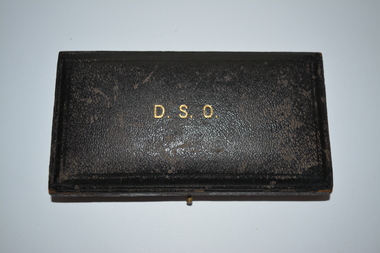
Medal - Presentation Case containing DSO Medal, Garrard & Co Ltd, C1915
... Salt. This award was presented to him by the Duke of Clarence. In post war period he commanded the 8th Australian Light Horse and later as Colonel of the 3rd Cavalry Brigade During the second world war Colonel Shannon came out from retirement to organise the V.D.C in North East Victoria. The DSO medal is awarded for distinguished service during active operations against an enemy. Wangaratta RSL Colonel Shannon DSO WW2 8th Light Horse WW1 Stamped on lid of presentation box ...Colonel Shannon DSO, VD., became the 1st President of the Wangaratta RSL in 1928 when it was organised under Anzac House and the present constitution. He was born at Bowman's Forest in 1874 and died in Wangaratta in 1960. He served in the Victorian Mounted Rifles at the turn of the century, rose to the rank of Captain and commanded the Wangaratta Detachment and Company - this later became the 8th Light Horse Regiment. In 1915 he embarked as Major in the 8th Light Horse and served in Gallipoli, Sinai, Palestine and Syria when he commanded the 8th Squadron. Later he was promoted to Lieutenant Colonel and commanded the Regiment. During the Amman raids, he was awarded the D.S.O at El Salt. This award was presented to him by the Duke of Clarence. In post war period he commanded the 8th Australian Light Horse and later as Colonel of the 3rd Cavalry Brigade During the second world war Colonel Shannon came out from retirement to organise the V.D.C in North East Victoria.The DSO medal is awarded for distinguished service during active operations against an enemy.Small rectangular black leather look covered timber box. Inside lid is lined in satin cloth and purple coloured velvet lines the base. Box contains a crimson ribbon with dark blue edges with a suspension bar and pin at the top and a lower suspension bar attached by a loop to a cross shaped medal made from white enamel. In the centre is the imperial crown in gold upon a red enamelled background surrounded by a laurel wreath. The reverse side depicts the royal cypherStamped on lid of presentation box - DSO Inside lid - Garrard & Co Ltd Goldsmiths and Jewellers to the King by special appointment Engraved on reverse of lower clasp - 8 LH Palestine wangaratta rsl, colonel shannon, dso, ww2, 8th light horse, ww1 -
 Lake Bolac & District Historical Society
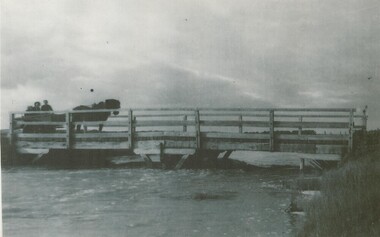
Black and white photograph, Salt Creek Bridge, Lake Bolac, circa 1950
... lake bolac, salt creek, bridge, redgum, yellow box, grampians, malin, 1950...Situated between the present bridge and the Salt Creek outlet from the lake. Built of local redgum and yellow box from the Grampians. ...Situated between the present bridge and the Salt Creek outlet from the lake. Built of local redgum and yellow box from the Grampians. ...Original bridge over the Salt Creek, Lake Bolac. Situated between the present bridge and the Salt Creek outlet from the lake. Built of local redgum and yellow box from the Grampians. In the pony trap are Lloyd, Lesley and John Malin. Circa 1950.lake bolac, salt creek, bridge, redgum, yellow box, grampians, malin, 1950 -
 Federation University Art Collection
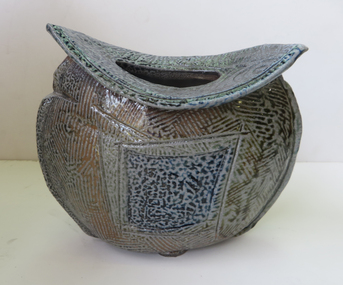
Ceramic, Salt Glazed Box by Heather Hutchinson
... Salt Glazed Box by Heather Hutchinson...Heather HUTCHINSON Heather Hutchinson was a Post Graduate student in Ceramics at Gippsland Campus. ceramics gippsland campus jan feder memorial ceramics collection alumni Heather Hutchinson Ceramic salt fired ceramic form. Salt Glazed Box by Heather Hutchinson Ceramic ...Heather HUTCHINSON Heather Hutchinson was a Post Graduate student in Ceramics at Gippsland Campus. Ceramic salt fired ceramic form.ceramics, gippsland campus, jan feder memorial ceramics collection, alumni, heather hutchinson -
 Federation University Art Collection
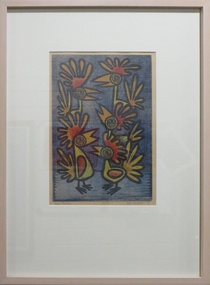
Work on paper - Printmaking - Linocut, 'Hen Party' by Max Coward, 1964
... Salt. He was a foundation staff member at the Burwood Teachers' College art department when it opened at Box Hill in 1954, transferring to the Burwood Campus in 1955. ...Salt. He was a foundation staff member at the Burwood Teachers' College art department when it opened at Box Hill in 1954, transferring to the Burwood Campus in 1955. ...Max COWARD ( -1991) Born Ballarat Max Coward was training to be an art teacher at the Ballarat Technical Art School from 1937 to 1941. He enlisted in the A.I.F. and was a Naval Trainee at Flinders Naval Depot in 1941. During these years Max Coward was described as a cartoonist and illustrator, and was was attached to the Naval Intelligence Division in 1945, producing stories and drawings for the Navy newspaper Dit. His work was reproduced in the Christmas annual, HMAS Mk IV and the Army educational journal, Salt. He was a foundation staff member at the Burwood Teachers' College art department when it opened at Box Hill in 1954, transferring to the Burwood Campus in 1955. Upon his retirement he moved to Queensland to start a graphic arts consultancy. Coward was active as a printmaker during the 1970s. This item is part of the Federation University Art Collection. The Art Collection features over 1000 works and was listed as a 'Ballarat Treasure' in 2007.Framed limited edition linocut by Max Coward. 'Hen Party' uses simplified forms reminiscent of the shapes gracing 'moderne' interiors of the 1950s and 1960s. The simplification of form and decorative pattern achieved through repetition shows the influence of Paul Klee's work and imagery. lls 'Hen Party' lower centre edition '8/28' lrs 'Max Coward 64' art, artwork, max coward, printmaking, alumni, hens, linoprint, linocut -
 Mont De Lancey
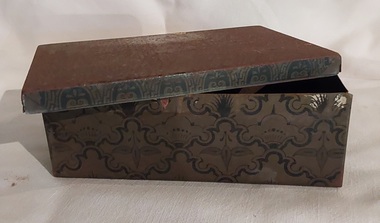
Container - Lidded Tin, C.E Morton, late 19th and early 20th C
... The effervescing salts consisting of one powder of sodium bicarbonate and Rochelle salt and another of tartaric acid that are mixed in water and drunk as a mild cathartic. Brown metal box with black decorative pattern and text "Seidlitz Powders C.E Morton London England". ...The effervescing salts consisting of one powder of sodium bicarbonate and Rochelle salt and another of tartaric acid that are mixed in water and drunk as a mild cathartic. Brown metal box with black decorative pattern and text "Seidlitz Powders C.E Morton London England". ...Seidlitz powders were a vintage, effervescent, and mild laxative and digestive regulator popular in the 19th and early 20th centuries. Named after the Bohemian village of Seidlitz (now Sedlec in the Czech Republic), they were commonly used to relieve constipation, heartburn, and gas due to stomach acidity. Seidlitz powders is the generic name under which a commonly known laxative and digestion regulator was marketed and sold by numerous manufacturers, particularly in the late 19th and early 20th centuries. The effervescing salts consisting of one powder of sodium bicarbonate and Rochelle salt and another of tartaric acid that are mixed in water and drunk as a mild cathartic. Brown metal box with black decorative pattern and text "Seidlitz Powders C.E Morton London England". Sachets inside were wrapped in tissue paper. A rusty small metal empty vintage brown and black patterned rectangular lidded old tin which contained Seidlitz Powders. The details printed on the lid are almost indescipherable. There is an overall black stylish pattern all over the outside of the lid and base. The powders were commonly used to relieve constipation, heartburn, and gas due to stomach acidity. This tin was used for other purposes when emptied.The print on the top of the lid is indescipherable as to the manufacturer and instructions for use of the Seidlitz Powders. medications, medication containers, containers, medicines -
 Flagstaff Hill Maritime Museum and Village
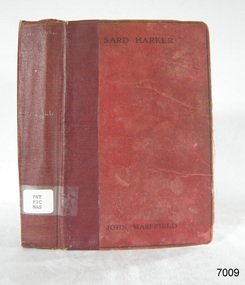
Book - Fictional Story, John Masefield, Sard Harker, 1924
... Salt-Water Ballads (containing his most famous poem, "Sea-Fever"). Beyond poetry, Masefield wrote celebrated adventure fiction, including Jim Davis and The Bird of Dawning, as well as children's classics like The Midnight Folk and The Box of Delights. ...Salt-Water Ballads (containing his most famous poem, "Sea-Fever"). Beyond poetry, Masefield wrote celebrated adventure fiction, including Jim Davis and The Bird of Dawning, as well as children's classics like The Midnight Folk and The Box of Delights. ...The novel centres on Chanticleer "Sard" Harker, a serious, stoic first mate aboard the trading ship Pathfinder. While anchored off the coast of the fictionalised South American nation of Santa Barbara a recurring setting in Masefield's fiction Harker experiences a vivid, recurring dream predicting that a woman named Doña Margherita Luisa Rosa is in grave danger. Driven by a strict sense of duty and premonition, Harker goes ashore to track down the estate where she is staying to deliver a warning. This decision plunges him into an extraordinary physical ordeal: separated from his ship and framed for murder, Harker must trek through hostile jungles, arid deserts, treacherous swamps, and rugged mountain passes while battling corrupt local officials, bandits, and a sinister occultist/cult leader named Don Hirsch Gomez.Hard cover book. Sard Harker Author: John Masefield Publisher: William Heinemann Ltd Date: 1924 Further Information: Red Cloth hardcover with lettering and patterning to spine in black. The spine has a Library label with an inscription.fictionThe novel centres on Chanticleer "Sard" Harker, a serious, stoic first mate aboard the trading ship Pathfinder. While anchored off the coast of the fictionalised South American nation of Santa Barbara a recurring setting in Masefield's fiction Harker experiences a vivid, recurring dream predicting that a woman named Doña Margherita Luisa Rosa is in grave danger. Driven by a strict sense of duty and premonition, Harker goes ashore to track down the estate where she is staying to deliver a warning. This decision plunges him into an extraordinary physical ordeal: separated from his ship and framed for murder, Harker must trek through hostile jungles, arid deserts, treacherous swamps, and rugged mountain passes while battling corrupt local officials, bandits, and a sinister occultist/cult leader named Don Hirsch Gomez.warrnambool, shipwrecked-coast, flagstaff-hill, flagstaff-hill-maritime-museum, maritime-museum, shipwreck-coast, flagstaff-hill-maritime-village, shipwrecked-artefact, book, sard harker, john masefield, warrnambool mechanics’ institute, pattison collection, warrnambool library, ralph eric pattison, corangamite regional library service, warrnambool city librarian, mechanics’ institute library, victorian library board, warrnambool books and records, warrnambool children’s library -
 Flagstaff Hill Maritime Museum and Village
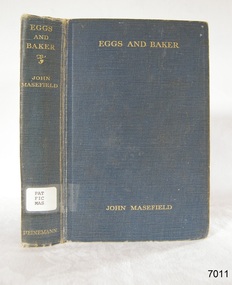
Book - Fictional Story, John Masefield, Eggs and Baker or ( The Days Of Trial), 1936
... Salt-Water Ballads (containing his most famous poem, "Sea-Fever"). Beyond poetry, Masefield wrote celebrated adventure fiction, including Jim Davis and The Bird of Dawning, as well as children's classics like The Midnight Folk and The Box of Delights. ...Salt-Water Ballads (containing his most famous poem, "Sea-Fever"). Beyond poetry, Masefield wrote celebrated adventure fiction, including Jim Davis and The Bird of Dawning, as well as children's classics like The Midnight Folk and The Box of Delights. ...Eggs and Baker, or The Days of Trial (1936) is a novel by the English poet and Poet Laureate John Masefield, best known for verse ('Sea-Fever', The Everlasting Mercy) and children's classics like The Box of Delights and The Midnight Folk, published the previous year. The story is set inland in Masefield's imagined English county of Tatchester/Condicote his recurring fictional geography, also used in The Box of Delights. The plot centres on a long-running trial of two men one a 'half-wit' accused of shooting and killing a gamekeeper while poaching. The real protagonist, though, is a baker who is losing business and standing in the community because of his socialist sympathies, and who takes up the accused men's cause at real cost to himself. A contemporary Kirkus review called it 'a totally unexpected book from Masefield, and a disappointing one', and wondered whether it was intended as 'a spoof on the law, or a serious commentary on problems of justice'.Hard cover book. Eggs & Baker or The Days of Trial Author: John Masefield Publisher: William Heinemann Ltd Date: 1936 Further Information: Navy blue cloth with pictorial end papers hardcover with lettering and patterning to spine in black. The spine has a Library label with an inscription.fictionEggs and Baker, or The Days of Trial (1936) is a novel by the English poet and Poet Laureate John Masefield, best known for verse ('Sea-Fever', The Everlasting Mercy) and children's classics like The Box of Delights and The Midnight Folk, published the previous year. The story is set inland in Masefield's imagined English county of Tatchester/Condicote his recurring fictional geography, also used in The Box of Delights. The plot centres on a long-running trial of two men one a 'half-wit' accused of shooting and killing a gamekeeper while poaching. The real protagonist, though, is a baker who is losing business and standing in the community because of his socialist sympathies, and who takes up the accused men's cause at real cost to himself. A contemporary Kirkus review called it 'a totally unexpected book from Masefield, and a disappointing one', and wondered whether it was intended as 'a spoof on the law, or a serious commentary on problems of justice'.warrnambool, shipwrecked-coast, flagstaff-hill, flagstaff-hill-maritime-museum, maritime-museum, shipwreck-coast, flagstaff-hill-maritime-village, shipwrecked-artefact, masefield, john, eggs and baker, john masefield, warrnambool mechanics’ institute, pattison collection, warrnambool library, ralph eric pattison, corangamite regional library service, warrnambool city librarian, mechanics’ institute library, victorian library board, warrnambool books and records, warrnambool children’s library -
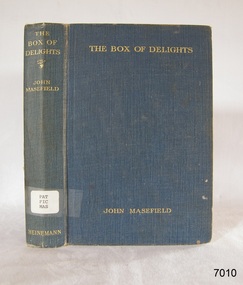 Flagstaff Hill Maritime Museum and Village
Book - A Fictional Story, John Masefield et al, The Box of Delights, 1935
... Salt-Water Ballads (containing his most famous poem, "Sea-Fever"). Beyond poetry, Masefield wrote celebrated adventure fiction, including Jim Davis and The Bird of Dawning, as well as children's classics like The Midnight Folk and The Box of Delights. ...Salt-Water Ballads (containing his most famous poem, "Sea-Fever"). Beyond poetry, Masefield wrote celebrated adventure fiction, including Jim Davis and The Bird of Dawning, as well as children's classics like The Midnight Folk and The Box of Delights. ...The Box of Delights is a children's fantasy novel by John Masefield, a sequel to The Midnight Folk, first published in 1935. Kay Harker is returning from boarding school when he finds himself mixed up in a battle to possess a magical box which allows the owner to shrink in size, to fly swiftly, to go into the past and to experience the magical wonders contained within. He's opposed by a wizard named Abner Brown and his gang of disguised bandits and witches masquerading as clergymen, and aided by talking animals, most memorably the cat Nibbins. It's a Christmas story at heart, steeped in English folklore, magic, and the atmosphere of a snowy Midlands winter.Hard cover book. The Box of Delights Author: John Masefield Illustrator: Judith Masefield Publisher: William Heinemann Ltd Date: 1935 Further Information: Navy blue cloth with pictorial end papers hardcover with lettering and patterning to spine in black. The spine has a Library label with an inscription. fictionThe Box of Delights is a children's fantasy novel by John Masefield, a sequel to The Midnight Folk, first published in 1935. Kay Harker is returning from boarding school when he finds himself mixed up in a battle to possess a magical box which allows the owner to shrink in size, to fly swiftly, to go into the past and to experience the magical wonders contained within. He's opposed by a wizard named Abner Brown and his gang of disguised bandits and witches masquerading as clergymen, and aided by talking animals, most memorably the cat Nibbins. It's a Christmas story at heart, steeped in English folklore, magic, and the atmosphere of a snowy Midlands winter.warrnambool, shipwrecked-coast, flagstaff-hill, flagstaff-hill-maritime-museum, maritime-museum, shipwreck-coast, flagstaff-hill-maritime-village, shipwrecked-artefact, book, the box of delights, john masefield, warrnambool mechanics’ institute, pattison collection, warrnambool library, ralph eric pattison, corangamite regional library service, warrnambool city librarian, mechanics’ institute library, victorian library board, warrnambool books and records, warrnambool children’s library -
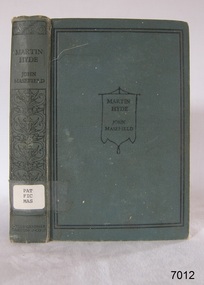 Flagstaff Hill Maritime Museum and Village
Book - Fictional Story, John Masefield, Martin Hyde The Dukes Messenger, 1928 to 1949
... Salt-Water Ballads (containing his most famous poem, "Sea-Fever"). Beyond poetry, Masefield wrote celebrated adventure fiction, including Jim Davis and The Bird of Dawning, as well as children's classics like The Midnight Folk and The Box of Delights. ...Salt-Water Ballads (containing his most famous poem, "Sea-Fever"). Beyond poetry, Masefield wrote celebrated adventure fiction, including Jim Davis and The Bird of Dawning, as well as children's classics like The Midnight Folk and The Box of Delights. ...Martin Hyde, the Duke's Messenger is a historical novel set in the late 17th century, following a young boy named Martin Hyde as he moves from a carefree childhood in rural Suffolk into a web of intrigue in London. Orphaned young, Martin goes to live with his uncle in London, where he becomes tangled up in royal conspiracies and secret missions. After his father's death in 1685, the 12-year-old goes to live with his uncle and eventually becomes messenger for James Scott, Duke of Monmouth, as Monmouth tries to build support for his claim to the English throne after the death of Charles II. It's often compared to Robert Louis Stevenson's Treasure Island or Kidnapped a boy's-own adventure that takes Martin overseas and eventually back to England to take part in the Monmouth Rebellion of 1685, with a rival working for the Crown whom he has to outwit. A reviewer also notes a small, restrained love-story thread Martin's messenger rival turns out to be a girl in disguise which nudges the book slightly outside the standard boys'-adventure genre of its era.Hard cover book. Martin Hyde “The Dukes Messenger” Author: John Masefield Publisher: Wells Gardner Darton & Co Date: 1928 to 1949 Further Information: Blue Cloth hardcover with lettering and patterning to spine in black. Publisher Logo to front cover with title & authors name. The spine has a Library label with an inscription.fictionMartin Hyde, the Duke's Messenger is a historical novel set in the late 17th century, following a young boy named Martin Hyde as he moves from a carefree childhood in rural Suffolk into a web of intrigue in London. Orphaned young, Martin goes to live with his uncle in London, where he becomes tangled up in royal conspiracies and secret missions. After his father's death in 1685, the 12-year-old goes to live with his uncle and eventually becomes messenger for James Scott, Duke of Monmouth, as Monmouth tries to build support for his claim to the English throne after the death of Charles II. It's often compared to Robert Louis Stevenson's Treasure Island or Kidnapped a boy's-own adventure that takes Martin overseas and eventually back to England to take part in the Monmouth Rebellion of 1685, with a rival working for the Crown whom he has to outwit. A reviewer also notes a small, restrained love-story thread Martin's messenger rival turns out to be a girl in disguise which nudges the book slightly outside the standard boys'-adventure genre of its era.warrnambool, shipwrecked-coast, flagstaff-hill, flagstaff-hill-maritime-museum, maritime-museum, shipwreck-coast, flagstaff-hill-maritime-village, shipwrecked-artefact, martin hyde the dukes messenger, john masefield, book, warrnambool mechanics’ institute, pattison collection, warrnambool library, ralph eric pattison, corangamite regional library service, warrnambool city librarian, mechanics’ institute library, victorian library board, warrnambool books and records, warrnambool children’s library -
 Flagstaff Hill Maritime Museum and Village
Book - Fictional Story, John Masefield, Dead Ned, 1938
... Salt-Water Ballads (containing his most famous poem, "Sea-Fever"). Beyond poetry, Masefield wrote celebrated adventure fiction, including Jim Davis and The Bird of Dawning, as well as children's classics like The Midnight Folk and The Box of Delights. ...Salt-Water Ballads (containing his most famous poem, "Sea-Fever"). Beyond poetry, Masefield wrote celebrated adventure fiction, including Jim Davis and The Bird of Dawning, as well as children's classics like The Midnight Folk and The Box of Delights. ...The full title for Dead Ned is The Autobiography of a Corpse Who Recovered Life Within the Coast of Dead Ned and Came to What Fortune You Shall Hear. The novel follows a young doctor who is hanged for a murder he did not commit, is rescued just in time, and rushed out of the country on a slave ship. The novel is an 18th-century-set adventure about a wrongly accused medical student, Ned Mansell. While he's aboard the slave ship, the story follows his journey as he is saved from the gallows at the last minute by friends who send him off to hide as a doctor on the vessel. It has a sequel, Live and Kicking Ned (1939), a seafaring novel about the African slave trade that continues the 1938 story.Hard cover book. Dead Ned Author: John Masefield Publisher: William Heinemann Ltd Date: 1938 Further Information: Green Cloth hardcover with lettering and patterning to spine in black. The spine has a Library label with an inscription.fictionThe full title for Dead Ned is The Autobiography of a Corpse Who Recovered Life Within the Coast of Dead Ned and Came to What Fortune You Shall Hear. The novel follows a young doctor who is hanged for a murder he did not commit, is rescued just in time, and rushed out of the country on a slave ship. The novel is an 18th-century-set adventure about a wrongly accused medical student, Ned Mansell. While he's aboard the slave ship, the story follows his journey as he is saved from the gallows at the last minute by friends who send him off to hide as a doctor on the vessel. It has a sequel, Live and Kicking Ned (1939), a seafaring novel about the African slave trade that continues the 1938 story.warrnambool, shipwrecked-coast, flagstaff-hill, flagstaff-hill-maritime-museum, maritime-museum, shipwreck-coast, flagstaff-hill-maritime-village, shipwrecked-artefact, book, dead ned, john masefield, warrnambool mechanics’ institute, pattison collection, warrnambool library, ralph eric pattison, corangamite regional library service, warrnambool city librarian, mechanics’ institute library, victorian library board, warrnambool books and records, warrnambool children’s library -
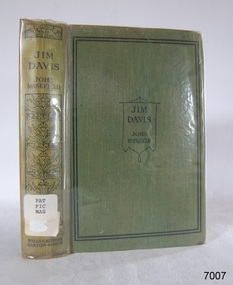 Flagstaff Hill Maritime Museum and Village
Book - Fictional Story, John Masefield, Jim Davis, 1912-1220s
... Salt-Water Ballads (containing his most famous poem, "Sea-Fever"). Beyond poetry, Masefield wrote celebrated adventure fiction, including Jim Davis and The Bird of Dawning, as well as children's classics like The Midnight Folk and The Box of Delights. ...Salt-Water Ballads (containing his most famous poem, "Sea-Fever"). Beyond poetry, Masefield wrote celebrated adventure fiction, including Jim Davis and The Bird of Dawning, as well as children's classics like The Midnight Folk and The Box of Delights. ...Jim Davis is a classic British sea-adventure novel written for young adults. Set along the Devon coast of England in 1812, the story follows a twelve-year-old orphan named Jim Davis. While exploring local caves and coastlines, Jim inadvertently stumbles upon a ring of night-riders and smugglers led by a fierce, charismatic captain named Marah. To protect their operational secrets, the smugglers kidnap Jim and take him to sea. The novel details his reluctant adventures aboard smuggling luggers, evasions of the coastguard, skirmishes, and his eventual effort to escape and return to civilian life.Hard cover book. Jim Davis Author: John Masefield Publisher: Wells Gardner Darton & Co Date: 1912-1920s Further Information: Green Cloth hardcover with lettering and patterning to spine in black. The spine has a Library label with an inscription.fictionJim Davis is a classic British sea-adventure novel written for young adults. Set along the Devon coast of England in 1812, the story follows a twelve-year-old orphan named Jim Davis. While exploring local caves and coastlines, Jim inadvertently stumbles upon a ring of night-riders and smugglers led by a fierce, charismatic captain named Marah. To protect their operational secrets, the smugglers kidnap Jim and take him to sea. The novel details his reluctant adventures aboard smuggling luggers, evasions of the coastguard, skirmishes, and his eventual effort to escape and return to civilian life.warrnambool, shipwrecked-coast, flagstaff-hill, flagstaff-hill-maritime-museum, maritime-museum, shipwreck-coast, flagstaff-hill-maritime-village, shipwrecked-artefact, book, jim davis, john masefield, warrnambool mechanics’ institute, pattison collection, warrnambool library, ralph eric pattison, corangamite regional library service, warrnambool city librarian, mechanics’ institute library, victorian library board, warrnambool books and records, warrnambool children’s library -
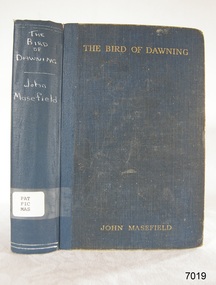 Flagstaff Hill Maritime Museum and Village
Book - Fictional Story, John Masefield, The Bird of Dawning, 1933 to 1939
... Salt-Water Ballads (containing his most famous poem, "Sea-Fever"). Beyond poetry, Masefield wrote celebrated adventure fiction, including Jim Davis and The Bird of Dawning, as well as children's classics like The Midnight Folk and The Box of Delights. ...Salt-Water Ballads (containing his most famous poem, "Sea-Fever"). Beyond poetry, Masefield wrote celebrated adventure fiction, including Jim Davis and The Bird of Dawning, as well as children's classics like The Midnight Folk and The Box of Delights. ...The Bird of Dawning (1933) is a sea-adventure novel about the clipper ship Black gauntlet, which is racing home from China to London when she's struck at night by a passing steamer. Only about half the crew sixteen men escape into a lifeboat before she goes down. The 22-year-old second mate, Cruiser Trewsbury, takes command of the survivors and leads them on a roughly 700-mile open-boat voyage to the island of Fayal in the Azores, fighting sharks, dwindling water and food, a leaking boat, and the threat of mutiny along the way. Partway through, the survivors come across an abandoned, dismasted clipper still afloat and Cruiser gets the chance to jury-rig her and sail her home himself, turning survival into a race against time.Hard cover book. The Bird of Dawning Author: John Masefield Publisher: William Heinemann Ltd Date: 1933 to 1939 Further Information: Blue Cloth hardcover with lettering and patterning to spine in gilt. Front cover with title & authors name in gilt. The spine has a Library label with an inscription.fictionThe Bird of Dawning (1933) is a sea-adventure novel about the clipper ship Black gauntlet, which is racing home from China to London when she's struck at night by a passing steamer. Only about half the crew sixteen men escape into a lifeboat before she goes down. The 22-year-old second mate, Cruiser Trewsbury, takes command of the survivors and leads them on a roughly 700-mile open-boat voyage to the island of Fayal in the Azores, fighting sharks, dwindling water and food, a leaking boat, and the threat of mutiny along the way. Partway through, the survivors come across an abandoned, dismasted clipper still afloat and Cruiser gets the chance to jury-rig her and sail her home himself, turning survival into a race against time.warrnambool, shipwrecked-coast, flagstaff-hill, flagstaff-hill-maritime-museum, maritime-museum, shipwreck-coast, flagstaff-hill-maritime-village, shipwrecked-artefact, martin hyde the dukes messenger, john masefield, book, warrnambool mechanics’ institute, pattison collection, warrnambool library, ralph eric pattison, corangamite regional library service, warrnambool city librarian, mechanics’ institute library, victorian library board, warrnambool books and records, warrnambool children’s library -
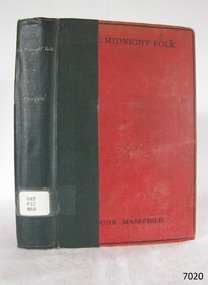 Flagstaff Hill Maritime Museum and Village
Book - Fictional Story, John Masefield, The Midnight Folk, 1930-1940
... Salt-Water Ballads (containing his most famous poem, "Sea-Fever"). Beyond poetry, Masefield wrote celebrated adventure fiction, including Jim Davis and The Bird of Dawning, as well as children's classics like The Midnight Folk and The Box of Delights. ...Salt-Water Ballads (containing his most famous poem, "Sea-Fever"). Beyond poetry, Masefield wrote celebrated adventure fiction, including Jim Davis and The Bird of Dawning, as well as children's classics like The Midnight Folk and The Box of Delights. ...The Midnight Folk (first published in 1927) is a celebrated fantasy novel for young readers written by John Masefield. The story centres on a young, lonely orphan named Kay Harker, who lives in a country house guarded by his stern governess. Kay learns that his great-grandfather, Captain Harker, lost a valuable treasure—the plunder of the Santa Barbara—that was entrusted to him. Kay sets out on a quest to locate the lost treasure. Guided by his cat, Nibbins, and an assortment of talking animals, witches, goblins, and nocturnal creatures (the titular 'Midnight Folk'), Kay journeys through magical, dream-like realms. The story seamlessly weaves together British folklore, nautical high adventure, piracy, and childhood wonder.Hard cover book. The Midnight Folk Author: John Masefield Publisher: William Heinemann Ltd Date: 1930-1940 Further Information: Two-tone quarter binding dark green/black spine and quarter shelf-back with red cloth sides, with hand-lettered ink text on the spine "The Midnight Folk / Masefield"). The spine has a Library label with an inscription.fictionThe Midnight Folk (first published in 1927) is a celebrated fantasy novel for young readers written by John Masefield. The story centres on a young, lonely orphan named Kay Harker, who lives in a country house guarded by his stern governess. Kay learns that his great-grandfather, Captain Harker, lost a valuable treasure—the plunder of the Santa Barbara—that was entrusted to him. Kay sets out on a quest to locate the lost treasure. Guided by his cat, Nibbins, and an assortment of talking animals, witches, goblins, and nocturnal creatures (the titular 'Midnight Folk'), Kay journeys through magical, dream-like realms. The story seamlessly weaves together British folklore, nautical high adventure, piracy, and childhood wonder.warrnambool, shipwrecked-coast, flagstaff-hill, flagstaff-hill-maritime-museum, maritime-museum, shipwreck-coast, flagstaff-hill-maritime-village, shipwrecked-artefact, book, the midnight folk, john masefield, warrnambool mechanics’ institute, pattison collection, warrnambool library, ralph eric pattison, corangamite regional library service, warrnambool city librarian, mechanics’ institute library, victorian library board, warrnambool books and records, warrnambool children’s library -
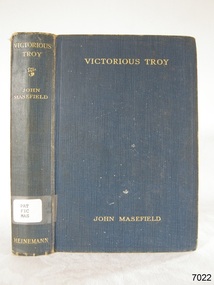 Flagstaff Hill Maritime Museum and Village
Book - Fictional Story, John Masefield, Victorious Troy or The Hurrying Angel, 1935
... Salt-Water Ballads (containing his most famous poem, "Sea-Fever"). Beyond poetry, Masefield wrote celebrated adventure fiction, including Jim Davis and The Bird of Dawning, as well as children's classics like The Midnight Folk and The Box of Delights. ...Salt-Water Ballads (containing his most famous poem, "Sea-Fever"). Beyond poetry, Masefield wrote celebrated adventure fiction, including Jim Davis and The Bird of Dawning, as well as children's classics like The Midnight Folk and The Box of Delights. ...Victorious Troy or The Hurrying Angel (first published in 1935) is a dramatic maritime novel by John Masefield. Set in 1922, the story takes place aboard a full-rigged grain ship—the Hurrying Angel—sailing from Melbourne, Australia, back to the UK across the South Pacific. Deep in the ocean, the ship is hit by a catastrophic cyclone. The storm dismasts the vessel, kills or incapacitates the captain and senior officers, and leaves the ship in perilous condition. The hero of this novel is eighteen-year-old senior apprentice Dick Pomfret, who is forced to take command. Through sheer grit, seamanship, and leadership, Dick clears the wreckage, constructs a jury-rig mast, and navigates the battered ship towards safety. Grounded in Masefield's real-life young adult experiences aboard merchant sailing ships, the novel is celebrated for its technical accuracy, vivid descriptions of rough seas, and authentic nautical terminology.Hard cover book. Victorious Troy or The Hurrying Angel Author: John Masefield Publisher: William Heinemann Ltd Date: 1935 Further Information: First edition with original publisher's blue cloth binding with gold foil/gilt lettering on both the front board ("VICTORIOUS TROY / JOHN MASEFIELD") and the spine. The spine has a Library label with an inscription.fictionVictorious Troy or The Hurrying Angel (first published in 1935) is a dramatic maritime novel by John Masefield. Set in 1922, the story takes place aboard a full-rigged grain ship—the Hurrying Angel—sailing from Melbourne, Australia, back to the UK across the South Pacific. Deep in the ocean, the ship is hit by a catastrophic cyclone. The storm dismasts the vessel, kills or incapacitates the captain and senior officers, and leaves the ship in perilous condition. The hero of this novel is eighteen-year-old senior apprentice Dick Pomfret, who is forced to take command. Through sheer grit, seamanship, and leadership, Dick clears the wreckage, constructs a jury-rig mast, and navigates the battered ship towards safety. Grounded in Masefield's real-life young adult experiences aboard merchant sailing ships, the novel is celebrated for its technical accuracy, vivid descriptions of rough seas, and authentic nautical terminology.warrnambool, shipwrecked-coast, flagstaff-hill, flagstaff-hill-maritime-museum, maritime-museum, shipwreck-coast, flagstaff-hill-maritime-village, shipwrecked-artefact, book, victorious troy, the hurrying angel, john masefield, warrnambool mechanics’ institute, pattison collection, warrnambool library, ralph eric pattison, corangamite regional library service, warrnambool city librarian, mechanics’ institute library, victorian library board, warrnambool books and records, warrnambool children’s library -
Emerald Museum & Nobelius Heritage Park
Domestic object - Salt and pepper shakers
... Salt and pepper bottles in blue and white check box...Emerald Victoria Australia Domestic Life Bohemia Glass Salt and pepper bottles in blue and white check box Domestic object Salt and pepper shakers ...Salt and pepper bottles in blue and white check boxemerald, victoria, australia, domestic life, bohemia glass -
 Emerald Museum & Nobelius Heritage Park
Functional object - First Aid Kit, William Wallace & Co, c. late 1950s
... The box still contains many elements of the first aid kit itself: - Three first aid guidebooks (a 283-page textbook published by St Johns Ambulance Association, a 27-page booklet published by Smith & Nephew, and a 15-page booklet published by Savlon) - Tubes of "strangulator tubing," cotton wool, boracic (boric) acid, sodium bicarbonate, and salt tablets - Vials of Sal Volatile (smelling salts), Acriflavine antiseptic, calamine lotion, castor oil, and benzethonium chloride germicide. - Five sachets of Bex Powder (a mix of caffeine, aspirin, and phenacetin) - A cardboard box containing a squeeze tube of 'Portex Medicated Plastic Skin' (likely a combination painkiller and liquid bandage) - A carboard box containing an eye dropper - Several bandages - A eye dust remover - A plastic cup...The box still contains many elements of the first aid kit itself: - Three first aid guidebooks (a 283-page textbook published by St Johns Ambulance Association, a 27-page booklet published by Smith & Nephew, and a 15-page booklet published by Savlon) - Tubes of "strangulator tubing," cotton wool, boracic (boric) acid, sodium bicarbonate, and salt tablets - Vials of Sal Volatile (smelling salts), Acriflavine antiseptic, calamine lotion, castor oil, and benzethonium chloride germicide. - Five sachets of Bex Powder (a mix of caffeine, aspirin, and phenacetin) - A cardboard box containing a squeeze tube of 'Portex Medicated Plastic Skin' (likely a combination painkiller and liquid bandage) - A carboard box containing an eye dropper - Several bandages - A eye dust remover - A plastic cup Functional object First Aid Kit William Wallace & Co ...This kit most likely originates from the late 1950s. The enclosed St Johns Ambulance first aid guide was published in 1955 (the 8th impression of the 40th Edition). It belonged to Doug Twaits , presumably first when he lived in Kew; while a residence in Kew is not recorded in biographical information about him, this too would most likely have occurred in the late 1950s after he returned from Papua New Guinea and before he lived in Essendon. Twaits had previously lived in Emerald, and would return later in life. The first aid book was not originally included in the kit and may not be contemporaneous with the box it is now stored in. However, based on the items stored within the kit it is unlikely to originate from much later, and it most likely did originate at a similar time to the enclosed book. In particular, Dex Powder was banned in the 1970s due to health risks, placing a hard limit on how late it could be from.This kit represents the state of home healthcare in the mid-20th century.The metal box is a rectangular prism in two equal halves, one painted blue and the other red. The blue side - the front - features a cross and text announcing it as a home first aid kit. On the left are two hinges connecting the two parts; on the right is a metal clasp closing the box. A carrying handle is attached to the top of the box, on the red rear section. The box still contains many elements of the first aid kit itself: - Three first aid guidebooks (a 283-page textbook published by St Johns Ambulance Association, a 27-page booklet published by Smith & Nephew, and a 15-page booklet published by Savlon) - Tubes of "strangulator tubing," cotton wool, boracic (boric) acid, sodium bicarbonate, and salt tablets - Vials of Sal Volatile (smelling salts), Acriflavine antiseptic, calamine lotion, castor oil, and benzethonium chloride germicide. - Five sachets of Bex Powder (a mix of caffeine, aspirin, and phenacetin) - A cardboard box containing a squeeze tube of 'Portex Medicated Plastic Skin' (likely a combination painkiller and liquid bandage) - A carboard box containing an eye dropper - Several bandages - A eye dust remover - A plastic cupBox: "Home Safety / FIRST AID KIT" Black Book: "FIRST AID / TO THE INJURED / THE ST. JOHN AMBULANCE ASSOCIATION" Black Book, handwritten inside cover: "D. TWAITS / 101 BARKERS ROAD / KEW" Red Booklet, Front Cover: "FIRST AID / S&N" Red Booklet, Rear Cover: "S&N / Published by / SMITH & NEPHEW LTD / Welwyn Garden City, Herts., England / Manufacturers of / Elastoplast Products / Gypsona P.O.P. Bandages / Surgical Dressings, etc. / PRINTED IN ENGLAND 893EL" Blue Booklet: "HANDBOOK OF / FIRST AID / 'Savlon'"medical & health, 1950s -
Emerald Museum & Nobelius Heritage Park
Equipment - Butter Churn, Unknown maker
... Salt was then added and the butter was kneaded and cleaned. Patting the butter with butter pats into one pound or half pound blocks would complete the process. This object is of historic significance as it offers an insight into how butter was produced in households and dairy farms before the process became mechanized. These insights facilitate a better understanding of the agricultural history of the Emerald region, as well as the social history of food production in a domestic setting. dairy industry dairy farm and equipment Farm machinery Farming farm domestic Butter churn Crank: 47797 / Wooden, cube-shaped box with a metal crank affixed to one side and a removable wooden lid on top. ...A butter churn is used to convert cream into butter. This particular type of churn uses a crank to turn a series of paddles to create the required movement to churn the cream into butter. Butter churns such as this were used in domestic houses as well as farms until around the early to mid-20th century. The paddle butter churn was used in farms and domestic settings until the early to mid twentieth century. After a cow was milked, the milk would be left in a cool setting for up to a week until the cream rose to the top. The cream would then be put into the churn to separate the fat of the cream from the buttermilk. The crank-operated paddles would create the necessary movement required to separate the fat. Salt was then added and the butter was kneaded and cleaned. Patting the butter with butter pats into one pound or half pound blocks would complete the process.This object is of historic significance as it offers an insight into how butter was produced in households and dairy farms before the process became mechanized. These insights facilitate a better understanding of the agricultural history of the Emerald region, as well as the social history of food production in a domestic setting.Wooden, cube-shaped box with a metal crank affixed to one side and a removable wooden lid on top. Interior of the box contains wooden paddles which are connected to the metal crank.Crank: 47797 /dairy industry, dairy, farm and equipment, farm machinery, farming, farm, domestic, butter churn
