
Showing 323 items matching "saturday school"
-
 Ukrainian Historical Society Sunshine
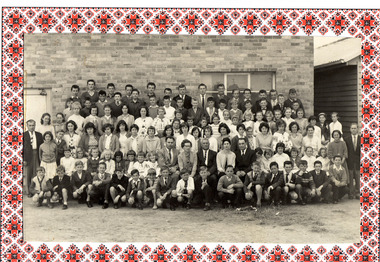
Photo, Ivan Franko School end of year 1960's, 1960
... ...ukrainian saturday school...Students and staff of Ivan Franko Ukrainian Saturday school ...Students and staff of Ivan Franko Ukrainian Saturday school students teachers ivan franko ukrainian saturday school Black & white photograph, with a border of traditional Ukrainian needlework pattern Ivan Franko School end of year 1960's Photo ...Students and staff of Ivan Franko Ukrainian Saturday school Black & white photograph, with a border of traditional Ukrainian needlework patternstudents, teachers, ivan franko, ukrainian saturday school -
 Ukrainian Historical Society Sunshine
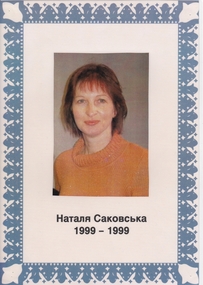
Photo, Natalie Sakowskyj. Principle of Ivan Franko school
... ...ukrainian saturday school...M/s Natalie Sakowskyj was principal of Ukrainian Saturday school 'Ivan Franko' during 1999....M/s Natalie Sakowskyj was principal of Ukrainian Saturday school 'Ivan Franko' during 1999. natalie sakowskyj principal ukrainian saturday school ivan franko Coloured photo , with date typed under photo. ...M/s Natalie Sakowskyj was principal of Ukrainian Saturday school 'Ivan Franko' during 1999.Coloured photo , with date typed under photo. Photo is attached to cardboard backing, is also framed with light blue patterned border. M/s Sakowskyj is wearing and orange top in the photo. Photo has been laminated. natalie sakowskyj, principal, ukrainian saturday school, ivan franko -
 Ukrainian Historical Society Sunshine
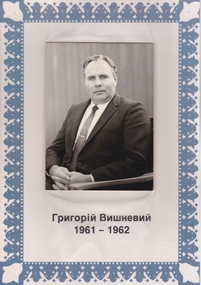
Photo, Gregory Vyshnevij. Principle of Ivan Franko school
... ...saturday school...Gregory Vyshnevij was principal of Ukrainian Saturday school 'Ivan Franko' in Sunshine from 1961 to 1962....Gregory Vyshnevij was principal of Ukrainian Saturday school 'Ivan Franko' in Sunshine from 1961 to 1962. gregory vyshnevij principal ukrainian saturday school ivan franko sunshine Black and white photo, with dates typed under photo. ...Mr. Gregory Vyshnevij was principal of Ukrainian Saturday school 'Ivan Franko' in Sunshine from 1961 to 1962.Black and white photo, with dates typed under photo. Photo is attached to cardboard backing,is also framed with light blue patterned border. Photo has been laminated.gregory vyshnevij, principal, ukrainian, saturday school, ivan franko, sunshine -
 Ukrainian Historical Society Sunshine
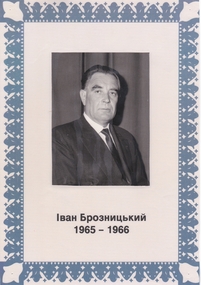
Photo, Ivan Brozntskyy. Principle of Ivan Franko school
... ...ukrainian saturday school...Ivan Brozntskyy was principal of Ukrainian Saturday school 'Ivan Franko' Sunshine from 1965 to 1966....Ivan Brozntskyy was principal of Ukrainian Saturday school 'Ivan Franko' Sunshine from 1965 to 1966. ivan brozntskyy principal ukrainian saturday school ivan franko sunshine Black and white photo, with date typed under photo. photo is attached to cardboard backing, is also framed with light blue patterned border. photo has been laminated. ...Mr. Ivan Brozntskyy was principal of Ukrainian Saturday school 'Ivan Franko' Sunshine from 1965 to 1966.Black and white photo, with date typed under photo. photo is attached to cardboard backing, is also framed with light blue patterned border. photo has been laminated.ivan brozntskyy, principal, ukrainian saturday school, ivan franko, sunshine -
 Ukrainian Historical Society Sunshine
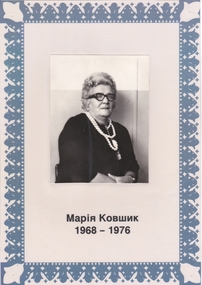
Photo, Maria Kowszyk. Principle of Ivan Franko school
... ...ukrainian saturday school...Maria Kowshek was principal of Ukrainian Saturday school 'Ivan Franko' Sunshine from 1968 to 1976....Maria Kowshek was principal of Ukrainian Saturday school 'Ivan Franko' Sunshine from 1968 to 1976. maria kowshek principal ukrainian saturday school ivan franko sunshine Black and white photo, with date typed under photo. ...Mrs. Maria Kowshek was principal of Ukrainian Saturday school 'Ivan Franko' Sunshine from 1968 to 1976.Black and white photo, with date typed under photo. Photo is attached to cardboard backing, is also framed with light blue patterned border. Photo has been laminated.maria kowshek, principal, ukrainian saturday school, ivan franko, sunshine -
 Ukrainian Historical Society Sunshine
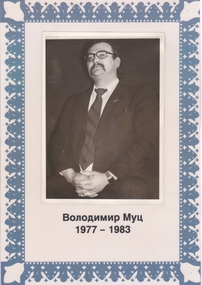
Photo, Vlodymir Muc. Principle of Ivan Franko school
... ...ukrainian saturday school...Vlodymir Muc was principal of Ukrainian Saturday school 'Ivan Franko' Sunshine from 1977 to 1983....Vlodymir Muc was principal of Ukrainian Saturday school 'Ivan Franko' Sunshine from 1977 to 1983. vlodymir muc principal ukrainian saturday school ivan franko sunshine Black and white photo, with date typed under photo. ...Mr. Vlodymir Muc was principal of Ukrainian Saturday school 'Ivan Franko' Sunshine from 1977 to 1983.Black and white photo, with date typed under photo. Photo is attached to cardboard backing, is also framed with a light blue patterned border. Photo has been laminatedvlodymir muc, principal, ukrainian saturday school, ivan franko, sunshine -
 Ukrainian Historical Society Sunshine
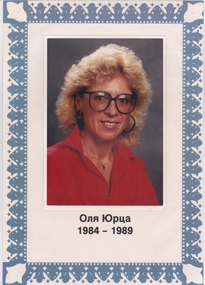
Photo, Olya Jursa. Principle of Ivan Franko school
... ...ukrainian saturday school...Mrs Olya Jursa was principal of Ukrainian Saturday school, 'Ivan Franko' Sunshine from 1984 to 1989....Mrs Olya Jursa was principal of Ukrainian Saturday school, 'Ivan Franko' Sunshine from 1984 to 1989. olya jursa principal ukrainian saturday school ivan franko sunshine Coloured photo, with date typed under photo. ...Mrs Olya Jursa was principal of Ukrainian Saturday school, 'Ivan Franko' Sunshine from 1984 to 1989.Coloured photo, with date typed under photo. Photo is attached to cardboard backing, is also framed with light blue patterned border. Mrs Jursa is wearing a red top and large framed black glasses.olya jursa, principal, ukrainian saturday school, ivan franko, sunshine -
 Ukrainian Historical Society Sunshine
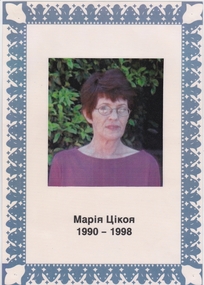
Photo, Maria Tsikoya. Principle of Ivan Franko school
... ...ukrainian saturday school...M/s Maria Tsikoya was principal of Ukrainian Saturday school 'Ivan Franko' Sunshine from 1990 to 1998...M/s Maria Tsikoya was principal of Ukrainian Saturday school 'Ivan Franko' Sunshine from 1990 to 1998 maria tsikoya principal ukrainian saturday school ivan franko Coloured photo , with date typed under photo. ...M/s Maria Tsikoya was principal of Ukrainian Saturday school 'Ivan Franko' Sunshine from 1990 to 1998Coloured photo , with date typed under photo. Photo is attached to cardboard backing, is also framed with light blue patterned border. M/s Tsikoya is wearing a light violet top and is standing in front of a green hedge.maria tsikoya, principal, ukrainian saturday school, ivan franko -
 Ukrainian Historical Society Sunshine
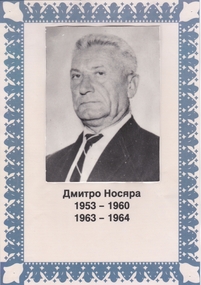
Photo, Dmitro Nosiara. 1st Principle of Ivan Franko school
... ...ukrainian saturday school...Mr Dmitro Nosiara was the first principal of Ukrainian Saturday School 'Ivan Franko in Sunshine. Mr. ...Mr Dmitro Nosiara was the first principal of Ukrainian Saturday School 'Ivan Franko in Sunshine. Mr. Nosiara was principal from 1953 to 1960, and again from 1963 to 1964. dmitro nosiara principal ukrainian saturday school ivan franko sunshine Black and White photo, with dates typed under photo. ...Mr Dmitro Nosiara was the first principal of Ukrainian Saturday School 'Ivan Franko in Sunshine. Mr. Nosiara was principal from 1953 to 1960, and again from 1963 to 1964.Black and White photo, with dates typed under photo. Photo is attached to cardboard backing,is also framed with a light blue patterned border. Photo has be laminated.dmitro nosiara, principal, ukrainian saturday school, ivan franko, sunshine -
 Sunshine and District Historical Society Incorporated
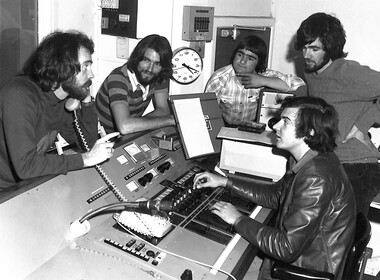
Photograph - Sunshine Technical School - Saturday Rock Show Photograph
... Sunshine Technical School - Saturday Rock Show Photograph...Photograph Sunshine Technical School - Saturday Rock Show Photograph ...sunshine technical school, technical school, athletics, student -
 Ringwood and District Historical Society
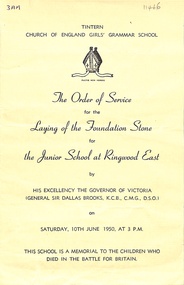
Document, Tintern CEGS Ringwood East - Order of Service for the Laying of the Foundation Stone for the Junior School on Saturday 10th June 1950 by The Governor of Victoria
... Tintern CEGS Ringwood East - Order of Service for the Laying of the Foundation Stone for the Junior School on Saturday 10th June 1950 by The Governor of Victoria. ...Buff coloured pamphlet setting out the Order of Service for the Laying of the Foundation Stone of the New School at Ringwood east by his Excellency The Governor of Victoria Si Dallas Brooks KCB,CMG,DSO on Saturday 10th June 1950 at 3pm. ...Tintern CEGS Ringwood East - Order of Service for the Laying of the Foundation Stone for the Junior School on Saturday 10th June 1950 by The Governor of Victoria. ...Buff coloured pamphlet setting out the Order of Service for the Laying of the Foundation Stone of the New School at Ringwood east by his Excellency The Governor of Victoria Si Dallas Brooks KCB,CMG,DSO on Saturday 10th June 1950 at 3pm. -
 Ukrainian Historical Society Sunshine
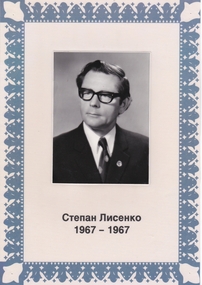
Photo, Stephen Lysenko. Principle of Ivan Franko school
... Stephen Lysenko was principal of Ukrainian Saturday School 'Ivan Franko' Sunshine during 1967....Stephen Lysenko was principal of Ukrainian Saturday School 'Ivan Franko' Sunshine during 1967. stephen lysenko principal ukrainiansaturday school ivan franko sunshine Black and white photo, with date typed under photo. ...Mr. Stephen Lysenko was principal of Ukrainian Saturday School 'Ivan Franko' Sunshine during 1967.Black and white photo, with date typed under photo. Photo is attached to cardboard backing, is also framed with a light blue patterned border. photo has been laminated.stephen lysenko, principal, ukrainiansaturday school, ivan franko, sunshine -
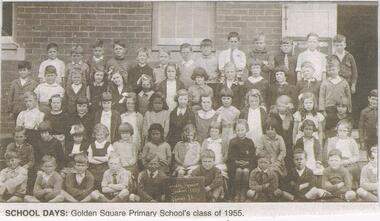 Bendigo Historical Society Inc.
Newspaper - JENNY FOLEY COLLECTION: SCHOOL DAYS
... Bendigo Advertiser "The way we were" from Saturday, May 7, 2005. School days: Golden Square Primary School's class of 1955....NEWSPAPER Bendigo advertiser the way we were Bendigo Advertiser "The way we were" from Saturday, May 7, 2005. School days: Golden Square Primary School's class of 1955. ...Bendigo Advertiser "The way we were" from Saturday, May 7, 2005. School days: Golden Square Primary School's class of 1955.newspaper, bendigo advertiser, the way we were -
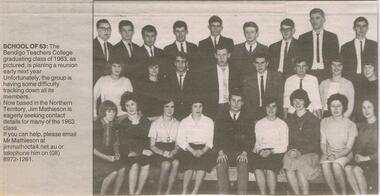 Bendigo Historical Society Inc.
Newspaper - JENNY FOLEY COLLECTION: SCHOOL OF '63
... Bendigo Advertiser "The way we were" from Saturday, November 15, 2003. School of '63: the Bendigo Teachers College graduating class of 1963....NEWSPAPER Bendigo advertiser the way we were Bendigo Advertiser "The way we were" from Saturday, November 15, 2003. School of '63: the Bendigo Teachers College graduating class of 1963. ...Bendigo Advertiser "The way we were" from Saturday, November 15, 2003. School of '63: the Bendigo Teachers College graduating class of 1963.newspaper, bendigo advertiser, the way we were -
![Document - Admission Ticket, Briar Hill Hall Trust, Picture Night, Comedy: 'BEDTIME FOR BONGO' with Ronald Regan [sic] and Shorts, ST. Faith's Hall, Cnr Price Avenue & Mountain View Road, Montmorency, Saturday, 13th August at 8pm, 1955](/media/collectors/4f729f7b97f83e03086018a5/items/62d3a368ec2b5dafd05f2739/item-media/62d3a422ec2b5dafd05f2c49/item-fit-380x285.jpg?cb=6) Eltham District Historical Society Inc
Eltham District Historical Society IncDocument - Admission Ticket, Briar Hill Hall Trust, Picture Night, Comedy: 'BEDTIME FOR BONGO' with Ronald Regan [sic] and Shorts, ST. Faith's Hall, Cnr Price Avenue & Mountain View Road, Montmorency, Saturday, 13th August at 8pm, 1955
... Presented by Briar Hill Hall Trust and St Faith's Pre-School Centre, Saturday, 13th August 1955....Presented by Briar Hill Hall Trust and St Faith's Pre-School Centre, Saturday, 13th August 1955. 1955 Admission Ticket Bedtime for Bongo (film) Briar Hill Hall Trust Montmorency Mountain View Road Picture Night Price Avenue Ronald Regan St Faith's Hall St Faiths Pre-School Centre Ticket Cinema Ronald Reagan Paper card ticket (used - punched hole), creased lenthwise from folded in half; 7 x 11.4 cm Picture Night, Comedy: 'BEDTIME FOR BONGO' with Ronald Regan [sic] and Shorts, ST. ...Presented by Briar Hill Hall Trust and St Faith's Pre-School Centre, Saturday, 13th August 1955.1955, admission ticket, bedtime for bongo (film), briar hill hall trust, montmorency, mountain view road, picture night, price avenue, ronald regan, st faith's hall, st faiths pre-school centre, ticket, cinema, ronald reagan -
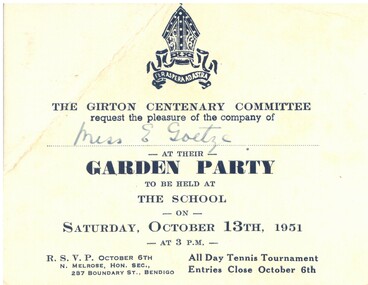 Bendigo Historical Society Inc.
Document - GOETZE COLLECTION: GIRTON COLLEGE GARDEN PARTY INVITATION
... Invitation to the Girton Centenary Committee Garden Party to be held at the School on Saturday, October 13th. 1951. N. Melrose, Secretary....Invitation to the Girton Centenary Committee Garden Party to be held at the School on Saturday, October 13th. 1951. N. Melrose, Secretary. ...Buff coloured card, dark blue writing. Invitation to the Girton Centenary Committee Garden Party to be held at the School on Saturday, October 13th. 1951. N. Melrose, Secretary.bendigo, education, girton college, girton college, n melrose, education, events -
 Canterbury History Group
Article, New School at Canterbury, 15/07/1908
... Photocopy of a report in the Australian Schoolmaster 15 July 1908 of the Proceedings and Speeches on the occasion of the opening of Canterbury Primary School on Saturday 20 June 1908 includes two photographs...Kinnard> D Opening Ceremonies Photocopy of a report in the Australian Schoolmaster 15 July 1908 of the Proceedings and Speeches on the occasion of the opening of Canterbury Primary School on Saturday 20 June 1908 includes two photographs New School at Canterbury Article ...Photocopy of a report in the Australian Schoolmaster 15 July 1908 of the Proceedings and Speeches on the occasion of the opening of Canterbury Primary School on Saturday 20 June 1908 includes two photographsnon-fictioncanterbury, canterbury primary school, primary schools, prospect hill road, molesworth street, sasche. a.o., madden> f., knox> w., balfour> jas., camberwell council, maloney> p., kinnard> d, opening ceremonies -
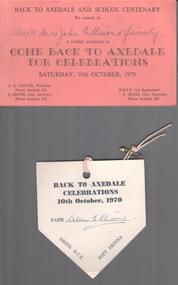 Bendigo Historical Society Inc.
Document - AILEEN AND JOHN ELLISON COLLECTION: BACK TO AXEDALE CELEBRATIONS
... Back to Axedale and school Centenary Saturday 10th October, 1970...Back to Axedale and school Centenary Saturday 10th October, 1970 Document AILEEN AND JOHN ELLISON COLLECTION: BACK TO AXEDALE CELEBRATIONS ...Two back to Axedale invitation, one in the name of Aileen Ellison the other to Mr and Mrs John Ellison and family. Back to Axedale and school Centenary Saturday 10th October, 1970axedale, history, back to axedale -
Canterbury History Group
Ephemera - Fourth Grand Dog Competition, 1953
... Advertising brochure distributed by Strathcona Baptist Girls' Grammar School Auxiliaries for the Fourth Grand Dog Competition held in the school grounds Saturday, 24 October 1953. Includes advertising for ten local businesses...Canterbury Strathcona Baptist Girls Grammar School Prospect Hill Road Competitions Dogs Shops Advertising brochure distributed by Strathcona Baptist Girls' Grammar School Auxiliaries for the Fourth Grand Dog Competition held in the school grounds Saturday, 24 October 1953. Includes advertising for ten local businesses Ephemera Fourth Grand Dog Competition ...Advertising brochure distributed by Strathcona Baptist Girls' Grammar School Auxiliaries for the Fourth Grand Dog Competition held in the school grounds Saturday, 24 October 1953. Includes advertising for ten local businessescanterbury, strathcona baptist girls grammar school, prospect hill road, competitions, dogs, shops -
 Bendigo Historical Society Inc.
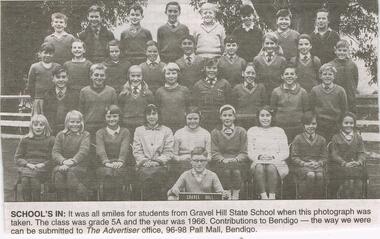
Newspaper - JENNY FOLEY COLLECTION: SCHOOL'S IN
... Bendigo Advertiser ''The way we were'' from Saturday, May, 28, 2005. School's in: it was all smiles for students from Gravel Hill State School when this photograph was taken. ...NEWSPAPER Bendigo advertiser the way we were Bendigo Advertiser ''The way we were'' from Saturday, May, 28, 2005. School's in: it was all smiles for students from Gravel Hill State School when this photograph was taken. ...Bendigo Advertiser ''The way we were'' from Saturday, May, 28, 2005. School's in: it was all smiles for students from Gravel Hill State School when this photograph was taken. The class was grade 5A and the year was 1966.newspaper, bendigo advertiser, the way we were -
 Orbost & District Historical Society
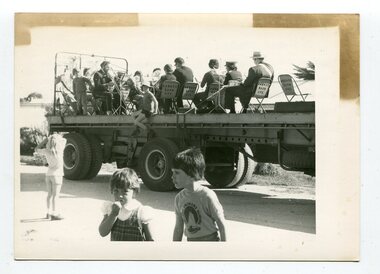
black and white photograph, October 4 1978
... From the Snowy River Mail October 4 1978 page 9 - " A MOBILE BAND - Although Orbost Municipal Band participated in Saturday's Primary School workathon, members feet didn't touch the ground. ...From the Snowy River Mail October 4 1978 page 9 - " A MOBILE BAND - Although Orbost Municipal Band participated in Saturday's Primary School workathon, members feet didn't touch the ground. ...From the Snowy River Mail October 4 1978 page 9 - " A MOBILE BAND - Although Orbost Municipal Band participated in Saturday's Primary School workathon, members feet didn't touch the ground. They idi it bthe easywayon the trailer of a truck. The band encouraged walkers with stirring music along the road to Marlo." The first Orbost Brass Band was formed in 1889. Around 1908 the town band split and the Orbost Workers' Band was formed. Eventually the two bands merged in 1913 to reform as the Orbost Municipal Band under conductorship of Charles Spink. The band continued for many years but was later disbanded and again reformed. This was to happen a number of times, the last time being in 1961 and continuing through to the late 1970's. Further info and Ref: In Times Gone By - Deborah Hall This is a pictorial record of the Orbost Municipal Band. The various Orbost bands over the years played a major role in community activities providing entertainment and musical experiences for the many members.A black / white photograph showing a group of uniformed band members sitting on folding chair s on the tray of a large flat bed truck. They are holding musical instruments. A young boy is sitting on the edge of the tray and three other children are standing on the road nearby.on back - information from S.R.M.music orbost-municipal-band entertainment recreation -
 Ringwood and District Historical Society
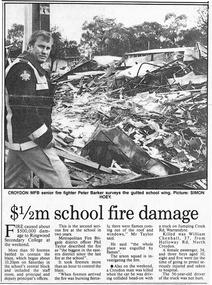
Newspaper, $1/2m school fire damage - Ringwood Mail, Tuesday, November 10 1992 - Picture SIMON HOEY
... More than 50 firemen battled to contain the blaze which began about 10.20pm on Saturday in the school's central block. This is the second serious fire at the school in two years. ...More than 50 firemen battled to contain the blaze which began about 10.20pm on Saturday in the school's central block. This is the second serious fire at the school in two years. ...ClippingFire caused about $500,000 damage to Ringwood Secondary College at the weekend. More than 50 firemen battled to contain the blaze which began about 10.20pm on Saturday in the school's central block. This is the second serious fire at the school in two years. MFB district officer Phil Taylor described the fire as "the biggest in the eastern district since the last fire at the school". The arson squad is investigating the fire. Photograph: Croydon MFB senior fire fighter Peter Barker surveys the gutted school wing. -
 Kiewa Valley Historical Society
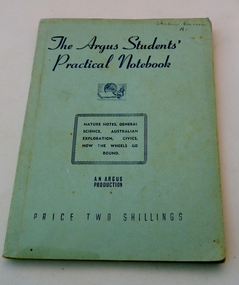
Book - Student's Text, The Argus Students' Practical Notebook, 28/09/1948
... The Argus Newspaper had been printing interesting, informative and instructive articles on various phases of the work in schools every Saturday in their newspaper and the students were expected to cut these articles out and paste them in a convenient form for study and revision. ...The Argus Newspaper had been printing interesting, informative and instructive articles on various phases of the work in schools every Saturday in their newspaper and the students were expected to cut these articles out and paste them in a convenient form for study and revision. ...Printed by the Argus and Australasian Limited in 1948 as a general text book for students. The Argus Newspaper had been printing interesting, informative and instructive articles on various phases of the work in schools every Saturday in their newspaper and the students were expected to cut these articles out and paste them in a convenient form for study and revision. The decision to publish the articles, by the Argus, in one volume was welcomed by the Director of Education, Victoria, J.A. Seitz and stated that it "can be recommended confidently to teachers and pupils."Gives a general overview of a lot of different subjects that students were being taught in the 1940's.It includes such areas as the three layers of government, simple mechanics and electrical theory, nature and general science. It is typical of what was being taught during the construction days in the Kiewa Valley and the owner would have possibly attended either the Tawonga State School or the Mt. Beauty State School. A green paper back text book of general knowledge. Contains nature notes, general science, Australian exploration, civics, and how the wheels go round. This is an Argus Production and the price is stated as two shillings.On the front cover, written in ink, is a name Helen Gunn, A1. This is repeated on the first page with two crosses underneath the inscription.argus newslpaper, general knowledge, education, pupils, text book -
 Wodonga & District Historical Society Inc
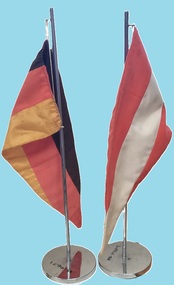
Memorabilia - German and Austrian miniature flags, Unknown
... It was used for meetings, Skat meetings, film nights and "Sonnabendschule” or Saturday school where children of members could continue to learn German. ...It was used for meetings, Skat meetings, film nights and "Sonnabendschule” or Saturday school where children of members could continue to learn German. ...Thousands of German migrants started a new life at Bonegilla, Victoria in the 1950s. Among them were five men who met each other in Wodonga, became friends and decided to form a German Austrian Club, where they could enjoy the company of likeminded individuals. They were Kurt Mueller, Willi Klimt, Toni Krischa and Erwin Klein from Germany and Manfred Teissl from Austria. On the 16th July 1960, after advertising in the Border Morning Mail, the German Austrian Club in Wodonga was born. Office bearers were Paul Peters as President. Gerhard Ziermann as Secretary and Günter Schmehl as Treasurer. Their aim was "To promote the upkeep of the German language in written and spoken form and to promote good German fellowship, while enjoying functions of a cultural and entertaining nature". By 1963 the Club boasted 40 members, holding meetings at the RSL Clubrooms and other suitable locations before they found a house in Hovell Street, Wodonga. It was used for meetings, Skat meetings, film nights and "Sonnabendschule” or Saturday school where children of members could continue to learn German. The Committee organised a wide range of activities and functions in their small rooms but dreamed of having a bigger home. This became reality in July 1979, when the Committee purchased land from the Albury Wodonga Development Corporation at 5 McFarland Road, Wodonga. The first brick was laid on the Club's land in May 1980, and the double-storey brick building was completed within 12 months voluntarily by Club members. At the same time members supported other organisations and charities in the Wodonga and wider community. The first Oktoberfest in Wodonga was held in 1975, drawing 4,000 attendees. The event was organized to promote German culture, and the profits from the first year were donated to the Wodonga District Hospital, raising $20,000. In 2001 the German Austrian Club was presented with the Certificate of Meritorious Service by the Government of Victoria for Community Works in Wodonga and district. The Club raised $23,000 for the Wodonga Hospital, had numerous fundraisers to assist in bushfires and drought situations and was involved in the Red Cross Calling campaign for many years. After much fundraising, hard work and making their way through extensive government red tape, the Club moved to its new premises in McFarland Road on 1st August 1981. The members continued to make necessary internal adjustments and sought an alcohol licence. The building was officially opened in May 1983. The Club prospered and had 300 members, making it necessary for new applicants to be put on a waiting list to be accepted as members. Interest groups consisted of Competition Air Rifle Shooting Group, a Skat (German Card game) Group, Folk Dancing Group, Ladies Group, Table Tennis Group, Darts Group, Chess Group and the Billiard Group. In later years, as so many Australians became members, the Club’s name was changed to the German Austrian Australian Club. Over recent years patronage and interest in the Club and its activities changed. Children of the original members had become “real Aussies” and did not always want to carry on traditions. Aging membership and lack of volunteers forced the Club to disband in 2025. The Club building has been gifted to the Albury Wodonga Theatre Company.These items are significant because they are representative of an important cultural organisation which operated in Wodonga for over 60 years.Two small flags of Germany and Austria attached to metal stands with string. Each stand has a metal circular base. "Lufthansa" is inscribed on the base.On base: Lufthansagerman austrian australian club, german austrian club -
 Wodonga & District Historical Society Inc
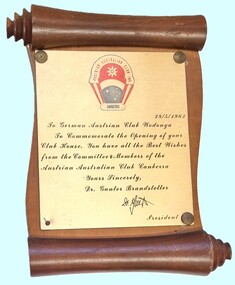
Plaque - German-Austrian Club Wodonga Opening, 1983
... It was used for meetings, Skat meetings, film nights and Sonnabendschule” or Saturday school where children of members could continue to learn German. ...It was used for meetings, Skat meetings, film nights and Sonnabendschule” or Saturday school where children of members could continue to learn German. ...Thousands of German migrants started a new life at Bonegilla, Victoria in the 1950s. Among them were five men who met each other in Wodonga, became friends and decided to form a German Austrian Club, where they could enjoy the company of likeminded individuals. They were Kurt Mueller, Willi Klimt, Toni Krischa and Erwin Klein from Germany and Manfred Teissl from Austria. On the 16th July 1960, after advertising in the Border Morning Mail the German Austrian Club in Wodonga was born. Office bearers were Paul Peters as President. Gerhard Ziermann as Secretary and Günter Schmehl as Treasurer. Their aim was "To promote the upkeep of the German language in written and spoken form and to promote good German fellowship, while enjoying functions of a cultural and entertaining nature". By 1963 the Club boasted 40 members, holding meetings at the RSL Clubrooms and other suitable locations before they found a house in Hovell Street, Wodonga. It was used for meetings, Skat meetings, film nights and Sonnabendschule” or Saturday school where children of members could continue to learn German. The Committee organised a wide range of activities and functions in their small rooms but dreamed of having a bigger home. This became reality in July 1979, when the Committee purchased land from the Albury Wodonga Development Corporation at 5 McFarland Road, Wodonga. The first brick was laid on the Club's land in May 1980, and the double-story brick building was completed within 12 months voluntarily by Club members. At the same time members supported other organisations and charities in the Wodonga and wider community. The first Oktoberfest in Wodonga was held in 1975, drawing 4,000 attendees. The event was organized to promote German culture, and the profits from the first year were donated to the Wodonga District Hospital, raising $20,000. In 2001 the German Austrian Club was presented with the Certificate of Meritorious Service by the Government of Victoria for Community Works in Wodonga and district. The Club raised $23,000 for the Wodonga Hospital, had numerous fundraisers to assist in bushfires and drought situations and was involved in the Red Cross Calling campaign for many years. After much fundraising, hard work and making their way through extensive government red tape, the Club moved to its new premises in McFarland Road on 1st August 1981. The members continued to make necessary internal adjustments and sought an alcohol licence. The building was officially opened in May 1983. The Club prospered and had 300 members, making it necessary for new applicants to be put on a waiting list to be accepted as members. Interest groups formed consisted of Competition Air Rifle Shooting Group, a Skat (German Card game) Group, Folk Dancing Group, Ladies Group, Table Tennis Group, Darts Group, Chess Group and the Billiard Group. In later years, as so many Australians became members, the Club’s name was changed to the German Austrian Australian Club. Over recent years patronage and interest in the Club and its activities changed. Children of the original members had become “real Aussies” and did not always want to carry on traditions. Aging membership and lack of volunteers forced the Club to disband in 2025. The Club building has been gifted to the Albury Wodonga Theatre Company. These items are significant because they are representative of an important cultural organisation which operated in Wodonga for over 60 years.A metal plaque attached to a wooden backing shaped like a scroll. The text is in the form of a letter.Emblem of the Austrian - Australian Clubs Inc. Canberra 28/5/1983 To German Austrian Club Wodonga To Commemorate the Opening of your Club House. You have all the Best Wishes from the Committee & Members of the Austrian Australian Club Canberra Yours Sincerely, Dr. Gunter Brandstetter Presidentgerman austrian australian club, german migrants wodonga -
 Wodonga & District Historical Society Inc
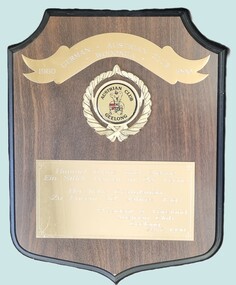
Plaque - German-Austrian Club Wodonga 30th Anniversary, 1990
... It was used for meetings, Skat meetings, film nights and Sonnabendschule” or Saturday school where children of members could continue to learn German. ...It was used for meetings, Skat meetings, film nights and Sonnabendschule” or Saturday school where children of members could continue to learn German. ...Thousands of German migrants started a new life at Bonegilla, Victoria in the 1950s. Among them were five men who met each other in Wodonga, became friends and decided to form a German Austrian Club, where they could enjoy the company of likeminded individuals. They were Kurt Mueller, Willi Klimt, Toni Krischa and Erwin Klein from Germany and Manfred Teissl from Austria. On the 16th July 1960, after advertising in the Border Morning Mail the German Austrian Club in Wodonga was born. Office bearers were Paul Peters as President. Gerhard Ziermann as Secretary and Günter Schmehl as Treasurer. Their aim was "To promote the upkeep of the German language in written and spoken form and to promote good German fellowship, while enjoying functions of a cultural and entertaining nature". By 1963 the Club boasted 40 members, holding meetings at the RSL Clubrooms and other suitable locations before they found a house in Hovell Street, Wodonga. It was used for meetings, Skat meetings, film nights and Sonnabendschule” or Saturday school where children of members could continue to learn German. The Committee organised a wide range of activities and functions in their small rooms but dreamed of having a bigger home. This became reality in July 1979, when the Committee purchased land from the Albury Wodonga Development Corporation at 5 McFarland Road, Wodonga. The first brick was laid on the Club's land in May 1980, and the double-story brick building was completed within 12 months voluntarily by Club members. At the same time members supported other organisations and charities in the Wodonga and wider community. The first Oktoberfest in Wodonga was held in 1975, drawing 4,000 attendees. The event was organized to promote German culture, and the profits from the first year were donated to the Wodonga District Hospital, raising $20,000. In 2001 the German Austrian Club was presented with the Certificate of Meritorious Service by the Government of Victoria for Community Works in Wodonga and district. The Club raised $23,000 for the Wodonga Hospital, had numerous fundraisers to assist in bushfires and drought situations and was involved in the Red Cross Calling campaign for many years. After much fundraising, hard work and making their way through extensive government red tape, the Club moved to its new premises in McFarland Road on 1st August 1981. The members continued to make necessary internal adjustments and sought an alcohol licence. The building was officially opened in May 1983. The Club prospered and had 300 members, making it necessary for new applicants to be put on a waiting list to be accepted as members. Interest groups formed consisted of Competition Air Rifle Shooting Group, a Skat (German Card game) Group, Folk Dancing Group, Ladies Group, Table Tennis Group, Darts Group, Chess Group and the Billiard Group. In later years, as so many Australians became members, the Club’s name was changed to the German Austrian Australian Club. Over recent years patronage and interest in the Club and its activities changed. Children of the original members had become “real Aussies” and did not always want to carry on traditions. Aging membership and lack of volunteers forced the Club to disband in 2025. The Club building has been gifted to the Albury Wodonga Theatre Company.This item is significant because it is representative of an important cultural organisation which operated in Wodonga for over 60 years.A wooden plaque with metal insignia and a plate with text in German. This plaque was presented by the German Austrian Club of Geelong on the occasion of the 30th Anniversary of the Wodonga Club and bears its insignia.Himmel Glanz und Sterne Ein Stuck Heimat in Der Fern Herzliche Gratulation Zu Eurem 30 Jahres Tag President and Vorstand Translation Sky, splendour and stars A piece of home away from home Congratulations On your 30th anniversary President and Board of Directorsgerman austrian australian club, german migrants wodonga -
 Wodonga & District Historical Society Inc
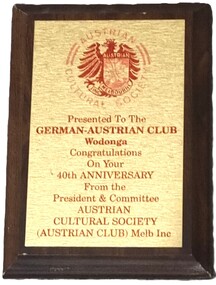
Plaque - German-Austrian Club Wodonga 40th Anniversary, 2000
... It was used for meetings, Skat meetings, film nights and Sonnabendschule” or Saturday school where children of members could continue to learn German. ...It was used for meetings, Skat meetings, film nights and Sonnabendschule” or Saturday school where children of members could continue to learn German. ...Thousands of German migrants started a new life at Bonegilla, Victoria in the 1950s. Among them were five men who met each other in Wodonga, became friends and decided to form a German Austrian Club, where they could enjoy the company of likeminded individuals. They were Kurt Mueller, Willi Klimt, Toni Krischa and Erwin Klein from Germany and Manfred Teissl from Austria. On the 16th July 1960, after advertising in the Border Morning Mail the German Austrian Club in Wodonga was born. Office bearers were Paul Peters as President. Gerhard Ziermann as Secretary and Günter Schmehl as Treasurer. Their aim was "To promote the upkeep of the German language in written and spoken form and to promote good German fellowship, while enjoying functions of a cultural and entertaining nature". By 1963 the Club boasted 40 members, holding meetings at the RSL Clubrooms and other suitable locations before they found a house in Hovell Street, Wodonga. It was used for meetings, Skat meetings, film nights and Sonnabendschule” or Saturday school where children of members could continue to learn German. The Committee organised a wide range of activities and functions in their small rooms but dreamed of having a bigger home. This became reality in July 1979, when the Committee purchased land from the Albury Wodonga Development Corporation at 5 McFarland Road, Wodonga. The first brick was laid on the Club's land in May 1980, and the double-story brick building was completed within 12 months voluntarily by Club members. At the same time members supported other organisations and charities in the Wodonga and wider community. The first Oktoberfest in Wodonga was held in 1975, drawing 4,000 attendees. The event was organized to promote German culture, and the profits from the first year were donated to the Wodonga District Hospital, raising $20,000. In 2001 the German Austrian Club was presented with the Certificate of Meritorious Service by the Government of Victoria for Community Works in Wodonga and district. The Club raised $23,000 for the Wodonga Hospital, had numerous fundraisers to assist in bushfires and drought situations and was involved in the Red Cross Calling campaign for many years. After much fundraising, hard work and making their way through extensive government red tape, the Club moved to its new premises in McFarland Road on 1st August 1981. The members continued to make necessary internal adjustments and sought an alcohol licence. The building was officially opened in May 1983. The Club prospered and had 300 members, making it necessary for new applicants to be put on a waiting list to be accepted as members. Interest groups formed consisted of Competition Air Rifle Shooting Group, a Skat (German Card game) Group, Folk Dancing Group, Ladies Group, Table Tennis Group, Darts Group, Chess Group and the Billiard Group. In later years, as so many Australians became members, the Club’s name was changed to the German Austrian Australian Club. Over recent years patronage and interest in the Club and its activities changed. Children of the original members had become “real Aussies” and did not always want to carry on traditions. Aging membership and lack of volunteers forced the Club to disband in 2025. The Club building has been gifted to the Albury Wodonga Theatre Company.This item is significant because it is representative of an important cultural organisation which operated in Wodonga for over 60 years.A small metal plaque on a wooden backing with red text. It includes the insignia of the Austrian Cultural Society of Melbourne.Presented To The GERMAN-AUSTRIAN CLUB Wodonga Congratulations On Your 40th ANNIVERSARY From the President & Committee AUSTRIAN CULTURAL SOCIETY (AUSTRIAN CLUB) Melb Incgerman austrian australian club, german migrants wodonga -
 Wodonga & District Historical Society Inc
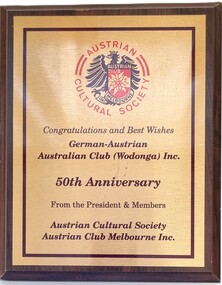
Plaque - German-Austrian Club Wodonga 50th Anniversary, 2010
... It was used for meetings, Skat meetings, film nights and Sonnabendschule” or Saturday school where children of members could continue to learn German. ...It was used for meetings, Skat meetings, film nights and Sonnabendschule” or Saturday school where children of members could continue to learn German. ...Thousands of German migrants started a new life at Bonegilla, Victoria in the 1950s. Among them were five men who met each other in Wodonga, became friends and decided to form a German Austrian Club, where they could enjoy the company of likeminded individuals. They were Kurt Mueller, Willi Klimt, Toni Krischa and Erwin Klein from Germany and Manfred Teissl from Austria. On the 16th July 1960, after advertising in the Border Morning Mail the German Austrian Club in Wodonga was born. Office bearers were Paul Peters as President. Gerhard Ziermann as Secretary and Günter Schmehl as Treasurer. Their aim was "To promote the upkeep of the German language in written and spoken form and to promote good German fellowship, while enjoying functions of a cultural and entertaining nature". By 1963 the Club boasted 40 members, holding meetings at the RSL Clubrooms and other suitable locations before they found a house in Hovell Street, Wodonga. It was used for meetings, Skat meetings, film nights and Sonnabendschule” or Saturday school where children of members could continue to learn German. The Committee organised a wide range of activities and functions in their small rooms but dreamed of having a bigger home. This became reality in July 1979, when the Committee purchased land from the Albury Wodonga Development Corporation at 5 McFarland Road, Wodonga. The first brick was laid on the Club's land in May 1980, and the double-story brick building was completed within 12 months voluntarily by Club members. At the same time members supported other organisations and charities in the Wodonga and wider community. The first Oktoberfest in Wodonga was held in 1975, drawing 4,000 attendees. The event was organized to promote German culture, and the profits from the first year were donated to the Wodonga District Hospital, raising $20,000. In 2001 the German Austrian Club was presented with the Certificate of Meritorious Service by the Government of Victoria for Community Works in Wodonga and district. The Club raised $23,000 for the Wodonga Hospital, had numerous fundraisers to assist in bushfires and drought situations and was involved in the Red Cross Calling campaign for many years. After much fundraising, hard work and making their way through extensive government red tape, the Club moved to its new premises in McFarland Road on 1st August 1981. The members continued to make necessary internal adjustments and sought an alcohol licence. The building was officially opened in May 1983. The Club prospered and had 300 members, making it necessary for new applicants to be put on a waiting list to be accepted as members. Interest groups formed consisted of Competition Air Rifle Shooting Group, a Skat (German Card game) Group, Folk Dancing Group, Ladies Group, Table Tennis Group, Darts Group, Chess Group and the Billiard Group. In later years, as so many Australians became members, the Club’s name was changed to the German Austrian Australian Club. Over recent years patronage and interest in the Club and its activities changed. Children of the original members had become “real Aussies” and did not always want to carry on traditions. Aging membership and lack of volunteers forced the Club to disband in 2025. The Club building has been gifted to the Albury Wodonga Theatre Company.This item is significant because it is representative of an important cultural organisation which operated in Wodonga for over 60 years.A small metal plaque on a wooden backing with red text. It includes the insignia of the Austrian Cultural Society of Melbourne.Congratulations and Best Wishes German-Austrian Australian Club (Wodonga) Inc. 50th Anniversary From the President & Members Austrian Cultural Society Austrian Club Melbourne Inc.german austrian australian club, german migrants wodonga -
 Melbourne Tram Museum
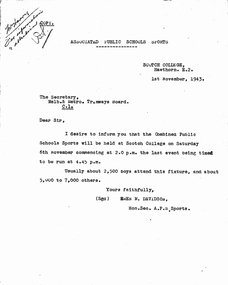
Letter, Melbourne & Metropolitan Tramways Board (MMTB), Associated Public Schools Sports, 1 November 1943, 18 October 1943
... Associated Public Schools Sports Saturday 6 November 1943 1 - Letter from Ewen M Davidson, Hon Sec APS Sports to Secretary M&MTB advising of combined public schools sports to be held at Scotch College on Saturday 6 November 1943. ...Associated Public Schools Sports Saturday 6 November 1943 1 - Letter from Ewen M Davidson, Hon Sec APS Sports to Secretary M&MTB advising of combined public schools sports to be held at Scotch College on Saturday 6 November 1943. ...Associated Public Schools Sports Saturday 6 November 1943 1 - Letter from Ewen M Davidson, Hon Sec APS Sports to Secretary M&MTB advising of combined public schools sports to be held at Scotch College on Saturday 6 November 1943. Letter dated 1 November 1943. 2 - Letter from L Powers, Bursar, Scotch College, to District Traffic Superintendent, M&MTB, advising of payment for 3 special trams. Also advising of school sports meeting at Wesley College on 23 October 1943 and at Scotch College on 6 November 1943. Letter dated 18 October 1943."Mr Harry, for information & attention" written in pencil in top left corner., Several notations in blue pencil on 2nd letter.trams, tramways, events, sports, scotch college -
 Ballarat Tramway Museum
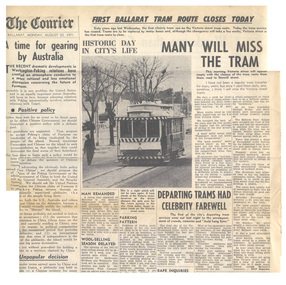
Newspaper, The Courier Ballarat, "Many will miss the Tram", "Departing Trams had Celebrity Farewell", 1971
... The main item written by a staff reporter recalls the days of travelling regularly on the tram when a student going to and from school, Saturday travelling and as a means of transport. ...The main item written by a staff reporter recalls the days of travelling regularly on the tram when a student going to and from school, Saturday travelling and as a means of transport. ...Yields information about the closure of the SEC Ballarat system in particular the Victoria St line. Has a strong association with the article author.Set of two Newspaper clippings pasted onto a single sheet of paper with two Punch holes on the left hand side with one hole through the photograph within the cutting. Clipping from The Courier, Ballarat, Monday, 23/8/1971 (corrected date), of two items in the paper about the closure of the trams in Victoria St. The main item written by a staff reporter recalls the days of travelling regularly on the tram when a student going to and from school, Saturday travelling and as a means of transport. Second item in the same cutting reports on the closure of the Victoria St. route the previous day. Mentions the interest in the trams, the BTPS, and police protection that was not needed. Photograph accompanying the article is of a driver turning the pole at the Victoria St. terminus of tram No. 31. Second clipping, from The Courier, dated 8/9/1971, reports on a collection of historic tram photos in the Commonwealth Bank for the next two weeks, presented by the Tramway Museum Society of Victoria. 1068.2 - full page of The Courier, 23/8/1971, added 10/9/2013 and image added.In red ink in upper right hand corner, "21/8/71" of the first cutting and "8/9/71" in red ink in the top right hand corner of the second cuttingtrams, tramways, closure, victoria st., tmsv, displays
