
Showing 16 items matching "scallop shell"
-
 Mission to Seafarers Victoria
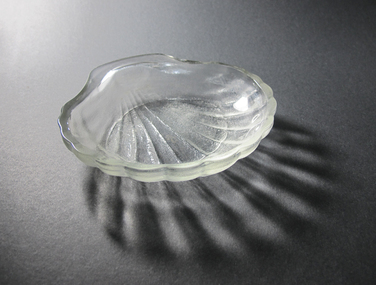
Domestic object - Comfit dish, Mid 20th C
... ...scallop shell...Added to collection as appears to be an artifact associated with the Mission and used by Mission staff. ashtray shell scallop shell shell of st james Moulded shell-shaped glass dish with textured underside and smooth upper side. ...The ashtray was found during c Mission's clearup in 2017.To be researched further. Added to collection as appears to be an artifact associated with the Mission and used by Mission staff.Moulded shell-shaped glass dish with textured underside and smooth upper side. ashtray, shell, scallop shell, shell of st james -
 Orbost & District Historical Society
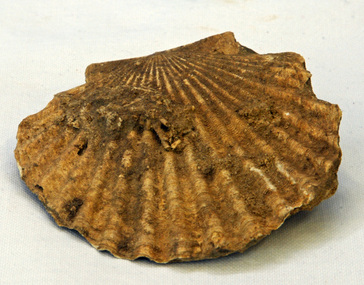
shell fossil
... fossil scallop pectinidae shell...Fossils are among the most valuable sources of information about the Earth's history. fossil scallop pectinidae shell A scallop fossil -Pectinidae. ...Inspected by George Rawlings 6.2.2013.Fossils are among the most valuable sources of information about the Earth's history.A scallop fossil -Pectinidae. This dates from the Miocene Era.fossil scallop pectinidae shell -
 Glenelg Shire Council Cultural Collection
Souvenir - China Dish - Portland Souvenir, Royal Stafford, England, n.d
... Royal Stafford white bone china scallop shell dish, coloured decal of the Portland harbour. ...Front: 'THE HARBOUR, PORTLAND' Back: Makers stamp - Guaranteed ENGLISH BONE CHINA ROYAL STAFFORD MADE IN ENGLAND Royal Stafford white bone china scallop shell dish, coloured decal of the Portland harbour. ...Royal Stafford white bone china scallop shell dish, coloured decal of the Portland harbour. Gold rim.Front: 'THE HARBOUR, PORTLAND' Back: Makers stamp - Guaranteed ENGLISH BONE CHINA ROYAL STAFFORD MADE IN ENGLAND -
 Orbost & District Historical Society
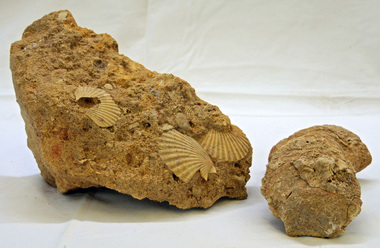
fossils
... Two fossils in Gippsland limestone. .1 has scallop shells - pectens .2 has calcified wood. ...Fossils are among the most valuable sources of information about the Earth's history. fossils miocene scallops petrified-wood Two fossils in Gippsland limestone. .1 has scallop shells - pectens .2 has calcified wood. ...Inspected by George Rawlings 6.2.2013.Fossils are among the most valuable sources of information about the Earth's history.Two fossils in Gippsland limestone. .1 has scallop shells - pectens .2 has calcified wood. Both are from the Miocene Era.fossils miocene scallops petrified-wood -
 Bendigo Historical Society Inc.
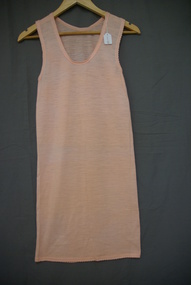
Clothing - HANRO COLLECTION: LADIES’ SINGLET
... Neckline, armholes and hem finished with an overlocked hem and a row of decorative stitching, giving a scalloped, shell shaped edge. Sleeveless, with a scooped neckline, higher at the back and lower at the front....Neckline, armholes and hem finished with an overlocked hem and a row of decorative stitching, giving a scalloped, shell shaped edge. Sleeveless, with a scooped neckline, higher at the back and lower at the front. ...Pink ladies’ singlet. Neckline, armholes and hem finished with an overlocked hem and a row of decorative stitching, giving a scalloped, shell shaped edge. Sleeveless, with a scooped neckline, higher at the back and lower at the front.Hanro W. 80% Wool/Nylon.costume, female underwear, singlet -
Glenelg Shire Council Cultural Collection
Equipment - Gunpowder Flask, n.d
... Brass gunpowder flask, decorated on both sides with scallop shape shell...Brass gunpowder flask, decorated on both sides with scallop shape shell Equipment Gunpowder Flask ...Brass gunpowder flask, decorated on both sides with scallop shape shell -
 Flagstaff Hill Maritime Museum and Village
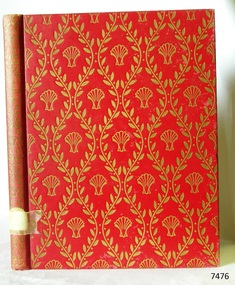
Book, The Scallop
... The Scallop Studies of a shell and its influences on humankind Eight authors edited by Ian Cox Publisher: The Shell Transport & Trading Co Ltd Date: 1957...The Warrnambool Mechanics' Institute publication collection is of both local and state significance. warrnambool shipwrecked-coast flagstaff-hill flagstaff-hill-maritime-museum maritime-museum shipwreck-coast flagstaff-hill-maritime-village shipwrecked-artefact book warrnambool mechanics’ institute pattison collection warrnambool library ralph eric pattison warrnambool city librarian mechanics’ institute library victorian library board warrnambool books and records warrnambool children’s library the scallop ian cox Label on spine cover with typed text PAT F 704.94 SCA Pastedown end page has a sticker from Warrnambool Public Library Front loose endpaper has a sticker from Corangamite Regional Library Service The Scallop Studies of a shell and its influences on humankind Eight authors edited by Ian Cox Publisher: The Shell Transport & Trading Co Ltd Date: 1957 The Scallop Book ...This item is from the ‘Pattison Collection’, a collection of books and records that was originally owned by the Warrnambool Mechanics’ Institute, which was founded in Warrnambool in 1853. By 1886 the Warrnambool Mechanics’ Institute (WMI) had grown to have a Library, Museum and Fine Arts Gallery, with a collection of “… choice productions of art, and valuable specimens in almost every branch and many wonderful national curiosities are now to be seen there, including historic relics of the town and district.” It later included a School of Design. Although it was very well patronised, the lack of financial support led the WMI in 1911 to ask the City Council to take it over. In 1935 Ralph Pattison was appointed as City Librarian to establish and organise the Warrnambool Library as it was then called. When the WMI building was pulled down in 1963 a new civic building was erected on the site and the new Warrnambool Library, on behalf of the City Council, took over all the holdings of the WMI. At this time some of the items were separated and identified as the ‘Pattison Collection’, named after Ralph Pattison. Eventually the components of the WMI were distributed from the Warrnambool Library to various places, including the Art Gallery, Historical Society and Flagstaff Hill. Later some were even distributed to other regional branches of Corangamite Regional Library and passed to and fro. It is difficult now to trace just where all of the items have ended up. The books at Flagstaff Hill Maritime Village generally display stamps and markings from Pattison as well as a variety of other institutions including the Mechanics’ Institute itself. RALPH ERIC PATTISON Ralph Eric Pattison was born in Rockhampton, Queensland, in 1891. He married Maude Swan from Warrnambool in 1920 and they set up home in Warrnambool. In 1935 Pattison accepted a position as City Librarian for the Warrnambool City Council. His huge challenge was to make a functional library within two rooms of the Mechanics’ Institute. He tirelessly cleaned, cleared and sorted a disarrayed collection of old books, jars of preserved specimens and other items reserved for exhibition in the city’s museum. He developed and updated the library with a wide variety of books for all tastes, including reference books for students; a difficult task to fulfil during the years following the Depression. He converted all of the lower area of the building into a library, reference room and reading room for members and the public. The books were sorted and stored using a cataloguing and card index system that he had developed himself. He also prepared the upper floor of the building and established the Art Gallery and later the Museum, a place to exhibit the many old relics that had been stored for years for this purpose. One of the treasures he found was a beautiful ancient clock, which he repaired, restored and enjoyed using in his office during the years of his service there. Ralph Pattison was described as “a meticulous gentleman whose punctuality, floorless courtesy and distinctive neat dress were hallmarks of his character, and ‘his’ clock controlled his daily routine, and his opening and closing of the library’s large heavy doors to the minute.” Pattison took leave during 1942 to 1942 to serve in the Royal Australian Navy, Volunteer Reserve as Lieutenant. A few years later he converted one of the Museum’s rooms into a Children’s Library, stocking it with suitable books for the younger generation. This was an instant success. In the 1950’s he had the honour of being appointed to the Victorian Library Board and received more inspiration from the monthly conferences in Melbourne. He was sadly retired in 1959 after over 23 years of service, due to the fact that he had gone over the working age of council officers. However he continued to take a very keen interest in the continual development of the Library until his death in 1969. WARRNAMBOOL PUBLIC LIBRARY The Warrnambool Mechanics’ Institute (WMI) was formed by a voluntary community group in 1863, within six years of Warrnambool’s beginnings, and its Reading Room opened in 1854. The WMI operated until 1963, at which time it was one of the oldest Mechanics’ Institutes in Victoria. Mechanics’ Institutes offered important services to the public including libraries, reading rooms and places to display and store collections of all sorts such as curiosities and local historical relics. In 1886 a Museum and Fine Arts Gallery were added to the WMI and by the beginning of the 20th century there was also a billiards room and a School of Art. By this time all Mechanics’ Institutes in country Victoria had museums attached. Over the years the Warrnambool Mechanics’ Institute Library was also known as the Warrnambool Public Library the Warrnambool Library and the Free Library. Early funding from the government was for the “Free Library”. The inscription in a book “Science of Man” was for the “Warrnambool Public Library”, donated by Joseph Archibald in 1899. Another inscription in the book “Catalogue of Plants Under Cultivation in the Melbourne Botanic Gardens 1 & 2, 1883” was presented to the “Warrnambool Library” and signed by the author W.R. Guilfoyle. In 1903 the Warrnambool Public Library decided to add a Juvenile Department to library and stock it with hundreds of books suitable for youth. In 1905 the Public Library committee decided to update the collection of books and added 100 new novels plus arrangements for the latest novels to be included as soon as they were available in Victoria. In July 1911 the Warrnambool Council took over the management of the Public Library, Art Gallery, Museum and Mechanics’ Institute and planned to double the size of the then-current building. In 1953, when Mr. R. Pattison was Public Librarian, the Warrnambool Public Library’s senior section 10,000 of the 13,000 books were fiction. The children’s section offered an additional 3,400 books. The library had the equivalent of one book per head of population and served around 33 percent of the reading population. The collection of books was made up of around 60 percent reference and 40 percent fiction. The library was lending 400 books per day. In 1963 the Warrnambool City Council allocated the site of the Mechanics’ Institute building, which included the Public Library, Museum and Art Gallery, for the new Municipal Offices and the Collections were dispersed until 1971. The Warrnambool Library took over the Mechanics’ Institute Library’s holdings on behalf of the Warrnambool City Council. Since the closure of the Warrnambool Mechanics’ Institute the exact location and composition of the original WMI books and items has become unclear. Other materials have been added to the collection, including items from Terang MI, Warrnambool Court House and Customs House. Many of the books have been identified as the Pattison Collection, named after the Librarian who catalogued and numbered the books during his time as Warrnambool Public Librarian in the time before the Mechanics’ Institute closed. It seems that when Warrnambool became part of the Corangamite Regional Library some of the books and materials went to its head office in Colac and then back to Warrnambool where they were stored at the Art Gallery for quite some time. Some then went to the Warrnambool Historical Society, some stayed at the Art Gallery and some were moved to Flagstaff Hill Maritime Village. The various stamps and labels on the books held at Flagstaff Hill show the variety of the collection’s distribution and origin. The books in the collection at Flagstaff Hill Maritime Village date from the 1850’s to the late 1950’s and include rare and valuable volumes. Many of the books are part of the “Pattison Collection” after the Warrnambool’s Public Librarian, Mr. R. Pattison. The Pattison Collection, along with other items at Flagstaff Hill Maritime Village, was originally part of the Warrnambool Mechanics' Institute’s collection. The Warrnambool Mechanics’ Institute Collection is primarily significant in its totality, rather than for the individual objects it contains. Its contents are highly representative of the development of Mechanics' Institute libraries across Australia, particularly Victoria. A diversity of publications and themes has been amassed, and these provide clues to our understanding of the nature of and changes in the reading habits of Victorians from the 1850s to the middle of the 20th century. The collection also highlights the Warrnambool community’s commitment to the Mechanics’ Institute, reading, literacy and learning in the regions, and proves that access to knowledge was not impeded by distance. These items help to provide a more complete picture of our community’s ideals and aspirations. The Warrnambool Mechanics Institute book collection has historical and social significance for its strong association with the Mechanics Institute movement and the important role it played in the intellectual, cultural and social development of people throughout the latter part of the nineteenth century and the early twentieth century. The collection of books is a rare example of an early lending library and its significance is enhanced by the survival of an original collection of many volumes. The Warrnambool Mechanics' Institute’s publication collection is of both local and state significance. The Warrnambool Mechanics' Institute Collection is primarily significant in its totality, rather than for the individual objects it contains. Its contents are highly representative of the development of Mechanics' Institute libraries across Australia, particularly Victoria. A diversity of publications and themes has been amassed, and these provide clues to our understanding of the nature of and changes in the reading habits of Victorians from the 1850s to the middle of the 20th century. The collection also highlights the Warrnambool community’s commitment to the Mechanics’ Institute, and to reading, literacy and learning in the regions, and proves that access to knowledge was not impeded by distance. These items help to provide a more complete picture of our community’s ideals and aspirations. As with many Mechanics' Institutes in Australia, the one which operated in Warrnambool was established and overseen for many years by key individuals associated with the development of the city itself. The WMI publication collection is historically significant because of its association with local people, places and the key historical themes in the development of Warrnambool of rural development, industry, farming, education, and community. The collection documents and illustrates the changing interests, focus and tastes of Victorians, especially those in regional cities. Generally the individual items in the collection are not particularly rare, as examples of all probably exist in other public collections in Victoria. It is primarily because there are so very few surviving Mechanics' Institute collections in Victoria, which lends this overall collection its significance. Many items in the WMI Collection have the potential to support further research, both as individual objects and through the collection in its entirety. This material is significant for its ability to assist in the interpretation of the history of the area and adds to the general understanding of the development of the township. Many components of the WMI publication collection complement and reinforce the Flagstaff Hill Maritime Museum Collection, the Warrnambool Art Gallery Collection, and that in the Warrnambool Historical Society, and also contribute to a clearer understanding of the original Warrnambool Mechanics' Institute collections. This will greatly enhance the appreciation of the few surviving Mechanics' Institute collections across Victoria, and also in New South Wales. The similarities and differences between the small number of collections that have survived can provide further insights into how the people of Victoria in general, and Warrnambool in particular, constructed a civic culture of adult learning to foster an informed citizenry. The Warrnambool Mechanics' Institute publication collection is of both local and state significance. The Scallop Studies of a shell and its influences on humankind Eight authors edited by Ian Cox Publisher: The Shell Transport & Trading Co Ltd Date: 1957Label on spine cover with typed text PAT F 704.94 SCA Pastedown end page has a sticker from Warrnambool Public Library Front loose endpaper has a sticker from Corangamite Regional Library Servicewarrnambool, shipwrecked-coast, flagstaff-hill, flagstaff-hill-maritime-museum, maritime-museum, shipwreck-coast, flagstaff-hill-maritime-village, shipwrecked-artefact, book, warrnambool mechanics’ institute, pattison collection, warrnambool library, ralph eric pattison, warrnambool city librarian, mechanics’ institute library, victorian library board, warrnambool books and records, warrnambool children’s library, the scallop, ian cox -
 Greensborough Historical Society
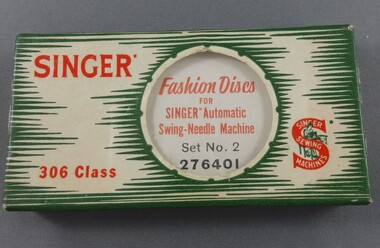
Sewing machine accessories, Singer Manufacturing Company, Singer Sewing Machine Discs, 1960c
... Set no. 2, 276401, 306 class. Shell, Solid scallop, Icicle and Banner ...Set no. 2, 276401, 306 class. Shell, Solid scallop, Icicle and Banner Box containing four sewing machine cams and leaflet containing sewing patterns and instructions for use. ...Commonly used removable cams from a Singer sewing machine of the 1960s. These cams enabled the home sewer to use fancy stitches in their work and were later superseded by integrated electronic controls.Box containing four sewing machine cams and leaflet containing sewing patterns and instructions for use. Accessories to a Singer sewing machine.Fashion discs for Singer Automatic swing-needle machine. Set no. 2, 276401, 306 class. Shell, Solid scallop, Icicle and Banner singer sewing machines -
 Rye RSL Sub Branch
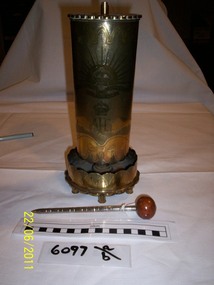
Dinner Gong
... Hand theatre made "trench art", utilising used artillery brass shell casings, of various calibres, hand made with such "tools" as were available at the time. They have been decoratively trimmed at the mouth of each with a "scalloped" pattern, the shallowest casing mounted on small arms casings as "feet" and the large casing inverted engraved and embossed with a depiction of the Australian Commonwealth Military Forces "Rising Sun" badge....Shell Casings of various sizes. The largest cut short at the bottom, mounted on rifle or machine gun casings cut short as 'feet'. A slightly smaller diameter inverted as the 'gong' with decorative engravings depicting, a Rising Sun emblem on a decorated back ground, 'AFC' (Australian Flying Corps) crowned wings, on the same decorated back ground. The open ends of these larger casings is 'scalloped...Shell Casings of various sizes. The largest cut short at the bottom, mounted on rifle or machine gun casings cut short as 'feet'. A slightly smaller diameter inverted as the 'gong' with decorative engravings depicting, a Rising Sun emblem on a decorated back ground, 'AFC' (Australian Flying Corps) crowned wings, on the same decorated back ground. The open ends of these larger casings is 'scalloped ...Hand theatre made "trench art", utilising used artillery brass shell casings, of various calibres, hand made with such "tools" as were available at the time. They have been decoratively trimmed at the mouth of each with a "scalloped" pattern, the shallowest casing mounted on small arms casings as "feet" and the large casing inverted engraved and embossed with a depiction of the Australian Commonwealth Military Forces "Rising Sun" badge.This "Dinner Gong" and "Striker" are significant Historically and Socially, as it is believed to be the only example of a dinner gong and striker made in theatre as contemporary "trench art" by serving members of this group. Around the top of the main part of the Gong are stamped the initials of the Australian members of the Royal Flying Corps at the time, it is of possible National historical significance, as they were such a small group at best, and a highly vulnerable group, quite likely to not survive the conflict. This group and their desendants went on to be a part of the formation of the Australian Flying Corps, the beginings of the Royal Australian Air Force. It relates to the embrionic stages of a part of the now Australian Defence Force.A commemorative Dinner Gong construted from Artillery Shell Casings of various sizes. The largest cut short at the bottom, mounted on rifle or machine gun casings cut short as 'feet'. A slightly smaller diameter inverted as the 'gong' with decorative engravings depicting, a Rising Sun emblem on a decorated back ground, 'AFC' (Australian Flying Corps) crowned wings, on the same decorated back ground. The open ends of these larger casings is 'scalloped' and decorated beautifully, while the closed ends have a 'pie crust effect around the flanged edge. There is a biforcated mount at the top to hold the 'striker' made from white metal ballastered rod with a wooden eliptical knob. On the top around the striker mount are stamped the initials of those believed to be the first Australian Aviators in the then AFC. -
Ringwood and District Historical Society
Decorative object - Doily, Crotched doily Ringwood c. 1930
... Close work in centre surrounded by shell pattern and scalloped edging....Close work in centre surrounded by shell pattern and scalloped edging. Crotched doily Ringwood c. 1930 Decorative object Doily ...Crotched by Catherine Webber (nee Danby)Pale cream coloured crotched doily. Circular with two small extensions. Close work in centre surrounded by shell pattern and scalloped edging. -
 Bendigo Historical Society Inc.
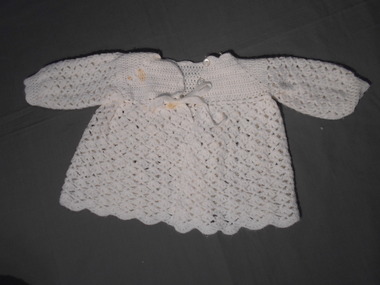
Clothing - AILEEN AND JOHN ELLISON COLLECTION: WHITE CROCHET BABY JACKET, 1950's
... scalloped edge at the neckline and cuffs. A 1 cm wide nylon ribbon passes through eyelets at the underarm, and ties with a bow at the front opening. Above this, the yoke has three plastic pearl buttons to fasten. The treble pattern of the crochet gives a shell...scalloped edge at the neckline and cuffs. A 1 cm wide nylon ribbon passes through eyelets at the underarm, and ties with a bow at the front opening. Above this, the yoke has three plastic pearl buttons to fasten. The treble pattern of the crochet gives a shell ...Long raglan sleeves, round neck with a scalloped edge at the neckline and cuffs. A 1 cm wide nylon ribbon passes through eyelets at the underarm, and ties with a bow at the front opening. Above this, the yoke has three plastic pearl buttons to fasten. The treble pattern of the crochet gives a shell-like effect, to the sleeves, and lower section of the garment, while the yoke, and cuffs have a treble filet pattern.costume, children's, white crochet baby's jacket -
 Bendigo Historical Society Inc.
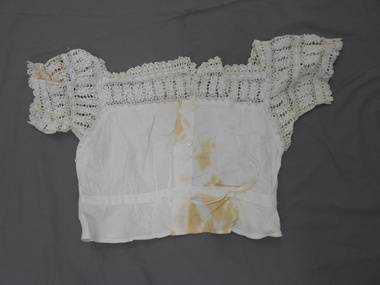
Clothing - WHITE COTTON CAMISOLE WITH CROCHET LACE TRIM, Early 1900's
... shell buttons( third is missing). Rows of 1.5cm cotton lace run horizontally at top and bottom of yoke, with three rows - one at each edge, and one in centre of sleeves. Neckline is then edged with crochet in a scalloped...shell buttons( third is missing). Rows of 1.5cm cotton lace run horizontally at top and bottom of yoke, with three rows - one at each edge, and one in centre of sleeves. Neckline is then edged with crochet in a scalloped ...Wide square neckline, and square yoke of crochet extending into short crocheted sleeves. A seven cm deep peplum has a cotton casing and cotton tape drawstring. The front opening has three hand-stitched button holes, and two pearl shell buttons( third is missing). Rows of 1.5cm cotton lace run horizontally at top and bottom of yoke, with three rows - one at each edge, and one in centre of sleeves. Neckline is then edged with crochet in a scalloped pattern with provision for a ribbon insert.costume, female, cotton camisole with crochet lace trim -
 Tatura Irrigation & Wartime Camps Museum
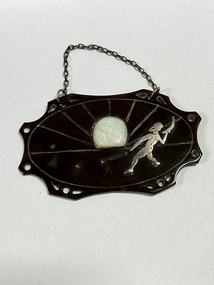
Decorative object - Tortoise shell ornament
... scalloped edge. An opal has been inserted in the centre with etched lines symbolising the rising sun. A silver native figure holding a boomerang is to the right. A small silver look chain is attached to the top. Decorative object Tortoise shell ...Lotte Mueller was 16 years old when her parents were interned. Her father was a German Woolbuyer living in Sydney. She was left alone for several months before she was able to join her family in Camp 3Oval shaped ornament/brooch with scalloped edge. An opal has been inserted in the centre with etched lines symbolising the rising sun. A silver native figure holding a boomerang is to the right. A small silver look chain is attached to the top.mueller, hoopman, camp 3, woolbuyer, tatura -
Beechworth RSL Sub-Branch
Memorabilia - Ashtray, 1918/19
... An ashtray made from a 85 mm artillery shell, inside the ashtray there is a small arms cartridge firmly embedded in the internal primer housing/ the shell has been cut to a height of 40 mm and the rim has been scalloped/ the base diameter is 85 mm/ the item does not sit flat because a small arm cartridge has been firmly wedged into the external primer housing and is not flush to the surface, it protrudes about 5mm out of the base....On the base in stamped or engraved "5 - DE - C (believed to be the lot number of the casing; F - R - E 99 16 X" around the external surface is engraved ''FRANCE - AUDRUICQ" and the side are further decorated with engraved flowers An ashtray made from a 85 mm artillery shell, inside the ashtray there is a small arms cartridge firmly embedded in the internal primer housing/ the shell has been cut to a height of 40 mm and the rim has been scalloped/ the base diameter is 85 mm/ the item does not sit flat because a small arm cartridge has been firmly wedged into the external primer housing and is not flush to the surface, it protrudes about 5mm out of the base. ...An ashtray made from a 85 mm artillery shell, inside the ashtray there is a small arms cartridge firmly embedded in the internal primer housing/ the shell has been cut to a height of 40 mm and the rim has been scalloped/ the base diameter is 85 mm/ the item does not sit flat because a small arm cartridge has been firmly wedged into the external primer housing and is not flush to the surface, it protrudes about 5mm out of the base.On the base in stamped or engraved "5 - DE - C (believed to be the lot number of the casing; F - R - E 99 16 X" around the external surface is engraved ''FRANCE - AUDRUICQ" and the side are further decorated with engraved flowers -
 Dandenong/Cranbourne RSL Sub Branch
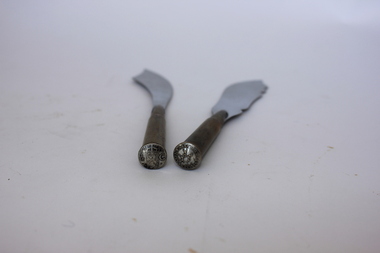
Memorabilia - Knives, hand made, Trench Art during WWII
... Two knives made of stainless steel blades, soldered into what appears to be .303 bullets with shells that are used as handles. One knife has a three scallops on the top (blunt part of the knife) with a shaped cutting edge. ...Hand made knives during WWII One coin has "Nederl Indie 1/10 G 1941" Two knives made of stainless steel blades, soldered into what appears to be .303 bullets with shells that are used as handles. One knife has a three scallops on the top (blunt part of the knife) with a shaped cutting edge. ...Hand made knives during WWIITwo knives made of stainless steel blades, soldered into what appears to be .303 bullets with shells that are used as handles. One knife has a three scallops on the top (blunt part of the knife) with a shaped cutting edge. On the base of the cartridge, a coin is soldered on that covers the primer and entire base of the cartridge. The coin appears to have Arabic writing on it. The other knife is scimitar in shape. At the base of the cartridge a 1941 Netherlands East Indies 1/10 Gulden Colonial Coin is soldered. This coin covers the primer and entire base of the shell.One coin has "Nederl Indie 1/10 G 1941" -
 Ballarat Diocesan Historical Commission
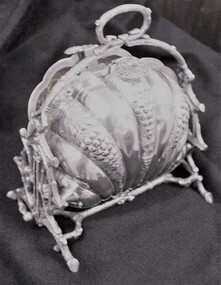
Butter dish, Victorian Butter Shell, c. 1895
... Victorian Silver Plated folding scallop design warming/biscuit dish, having a hand-chased oval body with grape and vine leaves decoration and plane silver border sitting inside a rustic cast frame with cast feet. c.1890. Victorian Butter Shell ...Presented to Dr Higgins as Bishop of Rockhampton before his translation to Ballarat. This presentation piece evidences Bishop Higgins' work around Australia in the late 19th and early 20th century and his administrative moves.Victorian Silver Plated folding scallop design warming/biscuit dish, having a hand-chased oval body with grape and vine leaves decoration and plane silver border sitting inside a rustic cast frame with cast feet. c.1890. Inscribed- To the Right Rev Dr Higgins from his grateful children the Pupils of Rosebank Sept 2nd 1899. Makers Mark for Walker and Hall underneath dish.walker and hall, bishop higgins, rockhampton, ballarat, rosedale.
