
Showing 17 items matching "school farms - western australia"
-
 Mrs Aeneas Gunn Memorial Library
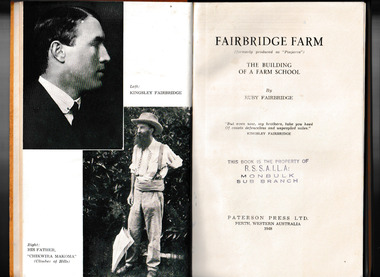
Book, Paterson Press, Fairbridge Farm : the building of a farm school, 1948
... ...School farms - Western Australia...Child migrants School farms - Western Australia A tale of the troubles, trials and vicissitudes of the Fairbridge Farm School Ill, p.189. ...A tale of the troubles, trials and vicissitudes of the Fairbridge Farm SchoolIll, p.189.non-fictionA tale of the troubles, trials and vicissitudes of the Fairbridge Farm Schoolchild migrants, school farms - western australia -
 University of Melbourne, Burnley Campus Archives
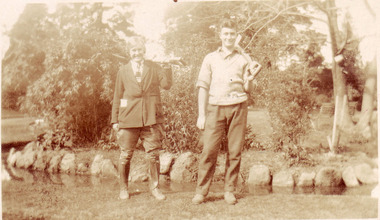
Photograph - Sepia print, E. Chalmers, Students Beside Ponds, 1927
... Littlejohn began school. Harry subsequently farmed in Western Australia and Les at Redhill, Vic. ...Littlejohn began school. Harry subsequently farmed in Western Australia and Les at Redhill, Vic. ...Harry and brother Les completed certificate courses. They were sons of the head teacher at Dromana State School where E.B. Littlejohn began school. Harry subsequently farmed in Western Australia and Les at Redhill, Vic. E.B. Littlejohn.Sepia photograph. Students P. Haines and H. Wiseman (1928) standing in front of the Luffmann PondsOn reverse, "Peggy Haines and Harry Wiseman 1927, E. Chalmers 29 Macleod Pde. Macleod."ella chalmers (née fry), peggy haines, harry wiseman, 1927, les wiseman, students, certificate courses, dromana state school, e.b. littlejohn, luffmann ponds, lily ponds -
 Federation University Historical Collection
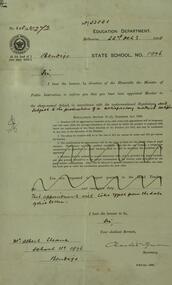
Book - Scrap Book, Ballarat School of Mines Scrap Book, 1924 - 1929, c1931
... school of mines museum...motor mechanics' classes for ladies...farm engineering...villers bretonneux carvings...trengrove...museum...port pirrie...j.i. simpson...reuben s. russelll...ballarat technical art school...charles harvey...elliott gower...la gerche...c. curnow...applied art...macroberston scholarship...ballarat school of mines procession...rag...vale park tree planting...smb ball...pottery classes...delineascope...mica smith scholarship...james peart...burma mnies...smb excursion to western australia...The scrap books were kept by the librarians and related to topics of interest to the Ballarat School of Mines, its students and its staff. ballarat school of mines martha pinkerton scrap book a.w. nicholson john lynch (junior) mount lyell leslie evans leslie blake evans herald shield for athletics ballarat school of mines museum motor mechanics' classes for ladies farm engineering villers bretonneux carvings trengrove museum port pirrie j.i. simpson reuben s. russelll ballarat technical art school charles harvey elliott gower la gerche c. curnow applied art macroberston scholarship ballarat school of mines procession rag vale park tree planting smb ball pottery classes delineascope mica smith scholarship james peart burma mnies smb excursion to western australia kalgoorlie elsie mckissock war trophies warwick smith spencer street bridge war museum richard j. young alfred mica smith obituary reginald callister john rowell sewerage installation h.h. smith w.h. middleton olive scott dolly whitehead vale park ballarat war museum opening repatriation classes sewerage at the ballarat school of mines australian coals j.p. ellsworth yallourn w.g. walker reunion norfolk island pine mica smith memorial jessice smith harry fern t. henderson bhp john adam ols students' association l.b. curnow laura crouch signwriting excursion port pirrie excursion albert potter pearl fricke technica school sports percy trompf ballarat school of mines battery albert mclean a.d.r. galloway alan douglas richard galloway r.j. young alan ludbrook r. timpe ballarat ironworkers and polytechnic association h. jolly carpentry harold jolly millinery classes phoenix model locomotive s.j. morgan r.d. bannister juvenile industrial exhibition w.h. shaw j.c. winds f.h. davis h.r. worland w.t. magee l. george l. balhausen white flat oval resue from yarrowee creek e. berriman ballarat teachers' college reg mcconnell mount lyell co munro reaper munro reaper model weaving classes mervyn trimmings briquette dust edna findlay jean rogers n. mccallum jessie glass classroom ventilation art metal charles fenner levi molyneux olice scott poster competition kerr grant w.h. steane h. caddy colvin smith claude creelman robert colins stan hillman n.c. heathcote egg collection john alexander nornie gude charles deane graham hopwood roswald john dart max wilson new battery jess hopwood william middleton a.e.c. kerr hand weaving classes m. martin a.h. leeson mona rogerson lorna bailey prospectors classes edwin robinson Kalgoorlie vist railway locomotive 17 December 1954 - Ballarat Junior Technical School Headmaster's Report 05 February 1925 - Ballarat School of Mines Museum closure 25 February 1925 - War Trophies Museum 06 May 1925 - Ballarat's Museum. ...The Ballarat School of Mines was a predecessor institution of Federatin University Australia. The scrap books were kept by the librarians and related to topics of interest to the Ballarat School of Mines, its students and its staff. 17 December 1954 - Ballarat Junior Technical School Headmaster's Report 05 February 1925 - Ballarat School of Mines Museum closure 25 February 1925 - War Trophies Museum 06 May 1925 - Ballarat's Museum. Where is it? Some Interesting Facts 14 May 1925 - White Flat Reserve 21 June 1928 - Ballarat School of Mines Procession 14 March 1929 - Mr A.D.R. Galloway - An Australian Abroad - Tragic end. 1929 - Technical Education 17 October 1929 - Agricultural Engineering 15 February 1930 - Ballarat School of Mines Student Association 20 February 1930 - 61s Annual Meeting of the Ballarat School of Mines 02 June 1930 - R. Young in Belgium and visits battlefields including Hill 60. 19 February 1931 - School Hostel Suggested 14 April 1931 - Frank Pinkerton Obituary 15 October 1921 - Life at Mt Isa (E. Loveland) 18 February 1932 - Discussion on Teachers College (Ballarat Teachers' College) 11 July 1931 - Phoenix Model Locomotive donation to the Ballarat School of Mines 06 May 1932 - The Mt Isa Country 11 Oct 1932 - Death of F.W. Alsopp (former SMB student) 21 January 1933 - Education In Victoria: Will a New Era Open 28 September 1933 - New Teaching System Explained by the Minister 17 February 1934 - Trip to New Guinea (A.F. Heseltine) 19 April 1934 - Early Ballarat - Address by Nathan Spielvogel 30 August 1934 - Ballarat Junior Technical School Tennis Court 23 August 1934 - Welding plant and Battery 17 June 1935 - Men about Town - A.F. Heseltine 21 June 1935 - Vocational Guidance 16 July 1935 - Ballarat School of Mines (history) 03 August 1935 - Men About Town - William H. Middleton 10 August 1935 - A.E.C. Kerrballarat school of mines, martha pinkerton, scrap book, a.w. nicholson, john lynch (junior), mount lyell, leslie evans, leslie blake evans, herald shield for athletics, ballarat school of mines museum, motor mechanics' classes for ladies, farm engineering, villers bretonneux carvings, trengrove, museum, port pirrie, j.i. simpson, reuben s. russelll, ballarat technical art school, charles harvey, elliott gower, la gerche, c. curnow, applied art, macroberston scholarship, ballarat school of mines procession, rag, vale park tree planting, smb ball, pottery classes, delineascope, mica smith scholarship, james peart, burma mnies, smb excursion to western australia, kalgoorlie, elsie mckissock, war trophies, warwick smith, spencer street bridge, war museum, richard j. young, alfred mica smith obituary, reginald callister, john rowell, sewerage installation, h.h. smith, w.h. middleton, olive scott, dolly whitehead, vale park, ballarat war museum opening, repatriation classes, sewerage at the ballarat school of mines, australian coals, j.p. ellsworth, yallourn, w.g. walker, reunion, norfolk island pine, mica smith memorial, jessice smith, harry fern, t. henderson, bhp, john adam, ols students' association, l.b. curnow, laura crouch, signwriting, excursion, port pirrie excursion, albert potter, pearl fricke, technica school sports, percy trompf, ballarat school of mines battery, albert mclean, a.d.r. galloway, alan douglas richard galloway, r.j. young, alan ludbrook, r. timpe, ballarat ironworkers and polytechnic association, h. jolly, carpentry, harold jolly, millinery classes, phoenix model locomotive, s.j. morgan, r.d. bannister, juvenile industrial exhibition, w.h. shaw, j.c. winds, f.h. davis, h.r. worland, w.t. magee, l. george, l. balhausen, white flat oval, resue from yarrowee creek, e. berriman, ballarat teachers' college, reg mcconnell, mount lyell co, munro reaper, munro reaper model, weaving classes, mervyn trimmings, briquette dust, edna findlay, jean rogers, n. mccallum, jessie glass, classroom ventilation, art metal, charles fenner, levi molyneux, olice scott, poster competition, kerr grant, w.h. steane, h. caddy, colvin smith, claude creelman, robert colins, stan hillman, n.c. heathcote, egg collection, john alexander, nornie gude, charles deane, graham hopwood, roswald john dart, max wilson, new battery, jess hopwood, william middleton, a.e.c. kerr, hand weaving classes, m. martin, a.h. leeson, mona rogerson, lorna bailey, prospectors classes, edwin robinson, kalgoorlie vist, railway locomotive -
 Federation University Historical Collection
Book - Book - Scrapbook, Ballarat School of MInes: Scrapbook of Newspaper Cuttings, Book 77, January 1997 to April 1997
... The papers concerned are The Courier, Ballarat, The Australian, The Age and other region papers over the period of 18 January 1997 to 3 April 1997. teaching positions advertised pre-employment courses courses available enrolment for smb courses more adults attending courses brace upgrades $40000 smb the brewery complex john howard - prime minister visits ballarat opens brewery complex bill prior and fr martin hislop jeanette lowe - laurinda scholton - josephine birch sherryl anderson - robin boyd - peter morey $1.5m tafe campus start deb's fun approach to fitness richard de fegely overseas students papua new guinea western samoa phillippines thailand "dante's peak" director roger donaldson school's back - officially farming apprentices help fire victims karl britt and ian miller smb women's course 21 years on ballarat faces higher cost for water australian college of education awards smb $500000 debt paid by government video link with sister city melting pot of cultures at smb concert will aid academy pianist roger woodward roger donaldson - smb to hollywood bruce widdop lecturer bapa farm machinery repairs course asian student drive Book with yellow cover, front, spiral bound. ...Collection of newspaper articles related to Ballarat School Of Mines.They cover activities and advertisements for staff. The papers concerned are The Courier, Ballarat, The Australian, The Age and other region papers over the period of 18 January 1997 to 3 April 1997. Book with yellow cover, front, spiral bound. teaching positions advertised, pre-employment courses, courses available, enrolment for smb courses, more adults attending courses, brace upgrades, $40000, smb the brewery complex, john howard - prime minister, visits ballarat, opens brewery complex, bill prior and fr martin hislop, jeanette lowe - laurinda scholton - josephine birch, sherryl anderson - robin boyd - peter morey, $1.5m tafe campus start, deb's fun approach to fitness, richard de fegely, overseas students, papua new guinea, western samoa, phillippines, thailand, "dante's peak" director roger donaldson, school's back - officially, farming apprentices help fire victims, karl britt and ian miller, smb women's course 21 years on, ballarat faces higher cost for water, australian college of education awards, smb $500000 debt paid by government, video link with sister city, melting pot of cultures at smb, concert will aid academy, pianist roger woodward, roger donaldson - smb to hollywood, bruce widdop lecturer bapa, farm machinery repairs course, asian student drive -
 Bendigo Historical Society Inc.
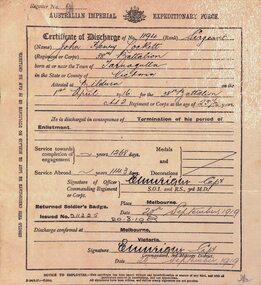
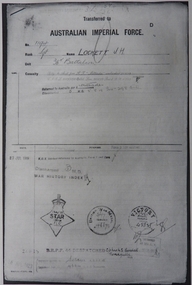
Document - Jack Lockett Collection: Army Certificate of Discharge
... school aged nine to work on a local farm. Later, he worked for his uncles in the Mallee. On 24 March 1916, he travelled to Mildura to enlist in the Australian Imperial Force. He served in France with the 38th Battalion, earning promotion to sergeant and was discharged on 20 September 1919. https://en.wikipedia.org/wiki/Jack_Lockett The 38th Battalion was formed on 1 March 1916 at a camp established on the Epsom Racecourse at Bendigo in Victoria. After training in both Australia and Britain, the 38th Battalion crossed to France in late November 1916 and moved into the trenches of the Western...school aged nine to work on a local farm. Later, he worked for his uncles in the Mallee. On 24 March 1916, he travelled to Mildura to enlist in the Australian Imperial Force. He served in France with the 38th Battalion, earning promotion to sergeant and was discharged on 20 September 1919. https://en.wikipedia.org/wiki/Jack_Lockett The 38th Battalion was formed on 1 March 1916 at a camp established on the Epsom Racecourse at Bendigo in Victoria. After training in both Australia and Britain, the 38th Battalion crossed to France in late November 1916 and moved into the trenches of the Western ...John Henry Lockett OAM (22 January 1891 – 25 May 2002) was the oldest man ever in Australia when he died aged 111 years, 123 days. As one of the last surviving veterans of World War I, he was acclaimed as a national hero during the last decade of his life. Lockett was born in the small Victorian town of Waanyarra, near Bendigo. He left school aged nine to work on a local farm. Later, he worked for his uncles in the Mallee. On 24 March 1916, he travelled to Mildura to enlist in the Australian Imperial Force. He served in France with the 38th Battalion, earning promotion to sergeant and was discharged on 20 September 1919. https://en.wikipedia.org/wiki/Jack_Lockett The 38th Battalion was formed on 1 March 1916 at a camp established on the Epsom Racecourse at Bendigo in Victoria. After training in both Australia and Britain, the 38th Battalion crossed to France in late November 1916 and moved into the trenches of the Western Front for the first time on 1 December.The 38th fought in its first major battle at Messines, in Belgium, between 7-9 June 1917. It fought in another two major attacks in this sector - the battle of Broodseinde on 4 October, and the battle of Passchendaele on 12 October. Belgium remained the focus of the 38th Battalion's activities for the next five months, until it was rushed south to France in late March 1918 to meet the German Army's Spring Offensive. The 38th participated in its last major action of the war between 29 September and 2 October 1918 as part of the Australian-American operation that breached the formidable defences of the Hindenburg Line along the St Quentin Canal. It was disbanded in April 1919. Source, Australian War Memorial https://www.awm.gov.au/collection/U51478 After the war, Jack returned to The Mallee and selected a 640 acres (260 ha) block of land in Linga, Victoria, deciding to make his living as a farmer. In 1923, he married Maybell Ingwerson and they had four children together. In 1963, the couple retired to Bendigo, leaving the farmland (which now covered more than 130,000 acres (53,000 ha), in the care of their children and grandchildren. An off-white coulored document with black print and black handwriting headed AUSTRALIAN IMPERIAL EXPEDITIONARY FORCE Certificate of Discharge No 1194 Sergeant John Henry Lockett 38th Battalion, born Tarnagulla Victoria Attested at Mildura 1st April 1916for the 38th Battalion at the age of 25 1/2 years Total service 1268 days Service abroad 1143 days Discharge confirmed at Melbourne Victoria 20th September 1919 On the reverse V/B 60883 No 177770 Description of the above named Soldier on discharge Age 28 1/2 years Height 5' 10", complexion Medium, Eyes Blue, Hair Brown, Trade Farmer, Intended place of Residence Ouyen P.O. Victoria Singed J H Lockett jack lockett, mabel ingwersen, 38th australian infantry battalion, w.w.1, mallee farming -
 Bendigo Historical Society Inc.
Document - Jack Lockett Collection: Copies of Army Service documents
... school aged nine to work on a local farm. Later, he worked for his uncles in the Mallee. On 24 March 1916, he travelled to Mildura to enlist in the Australian Imperial Force. He served in France with the 38th Battalion, earning promotion to sergeant and was discharged on 20 September 1919. https://en.wikipedia.org/wiki/Jack_Lockett The 38th Battalion was formed on 1 March 1916 at a camp established on the Epsom Racecourse at Bendigo in Victoria. After training in both Australia and Britain, the 38th Battalion crossed to France in late November 1916 and moved into the trenches of the Western...school aged nine to work on a local farm. Later, he worked for his uncles in the Mallee. On 24 March 1916, he travelled to Mildura to enlist in the Australian Imperial Force. He served in France with the 38th Battalion, earning promotion to sergeant and was discharged on 20 September 1919. https://en.wikipedia.org/wiki/Jack_Lockett The 38th Battalion was formed on 1 March 1916 at a camp established on the Epsom Racecourse at Bendigo in Victoria. After training in both Australia and Britain, the 38th Battalion crossed to France in late November 1916 and moved into the trenches of the Western ...John Henry Lockett OAM (22 January 1891 – 25 May 2002) was the oldest man ever in Australia when he died aged 111 years, 123 days. As one of the last surviving veterans of World War I, he was acclaimed as a national hero during the last decade of his life. Lockett was born in the small Victorian town of Waanyarra, near Bendigo. He left school aged nine to work on a local farm. Later, he worked for his uncles in the Mallee. On 24 March 1916, he travelled to Mildura to enlist in the Australian Imperial Force. He served in France with the 38th Battalion, earning promotion to sergeant and was discharged on 20 September 1919. https://en.wikipedia.org/wiki/Jack_Lockett The 38th Battalion was formed on 1 March 1916 at a camp established on the Epsom Racecourse at Bendigo in Victoria. After training in both Australia and Britain, the 38th Battalion crossed to France in late November 1916 and moved into the trenches of the Western Front for the first time on 1 December.The 38th fought in its first major battle at Messines, in Belgium, between 7-9 June 1917. It fought in another two major attacks in this sector - the battle of Broodseinde on 4 October, and the battle of Passchendaele on 12 October. Belgium remained the focus of the 38th Battalion's activities for the next five months, until it was rushed south to France in late March 1918 to meet the German Army's Spring Offensive. The 38th participated in its last major action of the war between 29 September and 2 October 1918 as part of the Australian-American operation that breached the formidable defences of the Hindenburg Line along the St Quentin Canal. It was disbanded in April 1919. Source, Australian War Memorial https://www.awm.gov.au/collection/U51478 After the war, Jack returned to The Mallee and selected a 640 acres (260 ha) block of land in Linga, Victoria, deciding to make his living as a farmer. In 1923, he married Maybell Ingwerson and they had four children together. In 1963, the couple retired to Bendigo, leaving the farmland (which now covered more than 130,000 acres (53,000 ha), in the care of their children and grandchildren. Thirteen photocopies relating to Jack Lockett's service in the Australian Imperial Force jack lockett, mabel ingwersen, 38th australian infantry battalion, w.w.1, mallee farming -
 Bendigo Historical Society Inc.
Map - Jack Lockett Collection: Copies of two maps of WW1 Battles
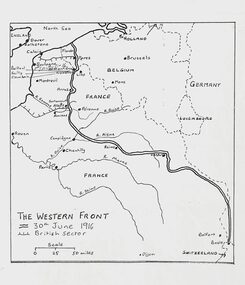
... school aged nine to work on a local farm. Later, he worked for his uncles in the Mallee. On 24 March 1916, he travelled to Mildura to enlist in the Australian Imperial Force. He served in France with the 38th Battalion, earning promotion to sergeant and was discharged on 20 September 1919. https://en.wikipedia.org/wiki/Jack_Lockett The 38th Battalion was formed on 1 March 1916 at a camp established on the Epsom Racecourse at Bendigo in Victoria. After training in both Australia and Britain, the 38th Battalion crossed to France in late November 1916 and moved into the trenches of the Western...school aged nine to work on a local farm. Later, he worked for his uncles in the Mallee. On 24 March 1916, he travelled to Mildura to enlist in the Australian Imperial Force. He served in France with the 38th Battalion, earning promotion to sergeant and was discharged on 20 September 1919. https://en.wikipedia.org/wiki/Jack_Lockett The 38th Battalion was formed on 1 March 1916 at a camp established on the Epsom Racecourse at Bendigo in Victoria. After training in both Australia and Britain, the 38th Battalion crossed to France in late November 1916 and moved into the trenches of the Western ...John Henry Lockett OAM (22 January 1891 – 25 May 2002) was the oldest man ever in Australia when he died aged 111 years, 123 days. As one of the last surviving veterans of World War I, he was acclaimed as a national hero during the last decade of his life. Lockett was born in the small Victorian town of Waanyarra, near Bendigo. He left school aged nine to work on a local farm. Later, he worked for his uncles in the Mallee. On 24 March 1916, he travelled to Mildura to enlist in the Australian Imperial Force. He served in France with the 38th Battalion, earning promotion to sergeant and was discharged on 20 September 1919. https://en.wikipedia.org/wiki/Jack_Lockett The 38th Battalion was formed on 1 March 1916 at a camp established on the Epsom Racecourse at Bendigo in Victoria. After training in both Australia and Britain, the 38th Battalion crossed to France in late November 1916 and moved into the trenches of the Western Front for the first time on 1 December.The 38th fought in its first major battle at Messines, in Belgium, between 7-9 June 1917. It fought in another two major attacks in this sector - the battle of Broodseinde on 4 October, and the battle of Passchendaele on 12 October. Belgium remained the focus of the 38th Battalion's activities for the next five months, until it was rushed south to France in late March 1918 to meet the German Army's Spring Offensive. The 38th participated in its last major action of the war between 29 September and 2 October 1918 as part of the Australian-American operation that breached the formidable defences of the Hindenburg Line along the St Quentin Canal. It was disbanded in April 1919. Source, Australian War Memorial https://www.awm.gov.au/collection/U51478 After the war, Jack returned to The Mallee and selected a 640 acres (260 ha) block of land in Linga, Victoria, deciding to make his living as a farmer. In 1923, he married Maybell Ingwerson and they had four children together. In 1963, the couple retired to Bendigo, leaving the farmland (which now covered more than 130,000 acres (53,000 ha), in the care of their children and grandchildren. Two photocopies of hand drawn maps on one A4 sheet of paper. One side labeled THE WESTERN FRONT 30th June 1916 British Sector Scale 1 inch to 50 miles. The Western Front spans from the North Sea to Switzerland. The other side is labeled POZIERES scale 1 inch to 500 yards. July to September 1916. There are numerous roads and trench lines. jack lockett, mabel ingwersen, 38th australian infantry battalion, w.w.1, mallee farming, pozieres 1916, the western front 1916 -
 Bendigo Historical Society Inc.
Postcard - Jack Lockett Collection:
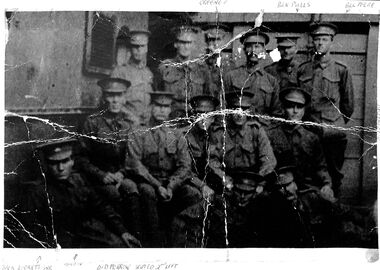
... school aged nine to work on a local farm. Later, he worked for his uncles in the Mallee. On 24 March 1916, he travelled to Mildura to enlist in the Australian Imperial Force. He served in France with the 38th Battalion, earning promotion to sergeant and was discharged on 20 September 1919. https://en.wikipedia.org/wiki/Jack_Lockett The 38th Battalion was formed on 1 March 1916 at a camp established on the Epsom Racecourse at Bendigo in Victoria. After training in both Australia and Britain, the 38th Battalion crossed to France in late November 1916 and moved into the trenches of the Western...school aged nine to work on a local farm. Later, he worked for his uncles in the Mallee. On 24 March 1916, he travelled to Mildura to enlist in the Australian Imperial Force. He served in France with the 38th Battalion, earning promotion to sergeant and was discharged on 20 September 1919. https://en.wikipedia.org/wiki/Jack_Lockett The 38th Battalion was formed on 1 March 1916 at a camp established on the Epsom Racecourse at Bendigo in Victoria. After training in both Australia and Britain, the 38th Battalion crossed to France in late November 1916 and moved into the trenches of the Western ...John Henry Lockett OAM (22 January 1891 – 25 May 2002) was the oldest man ever in Australia when he died aged 111 years, 123 days. As one of the last surviving veterans of World War I, he was acclaimed as a national hero during the last decade of his life. Lockett was born in the small Victorian town of Waanyarra, near Bendigo. He left school aged nine to work on a local farm. Later, he worked for his uncles in the Mallee. On 24 March 1916, he travelled to Mildura to enlist in the Australian Imperial Force. He served in France with the 38th Battalion, earning promotion to sergeant and was discharged on 20 September 1919. https://en.wikipedia.org/wiki/Jack_Lockett The 38th Battalion was formed on 1 March 1916 at a camp established on the Epsom Racecourse at Bendigo in Victoria. After training in both Australia and Britain, the 38th Battalion crossed to France in late November 1916 and moved into the trenches of the Western Front for the first time on 1 December.The 38th fought in its first major battle at Messines, in Belgium, between 7-9 June 1917. It fought in another two major attacks in this sector - the battle of Broodseinde on 4 October, and the battle of Passchendaele on 12 October. Belgium remained the focus of the 38th Battalion's activities for the next five months, until it was rushed south to France in late March 1918 to meet the German Army's Spring Offensive. The 38th participated in its last major action of the war between 29 September and 2 October 1918 as part of the Australian-American operation that breached the formidable defences of the Hindenburg Line along the St Quentin Canal. It was disbanded in April 1919. Source, Australian War Memorial https://www.awm.gov.au/collection/U51478 After the war, Jack returned to The Mallee and selected a 640 acres (260 ha) block of land in Linga, Victoria, deciding to make his living as a farmer. In 1923, he married Maybell Ingwerson and they had four children together. In 1963, the couple retired to Bendigo, leaving the farmland (which now covered more than 130,000 acres (53,000 ha), in the care of their children and grandchildren. An A4 size copy of a postcard with a black and white photograph of 14 men in army uniforms with some men identified - Greeno, Ben Pulls, Bill McCae, Jack Lockett Snr, Maldon, Dad Morrow. On the back there is a copy of the back of the postcard with handwriting - Dear Boys this a group of my cobbers No 1 section ............Dont loose it, Jack jack lockett, mabel ingwersen, 38th australian infantry battalion, w.w.1, mallee farming -
 Bendigo Historical Society Inc.
Memorabilia - Jack Lockett Collection: Boys from the Mallee 1916
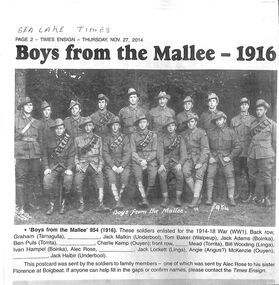
... school aged nine to work on a local farm. Later, he worked for his uncles in the Mallee. On 24 March 1916, he travelled to Mildura to enlist in the Australian Imperial Force. He served in France with the 38th Battalion, earning promotion to sergeant and was discharged on 20 September 1919. https://en.wikipedia.org/wiki/Jack_Lockett The 38th Battalion was formed on 1 March 1916 at a camp established on the Epsom Racecourse at Bendigo in Victoria. After training in both Australia and Britain, the 38th Battalion crossed to France in late November 1916 and moved into the trenches of the Western...school aged nine to work on a local farm. Later, he worked for his uncles in the Mallee. On 24 March 1916, he travelled to Mildura to enlist in the Australian Imperial Force. He served in France with the 38th Battalion, earning promotion to sergeant and was discharged on 20 September 1919. https://en.wikipedia.org/wiki/Jack_Lockett The 38th Battalion was formed on 1 March 1916 at a camp established on the Epsom Racecourse at Bendigo in Victoria. After training in both Australia and Britain, the 38th Battalion crossed to France in late November 1916 and moved into the trenches of the Western ...John Henry Lockett OAM (22 January 1891 – 25 May 2002) was the oldest man ever in Australia when he died aged 111 years, 123 days. As one of the last surviving veterans of World War I, he was acclaimed as a national hero during the last decade of his life. Lockett was born in the small Victorian town of Waanyarra, near Bendigo. He left school aged nine to work on a local farm. Later, he worked for his uncles in the Mallee. On 24 March 1916, he travelled to Mildura to enlist in the Australian Imperial Force. He served in France with the 38th Battalion, earning promotion to sergeant and was discharged on 20 September 1919. https://en.wikipedia.org/wiki/Jack_Lockett The 38th Battalion was formed on 1 March 1916 at a camp established on the Epsom Racecourse at Bendigo in Victoria. After training in both Australia and Britain, the 38th Battalion crossed to France in late November 1916 and moved into the trenches of the Western Front for the first time on 1 December.The 38th fought in its first major battle at Messines, in Belgium, between 7-9 June 1917. It fought in another two major attacks in this sector - the battle of Broodseinde on 4 October, and the battle of Passchendaele on 12 October. Belgium remained the focus of the 38th Battalion's activities for the next five months, until it was rushed south to France in late March 1918 to meet the German Army's Spring Offensive. The 38th participated in its last major action of the war between 29 September and 2 October 1918 as part of the Australian-American operation that breached the formidable defences of the Hindenburg Line along the St Quentin Canal. It was disbanded in April 1919. Source, Australian War Memorial https://www.awm.gov.au/collection/U51478 After the war, Jack returned to The Mallee and selected a 640 acres (260 ha) block of land in Linga, Victoria, deciding to make his living as a farmer. In 1923, he married Maybell Ingwerson and they had four children together. In 1963, the couple retired to Bendigo, leaving the farmland (which now covered more than 130,000 acres (53,000 ha), in the care of their children and grandchildren. A photocopy of an article and photograph headed - PAGE 2 TIMES ENSIGN - THURSDAY, NOV. 2014 (Sea Lake Times?) Boys from the Mallee- 1916. A photograph of a postcard of17 men in Australian Army Uniforms, 10 standing and seven sitting. Names listed Graham (Tarnagulla), Jack Malkin (Underbol), Tom Baker (Walpeup), Jack Adams (Binka), Ben Puls Torria), Charlie Kemp (Ouyen), Mead (Torrita), Bill Wooding (Linga), Ivan Hampel (Boinka), Alec Rose, Jack Locket (Linga) Angus McKenzie (Ouyen), Jack Halbir (Underbool) This postcard was sent by Alec Rose to his sister Florence. dge and Rheola. jack lockett, mabel ingwersen, 38th australian infantry battalion, w.w.1, mallee farming -
 Bendigo Historical Society Inc.
Photograph - Jack Lockett Collection: Five W.W.1 photographs
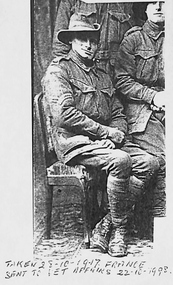
... school aged nine to work on a local farm. Later, he worked for his uncles in the Mallee. On 24 March 1916, he travelled to Mildura to enlist in the Australian Imperial Force. He served in France with the 38th Battalion, earning promotion to sergeant and was discharged on 20 September 1919. https://en.wikipedia.org/wiki/Jack_Lockett The 38th Battalion was formed on 1 March 1916 at a camp established on the Epsom Racecourse at Bendigo in Victoria. After training in both Australia and Britain, the 38th Battalion crossed to France in late November 1916 and moved into the trenches of the Western...school aged nine to work on a local farm. Later, he worked for his uncles in the Mallee. On 24 March 1916, he travelled to Mildura to enlist in the Australian Imperial Force. He served in France with the 38th Battalion, earning promotion to sergeant and was discharged on 20 September 1919. https://en.wikipedia.org/wiki/Jack_Lockett The 38th Battalion was formed on 1 March 1916 at a camp established on the Epsom Racecourse at Bendigo in Victoria. After training in both Australia and Britain, the 38th Battalion crossed to France in late November 1916 and moved into the trenches of the Western ...John Henry Lockett OAM (22 January 1891 – 25 May 2002) was the oldest man ever in Australia when he died aged 111 years, 123 days. As one of the last surviving veterans of World War I, he was acclaimed as a national hero during the last decade of his life. Lockett was born in the small Victorian town of Waanyarra, near Bendigo. He left school aged nine to work on a local farm. Later, he worked for his uncles in the Mallee. On 24 March 1916, he travelled to Mildura to enlist in the Australian Imperial Force. He served in France with the 38th Battalion, earning promotion to sergeant and was discharged on 20 September 1919. https://en.wikipedia.org/wiki/Jack_Lockett The 38th Battalion was formed on 1 March 1916 at a camp established on the Epsom Racecourse at Bendigo in Victoria. After training in both Australia and Britain, the 38th Battalion crossed to France in late November 1916 and moved into the trenches of the Western Front for the first time on 1 December.The 38th fought in its first major battle at Messines, in Belgium, between 7-9 June 1917. It fought in another two major attacks in this sector - the battle of Broodseinde on 4 October, and the battle of Passchendaele on 12 October. Belgium remained the focus of the 38th Battalion's activities for the next five months, until it was rushed south to France in late March 1918 to meet the German Army's Spring Offensive. The 38th participated in its last major action of the war between 29 September and 2 October 1918 as part of the Australian-American operation that breached the formidable defences of the Hindenburg Line along the St Quentin Canal. It was disbanded in April 1919. Source, Australian War Memorial https://www.awm.gov.au/collection/U51478 After the war, Jack returned to The Mallee and selected a 640 acres (260 ha) block of land in Linga, Victoria, deciding to make his living as a farmer. In 1923, he married Maybell Ingwerson and they had four children together. In 1963, the couple retired to Bendigo, leaving the farmland (which now covered more than 130,000 acres (53,000 ha), in the care of their children and grandchildren. Five photographs including Jack Lockett a. A photocopy of part of a group photograph, Jack sitting on a chair wearing an Australian Army Uniform. Written underneath - Teken 25-10-1917 France sent to Vet affairs 22-10-1998 b. A black and white photograph of a ship crowed with people on deck with printing - H.M.A.T. "RUNIC" (copyright) 20/6/16 written on the back in blue ink - Private Jack Locket No 1194 D Company 38th Battalion A.I.F. left Port Melbourne pier on Tues 20 June 1916 aboard H.M.A.T. RUNIC bound for England via South Africa. He was below deck peering out of a porthole when the boat pulled away from the pier, as he had the job of guarding some supplies. the arrived in England on (sic) Returning to Australia on Miltides on Mon 17th Feb 1919 as a Sargent Discharged 20 SEPT 1919 c. A very faded sepia tone photograph of four men in Army Uniforms without hats. three sitting and Jack Lockett lying on the man in the middle. Written on the back - JACK LOCKETT LYING ON ONE of His 3 MATES NAMES UNKNOWN FIRST AIF 1914 -1918 GREAT WAR d. A black and white postcard of Jack Lockett in an Australian Army Uniform sitting cross legged in a chair with an image of a forest behind him. Written on the back J H LOCKETT D COY 38 BATT 3DIV NO1194 1stAIF FRANCE e. c. A very faded sepia tone photograph of nine men in Army Uniforms wearing gas masks, six men standing, four men Kneeling in front. Behind them there is a corrugated-iron building. Written on the back - FIRST GAS MASKS W.W. 1 JACK LOCKET 2nd RIGHT STANDING jack lockett, mabel ingwersen, 38th australian infantry battalion, w.w.1, mallee farming, h.m.a.t. runic, gas masks -
 Bendigo Historical Society Inc.
Journal - Jack Lockett Collection: Brief handwritten 38th Battalion Histroy
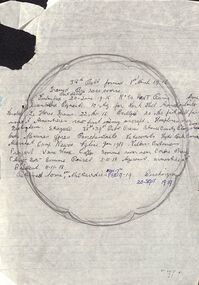
... school aged nine to work on a local farm. Later, he worked for his uncles in the Mallee. On 24 March 1916, he travelled to Mildura to enlist in the Australian Imperial Force. He served in France with the 38th Battalion, earning promotion to sergeant and was discharged on 20 September 1919. https://en.wikipedia.org/wiki/Jack_Lockett The 38th Battalion was formed on 1 March 1916 at a camp established on the Epsom Racecourse at Bendigo in Victoria. After training in both Australia and Britain, the 38th Battalion crossed to France in late November 1916 and moved into the trenches of the Western...school aged nine to work on a local farm. Later, he worked for his uncles in the Mallee. On 24 March 1916, he travelled to Mildura to enlist in the Australian Imperial Force. He served in France with the 38th Battalion, earning promotion to sergeant and was discharged on 20 September 1919. https://en.wikipedia.org/wiki/Jack_Lockett The 38th Battalion was formed on 1 March 1916 at a camp established on the Epsom Racecourse at Bendigo in Victoria. After training in both Australia and Britain, the 38th Battalion crossed to France in late November 1916 and moved into the trenches of the Western ...John Henry Lockett OAM (22 January 1891 – 25 May 2002) was the oldest man ever in Australia when he died aged 111 years, 123 days. As one of the last surviving veterans of World War I, he was acclaimed as a national hero during the last decade of his life. Lockett was born in the small Victorian town of Waanyarra, near Bendigo. He left school aged nine to work on a local farm. Later, he worked for his uncles in the Mallee. On 24 March 1916, he travelled to Mildura to enlist in the Australian Imperial Force. He served in France with the 38th Battalion, earning promotion to sergeant and was discharged on 20 September 1919. https://en.wikipedia.org/wiki/Jack_Lockett The 38th Battalion was formed on 1 March 1916 at a camp established on the Epsom Racecourse at Bendigo in Victoria. After training in both Australia and Britain, the 38th Battalion crossed to France in late November 1916 and moved into the trenches of the Western Front for the first time on 1 December.The 38th fought in its first major battle at Messines, in Belgium, between 7-9 June 1917. It fought in another two major attacks in this sector - the battle of Broodseinde on 4 October, and the battle of Passchendaele on 12 October. Belgium remained the focus of the 38th Battalion's activities for the next five months, until it was rushed south to France in late March 1918 to meet the German Army's Spring Offensive. The 38th participated in its last major action of the war between 29 September and 2 October 1918 as part of the Australian-American operation that breached the formidable defences of the Hindenburg Line along the St Quentin Canal. It was disbanded in April 1919. Source, Australian War Memorial https://www.awm.gov.au/collection/U51478 After the war, Jack returned to The Mallee and selected a 640 acres (260 ha) block of land in Linga, Victoria, deciding to make his living as a farmer. In 1923, he married Maybell Ingwerson and they had four children together. In 1963, the couple retired to Bendigo, leaving the farmland (which now covered more than 130,000 acres (53,000 ha), in the care of their children and grandchildren. An A blue-lined A4 page with black ink handwriting. A brief history of the 38th Battalion A.I.F. from when it was formed 1st March 1916 until returning home on 17th February 1919. A decorated circle is drawn with pencil over the handwriting jack lockett, mabel ingwersen, 38th australian infantry battalion, w.w.1, mallee farming, h.m.a.t. runic, gas masks -
 Bendigo Historical Society Inc.
Letter - Jack Lockett Collection: Letter Re Mission to France 1993
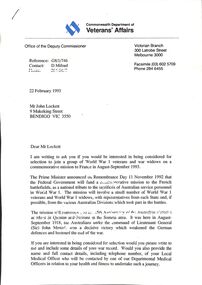
... school aged nine to work on a local farm. Later, he worked for his uncles in the Mallee. On 24 March 1916, he travelled to Mildura to enlist in the Australian Imperial Force. He served in France with the 38th Battalion, earning promotion to sergeant and was discharged on 20 September 1919. https://en.wikipedia.org/wiki/Jack_Lockett The 38th Battalion was formed on 1 March 1916 at a camp established on the Epsom Racecourse at Bendigo in Victoria. After training in both Australia and Britain, the 38th Battalion crossed to France in late November 1916 and moved into the trenches of the Western...school aged nine to work on a local farm. Later, he worked for his uncles in the Mallee. On 24 March 1916, he travelled to Mildura to enlist in the Australian Imperial Force. He served in France with the 38th Battalion, earning promotion to sergeant and was discharged on 20 September 1919. https://en.wikipedia.org/wiki/Jack_Lockett The 38th Battalion was formed on 1 March 1916 at a camp established on the Epsom Racecourse at Bendigo in Victoria. After training in both Australia and Britain, the 38th Battalion crossed to France in late November 1916 and moved into the trenches of the Western ...John Henry Lockett OAM (22 January 1891 – 25 May 2002) was the oldest man ever in Australia when he died aged 111 years, 123 days. As one of the last surviving veterans of World War I, he was acclaimed as a national hero during the last decade of his life. Lockett was born in the small Victorian town of Waanyarra, near Bendigo. He left school aged nine to work on a local farm. Later, he worked for his uncles in the Mallee. On 24 March 1916, he travelled to Mildura to enlist in the Australian Imperial Force. He served in France with the 38th Battalion, earning promotion to sergeant and was discharged on 20 September 1919. https://en.wikipedia.org/wiki/Jack_Lockett The 38th Battalion was formed on 1 March 1916 at a camp established on the Epsom Racecourse at Bendigo in Victoria. After training in both Australia and Britain, the 38th Battalion crossed to France in late November 1916 and moved into the trenches of the Western Front for the first time on 1 December.The 38th fought in its first major battle at Messines, in Belgium, between 7-9 June 1917. It fought in another two major attacks in this sector - the battle of Broodseinde on 4 October, and the battle of Passchendaele on 12 October. Belgium remained the focus of the 38th Battalion's activities for the next five months, until it was rushed south to France in late March 1918 to meet the German Army's Spring Offensive. The 38th participated in its last major action of the war between 29 September and 2 October 1918 as part of the Australian-American operation that breached the formidable defences of the Hindenburg Line along the St Quentin Canal. It was disbanded in April 1919. Source, Australian War Memorial https://www.awm.gov.au/collection/U51478 After the war, Jack returned to The Mallee and selected a 640 acres (260 ha) block of land in Linga, Victoria, deciding to make his living as a farmer. In 1923, he married Maybell Ingwerson and they had four children together. In 1963, the couple retired to Bendigo, leaving the farmland (which now covered more than 130,000 acres (53,000 ha), in the care of their children and grandchildren. A typed letter on two A4 pages to Jack Lockett Sent from the Commonwealth Department of Veterans Affairs, Office of the Deputy Commissioner, 22 February asking Jack if he wished to be considered for selection to join a commemorative mission to France in August - September 1993. Signed Brian Flynn DEPUTY COMMISSIONER jack lockett, mabel ingwersen, 38th australian infantry battalion, w.w.1, mallee farming, commemorative mission to france 1993, brian flynn -
 Bendigo Historical Society Inc.
Letter - Jack Lockett Collection: Letter Re Person profiles of W.W.1 veterans
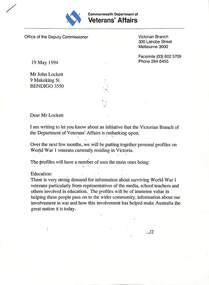
... school aged nine to work on a local farm. Later, he worked for his uncles in the Mallee. On 24 March 1916, he travelled to Mildura to enlist in the Australian Imperial Force. He served in France with the 38th Battalion, earning promotion to sergeant and was discharged on 20 September 1919. https://en.wikipedia.org/wiki/Jack_Lockett The 38th Battalion was formed on 1 March 1916 at a camp established on the Epsom Racecourse at Bendigo in Victoria. After training in both Australia and Britain, the 38th Battalion crossed to France in late November 1916 and moved into the trenches of the Western...school aged nine to work on a local farm. Later, he worked for his uncles in the Mallee. On 24 March 1916, he travelled to Mildura to enlist in the Australian Imperial Force. He served in France with the 38th Battalion, earning promotion to sergeant and was discharged on 20 September 1919. https://en.wikipedia.org/wiki/Jack_Lockett The 38th Battalion was formed on 1 March 1916 at a camp established on the Epsom Racecourse at Bendigo in Victoria. After training in both Australia and Britain, the 38th Battalion crossed to France in late November 1916 and moved into the trenches of the Western ...John Henry Lockett OAM (22 January 1891 – 25 May 2002) was the oldest man ever in Australia when he died aged 111 years, 123 days. As one of the last surviving veterans of World War I, he was acclaimed as a national hero during the last decade of his life. Lockett was born in the small Victorian town of Waanyarra, near Bendigo. He left school aged nine to work on a local farm. Later, he worked for his uncles in the Mallee. On 24 March 1916, he travelled to Mildura to enlist in the Australian Imperial Force. He served in France with the 38th Battalion, earning promotion to sergeant and was discharged on 20 September 1919. https://en.wikipedia.org/wiki/Jack_Lockett The 38th Battalion was formed on 1 March 1916 at a camp established on the Epsom Racecourse at Bendigo in Victoria. After training in both Australia and Britain, the 38th Battalion crossed to France in late November 1916 and moved into the trenches of the Western Front for the first time on 1 December.The 38th fought in its first major battle at Messines, in Belgium, between 7-9 June 1917. It fought in another two major attacks in this sector - the battle of Broodseinde on 4 October, and the battle of Passchendaele on 12 October. Belgium remained the focus of the 38th Battalion's activities for the next five months, until it was rushed south to France in late March 1918 to meet the German Army's Spring Offensive. The 38th participated in its last major action of the war between 29 September and 2 October 1918 as part of the Australian-American operation that breached the formidable defences of the Hindenburg Line along the St Quentin Canal. It was disbanded in April 1919. Source, Australian War Memorial https://www.awm.gov.au/collection/U51478 After the war, Jack returned to The Mallee and selected a 640 acres (260 ha) block of land in Linga, Victoria, deciding to make his living as a farmer. In 1923, he married Maybell Ingwerson and they had four children together. In 1963, the couple retired to Bendigo, leaving the farmland (which now covered more than 130,000 acres (53,000 ha), in the care of their children and grandchildren. A typed letter on two A4 pages to Jack Lockett sent from the Commonwealth Department of Veterans Affairs, Office of the Deputy Commissioner, 19 May 1994. It's asking if he would be part of program putting together personal profiles on World War 1 veterans currently residing in Victoria. Signed Brian Flynn, DEPUTY COMMISSIONER jack lockett, mabel ingwersen, 38th australian infantry battalion, w.w.1, mallee farming, profile of w.w.1 veterans, brian flynn -
 Bendigo Historical Society Inc.
Memorabilia - Jack Lockett Collection: Copy of Roll of Honor
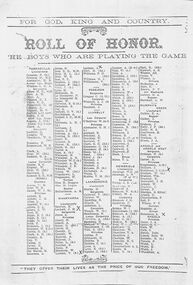
... school aged nine to work on a local farm. Later, he worked for his uncles in the Mallee. On 24 March 1916, he travelled to Mildura to enlist in the Australian Imperial Force. He served in France with the 38th Battalion, earning promotion to sergeant and was discharged on 20 September 1919. https://en.wikipedia.org/wiki/Jack_Lockett The 38th Battalion was formed on 1 March 1916 at a camp established on the Epsom Racecourse at Bendigo in Victoria. After training in both Australia and Britain, the 38th Battalion crossed to France in late November 1916 and moved into the trenches of the Western...school aged nine to work on a local farm. Later, he worked for his uncles in the Mallee. On 24 March 1916, he travelled to Mildura to enlist in the Australian Imperial Force. He served in France with the 38th Battalion, earning promotion to sergeant and was discharged on 20 September 1919. https://en.wikipedia.org/wiki/Jack_Lockett The 38th Battalion was formed on 1 March 1916 at a camp established on the Epsom Racecourse at Bendigo in Victoria. After training in both Australia and Britain, the 38th Battalion crossed to France in late November 1916 and moved into the trenches of the Western ...John Henry Lockett OAM (22 January 1891 – 25 May 2002) was the oldest man ever in Australia when he died aged 111 years, 123 days. As one of the last surviving veterans of World War I, he was acclaimed as a national hero during the last decade of his life. Lockett was born in the small Victorian town of Waanyarra, near Bendigo. He left school aged nine to work on a local farm. Later, he worked for his uncles in the Mallee. On 24 March 1916, he travelled to Mildura to enlist in the Australian Imperial Force. He served in France with the 38th Battalion, earning promotion to sergeant and was discharged on 20 September 1919. https://en.wikipedia.org/wiki/Jack_Lockett The 38th Battalion was formed on 1 March 1916 at a camp established on the Epsom Racecourse at Bendigo in Victoria. After training in both Australia and Britain, the 38th Battalion crossed to France in late November 1916 and moved into the trenches of the Western Front for the first time on 1 December.The 38th fought in its first major battle at Messines, in Belgium, between 7-9 June 1917. It fought in another two major attacks in this sector - the battle of Broodseinde on 4 October, and the battle of Passchendaele on 12 October. Belgium remained the focus of the 38th Battalion's activities for the next five months, until it was rushed south to France in late March 1918 to meet the German Army's Spring Offensive. The 38th participated in its last major action of the war between 29 September and 2 October 1918 as part of the Australian-American operation that breached the formidable defences of the Hindenburg Line along the St Quentin Canal. It was disbanded in April 1919. Source, Australian War Memorial https://www.awm.gov.au/collection/U51478 After the war, Jack returned to The Mallee and selected a 640 acres (260 ha) block of land in Linga, Victoria, deciding to make his living as a farmer. In 1923, he married Maybell Ingwerson and they had four children together. In 1963, the couple retired to Bendigo, leaving the farmland (which now covered more than 130,000 acres (53,000 ha), in the care of their children and grandchildren. An A4 photocopy of a ROLL OF HONOR for people who served in World War 1, with names from the towns of TARNAGULLA, WAANYARRA including (marked with a X) Lockett J.H., Lockett T., Lockett J., LLANELLY, LAAANECOORIE, NEWBRIDGE, MURPHY'S CREEK, ARNOLD and ARNOLD WEST including (marked with a X) Metelman J.C., Metelman A and RHEOLA jack lockett, mabel ingwersen, 38th australian infantry battalion, w.w.1, mallee farming -
University of Melbourne, Burnley Campus Archives
Certificate - Documents and correspondence, The University of Melbourne, Congratulatory certificates, correspondence, plaques and cards for the Centenary of VCAH Burnley Campus 1991, 1991
... School of Mines and Industries Ballarat...Outer Eastern College...Northern Metropolitan College of Tafe...Curtin University of Technology...Murdoch University...University of Hawaii...Victoria College ...Victoria University of Technology...University of Canberra...Victorian Farmers Federation...Ballarat University College...Deakin University...Northern Territory University...University of California Santa Barbara...Landscape Contractors Association of Victoria...University of Adelaide...University of Tasmania...The University of Sydney...Australian Catholic University...University of Western Sydney...Griffith University...The University of Wollongong...James Cook University...California Polytechnic...Marcus Oldham Farm Management College...The University of Western Australia...Mostly signed by chancellors, vice-chancellors, councils, chairmen, presidents, deans and directors, 1/ The University of New South Wales certificate July 1991 2/ The Royal Horticultural Society of Victoria 3/ Charles Sturt University 26 June 1991 4/ The Royal Horticultural Society 1891-1991 5/ Massey University, New Zealand July 1991 6/ Monash University 7/ The University of Melbourne 8/ Garden Advisory Service (card) 9/ The School of Mines and Industries Ballarat 10/ Outer Eastern College of Technical and Further Education (letter from Maurie Curwood Director 1/7/1991) 11/ Northern Metropolitan College of Tafe (letter from Brian J McDonald, Director 11/7/1991 12/ Curtin University of Technology 13/ Murdoch University 14/ University of Hawaii 15/ Victotria University of Technology (Letter to Mr R G Luff from G.J Allen) 16/ University of Canberra 12/7/1991 17/ Victorian Farmers Federation (letter froom Alex Arbuthnot President) 18/ Ballarat University College 19/ Deakin University 20/ Northern Territory University 21/ Victoria College 8/5/1991 22/ University of California Santa Barbara (Letter 1/7/1991) 23/ Landscape Contractors Association of Victoria Limited (letter) 24/ University of Adelaide 25/ University of Tasmania ========================BOX 222 26/ The University of Sydney 27/ Australian Catholic University 28/ University of Western Sydney (Hawkesbury) 29/ Griffith University 30/ The University of Wollongong (Letter and certificate) 31/ The University of Queensland 32/ Macquarie University 33/ James Cook University of North Queensland 34/ California Polytechnic State College, Wood and perspex Plaque 35/ Marcus Oldham Farm Management College, Wood plaque with metal coat of arms ============BOX 223 36/ THe University of Western Australia (Certificate in tube) 37/ Loddon Campaspe College of TAFE (Certificate in tube) 38/ Latrobe University (certificate in tube) 39/ Taranaki Polytechnic New Plymouth New Zealand 40/ Warwickshire College of Agriculture (made in UK, Wooden and painted coat of arms on plaque, in Box Heraldic Shield, Painted by hand) 41/ Massey University NZ (Wooden and painted coat of arms on plaque - in addition to (5) certificate) 42/ Ballarat University College ( Metal and wooden coloured plaque in addition to letter (18) Congratulatory certificates, correspondence, plaques and cards for the Centenary of VCAH Burnley Campus 1991 Certificate Documents and correspondence The University of Melbourne Monash University Massey University, New Zealand Garden Advisory Service The Royal Horticultural Society of Victoria Royal Horticultural Society Charles Sturt University The University of New South Wales The School of Mines and Industries Ballarat Outer Eastern College Northern Metropolitan College of Tafe Curtin University of Technology Murdoch University University of Hawaii Victoria College Victoria University of Technology University of Canberra Victorian Farmers Federation Ballarat University College Deakin University Northern Territory University University of California Santa Barbara Landscape Contractors Association of Victoria University of Adelaide University of Tasmania The University of Sydney Australian Catholic University University of Western Sydney Griffith University The University of Wollongong James Cook University California Polytechnic Marcus Oldham Farm Management College The University of Western Australia Loddon Campaspe College of Tafe Latrobe University Warwickshire College of Agriculture Taranki Polytechnic NZ ...Acknowledgement from 40 associations and universities to congratulate the VCAH Burnley Campus for a centenary of education 1891-1991.42 items. Multiple greetings, congratulatory letters, certificates and plaques sent to VCAH Burnley Campus (Director Mr R G Luff) as a record of the campus' revered place in higher education 1891-1991. Mostly signed by chancellors, vice-chancellors, councils, chairmen, presidents, deans and directors, 1/ The University of New South Wales certificate July 1991 2/ The Royal Horticultural Society of Victoria 3/ Charles Sturt University 26 June 1991 4/ The Royal Horticultural Society 1891-1991 5/ Massey University, New Zealand July 1991 6/ Monash University 7/ The University of Melbourne 8/ Garden Advisory Service (card) 9/ The School of Mines and Industries Ballarat 10/ Outer Eastern College of Technical and Further Education (letter from Maurie Curwood Director 1/7/1991) 11/ Northern Metropolitan College of Tafe (letter from Brian J McDonald, Director 11/7/1991 12/ Curtin University of Technology 13/ Murdoch University 14/ University of Hawaii 15/ Victotria University of Technology (Letter to Mr R G Luff from G.J Allen) 16/ University of Canberra 12/7/1991 17/ Victorian Farmers Federation (letter froom Alex Arbuthnot President) 18/ Ballarat University College 19/ Deakin University 20/ Northern Territory University 21/ Victoria College 8/5/1991 22/ University of California Santa Barbara (Letter 1/7/1991) 23/ Landscape Contractors Association of Victoria Limited (letter) 24/ University of Adelaide 25/ University of Tasmania ========================BOX 222 26/ The University of Sydney 27/ Australian Catholic University 28/ University of Western Sydney (Hawkesbury) 29/ Griffith University 30/ The University of Wollongong (Letter and certificate) 31/ The University of Queensland 32/ Macquarie University 33/ James Cook University of North Queensland 34/ California Polytechnic State College, Wood and perspex Plaque 35/ Marcus Oldham Farm Management College, Wood plaque with metal coat of arms ============BOX 223 36/ THe University of Western Australia (Certificate in tube) 37/ Loddon Campaspe College of TAFE (Certificate in tube) 38/ Latrobe University (certificate in tube) 39/ Taranaki Polytechnic New Plymouth New Zealand 40/ Warwickshire College of Agriculture (made in UK, Wooden and painted coat of arms on plaque, in Box Heraldic Shield, Painted by hand) 41/ Massey University NZ (Wooden and painted coat of arms on plaque - in addition to (5) certificate) 42/ Ballarat University College ( Metal and wooden coloured plaque in addition to letter (18) 1991 centenary, vcah burnley, burnley centenary, congratulations, greeting certificates -
 Warrnambool and District Historical Society Inc.
Album - Album with Cigarette Cards, Edwards Family, Cigarettes cards, 1908
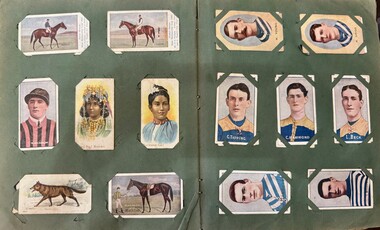
... Australian and English cigarette companies. These two pages contain among other cards of interest of the time, players for The Carlton Football Club, known as the Hat trick of Heroes namely Charlie Hammond, Les Beck and George Topping. These three players were three of a number who played in 3 premiership teams from 1906-1908. The album comes from the Edwards family who lived on the MORVEN property situated about 11 kilometres west of Branxholme in the Western District of Victoria. This property was sub divided in 1911 into 25 farms. There was once a Morven School...Australian and English cigarette companies. These two pages contain among other cards of interest of the time, players for The Carlton Football Club, known as the Hat trick of Heroes namely Charlie Hammond, Les Beck and George Topping. These three players were three of a number who played in 3 premiership teams from 1906-1908. The album comes from the Edwards family who lived on the MORVEN property situated about 11 kilometres west of Branxholme in the Western District of Victoria. This property was sub divided in 1911 into 25 farms. There was once a Morven School ...This is an album containing cards depicting popular sporting identities collected from cigarette packets in the early 20th century.This album has a worn cover in faded green and fawn colours with a blue spine almost wholly detached. The back cover is stained. The cover has text. There are eighteen double sided pages with cut spaces for holding seven cigarette cards on each. Most of the pages contain black and white, sepia or coloured cigarette cards. There is an inscription on the first page.This is an album containing cards depicting popular sporting identities collected from cigarette packets in the early 20th century.cigarette cards, morven, edwards family morven, album, carlton football club footy cards, 1910 football cards, vfl football cards, hat trick of heroes, cigarette card album -
Emerald Museum & Nobelius Heritage Park
Book - Fiction, Bernard Cronin, The Sow's Ear, 1933
... Australia in 1890. After winning a scholarship to Dookie Agricultural College, he worked as a jackeroo in Victoria before moving to a cattle farm in north-western Tasmania. This experience and setting furnished several novels including The Sow's Ear (1933), the tale of a bitter forced marriage in a rural setting. Bernard Cronin was related tot he Ferris family and lived for a time with them at the Lemeah Guest House on Molbulk Rd. Children went to Emerald State School ...Bernard Charles Cronin (1884–1968), novelist, was born in England and came to Australia in 1890. After winning a scholarship to Dookie Agricultural College, he worked as a jackeroo in Victoria before moving to a cattle farm in north-western Tasmania. This experience and setting furnished several novels including The Sow's Ear (1933), the tale of a bitter forced marriage in a rural setting.Bernard Cronin was related tot he Ferris family and lived for a time with them at the Lemeah Guest House on Molbulk Rd. Children went to Emerald State SchoolCrimson coloured with black writing on the front cover and spine. No dust jacket. "The Sow's Ear" by Bernard Cronin. Published by Endeavour Press, first published 1933. Bernard Cronin lived for some time at the Lemeah Guest House on Monbulk Rd and his Children went to Emerald State School. Donated by Chris Brittonunclear name in hanwriting John A Incoll(?)bernard cronin, lemeah guest house, ferres family
