
Showing 170 items matching "schools wodonga"
-
 Wodonga & District Historical Society Inc
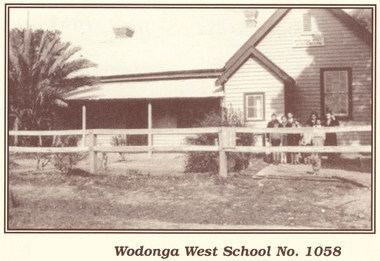
Photograph - Wodonga West School No. 1058
... Wodonga West School No. 1058...Wodonga West School No. 1058...Wodonga Schools...Wodonga...Wodonga West School opened on 24 January 1870 and closed on 9 May 1950. ...A black and white photo of a group of children standing outside the Wodonga West School building....Wodonga West School No. 1058 Photograph Wodonga West School No. 1058 ...Wodonga West School opened on 24 January 1870 and closed on 9 May 1950. It was located near the current intersection of McKoy Street and the Hume Freeway in West Wodonga on land donated by J.W. Klinge. The school replaced an older school, “Green Hills School, which was located north of the railway line. A public telephone was installed at the school and the mail service operated from the school three days each week. In 1935 a row of 15 ornamental trees was planted along the boundary fence, one for each of the pupils at the school. When this school closed the nine remaining students were transferred to Wodonga Primary School.This image is significant because it documents the early developments in the provision of education in Wodonga, Victoria A black and white photo of a group of children standing outside the Wodonga West School building.wodonga schools, wodonga west primary school, education wodonga -
 Wodonga & District Historical Society Inc
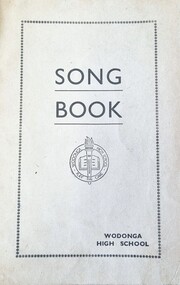
Booklet - Song Book Wodonga High School, Cambridge Press, 1956
... Song Book Wodonga High School...Song Book Wodonga High School...Wodonga High School...A small booklet of 97 pages containing a wide variety of song lyrics for use by students and choir of Wodonga High School. A red stamp of Wodonga High School is on the back cover....Front Cover Song Book Wodonga High School Insignia Wodonga High School Back Cover Wodonga High School stamp...Wodonga High School Music Book Wodonga High School This booklet contains lyrics of a wide range of songs studied and performed by students at Wodonga High School in the late 1950s. ...This booklet contains lyrics of a wide range of songs studied and performed by students at Wodonga High School in the late 1950s. It was divided into a variety of sections including English Songs, Sea Songs and Negro Songs, School Songs, Scotch Songs, Miscellaneous, Hymns, Patriotic Songs and Irish Songs. Post primary education in Wodonga began in 1923 when the existing primary school, which opened in 1857, became the Wodonga Central School. It extended students for a further teo years of secondary schooling. In 1938 the school was declared a higher elementary school with 90 students in the secondary classes. Following rapid growth after the Second World War, the High School was established as a separate school in 1954 and held its firs lessons on 2nd February 1954 with 249 students. It rapidly became evident that a new school building was needed to cater for growing enrolments and specialist facilities. After persistent pressure from the Advisory Council, Stage 1 of the new school was built and occupied by Forms 1 and 2 students in 1960. The final stages were completed during term 3, 1962. The official opening of the new Wodonga High School was declared by The Hon. J. S. Bloomfield M.L.A., Minister for Education, on Friday 30th April 1965.A small booklet of 97 pages containing a wide variety of song lyrics for use by students and choir of Wodonga High School. A red stamp of Wodonga High School is on the back cover.non-fictionThis booklet contains lyrics of a wide range of songs studied and performed by students at Wodonga High School in the late 1950s. It was divided into a variety of sections including English Songs, Sea Songs and Negro Songs, School Songs, Scotch Songs, Miscellaneous, Hymns, Patriotic Songs and Irish Songs. Post primary education in Wodonga began in 1923 when the existing primary school, which opened in 1857, became the Wodonga Central School. It extended students for a further teo years of secondary schooling. In 1938 the school was declared a higher elementary school with 90 students in the secondary classes. Following rapid growth after the Second World War, the High School was established as a separate school in 1954 and held its firs lessons on 2nd February 1954 with 249 students. It rapidly became evident that a new school building was needed to cater for growing enrolments and specialist facilities. After persistent pressure from the Advisory Council, Stage 1 of the new school was built and occupied by Forms 1 and 2 students in 1960. The final stages were completed during term 3, 1962. The official opening of the new Wodonga High School was declared by The Hon. J. S. Bloomfield M.L.A., Minister for Education, on Friday 30th April 1965.wodonga high school, music book wodonga high school -
 Wodonga & District Historical Society Inc
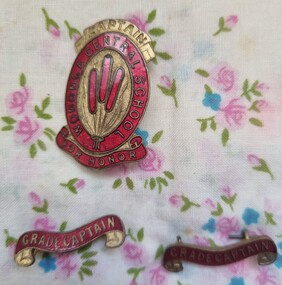
Badge - Wodonga Central School, 1923 - 1937
... Wodonga Central School...Wodonga Central School...Wodonga Schools...Wodonga...Post primary education in Wodonga began in 1923 when the existing primary school, which opened in 1857, became the Wodonga Central School. ...Around Oval badge: WODONGA CENTRAL SCHOOL On Scroll below oval; FOR HONOR Above Oval: CAPTAIN On smaller badges: GRADE CAPTAIN...The other 2 are in the form of a metal scroll with gold lettering. Wodonga Central School Badge Wodonga Central School ...Post primary education in Wodonga began in 1923 when the existing primary school, which opened in 1857, became the Wodonga Central School. It extended students for a further 2 years of secondary schooling. In 1938 the school was declared a higher elementary school with 90 students in the secondary classesThese items represent a school which operated in Wodonga from 1923 until 1938. It was an important stage in the pathway to establishing secondary education in Wodonga.3 Badges made of enamelled metal. The larger one is oval shaped above a scroll bearing an inscription. It has 3 maroon reeds in the centre. The other 2 are in the form of a metal scroll with gold lettering.Around Oval badge: WODONGA CENTRAL SCHOOL On Scroll below oval; FOR HONOR Above Oval: CAPTAIN On smaller badges: GRADE CAPTAINwodonga schools, wodonga central school, education wodonga -
 Wodonga & District Historical Society Inc
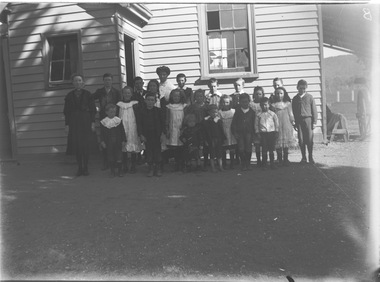
Negative - Haeusler Glass Negatives Collection - Wodonga West Primary School
... Haeusler Glass Negatives Collection - Wodonga West Primary School...Haeusler Glass Negatives Collection - Wodonga West Primary School......schools wodonga...school north of the railway line. It operated from January 1870 to May 1950 when the nine remaining students transferred to Wodonga Primary School. ...school north of the railway line. It operated from January 1870 to May 1950 when the nine remaining students transferred to Wodonga Primary School. ...The Wodonga Historical Society Haeusler Collection provides invaluable insight into life in late nineteenth and early twentieth century north east Victoria. The collection comprises manuscripts, personal artefacts used by the Haeusler family on their farm in Wodonga, and a set of glass negatives which offer a unique visual snapshot of the domestic and social lives of the Haeusler family and local Wodonga community. The Haeusler family migrated from Prussia (Germany) to South Australia in the 1840s and 1850s, before purchasing 100 acres of Crown Land made available under the Victorian Lands Act 1862 (also known as ‘Duffy’s Land Act’) in 1866 in what is now Wodonga West. The Haeusler family were one of several German families to migrate from South Australia to Wodonga in the 1860s. This digital image was produced from one of the glass negatives that form part of the collection, probably taken by Louis Haeusler (b.1887) with the photographic equipment in the Wodonga Historical Society Haeusler Collection. This item is unique and has well documented provenance and a known owner. It forms part of a significant and representative historical collection which reflects the local history of Wodonga. It contributes to our understanding of domestic and family life in early twentieth century Wodonga, as well as providing interpretative capacity for themes including local history and social history.Digital image created from the Haeusler Glass negative collection. A group of children and their teacher outside Wodonga West Primary School No. 1058. C.1910. The school was located near the current intersection of McKoy Street and the Hume Freeway in West Wodonga on land donated by J.W. Klinge, replacing an older school north of the railway line. It operated from January 1870 to May 1950 when the nine remaining students transferred to Wodonga Primary School. wodonga pioneers, haeusler family, glass negatives, dry plate photography, wodonga west primary school, schools wodonga -
 Uniting Church Archives - Synod of Victoria
Photograph
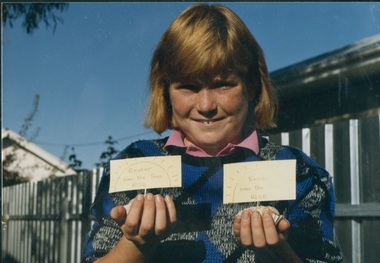
... Kelsie Watts St Stephen's Sunday School Wodonga UC...Kelsie Watts St Stephen's Sunday School Wodonga UC Kelsie Watts Photograph ...Kelsie WattsKelsie Watts St Stephen's Sunday School Wodonga UC -
 Wodonga & District Historical Society Inc
Drawing - The Green Hills School
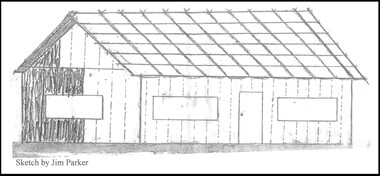
... School...Wodonga Schools...Green Hills School was the first school in the Wodonga area. Before the school could open and a teacher commence duties, the Government had to be assured that a minimum of 20 children would be attending. ...A sketch of Green Hills School completed by Jim Parker, a life member of Wodonga & District Historical Society. ...This drawing is significant because it depicts the first school opened in Wodonga. Green Hills School Wodonga Schools Education Wodonga A sketch of Green Hills School completed by Jim Parker, a life member of Wodonga & District Historical Society. ...Green Hills School was the first school in the Wodonga area. Before the school could open and a teacher commence duties, the Government had to be assured that a minimum of 20 children would be attending. The school was built of round timber, slab walls, bark roof, dirt floor and shuttered windows. The school opened in 1850 and closed in 1870. This sketch, completed by Jim Parker, a Life Member of Wodonga & District Historical Society, was included on a commemorative plaque as part of the Wodonga Heritage Drive established by the Society to recognise the story of key historic locations in the Wodonga area.This drawing is significant because it depicts the first school opened in Wodonga.A sketch of Green Hills School completed by Jim Parker, a life member of Wodonga & District Historical Society. This sketch was completed as part of a project to place commemorative plaques at key locations around Wodonga green hills school, wodonga schools, education wodonga -
 Wodonga & District Historical Society Inc
Plaque - Official Opening of the Child Care Centre & South Street Pre-School, Wodonga
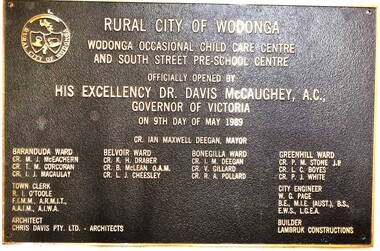
... Official Opening of the Child Care Centre & South Street Pre-School, Wodonga ...Official Opening of the Child Care Centre & South Street Pre-School, Wodonga ......Pre-schools Wodonga...This plaque commemorates the official opening of an occasional child care centre and pre-school in South St, Wodonga in 1989 by the Governor of Victoria Dr. ..."RURAL CITY OF WODONGA WODONGA OCCASIONAL CHILD CARE CENTRE AND SOUTH STREET PRE-SCHOOL CENTRE OFFICIALLY OPENED BY HIS EXCELLENCY DR. ...Official Opening of the Child Care Centre & South Street Pre-School, Wodonga Plaque Official Opening of the Child Care Centre & South Street Pre-School, Wodonga ...This plaque commemorates the official opening of an occasional child care centre and pre-school in South St, Wodonga in 1989 by the Governor of Victoria Dr. Davis McCaughey. With strong population growth in Wodonga community services had expanded rapidly throughout the 1980s. The first child minding centre had opened in 1975. BY 1987 Upper Murray Family Care provided full-day family day care and occasional care and there were also 2 private child care centres. By 1986 there were 350 full-time places and 75 part-time places, but pre-schools were unable to fill the demand for another 511 applicants. This new facility helped to ease a little of the problem. As well as the inscription included here, the name of the Mayor, all members of the Wodonga Council, City Engineer, Architect and Builder are listed on the plaque.This item illustrates an important development in the provision of pre-school and child care services in Wodonga.A bronze rectangular plaque with detailed inscription, designed to be attached to the wall of a building. There is a hole in each corner for bolts to be inserted. The text is raised above the surface of the plaque. It features the symbol of the shield of the Rural City of Wodonga in the top left corner.fiction"RURAL CITY OF WODONGA WODONGA OCCASIONAL CHILD CARE CENTRE AND SOUTH STREET PRE-SCHOOL CENTRE OFFICIALLY OPENED BY HIS EXCELLENCY DR. DAVIS MCCAUGHEY, A.C., GOVERNOR OF VICTORIA ON 9TH DAY OF MAY 1989child care facilities wodonga, children's services wodonga, pre-schools wodonga -
 Wodonga & District Historical Society Inc
Booklet - Leneva State Schools Centenary, 1975
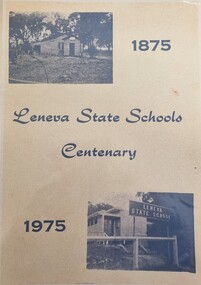
... School...Wodonga Schools...Leneva State School Wodonga Schools Education Wodonga Middle Creek State School Construction of the Leneva School number 1506 - then called Middle Creek - was completed by January 30th 1875. ...Construction of the Leneva School number 1506 - then called Middle Creek - was completed by January 30th 1875. The contracted builder was Mr. Jas. O'Keefe and his tender for the school and residence was £245-8-0. The school was opened on 10th May 1875 with George S. Manns as Head Teacher. The first building was a structure of Murray Pine, with a slate roof. The building consisted of 4 rooms and a lean-to veranda. Three of these rooms formed a residence and the remaining one was the classroom. Classes began with about 40 children attending grades 1-6. Lessons were also held for older people if they desired them. Head Teacher Manns remained in charge for 20 years. Leneva West School No 2195 (originally called Middle Creek West) was opened in 1879 with Agnes Short as Head Teacher. It only operated part time in conjunction with Wooragee North School. Its use appears to have been intermittent based on the number of student enrolments. It finally closed on 9th October 1951 and any students were conveyed by bus to Leneva State School. This booklet was published for the celebration of the Leneva Schools Centenary in 1975.A small booklet featuring photos and anecdotes published for the Centenary Celebrations of Leneva State School.non-fictionConstruction of the Leneva School number 1506 - then called Middle Creek - was completed by January 30th 1875. The contracted builder was Mr. Jas. O'Keefe and his tender for the school and residence was £245-8-0. The school was opened on 10th May 1875 with George S. Manns as Head Teacher. The first building was a structure of Murray Pine, with a slate roof. The building consisted of 4 rooms and a lean-to veranda. Three of these rooms formed a residence and the remaining one was the classroom. Classes began with about 40 children attending grades 1-6. Lessons were also held for older people if they desired them. Head Teacher Manns remained in charge for 20 years. Leneva West School No 2195 (originally called Middle Creek West) was opened in 1879 with Agnes Short as Head Teacher. It only operated part time in conjunction with Wooragee North School. Its use appears to have been intermittent based on the number of student enrolments. It finally closed on 9th October 1951 and any students were conveyed by bus to Leneva State School. This booklet was published for the celebration of the Leneva Schools Centenary in 1975.leneva state school, wodonga schools, education wodonga, middle creek state school -
 Wodonga & District Historical Society Inc
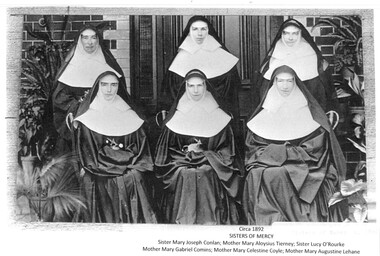
Photograph - Sisters of Mercy, Wodonga, Various dates
... From these early beginnings the Sisters of Mercy guided the development of many Wodonga children through more than one hundred years at St. Augustine's school in Wodonga. ...Three black and white photographs of Sisters of Mercy who served at St Joseph's Convent in Wodonga and taught at St Augustine's School in Wodonga....From these early beginnings the Sisters of Mercy guided the development of many Wodonga children through more than one hundred years at St. Augustine's school in Wodonga. ...In 1892 four Sisters of Mercy from Albury were invited to establish a foundation at Wodonga. On the 6th February 1892, Mother M. Aloysius Tierney (1864-1948), Sr. M. Gabriel Comins (1868-1945), Sr. M. Celestine Coyle (1871-1857) and a postulant Miss Mary Jane Conlan (1874-1939) (Sr. Mary Joseph) travelled by horse drawn cab from the Albury convent to a rented house in Hume Street. The parishioners of Wodonga were anxious for the nuns to have their own residence, and on the 19th March 1893, the foundation stone for St. Joseph’s Convent was laid. The Convent was officially opened on Sunday 13 August 1893. From these early beginnings the Sisters of Mercy guided the development of many Wodonga children through more than one hundred years at St. Augustine's school in Wodonga. The St. Joseph's convent was incorporated into changes in St Augustine's school in 2001. These items are important because they depict the Sisters of Mercy who were for many years responsible for the implementation of Catholic education in Wodonga, Victoria.Three black and white photographs of Sisters of Mercy who served at St Joseph's Convent in Wodonga and taught at St Augustine's School in Wodonga.Names under each photo sisters of mercy wodonga, catholic education wodonga -
 Wodonga & District Historical Society Inc
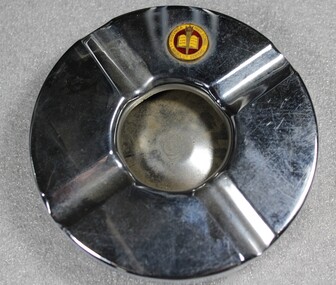
Memorabilia - Wodonga High School Souvenir Ashtray
... Wodonga High School Souvenir Ashtray...Wodonga High School Souvenir Ashtray......wodonga high school...In 1862 the Board of Education took control and called it Belvoir School No. 37, later known as No. 37 Wodonga. In 1938 it was made a Higher Elementary School and in 1954 it reached the status of a High School. ...The ashtray bears the symbol representing the school motto for Wodonga High School ...Around the edge of the circular yellow, red and gold logo "WODONGA HIGH SCHOOL / LABORA UT SERVIAS"...The ashtray bears the symbol representing the school motto for Wodonga High School Wodonga High School Souvenir Ashtray Memorabilia Wodonga High School Souvenir Ashtray ...The school was opened in 1857 and was known as School No. 378, Belvoir. In 1862 the Board of Education took control and called it Belvoir School No. 37, later known as No. 37 Wodonga. In 1938 it was made a Higher Elementary School and in 1954 it reached the status of a High School. The school's motto was "Labora ut Servias", which translates as "Work to Serve”Wodonga High School has a long history dating back to 1857. It has had several changes of name and provided a variety of levels of education as Wodonga itself grew and community needs changed. It developed from a primary school to become a Higher Elementary School and then a High School. It has since evolved further to become Wodonga Senior Secondary College.A circular metal ashtray with indentations for 4 cigarettes. The ashtray bears the symbol representing the school motto for Wodonga High School Around the edge of the circular yellow, red and gold logo "WODONGA HIGH SCHOOL / LABORA UT SERVIAS"education, wodonga high school, school souvenirs -
 Wodonga & District Historical Society Inc
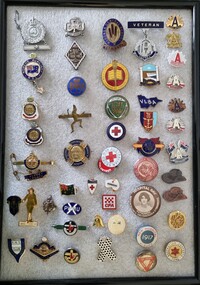
Badge - Badge Collection
... These include local schools such as the Wodonga Central School and Wodonga High School and local sporting clubs including the Wodonga Football Club and the Wodonga Bowling Club. ...These include local schools such as the Wodonga Central School and Wodonga High School and local sporting clubs including the Wodonga Football Club and the Wodonga Bowling Club. ...This is a collection ranging in dates from 1917 to the 1980s. It reflects a range of local and national organisations supported by people in the community. These include local schools such as the Wodonga Central School and Wodonga High School and local sporting clubs including the Wodonga Football Club and the Wodonga Bowling Club. National organisations like Red Cross, the Returned Soldiers' League, Legacy and the CWA are also represented.This collection commemorates a range of local and national organisations supported by community members throughout the 20th century.A collection of 50 different badges to commemorate a range of organisations and events. Included are several ANZAC Day and Legacy badges. Also in the collection are badges for Girl Guides, several sports clubs, Red Cross, Red Triangle Day 1917, the CFA and some church groups.commemorative badges, memorabilia, service organisations -
 Wodonga & District Historical Society Inc
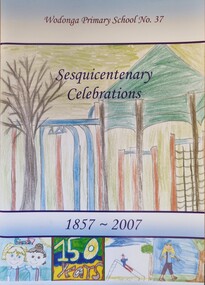
Booklet - Wodonga Primary School NO 37, Sesquicenentary Celebrations, 2007
... Wodonga Primary School NO 37, Sesquicenentary Celebrations...Wodonga Primary School NO 37, Sesquicenentary Celebrations...Wodonga Primary School. Primary School No 37...A small booklet of 24 pages including images, text and lists of student names attending Wodonga Primary School in 2007....Wodonga Primary School NO 37, Sesquicenentary Celebrations Booklet Wodonga Primary School NO 37, Sesquicenentary Celebrations ...Wodonga township’s first school was conducted in a small rented wooden cottage from September 1857. It was called the Belvoir National School. The building of a new schoolhouse, No. 378, began in October the same year near the corner of High and South Streets. In 1872 it changed to No. 37 Wodonga. The name was changed to Wodonga State School in 1875. This name remained until which remained until 1938 when it became a Higher Elementary School. In 1951 the Victorian Education Department purchased 12 acres of land in Ariel Street for the purpose of re-siting the State School. At this stage there were 600 pupils attending the school of which 170 were in the secondary section. Initially the Infant department moved into pre-fabricated classroom on the new site and by 1954 the whole primary school had been transferred. This booklet was created for the celebration of the school's 150th anniversary in 2007.A small booklet of 24 pages including images, text and lists of student names attending Wodonga Primary School in 2007.Wodonga township’s first school was conducted in a small rented wooden cottage from September 1857. It was called the Belvoir National School. The building of a new schoolhouse, No. 378, began in October the same year near the corner of High and South Streets. In 1872 it changed to No. 37 Wodonga. The name was changed to Wodonga State School in 1875. This name remained until which remained until 1938 when it became a Higher Elementary School. In 1951 the Victorian Education Department purchased 12 acres of land in Ariel Street for the purpose of re-siting the State School. At this stage there were 600 pupils attending the school of which 170 were in the secondary section. Initially the Infant department moved into pre-fabricated classroom on the new site and by 1954 the whole primary school had been transferred. This booklet was created for the celebration of the school's 150th anniversary in 2007.wodonga primary school. primary school no 37, education wodonga -
 Wodonga & District Historical Society Inc
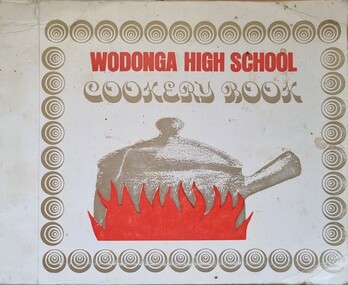
Book - Wodonga High School Cookery Book, 1970
... Wodonga High School Cookery Book...Wodonga High School Cookery Book...Wodonga High School...A cookery book of 86 pages produced by students of Wodonga High School. The cover features a saucepan over a red flame....WODONGA HIGH SCHOOL Cookery Book...Wodonga High School Galvin Hall Wodonga John Leslie Galvin This book was produced as a class project, the proceeds of which were in support of Miss Wodonga High School entrant, Debbie Gully. ...This book was produced as a class project, the proceeds of which were in support of Miss Wodonga High School entrant, Debbie Gully. The funds raised by the Miss Wodonga High Contest were to go to the Wodonga High School Assembly Hall Fund. The hall was was opened in August 1971 and was named Galvin Hall as reported in the accompanying article from the 1971 Belvoir school magazine. Mr John Leslie Galvin served the school with distinction for 27 years, first as an art and craft teacher and later as teacher in charge of Woodwork. Mr Galvin was active in many facets of school life. He took charge of school assemblies, was the manager of our school fete, a member of the advisory Council Grounds Committee and of the Assembly Hall Committee. In the wider Wodonga community he was instrumental in forming the Wodonga Apex Club, was a charter member of the Albury-Wodonga Lions Club and President of the Wodonga Golf Club. Mr Galvin passed away in October 1971.A cookery book of 86 pages produced by students of Wodonga High School. The cover features a saucepan over a red flame.This book was produced as a class project, the proceeds of which were in support of Miss Wodonga High School entrant, Debbie Gully. The funds raised by the Miss Wodonga High Contest were to go to the Wodonga High School Assembly Hall Fund. The hall was was opened in August 1971 and was named Galvin Hall as reported in the accompanying article from the 1971 Belvoir school magazine. Mr John Leslie Galvin served the school with distinction for 27 years, first as an art and craft teacher and later as teacher in charge of Woodwork. Mr Galvin was active in many facets of school life. He took charge of school assemblies, was the manager of our school fete, a member of the advisory Council Grounds Committee and of the Assembly Hall Committee. In the wider Wodonga community he was instrumental in forming the Wodonga Apex Club, was a charter member of the Albury-Wodonga Lions Club and President of the Wodonga Golf Club. Mr Galvin passed away in October 1971.wodonga high school, galvin hall wodonga, john leslie galvin -
 Wodonga & District Historical Society Inc
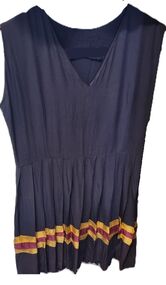
Uniform - Wodonga High School Sport Uniform, 1960s
... Wodonga High School Sport Uniform...Wodonga High School Sport Uniform...Wodonga High School...Post primary education in Wodonga began in 1923 when the existing primary school, which opened in 1857, became the Wodonga Central School. ...Wodonga High School Girls' Sports tunic. Waisted with v neck bodice and pleated skirt. ...This uniform is significant because it documents the evolution of accepted styles of girls' uniform at Wodonga High School. Wodonga High School Secondary Education Wodonga Wodonga High School Girls' Sports tunic. ...Post primary education in Wodonga began in 1923 when the existing primary school, which opened in 1857, became the Wodonga Central School. It extended students for a further 2 years of secondary schooling. In 1938 the school was declared a higher elementary school with 90 students in the secondary classes. Following rapid growth after the Second World War, the High School was established as a separate school in 1954 with 249 students and the primary students were relocated to premises in Ariel Street. However it rapidly became evident that a new school building needed to be established to cater for growing enrolments and specialist facilities. After persistent pressure from the Advisory Council, Stage 1 of the new school was built and occupied by Form 1 and 2 students in 1960. The final stages were completed during term 3, 1962. The official opening of the new Wodonga High School was declared by The Hon. J. S. Bloomfield M.L.A., Minister for Education, on Friday 30th April 1965. This sport tunic was worn by female students in the 1960s.This uniform is significant because it documents the evolution of accepted styles of girls' uniform at Wodonga High School.Wodonga High School Girls' Sports tunic. Waisted with v neck bodice and pleated skirt. A stripe in maroon and gold stripe of 6 centimetres width placed 16 centimetres above the hemline. It was worn with a coloured dressing gown cord depending on which Sports House the student represented.wodonga high school, secondary education wodonga -
 Wodonga & District Historical Society Inc
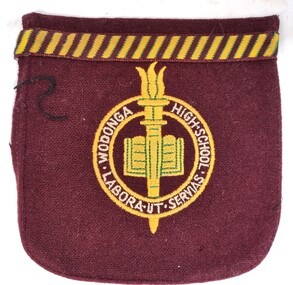
Uniform - Wodonga High School Blazer pocket and program for the new school's official opening
... Wodonga High School Blazer pocket and program for the new school's official opening....Wodonga High School Blazer pocket and program for the new school's official opening....Wodonga High School...Post primary education in Wodonga began in 1923 when the existing primary school, which opened in 1857, became the Wodonga Central School. ...A pocket from a Wodonga High School blazer made of a wool blend fabric. ...Around the edge of the circular yellow, white and gold logo "WODONGA HIGH SCHOOL / LABORA UT SERVIAS"...The pocket is paired with a program for official opening of the new school in 1965. Wodonga High School Blazer pocket and program for the new school's official opening. ...Post primary education in Wodonga began in 1923 when the existing primary school, which opened in 1857, became the Wodonga Central School. It extended students for a further 2 years of secondary schooling. In 1938 the school was declared a higher elementary school with 90 students in the secondary classes. Following rapid growth after the Second World War, the High School was established as a separate school in 1954 with 249 students and the primary students were relocated to premises in Ariel Street. However it rapidly became evident that a new school building needed to be established to cater for growing enrolments and specialist facilities. After persistent pressure from the Advisory Council, Stage 1 of the new school was built and occupied by Form 1 and 2 students in 1960. The final stages were completed during term 3, 1962. The official opening of the new Wodonga High School was declared by The Hon. J. S. Bloomfield M.L.A., Minister for Education, on Friday 30th April 1965.This program marks the an important occasion in the development of secondary education in Wodonga.A pocket from a Wodonga High School blazer made of a wool blend fabric. It is embroidered with the school logo featuring an open book and a torch combined with the school motto. The motto "Labora ut Servias", translates as "Work to Serve”. The pocket is paired with a program for official opening of the new school in 1965.Around the edge of the circular yellow, white and gold logo "WODONGA HIGH SCHOOL / LABORA UT SERVIAS"wodonga high school, secondary education wodonga -
 Bendigo Historical Society Inc.
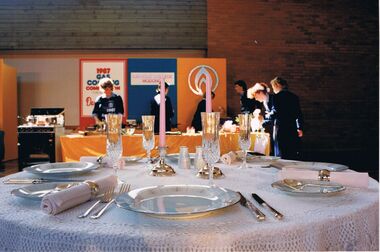
Photograph - CASTLEMAINE GAS COMPANY COLLECTION: PHOTO TABLE, 1987
... 1987 Cooking school's competition - Catholic College Wodonga Team at the cooking bench, Table set for 4 in forefront. ...EVENT Entertainment school's cooking competition Kodak 1987 Cooking school's competition - Catholic College Wodonga Team at the cooking bench, Table set for 4 in forefront. ...1987 Cooking school's competition - Catholic College Wodonga Team at the cooking bench, Table set for 4 in forefront. Location Unknown. B33 on the back.Kodakevent, entertainment, school's cooking competition -
 Bendigo Historical Society Inc.
Photograph - CASTLEMAINE GAS COMPANY COLLECTION: PHOTO PEOPLE, 1987
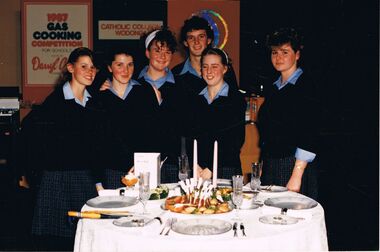
... 1987 Cooking school's competition - Catholic College Wodonga team standing in front of table prepared with candles and food. ...EVENT Entertainment school's cooking competition Kodak 1987 Cooking school's competition - Catholic College Wodonga team standing in front of table prepared with candles and food. ...1987 Cooking school's competition - Catholic College Wodonga team standing in front of table prepared with candles and food. Location Unknown. A15 on the back.Kodakevent, entertainment, school's cooking competition -
 Wodonga & District Historical Society Inc
Negative - Haeusler Glass Negatives Collection - Teachers and Students Wodonga West Primary School
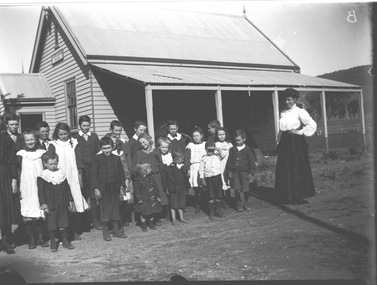
... Haeusler Glass Negatives Collection - Teachers and Students Wodonga West Primary School...Haeusler Glass Negatives Collection - Teachers and Students Wodonga West Primary School......wodonga west primary school...A group of students with their teacher standing outside their school building at Wodonga West, Victoria No. 1058. ...school north of the railway line. It operated from January 1870 to May 1950 when the nine remaining students transferred to Wodonga Primary School. ...The Wodonga Historical Society Haeusler Collection provides invaluable insight into life in late nineteenth and early twentieth century north east Victoria. The collection comprises manuscripts, personal artefacts used by the Haeusler family on their farm in Wodonga, and a set of glass negatives which offer a unique visual snapshot of the domestic and social lives of the Haeusler family and local Wodonga community. The Haeusler family migrated from Prussia (Germany) to South Australia in the 1840s and 1850s, before purchasing 100 acres of Crown Land made available under the Victorian Lands Act 1862 (also known as ‘Duffy’s Land Act’) in 1866 in what is now Wodonga West. The Haeusler family were one of several German families to migrate from South Australia to Wodonga in the 1860s. This digital image was produced from one of the glass negatives that form part of the collection, probably taken by Louis Haeusler (b.1887) with the photographic equipment in the Wodonga Historical Society Haeusler Collection. This item is unique and has well documented provenance and a known owner. It forms part of a significant and representative historical collection which reflects the local history of Wodonga. It contributes to our understanding of domestic and family life in early twentieth century Wodonga, as well as providing interpretative capacity for themes including local history and social history.Digital image created from the Haeusler Glass negative collection. A group of students with their teacher standing outside their school building at Wodonga West, Victoria No. 1058. The school was located near the current intersection of McKoy Street and the Hume Freeway in West Wodonga on land donated by J.W. Klinge, replacing an older school north of the railway line. It operated from January 1870 to May 1950 when the nine remaining students transferred to Wodonga Primary School.wodonga pioneers, haeusler family, glass negatives, dry plate photography, wodonga west primary school -
 Wodonga & District Historical Society Inc
Negative - Haeusler Glass Negatives Collection - Nellie Haeusler and J. Mann with Sunday School children, West Wodonga
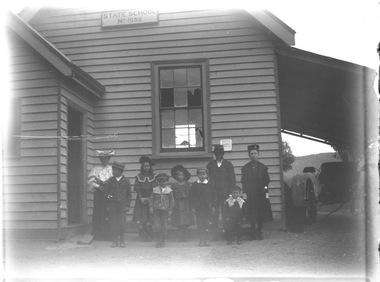
... Mann with Sunday School children, West Wodonga...Mann with Sunday School children, West Wodonga...wodonga pioneers...haeusler family...glass negatives...dry plate photography...sunday school...Mann with a group of Sunday School children in West Wodonga C. 1910...Mann with Sunday School children, West Wodonga ...The Wodonga Historical Society Haeusler Collection provides invaluable insight into life in late nineteenth and early twentieth century north east Victoria. The collection comprises manuscripts, personal artefacts used by the Haeusler family on their farm in Wodonga, and a set of glass negatives which offer a unique visual snapshot of the domestic and social lives of the Haeusler family and local Wodonga community. The Haeusler family migrated from Prussia (Germany) to South Australia in the 1840s and 1850s, before purchasing 100 acres of Crown Land made available under the Victorian Lands Act 1862 (also known as ‘Duffy’s Land Act’) in 1866 in what is now Wodonga West. The Haeusler family were one of several German families to migrate from South Australia to Wodonga in the 1860s. This digital image was produced from one of the glass negatives that form part of the collection, probably taken by Louis Haeusler (b.1887) with the photographic equipment in the Wodonga Historical Society Haeusler Collection. This item is unique and has well documented provenance and a known owner. It forms part of a significant and representative historical collection which reflects the local history of Wodonga. It contributes to our understanding of domestic and family life in early twentieth century Wodonga, as well as providing interpretative capacity for themes including local history and social history.Digital image created from the Haeusler Glass negative collection. Nellie Haeusler and J. Mann with a group of Sunday School children in West Wodonga C. 1910wodonga pioneers, haeusler family, glass negatives, dry plate photography, sunday school west wodonga -
 Wodonga & District Historical Society Inc
Photograph - First State School in Wodonga, 1920
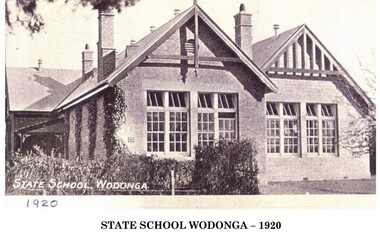
... First State School in Wodonga...First State School in Wodonga...Wodonga State School...Initially the Infant department moved into pre-fabricated classroom on the new site and by 1954 the whole primary school had been transferred.. The building was used became the temporary home of the Wodonga High School and later the Wodonga Technical School until they moved to new premises...At bottom of image: "WODONGA STATE SCHOOL 1920"...First State School in Wodonga Photograph First State School in Wodonga ...Wodonga township’s first school was conducted in a small rented wooden cottage from September 1857. It was called the Belvoir National School. The building of a new schoolhouse, No. 378, began in October the same year near the corner of High and South Streets. In 1872 it changed to No. 37 Wodonga. The name was changed to Wodonga State School in 1875. This name remained until which remained until 1938 when it became a Higher Elementary School. In 1951 the Victorian Education Department purchased 12 acres of land in Ariel Street for the purpose of re-siting the State School. At this stage there were 600 pupils attending the school of which 170 were in the secondary section. Initially the Infant department moved into pre-fabricated classroom on the new site and by 1954 the whole primary school had been transferred.. The building was used became the temporary home of the Wodonga High School and later the Wodonga Technical School until they moved to new premisesA black and white image of school building mounted on card.At bottom of image: "WODONGA STATE SCHOOL 1920"wodonga state school, education wodonga -
 Wodonga & District Historical Society Inc
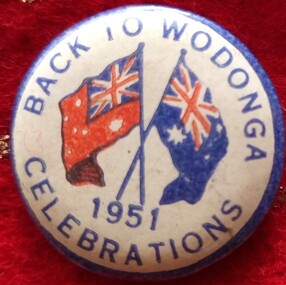
Badge - Back to Wodonga Celebrations 1951
... (Higher Elementary School), Wodonga Hospital Ball. Saturday: Bonegilla Race Club meeting, Competition Sports, (Cricket, Bowls, Tennis, etc.) ... (Higher Elementary School), Wodonga Hospital Ball. Saturday: Bonegilla Race Club meeting, Competition Sports, (Cricket, Bowls, Tennis, etc.) ...1951 was a year of celebration in Victoria. 9th May 1951 marked the 50th anniversary of the opening of the Australian Federal Parliament in 1901, which at that time met in Melbourne, Victoria. 13th November marked the Centenary of the opening of the first Victorian Parliament. Cities and towns held activities and celebrations to recognise the occasion. A "Back to Wodonga" was held from Friday 9th to Saturday 7th November 1951. Friday: Children’s Sport and Children’s Concert. Saturday: Welcome to Visitors, Official Luncheon, Gymkhana, Official Opening and Barbecue. Sunday: Church services, various denominations. Monday: Ladies’ Day (Bowls, Tennis, Croquet etc.) Afternoon Garden Parties, Boxing Tournament. Tuesday: Procession, Basket Lunch, Apex Sports Carnival, 50-50 Dance. Wednesday: Tour of district and visit to factories. Re-unions of various organisations. Thursday: All-day Street Fair and Carnival. Friday: Back to School (Higher Elementary School), Wodonga Hospital Ball. Saturday: Bonegilla Race Club meeting, Competition Sports, (Cricket, Bowls, Tennis, etc.) Farewell Parties by various organisations.This Badge is significant because it is a memento of an important community celebration in Wodonga.A small enamel badge featuring both the blue and red Australian ensigns in the centre on a white background surrounded by blue text.Around the edge; BACK TO WODONGA CELEBRATIONS 1951back to wodonga 1951, opening victorian parliament, australian federal parliament opening -
 Wodonga & District Historical Society Inc
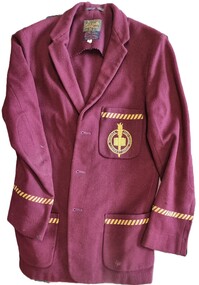
Uniform - Wodonga High School Blazer, 1970s
... Wodonga High School Blazer...Wodonga High School Blazer...Wodonga High School...Post primary education in Wodonga began in 1923 when the existing primary school, which opened in 1857, became the Wodonga Central School. ...On pocket WODONGA HIGH SCHOOL / LABORA UT SERVIAS" On tag at back - PURE WOOL / School Master by Kingswear GOLD LABEL MADE FROM The FAMOUS Doctor FLANNEL All Pure Wool Size 14...Wodonga High School Blazer Uniform Wodonga High School Blazer ...Post primary education in Wodonga began in 1923 when the existing primary school, which opened in 1857, became the Wodonga Central School. It extended students for a further 2 years of secondary schooling. In 1938 the school was declared a higher elementary school with 90 students in the secondary classes. Following rapid growth after the Second World War, the High School was established as a separate school in 1954 with 249 students and the primary students were relocated to premises in Ariel Street. However it rapidly became evident that a new school building needed to be established to cater for growing enrolments and specialist facilities. After persistent pressure from the Advisory Council, Stage 1 of the new school was built and occupied by Form 1 and 2 students in 1960. The final stages were completed during term 3, 1962. The official opening of the new Wodonga High School was declared by The Hon. J. S. Bloomfield M.L.A., Minister for Education, on Friday 30th April 1965.This blazer is significant because it documents an import stage in the development of education in Wodonga.A maroon woollen school blazer trimmed in gold with an insignia on the pocket.On pocket WODONGA HIGH SCHOOL / LABORA UT SERVIAS" On tag at back - PURE WOOL / School Master by Kingswear GOLD LABEL MADE FROM The FAMOUS Doctor FLANNEL All Pure Wool Size 14wodonga high school, secondary education wodonga -
 Wodonga & District Historical Society Inc
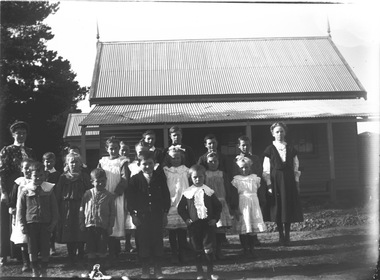
Negative - Haeusler Glass Negatives Collection - Wodonga West School and pupils
... Haeusler Glass Negatives Collection - Wodonga West School and pupils...Haeusler Glass Negatives Collection - Wodonga West School and pupils......wodonga west school...school north of the railway line. It operated from January 1870 to May 1950 when the nine remaining students transferred to Wodonga Primary School....Haeusler Glass Negatives Collection - Wodonga West School and pupils Negative Haeusler Glass Negatives Collection - Wodonga West School and pupils ...The Wodonga Historical Society Haeusler Collection provides invaluable insight into life in late nineteenth and early twentieth century north east Victoria. The collection comprises manuscripts, personal artefacts used by the Haeusler family on their farm in Wodonga, and a set of glass negatives which offer a unique visual snapshot of the domestic and social lives of the Haeusler family and local Wodonga community. The Haeusler family migrated from Prussia (Germany) to South Australia in the 1840s and 1850s, before purchasing 100 acres of Crown Land made available under the Victorian Lands Act 1862 (also known as ‘Duffy’s Land Act’) in 1866 in what is now Wodonga West. The Haeusler family were one of several German families to migrate from South Australia to Wodonga in the 1860s. This digital image was produced from one of the glass negatives that form part of the collection, probably taken by Louis Haeusler (b.1887) with the photographic equipment in the Wodonga Historical Society Haeusler Collection. This item is unique and has well documented provenance and a known owner. It forms part of a significant and representative historical collection which reflects the local history of Wodonga. It contributes to our understanding of domestic and family life in early twentieth century Wodonga, as well as providing interpretative capacity for themes including local history and social history.Digital image created from the Haeusler Glass negative collection. A group of students and their teacher standing outside Wodonga West Primary School No. 1058. C.1910. The school was located near the current intersection of McKoy Street and the Hume Freeway in West Wodonga on land donated by J.W. Klinge, replacing an older school north of the railway line. It operated from January 1870 to May 1950 when the nine remaining students transferred to Wodonga Primary School.wodonga pioneers, haeusler family, glass negatives, dry plate photography, wodonga west school -
 Wodonga & District Historical Society Inc
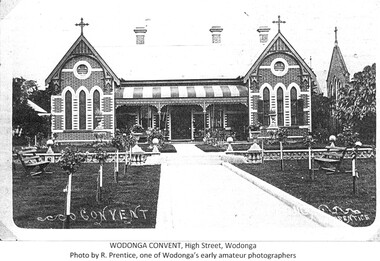
Photograph - St Joseph's Convent, Wodonga, Various dates
... Until 1892 the first Catholic School in Wodonga, a simple wooden skillion which was erected behind the sanctuary of St. ...Until 1892 the first Catholic School in Wodonga, a simple wooden skillion which was erected behind the sanctuary of St. ...Until 1892 the first Catholic School in Wodonga, a simple wooden skillion which was erected behind the sanctuary of St. Francis’ Chapel, was overseen by Dean William Tierney of Beechworth, Father Michael O’Connor P.P. of Chiltern and his successor Father Charles Van Der Hayden. The lay teachers, Miss Fagan and Miss O’Leary. In 1892 four Sisters of Mercy from Albury were invited to make a foundation at Wodonga. On the 6th February 1892, Mother M. Aloysius Tierney (1864-1948), Sr. M. Gabriel Comins (1868-1945), Sr. M. Celestine Coyle (1871-1857) and a postulant Miss Mary Jane Conlan (1874-1939) (Sr. Mary Joseph) travelled by horse drawn cab from the Albury convent to a rented house in Hume Street. The parishioners of Wodonga were anxious for the nuns to have their own residence, and on the 19th March 1893, the foundation stone for St. Joseph’s Convent was laid and consecrated by Bishop Stephen Reville on behalf of Bishop Crane of Sandhurst. The convent was designed by architects Gordon and Gordon and built by Fraser and Wilson of Melbourne at a cost of £1000. Construction was expected to take three months. The Wodonga and Towong Sentinel of Friday 24 March 1893 included the following description of the Convent. “In the front is a handsome verandah, with an oratory on the right and a community room on the left. Entering the door, the reception and music rooms are met with on opposite sides, and there are five cells in succession at the back of the reception room, whilst on the other side of the passage the reverend mother's cell, the refectory, pantry, and kitchen are found. At the extreme rear of the building there is a linen room, a bathroom, and a servant's room, There is also a verandah on either side of the convent. The height of the walls is to be 12 feet and 13 feet”. The Convent was officially opened on Sunday 13 August 1893 St Joseph’s Convent became part of St Augustine’s school in 2001.These images are significant because they capture the history of an important religious building in Wodonga, Victoria.Three black and white photographs of St Joseph's Convent in Wodonga in the early 1900s.sisters of mercy wodonga, st joseph's convent wodonga, st augustine's church wodonga -
 Kiewa Valley Historical Society
Photographs – Set of 25 colour photographs of the street parade to celebrate the first Official Hoppet race run at Falls Creek in 1991, 1991
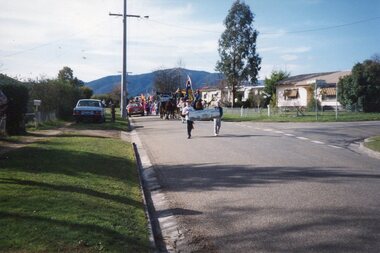
... Photos are taken near the corner of Maddison St 1&2 – Horseman & accordion player leading the parade Sign reads ‘Falls Creek The Happy Mountain’ 3-4 Birkbeioner Nordic Ski Club with Chinese Nordic ski representatives 5 & 6- Girl Guides & Brownies 7, 8 & 9- Mt Beauty Primary School & Netball team 10 & 11- UKV Calisthenics Club 12- Lawn Bowls Club 13- Junior Football Club 14- Mt Beauty High School Band (on Wodonga Timber & Hardware truck) 15, 16 17 & 18- Mt Beauty Kindergarten 19,20, 21 & 22- Local Community Vehicles including Community Transport and Fire Brigade 23 & 24- Mt Beauty High School Band 25- Fiat 500 Topolino Vintage Car ...Photos are taken near the corner of Maddison St 1&2 – Horseman & accordion player leading the parade Sign reads ‘Falls Creek The Happy Mountain’ 3-4 Birkbeioner Nordic Ski Club with Chinese Nordic ski representatives 5 & 6- Girl Guides & Brownies 7, 8 & 9- Mt Beauty Primary School & Netball team 10 & 11- UKV Calisthenics Club 12- Lawn Bowls Club 13- Junior Football Club 14- Mt Beauty High School Band (on Wodonga Timber & Hardware truck) 15, 16 17 & 18- Mt Beauty Kindergarten 19,20, 21 & 22- Local Community Vehicles including Community Transport and Fire Brigade 23 & 24- Mt Beauty High School Band 25- Fiat 500 Topolino Vintage Car Photographs – Set of 25 colour photographs of the street parade to celebrate the first Official Hoppet race run at Falls Creek in 1991 ...In 1977 a group of Mount Beauty cross country skiers formed the Birkebeiner Nordic Ski Club. In 1979, a version of the famous Birkebeiner race, the first Australian Birkebeiner was held at Falls Creek. In June 1990 representatives from Australia put their case for a southern hemisphere race in the series. Following a trial event in 1990. Australia became the 12th member of Worldloppet in the winter of 1991, with the first Kangaroo Hoppet. In 1991 a parade and commemorative torch lighting ceremony were organised in Mt Beauty as part of the celebrations to mark the first official Kangaroo Hoppett with participation from local community groups and commercial organisations, the Chamber of Commerce, local government representatives and individuals.Kangaroo Hoppet caters to diverse interests by offering a 42km and 21km event. It also offers a 7km event that attracts skiers, ranging from elite juniors to parents, grandparents, babies and first time skiers. It is recognised on the world cross country ski race calendar. It brings large numbers of participants and spectators to the area which support tourism, local businesses and employment. The 2018 event will be the 28th Kangaroo Hoppet, with cross country skiers travelling from across the country and overseas to compete.PHYSICAL: Set of 22 colour photographs of the street parade to celebrate the first Official Hoppet race run at Falls Creek in 1991. Participants from a range of local community groups are traveling along Kiewa Cres. Photos are taken near the corner of Maddison St 1&2 – Horseman & accordion player leading the parade Sign reads ‘Falls Creek The Happy Mountain’ 3-4 Birkbeioner Nordic Ski Club with Chinese Nordic ski representatives 5 & 6- Girl Guides & Brownies 7, 8 & 9- Mt Beauty Primary School & Netball team 10 & 11- UKV Calisthenics Club 12- Lawn Bowls Club 13- Junior Football Club 14- Mt Beauty High School Band (on Wodonga Timber & Hardware truck) 15, 16 17 & 18- Mt Beauty Kindergarten 19,20, 21 & 22- Local Community Vehicles including Community Transport and Fire Brigade 23 & 24- Mt Beauty High School Band 25- Fiat 500 Topolino Vintage Car No markingskangaroo hoppet; cross country skiing; ski race; bogong high plains, mt beauty, parade -
 Wodonga & District Historical Society Inc
Photograph - Send off for Alexander Frederick Reid OBE, MBE, 1956
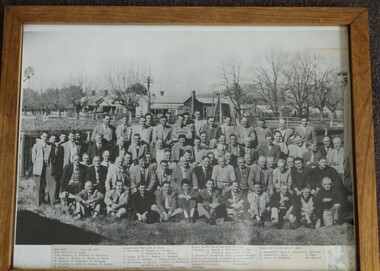
... As well as continued service to the RSL, Alex served as a member of the Wodonga High School advisory committee for 35 years and sat on the bench in the Wodonga Court for 15 years in his capacity as Justice of the Peace. ...As well as continued service to the RSL, Alex served as a member of the Wodonga High School advisory committee for 35 years and sat on the bench in the Wodonga Court for 15 years in his capacity as Justice of the Peace. ...Alex Reid was born in 1891 and began work on the Victorian Railways in 1907. He enlisted with the A.I.F in 1915. He served in Egypt and the Suez Canal but was discharged on medical grounds having contracted typhoid and dysentery. In 1917 he re-enlisted in the Anzac Light Horse. On his return to England, he survived the torpedoing of HMAT Ballarat and then served in France. On discharge from the army, Alex returned to the Victorian Railways and transferred to Wodonga. He was employed driving the “Spirit of Progress” and remained as “Driver in Charge” until his retirement in 1956. Alex was awarded the MBE in 1951 and the OBE in 1963 for his tireless efforts on behalf of Returned Servicemen and their families. He continued to work as a welfare officer for the RSL. As well as continued service to the RSL, Alex served as a member of the Wodonga High School advisory committee for 35 years and sat on the bench in the Wodonga Court for 15 years in his capacity as Justice of the Peace. Alexander Frederick Reid O.B.E died in Wodonga on 7 January 1979.This image represents a farewell work function for an outstanding member of the Wodonga community.A large black and white framed photo of a group of men attending a send off function in Wodonga in 1956.Alex Reid send off 1955 Back Row L to R Stan Warnock, F. Fulford, W. McEachern, S. Egan, P. Doolan, K. Moore, A. Smyth, M. Seymour, W. McAnanly, M. Flanagan, L. Gregson, L. Snow, H. Fraser, R. Cooper, W. Squires Second Back Row L to R K. Williams, W. Toomey, K. Coleman, F. Thistleton, K. Ziebell, P. Gough (S.M), C. Hughes, F. Dempsey, C. Craig, W. Baldock, J. Robinson, W. Odgers, C. Whitehead, G. Taylor, J. Muir, P. McDonald, W. Riley, A. Thompson, K. Robinson, B. Strachan, W. Walsh, T. Willoughby Seated second Row L to R J. Schmidt, A. Wagner, J. O’Donnell, J. Dawe, F. Leitch, J. Anderson, T. Brown, A. Elvish, F. Boadle, A. Reid, J. Draper (Police). N. Davey, F. Caine (P), A. Padgett, L. Burroughs (P), B. Saul, F. Weatherall, H. Binder, D. Sutton, T. Cosgriff, C. Clancy, ? , M. Nowadice, J. Karugan Front Row Seated L to R D. Shannon, S. Cuper, L. Cheesley. C. Williams, L. Madgeric, V. Snow. ?, A. Beach, L. Cross, C. McNamara, ? , Don Shepard.alexander frederick reid, eminent wodonga residents, ww1 veterans wodonga, hmat ballarat -
 Wodonga & District Historical Society Inc
Photograph - Commercial Bank of Sydney, High Street, Wodonga, 1876 - 2025
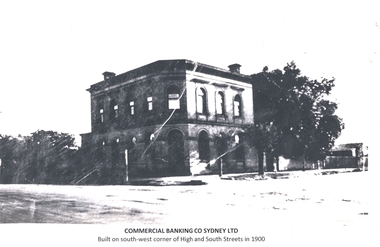
... It is currently (2025) used by the Wodonga Indie School....It is currently (2025) used by the Wodonga Indie School. These images are significant because they document the development of an important financial institution established in Wodonga in the late 19th century. ...The Bank of Victoria was established in Wodonga during 1873. This two storey bank was constructed on the site in 1876. It later became the Commercial Banking Company of Sydney. In 1876 the Albury Banner and Wodonga Express reported that Mr. Nation had gained the contract for the erection of a new building for the Bank of Victoria, at Wodonga. The site secured for the bank was at the corner of South and Sydney streets, and immediately opposite the new Post and Telegraph Offices. The original bank was demolished in the 1950s and a new bank was built on the site. The new building was constructed with innovative foundations designed to prevent damage from vibrations caused by heavy transport vehicles along High Street which was then part of the Hume Highway. A contemporary newspaper article provides detail of the new bank. The well-lit building with open banking offices was designed by Melbourne architects, Turner and Stephenson, and combined a bright and attractive appearance with a stream-lined working layout. Alderson Swythyn Blackett-Smith, the manager of bank at time of move to new premises stated that the growth of the district and the bank’s business had made the old premises unsatisfactory due to insufficient space. The Commercial Banking Company of Sydney (CBC) merged with the National Bank of Australasia in 1982 to form the National Australia Bank and the second bank was closed. The building has since operated as several retail (including video hire and framing shop), commercial and community functions. It is currently (2025) used by the Wodonga Indie School.These images are significant because they document the development of an important financial institution established in Wodonga in the late 19th century.A series of images showing the evolution of the Commercial Banking Company of Sydney building in Wodonga from its construction in 1876 to the development of the site in 2025.commercial banking company of sydney, banking wodonga, wodonga financial institutions -
 Wodonga & District Historical Society Inc
Photograph - Tom Ardern and Alf Haeusler
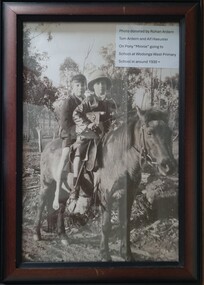
... Alf attended Wodonga West School No.1058 until the eighth grade. ...Alf attended Wodonga West School No.1058 until the eighth grade. ...John Alfred Lyell "Alf" Haeusler was born on 3rd February 1922, and was the only child of Louis and Ilma Haeusler. He lost his mother Ilma at the age of six and was raised by his father and his Aunt Nellie. He was a quiet lad with a limp, possibly caused by an illness early in life, later diagnosed as polymyositis. As a young boy, Alf was fascinated by electricity and radios. Like his father Louis, Alf had the ability to engineer and fabricate almost anything using humble materials, from mending the broken handle of a teapot, to making a toy xylophone, a homemade crystal radio set or a homemade drill. Alf attended Wodonga West School No.1058 until the eighth grade. Due to his medical condition, in order to avoid the two-mile walk to school, Alf travelled by pony, which was hired from another student, Tom Ardern for sixpence a week. The two boys remained lifelong friends. Tom Ardern died in Wodonga, Victoria on 10th January 1996 and Alf Haeusler died on 5th October 1997. The Haeusler Collection consisting of manuscripts, personal artefacts used by the Haeusler family and a set of glass negatives was bequeathed to the Wodonga & District Historical Society. It offers a unique visual snapshot of the domestic and social lives of the Haeusler family and local Wodonga community in the early 20th century.This photo is significant because it depicts an important aspect of the early life of Alf Haeusler of Wodonga.Framed black and white image of two boys on horseback on their way to school.haeusler family of wodonga, thomas ardern, alf haeusler -
 Wodonga & District Historical Society Inc
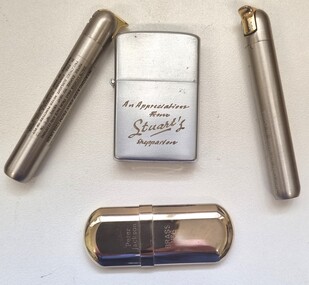
Functional object - Various Cigarette Lighters
... In 1934 when he finished school, Les moved into Wodonga. His first job was at Mates Timber Yard. ...In 1934 when he finished school, Les moved into Wodonga. His first job was at Mates Timber Yard. ...Leslie William Cole was born on 31 January 1920 in Albury, the first child of William James Cole and Gwendoline Fair. Les spent most of his childhood living with his grandparents in Bethanga, Victoria. In 1934 when he finished school, Les moved into Wodonga. His first job was at Mates Timber Yard. He later worked for Mylons of Wodonga driving taxis and buses. In 1939 after completing militia training, Les applied to enlist with the RAAF and eventually trained as an Aircraft Mechanic. He was posted to the 6th Squadron, serving in Port Moresby, Milne Bay and Goodenough Island before returning to the RAAF base in Sale, Victoria. On discharge. Les returned to Wodonga and resumed working with Mylons. After a range of jobs, Les and his wife Lorna operated a shop in Ariel Street, Wodonga. In the community, Les was a founding member of Wodonga Lions Club. He also joined the Civil Defence which was a predecessor off the SES. He became the Communications Officer and trained other members. Les became the first Controller of the Wodonga Branch of the State Emergency Service, a position he held for 17 years. The new SES headquarters was named in his honour. In retirement he also worked as a Volunteer Community Driver. Les was also named Wodonga Citizen of the Year in 1984 Les continued living in Wodonga until the age of 103 in 2023, when he moved to Melbourne to be closer to his children. He passed away on 12 December 2023. These lighters are part of his collection of memorabilia and artefacts.These items belonged to a respected member of the Wodonga community.A collection of 4 different cigarette lighters made from metal alloys. The brass lighter has a black cloth pouch.On long cylindrical lighters: Unicorn INT Made in China and Safety Instructions On silver lighter: An Appreciations from Stuart's Shepparton On brass lighter: Peter Jackson Brass No/ 6cigarette lighters, les cole -
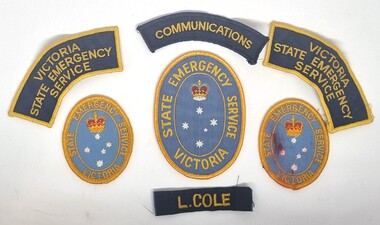 Wodonga & District Historical Society Inc
Functional object - State Emergency Service Cloth badges
... In 1934 when he finished school, Les moved into Wodonga. His first job was at Mates Timber Yard. ...In 1934 when he finished school, Les moved into Wodonga. His first job was at Mates Timber Yard. ...Leslie William Cole was born on 31 January 1920 in Albury, the first child of William James Cole and Gwendoline Fair. Les spent most of his childhood living with his grandparents in Bethanga, Victoria. In 1934 when he finished school, Les moved into Wodonga. His first job was at Mates Timber Yard. He later worked for Mylons of Wodonga driving taxis and buses. In 1939 after completing militia training, Les applied to enlist with the RAAF and eventually trained as an Aircraft Mechanic. He was posted to the 6th Squadron, serving in Port Moresby, Milne Bay and Goodenough Island before returning to the RAAF base in Sale, Victoria. On discharge. Les returned to Wodonga and resumed working with Mylons. After a range of jobs, Les and his wife Lorna operated a shop in Ariel Street, Wodonga. In the community, Les was a founding member of Wodonga Lions Club. He also joined the Civil Defence which was a predecessor off the SES. He became the Communications Officer and trained other members. Les became the first Controller of the Wodonga Branch of the State Emergency Service, a position he held for 17 years. The new SES headquarters was named in his honour. In retirement he also worked as a Volunteer Community Driver. Les was also named Wodonga Citizen of the Year in 1984 Les continued living in Wodonga until the age of 103 in 2023, when he moved to Melbourne to be closer to his children. He passed away on 12 December 2023.These patches belonged to a local Wodonga resident who was instrumental in establishing the Wodonga SES.A collection of cloth and embroidery uniform patches worn on the uniform of Leslie Cole who was a founding and long-term member of the Wodonga State Emergency Service. Oval badges all bear the Southern Cross and a crownAround oval badges: VICTORIA STATE EMERGENCY SERVICE On epaulettes: COMMUNICATIONS / L. COLEstate emergency service, wodonga ses
