
Showing 99 items matching "scottish stories"
-
 Bendigo Historical Society Inc.
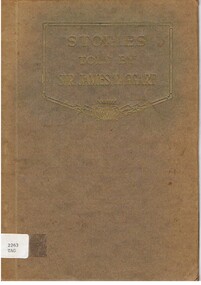
Book - ALEC H CHISHOLM COLLECTION: BOOK 'STORIES TOLD BY SIR JAMES TAGGART'
... ...scottish stories...ALEC H CHISHOLM COLLECTION. 36 page soft cover booklet of Scottish stories (jokes) by Sir James Taggart KBE, LLD, ex Lord-Provost of Aberdeen. ...BOOKS Collections scottish stories ALEC H CHISHOLM COLLECTION SIR JAMES TAGGART James Taggart Book. ...Book. ALEC H CHISHOLM COLLECTION. 36 page soft cover booklet of Scottish stories (jokes) by Sir James Taggart KBE, LLD, ex Lord-Provost of Aberdeen. Printed and published by Valentine & Sons Ltd, Dundee and London in 1926. Photo of Sir James Taggart in military uniform on flyleaf. Cat. No. 2263 TAG on front coverJames Taggartbooks, collections, scottish stories, alec h chisholm collection, sir james taggart -
 Bendigo Historical Society Inc.
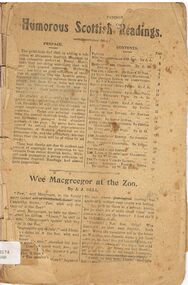
Book - ALEC H CHISHOLM COLLECTION: BOOK ''HUMOROUS SCOTTISH READINGS''
... ALEC H CHISHOLM COLLECTION. 48 page booklet of humorous Scottish short stories. Various authors. Printed and published by John Leng & Co. ...BOOKS Collections short stories ALEC H CHISHOLM COLLECTION HUMOUR SHORT STORIES SCOTLAND Various Book. ALEC H CHISHOLM COLLECTION. 48 page booklet of humorous Scottish short stories. ...Book. ALEC H CHISHOLM COLLECTION. 48 page booklet of humorous Scottish short stories. Various authors. Printed and published by John Leng & Co. Ltd. At the offices of the People's Journal, Dundee. Date unknown. Catalogue sticker ''2174 VAR''Variousbooks, collections, short stories, alec h chisholm collection, humour, short stories, scotland -
 Bendigo Historical Society Inc.
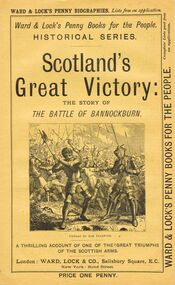
Book - LYDIA CHANCELLOR COLLECTION: SCOTLAND'S GREAT VICTORY. THE STORY OF THE BATTLE OF BANNOCKBURN
... A book titled 'Scotland's Great Victory: The story of the Battle of Bannockburn. ...Book LYDIA CHANCELLOR COLLECTION: SCOTLAND'S GREAT VICTORY. THE STORY OF THE BATTLE OF BANNOCKBURN ...A book titled 'Scotland's Great Victory: The story of the Battle of Bannockburn. A thrillling account of one of the great triumphs of the Scottish arms.' London : Ward, Lock & Co., Salisbury Square, E.C. New York : Bond Street. 225 - 240 pgs. (ill.). This booklet is one of a series of 37 ' Ward & Lock's Penny Books for the People.' 'Historical Series.' Price one penny. There are also advertisements of note.books, biography, scotland, lydia chancellor, collection, ward & lock's penny books for the people, ward & lock's penny biographies, historical series, history, biographies, scotland, scottish history, battle of bannockburn, advertisements, book, books, king robert bruce, penny books -
 Halls Gap & Grampians Historical Society
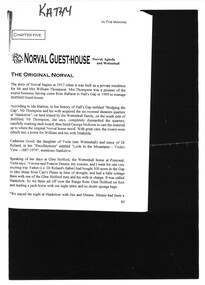
Book - B/W
... Written in the mid-16th century the play is set in the Grampian Mountains of Scotland. The story is of a boy who was parted from this mother during his early childhood, and was given to a shepherd who raised him. ...Written in the mid-16th century the play is set in the Grampian Mountains of Scotland. The story is of a boy who was parted from this mother during his early childhood, and was given to a shepherd who raised him. ...Norval Guest-House Aginda and Wettenhall The original Norval The story of Norval begins in 1917 when it was built as a private residence for Mr and Mrs William Thompson. Mrs Thompson was a pioneer of the tourist business, having come from Ballarat to Hall's Gap in 1909 to manage Bellfield Guest-house According to Ida Stanton, in her history of Hall's Gap entitled "Bridging the Gap", Mr Thompson and his wife acquired the six roomed shearers quarters at "Hankelow", on land leased by the Wettenhall family, on the south side of Bellfield. Mr Thompson, she says, completely dismantled the quarters, carefully marking each board, then hired George McKeon to cart the material up to where the original Norval house stood. With great care, the rooms were rebuilt into a home for William and his wife Mathilda. Catherine Good, the daughter of Viola (nee Wettenhall) and niece of Dr Roland, in here "Recollections" entitled "Look to the Mountains - Viola's View 1887-1979", mentions Hankelow. Speaking of her days at Glen Holford, the Wettenhall home at Pomonal, Viola says "Verona and Francie Dennis, my cousins, and I went for one very exciting trip. Father (i.e Dr Roland's father) had bought 300 acres in the Gap to take sheep from Carr's Plains in time of drought, and had a little cottage there with one of the Glen Holford men and his wife in charge. It was called Hankelow. So we three set off over the Range from Glen Holford on foot and leading a pack horse with our night attire and no doubt sponge bags. "We stayed the night at Hankelow with Jim and Minnie. Minnie had been a housemaid at Glen Holford. I was very fond of her. It makes one laugh to think of the excitement of "roughing it"! Minnie gave us a lovely dinner with meringues, and cream, I remember, then early morning tea. After breakfast we were driven in the buggy to the foot of the Goat Rock (since renamed Mt Rosea) and off we went - walking in our long skirts and ankle boots. There was no track of any kind, nor blazed trail - we just made for the top. It was rather frightening at times because we couldn't see where the top was an it always seemed to get further and further away. The last mile was so terribly steep, with a lot of lose shale where you went up twelve inches and slipped back six. Now you motor to about a couple of miles from the top and then have a graded path. Anyway, we got there and back safely and were rewarded with a magnificent view" By a strange coincidence, Hankelow, the source of Norval Guest-house in times past (if the name can be applied to the property as a whole, which seems likely) is in fact also the source of our Wettenhall Campsite! Hankelow was named after a property owned by the Wettenhall family in England. In 1917 William and Mathilda retired to their newly built home (Norval) "to escape from the tourist business" However, so many people made requests to stay with them that they found it necessary to add several more rooms and sleepouts to their home. In this way, early in 1921, the guest-house began to take shape. Mr Thompson, a former librarian of the Mechanics Institute in Ballarat, named the house "Norval". The name "Norval" comes from a quotation from the play 'Douglas" by John Home. Written in the mid-16th century the play is set in the Grampian Mountains of Scotland. The story is of a boy who was parted from this mother during his early childhood, and was given to a shepherd who raised him. Some eighteen years later the mother by chance happens to meet here son, and not knowing his true identity, asks his name. He answers, "My name is Norval; and in the Grampian hills my father feeds his flocks." Perhaps it was simply because "Norval" was associated with the "Grampians" that it was chosen by Mr Thompson. He may also have been conscious of feeding "flocks" of tourists in his expanding, guest-house. Norval Guest-house prospered. It was known for its fine cooking and friendly atmosphere - a tradition which has carried through to the modern Norval! It closed between 1940 and 1949 because of the second world war. In 1949 it was decided to almost completely rebuild the house. Most of the old building (Hankelow plus) was demolished and rebuilt to a much larger and more modern plan. And then, on May 1, 1965, it was purchased by the Committee of Management of the Methodist and Presbyterian Conference Centres. At this time the guest-house was owned and operated by Marjorie and Lachland McLennan, Mrs McLennan being the daughter of William and Mathilda Thompson, the pioneers of the establishment. The McLennans had operated the Guest-house since about 1930.Photocopy 2 pages of article from book titled 'In the Making' title of article Norval guest House the original Norvalaccommodation, guesthouses, norval -
 Uniting Church Archives - Synod of Victoria
Colour photo, Prior to 1977
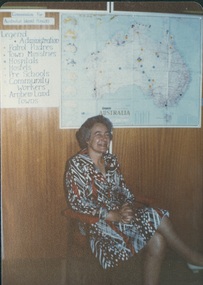
... stories of pioneers and knew well the history of where she had come from – the Western District. A keen follower of cricket, she would be right up with the last test and the issues of the team. Originally a Melbourne football supporter, she became an avid Geelong supporter and would often score at the annual self destruct St Philip’s vs Flynn Church match. She loved the gladiatorial, albeit often suicidal display. And though an Aussie through and through she loved her Scottish...stories of pioneers and knew well the history of where she had come from – the Western District. A keen follower of cricket, she would be right up with the last test and the issues of the team. Originally a Melbourne football supporter, she became an avid Geelong supporter and would often score at the annual self destruct St Philip’s vs Flynn Church match. She loved the gladiatorial, albeit often suicidal display. And though an Aussie through and through she loved her Scottish ...Everyone seemed to know Frances – it was November 1985 – I met Frances at the Victorian Synod office as she lent me her office to interview staff for St Philip’s which I was taking over in 1986. The interviews completed, she took me to a nearby coffee shop where we had a delightful chat. I came away much the richer, more informed about St Philip’s and feeling I had known Frances forever. And so started our 23 year friendship, with me hearing the first of many stories – for Frances was a wonderfully gifted story teller with a capacity to turn the past into life, and its characters into real people. It seems fitting that a person destined to add to Australia’s history should be born down the beach from Mendonca’s Mahogany ship – Port Fairy on the 28 January 1924. There she went to school – first to primary school then to Camperdown’s Higher Elementary School which went to Year 10. She was the eldest of four children with three brothers, Jock, Norman and Rod. After Year 10, Frances took a job in Camperdown as a dental nurse. She tackled this successfully until deciding to study at Rolland House in Carlton to become a Deaconess. Jock, her brother, recalls asking Frances what made her decide to be a Deaconess. At a Presbyterian Fellowship camp at Warrnambool, Frances and the others were sleeping in the Church Hall on palliases. During the night she awoke and her eye was drawn to a stained glass window, unusually brightly lit. On the window were the words “Follow Me”. Without flinching Frances took the words to heart and decided to serve God as a Deaconess, and during her time with the Australian Inland Mission she became quite a legend. What a patriot Frances was! She loved the stories of pioneers and knew well the history of where she had come from – the Western District. A keen follower of cricket, she would be right up with the last test and the issues of the team. Originally a Melbourne football supporter, she became an avid Geelong supporter and would often score at the annual self destruct St Philip’s vs Flynn Church match. She loved the gladiatorial, albeit often suicidal display. And though an Aussie through and through she loved her Scottish roots. Through her stories, she could easily transport a person in the Centralian landscape onto the heather of the Highlands. In spite of her love for Scotland, the city which was her favourite was New York. Frances – truly a citizen of the world. As a citizen of the world Frances fought for Indigenous and migrant women’s rights and was active in the World Council of Churches, sponsoring local and overseas women to study in Australia and to return to their homes as trained teachers and theologians. Up until recently she was involved in the Spina Bifida and Hydro Cephalis Association of SA. By the time she had taken up with the AIM Frances had a well tuned desire for social justice. To her it was important that the poor and less fortunate were given a go. She felt that the Labor Party provided her best avenue to push her social justice desires. After joining the party in 1956, she quickly became a respected member of the party and worked tirelessly for it, being honoured in the end with life membership. In the party she knew everyone and everyone knew her. She introduced me to Bob Hawke and when I spoke to Gough Whitlam once on a plane, he affirmed to me his friendship with Frances. In her cottage was a picture of her with Kevin Rudd with his arm around her. She is remembered by her party colleagues as someone who had a real compassion for helping people. She believed in the traditional ethic of the Labor Party which is to help those who are less fortunate. Interestingly, she supported St Philip’s moving from solely being a residential college to a school because we had chosen a relatively low fee base to enable maximum access for people and our boarding house continued to, and still does, offer accommodation to any student wishing to attend schools in Alice. Having supported the outback for years from the engine rooms of the mission arm of the church in Victoria, Frances then decided to move to Alice for her retirement. Settling in the little cottage at the far south eastern corner of Old Timers, this became to me, my family and I’m sure to plenty of people, Frances’ Cottage. But moving to Alice was hardly moving into retirement. She quickly became Chaplain at St Philip’s where she clearly showed her love for the children and staff and a real belief in St Philip’s role – to provide access to education for isolated children. She became a stalwart of the Adelaide House Museum, a wonderful member of the congregation, a powerful contributor to the Presbytery and the Annual Synod. Frances was strong, never flinched on a point of principle and discussed things face to face so that you truly knew where you stood with her. She had a great feeling for the pastoralists and knew many of them well. As Chaplain of the College she related well to the children and in addition, knew many of their families. She also felt deeply for the Indigenous people and regularly tackled the issue of how conditions could be improved for them. As we developed the school at St Philip’s, Frances worked with me on so many things. She would visit the College each week for Chapel, run a Sunday school for little kids and the service for all the boarders. When the school was ready to start she wrote the College prayer, said now every week by all students. The prayer says so much about Frances. She pioneered the RE program, teaching RE and in addition to Sunday, visited staff and students every Wednesday. At Presentation Night she presented a homily and provided the blessing – always a strong presence in front of the College community. She was so much part of St Philip’s that when we built the new boarding house in 1990 it seemed so obvious to call it McKechnie House. As a faithful servant of Adelaide House for years and an enthusiastic member of the National Trust, Frances was the first chairperson of the committee, a driving force to redevelop Adelaide House and she worked tirelessly to present John Flynn’s Hospital in the best light. She helped to deliver the stories of Flynn and McKay and the Outback missionaries to so many people and was instrumental in producing meaningful displays. I enjoyed walking around the museum with her intensely, enjoying her detailed stories of the past missionary era and I know many others would have as well. As a loyal and loving member of the Flynn Church, and being such a comrade of Fred McKay’s, Frances understood intricately the symbols which lie within the architecture. Once again, as a story teller, each one had a yarn attached to it. Over her twenty-three years as a member of the Flynn Church she has made a wonderful contribution. As a charismatic personality people were naturally attracted to Frances and were touched and affected by her. Peter Robson, twenty-two years at St Philip’s, remembers her asking him why he had stayed so long at the College. He explained to her that it was her address one day in Chapel in the early times that inspired him to keep going. With great wisdom she had said, “You can’t conquer something, unless you allow it to conquer you.” St Philip’s had conquered him. Wherever she went, whomever she was with, she had a real and lasting impact. Frances brought the reality of the Outback to so many as she addressed congregations around Victoria. She started the Australian Church Women’s Fellowship in the Northern Territory in 1997. She was also involved in setting up the Institute for Aboriginal Development. I believe that Frances should have been recognised nationally for her work with an AM. However, she was the Northern Territory finalist in the Senior Australian of the Year Awards in 2003. In 2004 she was awarded an OBE – not from the Queen but at Old Timers. This is a coveted award which means “Over Bloody Eighty”. Frances was part of it all, in the river, at a bush dance, at a dinner, at a service, at a party, at a meeting, at a footy game, at a cricket game, at Synod, at Presbytery, at Labour meetings, I could go on. Frances McKechnie, what a wonderful Australian. (Eulogy by Chris Tudor) Frances McKechnie died mid-2008. Deaconess Frances McKechnie is seated in front of a map of Australia marked with Australian Inland Mission places identified.At the time the photo was taken, McKechnie was the Victorian Regional Officer for the Australian Inland Mission (Presbyterian). At one stage, she worked for National Mission Frontier Services from 1968 to 1986. See below for the eulogy at her funeral by Chris Tudor. (Frances died May or June 2008.)deaconess frances mckechnie; australian inland mission; presbyterian church -
 Federation University Historical Collection
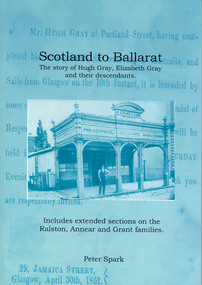
Book, Peter Spark, Scotland to Ballarat: The Story of Hugh Gray, Elizabeth Grey and their Descendants, 2009
... Scotland to Ballarat: The Story of Hugh Gray, Elizabeth Grey and their Descendants...The illustrated book outlines the story and descendants of Hugh and Elizabeth Gray, and includes extended sections on the Ralston, Annear and grant families. Scotland ...Blue, soft covered book of 210 pages. The illustrated book outlines the story and descendants of Hugh and Elizabeth Gray, and includes extended sections on the Ralston, Annear and grant families.eureka, hugh gray, robert gray, william gray, janet gray, david annear, elizabeth opie, peter ralston, mary ralston, donald grant, elizabeth wilson, edward rees, laura gray, humffray testimonial, robert shafto, william trahar -
 Flagstaff Hill Maritime Museum and Village
Drawing - Vessel Line Drawing, Ship Building Clipper Ship Schomberg, 1855-1876
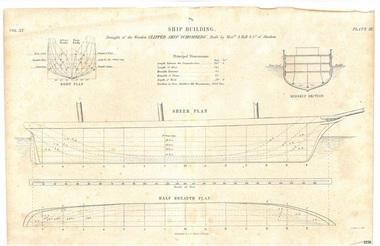
... Scottish printer and publisher. After his death his son became the sole proprietor of the firm until he sold it in 1876. The draft plan uses the vessel Schomberg as its example ship building plan for demonstration purposes. It is significant for its association with the Victorian Heritage Registered shipwreck, the Schomberg. It is an example of a shipo building plan. The Schomberg collection is primarily significant because of the relationship between the objects, as together they have a high potential to interpret the story ...This draft plan, a line etching, is of the wooden clipper ship "Schomberg" . It can be assumed from the heading "Ship Building." and the phrase "Built by Messrs. A Hall & Co. of Aberdeen" that the drawing is an example of plans for building a ship, and that the Schomberg ship has chosen to demonstrate this. The plan may have possibly been in a book, as it is made from two well-joined pieces of paper. The original plans would have been drawn up, discussed, reviewed and drawn in more detail before the building of the ship in Aberdeen, Scotland, in 1855. Information on the draft Is as follows: “Principal dimensions: Length between the perpendiculars: 262 feet 6 inches Length of keel 245 feet Breadth extreme: 45 feet Breadth of frame: 42 feet Depth of hold: 29 feet 9 inches Burthen in tons, Builders Old Measurement: 2600 Tons” The publisher firm A & C Black, was founded by Adam and Charles Black in Edinburgh in 1807. Over the years the company has published editions of Encyclopedia Britannica and Whose Who, and reference books, guides and technical books. The printer G Aikman (1788-1865) or his son G Aikman (1830-1905), were both named George. George senior was an early-19th century Scottish printer and publisher. After his death his son became the sole proprietor of the firm until he sold it in 1876. The draft plan uses the vessel Schomberg as its example ship building plan for demonstration purposes. It is significant for its association with the Victorian Heritage Registered shipwreck, the Schomberg. It is an example of a shipo building plan. The Schomberg collection is primarily significant because of the relationship between the objects, as together they have a high potential to interpret the story of the Schomberg. The Schomberg collection is archaeologically significant as the remains of an international passenger ship. The shipwreck collection is historically significant for representing aspects of Victoria’s shipping history and its potential to interpret sub-theme 1.5 of Victoria’s Framework of Historical Themes (living with natural processes). The collection is also historically significant for its association with the shipwreck and the ship, which was designed to be fastest and most luxurious of its day. The Schomberg collection meets the following criteria for assessment: Criterion A: Importance to the course, or pattern, of Victoria’s cultural history. Criterion B: Possession of uncommon, rare or endangered aspects of Victoria’s cultural history. Criterion C: Potential to yield information that will contribute to an understanding of Victoria’s cultural history.Plan; line engraving; draft of the wooden clipper ship 'Schomberg', built in 1855. The drawing on cream paper is made from two well- joined pages. The drawing gives the principal dimensions and labels for the Body Plan, Middle Section, Sheer Plan and Half Breadth Plan. Inscriptions are on the drawing and its rough cardboard storage folder. Publisher: A & C Black. Edinburgh. Printer: G. Aikman sc. EdinborughOn drawing: "SHIP BUILDING" "Draught of the Wooden CLIPPER SHIP SCHOMBERG", Buiilt by Messrs A Halt & Co. of Aberdeen" "Vol XX" "Plate III" "Principal Dimensions""BODY PLAN" "MIDDLE SECTION" "SHEER PLAN" "HALF BREDTH PLAN" "Published by A & C Black, Edinburgh" "G Aikman sc. Edinr" On storage folder: "Receipt Number 381A: "Line engraving draught of wooden ship "Schomberg" "warrnambool, flagstaff-hill-maritime-museum, shipwreck-coast, schomberg, schomberg plan, vessel schomberg, ship building, g. aikman ship plan draftsman, a.& c. black publisher aberdoon, a. hall & co. maker aberdeen, peterborough, clipper ship, captain forbes, black ball line, ship's plan, ship's drawing, line drawing, vessel plan, draft plan, line engraving, vol xx plate iii, a & c black, ship building example drawing, g aikman, 19th century -
 Mission to Seafarers Victoria
Journal (item) - Periodicals-Annual, Shiplovers' Society of Victoria, The Annual Dog Watch
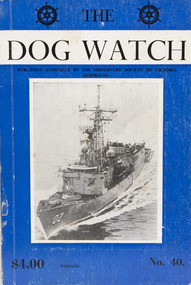
... Story of Two Dogs - Captain Laurie Gibson - 87 Adventure and Misadventure - K. S. Bull - 93 Moonstruck - Captain P. J. Elsey - 96 Confirmation of the Flood? - Doctor J. C. Anderson - 98 The "Scottish...Story of Two Dogs - Captain Laurie Gibson - 87 Adventure and Misadventure - K. S. Bull - 93 Moonstruck - Captain P. J. Elsey - 96 Confirmation of the Flood? - Doctor J. C. Anderson - 98 The "Scottish ...This journal provides the reader with glimpses of the adventures and hardships of a seaman's life. Many of the stories are of sailing ships.Contributes to our knowledge of the importance of shipping and places on record those stories of the sea which would otherwise be lost.Contents Foreword - His Excellency Rear Admiral Sir Brian Murray, K.C.M.G., A.O., K.St.J. - 5 Editorial - Joyce M. B. Lambert - 7 Thirty Years at Garden Island - Illingworth Mackay - 11 Swedish Christmas in New Guinea Waters - Joyce M. B. Lambert - 26 A Gentlemen's Disagreement - Capt. W. Sheffield-Williamson - 34 Around the Horn in "Falls of Clyde" - Capt. Frederick S. Moody, Jnr. - 37 Off the Beaten Track - Mrs. Mary Mithassel - 46 Greek Determination - W. P. Shemmeld - 51 Wharf Cats and Psychology - J.M.B.L. - 56 The Sailor's Wife - C. E. Bonwick - 57 The Dog Watch -- A Tribute to S. A. E. Strom - C. E. - - 58 Behind the Scenes of Captain's Courageous - Capt. Fred Klebingat - 63 Human Error - R. N. Thiele -66 Pay Up - Alex Duffield - 70 Letters from the Barque "Garthneill" Apprentice Colin Goss - 73 Drake and his Treasure - Captain R. G. Edwards - 82 The Story of Two Dogs - Captain Laurie Gibson - 87 Adventure and Misadventure - K. S. Bull - 93 Moonstruck - Captain P. J. Elsey - 96 Confirmation of the Flood? - Doctor J. C. Anderson - 98 The "Scottish Glens" - Captain W. J. Cowling - 100 'Couta Boats at the "Cliff" - Tim Phillips - 107 "Marco Polo" - Extracts - 111 Sailors at Westminster Abbey - E. Harper - 115 Book Reviewssailing ships, steamships, shipping, seafaring life, shiplovers' society of victoria, dog watch -
 Marysville & District Historical Society
THE TRIANGLE NEWS-VOL 33 NO 1-JANUARY 20 2006
... marysville victoria australia australia day jazz the queen's baton three ambassadors across shire mops thank you christmas appeal church notices women of hope marysville cricket weight loss inspirational story diary dates scottish country & morris dancing advertising rates deadline thornton marysville r.s.l. sub branch disclaimer fire calls what's on when informative ladies black spur inn narbethong annual buxton community christmas bbq football lions club THE TRIANGLE NEWS-VOL 33 NO 1-JANUARY 20 2006 ...marysville, victoria, australia, australia day, jazz, the queen's baton, three ambassadors across shire, mops, thank you christmas appeal, church notices, women of hope, marysville cricket, weight loss inspirational story, diary dates, scottish country & morris dancing, advertising rates, deadline, thornton marysville r.s.l. sub branch, disclaimer, fire calls, what's on when, informative ladies, black spur inn, narbethong, annual buxton community christmas bbq, football, lions club -
 Flagstaff Hill Maritime Museum and Village
Artwork, other - Framed poster, Tim Walker, Loch Ard Shipwreck, circa 2010
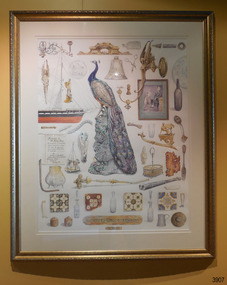
... stories. He soon became involved in the Warrnambool and District Artists’ Society, where he has served for a period as President. In 2010 Warrnambool Art Gallery hosted an exhibition “Nine Lives” with works from nine local artists including Tim Walker. The ‘LOCH ARD’ 1873-1878 - brief history The clipper ship ‘Loch Ard’ was a built in Scotland...stories. He soon became involved in the Warrnambool and District Artists’ Society, where he has served for a period as President. In 2010 Warrnambool Art Gallery hosted an exhibition “Nine Lives” with works from nine local artists including Tim Walker. The ‘LOCH ARD’ 1873-1878 - brief history The clipper ship ‘Loch Ard’ was a built in Scotland ...Tim Walker’s work is an eye-catching array of shipwreck artefacts and associated items. They help tell the story of the 19th century ships that travelled across the world full of people and cargo that are now part of our history. The work was commissioned especially for Flagstaff Hill and highlights the famous story of the 1878 ‘Loch Ard’ shipwreck. The images also include two small items from the 1981 ‘Fiji’ shipwreck. Local professional artist Timothy “Tim” Walker was born in Britain in 1970. He was self-taught had the desire to use his talents for full-time work. He specialised in painting local scenes, landscape and people of Warrnambool and district after he moved there in 1990. As he worked at the location of his subjects, people often told him interesting and amusing stories. He soon became involved in the Warrnambool and District Artists’ Society, where he has served for a period as President. In 2010 Warrnambool Art Gallery hosted an exhibition “Nine Lives” with works from nine local artists including Tim Walker. The ‘LOCH ARD’ 1873-1878 - brief history The clipper ship ‘Loch Ard’ was a built in Scotland in 1873. In 1978 the ship was sailing to Melbourne with 54 people on board as well as a mixed cargo of items, some of which were bound for the 1880 International Exhibition in Melbourne. On June 1st 1878 it was very close to its destination when it crashed into Mutton Bird Island, east of Port Campbell. Only two people survived. The wreck was re-discovered in 1967, almost a century later, and the site continues to provide evidence of the range of goods imported into the Colony of Victoria in the post-Gold Rush era. Flagstaff Hill divers in the 1970s reported finds of “Bottles of champagne, window panes, rolls of zinc, barrels of cement, iron rails, clocks, lead shot, corrugated iron, lead, marble, salad oil bottles, ink bottles, copper wire, gin bottles, rolls of carpet, floor tiles, copper rivets, gas light fittings, pocket knives, toys, crystal chandeliers, beer mugs, cutlery, candles sticks, wick scissors, cow bells, and sauce bottles.” The famous Loch Ard Peacock was also on board. The ‘FIJI’ 1875-1891 – brief history The barque ‘Fiji’ was built in Ireland in 1875. The sailing ship left Hamburg in May 1891, bound for Melbourne with a crew of twenty-five plus the captain. The ‘Fiji’ had almost reached her destination after a trip of 100 days at sea when, on September 5th 1891, she struck rock 300 metres from the shore at Moonlight Head, near Cape Otway. Eleven men lost their lives but with the help of locals including members of the Rocket Rescue Crew, the rest of the men were saved. In anticipation of Christmas, the cargo had included a wide variety of children’s toys, amongst which were dolls with china limbs, wooden rocking horses, miniature ships, and red and white rubber balls. There were also cases of dynamite, pig iron, steel goods, spirits, sailcloth, tobacco, fencing wire, concrete, 400 German pianos, concertinas and other musical instruments, artists’ supplies, porcelain, furniture, china and candles. This artwork has historical significance as it shows a small sample of the variety of items on board the late 19th century ships bound for Australia in the Colonial and late God Rush period. The cargo contained personal luggage, items intended as gifts, and goods ordered for domestic, commercial or industrial use. The wreck sites of both vessels, ‘Loch Ard’ and ‘Fiji’ are classified on the Victorian Heritage Register as significant and are now protected by government law. The sites are popular with divers and provide interpretive material regarding social and maritime history. Framed poster of a watercolour painting by Tim Walker, gilt frame, behind glass. Subject is a group of objects, most of which are connected with the 1878 shipwreck Loch Ard, such as items recovered from the shipwreck and the famous ‘Loch Ard Peacock’. Two items are from the wreck of the ‘Fiji’. Inscriptions on ingot, a handwritten letter, bell, clear bottle, and small plaque.On ingot: “PONTIFEX & WOOD. LONDON”. On letter: “Presented to Mr. Thomas Pearce”. On small ingot: “TIM WALKER”. On bell: “LOCH ARD”. On clear bottle “THE SINGER MANUFACTURING COMPANY“. On plaque: TIM WALKER”.warrnambool, flagstaff hill maritime museum, maritime museum, shipwreck coast, flagstaff hill maritime village, great ocean road, flagstaff hill, loch ard, fiji, watercolour, timothy walker, tim walker, warrnambool & district artists’ society, warrnambool art gallery, poster, henna street picture framers, cargo, print -
 Flagstaff Hill Maritime Museum and Village
Container - Stone Ware Bottle, Port Dundas Pottery, Circa early 1870's
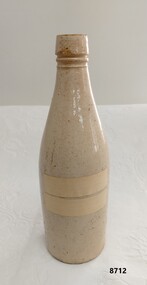
... Scotland. The shipwreck of the Loch Ard is of significance for Victoria and is registered on the Victorian Heritage Register ( S 417). Flagstaff Hill has a varied collection of artefact's from Loch Ard and its collection is significant for being one of the largest accumulation of artefact's from this notable Victorian shipwreck of which the subject items are a small part. The collection's objects give us a snapshot of how we can interpret the story ...This bottle was made at the Dundas Pottery Works, in Glasgow, Scotland and recovered from the shipwreck of the Loch Ard. Stoneware bottles similar to this one were in common use during the mid-to-late 19th century. They were used to store and transport beverages like ginger beer, porter or stout. The bottles were handmade using either a potter's wheel or in moulds such as a plaster mould, which gave the bottles uniformity in size and shape. The bottle would then be fired and glazed in a hot kiln. Makers often identified their bottles with the impression of a small symbol or adding a colour to the mouth. The manufacturer usually stamped their bottles with their name and logo, and sometimes a message that the bottle remained their property and should be returned to them. The bottles could then be cleaned and refilled. DUNDAS POTTERY WORKS - The Dundas Pottery works were established in 1828 by William Johnstone in partnership with John Forsyth and John Mc Coll. Located where the Forth and Clyde Canal joined the Monkland Canal, North of Glasgow. Johnstone sold the pottery in 1835 to Robert Cochran and James Couper. Mc Coll was retained as manager until 1837when in 1839 Cochran & Couper sold the pottery and purchased the St Rollex Glass Works. George Duncan took over briefly but died in 1841, with the pottery possibly being run by his widow Helen and a potter named Alexander Paul. James Miller was the manager at the time and he bought the pottery in 1856, in partnership with John Moody. Miller's long and careful stewardship of the pottery saw success from the export market which allowed him to purchase the North British pottery in 1867 until 1874 when it was sold. In 1875, Miller, in partnership with John Young, leased part of Caledonian Pottery, naming it Crown Pottery, however, it burned down in 1879. In the early 1880s, Young extended the pottery and named it Milton Pottery. Miller’s son, James W., became a partner in Milton pottery in 1905. James Miller Snr died in 1905 and the company continued as a limited liability company, being sold to the Borax Consolidation Ltd in 1929, but it was unsuccessful and Possil pottery purchased some of the company's equipment before it finally closed in 1932. From 1828 until the James Miller period of circa 1856, the pottery produced salt-glazed stoneware for the local industrial trade; mainly bottles and drain pipes. James Miller produced various bottles, whisky and acid jars, casks, butter crocks, jam jars and domestic wares in Bristol glaze. He streamlined the water filter manufacturing, which had become a specialty of the pottery, and a dedicated section of the pottery was created solely for their production, which was exported worldwide. It was salvaged from the Loch Ard. The ship Loch Ard was built on the River Clyde in Scotland in 1873 for the prestigious Loch Line of colonial clipper ships, designed for the Australian run. It sailed from England on 1 March 1878 carrying 37 crew, 17 passengers and a diverse general cargo ranging from luxury items to bulk railway iron. On 1 June 1878, emerging from fog and hearing too late the sound of breakers against the tall limestone cliffs, the vessel struck the southern foot of Mutton Bird Island and sank in 23 metres of water. Of the fifty-four people on board only two survived, one young male crewman, Tom Pearce, and one young female passenger, Eva Carmichael. This ink bottle was given to George Shields - a member of the Shields family who have had a long association with the wreck of the Loch Ard. In 1878, following the wreck of the Loch Ard and the subsequent rescue of Eva Carmichael, Eva was taken to Glenample station (near Princetown) to recuperate. It was during this period that Eva became great friends with Jane Shields (an Aunt of George Shields) - a friendship that continued throughout their lives. At that time, Jane was a young woman living in Princetown with her parents and siblings. Many of the Shields family continued to have a great interest in the Loch Ard and several generations of the family are buried in the Loch Ard cemetery.This stoneware bottle is historically significant for its manufacture and use in trade and transport in the late 19th to the early 20th century. This bottle is historically significant for its connection with the well-known stoneware manufacturers, Dundas Pottery of Glasgow, Scotland. The shipwreck of the Loch Ard is of significance for Victoria and is registered on the Victorian Heritage Register ( S 417). Flagstaff Hill has a varied collection of artefact's from Loch Ard and its collection is significant for being one of the largest accumulation of artefact's from this notable Victorian shipwreck of which the subject items are a small part. The collection's objects give us a snapshot of how we can interpret the story of this tragic event. The collection is also archaeologically significant as it represents aspects of Victoria's shipping history that allows us to interpret Victoria's social and historical themes of the time. Through is associated with the worst and best-known shipwreck in Victoria's history.A beige coloured,salt glazed stoneware bottle with gently tapered sides and a speckled finish. It has two narrow channels around the neck and is missing a stopper. Two 8.5 centimetre pieces of tape, with very faded writing, are stuck horizontally on the side of the bottle. The bottom of the bottle has brown discolouration. It has an oval shaped stamp with a makers' name and location on bottom side of bottle.On tape - "STONE BOTTLE SALVAGED / FROM WRECK OF LOCH ARD/ SUNK NEAR PORT CAMPBELL/ ? 1878" "1624 TNS SAILING SHIP / ONLY 2 SURVIVORS OUT OF / 54 PEOPLE ON BOARD/ NOW KNOWN AS LOCH ARD GORGE" Stamp - "PORT DUNDAS POTTERY / GLASGOW" Symbol - Stamp square with "D"flagstaff hill maritime museum and village, warrnambool, great ocean road, shipwreck coast, loch ard, stoneware bottle, port dundas pottery, shields family, ginger beer bottle, loch ard salvage, loch ard artefact -
 Flagstaff Hill Maritime Museum and Village
Book - Fiction, Mrs Herbert Strang, editor, The Rose Book for Girls, 1916
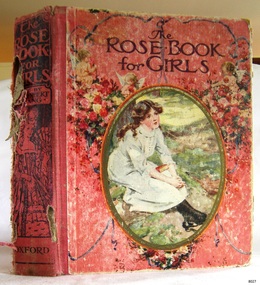
... The Rose Book for Girls A collection of short stories by various authors Edited by Mrs Herbert Strang Publisher: Henry Frowde, Hodder & Stoughton, London Printer: Morrison & Gibb Ltd., Tanfield, Edinburgh, Scotland, UK Date: 1916 Hardcover book. ...Conn, Teacher" The Rose Book for Girls A collection of short stories by various authors Edited by Mrs Herbert Strang Publisher: Henry Frowde, Hodder & Stoughton, London Printer: Morrison & Gibb Ltd., Tanfield, Edinburgh, Scotland, UK Date: 1916 Hardcover book. ...Alma McCullagh was a student at the Presbyterian Sabbath School located in Dennington, near Warrnambool. In January, around 1928, she received a book as an award from R. Conn, her Sabbath School teacher, in recognition of her involvement and achievements at the school. The exact year of this award is based on available records: in January 1928, Alma was presented with a prize by R. Conn, whereas by 1930, the role of awarding prizes had passed to F. Jones. Alma was probably the granddaughter of James McCullagh (1831–1911) and Elizabeth Eccles (1831–1909), who were pioneering settlers in the region. James and Elizabeth married in 1856 and established their home at Oak Grove, Yangery, Illowa from 1859, residing there until their deaths. One of their sons, William McCullagh (1873–1940), married Margaret Jane Russell (1879–1981). William and Margaret continued the family tradition, making their home at Oak Grove as well. They raised eleven children, with Alma likely being among the youngest of their children.The book, “The Rose Book for Girls”, edited by Mrs Herbert Strang, represents an example of literature accessible to older girls during the early 20th century. It was specifically selected as an end-of-year award, recognising consistent attendance at Sabbath School. Such choices highlight the role of books in supporting the educational and moral development of young women during this period. The book is important as a connection to the early township of Dennington, a community distinguished by its established school and church. This association reflects the values the community placed on education and religious instruction. The book’s significance is further enhanced by its relationship with colonial pioneer families in Australia, particularly those from Victoria and the Warrnambool district in southwest Victoria. It is a tangible link to the history and legacy of these early settlers, who were instrumental in shaping the regional development. In addition, the book is notable for its connection to the McCullagh family, a prominent farming family whose contributions supported the social and economic growth of the local district. This historical association enriches its value, situating the book within the broader narrative of community progress and pioneer achievement in the area, and highlighting its place within a tradition of religious life and community building.The Rose Book for Girls A collection of short stories by various authors Edited by Mrs Herbert Strang Publisher: Henry Frowde, Hodder & Stoughton, London Printer: Morrison & Gibb Ltd., Tanfield, Edinburgh, Scotland, UK Date: 1916 Hardcover book. Deep pink front and back covers, decorated with garlands of pink and white flowers, cupids and blue ribbons. The front has a cameo with a seated girl in white, with a book in her lap. Details on the spine: title, author, publisher and a sketched female in 19th-century dress holding a fan. The fly page shows details of the book and has a black and red sketch of two seated girls, one reading, the other stitching. Twenty-five books are listed on the Contents page, as well as the printer's details. Within the book are several colourful sketches. Inscriptions include the name of the book's previous owner, Alma McCullagh.Front loose-end paper: "Presbyterian Sabbath School, Dennington. Prize Awarded to: Alma McCullagh. January. (year is unreadable, circa 1928) R. Conn, Teacher"flagstaff hill, flagstaff hill maritime museum and village, warrnambool, maritime museum, maritime village, great ocean road, shipwreck coast, book, the rose book for girls, mrs herbert strang, short stories, henry frowde, hodder & stoughton, london, morrison & gibb ltd, 1916, alma mccullagh, james mccullagh, elizabeth eccles mccullagh, ca. 1928, dennington, southwest victoria, warrnambool district, presbyterian sabbath school, presbyterian sunday school, dennington presbyterian church, book award, book prize, book presentation, r. conn, sabbath school superintendent -
 Flagstaff Hill Maritime Museum and Village
Book - A Fictional Story, Ouida (Maria Louise Ramé), A Dog of Flanders, 1873
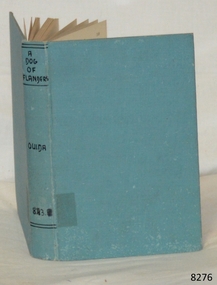
... stories and animal centrist narratives. Ouida was a passionate defender of animal rights and an active anti-vivisectionist, which heavily influenced the empathetic, protective lens through which she wrote about dogs. In later life, despite her substantial earnings, her penchant for luxury, excessive spending, and supporting countless stray dogs eventually bankrupted her. She died in poverty in Viareggio, Italy. The publisher George Robertson (1825–1898) was a towering figure in the 19th-century Australian book trade, effectively operating as the country's first major publisher and bookseller. Born in Glasgow, Scotland...stories and animal centrist narratives. Ouida was a passionate defender of animal rights and an active anti-vivisectionist, which heavily influenced the empathetic, protective lens through which she wrote about dogs. In later life, despite her substantial earnings, her penchant for luxury, excessive spending, and supporting countless stray dogs eventually bankrupted her. She died in poverty in Viareggio, Italy. The publisher George Robertson (1825–1898) was a towering figure in the 19th-century Australian book trade, effectively operating as the country's first major publisher and bookseller. Born in Glasgow, Scotland ...A Dog of Flanders (originally published in 1872) is a deeply moving, bittersweet story set in Belgium. It follows Nello, an impoverished orphan boy with a passion for art, and Patrasche a loyal, cart-pulling, abandoned, and abused draft dog whom Nello and his gentle grandfather, Jehan Daas, rescue and nurse back to health. The story focuses on the bond between Nello and Patrasche as they become inseparable, helping the aging Jehan pull a milk cart into Antwerp each day to earn a meagre living. Nello longs to become a great painter like the Baroque master Peter Paul Rubens. His only hope is to win a prestigious local drawing contest with a portrait he has laboured over. After a series of devastating setbacks his grandfather passes away, they are evicted, and Nello loses the drawing competition he and Patrasche his cart pulling dog seek shelter from a freezing Christmas Eve blizzard inside the Cathedral of Our Lady in Antwerp. There, Nello finally gazes upon Rubens’s shielded masterpieces, The Descent from the Cross and The Elevation of the Cross. The story ends sadly as, the next morning, the loyal dog and the young boy are found frozen to death, locked in a final embrace in front of the altar.Hard cover book, A Dog of Flanders Author: Ouida (Maria Louise Ramé) Publisher: George Robertson Date: 1873 Further Information: Blue cloth hardcover and spine with spine lettering in black texter. The spine has a Library label with inscription. fictionA Dog of Flanders (originally published in 1872) is a deeply moving, bittersweet story set in Belgium. It follows Nello, an impoverished orphan boy with a passion for art, and Patrasche a loyal, cart-pulling, abandoned, and abused draft dog whom Nello and his gentle grandfather, Jehan Daas, rescue and nurse back to health. The story focuses on the bond between Nello and Patrasche as they become inseparable, helping the aging Jehan pull a milk cart into Antwerp each day to earn a meagre living. Nello longs to become a great painter like the Baroque master Peter Paul Rubens. His only hope is to win a prestigious local drawing contest with a portrait he has laboured over. After a series of devastating setbacks his grandfather passes away, they are evicted, and Nello loses the drawing competition he and Patrasche his cart pulling dog seek shelter from a freezing Christmas Eve blizzard inside the Cathedral of Our Lady in Antwerp. There, Nello finally gazes upon Rubens’s shielded masterpieces, The Descent from the Cross and The Elevation of the Cross. The story ends sadly as, the next morning, the loyal dog and the young boy are found frozen to death, locked in a final embrace in front of the altar.flagstaff hill, warrnambool, shipwrecked coast, flagstaff hill maritime museum, maritime museum, shipwreck coast, flagstaff hill maritime village, great ocean road, book, pattison collection, warrnambool library, warrnambool mechanics’ institute, ralph eric pattison, corangamite regional library service, warrnambool city librarian, mechanics’ institute library, victorian library board, warrnambool books and records, warrnambool children’s library, a dog of flanders, ouida, maria louise ramé, marie louise de la ramée -
 Flagstaff Hill Maritime Museum and Village
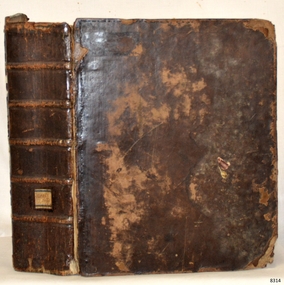
Book - Reference Bible, Mark & Charles Kerr, The Holy Bible 1789 (King James Version), 1789
... Scottish book production. At well over 230 years old, any book from the 1700s holds an inherent baseline historical value, but age alone doesn't automatically equal immense rarity in the Bible market, since Bibles were the most frequently printed and carefully preserved books of the era. However, we can assume that given the provenance in the handwritten inscriptions and its historical context, this work can be regarded as exceptional. The surnames written in the Bible point to the evolution from Robert Fay to Robert Wayne, telling a specific story ...The subject Bible is an incredible piece of history in the Pattison Collection. A Bible printed in 1789 with a personal handwritten inscription from 1792 is a true artefact of the late 18th century. The information on the book's title page refers to King George III, as Mark and Charles Kerr were prominent Scottish printers and stationers based in Edinburgh. In the 18th century, printing the Holy Bible wasn't something just anyone could do; it required a royal patent granted by the Crown to ensure textual accuracy and high-quality production. The Kerr family held the coveted title of "King's Printers for Scotland" during the late 1700s. Bibles from their press were highly regarded for their clear typography, sturdy leather bindings, and standard-setting quality. Owning an Edinburgh-printed royal edition like the subject publication was a point of pride for families across the English-speaking world.The Holy Bible 1789 Publisher: Mark & Charles Kerr His Majesty's Printers Date: 1789 Further Information : non-fictionThe subject Bible is an incredible piece of history in the Pattison Collection. A Bible printed in 1789 with a personal handwritten inscription from 1792 is a true artefact of the late 18th century. The information on the book's title page refers to King George III, as Mark and Charles Kerr were prominent Scottish printers and stationers based in Edinburgh. In the 18th century, printing the Holy Bible wasn't something just anyone could do; it required a royal patent granted by the Crown to ensure textual accuracy and high-quality production. The Kerr family held the coveted title of "King's Printers for Scotland" during the late 1700s. Bibles from their press were highly regarded for their clear typography, sturdy leather bindings, and standard-setting quality. Owning an Edinburgh-printed royal edition like the subject publication was a point of pride for families across the English-speaking world.flagstaff hill, warrnambool, shipwrecked coast, flagstaff hill maritime museum, maritime museum, shipwreck coast, flagstaff hill maritime village, great ocean road, book, pattison collection, warrnambool library, warrnambool mechanics’ institute, ralph eric pattison, corangamite regional library service, warrnambool city librarian, mechanics’ institute library, victorian library board, warrnambool books and records, warrnambool children’s library, the holy bible 1789, the holy bible -
 Orbost & District Historical Society
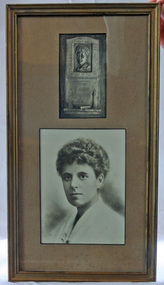
framed photograph, C1900
... Scotland, and his wife Margaret Jennings, née Clark, from Cornwall, England. . About 1880 the family moved to Gippsland where Henderson managed a station near Orbost. Grace learned to love the Gippsland forest. She began to express in verse her understanding of the sights, scents and sounds of the bush, often writing in some remote clearing, her manuscripts stored for privacy in a hollow trunk. The Bairnsdale Advertiser published her first story...Scotland, and his wife Margaret Jennings, née Clark, from Cornwall, England. . About 1880 the family moved to Gippsland where Henderson managed a station near Orbost. Grace learned to love the Gippsland forest. She began to express in verse her understanding of the sights, scents and sounds of the bush, often writing in some remote clearing, her manuscripts stored for privacy in a hollow trunk. The Bairnsdale Advertiser published her first story ...Link to 524. Grace Elizabeth Jennings Carmichael (1867-1904), poet and nurse, was born on 24 February 1867 at Ballarat, Victoria, daughter of Archibald Carmichael, a miner from Perthshire, Scotland, and his wife Margaret Jennings, née Clark, from Cornwall, England. . About 1880 the family moved to Gippsland where Henderson managed a station near Orbost. Grace learned to love the Gippsland forest. She began to express in verse her understanding of the sights, scents and sounds of the bush, often writing in some remote clearing, her manuscripts stored for privacy in a hollow trunk. The Bairnsdale Advertiser published her first story, and the Weekly Times an early poem; then on 28 November 1885 her poem 'The Old Maid' was published in the Australasian under her pen name Jennings Carmichael. Encouraged by its editor, David Watterston, Grace sent nearly all her subsequent verse to that newspaper. (Read more by Lindsay Gardiner in Australian Dictionary of Biography.)This is significant to the Orbost region in that it is associated with a woman who is certainly our foremost female poet.A framed photograph of a plaque above a photograph of head and shoulders of a woman. They are framed in a gold wooden frame and mounted on a light brown buff card.carmichael-jennings-grace poet memorial-plaque memento -
 Orbost & District Historical Society
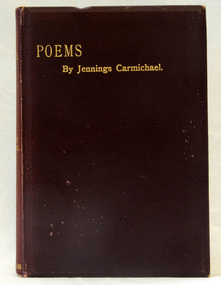
book, Ballantyne, Hanson & Co, Poems, 1895
... Scotland, and his wife Margaret Jennings, née Clark, from Cornwall, England. . About 1880 the family moved to Gippsland where Henderson managed a station near Orbost. Grace learned to love the Gippsland forest. She began to express in verse her understanding of the sights, scents and sounds of the bush, often writing in some remote clearing, her manuscripts stored for privacy in a hollow trunk. The Bairnsdale Advertiser published her first story...Scotland, and his wife Margaret Jennings, née Clark, from Cornwall, England. . About 1880 the family moved to Gippsland where Henderson managed a station near Orbost. Grace learned to love the Gippsland forest. She began to express in verse her understanding of the sights, scents and sounds of the bush, often writing in some remote clearing, her manuscripts stored for privacy in a hollow trunk. The Bairnsdale Advertiser published her first story ...Grace Elizabeth Jennings Carmichael (1867-1904), poet and nurse, was born on 24 February 1867 at Ballarat, Victoria, daughter of Archibald Carmichael, a miner from Perthshire, Scotland, and his wife Margaret Jennings, née Clark, from Cornwall, England. . About 1880 the family moved to Gippsland where Henderson managed a station near Orbost. Grace learned to love the Gippsland forest. She began to express in verse her understanding of the sights, scents and sounds of the bush, often writing in some remote clearing, her manuscripts stored for privacy in a hollow trunk. The Bairnsdale Advertiser published her first story, and the Weekly Times an early poem; then on 28 November 1885 her poem 'The Old Maid' was published in the Australasian under her pen name Jennings Carmichael. Encouraged by its editor, David Watterston, Grace sent nearly all her subsequent verse to that newspaper. (Read more by Lindsay Gardiner in Australian Dictionary of Biography.) This is a useful collection of the poetry of Jennings Carmichael, a leading Australian poet who spent much of her childhood in Orbost.A 212 pp cloth bound book with a dark purple cover and gold print on the spine and front - "Poems by Jennings Carmichael".Inside cover.carmichael-jennings literature poetry -
Glenelg Shire Council Cultural Collection
Book, Arthur Erskine's Story: a Tale of the Days of Knox, 1884
... Scotland at the time of the Reformation in the mid sixteenth century. Dark green cloth-covered board covers and spine. Red borders impressed on cover. Graphics on cover and spine in red and black and gold. Arthur Erskine's Story ...An historical tale set in Scotland at the time of the Reformation in the mid sixteenth century.Dark green cloth-covered board covers and spine. Red borders impressed on cover. Graphics on cover and spine in red and black and gold.An historical tale set in Scotland at the time of the Reformation in the mid sixteenth century.reformation, fiction, scotland -
Phillip Island and District Historical Society Inc.
Book, AGUIILAR, Grace, Days of Bruce : a story from Scottish history, 1870
... Days of Bruce : a story from Scottish history Book AGUIILAR, Grace Groombridge ... -
 Orbost & District Historical Society
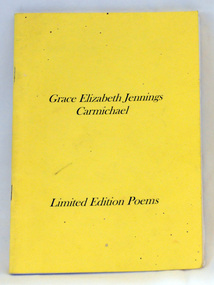
book, Grace Elizabeth Jennings Carmichael
... Scotland, and his wife Margaret Jennings, née Clark, from Cornwall, England. . About 1880 the family moved to Gippsland where Henderson managed a station near Orbost. Grace learned to love the Gippsland forest. She began to express in verse her understanding of the sights, scents and sounds of the bush, often writing in some remote clearing, her manuscripts stored for privacy in a hollow trunk. The Bairnsdale Advertiser published her first story...Scotland, and his wife Margaret Jennings, née Clark, from Cornwall, England. . About 1880 the family moved to Gippsland where Henderson managed a station near Orbost. Grace learned to love the Gippsland forest. She began to express in verse her understanding of the sights, scents and sounds of the bush, often writing in some remote clearing, her manuscripts stored for privacy in a hollow trunk. The Bairnsdale Advertiser published her first story ...This book was produced with a grant from the Victorian Government Dept of State and Regional Development. Grace Elizabeth Jennings Carmichael (1867-1904), poet and nurse, was born on 24 February 1867 at Ballarat, Victoria, daughter of Archibald Carmichael, a miner from Perthshire, Scotland, and his wife Margaret Jennings, née Clark, from Cornwall, England. . About 1880 the family moved to Gippsland where Henderson managed a station near Orbost. Grace learned to love the Gippsland forest. She began to express in verse her understanding of the sights, scents and sounds of the bush, often writing in some remote clearing, her manuscripts stored for privacy in a hollow trunk. The Bairnsdale Advertiser published her first story, and the Weekly Times an early poem; then on 28 November 1885 her poem 'The Old Maid' was published in the Australasian under her pen name Jennings Carmichael. Encouraged by its editor, David Watterston, Grace sent nearly all her subsequent verse to that newspaper. (Read more by Lindsay Gardiner in Australian Dictionary of Biography.)This is a useful collection of the poetry of Jennings Carmichael, a leading Australian poet who spent much of her childhood in Orbost.A thin, stapled, yellow covered paperback book. It is titled "Grace Elizabeth Jennings Carmichael" and is a limited edition print of Carmichael's poetry. Print is black.poetry literature jennings-carmichael -
 Flagstaff Hill Maritime Museum and Village
Functional object - Hat box, early to mid-20th century
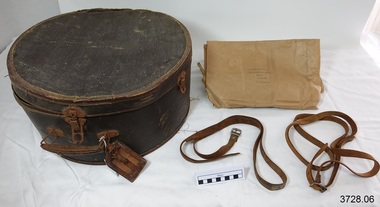
... Scotland to Katherine Robertson in Sale, Victoria. The postmark stamp shows it was sent in 1955. The paper had once been folded around something rectangular in shape, perhaps a book. The hat box was recently found by Archie’s daughter, niece of Katherine, when she was looking for something else in the ceiling of her home. The hat box had been there, with the brown paper wrapper inside, for about 30 years, forgotten by the family. There are no family members remaining now to tell the full story...Scotland to Katherine Robertson in Sale, Victoria. The postmark stamp shows it was sent in 1955. The paper had once been folded around something rectangular in shape, perhaps a book. The hat box was recently found by Archie’s daughter, niece of Katherine, when she was looking for something else in the ceiling of her home. The hat box had been there, with the brown paper wrapper inside, for about 30 years, forgotten by the family. There are no family members remaining now to tell the full story ...This large hat box was owned by Miss Katherine Robertson (now deceased). It was sold by Drews, a leather and travel goods shop in Melbourne, and has been made as good quality, sturdy travel luggage. It has its own leather luggage label buckled to the handle and there are remnants of labels on the base of the hat box, signifying that it has indeed been used as luggage. A hat box such as this one is made to protect, store and transport head wear. Hat boxes became popular in the 19th and early 20th century when hats were a part of the modern fashion. Inside the hat box is a brown paper wrapper with two Great Britain postage stamps attached. Both have the portrait image of Queen Elizabeth II (1) orange 1/2d (2) green ten pence. These stamps belong to the Wildings series and were issued 1952-1954. The wrapper was sent by J McGregor in Glasgow, Scotland to Katherine Robertson in Sale, Victoria. The postmark stamp shows it was sent in 1955. The paper had once been folded around something rectangular in shape, perhaps a book. The hat box was recently found by Archie’s daughter, niece of Katherine, when she was looking for something else in the ceiling of her home. The hat box had been there, with the brown paper wrapper inside, for about 30 years, forgotten by the family. There are no family members remaining now to tell the full story. ABOUT MISS KATHERINE ROBERTSON The Robertson family emigrated from the Isle of Wight and settled in Woorndoo, Western Victoria, Australia. Katherine Robinson was the 10th child of 13 children, born in 1906 and lived until 1995. The youngest child in the family was a boy named Archibald (Archie) who was born in 1911. His daughter is the donor of the hat box. Katherine went to school at Woorndoo and later became a trained teacher. She taught in many places, amongst them were Alexandria, Geelong, Sale, Stawell and Ballarat. People said “She was a school teacher 24 hours a day!” She was insistent on being called Miss Katherine Robinson, and no-one dare call her a shortened name in any way, not Kate, or Katie or even Kathie. She spoke with the authority of a teacher throughout her life, never asking but always giving her requests as orders. Miss Katherine Robinson remained single all her life. She bought items that were the best quality and workmanship, which gives reason for the strong and well-travelled hat box. She enjoyed going on trips and travelled the world twice. While on her journeys Katherine would knit Fair Isle patterned socks using fine 4 ply wool because she “Didn’t believe in wasting time!” Katherine’s niece remembers being in Melbourne at Station Pier, seeing her Aunt off on one of her journeys. She recalls the atmosphere and the colourful streamers in the air that celebrated the special occasion. Katherine travelled on the Oriana and Fair Star lines. ABOUT DREWS Drew’s, Leather Goods Specialists, was located at 70 Swanston St, corner of Queen’s Walk, Melbourne, at the time that this hat box was sold by the company. Queen’s Walk was constructed in 1889. It was a lavish ‘L’ shaped arcade that connected Swanston Street to Collins Street and was home to many specialist stores. In the 1950’s Drews address was advertised as Collins Street. In the late 1960’s Queen’s Walk was purchased by the Melbourne City Council and demolished in the early 1970’s, to be replaced by the Melbourne City Square. This very sturdy and good quality hat box is an example of travel luggage available to and used by the Victorian population of Australia in the early to mid-20th century. The retailer of this hat box, Drews, operated from premises on the corner of Swanston St and Queen’s Walk in Melbourne where many other specialist shops were located. Queen’s Walk was only in existence for around 70 years, 1889-late 1960, before it was demolished to make way for Melbourne’s City Square. Hat box, large, deep round shape with a straight section where lid is joined on at the back. Dated early to mid-1900’s. Brown coloured, textured heavy weight card box with folding metal carry handle, three clip closures for lid, metal hinge on back of lid. Purple maker’s label inside lid - DREWS, Leather Goods Specialists, Melbourne. Leather luggage tag has two rectangular cut-outs on front, attached with buckle strap. Underside of lid has two supporting leather straps attached to base. Base has inner cardboard liner around most of circumference. Contained inside are two leather straps with metal buckles. Label remnants, red, attached under base. Hat box was owned by Miss Katherine Robertson. Also inside is brown paper wrapper with three hand written addresses, in blue nib pen, and two attached Great Britain postage stamps, Queen Elizabeth II (1) Orange stamp, QE II, ½d (2) Green stamp, QE II, ten pence. It is postmarked [19] 55. Purple label has printing "70 SWANSTON STREET / Cr. QUEEN'S WALK / DREWS / LEATHER GOODS / SPECIALISTS / MELBOURNE". Wrapper inside has two hand written addresses (1J) Mrs. K. F. Robertson / 33 Mcalister Street / Sale / Victoria / Australia” (2) “from / J Mc Gregor / 15 Napier’s Hall St / Glasgow N W / Scotland” Postmark “ - -em 55” & “CLAS-“ OR “GLAS-“ [GLASGOW] flagstaff hill, warrnambool, shipwrecked coast, flagstaff hill maritime museum, maritime museum, shipwreck coast, flagstaff hill maritime village, great ocean road, luggage, hat box, hatbox, hat storage box, hat travel case, hat case, bandbox, drews melbourne, drew’s melbourne, drew’s handbags, travel goods, travel luggage, hat box suitcase, hat box luggage, 1952-1954 gb postage stamps 1/2d orange queen elizabeth ii, katherine robertson, archibald (archie) robertson of woorndoo, j mcgregor -
 Mission to Seafarers Victoria
Book, Nautical Association of Australia Inc, A Lucky Ship – Nine Lives of Australian Coaster Tambar 1912-1960, 2013
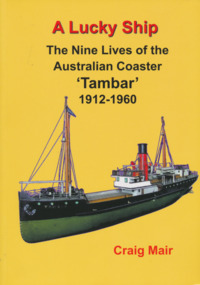
... The ANL has also been the sponsor of the Maritime Art Prize for many years. naa australian national line interest group moreton bay tambar coaster ships This high-quality book is the extraordinary story of an ordinary little ship that had a long and eventful life. Perhaps few Australian coasters have had a more interesting and varied history. Built in Scotland ...This high-quality book is the extraordinary story of an ordinary little ship that had a long and eventful life. Perhaps few Australian coasters have had a more interesting and varied history. Built in Scotland in 1912 for the North Coast Steam Navigation Company, Tambar worked as a lifeline to isolated river and island communities, first in New South Wales, then for the Tasmanian Government and Holymans in Bass Strait (King Island) and as the last steamer serving the Gippsland Lakes. In between she even spent a few years in Papua New Guinea. When World War II broke out, Tambar was commissioned into the RAN as an auxiliary minesweeper, but after the terrible Darwin air raid in 1942 became the first vessel of the newly formed Salvage Board, later assisting in the search for survivors of the Battle of the Coral Sea. Returning to Bass Strait in 1944 for a few more years, she then spent the 1950s on standby as a salvage vessel in Melbourne, working on Merilyn, Terawhiti, E.J. Fairnie, and River Burnett. Craig Mair grew up in Grangemouth, Scotland where Tambar was built, and became interested after inheriting a builder's model from his father. He has consulted thousands of records, including the ship's logs, tracked down witnesses, and assembled over 100 photographs and maps to give a unique insight into Tambar's story, and coastal Australia in the middle decades of the twentieth century, before roads took over the transport task. Besides many colourful stories of shipwrecks and strandings, strange cargoes, salty characters, exotic places, wartime air raids, and salvage jobs, the book includes a definitive account of the worst Second World War 'friendly fire' incident in Australian waters in Moreton Bay in 1942.250 pages, Appendices, Bibliography and Indices, extensively illustratednon-fictionThis high-quality book is the extraordinary story of an ordinary little ship that had a long and eventful life. Perhaps few Australian coasters have had a more interesting and varied history. Built in Scotland in 1912 for the North Coast Steam Navigation Company, Tambar worked as a lifeline to isolated river and island communities, first in New South Wales, then for the Tasmanian Government and Holymans in Bass Strait (King Island) and as the last steamer serving the Gippsland Lakes. In between she even spent a few years in Papua New Guinea. When World War II broke out, Tambar was commissioned into the RAN as an auxiliary minesweeper, but after the terrible Darwin air raid in 1942 became the first vessel of the newly formed Salvage Board, later assisting in the search for survivors of the Battle of the Coral Sea. Returning to Bass Strait in 1944 for a few more years, she then spent the 1950s on standby as a salvage vessel in Melbourne, working on Merilyn, Terawhiti, E.J. Fairnie, and River Burnett. Craig Mair grew up in Grangemouth, Scotland where Tambar was built, and became interested after inheriting a builder's model from his father. He has consulted thousands of records, including the ship's logs, tracked down witnesses, and assembled over 100 photographs and maps to give a unique insight into Tambar's story, and coastal Australia in the middle decades of the twentieth century, before roads took over the transport task. Besides many colourful stories of shipwrecks and strandings, strange cargoes, salty characters, exotic places, wartime air raids, and salvage jobs, the book includes a definitive account of the worst Second World War 'friendly fire' incident in Australian waters in Moreton Bay in 1942.naa, australian national line, interest group, moreton bay, tambar, coaster, ships -
 Orbost & District Historical Society
book, Highland Kitchen-Maid, 1850
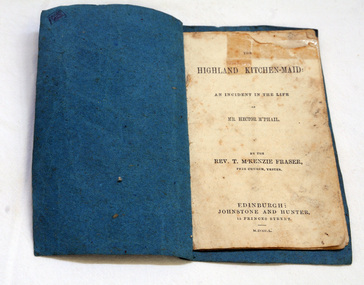
... This story is based on a well-known story about the christianisation of a poor servant-maid by a Scottish preacher named Hector McPhail....This story is based on a well-known story about the christianisation of a poor servant-maid by a Scottish preacher named Hector McPhail. ...This story is based on a well-known story about the christianisation of a poor servant-maid by a Scottish preacher named Hector McPhail.This book is an example of religious literature in the mid 19th century.A small paper back book. It has a blue paper cover with string binding. The 12 inside pages are white. The author is Rev. T. McKenzie Fraserreligious-book fraser-mckenzie -
 Eltham District Historical Society Inc
Book, Shillinglaw Family of Eltham: 1660-2007 by Margaret Ball, 2017
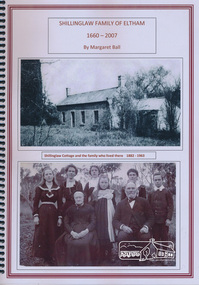
... Scotland and finally Australia." - page 3 Primarily a family history, the fifth chapter (page 44 - 103) concerns the family of Philip Shillinglaw and his his wife Sarah Ann (nee Kidd) and their family and their connection to Eltham and story of the Shillinglaw cottage. ...Scotland and finally Australia." - page 3 Primarily a family history, the fifth chapter (page 44 - 103) concerns the family of Philip Shillinglaw and his his wife Sarah Ann (nee Kidd) and their family and their connection to Eltham and story of the Shillinglaw cottage. shillinglaw family philip shillinglaw margaret ball shillinglaw cottage Book 3 (handwritten on page 2) Spiral Bound. ..."The information covers seven generations of the Shillinglaw family's journey, from England to Scotland and finally Australia." - page 3 Primarily a family history, the fifth chapter (page 44 - 103) concerns the family of Philip Shillinglaw and his his wife Sarah Ann (nee Kidd) and their family and their connection to Eltham and story of the Shillinglaw cottage. Spiral Bound. Text and photographs, some colour printed on one side (right) only. Includes index. 126 pagesBook 3 (handwritten on page 2)shillinglaw family, philip shillinglaw, margaret ball, shillinglaw cottage -
Eltham District Historical Society Inc
Document - Folder, Sutherland, Selina M
... Scotland, went to New Zealand, and became active in nursing. After an injury, she took a round tour by steamer, one stop being Melbourne where Sutherland stayed. She was involved in working in, or founding, various charities, importantly the Sutherland Homes for Neglected Children which, later, was donated land at Greensborough by Miss Meglin on which cottages were built. Contents Photocopy of booklet: "Selina M Sutherland: her life story...Scotland, went to New Zealand, and became active in nursing. After an injury, she took a round tour by steamer, one stop being Melbourne where Sutherland stayed. She was involved in working in, or founding, various charities, importantly the Sutherland Homes for Neglected Children which, later, was donated land at Greensborough by Miss Meglin on which cottages were built. Contents Photocopy of booklet: "Selina M Sutherland: her life story ...Selina Murray McDonald Sutherland was born in 1839 in Scotland, went to New Zealand, and became active in nursing. After an injury, she took a round tour by steamer, one stop being Melbourne where Sutherland stayed. She was involved in working in, or founding, various charities, importantly the Sutherland Homes for Neglected Children which, later, was donated land at Greensborough by Miss Meglin on which cottages were built. Contents Photocopy of booklet: "Selina M Sutherland: her life story and work" by J C Jessop, 3 June 1958.Newspaper clippings, A4 photocopies, etcjean sutherland, alexander sutherland, selina sutherland nee murray, john murray, george mcdonald, anne mcdonald, margaret sutherland, margaret grand nee sutherland, robert grant, alfredton propert of rutherfords, t w hickson, masterton hospital new zealand, wellington public hospital, maria lloyd armour, "the villa" cottage little collins street, alfred hospital melbourne, women's hospital melbourne, scot's church neglected children's society, melbourne district nursing society, presbyterian church of victoria, rev dr bevan, rev alex stewart, alfred deakin, alex peacock, george maxwell, samuel leon qc, the victorian neglected children's aid society, 68 latrobe street melbourne, janet lady clarke, ellen sanderson, melbourne hospital, sutherland home for neglected children, victorian neglected children's aid society, william keogh, miss meglin of greensborough, josiah thomas m h r, dr will maloney m h r, john leillillon m l a, john lemmon, ada wenborn, leslie m perrott and partners, l j owen and sons, lady angliss, lady warner, g rodd, j c jessop, d m finlay, j williamson, e l mead, e smythe -
Eltham District Historical Society Inc
Document - Folder, Mann, John and Violet and family
... story of Mann family, researched by descendant Lindsay Mann who grew up at the Mann property She-Oak at Yan Yean and has numerous family records. Newspaper article: "A realist who captures light," Diamond Valley News, 29 July 1986, David Moore, a realist painter had been working from a studio at Montsalvat and his exhibition of work from that period was to open 1 August 1986 at the Victorian Artists Society Galleries. John Manan Violet Mann nee McKimmie Clipper packet "Ellen Stuart" Forfar Scotland ...John Mann arrived from Forfar, Scotland, on the clipper packet "Ellen Stuart" in 1857 and rented a farm "Overton" at Janefield. Soon after he met Melbourne-born Violet McKimmie, whose parents had a property near Darebin Creek. They married on 25 September 1862, John 26 and Violet 19. In 1874 John selected a block on Arthurs Creek and built a slab and bark hut (still standing in 1984) and called their farm "Carseburn" after John's parish in Scotland. They had seven children: John, Jane, Christine, David, Walter, James and Violet. John was drowned in the Yarra in May 1875 and Violet struggled to meet the lease commitment. She wrote to her brother-in-law David Mann in New Zealand who came to her aid, and on 10 September 1876, they married at the Victorian Free church, Smith Street, Collingwood. They improved the farm and built a three-room house. in July 1883 they bought neighbouring land from Ann Welsh. With David, Violet had four more children: Robert, William and twins Thomas and Henry. In 1883, David died and was buried in the same grave as his brother in Preston Cemetery. The twins also died, Thomas just before and Henry just after their father. the children assisted with the farm and orchard, the business including crops, a dairy herd, Carseburne sheep, and breeding horses. Violet died at Yan Yean in 1925, aged 83. A grandson of John Mann, James Mann, lived in Henry Street, Greensborough and had given a talk at the Whittlesea Historical Society in 1983 on his family. Descendant Lindsay Mann was part of a creative writing group that published a book including a short story "The Mountain Tramway" is loosely based on his childhood and stories he was told then but was planning to write his family story. Contents Newspaper article: "Tragedy couldn't stop this pioneer", Diamond Valley News, 31 January 1984, story of Mann family. Newspaper article: "Tracing the history of ordinary. people," Diamond Valley News, 29 July 1986, story of Mann family, researched by descendant Lindsay Mann who grew up at the Mann property She-Oak at Yan Yean and has numerous family records. Newspaper article: "A realist who captures light," Diamond Valley News, 29 July 1986, David Moore, a realist painter had been working from a studio at Montsalvat and his exhibition of work from that period was to open 1 August 1986 at the Victorian Artists Society Galleries.Newspaper clippings, A4 photocopies, etcjohn manan, violet mann nee mckimmie, clipper packet "ellen stuart", forfar scotland, darebin creek victoria, arthurs creek victoria, "overton" at janefield, "carseburn" at arthurs creek, jane mann, christine mann, david mann, walter mann, james mann, violet mann, victorian free church smith street collingwood, ann welsh, robert mann, william mann, thomas mann, henry mann, preston cemetery, carseburne sheep, yan yean cemetery, lindsay mann, david moore, montsalvat -
 Eltham District Historical Society Inc
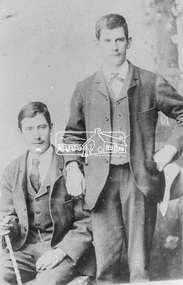
Photograph, William and Harold Sinclair of Diamond Creek, c.1895
... Story by Dianne H. Edwards, Shire of Diamond Valley 1979. "Twin sons of Harry Sinclair who came to the district from Scotland in 1860." ...Story by Dianne H. Edwards, Shire of Diamond Valley 1979. "Twin sons of Harry Sinclair who came to the district from Scotland in 1860." ...Photo supplied by J. Sinclair reproduced (cropped) on p48 of The Diamond Valley Story by Dianne H. Edwards, Shire of Diamond Valley 1979. "Twin sons of Harry Sinclair who came to the district from Scotland in 1860." William and Harry were born 25 Feb 1869 in Diamond Creek. William died 12 Sep 1943 at Heidelberg and Harry died 1947 at GreensboroughBlack and white copy of photo printed on glossy photographic paper 30.5 x 40.5 cm (12 x 16 inch); image size approx. 18.5 x 28 cmdiamond creek, diamond valley story, harold sinclair, henry colling sinclair, henry sinclair, william alexander sinclair, william sinclair -
 Eltham District Historical Society Inc
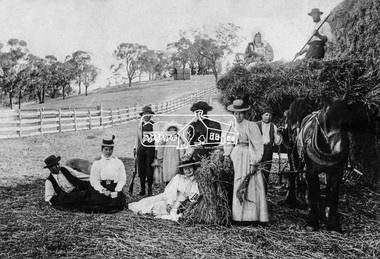
Photograph, Stack Building, Pigeon Bank, Kangaroo Ground
... Source: Family Story: The Bells of Scotland Kangaroo Ground and Yarra Flats by Vera Jackson, 1986 Supplementary unknown source states: Top L-R: Jessie Cameron, mother of Vera (Mrs E.M. ...Source: Family Story: The Bells of Scotland Kangaroo Ground and Yarra Flats by Vera Jackson, 1986 Supplementary unknown source states: Top L-R: Jessie Cameron, mother of Vera (Mrs E.M. ...Building a stack at harvest time at 'Pigeon bank', Kangaroo Ground. Mrs Agnes Cameron and family; On hay wagon: Jessie and Jim Stuart (standing), From left to right Archie, Flora Crighton, Gordon, Vera. Evelyn in front, Mrs Cameron, Maggie McInnes, Tom. In the background is one of the earliest shepherd huts still standing in 1914. Source: Family Story: The Bells of Scotland Kangaroo Ground and Yarra Flats by Vera Jackson, 1986 Supplementary unknown source states: Top L-R: Jessie Cameron, mother of Vera (Mrs E.M. Jackson donor of photograph and later resident at 'Pigeon Bank"), John Stewart (with fork) Lower L-R: Tom Cameron, Fiona Crighton, Gordon Cameron, Vera Cameron, Evelyn Cameron (sitting), Mrs Cameron (in black), Maggie McInnes, Archie Cameron About 1910 James Stuart worked as a gardener and farmhand at Pigeon Bank. He was also employed at Gulf Staton. He and other family members are buried at Kangaroo Ground. Source: Olive Hailes (nee Stuart) This photo forms part of a collection of photographs gathered by the Shire of Eltham for their centenary project book,"Pioneers and Painters: 100 years of the Shire of Eltham" by Alan Marshall (1971). The collection of over 500 images is held in partnership between Eltham District Historical Society and Yarra Plenty Regional Library (Eltham Library) and is now formally known as 'The Shire of Eltham Pioneers Photograph Collection.' It is significant in being the first community sourced collection representing the places and people of the Shire's first one hundred years.Digital imagesepp, shire of eltham pioneers photograph collection, kangaroo ground, pigeon bank, haystack, cameron family, stacks, hay, farming, summer -
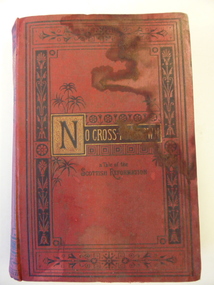 Warrnambool and District Historical Society Inc.
Book, No Cross No Crown A Tale of the Scottish Reformation, 1885
... story. The cover and pages are much water-stained. The inscription is handwritten in black ink. No Cross No Crown A Tale of the Scottish Reformation Book ...This book has been given by the Woodford Sunday School to Edith Cassady (note the misspelling of ‘Cassady’). Edith Cassady was the daughter of William and Elizabeth who lived at Boughton on the Merri River (near Cassady’s Bridge, Caramut Road today). This property was established about 1845. The donor of the book was William Wines, a member of a pioneering family in the Woodford district. This book is of some interest as it belonged to Edith Cassady, a member of a pioneering family who lived at Boughton on the Merri River. This is a hard cover book of 344 pages. The cover is red with black border decorations and black and gold lettering. There are several full page black and white illustrations scattered throughout the book which has 23 chapters of story. The cover and pages are much water-stained. The inscription is handwritten in black ink. ‘Woodford Sunday School Presented to Edith Cassidy (sic) by her well-wisher William Wines’ william wines, woodford, history of woodford, edith cassady, boughton property, cassady family, woodford sunday school -
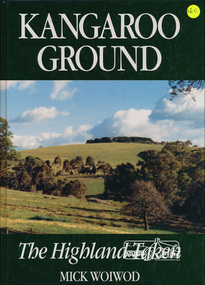 Eltham District Historical Society Inc
Book, Tarcoola, Kangaroo Ground: The Highland Taken by Mick Woiwod, 1994
... Scottish farming community in the middle of nowhere to a town that became the centre of the Yarra Valley region... It took Mr Woiwod six months of intensive research and nine months to write the book on Kangaroo Ground. He spent much of his time searching archives, public records and newspaper files for detailed information on the characters who colour his book." -- Diamond Valley News November 16, 1994 This major history of Kangaroo Ground details the district’s story between 1841 and 1994, describing it as having been unique in the Yarra Valley in that its early settlers were all Scottish and its soils were more fertile than those of surrounding districts. ...Scottish farming community in the middle of nowhere to a town that became the centre of the Yarra Valley region... It took Mr Woiwod six months of intensive research and nine months to write the book on Kangaroo Ground. He spent much of his time searching archives, public records and newspaper files for detailed information on the characters who colour his book." -- Diamond Valley News November 16, 1994 This major history of Kangaroo Ground details the district’s story between 1841 and 1994, describing it as having been unique in the Yarra Valley in that its early settlers were all Scottish and its soils were more fertile than those of surrounding districts. ..."A piece of Scotland in the Australian bush is how author Mick Woiwod describes the "Village" of Kangaroo Ground. Settled in 1841 by a Scottish family, the Donaldsons, the town is the feature of Mrs Woiwod's latest book, "Kangaroo Ground - The Highland Taken" The book follows the history of Kangaroo Ground, from its beginnings as an exclusively Scottish farming community in the middle of nowhere to a town that became the centre of the Yarra Valley region... It took Mr Woiwod six months of intensive research and nine months to write the book on Kangaroo Ground. He spent much of his time searching archives, public records and newspaper files for detailed information on the characters who colour his book." -- Diamond Valley News November 16, 1994 This major history of Kangaroo Ground details the district’s story between 1841 and 1994, describing it as having been unique in the Yarra Valley in that its early settlers were all Scottish and its soils were more fertile than those of surrounding districts. Their soil gave them the sort of power that saw the then extensive Shire of Eltham governed from little Kangaroo Ground for a remarkable 69 years. The author describes the Kangaroo Ground landscape that these farmers worked in the early period as having been already significantly modified by Aboriginal fire-stick farming before their arrival. This publication is a significant title in the recording of the early history of the pioneers of the small area of Kangaroo Ground, VictoriaHardback Book, 312 pagesISBN 0646209000kangaroo ground, mick woiwod, pioneers, donaldson family, thomson family -
 Eltham District Historical Society Inc
Book, Scottish Connections : the story of Agnes Grant and her Grant and McKenzie ancestors in Scotland to her life in Victoria, Australia, together with a genealogy of her cousins and descendants to 2000 / Grant Angus, 2001
... Scottish Connections : the story of Agnes Grant and her Grant and McKenzie ancestors in Scotland to her life in Victoria, Australia, together with a genealogy of her cousins and descendants to 2000 / Grant Angus..... ; 29 cm. Scottish Connections : the story of Agnes Grant and her Grant and McKenzie ancestors in Scotland to her life in Victoria, Australia, together with a genealogy of her cousins and descendants to 2000 / Grant Angus. ...Paperback; xx, 295 p. : ill., geneal. tables, maps, ports. ; 29 cm.ISBN 0646413481mackenzie family, grant family, agnes grant
