
Showing 38 items matching "seafarer registers"
-
 Mission to Seafarers Victoria
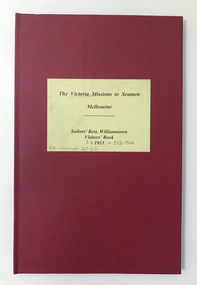
Book (item) - Visitor logbook, The Victoria Missions to Seamen Melbourne- Sailor's Rest Williamstown Visitors' Book, 1933 - 1944
... ...seafarer registers...This book or register records the date, name and address and ship name and remarks of visiting seafarers from a wide range of origins. ...This together with the 1945 register from Williamstown (see VC MtSV record) provides the earliest such register records surviving in the Mission heritage collection and Archive. seafarers seafarer registers seafarer's rest seafarer's rest williamstown visitors log book box 24 williamstown sailors seamen mrs hodgkiss j.g. sheel crew nationality padre frank leslie oliver Cover: The Victoria Missions to Seamen Melbourne / Sailors' Rest Williamstown/ Visitors' book/ 1933 ( February1933 - March-1944) / Spine:/Sailors' Rest, Williamstown - Visitors' book 1933. ...This book or register records the date, name and address and ship name and remarks of visiting seafarers from a wide range of origins. The logbook provides an insight into which ships and the origins of their crews were visiting Williamstown and Melbourne in 1933. This together with the 1945 register from Williamstown (see VC MtSV record) provides the earliest such register records surviving in the Mission heritage collection and Archive.Cover: The Victoria Missions to Seamen Melbourne / Sailors' Rest Williamstown/ Visitors' book/ 1933 ( February1933 - March-1944) / Spine:/Sailors' Rest, Williamstown - Visitors' book 1933. Inner page: details of Chaplains and caretakers and contact nos re the Mission.seafarers, seafarer registers, seafarer's rest, seafarer's rest williamstown, visitors log book, box 24, williamstown, sailors, seamen, mrs hodgkiss, j.g. sheel, crew, nationality, padre frank leslie oliver -
 Flagstaff Hill Maritime Museum and Village
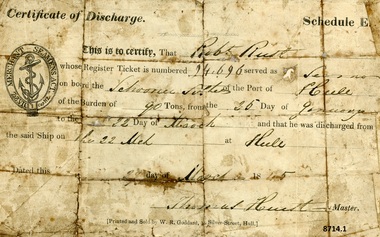
Certificate - Certificate of Discharge, 1845 - 1852
... The Merchant Shipping Act of 1835 introduced the formal registration of British seamen, to allow the Government (Board of Trade) to identify individual seamen for the Royal Naval Reserve. Seafarers who registered were issued with tickets which contained some personal details including name, date and place of birth. ...The Merchant Shipping Act of 1835 introduced the formal registration of British seamen, to allow the Government (Board of Trade) to identify individual seamen for the Royal Naval Reserve. Seafarers who registered were issued with tickets which contained some personal details including name, date and place of birth. ...Bob Rust was born in Poplar, London in 1823. He became a merchant seaman and all of his "Certificates of Discharge" (except the first one) show him working out of the London docks. The certificates document his career as an "Able Seaman" between the years 1845 to 1852. He worked on the following ships - Jan 25th - March 22nd, 1845 - schooner "Sisters" out of Hull. 14th July - 30th Nov 1845 - "Caleb Angus" - Port of London to West India Dock, London. 12th Dec 1845 - 14th June 1846 - "Caleb Angus" - Port of London to West India Dock, London. April - 16th Oct 1847 - barque "James Turcan" - discharged at Antwerp. It was noted by Mr Mills (Master) "his conduct was to my entire satisfaction. He is a sober, steady man" 25th Oct - 18th Dec 1847 - Brig "Eclipse" - Port of London. Dec 1847 - Nov 1848 - "Cecrops" - London to Cardiff to Cuba and discharged at West India Dock, London. 2nd Dec 1848 - 9th Feb 1850 (15 months) - "Enterprise" - discharged London. Nb - this was not the "Enterprise" used by John Pascoe Fawkner to enter the Yarra in 1835 or the "Enterprise" that sank in Lady Bay, Warrnambool in 1850 and it was not the "Enterprise" belonging to the British Navy which was used to search for Sir John Franklin's lost expedition and later made two Arctic voyages. It is not noted where Bob Rust sailed to on this voyage, but his Master noted on his certificate that "the bearer is an excellent seaman and a good sail maker". 3rd April - 20th Oct 1850 - brig "Thames" - London to London via Trieste. 30th Oct 1850 - 10th May 1851 - "Elizabeth". 9th June - 10th Nov 1851 - "Lady Rowena" - to Alexandria. 23rd Nov 1851 - 17th May 1852 - "Thames" - Mediterranean voyage to Trieste. Bob Rust was an early settler in Warrnambool. He came to Warrnambool, Australia sometime between May 1852 and 1856 where he was recorded in the Electoral Roll, as a labourer, living in Henna Street. According to family history, he "jumped ship" at Port Fairy (then Belfast) as there are no records of him officially arriving in Australia. His picture and details are recorded in "The Pioneers' Register, Warrnambool Township and Shire 1839-1900 Volume Two". He married Sarah Ann Twaits in 1865 and they had seven children. His wife died in 1876 following the birth of their last child. He doesn't appear to have ever worked as a seafarer once he arrived in Warrnambool but is only recorded as working as a labourer and chimney sweep and (in the 1880's) operating as a "General Storekeeper" and "Produce Merchant" (frequently advertising in the Warrnambool Standard for items such as potatoes, oats and dairy produce from his Henna Street premises). He continued to live in Henna Street until his death on 15th January 1906 aged 82 years. English maritime discharge certificates evolved from simple proof of release in the 1700's to become official service records in the mid 1800's. They were issued at the end of a voyage to confirm a sailor had been released from duty and paid. The Merchant Shipping Act of 1835 introduced the formal registration of British seamen, to allow the Government (Board of Trade) to identify individual seamen for the Royal Naval Reserve. Seafarers who registered were issued with tickets which contained some personal details including name, date and place of birth. As the registration system evolved over time, each merchant seafarer was allocated a unique number which would be retained during their time of service at sea. Bob Rust's number was 27914. It also documented the name of the ship (for each voyage), its tonnage, master and date and place of discharge. Early certificates had separate notes re the seaman's conduct or character but after the early 1850's, these became part of the discharge certificate. This collection of "Certificates of Discharge" include those from the late 1840's (which were smaller in size), several handwritten character references as well as some examples of the newer forms of the early 1850's.Theses certificates are significant examples of the legal paperwork generated by the British government in the day-to-day regulation of working seamen in the late 19th century. They are also significant as they document the career of a working seaman at that time.This is a set of twelve "Certificates of Discharge", two handwritten character descriptions and two "Certificates of Character" issued to Able Seaman Bob Rust primarily between the years 1845 and 1852. They have been issued by the Masters of the ships Bob Rust had sailed on, at the completion of each voyage. They differ slightly in size and layout but most follow a similar format in documenting the name of the seaman (Bob Rust), his ticket number (24696), the name of the ship and its tonnage, the port of departure and discharge (e.g. West India Docks London) and the date of the voyage. Some later certificates also describe the destination of the voyage (e.g. Mediterranean). Two of the documents are handwritten notes by the master of the ship certifying as to the conduct of the seaman and two later documents (from 1851 and 1852) are "Certificates of Character" - completed and signed by the Master on the termination of the voyage. Example of Certificate from 1845 - 1850 - "Certificate of Discharge. Schedule E, 7 & 8 Victoria, c.112. This is to certify, that Robert Rust/ whose Register Ticket is numbered 24696 served as Able Seaman/ on Board the Caleb Angus of the Port of London / of the Burden of 303 Tons, from the 14th day of July to the 30th / day of Nov 1845 and that he was discharged from the said ship on 30th /Nov 1845 at West India Docks London Dated this 3 day of December 1845" Mr Whittle MASTER. Example of handwritten character note - "This is to certify that the/ bearer Robert Rust sailor in the barque/ James Turcan, under my command as able / seaman six months during which time / his conduct was to my entire satisfaction / he is a sober steady man. W B. Mills Antwerp 20th October 1847"flagstaff hill maritime museum and village, shipwreck coast, warrnambool, certificate of discharge, certificate of character, robert rust, bob rust, seaman's certificate of discharge, sisters, caleb angus, james turcan, eclipse, cecrops, enterprise, brig thames, elizabeth, lady rowena, warrnambool pioneer, sarah ann twaits -
 Flagstaff Hill Maritime Museum and Village
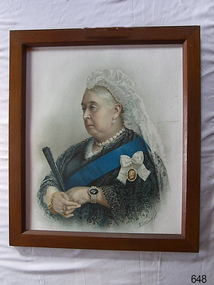
Print - Portrait, Alf Cooke, Queen's Printer, ca mid-to-late 19th century
... seafarers’ physical, social, and spiritual needs. The organisation originated in Bristol, England, when a Seamen's Mission was formed in 1837. The portrait is also significant for its use in the St Nicholas Missions to Seamen's chapel, Williamstown, as the original building is now listed on the Victorian Heritage Register. ...This framed print was part of the original furnishings of the St Nicholas Seamen's Church in Williamstown, Victoria, likely to be displayed in the Missions to Seamen.. THE MISSIONS TO SEAMEN (Brief History): - The Missions to Seamen was an Anglican charity in Great Britain that has served the world's seafarers since 1856. Its symbol is a Flying Angel, inspired by a Bible verse. Today, there are centres in over 200 ports worldwide where seamen of all backgrounds are offered a warm welcome and provided with a wide range of facilities. In Victoria, the organisation began in Williamstown in 1857 as a Sailors’ Church, also known as ‘Bethel’ or the ‘Floating Church’ in an old hulk floating in Hobson’s Bay, Port of Melbourne. It soon became part of the Missions to Seamen, Victoria. In 2000, the organisation, now named Mission to Seafarers, still operated locally in Melbourne, Portland, Geelong and Hastings. The Ladies’ Harbour Lights Guild was formed in 1906 to support the Missions to Seamen in Melbourne and other centres, such as Williamstown. Two of the most significant ladies of the Guild were founder Ethel Augusta Godfrey and foundation member Alice Sibthorpe Tracy (who established a branch of the Guild in Warrnambool in 1920). The Guild continued its work until the 1960s. In 1943, a former Williamstown bank was purchased for the Missions to Seamen Club. The chapel was named St Nicholas’ Seamen’s Church and was supported by the Ladies’ Harbour Lights Guild, the Williamstown Lightkeepers’ Auxiliary and the League of Soldiers’ and Sailors’ Friends. It ceased operation in 1966. A Missions to Seamen Chapel and Recreation Room was a significant feature of ports during the late 1800s and 1900s. It seemed appropriate for Flagstaff Hill to include such a representation within the new Maritime Village, and the Melbourne Board of Management of Missions to Seamen Victoria gave its permission on 21st May 1979 for the entire furnishings of the Williamstown chapel to be transferred to Flagstaff Hill. The St Nicholas Seamen’s Church was officially opened on October 11, 1981, and resembles the Williamstown chapel. The portrait of Queen Victoria is significant as part of Australia's History, as she was the reigning monarch during the time of the colonisation of Australia by the British. This portrait is historically significant for its origin in the St Nicholas Mission to Seamen's Church in Williamstown, established in 1857 to cater for seafarers’ physical, social, and spiritual needs. The organisation originated in Bristol, England, when a Seamen's Mission was formed in 1837. The portrait is also significant for its use in the St Nicholas Missions to Seamen's chapel, Williamstown, as the original building is now listed on the Victorian Heritage Register.Print: Coloured print behind glass in a timber frame. Portrait of Queen Victoria wearing a blue dress and sash. Printed by Alf Cooke, Queens Printer, Leeds, UK. This print is part of the St. Nicholas Seamen's Church Collection. Lower left corner: "Printed in Leeds, UK by Alf Cooke, Queen's Printer" Lower right corner: "[facsimile of Victoria's signature]"flagstaff hill, flagstaff hill maritime museum and village, warrnambool, maritime museum, maritime village, great ocean road, shipwreck coast, religion, religious service, st nicholas seamen’s church, williamstown, missions to seamen victoria, print, portrait, queen victoria, religious worship, worship service, mission to seafarers, st nicholas missions to seamen’s church williamstown, missions to seamen, st nicholas missions to seamen’s church flagstaff hill, 139 nelson place williamstown, anglican church, church furnishings, religious furnishings, religious print -
 Flagstaff Hill Maritime Museum and Village
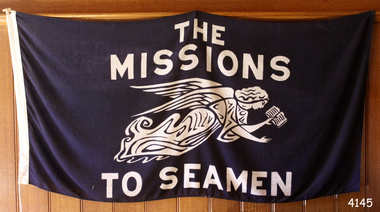
Flag - Missions to Seamen, Victoria Missions to Seamen, The Missions to Seamen, 1940s to 1960s
... seafarers’ physical, social, and spiritual needs. The organisation originated in Bristol, England, when a Seamen's Mission was formed in 1837. The flag is also significant for its connection with the St Nicholas Missions to Seamen's chapel, Williamstown, as the original building is now listed on the Victorian Heritage Register. flagstaff hill warrnambool shipwrecked-coast flagstaff-hill flagstaff-hill-maritime-museum maritime-museum shipwreck-coast flagstaff-hill-maritime-village the missions to seamen flag flying angel Missions to Seamen banner collection of four flags Printed: THE MISSIONS TO SEAMEN" Logo: [flying angel] image" Flag: one of four in the Missions to Seamen collection of flags. ...This flag is one of four in the Missions to Seamen flag collection. The flags were part of the original furnishings of the St Nicholas' Mission to Seamen's Church at 139 Nelson Place, Williamstown, Victoria, which was operated by the Missions to Seamen organisation. THE MISSIONS TO SEAMEN: - The Missions to Seamen was an Anglican charity in Great Britain that has served the world's seafarers since 1856. Its symbol is a Flying Angel, inspired by a Bible verse. Today, there are centres in over 200 ports worldwide where seamen of all backgrounds are offered a warm welcome and provided with a wide range of facilities. In Victoria, the organisation began in Williamstown in 1857 as a Sailors’ Church, also known as ‘Bethel’ or the ‘Floating Church’ in an old hulk floating in Hobson’s Bay, Port of Melbourne. It soon became part of the Missions to Seamen, Victoria. In 2000, the organisation, now named Mission to Seafarers, still operated locally in Melbourne, Portland, Geelong and Hastings. The Ladies’ Harbour Lights Guild was formed in 1906 to support the Missions to Seamen in Melbourne and other centres, such as Williamstown. Two of the most significant ladies of the Guild were founder Ethel Augusta Godfrey and foundation member Alice Sibthorpe Tracy (who established a branch of the Guild in Warrnambool in 1920). The Guild continued its work until the 1960s. In 1943, a former Williamstown bank was purchased for the Missions to Seamen Club. The chapel was named St Nicholas’ Seamen’s Church and was supported by the Ladies’ Harbour Lights Guild, the Williamstown Lightkeepers’ Auxiliary and the League of Soldiers’ and Sailors’ Friends. It ceased operation in 1966. A Missions to Seamen Chapel and Recreation Room was a significant feature of ports during the late 1800s and 1900s. It seemed appropriate for Flagstaff Hill to include such a representation within the new Maritime Village, and the Melbourne Board of Management of Missions to Seamen Victoria gave its permission on 21st May 1979 for the entire furnishings of the Williamstown chapel to be transferred to Flagstaff Hill. The St Nicholas Seamen’s Church was officially opened on October 11, 1981, and resembles the Williamstown chapel. This collection of four flags is significant to the history of The Missions to Seamen organisation and the evolution of its name, flag and symbols. The flag represents the organisation and community care for the families of those who lost their lives at sea, and the support of seamen and mariners all over the world. This flag is historically significant for its origin in the St Nicholas Mission to Seamen's Church in Williamstown, established in 1857 to cater for seafarers’ physical, social, and spiritual needs. The organisation originated in Bristol, England, when a Seamen's Mission was formed in 1837. The flag is also significant for its connection with the St Nicholas Missions to Seamen's chapel, Williamstown, as the original building is now listed on the Victorian Heritage Register. Flag: one of four in the Missions to Seamen collection of flags. This flag is a dark blue rectangle with white print and an emblem. All four flags are Part of the St. Nicholas Seamen's Church Collection. Printed: THE MISSIONS TO SEAMEN" Logo: [flying angel] image"flagstaff hill, warrnambool, shipwrecked-coast, flagstaff-hill, flagstaff-hill-maritime-museum, maritime-museum, shipwreck-coast, flagstaff-hill-maritime-village, the missions to seamen, flag, flying angel, missions to seamen, banner, collection of four flags -
 Flagstaff Hill Maritime Museum and Village
Photograph - Shipwreck rescue, c. 1890's
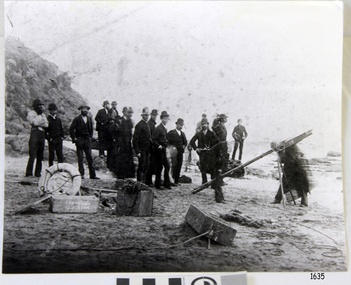
... seafarers. It gives a clear picture of the use of Rocket Rescue Equipment in shore-to-ship rescues. Flagstaff Hill’s Fiji collection is of historical significance at a State level because of its association with the wreck Fiji, which is on the Victorian Heritage Register VHR S259. ...CONTEXT – UPDATED The photograph taken on Sunday, September 6, 1891, shows the Port Campbell Rocket Rescue Crew and Equipment at Wreck Beach, Moonlight Head, preparing to save the stranded men on the wreck of the barque Fiji. The man standing in the middle, front of the photograph, facing the ocean, is Herbert Maxwell Morris, a farmer at Barruppa near Princetown, who is also a member of the Rocket Rescue Crew. The Rocket Rescue lifesaving method used an explosive rocket to shoot a light line from the shore across to the distressed vessel. The line was then secured to the ship’s mast, and a heavy, continuous line was sent out with a ‘breaches buoy’ attached (a buoy similar to the seat of a pair of trousers). The stranded seafarers would sit in the seats and be pulled along the line to safety. A lot of skill was needed to set up the line to reach its target, and the crew trained regularly to keep up their skills. The FIJI and the RESCUE: - The three-masted iron barque Fiji was built at Belfast, Ireland, in 1875 by Harland and Wolfe for a Liverpool-based shipping company. The ship departed Hamburg on May 22, 1891, bound for Melbourne under the command of Captain William Vickers with a crew of 25. The Cape Otway light was sighted on September 5, 1891. However, the bearing was different from Captain Vickers’ calculations. At about 2:30 am the next morning, the land was reported only 4-5 miles away. The captain tried to redirect the ship in the rough weather without success, and the Fiji struck rock only 300 yards (274 metres) from shore. The crew burned blue lights and fired rockets to signal distress. The lifeboats either capsized or were swamped and smashed to pieces. Two younger crewmen volunteered to swim to the shore with a line. One, a Russian named Daniel Carkland, drowned after he was swept away when the line broke. The other, Julius Gebauhr, a 17-year-old German able seaman, reached shore safely on his second attempt but had cut the line loose with his sheath-knife when it tangled in kelp. He climbed the cliffs in search of help. Later that morning, a young man named William (Willie) Ward reported that he saw the wreck of the ship close to shore near Moonlight Head from the cliffs, and the alarm for help was sent to Princetown, six miles away. At around the same time, a Mott’s party of land selectors, including F. J. Stansmore and Leslie Dickson, was travelling on horseback from Princetown towards Moonlight Head. They were near Ryans Den when they found Gebauhr in the scrub, bleeding and dressed only in a singlet, socks and a belt with his sheath-knife. They thought the man might be an escaped lunatic, due to his wild and shaggy-looking state and what seemed to be gibberish speech. After Gebauhr threw his knife away, they realised that he was speaking half-English, half-German as he talked about the wreck. They gave him food, brandy and clothing, and he was taken to a nearby guest house, Rivernook, owned by John Evans, where he was cared for. Most of the party went off to the wreck site. Stanmore and Dickson rode for help from both Port Campbell, for the two Rocket Rescue Crew buggies, and from Warrnambool, for the lifeboat. The vessel S.S. Casino sailed from Portland towards the scene. Half of the Port Campbell Rocket Crew and equipment arrived after a 25-mile journey and set up the rocket tripod on the beach below the cliffs. By this time, the weary crew of the Fiji had been clinging to the jib-boom for almost 15 hours, calling frantically for help. The Office in Charge of the Rocket Crew, W. Tregear, ordered the rocket to be fired, but the light line broke and the rocket was carried away. A second line was successfully set up by Herbert Morris. It crossed the ship and was secured. The anxious sailors tried to come ashore along the line, but some were washed off as the line sagged with too many on it at one time. Other nearly exhausted crewmen made their way through masses of seaweed and were often smothered by waves. Only 14 of the 24 who had remained on the ship made it to shore. Rocket Crew members and onlookers on the beach took turns to go into the surf and drag the half-drowned seamen to safety. These rescuers included Bill (William James) Robe, Herbert Maxwell Morris, Edwin Vinge, Hugh Cameron, Fenelon Mott, Arthur Wilkinson and Peter Carmody, who was also involved in the rescue of men from the Newfield. Arthur Wilkinson, a 29-year-old land selector from Geelong, swam out to help one of the ship’s crewmen, a carpenter named John Plunken, who was trying to swim from the ship to the shore. Two or three times, both men almost reached the shore but were washed back to the wreck, where they were both hauled back on board. Wilkinson was unconscious, possibly from hitting his head on the anchor before they were brought up. Plunken survived, but Wilkinson later died, and his body washed up the next day. The 26-year-old Bill Robe hauled out the last man; it was the captain, and he’d been tangled in the kelp. Only 20 minutes later, the wreck of the Fiji was smashed apart, and it settled in about 6 metres of water. Of the 26 men on the Fiji, 11 in total lost their lives. The remains of 7 bodies were washed onto the beach. Their coffins were made from timbers from the wrecked Fiji, and they were buried on the cliff top above the wreck. The survivors were taken to Rivernook and cared for over the next few days. Funds were raised by locals soon after the wreck in aid of the sufferers of the Fiji disaster. Captain Vickers was severely reprimanded for his mishandling of the ship. His Master's Certificate was suspended for 12 months. There was public criticism of the rescue. The important canvas ‘breeches buoy’ and heavy line for the Rocket Rescue were in the half of the rocket outfit that didn’t make it in time for the rescue, as they had been delayed at the Gellibrand River ferry. The communications to Warrnambool were down, so the call for help didn’t get through on time. The boat that was notified of the wreck failed to reach it in time. Much cargo looting occurred. One looter was caught with a small load of red and white rubber balls. Essence of peppermint mysteriously turned up in many settlers' homes. Sailcloth was salvaged and used for horse rugs and tent flies. Soon after the wreck, “Fiji tobacco” was advertised around Victoria. A Customs officer, trying to prevent some of the looting, was assaulted by looters and thrown over a cliff. He managed to cling to a bush lower down until rescued. In 1894, some coiled fencing wire was salvaged from the wreck. Hundreds of coils are still strewn over the site of the wreck, encrusted and solidified. The hull is broken, but the vessel’s iron ribs can be seen along with some of the cargo of concrete and pig iron. Captain Vickers presented Bill Robe with his silver-cased pocket watch, the only possession that he still had, as a token for having saved his life and the lives of some of the crew. Years later, Bill used the pocket watch to pay a debt, and it was handed down through that family. Seaman Julius Gebauhr later gave his knife, in its handcrafted leather sheath, to F. J. Stansmore for caring for him when he came ashore. The knife handle had a personal inscription on it. A marble headstone on the cliffs overlooking Wreck Beach pays tribute to the men who lost their lives when Fiji ran aground. The scene of the wreck is marked by the anchor from the Fiji, erected by Warrnambool skin divers in 1967. Captain Vickers’ pocket watch and Julius Gebauhr’s sheath knife are among the artefacts salvaged from the Fiji that are now part of the Fiji collection at Flagstaff Hill Maritime Village. The man identified in the photograph, Herbert Maxwell Morris, was the nephew of the Victorian era artist, William Morris. Herbert had sailed from England to Australia; he was about 25 years old when he joined the Rocket Rescue Crew at Port Campbell, where he lived. His successful rocket line firing at the Fiji wreck site was noted by author Jack Loney in one of his historic shipwreck books. Later, Morris moved from his property at Baruppa to Laver’s Hill to run a more profitable enterprise. This photograph is significant as an image of a historical event, being the willingness of local volunteers to aid in the saving of lives of stranded seafarers. It gives a clear picture of the use of Rocket Rescue Equipment in shore-to-ship rescues. Flagstaff Hill’s Fiji collection is of historical significance at a State level because of its association with the wreck Fiji, which is on the Victorian Heritage Register VHR S259. The Fiji is archaeologically significant as the wreck of a typical 19th century international sailing ship with cargo. It is educationally and recreationally significant as one of Victoria's most spectacular historic shipwreck dive sites with structural features and remains of the cargo evident. It also represents aspects of Victoria’s shipping history and its potential to interpret sub-theme 1.5 of Victoria’s Framework of Historical Themes. The Fiji collection meets the following criteria for assessment; Importance to the course, or pattern, of Victoria’s cultural history, possession of uncommon, rare or endangered aspects of Victoria’s cultural history, and potential to yield information that will contribute to an understanding of Victoria’s cultural history. Black and white photograph of the Rocket Rescue Crew from Pt Campbell on Wreck Beach, Moonlight Head, at the barque 'Fiji' wreck site. September 6, 1891.warrnambool, shipwrecked coast, flagstaff hill, flagstaff hill maritime museum, maritime museum, shipwreck coast, flagstaff hill maritime village, shipwrecked artefact, pocket watch, fob watch fiji, william vickers, william robe, bill robe, gebauhr, stansmore, carmody, wreck bay, moonlight head, fiji shipwreck 1891, rocket crew, port campbell rocket crew, lifesaving crew, photograph of rocket crew, herbert morris, warrnambool, shipwreck artefact, mott, william ward, rocket rescue, breeches buoy, rivernook guest house -
 Flagstaff Hill Maritime Museum and Village
Book - Reference, navigation, J. W. Norie (author and editor), The Seaman and Merchants Complete Expeditious Measurer, 1853
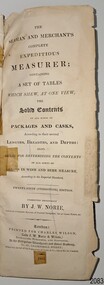
... seafarers, both naval and merchant. It is the twenty-fifth edition, showing that it was in great demand in the early to mid-19th century. Sea merchants could have used this as a reference for working out freight costs for their cargo. Customs Officers could have referred to it as well to calculate fees and taxes. The book’s owner had inscribed in pen and ink "Rose Anna, Schooner, Melbourne, March 25th 1857". At that time, the registered...seafarers, both naval and merchant. It is the twenty-fifth edition, showing that it was in great demand in the early to mid-19th century. Sea merchants could have used this as a reference for working out freight costs for their cargo. Customs Officers could have referred to it as well to calculate fees and taxes. The book’s owner had inscribed in pen and ink "Rose Anna, Schooner, Melbourne, March 25th 1857". At that time, the registered ...The book was published at the same address as London’s Navigation Waterhouse and Naval Academy. It is likely to be one of the textbooks used in educating seafarers, both naval and merchant. It is the twenty-fifth edition, showing that it was in great demand in the early to mid-19th century. Sea merchants could have used this as a reference for working out freight costs for their cargo. Customs Officers could have referred to it as well to calculate fees and taxes. The book’s owner had inscribed in pen and ink "Rose Anna, Schooner, Melbourne, March 25th 1857". At that time, the registered owners were Thomas Lamb & E. Keays, who were freighting cargo between Melbourne and Geelong. Schooner, ROSE ANNA: - The schooner Rose Anna was built in 1844 at Fremantle, W.A., by H. Edwards for Capt. William Heard. The 2-masted wooden vessel was carvel-built. Captain Heard registered Rose Anna at Fremantle in 1845 and in the same year, registered it at Port Adelaide. in 1852, Rose Anna was crushed and sunk at Port Adelaide by the Selma and raised. In 1852, the schooner was lengthened by William Hardy. In 1853, William Burton and W. Roberts registered Rose Anna at Melbourne. In 1855, W. Roberts registered, followed by John Balston & Thomas Ross. In 1856, it was registered by Thomas Lamb & E. Keays, in 1857 by William Howes & Charles Holland, in 1865 by Charles Holland & John Balfour, and in 1866 registered in Melbourne by mariners John Balfour & David Griffiths. In the 1940s, Rose Anna traded between Hobart, Melbourne, Adelaide, Sydney, Circular Head, Port Fairy, and Port Albert. In the 1950s and 1960s, it traded between Geelong Heads and Hobsons Bay, Melbourne, in lime, wool, general cargo and ballast. In 1857, when Rose Anna’s registered owners were Thomas Lamb & E. Keays, an advertisement was placed in The Age on March 9th, announcing that the Rose Anna was taking freight from Melbourne to Geelong. Later in the year, in October, the registered owners were William Howes & Charles Holland. They were still trading with Geelong, as on October 7th, The Age announced that Rose Anna arrived in Geelong from Melbourne on October 5th. On October 6th, 1866, Rose Anna went ashore while loading wheat at Sandridge, Port Phillip Bay, in severe gales and heavy seas and became a total wreck. The book is significant for its association with reference information to instruct sea merchant traders and naval officers. The publication is in its twenty-fifth edition, indicating the importance of such an instructional book. The book of tables and calculations shows the evolution of such reference texts, going from handwritten notes, to printed tables like these, and forward to slide rules, calculators, and to modern time computers. it demonstrates the importance of accuracy in calculating weights and measures at sea and for the purposes of fess, charges and taxes. The book is important to the history of the schooner Rose Anna, which is listed as a significant vessel on the Victorian Heritage Register, S582, as it has an inscription with the ship's name, date, and destination. Book, tall and narrow, with index tabs on the side edges of the pages. FULL Title: The Seaman and Merchants Complete Expeditious Measurer: The Seaman and Merchants Complete Expeditious Measure; containing a set of tables which show, at one view, the solid contents of all kinds of packags and casks, according to their several lengths, breadths and depths: also, rules for determining the contents of all sorts of casks in wine and beer measure, according to the Imperial Standard. Twenty-Fifth (Stereotype) Edition. Author: Mr J W Norie (John William Norie) Date: 1853 Publisher: Charles Wilson (late J.W. Norrie & Wilson), Bookseller, Publisher and Stationer, At the Navigation Waterhouse and Naval Academy, No. 157, Leadenhall Street, where may be had all the publications of Steel & Co. Late at No. 70, Cornhill. Printer: Bateman and Dennis, 95 Leadenhall Street, London, England, 1853 The book has handwritten, pen and ink inscriptions. It refers to the Schooner, Rose Anna, Melbourne, March 25th 1857.Handwritten in script with pen and ink: "Rose Anna / Schooner / Melbourne, / March 25th 1857"flagstaff hill, warrnambool, shipwrecked-coast, flagstaff-hill, flagstaff-hill-maritime-museum, maritime-museum, shipwreck-coast, flagstaff-hill-maritime-village, the seaman and merchants complete expeditious measurer, book, sea merchants, cargo, calculations, measurements, sea trade, maritime book, sea transportation, cargo rate calculations, naval academy, navy education, navigation, navigation instruction, navigation waterhouse and naval academy, twenty-fifth edition, 19th century, 1853, 1857, customs, freight, ullage, rose anna, schooner, 2-masted, march 25th 1857, melbourne, 25 march 1857, thomas lamb & e. keays, geelong, 1844, h. edwards, fremantle, carvel-built, port adelaide, selma, william hardy, william burton and w. roberts, john balston & thomas ross., charles holland & john balfour, john balfour & david griffiths, hobart, sydney, circular head, port fairy, port albert, hobsons bay, sandridge, port phillip bay -
 Mission to Seafarers Victoria
Programme (item) - Program, National Trust, Australian Heritage Festival - Victorian Program 2023, 2023
... register their events held during a month, with dates varying in each state. In 2023, tours of the Mission were organised over three week ends. And two sessions about the restoration of the Manse chairs were presented by Tim Wilmot from the Furniture History Society. The chairs, table and butler table were relocated in the Manse dining room for the occasion. The Mission to Seafarers ...The Australian Heritage Festival is a yearly event organised by the National Trust. Organisations can register their events held during a month, with dates varying in each state. In 2023, tours of the Mission were organised over three week ends. And two sessions about the restoration of the Manse chairs were presented by Tim Wilmot from the Furniture History Society. The chairs, table and butler table were relocated in the Manse dining room for the occasion.The Mission to Seafarers holds tours and other events every year during this Festival for the community to discover its history. australian heritage festival, events, victorian program, national trust, furniture history society, tim wilmot, 2023 -
 Mission to Seafarers Victoria
Certificate - Certificate of Competency Extra Master, 1919
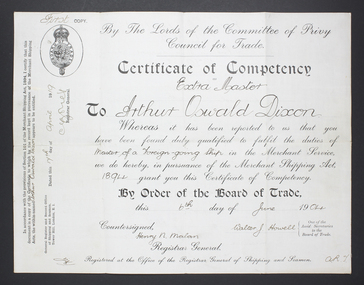
... Personal objects included an unusual small travel size New Testament (see VC record ) heavily annotated provide further insights into the experience of early 20th C. seafarers. certificate of competency master captain sailor arthur oswald dixon seamanship sailors seamen seafarers officers 1904 See image for both sides of the document for extensive text. Officially printed document, and official copy of an original certificate of competency issued by the office of the Register General of Shipping and Seamen recognising Arthur Oswald Dixon as an Extra Master. ...This document one of several papers and objects from the estate of Mr Arthur O. Dixon, an ex-master mariner and later smallhold farmer. Other correspondence and papers gifted to the Mission indicates the year 1919 (post his service in World War 1) was a time of some changes for Mr Dixon, possibly leading to his subsequent re-location to Australia show that he served as a crew member on the Merchant vessel "Hororata" a vessel which is noted in the MTSV records including an image of the crew in the early 1920s. (see VC record ).This vessel is also mentioned in a narrative poem by a de-mobbed Soldier of WW1 as the transport for a number of returning servicemen and families. The poem is held in the National Library of Australia.Unusually for the early 20th C. era of Mr Dixon's service at sea two images of Mr Dixon were included in the gift of papers. Personal objects included an unusual small travel size New Testament (see VC record ) heavily annotated provide further insights into the experience of early 20th C. seafarers. Officially printed document, and official copy of an original certificate of competency issued by the office of the Register General of Shipping and Seamen recognising Arthur Oswald Dixon as an Extra Master. At right angles to the certificate is a small margin at left indication the current document is an approved copy in 1919 of the original certificate issued in 1904. See image for both sides of the document for extensive text.certificate of competency, master, captain, sailor, arthur oswald dixon, seamanship, sailors, seamen, seafarers, officers, 1904 -
 Mission to Seafarers Victoria
Programme (item) - Program, National Trust, Australian Heritage Festival - Victorian Program 2018, 2018
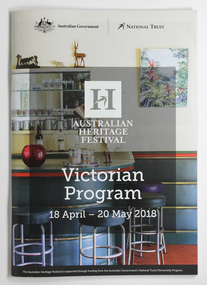
... Organisations can register their events held during a month, with dates varying in each state. The Mission to Seafarers holds tours and other events every year during this Festival for the community to discover its history. australian heritage festival 2018 heritage tours national trust victorian program National Trust Victoria events program with photo of the bar of the Mooramong property in cover Australian Heritage Festival - Victorian Program 2018 Programme Program National Trust ...The Australian Heritage Festival is a yearly event organised by the National Trust. Organisations can register their events held during a month, with dates varying in each state.The Mission to Seafarers holds tours and other events every year during this Festival for the community to discover its history.australian heritage festival, 2018, heritage tours, national trust, victorian program -
 Mission to Seafarers Victoria
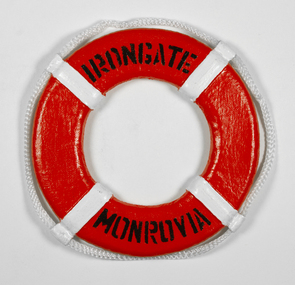
Decorative object - Miniature, lifebuoy, c. 2018
... Presented to MTSV by seafarer Bosun Tomovs from the vessel Irongate, registered in Monrovia, Liberia who created this memento miniature and presented it to Chief Manager Sue Dight, on the occasion of his visit to the MTSV, Melbourne....Presented to MTSV by seafarer Bosun Tomovs from the vessel Irongate, registered in Monrovia, Liberia who created this memento miniature and presented it to Chief Manager Sue Dight, on the occasion of his visit to the MTSV, Melbourne. ...Presented to MTSV by seafarer Bosun Tomovs from the vessel Irongate, registered in Monrovia, Liberia who created this memento miniature and presented it to Chief Manager Sue Dight, on the occasion of his visit to the MTSV, Melbourne.The seafarer who created this object has presented similar objects to Missions to Seamen wherever he has come ashore and used the services. The object forms a connection through the creator with the Mission network across the globe. It is also a representative sample of creativity aboard ship: model making was often a hobby to kill time on long journeys.small red painted and white corded life buoy with inscription in black paint.side a) In Upper Case stencil: " IRONGATE / MONROVIA " Side b) handwritten in black ink: "04.09.2018 / BSN TOMOVS / BULGARIA"lifebelt, life preserver, miniature models, life buoy, bosun tomovs, irongate ship, gift, buoy, hobbie, seamen, sailors, seafarers -
 Flagstaff Hill Maritime Museum and Village
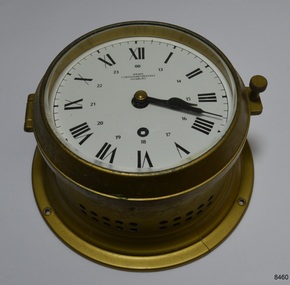
Instrument - Chronometer or Marine Clock
... Seafarers” refers to the weather’s signs and patterns being repeated over and over, and the recording of these observations helps forecasters predict changes in the weather. The chronometer is an example of a mechanical navigational marine instrument in use in the early to the mid-20th century. The maker is significant as part of a German government initiative to be self-sufficient in the production of good quality marine technology. This chronometer is significant as part of the exhibit, the Australian-built vessel, 1922 coastal trader ‘Reginald M’, listed on the Australian Register ...This chronometer was made around 1936 and has been on display at Flagstaff Hill for over 40 years as part of the exhibit of the ‘Reginald M’, an Australian-built, 19ss, coastal trader vessel. A chronometer is an accurate mechanical instrument used for measuring time. It is constructed carefully to remain stable even under the changing conditions of seafaring life such as temperature, humidity and air pressure. The Master or Navigator of a ship could use the chronometer and the positions of celestial bodies to calculate the ship’s latitude at sea. In 1905 the business Chronometerwerke GmbH was formed in Frankfurt, Germany, to supply the country with high-quality mechanical chronometers and ship clocks for their maritime trade, making the country independent of other international suppliers such as those in England. In 1938 the firm was renamed Wempe Chronometerwerke. The business continues today. Its products now include its well-known chronometers, battery-powered ship clocks, ship’s bell clocks, barometers, barographs, thermometers, hygrometers, comfort meters to measure temperature and humidity, and wristwatches. The company also performs chronometer testing facilities for the State’s Weights and Measures office. The article written by Givi in July 2022 “The Basics of Marine Meteorology – a Guide for Seafarers” refers to the weather’s signs and patterns being repeated over and over, and the recording of these observations helps forecasters predict changes in the weather. The chronometer is an example of a mechanical navigational marine instrument in use in the early to the mid-20th century. The maker is significant as part of a German government initiative to be self-sufficient in the production of good quality marine technology. This chronometer is significant as part of the exhibit, the Australian-built vessel, 1922 coastal trader ‘Reginald M’, listed on the Australian Register of Historic Vessels and on display for over 40 years.Marine chronometer or marine clock, brass case, glass cover, Roman numerals, 24-hour numbers beside them. Two black hands, a keyhole for winding and ventilation holes in the side. The base has a collar with four machined mounting holes. Inscriptions are on the clock’s face."Made in Germany" and "WEMPE / CHRONOMETERWERKE / HAMBURG"flagstaff hill, flagstaff hill maritime museum and village, warrnambool, maritime museum, maritime village, great ocean road, shipwreck coast, marine meteorology, horology, chronometer, marine technology, latitude, marine navigation, mechanical instrument, scientific instrument, ship clock, chromometerwerke gmbh, wempe chronometerwerke, marine clock -
 Flagstaff Hill Maritime Museum and Village
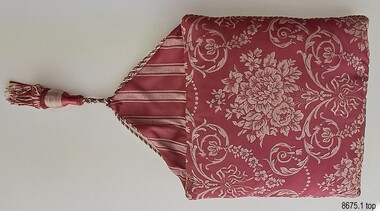
Textile - Seat Squabs, mid-20th century
... seafarers’ physical, social, and spiritual needs. The organisation originated in Bristol, England, when a Seamen's Mission was formed in 1837. The squabs are also significant for their use in the St Nicholas Missions to Seamen's chapel, Williamstown, as the original building is now listed on the Victorian Heritage Register. flagstaff hill warrnambool shipwrecked-coast flagstaff-hill flagstaff-hill-maritime-museum maritime-museum shipwreck-coast flagstaff-hill-maritime-village st nicholas mission to seamen's church williamstown mission to seamen williamstown mission to seamen victoria st nicholas mission to seamen st nicholas seamen's church religion religious service sailor's rest ladies harbour light guild squab seat covers cushions squabs religious furnishing padded seats seating accessory Squabs or padded seat cushions, a pair of two. ...The term 'seat squabs' is no longer commonly used, but is sometimes referred to in the upholstery and motor vehicle industries. Squabs are padded cushions frequently added to wooden chairs or benches to add comfort to their hard forms. They have been made to an 18th-to-19th-century pattern using beautiful, richly coloured satin fabric and fancy cord tassels. The weighted flap at the rear of the squabs helps to keep them in place on the chair, and could be used on the top of the backrest instead of on the seat. These days, squabs are attached with fabric ties or hook-and-loop tabs. These seat squabs were once used in the St Nicholas Seamen's Church at 139 Nelson Place, Williamstown, Victoria, which was purchased and furnished around 1943. The furniture and furnishings are now part of the St. Nicholas Seamen's Church collection. DETAILED HISTORY of the Missions to Seamen: - The Missions to Seamen is an Anglican (Church of England) charity that has served the world’s seafarers since 1856. It was inspired by the work of Rev. John Ashley, who, 20 years earlier, had pioneered a ministry to seafarers in the Bristol Channel in Great Britain. When Ashley retired, others continued the work, founding the Missions to Seamen. It adopted a Flying Angel as its symbol, inspired by a verse from the Bible in Revelation 14. Today, over 200 world ports have Missions to Seamen centres and chaplains. A Missions to Seamen’s club warmly welcomes sailors of all colours, creeds and races and provides a wide range of facilities. The Missions to Seamen organisation changed its name to the Mission to Seafarers in 2000, continuing to include Missions to Seamen clubs in Victoria’s cities of Melbourne, Portland, Geelong and Hastings. Flagstaff Hill’s St Nicholas’ Seamen’s Church is named after its namesake from Williamstown, Victoria, which began in 1857. Bishop Perry opened the first Sailors’ Church, which was known as ‘Bethel’, on an old hulk floating in Hobson’s Bay, Port of Melbourne. In 1860, a Sailors’ Rest started operating from rented premises in Williamstown. In 1878, the Sailors’ Church moved into an old Wesleyan chapel in Ann Street. By the end of that year, they managed to purchase the building, which they had already refurbished. In 1883, they affiliated with the Victorian Seamen’s Mission. A few years later, in 1906, the building had to be demolished because it was no longer safe. While they raised funds for a new building, the Sailors’ Rest temporarily moved to premises in front of Customs House in Nelson Place. Around this time, in 1906, the Ladies Harbour Lights Guild was formed in Australia to support and raise funds for the Mission to Seamen organisation in Melbourne. Two of the most significant ladies of the Guild were founding members Ethel Godfrey and Alice Sibthorpe. During the Mission's time at Siddeley Street, Melbourne, the activities of the Guild raised funds for the Mission to Seamen's Chapel at their new, and still current, premises in Flinders Street, Melbourne, opened in 1917. The Guild continued its important work until the 1960s. In 1908, the Williamstown Mission had enough money to purchase the former Mascotte skating rink on Thompson Street, Williamstown. In August of that year, they were inaugurated into the Victorian Missions to Seamen. They continued at that venue for a few decades. In 1943, the former ES&A Bank building at 139 Nelson Place, Williamstown, was purchased for the new Mission to Seaman’s Club. The official opening was on May 6th, 1944. It was described as a ‘distinctive little building’. Funds had previously been raised for the building and furnishing of the chapel at the rear. The chapel was named St Nicholas’ Seamen’s Church, after St Nicholas, fourth-century bishop and patron saint of sailors. Services were held on Wednesdays and Sundays. The church was supported by the Williamstown Lightkeepers’ Auxiliary, newly founded by Mrs Ethel Margaret Musther in 1943, as well as the Harbour Lights Guild and the League of Soldiers’ and Sailors’ Friends. The Williamstown Mission to Seamen’s Church operated until 1966, when large international ships no longer used the Port of Williamstown. The Commonwealth Government then leased the premises. In the formative years of Flagstaff Hill Maritime Village, the Advisory Board decided to include a Missions to Seamen Chapel and Recreation Room in its village. The Missions organisation was a significant feature of ports during the late 1800s and early 1900s, the period that the Village represents. They often erected Missions to house social and worshipful activities for seamen. Flagstaff Hill’s curator, Mr Ken Marshman, approached the Melbourne Board of Management of Missions to Seamen regarding the Williamstown branch. Consequently, the Board permitted the furnishings of the Williamstown chapel to be transferred to Flagstaff Hill Maritime Village. A provision of the transfer was that the Victoria Missions to Seamen be recognised, that the items would remain as a collection, and that the chapel would be called St Nicholas Seamen’s Church and conduct Divine services. The donation was approved on 21st May 1979. Flagstaff Hill's St. Nicholas Seamen's Church: - The idea behind Flagstaff Hill’s Missions to Seamen’s Church was partly driven by the offer of Stained Glass Memorial Windows that originated from the Warrnambool and District Base Hospital, which was undergoing multi-storey expansion in the late 1960s and early 1970s. The hospital’s Manager/Secretary was eager to see the historic window installed in a suitable place. The church, or chapel, was designed by a local architectural draftsman in collaboration with the Flagstaff Hill Planning Board and was constructed by Mr Leon Habel. The designers hoped the church would be used for formal worship, such as weddings, funerals, and multi-denominational special services like war commemorations. Its design was inspired by the ‘Missions to Seamen’ buildings in Portland and the Port of Melbourne. The furniture and furnishings were placed as accurately as possible according to photographs of the Williamstown St Nicholas Seamen’s Church and with assistance from local clergy. The Recreation Room was furnished and arranged on advice from experienced members of the Missions to Seamen organisation. A framed document in the building recognises the donor of the furnishings, Victoria Missions to Seamen, and includes the names of some original donors and their donated item/s. The building’s design incorporates local features such as Warrnambool sandstone, which was no longer commercially available but was procured from demolished buildings and uniformly cut to use as a veneer over the stronger Mt. Gambier stone. Also, traditional green American roofing slate was used, sourced from the 1908 local shipwreck “Falls of Halladale” by Flagstaff Hill volunteer divers. The bell tower includes a bell believed to be from a local shipwreck. Additional furnishings were acquired locally, and several items were donated by Warrnambool residents. Light fittings in both rooms were assembled to simulate 19th-century gas light fittings. The stained-glass window at the back of the church is a memorial to Dr Connell, a well-respected member of the Warrnambool community. It was originally installed in 1928 in the main building of Warrnambool Hospital. The St Nicholas’ Seamen’s Church at Flagstaff Hill was officially opened by His Worship the Mayor, Cr. John Lindsay, on Sunday, 11th October 1981. The event included a service of thanksgiving conducted by the Warrnambool Ministers Fraternal. Since then, the Chapel has been the historic venue for many weddings. This pair of seat squabs is historically significant for its origin in the St Nicholas Mission to Seamen's Church in Williamstown, established in 1857 to cater for seafarers’ physical, social, and spiritual needs. The organisation originated in Bristol, England, when a Seamen's Mission was formed in 1837. The squabs are also significant for their use in the St Nicholas Missions to Seamen's chapel, Williamstown, as the original building is now listed on the Victorian Heritage Register. Squabs or padded seat cushions, a pair of two. These 18th to 19th-century design squabs have crimson and cream satin fabric on top and underneath, and weighted tassels are attached to their rear corners. They can be used for comfort on hard seats and benches. The squabs were furnishings from the Missions to Seamen chapel in Williamstown, and they are now part of the St Nicholas Seamen's Church Collection.flagstaff hill, warrnambool, shipwrecked-coast, flagstaff-hill, flagstaff-hill-maritime-museum, maritime-museum, shipwreck-coast, flagstaff-hill-maritime-village, st nicholas mission to seamen's church williamstown, mission to seamen williamstown, mission to seamen victoria, st nicholas mission to seamen, st nicholas seamen's church, religion, religious service, sailor's rest, ladies harbour light guild, squab, seat covers, cushions, squabs, religious furnishing, padded seats, seating, accessory -
 Flagstaff Hill Maritime Museum and Village
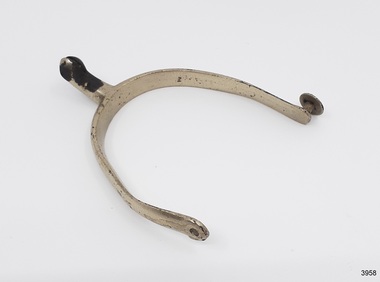
Equipment - Spur, Ca. 1855
... seafarers. After two of the men drowned when they tried to reach Schomberg, salvage efforts were abandoned. This spur is significant as an example of an item in common use in the mid-19th century. The Schomberg collection as a whole is of historical and archaeological significance at a State level. Flagstaff Hill’s collection of artefacts from the Schomberg is also significant for its association with the Victorian Heritage Registered ...Amongst the items of cargo recovered from the wreck of the Schomberg were riding spurs. This spur has been restored to show the type of finish the Spurs would have had when they were new. ABOUT THE SCHOMBERG- When the ship Schomberg was launched in 1855, she was considered the most perfect clipper ship ever to be built. James Blaine’s Black Ball Line had commissioned her to be built for their fleet of passenger liners. The Aberdeen builders designed her to sail faster than the quick clippers designed by North American Donald McKay. She was a three-masted wooden clipper ship, built with diagonal planking of British oat with layers of Scottish larch. Schomberg departed Liverpool for Melbourne on 6 October 1855 under her master Captain ‘Bully’ Forbes, with 430 passengers and 3000 tons of cargo including iron rails and equipment intended the build the Geelong Railway and a bridge over the Yarra from Melbourne to Hawthorn. Schomberg’s journey was slower than the predicted 60 days. She was 78 days out of Liverpool when she ran aground on an uncharted sand spit near Peterborough, Victoria, on 27 December. Overnight, the crew launched a lifeboat to find a safe place to land the ship’s passengers. The scouting party returned to Schomberg and advised Forbes that it was best to wait until morning because the rough seas could easily overturn the small lifeboats. The ship’s Chief Officer spotted SS Queen at dawn and signalled the steamer. The master of the SS Queen approached the stranded vessel and all of Schomberg’s passengers were able to disembark safely. The Black Ball Line’s Melbourne agent sent a steamer to retrieve the passengers’ baggage from the Schomberg. Other steamers helped unload her cargo until the weather changed and prevented the salvage teams from accessing the ship. Local merchants Manifold & Bostock bought the wreck and cargo but did not attempt to salvage the cargo still on board the ship. They eventually sold it on to a Melbourne businessman and two seafarers. After two of the men drowned when they tried to reach Schomberg, salvage efforts were abandoned.This spur is significant as an example of an item in common use in the mid-19th century. The Schomberg collection as a whole is of historical and archaeological significance at a State level. Flagstaff Hill’s collection of artefacts from the Schomberg is also significant for its association with the Victorian Heritage Registered shipwreck (VHR S 612). The collection is of prime significance because of the relationship between the objects salvaged, as together they help us to interpret the story of the Schomberg. The collection as a whole is historically significant for representing aspects of Victoria's maritime history and its potential to interpret social and historical themes. Spur; wish-bone shaped metal with a knob on one end, a drilled hole on the other and a hook shaped extension in the centre that has a hole through it. The edges are smooth and rounded. It was recovered from the wreck of the Schomberg and has since been reconditioned.warrnambool, flagstaff hill, maritime village, maritime museum, great ocean road, shipwreck coast, shipwreck artefact, schomberg, clipper ship, black ball line, 1855 shipwreck, aberdeen clipper ship, captain forbes, peterborough shipwreck, silver plated spur, horse riding, spur, cargo, riding equipment -
 Mission to Seafarers Victoria
Programme (item) - Program, National Trust, Australian Heritage Festival - Victorian Program 2019, 2019
... Organisations can register their events held during a month, with dates varying in each state. The Mission to Seafarers holds tours and other events every year during this Festival for the community to discover its history. ...The Australian Heritage Festival is a yearly event organised by the National Trust. Organisations can register their events held during a month, with dates varying in each state.The Mission to Seafarers holds tours and other events every year during this Festival for the community to discover its history. In 2019, The Mission hosted "Practice Makes Perfect", a showcase of rare trades: stained glass windows, lace making, marine knots, wood carving etc.australian heritage festival, 2019, events, victorian program, national trust, friend of the festival, practice makes perfect, lost trades, artisans, rare trades, gordon byrne, artisan's guild of australia, bruce hutton, bruce walker, henry hakopian, keiran dunleavy, david stephenson, duncan mcharg, james charlwood, barry smith -
 Mission to Seafarers Victoria
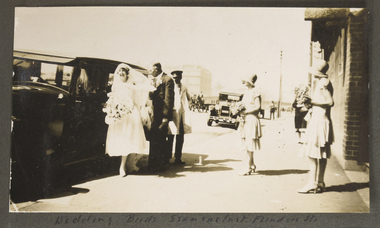
Photograph - Photograph, Sepia, Dora Walker bride to be and Father , 1928, 14 February 1928
... This photograph shows one of the many weddings performed at the Mission to Seafarers over the years. Cross referencing with the marriage registers, also held in the collection, reveals that this photograph is Amy Dora Walker (known as Dora) of East Malvern marrying Harold Priestley Simpson of Surrey Hills / Mornington on 14 February 1928. ...This photograph shows one of the many weddings held at the Mission to Seafarers over the years and provides an overview of wedding fashion of the late 1920s. The bridesmaids were Ella Kendall and Molly Walker. In this image a horse and cart can be seen in the background on Flinders St and a Telegraph pole. Dora would continue association with the Mission and as president of the Flying angels in the 1960s-70s she would be awarded the MBE for services to Community presented by the State Governor of Victoria. This photograph shows one of the many weddings performed at the Mission to Seafarers over the years. Cross referencing with the marriage registers, also held in the collection, reveals that this photograph is Amy Dora Walker (known as Dora) of East Malvern marrying Harold Priestley Simpson of Surrey Hills / Mornington on 14 February 1928. Dora's son David Simpson, a former architect still volunteers for the Mission in 2018. Dora is listed on the Women of achievement listing.Sepia toned photograph of bride and attendants in the courtyard of the Mission to Seafarers. The bride's dress is calf length and she has just stepped out of a large car assisted by her Father Mr Walker. The Bride is holding a large bouquet. There are two attendants or Bridesmaids to the right of the photograph, wearing layered calf length dresses, cloche hats and holding a small bouquet. Both are standing outside the Mission to Seamen on Flinders St waiting to assist the bride. small circular Blue ink stamp on rear of photograph: PRINTED BY HARRINGTONS. numerals stamped on the back 3 and 8 hat, flowers, veil, wedding, dress, shoes, motorcar, bridesmaids, dora walker, dora simpson, harry simpson, flinders street, 1928, david simpson, fan album, john reginald weller (1880-1969), arthur walker, molly walker, ella kendall -
 Mission to Seafarers Victoria
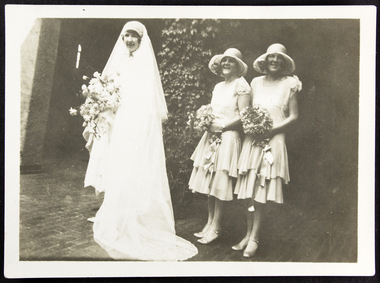
Photograph, 15/2/1928
... This photograph shows one of the many weddings performed at the Mission to Seafarers chapel over the years. Cross referencing with the marriage registers, also held in the collection, records that this photograph is Amy Dora Simpson (nee Dora Walker) of East Malvern marrying Harold Priestley Simpson of Surrey Hills / Mornington? ...This photograph shows one of the many weddings held at the Mission to Seafarers over the years and provides an overview of wedding fashion of the late 1920s. The Bride is posing in the courtyard of the Mission to Seamen. The bridesmaids were Ella Kendall and Molly Walker. The Walkers and Dora had a long association with the Mission and the LHLG and in the 1960s becoming president of the Flying Angel League which amalgamated with the LHLG in the early 1960s. In 1970 Dora received an OBE. Private images of the day for the record were supplied to the Mission by sons David and Brian in 2018. The article in the Herald of the day describes the event: "WEDDING AT SEAMEN'S CHAPEL Reception at Hotel Windsor The pretty little chapel at the Sea men's Institute was packed with interested friends this afternoon, when Miss Dora Walker, one of the Mission's most enthusiastic and efficient voluntary helpers, chose it as the setting for her marriage with Mr H. P. Simpson, son of Mr and Mrs J. H. Simpson, of Mornington. A group of her fellow workers decorated the chapel with lovely pink and white gladioli, carnations and roses. The ceremony was performed by the Rev. J. R. Weller, chaplain of the Mission, and the bride was given away by her father, Mr A. W. Walker, of Manning road, East Malvern. She wore a lovely ivory georgette frock, the finely tucked skirt being fashioned with a deep transparent hem of Chantilly lace. Over it fell a beautiful Honiton lace veil mounted on tulle and arranged to give the ef fect of a train. Fragrant white roses composed her bouquet. Two attendants followed her down the aisle — her sister, Miss Molly Walker, and Miss Ella Kendall — both wearing dainty shrimp pink georgette frocks and large crinoline straw hats in the same shade with a dainty edging of tulle. They carried bouquets of pink cactus dahlias nnd delphiniums. Mr Louis Buscombe was best man, and Mr George Thompson grooms man. After the ceremony Mr and Mrs Walker entertained about 50 guests at the Hotel Windsor."This photograph shows one of the many weddings performed at the Mission to Seafarers chapel over the years. Cross referencing with the marriage registers, also held in the collection, records that this photograph is Amy Dora Simpson (nee Dora Walker) of East Malvern marrying Harold Priestley Simpson of Surrey Hills / Mornington? on 14 February 1928.Sepia toned photograph of bride and attendants in the courtyard of the Mission to Seafarers. The bride's dress is calf length and she is standing with her veil draped in front of her, holding a large bouquet. There are two attendants to the right of the photograph, wearing layered calf length dresses and wearing cloche hats and holding small posy bouquets. The bridal group is posed standing in in the courtyard near the entrance to the MTS chapel.Small circular Blue ink stamp on rear of photograph: Printed by Harringtons stamped 2 small numerals : 3 and 8hat, flowers, veil, wedding, dress, ivy, shoes, dora walker, dora simpson, ella kendall, molly walker, amy dora walker, reverend j.r. weller, flinders street, st peter chapel, mission to seamen, seamen's mission, mission to seafarers, david simpson -
 Mission to Seafarers Victoria
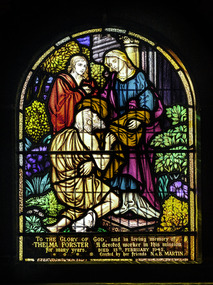
Artwork, other - Stained glass window, Brooks Robinson & Co, In memory of Thelma Forster, 1946
... On electoral Rolls she is registered as typist so it is likely she was typing the documents, newsletter or administrative documents for the Mission or the Guild. Thelma Forster was a member of the HLG. She died on 15 February 1945 st peter chapel flinders street mission to seafarers ...Thelma Jessie Forster (1892-1945) was a member of the Ladies Harbour Lights Guild. Daughter of Henry William Forster and Jessie Graham Wheeler. On electoral Rolls she is registered as typist so it is likely she was typing the documents, newsletter or administrative documents for the Mission or the Guild.Arched windows st peter chapel, flinders street, mission to seafarers, seamen's mission, mission to seamen, st peter, sailors, seamen, stained glass windows, win, memorial chapel, ww2, jesus, hlg, thelma forster, n. martin, b. martin, typist -
 Mission to Seafarers Victoria
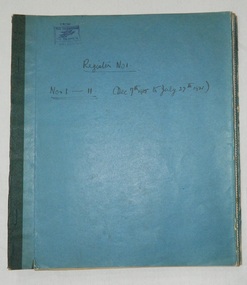
legal record (item) - Register, marriages, Register No. 1, No. 1-11 (Dec. 7th 1915 to July 27th 1921), c.1915
... This is a register of weddings performed at the Mission to Seafarers at the Port Melbourne site. ...This is a register of weddings performed at the Mission to Seafarers at the Port Melbourne site. ...This is a register of weddings performed at the Mission to Seafarers at the Port Melbourne site. The register names all parties involved including bride, groom, celebrant, witnesses, bride and groom's parents and addresses at the time. It also outlines previous marital status, employment details and other personal details. Historical record of marriages performed at the Mission to Seafarers commencing in 1915.Purple stamp in top left-hand corner of a flag with a flying angel. "From the Mission to Seamen Melbourne" Handwritten: Register No. 1, No. 1-11 (Dec. 7th 1915 to July 27th 1921)st nicholas chapel, port melbourne, mission to seamen, seamen's mission, mission to seafarers, marriage, register, wedding, st james, anglican church, dio-marriages, dio-archives -
 Mission to Seafarers Victoria
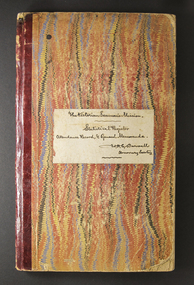
administrative record (item) - Register, W.H.C. Darvall, The Victorian Seamen's Mission/Statistical Register/Attendance Record & General Memoranda./W.H.C. Darvall/Honorary Secretary, 1895
... register of elections and other committee information. Stuck in behind all this statistical data are flyers advertising functions and events at the Mission. This ledger outlines the people involved in decision making at the Victorian Seamen's Mission in the late 19th C , the forerunner to Mission to Seafarers and 10 years prior to amalgamation with the group led by Rev'd. ...This handwritten ledger lists all annual meetings by date and includes all those in attendance. There is also a register of elections and other committee information. Stuck in behind all this statistical data are flyers advertising functions and events at the Mission.This ledger outlines the people involved in decision making at the Victorian Seamen's Mission in the late 19th C , the forerunner to Mission to Seafarers and 10 years prior to amalgamation with the group led by Rev'd. Alfred Gurney-Goldsmith. The ledger includes meeting dates as well as flyers advertising events and functions at the venue.Stuck to front cover and handwritten in ink: "The Victorian Seamen's Mission/Statistical Register/Attendance Record & General Memoranda./W.H.C. Darvall/Honorary Secretarywilliam henry charles darvall (1830-1906), office bearers, mission to seafarers, mission to seamen, seamen's mission, victoria, administration, committee, ledger, annual meetings, statistics, functions, events, register, elections, attendance, 1895 -
 Mission to Seafarers Victoria
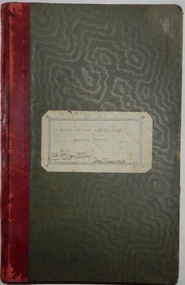
Administrative record (item) - Register, membership, Ladies Harbour Lights Guild Working Members, c. 1927
... Provides an overview of membership names and dates of subscribers to the LHLG at the Mission Provides a record of and insight into patterns of membership of the MtS LHLG in the early 20th C. lhlg membership register ladies ladies harbour lights guild mission to seafarers seamen's mission fundraising charity philanthropy alice sibthorpe tracy treasurer working members subscriptions Typewritten in black ink: Ladies Harbour Lights Guild / Working Members Handwritten in blue ink: A. ...Provides an overview of membership names and dates of subscribers to the LHLG at the Mission Provides a record of and insight into patterns of membership of the MtS LHLG in the early 20th C.Typewritten in black ink: Ladies Harbour Lights Guild / Working Members Handwritten in blue ink: A. Sibthorpe Tracy / Hon. Treasurerlhlg, membership, register, ladies, ladies harbour lights guild, mission to seafarers, seamen's mission, fundraising, charity, philanthropy, alice sibthorpe tracy, treasurer, working members, subscriptions -
 Mission to Seafarers Victoria
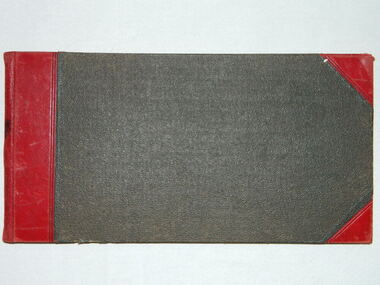
legal record (item) - Register, Funerals, Victorian Seamen's Mission
... seamens' mission mission to seamen mission to seafarers registers funerals chapel dio-funerals dark card end boards with red bindings at spine and corners of front cover. legal record Register, Funerals Victorian Seamen's Mission ...seamens' mission, mission to seamen, mission to seafarers, registers, funerals, chapel, dio-funerals -
 Mission to Seafarers Victoria
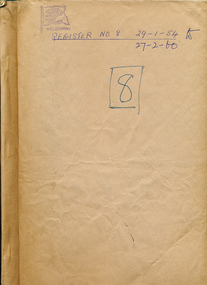
legal record (item) - Register, marriages, Register No. 8 Marriages 29-1-54 to 27-2-60, 1954
... Beverley and Robin continued to live at the Mission after their marriage and both of their children, Roslyn and Andrew, were born during that time. st peter chapel robin kent frank leslie oliver padre oliver marriages weddings register beverley oliver mission to seafarers seamen's mission mission to seamen flinders street melbourne dio-marriages dio-archives Handwritten in blue ink on the front cover: "REGISTER NO. 8 29-1-54 to/27-2-60/8 Book covered in brown paper containing twenty-five registration pages on which marriage details are recorded. ...The St Peter Chapel has been the site of many religious celebrations including weddings, funerals and baptisms. This register is a government produced document recording all the necessary information in order to legally register a marriage in the Commonwealth of Australia.Whilst this register details marriages conducted at the St Peter Chapel during the period 1954-1960, of particular importance is the marriage between Robin Alexander Kent and Beverley Langdon Oliver. Beverley is the daughter of Frank Oliver, who served as chaplain to the Mission for a period of 30 years. Beverley and Robin continued to live at the Mission after their marriage and both of their children, Roslyn and Andrew, were born during that time.Handwritten in blue ink on the front cover: "REGISTER NO. 8 29-1-54 to/27-2-60/8st peter chapel, robin kent, frank leslie oliver, padre oliver, marriages, weddings, register, beverley oliver, mission to seafarers, seamen's mission, mission to seamen, flinders street, melbourne, dio-marriages, dio-archives -
 Mission to Seafarers Victoria
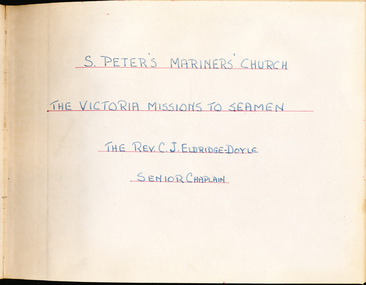
Book (item) - Register, services, Service Register 1960 - 1988, 1960
... registers, recording similar information. However, they represent a continuity of Anglican service throughout the lifespan of the Mission to Seafarers Victoria. ...This register records every Anglican service held in the St Peter the Mariner's Chapel from 10 July 1960 through to 30 December 1988. It also records the date, time of service, name of the preacher, text used for sermon, approximate numbers in attendance and approximate numbers of communicants.The service register is one a series of similar registers, recording similar information. However, they represent a continuity of Anglican service throughout the lifespan of the Mission to Seafarers Victoria. This also shows the way in which the Mission has adhered to its core values as a religious organisation.White sticker on spine: "ST PETERS CHURCH/Service Register 1960 - 30/12198register, st peter chapel, mission to seafarers, seamen's mission, flinders street, melbourne, anglican church, reverend c.j. eldridge-doyle, chaplain -
 Mission to Seafarers Victoria
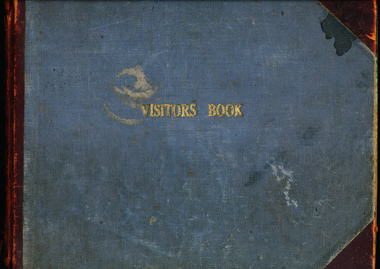
Book (item) - Visitor logbook, Visitors Book 1945-1947, 1945
... It provides an insight into the comments and also the practice of some seafarers who adopted other identities such as Churchill or Clement Atlee. The book predates the requirement to supply official ID and registration. The book and register ...This book documents visitation fo seafarers to the Williamstown rest from 1945-47. The book appears to have been donated. The contents are signed in some instances by what appear to be whole crew. It provides an insight into the comments and also the practice of some seafarers who adopted other identities such as Churchill or Clement Atlee. The book predates the requirement to supply official ID and registration.The book and register is one of the earliest to survive, only one or two others have survived as records of seafarers visiting the Missions. It is therefore significant as an example of a register and entries names, home ports , ships and commentary. Front cover: VISITORS BOOK in gold gilt. Spine: white sticker WILLIAMSTOWN M.T.S/VISITORS 1945-7.williamstown, seafarers, logbook, signatures, seamen, sailors, mission to seafarers, seamen's mission, betty mcaleese, ships name -
 Mission to Seafarers Victoria
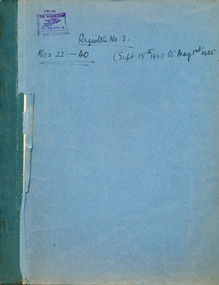
legal record (item) - Register, marriages, Register no 3, Nos 22 to 40 (Sept 15th 1923 to May 1st 1935, 1923
... The register is a record of the weddings conducted at the St Peter Chapel between the 15th of September, 1923 to the 1st of March, 1935. wedding mission to seafarers seamen's mission mission to seamen st peter chapel marriage register record flinders street dio-marriages dio-archives Handwritten in black ink on front cover: REGISTRATION NO 3. / NOS 22- 40 (SEPT 15TH 1923 TO MAY 1ST 1935. ...All the weddings performed in the St Peter Chapel from September 1923 to May 1935 are documented in the register. Each page records the necessary information for the marriage to be registered legally in the Commonwealth of Australian.The register is a record of the weddings conducted at the St Peter Chapel between the 15th of September, 1923 to the 1st of March, 1935.Handwritten in black ink on front cover: REGISTRATION NO 3. / NOS 22- 40 (SEPT 15TH 1923 TO MAY 1ST 1935. Stamped in purple ink in top left corner: FROM / THE MISSION / TO SEAMEN / MELBOURNE.wedding, mission to seafarers, seamen's mission, mission to seamen, st peter chapel, marriage, register, record, flinders street, dio-marriages, dio-archives -
Mission to Seafarers Victoria
legal record (item) - Register, Marriages, The Victoria Missions to Seamen, Marriage Register, 1950
... The register is a record of the weddings conducted in Peter the Marina Church between the 14th of October 1950 to the 16th of January 1954. wedding marriage 1950-1954 register mission-to-seafarers mission to seafarers mission to seamen seamen's mission marriages weddings chapel st peter chapel padre oliver dio-marriages dio-archives On unattached front cover: REGISTER NO 7 (underlined) / 106 - 130 / 14-10-50 - 16-1-54 / NOTE NOS 107 PORT MELBOURNE / 114 WILLIAMSTOWN / 122 WILLIAMSTOWN / 120 PRIVATE ADDRESS GLENHUNTLY, handwritten in ink. ...The register documents the weddings that took place in St. Peter's Mariners Church between October 1950 to January 1954. Each page is the legal documentation of the necessary information for the wedding to be registered in the Commonwealth of Australia. Two of the weddings registers also have Forms of Consent, as the brides were under age. Most of the weddings have been officiated by Reverend Frank Oliver.The register is a record of the weddings conducted in Peter the Marina Church between the 14th of October 1950 to the 16th of January 1954.On unattached front cover: REGISTER NO 7 (underlined) / 106 - 130 / 14-10-50 - 16-1-54 / NOTE NOS 107 PORT MELBOURNE / 114 WILLIAMSTOWN / 122 WILLIAMSTOWN / 120 PRIVATE ADDRESS GLENHUNTLY, handwritten in ink. There is an ink smudge just below the last line.wedding, marriage, 1950-1954, register, mission-to-seafarers, mission to seafarers, mission to seamen, seamen's mission, marriages, weddings, chapel, st peter chapel, padre oliver, dio-marriages, dio-archives -
 Mission to Seafarers Victoria
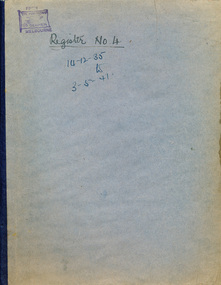
legal record (item) - Register, Register no 4 Marriages 1935-1941, 1935
... Peter's Seamen's Church between 1935 to 1941. wedding mission-to-seamen wartime register marriages dio-marriages st peter chapel mission to seafarers seamen's mission Front cover: REGISTER NO. 4 / 14-12-35 / TO / 3-5-41 handwritten in ink. ...This register was used by the Mission to Seamen, in the St. Peter's Seamen's Church from the 14th of December, 1935 to the 3rd of May, 1941. It records the weddings that took place at the church, along with all the information necessary to legalise the marriage under Australian law.The register details weddings conducted at the St. Peter's Seamen's Church between 1935 to 1941.Front cover: REGISTER NO. 4 / 14-12-35 / TO / 3-5-41 handwritten in ink. In the top right hand corner of the the front cover is a Mission to Seamen, Melbourne stamp, in blue ink.wedding, mission-to-seamen, wartime, register, marriages, dio-marriages, st peter chapel, mission to seafarers, seamen's mission -
 Mission to Seafarers Victoria
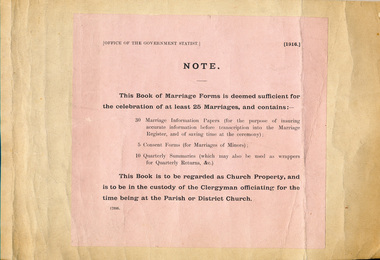
legal record (item) - Register, Anglican Diocese of Melbourne, Marriage Information Papers and guidelines, 1916
... The register is a record of the weddings that took place at the Mission to Seafarers church district in 1916. ...The register is a record of the weddings that took place at the Mission to Seafarers church district in 1916. ...The register is a record of the weddings that took place at the Mission to Seafarers church district in 1916. Each register is a legal contract, with all the information needed to legalise a marriage under Australian law. The last four pages of the register are consent forms.The register documents the weddings that took place at the Mission to Seafarers church in 1916.On the front cover, in the pink square, typed in black ink: OFFICE OF THE GOVERNMENT STATIST 1916 / NOTE /THIS BOOK OF MARRIAGE FORMS IS DEEMED SUFFICIENT FOR THE CELEBRATION OF AT LEAST 25 MARRIAGES, AND CONTAINS:- / 30 MARRIAGE INFORMATION PAPERS (FOR THE PURPOSE OF INSURING ACCURATE INFORMATION BEFORE TRANSCRIPTION INTO THE MARRIAGE REGISTER, AND OF SAVING TIME AT THE CEREMONY) / 5 CONSENT FORMS (FOR MARRIAGES OF MINORS); / 10 QUARTERLY SUMMERIES (WHICH MAY ALSO BE USED AS WRAPPERS FOR QUARTERLY RETURNS, &C.) / THIS BOOK IS TO BE REGARDED AS CHURCH PROPERTY, AND / IS TO BE IN THE CUSTODY OF THE CLERGYMAN OFFICIATING FOR THE / TIME BEING AT THE PARISH OF DISTRICT CHURCH. / 17595.register, wedding, marriage, marriages, mission to seafarers, dio-marriages, 1916 -
Mission to Seafarers Victoria
legal record (item) - Register, Marriage Register, c. 1941
... The register records the weddings that took place at the Mission to Seafarers church between the 14th of May, 1941 to the 2nd of March, 1947. ...The register records the twenty weddings that were conducted at the Mission to Seafarers church between 1941 to 1947. ...The register records the weddings that took place at the Mission to Seafarers church between the 14th of May, 1941 to the 2nd of March, 1947. It documents all the information necessary to perform a legal wedding in Australia. This included Forms of Consent, if one or both the parties were under the age of 21.The register records the twenty weddings that were conducted at the Mission to Seafarers church between 1941 to 1947. Each page of the register is a legally binding document.Handwritten on front cover in blue and black ink: REGISTER NO 5 (underlined) / 14-5-22-3-47. / NOTE MARRIAGES IN 1942 (underlined) / MARRIAGES CELEBRATED ST PETER'S SEAMEN'S / CHURCH MELBOURNE / 31-2-42 / 3-2-42 / 19-3-1942 / ARE REGISTERED ON THE LAST THREE / FORMS OF THE PORT MELBOURNE (underlined) REGISTER / FOR THAT PERIOD FLO (signed). There is also some water stained, and dust markings on the covers.register, 1941-1947, wartime, church-of-england, consent, chaplaincy, dio-marriages, dio-archives, mission to seafarers, seamen's mission, weddings, marriages -
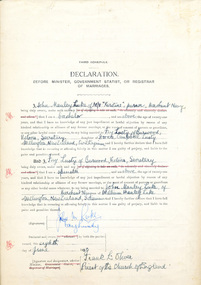 Mission to Seafarers Victoria
legal record (item) - Register, Marriage Register, Circa 1947
... The register is a historical record of weddings performed at the Mission to Seamen church between 1947 to 1950. wedding marriage 1947-1950 register church marriages dio-marriages mission to seafarers seamen's mission On front cover, handwritten in blue ink: REGISTER NO 6 / 21-4-47 - 8-6-50 / NOTE NO 94 (underlined) / CELEBRATED AT ST NICHOLAS'MARINERS'CHURCH / WILLIAMSTOWN / NO 103 (underlined) AT ST ANDREWS " " / PORT MELBOURNE A large grey paper covered book, with red material binding on the spine. the edges of the front cover are somewhat torn, and the back cover is missing. ...The register documents twenty-five weddings that took place in the Mission to Seamen's church district between the 21st of April, 1947 to the 8th of June 1950. Each certificate is a record of all the information needed to legalise a marriage under Commonwealth law, such as names, dates of birth, marital status, parents and employment. Within the register, there are four Forms of Consent, used when the bride or groom were below the age of twenty-one. There is a memo confirming the death of one bride's previous husband, a letter confirming one groom was actually a bachelor, and letters from a ship's captain, swearing a bride and groom are both unmarried.The register is a historical record of weddings performed at the Mission to Seamen church between 1947 to 1950.On front cover, handwritten in blue ink: REGISTER NO 6 / 21-4-47 - 8-6-50 / NOTE NO 94 (underlined) / CELEBRATED AT ST NICHOLAS'MARINERS'CHURCH / WILLIAMSTOWN / NO 103 (underlined) AT ST ANDREWS " " / PORT MELBOURNEwedding, marriage, 1947-1950, register, church, marriages, dio-marriages, mission to seafarers, seamen's mission
