
Showing 39 items matching "seamstress"
-
 Kiewa Valley Historical Society
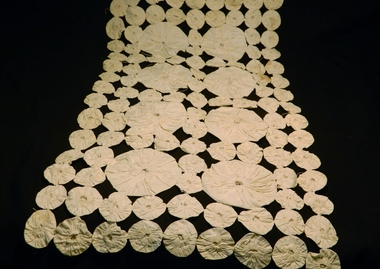
Table Runner, circa 1920s to 1950s
... Unknown local seamstress...Table Runner Unknown local seamstress ...Historically this item highlights the middle to upper to middle socio economic levels of a rural community in the 1920s to 1950s. The fashion dictated to by the larger cities and towns were for some smaller items of house hold furniture encompassed by homes in the region, not only because of practicality but also for longevity of the item it protected.The significance of this item in showing that although the region was to a small degree isolated from the "latest" fashion of house hold dressage, it was to a certain degree not regional and that the fashion of the day in large cities and towns was instilled through magazines and Country Women,s organisations.Fine cotton table runner. Middle section has a 2cm wide crochet insert around it with another border of cotton around it 2cm wide. All the item is edged with a 7cm wide crochet band.hand craft, furniture dressing, lace, crochet, cotton furniture proctective coverings -
 Kiewa Valley Historical Society
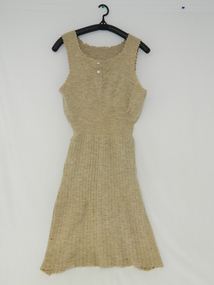
Dress Knitted
... This dress was possibly manufactured by a local seamstress in the period circa early 1900.The quality of the dress suggests that the lady who wore it was from middle to upper range of the socio-economic structure within the Kiewa Valley...no manufacturer's label suggesting manufacturer was a very talented local seamstress ...This dress was possibly manufactured by a local seamstress in the period circa early 1900.The quality of the dress suggests that the lady who wore it was from middle to upper range of the socio-economic structure within the Kiewa Valley Historically this item dating in the early 1900s was made by a very competent seamstress (lack of manufacturer's label). ...This dress was possibly manufactured by a local seamstress in the period circa early 1900.The quality of the dress suggests that the lady who wore it was from middle to upper range of the socio-economic structure within the Kiewa ValleyHistorically this item dating in the early 1900s was made by a very competent seamstress (lack of manufacturer's label). It demonstrates that the conditions of relative isolation within the Kiewa Valley was not extreme and that local manufacture of clothing items were available and at a very high level of quality. This item demonstrates that the hand made era was alive and an essential part of community/social adhesion within the valley.Beige knitted dress, sleeveless ladies pin weaved running from waist to bottom. Fine pin weave from bust to waist. Two mother of pearl buttons fastening opening front neck 11cm from neck to upper breastno manufacturer's label suggesting manufacturer was a very talented local seamstress costume, woollen, knitted, dress, female clothing -
 Whitehorse Historical Society Inc.
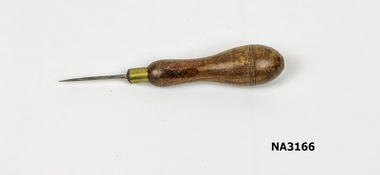
Tool - Metal Stiletto
... Metal stiletto or seamstress eyelet-pricker, with a wooden handle. ...From the Betty McPhee sewing collection handcrafts equipment Metal stiletto or seamstress eyelet-pricker, with a wooden handle. ...From the Betty McPhee sewing collectionMetal stiletto or seamstress eyelet-pricker, with a wooden handle. Handle is secured to stiletto with a metal ferrule. Used to form a hole in embroidery and other dressmakers activities.handcrafts, equipment -
 Bendigo Historical Society Inc.
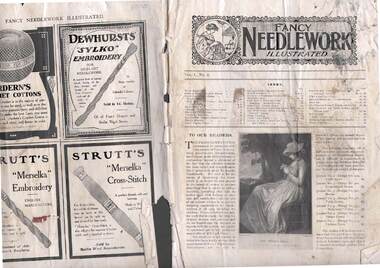
Magazine - FANCY NEEDLEWORK ILLUSTRATED, 1907-1908
... The front page shows a painting called The Seamstress...The front page shows a painting called The Seamstress Magazine FANCY NEEDLEWORK ILLUSTRATED ...Magazine, Fancy Needlework Illustrated, Vol.1; No.4, Missing pages 3,4,13,14,25,26.. Published early 1907-1908. The front page shows a painting called The Seamstressmagazine, organization -
 Bendigo Historical Society Inc.
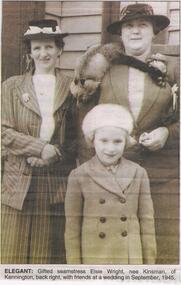
Newspaper - JENNY FOLEY COLLECTION: ELEGANT
... Elegant: gifted seamstress Elsie Wright, nee Kinsman of Kennington, back right with friends at a wedding in September, 1945....Elegant: gifted seamstress Elsie Wright, nee Kinsman of Kennington, back right with friends at a wedding in September, 1945. ...Bendigo Advertiser "the way we were'' from Thursday, December 9, 2004. Elegant: gifted seamstress Elsie Wright, nee Kinsman of Kennington, back right with friends at a wedding in September, 1945.newspaper, bendigo advertiser, the way we were -
 Flagstaff Hill Maritime Museum and Village
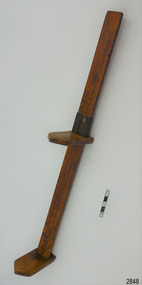
Tool - Hem marker stand, 1900s
... ...seamstress...The hem marker would be used by professional dressmakers, seamstresses, and tailors as well as by crafts people at home. ...The hem marker would be used by professional dressmakers, seamstresses, and tailors as well as by crafts people at home. ...This hem marker stand is a measuring tool for gauging the height of a hem, such as on a dress or curtain. The adjustable arm slides along the ruler and its snug fit ensures that it stays at the right height. The end of the arm has a metal pin inserted into it to hold a piece of chalk, which would be used to mark the fabric. The hem marker would be used by professional dressmakers, seamstresses, and tailors as well as by crafts people at home. The hem marker was made in Birmingham.The hem marking stand is an example of tools used during the 1900s in the garments and furnishings trades as well as for domestic purposes. Since that time the tool has evolved into a more efficient design that makes home sewing easier.Ham marking stand with a wooden ruler, stand and a sliding adjustable arm on a brass sleeve. The arm has a metal pin on the end. Measurements are marked on both sides, inches on one side and centimetres on the other. Inscriptions are stamped into the wood. Made in Birmingham."- - - - / - - - - - / -BIRMINGHAM" On end of arm "2*4'flagstaff hill, warrnambool, maritime village, maritime museum, shipwreck coast, great ocean road, hem marker, dressmaker, dressmaking, alterations, tailor, dressmaker's tool, sewing marker, sewing gauge, seamstress, domestic use, dress fitting, curtain hemming, birmingham, freestanding, chalk hem marker, stand, home craft -
 Bendigo Historical Society Inc.
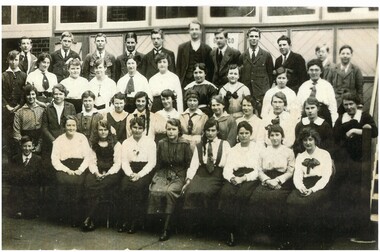
Photograph - BENDIGO BUSINESS COLLEGE - STUDENTS, 1916
... Mrs Wills' mother (Mrs Quinn) was seamstress for Lady Lansell....Mrs Wills' mother (Mrs Quinn) was seamstress for Lady Lansell. Photograph BENDIGO BUSINESS COLLEGE - STUDENTS ...Black and White Photo of a group of students of the Bendigo Business College circa 1916. Accompanying note states that the original photo was given to Q C Binks by the late Mrs Edna Wills. The writer thinks that she is the lady second from the left in the front row. Mrs Wills' mother (Mrs Quinn) was seamstress for Lady Lansell.education, secondary, bendigo busines college, bendigo business college, trades hall, view street, view st -
 Kiewa Valley Historical Society
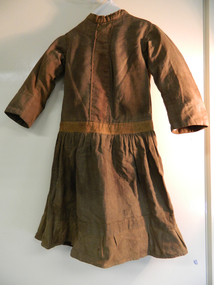
Dress
... Due to relative long distance to haberdashery stores majority of children's garments were hand made by a local talented seamstress or mother/relative...Due to relative long distance to haberdashery stores majority of children's garments were hand made by a local talented seamstress or mother/relative Historical significant to the period circa 1900 to circa 1950 when fashion was dictated by long lasting durability, local manufacture, earthy colours and ease of mobility. ...made locally circa 1910. Due to relative long distance to haberdashery stores majority of children's garments were hand made by a local talented seamstress or mother/relativeHistorical significant to the period circa 1900 to circa 1950 when fashion was dictated by long lasting durability, local manufacture, earthy colours and ease of mobility. Photos in the KVHS collection show girls from Tawonga Primary School in a dress that could be this dress which is dated 1910. Dress brown cotton with long sleeves. Dress top and sleeves lined. Back of dress is open with metal hooks for fastening. Hand stitched eyelets and decorative strip down centre front bodice and around hips. Gathered skirt is joined at hip. One pocket on left side 6cm from waist band.Decorative strip at bottom of dress with a pleated hand and machine stitched frill.no inscriptions or markings suggesting locally made.dress, clothing, girl's dress, home made -
 Embroiderers Guild, Victoria
Tool - Bracelet thread holder
... This yarn holder is a tool for seamstresses and knitters, allowing the wearer to keep yarn or thread accessible while working. ...This yarn holder is a tool for seamstresses and knitters, allowing the wearer to keep yarn or thread accessible while working. ...This yarn holder is a tool for seamstresses and knitters, allowing the wearer to keep yarn or thread accessible while working. Worn around the wrist, it would hold a spool of yarn, preventing tangling and ensuring smooth operation. Evidence of designs for tools for needleworkers/knittersStretch bracelet with split pin with tip attached on 4cm long swivelyarn holder, needlework tool -
 City of Ballarat Libraries
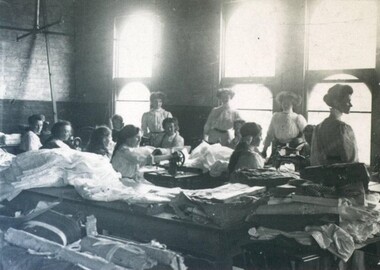
Photograph - Card Box Photographs, Sewing workshop, Tylers, Ballarat 1909
... This photo shows seamstresses at their sewing machines at what could be, Tylers which is located on the first floor of the corner of Bridge and Grenville Streets. ...This photo shows seamstresses at their sewing machines at what could be, Tylers which is located on the first floor of the corner of Bridge and Grenville Streets. ...This photo shows seamstresses at their sewing machines at what could be, Tylers which is located on the first floor of the corner of Bridge and Grenville Streets. The lady in the foreground is 'Baby' Gingell who later became Mrs W. Wallis.tylers, sewing, business, commerical, fashion, ballarat, bridge street, grenville street, manufacturing, costume work -
 Kiewa Valley Historical Society
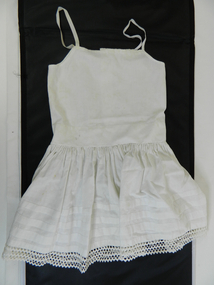
Petticoat Child
... Mothers and other family members had the seamstress talent to make clothes that are not in full view of anyone...Mothers and other family members had the seamstress talent to make clothes that are not in full view of anyone Historically these undergarments have no fashion relevance for the younger fashion scene and this garment is an example of the self sufficient supply of home made articles. ...This petticoat is demonstrative of home made infant undergarment clothing in the early 1900. Distance to and from commercial haberdashery store was too far to fit out young girls especially if the are undergarments. Mothers and other family members had the seamstress talent to make clothes that are not in full view of anyoneHistorically these undergarments have no fashion relevance for the younger fashion scene and this garment is an example of the self sufficient supply of home made articles. This was especially so within the Kiewa Valley and surrounds. Fashion in Australia and more so in areas with little or no access to overseas or city merchandise lacked "modern fashionable" clothes e.g. the latest from England and Paris. This region was and still is a rural backdrop of clothes that fit into the type of life and work of the society it holds.Cotton petticoat, white, three buttons on top back, 8mm wide straps of cotton tape. Gathered skirt with triple row of Rick Rack on the bottom edge and three pintucks, 17mm wide, on the lower edge of skirt. Garment is completely hand stitchedchildren's underwear, female underwear, dressmaking, handcraft, costume, clothing -
 Kiewa Valley Historical Society
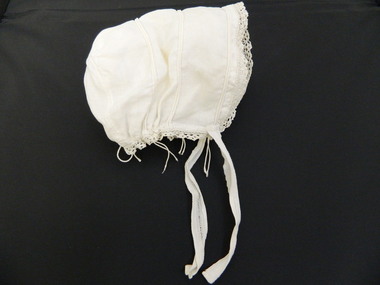
Baby's Bonnet
... Due to relative long distance to haberdashery stores majority of children's garments were hand made by a local talented seamstress or mother/relative. This bonnet is very similar is style and fashion to other children's clothing in KVHS collection which indicates this was made during the early 1900's. ...Due to relative long distance to haberdashery stores majority of children's garments were hand made by a local talented seamstress or mother/relative. This bonnet is very similar is style and fashion to other children's clothing in KVHS collection which indicates this was made during the early 1900's. ...Due to relative long distance to haberdashery stores majority of children's garments were hand made by a local talented seamstress or mother/relative. This bonnet is very similar is style and fashion to other children's clothing in KVHS collection which indicates this was made during the early 1900's. This has good historical significance because it shows the fashions during the early 1900's which baby bonnets were made by women of the Kiewa Valley. This item also has good interpretive capacity as it adds to the other babies clothing in the KVHS collection and therefore increases the interpretive capacity for the children's clothesCream muslin with 1 cm wide lace around the face and neck. Pin tucks threaded with fine string and 2 tape ties 13 cm long. Also string used to gather the neck edge.baby. bonnet. christening. clothing. infant. -
 Kiewa Valley Historical Society
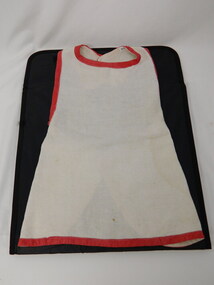
Apron - Child's
... Due to relative long distance to haberdashery stores majority of children's garments were hand made by a local talented seamstress or mother/relative. This apron is very similar in style to the other children's clothing which indicates it could have been made in the early - mid 1900's. ...Due to relative long distance to haberdashery stores majority of children's garments were hand made by a local talented seamstress or mother/relative. This apron is very similar in style to the other children's clothing which indicates it could have been made in the early - mid 1900's. ...Due to relative long distance to haberdashery stores majority of children's garments were hand made by a local talented seamstress or mother/relative. This apron is very similar in style to the other children's clothing which indicates it could have been made in the early - mid 1900's. It is preventative of aprons which little girls wore over their dresses at the time. This items has good historical significance because it shows the style of aprons which little girls wore over their dresses in the Kiewa Valley during the early to mid 1900's. This is part of the children's clothes in the KVHS collections which gives this item more interpretive capacity. Natural coloured linen with red binding around the edges. 2 white buttons. Would fit a small child.clothing. children. apron. -
 Brighton Historical Society
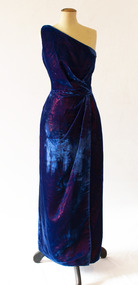
Outfit, Evening outfit, 1961
... Growing up in Sandringham, Joy Bosomworth learned to sew at the knee of her mother Elsie Myra Keefer, a seamstress. By the time she was an adult, she was making most of her own clothes. ...Growing up in Sandringham, Joy Bosomworth learned to sew at the knee of her mother Elsie Myra Keefer, a seamstress. By the time she was an adult, she was making most of her own clothes. ...Growing up in Sandringham, Joy Bosomworth learned to sew at the knee of her mother Elsie Myra Keefer, a seamstress. By the time she was an adult, she was making most of her own clothes. She made this shot velvet evening dress, along with a matching stole and bag, in 1961 to wear to a ball at the Royal Melbourne Hospital, where she worked as a radiographer. An evening outfit consisting of a matching dress, stole, bag and gloves. Sleeveless one-shoulder evening dress of blue velvet shot with metallic red. The dress is gathered at the proper left front waist and is lined with red synthetic fabric. Fastens with a zip and hook at the side. Stole of blue velvet shot with metallic red, lined with red synthetic fabric. Handbag made from blue velvet shot with metallic red. The bag has a gold metal frame and clasp, with a shot gold metal chain attached. The interior is red synthetic fabric, with a single side pocket. Elbow-length red nylon evening globes.joy myra bosomworth, joy myra keefer, evening dress, ball gown, 1960s -
 Kiewa Valley Historical Society
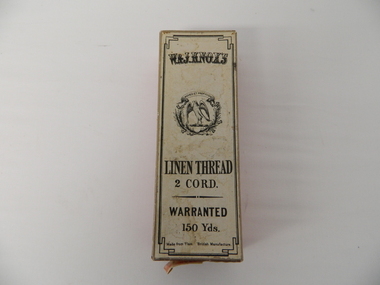
Box Linen Thread, early to mid 1900's
... This box which once contained linen thread manufactured in Scotland and labelled "British" manufacture" was used for the repair/manufacture of clothing by professional seamstresses and those wives required to "do" repair stitching of family clothes. ...This box which once contained linen thread manufactured in Scotland and labelled "British" manufacture" was used for the repair/manufacture of clothing by professional seamstresses and those wives required to "do" repair stitching of family clothes. ...This box which once contained linen thread manufactured in Scotland and labelled "British" manufacture" was used for the repair/manufacture of clothing by professional seamstresses and those wives required to "do" repair stitching of family clothes. This box was manufactured in a period when the title "United Kingdom" was used (late 1700's early 1900's) to describe the union of Britain and Scotland. The label however can be misleading as the"British Manufacture" thread was manufactured in Scotland. The broad term "British Manufacture" was used for the benefit of those in the "colonies" of Australia and New Zealand, during a period when the "coined" phrase "best of British, or British best" was synonymous to "top quality". After World War II the need for "cheaper products" was more persuasive than the quality of the product. In rural areas this shift to cheaper "non British" goods was at a slower rate than in the cities. Goods such as clothing manufactured or altered by seamstresses were regarded as of a higher standard and therefor the use of linen thread from "Britain" was a sign of quality and reliability.This box which contained linen thread, "British" made, is very significant to the Kiewa Valley because it demonstrates the conditions under which households in the late 1800's and early 1900's evolved from a "domestic repair /replacement" of damaged clothing to a consumer of recycled and shop bought clothing and linen. The ability of semi isolated rural based families to purchase "off the rack" clothing was severely affected by weather, long distance over dirt roads(poorly serviced) to large towns(shops), horse/cart or slower driven cars. The purchasing of clothing was, on the whole, from trading house "mail order" consignment orders.This red paper covered box has a white covered lid (top) with black print detailing the manufacturer and contents. This box contained 150 yds of linen thread 2 cord. A small added note pasted on one side "USUAL TWIST (s)" describing the thread's appearance. Two semicircular "finger" holes on two sides of the lid permit easier removal of the lid from the base.On the top lid: "W.&J. KNOX'S" below this a crest with latin motive "MOVEO ET PROFICIOR" English translation "I proceed and am more prosperous" encircling an open winged falcon. below this "LINEN THREAD", "2 CORD." "WARRANTED" "150 Yds." Made from Flax." British Manufacture". On one side "DRABS SOFT FINISH" within a shield "KNOX'S TWO CORD 150 YARDS 30" next to this a trade mark "W & J KNOX below this "made in KILBIRNIE, SCOTLAND"thread, cord. flax, box container, linen thread, seamstress items, cardboard box -
 Warrnambool and District Historical Society Inc.
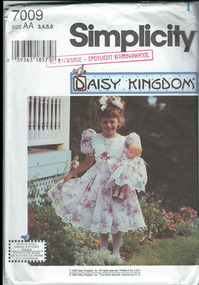
Document, Pattern Spotlight, 1996
... Paper patterns have been used by seamstresses and home sewers throughout the 20th century and are still used today. ...Paper patterns have been used by seamstresses and home sewers throughout the 20th century and are still used today. ...Paper patterns have been used by seamstresses and home sewers throughout the 20th century and are still used today. The Simplicity Pattern Company was established in New York City in 1927 by James Shapiro and distributes patterns world-wide. Spotlight is the largest chain store in Australia selling fabrics, craft and interior decorator supplies at 100 stores throughout Australia, New Zealand and Singapore. It is currently situated in Warrnambool at 84 Raglan Parade. This dress pattern is of minor interest as coming from a local Warrnanmbool shop. It may be useful for display. This is a paper envelope containing the instructions and cut-out material for a child’s dress. There are three loose items inside the envelope. ‘Simplicity, 7009, Daisy Kingdom’ ‘No Exchange, Spotlight, Warrnambool’ spotlight store, warrnambool, sewing patterns, warrnambool -
 National Vietnam Veterans Museum (NVVM)
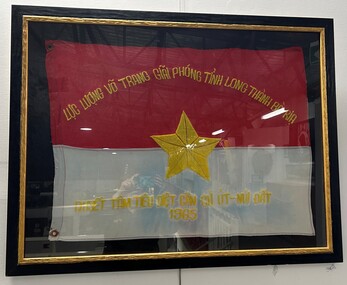
Flag - Viet Cong Flag
... It seems that the VC seamstress confused the year for 1966, as a decision to locate the new Australian base was not made until early that year. ...It seems that the VC seamstress confused the year for 1966, as a decision to locate the new Australian base was not made until early that year. ...The flag is of the National Liberation Front or Viet Cong. It was adopted in 1960 and was a variation of the North Vietnamese flag. In 1975, it became the flag of the provisional government of the Republic of South Vietnam. It seems that the VC seamstress confused the year for 1966, as a decision to locate the new Australian base was not made until early that year. This item was donated by Pte Helmut Grzegozewski(39121) who was with the Royal Australian Infantry Corps and served in Vietnam with 3rd Battalion, The Royal Australian Regiment from December 1967 to November 1968.A black and gold frame of a Viet Cong flag. The flag is red and white with yellow embroidered letters. Viet Cong Flag - c1966. This viet Cong flag reads: Long Thanh-Baria's Provincial Liberation Armed force Determines/Resolves to destroy the Australian bases in Nui Dat - 1965 flag, viet cong, long thanh-baria's provincial liberation armed force, nui dat, vc, pte helmut grzegozewski, 39121, 3rd battalion, the royal australian regiment -
 National Wool Museum
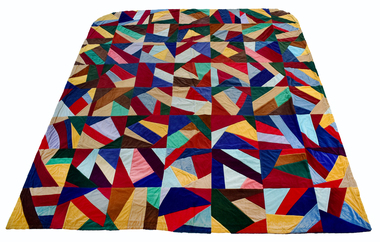
Textile - Quilt, Mrs Mary Joyce Abbott, 1972
... Mary was an excellent seamstress and a very early winner of Melbourne Show quilt prize with two single log cabin style quilts. ...Mary was an excellent seamstress and a very early winner of Melbourne Show quilt prize with two single log cabin style quilts. ...Mary Joyce Abbott made the quilt in 1972 in Bendigo. The quilt was constructed on Mary’s old Singer sewing machine with knee-action drive. Mary gifted the quilt to her daughter Sandra who used it on her bed for about a decade then retired it when she purchased her first doona. Mary was an excellent seamstress and a very early winner of Melbourne Show quilt prize with two single log cabin style quilts. In the mid-1980s Sandra roughly stitched Mary’s name and the date onto the back of the quilt.The quilt is constructed out of crazy quilt blocks, machine sewn, and made from factory offcuts of velveteen in a kaleidoscope of colours. The top end has squared edges and the bottom end has rounded edges.Mary Abbott \ 1972 (sewn into back of quilt)quilts, textiles, bed, sewing -
 National Wool Museum
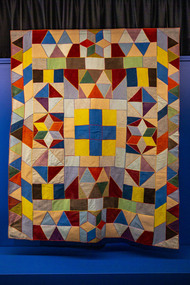
Textile - Quilt, Harry Walter Hewitt Wilton, 1885 - 1915
... Married wife Mary Elizabeth in India in 1895, she was a seamstress. Harry was injured during a battle and made this quilt as part of his rehabilitation. ...Married wife Mary Elizabeth in India in 1895, she was a seamstress. Harry was injured during a battle and made this quilt as part of his rehabilitation. ...The quilt, alternatively known as a wagga due to its improvised nature of creation, was made by Harry Walter Hewitt Wilton (great grandfather of donor), b.1872, d.1950. Harry joined the Essex Regiment and served in the British Military in India, as well as seeing action in the Boer War. Married wife Mary Elizabeth in India in 1895, she was a seamstress. Harry was injured during a battle and made this quilt as part of his rehabilitation. Quilt was made using woollen army singlets. Harry and Mary moved to Victoria, near Orbost, in 1914. Patchwork style quilt with coloured pieces of dyed woolen singlets stitched together over a backing. Features feather stitching between pieces and around border edges. Size of a double bed.harry walter hewitt wilton, wagga, essex regiment, british military, india, boer war, mary elizabeth, sewing, quilting, quilt, rehabilitation, army, orbost -
 Brighton Historical Society
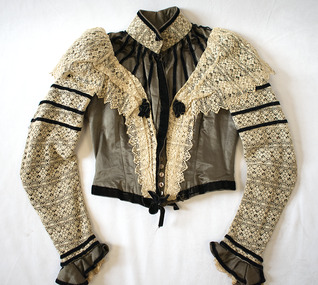
Bodice, circa 1900
... The bodice was likely made by a seamstress as the family were quite fashion-conscious. ...The bodice was likely made by a seamstress as the family were quite fashion-conscious. ...This bodice, which originally had a matching skirt, belonged to Phoebe Richardson (nee Brinsmead, 1885-1956), who married Charles William Richardson in 1911. The family lived in Geelong. Brinsmead Lane, off the Bellarine Highway in Leopold, is named after Phoebe's family, being the original location of the family home. The bodice was likely made by a seamstress as the family were quite fashion-conscious. Phoebe's daughter Edna Baker (nee Richardson, b. 1914) wore this bodice as a dress-up as a child. She donated it BHS in the 1980s and provided additional information on it when visiting the Society in 2004.Khaki green silk bodice, boned around waist. Ecru cotton lace overlay on sleeves and high neck. More lace over shoulders, gathered and tapered down front of bodice. Stripes of velvet ribbon around yoke. Four more stripes of velvet ribbon around upper sleeve, and three around each cuff. Velvet bows and metal buckle at waist. Tape at waist with hooks to attach to skirt. Lined with brown fabric. 20 mother-of-pearl buttons down front.phoebe richardson, phoebe brinsmead, edna baker, 1900s -
 Ballarat Base Hospital Trained Nurses League
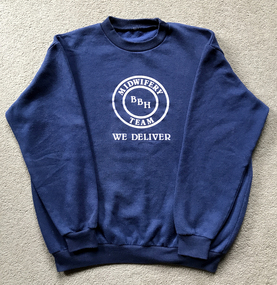
Midwifery Windcheater - "Midwifery Team, BBH, We Deliver" - early to mid 1980's, plus Courier newspaper - new Director of Nursing, Lorraine Broad, 1995
... Graphic artist and seamstress, Geraldine Roberts of Wendouree, made the windcheaters as well as screen printed the logo which the staff designed. ...Graphic artist and seamstress, Geraldine Roberts of Wendouree, made the windcheaters as well as screen printed the logo which the staff designed. ...Windcheater which the midwives in old E1 had made and were sold to staff to fund raise. Some proceeds were to assist midwives attend state conferences. Other fundraising activities were also undertaken at that time to modify the stark hospital environment of E1 to a more homely environment. Graphic artist and seamstress, Geraldine Roberts of Wendouree, made the windcheaters as well as screen printed the logo which the staff designed. Geraldine also did the graphics for an educational booklet the staff produced for expectant parents. These activities were initiated by the enthusiastic staff of E1 during the early to mid 1980s."Midwifery Team, BBH, We Deliver"midwifery, 1980s, windcheater, logo, courier, new, director of nursing, broad, 1995 -
 Sunshine and District Historical Society Incorporated
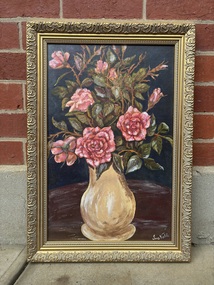
Painting - Iris Noble Still Life Flowers Painting, Iris Noble
... Iris was a meticulous and talented artist, known for working across several craft and art forms including decorated eggshells, paint, lace‑making, sewing / seamstress work and pottery. During the Second World War she was an Air Raid Warden patrolling the streets of Yarraville, Victoria. ...Iris was a meticulous and talented artist, known for working across several craft and art forms including decorated eggshells, paint, lace‑making, sewing / seamstress work and pottery. During the Second World War she was an Air Raid Warden patrolling the streets of Yarraville, Victoria. ...Iris Blanche Noble was a Sunshine North resident and lived to the age of 94. Iris was born in 1922, Daylesford, Victoria to John Edward Henry Howard and Lily Jane Howard Nee Courtot. She married Stewart William Noble in 1942, Victoria. Iris died on the 13th June 2014, Daylesford, Victoria. Iris was a meticulous and talented artist, known for working across several craft and art forms including decorated eggshells, paint, lace‑making, sewing / seamstress work and pottery. During the Second World War she was an Air Raid Warden patrolling the streets of Yarraville, Victoria. Oil painting in wooden frameIris Noble signature bottom right corneriris noble, air raid warden -
 Surrey Hills Historical Society Collection
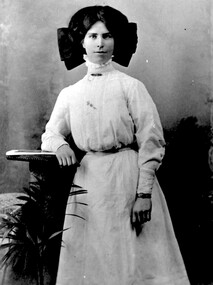
Photograph, Phoebe Rebecca Georgina Colton
... Phoebe had worked as a seamstress prior to marriage, earning 2/6d a week. ...Phoebe had worked as a seamstress prior to marriage, earning 2/6d a week. ...Phoebe Rebecca Georgina Colton was born in Williamstow in c1889, the daughter of Henry Culter Colton and Elizabeth Georgina Lucas. This photo was taken on her engagement to Albert George Harbert. They married in 1912 and moved into the house Albert had built at 237 Union Road. The house had cost him £240 to build. During his career he built a number of houses in Surrey Hills. Phoebe had worked as a seamstress prior to marriage, earning 2/6d a week. They had 2 daughters Unice and Norma. Unice remained single. Norma married Henry Jamieson. Phoebe and Albert are buried in Boroondara Cemetery - Spec E, Grave 6.A black and white photograph of a young lady wearing a light coloured lace blouse with a high neck and a white skirt. She has a very large bow at the back of her head.clothing and dress, mr albert george harbert, 1912, builder, miss phoebe rebecca georgina colton, mrs phoebe rebecca georgina harbert -
 Coal Creek Community Park & Museum
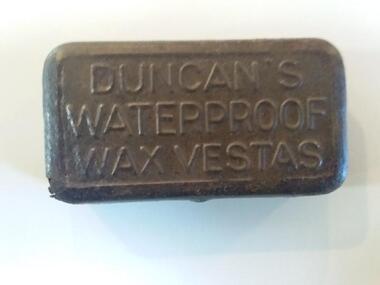
Domestic object - Tin Match Box
... Girls could work as domestic servants, seamstresses, or in large clothing factories or weaving mills. ...Girls could work as domestic servants, seamstresses, or in large clothing factories or weaving mills. ...By the close of the 19th century, colonial children in Australia (especially poorer ones) were expected to work by age 10 or 11. Boys could become apprentices or assistants to trades such as butchers, printers, carpenters, bakers, smiths or services such as delivering newspapers. Girls could work as domestic servants, seamstresses, or in large clothing factories or weaving mills. Girls as young as 6 could work in cities selling stationary or matches to passers-by. In the 1880s workers in matchstick factories, predominantly women and young girls (4-16 years old) from working-class families could work up to 14 hours a day and were exposed to deadly phosphorous vapours on a daily basis. This led to the devastating disease known as “phossy jaw” or “phosphorous necrosis of the jaw” which caused the jawbone to rot. This small rectangular tin matchbox with raised writing on top would once have been gold and brightly coloured. It has a metal striker on the inside as this type of match contains phosphorous which is volatile and can be lit by friction. Duncan's Waterproof Wax vestas -
 Albert Park-South Melbourne Rowing Club
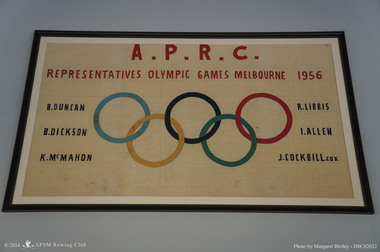
APRC 1956 Olympic Banner, 1957
... Recent research has confirmed that it was made by Joan Eddy, the wife of club member Kevin Eddy and a professional seamstress. Grace Blake’s interview notes record her conversation with Mr Eddy on 24 October 2014: Kevin confirmed that the banner was made by his wife, Joan Eddy, in time for the opening of the new shed after the Olympics (1957). ...Recent research has confirmed that it was made by Joan Eddy, the wife of club member Kevin Eddy and a professional seamstress. Grace Blake’s interview notes record her conversation with Mr Eddy on 24 October 2014: Kevin confirmed that the banner was made by his wife, Joan Eddy, in time for the opening of the new shed after the Olympics (1957). ..."The banner has been with the Club since it was created in 1957. Recent research has confirmed that it was made by Joan Eddy, the wife of club member Kevin Eddy and a professional seamstress. Grace Blake’s interview notes record her conversation with Mr Eddy on 24 October 2014: Kevin confirmed that the banner was made by his wife, Joan Eddy, in time for the opening of the new shed after the Olympics (1957). Kevin was the Social Secretary at the time, and co-opted his wife, who had worked as a machinist for Harford Clothing in Carlton before they married. Her mother had also worked there as a sewing hand (hand sewing the linings for jackets). The company was later taken over by Sires. ... It was made at home (Joan had ‘retired’ from work by then)." Excerpt from the 2014 Significance Assessment, p32.Banner Celebrating Albert Park Rowing Club Olympic Representatives, 1956 Statement of significance by Margaret Birtley, October 2014 Harry Gordon, the distinguished Australian sports historian, wrote of the 1956 Melbourne Olympic Games: "When the Olympic Games moved into Melbourne ... it was as if the city had been brushed by a certain magic. Nothing before or since ... has ever evoked such sheer emotional involvement from the whole community." Gordon refers to the large crowds that massed in Melbourne with anticipation and exhilaration on the day before the official opening, ‘with little apparent motive other than just to be there, and be happy’. The hand-crafted banner celebrating Albert Park Rowing Club’s representatives at those Olympic Games seems to exude that same sense of joy and exhilaration. Made by the wife of the club’s social secretary, it testifies to the admiration felt by individuals and organisations for the success of their own on a world stage. The banner has historic significance for its accurate documentation of the great achievement of a single rowing club in contributing six outstanding athletes to the relatively small Australian rowing team. Additional historic significance derives from the fact that this is an unofficial expression of tribute and pride. The banner’s incorporation of the Olympic rings would now be likely to require licensing by the Australian Olympic Committee, a process that can dampen social engagement. While definitely a hand-made item, there is some aesthetic significance in the design and execution of the banner. Good judgement has been demonstrated in the selection of fabrics and the choice of colours. The workmanship is quite skilful. The vertical symmetry and the horizontal balance of the design are pleasing to the eye. The use of red for the heading lines and black for the Olympians names is well-chosen and aesthetically pleasing. The collection holds black and white photographs of the same oarsmen at the Olympic regatta. This banner complements their role in the collection by providing colour and a sense of connection with an affectionate and supportive community. Its social significance transcends the local context for which it was created and used, to become part of the large body of art, craft and memorabilia that are associated with the Olympic movement worldwide. A handmade embroidered banner to commemorate the Albert Park members who were part of the 1956 Olympic Rowing team.A.P.R.C. / REPRESENTATIVES OLYMPIC GAMES MELBOURNE 1956 / R. DUNCAN / R. DICKSON / K. McMAHON / R. LIBBIS / I. ALLEN / J COCKBILL coxrowing, apsm rowing club, olympic games, albert park rowing club, albert park lake, duncan, robert, dickson, bruce, allen, ian, libbis, reg, mcmahon, kevin, cockbill, john -
 Kiewa Valley Historical Society
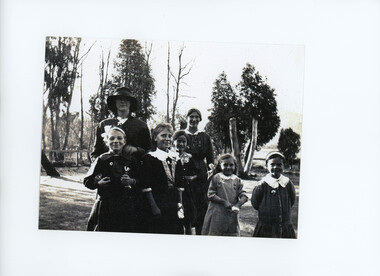
Photo - Family dressed in the fashion of the early 1900s
... Because of the long distance to haberdashery stores, the majority of children's garments would have been hand made by a local seamstress, mother or relation....Because of the long distance to haberdashery stores, the majority of children's garments would have been hand made by a local seamstress, mother or relation. children's clothing Black and white photo of a family with 5 children in the foreground with trees in the background. ...During the early 1900s little girls' dresses were fashioned on the style worn by older women. Girls dresses were knee length with trimmings of lace and ribbon. Collars were often removable for ease of washing. Leather lace-up boots and woollen stocking or socks were usually worn with these dresses. A pinafore or apron would be worn over the dresses to help keep them clean. Girls' hair was kept long, with curls and tied with ribbons.Boys' clothing was fashioned on sailor suits, blouses/shirts with a collar and trousers or knickerbockers. Woollen jackets, shirts and ties were suitable attire for older boys. Children's fashion of this time was dictated by long lasting durability, local manufacture, earthy colours and ease of mobility. Because of the long distance to haberdashery stores, the majority of children's garments would have been hand made by a local seamstress, mother or relation.Black and white photo of a family with 5 children in the foreground with trees in the background.children's clothing -
 Surrey Hills Historical Society Collection
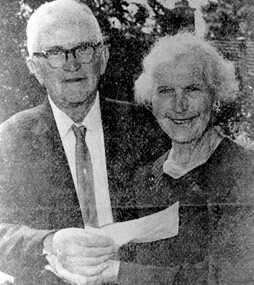
Photograph, Mr and Mrs Albert George Harbert
... Phoebe had worked as a seamstress prior to marriage, earning 2/6d a week. ...Phoebe had worked as a seamstress prior to marriage, earning 2/6d a week. ...Albert, the son of William Devereux Harbert and Anna Maria Gooch) was born in 1890. He died 15 June 1971 in Malvern. Phoebe Rebecca Georgina Colton (b 1889, Williamstown; d 31 August 1968), the daughter of Henry Culter Colton and Elizabeth Georgina Lucas. Albert and Phoebe were married in 1912 and moved into the house Albert had built at 237 Union Road. He bought the 60 foot frontage block for £60 in 1912 and built the home for £240. Albert built a number of homes in the locality and the shelter sheds at Chatham School. Phoebe had worked as a seamstress prior to marriage, earning 2/6d a week. They had 2 daughters Unice and Norma. Unice remained single. Norma married Henry Jamieson. They both lived to a good age and continued to live locally until frailty in old age caused them to move to nursing homes. Albert and Phoebe are buried in Boroondara Cemetery Spec E, Grave 66. A black and white screened photograph of a man and a woman. The man is holding a piece of paper in his right hand.mr albert george harbert, mrs phoebe harbert, builders, union road, surrey hills, chatham school, miss phoebe colton -
 Bendigo Historical Society Inc.
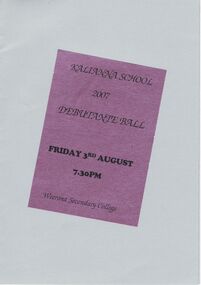
Document - PETER ELLIS COLLECTION: KALIANNA SCHOOL DEBUTANTE BALL, 3rd August, 2007
... Names are: Cr Kevin Gibbons, Debbie Gibbons, Lindy & William Lupo, Alison & Geoff Byron, Leon Scott, Debbie Price, Peter Burch, Cherryl Fyffe, Leon Scott, Emu Creek Band, Rebecca Nelson, Caleb Richardson, Charmaine Scown, Alicia Owen, Jessica Brereton, Nikita Riordan, Laura Semmens, Rebecca Apps, Chloe Gruber, Lauren Hawken, Amanda Anderson, Victoria Jelbart, Rachell Sutherland, Amy Roberts, Sally McMurtrie, Chevonne Strauch, Ben Holmes, Dean Snelson, Zac Flint, Tamati Poindestre, Brandon Kelly, Paul Drinkell, Adrian Brown, Chris Oojges, David Boyce, Josh Rosewall, Michael Semmens, John Wiktorek, Kane Wojcicki, Matthew Mitchell, Hairem Scarem, Grant Rule Menswear, Sean Walsh Photography, Mary Smith (Plant Exhibits), Anne Hastings (Deb Ball Seamstress), Debbie Price, Tracey Wojcicki, Glenys Jelbart, Pam Holmes, Rae Hall, Samantha Wearne, Kylie Salter, Cathy Brew, Judy Richards, Aileen Gilbee, Marie Loch, Noel & Lorna Thomas, Ron & Janette Moss, Tracey & Peter Wojcicki, Val & Neil Cartledge, Warwick Strauch, Kevin Salter, Grant King, Kay Tamblyn and Christine Smith....ENTERTAINMENT Dance ball Peter Ellis Collection Kalianna School Weerona Secondary College Cr Kevin Gibbons Debbie Gibbons Lindy & William Lupo Alison & Geoff Byron Leon Scott Debbie Price Peter Burch Cherryl Fyffe Leon Scott Emu Creek Band Rebecca Nelson Caleb Richardson Charmaine Scown Alicia Owen Jessica Brereton Nikita Riordan Laura Semmens Rebecca Apps Chloe Gruber Lauren Hawken Amanda Anderson Victoria Jelbart Rachell Sutherland Amy Roberts Sally McMurtrie Chevonne Strauch Ben Holmes Dean Snelson Zac Flint Tamati Poindestre Brandon Kelly Paul Drinkell Adrian Brown Chris Oojges David Boyce Josh Rosewall Michael Semmens John Wiktorek Kane Wojcicki Matthew Mitchell Hairem Scarem Grant Rule Menswear Sean Walsh Photography Mary Smith (Plant Exhibits) Anne Hastings (Deb Ball Seamstress) Debbie Price Tracey Wojcicki Glenys Jelbart Pam Holmes Rae Hall Samantha Wearne Kylie Salter Cathy Brew Judy Richards Aileen Gilbee Marie Loch Noel & Lorna Thomas Ron & Janette Moss Tracey & Peter Wojcicki Val & Neil Cartledge Warwick Strauch Kevin Salter Grant King Kay Tamblyn Christine Smith Weerona Secondary College Program for the Kalianna School Debutante Ball held on Friday 3rd August 2007 at the Weerona Secondary College. ...Program for the Kalianna School Debutante Ball held on Friday 3rd August 2007 at the Weerona Secondary College. Program is light grey with a purple sticker on an angle with the name on it. On white paper on the inside is the names of the debutantes and their partners and who they were presented to, Master of Ceremonies & Deb Set Co-ordinator, Chaperones, Compares, Music by Emu Creek Band, Flower Girl and Page Boy. Pasted on the back is a matching grey card thanking businesses and people who helped. Names are: Cr Kevin Gibbons, Debbie Gibbons, Lindy & William Lupo, Alison & Geoff Byron, Leon Scott, Debbie Price, Peter Burch, Cherryl Fyffe, Leon Scott, Emu Creek Band, Rebecca Nelson, Caleb Richardson, Charmaine Scown, Alicia Owen, Jessica Brereton, Nikita Riordan, Laura Semmens, Rebecca Apps, Chloe Gruber, Lauren Hawken, Amanda Anderson, Victoria Jelbart, Rachell Sutherland, Amy Roberts, Sally McMurtrie, Chevonne Strauch, Ben Holmes, Dean Snelson, Zac Flint, Tamati Poindestre, Brandon Kelly, Paul Drinkell, Adrian Brown, Chris Oojges, David Boyce, Josh Rosewall, Michael Semmens, John Wiktorek, Kane Wojcicki, Matthew Mitchell, Hairem Scarem, Grant Rule Menswear, Sean Walsh Photography, Mary Smith (Plant Exhibits), Anne Hastings (Deb Ball Seamstress), Debbie Price, Tracey Wojcicki, Glenys Jelbart, Pam Holmes, Rae Hall, Samantha Wearne, Kylie Salter, Cathy Brew, Judy Richards, Aileen Gilbee, Marie Loch, Noel & Lorna Thomas, Ron & Janette Moss, Tracey & Peter Wojcicki, Val & Neil Cartledge, Warwick Strauch, Kevin Salter, Grant King, Kay Tamblyn and Christine Smith.Weerona Secondary Collegeentertainment, dance, ball, peter ellis collection, kalianna school, weerona secondary college, cr kevin gibbons, debbie gibbons, lindy & william lupo, alison & geoff byron, leon scott, debbie price, peter burch, cherryl fyffe, leon scott, emu creek band, rebecca nelson, caleb richardson, charmaine scown, alicia owen, jessica brereton, nikita riordan, laura semmens, rebecca apps, chloe gruber, lauren hawken, amanda anderson, victoria jelbart, rachell sutherland, amy roberts, sally mcmurtrie, chevonne strauch, ben holmes, dean snelson, zac flint, tamati poindestre, brandon kelly, paul drinkell, adrian brown, chris oojges, david boyce, josh rosewall, michael semmens, john wiktorek, kane wojcicki, matthew mitchell, hairem scarem, grant rule menswear, sean walsh photography, mary smith (plant exhibits), anne hastings (deb ball seamstress), debbie price, tracey wojcicki, glenys jelbart, pam holmes, rae hall, samantha wearne, kylie salter, cathy brew, judy richards, aileen gilbee, marie loch, noel & lorna thomas, ron & janette moss, tracey & peter wojcicki, val & neil cartledge, warwick strauch, kevin salter, grant king, kay tamblyn, christine smith -
 Federation University Art Collection
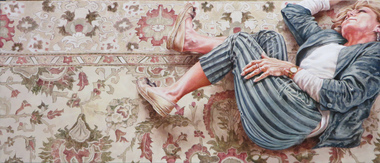
Painting - Artwork, Trudi Harley, 'Fallen' by Trudi Harley, 2009
... Added to this were my own influences of upbringing, I have always been particularly drawn to fabrics and patterns as my mother was/is (getting a little old now) a seamstress and my father was a bit of a ‘perfectionist’. ...Added to this were my own influences of upbringing, I have always been particularly drawn to fabrics and patterns as my mother was/is (getting a little old now) a seamstress and my father was a bit of a ‘perfectionist’. ...Trudi HARLEY Born Korumburra, Victoria Born in country Victoria Trudi Harley graduated with a Bachelor of Education (Art and Craft) at Victoria College, Burwood. After teaching for 10 years in both Government and Independent schools in Melbourne she worked as a Sales Executive and Art Educator for Cavalier Art Supplies for 16 years. Recently Trudi Harley completed a Bachelor of Arts (Visual Arts) (Honours) with Distinction between 2008 – 2009, and a Master of Arts (Research), Visual Art between 2010 – 2012 at the University of Ballarat (now Federation University). Maintaining an artistic practice while in a business partnership Trudi Harley owns and runs Atelier Art Supplies in Williamstown, Victoria, which is a major supporter of the arts in the western suburbs of Melbourne/ This item is part of the Federation University Art Collection. The Art Collection features over 2000 works and was listed as a 'Ballarat Treasure' in 2007.Artist's Statement: As an artist am continually drawn to ‘what makes us who we are’ and as a result the work, whatever it may be, is a reflection on what makes me who I am. In this I refer to perception, experience and memory as aspects that contribute to our sense of reality. By using these references I intend to engage the audience and develop a sense of connection and community through the visual image. ‘Fallen’ was not necessarily a reflection on my own life but of life in general as I recall at the time I had a family member who was struggling to cope with their own reality. I can also recall at the time reflecting on the adage ‘walk a mile in my shoes’ and the pressures we all face in life. Added to this were my own influences of upbringing, I have always been particularly drawn to fabrics and patterns as my mother was/is (getting a little old now) a seamstress and my father was a bit of a ‘perfectionist’. During my honours study I came across the term ‘Esperpento’ which included such visual elements as exaggeration and unusual viewpoints. Fallen was a comment on the psychology associated with expectations in life, or more importantly those expectations placed on offspring by their parents. This painting reflected the consequences of not living up to those expectations. It is unfortunate that in life, by the time you get to the point of realising that you have the opportunity to set your own standards, that you’ve probably embodied a great many set of values by osmosis and that you’ve now claimed them as your own. The view is from above to dramatize the subject, the figure placed compositionally in the top right hand corner to open up the picture plane and allow for the narrative to continue outside the visual area of the canvas. It was also in this painting that I rubbed back some of the darker oil paint to allow the lighter underpainting to show through.art, artwork, trudi harley, harley, carpet, portrait, self-portrait, alumni -
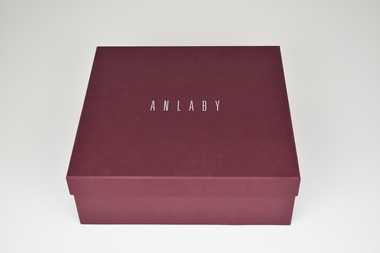 National Wool Museum
Throw, 2017
... Sewing is completed by artisan seamstresses and packaging is from a local Adelaide family business. ...Sewing is completed by artisan seamstresses and packaging is from a local Adelaide family business. ...Anlaby’s sheep are born, bred and shorn at their farm located in South Australia. The wool is then scoured at Michels in Adelaide, combed and turned into Tops at Cashmere Connections in Bacchus Marsh, and then Spun and Woven at a historic mill in Scotland named Johnstons of Elgin. Sewing is completed by artisan seamstresses and packaging is from a local Adelaide family business. Established in 1839 just North of the Barossa Valley in South Australia, Anlaby is the oldest continuing merino sheep stud on mainland Australia. Fredrick Dutton employed Alexander Buchannan to bring sheep to the buoyant market in Adelaide from Goulburn NSW. Several others speculated on possible successes, including Buchannan and a flock of 18,000 sheep were walked overland. The trek took nine months. During this time the Adelaide market prices had collapsed. Having found land with a spring of sweet water, Dutton decided to keep his flock of 5,000 stud sheep and purchased a small parcel of land that is now called Anlaby. The property prospered and Buchannan was employed as manager for the next 25 years. At its height Anlaby covered 250sq miles – 160,000 acres and employed 70 men. The first bale of wool from South Australia to be auctioned in London came from Anlaby. The Anlaby stud also provided the foundation ewes for the well-known Bungaree merino stud in 1841. With prosperity came a large house and gardens for Buchannan in 1861. Anlaby was inherited by Henry Dutton from his uncle in 1895. Squire Dutton, as he was known, continued to grow the family’s fortunes and spent his money expanding the grand home and creating a magnificent 10-acre garden. Today the Anlaby merino stud continues and both the house and garden are undergoing significant restorations. Wool continues to be one of the most important elements at Anlaby. It was the source of great wealth in the past and is now directly tied into Anlaby’s future. Anlaby makes beautiful woollen scarves, lady’s wraps, exquisite throws and small range of baby blankets. From the moment a lamb is conceived and through its entire lifecycle Anlaby look after nutrition and quality of life. Twice a year the sheep are shorn and the wool using minimal treatment is washed, combed, spun and woven into the Anlaby product range. This attention to detail results in the buttery softness distinctive of the exclusive woollen range.Throw came with packaging and information card which reads ANLABY in large capital lettering at the top and bottom of either side of card. Throw is white with green edging of 15cm on two edges. Within this edging is the sewing of a tree in white.Wording: ANLABY Pure Anlaby Merino Wool Oldest merino stud on mainland Australia Made in Australia Card. Wording: ANLABY Certificate of Authentication THIS CERTIFICATE AUTHENTICATES THE PRODUCT TO BE 100% AUSTRALIAN AND MADE FROM PURE MERINO WOOL PRODUCED EXCLUSIVELY AT THE ANLABY MERINO STUD IN SOUTH AUSTRALIA THE ANLABY FLOCK (REGISTERED NUMBER 102) IS THE OLDEST CONTINUOSLY OPERATING MERINO STUD IN MAINLAND AUSTRALIA. THE MERINO FLOCK AT ANLABY MAINTAINS A GENETIC LINE STARTED IN 1839 THIS PRODUCT IS PART OF THE LIMMITED EDITION RANGE PRODUCED AT ANLABY. IN 2014 WE CELEBRATED ANLABY’S 175TH ANNIVERSAY ANLABY Reverse. Wording: ANLABY PURE NATURAL WOOL THE SHEEP GRAZE AMONGST THE GUM TREES ON THE ROLLING HILLS OF ANLABY. ANLABY SHEEP ARE CHARACTERISTICALLY BIG BODDIED AND BRED TO FLOURISH IN THE WARM AUSTRALIAN CLIMATE. OUR WOOL IS MINIMALLY TREATED AND THE PRODUCTS ARE MADE IN SMALL RUNS UNDER THE PERSONAL SUPERVISION OF THE OWNERS. WE BELIEVE IN SUSTAINABLE AND RESPONSIBLE FARMING AND MILLING PRACTICES. THE ATTENTION TO DETAIL RESULTS IN THE BUTTERY SOFTNESS DISTINCTIVE OF THIS EXCLUSIVE WOOLLEN PRODUCT. WITH CARE THIS IS A TREASURED ITEM FOR THE NEXT GENERATION. ANLABY www.anlaby.com.auwool, merino sheep, south australia, wool processing, wool processing textile finishing
