
Showing 29 items matching "seat loading"
-
 Moorabbin Air Museum
Manual - Ansett Boeing 727 operating manuals, Boeing 727 Operating Manual Section 6 Weight & Balance May 1988
... ...Seat loading...Ansett Boeing 727 operating manuals Structural limiting weights Maximum allowable number of passengers Compartment capacities Loading limitations Variations Special configurations for passenger & palletised freighters Seat loading Fuel management Loading systems & guide Overview of weight & balance requirements for Boeing 727, circa 1988 Spiral bound book type manual Boeing 727 Operating Manual Section 6 Weight & Balance May 1988 Manual Ansett Boeing 727 operating manuals ...Overview of weight & balance requirements for Boeing 727, circa 1988Spiral bound book type manualnon-fictionOverview of weight & balance requirements for Boeing 727, circa 1988structural limiting weights, maximum allowable number of passengers, compartment capacities, loading limitations, variations, special configurations for passenger & palletised freighters, seat loading, fuel management, loading systems & guide -
 Ballarat Tramway Museum
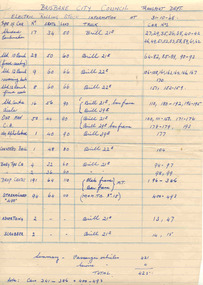
Document - List, Wal Jack, Brisbane City Council - tramcars, 1948?
... List of Brisbane City Council trams at 31.10.1948. 13 categories, giving type of car, number, seats, load, trucks and car numbers. ...List of Brisbane City Council trams at 31.10.1948. 13 categories, giving type of car, number, seats, load, trucks and car numbers. Brisbane trams tramcars Single sided foolscap Ink and blue pencil on lined paper. ...List of Brisbane City Council trams at 31.10.1948. 13 categories, giving type of car, number, seats, load, trucks and car numbers. Single sided foolscap Ink and blue pencil on lined paper.brisbane, trams, tramcars -
 Melbourne Tram Museum
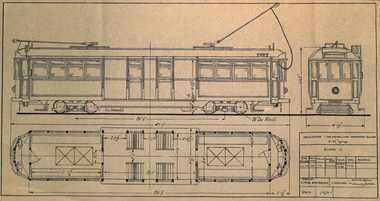
Drawing, Chris Andrews, MMTB class L, 5/1967
... Includes data on the tram such as truck, seated load and motors. ...Includes data on the tram such as truck, seated load and motors. Yields information about the MMTB L class tram drawings MMTB L class Has a stamp on the rear. ...Drawing - special size sheet - titled "MMTB Class L", drawing Chris Andrews 5/67 for the TMSV giving a GA type drawing of the MMTB L class tram. Includes data on the tram such as truck, seated load and motors. Yields information about the MMTB L class tramPrint on off white paper.Has a stamp on the rear.drawings, mmtb, l class -
 Melbourne Tram Museum
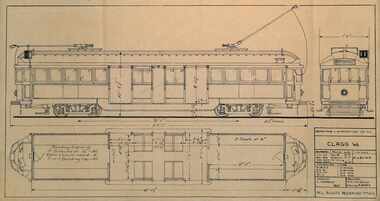
Drawing, Chris Andrews, MMTB class W2, 9/1967
... Includes data on the tram such as truck, seated load, controllers, numbers and motors. ...Includes data on the tram such as truck, seated load, controllers, numbers and motors. ...Drawing - special size sheet - titled "MMTB Class W2", drawing Chris Andrews 9/67 for the TMSV giving a GA type drawing of the MMTB W2 class tram. Includes data on the tram such as truck, seated load, controllers, numbers and motors. Yields information about the MMTB W2 class tramPrint on off white paper.Has a stamp on the rear.drawings, mmtb, w2 class -
 Stawell Historical Society Inc
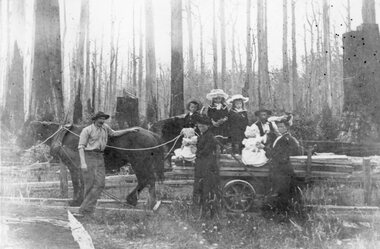
Photograph, Mr Peter Borella standing beside the horse with cart transporting timber with family seated on the timber c1900
... Peter Borella standing beside the horse with cart transporting timber with family seated on load. C1900...Peter Borella standing beside the horse with cart transporting timber with family seated on load. C1900 Stawell Mr Peter Borella standing beside the horse with cart transporting timber with family seated on the timber c1900 Photograph ...Bushland Scene taken in the Grampians Area. Peter Borella standing beside the horse with cart transporting timber with family seated on load. C1900stawell -
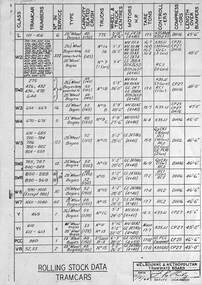 Melbourne Tram Museum
Drawing, Melbourne & Metropolitan Tramways Board (MMTB), "Rolling Stock Data Tramcars", 11/5/1965
... Provides a detailed listing of Melbourne's tram in 1965 and details of their numbers, No in service, type, capacity - seated and crush load, trucks, wheel and truck centres, tare weight, controllers, compressors and length over bumpers....Provides a detailed listing of Melbourne's tram in 1965 and details of their numbers, No in service, type, capacity - seated and crush load, trucks, wheel and truck centres, tare weight, controllers, compressors and length over bumpers. ...Provides a detailed listing of Melbourne's tram in 1965 and details of their numbers, No in service, type, capacity - seated and crush load, trucks, wheel and truck centres, tare weight, controllers, compressors and length over bumpers.Yields information about the Melbourne tram fleet in 1965.Drawing or document - A4 sheet, photocopied from a Foolscap sheet, titled "Rolling Stock Data Tramcars" dated 11/5/1965tramways, tramcars, mmtb, melbourne, data sheet, w class -
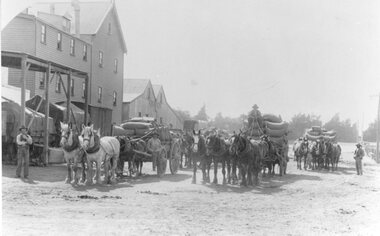 Stawell Historical Society Inc
Photograph, Wimmera Flour Mill with horse drawn wagons loaded with wheat -- 2 B/W Photos
... In the second photo there are six horses pulling a loaded wagon with bagged grain and driver seated on the load. ...In the second photo there are six horses pulling a loaded wagon with bagged grain and driver seated on the load. Wimmera Flour Mill with horse drawn wagons loaded with wheat -- 2 B/W Photos Photograph ...Photos of horse drawn wagons loaded with wheat in front of Wimmera Flour Mill. Railway trucks in front of mill. William Frayne built and owned the mill (181-01). This photograph was taken near the railway station. Rail trucks indicate late 1870's, railway opened 1876.Two black and white photos of horses with loaded wagons. In the first photo there are 4 men and many loaded wagons in front of the wooden three-story mill. In the second photo there are six horses pulling a loaded wagon with bagged grain and driver seated on the load. stawell business industry farming -
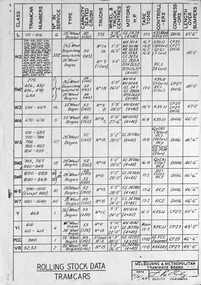 Melbourne Tram Museum
Document, Melbourne & Metropolitan Tramways Board (MMTB), "R10-495 - Rolling Stock Data", 5/1965
... "R10-495 - Rolling Stock Data" dated 11/5/1965 details the tram fleet of the MMTB at the time - listing class, Tramcar numbers, No. in Service, type, capacity seated and crush loading, trucks, wheel and truck centres, motors, Tare Tons, Controllers, Compressors, and length over bumpers. ..."R10-495 - Rolling Stock Data" dated 11/5/1965 details the tram fleet of the MMTB at the time - listing class, Tramcar numbers, No. in Service, type, capacity seated and crush loading, trucks, wheel and truck centres, motors, Tare Tons, Controllers, Compressors, and length over bumpers. ..."R10-495 - Rolling Stock Data" dated 11/5/1965 details the tram fleet of the MMTB at the time - listing class, Tramcar numbers, No. in Service, type, capacity seated and crush loading, trucks, wheel and truck centres, motors, Tare Tons, Controllers, Compressors, and length over bumpers. No heritage trams at the time included. The drawing number determined from the MMTB drawing Registers. Signed by F Kirby.Yields information about the MMTB tram fleet in 1965.Photocopy of drawing "R10-495 - Rolling Stock Data" sheetmmtb, tramcars, tramways, data sheet, rolling stock -
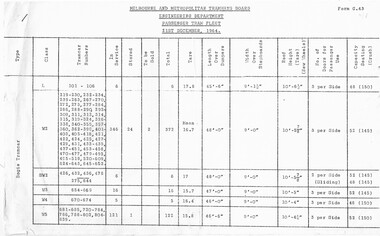 Melbourne Tram Museum
Document - Report, Melbourne & Metropolitan Tramways Board (MMTB), "Passenger Tram Fleet", 21/12/1964 12:00:00 AM
... Lists all bogie trams, numbers, class, number in service, stored, to be sold, Tare weight, length and width, roof height, number of doors and seated / crush capacity loads. Has form G.43 in top right hand corner....Lists all bogie trams, numbers, class, number in service, stored, to be sold, Tare weight, length and width, roof height, number of doors and seated / crush capacity loads. Has form G.43 in top right hand corner. ...Duplicated two page foolscap sheet, stapled in the top left hand corner, issued by the MMTB Engineering Department - titled "Passenger Tram Fleet", as at 21/12/1964. Lists all bogie trams, numbers, class, number in service, stored, to be sold, Tare weight, length and width, roof height, number of doors and seated / crush capacity loads. Has form G.43 in top right hand corner.trams, tramways, tramcars, lists, mmtb -
 Melbourne Tram Museum
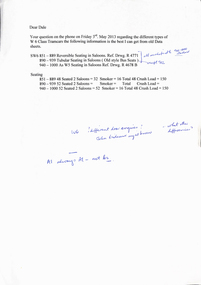
Document - Memorandum, differences in the various seating arrangements in SW6 trams, c2000
... Memorandum - A4 sheet typed to Dale Budd from an unknown person detailing the differences in the various seating arrangements in SW6 trams and seat types, including passenger load details. Lists trams SW6 851 to 1000. ...Trams tramways SW6 class Seats Loading Trams Passengers Memorandum - A4 sheet typed to Dale Budd from an unknown person detailing the differences in the various seating arrangements in SW6 trams and seat types, including passenger load details. ...Memorandum - A4 sheet typed to Dale Budd from an unknown person detailing the differences in the various seating arrangements in SW6 trams and seat types, including passenger load details. Lists trams SW6 851 to 1000. undated. Has handwritten notes about the modifications, door engines and A class trams.trams, tramways, sw6 class, seats, loading trams, passengers -
 Melbourne Tram Museum
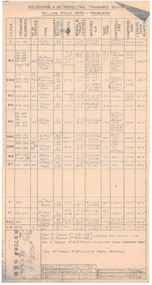
Document - Tramcar Data Sheet, Melbourne & Metropolitan Tramways Board (MMTB), "Rolling stock data Tramcars", 1962
... Lists class, tramcar numbers, type, number in service, capacity - seats and crush loading, trucks, wheel and truck centres, motors HP, Tare tons, controllers, compressors, length over bumpers....Lists class, tramcar numbers, type, number in service, capacity - seats and crush loading, trucks, wheel and truck centres, motors HP, Tare tons, controllers, compressors, length over bumpers. ...Dyeline print of Drawing R9706 version G - titled "Rolling stock data Tramcars" listing tramcars including VR tramcars. Updated to 16-11-1962, lists only X2 676, notes all other X's withdrawn 11-3-1962. Superseded drawing R6660. Lists class, tramcar numbers, type, number in service, capacity - seats and crush loading, trucks, wheel and truck centres, motors HP, Tare tons, controllers, compressors, length over bumpers.trams, tramways, tramcars, mmtb, lists -
 Melbourne Tram Museum
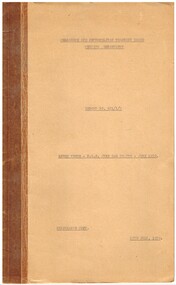
Document - Report, Melbourne & Metropolitan Tramways Board (MMTB), "Speed Tests - PCC Type Car No. 980 - June 1950", 17/07/1950 12:00:00 AM
... Gives details of testing done to determine the coasting characteristics of the tram, with crush, seated or no load. Tested in Miller St, Preston. ...Gives details of testing done to determine the coasting characteristics of the tram, with crush, seated or no load. Tested in Miller St, Preston. ...Report - original typed copy - six foolscap sheets bound within a brown card folder, stapled, with adhesive tape binding on the outside. Titled "Speed Tests - PCC Type Car No. 980 - June 1950", marked "Chairman's Copy", dated 17 July 1950, prepared by the MMTB Testing Department, Report No. S21/1/2. Gives details of testing done to determine the coasting characteristics of the tram, with crush, seated or no load. Tested in Miller St, Preston. Also reports on the maximum speed compared to car 888, and scheduled speed. Has appendices with the actual data. Conclusion on page 3 - that 980 would show an improvement of about 5% in schedule speed of SW6 cars. Second copy added 31-5-2016 from donation of Geoff Warburton.trams, tramways, testing, pcc, preston workshops, reports, specification, tram 980 -
 Flagstaff Hill Maritime Museum and Village
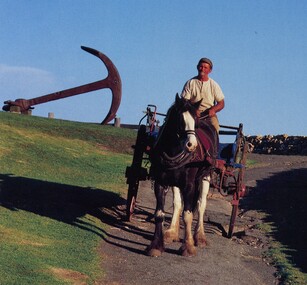
Vehicle - Spring Cart, Late 19th to early 20th centuries
... seat. Carts like this one had springs to make the ride smoother. It is a lighter version of a farm dray and is sometimes called a spring dray. Spring carts were often used on farms for carrying loads...seat. Carts like this one had springs to make the ride smoother. It is a lighter version of a farm dray and is sometimes called a spring dray. Spring carts were often used on farms for carrying loads ...A spring cart is a two-wheeled, one-horse cart, often with the driver standing up to drive it, and otherwise seated on a simple seat. Carts like this one had springs to make the ride smoother. It is a lighter version of a farm dray and is sometimes called a spring dray. Spring carts were often used on farms for carrying loads. In the towns, some businesses used a spring cart for deliveries of bread, milk and other goods. The carts would be used for travel and for families going on outings and picnics. Visitors to Flagstaff Hill Maritime Village from 1986 to 1992 would enjoy watching a Clydesdale horse named Duke as he worked around the village with his driver Pat McGowan. He would be hitched to a wagon or to this lightweight spring cart or sometimes he would pull the wagon with the cart attached as a trailer. The cart was used for maintenance, carting loads of timber or stone around the site or from town to Flagstaff Hill. Sometimes Duke and the cart would take visitors for cart rides around the Village. Pat McGowan was known for his restoration of horse-drawn vehicles including this spring cart. He already had 40 years of horse handling experience when he began looking after Duke, feeding and harnessing him and driving the horse and cart around the Village. Pat’s dog ‘Yabbie’ would often join them. In August 1992 Duke had to be put down. Warrnambool Veterinary Clinic and other fund-raisers began well-supported appeals and the beloved horse was replaced by a Clydesdale also named Duke (the second), who began work in late October 1992. He, like his predecessor, had a quiet temperament and was comfortable in the traffic. The spring card is an example of vehicles used on farms, for business delivery and for domestic transport in the late-19th and early-20th century. This cart is of note for being associated with the Clydesdale horse Duke which pulled the cart around Flagstaff Hills in the 1980s and 1990s, representing transport of that period.Spring cart; two-wheeled cart with shallow box tray and plank seat bolted across the front. Wheels have metal rims and fourteen (14) wooden spokes. A plank is bolted from side to side. A decorative metal step is on the cart's left and has acorn cut-out shapes in the plate. Both wheels have a brake block that is operated by a lever on the cart's right. The cart has eight-leaf suspension from front to back. The box tray is painted blue and has decorative pale yellow detail. Each shaft pole has has a handle fitting on it. (Horse equipment with the cart is a leather covered, straw filled collar.) flagstaff hill, flagstaff hill maritime museum and village, warrnambool, maritime museum, maritime village, great ocean road, shipwreck coast, springcart, spring cart, jingle, horse-drawn cart, one horse cart, two-wheeled cart, dray, spring dray, wagon, transportation, travel, cart, duke, clydesdale, pat mcgowan, delivery cart, yabbie, cartwright, horse-drawn vehicle, transport, horse cart -
 Orbost & District Historical Society
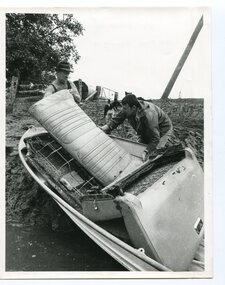
Photograph - Flood photos, Orbost 1971, 9/10 February 1971
... They appear to be loading or unloading car seats. Inscription on back: 1971 FLOOD CLEANING UP. ...They appear to be loading or unloading car seats. Inscription on back: 1971 FLOOD CLEANING UP. ...This series of photos documents some of the destruction from the January 1971 flood at Orbost. This flood was a record Snowy River flood and isolated the district through road and bridge destruction. These photos are significant because they document aspects of the record 1971 flood at Orbost, and are of good quality. A series of b/w photos from the 1971 record flood in Orbost. 2733.1 A b/w aerial photograph of a farm house with debris around, cattle in the background. Inscription: 1971 FLOOD. 2733.2 A b/w photo of 2 people walking towards an upturned vehicle in floodwaters. Inscription: 1971 FLOOD. 2733.3 A b/w photo taken at night time. Five people beside and climbing on a tree which has been uprooted, with water flowing underneath. Inscription: 1971 FLOOD. 2733.4 A b/w photo of a man standing in doorway of the old pumphouse for the Butter Factory. He is leaning out of the doorway and pointing to a mark on the wall (presumably the height of the 1971 flood). Inscription: FLOOD MARKER AT ORBOST BUTTER FACTORY. 2733.5 A b/w photo of a man and woman walking on a road towards a section of the road which has been broken-up by a flood waters. Inscription: 1971 FLOOD HIGHWAY AT SOUTHERN END OF TOWN. 2733.6 A b/w photo of two men with a boat hauled up on an eroded bank. They appear to be loading or unloading car seats. Inscription on back: 1971 FLOOD CLEANING UP. 2733.1 1971 FLOOD. 2733.2 1971 FLOOD. 2733.3 1971 FLOOD. 2733.4 FLOOD MARKER AT ORBOST BUTTER FACTORY. 2733.5 1971 FLOOD HIGHWAY AT SOUTHERN END OF TOWN. 2733.6 1971 FLOOD CLEANING UP. orbost, snowy river, 1971 flood -
 Learmonth and District Historical Society Inc.
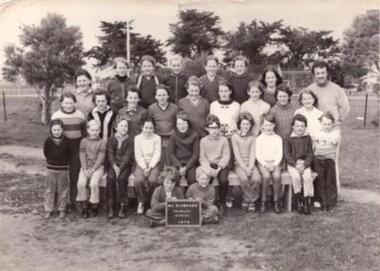
Photo, Mt Blowhard Primary School 1975, 1975
... Front row: Marion Ford, Angela Loader, Jamie Bannister, Kate Murphy, Stephen Hucker, Darryn Crick, Paula Ryan, Sandra Lakey, Len Timmins & Alison Bannister. Seated...Front row: Marion Ford, Angela Loader, Jamie Bannister, Kate Murphy, Stephen Hucker, Darryn Crick, Paula Ryan, Sandra Lakey, Len Timmins & Alison Bannister. Seated ...This Mt Blowhard Primary School photo was taken in 1975. Photos were taken at most schools on an annual basis.The only photo of the Mt Blowhard Primary School in 1975Black and White photo of the students from the Mt Blowhard Primary School in 1975 with the names printed on the back. Width 12 & 1/2 cms x 17 & 34 cms high.Mt Bloward, Primary School, 1974 on the front. On the back, Back row: Catherine McCallum, Murray McCallum, Bernadette Murphy, Neville Loader, Danny Ryan, Rodney Timmins, Cathy Schroeders & Jeff Fyffe. Middle row: Janine Hucker, Tony Ryan, Anthony Shelton, Geoffrey Lakey, Leanne Timmins, Sandra Dehn, Janene Grills, Joanne Ryan & Jeanette Dehn. Front row: Marion Ford, Angela Loader, Jamie Bannister, Kate Murphy, Stephen Hucker, Darryn Crick, Paula Ryan, Sandra Lakey, Len Timmins & Alison Bannister. Seated on ground: Stephen Dehn & Gary Crick. -
 Bendigo Military Museum
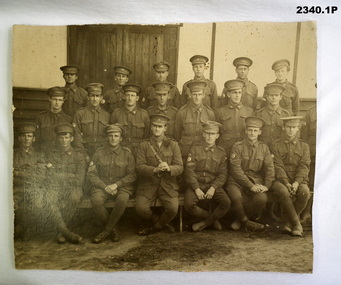
Photograph - PHOTOGRAPH & POSTCARDS, 2) 17/02/1916
... seated outside building. Albert BOLDISTON is on 2nd left front row. .2) Postcard photo, B&W, soldier in peak cap standing. Letter on rear in ink from J.M. BURKE. .3) Postcard photo, B&W featuring "King George" in a gun pit. .4) Postcard photo, B&W featuring "Australian heavy gun at work". .5) Postcard photo, B&W featuring "Australians loading a trench mortar". .6) Postcard photo, B&W showing a camouflaged troopship. .7) Postcard photo, B&W, soldier keeping a lookout in trench. .8) Postcard photo, B&W showing "An observation balloon". .9) Postcard photo, B&W showing wounded waiting for the field ambulance. .10) Postcard photo, B&W showing "Australian gunners at work". .11) Card, yellow with black print both sides relating to a 37th Batt. 1st & 2nd A.I.F reunion "Whippbang 1950"....seated outside building. Albert BOLDISTON is on 2nd left front row. .2) Postcard photo, B&W, soldier in peak cap standing. Letter on rear in ink from J.M. BURKE. .3) Postcard photo, B&W featuring "King George" in a gun pit. .4) Postcard photo, B&W featuring "Australian heavy gun at work". .5) Postcard photo, B&W featuring "Australians loading a trench mortar". .6) Postcard photo, B&W showing a camouflaged troopship. .7) Postcard photo, B&W, soldier keeping a lookout in trench. .8) Postcard photo, B&W showing "An observation balloon". .9) Postcard photo, B&W showing wounded waiting for the field ambulance. .10) Postcard photo, B&W showing "Australian gunners at work". .11) Card, yellow with black print both sides relating to a 37th Batt. 1st & 2nd A.I.F reunion "Whippbang 1950". ....1) Albert BOLDISTON, No. 747 enlisted 02/11/1916 ANZAC cyclist Batt. then 37th Bn. Discharged 29/01/1919. .2) Letter is to "Mr & Mrs DILLON from Pte. J. BURKE No. 3477 21st Batt. A.I.F", dated 17/02/1916. .3)-.10) These are "Daily mail official war pictures". Series 18. Albert Boldiston No 747 enlisted in the AIF in reinforcements 7 Anzac Cyclist Batt on 2.11.1916 age 24 years. Embarked for England 16.12.1916, transfer to 8th Batt 7.3.1917, embark for France 14.6.1917, transfer to 37th Batt 29.6.1917, hospital accidental injury (sprained ankle) 5.7.1917, rejoin unit 10.9.1917, hospital 18.11.1917 with Trench Feet, rejoin unit 13.6.1918, WIA 10.8.1918 GSW left wrist (through the joint) return to Australia 20.10.1918, discharged from the AIF 29.1.1919. Joseph Martin Burke No 3477 enlisted in the AIF in 8th reinforcements 21st Batt on 16.7.1915 age 21 years 4 months. Embark for Egypt 29.12.1915, transfer to 60th Batt 26.2.1916, then 57th 21.3.1916, then 13th FAB (Artillery) 27.3.1916, embark for France 16.6.1916, transfer to 25th FAB 9.7.1916 then 13th FAB 24.1.1917, hospital England while on leave 29.10.1918 with Influenza, return to Australia 21.12.1918 re the Influenza for discharge, discharged from the AIF 21.3.1919..1) Photo, B&W on cardboard, group of soldiers (20) seated outside building. Albert BOLDISTON is on 2nd left front row. .2) Postcard photo, B&W, soldier in peak cap standing. Letter on rear in ink from J.M. BURKE. .3) Postcard photo, B&W featuring "King George" in a gun pit. .4) Postcard photo, B&W featuring "Australian heavy gun at work". .5) Postcard photo, B&W featuring "Australians loading a trench mortar". .6) Postcard photo, B&W showing a camouflaged troopship. .7) Postcard photo, B&W, soldier keeping a lookout in trench. .8) Postcard photo, B&W showing "An observation balloon". .9) Postcard photo, B&W showing wounded waiting for the field ambulance. .10) Postcard photo, B&W showing "Australian gunners at work". .11) Card, yellow with black print both sides relating to a 37th Batt. 1st & 2nd A.I.F reunion "Whippbang 1950"..5) "Troopship in port".photography-photographs, military history - army -
 Otway Districts Historical Society
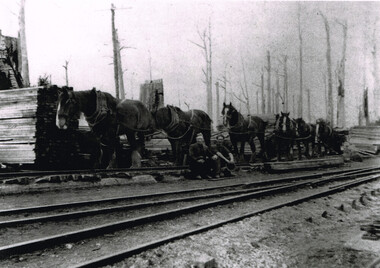
Photograph, Brucker, Pile Siding: horse-drawn timber tram, c.1920, c.1920
... loading dropped to insignificant proportions. Pettit's again occupied the site from 1924 and traffic rose to major levels again. pile siding; weeaproinah; railways; tramways; B/W. A six horse-drawn timber tram at Pile Siding station in c.1920. Two timber workers are seated ...Pile Siding was opened in December 1915 because of the Pettit Brothers sawmill and pile extraction operation. The siding was a spur with points facing Beech Forest with a timber tramway feeding the siding. During 1916/17 Pettit's sent away 5,000 tonnes of timber before moving to another site, after which loading dropped to insignificant proportions. Pettit's again occupied the site from 1924 and traffic rose to major levels again.B/W. A six horse-drawn timber tram at Pile Siding station in c.1920. Two timber workers are seated at the centre. Stacks of timber are awaiting collection. Note the bare tree trunks in the background. pile siding; weeaproinah; railways; tramways; -
 Australian Gliding Museum
Machine - Glider –Sailplane, 1960
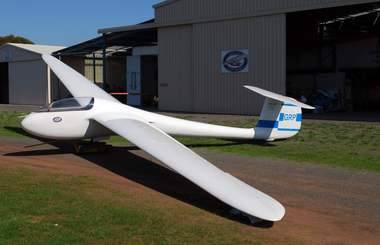
... loading is a modest 20kg/square metre. As at January 2016, minor repairs and airworthiness certification are required to return the glider to flying condition. This exhibit is highly significant as it is one of only eight of this pioneering sailplane design. It is the only one in Australia. australian gliding sailplane glider fs-24 phonix nagele eppler lindner stuttgart technical university bolkov aircraft company segelfluggruppe solothurn ashford geelong gliding club. Australian registration GRP on rudder; Serial Number 403 and Vintage glider club of Netherlands plaque in cockpit Glassfibre single seat ...The FS-24 Phonix is the first sailplane design to be built using a moulded fiberglass sandwich technique. It was designed by Hermann Nagele and Richard Eppler leading a group setup for the purpose at Stuttgart Technical University in the early 1950s. Initial construction was undertaken at workshops of Wolf Hirth and the first prototype was completed at the Bolkow Aircraft Company where Nagele and another member of the group, Rudi Lindner, had gained employment. It flew on 27 November 1957. Two further prototypes were built incorporating a T-tail and other refinements. Eight in all were built before production was stopped in 1961. A number of gliding records were broken in Phonix sailplanes in Germany in 1962-1963. It was found to have a best glide ratio of 40:1. The Museum’s example, No. 403 was originally a prototype built on 25 May 1960 [Registration D-8354]. It was converted at Bolkow to a Phonix T in 1963 and sold to a private owner in Switzerland [Registration HB-746] and later then to gliding club Segelfluggruppe Solothurn in 1965. The glider returned to Germany in 1971 (Meersburg) and re-registered as D-0738. It moved to a new owner in Allershausen in 1976, and again to Lindhoft in 1982. In 1983 the glider was sold to owners at Hasselt, Belgium and given registration OO-ZQD. In 1989 a further change of ownership occurred and the glider went to Leusden in the Netherlands where it was registered as PH-949. In 2006 the Phonix No.403 was imported into Australia by John Ashford of the Geelong Gliding Club. On 30 January 2007, it was registered as VH-GRP. However, as at January 2016 it has not been flown in Australia. In the course of its flying history the glider was damaged several times and repaired. At one stage a larger rudder was fitted and later on this modification was reversed. With the original conversion to a Phonix T and subsequent repairs and changes to equipment the weight of the airframe increased from 182 kg to approximately 220 kg. Nevertheless, the wing loading is a modest 20kg/square metre. As at January 2016, minor repairs and airworthiness certification are required to return the glider to flying condition. This exhibit is highly significant as it is one of only eight of this pioneering sailplane design. It is the only one in Australia. Glassfibre single seat sailplane, finished white with blue stripes on fin and rudder.Australian registration GRP on rudder; Serial Number 403 and Vintage glider club of Netherlands plaque in cockpitaustralian gliding, sailplane, glider, fs-24, phonix, nagele, eppler, lindner, stuttgart technical university, bolkov aircraft company, segelfluggruppe solothurn, ashford, geelong gliding club. -
 Stawell Historical Society Inc
Photograph, Magdala Mine with woodstacks c1895
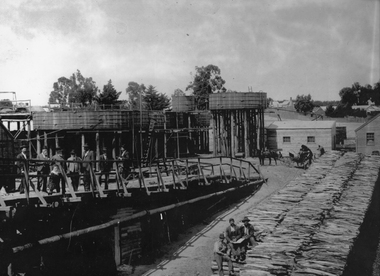
... To load drays with sand a horse would walk under a chute that was at the end of the conveyor belt and when sand was shoveled onto the conveyor, a dray could be loaded in 12 seconds. stawell gold mining B/W Mr. Thomas Kinsella and gentlemen with young child leaning on rails overlooking wood stacks with three workers seated ...Magdala cum Moonlight Mine c1895. Showing wooden tanks and woodheap. Directors on left. The fifth from left tall man is Thomas Kinsella. A horse and dray would go up this ramp and take the crushed sand to the cyanide vats. To load drays with sand a horse would walk under a chute that was at the end of the conveyor belt and when sand was shoveled onto the conveyor, a dray could be loaded in 12 seconds.B/W Mr. Thomas Kinsella and gentlemen with young child leaning on rails overlooking wood stacks with three workers seated. Wooden vats, buildings. Three people by two horse buggy. labourer standing behind buggy.stawell gold mining -
 Lakes Entrance Historical Society
Photograph - Anchovette Lakes Entrance 1952, Hancock
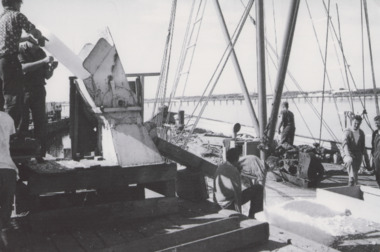
... Black and white photograph of fishermen loading ice onto the Anchovette, seated in photograph is Jimmy McNamara Lakes Entrance Victoria...Fishing Industry Black and white photograph of fishermen loading ice onto the Anchovette, seated in photograph is Jimmy McNamara Lakes Entrance Victoria Photograph Anchovette Lakes Entrance 1952 Hancock ...Black and white photograph of fishermen loading ice onto the Anchovette, seated in photograph is Jimmy McNamara Lakes Entrance Victoriafishing industry -
 Puffing Billy Railway
Lister Auto Truck
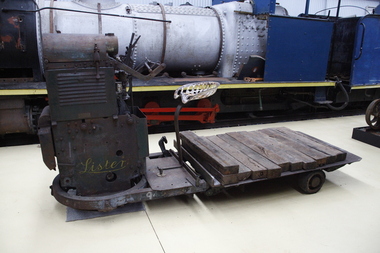
... load upon this. On early Auto-Trucks this bearing is set very low, in line with the chassis members, and is covered by thin steel plates. The front panel of the engine cover is distinctive with large ventilation holes and a Lister signature cut through it. Strangely this panel is made of thick cast iron, providing substantial weight high on the engine and only adding to its top heaviness. To improve visibility of moving vehicles in noisy factories, this panel was often painted white, the rest of the vehicle being Lister's usual brunswick green. The driver was seated...load upon this. On early Auto-Trucks this bearing is set very low, in line with the chassis members, and is covered by thin steel plates. The front panel of the engine cover is distinctive with large ventilation holes and a Lister signature cut through it. Strangely this panel is made of thick cast iron, providing substantial weight high on the engine and only adding to its top heaviness. To improve visibility of moving vehicles in noisy factories, this panel was often painted white, the rest of the vehicle being Lister's usual brunswick green. The driver was seated ...The Lister Auto-Truck was a small monowheel tractor built for moving light loads around factories, railway yards and similar sites. They were built by R A Lister and Company of Dursley, Gloucestershire, well known for their range of small stationary engines The Auto-Truck was one of several monowheel tractors to appear in the 1920s and '30s, with the availability of small, reliable petrol engines, as developed for motorcycles and the stationary engines for which Lister were already known. These were tricycle vehicles, with the single leading wheel used for both drive and steering. Their simple construction carried most of the mechanism on this wheel as a single unit, the chassis with the trailing wheels being little more than a trailer for balance. Simplicity was a key feature. The engines were single-cylinder and air-cooled. Ignition was by magneto, rather than requiring a battery and electrical system. One of these designs was produced in the 1920s by George Grist of the Auto Mower Co., Norton St Philip, Somerset. The engine was a JAP 600 cc four-stroke air-cooled sidevalve, a typical small engine of the time. The Auto Mower Co. were Lister agents and when Lister heard of this 'Auto-Truck' they bought one for use in their own factory. It was used to carry heavy engine castings from the foundry to the machine shop. Lister customers saw them and there was such interest in wanting to buy them that Lister negotiated with Auto Mower to build them under licence. Although Lister were already well known for their small petrol stationary engines, these were heavy cast-iron engines with water hopper cooling and unsuitable for vehicle use. Lister remained with the JAP engine for the Auto-Truck. The Auto-Truck was designed for use in factories or other places with smooth surfaces of concrete or tarmac. This allowed the use of small solid-tyred wheels with only simple suspension, making the vehicle simple, cheap and lightweight. They had little ability on soft surfaces though and could even topple over if driven carelessly across slopes. Their design was a compromise between the top-heavy nature of the tall engine grouping above its wheel and a well thought-out chassis for stability. The bearing between them was a large diameter ring roller bearing, mounted at the lowest part of the chassis. This gave rigidity and stability, even after long wear. A ring of rolled channel girder was attached to the engine group and rollers on the chassis carried the load upon this. On early Auto-Trucks this bearing is set very low, in line with the chassis members, and is covered by thin steel plates. The front panel of the engine cover is distinctive with large ventilation holes and a Lister signature cut through it. Strangely this panel is made of thick cast iron, providing substantial weight high on the engine and only adding to its top heaviness. To improve visibility of moving vehicles in noisy factories, this panel was often painted white, the rest of the vehicle being Lister's usual brunswick green. The driver was seated on a Brooks bicycle saddle, which in recognition of the lack of vehicle suspension, was carried on the end of a cantilevered bar that acted as a leaf spring. A wide handlebar on the engine group was used for steering. A squeeze bar the width of this handlebar engaged the clutch. Controls included a hand throttle, a gear lever with two forward and one reverse gears, and a large handbrake lever. The engine unit rotated freely for a full 360° rotation. When used in reverse, the Auto-Truck could either be driven from the saddle, looking backwards over the driver's shoulder; or they could dismount, swivel the engine unit around and control it as a pedestrian-controlled truck from behind. Under the engine cover were two equal diameter tanks, a fuel tank for petrol and a shorter oil tank. Engine and chain-drive lubrication used a total-loss oil system, controlled by a small pump and needle valve. Info Ref: Lister Auto-Truck - Wikipedia https://en.wikipedia.org/wiki/Lister_Auto-TruckHistoric - Industrial monowheel tractor for moving light loads around factories, railway yards and similar sites.The Lister Auto-Truck - small monowheel tractor Made of steel with three wheels. Powered by a J.A.P single cylinder petrol motor which is Hand Cranked to start.Lister puffing billy, lister, lister auto truck, monowheel tractor -
 Puffing Billy Railway
Zeehan & North East Dundas Tramway Bogie 1896, wagon bogie, 1896
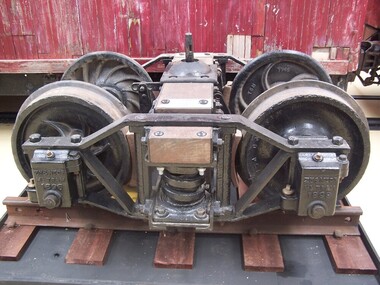
... The rolling stock for the Tramway was built in the Launceston Railway workshops, and comprised twenty five eight-wheel low-side trucks, tare 3 tons 1 cwt. 1 qr., load 10 tons; six eight-wheel flat trucks, tare 2 tons 18 cwt. 1 qr., load 10 tons; two four-wheel bolster trucks, for carrying long timber, tare 1 ton 19 cwt., load 5 tons; and four passenger cars, each with six cross-seats with reversible backs, to carry eighteen passengers, also a locker for mails and parcels. ...The rolling stock for the Tramway was built in the Launceston Railway workshops, and comprised twenty five eight-wheel low-side trucks, tare 3 tons 1 cwt. 1 qr., load 10 tons; six eight-wheel flat trucks, tare 2 tons 18 cwt. 1 qr., load 10 tons; two four-wheel bolster trucks, for carrying long timber, tare 1 ton 19 cwt., load 5 tons; and four passenger cars, each with six cross-seats with reversible backs, to carry eighteen passengers, also a locker for mails and parcels. ...Zeehan & North East Dundas Tramway Bogie 1896 The North East Dundas Tramway (NEDT) was a 2 ft (610 mm) narrow gauge tramway on West Coast Tasmania that ran between Zeehan and Deep Lead (now Williamsford). It was part of Tasmanian Government Railways. The line was opened in 1896 to carry ore from the Williamsford mines to Zeehan where it would be loaded onto another train for shipment to Burnie. The narrow-gauge (2 ft) was chosen because of the extremely difficult terrain that the railway crossed, requiring several big trestle bridges, including one at the foot of Montezuma Falls. After some rain the engine and carriages would get soaked by spray from the falls. There was a break-of-gauge with the mainline 1,067 mm (3 ft 6 in) system at Zeehan. The railway was closed in 1932. The rolling stock for the Tramway was built in the Launceston Railway workshops, and comprised twenty five eight-wheel low-side trucks, tare 3 tons 1 cwt. 1 qr., load 10 tons; six eight-wheel flat trucks, tare 2 tons 18 cwt. 1 qr., load 10 tons; two four-wheel bolster trucks, for carrying long timber, tare 1 ton 19 cwt., load 5 tons; and four passenger cars, each with six cross-seats with reversible backs, to carry eighteen passengers, also a locker for mails and parcels. All trucks and cars have cast-steel wheels 21 inches in diameter and are fitted with automatic vacuum brakes. The trucks have side levers and the cars have hand-screw brakes. The vacuum brake can be worked from the engine or from the passenger cars, which act as brake vans. When this brake was introduced, one effect was to accelerate the journey speed by about 10 minutes owing to more even running on down gradients. Historic - Industrial Narrow Gauge railway - Bogie used on the Zeehan & North East Dundas Tramway, Tasmania, Australia Bogie made from steel, iron and wrought ironZN & NTDS ML TRAM 1896 Griffinpuffing billy, bogie, zeehan & north east dundas tramway bogie, zeehan & north east dundas tramway, industrial narrow gauge railway, gauge: 2' (610 mm) -
 Lake Bolac & District Historical Society
Black and white photograph, Carting wheat on "Bellevue", c.1910
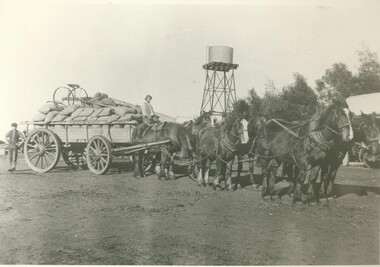
... A load of wheat is ready for the trip to the railhead at Willaura. Seated on the wagon is Bert Moreton and standing at the rear is Harry Hewitt. ...A load of wheat is ready for the trip to the railhead at Willaura. Seated on the wagon is Bert Moreton and standing at the rear is Harry Hewitt. ...On the road in front of "Bellevue", Lake Bolac, circa 1910. A load of wheat is ready for the trip to the railhead at Willaura. Seated on the wagon is Bert Moreton and standing at the rear is Harry Hewitt. Note the home-made gig perched on top of the load.lake bolac, bellevue, moreton, hewitt, wheat, willaura, -
 Melbourne Tram Museum
Drawing - Tramcar floor plans to 1923, Melbourne & Metropolitan Tramways Board (MMTB), c1924
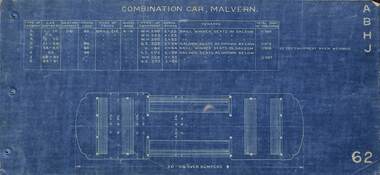
... Shows floor plan, seats and a table with car numbers, loading, truck type, type of equipment, horse power, remarks and total weight. 1 - Malvern Combination - A, B, H, J classes 2 - Drop centre cars - Malvern - C, E and D classes 3 - Summer car - Malvern - F class 4 - Short saloon combination - Malvern G class 5 - Short saloon combination - Malvern K class 6 - Four motor bogie car - Malvern - L class 7 - Combination car - Hawthorn - M class 8 - Drop centre bogie car - Hawthorn - N and P class 9 - Closed bogie car - Hawthorn - O class 10 - Combination car, Preston - R and Q class 11 - Combination car, Coburg - S class 12 - Double saloon combination car - Coburg - T class 13 - Box Car Essendon U class 14 - Cross seat (toastrack) car, Essendon, V class 15 - Four motor bogie car - W class 16 - "Birney" Safety car - X class Plain copies - black on white paper held for all cars except the X class....Shows floor plan, seats and a table with car numbers, loading, truck type, type of equipment, horse power, remarks and total weight. 1 - Malvern Combination - A, B, H, J classes 2 - Drop centre cars - Malvern - C, E and D classes 3 - Summer car - Malvern - F class 4 - Short saloon combination - Malvern G class 5 - Short saloon combination - Malvern K class 6 - Four motor bogie car - Malvern - L class 7 - Combination car - Hawthorn - M class 8 - Drop centre bogie car - Hawthorn - N and P class 9 - Closed bogie car - Hawthorn - O class 10 - Combination car, Preston - R and Q class 11 - Combination car, Coburg - S class 12 - Double saloon combination car - Coburg - T class 13 - Box Car Essendon U class 14 - Cross seat (toastrack) car, Essendon, V class 15 - Four motor bogie car - W class 16 - "Birney" Safety car - X class Plain copies - black on white paper held for all cars except the X class. ...Set of 16 floor plans of electric trams of the MMTB and the trusts from the A class of 1910 to W class of 1923. Shows floor plan, seats and a table with car numbers, loading, truck type, type of equipment, horse power, remarks and total weight. 1 - Malvern Combination - A, B, H, J classes 2 - Drop centre cars - Malvern - C, E and D classes 3 - Summer car - Malvern - F class 4 - Short saloon combination - Malvern G class 5 - Short saloon combination - Malvern K class 6 - Four motor bogie car - Malvern - L class 7 - Combination car - Hawthorn - M class 8 - Drop centre bogie car - Hawthorn - N and P class 9 - Closed bogie car - Hawthorn - O class 10 - Combination car, Preston - R and Q class 11 - Combination car, Coburg - S class 12 - Double saloon combination car - Coburg - T class 13 - Box Car Essendon U class 14 - Cross seat (toastrack) car, Essendon, V class 15 - Four motor bogie car - W class 16 - "Birney" Safety car - X class Plain copies - black on white paper held for all cars except the X class.Yields information about various classes of electric trams up to about 1923 that the MMTB absorbed from the Trusts and/or built themselves.Folder of 16 blue prints secured with three brass clips,tramways, tramcars, floor plans, drawings, a class, b class, c class, d class, e class, f class, g class, h class, k class, l class, m class, n class, o class, p class, q class, r class, s class, t class, u class, v class, x class, pmtt, htt, mbctt, fnptt -
 Wodonga & District Historical Society Inc
Booklet - Spirit of Progress, Victorian Railways, 1958
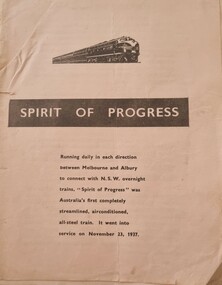
... The average load of the "Spirit of Progress" was 499 tons, and it could carry 240 first-class and 192 second-class passengers. A luxurious dining car was a feature of the “Spirit of Progress” with Queensland beech walls and leather upholstered seats. ...The average load of the "Spirit of Progress" was 499 tons, and it could carry 240 first-class and 192 second-class passengers. A luxurious dining car was a feature of the “Spirit of Progress” with Queensland beech walls and leather upholstered seats. ...The "Spirit of Progress' was constructed at the Railway Workshops, Newport, Victoria, and placed into service between Melbourne and Albury on 23rd November, 1937. It was the first completely streamlined, airconditioned, all steel train in the Southern Hemisphere. It travelled non-stop daily in both directions between Melbourne and Albury. On its daily run a speed of one mile a minute was averaged for much of the 1,904 mile journey. Eighty m.p.h. was exceeded in tests, but in normal running a 70 m.p.h. restriction was imposed. The average load of the "Spirit of Progress" was 499 tons, and it could carry 240 first-class and 192 second-class passengers. A luxurious dining car was a feature of the “Spirit of Progress” with Queensland beech walls and leather upholstered seats. It had a well-equipped kitchen with walls of stainless steel, a slow combustion coke-burning range and a modern air circulation system. The "Spirit of Progress" was hauled by one of the four giant "S" class steam locomotives. Each was named after a man famous in Australian History: Matthew Flinders, Edward Henty, Sir Thomas Mitchell and C.J. Latrobe. After World War II the locomotives were converted to oil burners and were hauled by “S” class diesel-electric locomotives. In a normal year, the "Spirit of Progress" travelled about 146, 000 miles and carried over 300,000 passengers, while approximately 126,000 meals and 45, 000 serves of light refreshments would be provided in the dining car. The Spirit of Progress ran for the last time on 2nd August 1986.This item is significant because it provides a description and information about an important locomotive which served the Wodonga DistrictA small leaflet of six pages plus cover outlining information about the Spirit of Progress. The cover features a picture of the Spirit of Progress. Printed on buff coloured paper in black ink.SPIRIT OF PROGRESS"spirit of progress", victorian railways, locomotives -- victoria -- history -
 Brown Hill Progress Association Inc.
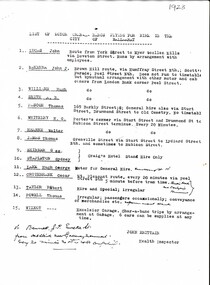
Document, List of Bus and Char-a-Banc Plying for Hire, 1923, 1923
... In Australia a modern similar type of bus or motorcoach, with a lateral door for each row of seats, survived up to the 1970s and was referred to as side loader bus; but all or most of them were not open-topped. ...In Australia a modern similar type of bus or motorcoach, with a lateral door for each row of seats, survived up to the 1970s and was referred to as side loader bus; but all or most of them were not open-topped. ...A charabanc or "char-à-banc" is a type of horse-drawn vehicle or early motor coach, usually open-topped, common in Britain during the early part of the 20th century. It has "benched seats arranged in rows, looking forward, commonly used for large parties, whether as public conveyances or for excursions." It was especially popular for sight-seeing or "works outings" to the country or the seaside, organised by businesses once a year. The name derives from the French char à bancs ("carriage with wooden benches"), the vehicle having originated in France in the early 19th century. In Australia a modern similar type of bus or motorcoach, with a lateral door for each row of seats, survived up to the 1970s and was referred to as side loader bus; but all or most of them were not open-topped. (Wikipedia)Two pages relating to buses, char-a-bancs and trams in Ballaratbus, tram, char-a-banc, john lucas, john j. mckenna, hugh williams, a.b. smith, thomas pascoe, h.g. whiteley, walter hearne, thomas james, george skinner, sydney stapleton, hugh george lake, oscar cruikshank, robert taylor, thomas powell, wilmot, j.p. bennett -
Maldon Vintage Machinery Museum Inc
One Ton Truck
... load / Graham Brothers Detroit. U. S. A. / A division of Dodge Brothers Inc." On cast wheel hub nuts "GB" Graham Brothers flat bed one ton truck. In-line four cylinder engine. Blue body with white engine housing, red engine block, cream wheel trim and upholstery maroon chasis. Natural timber seat ...Used in annual Maldon Easter parade.Graham Brothers flat bed one ton truck. In-line four cylinder engine. Blue body with white engine housing, red engine block, cream wheel trim and upholstery maroon chasis. Natural timber seat frame, tray and running boards. Chrome radiator housing and headlights. Retrofitted electric turning indicators.Etched plate on dashboard "1 Ton CAUTION Truck / Over-loading or over-speeding / will void your warranty / Speed 25 miles per hour / Maximum allowable load capacity 2000 lbs / Allowable for weight of body 1000 lbs / Total weight of chassis body -------- / and load not to exceed 5515 lbs / deduct excess body weight from rated load / Graham Brothers Detroit. U. S. A. / A division of Dodge Brothers Inc." On cast wheel hub nuts "GB" -
 University of Melbourne, Burnley Campus Archives
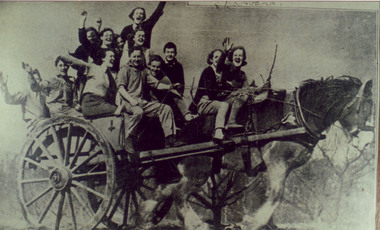
Photograph - Colour print, A.P. Winzenried, Things are Never Down on the Farm at Burnley Horticultural School, 1934
... load of happy students back to the lecture room after a session of practical work. Most of the 30 pupils now at the school are engaged in the study of pruning." See B94.-902. A large group of male and female students seated...load of happy students back to the lecture room after a session of practical work. Most of the 30 pupils now at the school are engaged in the study of pruning." See B94.-902. A large group of male and female students seated ...Photograph made by A.P. Winzenried for, "Green Grows Our Garden," p73.Colour photograph. Copy made by A.P. Winzenried. Photograph appeared in the "Sun News Pictorial," July 10, 1934. The caption reads, "Things are never down on the farm at Burnley Horticultural School while Don, the old dray horse, is on the job carting his load of happy students back to the lecture room after a session of practical work. Most of the 30 pupils now at the school are engaged in the study of pruning." See B94.-902. A large group of male and female students seated on a cart darwn by a draught horse.a.p. winzenried, green grows our garden, don, dray horse, students working outside, draught horse, students, orchard, newspaper cutting -
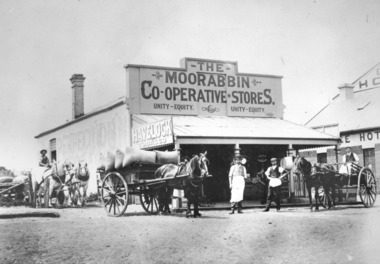 City of Kingston
Photograph - Digital image, Black and white, Moorabbin Co-operative Store, c. 1910
... Three horse drawn wagons, on the left two white horses with a man holding the reins, one carrying a load with hessian sacks and another on the far right with a man in the seat of the wagon also wearing an apron, suggesting they are workers at the store....Black and white image of two men wearing aprons standing in front of Moorabbin Co-operative Store with three horse drawn wagons, on the left two white horses with a man holding the reins, one carrying a load with hessian sacks and another on the far right with a man in the seat of the wagon also wearing an apron. ...Three horse drawn wagons, on the left two white horses with a man holding the reins, one carrying a load with hessian sacks and another on the far right with a man in the seat of the wagon also wearing an apron, suggesting they are workers at the store. ...Black and white image depicting two men wearing aprons standing in front of Moorabbin Co-operative Stores, Nepean Highway Cheltenham. Exchange Hotel to the right. Three horse drawn wagons, on the left two white horses with a man holding the reins, one carrying a load with hessian sacks and another on the far right with a man in the seat of the wagon also wearing an apron, suggesting they are workers at the store.Black and white image of two men wearing aprons standing in front of Moorabbin Co-operative Store with three horse drawn wagons, on the left two white horses with a man holding the reins, one carrying a load with hessian sacks and another on the far right with a man in the seat of the wagon also wearing an apron. A sign on the left hand side of the building Havelock Tabacco.Printed in black text a round white sticker: 75 Hand written in red ink: 75%horse drawn wagon, workers, moorabbin, cheltenham, commerce, trade
