
Showing 65 items matching "second boer war"
-
 Bendigo Military Museum
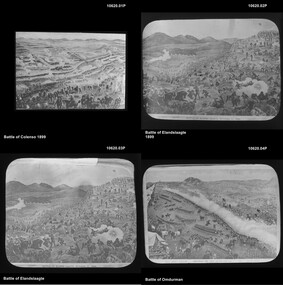
Photograph - MAGIC LANTERN SLIDES, Popular views of the Second Boer War 1899
... Popular views of the Second Boer War 1899...second boer war 1899...A collection of 36 magic lantern slides featuring scenes from the Second Boer War, 1899. Examples of “magic lantern”projectors can be found on Victorian Collections....Popular views of the Second Boer War 1899 Photograph MAGIC LANTERN SLIDES ...These slides are positive images imprinted on glass plates designed to be projected onto a screen using a magic lantern, a forerunner of the modern projector. Many of the slides are photographs of items in publications such as the London Illustrated News and other popular sources. Magic lantern shows were entertainments held in halls and mechanics institutes as a form of community entertainment. A slide projector would display the images onto a stage curtain accompanied by a commentary from the presenter. The subjects shown were topical and patriotic, illustrating current events. The Australian colonies sent sizable contingents to South Africa, so the show would have been of great interest. A collection of 36 magic lantern slides featuring scenes from the Second Boer War, 1899. Examples of “magic lantern”projectors can be found on Victorian Collections.Some slides have text from newspapers attached, probably acting as a prompt to the presenter.second boer war 1899, magic lantern shows -
 Federation University Historical Collection
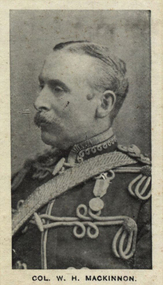
Photograph (black & White), Colonel William Henry MacKinnon - South Africa
... ...second boer war...After the outbreak of the Second Boer War he was appointed Colonel commandant of the City of London Volunteers who proceeded to South Africa. ...After the outbreak of the Second Boer War he was appointed Colonel commandant of the City of London Volunteers who proceeded to South Africa. ...After serving in Malta and India, he became Assistant Adjutant General at Home District in 1893. After the outbreak of the Second Boer War he was appointed Colonel commandant of the City of London Volunteers who proceeded to South Africa. This corps included infantry, mounted infantry and artillery. They were in South Africa from January 1900 until October 1900, returning to England. The corps was disbanded in December 1900. MacKinnon was awarded with the Knight Grand Cross of the Order of the Bath and Knight Commander of the Royal Victorian Order.Individual image from photographed poster of tobacco and cigarette cardsmalta, india, assistantadjutant general, second boer war, city of london volunteers, colonel, south africa -
 Federation University Historical Collection
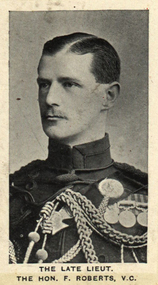
Photograph (black & White), Lieutenant, The Honourable Frederick Hugh Sherston Roberts - South Africa
... ...second boer war...At the age of 27 he went with the King's Rifles to the Second Boer War. During battle he, with two officers tried to assist and save guns when the detachments serving the guns had all become casualties or been driven away. ...At the age of 27 he went with the King's Rifles to the Second Boer War. During battle he, with two officers tried to assist and save guns when the detachments serving the guns had all become casualties or been driven away. ...Frederick Roberts was the son of Field Marshall Frederick Roberts, 1st Earl Roberts. At the age of 27 he went with the King's Rifles to the Second Boer War. During battle he, with two officers tried to assist and save guns when the detachments serving the guns had all become casualties or been driven away. While doing this Roberts fell badly wounded and 2 days later died. Commander-in-Chief Redvers Buller recommended Roberts for the Victoria Cross. Confirmation of the award made after his death. Roberts and his father were one of only three father son pairs to win the Victoria Cross. His father's was in 1858.Individual image from photographed poster of tobacco and cigarette cards.frederick roberts, field marshall roberts, king's rifles, second boer war, redvers buller, south africa -
 Federation University Historical Collection
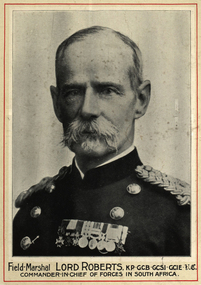
Photograph (black & White), Field-Marshall Lord Roberts, Commander-in-Chief - South Africa
... ...second boer war...Frederick Sleigh Roberts, 1st Earl Roberts was a British Soldier who served in India, Abyssinia and Afghanistan before leading the British Forces to success in the Second Boer War. He became the last Commander-in-Chief of the Forces before the post was abolished in 1904. ...Frederick Sleigh Roberts, 1st Earl Roberts was a British Soldier who served in India, Abyssinia and Afghanistan before leading the British Forces to success in the Second Boer War. He became the last Commander-in-Chief of the Forces before the post was abolished in 1904. ...Frederick Sleigh Roberts, 1st Earl Roberts was a British Soldier who served in India, Abyssinia and Afghanistan before leading the British Forces to success in the Second Boer War. He became the last Commander-in-Chief of the Forces before the post was abolished in 1904. While in South Africa he was at the Siege of Kimberley, the Battle of Paardeberg, the Battle of Poplar Grove, the Battle of Diamond Hill and the Battle of Bergendal. Roberts received many awards: Victoria Cross (1858-India); Companion of the Order of the Bath (1872-Afghanistan); Knight Commander of the Order of the Bath (1878-Afghanistan);Knight Grand Cross of the Order of the Bath (1880-Afghanistan) and Companion of the Order of the Indian Empire in the same year. He was Commander-in Chief, India in 1885 was advanced to Knight Commander of the Order of India (1887) and then Knight Grand Commander of the Order of the Indian Empire later that year. He became Knight Grand Commander of the Order of the Star of India. The same year he relinquished his Indian command and became Commander-in-Chief of British Forces in 1895 made a Knight of the Order of St Patrick. In 1899 he returned to South Africa to take overall command of British Forces in the Second Boer War. December 1900 Roberts handed over command to Lord Kitchener and returned to England where more honours were awarded. He was made a Knight of the Order of the Garter; created Earl Roberts of Kandahar, Pretoria and Waterford and Viscount St Pierre. He became a Knight of Grace of the Order of St John (1901) and then Knight of Justice of the Order of St John. The Kaiser awarded him the German Order of the Black Eagle and was among the original recipients of the Order of Merit in the 1902 Coronation Honours. Roberts died in 1914. He was given and State Funeral and buried in St Paul's Cathedral.Individual image taken from photographed poster of tobacco and cigarette cards.frederick sleigh roberts, earl roberts, india, abyssinia, afghanistan, british forces, second boer war, commander-in-chief, south africa, siege of kimberley, battle of paardeberg, battle of poplar grove, battle of diamond hill, battle of bergendal, victoria cross, companion of the order of the bath, knight commander of the order of the bath, knight grand cross of the order of the bath, companion of the order of the indian empire, knight commander of the order of india, knight grand commander of the order of the indian empire, knight grand commander of the order of the star of india, knight of the order of st patrick, knight of the order of the garter, viscount st pierre, knight of grace of the order of st john, knight of justice of the order of st john, order of the black eagle, order of merit, st paul's cathedral, london -
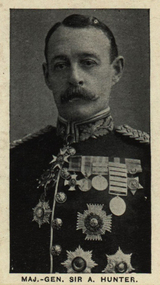 Federation University Historical Collection
Photograph (black & White), Major-General Sir Archibald Hunter - South Africa
... second boer war...At the outbreak of the Second Boer War, Major General Hunter was on the staff of Sir George White's Natal Field Force during the Battle of Ladysmith in Natal. ...At the outbreak of the Second Boer War, Major General Hunter was on the staff of Sir George White's Natal Field Force during the Battle of Ladysmith in Natal. ...At the outbreak of the Second Boer War, Major General Hunter was on the staff of Sir George White's Natal Field Force during the Battle of Ladysmith in Natal. He led a small raid against some of the Boers' guns, disabled them and relieved the town. Promotion followed and he became General Officer Commanding 10th Division. The Division was sent to join Lord Roberts' army camped at the captured Orange Free State capital. Hunter led them in the march on Pretoria. Once Pretoria was captured they still had to deal with Guerrilla Warfare and Hunter was sent south as overall commander of five columns that converged on the Free State army camped at Brandwater Basin, forcing the surrender of 4,314 Boers led by Marthinus Prinsloo. He was awarded Knight Grand Cross of the Order of the Bath, Knight Grand Cross of the Royal Victorian Order, Territorial Decoration Legion of Honour (France)Individual image taken from photographed poster of tobacco and cigarette cardssecond boer war, major generl, archibald hunter, natal field force, battle of ladysmith, general officer commanding, sir george white, guerrilla warfare, orange free state, brandwater basin, marthinus prinsloo, knight grand cross of the order of the bath, knight grand crossof the royal victorian order, legion of honour (france) -
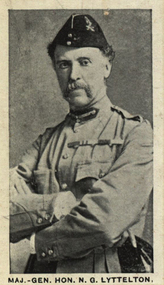 Federation University Historical Collection
Photograph (black & White), Major-General, Honorable Neville Gerald Lyttelton - South Africa
... ...second boer war...Lyttelton served in the Second Boer War as Commander of the 4th Brigade from 1899. ...Lyttelton served in the Second Boer War as Commander of the 4th Brigade from 1899. ...Lyttelton served in the Second Boer War as Commander of the 4th Brigade from 1899. He temporarily became General Officer Commanding the 2nd Division and the commanded the 4th Division. The Division was involved in the Battle of Spion Kop and the Battle of Vaal Krantz, leading to the Relief of Ladysmith 1900. Lord Roberts referred to Lyttelton as an officer "with great coolness under fire, and considerable tactical knowledge and resource........an excellent commander in the field." Following the end of the Boer War in 1902, Lyttelton became Commander-in-Chief of the whole of South Africa. He and his wife sought to repair relations with the Boer community. In the South Africa honours of 1902 Lyttelton was knighted as Knight Commander of the Order of the Bath. He retired in 1912 and under insistence by the King was appointed as Governor of the Royal Hospital Chelsea from that time until his death there in 1931. Other awards received were Knight Grand Cross of the Order of the Bath; Knight Grand Cross of the Royal Victorian Order; Order of Osmanieh (Ottoman Empire)Individual image taken from photographed poster of tobacco and cigarette cards.neville gerald lyttelton, second boer war, commander, 4th brigade, battle of spion kop, battle of vaal krantz, relief of ladysmith, lord roberts, commander-in-chief, south africa, knight commander of the order of the bath, royal hospital chelsea, order of osmanieh (ottoman empire), knight grand cross of the royal victorian order -
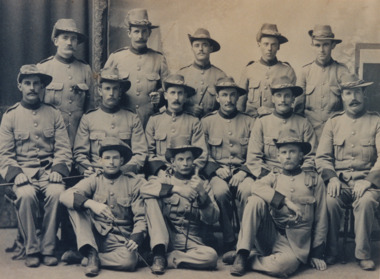 The Beechworth Burke Museum
Photograph - Photograph - Reproduction
... ...second boer war...Two contingents of the Victorian Mounted Rifles fought during the Second Boer War (11 October 1889 - 31 May 1902). ...Two contingents of the Victorian Mounted Rifles fought during the Second Boer War (11 October 1889 - 31 May 1902). ...It is believed that the photograph was taken between 1899 - 1903. Depicted is a group of fourteen unidentified young men dressed in Australian military uniforms. A few of them are holding swords. This group were part of the Beechworth Mounted Rifles; a voluntary detachment of the Australian Light Horse Militia. This unit consisted of soldiers from the Euroa, Longwood, Violet Town, Benalla, Thoona, Wangaratta, Rutherglen, and Beechworth Detachments of Victorian Rifles, and subsequently formed into the 8th Australian Light Horse Regiment (Victorian Mounted Rifles). The Victorian Mounted Rifles was gazetted as a volunteer formation on 2 December 1885 with the aim of consolidating all the disparate calvary units dispersed across Victoria into a coordinated and single administrative and military unit. Two contingents of the Victorian Mounted Rifles fought during the Second Boer War (11 October 1889 - 31 May 1902). This conflict was fought between the British Empire and two independent Boer states; the South African Republic and the Orange Free State, over the Empire's influence in South Africa.The photograph is historically significant due to its connection to the Second Boer War and Australian Light Horse Regiment. This significance is enhanced by Australia's involvement in this war, specifically of the Victorian Mounted Rifles. This unit retains a special significance within Victorian culture, as there is a memorial and monument - erected in 1903 - honouring their service on St. Kilda Road in Melbourne. The record has strong research potential. This is due to the ongoing scholarly and public interest in war, military history, and the ANZAC legend. The historic context of this record can provide insight into Australia's history, military and defence policies. Lastly, as the Victorian Mounted Rifles remain a largely unexplored topic in comparison to other military units and divisions, the record presents a unique opportunity for further and important study and research.Sepia rectangular photograph printed on matte photographic paper.Reverse: BMM2638 / 071 1NA211 22JAN98 FOTOSUPPLIES........ ........................................ /military album, beechworth mounted rifles, australian light horse militia, second boer war, victorian mounted rifles, australian light horse regiment, military, war, british empire, south africa, 1800s, 1900s, australian army -
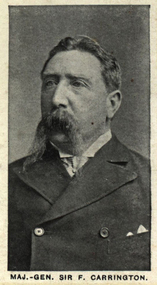 Federation University Historical Collection
Photograph (black & White), Major-General Sir Frederick Carrington - South Africa
... ...second boer war...During 1899-1900 he was back in Ireland but returned to South Africa in 1900 following the outbreak of the Second Boer War and was appointed on the staff of the South Africa Field Force with the rank of lieutenant-general. he was in command of the Rhodesian Field Force during the war. ...During 1899-1900 he was back in Ireland but returned to South Africa in 1900 following the outbreak of the Second Boer War and was appointed on the staff of the South Africa Field Force with the rank of lieutenant-general. he was in command of the Rhodesian Field Force during the war. ...After completing his education, Sir Frederick Carrington joined the 24th Regiment of Foot in 1864. In 1875 he went to South Africa and formed and commanded the Mounted Infantry in the Griqualand West expedition and the Frontier Light Horse in the Ninth Frontier War in 1877. In 1878-1879 he commanded the Transvaal Volunteer Force against Sekhukhune and the Cape Mounted Riflemen in the Basuto Gun War of 1881. In 1885 he was in command of the 2nd Mounted Infantry when he accompanied Sir Charles Warren expedition to Bechuanaland. The Infantry soon became known as "Carrington's Horse". He became military adviser to the High Commissioner in the First Matabele War and commanded the British Force in the Matabele Rebellion in 1896. During 1899-1900 he was back in Ireland but returned to South Africa in 1900 following the outbreak of the Second Boer War and was appointed on the staff of the South Africa Field Force with the rank of lieutenant-general. he was in command of the Rhodesian Field Force during the war. He was awarded the Knight Commander of the Order of St Michael and St George in 1887 and Knight Commander of the Order of the Bath in 1897.Individual image from photographed poster of tobacco and cigarette cards.sir frederick carrington, south africa, transvaal volunteer force, mounted infantry, frontier light horse, griqualand west, ninth frontier war, cape mounted riflemen, basuto gun war, carrington's horse, high commissioner, second boer war, lieutenant-general, knight commander of the order of the bath, knight commander of the order of st michael and st george, rhodesian field force -
 Federation University Historical Collection
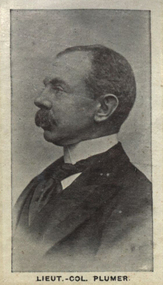
Photograph (black & White), Lieutenant-Colonel Herbert Charles Onslow Plumer - South Africa
... second matabele war...siege of mafeking...second boer...Second Matabele War. In 1899 he returned to Southern Rhodesia as Lieutenant-Colonel where he led the Siege of Mafeking during the Second Boer War. ...Second Matabele War. In 1899 he returned to Southern Rhodesia as Lieutenant-Colonel where he led the Siege of Mafeking during the Second Boer War. ...His military career led him to become appointed as assistant military secretary to the General Officer Commanding Cape Colony in 1895. He went to Southern Rhodesia in 1896 to disarm the local police force following the Jameson Raid and then later to command the Matabele Relief Force during the Second Matabele War. In 1899 he returned to Southern Rhodesia as Lieutenant-Colonel where he led the Siege of Mafeking during the Second Boer War. Plumer returned to the United kingdom in 1904 and received an audience with King Edward VI. Lord Kitchener, Commander-in-Chief in South Africa stated "invariable displayed military qualifications of a very high order.Few officers have rendered better service." Plumer received many honours - British and foreign. Knight Grand Cross of the Order of the Bath (1918; Knight Grand Cross of the Order of St Michael and St George (1916); Knight Grand Cross of the Royal Victorian Order (1917); Knight Grand Cross of the Order of the British Empire (1924); Knight of Grace of the Venerable Order Of St John (1925); Legion of Honour (France-!917); Croix de Guerre (Belgium-1918); Croix de Guerre with Palm ( France-1919); Distinguished Service Medal (United States-1919); Grand Cordon, Order of the Rising Sun (1921) Individual image from photographed poster of tobacco and cigarette cards.cape colony, southern rhodesia, jameson raid, matabele rrelief force, second matabele war, siege of mafeking, second boer war, lord kitchener, knight grand cross of the order of st michael and st george, knight grand cross of the order of the bath, knight grand crossof the royal victorian order, knight grand cross of the order of the british empire, knight of grace of the venerable order of st john, legion of honour, croix de guerra, croix de guerra with palm, distinguished service medal, grand cordon, order of the rising sun -
 Monbulk RSL Sub Branch
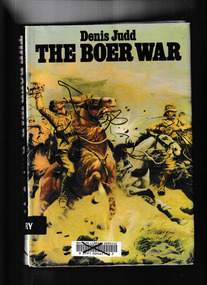
Book, Hart-Davis, MacGibbon, The Boer war, 1977
... ...Second Boer war...South African war 1899-1901 Second Boer war The Boer War was an epic both of heroism and of barbarism. ...The Boer War was an epic both of heroism and of barbarism. Fought by the British against the Dutch inhabitants of South Aftrica, the Boer War had an extraordinary cast of characters including Commanders-in chief buller, Roberts and Kitchener, Winston Churchill, Arthur Conan Doyle, Emily Hobhouse, Rudyard Kipling, and Gandhi. The war revealed the ineptitude of the British military, and exposed the corrupt underside of British imperialism . For the first time, Judd and Surridge debunk several myths. There was not, for instance, a straightforward divide between the Boers and British. In fact, the overriding aim of both sides was to maintain European supremacy and to keep Africans and Indians "in their place." Giving us a sense of how the Apartheid era was born.Index, bibliography, ill, maps, p.190.non-fictionThe Boer War was an epic both of heroism and of barbarism. Fought by the British against the Dutch inhabitants of South Aftrica, the Boer War had an extraordinary cast of characters including Commanders-in chief buller, Roberts and Kitchener, Winston Churchill, Arthur Conan Doyle, Emily Hobhouse, Rudyard Kipling, and Gandhi. The war revealed the ineptitude of the British military, and exposed the corrupt underside of British imperialism . For the first time, Judd and Surridge debunk several myths. There was not, for instance, a straightforward divide between the Boers and British. In fact, the overriding aim of both sides was to maintain European supremacy and to keep Africans and Indians "in their place." Giving us a sense of how the Apartheid era was born.south african war 1899-1901, second boer war -
 Frankston RSL Sub Branch
Booklet - Pocketbook, Souvenir, Australian Imperial Regiment, Souvenir of the Victorian contingent, April, 1900
... Small booklet containing the words of a patriotic song about the Victorian contingent to the second Boer War, April 1900. This illustrated booklet has a stiff card cover printed in colour and has 12 pages printed in sepia tones. ...Small booklet containing the words of a patriotic song about the Victorian contingent to the second Boer War, April 1900. This illustrated booklet has a stiff card cover printed in colour and has 12 pages printed in sepia tones. ...Small booklet containing the words of a patriotic song about the Victorian contingent to the second Boer War, April 1900. This illustrated booklet has a stiff card cover printed in colour and has 12 pages printed in sepia tones. Published by E. Whitehead & Co., Printers, 238 Collins Street, Melbourne. -
 National Wool Museum
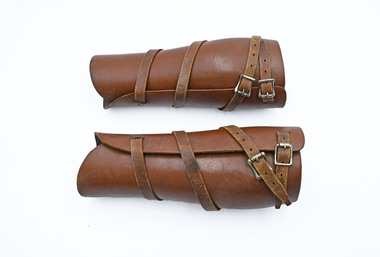
Equipment - Gaiter
... The Australian Light Horse were mounted troops with characteristics of both cavalry and mounted infantry, who served in the Second Boer War and World War 1....The Australian Light Horse were mounted troops with characteristics of both cavalry and mounted infantry, who served in the Second Boer War and World War 1. WWI Boer War Australian Light Horse Brigade Leather A pair of leather gaiters (or leggings). ...The gaiters were possibly worn by soldiers of the Australian Light Horse Brigade. The Australian Light Horse were mounted troops with characteristics of both cavalry and mounted infantry, who served in the Second Boer War and World War 1.A pair of leather gaiters (or leggings). The leather panel is shaped to fit the contour of the lower leg and overlaps at the centre back. Attached at the lower edge is a single strap of leather which winds around the legging and feeds through two flat loops which have been rivetted to the front. At the top of the outer sides of both leggings is a leather securing tab with two buckles. The lower secures the strap and the upper secures a second, shorter strap that wraps around the calf.wwi, boer war, australian light horse brigade, leather -
 Dandenong/Cranbourne RSL Sub Branch
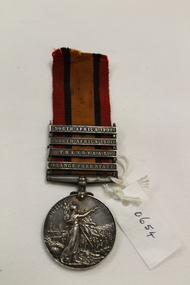
Medal - South African Medal Boer War, Circa 1900s
... The Queens South Africa Medal was awarded to British and Colonial Military personal and civilians who served in the Second Boer War. On the death of Queen Victoria the medal became the "Kings Africa Medal". ...The Queens South Africa Medal was awarded to British and Colonial Military personal and civilians who served in the Second Boer War. On the death of Queen Victoria the medal became the "Kings Africa Medal". ...The Queens South Africa Medal was awarded to British and Colonial Military personal and civilians who served in the Second Boer War. On the death of Queen Victoria the medal became the "Kings Africa Medal". Was awarded for service after January 1902. There were 176,000 medals awarded.Queens South African Medal. Round Silver Medal with 4 bars on cotton ribbon - Orange Red and Black stripes. The Bars were for campaigns South Africa 1902 , South Africa1901, Transvaal and Orange Free State. There were 26 bars awarded for the various campaigns. Obverse side shows Queen Victoria - reverse side depicts Britannia with South Africa above.The medal was awarded to Private J James # 2784. RLY. PNR. REG x. Wording on outer rim of obverse side reads " Victoria Regina Et Imperatrix ". -
 Frankston RSL Sub Branch
Photograph
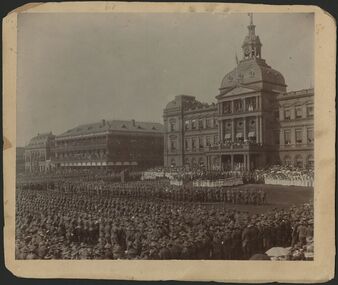
... Lord Robert's victorious British armies raise the Union Jack flag at the Transvaal Republic Parliament building after the occupation of Pretoria on June 6th 1900 during the second Anglo Boer War....boer war anglo boer war transvaal pretoria south africa Lord Robert's victorious British armies raise the Union Jack flag at the Transvaal Republic Parliament building after the occupation of Pretoria on June 6th 1900 during the second Anglo Boer War. ...Lord Robert's victorious British armies raise the Union Jack flag at the Transvaal Republic Parliament building after the occupation of Pretoria on June 6th 1900 during the second Anglo Boer War.boer war, anglo boer war, transvaal, pretoria, south africa, -
 Ballarat Heritage Services
Photograph - Photograph - Colour, CK Gervasoni, Daylesford War Memorial, 2016, 18/08/2016
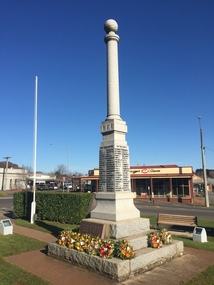
... Plaques have been added to commemorate Post World War Two conflicts, and Sergeant John Cock who was killed in action during the Second Boer War. ...Plaques have been added to commemorate Post World War Two conflicts, and Sergeant John Cock who was killed in action during the Second Boer War. daylesford war memorial H. Respini A number of colour photographs of the grey granite Daylesford War Memorial. ...The monument commemorates the residents of Daylesford who died in service or were killed in action in World War One and World War Two. Plaques have been added to commemorate Post World War Two conflicts, and Sergeant John Cock who was killed in action during the Second Boer War. A number of colour photographs of the grey granite Daylesford War Memorial.daylesford war memorial, h. respini -
 Brighton Historical Society
Uniform, NSW Mounted Rifles waistcoat, circa 1899
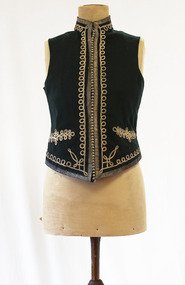
... In 1899 he travelled to South Africa to fight in the Second Boer War as an officer of the 1st NSW Mounted Rifles. ...In 1899 he travelled to South Africa to fight in the Second Boer War as an officer of the 1st NSW Mounted Rifles. ...NSW Mounted Rifles officer's mess dress waistcoat worn by Lieutenant William Augustine Newman (1873-1955) during the Second Boer War. Born in Campbelltown, NSW, William began working in the colonial public service at the age of eighteen. In 1899 he travelled to South Africa to fight in the Second Boer War as an officer of the 1st NSW Mounted Rifles. Returning to Australia in time for Federation on 1 January 1901, William rejoined the public service and was appointed to the original staff of Prime Minister Sir Edmund Barton, attending the first opening of Federal Parliament in Melbourne as Barton's private secretary. He went on to serve as the chief clerk of the Home Affairs Department, Commonwealth Electoral Officer for Victoria and official secretary to the Governor-General. In 1927 he was appointed Administrator of Nauru, a position he occupied until his retirement at the end of 1932. He retired to Brighton, where he lived with his family at 43 Martin Street until his death in 1955.Black NSW Mounted Rifles officer's mess dress waistcoat. Black superfine wool front, with black cotton back and cream cotton lining. The neck, front and bottom front edge are edged with gold metal lace and gold cording in an Austrian knot style. Two front pockets are edged in the same looped cording. The left front opening is edged with a row of decorative gold metal studs, with hook and eye fastenings underneath.Handwritten in pen on lining: "MESS WAISTCOAT / BOER WAR / LIEUT. NEWMAN / Gift of Mrs. D. Kelly, daughter".military uniform, nsw mounted rifles, boer war, william augustine newman -
 Warrnambool and District Historical Society Inc.
Badge, Australian Commonwealth Horse, C1902
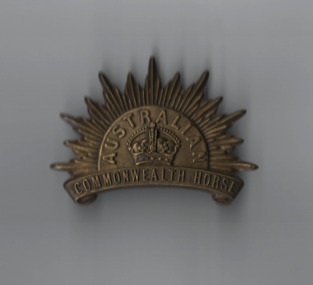
... This is the badge of the Australian Commonwealth Horse which was a mounted infantry unit of the Australian Army established during the Second Boer War in 1902. It was the first expeditionary force established by the Commonwealth of Australia following Federation in 1901 and the first to wear the Rising Sun Badge, a design chosen by the British Commander in Chief of the Australian Forces, Sir Edward Hutton. ...This is the badge of the Australian Commonwealth Horse which was a mounted infantry unit of the Australian Army established during the Second Boer War in 1902. It was the first expeditionary force established by the Commonwealth of Australia following Federation in 1901 and the first to wear the Rising Sun Badge, a design chosen by the British Commander in Chief of the Australian Forces, Sir Edward Hutton. ...This is the badge of the Australian Commonwealth Horse which was a mounted infantry unit of the Australian Army established during the Second Boer War in 1902. It was the first expeditionary force established by the Commonwealth of Australia following Federation in 1901 and the first to wear the Rising Sun Badge, a design chosen by the British Commander in Chief of the Australian Forces, Sir Edward Hutton. This Rising Sun Badge was the second version of a military badge used by Australian soldiers in 1902.This badge is of great interest as the hat badge worn by the Australian Commonwealth Horse in the Boer War. It is not known if it has any local significance. Brass semi-circular badge in the shape of the rising sun with slightly curved bottom edge. There is text along the bottom edge with "Australia" in a semi-circle above a crown in low relief.two hooks on the back of the badge."Commonwealth Horse" in scroll alonf bottom of badge. "Australia " in semicircle below the rays of the sun.warrnambool, commonwealth horse badge, military badges of australia, australian commonwealth horse badge -
 Orbost & District Historical Society
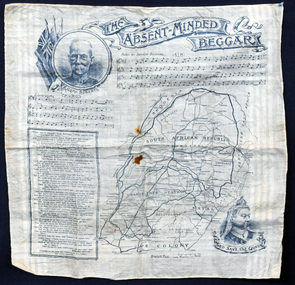
handkerchief, c. 1899
... The Daily Mail printed this handkerchief to raise funds for the "Soldiers' Families Fund" after the outbreak of the Second Boer War (1899-1902. (The Daily Mail, devised by Alfred Harmsworth (later Lord Northcliffe) and his brother Harold (later Lord Rothermere), was first published on 4 May 1896 and was an immediate success.) ...This handkerchief was produced to raise funds for the families of soldiers involved in the Second Boer War. This fund, The Soldiers' Families Fund was the first such charitable effort for a war. ...The Daily Mail printed this handkerchief to raise funds for the "Soldiers' Families Fund" after the outbreak of the Second Boer War (1899-1902. (The Daily Mail, devised by Alfred Harmsworth (later Lord Northcliffe) and his brother Harold (later Lord Rothermere), was first published on 4 May 1896 and was an immediate success.) Patriotic handkerchiefs were popular during the Victorian era and this one featuring a popular song and well-known people was probably the most popular.This handkerchief was produced to raise funds for the families of soldiers involved in the Second Boer War. This fund, The Soldiers' Families Fund was the first such charitable effort for a war. The handkerchief and other related items raised more than 250,000 pounds.A white linen man's handkerchief. It is printed in blue. It has a map of the South African Republic and the music and words of The Absent Minded Beggar - music by Arthur Sullivan, words by Rudyard Kipling. There is a picture of Lord Roberts, the British Commander in Chief, in the top left corner with the British flag and a picture of Queen Victoria in the bottom right corner.handkerchief souvenir boer-war -
 Red Cliffs Military Museum
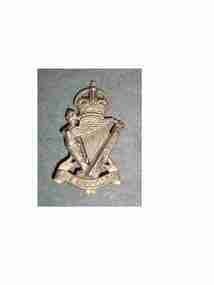
Hat Badge, Hat Badge Royal Irish Rifles WW1, (estimated); around 1900
... In 1881 under the Childers Reforms these 2 regiments were amalgamated to form the Royal Irish Rifles,it saw service in the Second Boer War, Great War. In 1921 it was renamed the Royal Ulster Rifles. ...In 1881 under the Childers Reforms these 2 regiments were amalgamated to form the Royal Irish Rifles,it saw service in the Second Boer War, Great War. In 1921 it was renamed the Royal Ulster Rifles. ...The Royal Irish Rifles was a British Army Infantry Regiment. It dates back to the reign of King George 111. In 1793 the British Army raised 2 new Regiments to meet the commitmentd of the war with the French First Republic. In 1881 under the Childers Reforms these 2 regiments were amalgamated to form the Royal Irish Rifles,it saw service in the Second Boer War, Great War. In 1921 it was renamed the Royal Ulster Rifles. Quis Separabit = "Who shall seperate us" (Latin) In 1968 under reforms of the army, was amalgamated with The Royal Inniskilling Fusiliers and the Royal Irish Fusiliers to form the Royal Irish Rangers. More information on this Regiment can be found on Wikipedia under Royal Ulster RiflesThis Royal Irish Rifles Hat badge appears to be a Pewter type alloy with brass clip. At top a Crown. Centre is harp shaped. Left side of harp has the figure of a siren her wings join to the right side of the harp which is a bar? adorned with raised decor. Bottom is a scroll with the lettering- Qius Separabit.Royal Crown Harp -Siren on left, wings joining to the right side with raised decor Scroll has - Quis Serarabithat, ww1, collection, royal, badge, a j, roddy, irish, rifles, pte2, james, ulster -
 8th/13th Victorian Mounted Rifles Regimental Collection
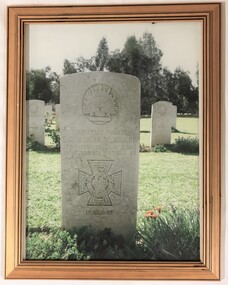
Photograph - Maygar grave
... He was awarded the VC for facilitating the rescue of a dismounted man while under severe rifle fire in 1902 during the Second Boer War. He later served with the 4th Australian Light Horse at Gallipoli during the First World War, and died of wounds after being strafed during the Battle of Beersheba as part of the Sinai and Palestine campaign while commanding the 8th Australian Light Horse.....He was awarded the VC for facilitating the rescue of a dismounted man while under severe rifle fire in 1902 during the Second Boer War. He later served with the 4th Australian Light Horse at Gallipoli during the First World War, and died of wounds after being strafed during the Battle of Beersheba as part of the Sinai and Palestine campaign while commanding the 8th Australian Light Horse.. ...Lieutenant Colonel Leslie Cecil Maygar, VC, DSO, VD (27 May 1868 – 1 November 1917) was an Australian recipient of the Victoria Cross, the highest award for gallantry in the face of the enemy that can be awarded to British and Commonwealth forces. He was awarded the VC for facilitating the rescue of a dismounted man while under severe rifle fire in 1902 during the Second Boer War. He later served with the 4th Australian Light Horse at Gallipoli during the First World War, and died of wounds after being strafed during the Battle of Beersheba as part of the Sinai and Palestine campaign while commanding the 8th Australian Light Horse..Framed colour photograph of headstone at the grave of Lieutenant Colonel Leslie Maygar VC.maygar, grave, world war, wwi -
 Federation University Historical Collection
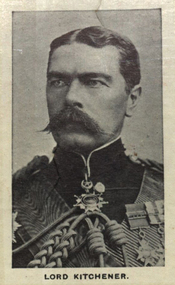
Photograph (black & White), Horatio Herbert Kitchener, 1st Earl Kitchener - South Africa
... Kitchener was a senior British Army officer and colonial administrator who won notoriety for his campaigns, most especially his scorched earth policy against the Boers and his establishment of concentration camps during the Second Boer War. Awards he received include: Knight of the Order of the Garter; Knight of the Order of St Patrick; Knight Grand Cross of the Order of the Bath; Member of the Order of Merit; Knight Grand Commander of the Order of the Star of India; Knight Grand Cross of the Order of St Michael and St George; Knight Grand Commander of the Order of the Indian Empire. ...Kitchener was a senior British Army officer and colonial administrator who won notoriety for his campaigns, most especially his scorched earth policy against the Boers and his establishment of concentration camps during the Second Boer War. Awards he received include: Knight of the Order of the Garter; Knight of the Order of St Patrick; Knight Grand Cross of the Order of the Bath; Member of the Order of Merit; Knight Grand Commander of the Order of the Star of India; Knight Grand Cross of the Order of St Michael and St George; Knight Grand Commander of the Order of the Indian Empire. battle of omdurman sudan kitchener earl scorched earth policy boers concentration camps colonial administrator knight of the order of st patrick knight of the order of the garter knight grand cross of the order of st michael and st george knight grand cross of the order of the bath member of the order of merit knight grand commander of the order of the star of india knight grand commander of the order of the indian empire Individual imagae take from photographed poster of tobacco and cigarette cards. ...For his achievements in the Battle of Omdurman and Sudan in 1898, Kitchener was made Lord Kitchener of Khartoum, becoming an Earl - qualifying peer of mid-rank. Kitchener was a senior British Army officer and colonial administrator who won notoriety for his campaigns, most especially his scorched earth policy against the Boers and his establishment of concentration camps during the Second Boer War. Awards he received include: Knight of the Order of the Garter; Knight of the Order of St Patrick; Knight Grand Cross of the Order of the Bath; Member of the Order of Merit; Knight Grand Commander of the Order of the Star of India; Knight Grand Cross of the Order of St Michael and St George; Knight Grand Commander of the Order of the Indian Empire. Individual imagae take from photographed poster of tobacco and cigarette cards.battle of omdurman, sudan, kitchener, earl, scorched earth policy, boers, concentration camps, colonial administrator, knight of the order of st patrick, knight of the order of the garter, knight grand cross of the order of st michael and st george, knight grand cross of the order of the bath, member of the order of merit, knight grand commander of the order of the star of india, knight grand commander of the order of the indian empire -
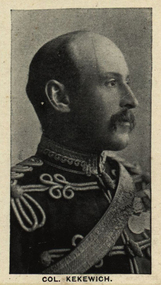 Federation University Historical Collection
Photograph (black & White), Colonel Robert George Kekewich - South Africa
... Kekewich commanded the 1st Battalion of the Royal Regiment (North Lancashire) in the Second Boer War. He commanded the garrison in Kimberley during the siege and successful defence of the town. ...Kekewich commanded the 1st Battalion of the Royal Regiment (North Lancashire) in the Second Boer War. He commanded the garrison in Kimberley during the siege and successful defence of the town. ...Kekewich commanded the 1st Battalion of the Royal Regiment (North Lancashire) in the Second Boer War. He commanded the garrison in Kimberley during the siege and successful defence of the town. At this time he came into conflict with Cecil Rhodes who persuaded John French, commanding the relief force, to replace Kekewich with another officer as commander of the garrison. Kekewich was promoted to colonel for his services. In 1901 he was wounded in an attack by General de la Rey near Moedwil but soon recuperated. Kekewich was in charge during the British victory at the Battle of Rooiwai, the last major battle during the war. He stayed in South Africa until peace had been signed and then returned to England. For his services he was appointed a Companion of the Order of the Bath and on retirement was appointed to the Honorary position of Colonel of the Buffs.Individual image taken from photographed poster of tobacco and cigarette cards.kekewich, 1st battalion, loyal regiment, second boer, kimberley, cecil rhodes, john french, garrison, de la rey, moedwil, rooiwai, companion of the order of the bath -
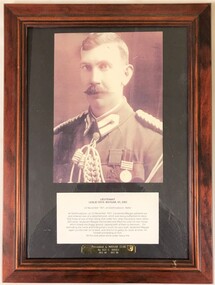 8th/13th Victorian Mounted Rifles Regimental Collection
Photograph - Magyar portrait
... He was awarded the VC for facilitating the rescue of a dismounted man while under severe rifle fire in 1902 during the Second Boer War. He later served at Gallipoli during the First World War, and died of wounds after being strafed during the Battle of Beersheba as part of the Sinai and Palestine campaign. ...He was awarded the VC for facilitating the rescue of a dismounted man while under severe rifle fire in 1902 during the Second Boer War. He later served at Gallipoli during the First World War, and died of wounds after being strafed during the Battle of Beersheba as part of the Sinai and Palestine campaign. ...Lieutenant Colonel Leslie Cecil Maygar, VC, DSO, VD (27 May 1868 – 1 November 1917) was an Australian recipient of the Victoria Cross, the highest award for gallantry in the face of the enemy that can be awarded to British and Commonwealth forces. He was awarded the VC for facilitating the rescue of a dismounted man while under severe rifle fire in 1902 during the Second Boer War. He later served at Gallipoli during the First World War, and died of wounds after being strafed during the Battle of Beersheba as part of the Sinai and Palestine campaign. The Maygar Club was the Other Ranks club at firstly Buna Barracks Albury, later at North Bandiana and currently at Latchford Barracks Bonegilla. The framed artwork was removed from the Club at Buna Barracks when the regiment relocated to Bandiana and placed in the Heritage Collection.Framed black and white reproduction of a photograph of Lieutenant Colonel Leslie Magyar together with a interpretive panel and a donor's plaque.Presented to Maygar Club by Sgt C Bruce Dec 97-Dec 99maygar, wwi, world war one, boer war, victoria cross -
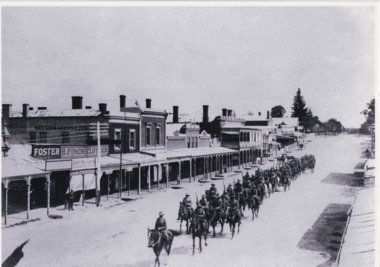 The Beechworth Burke Museum
Photograph, 1908
... The Victorian Mounted Rifles fought in the Second Boer War (1889 - 1902), although it is unknown if the group depicted in this image were involved in the conflict....The Victorian Mounted Rifles fought in the Second Boer War (1889 - 1902), although it is unknown if the group depicted in this image were involved in the conflict. ...Taken in 1908, the photograph depicts a long line of Australian soldiers riding atop horses. They marching down Ford St, Beechworth. This group were part of the Beechworth Mounted Rifles; a voluntary detachment of the Australian Light Horse Militia. This unit consisted of soldiers from the Euroa, Longwood, Violet Town, Benalla, Thoona, Wangaratta, Rutherglen, and Beechworth Detachments of Victorian Rifles, and subsequently formed into the 8th Australian Light Horse Regiment (Victorian Mounted Rifles). The Victorian Mounted Rifles was gazetted as a volunteer formation on 2 December 1885 with the aim of consolidating all the disparate calvary units dispersed across Victoria into a coordinated and single administrative and military unit. The Victorian Mounted Rifles fought in the Second Boer War (1889 - 1902), although it is unknown if the group depicted in this image were involved in the conflict.The photograph is historically significant due to its connection to the Australian Light Horse Regiment, specifically of the Victorian Mounted Rifles. This unit retains a special significance within Victorian culture, as there is a memorial and monument - erected in 1903 - honouring their service on St. Kilda Road in Melbourne. The record has strong research potential. This is due to the ongoing scholarly and public interest in war, military history, and the ANZAC legend. The historic context of this record can provide insight into Australia's history, military and defence policies. Lastly, as the Victorian Mounted Rifles remain a largely unexplored topic in comparison to other military units and divisions, the record presents a unique opportunity for further and important study and research.Black and white rectangular photograph printed on matte photographic paper.military album, military, war, wwi, world war i, beechworth, ford st, parade, horses, mounted rifles, soldiers, victorian mounted rifles, australian light horse militia -
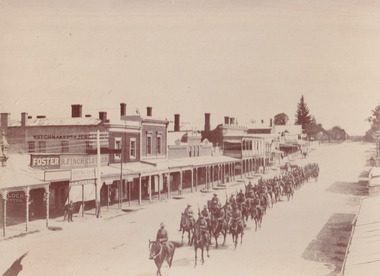 The Beechworth Burke Museum
Photograph, 1908
... The Victorian Mounted Rifles fought in the Second Boer War (1889 - 1902), although it is unknown if the group depicted in this image were involved in the conflict....The Victorian Mounted Rifles fought in the Second Boer War (1889 - 1902), although it is unknown if the group depicted in this image were involved in the conflict. ...Taken in 1908, the photograph depicts a long line of Australian soldiers riding atop horses. They marching down Ford St, Beechworth. This group were part of the Beechworth Mounted Rifles; a voluntary detachment of the Australian Light Horse Militia. This unit consisted of soldiers from the Euroa, Longwood, Violet Town, Benalla, Thoona, Wangaratta, Rutherglen, and Beechworth Detachments of Victorian Rifles, and subsequently formed into the 8th Australian Light Horse Regiment (Victorian Mounted Rifles). The Victorian Mounted Rifles was gazetted as a volunteer formation on 2 December 1885 with the aim of consolidating all the disparate calvary units dispersed across Victoria into a coordinated and single administrative and military unit. The Victorian Mounted Rifles fought in the Second Boer War (1889 - 1902), although it is unknown if the group depicted in this image were involved in the conflict.The photograph is historically significant due to its connection to the Australian Light Horse Regiment, specifically of the Victorian Mounted Rifles. This unit retains a special significance within Victorian culture, as there is a memorial and monument - erected in 1903 - honouring their service on St. Kilda Road in Melbourne. The record has strong research potential. This is due to the ongoing scholarly and public interest in war, military history, and the ANZAC legend. The historic context of this record can provide insight into Australia's history, military and defence policies. Lastly, as the Victorian Mounted Rifles remain a largely unexplored topic in comparison to other military units and divisions, the record presents a unique opportunity for further and important study and research.Sepia rectangular photograph printed on photographic paper and mounted on cardObverse: Ford Street / Beechworth / 1908 (in pen) Reverse: (upper left corner) UNITED SHIRE OF BEECHWORTH / .................................. / SHIRE SECRETARY [stamped in purple ink] (upper right corner) BMM 2639 [written in pencil] 2G [written and crossed out in blue ink] (centre-right margin) Beechworth Light Horse / 60 / 1908 [written in blue ink]military album, burke museum, burke, beechworth, light horse, ford street, 1908, world war one, wwi, horse, parade -
 8th/13th Victorian Mounted Rifles Regimental Collection
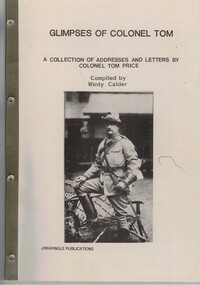
Book, Glimpses of Colonel Tom
... In 1900, he led a Victorian contingent during the Second Boer War, and was the only Australian officer during that war to command a force of British regulars. ...In 1900, he led a Victorian contingent during the Second Boer War, and was the only Australian officer during that war to command a force of British regulars. ...This is a supplement to Winty Calder's earlier work 'Heroes and Gentlemen'. Thomas Caradoc Rose Price CB, often known as Colonel Tom Price, was an Australian soldier, and acting commandant of the Commonwealth Military Forces in Victoria in 1902. Joining the British Indian Army in his early years, he served 20 years in India before returning to Australia. In 1885, he raised the Victorian Mounted Rifles, and was instrumental in establishing the concept of light horse units within the Australian Army. In 1900, he led a Victorian contingent during the Second Boer War, and was the only Australian officer during that war to command a force of British regulars. He remained in the Australian military after the war, serving in Queensland until 1904 when he was medically discharged. He retired to Victoria again and died in 1911 at the age of 68.Soft cover book with adhesive binding on spine, A4 size, 56 pages being a collection of addresses and letters of Colonel Tom Price, compiled by Winty Calder, published by Jimaringle Publications 1985. Gift letter on reverso of front cover.Presented to the 8/13 Victorian Mounted Rifles Royal Australian Armoured Corps as a memorial to Colonel Tom Price and the original Victorian Mounted Rifles and as a tribute to the men who carry on a fine tradition. Winty Calder 4 October 1985.price, calder, vmr, victorian mounted rifles -
4th/19th Prince of Wales's Light Horse Regiment Unit History Room
Decorative object - Gift Tin, c.1900
... In 1899, British soldiers and sailors were in South Africa fighting the second Boer War which lasted from 1899 to 1902. ...In 1899, British soldiers and sailors were in South Africa fighting the second Boer War which lasted from 1899 to 1902. ...In 1899, British soldiers and sailors were in South Africa fighting the second Boer War which lasted from 1899 to 1902. Queen Victoria was concerned about the morale of her army and navy and wanted to do something to lift their spirits. She would send chocolate to all of her army and navy serving in South Africa (including Australian contingents) as a Christmas/New Year gift in 1899/1900. The chocolate manufacturer, Cadbury, which since around 1854 had a Royal Warrant to supply Queen Victoria with cocoa and chocolate, was contacted and requested to produce the royal bars of chocolate, each with its own individual tin. This put Richard and George Cadbury in a dilemma because, as Quakers, they were pacifists and did not agree with the war. However they did not want to refuse a request from the Queen. To prevent their confectionery rivals from accusing them of going against their principles, their solution was to invite fellow Quakers, Joseph Fry and Joseph Rowntree to form a temporary three-way partnership to complete the order. Forty thousand tins, designed and made by Fry, were produced in two different sizes. The larger of the tins (15 x 9 cm) has a gold coloured rim around the edge of the lid and contained two layers of chocolate. The slightly smaller or rather thinner tin (16 x 8 cm) has a blue rim around the edge of the lid and contained one layer of chocolate. The design of the lid of both sizes is the same. It was decided by all three companies, that the tins would carry no brand name. However Queen Victoria was not amused by this decision; she wanted her army and navy to know that she was sending them quality British chocolate. As a compromise, the Cadbury name appeared on interior packaging of the chocolate. The tins remained unbranded. The empty tins had a more sombre use for for men killed in action. The tins, containing their few personal belongings, were sent home to the next of kin. The tins were not large and may have contained items such as medals, talismans, coins, jewellery, photos, letters and dog tags.Sheet metal tin with hinged lid. In the middle of the red lid of the tin is a gold-coloured embossed picture of Queen Victoria's head. To the left is Queen Victoria's insignia, and to the right are the words "South Africa 1900" and is inscribed "I wish you a happy New Year" and signed Victoria running along the bottom.gift to defence personnel from queen victoria. gift sent at christmas / new year in 1899/1900, gift sent at christmas / new year 1899/1900 -
 Federation University Historical Collection
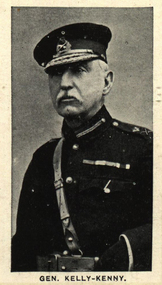
Photograph (black & White), General Sir Thomas Kelly-Kenny - South Africa Forces
... As well as his army positions, Kelly-Kenny was very interested in politics in his native County Clare. In the Second Anglo-Boer War he was , as a Lieutenant-General, General Officer Commanding the 6th Division of the South African field forces. ...As well as his army positions, Kelly-Kenny was very interested in politics in his native County Clare. In the Second Anglo-Boer War he was , as a Lieutenant-General, General Officer Commanding the 6th Division of the South African field forces. ...As well as his army positions, Kelly-Kenny was very interested in politics in his native County Clare. In the Second Anglo-Boer War he was , as a Lieutenant-General, General Officer Commanding the 6th Division of the South African field forces. He was twice mentioned in dispatches and received the Queen's South African Medal with four clasps. He was involved in the relief of Kimberley, the battles of Paardeberg, Poplar Grove and Driefontein. Lieutenant-General Kitchener was appointed commander and over-ruled Kelly-Kenny's plan to besiege Cronji and bombard his force from a safe distance. Kitchener ordered an assault on the Boer trenches. The result was "Bloody Sunday" - an unnecessary sacrifice of hundreds of lives on the British side. Kelly-Kenny was involved in the engagements at Poplar Grove and Driefontein where the 6th Division distinguished itself. These were viewed as key to destroying the Boer morale and winning the war. General Kelly-Kenny was a close friend of King Edward VII. Appointments made, at the insistence of the King, were often challenged. Due to his loyalty and abilities Kelly-Kenny was appointed Knight Commander of the Order of the Bath and received a knighthood in a private audience. Once again others tried to have him moved from the War Office but the King intervened again and he remained in his position. He was conferred with the Knight Grand Cross of the Order of the Bath (1904), Grand Cross of the Red Eagle (1905 - Germany), Grand Cross of the Rising Sun (1906 - Japan) and on his return to Britain he received the Knight Grand Cross of the Royal Victorian Order (1906) Individual image taken from photographed poster of tobacco and cigarette cards.kell-kenny, county clare, lieutenant-general, kimberley, queen's south african medal, paardeberg, poplar grove, driefontein, kitchener, bloody sunday, cronji, boer war, trenches, knight commander of the order of the bath, war office, king, king edward vii, knight grand cross of the order of the bath, grand cross of the red eagle, grand cross of the rising sun, knight grand cross of the royal victorian order -
 Federation University Historical Collection
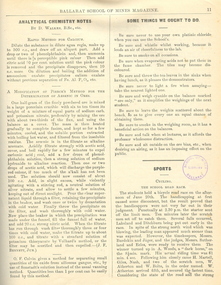
Magazine, Ballarat School of Mines Students' Magazine, 1898-1901, 1898-1901
... Second Term 1901 * The Metallurgical Treatment of Sulpho-Telluride Ores by L.W. Grayson * Some Metallurgical Difficulties of Aluminium * Diehl's Sulphide Process by A.E. C. Kerr * A Californian Gold Mine by A.E. C. Kerr * New Express Locomotives for the Victorian Government (Phoenix Foundry) * An Excursion to Geelong (Electric Light and Traction Company of Australia) * The Linkenback Table for our New Mining Laboratory (Humboldt Company of Colgne) * Death of Thomas Bath * The Late Alfred G. Johnson (Boer War...Second Term 1901 * The Metallurgical Treatment of Sulpho-Telluride Ores by L.W. Grayson * Some Metallurgical Difficulties of Aluminium * Diehl's Sulphide Process by A.E. C. Kerr * A Californian Gold Mine by A.E. C. Kerr * New Express Locomotives for the Victorian Government (Phoenix Foundry) * An Excursion to Geelong (Electric Light and Traction Company of Australia) * The Linkenback Table for our New Mining Laboratory (Humboldt Company of Colgne) * Death of Thomas Bath * The Late Alfred G. Johnson (Boer War ...Bound copies of the Ballarat School of Mines Students' Magazine, 1898-1901 Vol 1, No. 1, September 1898 * News and Notes (Ballarat School of Mines Museum, J.F. Usher, New British Pharmacopoeia, excursion to Bendigo) * History of the Ballarat School of Mines * Current Topics (Federation, Gladstone, Anglo-American Alliance) * Of Custom * Discovery of Coolgardie * Mining Notes(Clunes, Pitfield, Birthday Mine, Western Australia, Transvaal, Mt Bischoff, Rand Drill Co.) * From the Journals * The Societies - (Student Association, Ballarat Field Club and Science Society, Ballarat Photographic Club) * Original Poetry * Sports * Students' Association Committee Meetings * On the Increase of Temperature of the Earth With Increased Depth Vol 1, No. 2, October 1898 * Notes about some of the Past Students (E.M. Weston, J.A. Porter, H.R. Sleeman, G.E. Sander, B.C.T. Solley, T. Rhys, C. Burbury, D. McDougal, J. Matsen) * Excursion to Daylesford, p.3 * History of the Ballarat School of Mines (continued) * The Soudan * Greater Melbourne * Image of J. Hopkinson, electrical engineer killed ascending the Alps * What is Science * Mining Notes (Pitfield Plains, Victoria United G.M.Co., Lithgow, Avoca, great Cobar, Mt Whycheproof) * Student's Association (women's franchise) * Sports Vol 2, No. 1, March 1899 * News and Notes * History of the Ballarat School of Mines (continued) * Notes of Victorian Geology, 1. Granites, by Thomas S. Hart * Sir William Crookes * Summaries and Notes from the Mining Journals * Students' Association * Sports * The Bush Assayer * Solubility of Gold-Silver Alloys in Potassium Cyanide * Correspondence Vol 2, No. 2, April 1899 * News and Notes (Smythesdale Excursion, New Buildings, A.S. Coyte, R.J. Allan) * History of the Ballarat School of Mines (Continued) * The New Students (J. Owen, A. Clayton Morrisby, A.S. Atkin, J. Alexander Reid, Alfred G. Johnston, L. Lowe, F.H. Dalton, W.M. Robertson, A. Hacke, H.L. Giles, W. Martin, E. Walshe, H.L. Krause, R. Sawyer) * Berringa by Oh'E Jay * Summaries and Notes from the Mining Journals * Mount Magnet to Victoria - A Long Bicycle Trip * 1898 Examination returns * Sports Vol 2, No. 3, May 1899 * Technical Education and the Proposed Affiliation of the Schools of Mines with the Melbourne University. * Laying of the Foundation Stone of the New Classrooms (now Administration Building). Alexander J. Peacock * News and Notes (Past Students - A.S. Lilburn, J.W. Sutherland, J. Richardson, E. Prendergast, J. Wallace, J. Kidd, J. Lake, Mathew Thompson), Coolgardie Exhibition. * Trip to Lal Lal * Students' Association * Summaries and Notes from the Mining Journals * Professor Henry Louis on Mining Education * Corrections Used in Chaining by C.W. Adams * The Black Horse Cyanide Plant * Sports * Completed List of 1898 Examinations Vol 2, No. 4, June 1899 * News and Notes * The Education Problem by D.N. McLean * A Few Hints on Histological Technique by Emil Gutheil * Summaries and Notes from the Mining Journals * Students' Association * A Visit to the Skipton Caves (Mount Widdern, Ormand Hill, volcano, Emu Creek, Mount Kinross, Mount Elephant, Mount Vite Vite, Mount Kinross, Mount Hamiston) * Mount Magnet To Victoria (cont) * The New Engines at the Ballarat Woollen Mills - includes image of the Compound 700 H.P. Engines constructed for the Ballarat Woollen Mills by Austral Otis Company and consulting engineers Monash and Anderson. * Sports * Original Poetry * Correspondence Vol 2, No. 5, July 1899 * News and Notes (E. Byron Moore, Visit to Britannia Gold Mine, J. Bryant, Visit to Last Chance Mine) * A Few Hints on Histological Technique (cont) by Emil Gutheil * Summaries and Notes from the Mining Journals * Professor Alfred Mica Smith (includes image) * Notes on Victorian Geology Part 2 The Trappean Rocks, by Thomas Hart * Origin of Diamonds * Hydraulic Mining by A.E.C. Kerr * Volcanoes by F.G. Bonney * Analytical Chemistry Notes by Daniel Walker * Some Things Out To Do * Sports * Correspondence Vol 2, No. 6, August 1899 *Summaries and notes from the Mining Journals * Some Regulations of the Academy of Mines at Freiberg * A visit to Mt Lyell Smelters * Professor Gilbert J. Dawbarn (includes image) * Air compressor and Transmission of Power by Compressed air by A.E.C. Kerr * Chemistry Notes by Daniel Walker * Mineralogical Notes, Ballarat by Thomas S. Hart * Kalgurli Gold Mines, W.A. * OUr New Lab Vol 2., No 7, September 1899 * Summaries and Notes from the Mining Journals * Some recent Steam Plants at Bendigo by Gilbert Dawbarn * Professor Thomas Stephen Hart (includes image) * Students Association * Notes on Victorian Geology by Thomas Hart * Centrifugal Pumps * A New Chum's Experience by E.M. Weston Vol 2., No 8, October 1899 * The institute of Chemistry Examinations * A New Method of Qualitative Chemical Analysis by Emil Gutheil * Steam Engine Valves and Valve-Gears by Gilbert Dawbarn * Daniel Walker (includes image) * Notes on Victorian Geology by Thomas Hart * Cyaniding Cripple Creek Tellurides (Metallic Extraction Company) * Notes on Two Ballarat Gravel Pumping Plants, G.A. Wilberforce (Eureka Jennings Co and Yarrowee Sluicing Co) * History of the School of Mines (concluded) Vol 3., No 1, March 1900 * A Journey from Natal to Mashomaland with the British Police * A Plea for Research * New Caledonia by C.A.M. Deane * Notes of Victorian Geology - Lower Palaeoroic Rocks by Thomas Hart * Mt Bischoff Mine and Mill * Summaries and Notes from the Mining Journals * Things we Eat and Drink * Farewell to A.S. Coyte Vol 3., No 1, March 1900 * Mining Education * Model Locomotive made by the apprentices of the Phoenix Foundry, p2 * Glimpses of Rhodesian Police Camp Life * New Caledonia (continued) * Summaries from the Mining and Engineering Journals * Boot and Saddle Vol 3., No 3, May 1900 * A Students' Common Room * Geological Excursion to Hardie's Hill * Notes on Victorian Geology by Thomas Hart * The Planet Venus by John Brittain * Summaries and Notes from the Australian Mining Standard * The Assay Ton * Zeehan Smelters * Electrical Notes by Ohe Jay * Trop of the Cricket Club to Stawell * Students' Association * Solid Hydrogen Vol 3., No 4, June 1900 * The Minister of Mines on Mining Education (Minister A.R. Outtrim) * Lal Lal Geology Trip (Thomas Hart) * Rifle Club now defunct, pg 3 * A Contribution to the Mining Geology of Kalgoorlie, W.A. by Ferdinand Krause (includes cross sections) (Wood's Point, Rand, Johannesburg, South Africa, Gaffney's Creek, Walhalla, Shady Creek, Sago Hill at Cardigan, Bunbury) * Summaries and Notes from the Australian Mining Standard (Buninyong Estate Mine) * Monthly Progress Reports of the Geological Survey * Electrical Notes by John M Sutherland (Telagraphone, phonograph, telephone receiver) * Students' Theatre Party (Gordon Todd, Ohe Jaeger, C.S. Wakley) * Opening of the New Buildings - Ministerial Speeches (Outtrim, W.H. Irvine, New Mining Laboratory, Old Chemistry Building, Battery, Model Mine) * Students' Association * Relief of Mafeking * A Critic Criticised * Things We Eat and Drink by Ohe Jay - Oatmeal, Coffee and Cocoa. Vol 3., No 5, July 1900 * Research * Adelaide Varsity Students at Ballarat * The Manchester-Liverpool Mono Railway * Students Association * *A Contribution to the Mining Geology of Kalgoorlie, W.A. by Ferdinand Krause (continued) (includes cross-sections) * Motive Power, address by Charles A. Parsons * Summaries and Notes from the Australian Mining Standard * Sugar Manufacturing by Sugna * Great Creswick Hydraulic Sluicing Plant (THomas Hart, Ballarat School of Mines Mining Class visit) * Reminiscences of a Students Life in Germany * Football - Ballarat School of Mines v Geelong Grammar School (Australian Rules Football) Vol 3., No 6, August 1900 * Cheap Mine Management * Library * Bendigo School of Mines, pg 3 * Notes on Ore Dressing by T, Vincent, Manager The Zeehan (Tas) Silver-Lead Mines Ltd) * Motive Power * Notes on Broken Hill - Its Mines and Minerals by J. Williams * The Concert * Summaries and Notes from the Australian Mining Standard * The Dandy Duke's Dreadful Demise * The Road Race Vol 3., No 7, September 1900 * Michaelmas Excursion (Melbourne University, Prof Kernot, Applied Mechanics) * Injury to School Property * Return of E. Ditchburn (Boer War) * Mt William Gold-Field visit, pg 3 * The Stoping of Wide Lodes by J.V. Lake (includes cross sections) * Summaries of Notes from the Australian Mining Standard * Notes on Broken Hill Part 2- Its Mines and Minerals by W.J. Williams * Motive Power from the Waves * Electrical Notes * Some Account of Italian Mining (Sarinia, Sicily, Peidmont, Lombardia) by Candido Maglione * Students Association * Should Women Have the Vote by Frank Bessemeres * The School Theatre Parly * Past Students * Poetry * Football * Surveying Rules Vol 3., No 8, October 1900 * Ballarat School of Mines Associateship * An Engineering Laboratory * Students' Practical Work * Notes on Broken Hill Part 3 by W.J. Williams * The Lake View Consols by F.S. Earp - Battery Treatment of Sulpo-Telluride Ore * Neglected Mineral Fields - Eurowie and Warrata * A Glimpse Ahead * News and Notes * A.W. G. McPherson, Boer War * Students Association * Ballarat School of Mines Melbourne Excursion to the Government Electric Lighting Station, Austral-Otis Co, Working Mens College * Ballarat School of Mines Concert in Aid of Soldiers Statue Balance Sheet * Football * Cricket Vol 3., No 8b, November 1900 * Position of the Ballarat School of Mines with Regards to Mining Education * Age Limit * Entrance Examination * Presentation t0 Professor Alfred Mica Smith * Image of a Group of Old Ballarat School of Mines Students in Coolgardie and Kalgoorlie. * Students Association Vol 4., No 1, March 1901 * Espirit De Corps * A few Notes on the Testing of Explosives * Round About Inverell, NSW by F. and J. Mawl * On the Choice of Drawing Instruments * Summaries and Notes From the Technical Journals * Annual Examinations 1900 * New Students * Sporting Notes * The Vale of Coolgardie Mine, Bonnievale, W.A. by G. Stephen Hart * News and Notes (Kerr Grant, C.L. Nash, R. Gordon Todd, Vial) * Editorial Notices Vol 4., No 2, Second Term 1901 * The Metallurgical Treatment of Sulpho-Telluride Ores by L.W. Grayson * Some Metallurgical Difficulties of Aluminium * Diehl's Sulphide Process by A.E. C. Kerr * A Californian Gold Mine by A.E. C. Kerr * New Express Locomotives for the Victorian Government (Phoenix Foundry) * An Excursion to Geelong (Electric Light and Traction Company of Australia) * The Linkenback Table for our New Mining Laboratory (Humboldt Company of Colgne) * Death of Thomas Bath * The Late Alfred G. Johnson (Boer War) * An Introduction to Natural Science by Emil Gutheil * The First Annual School Sports Meeting * Concert in Aid of Magazine Funds * The Men That Made the Concert (C.E. Denniston, W.H. Chandler, Mr White, William Litte Jnr, Marriott, Giles McCracken) * Sports * News and Notes Vol 4., No 2, Third Term 1901 * Bagging-Up - A Sketch * Concentration of Difficult Silver-Lead Ores * Estimation of Chlorine, Bromine and Iodine by D. Runting * Summaries of Notes from teh technical Journals * Notes on the Use and Care of Platinum Ware Common Sense * The Machinery at the Tasmania Gold Mine, Beaconsfield, Tasmania * Mining at Walhalla - The Long Tunnel Mine * Past Students * Mapping our of Agricultural Areas, etc, In Dense Vine Lands, North Queensland by R.A. Suter * News and Notes * Concert Balance Sheet e.m. weston, robert brough smyth, mcdougall, bruce, charles burbury, harrie wood, graham j. hopwood, emil gutheil, daniel walker, thomas hart, thomas stephen hart, m. hacker, schnitzler, f.a., ditchfield, l.h, alfred e.c. kerr, charles harvey, campbell, joseph bryant, campbell & ferguson, gilbert j. dawburn, irving, g.b., kerr, a.e.c., john walter sutherland, william robertson, herbert l. krause, alfred mica smith, binh pham, crosbie, d. jack, ditchburn, j., james hiscock, alfred johnston, reid, j.a., kidd, john, james bonwick, james, j.p, overall, d, e.h salmon, gaynor marquand, williams, w.w., williams, william, deane, c.m., vincent, tom, phillips, g.e., hart, d.w., jarnail suingh, rowlands, e., ferdinand m. krause,, easterby, f.l, parsons, r.g., partington, j.r., vial, s.b., meadows, h, atkins, arthur, john braisted burdekin, w.h. corbould, ditchburn, john, hill, john, otto e. jager, mcpherson, g.t, nicholls, c, thom, j.m., crafter, stewart, john brittain, peter lalor, hardy - commissioner, thomas bath, alf johnston, charles campbell, nash, llewellyn, watson, m.a, gardener, eddie, adamson, s.g, alford, l.c, allen, r.j, arthur, d.w.b., burge, a., willia, cairncross, cooper, i, maurice osric copland, maurice copland, dickinson, s., doepel, dunstan, john, loveday dunstan, eeles, terri, flegeltaub, israel, fletcher, a, fyrar, peter, kerr grant, w.kerr, green, gary, betty harris, harris, c.m., hay, a.l., hearn, hill, martin, james, david, johnston, alfred g, kilner, marion, kingston, thomas, lewin, f.c.k., lilburne, arthur m, linahan, colin, macready, w.h, major birlefco, markwald, henry, mccaffrey, mcfarlane, kaye, mciver, s.k, mellins, b, morton, felicity, w. kenneth moss, ken moss, nash, c.w., nash, neville, nickolls, berkeley, osborne, percy, philp, e., playford, william, reid, e, roberts, gordon, ross, f.c., royce, phillip, sawyer, basil, stewart, r.c., todhunter, i, vaisey, a., vincent, john, vinden, sue, wakley, cecil, watt, james, westcott, lewis, charles w. whyte,, vial, s browning, ballarat school of mines students in coolgardie and kalgoorlie, coolgardie, kalgoorlie, claude maitland, a.l. hay, a.s. lilburne, latham watson, arthur kildahl, thomas copeland, f.a. moss, w.a. hearman, cardoc james, alexander fraser, e.o. watt, g.m. roberts, j.j. dunstan, h.v. moss, j.a. hill,, john dunstan, c.m. harris, william h. corbould, j.w. sutherland, ballarat photographic club, ballarat field naturalists club, ballarat field club and science society, photography, geology, excursions, last chance mine, tasmania gold mine, beaconsfield, tasmania, rand, south africa, mount lyell, ballarat school of mines student excursion to mount lyell, h.l. krause, ferdinand krause, krause, hardie's hill, hardie's hill excursion, lal lal, lal lal excursion, lal lal geology excursion, smythesdale, smythesdale excursion, soudan, south african miners, south star mines, wynne and tregurtha battery, ananconda copper mining, arizona copper mining, boiler plates, british guinea, butte copper smelter, daylesford geology camp, daylesford excursion, diehl process, electric power house ballarat, electric pumps, geelong rope factory, gympie, golden horseshoe estate, c johnstone, jack nichol, c. macgennis, alec saunders, alfred g. johnstone, graeme jolly, william purdie, john mann, maxwell l gaunt, sale school of mines, freiberg school of mines, schools of mines, railway locomotive -
 Lara RSL Sub Branch
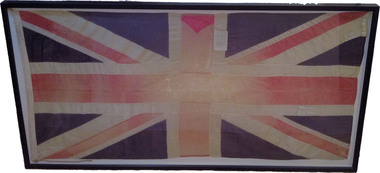
Flag, Australian Flag (Union Jack) 1900
... second time I have written to you. I was very sorry at not seeing my first letter in "The Leader". But I hope to say, that this one will be in. The last time I wrote to you I told you that my brother (Fredrick Smith) went to the Boer War in South Africa, and that he was supposed to be killed in the Wilmansrust disaster. ...second time I have written to you. I was very sorry at not seeing my first letter in "The Leader". But I hope to say, that this one will be in. The last time I wrote to you I told you that my brother (Fredrick Smith) went to the Boer War in South Africa, and that he was supposed to be killed in the Wilmansrust disaster. ...There is a Union Jack brought back from South Africa by 1229 Trooper Fredrick James Smith. Between 1899 and 1902, around 16,500 Australians served in South Africa during the Boer War. This was the largest international deployment of troops from the Australian Colonies before Australian Federation. Of the 16,500 men who served in South Africa, 606 were killed in action or died of diseases. The Australian War Memorial records that the fighting conditions in South Africa extremely hard on men and horses. Australians fighting in South Africa were doing so as part of Colony based Regiments such as the Victorian Mounted Rifles, New South Wales Lancers, Queensland Mounted Infantry as well as units from the other states. Australians were awarded six Victoria Crosses during the campaign along with many other decorations. In May of 1902 the treaty of Vereeniging was signed officially ending the Boer War. The Boer War is commemorated in many Towns and Cities around Australia. The Lara RSL Sub Branch holds some memorabilia from the Boer War. There is a Union Jack brought back from South Africa by 1229 Trooper Fredrick James Smith. He was a resident of Lara and was a member of the 5th Victorian Mounted Rifles. It was reported that he carried this flag into battle. The Lara RSL also holds the flag staff of the China, South African and Old Veterans Association. Both these items are of national significance. Both the flag and flag staff were used in marches in Geelong each year until 1916 when Anzac Day commenced. The flag and flag staff were donated to the Lara RSL sub Branch when he joined in 1928. Fredrick James Smith was born at Lara in 1879, the son of Mr/Mrs Smith from Lara. He was a farm hand from Horton Vale, Anakie when he joined F Company of the 5th Victorian Mounted Rifles at the beginning of February 1901. Two weeks later, he left for South Africa on the 15th February. Before leaving, he purchased the flag from W. Libby & Son Geelong. Frederick Left for South Africa on the 15 February 1901 on the Orient. He saw service between March 1901 - March 1902 in east Transvaal and Natal frontier under the British Major General S. Beatson then Pulteney, including the defeat at Wilmansrust where 18 soldiers were killed and 42 wounded (12th June 1901 - heaviest casualties of any Australian contingent,); and the successful intervention at Onverwacht on the 4th January 1902. The 5th Victorian Mounted Rifles suffered: 36 killed or died of wounds, 13 died of disease of a contingent of 46 Officers, 971 Other Ranks and 1099 horses. They returned to Australia on the 26th April 1902 on the Custodian after sailing from Point Natal in South Africa on the 5th April. On his return, Tropper Smith (Saddler Private) joined the South African Soldiers Association of Victoria – Geelong Branch, and after 1928, he joined the Lara RSL. He was buried in Western Cemetery on the 19th June 1968 at the age of 89. Enrolled February 1901 Departed for South Africa on 15 February 1901 Establishment: 46 Officers, 971 Other Ranks with 1099 horses Mobilised at Pretoria: 24 March -- 4 April 1901 Typical company: 1 Captain, 4 Lieutenants, 1 company sergeant-major, 1 company quartermaster-sergeant, 1 sergeant-farrier, 1 sergeant-saddler, 5 sergeants, 6 corporals, 3 shoeing-smiths, 3 saddlers, 1 bugler, 99 privates. Total in company: 126 with 131 horses. Engagements: Rhenoster Kop, Klippan, Kornfontein, Drivelfontein, Wilmansrust, Kambuladraai, H'Lobane, Luchiel's Nek, Loch's Kraal, Vryheid, Onverwacht, Johnston Hoek Killed in action (or died): six Officers, 48 Other Ranks VC Winner: Lieut. L. C. Maygar News article Leader (Melbourne) Saturday 31st May 1902, page 42 - Dear Cinderella. — This is the second time I have written to you. I was very sorry at not seeing my first letter in "The Leader". But I hope to say, that this one will be in. The last time I wrote to you I told you that my brother (Fredrick Smith) went to the Boer War in South Africa, and that he was supposed to be killed in the Wilmansrust disaster. But this time I am going to tell you about his return, and the grand welcome he got from the residents of Lara. Mother, Father, and my Brother, went down to Melbourne, to meet the boat. You can just imagine how rejoiced we all were to see him back again. The railway station was decorated some thing beautiful with flags of all description all the colours you could think of. He has bought a lot of Boer curios home and some Kaffir bracelets. They are such funny looking things. The residents of Lara, also gave my brother a grand social and ball there were over four hundred people present, They presented him with a hand some gold chain, and locket suitably inscribed, and a pair of gold sleeve links, they were magnificent. The ball was very nice. . I had a few dances. I enjoyed myself grand. I think this is all I can tell you this time. I must conclude with love. I remain yours sincerely - BESSIE SMITH. Age 14-years. This flag is of national significance as it was used in the Boer War by Private Fredrick James Smith (SN:1229) of the 5th Victorian Mounted Rifles, F Company in their deployment to South Africa between 1901 and 1902. The flag was taken into the Wilmansrust engagement in which 19 soldiers died and 41 were wounded. On return to Australia, the flag was used in marches by the South Africa, China Old Veterans Association - Geelong. This flag represents a unique part of Australian history from which the movie, Breaker Morant was taken. It is of spiritual significance as the Boer War was where the first Australian received the Imperial Victoria Cross, and the spirit of Anzac was conceived, giving birth in World War 1. The Flag represents the spirit of Australians who fought and died in South Africa.Cotton Union Jack flag approx 221cm wide by 109cm tall with small repair patches and center section cotton deteriorated.Has the word "Lara" inscribed in black on bottom part of the flag heading. Has the flag makers name "W.Libby & Son" on the top part of the flag heading.boer war, union jack flag, south africa, wilmansrust, 5th victorian mounted rifles, f coy, private fredrick james smith, service number 1229, february 1901, april 1902, south africa china old veterans association
