
Showing 46 items matching "second hand shop"
-
 Ballarat Tramway Museum
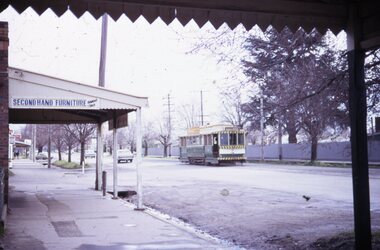
Photograph - Ballarat Tram 21, Tram 21 in Macarthur Street showing the Cemetery fence in the background, 11 August 1971
... ...second hand shop...The photograph show the tram in Macarthur Street passing the Cemetery - fence in the background. Second hand shop visible on left side. At the time of the photograph it was the only tram running that had five saloon windows. ...The photograph show the tram in Macarthur Street passing the Cemetery - fence in the background. Second hand shop visible on left side. At the time of the photograph it was the only tram running that had five saloon windows. ...Tram 21 was built by Duncan and Fraser, Adelaide in 1909. Originally built for the Municipal Tramways Trust of Adelaide. Came to Ballarat in 1937. The photograph show the tram in Macarthur Street passing the Cemetery - fence in the background. Second hand shop visible on left side. At the time of the photograph it was the only tram running that had five saloon windows. When the trams stopped running in 1971, it went to the Australian Electric Transport Museum, Adelaide, South Australia. Colour image in cardboard Kodak mount. 35mm slideHandwritten notation in ink on mount.macarthur street, cemetery fence, second hand shop, tram 21, duncan and fraser, 1909, municipal tramways trust adelaide, ballarat 1937, five saloon windows, 1971 australian electric transport museum adelaide -
 Embroiderers Guild, Victoria
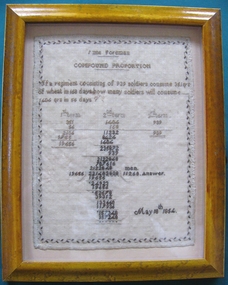
Textile - Anne Foreman Compound Problem Sampler, Anne Foreman, May 18th 1854
... Bought by donor in second hand shop in about 1965....Bought by donor in second hand shop in about 1965. Embroidery Cross stitch Samplers Mid 19th Century Anne Foreman "Compound Problem" If a regiment consisting of 939 soldiers consume 351 qrs of wheat in 168 days how many soldiers will consume 1404 qrs in 56 days ? ...Bought by donor in second hand shop in about 1965.Sampler depicts a problem in arithmetic on compound proportion, all worked out. It is on natural linen in pale brown thread, there is a fine flowing border of leaves.Anne Foreman "Compound Problem" If a regiment consisting of 939 soldiers consume 351 qrs of wheat in 168 days how many soldiers will consume 1404 qrs in 56 days ? May 18th, 1854embroidery, cross stitch, samplers, mid 19th century -
 Phillip Island and District Historical Society Inc.
Framed Print, Unknown
... Found in Second Hand Shop in Warrnambool by Mr. S. J. McFee and bought for $4.00...Found in Second Hand Shop in Warrnambool by Mr. S. J. McFee and bought for $4.00 local history illustrations prints wollomai race horse melbourne cup Picture of racehorse "Wollomai" by Frederick Woodhouse. ...Found in Second Hand Shop in Warrnambool by Mr. S. J. McFee and bought for $4.00Picture of racehorse "Wollomai" by Frederick Woodhouse. Bred & trained by John Cleeland of Phillip Island. Glass covered print. Plain wooden frame. Horse's winning races listed on display marker. Winner of Melbourne Cup 1875.local history, illustrations, prints, wollomai race horse, melbourne cup -
 National Wool Museum
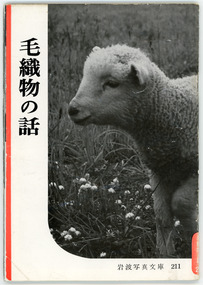
Book - The Story of Woollen Fabrics, 1957
... Booklet found by donor in a second-hand shop in Kurashiki (Japan) in September 2024....Booklet found by donor in a second-hand shop in Kurashiki (Japan) in September 2024. ...Vintage Japanese school geography primer (one of a series) titled ‘The Story of Woollen Fabrics’ (1957). Tells the story of wool from a global perspective, including several pages devoted to Australia. Booklet found by donor in a second-hand shop in Kurashiki (Japan) in September 2024.Sixty four page soft cover book, with staples at spine. Monochromatic on gloss paper featuring extensive photographs and illustrations. Text is in Japanese. Front cover features an image of a lamb and printed Japanese text.japan, wool industry, international, school, primer, kurashiki, book -
 Blacksmith's Cottage and Forge
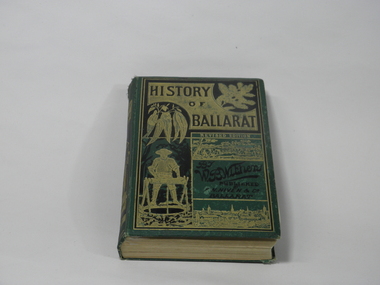
Book, F.W. Niven and Co, History of Ballarat, 1887
... This book came into our collection via a donation to the Book Barn, which operates as a second-hand book shop. The donor is unknown....This book came into our collection via a donation to the Book Barn, which operates as a second-hand book shop. The donor is unknown. This book was published in 1887, a time of consolidation of wealth after the initial gold rushes in Ballarat in the 1850s. ...This book came into our collection via a donation to the Book Barn, which operates as a second-hand book shop. The donor is unknown.This book was published in 1887, a time of consolidation of wealth after the initial gold rushes in Ballarat in the 1850s. Its full title is 'History of Ballarat from the First Pastoral Settlement to the Present Time.' By William Bramwell Withers, Journalist. Second Edition with Plans, Ilustrations and Original Documents. It is an invaluable history of the origins of Ballarat and its mining history, with a chapter devoted to the Eureka Stockade. Book bound in green cloth on hard cover. On cover: Title incised in black on gold: HISTORY/OF/BALLARAT In gold: REVISED EDITION In black:By/W.B.Withers/PUBLISHED/BY/F.W.NIVEN &Co/Ballarat. Front cover embossed with gold pictures, one of a spray of wattle, one of a spray of eucalyptus leaves, a picture of a miner standing at a winch, and two panoramas of Ballarat, one in its early days as a gold-mining camp, and one as a built-up city. On spine: In green on gold: HISTORY/OF/BALLARAT : BY W.B.WITHERS 1887 Picture of two miners in a lift cage descending a mine shaft. On back cover: In black, picture of an aborigine looking into the sun, which is either rising or setting. On inside front cover: label pasted in. Inscription in gold: PRESENTED TO/THE/MEMBERS/OF THE/Empire Commerce Congress/BY/BALLARAT'S PIONEER DIGGER,/MR.JAMES ODDIE,1851. Front brown flyleaf partially torn off. ballarat gold rush, w.b.withers, eureka stockade, mining history, early maps of ballarat, mr james oddie, empire commerce congress -
 Parks Victoria - Mount Buffalo Chalet
Crockery
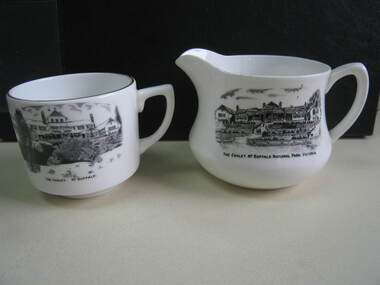
... The jug and cup were purchased from a second - hand shop in Bairnsdale. Jug is older than cup as the chalet is represented as a single storey structure. ...The jug and cup were purchased from a second - hand shop in Bairnsdale. Jug is older than cup as the chalet is represented as a single storey structure. ...The jug and cup were purchased from a second - hand shop in Bairnsdale. Jug is older than cup as the chalet is represented as a single storey structure. The cup is later as the second storey appears in the illustration. 'Souvenirs in relation to the Chalet and Mount Buffalo wee first mention in December 1912... A large range of souvenirs has since been associated with the Chalet and Mount Buffalo from crafted wooden items, silver spoons, cups etc... The collection includes a broad selection of products that have been sold throughout much of the Chalet's history, each representative of the transient fashions of their period.' (Pg. 114. Historica) 'A group of tableware items is notable for its black transfer printed decoration, which features the Chalet building. Interestingly, the printed designs represent the Chalet at two different stages in its building history under the Victorian Railways, in 1926 after completion of the north wing, and 1937-39, after the second storey is added to the front.. manufactured in England by A.B. Jones and sons, a Stoke on Trent pottery firm which operated under the trade name of Grafton China between 1900-1972.' (Pg. 114. Historica)Listed in Draft Inventory of Significant Collection Items . Appendix A.3. Souvenirs. (Pg 168. Historica)..1] Ceramic jug. Souvenir of Mt Buffalo. White ceramic squat milk jug with a black transfer illustration/drawing on front side. Picture is of the MtBuffalo Chalet from the front. Some worn gold glaze detail. It appears to be a single story building with a planted garden at the front with a fence. Trees to one side and people walking up steps. "THE CHALET, MT BUFFALO NATIONAL PARK, VICTORIA." is written under the illustration. Jug has a faint crack. .2] White ceramic cup with gold edging around top of cup. Black transfer drawing of the chalet with a second storey. Rocks and tree in foreground and "THE CHALET. MT BUFFALO." underneath transfer. .1] "THE CHALET, MT BUFFALO NATIONAL PARK, VICTORIA." is written under the illustration. On the base of the jug, with sun motif, "ENGLAND / GRAFTON CHINA /A / B J / & SONS / LOFTUS MORA / PTY. LTD" .2] "THE CHALET. MT BUFFALO." underneath transfer. Under cup, "A.B.J. / GRAFTON / CHINA / MADE IN / ENGLAND" -
 Parks Victoria - Mount Buffalo Chalet
Bookends
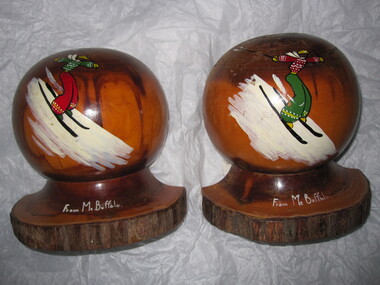
... Historica) Purchased in a second hand shop and donated to MBC. ...Historica) Purchased in a second hand shop and donated to MBC. Listed in Draft Inventory of Significant Collection Items . ...Sold as a souvenir of Mt Buffalo. 'Souvenirs in relation to the Chalet and Mount Buffalo were first mention in December 1912... A large range of souvenirs has since been associated with the Chalet and Mount Buffalo from crafted wooden items, silver spoons, cups etc... The collection includes a broad selection of products that have been sold throughout much of the Chalet's history, each representative of the transient fashions of their period.' (Pg. 114. Historica) "Souvenirs in relation to the chalet were perhaps first mentioned in December 1912, when enterprising locals, Mr J Pass of Porepunkah and Mr C Walker asked for permission to use timber on the mountain for making ornamental souvenirs . The government was agreeable to the ide and soon afterwards PWD chief architect George Austin went to Mount buffalo to make arrangements for supply of the timber, They proposed to make wooden egg cups, small boxes and photograph frames to sell to tourists, small items that' will serve as an advertising medium of the famous mount'" (Pg. 113.Historica) ' Fig 123. Bookends MBC0319,serviette rings MBC0217.2,eggcup MBC0218 and ashtray MBC0205 made of mulga, a wood from particular types of wattle tree that grow in arid climates. Souvenirs crafted from mulga became popular in the post WW2 years' (Pg 117. Historica) Purchased in a second hand shop and donated to MBC. Listed in Draft Inventory of Significant Collection Items . Appendix A.3. Souvenirs. (Pg 168. Historica).Two matching mulga wood book ends. They form a sphere when placed together. Hand painted motif and inscription on each. Painting of a skier dressed in colourful clothing on each and "From Mt Buffalo" painted at the base. "From Mt Buffalo" -
 Returned Nurses RSL Sub-branch
Document - Photocopy of newspaper clipping and related documents, Sunday Herald, The forgotten heroine, 5 December 1914 - May 20 2012
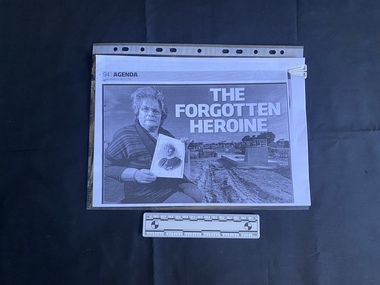
... Margaret, who never met her aunt, has pieced together her history, including that Estelle's medals, including the prestigious Royal Red Cross 2nd Class for services in support of our ANZACs have ended up in the MAryborough Military & Colonial Museum after they were bought at a second hand shop. Estelle served in seven army units and was in the Middle East, England and France for the duration of World War 1. ...Margaret, who never met her aunt, has pieced together her history, including that Estelle's medals, including the prestigious Royal Red Cross 2nd Class for services in support of our ANZACs have ended up in the MAryborough Military & Colonial Museum after they were bought at a second hand shop. Estelle served in seven army units and was in the Middle East, England and France for the duration of World War 1. ...Newspaper - 'The forgotten heroine' Visitors to New Cheltenham Cemetery in Melbourne would not know that a highly decorated and dedicated nurse was buried there. Her grave is unmarked, there is no reference to her achievements or selfless dedication. Estelle Lee Archer died in 1960, at the Repatriation General Hospital, Heidelberg, age 78 from a perforated ulcer. Margaret Leyden wants the Office of Australian War Graves to recognise that her great-aunt died from war-related injuries and to restore and maintain her grave. Margaret, who never met her aunt, has pieced together her history, including that Estelle's medals, including the prestigious Royal Red Cross 2nd Class for services in support of our ANZACs have ended up in the MAryborough Military & Colonial Museum after they were bought at a second hand shop. Estelle served in seven army units and was in the Middle East, England and France for the duration of World War 1. After the war she continued to dedicate her life to the care of soldiers. Document 1 - digitised copy of 'First Wold War Embarkation Roll' for Estelle Frances Lee-Archer Document 2 - photocopy of 'Austraalian Imperial Force - Nominal Roll' page 7 (Lee-Archer, Estelle Frances listed) Document 3 - photocopy of unknown document (Sis. Lee-Archer, Estelle (RRC) listed) Five photocopied pages held together with a plastic paperclip. Two pages are of a newspaper story, the first showing a full page black and white photo of a seated older woman holding a photo of a woman in nurse's uniform. The second page of the newspaper story has four columns of text with a photo of a war medal and a photo of a standing woman in nurse's uniform beside them. The final three pages are war-time documents.dr collopy, kildonian castle, london, caulfield, tasmania, john lee archer, mary anne lyons, joseph lyons, parlianment house, hobart, ross bridge, alfred hospital, kyarra, 1st australian general hospital, swanage, dorset, gallipoli, 2nd australian general hospital, 3rd australian general hospital, 25th australian general hospital, 47th australian casualty clearing station, 3rd australian casualty clearing station, 7th australian general hospital, john saddington -
 Department of Energy, Environment and Climate Action
Chinese clothing once owned by Bill Ah Chow
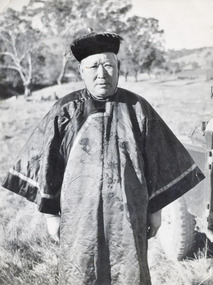
... Bill loved to tell embellished campfire stories and often claimed to be a descendant of Chinese Royalty, but his family believes the robes were more likely picked up from a second-hand shop in Little Bourke Street in the 1940s. ...Bill loved to tell embellished campfire stories and often claimed to be a descendant of Chinese Royalty, but his family believes the robes were more likely picked up from a second-hand shop in Little Bourke Street in the 1940s. ...These are the Chinese robes that belonged to Forests Commission fireguard and builder of Moscow Villa - Bill ah Chow. Every organisation has a handful of colourful characters, and the Commission had its share, but Bill remains one of its enduring legends. After Bill's death in 1967, the robes were safely kept by Bill's daughter, Rose, until she died in 1993. The robes then passed to Bill's granddaughter, Janice, and were also highly prized. Janice wrote a book about Bill and Moscow Villa in 2019. After much deliberation, the family felt the retired foresters were better positioned to keep Bill's story alive. Bill loved to tell embellished campfire stories and often claimed to be a descendant of Chinese Royalty, but his family believes the robes were more likely picked up from a second-hand shop in Little Bourke Street in the 1940s. In 2018 the Chinese Museum in Melbourne gave this advice. Mr. Ah Chow is dressed in a way that imitates a Mandarin or official of the Qing Dynasty. His hat looks like a mandarin style hat, a Qing dynasty official’s headwear, although it’s quite unlikely that he was actually a Mandarin. The button atop the hat usually indicated the wearer’s rank. His robe fastens up to the neck with buttons, which is typical of Manchurian style men’s clothing of the Qing dynasty also. He is not wearing a rank badge, which denoted official status. This kind of garment was also normally worn with a separate collar, which Mr. Ah Chow is not wearing in any of these pictures.Chinese clothing including robes, bear skin hat, silk trousers and slippers -
 Warrnambool and District Historical Society Inc.
Artefact, Alka, Dish, Mid 20th century
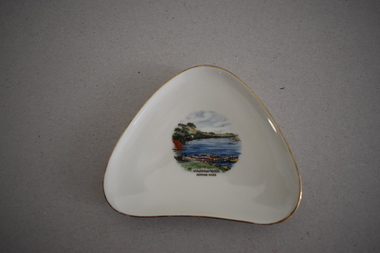
... Souvenir dishes such as this one can be sometimes found in local second hand and opportunity shops. ...Souvenir dishes such as this one can be sometimes found in local second hand and opportunity shops. This dish is of interest as an example of the high-quality souvenirs bought by local tourists in the Warrnambool area in the mid 20th century. ...This souvenir dish has been made by the German firm of Alka. The name comes from the surnames of the two proprietors, Alboth and Kaiser. This type of dish was made between 1938 and 1958. Tourism has been an important industry in the Warrnambool area for over 100 years and souvenir dishes of this kind were a popular buy by the visiting tourists. The dish features a scene from the Hopkins River, a fishing and recreational area in Warrnambool since the early days of European settlement. Souvenir dishes such as this one can be sometimes found in local second hand and opportunity shops. This dish is of interest as an example of the high-quality souvenirs bought by local tourists in the Warrnambool area in the mid 20th century.This is a china dish made in a rounded-edged triangular shape. The rim is gilt-edged. In the centre of the dish is a coloured sketch/photograph of the Hopkins River in Warrnambool (Clifton Banks region). ‘Warrnambool Hopkins River’ ‘Alka Bavaria Germany’ tourism in warrnambool, hopkins river, warrnambool, history of warrnambool -
 Flagstaff Hill Maritime Museum and Village
Tool - Wood Smoothing Plane, Late 19th to Early 20th century
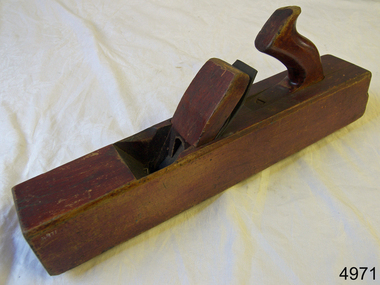
... shop might have many, perhaps hundreds, of moulding and smoothing planes for the full range of work to be performed. Company History: The firm of Alexander Mathieson & Sons was one of the leading makers of hand tools in Scotland. Its success went hand in hand with the growth of the shipbuilding industries on the Firth of Clyde in the nineteenth century and the emergence of Glasgow regarded as the "second city of the Empire". ...shop might have many, perhaps hundreds, of moulding and smoothing planes for the full range of work to be performed. Company History: The firm of Alexander Mathieson & Sons was one of the leading makers of hand tools in Scotland. Its success went hand in hand with the growth of the shipbuilding industries on the Firth of Clyde in the nineteenth century and the emergence of Glasgow regarded as the "second city of the Empire". ...A Jack plane is used for smoothing timber that is used in the manufacture of furniture or other wooden objects. Traditionally, smoothing planes were blocks of wear-resistant hardwood, often beech or maple, which were worked to smooth or even out timber. The blade or iron was likewise secured in the body of the plane with a wooden wedge. A traditional cabinetmakers shop might have many, perhaps hundreds, of moulding and smoothing planes for the full range of work to be performed. Company History: The firm of Alexander Mathieson & Sons was one of the leading makers of hand tools in Scotland. Its success went hand in hand with the growth of the shipbuilding industries on the Firth of Clyde in the nineteenth century and the emergence of Glasgow regarded as the "second city of the Empire". It also reflected the firm's skill in responding to an unprecedented demand for quality tools by shipyards, cooperage's and other industries, both locally and far and wide. The year 1792 was deemed by the firm to be that of its foundation it was in all likelihood the year in which John Manners had set up his plane-making workshop on Saracen Lane off the Gallowgate in the heart of Glasgow, not far from the Saracen's Head Inn, where Dr Johnson and James Boswell had stayed on their tour of Scotland in 1773. Alexander Mathieson (1797–1851) is recorded in 1822 as a plane-maker at 25 Gallowgate, but in the following year at 14 Saracen's Lane, presumably having taken over the premises of John Manners. The 1841 national census described Alexander Mathieson as a master plane-maker at 38 Saracen Lane with his son Thomas Adam working as a journeyman plane-maker. In 1849 the firm of James & William Stewart at 65 Nicolson Street, Edinburgh was taken over and Thomas was put in charge of the business, trading under the name Thomas A. Mathieson & Co. as plane and edge-tool makers. Thomas's company acquired the Edinburgh edge-tool makers Charles & Hugh McPherson and took over their premises in Gilmore Street. The Edinburgh directory of 1856/7 the business is recorded as being Alexander Mathieson & Son, plane and edge-tool makers at 48 Nicolson Street and Paul's Work, Gilmore Street. The 1851 census records indicate that Alexander was working as a tool and plane-maker employing eight men. Later that year Alexander died and his son Thomas took over the business. Under the heading of an edge-tool maker in the 1852/3 (Post-Office Glasgow Annual Directory) the firm is now listed as Alexander Mathieson & Son. By the early 1850s, the business had moved to 24 Saracen Lane. The directory for 1857/8 records that the firm had moved again only a few years later to East Campbell Street, also off the Gallowgate, and that through further diversification was also manufacturing coopers' and tinmen's tools. The ten-yearly censuses log the firm's growth and in 1861 Thomas was a tool manufacturer employing 95 men and 30 boys; in 1871 he had 200 men working for him and in 1881 300 men. By 1899 the firm had been incorporated as Alexander Mathieson & Sons Ltd, even though only Alexander's son Thomas appears ever to have joined the firm. A vintage tool made by a well-known firm made for other firms and individuals that worked in wood. The tool was used for the smoothing of a piece of timber that was then used in some form of cabinet manufacture or wood working. A significant item from the mid to late 19th century that today is sought after by collectors. It gives us a snapshot of how furniture was made predominately by hand and with tools that were themselves hand made. Jack Plane; a wooden smoothing plane, made by Alex Mathieson & Son, Glasgow. Plane has inscriptions."Alex Mathieson & Son Glasgow" Stamped "GN" inside with a "W" on endflagstaff hill, warrnambool, shipwrecked-coast, flagstaff-hill, flagstaff-hill-maritime-museum, maritime-museum, shipwreck-coast, flagstaff-hill-maritime-village, jack plane, smoothing plane, woodworking tool, woodwork, cabinet making -
 Ringwood and District Historical Society
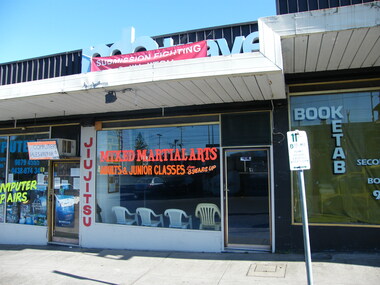
Photograph, Computer repairs shop, MixedMartial Arts and Booketab second-hand books on Railway Place. South side of Railway Place
... Computer repairs shop, MixedMartial Arts and Booketab second-hand books on Railway Place. ...Computer repairs shop, MixedMartial Arts and Booketab second-hand books on Railway Place. ...Photographic record by Russ Haines, RDHS, in October 2008. -
 Flagstaff Hill Maritime Museum and Village
Memorabilia - Horseshoe Case, 1906 – 1907
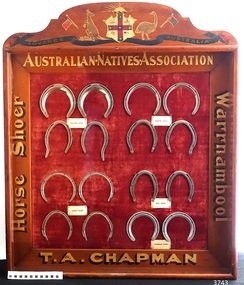
... Second World War (non-British immigration from southern and central Europe) in order to maintain a 'white Australia', and resisted changes when the Labor government during the 1970s fully dismantled and abandoned the White Australia Policy. The ANA merged with Manchester Unity Independent Order of Oddfellows, in 1993 to become Australian Unity Ltd. The display case of horseshoes changed hands several times, going from its maker Thomas Chapman to his mother then various other members of his family. The case was also displayed at the Lee Family’s butcher shop...Second World War (non-British immigration from southern and central Europe) in order to maintain a 'white Australia', and resisted changes when the Labor government during the 1970s fully dismantled and abandoned the White Australia Policy. The ANA merged with Manchester Unity Independent Order of Oddfellows, in 1993 to become Australian Unity Ltd. The display case of horseshoes changed hands several times, going from its maker Thomas Chapman to his mother then various other members of his family. The case was also displayed at the Lee Family’s butcher shop ...The horseshoes in this purpose-built display case were made by Thomas Alfred Chapman in 1906-1907. Chapman operated a blacksmith’s shop in Mortlake Rd, Purnim, about 15 mins drive from Warrnambool. Chapman made this horseshoe case especially for the 3rd Exhibition of Australian Manufacturers and Products, held in the Exhibition Building in Melbourne, which was organised and promoted by the Australian Natives Association (ANA). Reference is made to the horseshoe case in the Exhibition’s Souvenir Catalogue of 1907 on page 85, under the heading 'In the Machinery Section the following exhibits are also shown … 'CHAPMAN, T.A. , Woolsthorpe, via Warrnambool, Case of Horseshoes'. The Australian Natives’ Association (ANA) were a non-partisan and non-sectarian, friendly society founded in Melbourne, Australia in April 1871. It was set-up for the benefit of Australian-born white men, and membership was restricted exclusively to that group. Men of other races including the Chinese and Indigenous people were not allowed to join. The ANA had relatively progressive views on women (for the time) and attracted suffragists seeking support for their cause, and in 1894, the ANA advocated for women’s enfranchisement. Although, white women were only admitted as members from 1964. The organisation was most prominent in Victoria and sought to shape Australia’s national identity and was a training ground for businessmen, trade unionists and politicians including many of Australia’s early prime ministers such as Edmund Barton, Alfred Deakin, James Scullin and Francis Forde, and the first Australian-born governor-general, Isaac Isaacs, was a member. By 1910 it had developed into a nationwide association with real political and social influence, and members would participate in many activities. The ANA lobbied strongly for anti-Chinese legislation and were an ardent believer of colonial unification. Its mission and efforts are largely credited for the successful referendums that resulted in Federation of the six Australian colonies into a new nation, the association’s most important legacy. The ANA was also a supporter of trade protection, and were a staunch advocate of the first act of Australia's new parliament, the Immigration Restriction Act 1901 (cth) or commonly known as the White Australia Policy, which became one of the central pillars of Australian nationalism in the 20th-century. The ANA campaigned against the Australian Federal Government's new immigration policy after the Second World War (non-British immigration from southern and central Europe) in order to maintain a 'white Australia', and resisted changes when the Labor government during the 1970s fully dismantled and abandoned the White Australia Policy. The ANA merged with Manchester Unity Independent Order of Oddfellows, in 1993 to become Australian Unity Ltd. The display case of horseshoes changed hands several times, going from its maker Thomas Chapman to his mother then various other members of his family. The case was also displayed at the Lee Family’s butcher shop at 188 Liebig St Warrnambool, and in the Purnim Hotel during the Warrnambool May Races. In the late 1950s the horseshoe case went to Thomas’s son, Brian. He was a Master Farrier and completed his apprenticeship at Flemington Racecourse, and in Warrnambool he owned a blacksmith business at the Warrnambool Racecourse Grounds. Brian later operated a blacksmith’s at Flagstaff Hill, where his customers would bring their horses to be shod. Brian passed away in August 2017. The horseshoe case is significant as an example of trades in the early 20th century in Western Victoria, Australia. It is also significant as an example of horseshoes from the early 20th century. The horseshoe display case is also significant for its association with the Australian Exhibition of 1907, showcasing Australian produce and manufacturing to the world. The horseshoe display case is locally significant for its association with local families, essential businesses and community events. Display case of homemade horseshoes. Wooden case with glass front containing 16 horse shoes grouped in sets, each set with a label: Made 1906-1907 for Australian Exhibition of 1907 by Thomas Alfred Chapman of Warrnambool. The case contains (a) complete chrome set each of Trotting Shoes, Hunting Shoes and Racing Plates, and (b) one pair of Hind Polo Shoes and one pair of Front Aluminium Shoes. The wooden frame has gold lettering on each side proclaiming “Australian Natives Association, T.A. Chapman, horse shoer, Warrnambool” and is topped by a painted Australian coat of arms. Gold lettering on frame, in the order of top/bottom/ left/right “AUSTRALIAN.NATIVES.ASSOCIATION / T.A. CHAPMAN / Horse Shoer / Warrnambool”flagstaff hill, warrnambool, shipwrecked coast, maritime museum, shipwreck coast, horseshoe display case 1906-1907, chromed set of trotting shoes 1906-1907, chrome set of hunting shoes 1906-1907, chrome set of racing plates 1906-1907, pair of hind polo shoes 1906-1907, pair of front aluminium shoes 1906-1907, australian exhibition 1907, australian natives association (ana), t.a. chapman horse shoer warrnambool, thomas alfred chapman, brian chapman, brian “snacks” chapman, blacksmith warrnambool, warrnambool may races, warrnambool racecourse, purnim hotel, lee family’s butcher shop warrnambool -
Eltham District Historical Society Inc
Document - Folder, Marshall, Anthony
... Anthony Marshall had a shop, County Bookshop, selling antiquarian and second hand books in Rutland, England. ...Anthony Marshall had a shop, County Bookshop, selling antiquarian and second hand books in Rutland, England. ...Anthony Marshall had a shop, County Bookshop, selling antiquarian and second hand books in Rutland, England. For twelve months, he and wife Cecile had swapped homes and businesses with Lloyd Holyoak and wife Jill, of Roycroft Booksellers in Eltham. During the stay in Melbourne, he had followed his interests of cricket and choral singing; his children attended the Wattle Glen Primary School. Contents Newspaper article: "Shop swapping's the thing to do", Diamond Valley News, 7 July 1987, outlines Anthony Marshall's life and his swap with Lloyd Holyoak of Roycroft Booksellers in Eltham.Newspaper clippings, A4 photocopies, etcanthony marshall, lloyd holyoak, roycroft antiquarian booksellers, roycroft booksellers, jill holyoak, wattle glen primary school -
 Eltham District Historical Society Inc
Photograph - Digital Photograph, Alan King, Former CBA bank, Main Road, Eltham, 26 January 2008
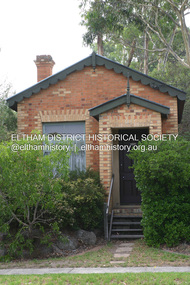
... Funds were also donated to local charities including the Eltham and Research Fire Brigades, the Austin Hospital Auxiliary, the Benevolent Society, the Red Cross and the Diamond Valley Hospital.4 In 2008 the Opportunity Shop volunteers continue to work together to help the local community. Although crammed with second-hand goods, the simple, almost stark interior, is still evident and is relieved only by a front rectangular window and an unused fireplace. ...Funds were also donated to local charities including the Eltham and Research Fire Brigades, the Austin Hospital Auxiliary, the Benevolent Society, the Red Cross and the Diamond Valley Hospital.4 In 2008 the Opportunity Shop volunteers continue to work together to help the local community. Although crammed with second-hand goods, the simple, almost stark interior, is still evident and is relieved only by a front rectangular window and an unused fireplace. ...This tiny picturesque building near the corner of John Street has served the community since 1878. At that time it served as an agency of the Heidelberg branch of the Commonwelath Bank of Australia. It has a small space inside measuring about 3.6 metres by 4.5 metres. It was built by George Stebbing who was also responsible for other heritage buildings nearby in Eltham. Covered under Heritage Overlay, Nillumbik Planning Scheme. Published: Nillumbik Now and Then / Marguerite Marshall 2008; photographs Alan King with Marguerite Marshall.; p93 The tiny picturesque building on Main Road, Eltham, near the corner of John Street, has served the community since 1878. At that time the building, which inside measures only about 3.6m by 4.5m served as an agency of the Heidelberg branch of the Commercial Bank of Australia. The yellow and orange Victorian brick structure was built by Mr George Stebbing.1 Mr Stebbing, who also built the Anglican and former Methodist churches and the Shillinglaw Cottage, had come from England and lived in Pitt Street. The bank is a fine example of a once common but now rare building style – the single room bank. It compares with another in the municipality, also a former Commercial Bank of Australia branch, the timber Little Bank Building in Hurstbridge, built around the early 1900s.2 The Eltham bank, which was said to store gold from the Eltham - Research mining areas, has had exciting moments. A bullet hole still visible in a cedar bench testifies to the drama in 1949 when a youth held up the bank. After the 19-year-old opened an account as John Henderson, he walked to the door and then turned pointing a pistol. But it was shots fired by the clerk, Lindsay Spear, that saved the day, frightening the youth, who drove off empty-handed in a grey sports car. He was later apprehended and given a two-year sentence. Soon afterwards the agency was upgraded to a branch. However by 1954 the bank no longer needed the branch and the adjoining Methodist Church bought the building. It proved useful for the Church’s young people who furnished it and used it for their meetings. A youth club developed, led by young adult member, Ross Gangell. The building was also used as a Sunday School, which with junior membership numbered 27.3 Around 1960, Mrs Alma Bell, of the Methodist Church Women’s Guild, suggested using the building as an opportunity shop to raise funds for a chaplain at the Eltham High School. The women later asked the nearby St Margaret’s Anglican Church to help them in the shop. In 1960 the Eltham Combined Churches Opportunity Shop was established and staffed by Methodist and Anglican parishioners, notably Methodist Mrs Gwen Miller. The shop originally opened on Child Endowment Days to help the needy, but later for years, it opened twice a week. In 1962 it donated clothing and shoes to the Eltham Bushfire Appeal. By 1963 the chaplaincy scheme ceased. So the £450 raised was then donated to the Council for Christian Education and to the participating churches. Funds were also donated to local charities including the Eltham and Research Fire Brigades, the Austin Hospital Auxiliary, the Benevolent Society, the Red Cross and the Diamond Valley Hospital.4 In 2008 the Opportunity Shop volunteers continue to work together to help the local community. Although crammed with second-hand goods, the simple, almost stark interior, is still evident and is relieved only by a front rectangular window and an unused fireplace. Outside, the chimney, the corrugated iron peaked roof, and the surrounding varied plants, add to the charm of this sound building which continues to serve the community well.This collection of almost 130 photos about places and people within the Shire of Nillumbik, an urban and rural municipality in Melbourne's north, contributes to an understanding of the history of the Shire. Published in 2008 immediately prior to the Black Saturday bushfires of February 7, 2009, it documents sites that were impacted, and in some cases destroyed by the fires. It includes photographs taken especially for the publication, creating a unique time capsule representing the Shire in the early 21st century. It remains the most recent comprehenesive publication devoted to the Shire's history connecting local residents to the past. nillumbik now and then (marshall-king) collection, cba bank -
 Eltham District Historical Society Inc
Slide - Photograph, Second Life, 736 Main Road, Eltham, c.May 1988
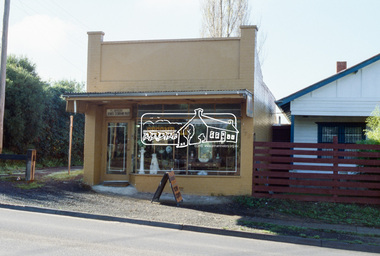
... Shop and in 2010 “Eltham Cycles”. It is now a popular eatery – Zen Den. eltham main road antiques and old wares cafe zen den restaurants second hand dealer second life decor pty ltd shops Process Date MAY 88M 35mm colour positive transparency (1 of 23) Mount - Kodak Ektachrome Second Life, 736 Main Road, Eltham Slide Photograph ...The c1920 brick shop and side dwelling is one of just three early 20th century shop buildings left in Eltham and one of just two that have intact facades. These shops are physical links with the country village of Eltham at that time and their siting in isolated locations along the street reflects that village era. Since the 1950s Eltham's main street has changed dramatically and the intact pre 1940 buildings such as this shop are key components of the section of Main Road south of Henry Street which still has a streetscape recognisable from that earlier time. The side dwelling illustrates the common practice of that time for shopkeepers to live at their premises. In the 1990s this was an antique Shop and in 2010 “Eltham Cycles”. It is now a popular eatery – Zen Den. 35mm colour positive transparency (1 of 23) Mount - Kodak EktachromeProcess Date MAY 88Meltham, main road, antiques and old wares, cafe zen den, restaurants, second hand dealer, second life decor pty ltd, shops -
 Kiewa Valley Historical Society
Bogong 3 Items: Rover Scouts Skis x2; Bogong Rover Scout shirt; Book with signature by WF (Bill) Waters, Book: WF "Bill" Waters A Biography A man of the Mountains - Stephenson 1983 Publisher; The Scout Association Carlton 1983
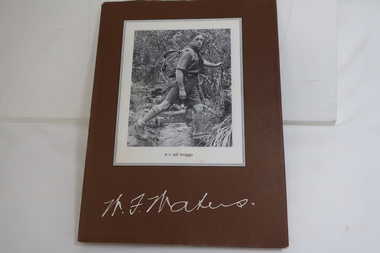
... shop' 'size 14' 1. 2 pairs of skis: One pair is hand-crafted Swedish wooden skis circa 1937. Quite a thick ski. Tapered shape with a distinctive pointed toe. Coated with dark brown varnish which is lifting in some parts. The ski has a yellow plastic patch at the rear and a re-inforced foot plate. Bindings are metal and leather. 216 cm long and 7 cm wide. The second ...1. These Skis were hand carved in Sweden around 1937 and brought to Australia where they were purchased around 1962 by a Bogong Rover Scout. They were refurbished with steel edging and plastic soles and saw extensive service on the Bogong High Plains between 1962 and 1968. They performed magnificently, riding out the deepest mogul with ease because of their highly curved tips. Of particuular interest is the way the Kandahar toe iron has been attached to the ski. The ski was slotted through its width, the tow iron inserted and then folded vertically to give an integral attachment. In those days skins were used extensively for uphill climbing, hence the yellow plastic patch on the back surface to protect from the skin buckle. Cable bindings were used to enable the boot to lift for climbing. When ready for a downhill run, the cable was slipped under the side-pulls to anchor the heel. The beauty of these bindings in those days was that they were composite downhill and touring skis. These particular skis were of lightweight timber (timber unknown) compared to others of their day, which are often made of Hickory which is much denser and heavier. Rover Scouts and the Bogong High Plains The Bogong Rover Lodge started as an SEC (State Electricity Commission) hut near Langford's Gap and was carried on the backs of Rover Scouts across to its present location on the Southern side of the Bogong High Plains around 1937 under the direction of W.F. (Bill) Waters, a skiing pioneer, synonymous with establishing skiing on the BHP. The Rover Scouts left Melbourne by train to Bairnsdale. They went onto Omeo (bus?) where they stayed overnight at the pub then (bus?) to Fitzgerald's farm on the Omeo Highway. Then on packhorses to the snow line. Then they carried their packs and skis. to the lodge. The Lodge continues to this day (2026) as a base for Scouts skiing and bushwalking on the Bogong High Plains. Rovers, the senior branch of Scouting, are aged between 18 to 25 years. The Bogong Rover Lodge / Chalet / or Scout Hut is open all year round.1. 2 pairs of skis: One pair is hand-crafted Swedish wooden skis circa 1937. Quite a thick ski. Tapered shape with a distinctive pointed toe. Coated with dark brown varnish which is lifting in some parts. The ski has a yellow plastic patch at the rear and a re-inforced foot plate. Bindings are metal and leather. 216 cm long and 7 cm wide. The second pair of skies are red plastic. Possibly Italian with an unusual downhill & touring binding circa 1970. 198 cm long and 7 cm wide Bogong Rover overshirt (winter). Pure wool, long sleeves, 2 front buttons, pockets with insignia include Box Hill District Boy Scouts Alpine Rovers Badge on right top of sleeve. Epaulettes on the left and right shoulders. Left hand side has 8 pieces of coloured tabs attached. Also, Green triangular cotton neck tie with leather toggle.Labels 'pure wool'; 'scout shop' 'size 14'rover scouts, cross country skiing, bill waters, swedish skis, scouts uniform -
 Kiewa Valley Historical Society
Book - Ledger Commercial, 1902
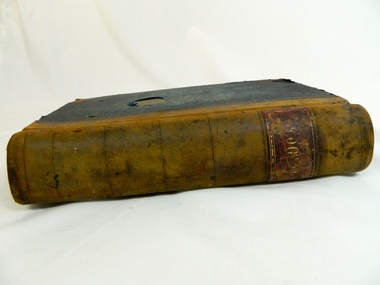
... The ability of the shop keepers to interact with their customers not only in the commercial sense but also in a social atmosphere permitted the long hand scribbling of purchases without causing any offence. commerce book keeping shop ledger local history On spine " LEDGER" This item is a cloth and suede leather covered ledger.The spine is suede leather with a red stamped "LEDGER" title. The cover is covered with a dark blue cloth and shows a faded unrecognisable pattern. Each page has light blue lines running horizontal and 90 mm apart. Each page has, from the second ...This ledger was started in 1901 when ledgers and other bookkeeping methods were hand written and with nib or fountain pen application. The various ink spots on the pages of this ledger suggests that when the office worker scribed they used the nib and the owner used the fountain pen. It was not until the mid 1950s that ball point pens were discovered and used in rural areas. The owner of this rural general store was more interested in recording transactions, be it in ink or pencil than the aesthetics of a neat and tidy document. Even though in this era, the principle of neat and tidiness was instilled in workers, this was overlooked and fell away through the economics of employing one staff member to do a variety of tasks for which they may not have had the proper training. It was in the early 1900s that the rural areas such as the Kiewa Valley "had to do" with local employees who had basic training but knew their customers very well and were very respectful of age and the mores of the trading public. The respect by shop owners and staff towards their customers was greater in small rural townships and villages within the Kiewa Valley than in the larger towns and cities. Their was no rushing to get the groceries or to spend the least amount of time within the shop. The social interactions where mixed with commercial activities at a very personalised level of one on one. This closeness gave the customer the confidence that those in the commercial transactions in the shop, where looking after them. This ledger is very significant to the Kiewa Valley as it lists the personal transactions of local businesses, farmers, graziers and miners. Larger accounts and other businesses had one or more pages set aside for their transactions. The words are in large freehand (Capitals 5 mm high) possibly to be read by those with poorer eyesight. The relative long distance to travel for reading glasses or specialised optometrist was overcome by writing in larger fonts. The time taken to register produce or other consumables was not critical during the period when this ledger was in use because the local population was not at the critical level where the demand was not as intense as later on when periods of tourist influx became more demanding. The lay back and relaxed attitude of the local population during this period (early 1900s) was not intense and impersonal as within the larger city shopping and commercial environment. The ability of the shop keepers to interact with their customers not only in the commercial sense but also in a social atmosphere permitted the long hand scribbling of purchases without causing any offence.This item is a cloth and suede leather covered ledger.The spine is suede leather with a red stamped "LEDGER" title. The cover is covered with a dark blue cloth and shows a faded unrecognisable pattern. Each page has light blue lines running horizontal and 90 mm apart. Each page has, from the second line going horizontal two fine 1 mm apart red line. Each page is divided horizontally by single vertical line (except for the two double lines in the centre of the page). The first division separates the month from the day.Next to these lines is an area for the description of the item being purchased. Within the central double lines are vertical lines separating the type of tender paid, i.e., pounds, shillings and pence. The last section of the page has various comments, as required by the scribe.Each page is approximately 160 g/ms. The ledger has 698 pages drawn up on both sides and page numbers of 5 mm in height. 'On spine " LEDGER"commerce, book keeping, shop ledger, local history -
 Warrnambool and District Historical Society Inc.
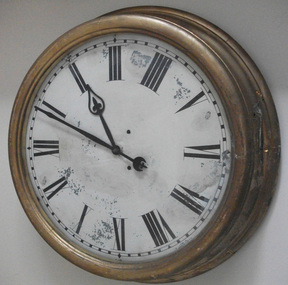
Functional object - Clock Sambell Chemist, Early 20th century
... second hands and the Roman figures are made of metal. The clock is designed to be placed on a wall or frame of some sort and to be used outside on a shop or other commercial building. ...shops of Brocks and Mainlands, both jewellers. This clock is of considerable importance as it was connected to the pharmacy business of the Sambell family, a business that was prominent in Warrnambool for many years. It is an example of the 19th and early 20th centuries practice of placing a large clock outside a business. sambell pharmacy warrnambool This is a large oval clock with a gilded wooden frame and a metal face. The hour and second hands ...This clock was over the door of the shop of Sambell’s pharmacy at 90 Fairy Street. John Sambell opened the Hall of Pharmacy in Fairy Street, Warrnambool about 1890. He was a chemist and dentist with previous experience in Great Britain and Victoria. His shop had been conducted by Edward Griffiths in the 1880s. By 1919 John Sambell’s son, Herbert, had joined the business, trading as Sambell and Son, though John Sambell had died in 1906. This shop was located at 151 Fairy Street. The Sambells then built new shops on the north eastern corner of Koroit and Fairy Streets and occupied the corner position. In the late 1930s the Sambell business moved to 90 Fairy Street and the business was known as Sambell, Son and Granddaughter. Herbert Sambell died in 1943. This Sambell clock had previously been at the shops of Brocks and Mainlands, both jewellers. This clock is of considerable importance as it was connected to the pharmacy business of the Sambell family, a business that was prominent in Warrnambool for many years. It is an example of the 19th and early 20th centuries practice of placing a large clock outside a business. This is a large oval clock with a gilded wooden frame and a metal face. The hour and second hands and the Roman figures are made of metal. The clock is designed to be placed on a wall or frame of some sort and to be used outside on a shop or other commercial building. The outside frame is somewhat dented.sambell pharmacy, warrnambool -
 Eltham District Historical Society Inc
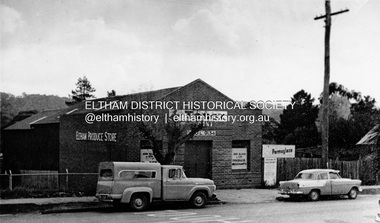
Photograph, Eltham Produce Store, c.1960
... Situated just south from opposite Arthur Street, opposite the Eltham Village Shopping Centre. To the right was Garnet Burgess' second hand scrap metal and bottles, then the blacksmith shop, which was later taken over by Garnet with second hand furniture and next door to that was Ray Staff's grocery store. ...Situated just south from opposite Arthur Street, opposite the Eltham Village Shopping Centre. To the right was Garnet Burgess' second hand scrap metal and bottles, then the blacksmith shop, which was later taken over by Garnet with second hand furniture and next door to that was Ray Staff's grocery store. ...Two vehicles including a Holden FC Special Sedan and ca 1958 Ford 100 truck are parked outside the Eltham Produce Store, Main Road, Eltham near Arthur Street. The brick building has signage to promote Tanox Paint and Permoglaze products. It also sold hay and grain. Operated by John McLean and Son. Situated just south from opposite Arthur Street, opposite the Eltham Village Shopping Centre. To the right was Garnet Burgess' second hand scrap metal and bottles, then the blacksmith shop, which was later taken over by Garnet with second hand furniture and next door to that was Ray Staff's grocery store. The store was demolished by 1963 for the BP Evergreen Service Station. See also: Cross Ref 00161This photo forms part of a collection of photographs gathered by the Shire of Eltham for their centenary project book, "Pioneers and Painters: 100 years of the Shire of Eltham" by Alan Marshall (1971). The collection of over 500 images is held in partnership between Eltham District Historical Society and Yarra Plenty Regional Library (Eltham Library) and is now formally known as 'The Shire of Eltham Pioneers Photograph Collection.' It is significant in being the first community sourced collection representing the places and people of the Shire's first one hundred years.Digital image. Copy of original photograph. 4 x 5 inch B&W Neg 120 format B&W negative sepp, shire of eltham pioneers photograph collection, eltham, eltham produce store, main road, tanox paint, permoglaze, holden fc special sedan, ford 100 truck -
 Eltham District Historical Society Inc
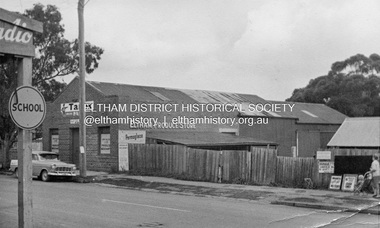
Photograph, Eltham Produce Store, Main Road, c.1960
... Shopping Centre. In 1974 the site was the location of the B.P Garage and opposite was the Woolworths Arcade. The Produce Store sold hay and grain. To the right was Garnet Burges' second hand...Shopping Centre. In 1974 the site was the location of the B.P Garage and opposite was the Woolworths Arcade. The Produce Store sold hay and grain. To the right was Garnet Burges' second hand ...Operated by John McLean and Son Situated just south from opposite Arthur Street, opposite the Eltham Village Shopping Centre. In 1974 the site was the location of the B.P Garage and opposite was the Woolworths Arcade. The Produce Store sold hay and grain. To the right was Garnet Burges' second hand scrap metal and bottles, then the blacksmith shop, which was later taken over by Garnet with second hand furniture and next door to that was Ray Staff's grocery store. The brick building has signage to promote Tanox Paint and Permoglaze products. This building was demolished by 1963 for the BP Evergreen Service Station. Photo taken at same time as Shire of Eltham Pioneers Photograph Collection No. 785 which is a view from near Arthur Street and Main Road intersection. Cross Ref: SEPP_0785Sepia black and white printshops, main road, eltham, eltham produce store, tanox paint, permaglaze, produce station, john mclean and son, garnet burges -
 Bendigo Historical Society Inc.
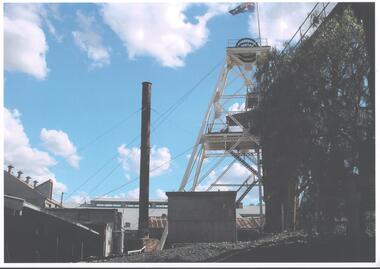
Photograph - AUSTIN COLLECTION: Central Deborah Gold Mine, 1980's
... Second World War. In 1939 the mine boasted a small timber poppet head, boiler steam winch, compressor, blacksmith shop, store, change rooms, and offices. Between 1945-46 the company upgraded the mine with extensions to sheds and the installation of new steam machinery, electric air compressor, steel poppet head, and ore bins. mining Bendigo mine site historic mine site Central Deborah Gold Mine poppet head Colour photograph: metal mine chimney in centre of image, metal poppet head on right hand side. ...The Central Deborah Gold Mine, 76 Violet Street, Bendigo, was developed from 1939 and operated as a working mine until 1954. The mine was one of a minority that continued to function during the Second World War. In 1939 the mine boasted a small timber poppet head, boiler steam winch, compressor, blacksmith shop, store, change rooms, and offices. Between 1945-46 the company upgraded the mine with extensions to sheds and the installation of new steam machinery, electric air compressor, steel poppet head, and ore bins. Colour photograph: metal mine chimney in centre of image, metal poppet head on right hand side. Mine sheds on left of image, peppercorn trees on right. Australian flag flying from top of popper head. mining, bendigo, mine site, historic mine site, central deborah gold mine, poppet head -
 Ballarat Tramway Museum
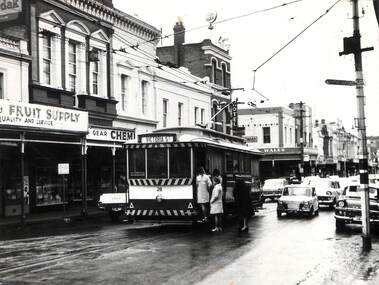
Photograph - Black & White Photograph/s and Black and White photograph/s -mounted, John Phillips, 1968
... Yields information about the use of the trams in Bridge St - the major shopping strip at the time in Ballarat, shows the nature of the strip, the passengers (all ladies) and the motor cars in use at the time. tramways trams Bridge St Stones Corner Passengers tram 28 On rear of second print - "Copyright John Phillips 1968 Bridge St" and in bottom right hand corner "William Scott" and address label. ...Yields information about the use of the trams in Bridge St - the major shopping strip at the time in Ballarat, shows the nature of the strip, the passengers (all ladies) and the motor cars in use at the time.Black and white print of No. 28, picking up four lady passengers at the junction in Bridge St, Stones Corner. Tram has the destination of Victoria St. Photo taken late 1960's, early 1970's. In the photo are the Bank of NSW buildings, Gear Chemist and Hotel on the Corner of Peel and Bridge Sts. See also Item 3129A for Mounted A3 display photograph in AS Box 16B. Print and photo by John Phillips. Second copy added 13/4/2009 - see history .1 - Black and White photograph mounted on heavy cardboard backing, used for display purposes. See item in AS Box 16B. On rear of second print - "Copyright John Phillips 1968 Bridge St" and in bottom right hand corner "William Scott" and address label.tramways, trams, bridge st, stones corner, passengers, tram 28 -
 Ballarat Tramway Museum
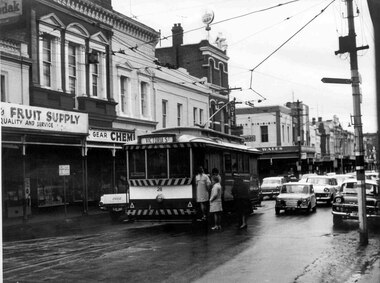
Photograph - Black & White Photograph/s and Black and White photograph/s, John Phillips, 1968
... Yields information about the use of the trams in Bridge St - the major shopping strip at the time in Ballarat, shows the nature of the strip, the passengers (all ladies) and the motor cars in use at the time. tramways trams Bridge St Stones Corner Passengers tram 28 On rear of second print - "Copyright John Phillips 1968 Bridge St" and in bottom right hand corner "William Scott" and address label. ...Yields information about the use of the trams in Bridge St - the major shopping strip at the time in Ballarat, shows the nature of the strip, the passengers (all ladies) and the motor cars in use at the time.Black and white print of No. 28, picking up four lady passengers at the junction in Bridge St, Stones Corner. Tram has the destination of Victoria St. Photo taken late 1960's, early 1970's. In the photo are the Bank of NSW buildings, Gear Chemist and Hotel on the Corner of Peel and Bridge Sts. See also 3129A for Mounted A3 display photograph in AS Box 16B. Print and photo by John Phillips. Second copy added 13/4/2009 - see history .1 - Black and White photograph mounted on heavy cardboard backing, used for display purposes. On rear of second print - "Copyright John Phillips 1968 Bridge St" and in bottom right hand corner "William Scott" and address label.tramways, trams, bridge st, stones corner, passengers, tram 28 -
 Sunshine and District Historical Society Incorporated
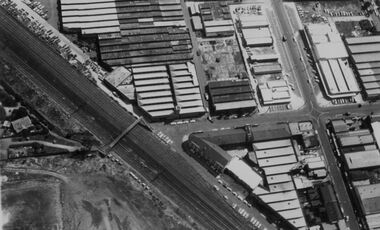
Photograph - Aerial photographs of McKay factory, 1960's
... 2 aerial views of McKay factory approximately early 1960s Photos most likely taken for Massey Ferguson showing factory building and adjacent land and shops|Photograph 1 center left McKay gardens curator's house Bendigo Railway line and ramp to Devonshire Road Second clock tower and show rooms Factory office at Russell Street entrance to factory Shops built on land once engine works machinist Portion of McKay Factory Photo taken after Massey Ferguson take over Bolt shop dismantled Land Sold for shops|Photograph 2 Aerial view of McKay Factory 1960s approximately Hampshire Road right hand side Fire station on corner of Hertford Road with Woodmill Site Later years Sunshine Plaza Shopping Centre Stony Creek still visible with garage private and car park adjacent to creek Service Street then Duplicates Building Duplicate parts of McKay factory for supply of duplicate parts Remainder of photo factory site...Sunshine Harvester Works Massey Ferguson Employ 2 aerial views of McKay factory approximately early 1960s Photos most likely taken for Massey Ferguson showing factory building and adjacent land and shops|Photograph 1 center left McKay gardens curator's house Bendigo Railway line and ramp to Devonshire Road Second clock tower and show rooms Factory office at Russell Street entrance to factory Shops built on land once engine works machinist Portion of McKay Factory Photo taken after Massey Ferguson take over Bolt shop dismantled Land Sold for shops|Photograph 2 Aerial view of McKay Factory 1960s approximately Hampshire Road right hand side Fire station on corner of Hertford Road with Woodmill Site Later years Sunshine Plaza Shopping Centre Stony Creek still visible with garage private and car park adjacent to creek Service Street then Duplicates Building Duplicate parts of McKay factory for supply of duplicate parts Remainder of photo factory site Aerial photographs of McKay factory Photograph Aerial photographs of McKay factory ...2 aerial views of McKay factory approximately early 1960s Photos most likely taken for Massey Ferguson showing factory building and adjacent land and shops|Photograph 1 center left McKay gardens curator's house Bendigo Railway line and ramp to Devonshire Road Second clock tower and show rooms Factory office at Russell Street entrance to factory Shops built on land once engine works machinist Portion of McKay Factory Photo taken after Massey Ferguson take over Bolt shop dismantled Land Sold for shops|Photograph 2 Aerial view of McKay Factory 1960s approximately Hampshire Road right hand side Fire station on corner of Hertford Road with Woodmill Site Later years Sunshine Plaza Shopping Centre Stony Creek still visible with garage private and car park adjacent to creek Service Street then Duplicates Building Duplicate parts of McKay factory for supply of duplicate parts Remainder of photo factory sitesunshine harvester works, massey ferguson, employ -
 Brighton Historical Society
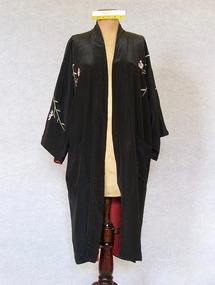
Jacket, Kimono, c.1960s
... Between 1995 and 2015, ran the vintage and second hand clothing store Hooti Couture at 321 Flatbush Avenue, Brooklyn, and after reading the book Di was inspired to seek out the shop. ...Between 1995 and 2015, ran the vintage and second hand clothing store Hooti Couture at 321 Flatbush Avenue, Brooklyn, and after reading the book Di was inspired to seek out the shop. ...This item is part of the Di Reidie collection. Diane Reidie was a much loved volunteer and President of Brighton Historical Society from 1999 until 2016. Originally from New Zealand, Di and her family lived in Male Street, Brighton for many years. A vibrant and energetic person with a zest for life and a gift for bringing people together, Di was a friend to many in the Bayside community and active in local community organisations. Her tireless work as President of BHS saw her named Bayside Citizen of the Year in 2008. As a seller and collector of vintage clothing, she was passionate about fashion history; one of her many enduring contributions to BHS was her extensive work in preserving, developing and promoting the Society's costume collection. In 2018-19, Di donated more than one hundred items from her personal vintage clothing collection to the Society. The collection, which includes clothing, hats, handbags and shoes from local and international designers, is representative of Di's wide-ranging interests, colourful personality, creativity, humour and love of fashion and travel. In 2006, as Di prepared for a trip to New York City, fellow BHS volunteer Liz Gay gifted her a copy of the book “Alligators, Old Mink and New Money” by vintage clothing dealer and former fashion model Alison Houtte. Between 1995 and 2015, ran the vintage and second hand clothing store Hooti Couture at 321 Flatbush Avenue, Brooklyn, and after reading the book Di was inspired to seek out the shop. During her visit she met Alison, who autographed her book, and purchased this kimono jacket from the store.Pure silk black kimono with red silk lining. The kimono features floral and leaf motif machine embroidery in pale pink and green."Made in Japan"hooti couture, alligators, old mink and new money, kimono, alison houtte, vintage clothing, di reidie, 1960s -
 Melbourne Tram Museum
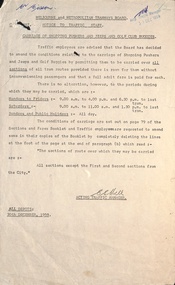
Document - Notice to Traffic Staff, Melbourne & Metropolitan Tramways Board (MMTB), "Carriage of shopping pushers, jeeps and golf club buggies", Dec 1959
... shopping pushers, jeeps and golf club buggies" being allowed to be carried on all routes during off peak hours at a charge of a full adult fare. This allowed for the carriage of these items in the first and second sections from the City. Yields information about the carriage of "Carriage of shopping pushers, jeeps and golf club buggies" tramways golf shopping pushers Has hand ...Notice to traffic staff, dated 30 Dec 1959 about the "Carriage of shopping pushers, jeeps and golf club buggies" being allowed to be carried on all routes during off peak hours at a charge of a full adult fare. This allowed for the carriage of these items in the first and second sections from the City.Yields information about the carriage of "Carriage of shopping pushers, jeeps and golf club buggies"Notice - printed on foolscap size paper with handwritten notes and a date stamp.Has hand date stamp of 31 Dec. 1959 and Mr Misson's initials.tramways, golf, shopping pushers -
Whitehorse Historical Society Inc.
Article, 'Clothes Line' open for business, 1992
... Mitcham Rotary Club have opened a 3rd Opportunity Shop in Mitcham due to a demand for second hand furniture and clothing and are asking for donations....rotary club of mitcham varley john van de kuyp pat opportunity shops Mitcham Rotary Club have opened a 3rd Opportunity Shop in Mitcham due to a demand for second hand furniture and clothing and are asking for donations. ...Mitcham Rotary Club have opened a 3rd Opportunity Shop in Mitcham due to a demand for second hand furniture and clothing and are asking for donations.Mitcham Rotary Club have opened a 3rd Opportunity Shop in Mitcham due to a demand for second hand furniture and clothing and are asking for donations.Mitcham Rotary Club have opened a 3rd Opportunity Shop in Mitcham due to a demand for second hand furniture and clothing and are asking for donations.rotary club of mitcham, varley, john, van de kuyp, pat, opportunity shops -
 Whitehorse Historical Society Inc.
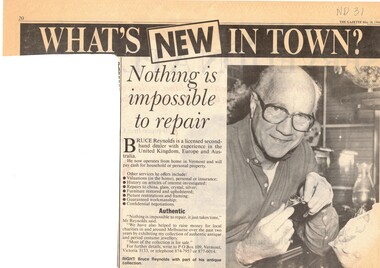
Newspaper - Article, What's New in Town: Nothing Is Impossible to Repair, 1/05/1994
... Cutting from Nunawading Gazette 18th May, 1994 reynolds bruce antique shops jewellers Article about Bruce Reynolds, a licensed second-hand dealer with an interest in the repair of old furniture and jewellery. ...Article about Bruce Reynolds, a licensed second-hand dealer with an interest in the repair of old furniture and jewellery.Article about Bruce Reynolds, a licensed secondhand dealer with an interest in the repair of old furniture and jewellery. He has raised money for charity by exhibiting a collection of authentic antique and period costume jewellery. He lives in Vermont and is a member of the Society. Cutting from Nunawading Gazette 18th May, 1994Article about Bruce Reynolds, a licensed second-hand dealer with an interest in the repair of old furniture and jewellery. reynolds, bruce, antique shops, jewellers -
 Melbourne Tram Museum
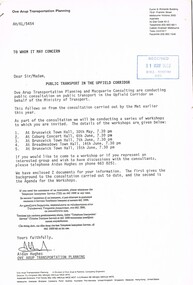
Document - Report, Ove Arup Transportation Planning, "Public Transport in the Upfield Corridor", May. 1989
... hand corner, titled "Public Transport in the Upfield Corridor". Prepared by Ove Arup Transportation Planning, dated May 1989. Provides an outline of the consultation process, dates, gives an outline of the options for the corridor, social costs, access to facilities, shoppers and business, costs and benefits. Two copies held. Second...hand corner, titled "Public Transport in the Upfield Corridor". Prepared by Ove Arup Transportation Planning, dated May 1989. Provides an outline of the consultation process, dates, gives an outline of the options for the corridor, social costs, access to facilities, shoppers and business, costs and benefits. Two copies held. Second ...Consultative report - 8 A4 pages, stapled in the top right hand corner, titled "Public Transport in the Upfield Corridor". Prepared by Ove Arup Transportation Planning, dated May 1989. Provides an outline of the consultation process, dates, gives an outline of the options for the corridor, social costs, access to facilities, shoppers and business, costs and benefits. Two copies held. Second copy stamped 31/5/1989 -WMR Registry HDV.trams, tramways, upfield light rail, sydney rd, north coburg, conversion
