
Showing 30 items matching "service ware"
-
 Whitehorse Historical Society Inc.
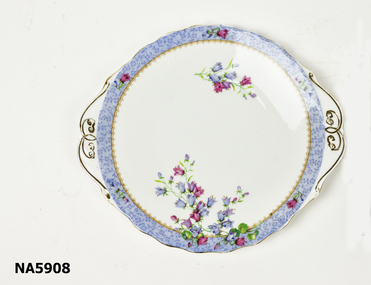
Domestic object - Plate, Royal albert, C 1950's
... ...Service ware...- Example of afternoon tea set Afternoon tea Service ware "Harebell" Royal Albert, Bone China Reg No 830479 England C 1950's Royal Albert, Bone China, Harebell pattern - Blue border (with flowers (harebells) - Gold trim Domestic object Plate Royal albert ...- Example of afternoon tea setC 1950's Royal Albert, Bone China, Harebell pattern - Blue border (with flowers (harebells) - Gold trim"Harebell" Royal Albert, Bone China Reg No 830479 Englandafternoon tea, service ware -
 Flagstaff Hill Maritime Museum and Village
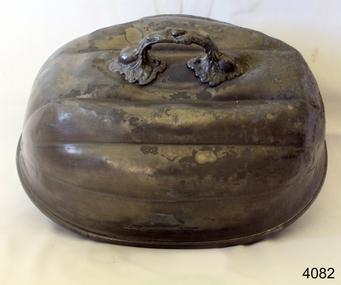
Domestic object - Pewter Dome Cloche, James Dixon & Sons, 1900-1940 as indicated by the design No 399 stamped in the cover
... ware, electroplated Britannia metal, silverware, and electroplated nickel silver. Their products included hundreds of items for use in the kitchen (e.g. bowls, cutting tools) and the dining room (e.g. tea services, cocktail shakers, and mixers) as well as items such as candlesticks. ...ware, electroplated Britannia metal, silverware, and electroplated nickel silver. Their products included hundreds of items for use in the kitchen (e.g. bowls, cutting tools) and the dining room (e.g. tea services, cocktail shakers, and mixers) as well as items such as candlesticks. ...James Dixon & Sons were founded in 1806 in Sheffield and were one of the major British manufacturers of the Industrial Revolution. They were manufacturers of pewter ware, electroplated Britannia metal, silverware, and electroplated nickel silver. Their products included hundreds of items for use in the kitchen (e.g. bowls, cutting tools) and the dining room (e.g. tea services, cocktail shakers, and mixers) as well as items such as candlesticks. They were a world leader in manufacturing shooting accessories through the nineteenth century and exported powder flasks in large quantities to America, They were known as whistle makers, which like most of their products were of outstanding quality. They were located first at Silver Street (1806), Cornish Place (1822) Sheffield. Their registered trademark since 1879 was a Trumpet with a Banner hanging from it. Although registered in 1879, the "Trumpet with Banner" logo was used at times before registration and appears on some of their silver plate pieces. They were one of the foremost names in EPNS and sterling silver tableware including silver tea services and hollowware pieces. They also made silverware serving pieces and had a wide catalogue of patterns. Their tea sets and hollowware pieces produced in silver are now very valuable as antiques. The firm continued to be a family-run enterprise until 1976. The patterns are currently owned by another Sheffield firm that exports products mainly to the Middle East.An item made for domestic use late19th to early 20th century by a renowned maker of pewter and silverware products. These types of products give us a snapshot into domestic and social life during the time it was made.Pewter Cloche or cover for food ornate handle at top. Ring on one end. Number 399 inside lid & Dixon & Sons Sheffield.flagstaff hill, warrnambool, shipwrecked-coast, flagstaff-hill-maritime-museum, shipwreck-coast, flagstaff-hill-maritime-village, pewter ware, james dixon, silver ware, kitchen cutlery, britannia steel, food cover, cloche -
 Flagstaff Hill Maritime Museum and Village
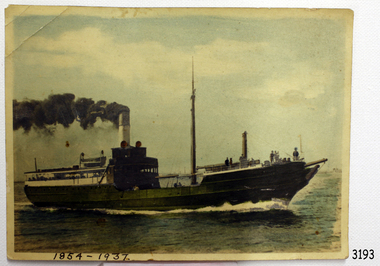
Photograph - Vessel, Steam Ship, Between 1890 - 19-12-1937
... service made SS Edina famous world-wide as the longest serving screw steamer. (The term screw steamer comes from being driven by a single propeller, sometimes called a screw, driven by a steam engine.) SS Edina’s interesting history includes English Chanel runs, serving in the Crimean Ware...service made SS Edina famous world-wide as the longest serving screw steamer. (The term screw steamer comes from being driven by a single propeller, sometimes called a screw, driven by a steam engine.) SS Edina’s interesting history includes English Chanel runs, serving in the Crimean Ware ...This photographic postcard of the SS Edina was taken after the 1890’s due to the style and configuration of the vessel. There is a black and white photograph of the same image also in our Collection (RN 3192). It is most likely that both of the photographs were donated by the same person because the people mentioned in the inscription on the black and white photograph’s reverse side connect with two of the people mentioned in the letter on the reverse of the coloured photograph. * RN 3192; Black & White photograph - inscription: - "Donated by Mrs. Nancy Mason, Bay View. Owned by Mac Fordham, Chief Engineer, 'Edina', then given to Mrs. Mason's father-in-law Arnold Mason (both Engineers W.W. I)" The “Arnie” to whom the letter was addressed is likely to be Arnold Mason, Engineer. The author of the letter, “Mac”, is likely to be Mac Fordham, Chief Engineer of SS Edina. The transcribed letter tells of two men who know each other well and have an interest in the Edina. “Mac” mentions that he may be “too old” to be at sea again; this would also support the idea that the older writer would give his photographs to the perhaps younger “Arnie”. * RN 3193 (this photograph) - Transcription of pen and ink script handwriting = = = = = = = = = = = = 19-12-37 No. 1 Flat, “Goodwood Lodge” 196 Lennox Street, Richmond [Victoria] Dear Arnie , Been meaning to write for long time but you know, it’s just the usual routine of the seamen within Bay trades. Had a good trip back from Sydney. Took our time, spent almost a week coming back, rather monotonous in parts in the hill country, too many darn curves, still was a good trip. How are you all keeping? Suppose you’ve moved back to Drummoyne [erettris?], expect you can let the house in Manly easily enough. Noticed they had a strike at Cockatoo [Cockatoo Island NSW]. don’t suppose they pulled the boys out. How is Jack doing? Has [Willie?] commenced training yet, or no! too young, isn’t she? Been a lot of “paper” talk about the “Edina” finishing but nothing official that I’m aware of, but it’s always on the cards I suppose, then I suppose it will be to sea again if I’m not too old. Easy Winter only 3 trips per week, running every day from today until further notice. Trust [Mary?] Is well & all’s well with you too. Best wishes from us both for Xmas & New Year. Cheerio Mac = = = = = = = = = = = = ABOUT THE SS EDINA The three masted iron screw steamer SS Edina was built in Glasgow, Scotland, in 1854 by Barclay and Curle. She was adorned with the figurehead of ‘fair maid of Judea’. The many years of service made SS Edina famous world-wide as the longest serving screw steamer. (The term screw steamer comes from being driven by a single propeller, sometimes called a screw, driven by a steam engine.) SS Edina’s interesting history includes English Chanel runs, serving in the Crimean Ware carrying ammunition, horses and stores to the Black Sea, and further service in the American Civil War and later, serving in the western district of Victoria as well as in Queensland and carried gold, currency and gold prospectors Australia to New Zealand. SS Edina had the privilege of being an escort vessel to H.R.H. the Duke of Edinburgh during his visit to Australia in 1867. In March 1863 SS Edina arrived in Port Phillip Bay, Melbourne and was bought by Stephen Henty, of Portland fame, to work the cargo and passenger run from Melbourne – Warrnambool – Port Fairy - Portland. After a short time of working the run from Australia to New Zealand, with passengers and cargo that included gold and currency, she returned to her Melbourne - Warrnambool – Port Fairy run, with cargo including bales of wool produced in the western district of Victoria. The Warrnambool Steam Packet Company purchased SS Edina in 1867; she was now commanded by Captain John Thompson and Chief Engineer John Davies. She survived several mishaps at sea, had a complete service and overhaul and several changes of commanders. In 1870 SS Edina was in Lady Bay, Warrnambool, when a gale sprung up and caused a collision with the iron screw steamer SS Dandenong. SS Edina’s figurehead was broken into pieces and it was not ever replaced. SS Edina was re-fitted in 1870 then was used as a coastal trader in Queensland for a period. She was then brought to Melbourne to carry cargo and passengers between Melbourne and Geelong and performed this service 1880-1938. During this time (1917) she was again refitted with a new mast, funnel, bridge and promenade deck, altering her appearance. In 1938, after more collisions, SS Edina was taken out of service. However she was later renamed Dinah and used as a ‘lighter’ (a vessel without engine or superstructure) to be towed and carry wool and general cargo between Melbourne and Geelong. In 1957, after 104 years, the SS Edina was broken up at Footscray, Melbourne. Remains of SS Edina’s hull can be found in the Maribyrnong River, Port Phillip Bay. This photographic postcard with the letter on the revers tell about the SS Edina and are significant for its association with the screw steamer SS Edina. The SS Edina is heritage listed on the Victorian Heritage Database VHR S199. She had endeared herself to the people of Port Phillip Bay as a passenger ferry, part of their history and culture. She played a significant role in the Crimean War, the American Civil War and the gold rush in New Zealand. She also served western Victoria for many years in her cargo and passenger runs. The SS Edina is famous for being the longest serving screw steamer in the world. After spending her first nine years overseas she arrived in Melbourne and her work included running the essential service of transporting cargo and passengers between Melbourne and the western Victoria ports of Warrnambool, Port Fairy and Portland. The SS Edina was purchased in the late 1860’s by local Warrnambool business, the Warrnambool Steam Packet Co. and continued trading from there as part of the local business community. The SS Edina’s original ‘fair maid of Judea’ figurehead was broken to pieces in a collision with another vessel (the SS Dandenong) in a gale off Warrnambool, Victoria, in 1870.Coloured (hand coloured) photographic postcard of SS Edina. Letter on reverse, hand written in pen and ink, from Mac to Arnie, dated 19-12-37 [1937]. The photograph shows the SS Edina moving under steam power, many people on both the bow and stern and a few people in the centre of the vessel. There are buildings on the shore in the background. The ship's configuration is dated post 1890.Hand written in pen on base of front “1854-1957” Hand written on back in blue pen and crossed out “REC 409” Hand written on back in pen ‘EDINA,’ “3173,” “086.2” Hand written letter dated 19-12-37, from Mac to Arnie. Script writing in pen and ink letter on reverse of photograph – see “Context” section for transcription. warrnambool, shipwrecked coast, flagstaff hill, flagstaff hill maritime museum, maritime museum, shipwreck coast, flagstaff hill maritime village, shipwrecked artefact, barclay & curle, figurehead 'fair maid of judea', centenary maritime exhibition 1934, a brief review of steam navigation in victoria, pleasure steamer edina, trade and travel late 19th and early 20th century, trade melbourne to geelong, screw steamer edina, coastal trader edina, lighter dinah, cargo carrying for cremean war, cargo carrying for american civil war, passenger and trade in western district of victoria, export gold and currency and gold diggers to new zealand, export vessel to h r h the duke of edinburgh, melbourne - warrnambool - port fairy - portland cargo run, warrnambool steam packet company, stephen henty, captain john thompson, chief engineer john davies, lady bay warrnambool, lighter edina, shipping victoria, port phillip bay steamers, steamship great britain, edina, vhr s199 victorian heritage database, photographic postcard of ss edina 1854-1957, letter by mac fordham chief engineer ss edina, letter to arnold mason, engineer -
 Flagstaff Hill Maritime Museum and Village
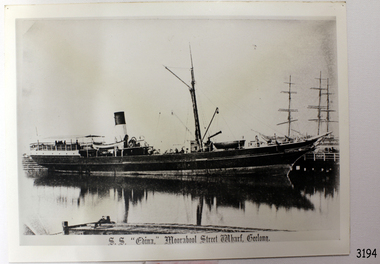
Photograph - Vessel, Steam Ship, S.S. "EDINA," Moorabool Street Wharf, Geelong, c. 1870's - 1930's
... service made SS Edina famous world-wide as the longest serving screw steamer. (The term screw steamer comes from being driven by a single propeller, sometimes called a screw, driven by a steam engine.) SS Edina’s interesting history includes English Chanel runs, serving in the Crimean Ware...service made SS Edina famous world-wide as the longest serving screw steamer. (The term screw steamer comes from being driven by a single propeller, sometimes called a screw, driven by a steam engine.) SS Edina’s interesting history includes English Chanel runs, serving in the Crimean Ware ...This black and white photograph was taken when the SS Edina was as port at the Geelong Wharf in Moorabool Street. The Port of Geelong had many wool sheds alongside the wharf - wool was a major export product. ABOUT THE SS EDINA The three masted iron screw steamer SS Edina was built in Glasgow, Scotland, in 1854 by Barclay and Curle. She was adorned with the figurehead of ‘fair maid of Judea’. The many years of service made SS Edina famous world-wide as the longest serving screw steamer. (The term screw steamer comes from being driven by a single propeller, sometimes called a screw, driven by a steam engine.) SS Edina’s interesting history includes English Chanel runs, serving in the Crimean Ware carrying ammunition, horses and stores to the Black Sea, and further service in the American Civil War and later, serving in the western district of Victoria as well as in Queensland and carried gold, currency and gold prospectors Australia to New Zealand. SS Edina had the privilege of being an escort vessel to H.R.H. the Duke of Edinburgh during his visit to Australia in 1867. In March 1863 SS Edina arrived in Port Phillip Bay, Melbourne and was bought by Stephen Henty, of Portland fame, to work the cargo and passenger run from Melbourne – Warrnambool – Port Fairy - Portland. After a short time of working the run from Australia to New Zealand, with passengers and cargo that included gold and currency, she returned to her Melbourne - Warrnambool – Port Fairy run, with cargo including bales of wool produced in the western district of Victoria. The Warrnambool Steam Packet Company purchased SS Edina in 1867; she was now commanded by Captain John Thompson and Chief Engineer John Davies. She survived several mishaps at sea, had a complete service and overhaul and several changes of commanders. In 1870 SS Edina was in Lady Bay, Warrnambool, when a gale sprung up and caused a collision with the iron screw steamer SS Dandenong. SS Edina’s figurehead was broken into pieces and it was not ever replaced. SS Edina was re-fitted in 1870 then was used as a coastal trader in Queensland for a period. She was then brought to Melbourne to carry cargo and passengers between Melbourne and Geelong and performed this service 1880-1938. During this time (1917) she was again refitted with a new mast, funnel, bridge and promenade deck, altering her appearance. In 1938, after more collisions, SS Edina was taken out of service. However she was later renamed Dinah and used as a ‘lighter’ (a vessel without engine or superstructure) to be towed and carry wool and general cargo between Melbourne and Geelong. In 1957, after 104 years, the SS Edina was broken up at Footscray, Melbourne. Remains of SS Edina’s hull can be found in the Maribyrnong River, Port Phillip Bay. This postcard of the SS Edina is significant for its association with the screw steamer SS Edina and shows her at one of her trading ports on the Melbourne - Warrnambool - Port Fairy - Portland run. The SS Edina is heritage listed on the Victorian Heritage Database VHR S199. She had endeared herself to the people of Port Phillip Bay as a passenger ferry, part of their history and culture. She played a significant role in the Crimean War, the American Civil War and the gold rush in New Zealand. She also served western Victoria for many years in her cargo and passenger runs. The SS Edina is famous for being the longest serving screw steamer in the world. After spending her first nine years overseas she arrived in Melbourne and her work included running the essential service of transporting cargo and passengers between Melbourne and the western Victoria ports of Warrnambool, Port Fairy and Portland. The SS Edina was purchased in the late 1860’s by local Warrnambool business, the Warrnambool Steam Packet Co. and continued trading from there as part of the local business community. The SS Edina’s original ‘fair maid of Judea’ figurehead was broken to pieces in a collision with another vessel (the SS Dandenong) in a gale off Warrnambool, Victoria, in 1870.Black and White photograph of S.S Edina at the Moorabool Street Wharf, Geelong in calm water that shows the reflection of the steamer. Ship has no sails raised. The funnel has a light coloured base with a dark coloured top. There are people on board the steamer. Other ship masts and people are in the background. In the foreground is a jetty with a small boat beside it and a person inside the boat. There is a title printed along the base of the photograph. c. 1870's to 1930'sPrinted at base of photograph "S.S. "EDINA," Moorabool Street Wharf, Geelong"warrnambool, shipwrecked coast, flagstaff hill, flagstaff hill maritime museum, maritime museum, shipwreck coast, flagstaff hill maritime village, shipwrecked artefact, barclay & curle, figurehead 'fair maid of judea', centenary maritime exhibition 1934, a brief review of steam navigation in victoria, pleasure steamer edina, trade and travel late 19th and early 20th century, trade melbourne to geelong, screw steamer edina, coastal trader edina, lighter dinah, cargo carrying for cremean war, cargo carrying for american civil war, passenger and trade in western district of victoria, export gold and currency and gold diggers to new zealand, export vessel to h r h the duke of edinburgh, melbourne - warrnambool - port fairy - portland cargo run, warrnambool steam packet company, stephen henty, captain john thompson, chief engineer john davies, lady bay warrnambool, lighter edina, shipping victoria, port phillip bay steamers, steamship great britain, edina, vhr s199 victorian heritage database, postcard of ss edina 1870's - 1930's -
 Flagstaff Hill Maritime Museum and Village
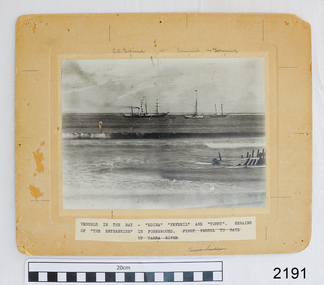
Photograph - Vessels, Steam and Sail, Vessels in the bay, 1890's
... service made SS Edina famous worldwide as the longest-serving screw steamer. (The term screw steamer comes from being driven by a single propeller, sometimes called a screw, driven by a steam engine.) SS Edina’s interesting history includes English Chanel runs, serving in the Crimean Ware...service made SS Edina famous worldwide as the longest-serving screw steamer. (The term screw steamer comes from being driven by a single propeller, sometimes called a screw, driven by a steam engine.) SS Edina’s interesting history includes English Chanel runs, serving in the Crimean Ware ...The photograph, taken in the 1890s, shows sailing ships and a wreck in Lady Bay, Warrnambool. Lady Bay was once a very busy port of trade in Warrnambool and was also called the Port of Warrnambool or Warrnambool Harbour. ENTERPRISE (1847-1850) NOTE: The “Enterprise” wrecked in 1850 in Warrnambool should not be confused with John Pascoe Faulkner’s ‘Enterprise’, which was wrecked in NSW in 1847. The 58-ton schooner Enterprise was built by David Hay in Waiheke, New Zealand in 1847 and registered by owners John Watson and Edward Byam in Melbourne, Australia. She was a single-deck sailing ship with two masts, used for carrying cargo such as local agricultural produce and general commodities between Melbourne and other colonial ports. On September 14th, 1850 the Enterprise had sailed from Melbourne under the control of the ship’s Master, James Gardiner Caught, and was moored in at the Tramway Jetty in Lady Bay, laden with wheat and potatoes. The vessel rode out a south-easterly gale but eventually dragged anchor and was beached, bow first and then broadside. Buckwall, a local indigenous man, braved the heavy surf and reached the stricken vessel with a rescue line, saving all five crew on board. There were no passengers on board. The Enterprise wreck was in an area called Tramway Jetty in Lady Bay. Since then the area has become the location of Lady Bay Hotel and now, in 2019, it is in the grounds of the Deep Blue Apartments. In fact, with the constantly changing coastline through built-up sand, the wreck site is now apparently under the No 2 Caravan Park on Pertobe Road, perhaps 150 metres from the high tide. Its location was found by Ian McKiggan (leader of the various searches in the 1980s for the legendary Mahogany Ship). The Warrnambool Wreck Enterprise is listed on the Victorian Heritage Database VHR S238. DIFFERENTIATING the New Zealand Schooner “Enterprise” from John Fawkner’s “Enterprize“ Dr Murray Johns, Melbourne, says in his article The Mahogany Ship Story, “…the Enterprise, wrecked in Lady Bay, Warrnambool in 1850 ... was soon covered by sand but was exposed again after several storms in 1887. “Samples of timber were then cut from the wreck, which would then have been buried for 37 years. In November 1887 the Warrnambool Standard reported that “the timber looks sound and hard, a penknife scarcely making any impression.” “For many years there was confusion about the identity of that ship in Lady Bay. Most people believed it was the wreck of John Pascoe Fawkner’s Enterprize, which had sailed from Tasmania to Victoria bringing the pioneer settlers to Melbourne in 1835. “In fact, as I documented in 1985, the Warrnambool wreck was of an entirely different ship, also called Enterprize [Enterprise], but built in New Zealand in 1847. Fawkner’s ship had already been sold to Captain Sullivan in 1845 and was wrecked on the Richmond Pier in northern New South Wales early in 1847. “In 1985 a piece of timber from the local Enterprise, which had been kept at the Warrnambool Museum since 1892, was identified histologically as a New Zealand timber, not Tasmanian timber such as blue gum, from which Fawkner’s Enterprize would have been built in 1830. This confirmed the identity of the Warrnambool Enterprize.”[Dr. M.W. Johns later wrote an article called “The Schooner Enterprise: A Final Word on a Historic Wreck.”] ABOUT THE S S EDINA The three-masted iron screw steamer SS Edina was built in Glasgow, Scotland, in 1854 by Barclay and Curle. She was adorned with the figurehead of the ‘fair maid of Judea’. The many years of service made SS Edina famous worldwide as the longest-serving screw steamer. (The term screw steamer comes from being driven by a single propeller, sometimes called a screw, driven by a steam engine.) SS Edina’s interesting history includes English Chanel runs, serving in the Crimean Ware carrying ammunition, horses and stores to the Black Sea, and further service in the American Civil War and later, serving in the western district of Victoria as well as in Queensland and carried gold, currency and gold prospectors Australia to New Zealand. SS Edina had the privilege of being an escort vessel to H.R.H. the Duke of Edinburgh during his visit to Australia in 1867. In March 1863 SS Edina arrived in Port Phillip Bay, Melbourne and was bought by Stephen Henty, of Portland fame, to work the cargo and passenger run from Melbourne – Warrnambool – Port Fairy - Portland. After a short time of working the run from Australia to New Zealand, with passengers and cargo that included gold and currency, she returned to her Melbourne - Warrnambool – Port Fairy run, with cargo including bales of wool produced in the western district of Victoria. The Warrnambool Steam Packet Company purchased SS Edina in 1867; she was now commanded by Captain John Thompson and Chief Engineer John Davies. She survived several mishaps at sea, had a complete service and overhaul and several changes of commanders. In 1870 SS Edina was in Lady Bay, Warrnambool, when a gale sprung up and caused a collision with the iron screw steamer SS Dandenong. SS Edina’s figurehead was broken into pieces and it was not ever replaced. SS Edina was re-fitted in 1870 and was then used as a coastal trader in Queensland for a period. She was then brought to Melbourne to carry cargo and passengers between Melbourne and Geelong and performed this service from 1880-1938. During this time (1917) she was again refitted with a new mast, funnel, bridge and promenade deck, altering her appearance. In 1938, after more collisions, SS Edina was taken out of service. However, she was later renamed Dinah and used as a ‘lighter’ (a vessel without an engine or superstructure) to be towed and carry wool and general cargo between Melbourne and Geelong. In 1957, after 104 years, the SS Edina was broken up at Footscray, Melbourne. Remains of SS Edina’s hull can be found in the Maribyrnong River, Port Phillip Bay. This photograph is significant for its association with the screw steamer SS Edina, heritage listed on the Victorian Heritage Database VHR S199. She had endeared herself to the people of Port Phillip Bay as a passenger ferry, part of their history and culture. She played a significant role in the Crimean War, the American Civil War and the gold rush in New Zealand. She also served western Victoria for many years in her cargo and passenger runs. The SS Edina is famous for being the longest-serving screw steamer in the world. After spending her first nine years overseas she arrived in Melbourne and her work included running the essential service of transporting cargo and passengers between Melbourne and the western Victoria ports of Warrnambool, Port Fairy and Portland. The SS Edina was purchased in the late 1860s by the local Warrnambool business, the Warrnambool Steam Packet Co. and continued trading from there as part of the local business community. Her original ‘fair maid of Judea’ figurehead was broken to pieces in a collision with another vessel (the SS Dandenong) in a gale off Warrnambool, Victoria, in 1870. The photograph is significant for its association wreck of the Victorian Heritage Listed schooner Enterprise, VHR S238, being a New Zealand-built but Australian-owned coastal trader. The wreck was also significant for its association with the local indigenous hero, Buckawall, who saved the lives of the five crew on board. Photograph "Vessels in the Bay". Black and white photograph of several vessels in Lady Bay, Warrnambool, including some small vessels and "S.S. Edina", the "Peveril" and "Tommy", plus the remains of the wrecked vessel "Enterprise" in the foreground. Photograph is mounted on beige card with label describing the vessels, plus pencilled vessel names. There are several pin holes in each corner of the photograph. Typed label under the photograph “VESSELS IN THE BAY – “EDINA” “PEREVIL” AND “TOMMY”. / REMAINS OF “THE ENTERPRISE” IN FOREGROUND. (Also crossed out on the label “FIRST VESSEL TO SAIL UP YARRA RIVER). In pencil script above the vessels on the photograph “S.S. Edina”, “Peveril” “Tommy”. On the reverse is a printed sticker with “F-Ph 59/2 74”, red felt-tip pen “88”, green pen script repeating the text that is under the photograph on the front.flagstaff hill, warrnambool, shipwrecked-coast, flagstaff-hill, flagstaff-hill-maritime-museum, maritime-museum, shipwreck-coast, flagstaff-hill-maritime-village, enterprize, port of warrnambool, warrnambool harbour, peveril, tommy, ss edina, lighter dinah, warrnambool steam packet company, lady bay, pleasure steamer, edina, trade, travel, screw ship, coastal trader, cargo, victoria, buckawall, indigenous rescue, indigenous hero -
 Flagstaff Hill Maritime Museum and Village
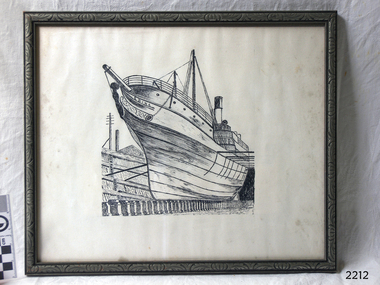
Drawing - Vessel, Sail and Steam Ship, c 1890's
... service made SS Edina famous world-wide as the longest serving screw steamer. (The term screw steamer comes from being driven by a single propeller, sometimes called a screw, driven by a steam engine.) SS Edina’s interesting history includes English Chanel runs, serving in the Crimean Ware...service made SS Edina famous world-wide as the longest serving screw steamer. (The term screw steamer comes from being driven by a single propeller, sometimes called a screw, driven by a steam engine.) SS Edina’s interesting history includes English Chanel runs, serving in the Crimean Ware ...This drawing of the screw steamer SS Edina depicts the vessel in the period of service in Australia from the 1870's onward until the time when she was cut down to use as a 'lighter' to carry cargo in 1938. The artist is unknown. ABOUT THE S S EDINA The three masted iron screw steamer SS Edina was built in Glasgow, Scotland, in 1854 by Barclay and Curle. She was adorned with the figurehead of ‘fair maid of Judea’. The many years of service made SS Edina famous world-wide as the longest serving screw steamer. (The term screw steamer comes from being driven by a single propeller, sometimes called a screw, driven by a steam engine.) SS Edina’s interesting history includes English Chanel runs, serving in the Crimean Ware carrying ammunition, horses and stores to the Black Sea, and further service in the American Civil War and later, serving in the western district of Victoria as well as in Queensland and carried gold, currency and gold prospectors Australia to New Zealand. SS Edina had the privilege of being an escort vessel to H.R.H. the Duke of Edinburgh during his visit to Australia in 1867. In March 1863 SS Edina arrived in Port Phillip Bay, Melbourne and was bought by Stephen Henty, of Portland fame, to work the cargo and passenger run from Melbourne – Warrnambool – Port Fairy - Portland. After a short time of working the run from Australia to New Zealand, with passengers and cargo that included gold and currency, she returned to her Melbourne - Warrnambool – Port Fairy run, with cargo including bales of wool produced in the western district of Victoria. The Warrnambool Steam Packet Company purchased SS Edina in 1867; she was now commanded by Captain John Thompson and Chief Engineer John Davies. She survived several mishaps at sea, had a complete service and overhaul and several changes of commanders. In 1870 SS Edina was in Lady Bay, Warrnambool, when a gale sprung up and caused a collision with the iron screw steamer SS Dandenong. SS Edina’s figurehead was broken into pieces and it was not ever replaced. SS Edina was re-fitted in 1870 then was used as a coastal trader in Queensland for a period. She was then brought to Melbourne to carry cargo and passengers between Melbourne and Geelong and performed this service 1880-1938. During this time (1917) she was again refitted with a new mast, funnel, bridge and promenade deck, altering her appearance. In 1938, after more collisions, SS Edina was taken out of service. However she was later renamed Dinah and used as a ‘lighter’ (a vessel without engine or superstructure) to be towed and carry wool and general cargo between Melbourne and Geelong. In 1957, after 104 years, the SS Edina was broken up at Footscray, Melbourne. Remains of SS Edina’s hull can be found in the Maribyrnong River, Port Phillip Bay. This drawing of the SS Edina is significant for its association with the screw steamer SS Edina. The SS Edina is heritage listed on the Victorian Heritage Database VHR S199. She had endeared herself to the people of Port Phillip Bay as a passenger ferry, part of their history and culture. She played a significant role in the Crimean War, the American Civil War and the gold rush in New Zealand. She also served western Victoria for many years in her cargo and passenger runs. The SS Edina is famous for being the longest serving screw steamer in the world. After spending her first nine years overseas she arrived in Melbourne and her work included running the essential service of transporting cargo and passengers between Melbourne and the western Victoria ports of Warrnambool, Port Fairy and Portland. The SS Edina was purchased in the late 1860’s by local Warrnambool business, the Warrnambool Steam Packet Co. and continued trading from there as part of the local business community. The SS Edina’s original ‘fair maid of Judea’ figurehead was broken to pieces in a collision with another vessel (the SS Dandenong) in a gale off Warrnambool, Victoria, in 1870.Drawing in pen and ink, of screw steamer vessel SS Edina, framed in decorative timber and glass. View of bow of SS Edina with vessel's name on bow. SS Edina is in dry dock, background shows a power pole and roof. Ship configuration in the drawing was 1870's - 1938. Drawing dated c. 1890's.Drawn on bow "EDINA"warrnambool, shipwrecked coast, flagstaff hill, flagstaff hill maritime museum, maritime museum, shipwreck coast, flagstaff hill maritime village, shipwrecked artefact, barclay & curle, figurehead 'fair maid of judea', centenary maritime exhibition 1934, a brief review of steam navigation in victoria, pleasure steamer edina, trade and travel late 19th and early 20th century, trade melbourne to geelong, screw steamer edina, coastal trader edina, lighter dinah, cargo carrying for cremean war, cargo carrying for american civil war, passenger and trade in western district of victoria, export gold and currency and gold diggers to new zealand, export vessel to h r h the duke of edinburgh, melbourne - warrnambool - port fairy - portland cargo run, warrnambool steam packet company, stephen henty, captain john thompson, chief engineer john davies, lady bay warrnambool, lighter edina, shipping victoria, port phillip bay steamers, steamship great britain, edina, vhr s199 victorian heritage database, drawing of ss edina, pen and ink drawing of ss edina, pen and ink drawing 1870's - 1938, maritime drawing of screw steamer -
 Frankston RSL Sub Branch
Kitbag
... Issued to Flight Lieutenant JACK WARE CORNISH, 409295, Royal Australian Air Force. Copy of certificate of service attached in Images section ...Kitbag, RAAF grey canvas, with white cord, circa World War 2, certificate of service attached under images for Flight Lietutenant Jack Ware Cornish, 409295...Issued to Flight Lieutenant JACK WARE CORNISH, 409295, Royal Australian Air Force. Copy of certificate of service attached in Images section RAAF 409295 Kitbag, RAAF grey canvas, with white cord, circa World War 2, certificate of service attached under images for Flight Lietutenant Jack Ware Cornish, 409295 Kitbag ...Issued to Flight Lieutenant JACK WARE CORNISH, 409295, Royal Australian Air Force. Copy of certificate of service attached in Images section Kitbag, RAAF grey canvas, with white cord, circa World War 2, certificate of service attached under images for Flight Lietutenant Jack Ware Cornish, 409295RAAF 409295 -
 City of Moorabbin Historical Society (Operating the Box Cottage Museum)
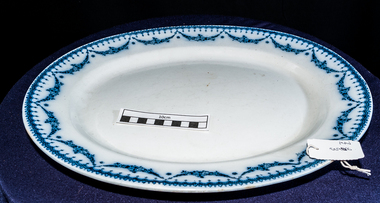
Kitchen Equipment, meat platter 'CETEM WARE', c1930
... Ware” when the company adopted its well known trademark of a castle in the early years of this century. The “Cetem” name continued to be used into the 1930s. the Maling name continued to be used as a trademark until the factory finally closed in 1963 The outbreak of World War 11 in 1939 marked the beginning of a long decline. Many of the factory’s workers were called up for military service...Ware” when the company adopted its well known trademark of a castle in the early years of this century. The “Cetem” name continued to be used into the 1930s. the Maling name continued to be used as a trademark until the factory finally closed in 1963 The outbreak of World War 11 in 1939 marked the beginning of a long decline. Many of the factory’s workers were called up for military service ...The Maling Pottery of Newcastle upon Tyne, England, was in production from 1762 to 1963. In its heyday it claimed to be the biggest pottery in the world. The first Maling pottery was established at North Hylton, near Sunderland, in 1762 by William Maling. William’s descendants who moved to the Newcastle area and built a succession of larger works. The last of these – the Ford B pottery – was begun in 1878 and occupied a 14 acre site... Maling’s stock in trade was everyday white ware – marmalade jars for Keillers and Coopers, crockery for railways, shipping lines and hotels, and a huge variety of domestic kitchenware. With a significant export trade in the 1920s they had showrooms in Australia, New Zealand and Denmark. Mary Ford, daughter of an Edinburgh glass manufacturer, married Christopher Maling. Christopher Thompson Maling’s initials form one of the company’s early factory marks – the letters CTM inscribed vertically inside a triangle. The Maling name (which had first appeared with the castle mark in the 1920s) and extended to the trade name “Cetem Ware” when the company adopted its well known trademark of a castle in the early years of this century. The “Cetem” name continued to be used into the 1930s. the Maling name continued to be used as a trademark until the factory finally closed in 1963 The outbreak of World War 11 in 1939 marked the beginning of a long decline. Many of the factory’s workers were called up for military service, and wartime restrictions prevented decorative ware being produced for the home market.A larger oval china platter with blue garland around the rim ‘ CETEM WARE’ EMPIRE c1930 On base ; CETEM WARE / over a Castle / EMPIRE / Rd No 519757 china, pottery, cetem ware, maling pottery co ltd., maling william, maling christopher thompson, ford mary, newcastle upon tyne uk, crockery, north hylton sunderland uk, moorabbin, bentleigh, market gardeners, early settlers, cheltenham, world war 11 1939-45, cooking -
 Geelong RSL Sub Branch
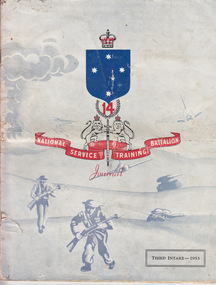
Journal, National Service Training Battalion, 1953
... National Service 1951-1953 3rd Intake 1953 On the back page are the signatures of Members of this Intake. Printed by Ramsay, Ware Publishing Pty Ltd, 129 King Street, Melbourne. ...Compulsory National Service existed for all males between 1951 and 1959. This journal relates to the 3rd Intake in 1953.This is an original journal of the National Service Training Battalion, 3rd Intake 1953.A paper journal of 44 pages relating to the 3rd Intake of National Servicemen 1953.On the back page are the signatures of Members of this Intake. Printed by Ramsay, Ware Publishing Pty Ltd, 129 King Street, Melbourne.national service, 1951-1953, 3rd intake, 1953 -
 Mission to Seafarers Victoria
Photograph - Photograph, Black and White, circa 1944
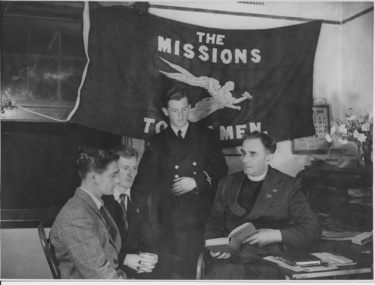
... services and support for cadets and officers of the merchant fleets. Officers had access to accommodation at the Mission and were encouraged as senior crew to improve pastoral and counselling skills that may benefit crews at sea. Padre Oliver is in his office, holding the book: Clanbrae: A Golfing Idyll by Pentland Peile This image depicts Chaplain Oliver and three young seafarers possibly all officers / cadets (one is wearing a Merchant Navy badge) at the Mission circa 1944. Unclear if any of these men were related to Frank Ware ...The Mission to seamen provided special services and support for cadets and officers of the merchant fleets. Officers had access to accommodation at the Mission and were encouraged as senior crew to improve pastoral and counselling skills that may benefit crews at sea. Padre Oliver is in his office, holding the book: Clanbrae: A Golfing Idyll by Pentland PeileThis image depicts Chaplain Oliver and three young seafarers possibly all officers / cadets (one is wearing a Merchant Navy badge) at the Mission circa 1944. Unclear if any of these men were related to Frank Ware.Black and white photograph depicting Padre Oliver, holding an open book and three seamen, one in naval uniform standing and two other men seated next to the Padre. A Mission to Seafarers Flag is in the background. mission to seafarers, frank ware, frank oliver, padre oliver, merchant navy, mn, clanbrae a holding idyll, josephine atkinson -
 Ringwood and District Historical Society
Flyer, Subdivisional Auction Sale Brochure, Ware Estate, East Ringwood, Vic. - 1958
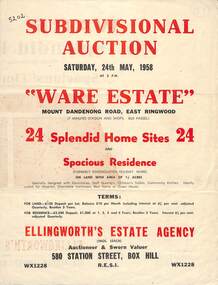
... Ware Kindergarten Holiday Home. (Agent) Ellingworth's Estate Agency, 580 Station Street, Box Hill - (Phone) WX1228. Folded double-sided advertisement for auction of 24 home sites and existing residence on Saturday, 24th May, 1958, including locality map, subdivision layout, terms of sale, and summary of local facilities and services. ...Folded double-sided advertisement for auction of 24 home sites and existing residence on Saturday, 24th May, 1958, including locality map, subdivision layout, terms of sale, and summary of local facilities and services. Additional plan of lots 28-33 dated 26/10/60 by Licensed Surveyor for Kirkpatrick & Webber, 225 Maroondah Highway Ringwood headed Plan of Subdivision of part of Crown Allotment 26A Parish of Ringwood.Subdivision includes Mount Dandenong Road, Ware Crescent, Davey Drive, and Grey Road (later Grey Street). Timber residence included in the subdivision was formerly Ware Kindergarten Holiday Home. (Agent) Ellingworth's Estate Agency, 580 Station Street, Box Hill - (Phone) WX1228. -
 Bendigo Military Museum
Badge - MEMBERSHIP BADGES, 1) Bishop / Brisbane, 1) Pre WW2
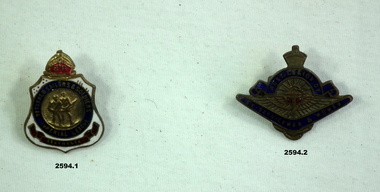
... service clubs...metalcraft - enamel ware...Williams DSO, refer Cat No 2580 for service details. numismatics-badges-societies-service clubs metalcraft - enamel ware .1) Badge, metal, RSL Membership, 2 figures central with membership year clasp at top. .2) Badge, metal Australian Legion of Ex Servicemen & Women. ...Items in collection re Brig E.M. Williams DSO, refer Cat No 2580 for service details..1) Badge, metal, RSL Membership, 2 figures central with membership year clasp at top. .2) Badge, metal Australian Legion of Ex Servicemen & Women. Blue scroll with Army, Navy Air Force over Boomerang. Red, blue & white enamel work.numismatics-badges-societies-service clubs, metalcraft - enamel ware -
 Kiewa Valley Historical Society
Kettle Aluminium, mid to late 1900's
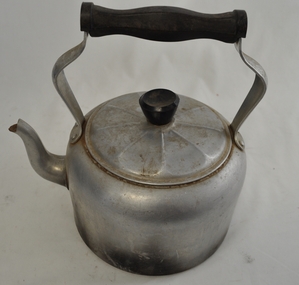
... The C.W.A. motto "Honour our God, Loyalty to the throne, Service to the country, Through country women, For country women, By country women." cwa homeware aluminium kitchen utensils made in australia cook ware On both sides of the aluminium handle "HOT PLATE WARE" and covering an oblique shaped triangle "99% PURE ALUMINIUM" and below that "MADE IN AUSTRALIA".Within the triangle "DURALIFE" This 99% aluminium hot plate kettle with lid (bakelite handle) is Australian made for flat stoves (cooking or room heating). ...This aluminium kettle was manufactured between 1940 to 1960's and replaced the heavier caste iron "open fire" stove ones (in doors or in the bush). A cast iron flat base between the open fires and the kettle was required. This kettle was used extensively with indoor open fire places. It was part of the evolution in "tea" making kettles. These were the only method of making hot beverages before introduction of electric kettles. For the Kiewa Valley the connection to the major electricity grid was post 1950's.This kettle is significant demonstrating the type of kitchen utensils required before electrical home connections became a reality. The aluminium structure of the kettle was an advancement over the heavier caste iron kettles. This type of kettle is still in use for bush and mountain hikers/climbers due to the light weight. This kettle was used by the Tawonga C.W.A. Branch. The C.W.A. motto "Honour our God, Loyalty to the throne, Service to the country, Through country women, For country women, By country women."This 99% aluminium hot plate kettle with lid (bakelite handle) is Australian made for flat stoves (cooking or room heating). It has a "tea style" spout and a bakelite hand grip(knob) on the top of the lid. The lid has nine ridges (for strength) radiating from the central hand grip. The two handle prongs are bop riveted onto the the body of the kettle. The bakelite hand grip has been fashioned to fit the natural contours of a clutching hand.On both sides of the aluminium handle "HOT PLATE WARE" and covering an oblique shaped triangle "99% PURE ALUMINIUM" and below that "MADE IN AUSTRALIA".Within the triangle "DURALIFE"cwa, homeware aluminium kitchen utensils, made in australia cook ware -
4th/19th Prince of Wales's Light Horse Regiment Unit History Room
Booklet, Ramsay, Ware Publishing Pty Ltd, Notes on Administration of Discipline on War Service, 1 May 1943
... Military Law World War 2 Not to be published A paper covered publication to assist officers of the Australian Military Forces on war service on the administration of military law Notes on Administration of Discipline on War Service Booklet Ramsay, Ware Publishing Pty Ltd ...A paper covered publication to assist officers of the Australian Military Forces on war service on the administration of military law Not to be publishedmilitary law, world war 2 -
 Bendigo Historical Society Inc.
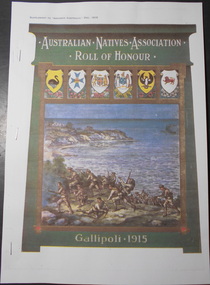
Booklet - ANA COLLECTION: AUSTRALIAN NATIVES ASSOCIATION ROLL OF HONOUR GALLIPOLI 1915
... Australian Natives Association Roll of Honour Gallipoli 1915 Australian wide list of members who enlisted for active service between Aug. 1914 to Oct. 1915 Paper coloured copy of the list of ANA members who enlisted in World Ware 1, stapled as a booklet a colored cover b page 3 with list of Bendigo members c page 5 list of Eaglehawk members...Australian Natives Association Gallipoli Australian Natives Association Roll of Honour Gallipoli 1915 Australian wide list of members who enlisted for active service between Aug. 1914 to Oct. 1915 Paper coloured copy of the list of ANA members who enlisted in World Ware 1, stapled as a booklet a colored cover b page 3 with list of Bendigo members c page 5 list of Eaglehawk members Booklet ANA COLLECTION: AUSTRALIAN NATIVES ASSOCIATION ROLL OF HONOUR GALLIPOLI 1915 ...Australian Natives Association Roll of Honour Gallipoli 1915 Australian wide list of members who enlisted for active service between Aug. 1914 to Oct. 1915 Paper coloured copy of the list of ANA members who enlisted in World Ware 1, stapled as a booklet a colored cover b page 3 with list of Bendigo members c page 5 list of Eaglehawk membersaustralian natives association, gallipoli -
 Port Melbourne Historical & Preservation Society
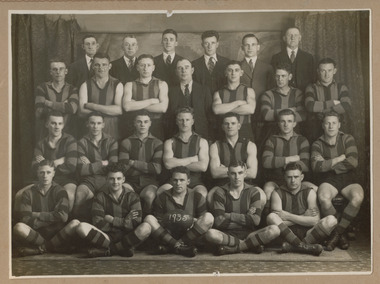
Photograph - Port Melbourne Football Club, 2nd XVIII, A H Williams, 1935
... W MATHEWS (1st left second row from rear); Nat ELDER (beside MATHEWS); H BARNES (Middle second front row); Choota BALMAN (on BARNE's left) Sport - Australian Rules Football George Alexander ROGERS Mayors W MATHEWS Nat ELDER A BILLS Alex ROGERS Graham 'Nuts' NUGENT W PAYNE W CORNWAITHE S TYMMS H COMPTON H BARNES Choota BALMAN H SMITH MARSHALL D SPENCE S WARE M LARWOOD Port Melbourne Railway United Football Club Port Melbourne Junior Football Club B&W photo of Port Melbourne Football Club 2nd 18 team and officials from 1935. Presented to his Worship, CR. A. ROGERS, President, in appreciation of services ...Sixteen of the 25 individuals are known but only four are specifically identified by position. W MATHEWS (1st left second row from rear); Nat ELDER (beside MATHEWS); H BARNES (Middle second front row); Choota BALMAN (on BARNE's left)B&W photo of Port Melbourne Football Club 2nd 18 team and officials from 1935. Presented to his Worship, CR. A. ROGERS, President, in appreciation of services rendered.sport - australian rules football, george alexander rogers, mayors, w mathews, nat elder, a bills, alex rogers, graham 'nuts' nugent, w payne, w cornwaithe, s tymms, h compton, h barnes, choota balman, h smith, marshall, d spence, s ware, m larwood, port melbourne railway united football club, port melbourne junior football club -
 Alfred Hospital Nurses League - Nursing History Collection
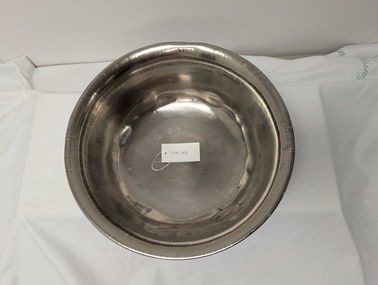
Functional object - Monelmetal wash bowl, K.G. LUKE
... servicing/cleaning this item. The item is also a good example of wares made by K.G. Luke Pty Ltd. AHNL Alfred Hospital nurses patient care bed bath Alfred hospital nurses league ward 5 Alfred hospital metal bowl wash bowl ward 5 melbourne hospitals school of nursing prahran nursing history kenneth luke K.G. Luke Pty Ltd. PARAMOUNT/ WARE ...Item that was used daily for patient ablutions. Would have been used by Alfred hospital nurses on a daily basis. Many of our membership would have memories of using this item. The item is marked with the ward as items sometimes were borrowed or used by different wards or areas of the hospital so labeling was essential for staff to retrieve their equipment back.Item that was used daily for patient ablutions. Would have been used by Alfred hospital nurses on a daily basis. Many of our membership would have memories of using and servicing/cleaning this item. The item is also a good example of wares made by K.G. Luke Pty Ltd.Large monelmetal wash bowl. Bowl is round and made of metal. It has 2 cracks on the rim. It has numerous dents and small scratches from use. On the base/underside of the bowl is an inscription from the maker and additional inscription from it's use on "Ward 5 - Alfred Hospital"PARAMOUNT/ WARE/ K.G. LUKE/ MELBOURNE/ ALFRED/ HOSPITAL/ WARD 5/ahnl, alfred hospital, nurses, patient care, bed bath, alfred hospital nurses league, ward 5 alfred hospital, metal bowl, wash bowl, ward 5, melbourne hospitals, school of nursing, prahran, nursing history, kenneth luke, k.g. luke pty ltd. -
Moorabbin Air Museum
Document (item) - John Porter Estate Collection, John Porter Estate Collection See Description for contents
... RAAF /Ansett - various Newspaper clippings - from November 9,1948 Airlines - various newspaper clippings Official RAAF records etc Details of RAAF service including personal items Record of service 26/4/41 - 6/7/45 Various photos & newspaper clippings The Age newspaper clippings- 25/7/2003 - 24/8/94 - Colin MacDonald Australians At Ware Film Archive - supporting paperwork for interview Various photos & newspaper clippings Pilots Log Book - Donald Russell Elford Autobiography - Part 2 - John Porter Helicopter & Bristol photos Ansett - various news items & photos D.H. 4 Aircraft - Spirit of Melbourne Assorted photos, newspaper clippings, personal paperwork etc Personal letters & photos re Aberdeen Assorted photos Trip to Rhodesia...RAAF /Ansett - various Newspaper clippings - from November 9,1948 Airlines - various newspaper clippings Official RAAF records etc Details of RAAF service including personal items Record of service 26/4/41 - 6/7/45 Various photos & newspaper clippings The Age newspaper clippings- 25/7/2003 - 24/8/94 - Colin MacDonald Australians At Ware Film Archive - supporting paperwork for interview Various photos & newspaper clippings Pilots Log Book - Donald Russell Elford Autobiography - Part 2 - John Porter Helicopter & Bristol photos Ansett - various news items & photos D.H. 4 Aircraft - Spirit of Melbourne Assorted photos, newspaper clippings, personal paperwork etc Personal letters & photos re Aberdeen Assorted photos Trip to Rhodesia John Porter Estate Collection See Description for contents Document John Porter Estate Collection ... -
 Charlton Golden Grains Museum Inc
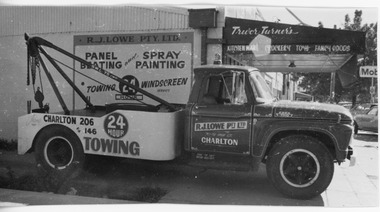
Photograph - Black and white photo of tow truck belonging to R.J. Lowe Pty. Ltd
... LOWE PTY LTD PANEL BEATING and SPRAY PAINTING, TOWING 24 HOUR WINDSCREEN SERVICE On shop in background - Trevor Turner's KITCHEN WARE, CROCKERY, TOYS & FANCY GOODS store in High St Charlton. ...LOWE PTY LTD PANEL BEATING and SPRAY PAINTING, TOWING 24 HOUR WINDSCREEN SERVICE On shop in background - Trevor Turner's KITCHEN WARE, CROCKERY, TOYS & FANCY GOODS store in High St Charlton. ...Charlton Tow Truck and Trevor Turner's shop c 1970sBlack and white photo of tow truck belonging to R.J. Lowe Pty. Ltd. The truck is parked beside Trevor Turner's KITCHEN WARE, CROCKERY, TOYS & FANCY GOODS store in High St Charlton. Markings on Tow Truck - Advertising for R . J. Lowe 70-72 High St. Charlton. Charlton 206 A/H 146 24 HOUR TOWING On advertising poster on business wall - R. J. LOWE PTY LTD PANEL BEATING and SPRAY PAINTING, TOWING 24 HOUR WINDSCREEN SERVICE On shop in background - Trevor Turner's KITCHEN WARE, CROCKERY, TOYS & FANCY GOODS store in High St Charlton. r j lowe pty ltd, trevor turner, charlton towing -
 Numurkah & District Historical Society
Domestic object - Nutloaf Tins x 2, Certificate, History information (Willow), Willow Ware Australia
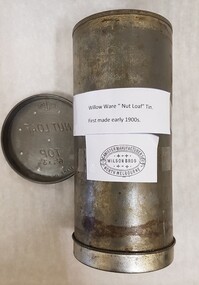
... Nutloaf tin: Willow, Nutloaf, top, 6 3/4 x 3 1/8, made in Australia (on top lid) / Willow Australia, Nut Loaf, 170mm x 80mm (on bottom lid) / Willow Ware "Nut Loaf" Tin First made early 1900's (on the side of the cylinder) / Canister Manufacturers Wilson Bros North Melbourne (stamped on paper on the side of the cylinder) 2. as per photo Also.....handwritten "Left the company in1998 (43 years service) 3. ...Nutloaf tin: Willow, Nutloaf, top, 6 3/4 x 3 1/8, made in Australia (on top lid) / Willow Australia, Nut Loaf, 170mm x 80mm (on bottom lid) / Willow Ware "Nut Loaf" Tin First made early 1900's (on the side of the cylinder) / Canister Manufacturers Wilson Bros North Melbourne (stamped on paper on the side of the cylinder) 2. as per photo Also.....handwritten "Left the company in1998 (43 years service) 3. ...1. 2 x Cylinder shaped tins with lids on both ends - used for cooking nutloaf. The top lid is removable and has 9 perforated holes. One tin has a label on the side which has been added for display purposes (see below) 2. Centenary Certificate from Willoware to Thomas O'Sullivan 3. Willow Centenary book 1887-1987 and photocopy pages of Willowware history1. Nutloaf tin: Willow, Nutloaf, top, 6 3/4 x 3 1/8, made in Australia (on top lid) / Willow Australia, Nut Loaf, 170mm x 80mm (on bottom lid) / Willow Ware "Nut Loaf" Tin First made early 1900's (on the side of the cylinder) / Canister Manufacturers Wilson Bros North Melbourne (stamped on paper on the side of the cylinder) 2. as per photo Also.....handwritten "Left the company in1998 (43 years service) 3. Willow 1887-1987 on front of bookletwillow ware, willow, kitchen, cooking, nutloaf tin, certificate, centenary -
 St Kilda Historical Society
Domestic object - Crockery, St Clement's Private Hospital creamer jug, c1927-1940
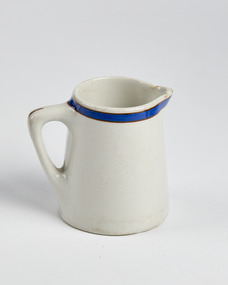
... services. The hospital was sold in 1940. St Clement's Private Hospital On base: image of a crown GRINDLEY HOTEL WARE ENGLAND VITRIFIED LOFTUS, MORAN MELBOURNE PATENT 6.32 White jug with blue and gold border at rim and gold stripe on the handle. ...St Clement's Private Hospital was situated on the corner of Southey and Byron Streets, St Kilda South. After Sister Gwendolen Luly finished her training at the Alfred Hospital, her father William Luly established the hospital in about 1927 or 1928. She and Sister Brocklebank offered surgical, medical and midwifery services. The hospital was sold in 1940.White jug with blue and gold border at rim and gold stripe on the handle.On base: image of a crown GRINDLEY HOTEL WARE ENGLAND VITRIFIED LOFTUS, MORAN MELBOURNE PATENT 6.32st clement's private hospital -
 Puffing Billy Railway
Bread Plate, Victorian Railways Black & White, June 1953 "6-53" = "month-year"
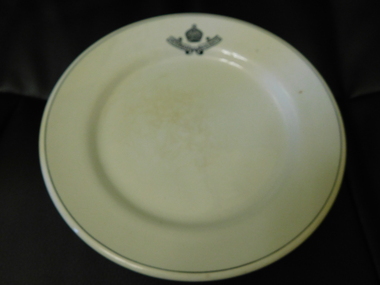
... Ware Co., are tough as raw-hide. This is why they are used by practically every hotel and institution in Australia. Obtainable only from LOFTUS MORAN PTY. LTD., Hotel Supply Specialists, 131 Queen's Bridge Street, Melbourne South Advertising (29 March 1933, ). The Argus (Melbourne, Vic. ), p. 7. http://nla.gov.au/nla.news-article4726734 Historic - Victorian Railways - Refreashment Services ...Victorian Railways Bread Plate - Black & White Maker : W H Grindley & Co (Ltd) Earthenware manufacturer at the Newfield Pottery and then the Woodfield Pottery, Tunstall, Stoke-on-Trent The company was founded at the Newfield Pottery in 1880 by William Harry Grindley (princliple partner) and Mr Turner (the '& Co.') They produced Earthenware and Ironstone China - particularly for the Canadian, United States, South American and Australian markets. In 1891 the company moved to the Woodfield Pottery, Woodland Street, Tunstall. In 1960 the business was purchased by Alfred Clough Ltd. In 1978 renamed Grindley of Stoke (ceramics) Ltd. Federated Potteries Co. Ltd. took them over in 1982 and in 1988 the business was re-purchase by W. H. Grindley. 1991 saw the company in the hands of the receivers. and the same year they were taken over by Woodlands Pottery. DURALINE (trade mark) printed mark used by Grindley Hotel Ware Co Ltd c.1930's onwards The Number i.e "6-53" = "month-year" Supplier to Victorian railways : Loftus Moran, Melbourne: Mr Loftus Henry Moran was well known in the tea trade. Originally employed by Griffiths Bros Ltd, he started his own business, Loftus Moran Pty Ltd, in 1909 In 1913 he purchased the tea business of Mcintyre Bros, and later' that of Steele Bros, and absorbed them in his own company. He had a wide business connection among hotels and guest houses for supplying crockery and other supplies. Ref: DEATH OF MR LOFTUS MORAN (1944, May 27). The Argus (Melbourne, Vic. : 1848 - 1957), p. 4. http://nla.gov.au/nla.news-article11809686 1st Advertisement of the Plates in the papers: CHIPPED CROCKERY. Nothing is more objectionable than chipped crockery--besides its use is illegal. DURALINE Plates, manufactured by The Grindley Hotel Ware Co., are tough as raw-hide. This is why they are used by practically every hotel and institution in Australia. Obtainable only from LOFTUS MORAN PTY. LTD., Hotel Supply Specialists, 131 Queen's Bridge Street, Melbourne South Advertising (29 March 1933, ). The Argus (Melbourne, Vic. ), p. 7. http://nla.gov.au/nla.news-article4726734Historic - Victorian Railways - Refreashment Services crockery - plateceramic Victorian Railways Bread Plate - Black & White Victorian Railways ( in black on fount of plate ) "DURALINE" ( in Black on back of plate ) super Vitrified GRINDLEY HotelWare Co England Loftus Moran Pty Ld Melbourne 8 -53puffing billy, victorian railways, crockery, plate -
 Puffing Billy Railway
Victorian Railways Saucer Plate, May 1954 "5-54" = "month-year"
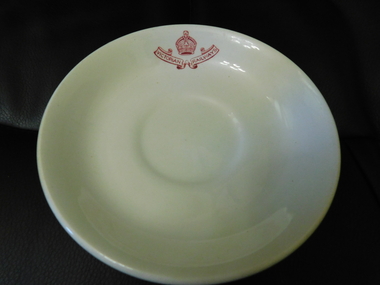
... Ware Co., are tough as raw-hide. This is why they are used by practically every hotel and institution in Australia. Obtainable only from LOFTUS MORAN PTY. LTD., Hotel Supply Specialists, 131 Queen's Bridge Street, Melbourne South Advertising (29 March 1933, ). The Argus (Melbourne, Vic. ), p. 7. http://nla.gov.au/nla.news-article4726734 Historic - Victorian Railways - Refreshment Services ...Victorian Railways Saucer Plate - Red & White Supplier to Victorian railways : Loftus Moran, Melbourne: Mr Loftus Henry Moran was well known in the tea trade. Originally employed by Griffiths Bros Ltd, he started his own business, Loftus Moran Pty Ltd, in 1909 In 1913 he purchased the tea business of McIntyre Bros, and later, that of Steele Bros, and absorbed them in his own company. He had a wide business connection among hotels and guest houses for supplying crockery and other supplies. Ref: DEATH OF MR LOFTUS MORAN (1944, May 27). The Argus (Melbourne, Vic. : 1848 - 1957), p. 4. http://nla.gov.au/nla.news-article11809686 1st Advertisement of the Plates in the papers: CHIPPED CROCKERY. Nothing is more objectionable than chipped crockery--besides its use is illegal. DURALINE Plates, manufactured by The Grindley Hotel Ware Co., are tough as raw-hide. This is why they are used by practically every hotel and institution in Australia. Obtainable only from LOFTUS MORAN PTY. LTD., Hotel Supply Specialists, 131 Queen's Bridge Street, Melbourne South Advertising (29 March 1933, ). The Argus (Melbourne, Vic. ), p. 7. http://nla.gov.au/nla.news-article4726734Historic - Victorian Railways - Refreshment Services crockery - plateCeramic Victorian Railways Saucer Plate - Red & White Victorian Railways ( in Red on fount of plate ) "DURALINE" ( in Black on back of plate ) super Vitrified GRINDLEY HotelWare Co England Loftus Moran Pty Ld Melbourne 5 -54 puffing billy, victorian railways, crockery, plate -
 Federation University Art Collection
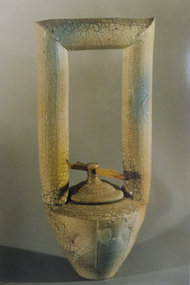
Ceramic - Artwork - Ceramics, 'Raku Lidded Pot with Tall Handle' by Bruce Anderson, c1984
... For the next two years, he worked at Raynham Ceramics in East Bentleigh, making slipcast ware. After a year of National Service, he completed a teacher education course at the State College of Victoria, Auburn and taught for a time in the secondary school system. ...For the next two years, he worked at Raynham Ceramics in East Bentleigh, making slipcast ware. After a year of National Service, he completed a teacher education course at the State College of Victoria, Auburn and taught for a time in the secondary school system. ...Bruce ANDERSON (20 August 1950- Born Surry Hills, Melbourne, Victoria In 1971 Bruce Anderson obtained a Diploma of Art (Sculpture) from the Prahran Institute of Technology. For the next two years, he worked at Raynham Ceramics in East Bentleigh, making slipcast ware. After a year of National Service, he completed a teacher education course at the State College of Victoria, Auburn and taught for a time in the secondary school system. In 1977, he moved to Queensland to take up a position as Head of the Ceramics Department at Townsville TAFE. In 1984, he relocated to the Darling Downs Institute in Toowoomba and was still teaching there in his entry in the 1986-7 directory, working in raku and blackware fired with gas in a ceramic fibre kiln. During 1986, he moved to Adelaide to take up a position as senior lecturer in ceramics at the South Australian School of Design. During the late 1980s and 1990s, he began to make sculptural works of architactural form cast from a mixture of terracotta clay and refractory concrete. Part-glazed, the works allude to primitive industry and utilitarianism. In 1984 Bruce Anderson was a guest at Spotkanie held at the Gippsland Institute of Advanced Education.Raku teapot with tall handle. bruce anderson, ceramics, jan feder memorial ceramics collection, gippsland campus, teapot, raynham ceramics -
 Federation University Art Collection
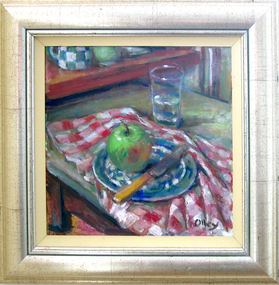
Painting - Artwork - bookplate, Olley, Margaret, 'Apple with Glass' by Margaret Olley, 2005
... Her paintings often feature arrangements of fruits and flowers, set amid domestic ware art and souvenirs of her travels. For her service as an artist and to the promotion of art, she was awarded the Order of Australia in 1991 and made a Companion of the Order of Australia in 1996. ...Her paintings often feature arrangements of fruits and flowers, set amid domestic ware art and souvenirs of her travels. For her service as an artist and to the promotion of art, she was awarded the Order of Australia in 1991 and made a Companion of the Order of Australia in 1996. ...Margaret Olley (24 June 1923 – 26 July 2011) Born Lismore, New South Wales In 1941 Margaret commenced classes at Brisbane Central Technical College. In 1943 Olley moved to Sydney and enrolled in an art Diploma course at East Sydney Technical College graduating in 1945 with A-class honours. She is known as a still-life and interior painters Margaret who drew inspiration from her home and studio, and the beauty of the everyday objects she gathered around her. Her paintings often feature arrangements of fruits and flowers, set amid domestic ware art and souvenirs of her travels. For her service as an artist and to the promotion of art, she was awarded the Order of Australia in 1991 and made a Companion of the Order of Australia in 1996. This item is part of the Federation University Art Collection. The Art Collection features over 2000 works and was listed as a 'Ballarat Treasure' in 2007.Framed oil painting of an apple on a table with red gingham cloth. art, artwork, margaret olley, olley, apple, fruit, still life -
 Parks Victoria - Mount Buffalo Chalet
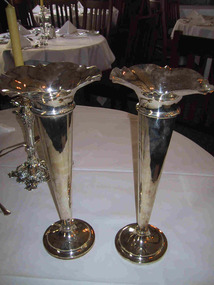
Vase
... service settings . 'When the Victorian railways took over managemen of the Chalet from 1 october 1924, they ran their dining room and cafe in similar fashion to the dining cars on their trains and refreshment rooms on their stations, using the same ceramic hotel-ware and electro plated nickel silverware (EPNS), all made to order items that are clearly idenitified by the distinctive 'VR' monogram. ...service settings . 'When the Victorian railways took over managemen of the Chalet from 1 october 1924, they ran their dining room and cafe in similar fashion to the dining cars on their trains and refreshment rooms on their stations, using the same ceramic hotel-ware and electro plated nickel silverware (EPNS), all made to order items that are clearly idenitified by the distinctive 'VR' monogram. ...Silver plated vase which was part of the Dining room silver service settings . 'When the Victorian railways took over managemen of the Chalet from 1 october 1924, they ran their dining room and cafe in similar fashion to the dining cars on their trains and refreshment rooms on their stations, using the same ceramic hotel-ware and electro plated nickel silverware (EPNS), all made to order items that are clearly idenitified by the distinctive 'VR' monogram. The Chalet retains a good selection of of the diverse range of EPNS item formerly used in the dining room..- which in all their variety and function help to interpret the dining room protocols of the 'tourist house' and the service provied by the Victorian Railways refreshment and Services Branch. Many of the items were manufactured by by Stoke & Sons of Melbourne (est. 1856.' (Pg 103. Historica) Listed in Draft Inventory of Significant Collection items. Appendix A.3.Tableware. (Pg 166 Historica).Two fluted electroplated silver vases with Victorian Railways insignia and a number at base."VR" and more... -
 Parks Victoria - Mount Buffalo Chalet
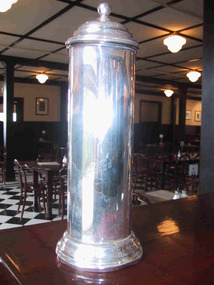
Container
... ware and electro plated nickel silverware (EPNS), all made to order items that are clearly idenitified by the distinctive 'VR' monogram. The Chalet retains a good selection of of the diverse range of EPNS item formerly used in the dining room..- which in all theoir variety and function help to interpret the dining room protocols of the 'tourist house' and the service provied by the Victorian Railways refreshment and Services Branch. ...ware and electro plated nickel silverware (EPNS), all made to order items that are clearly idenitified by the distinctive 'VR' monogram. The Chalet retains a good selection of of the diverse range of EPNS item formerly used in the dining room..- which in all theoir variety and function help to interpret the dining room protocols of the 'tourist house' and the service provied by the Victorian Railways refreshment and Services Branch. ...Straw container, original to the Cafe, which supplied afternoon teas and suppers to casual visitors and Chalet guests. Spiders and milkshakes were popular with yung guests after evening tournaments, films and concerts. 'When the Victorian railways took over managemen of the Chalet from 1 october 1924, they ran their dining room and cafe in similar fashion to the dining cars on their trains and refreshment rooms on their stations, using the same ceramic hotel-ware and electro plated nickel silverware (EPNS), all made to order items that are clearly idenitified by the distinctive 'VR' monogram. The Chalet retains a good selection of of the diverse range of EPNS item formerly used in the dining room..- which in all theoir variety and function help to interpret the dining room protocols of the 'tourist house' and the service provied by the Victorian Railways refreshment and Services Branch. Many of the items were manufactured by by Stoke & Sons of Melbourne (est. 1856.' (Pg 103. Historica) Listed in Draft Inventory of Significant Collection items. Appendix A.3.Tableware. (Pg 166 Historica).Electroplated silver drinking straw container. Tube shape. Moulded circular base with matching lid with central post which can be pulled up to reveal drinking straws resting on it.On front, "VR / Straws" Also silver stamp on base and inscription;"Parmount / plate / best / EP A1 NS / quality / warranted / hardsoldered / K. G. LUKE / MELB / 6889" -
 Parks Victoria - Mount Buffalo Chalet
Teapot
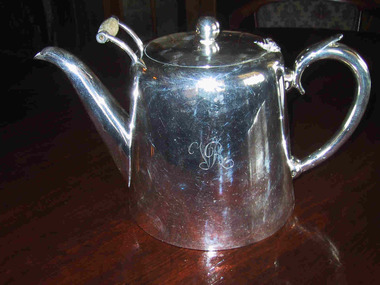
... service. When the Victorian railways took over management of the Chalet from 1 October 1924, they ran their dining room and café in similar fashion to the dining cars on their trains and refreshment rooms on their stations, using the same ceramic hotel-ware and electro plated nickel silverware (EPNS), all made to order items that are clearly identified by the distinctive 'VR' monogram. ...service. When the Victorian railways took over management of the Chalet from 1 October 1924, they ran their dining room and café in similar fashion to the dining cars on their trains and refreshment rooms on their stations, using the same ceramic hotel-ware and electro plated nickel silverware (EPNS), all made to order items that are clearly identified by the distinctive 'VR' monogram. ...Original Victorian Railways teapot, part of the silver service at Mt Buffalo Chalet. Part of Victorian Railways silver service. When the Victorian railways took over management of the Chalet from 1 October 1924, they ran their dining room and café in similar fashion to the dining cars on their trains and refreshment rooms on their stations, using the same ceramic hotel-ware and electro plated nickel silverware (EPNS), all made to order items that are clearly identified by the distinctive 'VR' monogram. The Chalet retains a good selection of the diverse range of EPNS item formerly used in the dining room..- which in all their variety and function help to interpret the dining room protocols of the 'tourist house' and the service provided by the Victorian Railways refreshment and Services Branch. Many of the items were manufactured by Stoke & Sons of Melbourne (est. 1856.)' (Pg. 103. Historica) Possibly once graced the chrome display cabinet.Listed in Draft Inventory of Significant Collection items. Appendix A.3.Tableware. (Pg 166 Historica).Large electroplated teapot with "VR" engraved on one side. Handle features holes at base either end of join. Lid features a circular knob and scroll handle at front with a wooden insert. Teapot has flat wide circular base."EPNSSRS / MADE IN AUSTRALIA / STOKES & SONS / MELBOURNE / BOOMERANG PLATE / WARRANTED / HARD SOLDERED / 745 / VICTORIAN RAILWAYS" -
 Parks Victoria - Mount Buffalo Chalet
Bucket, ice
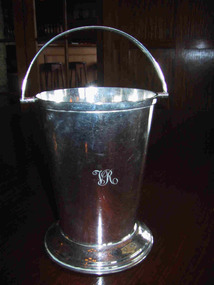
... service. When the Victorian railways took over management of the Chalet from 1 October 1924, they ran their dining room and cafe in similar fashion to the dining cars on their trains and refreshment rooms on their stations, using the same ceramic hotel-ware and electro plated nickel silverware (EPNS), all made to order items that are clearly idenitified by the distinctive 'VR' monogram. ...service. When the Victorian railways took over management of the Chalet from 1 October 1924, they ran their dining room and cafe in similar fashion to the dining cars on their trains and refreshment rooms on their stations, using the same ceramic hotel-ware and electro plated nickel silverware (EPNS), all made to order items that are clearly idenitified by the distinctive 'VR' monogram. ...Part of the Victorian Railways silver service. When the Victorian railways took over management of the Chalet from 1 October 1924, they ran their dining room and cafe in similar fashion to the dining cars on their trains and refreshment rooms on their stations, using the same ceramic hotel-ware and electro plated nickel silverware (EPNS), all made to order items that are clearly idenitified by the distinctive 'VR' monogram. The Chalet retains a good selection of of the diverse range of EPNS items formerly used in the dining room..- which in all their variety and function help to interpret the dining room protocols of the 'tourist house' and the service provided by the Victorian Railways refreshment and Services Branch. Many of the items were manufactured by Stoke & Sons of Melbourne (est. 1856.)' (Pg 103. Historica) Possibly once graced the chrome display cabinet.Listed in Draft Inventory of Significant Collection items. Appendix A.3.Tableware. (Pg 166 Historica).Small ice bucket. Electroplated silver on nickel. Has a handle to carry and wide pedestal base."VR" insiginia engraved on front of bucket.Crown with scroll underneath with "Victorian Railways" Under that,"WHITE - THROUGH / E.P \ A1\ N.S" -
 Wodonga & District Historical Society Inc
Domestic object - Hand made toasting fork, Mid 20th Century
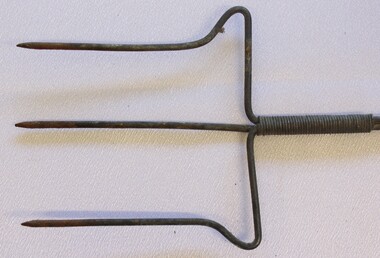
... services. This item demonstrates the ingenuity of earlier pioneers and settlers to adapt to their living conditions and improvise from their available resources and environment. hand made utensils kitchen ware pioneer skills A hand-made wire toasting fork. ...This fork was made by a member of the Conway family of Wodonga. It was used for making toast over an open fire well before modern toasters become widely available. It demonstrates the ingenuity of early settlers and pioneers before the advent of modern appliances and services. This item demonstrates the ingenuity of earlier pioneers and settlers to adapt to their living conditions and improvise from their available resources and environment.A hand-made wire toasting fork. It has three prongs and the handle is twisted with a loop at the top for hanging. It is made from fencing wire.hand made utensils, kitchen ware, pioneer skills
